NYT Befuddled on Cluster Bomb Ban?
Which Side Are We On? NYT, U.S and Cluster Bombs
By Peter Hart – FAIR – 11/28/2011
International efforts to ban cluster bombs fell apart late last week. If you were reading about this in the New York Times, you might have been led to believe that the United States was pushing to get rid of the weapons–instead of the opposite.
Here’s the lead sentence from a story in Saturday’s paper (11/26/11):
GENEVA — Despite last-minute attempts to broker a compromise, American-led efforts to conclude an international treaty restricting use of cluster munitions collapsed on Friday in the face of opposition from countries that said it did not address their humanitarian concerns and would undermine existing international law.
This “American-led effort,” readers were told, “reflected the increasing stigmatization of a weapon recognized as causing unacceptable harm to civilians and seen as having lasting effects on development for decades after conflicts have ended.”
Well, who opposes such efforts? It takes a little while to understand that the other side is taking a much tougher stance to eliminate cluster bombs, as outlined at an Oslo conference in 2008:
But countries and disarmament groups opposing the draft treaty said the humanitarian impact of the proposed protocol would be minimal and would legitimize continued use of other cluster munitions that are recognized to cause unacceptable harm.
These countries, together with the International Committee of the Red Cross and United Nations agencies dealing with development and human rights, also argued that the adoption of a legal instrument that was weaker than the Oslo agreement would set a dangerous precedent.
The Times’ confused account is in stark contrast to other reporting. This Reuters piece, for example, does a much better job of explaining things in its lead:
GENEVA (Reuters) — A U.S.-led push to regulate, rather than ban, cluster munitions failed Friday after 50 countries objected, following humanitarian campaigners’ claims that anything less than a outright ban would be an unprecedented reversal of human rights law.
Something tells me the Times story would look a little differently if the United States weren’t on the pro-cluster bomb side of this argument.
‘US-led sanctions on Iran illegal’
Interview with Mohammad Marandi, professor of University of Tehran
Press TV – November 22, 2011
Britain the United States have imposed new sanctions on Iran’s banking system and energy sector after the UN nuclear agency’s recent report on Tehran’s nuclear program.
The International Atomic Energy Agency (IAEA) report, circulated among the 35 members of the agency’s Board of Governors on November 8, accused Iran of pursuing military objectives in its nuclear program.
Iran said the new round of sanctions imposed on the country over its nuclear energy program are fruitless.
Meanwhile, Russia’s foreign ministry has also denounced the new sanctions as “unacceptable and illegal.”
The Russian ministry’s statement also warned against the adverse affects of fresh anti-Iran sanctions, saying, “We believe that the constant strengthening of sanctions has long ago gone beyond the bounds of decisions on non-proliferation tasks surrounding the Iranian nuclear program.”
Press TV has interviewed Mohammad Marandi, professor of University of Tehran, to discuss the issue further.
Press TV: Are these sanctions, to begin with, actually legal?
Marandi: They are definitely not legal –just like many previous sanctions– because the Americans and the Europeans along side with the Americans are trying to impose their will upon the international community, they’re basically trying to force third countries not to do business with Iran and this is not new; this has been going on for many years but more or less it has not had the sort of effect that they have been looking for. They have been trying to increase sanctions but there really is not much more left that they could do.
The Iranians have more or less over the last decades moved away from trading with Europe and the United States and the sectors in which the Americans are now trying to put pressure on –meaning petrochemicals and oil and gas– these are sectors which are in high demand throughout the world. So Iran definitely will have customers and Iran has –because of the sanctions– developed its own industry for building petrochemical plants as well as facilities for producing oil. So the fact has minimized over the years and indeed it caused Iran basically to learn to look for alternative partners than the West. In some ways, it actually benefited Iran.
Press TV: And when we look at the countries involved, as you mentioned, Western countries –but in particular it is the United States, the UK and France– they are basing this on the most recent IAEA report that came out which in itself is controversial and has been labeled as being politically motivated. So it is kind of confusing when you have a report that is inconclusive because Iran has been transparent and then based on that, they come out and impose these sanctions.
Marandi: I think for the international community it is quite clear that the IAEA chief [Yukiya Amano] does not have any credibility and that the new report is based on very old information that goes back to a simple laptop that the Americans claim proves that Iran’s peaceful nuclear program has a military aspect to it. The Iranians said that this laptop –which the Americans say they obtained many years ago– the Iranians said it should be shown to computer experts to see if it is authentic. The Americans refused to give it to the IAEA or to give it to independent computer experts to analyze and –as the Iranians point out– this shows that it is a fabricated piece of evidence.
So the report itself does not contain anything new but the United States and the Europeans, in their rather irrational hostility towards Iran which to a large degree has to do with their rapidly declining fortunes in the Middle East and beyond, they continue to pursue hostile policies towards the Iranian people.
One of the interesting things is that this is probably the worst public diplomacy move that the Americans can make because they and the Europeans are obviously trying to hurt ordinary Iranians, trying to make ordinary Iranians suffer and that of course is itself a violation of human rights. But the problem is that they have really lost their influence over the country and Iran has many alternatives. You see rising powers in Latin America, in the Far East and in the Indian sub-continent which need Iran and the more Iran trades with them, in fact, the more reliant they become upon Iran.
Press TV: When you talk about diplomatic gestures made by the West, we remember when Barack Obama came into office, he said we are going to keep that dual track approach towards Iran, on the one hand, we are open for talks, on the other, sanctions. Of course it has been more of the sanctions and the negative approach that they have had towards Iran where they have exercised more in terms of any action than any diplomatic push towards trying to resolve any type of standoff. So put that into context for us if you can –a little wrap off of how the current US administration has approached Iran.
Marandi: It has been more or less an arrogant approach in the sense they assume they have the right to punish Iran whenever they see fit and use international organizations to do so and then try to force Iran to speak to them under duress –therefore giving concessions.
What they basically want is for Iran to be like Saudi Arabia –to be a client regime. But again Iran is too strong and too powerful for the US and for the Europeans to make it kneel and the world has changed dramatically over the past few years; more Iranians than ever before are traveling to countries outside of Europe and the US for trade, for studying, even for entertainment and sightseeing. So I think this Euro-centric mold –where the white European males who have been running the world for the last few centuries– this is beginning to break and we see major signs of it in Europe and the US, even now, through economic crises, through the protests that are going on throughout the US, and I don’t think time is really on their side.
Gould-Werritty: A Real Conspiracy, Not a Theory
By Craig Murray | November 25, 2011
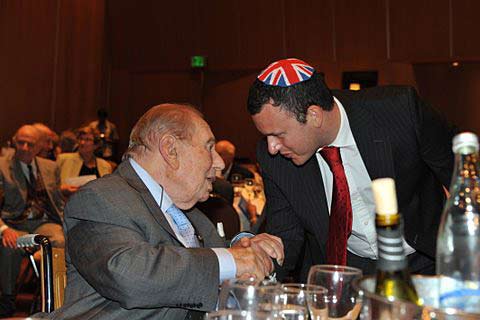
There is a huge government cover-up in progress over the Werritty connection to Mossad and the role of British Ambassador to Israel Matthew Gould, and their neo-con plan to start a war with Iran.
Yesterday at 22.15pm I submitted by email a Freedom of Information request for:
All communications in either direction ever made between Matthew Gould and Adam Werritty, specifically including communications made outside government systems.
At 23.31pm I was astonished to get a reply from the Foreign and Commonwealth Office. The request was refused as it was
“likely to exceed the cost limit”.
Now it is plainly nonsense that to gather correspondence between two named individuals would be too expensive. They could just ask Gould.
And a reply at nearly midnight? The Freedom of Information team in the FCO is not a 24 hour unit. Plainly not only are they hiding the Gould/Werritty correspondence, they are primed and on alert for this cover-up operation.
Even more blatant was the obstruction of MP Paul Flynn, when he attempted to question Cabinet Secretary Gus O’Donnell on the Gould-Werritty connection at the House of Commons Public Administration Committee. These are the minutes: anybody who believes in democracy should feel their blood boil as you read them:
Publc Admininstration Committee 24/11/2011
Q<369> Paul Flynn: Okay. Matthew Gould has been the subject of a very serious complaint from two of my constituents, Pippa Bartolotti and Joyce Giblin. When they were briefly imprisoned in Israel, they met the ambassador, and they strongly believe—it is nothing to do with this case at all—that he was serving the interest of the Israeli Government, and not the interests of two British citizens. This has been the subject of correspondence.
In your report, you suggest that there were two meetings between the ambassador and Werritty and Liam Fox. Questions and letters have proved that, in fact, six such meetings took place. There are a number of issues around this. I do not normally fall for conspiracy theories, but the ambassador has proclaimed himself to be a Zionist and he has previously served in Iran, in the service. Werritty is a self-proclaimed—
Robert Halfon: Point of order, Chairman. What is the point of this?
Paul Flynn:> Let me get to it. Werritty is a self-proclaimed expert on Iran.
Chair:> I have to take a point of order.
Robert Halfon:> Mr Flynn is implying that the British ambassador to Israel is working for a foreign power, which is out of order.
Paul Flynn:> I quote the Daily Mail: “Mr Werritty is a self-proclaimed expert on Iran and has made several visits. He has also met senior Israeli officials, leading to accusations”—not from me, from the Daily Mail—“that he was close to the country’s secret service, Mossad.” There may be nothing in that, but that appeared in a national newspaper.
Chair:> I am going to rule on a point of order. Mr Flynn has made it clear that there may be nothing in these allegations, but it is important to have put it on the record. Be careful how you phrase questions.
Paul Flynn:> Indeed. The two worst decisions taken by Parliament in my 25 years were the invasion of Iraq—joining Bush’s war in Iraq—and the invasion of Helmand province. We know now that there were things going on in the background while that built up to these mistakes. The charge in this case is that Werritty was the servant of neo-con people in America, who take an aggressive view on Iran. They want to foment a war in Iran in the same way as in the early years, there was another—
Chair:> Order. I must ask you to move to a question that is relevant to the inquiry.
Q<370> Paul Flynn:> Okay. The question is, are you satisfied that you missed out on the extra four meetings that took place, and does this not mean that those meetings should have been investigated because of the nature of Mr Werritty’s interests?
Sir Gus O’Donnell:> I think if you look at some of those meetings, some people are referring to meetings that took place before the election.
Q<371> Paul Flynn:> Indeed, which is even more worrying.
Sir Gus O’Donnell:> I am afraid they were not the subject—what members of the Opposition do is not something that the Cabinet Secretary should look into. It is not relevant.
But these meetings were held—
Chair:> Mr Flynn, would you let him answer please?
Sir Gus O’Donnell:> I really do not think that was within my context, because they were not Ministers of the Government and what they were up to was not something I should get into at all.
Chair:> Final question, Mr Flynn.
Q<372> Paul Flynn:> No, it is not a final question. I am not going to be silenced by you, Chairman; I have important things to raise. I have stayed silent throughout this meeting so far.
You state in the report—on the meeting held between Gould, Fox and Werritty, on 6 February, in Tel Aviv—that there was a general discussion of international affairs over a private dinner with senior Israelis. The UK ambassador was present. Are you following the line taken by the Secretary of State for Communities and Local Government who says that he can eat with lobbyists or people applying to his Department because, on occasions, he eats privately, and on other occasions he eats ministerially? Are you accepting the idea? It is possibly a source of great national interest—the eating habits of their Secretary of State. It appears that he might well have a number of stomachs, it has been suggested, if he can divide his time this way. It does seem to be a way of getting round the ministerial code, if people can announce that what they are doing is private rather than ministerial.
Sir Gus O’Donnell:> The important point here was that, when the Secretary of State had that meeting, he had an official with him—namely, in this case, the ambassador. That is very important, and I should stress that I would expect our ambassador in Israel to have contact with Mossad. That will be part of his job. It is totally natural, and I do not think that you should infer anything from that about the individual’s biases. That is what ambassadors do. Our ambassador in Pakistan will have exactly the same set of wide contacts.
Q<373> Paul Flynn:> I have good reason, as I said, from constituency matters, to be unhappy about the ambassador. Other criticisms have been made about the ambassador; he is unique in some ways in the role he is performing. There have been suggestions that he is too close to a foreign power.
Robert Halfon:> On a point of order, Chair, this is not about the ambassador to Israel. This is supposed to be about the Werritty affair.
Paul Flynn:> It is absolutely crucial to this report. If neo-cons such as yourself, Robert, are plotting a war in Iran, we should know about it.
Chair:> Order. I think the line of questioning is very involved. I have given you quite a lot of time, Mr Flynn. If you have further inquiries to make of this, they could be pursued in correspondence. May I ask you to ask one final question before we move on?
Sir Gus O’Donnell:> One thing I would stress: we are talking about the ambassador and I think he has a right of reply. Mr Chairman, I know there is an interesting question of words regarding Head of the Civil Service versus Head of the Home Civil Service, but this is the Diplomatic Service, not the Civil Service.
Q<374> Chair:> So he is not in your jurisdiction at all.
Sir Gus O’Donnell:> No.
Q<375> Paul Flynn:> But you are happy that your report is final; it does not need to go the manager it would have gone to originally, and that is the end of the affair. Is that your view?
Sir Gus O’Donnell:> As I said, some issues arose where I wanted to be sure that what the Secretary of State was doing had been discussed with the Foreign Secretary. I felt reassured by what the Foreign Secretary told me.
Q<376> Chair:> I think what Mr Flynn is asking is that your report and the affair raise other issues, but you are saying that that does not fall within the remit of your report and that, indeed, the conduct of an ambassador does not fall within your remit at all.
Sir Gus O’Donnell:> That is absolutely correct.
Paul Flynn:> The charge laid by Lord Turnbull in his evidence with regard to Dr Fox and the ministerial code was his failure to observe collective responsibility, in that case about Sri Lanka. Isn’t the same charge there about our policies to Iran and Israel?
Chair:> We have dealt with that, Mr Flynn.
Paul Flynn:> We haven’t dealt with it as far as it applies—
Chair:> Mr Flynn, we are moving on.
Paul Flynn:> You may well move on, but I remain very unhappy about the fact that you will not allow me to finish the questioning I wanted to give on a matter of great importance.
It is shocking but true that Robert Halfon MP, who disrupted Flynn with repeated points of order, receives funding from precisely the same Israeli sources as Werritty, and in particular from Mr Poju Zabludowicz. He also formerly had a full time paid job as Political Director of the Conservative Friends of Israel.
But despite the evasiveness of O’Donnell and the obstruction of paid zionist puppet Halfon, O’Donnell confirms vital parts of my investigation. In particular he agrees that the Fox-Werritty-Gould “private dinner” in Tel Aviv was with Mossad, and that Gould met Werritty many times more than the twice that O’Donnell listed in his “investigation” into this affair.
Of the six meetings of Fox-Gould-Werritty together which I discovered, five were while Fox was Secretary of State for Defence. Only one was while Fox was in opposition. But O’Donnell has now let the cat much further out of the bag, with the astonishing admission to Paul Flynn’s above questioning that Gould, Fox and Werritty held “meetings that took place before the election.” He also refers to “some of those meetings” as being before the election. Both are plainly in the plural.
It is now evident that not only did Fox, Gould and Werritty have at least five meetings while Fox was in power – with never another British official present – they had several meetings while Fox was shadow Foreign Secretary. O’Donnell is right that what Fox and Werritty were up to in opposition is not his concern. But what Gould was doing with them – a senior official – most definitely is.
A senior British diplomat cannot just hold a series of meetings with the opposition shadow Defence Secretary and a paid zionist lobbyist. What on earth was happening?
The absolutely astonishing cover-up and lack of honesty from the government about the Fox-Gould-Werritty relationship is being maintained with cast-iron resolve. Not only is Gould a self-declared fervent zionist, he was born in the same year as Chancellor George Osborne and attended the same private school – St Paul’s. At least some of the time he was meeting Fox and Werrity while they were in opposition, Gould was Private Secretary to New Labour Foreign Secretary David Milliband. That opens up the question of whether David Milliband, another fervent zionist, was part of the discussions with Mossad and US neo-cons on how to engineer war with Iran, for which Werritty was the conduit.
That would help explain the completeness of the cover-up. The government appears able with total impunity to refuse to answer MPs’ questions on Gould/Fox/Werritty, and they will not respond to Freedom of Information requests. It is now proven without doubt that O’Donnell lied blatantly about the number of Gould-Fox-Werritty meetings, and that Mossad was involved. And yet every single British mainstream media outlet still refuses to mention it.
I know from a mole that the plot involves a plan to attack Iran. For the cover-up to be so blatant and yet so comprehensively maintained, the secret at the heart of this conspiracy must be great, and those complicit must include a very large swathe of the British political and media establishment.
UPDATE: access to this blog is now blocked from FCO and Cabinet Office terminals. Very wise – truth can be contagious.
Propagandized America
By Margaret Kimberley | Black Agenda Report | November 23, 2011
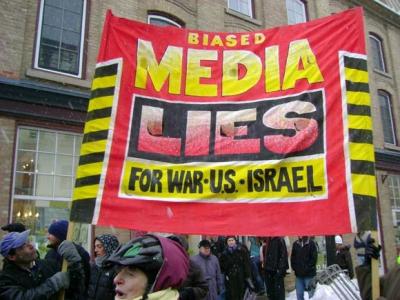
When Americans think of propagandized people they think of the now defunct Soviet Union or Nazi Germany or perhaps a banana republic dictatorship of the sort supported by their government. Very few of them would think of themselves as being under the sway of a government and corporations who work hand in glove to tell outright falsehoods or hide important information that is inconvenient for them.
In this country, not only are we victims of a government intent upon keeping us misinformed or silent in the face of its wrong doing, but they work hand in hand with a media almost entirely owned by corporations. The interests of the people are rarely in sync with the interests of these corporations, and that results in a media which works with the government which consciously works to misdirect our attention or have us believe outright lies.
Almost every major news story gives us an example of this terrible phenomenon. We may be told that Iran is on the verge of acquiring nuclear weapons capability, but we are not told that it has the right to do so as a signatory of the Non Proliferation Treaty. To add insult to injury, there isn’t any proof that Iran has even acquired this capability.
But Israel is chomping at the bit to attack Iran, and its lackey state, the United States of America, will not stand in its way. The corporate media never tell us that Israel, a country which is not a signatory of the NPT, has an arsenal of an unknown number of nuclear weapons.
A simple and easily provable fact, that the nation which casts itself as the victim of a potential nuclear power is itself nuclear, is rarely mentioned. One might read the New York Times and Washington Post every day and watch one of the broadcast or cable news networks at night, and not be aware of this information.
“Government sources say,” are the buzz words for falsehoods told in the name of the state. So-called prestigious publications will print the most outrageous information without attribution, investigation or proof of very serious charges. The Washington Post prints a story, quoting an anonymous source, claiming that Gaddafi’s Libya not only was in possession of a mustard gas stockpile, but also that it was supplied by Iran.
When Israel and/or the United States attack Iran none of the highly paid anchor men or women or reporters who have access to the administration will stray far from the official party line. That is why one president is as dangerous as any other. The system rewarded the liars who drove America to war against Iraq. The anti-Iranian warmongers will probably fare equally well.
Foreign policy has long been the domain of the big lie, but reporting or the lack of reporting on important domestic issues is either twisted in favor of the powerful or ignored altogether. The sins of omission are as dangerous as the sins of the bald faced lie. Did any major newspaper report on the week-long Georgia prison strike which took place one year ago? This phenomenal story of incarcerated Bloods and Crips working hand in hand with members of Aryan nation should have been front page news. But it was ignored, and the country lost an opportunity to be informed that their nation has the largest prison system on the planet and that it profits quite literally from their slave labor.
The court scribes who tell us that a statistical blip is proof of economic recovery or that the president had no choice but to accept the “Satan sandwich” budget deal are no better than propagandists in dictatorial states. The press corps in Libya, who actively assisted NATO in destroying that nation, committed international war crimes in the process. They will never reveal their own evil doing nor will they be called to account by a public that doesn’t even realize the magnitude of their crimes.
Anyone who is resistant to the notion that this country is awash in propaganda need look no further than the case of Anwar al-Awlaki. The president ordered the killing of an American citizen who was never charged with a crime. He then directed his minions to reveal to the New York Times the existence of a secret, extra legal memo which justifies his actions. The Times no doubt celebrated their role as court favorites and ignored the role that a newspaper ought to play in reporting a story that should have resulted in a presidential impeachment.
Americans love to say that they live in the greatest country in the world. Such a nation will be hard pressed to admit that they can trust little of the information they get. The nexus of a corrupt governmental structure and a corporate media results in nonsense on a good day and disinformation on a bad one. Our country is not great, it is just powerful and very, very dangerous.
Margaret Kimberley’s Freedom Rider column appears weekly in BAR. She maintains a frequently updated blog as well at http://freedomrider.blogspot.com. Ms. Kimberley lives in New York City, and can be reached via e-Mail at Margaret.Kimberley(at)BlackAgandaReport.com.
FBI Sanctioned for Lying About Existence of Surveillance Records
By Jennifer Lynch | Electronic Frontier Foundation | November 21, 2011
An order from the U.S. District Court for the Central District of California has revealed the FBI lied to the court about the existence of records requested under the Freedom of Information Act (FOIA), taking the position that FOIA allows it to withhold information from the court whenever it thinks this is in the interest of national security. Using the strongest possible language, the court disagreed: “The Government cannot, under any circumstance, affirmatively mislead the Court.” Islamic Shura Council of S. Cal. v. FBI (“Shura Council I”), No. 07-1088, 3 (C.D. Cal. April 27, 2011) (emphasis added).
This case may prove relevant in EFF’s ongoing FOIA litigation against the FBI. As discussed further below, one of the issues in Shura Council was the FBI’s extensive and improper use of “outside the scope” redactions. The agency has also used these heavily in at least one of our current cases — in areas where it is highly unlikely the material blocked out is actually outside the scope of our FOIA request. (see example to the left from our case seeking records on the government’s push to expand federal surveillance laws). We’ll be writing more about that case in the coming weeks and posting the documents we received on this site soon.
Shura Council started five years ago in May 2006, after widespread reporting on the FBI’s programs targeting Muslims after September 11, 2001. At that time, several Muslim citizens and organizations in Southern California, including the Islamic Shura Council of Southern California and the Council on American Islamic Relations (CAIR), submitted a broad joint FOIA request to the FBI seeking “[a]ny records relating or referring” to themselves, “including . . . records that document any collection of information about monitoring, surveillance, observation, questioning, interrogation, investigation and/or infiltration[.]” Shura Council I at 4.
In 2008, after the FBI produced only minimal records, the requesters filed a federal lawsuit. The FBI then searched for and located additional records for nine of the plaintiffs, but these records were heavily redacted, with much of the information withheld as “outside the scope” of the plaintiffs’ FOIA request. The FBI attested, in documents and declarations it submitted under oath to the court, that these were all the records that existed about the plaintiffs and that the materials labeled “outside the scope” were “not responsive” to the plaintiffs’ FOIA request.
After court ordered the FBI to submit full versions of the records in camera, along with a new declaration about the agency’s search, the FBI revealed for the first time that it had materially and fundamentally mislead the court in its earlier filings. The unaltered versions of the documents showed that the information the agency had withheld as “outside the scope” was actually well within the scope of the plaintiffs’ FOIA request. The government also admitted it had a large number of additional responsive documents that it hadn’t told the plaintiffs or the court about. Id. at 7-8.
If these revelations weren’t bad enough, the FBI also argued FOIA allows it to mislead the court where it believes revealing information would “compromise national security.” Id. at 9. The FBI also argued, that “its initial representations to the Court were not technically false” because although the information might have been “factually” responsive to the plaintiffs’ FOIA request, it was “legally nonresponsive.” Id. at 9, n. 4 (emphasis added).
The court noted, this “argument is indefensible,” id. at 9-10, and held, “the FOIA does not permit the government to withhold responsive information from the court.” (Id.)(upheld on appeal in Islamic Shura Council of S. Cal. v. FBI, __ F.3d __, No. 09-56035, at 4280-81 (9th Cir. Mar. 30, 2011) (“Shura Council II”).1 The court stated:
The Government argues that there are times when the interests of national security require the Government to mislead the Court. The Court strongly disagrees. The Government’s duty of honesty to the Court can never be excused, no matter what the circumstance. The Court is charged with the humbling task of defending the Constitution and ensuring that the Government does not falsely accuse people, needlessly invade their privacy or wrongfully deprive them of their liberty. The Court simply cannot perform this important task if the Government lies to it. Deception perverts justice. Truth always promotes it.
(Shura Council I at 17) (emphasis added). This is an important opinion for FOIA requesters because sometimes the only protection a FOIA requester has from the government’s potentially arbitrary withholding of information is a court’s in camera review of the full versions of documents. If the government were allowed to withhold information from the court, this protection would be meaningless and the role of judicial oversight in FOIA cases would be compromised.
Unfortunately for the plaintiffs in Shura Council, this seems to be a hollow victory. Although the court did not restrain itself from using the strongest possible language to criticize the government’s actions (calling the FBI’s arguments “untenable,” id. at 3, “indefensible,” id. at 10, and “not credible” id. at 17) it also held that “disclosing the number and nature of the documents the Government possesses could reasonably be expected to compromise national security.” Id. 18. Therefore it did not order the government to release the records to the plaintiffs or even to reveal how many records turned up in the second search. And on appeal, the Ninth Circuit held that neither the plaintiffs nor their attorneys had the right to see the original version of the district court’s order (filed under seal) because it contained information the FBI considered to be “national security and sensitive law enforcement information.” (Shura Council II at 4286).
It seems unlikely that, five years after the plaintiffs filed their FOIA request, the release of the information the FBI has on these individuals and organizations would truly threaten national security or an ongoing criminal investigation. None of the plaintiffs appears to have been arrested or retained in conjunction with a crime or foreign terrorist plot, so it seems more likely that this is yet another example of the government valuing secrecy over transparency.
The district court’s April 27, 2011 order after remand is here, and the Ninth Circuit opinion remanding the case is here.
UPDATE (November 21, 2011): In a later opinion, the district court sanctioned the government for lying. In issuing monetary sanctions against the DOJ, the court held, “the Government’s deception of the Court was without any factual or legal basis and simply wrong.” (p. 19). The court noted issuing sanctions was necessary to “deter the Government from deceiving the Court again.” (p. 2). Unfortunately, it’s not clear this practice will end any time soon. The DOJ has been attempting to change its FOIA regulations to codify the procedures it used in this case. As the court noted, even though the proposed changes were withdrawn, “the deceptive policy and practice of the DOJ with respect to asserting and applying exclusions under FOIA apparently remains intact.” (p. 19).
- 1. This case has a convoluted procedural history. When the district court discovered the FBI’s lies it issued an order under seal on June 23, 2009 and told the parties it would unseal the order on July 7, 2009 unless further directed by the Ninth Circuit Court of Appeals. The government immediately appealed, and the Ninth Circuit issued a stay of the district court’s ruling until it could hear the case. On March 30, 2011, the Ninth Circuit issued its opinion in Islamic Shura Council of S. Cal. v. FBI, __ F.3d __, No. 09-56035 (9th Cir. Mar. 30, 2011), vacating the district court’s sealed order and remanding to the district court to revise its order to eliminate statements the government had designated as national security and sensitive law enforcement information. On April 27, 2011, the district court issued its revised order.
Attached Documents

Climategate 2.0: “Scientists” at the heart of the global warming movement exposed as doubting their claims
Aletho News | November 22, 2011
Early today FOIA.org released a zip file of 5,000 additional emails similar to those released two years ago in November 2009 and coined Climategate. All of the central characters are here including Michael Mann, Phil Jones, Ben Santer, Tom Wigley, Kevin Trenberth and Keith Briffa.
Select examples:
<1939> Thorne/MetO:
Observations do not show rising temperatures throughout the tropical troposphere unless you accept one single study and approach and discount a wealth of others. This is just downright dangerous. We need to communicate the uncertainty and be honest. Phil, hopefully we can find time to discuss these further if necessary […]
<3066> Thorne:
I also think the science is being manipulated to put a political spin on it which for all our sakes might not be too clever in the long run.
<1611> Carter:
It seems that a few people have a very strong say, and no matter how much talking goes on beforehand, the big decisions are made at the eleventh hour by a select core group.
<2884> Wigley:
Mike, The Figure you sent is very deceptive […] there have been a number of dishonest presentations of model results by individual authors and by IPCC […]
<4755> Overpeck:
The trick may be to decide on the main message and use that to guid[e] what’s included and what is left out.
<3456> Overpeck:
I agree w/ Susan [Solomon] that we should try to put more in the bullet about “Subsequent evidence” […] Need to convince readers that there really has been an increase in knowledge – more evidence. What is it?
<3373> Bradley:
I’m sure you agree–the Mann/Jones GRL paper was truly pathetic and should never have been published. I don’t want to be associated with that 2000 year “reconstruction”.
<0310> Warren:
The results for 400 ppm stabilization look odd in many cases […] As it stands we’ll have to delete the results from the paper if it is to be published.
<1682> Wils:
[2007] What if climate change appears to be just mainly a multidecadal natural fluctuation?
<5315> Jenkins/MetO:
would you agree that there is no convincing evidence for kilimanjaro glacier melt being due to recent warming (let alone man-made warming)?
<2292> Jones:
[tropical glaciers] There is a small problem though with their retreat. They have retreated a lot in the last 20 years yet the MSU2LT data would suggest that temperatures haven’t increased at these levels.
<1788> Jones:
There shouldn’t be someone else at UEA with different views [from “recent extreme weather is due to global warming”] – at least not a climatologist.
<4693> Crowley:
I am not convinced that the “truth” is always worth reaching if it is at the cost of damaged personal relationships
<2733> Crowley:
Phil, thanks for your thoughts – guarantee there will be no dirty laundry in the open.
<2095> Steig:
He’s skeptical that the warming is as great as we show in East Antarctica — he thinks the “right” answer is more like our detrended results in the supplementary text. I cannot argue he is wrong.
<0953> Jones:
This will reduce the 1940-1970 cooling in NH temps. Explaining the cooling with sulphates won’t be quite as necessary.
<4944> Haimberger:
It is interesting to see the lower tropospheric warming minimum in the tropics in all three plots, which I cannot explain. I believe it is spurious but it is remarkably robust against my adjustment efforts.
<4262> Klein/LLNL:
Does anybody have an explanation why there is a relative minimum (and some negative trends) between 500 and 700 hPa? No models with significant surface warming do this
<0896> Jones:
I think the urban-related warming should be smaller than this, but I can’t think of a good way to argue this. I am hopeful of finding something in the data that makes by their Figure 3.
<0044> Rean:
[…] we found the [urban warming] effect is pretty big in the areas we analyzed. This is a little different from the result you obtained in 1990.
[…] We have published a few of papers on this topic in Chinese. Unfortunately, when we sent our comments to the IPCC AR4, they were mostly rejected.<4789> Wigley:
there are some nitpicky jerks who have criticized the Jones et al. data sets – we don’t want one of those [EPRI/California Energy Commission meeting].
Jones:
The jerk you mention was called Good(e)rich who found urban warming at all Californian sites.
<1601> Jones:
I think China is one of the few places that are affected [urban heat]. The paper shows that London and Vienna (and also New York) are not affected in the 20th century.
<2939> Jones:
[…] every effort has been made to use data that are either rural and/or where the urbanization effect has been removed as well as possible by statistical means. There are 3 groups that have done this independently (CRU, NOAA and GISS), and they end up with essentially the same results.
[…] Furthermore, the oceans have warmed at a rate consistent with the land. There is no urban effect there.<1583> Wilson:
any method that incorporates all forms of uncertainty and error will undoubtedly result in reconstructions with wider error bars than we currently have. These many be more honest, but may not be too helpful for model comparison attribution studies. We need to be careful with the wording I think.
<4165> Jones:
what he [Zwiers] has done comes to a different conclusion than Caspar and Gene! I reckon this can be saved by careful wording.
<3994> Mitchell/MetO
Is the PCA approach robust? Are the results statistically significant? It seems to me that in the case of MBH the answer in each is no
<4369> Cook:
I am afraid that Mike is defending something that increasingly can not be defended. He is investing too much personal stuff in this and not letting the science move ahead.
<5055> Cook:
One problem is that he [Mann] will be using the RegEM method, which provides no better diagnostics (e.g. betas) than his original method. So we will still not know where his estimates are coming from.
<0999> Hulme:
My work is as Director of the national centre for climate change research, a job which requires me to translate my Christian belief about stewardship of God’s planet into research and action.
<3653> Hulme:
He [another Met scientist] is a Christian and would talk authoritatively about the state of climate science from the sort of standpoint you are wanting.
<3111> Watson/UEA:
I’d agree probably 10 years away to go from weather forecasting to ~ annual scale. But the “big climate picture” includes ocean feedbacks on all time scales, carbon and other elemental cycles, etc. and it has to be several decades before that is sorted out I would think. So I would guess that it will not be models or theory, but observation that will provide the answer to the question of how the climate will change in many decades time.
<5131> Shukla/IGES:
[“Future of the IPCC”, 2008] It is inconceivable that policymakers will be willing to make billion-and trillion-dollar decisions for adaptation to the projected regional climate change based on models that do not even describe and simulate the processes that are the building blocks of climate variability.
<2423> Lanzante/NOAA:
While perhaps one could designate some subset of models as being poorer in a lot of areas, there probably never will be a single universally superior model or set of models. We should keep in mind that the climate system is complex, so that it is difficult, if not impossible to define a metric that captures the breath of physical processes relevant to even a narrow area of focus.
<1982> Santer:
there is no individual model that does well in all of the SST and water vapor tests we’ve applied.
<0850> Barnett:
[IPCC AR5 models] clearly, some tuning or very good luck involved. I doubt the modeling world will be able to get away with this much longer
<4443> Jones:
Basic problem is that all models are wrong – not got enough middle and low level clouds.
<4085> Jones:
GKSS is just one model and it is a model, so there is no need for it to be correct.
<2440> Jones:
I’ve been told that IPCC is above national FOI Acts. One way to cover yourself and all those working in AR5 would be to delete all emails at the end of the process
<2094> Briffa:
UEA does not hold the very vast majority of mine [potentially FOIable emails] anyway which I copied onto private storage after the completion of the IPCC task.
<2459> Osborn:
Keith and I have just searched through our emails for anything containing “David Holland”. Everything we found was cc’d to you and/or Dave Palmer, which you’ll already have.
<1473> McGarvie/UEA Director of Faculty Administration:
As we are testing EIR with the other climate audit org request relating to communications with other academic colleagues, I think that we would weaken that case if we supplied the information in this case. So I would suggest that we decline this one (at the very end of the time period)
<1577> Jones:
[FOI, temperature data] Any work we have done in the past is done on the back of the research grants we get – and has to be well hidden. I’ve discussed this with the main funder (US Dept of Energy) in the past and they are happy about not releasing the original station data.
FOIA 2011 gives us this commentary which should shed light on their motive in leaking these emails:
Over 2.5 billion people live on less than $2 a day.
Every day nearly 16.000 children die from hunger and related causes.
One dollar can save a life” — the opposite must also be true.
Poverty is a death sentence.
Nations must invest $37 trillion in energy technologies by 2030 to stabilize greenhouse gas emissions at sustainable levels.
Today’s decisions should be based on all the information we can get, not on hiding the decline.
Stay tuned for analysis of these and many more damning emails.
Ex-Inspector Rejects IAEA Iran Bomb Test Chamber Claim
By GARETH PORTER | CounterPunch | November 21, 2011
A former inspector for the International Atomic Energy Agency (IAEA) has repudiated its major new claim that Iran built an explosives chamber to test components of a nuclear weapon and carry out a simulated nuclear explosion.
The IAEA claim that a foreign scientist – identified in news reports as Vyacheslav Danilenko – had been involved in building the alleged containment chamber has now been denied firmly by Danilenko himself in an interview with Radio Free Europe published Friday.
The latest report by the IAEA cited “information provided by Member States” that Iran had constructed “a large explosives containment vessel in which to conduct hydrodynamic experiments” – meaning simulated explosions of nuclear weapons – in its Parchin military complex in 2000.
The report said it had “confirmed” that a “large cylindrical object” housed at the same complex had been “designed to contain the detonation of up to 70 kilograms of high explosives”. That amount of explosives, it said, would be “appropriate” for testing a detonation system to trigger a nuclear weapon.
But former IAEA inspector Robert Kelley has denounced the agency’s claims about such a containment chamber as “highly misleading”.
Kelley, a nuclear engineer who was the IAEA’s chief weapons inspector in Iraq and is now a senior research fellow at the Stockholm International Peace Research Institute, pointed out in an interview with the Real News Network that a cylindrical chamber designed to contain 70 kg of explosives, as claimed by the IAEA, could not possibly have been used for hydrodynamic testing of a nuclear weapon design, contrary to the IAEA claim.
“There are far more explosives in that bomb than could be contained by this container,” Kelley said, referring to the simulated explosion of a nuclear weapon in a hydrodynamic experiment.
Kelley also observed that hydrodynamic testing would not have been done in a container inside a building in any case. “You have to be crazy to do hydrodynamic explosives in a container,” he said. “There’s no reason to do it. They’re done outdoors on firing tables.”
Kelley rejected the IAEA claim that the alleged cylindrical chamber was new evidence of an Iranian weapons program. “We’ve been led by the nose to believe that this container is important, when in fact it’s not important at all,” Kelley said.
The IAEA report and unnamed “diplomats” implied that a “former Soviet nuclear weapons scientist”, identified in the media as Danilenko, had helped build the alleged containment vessel at Parchin.
But their claims conflict with one another as well as with readily documented facts about Danilenko’s work in Iran.
The IAEA report does not deny that Danilenko – a Ukrainian who worked in a Soviet-era research institute that was identified mainly with nuclear weapons – was actually a specialist on nanodiamonds. The report nevertheless implies a link beween Danilenko and the purported explosives chamber at Parchin by citing a publication by Danilenko as a source for the dimensions of the alleged explosives chamber.
Associated Press reported Nov. 11 that unnamed diplomats suggested Volodymyr Padalko, a partner of Danilenko in a nanodiamond business who was described as Danilenko’s son-in-law, had contradicted Danilenko’s firm denial of involvement in building a containment vessel for weapons testing. The diplomats claimed Padalko had told IAEA investigators that Danilenko had helped build “a large steel chamber to contain the force of the blast set off by such explosives testing”.
But that claim appears to be an effort to confuse Danilenko’s well-established work on an explosives chamber for nanodiamond synthesis with a chamber for weapons testing, such as the IAEA now claims was built at Parchin.
One of the unnamed diplomats described the steel chamber at Parchin as “the size of a double decker bus” and thus “much too large” for nanodiamonds.
But the IAEA report itself made exactly the opposite argument, suggesting that the purported steel chamber at Parchin was based on the design in a published paper by Danilenko.
The report said the alleged explosives chamber was designed to contain “up to 70 kg of high explosives” which is claims would be “suitable” for testing what it calls a “multipoint initiation system” for a nuclear weapon.
But a 2008 slide show on systems for nanodiamond synthesis posted on the internet by the U.S.-based nanotechnology company NanoBlox shows that the last patented containment chamber built by Danilenko and patented in 1992, with a total volume of 100 cubic metres, was designed for the use of just 10 kg of explosives.
An unnamed member state had given the IAEA a purported Iranian document in 2008 describing a 2003 test of what the agency interpreted to be a possible “high explosive implosion system for a nuclear weapon”.
David Albright, director of a Washington, D.C. think tank who frequently passes on information from IAEA officials to the news media, told this writer in 2009 that the member state in question was “probably Israel”.
Although the process of making “detonation nanodiamonds” uses explosives in a containment chamber, the chamber would bear little resemblance to one used for testing a nuclear bomb’s initiation system.
The production of diamonds does not require the same high degree of precision in simultaneous explosions as the initiator for a nuclear device. And unlike the explosives used in a multipoint initiation system, the explosives used for making synthetic nanodiamonds must be under water in a closed pool, as Danilenko noted in a 2010 PowerPoint presentation.
Having endorsed the IAEA’s claims, Albright concedes in a Nov. 13 article that the IAEA report “did not provide [sic] Danilenko’s involvement, if any, in this chamber.”
In an interview with Radio Free Europe Friday, Danilenko denied that he has any expertise in nuclear weapons, saying, “I understand absolutely nothing in nuclear physics.” He also denied that he participated in “modeling warheads” at the research institute in Russia where he worked for three decades.
Danilenko further denied doing any work in Iran that did not relate to “dynamic detonation synthesis of diamonds” and said he has “strong doubts” that Iran had a nuclear weapons program during those years.
Albright and three co-authors published an account of Danilenko’s work in Iran this week seeking to give credibility to the IAEA suggestion that he worked on the containment chamber for a nuclear weapons programme.
The Albright article, published on the website of the Institute for Science and International Security, said that Danilenko approached the Iranian embassy in 1995 offering his expertise on detonation diamonds, and later signed a contract with Syed Abbas Shahmoradi who responded to Danilenko’s query.
Albright identifies Shahmoradi as the “head of Iran’s secret nuclear sector involved in the development of nuclear weapons”, merely because Shahmoradi later headed the Physics Research Center, which the IAEA argues has led Iran’s nuclear weapons research.
But in late 1995, Shahmoradi was at the Sharif University of Technology, which is a leading centre for nanodiamonds in Iran. Albright argues that this is evidence supporting his suspicion that nanodiamonds were a cover for his real work, because the main centre for nanodiamond research is at Malek Ashtar University of Technology rather than at Sharif University.
However, Sharif University had just established an Institute of Nanoscience and Nanotechnology in 2005 that was intended to become the hub for nanotechnology research activities and strategy planning for Iran. So Sharif University and Shahmoradi would have been the logical choice to contract one of the world’s leading specialists on nanodiamonds.
~
GARETH PORTER is an investigative historian and journalist with Inter-Press Service specialising in U.S. national security policy. The paperback edition of his latest book, “Perils of Dominance: Imbalance of Power and the Road to War in Vietnam“, was published in 2006.
More Anti-Iran Propaganda By Joby Warrick & Co
Moon of Alabama | November 21, 2011
The currently “most emailed story” at the Washington Post site is Iran may have sent Libya shells for chemical weapons.
May, may, may?
The 1.500 words piece is clearly written to suggest some Iranian “Weapon of Mass Destruction” business even though, as a not-so-casual read will find, there is nothing to it. Just many mays, vague anonymous sources and innuendo added to each other.
The picture above the article shows unmarked empty gas canisters with handles, not artillery shells.
In the second picture in the gallery accompanying the article a container marked “Hydroxyde de Sodium” somewhere in Libya is shown. It is describe as:
Chemical containers are seen in an unguarded storage facility in the desert, about 60 miles south of Sirte, Libya.
But “hydroxyde de sodium” is just caustic soda which:
is used in many industries, mostly as a strong chemical base in the manufacture of pulp and paper, textiles, drinking water, soaps and detergents and as a drain cleaner. Worldwide production in 2004 was approximately 60 million tonnes, …”
This has, unlike the Washington Post placement of the pictures suggests, nothing to do with chemical weapons.
The article begins:
The Obama administration is investigating whether Iran supplied the Libyan government of Moammar Gaddafi with hundreds of special artillery shells for chemical weapons that Libya kept secret for decades, U.S. officials said.The shells, which Libya filled with highly toxic mustard agent, were uncovered in recent weeks by revolutionary fighters at two sites in central Libya. Both are under heavy guard and round-the-clock surveillance by drones, U.S. and Libyan officials said.
So the whole issue is about empty artillery shells found somewhere in Libya (the piece does not even say where), which may have come from Iran, decades ago.
How does such a find, even when confirmed, allow for the following passages:
A U.S. official with access to classified information confirmed that there were “serious concerns” that Iran had provided the shells, albeit some years ago. […] Confirmed evidence of Iran’s provision of the specialized shells may exacerbate international tensions over the country’s alleged pursuit of weapons of mass destruction.
Why should decades old empty artillery shells in Libya “exacerbate international tensions” about an alleged nuclear program in Iran?
In an unclassified report to Congress this year, the U.S. director of national intelligence said that “Iran maintains the capability to produce chemical warfare agents … [and] is capable of weaponizing CW agents in a variety of delivery systems.” Those systems include artillery shells, according to current and former U.S. officials.
Any school chemistry lab has the “capability to produce chemical warfare agents” and the means to deliver those. Again – what has this to do with decades old empty artillery shells in the Libyan desert? Is this journalism?
The whole piece is just constructed anti-Iran propaganda. Not astonishingly, it was co-written by Joby Warrick, the Washington Post’s Judith Miller equivalent, who also recently spread the false “Soviet nuclear scientist” stories about an expert in nanodiamond production who once worked in Iran.
What gives me some hope is that the comments to this latest Washington Post smear piece seem to recognize it for what it is. They don’t buy it but call it out as pure propaganda without any journalistic value.
Featured Video

Iran’s Next Strike May Not Explode. It Could Shut You Down
or go to
Aletho News Archives – Video-Images
Book Review
New paperback: Butchered by “Healthcare”
Lies are Unbekoming | October 20, 2026
 Butchered by “Healthcare” is Robert Yoho’s plain-spoken account of how American medicine stopped being a profession and became an industry. 341 pages. Over a thousand references. Thirty-eight chapters.
“Screening Tests Are Useless”, on tests that find diseases that would never have hurt you. “The FDA Protects the Big Drug Companies”, on an agency funded by the companies it regulates. “The Journals’ Sins Are the Editors’ Sins”, on ghostwritten studies and captured peer review. “Opioids and ‘Pain Management’”, on how a generation was prescribed its way into addiction. “Prozac and Relatives” and “Antipsychotics Are Disastrous”, on what psychiatry does to adults and children. “Surgery: Money Before Patients”. “Failed Cancer Treatments”. “Futile CPR and Overprescribing”. “Billing Scams & Specialty Warfare”. “Hospitals Are Sharks”. Each with a Patient Tips section at the end on how to survive it.
If you have ever walked out of a doctor’s office with a prescription you didn’t ask for, or watched a parent put through a treatment that made them worse, this is the book you want on your shelf before the next appointment. … Full review
Butchered by “Healthcare” is available on Lulu now.
Blog Roll
 Aletho News
- Iran’s Next Strike May Not Explode. It Could Shut You Down /Col Doug Macgregor
- Iran: US political targets legitimate if assassinations return
- Iraq shuts key border crossing with Iran under US pressure: Report
- Undersea Internet cables could be targeted in retaliation for attacks on Iran: IRGC deputy chief
- EU sending ‘biased’ observers to interfere in Serbian election – president
- White House envoy declares kinetic action against Yemen ‘fruitless’
- Ukraine deployed thousands of microdrones in Iraqi Kurdistan: Tasnim
- Iran calls for emergency UNSC meeting over Trump’s ‘brazen’ bomb talk, Israeli threats
- Iranian sources reveal details of Russia-China Hormuz proposal
- Plan for more US-Israel integration puts our military tech at risk
- If Americans Knew
- Americans at National Conservatism Conference held in Israel this year criticize Israel
- Christiane Amanpour exits CNN with a legacy shaped by the debate over Israel
- Israel’s war on Iran is the final move in a decades-old strategy
- Israel Denies Entry to French Journalist, U.S. Researcher Amid Rise in Entry Denials
- Gaza’s hospitals are running out of life-saving fuel – Daily Update
- Mysterious bot accounts reportedly spread fake ‘man on the street’ videos for Michigan Senate candidate
- Israeli Defense Minister Katz Says Over 60 Lebanon Villages Have Been Destroyed
- Why Is Israel Running TV Ads in Iowa Ahead of the Midterms?
- Hind Rajab’s Alleged Killer Is in the United States. HRF Demands His Arrest.
- US Officials Face Fresh Pressure After Another American ‘Brutalized’ by Israeli Settlers in West Bank
- No Tricks Zone
- E-Cars Reduce CO2 Emissions By Only 41% Compared To Internal Combustion Engine Vehicles
- Predictions Made By Renowned Climate Professor Over Past Decades Have Been Proven To Be Poor
- New Study Suggests Large Regions Of The Pacific Ocean Have Been Cooling For The Last 80 Years
- Germany’s Green Energy Debacle: High Energy Costs Force Kahla Porzellan to Close After 182 Years!
- New Study: 50 Years Of The Most Aggressive ‘Net Zero’ Policies Can Only Affect The Global Climate By 0.03°C
- US September “Heat” Was No Record…Many Records Set Decades Ago
- Latest European Green Energy Debacle; Portugal’s Largest Flagship Solar Park Insolvent!
- Green Energy Debacle: German Expert Professor Fritz Vahrenholt Warns Of Severe Economic And Social Consequences
- Two More Paleo Reconstructions Affirm Meters-Higher Sea Levels Across Ireland, Brazil 7000-6000 Years Ago
- New Study: Earth And Venus Surface Warmth Largely Explained By Convection And Lapse Rate, Not CO2 Or Radiation

