In a Washington Post opinion piece, U.S. Secretary of State Antony Blinken and Defense Secretary Lloyd Austin spelled out their objectives in visiting Japan, South Korea, and India. “The United States is now making a big push to revitalize our ties with friends and partners,” they wrote. The nature of those relationships, as perceived by Washington, is the subordination of Asian nations as junior partners in an anti-China coalition. “Our alliances are what our military calls ‘force multipliers,’ Blinken and Austin explain. “Our combined power makes us stronger when we must push back against China’s aggression and threats.” [1]
That approach found a receptive audience in meetings with Japanese officials, who recognize it as offering a path to remilitarization. Results in South Korea were more ambiguous. By a substantial margin, China is South Korea’s primary trading partner, and relations between the two nations are generally solid. South Korea has no rational reason to join Washington’s fanatical anti-China campaign, no matter how much pressure the United States applies. A difference of opinion between Washington’s envoys and South Korean officials can be inferred by comparing the joint U.S.-Japan statement with South Korea’s, as only the latter lacked China-bashing verbiage.
Blinken and Austin appear to have been more successful in reminding South Korean officials that no independent action should be taken to improve inter-Korean relations and in making it understood that Washington calls the shots. The two sides agreed to establish a “working-level diplomatic dialogue” process to align policy regarding North Korea and other matters. [2]In their joint statement, Korean and American officials affirmed that their two nations “are closely coordinating on all issues related to the Korean Peninsula” and that “these issues should be addressed through a fully-coordinated strategy toward North Korea.” [3]
Not that Blinken and Austin found their position on North Korea a hard sell. Although peace and improved inter-Korean relations matter deeply to South Korean President Moon Jae-in, he attaches more importance to the military alliance with the United States. In an article published at the end of 2019, Moon argued, “No matter how desperately peace is desired, Korea cannot afford to race ahead on its own. It has counterparts and must move within the international order.” Support from the “international community” is needed, Moon claims, while using the standard term signifying the several thousand people at the top rungs of power in the United States and excluding the nearly eight billion people in the rest of the world’s population. [4] Moon’s statement is consistent with other comments he has made, such as in his New Year’s address, where he stated, “If we can draw support from the international community in the process,” then the door to peace will “open wide.” [5] No role there for South Korea, other than as supplicant.
Joint U.S.-South Korean military exercises were well underway during Bliken’s and Austin’s time in Seoul. Due to COVID-19 restrictions, war games were conducted via computer simulation. Concurrently, the U.S. deployed F-22 Raptor stealth fighters to participate in joint exercises with the Japanese military. [6] According to a South Korean military official, “The deployment is significant as an alert to North Korea as well as deterrence to China, given F-22s’ operational radius and performance.” [7]
None of this went unnoticed in Pyongyang. Kim Yo Jong, Vice Department Director of the Central Committee of the Workers’ Party of Korea, dismissed South Korean claims that the military exercises are defensive. While no details of the drilled scenarios have been publicly released, past war games customarily practiced the bombing and invasion of North Korea as well as sending commando teams into the north to assassinate government officials. There is no reason to suppose that the latest exercises pose a unique exception. Kim called the “launching of a war game against” her nation “a serious challenge” and pointed out that the “essence and nature of the drills” never changes, regardless of what form they take. [8]
It was not the first time that Pyongyang has expressed frustration over the discrepancy between Moon’s rhetoric on inter-Korean relations and his actions. Similar complaints were raised last June. By hitching its wagon to the U.S. military, the Moon administration is seriously straining ties with the north. “War drill and hostility can never go with dialogue and cooperation,” Kim stated. If South Korean authorities “persist in hostile acts” that deny dialogue and “destroy the foundation of trust through ceaseless war games,” then Pyongyang may abrogate some of the inter-Korean agreements it had signed. [9]
Some aspects of the Panmunjom Declaration, signed on April 27, 2018 by Moon Jae-in and Kim Jong Un, are already a dead letter. Certainly, the affirmation of “the principle of determining the destiny of the Korean nation on their own accord” has never been put into practice, as the Moon administration is unwilling to act without U.S. permission. Nor have any “practical steps” been adopted to connect and modernize rail and road connections or steps been taken to “actively implement” inter-Korean economic agreements signed in 2004. [10] After all, Washington would not approve.
“Pyongyang is pressing Seoul not to talk nonsense in the upcoming meeting with Blinken and Austin,” observed Kim Il-gi, a senior researcher at South Korea’s Institute for National Security Strategy. “And the message goes to the U.S., as well.” [11] A message, one cannot help noting, that inevitably fell on deaf ears.
The United States, too, is hoping for a change in South Korea’s approach, albeit in a decidedly different direction than that sought by North Korea. A recent report by the Atlantic Council’s Scowcroft Center for Strategy and Security is typical of the recommendations being churned out by Washington think tanks. “The Republic of Korea and the United States should broaden their military alliance into a national security alliance in order to more effectively deal with the challenges and opportunities of this new era,” it states. Predictably, the Center lists China as the top challenge and argues that the U.S.-South Korea alliance “must be prepared to continue to deter and dissuade” China from “considering any further aggression.” South Korea ought to “prioritize security cooperation” with Southeast Asian nations “on behalf of the alliance,” the Center argues. Furthermore, “as NATO goes global in its approach in response to the challenges posed by China…NATO’s partnership with the Republic of Korea will increase in importance.” [12]
The Scowcroft Center recognizes that reliance on Chinese trade presents a roadblock in persuading South Korea to join Washington’s anti-China campaign. What South Koreans may happen to want is not a question the Center ever troubles itself with, other than to bemoan that it is necessary to “avoid forcing the Republic of Korea to make explicit, public choices in disputes between the United States and China.”
But less overtly, South Korea can be slowly moved into that position. The Center expects South Korea to join U.S. “efforts to reform international rules and institutions,” a euphemism for American plans to cut China off from much of its international trade. Several measures are recommended that South Korea “should” adopt to align its economy with U.S. regional goals. In addition, to chip away at Chinese-Korean trade, “The Republic of Korea should join the US efforts to diversify its supply chains” and avoid “over-reliance on a single country.” [13] The essential task for South Korea, the Center insists, is that “much more must be done to reduce dependence on Chinese supply chains and protect key industries from” what it laughably calls “predatory Chinese practices.” Washington expects nations it regards as subordinates, such as South Korea, to act as pawns in maintaining American hegemony against challengers such as China.
Despite North Korea’s concerns, it appears that a resumption of full-scale military exercises on the Korean Peninsula may be on the horizon. Currently, the United States holds operational control (OPCON) over South Korean military forces in wartime. The Moon administration hopes to regain OPCON before the expiration of its term in office. Still, the key condition for doing so is completing full-scale live-action military drills to evaluate the concept. [14] According to a South Korean military source, Seoul wants to test Full Operational Capability (FOC) with a full-scale exercise in the second half of this year. [15] A successful assessment would leave only one official step, Full Mission Capability (FMC), to be completed before OPCON transfer could proceed.
Transfer of OPCON is long overdue, but predicating progress toward that decision on a resumption of live-action drills can be counted on to place a further strain on inter-Korean relations, which no doubt Washington regards as a bonus. Indeed, roiling inter-Korean waters may be the only result produced by full-scale military exercises. Robert Abrams, U.S. Forces Korea (USFK) commander, maintains that it is not enough for Seoul to pass the three official assessment stages; it would have to meet an additional 26 requirements. [16] It is a formula perfectly calculated to compel South Korea to resume live military drills while imposing endless conditions that will continually postpone OPCON transfer so that it may never take place.
Currently, relations between South Korea and Japan are at a low point over the unresolved issue of Imperial Japan’s “comfort women” system of sexual slavery, as well as Japanese trade restrictions on South Korea. The rift in relations is problematic for Washington, as it wishes to assign both nations the key role among junior partners in confronting China. As a U.S. State Department fact sheet explains, in “working to strengthen America’s relationships with our allies…[n]o relationship is more important than that between Japan and the Republic of Korea.” [17] Moon promised Blinken he would continue to reach out and try to resolve disputes with Japan. [18] However, previous conciliatory messages sent from South Korea to Japan since the Yoshihide Suga administration’s inauguration have gone unanswered. [19]
The Biden administration is currently undertaking a review to determine details of its North Korea policy, and it has attempted to contact North Korean officials through various channels. The content of the messages is not publicly known, but the Biden administration has indicated in general an intention to add other demands along with that of denuclearization. Piling on demands is not a promising approach for initiating dialogue.
North Korea chose not to respond to the Biden administration’s attempts at contact. In a statement issued during Blinken’s and Austin’s stay in Seoul, North Korean Vice Minister of Foreign Affairs Choe Son Hui explained that no communication or dialogue “of any kind can be possible unless the U.S. rolls back its hostile policy.” She took due note of the Biden administration’s harsh rhetoric and military activities aimed against North Korea. What North Korea is asking for is a change of tone, one that would be conducive for establishing dialogue “on an equal basis.” [20]
A more diplomatic attitude would seem not to be a tall order, but it is constitutionally foreign to the Washington establishment’s nature. It can be anticipated that President Moon may urge Biden to soften the administration’s public comments to encourage a resumption of dialogue. Whether anyone in Washington will be listening is another matter. When U.S. policymakers talk about South Korea and the United States needing to closely coordinate North Korea policy, what they have in mind is a one-way process in which the U.S. decides, and South Korea follows. On China, Seoul can expect to be subjected to mounting pressure to reduce trade, thereby providing Washington with more leverage in attempting to bully it into joining the belligerent U.S.-led anti-China alliance. The one certainty is that respect for South Korean sovereignty is not in the cards.
Notes.
[1] Antony J. Blinken and Lloyd J. Austin III, “America’s Partnerships Are ‘Force Multipliers’ in the World,” Washington Post, March 14, 2021.
[2] “S. Korea, U.S. to Launch New Working-level Policy Dialogue Aimed at Cementing Alliance,” Yonhap, March 18, 2021.
[3] “Full Text of Joint Statement of 2021 S. Korea-U.S. foreign and Defense Ministerial Meeting,” Yonhap, March 18, 2021.
[4] https://english1.president.go.kr/Media/Interviews/541
[5] https://english1.president.go.kr/BriefingSpeeches/Speeches/931
[6] Nick Wilson, “Hawaii-based F-22s Land at MCAS Iwakuni to Support DFE Concept,” Pacific Air Forces, March 16, 2021.
[7] Sang-ho Yun, “U.S. Deploys F-21 [sic] Raptors in Japan,” Dong-A Ilbo, March 18, 2021.
[8] “It Will be Hard to See Again Spring Days Three Years Ago,” KCNA, March 16, 2021.
[9] “It Will be Hard to See Again Spring Days Three Years Ago,” KCNA, March 16, 2021.
[10] Panmunjom Declaration for Peace, Prosperity and Unification of the Korean Peninsula, April 27, 2018.
[11] Won-gi Jung, “South Korea Defends Military Exercises After Kim Yo Jong Threatens Retaliation,” NK News, March 16, 2021.
[12] https://www.atlanticcouncil.org/in-depth-research-reports/report/the-future-of-the-us-rok-security-alliance/
[13] https://www.atlanticcouncil.org/in-depth-research-reports/report/the-future-of-the-us-rok-security-alliance/
[14] Mitch Shin, “South Korea, US to Prepare to Conduct Joint Military Exercise,” The Diplomat, March 2, 2021.
[15] Elizabeth Shim, “Reports: U.S., South Korea to Commence Scaled-down Military Exercises,” UPI, March 4, 2021.
[16] Lee Chul-jae, Kim Sang-jin, Shim Kyu-seok, “Opcon Timing Dashes Moon’s Hope for Transfer,” JoongAng Ilbo, January 24, 2021.
[17] https://www.state.gov/reaffirming-the-unbreakable-u-s-japan-alliance/
[18] Lee4 Chi-dong, “Moon Vows Efforts to Improve Japan Ties in Talks with Biden Aides,” Yonhap, March 18, 2021.
[19] Sarah Kim, “U.S. Working as Middleman to Help Korea-Japan Relations,” JoongAng Ilbo, March 15, 2021.
[20] “Statement of First Vice Foreign Minister of DPRK,” KCNA, March 18, 2021.
March 25, 2021
Posted by aletho |
Economics, Militarism | Korea, United States |
Leave a comment

Hundreds of farmers and human rights groups are boycotting the 2021 United Nations Food Systems Summit because they believe it favors agribusiness interests, elite foundations and the exploitation of African food systems.
The Summit claims it is convening to “launch bold new actions to transform the way the world produces and consumes food,”2 but critics say it is biased toward industrial, corporate farming while leaving out those in regenerative agriculture and the knowledge of indigenous people.3
The controversy began right from the start, when U.N. secretary general António Guterres appointed Agnes Kalibata as the event’s head. Kalibata is the former Rwandan agriculture minister who is now the president of the Alliance for a Green Revolution in Africa (AGRA), an organization funded by the Bill & Melinda Gates Foundation.4
AGRA is essentially a Gates Foundation subsidiary, and while some of its projects appear to be beneficial, most of its goals are centered on promoting biotechnology and chemical fertilizers.
Corporate Interests Dominating Food Summit
After Kalibata was appointed special envoy to the 2021 United Nations Food Systems Summit in December 2019, 176 civil society organizations and farmer groups from 83 countries urged Guterres to withdraw the appointment due to Kalibata’s clear conflicts of interest with corporate interests.
A second statement, signed by more than 500 academics and organizations, also opposed Kalibata’s appointment to, and her organization of, the Summit.5 AGRA is known to promote the interests of agribusiness, leading civil society organizations to argue that Kalibata’s appointment was a clear conflict of interest.
“This concern over Kalibata’s nomination has been largely borne-out by Kalibata’s top-down approach to organizing the Summit and her exclusion of those most affected by food insecurity and malnutrition in the planning process,” according to an August 2020 report by AGRA Watch.6
A dozen individuals representing development banks, academic institutions and the private sector came forward in support of Kalibata, but “11 had past or current connections to the Gates Foundation,” AGRA Watch reported, adding:7
“These findings illustrate the influence of the Bill and Melinda Gates Foundation (BMGF) on global food and agricultural policy. AGRA Watch has continually documented the role of the BMGF in influencing agricultural development, which has grown immensely in recent years.
That Gates Foundation seeks to exercise influence not only through its funding of projects and shaping of expertise, but also in funding the governance platforms that determine food and agricultural policy. This role of the BMGF in driving policy decisions based on its proprietary and technological model of agricultural development is often overlooked.”
Precision Agriculture, Genetic Engineering Take Center Stage
Concerns that the Summit was dominated by corporate industry heightened when its concept paper included precision agriculture, data collection and genetic engineering as pillars for addressing food security while leaving out regenerative agriculture.
As reported by The Guardian, Michael Fakhri, the U.N. special rapporteur on the right to food, wrote to Kalibata stating that the Summit was focused on “science and technology, money and markets” while leaving fundamental questions about inequality, accountability and governance unaddressed:8
“It [appears] heavily skewed in favor of one type of approach to food systems, namely market-based solutions … it leaves out experimental/traditional knowledge that has the acute effect of excluding indigenous peoples and their knowledge. The business sector has been part of the problem of food systems and has not been held accountable.”
The 300 million-member Civil Society and Indigenous Peoples’ Mechanism announced plans to boycott the Summit and set up a meeting of their own, while others, including Sofía Monsalve Suárez, head of nutrition rights group Fian International, questioned the Summit’s legitimacy:9
“We cannot jump on a train that is heading in the wrong direction … We sent a letter last year to the secretary general about our concerns. It was not answered. We sent another last month, which has also not been answered. The summit appears extremely biased in favor of the same actors who have been responsible for the food crisis.”
Other nutrition experts also expressed the need for the Summit to be more inclusive of initiatives such as agro-ecology and food sovereignty.
Food Group Calls On UN To Sever Ties With WEF
A group of 148 organizations from 28 countries also called on the U.N. to revoke their 2019 strategic partnership formed with the World Economic Forum (WEF). WEF’s involvement with the Summit has been called a form of “corporate hijacking” that would infringe on people’s rights to food and food production. According to the People’s Coalition on Food Sovereignty:10
“The WEF will exploit the Summit to streamline neoliberal globalization, which it has espoused for the past 50 years. It is the perfect venue to push for the role of ‘Fourth Industrial Revolution technologies’ to transform food systems, which the WEF has been championing since 2017.
A corporate-led FSS [Food Systems Summit] would be a great advantage to the political elites and corporate billionaires, enabling them to pose hypocritically as responsible entities that promote healthier diets and climate action.
… The sidelined and marginalized sectors in society — the poor farmers, workers, Indigenous Peoples, herders, pastoralists, fisherfolks, urban poor, women, Dalits, and youth — should replace these corporate moguls in shaping the Summit’s proceedings and reforms.”
Beyond the Summit, WEF’s takeover of the U.N. has been denounced by more than 400 civil society organizations and 40 international networks, which claim it will only accelerate the move toward a privatized, undemocratic global takeover. Monsalve Suárez stated:11
“Corporations in the global industrial food chain alone destroy 75 billion tons of topsoil annually and are responsible for the annual loss of 7.5 million hectares of forest. This destruction, along with other factors, leaves 3.9 billion underfed or malnourished people. The WEF represents the interests of those who destroy the environment and abuse our human rights. It cannot be considered a strategic partner in solving the world’s crises.”
Africa’s Traditional Food Systems Under Attack
Planning documents for the Summit also reveal plans for a “radical transformation shift” in Africa, away from traditional farming practices and toward industrial farming — even describing the potential as the “new oil.”12 The African Centre for Biodiversity (ACB), which released the documents, said the plans recycle the “same false solutions … with the same narrow benefits accruing to a limited number of actors.”13
For instance, one section of the documents is titled “the promise of digital and biotechnologies and the transformation of food systems,” and describes “the significant potential for capturing large economic, social and environmental payoffs from the use of biotechnology products … In West Africa, for instance, farmers can benefit significantly from the adoption of Bt cotton.”14
Technology and development take center stage, along with “strengthening the use of big data” for decisions on things like fertilizer use, genetically engineered crops and “accessing markets.” As noted by U.S. Right to Know:15
“This agenda aligns perfectly with the plans of the agrichemical industry, the Gates Foundation and its main agricultural development program, the Alliance for a Green Revolution in Africa, which encourages African countries to pass business-friendly policies and scale up markets for patented seeds, fossil-fuel based fertilizers and other industrial inputs they say are necessary to boost food production.”
“The main problem with AGRA,” Global Justice Now explains, “is that it is laying the groundwork for the deeper penetration of African agriculture by agribusiness corporations,” and:
“The BMGF, through AGRA, is one of the world’s largest promoters of chemical fertiliser. Some grants given by the BMGF to AGRA have been specifically intended to ‘help AGRA build the fertiliser supply chain’ in Africa. One of the largest of AGRA’s own grants, worth $25 million, was to help establish the African Fertiliser Agribusiness Partnership (AFAP) in 2012 whose very goal is to ‘at least double total fertiliser use’ in Africa.”16
Bill Gates Is The Biggest Owner Of US Farmland
The BMGF’s involvement in the Summit is also self-serving, as Bill Gates owns more farmland in the U.S. than any other private farmer, having purchased a total of 242,000 acres — much of it considered some of the richest soil in the U.S. — at a frenzied pace over the past few years.17
Gates, however, isn’t interested in regenerative agriculture but instead is furthering an agricultural agenda that supports agrochemicals, patented seeds, fake meat and corporate control — interests that undermine regenerative, sustainable, small-scale farming. One of the key players in this agenda is the widespread adoption of synthetic meat.
Gates has made it clear that he believes switching to synthetic beef is the solution to reducing methane emissions that come from animals raised on concentrated animal feeding operations (CAFOs).18
The strong recommendation to replace beef with fake meat is made in Gates’ book “How to Avoid a Climate Disaster: The Solutions We Have and the Breakthroughs We Need,” which was released in February 2021.19 In an interview with MIT Technology Review, he goes so far as to say that people’s behaviors should be changed to learn to like fake meat and, if that doesn’t work, regulations could do the trick.20
What many aren’t aware of, however, is that Gates is either personally invested in, or invested in via Breakthrough Energy Ventures, fake meat companies like Beyond Meats, Impossible Foods, Memphis Meats and other companies he actively promotes.21
When asked whether he thinks plant-based and lab-grown meats could “be the full solution to the protein problem globally,” he says that, in middle- to above-income countries, yes, and that people can “get used to it.”22
Small Farmers, Regenerative Agriculture Are The Answer
The U.N. Food Summit is poised to bow down to corporate ideology instead of embracing the small farmers and regenerative practices that have true potential to feed the world and heal the planet. If you’re new to this discussion, you can find the top six reasons to support regenerative agriculture here. As Timothy Wise, senior adviser at the Institute for Agriculture and Trade Policy, told The Guardian :23
“A growing number of farmers, scientists and development experts now advocate a shift from high-input chemical-intensive agriculture to low-input ecological farming. They are supported by an array of new research documenting both the risks of continuing to follow our current practices and the potential benefits of a transition to more sustainable farming.”
Sources and References
March 21, 2021
Posted by aletho |
Book Review, Economics, Environmentalism | Africa, Gates Foundation, WEF |
Leave a comment
Like nearly all US states, Georgia imposed a stay-at-home order in March 2020 in response to demands from public health officials claiming a stay-at-home order would lessen total deaths from covid-19.
But unlike most states, Georgia ended its stay-at-home order after only five weeks, and proceeded to lower other restrictions quickly.
The legacy media responded with furious opposition. For example, an article in the Atlantic declared the end of Georgia’s lockdown to be an “experiment in human sacrifice.” The Guardian approvingly quoted one Georgian who insisted the end of the stay-at-home order was “reckless, premature and dangerous.”
A few weeks later, other states began to end their stay-at-home orders and to end other restrictions as well. Florida was the largest among these states.
Shortly thereafter the Daily Beast declared that the scaling back of restrictions in Georgia and Florida was “terrifyingly premature,” and quoted one expert who insisted, “If you lift the restriction too soon, a second wave will come, and the damage will be substantial both medically and economically. We don’t want to throw away the sacrifices we have made for weeks now.”
All this hyperbole about human sacrifice and recklessness leads us to conclude that states which ended lockdowns quickly must have experienced far worse numbers of deaths from covid than states which maintained lockdowns longer. Indeed, when it came to lockdowns, we were told, the longer the better. Ideally, lockdowns shouldn’t be loosened up at all until everyone can be vaccinated.
But things didn’t turn out that way. Experts have scrambled to come up with explanations for why this is the case, but the fact remains some of the most strict states (i.e., New York and Massachusetts) have covid deaths at far worse rates than the “reckless” states like Georgia and Florida.
Moreover, with little to show for their lockdowns in terms of “public health,” these states with extreme lockdowns also have some of the worst unemployment rates. This occurred in spite of the fact that experts insisted that a failure to impose lockdowns would doom a state’s economy to later economic disaster.
State-to-State Comparisons Aren’t Helping the Prolockdown Narrative
A year after stay-at-home orders began, even the usual media outlets are being forced to recognize the outcomes aren’t what was predicted. The Associated Press reported earlier this week:
California and Florida both have a COVID-19 case rate of around 8,900 per 100,000 residents since the pandemic began, according to the federal Centers for Disease Control and Prevention. And both rank in the middle among states for COVID-19 death rates—Florida was 27th as of Friday; California was 28th.
Connecticut and South Dakota are another example. Both rank among the 10 worst states for COVID-19 death rates. Yet Connecticut Gov. Ned Lamont, a Democrat, imposed numerous statewide restrictions over the past year after an early surge in deaths, while South Dakota Gov. Kristi Noem, a Republican, issued no mandates as virus deaths soared in the fall….
Like Florida, Missouri had no statewide mask mandate, ended business restrictions last June and has a cumulative COVID-19 death rate similar to California’s.
Even the LA Times was forced to admit this reality, although they insisted that when you consider the higher levels of poverty and “overcrowding” in California—translation: California is a filthy breeding ground for disease—California should have had far worse rates than Florida for covid deaths. Thus, the LA Times concludes, “California better controlled the virus.”
The LA Times goes on to point to the fact Florida’s covid death rate, while similar, is nonetheless 6 percent higher than California’s, and this translates to three thousand deaths that presumably wouldn’t have happened if Florida had adopted lockdown rules similar to California.
But the numbers don’t stack up so well in favor of lockdowns if we use the LA Times‘s method to make other comparisons. For example, New York’s total deaths-per-million rate is 67 percent higher than Florida’s. Translated into raw numbers, that means if Florida were like New York, Florida would have experienced 54,000 deaths instead of the 33,000 that the CDC now attributes to covid in Florida. (New Jersey’s outcomes are even worse than New York’s.)
Similarly, if Florida were like Massachusetts in its outcomes, Florida would have experienced 54 percent more deaths.
If the LA Times is going to claim overcrowding should translate into more death in California, it should also note that Florida fares worse than California in terms of median age and incidence of obesity. Since advanced age and obesity are major factors in covid hospitalizations and deaths, we might conclude it is Florida, and not California, that is primed for especially bad covid numbers.
(According to the CDC, Florida and New York are evenly matched in terms of obesity, Florida has more obesity than Massachusetts, and Florida has the highest median age of them all.)
And what about Georgia, that experiment in human sacrifice? Well, the CDC reports Georgia’s total deaths-per-million rate at 1,720. That’s worse than California’s rate of 1,400, but Georgia is still far and away better than New York, New Jersey, and Massachusetts, which have rates of 2,530, 2,690, and 2,400, respectively.
What about Economic Performance?
Meanwhile, it is likely that the economies of Florida and Georgia have suffered less. Although the Daily Beast assured us that the “damage will be substantial both medically and economically” if a state ends lockdowns “too soon,” we now find that the unemployment rates in Florida and Georgia are 4.8 and 5.1, respectively.
In California, the picture is quite different, where the unemployment rate now sits at 9 percent. New York doesn’t fare much better, with an unemployment rate of 8.8 percent. New Jersey clocks in at 7.9 percent.
In other words, the dire predictions surrounding states that first canceled stay-at-home orders have been spectacularly wrong. Many lockdown enthusiasts will now do what the LA Times did: quibble over small differences between Florida and California to show that California did a little bit better. New York, of course, will just be completely ignored.
As one doctor at UC San Francisco admitted: “One might’ve expected that the Floridas of the world would’ve done tremendously worse than the Californias of the world … ” Places like Florida and Georgia were supposed to be overwhelmed by an absolute tsunami of death if they were “reckless” in ending covid restrictions. That didn’t happen.
March 20, 2021
Posted by aletho |
Economics, Mainstream Media, Warmongering | Covid-19, United States |
Leave a comment
The secretary-general of Lebanon’s Hezbollah resistance movement has warned against attempts by certain groups to foment a civil war in the cash-strapped country on economic, racial, and religious grounds, emphasizing that the movement will not allow anyone to realize such a fiendish plot.
Those, who become frustrated in the face of the country’s resistance, could resort to the option of trying to ignite such an internal conflict, Sayyed Hassan Nasrallah said in a televised speech broadcast from the Lebanese capital city of Beirut on Thursday evening.
“I have information that there are outside forces and some internal ones that are pushing towards civil war … They are looking for the fuel to add to the fire,” he said.
“The chaos in Lebanon is aimed at driving Lebanon into a civil war and this is a red line,” he, however, added.
Lebanon is experiencing its worst economic crisis in decades, compounded by the COVID-19 pandemic. Prices are skyrocketing and more than half of the population is now living below the poverty line.
Nasrallah’s remarks came as the country’s major cities are hosting fresh protests at the situation afflicting the economy that is falling apart at the seams. He, therefore, entitled the high point of his address to the domestic woes.
“Lebanon is at the heart of a true and great national economic, livelihood, financial, and also political crisis,” he said, noting, “It can also be described as a crisis of the establishment.”
Nasrallah categorically dismissed that his movement harbored any intention to exacerbate the already explosive situation.
“Some say that Hezbollah is the party, which has weapons [and may start a civil war]. This rhetoric is wrong since the civil war can be waged by light arms and such arms are found everywhere in Lebanon and are in the hands of many people,” the Hezbollah chief said.
Hezbollah has no intention to resort to its weapons in a bid to form a government or to deal with the economic and financial crisis.
Since the Lebanese government formally resigned after a massive explosion in Beirut port last August, domestic political divisions and pressure by some Western states have hindered the formation of a formal cabinet.
‘US pressure main factor behind crisis’
Nasrallah pointed to the pressure that the United States was applying to Lebanon as a main principle driving the country’s crisis.
The United States wants for Lebanon to “be placed in the US-Israel axis” in the same way that such regional countries as the United Arab Emirates and Bahrain did by normalizing their relations with the Israeli regime through Washington’s facilitation, he stated.
Nasrallah questions dependence on IMF
Without a formal cabinet, the country cannot resume negotiations with the International Monetary Fund (IMF) for potential bailout packages.
Even if the country was to be thrown such a lifeline, it would be required by the IMF and the West to enact certain “reforms” in its political structure. The reforms entail introduction of stringent austerity measures, the biggest part of whose burden falls on the people.
Lebanese Prime Minister-designate Saad al-Hariri alleged earlier that the only way to stop the country’s economy from total collapse was to re-engage with the IMF.
“The main priority of any government is to prevent the collapse that we are facing today… that we proceed to start halting the collapse with the IMF and regain the trust of the international community,” Hariri said at a press conference at the presidential palace in Baabda.
Nasrallah, however, asked whether the Lebanese nation could bear the burden of the IMF’s conditions, including subtraction of subsidies from staples.
He considered the country’s economic policies, including the policy of borrowing money from others, to be one of the reasons that Lebanon had ended up this way.
The American pressure, he added, was aimed at forcing Lebanon into “resorting to certain economic options.”
It was this very fear of Washington that was scaring some inside the country from strengthening its ties with China.
Hezbollah agrees to a technocratic-political government
The Hezbollah leader, meanwhile, signaled his movement’s approval of the formation of a government composed of technocrats and politically influential elements at the same time.
He said if Hariri and President Michel Aoun reached an agreement on formation of such a ruling structure, Hezbollah would agree to it too.
US apparatuses freeing Daesh ringleaders in Iraq
Nasrallah also said there is evidence pointing to US intelligence and security apparatuses establishing contact with the Takfiri terrorist group Daesh’s ringleaders in Iraq’s prisons before enabling their release.
“With every day that goes by, the truth that lies behind the armed Takfiri terrorist groups and the nature of their handler and supporter comes further to light,” he said.
Nasrallah, however, announced, “We stand up to the terrorist groups that are shaped, run, supported, and armed by the American intelligence apparatuses.”
March 19, 2021
Posted by aletho |
Economics, Ethnic Cleansing, Racism, Zionism | Da’esh, Hezbollah, Israel, Lebanon, Middle East, United States, Zionism |
Leave a comment
CNN was forced to admit that Florida Governor Ron DeSantis’ refusal to impose strict lockdown measures and mask mandates is “paying off,” with the state recording fewer COVID-19 deaths per capita while the economy is booming.
Unlike states run by Democrat politicians, DeSantis consistently refused to impose harsh pandemic restrictions and has been pilloried for it by the media for the best part of a year.
However, compared to those states, which have recorded higher COVID deaths and face massive economic turmoil, Florida is in such a better position that even CNN has been forced to acknowledge it.
“A year into the pandemic, Florida is booming and Republican Gov. DeSantis is taking credit,” writes CNN’s Jeff Zeleny.
“As many parts of the country embark on an uneasy march toward normalcy, Florida is not only back in business — it’s been in business for the better part of the past year. DeSantis’ gamble to take a laissez faire approach appears to be paying off — at least politically, at least for now, as other governors capturing attention in the opening phase of the pandemic now face steeper challenges.”
“Despite far fewer rules and restrictions, Florida lands nearly in the middle of all states on a variety of coronavirus metrics. The state has had about 3% more Covid-19 cases per capita than the US overall, but about 8% fewer deaths per capita.”
Drew Holden pointed out on Twitter how, as recently as December, CNN was amplifying claims that DeSantis was putting politics in front of lives.
Now they’re having to eat those words.
Florida’s unemployment rate stands at just 4.8% compared to 6.8% in Texas, 8.8% in New York and 9% in California.
“DeSantis suddenly appears to be in a position of strength compared to some of his fellow governors, including many of whom took far more restrictive approaches to the fight against coronavirus that caused a trickle-down effect on the economy,” admits CNN.
March 18, 2021
Posted by aletho |
Civil Liberties, Economics | Covid-19, Human rights, United States |
Leave a comment
According to Fight Chronic Diseases.org, nearly half of Americans have one or more chronic diseases.
They’re responsible for around 70% of US deaths annually.
They’re disabling, destroy the quality of life and shorten lifespans.
The American Action Forum calls growing numbers of chronic diseases a national crisis that costs nearly $4 trillion annually, around 20% of GDP.
Spiraling healthcare costs make treatment unaffordable for millions of US households.
Health issues notably affect the aged. Yet US children are disproportionately ill.
Robert F. Kennedy Jr.’s Children’s Health Defense (CHD) calls “the chronic disease epidemic” affecting US children “the greatest crisis” the nation faces.
Mass-jabbing with experimental, high-risk, DNA altering, unapproved, rushed to market drugs based on Big Lies and mass deception is making crisis conditions far worse.
According to CHD, over half of US children suffer from one or more chronic diseases.
They include autism, attention deficit hyperactivity disorder (ADHD), asthma, allergies, pediatric autoimmune conditions and others.
In the last 30 years, the incidence of diseases in children grew dramatically — at a time of life when most US children were healthy and normal long ago.
No longer because of increased use of heavy metals, pesticides, fluoridated water, herbicides, toxic drugs, air pollutants, artificial food additives, hazardous to health GMO foods and ingredients, and other environmental toxins that risk the health and well-being of everyone.
Vaccines are another major culprit. None are safe. They don’t preserve health.
Time and again, they cause diseases they’re supposed to protect against.
They create customers for other drugs, the more taken, the greater the risk of serious adverse events and shortened lifespans.
In the 1950s, the US had one of the world’s highest life expectancy rates.
Today it’s one of the lowest among developed nations.
It has the world’s highest child poverty rate among developed nations and increasing social inequality.
US children have never been more adversely affected by chronic illnesses than today — what CHD calls the “sickest generation,” adding:
“Life expectancy is falling and infant mortality is rising.”
“US children are 76% more likely to die before their first birthday than infants in other wealthy countries.”
“A study conducted from 2001-2004 found that half of US youths (ages 13-18) had been diagnosed with at least one mental, emotional, and/or behavioral disorder.”
“Top military leaders report seven in ten young Americans aged 17-24 are unfit to serve in the US military because of obesity, asthma, hearing and eyesight problems and mental illness.”
Instead of fostering wellness as a national priority, an epidemic of sickness harms most Americans, including over half the nation’s children.
The world’s richest country is unhealthy, things worsening, not improving.
Among developed nations, Americans have shorter lifespans, more illnesses and injuries — despite around double the per capita amount spent on healthcare.
What should be a model system for the world community to emulate is dysfunctional for most of its people.
Sickness is prioritized over good health because the latter is unprofitable.
Among developed nations, the US has one of the highest per capita rate of infant mortality, heart disease, cancer, diabetes, strokes, respiratory illnesses and other diseases.
Millions of adverse prescription drug reactions happen annually.
Over 100,000 Americans die each year from prescribed drugs, including vaccines.
The above toll is rising sharply because of mass-jabbing with hazardous to health covid drugs.
Millions of Americans lack health insurance. Many millions more are inadequately covered because it’s unaffordable.
At a time of made-in-the-USA Main Street Depression with over 25% of working-age Americans jobless, most others way underemployed, the health and well-being of countless millions of households greatly eroded.
Instead of going all-out to stimulate economic growth by jobs creation and other policies to end hard times for most people, US policymakers serve privileged interests at the expense of most others.
The worst of times most likely lie ahead.
As long as US policymakers serve sickness industry interests over wellness, the crisis of chronic diseases is likely to worsen, not improve, including for the nation’s children.
March 18, 2021
Posted by aletho |
Economics | Human rights, United States |
Leave a comment
The head of a scientific equipment supplier targeted by officials in Washington over supposed links to a shadowy Russian “chemical weapons” program has insisted the US’ accusations are untrue and it’s being unfairly singled out.
Andrey Mezinov, Director General of Femteko LLC, a Moscow-based wholesaler specializing in technical supplies, described how he was surprised to discover the firm among a list of organizations facing new sanctions from America. In an interview with business outlet RBK published on Tuesday, he said “we are accused, as I understand it, of supporting the production and development of chemical weapons… this is just nonsense.”
According to the businessman, far from participating in the alleged development of deadly toxic agents, Femteko has only ever done business with defense research institutes in the country on two occasions. This included “spare parts for the detector of a gas chromatograph” for a laboratory at the 27th Scientific Center of the Ministry of Defence, which also found itself on the sanction list. The equipment is used in laboratories throughout the world to analyze the content of gases, and the 2017 delivery was reportedly worth only 408,000 rubles ($5,590).
Last July, the firm also supplied forensic laboratory bottles to the State Research Institute of Organic Chemistry and Technology, for a total cost of 86,000 rubles ($1,180 ). “We knew what these would be used for,” Mezinov said, “but to say that the sale of such bottles supports the distribution [of chemical weapons]…”
While these purchases were made publicly accessible through tender processes and other documents, Mezinov insists that there was no off-the-books dealings with defense research institutes. However, he accepts that the equipment could potentially be used in a way that is undesirable for the US, “because we supply equipment that is versatile.” He added that, “most often it is used in the pharmaceutical industry, for the analysis of environmental substances, as well as in forensics, medicine, acute poisoning centers, anywhere.” At the same time, Femteko has also done business with US firms, and received clean bills of health as part of due-diligence inquiries.
The business is now reportedly weighing up its legal options and considering how best to extricate itself from the list of sanctioned organizations. In theory, Mezinov said, he could overcome the measures by simply shutting the business and transferring its assets to a new one with a different name, but at present, US officials are “engaged in the most obvious lawlessness.” Comparing the current state of affairs to “economic Guantanamo,” a notorious US prison for suspected terrorists on the island of Cuba, he added that “I would like to receive explanations and by my own means prove the injustice and illegality of this decision.”
Femteko was among nine Russian firms included on the list of organizations that Washington claims are involved in an alleged secretive chemical weapons program, as well as three based in Germany and one based in Switzerland. At the time, American authorities said that the businesses were engaged in “the production of biological and chemical weapons,” as well as “activities that are contrary to US national security and foreign policy interests.”
Kremlin spokesman Dmitry Peskov has insisted that the US claims are not based in reality. “Russia declared and verified the destruction of all chemical weapons on its territory many years ago and fully complied with international conventions,” he said. “Russia has no chemical weapons.”
March 16, 2021
Posted by aletho |
Economics, Russophobia | Russia, United States |
Leave a comment

Russian energy major Gazprom’s gas exports to non-CIS (Commonwealth of Independent States) countries increased by 28.3% since the beginning of the year to 42.9 billion cubic meters, the company said.
That is “9.5 billion cubic meters more than in the first 2.5 months of last year,” according to Gazprom.
The company pointed out that the high demand for gas was due to the cold start of the calendar spring this year. “We continue to provide gas to domestic and foreign consumers on a full-scale basis,” it said.
Gazprom’s supplies particularly rose in Turkey (by 80.5%), Romania (77.7%), Finland (74.2%), Serbia (61.5%) and Bulgaria (52.1%). Gas deliveries to Germany and Greece also saw a boost of 28.7% and 24.5%, respectively.
The company said that in the first two weeks of this month, gas supplies to Turkey increased 11.5 times compared with the same period last year. Exports to China via the Power of Siberia mega gas pipeline regularly exceed Gazprom’s daily contractual obligations. The actual volume of supplies from March 1 to March 15 was 3.2 times more than in the same period of 2020, it said.
March 15, 2021
Posted by aletho |
Economics | China, Russia, Turkiye |
Leave a comment
Banning carbon-based fuels will impose enormous costs that Team Biden deliberately ignores
Fearing that incessant warnings about manmade climate cataclysms would not be enough to end US fossil fuel use, the Obama-Biden Administration instructed a special Interagency Working Group to concoct a “social cost of carbon” concept. The SCC would “scientifically” calibrate the dollar value of damages that a ton of carbon dioxide emitted today in America would inflict on the USA and world in the future.
The price tag was set at $22/ton in 2010, raised to $36/ton in 2013, and just as arbitrarily increased to $40, before finishing the Obama era at $51/ton. President Trump disbanded the IWG and had the SCC slashed to less than $10/ton. Within hours of taking office, President Biden resurrected the working group, reinstituted $51/ton as a starting point, and directed federal agencies to devise a definitive SCC by 2022.
This “updated” version will reflect “recent developments in the science and economics” of climate change, including the costs of other greenhouse gases, the White House said. It will also factor in US commitments under the Paris climate treaty, and especially “considerations of environmental justice and intergenerational equity.” Climate “scientists,” economists, “ethics experts” and “diverse stakeholders” will all participate in the process, which many expect will devise a final SCC of $100 or even $200/ton.
The IWG methodology for developing SCC estimates is so infinitely flexible, so devoid of any rigorous standards, that it could produce almost any estimates that Biden and his climate czars feel is needed. Adding “justice” and “equity” to the mix makes it doubly malleable, doubly prone to abuse by an administration and Democrat Party that are obsessed with “manmade climate change” (even Securities and Exchange Commission and Department of Defense appointees must be committed to ending the “climate crisis”) and are determined to make America “carbon neutral” by 2050.
Social cost of carbon is intended to advance that agenda and a 981-page “CLEAN Future” bill requiring that electricity generators provide 80% carbon-free energy by 2030 and 100% “clean” power by 2035.
Right now, over 80% of all US and global energy come from fossil fuels – and China, India and other countries are building thousands of new coal-fired power plants, on top of the thousands they already have. So even total cancelation of fossil fuel use and CO2/greenhouse gas emissions by the United States would be imperceptible and irrelevant amid the world’s enormous and increasing levels of both.
Social cost of carbon is a key tactic in a war on reliable, affordable American energy; on jobs, human welfare and human rights; and on US and global lands, wildlife and environmental quality. It will be used to justify raising carbon taxes and prices to at least $160 per ton of CO2 and imposing Covid-on-steroids lockdowns every two years, supposedly to keep average global temperatures from rising more than 1.5 degrees C from pre-industrial/post Little Ice Age levels, which alarmists claim would be catastrophic.
The SCC enables agencies and their allies to attach any price they wish to every conceivable cost of using fossil fuels: hotter and colder, wetter and drier climate and weather; more frequent and intense hurricanes; reduced agricultural output; forest health and wildfires; floods, droughts and water resources; “forced migration” of people and wildlife; worsening health and disease; flooded coastal cities; even “reduced student learning and worker productivity,” due to warmer planetary temperatures.
The SCC also lets practitioners completely ignore the obvious and enormous benefits of using fossil fuels, and emitting carbon dioxide – such as enhanced productivity via affordable air conditioning in summer and heating in winter; improved forest, grassland and crop growth (and greening deserts) due to more CO2 in the air; greater home and human survival rates amid extreme weather events; and having the jobs, mobility, living standards, healthcare and longevity of modern industrialized life.
In fact, hydrocarbon and carbon dioxide benefits outweigh costs by 50:1, 400:1 or even 500:1! Will Team Biden and others in the anti-hydrocarbon movement acknowledge any of this?
Unless compelled to do so by our courts, the odds are probably 500:1 against it. They won’t even admit that the sun and other natural forces still play dominant roles in climate and weather, as they have throughout history. In their minds, every SCC cost is directly and solely due to fossil fuels. (For a reality check, read Indur Goklany, Patrick Moore, Gregory Wrightstone, Marc Morano and Jennifer Marohasy.)
In fact, eliminating carbon-based energy and carbon dioxide emissions will impose far greater human and ecological costs. It is fossil fuel replacements that will inflict incalculable damage to people and planet.
Replacing coal, oil, natural gas and internal combustion vehicles would require millions of wind turbines, billions of solar panels, billions of battery modules, millions of acres of biofuel plantations, a complete overhaul of electrical grids and infrastructures, on millions of acres. That will require billions of tons of steel, aluminum, copper, lithium, cobalt, rare earth elements, concrete, plastics and other materials – which will require digging up and processing hundreds of billions of tons of ores and minerals.
Under Team Biden, Democrats and Big Green, little of this will take place in the US, under our rigorous laws and regulations. It will be done overseas, in China, Mongolia, Africa, Bolivia – often with slave and child labor, and with few or no workplace safety, air and water pollution, toxic substances, endangered species or other rules. Don’t their health, human rights and environmental quality mean anything?
The technologies may be clean and emission-free in the USA – but won’t be in any of these countries.
Even manufacturing the turbines, panels, batteries and other technologies will be done overseas – again with few or no pollution, health, safety or fair wage rules – because expensive, unreliable, weather-dependent, blackout-prone electricity will send America’s manufacturing and other basic industries into oblivion, along with millions of good jobs. Minority and blue-collar families will be hammered hardest.
The proliferation of “clean, climate-friendly” wind and solar energy will pummel wildlife and habitats. Wind turbines already slaughter a million birds and bats annually in the USA – far in excess of what Big Wind admits to – and that’s from a “measly” 60,000 turbines. The same thing is happening in Europe.
With the best wind sites being along migratory bird flyways, raptor hunting grounds, bat habitats, and Great Lake and sea coasts, the slaughter will get worse with every passing year. I just put new bluebird, hummingbird and wood duck nest houses around my home and neighborhood. It is terribly depressing that such efforts in suburban areas will be overwhelmed by a tsunami of death in our wildlife kingdoms. As forests, grasslands and deserts get torn up for turbines and blanketed by solar panels and biofuel crops, mammals, reptiles, amphibians, invertebrates and wild plants will also disappear.
Team Biden, Democrats, Big Green and Big Media will loudly deny these realities. They will insist that any wildlife losses are “inadvertent.” As though the wildlife are less dead because it was inadvertent; as though negligible inadvertent deaths from fossil fuel extraction and pipelines were bad, but these are OK.
Wind turbines, solar panels and batteries have short life spans – and are difficult or impossible to recycle. Where will we bury millions of 300-foot-long fiberglass-composite turbine blades? billions of solar panels? Will we just keep sending solar panels overseas, where parents and children burn them in open fires to recover the metals – breathing toxic fumes all day long?
This is just the tip of the iceberg of adverse impacts from SCC/Green New Deal policies. Any honest, accurate, complete social cost of carbon analysis would require that every one of them be fully accounted for, before we make any decisions on fossil fuels. Will oddsmakers even take bets on that happening?
Will courts step up to the plate? Will state attorneys general? Will Republicans become better informed about our energy lifeblood, better organized, less focused on less critical issues – and more willing to mount passionate, principled opposition to this irresponsible insanity? Or will Democrats just ram this through, because they can, because they control the House, Senate, White House and Deep State Executive Branch – perhaps with bare 1-10 majorities, but arrogant totalitarian control nonetheless?
Paul Driessen is senior policy advisor for the Committee For A Constructive Tomorrow (www.CFACT.org) and author of books, reports and articles on energy, environmental, climate and human rights issues.
March 15, 2021
Posted by aletho |
Economics, Science and Pseudo-Science, Timeless or most popular | United States |
Leave a comment
The levelized cost of electricity was, for decades, an honest method for comparing the cost of electricity generated by different methods.
With the advent of wind and solar generation, there has been a continuing effort to demonstrate they are competitive with coal, natural gas and nuclear power plants.
Because the cost of electricity, based on LCOE calculations, for wind and solar were always higher than the cost of electricity from coal, natural gas combined cycle (NGCC) and nuclear power plants, efforts were made to adjust the LCOEs so that wind and solar would seem to be competitive.
It should be noted that the media would seize and promote any LCOE number, no matter how contrived, purporting to show that wind and solar were competitive with traditional methods for generating electricity.
An early attempt at “adjusting” LCOEs was done by Lazard.
A previous PowerForUSA article, Misleading Costs for Wind and Solar, showed how Lazard used contrived capacity factors (CF) to calculate LCOEs favorable to wind and solar.
The media, even the Wall Street Journal, fixated on these manufactured LCOEs to report that wind and solar were competitive with traditional methods for generating electricity.
Few, if any, reporters looked into how these LCOEs were calculated.
We now have history repeating itself.

The International Energy Agency (IEA) and the Nuclear Energy Agency (NEA) published a joint report on December 9, 2020, showing that LCOEs for wind and solar were competitive with traditional methods for generating electricity.
In its conclusion, the report said:
“Renewable energy costs have continued to decrease in recent years and their costs are now competitive, in LCOE terms, with dispatchable fossil fuel-based electricity generation in many countries.”
But the truth is buried in the report, where it said:
“With the assumed moderate emission costs of USD 30/tCO2, their costs are now competitive…”
In other words, wind and solar are competitive if fossil fuel power plants are penalized by using a $30 per ton charge for CO2 emissions.
The IEA and NEA report is misleading in at least two respects.
- First, its stated conclusion omits the fact that fossil fuel power plants are penalized by including a charge of $30/ton of CO2 in the LCOE calculation.
- Second, the tables in the report omit references that LCOEs for NGCC and coal-fired power plants include a $30 charge for CO2 emissions.
The end result is that reporters, and the media in general, can report that wind and solar are competitive with fossil fuel power plants … which is patently misleading.
Even so, none of the purported lower cost calculations ever account for the fact that wind and solar require backup or storage, which adds to their costs. These real costs are never included in LCOE calculations.
It could be concluded that the IEA and NEA are intentionally misleading the public by burying the facts deep in their report, and omitting them from the report’s conclusion.
The truth remains: Wind and solar are more expensive than coal-fired and natural gas power plants for generating electricity.
They are also unreliable and can’t provide electricity when the wind doesn’t blow or the sun doesn’t shine. Freezing temperatures and snow can result in blackouts.
March 10, 2021
Posted by aletho |
Deception, Economics |
Leave a comment
You would think that a publication calling itself Christian would actually place a premium on telling the truth. Sadly it is only propaganda that matters to the Christian Science Monitor :
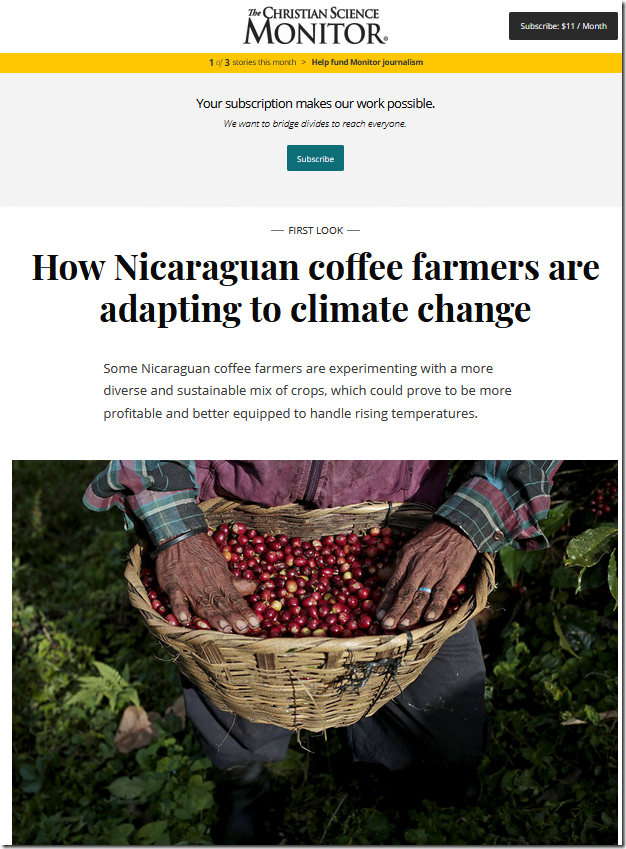
Jinotega, Nicaragua
Maria Gonzalez knows that growing coffee in Nicaragua’s northern mountains – as she has done since she was a little girl – gets harder and harder each year.
Rising temperatures are spoiling harvests when berries ripen too fast and a coffee leaf disease wiped out about half of the region’s crop between 2012 and 2014, killing most of Ms. Gonzalez’s plants.
Just as her new plants were starting to flourish, whipping winds and torrential rains from hurricanes Eta and Iota last November uprooted the bushes and shook the unripe berries to the ground.
With an initial hard few years now stretching into a decade, coffee farmers like Ms. Gonzalez face a tough decision: stay loyal to their coffee crop or find a new way to survive.
“I’m experimenting with a lot of things because if I see that one is doing better, I’ll stick with that,” she said. “And if not, we’ll be there fighting for our coffee.”

A coffee picker carries sacks of coffee cherries at a plantation in the Nogales farm in Jinotega, Nicaragua January 7, 2016.
Soaring temperatures in Central America due to climate change are forcing farmers to pull up coffee trees and replace them with cocoa, spurring a revival in the cultivation of a crop once so essential to the region’s economy.
https://www.csmonitor.com/World/Americas/2021/0302/How-Nicaraguan-coffee-farmers-are-adapting-to-climate-change
This article could hardly be further from the truth.
Coffee production in Nicaragua has been rocketing in recent years, and is double what it was a couple of decades ago:

Nicaragua Coffee Production 1961-2019
Of course, there are inevitably years when harvests are poor, but the decline in output between 2012 and 2014 was no greater than many other years since 1961.
It is estimated that harvest losses from the two hurricanes, which frequently hit Nicaragua, will be between 10% and 15%., taking output back to 2017 levels. Again, drops of this magnitude are commonplace in Nicaragua.
And far from the Jinotega region being particularly vulnerable as claimed, it is recognised as the best in a country noted for the quality of its coffee:

The simple fact is that coffee plantations are thriving in Nicaragua.
Shame on the Christian Science Monitor for peddling lies.
March 8, 2021
Posted by aletho |
Economics, Fake News, Mainstream Media, Warmongering | Christian Science Monitor |
Leave a comment
Though marketed as ‘the shining city on the hill’ envied by all other nations, America is rapidly proving to its own inhabitants and the world that not only can it not keep its own people safe – it can barely keep them alive.
Between the Covid-19 pandemic and the disastrous economic fallout engendered by government responses to that outbreak, the US has proven itself shockingly incapable of actually functioning in any way its peers might consider “normal.” Whether it’s keeping the lights on in American households, providing healthcare that cures rather than kills, educating children, or merely standing out of the way while residents try to build a life for themselves, Washington has demonstrated a profound, almost malignant ineptitude at the simplest tasks, so much that one might ask if it actually wants to perform them at all.
Dozens of Texas residents perished amid the massive snowstorm that seized the state last month. The storm knocked out the electric grid and left over 4 million residents with neither heat nor light. The state’s electricity vendors added insult to injury by slapping customers with absurdly high electric bills (some over $10,000) as the utility’s money-grubbing equivalent of “surge pricing” kicked in – all in a state where energy can literally be pulled out of the ground.
Texas is only one state, though – surely the rest of the country can’t be so horrifically incompetent when it comes to something as basic as electricity? But oh no, out West, there’s always California bidding to fail bigger and better. The Golden State’s own power supplier PSE&G was sued for starting the wildfires that destroyed entire neighborhoods in 2017 and 2018. Indeed, PSE&G has been blamed for more than 1,500 fires since 2014 alone and is in the process of declaring bankruptcy after being sued by over 70,000 of its victims, including the entire city of Paradise. It’s so inept when it comes to not burning down the state that for years it has shut off power – often for extended periods – during the summer, lest its equipment trigger still more wildfires.
OK, but surely such travesties are rare? It’s not like the US government just goes around displacing people from their land deliberately? Yet Georgia man Tim Leslie is living through that Kafkaesque nightmare of his own right now after having bought a plot of land in Polk County to homestead and raise animals with his family. Because they haven’t built their house yet, they’re (legally) living out of a trailer on that land – or were, until the police forced them to abandon their animals and move to a proper RV park. It’s difficult to imagine a community so free of crime that it wouldn’t have benefited from the cops finding something else to do during the hours spent harassing the Leslie family, but victimizing law-abiding citizens is much easier than going after criminals.
Policing – once the pride and joy of the world’s largest prison state – has itself deteriorated rapidly. New York City endured a major surge in crime thanks to the shutdown, while cops who might have been able to stop it were ignominiously tasked with guarding Mayor Bill de Blasio’s virtue-signaling “Black Lives Matter” mural or (somewhat schizophrenically) detailed to clobber the odd BLM protester. The NYPD even punished its own officers for public display of Trump fandom while real crimes went ignored and unpunished. (New York also released hundreds of supposedly low-level convicts last year “because Covid,” only for the public to learn they were guilty of much more serious offenses, with many ending up right back in the clink after committing further crimes. It’s an ominous state of affairs indeed for the country with the most prison inmates per capita in the world, and those numbers are almost guaranteed to further explode thanks to law enforcement’s new fixation on “domestic terrorists” – a group defined so broadly as to include anyone who’s expressed opinions outside the ever-narrowing mainstream.
Maybe the US is just focusing its efforts on combating the Covid-19 pandemic? Americans may spend more on healthcare than any other first-world country, but it wasn’t getting much for its money even before Covid. When the pandemic hit, all hell broke loose in many states, and when hospitals were barred from seeing ‘normal’ patients for lucrative procedures, they instead turned to ventilating anything that moved in order to get reimbursed by the government – even though 88 percent of those intubated died. Governors didn’t beg for lifesaving treatments – indeed, they banned some. Instead, they pleaded for ventilators, all while shunting Covid-infected patients into nursing homes where they would go on to decimate the helpless population.
If this is how the US treats its sick, what about its children? Despite some scientists confirming vanishingly few kids are falling ill, major teachers’ unions refuse to return to the classroom, never mind how poorly most children have been shown to learn over a distance model. In some areas, the shutdown of schools revealed a problem the US had been covering up for a while – the need to feed the millions of destitute children who rely on their schools not just for learning, but for free meals their families can’t afford. At the same time, these kids’ parents spent hours lined up in the cold for free groceries from the nearest food bank, and millions remain out of work or severely underemployed, many dangling on the verge of eviction. Sorely-needed stimulus checks never arrived for many, whose only recourse now is to claim the check on their taxes in the hope of maybe getting reimbursed later.
Most of these problems could be solved with some smart policies and a fraction of the infusion of cash that has already gone out to large corporations. But there’s wars to fight, and no evidence the ruling class wants its domestic problems fixed anyway. Instead, it seems to take sadistic pleasure in gaslighting Americans to within an inch of their sanity, insisting the rest of the world wants to be just like us. After all, it’s not like we can fly there to check.
Helen Buyniski is an American journalist and political commentator at RT. Follow her on Telegram
March 4, 2021
Posted by aletho |
Economics, Malthusian Ideology, Phony Scarcity | Human rights, United States |
Leave a comment