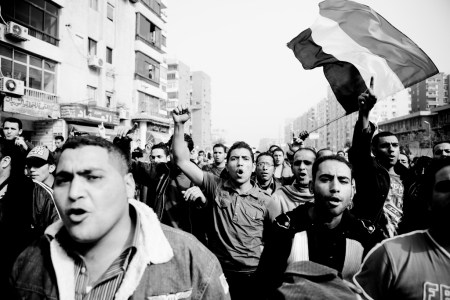
Since yesterday, and actually earlier, middle class activists have been urging Egyptians to suspend the protests and return to work, in the name of patriotism, singing some of the most ridiculous lullabies about “let’s build new Egypt,” “Let’s work harder than even before,” etc… In case you didn’t know, actually Egyptians are among the hardest working people in the globe already..
Those activists want us to trust Mubarak’s generals with the transition to democracy–the same junta that has provided the backbone of his dictatorship over the past 30 years. And while I believe the Supreme Council of the Armed Forces, who receive $1.3 billion annually from the US, will eventually engineer the transition to a “civilian” government, I have no doubt it will be a government that will guarantee the continuation of a system that will never touch the army’s privileges, keep the armed forces as the institution that will have the final say in politics (like for example Turkey), guarantee Egypt will continue to follow the US foreign policy whether it’s the undesired peace with the Apartheid State of Israel, safe passage for the US navy in the Suez Canal, the continuation of the Gaza siege and exports of natural gas to Israel at subsidized rates. The “civilian” government is not about cabinet members who do not wear military uniforms. A civilian government means a government that fully represents the Egyptian people’s demands and desires without any intervention from the brass. And I see this as hard to be accomplished or allowed by the junta.
The military has been the ruling institution in this country since 1952. Its leaders are part of the establishment. And while the young officers and soldiers are our allies, we cannot for one second lend our trust and confidence to the generals. Moreover, those army leaders need to be investigated. I want to know more about their involvement in the business sector.
All classes in Egypt took part in the uprising. In Tahrir Square you found sons and daughters of the Egyptian elite, together with the workers, middle class citizens, and the urban poor. Mubarak has managed to alienate all social classes in society including wide section of the bourgeoisie. But remember that it’s only when the mass strikes started three days ago that the regime started crumbling and the army had to force Mubarak to resign because the system was about to collapse.
Some have been surprised that the workers started striking. I really don’t know what to say. This is completely idiotic. The workers have been staging the longest and most sustained strike wave in Egypt’s history since 1946, triggered by the Mahalla strike in December 2006. It’s not the workers’ fault that you were not paying attention to their news. Every single day over the past three years there was a strike in some factory whether it’s in Cairo or the provinces. These strikes were not just economic, they were also political in nature.
From day 1 of our uprising, the working class has been taking part in the protests. Who do you think were the protesters in Mahalla, Suez and Kafr el-Dawwar for example? However, the workers were taking part as “demonstrators” and not necessarily as “workers”– meaning, they were not moving independently. The govt had brought the economy to halt, not the protesters by its curfew, shutting down of banks and business. It was a capitalist strike, aiming at terrorizing the Egyptian people. Only when the govt tried to bring the country back to “normal” on Sunday that workers returned to their factories, discussed the current situation, and started to organize en masse, moving as a block.
The strikes waged by the workers this week were both economic and political fused together. In some of the locations the workers did not list the regime’s fall among their demands, but they used the same slogans as those protesting in Tahrir and in many cases, at least those I managed to learn about and I’m sure there are others, the workers put forward a list of political demands in solidarity with the revolution.
These workers are not going home anytime soon. They started strikes because they couldn’t feed their families anymore. They have been emboldened by Mubarak’s overthrow, and cannot go back to their children and tell them the army has promised to bring them food and their rights in I don’t know how many months. Many of the strikers have already started raising additional demands of establishing free trade unions away from the corrupt, state backed Egyptian Federation of Trade Unions.
Today, I’ve already started receiving news that thousands of Public Transport workers are staging protests in el-Gabal el-Ahmar. The temporary workers at Helwan Steel Mills are also protesting. The Railway technicians continue to bring trains to halt. Thousands at el-Hawamdiya Sugar Factory are protesting and oil workers will start a strike tomorrow over economic demands and also to impeach Minister Sameh Fahmy and halt gas exports to Israel. And more reports are coming from other industrial centers.
At this point, the Tahrir Square occupation is likely to be suspended. But we have to take Tahrir to the factories now. As the revolution proceeds, an inevitable class polarization is to happen. We have to be vigilant. We shouldn’t stop here… We hold the keys to the liberation of the entire region, not just Egypt… Onwards with a permanent revolution that will empower the people of this country with direct democracy from below…
February 12, 2011
Posted by aletho |
Economics, Solidarity and Activism, Timeless or most popular |
Leave a comment
In commenting on the unfolding Egyptian revolution, media and analysts have emphasised the role of social media in building up networks of dissidents and facilitating the organisation of protests. Some have credited the ‘Facebook generation’ with lighting the spark of collective action. Undoubtedly, social media activists, in calling for ‘the day of anger’, put the tools of virtual communication to remarkable use. However these ‘days of anger’ can only be understood if we look at what the vast majority of Egyptians have experienced over the last three decades under Mubarak’s rule.
Successive waves of protests by wide segments of the population, particularly over the last decade, have also given a clear indication of growing opposition to the regime’s economic and social policies and its instruments of government and control. Prior to the recent protests, there were numerous massive strikes by textile workers demanding better pay, week-long street occupation by tax collectors protesting their low wages, and various sit-ins by university professors, doctors and lawyers calling for policy change.
Under Mubarak, the Egyptian state abandoned its welfare responsibilities and left citizens to fend for themselves. The so called free market became dominated by monopolies and oligopolies, with party elites and regime cronies controlling entire markets in basic and strategic commodities such as iron and steel, cement, and wood. The ruling clique and its business partners appropriated the country’s lands converting publicly-owned property into gated communities and turning entire coastal areas into exclusive resorts for the super rich. Built on vast areas of privatised state land, enclaves like Qatamiyya Heights and Mirage City catered to multi-million dollar palaces for the very privileged few. The scale of the land grab has threatened to deprive future generations of any chance of descent housing and a share of the country’s resources and wealth.
At the same time, masked and not-so-masked privatisation of education and health robbed citizens of the few citizenship rights gained in the country’s post-independence period. Social disparities have grown at extraordinary rates as state offices turned into personal fiefdoms in order to maintain the regime and its clients and to implement the neo-liberal agenda of economic reform.
To try and prevent growing resistance to these economic and social policies, Egypt and the Egyptians became subject to a police government. The Egyptian police departments govern vast areas of social life. They have responsibilities over security and public order, but also have jurisdiction over the regulation of, among other things, outdoor markets, the use of public utilities such as electricity, and the implementation of municipal building codes. With regular outdoor market raids and campaigns to monitor citizens’ use of these utilities, the police intruded into the daily life of ordinary citizens. Endowed with the arbitrary powers of emergency laws, the police engaged in practices of extortion, and used violence to intimidate and silence any questioning of their powers.
Security checks and roadblocks on the streets of Cairo and many other cities were part of Egyptian citizens’ daily reality. Drivers and pedestrians were randomly stopped, arrested and subjected to arbitrary investigation. Young men, feared by the regime for their potential for activism and resistance, were the main target of these practices. The everyday experience of humiliation at the hands of the police fuelled the youth’s opposition and rejection of the regime and its coercive arm, the police.
It was befitting that the revolution had its spectacular beginning on Police Day and that the youth would take the lead in breaking down the barrier of fear that the police have erected over a long period of time. Egypt’s youth have bravely put themselves forward along with vast segments of society to reassert their right to dignity and freedom. They have taken the first steps towards reclaiming their rights and towards exercising fully the responsibilities of citizenship. It is in reference to these objectives that the protesters’ main and most powerful slogan “the people want to bring down the system” should be understood. The desired change is nothing short of an overhaul of the institutions and structures of government.
~
Salwa Ismail is Professor of Politics with reference to the Middle East at the School of Oriental and African Studies (SOAS).
February 11, 2011
Posted by aletho |
Civil Liberties, Corruption, Economics, Mainstream Media, Warmongering |
Leave a comment
 Activists of the Bangladesh Nationalist Party (BNP) clash with the riot police during a nationwide strike in Dhaka on February 7, 2011.
Riot police in Bangladesh have clashed with hundreds of protesters in the Capital Dhaka who insist swift parliamentary elections to topple the country’s ruling power.
The fighting erupted during a nationwide strike, called by Bagladesh Nationalist Party (BNP), which is the country’s main opposition party.
Scores of protesters were wounded and at least 70 activists were arrested in clashes with the police, according to witnesses.
The police patrolled the capital and the main cities, using water cannons and batons to disperse the protesters who are discontent with high prices, weak public services in the impoverished land.
On Sunday, fighting between the police and the demonstrators left one policeman dead and dozens of people injured.
The BNP, which has been led by two times ex-Premier Khaleda Zia, is objecting the government’s economic policies and its alleged crackdown on the opposition.
February 7, 2011
Posted by aletho |
Economics |
Leave a comment
EUROPE TO BECOME PLANNED ECONOMY LIKE CHINA
*Germany and France to control all wages, taxes, pensions and welfare benefits across the Eurozone under new plan unveiled in Brussels.
*Economic coordination will result in a planned economy and inefficiency, economic experts say.
*People of Europe will have no say in the transfer of control over their pensions, wages and taxes to a central authority, national leaders to decide.
A plan by Germany and France to enforce the same labour, welfare, pension and economic policies across the entire Eurozone by decree was unveiled in Brussels on Friday.
Economist Hans-Werner Sinn from Germany’s IFO said that the attempt to introduce new binding agreements on labour costs, taxes and pensions that would apply to every single citizen in every single country in the Eurozone, amounted to introducing a planned economy that will promote inefficiency.
http://diepresse.com/home/wirtschaft/international/631259/HansWerner-Sinn_EUPlaene-wie-in-einer-Planwirtschaft
The plans set out by German Chancellor Angela Merkel and the French President Nicolas Sarkozy called for the harmonization of the corporate-tax base, the abolition of indexing pay raises to inflation, and also for the linking of pension ages to demographics i.e. the pension age to be raised across the Eurozone.
Merkel and Sarkozy are pushing for an agreement in March.
They claim their push for economic convergence in the euro monetary union without a political union and without any opportunity by the people of Europe to have a say and also without any adequate basis in an EU treaty will allow economies in Europe to overcome the financial crisis and grow faster. But experts say their plan is a way of introducing through the back door the transfer union and Eurobonds benefiting banks at the expense of ordinary people .
The plan also includes a binding indicator for labour productivity and labour unit costs across Europe i.e. the amount of earnings every person working in a specific job sector is to be set centrally across Europe.
In any event labour cost units do not address the problem of enormous and growing unemployment in the Eurozone as a result of the failed policies of Merkel and Sarokzy and EU, especially in countries in the southern European zone where many jobs have been lost because they joined the Eurozone at an exchange rate that was too high and so became uncompetitive.
To regain competitiveness, the countries need to be able to devalue their currency or introduce a regional, parallel currency, experts say. However, there is no mention of devaluation in the Merkel/Sarkozy plan.
Crucial also to a buoyant economy is the demand for products. Germany, for example, was prosperous in the 1980s because people earned enough money to be able to buy German products, creating a virtuous economic circle of demand and production. Today, Germany’s domestic demand is small because real income is barely enough to cover essentials, and the new plan does nothing to change that.
In fact, Germans along with the rest of Europeans are set to have even less money if the new pact is agreed in Brussels in March with wages and pensions set to be slashed in real terms.
Scrapping the link between annual wage increases and inflation will mean that wages will fall in real terms across Europe, leaving people with even less money to spend resulting in reduced demand in the economy.
Far from boosting the economy, the measures unveiled will, in fact, accelerate Europe’s transformation into a centrally planned, labour Gulag such as in China.
It has been estimated that more people in the developing countries will have an income of 10,000 dollars a year than in Europe and the USA together in five years time, underlining just how steep the drop in the real incomes in Europe and the USA has been.
Charities have calculated that the minimum required to live in Germany is about 1000 euros a month. That means almost 80% of the Germans are now already living on or close to the minimum needed to exist.
According to Die Welt, more than 20% of Germans have less than 1,070 euros a month and another 60% of Germans earn between 1,070 to 2,350 euros a month. Only 3% earn more than 7,000 euros a month.
http://www.welt.de/wirtschaft/article12349505/DIW-Forscher-sehen-schwindende-Mittelschicht.html
The long-term unemployment benefit Hartz IV is 350 euros or only about 7 times more than the poorest Egyptians have to live on a month in spite of much higher costs in Germany.
The Hartz IV benefit is set to rise by only 5 euros this year on the insistence of Merkel, far below inflation, further eroding the real purchasing power and driving millions deeper into poverty.
It is not just in Germany but all across Europe that salaries have been decimated. Gone are the days not so long ago when professions such as young teachers for example earned 30 times more than their average cost of accommodation in major cities. In Greece, for example, the average pension is just 600 euros.
The next logical step for Merkel and Sarkozy is to float plans to send millions of Europeans to live in barracks and work in factories or roads with a bowl of soup and bread until they are 90 or drop dead as in the 1930s after a similar engineered financial crisis.
I can’t see the people of Europe allowing a centralised bureaucracy set up by governments in Berlin and Paris to cut their pensions and wages in order to give yet more to the banks and corporations – not after these same governments aided the banks in an engineered financial crisis that wrecked economies, and plunged nations into debt.
Merkel has said that the rest of Europe has to keep up with the “best”. Implying the low wage, slave labour concentration camp that Germany has become, with its corrupt financial sector, corrupt corporations caught bribing its own and foreign politicians (Siemens in Greece) is in some way to be emulated.
I suspect Europeans will not share that view.
Not the Irish for sure. Even tame politicians and newspapers like Enda Kenny and the Irish Times are comparing the brutal take-over of the Irish economy by the German and EU bankers via an enforced 85 billion euro loan with the armed conflicts of Leningrad and the Easter Rising.
How much longer will the people of Europe put up with this?
After helping the banks wreck the European economy in front of everyone’s eyes and pushing toxic vaccines on their populations, Merkel and Sarkozy pair up in a flagrant bid to steal pensions (etc) instead of presenting a serious plan.
How dare they?
February 7, 2011
Posted by aletho |
Corruption, Economics, Malthusian Ideology, Phony Scarcity, Supremacism, Social Darwinism, Timeless or most popular |
Leave a comment
Soaring Prices, Growing Destabilization
The dramatic rise in food prices is fueling a great deal of discontent in Tunisia, Egypt and elsewhere. It’s a deep undercurrent propelling many of the poor, who face prospects of starvation to resort to the streets and to violence. According to the United Nation’s Food Agency (Food and Agriculture Organization — FAO) world food prices are up for the 7th month in a row and are likely to surpass the record high reached in December 2010.
No end is in sight for this destabilizing battle with food price inflation in places like Egypt, where more than half of an average income goes for food. According to the State Department, more than 60 food riots occurred worldwide over the past two years.
In March 2008, a dramatic spike in food prices led thousands of people on the brink of starvation in Egypt to violently riot — sending a seismic shock wave through the Mubarak regime. After the Egyptian military was able to distribute enough wheat to dispel the rioting, efforts to stockpile wheat by the Mubarak government have failed, as food prices continue to hover at record highs.
The media is reporting many reasons for this problem ranging from soaring demand, cuts in food subsidies, droughts, and government mandates to use more grain-based biofuel. But, another significant factor is at play: unfettered speculation by investment banks. As noted in USA Today, in 2008, “the bulls may not be running on Wall Street, but they’re charging in the commodities pits.
At issue are the still deregulated commodity markets ushered in by the Clinton administration and the U.S. Congress with the passage of the Commodity Futures Modernization Act of 2000. Before this law, the Commodity Futures Trading Commission (CFTC) served as a cop on the beat, enforcing rules that prevent the distortion or manipulation of prices beyond normal supply and demand. But Wall Street banks and companies such as ENRON and British Petroleum were determined to make a lot more money from speculation by exempting energy-derivative contracts and related swaps from government oversight.
For this reason, the 2000 law allows entities that have no stake in whether adequate amounts of food and fuel are available for ordinary people and commodity-dependent businesses to make huge sums of money by gambling with other people’s money.
Soon after passage of the 2000 law, “dark” unregulated futures trading markets emerged, most notably the Intercontinental Exchange (ICE) in London — created by Wall Street and European investment banks and several oil companies. A key practice involves “over the counter index trading” in which hundreds of billions of dollars of pension, sovereign wealth, and other institutional funds are used to flood “dark” commodity markets to buy and hold futures contracts without an expiration date or oversight. When it’s time to make money on a losing bet, these funds are withdrawn, causing commodity price crashes and economic instability.
These transactions don’t involve customary “bona fide” commodity traders, such as an airline company hedging on the price of jet fuel by purchasing futures contracts. As prominent hedge fund manager Michael McMasters noted before a U.S. Senate panel in 2008, this amounts to “a form of electronic hoarding and greatly increases the inflationary effect of the market. It literally means starvation for millions of the world’s poor.”
Some world leaders are willing to speak out against the pernicious role of “dark” commodity markets. Recently, French President Sarkozy warned of further unrest and even war at the Davos forum, unless commodity speculation is reined in — something that Wall Street and Republican lawmakers are bitterly fighting. The Dodd/Frank Financial Reform Law places some restrictions on this practice by the CFTC. In particular, the CFTC is beginning the process of weeding out “non bona fide” investment bank speculators.
True to form, House Republicans are demanding that the CFTC slam on the brakes. They’re planning hearings and legislation to hamstring these efforts.
The spontaneous mass uprising of ordinary people in Egypt and the Middle East against their authoritarian regimes has many root causes. One that deserves much greater attention is unfettered speculation by powerful private financial institutions that don’t care about world-wide starvation and its impacts. It’s distorting global food supplies.
Robert Alvarez, an Institute for Policy Studies senior scholar, served as senior policy adviser to the Energy Department’s secretary from 1993 to 1999.
February 4, 2011
Posted by aletho |
Corruption, Economics, Malthusian Ideology, Phony Scarcity, Timeless or most popular |
Leave a comment
What’s it like spending two years doing thankless work that, in the end, is going to be ignored by the very people who asked for your services? The members of the Financial Crisis Inquiry Commission have just found out. Their 662 page report is sinking rapidly into oblivion in official Washington, and is now destined to be of interest only to historians. This was fully predictable. The Commission was given a charter by Congress to tell us who, what, when, and where about the financial crisis, but they were not allowed to explain why. To understand why this crisis occurred would be stepping on way too many powerful toes in Washington, and for this reason the Commission was told not to make any policy recommendations to Congress that would help prevent such a crisis from occurring again.
Though toothless and hobbled by Congress, the Commission has issued a remarkable report, at least by Washington standards. The report reads like the work of an investigative reporter, filled with interesting anecdotes selected from hundreds of hours of interviews with financial experts and market participants. The chapters are organized chronologically from the start of the housing boom to its collapse. Hardly anybody comes out of this report looking good, but of the many people who have reason to hang their head in shame, none appear quite as damaged as Alan Greenspan. He and the Federal Reserve are fingered by the Commission for failure to regulate the banks and other players in the housing market.
The outcome of “Fed Lite”
The central bank operated a regulatory regime called “Fed Lite”, providing little regulatory oversight for the banks, and no oversight for the shadow banking system that blew up under the weight of excessive debt and sparse capital. Fed Lite was founded on Alan Greenspan’s near-religious belief that the markets always weed out inefficient players and excesses, and the Fed’s job therefore is to stay out of the way of the banks they are supposed to regulate. Greenspan later admitted to the Commission that he might have been a bit wrong about the wonderful self-correcting mechanism of the markets. He also admitted that he was out of his depth whenever the staff came to talk to him about technical matters like mortgages, the housing markets, derivatives such as CDOs, and so on.
This was the man who was dubbed “The Maestro” by Bob Woodward, but apparently nearly twenty years of hands-on experience running the central bank was not enough to educate him sufficiently to understand the housing market, much less detect a bubble in the making. Why was someone like him given such a position of power? The Commission is unable to explain this to us, and to do so would require going much further back in time than the housing bubble – in fact back to the 1950s, when Alan Greenspan sat at the side of Ayn Rand, as an Apostle of Selfishness and a prized member of her cult of Objectivists.
Greenspan Shrugged
In his professional life Alan Greenspan has never talked about his days with Ayn Rand, and curiously no one in Washington has bothered to ask him publicly about how much of her philosophy he believes. As Fed Chairman, if Greenspan was a maestro of anything, it was playing Washington politics, and he was always wise enough never to tip his hand on policy matters until he had to. By the time the Fed was ready to implement Fed Lite, the mood in Washington had already shifted in favor of the Republican campaign to reduce government regulation wherever possible. This meant not only allowing market operators to function unfettered, it meant giving the wolves access to the henhouse. Insurance and oil industry executives were allowed in to Congressional staff meetings to help write laws governing their industries. Bankers were appointed to top positions at the Treasury and the Fed. As far as Wall Street was concerned, the traditional balance between Greed and Fear was upended: Fear was banished and Greed was allowed to run rampant once bankers were given access to unlimited taxpayer money in the form of bailouts.
All of this was quite congenial to Alan Greenspan, the inventor of the “Greenspan put” – which was a phrase created by the market to characterize the promise by the Fed that any serious losses in the market could always be “put back” to the government. Time and again Greenspan oversaw one bank bailout after another, and then expanded the franchise to the hedge fund industry when he bailed out LTCM in 1998. By the time he retired from the Fed, the financial industry had become so large that the Greenspan put had become institutionalized, and is now referred to as the Bernanke put. The job of Chairman of the Federal Reserve apparently carries with it the promise to forever protect the markets from their mistakes.
Only the “Worthy” Succeed
This must be quite satisfying to Ayn Rand followers. In their mythology, only Worthy Individuals are allowed to succeed in life, by taking what they want from others, and fighting off the little people and bothersome bureaucrats who obstruct them because they are envious of anyone who succeeds. Alan Greenspan must view himself and the eminent people he associates with as the Worthy few, entitled to their wealth and position of power. As a Republican, Greenspan has had no problems with the evolution of his party into the protector of the privileged few – the Lucky Duckies who control nearly 90% of the wealth in America, and feel entitled to raid the Treasury whenever they need to cover up for their mistakes.
This is the problem the Commission has had in doing its work. It is operating in a political and social environment in Washington that for decades has glorified greed and selfishness, and so accepted are these qualities that an alternative universe where government helps the average person rather than just the wealthy person is simply too hard for people in Washington to imagine. The best the Commission can do is say “Alan Greenspan should have done this, and he shouldn’t have done that.” It cannot say that there is something deeply corrupting in the way politicians of both parties think and act in Washington.
That is also why this Commission is so very different from the Pecora Commission of the 1930s, which took as its job the exposure of corruption and fraud at the very highest levels of business and government. The evidence of corruption and fraud in the housing bubble and during the credit crisis is mounting every day, but no one of responsibility or power has been called to account. The Commission has apparently identified a few low level functionaries for the attention of the Justice Department, but it is unlikely that someone like Angelo Mozilo of Countrywide is ever going to wind up in court on fraud charges. There is no moral outrage in Washington anymore, because there is simply no telling whose head would not fall under the guillotine if the true extent of fraud and corruption were revealed.
“Greed is Good”
The American people don’t have much moral outrage either. For the longest time they bought into the Greed is Good philosophy as long as the stock market was going up, and the housing bubble was in the ascendant. Once both of these financial props collapsed, misery spread everywhere, but it wasn’t the misery experienced by our grandfathers, who lost all their wealth in the 1930s when the banks collapsed completely. Most Americans are holding on to some of their wealth, and 80% of them have full time jobs, even if the work is stressful and the benefits are disappearing. Unemployment checks are being extended for another year, payroll taxes are scheduled to be cut in 2011, and Ben Bernanke has spent over half a trillion dollars generating another stock market bubble. The wealthy are spending money, which helps the retail sales numbers look good, and the Fed assures us that inflation is not a problem, because the Fed excludes the price of food and energy in its calculations of inflation.
Of what use, then, is a Commission that explains why things really happen the way they do? No one wants to hear it – not the Congress, not the White House, not Republicans, Democrats, nor independents. No one wants to hear that the American Dream – which use to say that anyone could succeed in America with hard work – has been polluted by a wholly different American Dream, which now says you can succeed with the right connections and you can take what you want without any consequences. We have brought the philosophy of Selfishness to its logical conclusion, which has left us with a society of individuals who are isolated from each other, who have been stripped of any sense of community, and who have been taught to expect that government will be of no help to you unless your are in a position of privilege and power.
What America really needs is a Commission of Truth, that would outline how Selfishness became triumphant, how it has devastated our country, and what we as a community and as a nation must do about this. A Commission of Truth, however, needs to have an audience willing to listen to the truth, and such an audience does not exist in America. At least not yet – not until Americans have experienced the full, bitter fruits that a lifetime of Selfishness can produce.
February 3, 2011
Posted by aletho |
Corruption, Economics, Supremacism, Social Darwinism, Timeless or most popular |
Leave a comment
The people of Egypt have had enough of a failed dictatorship masquerading as a democracy. As events unfold, we’re seeing a cautionary message entering the corporate media coverage of this event. Having never exposed the dire conditions that prompted the massive protests and demands for change, we’re now told that this could negatively impact oil supplies, the stock market, and anti-terror efforts. No foundation for the claims was provided but they’re repeated regularly on CNN, the NBCs, Fox, and the print media.
Thus, a false dilemma is created for the public: support the right of people to determine their own fate or protect your safety and the current standard of living, as it were.
Egypt’s oppressive tyranny
Eighty million Egyptians have suffered under an oppressive regime for thirty years. President Hosni Murbark became Egypt’s president and dictator in 1981 after the assassination of the late President Answer Sadat in 1981. Sadat had just completed a peace treaty with Israel. Since then, Mubarak has ruled through emergency law for all but 18 months. Using this law, the government has the, “right to arrest people without charge, detain prisoners indefinitely, limit freedom of expression and assembly, and maintain a special security court.” The Egyptian parliament extended for two years in May 2010. For those who get too far out of line, there are the famous torture facilities of the national police.
The Egyptian revolution followed the successful peoples uprising in Tunisia just days before. The Egyptian economy has not performed for the people. The majority of Egyptians live in substandard conditions and they see little reason for hope. Conditions were no better in Tunisia. Future hot spots for revolution, Algeria and Yemen, are equally bereft of the conditions that allow for human dignity – gainful employment, health, and safety.
Children are particularly hard hit, one-third of Egypt’s population. A recent UNISEF that, “Increases in child mortality and morbidity, child labour, child exploitation, violence against children and women and other forms of abuse, alongside declines in school attendance and the quality of education, nurture, care and emotional well-being, can all be traced to times of economic crisis.” (Harper et al, 2009). The Egyptian economic crisis has been devastating to children.
The conditions in Egypt are different from those in the United States in terms of income and material wealth. On a structural level, however, the class inequalities mirror those faced here. A robust stock market failed to translate into employment gains or basic benefits for the vast majority. Policies are friendly to businesses but discriminate against worker rights and unions. Privatization has sapped the public coffers.
While conditions were building up to a boiling point, the Egyptian Stock Exchange became a favorite for foreign investors. Somehow, the geniuses on Wall Street convinced President Mubarak to privatize and adopt a market economy [crony capitalism]. He did, the people suffered more, and the results led to the near universal demand that Mubarak step down. The globalization of crony capitalism has reached the point where the main stimulus is revolution.
The false dilemma
The coverage of Egypt’s revolution has been a bit timelier than the Tunisian affair, which the corporate media nearly missed. The initial focus was on events and the questions determining the survival of Hosni Mubarak. Who will win? There was no explanation of conditions prompting the protests. That would legitimize the protesters and foreclose media manipulation that may be needed to continue the three-decade support for the present dictatorship and oligarchy.
A Wall Street Journal article Sunday laid out the talking points for fear mongering and the false dilemma – support a peoples revolution? – take an oil shock and more terror.
US stocks are taking a big hit because of the revolution. We’re supposed to react by thinking, Is this really worth it? The recession may get worse.
“Anti-government protests in Egypt have affected world financial markets, with US stocks suffering the biggest one-day loss in six months.” Egyptian Unrest Has Repercussions in Global Economy Wall Street Journal (WSJ), January 30
The specific fear of oil price increases appears. Somehow, we’re asked to believe that a new government might say, all of a sudden, no more United States ships in the Suez Canal.
“In the short term, the biggest global economic worry remains oil prices. Egypt itself isn’t a big energy producer. But significant shipments of oil and petroleum products pass through Egypt each day on their way from the Mideast to European and U.S. markets.” WSJ 01/30
There is absolutely no basis for this. Therefore, the fabrication is deliberate and ill intended.
Then the Journal trots out an expert who draws a conclusion based on the unproven hypothetical. Once again, there is no basis for saying that there would be any shipping disruptions. Why would a new Egyptian government give up that income or pick a fight with a White House with a record of military aggression?
“If oil shipments through Egypt were disrupted, European supply — and global prices — would be affected tremendously, said Dalton Garis, an associate professor in petroleum-market behavior at the Petroleum Institute, an energy-research center in Abu Dhabi.” WSJ 01/30
The media is like a dog on point. They just can’t give up the notion that we’re headed for an oil shock.
“Apart from Egypt’s role as an energy transporter, fear that unrest could spread to bigger oil producers could exacerbate worries.” WSJ 01/30
Where is the information that would justify this fear?
Where is the explanation that accounts for this remarkable mass uprising?
Where are the questions about the three decades of neglect by several U.S. administrations and the requests by presidents Bush and perhaps Obama to carry out “renditions” [torture] in behalf of the United States.
When you support a tyrant who oppresses his/her people, you risk the antipathy of the people when they gain control.
Apparently, our ruling class hasn’t paid any attention to recent history. For years, successive US regimes supported dictatorial rule in South America. The dictators are gone, left leaning governments are in place, and no one is lining up to punish the United States.
The real concern about change in Egypt is all about control. The elite of the US and Europe may encounter a leader who isn’t in their pocket, doesn’t care whether or not he or she is invited to Davos, and actually seeks the benefit of the vast majority of citizens rather than the crony capitalist network also known as the global economy.
Michael Collins is a writer in the DC area who researches and comments on the corruptions of the new millennium. His articles focus on the financial manipulations of The Money Party, the abuse of power by government, and features on elections and election fraud. His articles can be found here. His website is called The Money Party.
Copyright © 1998-2007 Online Journal
February 2, 2011
Posted by aletho |
Deception, Economics, Mainstream Media, Warmongering, Timeless or most popular |
Leave a comment
CAIRO – There is no money at the banks. Fuel is scarce. Tourism is evaporating.
As a popular uprising to oust President Hosni Mubark enters its second week, Egyptians are feeling the economic pinch.
Banks have been shut since Sunday, and they remained so on Tuesday, the day that protesters hope will see a million-strong demonstration in Cairo to demand an end to Mubarak’s regime.
Many automatic teller machines (ATM) in the teeming capital have run out of cash, and those still working were dispensing only a limited number of banknotes.
“I scoured the city in search of an automatic teller and I found only one place — in a neighbourhood where people do not normally use ATMs,” said Mohamed, a driver.
In Cairo, supermarkets that usually accepted credit cards insisted on cash instead, while crowds flocked to grocery stores in several neighbourhoods to stock up on essentials.
Many gas stations were closed, with long lines at those that were still open. The Chamber of Commerce in Cairo appealed to shopkeepers on Monday to reopen, but most ignored the call.
Some kiosks complained of an early shortage of cigarettes, in a country with a large number of smokers and relatively cheap tobacco. Top-up cards for mobile phones were also running short.
Responding to growing fears of shortages, the authorities said Egypt still had sufficient stocks of food, including wheat reserves, to feed itself until June.
Tourism, a crucial source of foreign revenue, has been hit hard by the uprising in which at least 125 people have died and thousands injured since it began last Tuesday.
This is high season for the tourist industry, with Europeans escaping their winter for sunshine by the Red Sea and the River Nile, but many tour operators have suspended departures and leisure bookings have dried up.
With 14.7 million visitors in 2010 and revenues estimated at about 13 billion dollars, tourism is an important source of income for Egypt, a developing nation with an estimated 20 percent living under the poverty line.
Some foreign firms have suspended their activities, such as the Danish shipping and oil concern A.P. Moeller-Maersk, the French cement manufacturer Lafarge and Japanese automaker Nissan.
Egyptair cancelled all domestic and international flights between 3 p.m. and 8 a.m. — the hours of a government-imposed curfew — starting Monday. Other flight times are to be modified.
Air freight is off sharply as well, said Ayman Nasr, head of Egyptair’s cargo department.
He said foreign trade had been affected by “the inability to pay for imports due to lack of liquidity resulting from the closure of banks or, the inability to arrive at the airport (to collect shipments) due to the curfew.”
The Cairo stock exchange had been shut since Thursday, after more than 10 percent of its value or 70 billion Egyptian pounds (about 12 billion dollars) was wiped out over its last two days of trading.
February 1, 2011
Posted by aletho |
Economics, Timeless or most popular |
Leave a comment
Escalating Reaganomics
By ISMAEL HOSSEIN-ZADEH | January 28, 2011
President Reagan did not make any bones about his intention to reverse the New Deal economics when he set out to promote the Neoliberal economics. Likewise, President George W. Bush did not conceal his agenda of aggressive, unilateral militarism abroad and curtailment of civil liberties at home.
There is a major similarity and a key difference between these two presidents, on the one hand, and President Obama, on the other. The similarity lies in the fact that, like his predecessor, President Obama faithfully, and indeed vigorously, carries out both the Neoliberal and militaristic policies he inherited.
The difference is that while Reagan and Bush were, more or less, truthful to their constituents, President Obama is not: while catering to the powerful interests vested in finance and military capitals, he pretends to be an agent of “change” and a source of “hope” for the masses.
There has been a wide-ranging consensus that the excessive financial/economic de-regulations that started in the late 1970s and early 1980s played a critical role in both the financial bubble that imploded in 2007-2008 and the continuing persistence of the chronic recession, especially in the labor and housing markets.
Prior to his recent U-turn on the regulation-deregulation issue, President Obama shared this near unanimous view of the destructive role of the excessive deregulation of the past several decades and, indeed, strongly supported the need to bolster regulation: “It’s time to get serious about regulatory oversight,” Mr. Obama argued as the Democratic nominee for President; and again, “…this crisis has reminded us that without a watchful eye, the market can spin out of control,” as he stated in his inaugural speech.
Expressions of such pro-regulation sentiments were part of his earlier promises of “hope” and “change” in a new direction. Back then, that is, before showing his Neoliberal hand, the majority of the American people believed him—the middle, lower-middle, poor and working people who were tired of three decades of steady losses of economic security were desperately willing to believe a charismatic leader who peddled hope and change in their favor.
Recently, however, the president seems to have had a change of heart, or perhaps an epiphany, regarding the regulation-deregulation debate: he now argues that protracted recession and persistent high levels of unemployment are not due to excessive deregulation but to overregulation! Accordingly, he issued an executive order on 18 January 2011 that requires a comprehensive review of all existing government regulations. On the same day, the president wrote an op-ed piece for the Wall Street Journal in which he argued that the executive order was necessary in order “to remove outdated regulations that stifle job creation and make our economy less competitive.” The president further argued that “Sometimes, those [regulatory] rules have gotten out of balance, placing unreasonable burdens on business—burdens that have stifled innovation and have had a chilling effect on growth and jobs. . . . As the executive order I am signing makes clear, we are seeking more affordable, less intrusive means to achieve the same ends—giving careful consideration to benefits and costs.”
Stripped from its Orwellian language, this “cost-benefit” approach to health, safety and environmental standards is clearly the familiar Neoliberal rhetoric that is designed to help big business and their lobbies that have been working feverishly to stifle the widespread pro-regulation voices that have grown louder since the 2007-08 financial melt-down.
Indeed, the president’s recent agenda of further deregulation has already born fruits for big business. The Wall Street Journal reported on 20 January 2011:
“A day after President Barack Obama ordered the government to get rid of burdensome rules, two federal agencies backed down from proposals that had drawn jeers from businesses. . . . The Labor Department said it was withdrawing a proposal on noise in the workplace that could have forced manufacturers to install noise-reducing equipment. And the Food and Drug Administration retreated from plans to tighten rules on medical-device approvals, postponing a proposal that would have given the FDA power to order additional post-market studies of devices. . . . Industry leaders praised the moves, while consumer advocates expressed disappointment. . . . ‘This is a very positive step forward,’ said Bill Hawkins, chief executive of medical-devices heavyweight Medtronic Inc.”
How is the president’s sharp turnaround on the regulation-deregulation debate to be explained? What “outdated deregulation” is he talking about? How could deregulation, which is widely believed to have been the problem, also be the solution? Why this sudden U-turn?
The change in the president’s view from the need for regulation to that of further deregulation can be explained on a number of planes.
On a narrow, personal and (perhaps) simplistic level, it can be argued that the president’s about-face on the issue of deregulation should not really be surprising; the turnaround represents quintessential Obama: spineless and/or unscrupulous, if you are a critic of the president; pragmatic and/or complex, if you are an apologist or defender of him.
There are also, of course, re-election considerations here. And here it seems that the president’s team is pinning his chances for re-election on big business and big media; confident that once he is able to win their hearts and minds, they will, in turn, be able to manipulate the public to vote for him—just as they did in the 2008 election.
On a deeper (but still personal) level, that is, on a philosophical or ideological level, it can be argued that the president has always been a Neoliberal thinker, albeit a stealth Neoliberal, who is coming out of the closet, so to speak, carefully and gradually. Evidence of his being ideologically more a partisan of Neoliberal than New Deal economics is overwhelming (see, for example, Pam Martin and Alan Nasser).
It is necessary to point out that although the stealth Neoliberal president has been taking baby steps out of the closet, he would always stay by the entrance: as long as there is no popular anger or pressure against his Neoliberal policies, he would stay on the outside; at the first signs of a threatening pressure from the grassroots, however, he would crawl back inside the closet, and begin preaching populism or uttering ineffectual, benign corporate-bashing rhetoric. This is his mission and his political forte – a master demagogue. And this is why the politico-economic establishment promoted him to presidency as they found him the most serviceable presidential candidate. None of his presidential rivals could have served the tycoons of the finance world and the kings of Wall Street as well as he has.
On a more fundamental level, President Obama’s reversal of his view from the need for rigorous regulation to the need for further deregulation, and his economic policies in general, show that while the politics and personalities of a president ought not be ignored, presidential economic policies cannot be explained by purely personality issues such as a failure of nerve, conviction, or ideas. The more crucial determinants of national economic policies are often submerged: the balance of social forces and the dominant economic interests that shape such policies from behind the scene. Stabilization, restructuring or regulatory policies are often subtle products of the outcome of the class struggle.
Thus, when the balance of social forces is tilted in favor of the rich and powerful, crisis-management economic policies would be crafted at the expense of the working people and other grassroots. In other words, as long as the costly consequences of the brutal Neoliberal restructuring policies (in terms of job losses, economic insecurity, and environmental degradation) are tolerated, business and government leaders, Republican or Democrat, would not hesitate to put into effect draconian measures to restore conditions of capitalist profitability at the expense of the impoverishment of the public.
On the other hand, when crisis periods give rise to severe resistance from the people to cuts in social spending, such crisis-management policy measures could also benefit the public. A comparison/contrast of policy responses to major economic crises in the United States clearly supports this point. Economic historians have identified four major economic crises in the past 150 years or so: The First Great Depression (1873-97), The Second Great Depression (1929-37), the long recession of 1973-83 (also known as the stagflation of the 1970s), and the current long recession that started in 2007-08.
Since there was no compelling grassroots pressure in response to either the First Great Depression of 1873-97 or the long recession of the 1970s, crisis management policies in both instances were decisively of the Neoliberal, supply-side type: suppression of trade unions and curtailment of wages and benefits; promotion of mergers, concentrated industries and big business; extensive de-regulations and generous corporate welfare plans; in short, huge transfers of income from labor to capital. Likewise, a glaring lack of grassroots resistance in the face of the current long recession has allowed the ruling kleptocracy (both in the US and beyond) to adopt similarly brutal austerity policies that are gradually reviving financial/corporate profitability at the expense of the poor and working people.
By contrast, in response to the Great Depression of the 1930s workers and other popular forces achieved employment and income security as a result of a sustained pressure from “below.”
The contrast between these two entirely different types of restructuring strategies shows that, as Mark Vorpahl, a union steward, recently put it, “Working people and the unemployed cannot rely on the politicians to get the change we need. We can only rely on our own collective strength. That is, we need to organize and mobilize as a united, massive, powerful force that cannot be ignored by those more intent to do Wall Street’s bidding.” Only the threat of revolution can force people-friendly reform on the ruling kleptocracy.
Ismael Hossein-zadeh, author of The Political Economy of U.S. Militarism (Palgrave-Macmillan 2007), teaches economics at Drake University, Des Moines, Iowa.
Source
January 29, 2011
Posted by aletho |
Economics, Progressive Hypocrite, Solidarity and Activism, Timeless or most popular | Food and Drug Administration, Militarism, Neoliberal, Obama, Ronald Reagan |
Leave a comment
Technology cooperation with China will bolster Venezuela’s industrial capacity, a government minister said.
The bilateral strategic ties are “very important” to Venezuela, Basic Industry and Mining Minister Jose Khan told Xinhua on Sunday, adding that the joint commissions of the two nations have held nine meetings to design production projects to boost Venezuelan economic development.
He said that the plans designed would cover various fundamental areas, such as transportation, agriculture, food production and telecom.
“In the case of basic industries, we have been discussing and approving a series of projects which will allow in 2011 the basic industries to recover their production and improve their productiveness,” he said.
Khan also told Xinhua the government plans to expand ports along the Orinoco River, the major transport system for eastern and interior Venezuela, in order to streamline the transportation of mining products.
There are also plans to buy hi-tech machinery for iron extraction, he said. In the case of aluminum, the government plans to upgrade existing plants and build new extraction plants.
He said these projects will improve “not only the conditions of the workers, but also the conditions of the people, because these materials will be used for the national housing plan.”
January 26, 2011
Posted by aletho |
Economics |
Leave a comment
Corpses are still under tons of rocks and mud in the hills of Rio de Janeiro, but some experts are already rushing to the microphones here in Brazil and abroad to declare the worst natural disaster in the Brazilian history as a clear and unequivocal evidence of global warming (a.k.a. global climate disruption).

The Brazilian media is not immune to the frenzy on global warming and extreme weather events. The Folha de Sao Paulo newspaper, one of the most important media outlets in the country, published a report connecting the Rio de Janeiro disaster to the Queensland flooding in Australia and the recent snowstorms in the United States and Western Europe.

To establish the ongoing catastrophe in Brazil as a global warming product is a bogus claim in the view of the staff of MetSul Meteorologia. The same can be said to the events of cold snaps and snow in the Northern Hemisphere – strong negative Arctic Oscillation related – and the massive flooding in Australia, a direct result of the strong and natural derived La Niña event.
Rio de Janeiro is subject to heavy or extreme rainfall every year, but this time the amount of precipitation was very heavy and in a short period of time, creating an inland tsunami-like torrent. The risk of major extreme rain episodes this summer was widely anticipated by MetSul meteorologists as analog years strongly pointed to a summer similar to the ones with disastrous events in the past. Rain gauges in Nova Friburgo measured 300 millimeters (12 inches) of rain in just 24 hours from January 11th to 12th. The tragedy happened in the Sierras of Rio de Janeiro (Região Serrana) where major topographical forcing is usually present in extreme rainfall. Moisture flow from the ocean (SSTs are above average in the South Atlantic) find a natural physical barrier in the mountains of Rio de Janeiro, making the region prone to extreme rainfall during summer months and early autumn.
The most affected cities (Petrópolis, Teresópolis and Nova Fribrugo) are located between mountains as high as 5 to 6 thousand feet and besides rivers cross these towns. The only way the water can take are the valleys and the regional rivers. Due to the regional terrain, the major menace to the population is landslide. For many decades Brazilian authorities allowed construction of homes and buildings in the slopes, so every single year landslides with numerous deaths are recorded in the states of Rio de Janeiro, Sao Paulo and Minas Gerais.
The front page of the Extra newspaper from Rio de Janeiro (click over the picture for a wider view) published on January 13th 2010 showed that every single year in the last decade witnessed tragedies caused by rain in the state of Rio. The newspaper headline is “Até quando?” (When will it end?). The paper argues: “The government excuse is always the same…it rained an equivalent to…”. The dominant opinion in the Brazilian media and public arena is that these repeated tragedies must be above all attributed to poor risk management and ridiculous urban planning instead of only blaming nature. Despite recognizing the ferocity of the rain, many are calling this week’s tragedy a manmade disaster.

In the state of Rio de Janeiro, there is massive occupation of the slopes and the hills, so landslides tend to be much more devastating and tragedies much more frequent. If this week’s rainfall had happened in the same region 35 years ago, the consequences would have been incredibly less dramatic. Satellite pictures released by the Brazilian Global TV Network show clearly some of the risky areas that concentrate most of the victims (Caleme, Posse and Meudon) as heavily populated nowadays in contrast to low or no land occupation 35 years ago.


There are anecdotal and historic accounts of extreme rainfall in the state of Rio de Janeiro since Brazil was a Portuguese colony in the 1600’s and 1700’s, but meteorological records are not available for that period. Great tragedies caused by rain and landslides in Rio de Janeiro began mainly in the second half of the 20th century coinciding with the demographic explosion and the massive and unorganized occupation of the hills. The risky areas of today, where the tragedies of the modern times use to happen almost every year, were not occupied 100 years ago, and for that reason the vast majority of the tragic events concentrate in the last 50 years.
-
April 1756 – Three days of heavy rainfall caused flooding, home collapses and “lots of victims” all over the town – still small – of Rio de Janeiro.
-
February 1811 – Between February 10th and 17th heavy rains caused a “catastrophe” in the city of Rio de Janeiro. Hills collapsed, the city was flooded and landslides were widespread with a torrent of water and mud invading town. Historical accounts tell of many victims, but there is no official number. The regent prince – designated by Portugal – ordered the churches to be open to serve as shelters.


-
January 1962 – Heavy flooding and several landslides in the city of Rio de Janeiro after 242 mm of precipitation during a storm.
-
January 1966 – The storm of January 2nd, 1966, brought record rainfall to the city of Rio de Janeiro. Flooding and massive landslides caused 250 casualties. Other 70 people died after the storm due to diseases.


-
November 1981 – Landslides in the Sierras of Rio kill 20 people in the city of Teresopolis.
-
February 1987 – Flooding and landslides kill 292 people. The city of Rio de Janeiro and the Sierras of the state concentrate the damages and the victims.
-
February 1988 – 277 people died in flooding and landslides in the Baixada Fluminense region and in the city of Petrópolis in the Sierras. In the rest of the month hundreds more died in new landslides and flooding. A hospital collapsed, killing 18 people. Damages topped 1 billion dollars.


-
Summer of 1996 – Dozens of deaths in flooding and landslides.
-
January 1999 – Dozens of deaths in flooding and landslides.
-
2010 – Nearly 100 people died in the cities of Angra dos Reis and Rio de Janeiro due to landslides on January 1st. In April, record rainfall caused over 200 deaths in massive landslides in the cities of Rio and the neighboring town of Niteroi.
Tragic events will happen again in the future, but can be less dramatic if some steps are taken urgently and seriously: improvement of risk management, urban reorganizing, investments in weather forecast and monitoring equipments and staff, a new media approach to weather warnings’ importance and a good public governance. History proves these areas will be hit again, but we as society have the power to mitigate the consequences. It is a matter of serious and urgent public priority for our authorities and the population’s will.
(note there’s much more here at METSUL’s blog)
January 16, 2011
Posted by aletho |
Deception, Economics, Science and Pseudo-Science |
Leave a comment
No matter what Barack Obama says in his State of the Union Address later this month, it is clear where he is headed: ever rightward. His appointments tell the tale. Obama also gave the game away – that he would govern from the center-right and attempt a grand consensus with the GOP – in the weeks before he was first sworn into office, January 20, 2009. That is, his appointments of Bill Clinton’s Wall Street deregulation crowd to head economic policy and his retention of George Bush’s Secretary of Defense to guard and expand the empire, should have signaled to every sober observer that Obama’s political orientation might differ dramatically from his predecessor’s in tone, but not in substance. The problem was, there were very few sober Left political observers around two years ago, and nearly all Black folks were falling down drunk on ObamaL’aid – a brain-softening condition that persists among many, to this day.
In the intervening 24 months, the Right has achieved a near-miraculous comeback, a reversal of fortune that could not have happened without considerable assistance from Mr. Obama. By positioning his administration to the Right of center from the vey beginning, becoming more intimately identified with Wall Street bankers even than Bush, and waging relentless war on the Left half of his party, Obama reduced fellow Democrats to a state of demoralized confusion, leading to catastrophic defeat. Defeat, that is, for the party, but not for the president, who has at last arrived in his comfort zone.
Indeed, in order for Obama to reach his comfort zone, it was necessary that the Democrats be defeated. Only then could New Democrat Obama’s collaboration with the GOP in furtherance of corporate rule appear to be an act of statesmanship, a grand compromise (as the tax deal was pitched) in the interest of orderly government by the “grownups.”
With Obama’s appointment of JP Morgan Chase executive William Daley as his chief of staff and Gene Sperling to head the National Economic Council, the White House is tooled to coordinate even more seamlessly with Wall Street. Both are seasoned operatives in subverting government to private purposes, having made their bones in Bill Clinton’s administration, where Daley was the indispensable man in passing the Clinton/Republican NAFTA bill despite the opposition of 60 percent of Democrats in the House. Both are now rich banksters specializing in moving effortlessly from the boardroom to wherever the public’s money is kept.
Economist Dean Baker, of the Center for Economic and Policy Research, doesn’t mind the money Sperling made from Goldman Sachs. His problem with Obama’s new top economic advisor is:
“Sperling saw nothing wrong with the stock market bubble that laid the basis for the 2001 recession. The economy did not begin to create jobs again until two and a half years after the beginning of this recession and even then it was only due to the growth of the housing bubble. Gene Sperling also saw nothing wrong with the growth of that bubble. Gene Sperling also saw nothing wrong with the financial deregulation of the Clinton years which, by the way, helped make Goldman Sachs lots of money. And, he saw nothing wrong with the over-valued dollar which gave the United States an enormous trade deficit. This trade deficit undermined the bargaining power of manufacturing workers and helped to redistribute income upward.
“In short, Sperling has a horrible track record of supporting policies that were bad for the country and good for Wall Street.”
Which makes him perfect for Barack Obama, who is Wall Street’s guy by choice, and always has been. In fact, it is disrespectful to Obama to argue that his consistent appointment of Clinton’s clique of deregulating Wall Street warriors as his economic generals is not reflective of the president’s own worldview. Either Obama is his own man, or he is a hireling, a whore, and a mere figurehead.
I operate on the assumption that Obama is a purposeful, talented, and extremely effective center-right politician straight out of the Clinton Democratic Leadership Council mold who is determined to shape all of the public sector to finance capital’s advantage. He has chosen the best men for the damnable job.
With Wall Street’s hegemony at the commanding heights of the world’s sole superpower unchallenged, the crisis of finance capital has become a crisis of the U.S. state and a threat to every other capitalist economy and state on the planet. But of course, Wall Street calls that an opportunity. Not an opportunity, mind you, to invest in anything remotely productive. The team that brought us NAFTA in order to export the U.S. manufacturing sector, and destroyed the financial regulatory infrastructure of the New Deal so that Wall Street could dominate every aspect of American economic and political life, has no interest in productive enterprise or good jobs creation.
And neither does Barack Obama – or else he wouldn’t have appointed Daley and Sperling or the 2009 crew. All of which should be perfectly obvious, except to the mush-brains who are still sipping from vinegary old bottles of ObamaL’aid.
BAR executive editor Glen Ford can be contacted at Glen.Ford@BlackAgendaReport.com
January 12, 2011
Posted by aletho |
Economics, Militarism, Progressive Hypocrite |
Leave a comment



 Aletho News
