Trump’s so-called peace plan offers no justice, no peace
By Fareed Taamallah | MEMO | October 19, 2025
I skipped the olive harvest in my village near Nablus to listen to Donald Trump’s much-anticipated speech before the Israeli Knesset and the subsequent summit in Sharm el-Sheikh. I had hoped—perhaps naively—that the US president, now once again playing a central role in Middle East diplomacy, might finally acknowledge Palestinian suffering or offer a genuine vision for peace. Instead, what I heard left me deeply disappointed, even angry.
Trump spoke for nearly an hour, full of self-congratulation and exaggerated praise for Israel’s “resilience” after 7 October. He called it one of Israel’s darkest days, repeating stories of Israeli pain, fear, and heroism. But not once did he mention the ongoing genocide in Gaza—the tens of thousands of Palestinian civilians killed, the families buried under rubble, the starving children trapped in what has become the world’s largest open-air graveyard.
He seemed proud—boastful even—of his role in arming Israel. He bragged about how his administration “stood by Israel like no other” and reminded the audience that it was he who moved the US embassy to Jerusalem and recognized the illegal Israeli settlements as “legitimate.” He said all this as though gifting our land away was an act of peace.
As a Palestinian living under occupation, I felt that his words were not just ignorant but cruel. They erased our humanity. They erased 77 years of Palestinian displacement and oppression. They erased the checkpoints that divide our lives, the walls that suffocate our villages, and the soldiers who humiliate our elders and children daily.
While Trump was speaking in Jerusalem, my close friend in Gaza was searching for food and shelter for his family after their home was destroyed by Israeli bombing. He lives with his wife and children in a small tent, far from their shattered neighbourhood. In a short voice note he sent me — with the sound of drones buzzing above — he said they had eaten only a little food in two days. As Trump boasted about “supporting Israel’s defence,” my friend was struggling to defend his family from hunger, cold, and despair — not from an army, but from a war machine that has turned his life into rubble.
Trump’s so-called “peace plan,” unveiled once again with great fanfare, offers nothing resembling peace. It is not even a plan—it is a continuation of the same colonial logic that has defined every failed American initiative since 1948: to secure Israel’s dominance while pacifying Palestinians into submission.
From what we have seen, the “plan” does not even address the root cause of the conflict—the Israeli occupation of Palestinian land. It speaks vaguely about “economic opportunities” and “regional cooperation,” as if what we need are more jobs instead of freedom. It promises “security for Israel” but nothing about security for Palestinians living under constant military siege. It celebrates normalisation between Israel and Arab regimes, while ignoring the normalization of apartheid and dispossession on the ground.
This is not peace. It is a political mirage designed to buy time for Israel to continue its colonization project.
I remember the last time Trump presented a “deal of the century,” back in 2020. Back then, too, he stood beside Israeli leaders while excluding Palestinians entirely from the process. That plan, like this one, sought to legalize the illegal: annexation of settlements, denial of refugee rights, and the permanent fragmentation of Palestinian territory. The difference now is that the destruction in Gaza and the tightening of Israel’s control over the West Bank have made such plans even more grotesque.
When Trump stood before the Knesset and described Israel as “a beacon of democracy and civilization,” I thought of the olive trees uprooted near my village by settlers under army protection. I thought of the hundreds of checkpoints that prevent us from reaching our land. I thought of my friends in Gaza who haven’t had a single night of safety in two years. Is this the “civilization” he was praising?
For us Palestinians, peace has never meant simply the absence of war. Peace means justice. It means accountability for war crimes. It means the right to live freely on our land without occupation, without siege, without fear.
At the Sharm el-Sheikh summit, Trump was joined by Egyptian President Abdel Fattah el-Sisi and several Arab officials. They all spoke in the same language of “stability,” “security,” and “ending the cycle of violence.” But what they did not say was more telling: none demanded an end to occupation; none called for lifting the siege on Gaza; none spoke of justice for Palestinian victims.
Many Arab regimes seem eager to move on from the Palestinian issue, to normalize with Israel and focus on their own interests. But ignoring injustice will not bring stability to the region. The Palestinian struggle for freedom cannot simply be erased because it is inconvenient to powerful governments. Injustice breeds resistance. And no amount of political summits or empty declarations will change that fact.
Trump’s “peace plan” is not only about politics—it is also about profit. He treats diplomacy as a business deal, where justice and human rights are bargaining chips. His approach is transactional: sell weapons, secure contracts, reward allies. By promoting this plan, Trump is trying to whitewash Israel’s crimes, to make genocide and apartheid look like stability and partnership. He aims to polish Israel’s image internationally while creating lucrative opportunities for arms deals and regional investments. It is the commercialization of oppression.
But if Israel is not held accountable for what the entire world has seen—massacres livestreamed to our screens, starvation used as a weapon, entire families erased—then the international system itself has collapsed. The institutions that were built after World War II to uphold justice and prevent genocide will have proven meaningless. If such atrocities can occur in broad daylight, with impunity, while world leaders speak of “peace,” then the moral foundation of the international order has crumbled.
When Trump left the podium to applause from Israeli lawmakers, I realized that this was not a peace process—it was a performance. It was meant to reassure Israel and its allies that nothing would fundamentally change, that Palestinian suffering would remain background noise to the “new Middle East” they dream of.
But for us, the reality is very different. Every day, we wake up to news of more killings in Gaza, more arrests in the West Bank, more land confiscations, more despair. We do not have the privilege of pretending that peace can exist without justice.
I returned to my olive trees after Trump’s speech, with the noise of his words still echoing in my head. As I picked the olives from branches planted by my grandfather, I felt the deep connection between our land and our struggle. These trees have survived droughts, wars, and occupations. They are witnesses to our history and symbols of our steadfastness.
Trump may talk about “peace” in grand halls and luxury resorts, but real peace begins here—in the soil of Palestine, in the dignity of our people, and in the pursuit of justice that no speech can silence.
Until the occupation ends, until the siege on Gaza is lifted, until those responsible for genocide and ethnic cleansing are held accountable, there will be no peace—no matter how many plans or summits are announced.
The world must understand that Palestinians do not reject peace; we reject oppression disguised as peace. We are not asking for privileges or favours. We are demanding our basic human rights: freedom, equality, and justice.
Trump’s visit has only reinforced one truth—that peace built on denial and injustice will never last. The path to real peace begins not in the Knesset or in Sharm el-Sheikh, but in the recognition of Palestinian rights and the end of Israeli occupation. Only then can we speak of peace with meaning.
Iran announces legal campaign to hold Israeli officials accountable for ‘crimes against humanity’
The Cradle | October 18, 2025
Iran’s Foreign Ministry spokesperson Esmaeil Baghaei announced on 18 October that Tehran is launching a comprehensive legal campaign to hold Israeli officials accountable for crimes against humanity.
Speaking at a specialized meeting titled Legal Response to the 12-Day Aggression: From Criminal Justice to Restorative Justice, Baghaei said the legal challenge aims to end what he described as Israel’s “entrenched impunity.”
“Iran will pursue justice through international legal channels,” he said, warning that the absence of accountability has emboldened Israel’s continued violations across West Asia.
He emphasized that the Foreign Ministry has been documenting legal evidence since the beginning of the 12-day aggression, which has been compiled into a book detailing human rights violations committed by Israel.
Baghaei noted that, although Iran is not a state party to the International Criminal Court (ICC), it engages with the court and supports global efforts to confront Israeli crimes.
The Iranian diplomat also rejected Israeli claims of “preventive attacks,” calling them legally baseless, and asserted that Iran’s response represents an act of legitimate defense.
He accused western governments of shielding Israel from accountability despite overwhelming evidence of war crimes.
Baghaei added that 120 countries have expressed strong support for Iran’s opposition to Europe’s attempt to reimpose sanctions through the snapback mechanism unlawfully, highlighting this consensus during the Non-Aligned Movement (NAM) ministerial meeting in Uganda.
He argued that European maneuvers undermine the integrity of the UN Security Council and lack legal standing, and that they face opposition from permanent members China and Russia.
Separately, Baghaei condemned the thousands of Israeli ceasefire violations in southern Lebanon, and blamed France and the US—both ceasefire guarantors—for enabling these actions through their continued appeasement of Tel Aviv.
The real ISIS

By Muhammad Jamil | MEMO | October 19, 2025
The people of Gaza Strip lived through two years of an unprecedented genocide in the history of warfare, leaving more than seventy thousand dead, tens of thousands more wounded and mutilated, and the territory itself reduced to rubble. Amid this devastation, a few conscienceless individuals emerged. They were collaborators who assisted the occupier in killing, looting, and abduction. They were also war profiteers whose crimes were no less vile, hoarding essential goods and extorting the starving with outrageous prices.
History, whether ancient or modern, shows that when wars end, the enemy swiftly abandons his agents to their fate. That is exactly what Israel did in the first minutes of the ceasefire, just as it did to the South Lebanon Army (LAHD) when it pulled out of southern Lebanon in 2000.
There were, by all accounts, only a few hundred collaborators and profiteers. Despite the magnitude of their crimes, retribution in Gaza was limited, that after field trials, a handful of those directly implicated in killings were executed. There was no sweeping revenge, but rather patience and dignity, which prevailed over the pain.
This is not to justify summary executions but to explain the extraordinary circumstances of a shattered society emerging from unprecedented destruction, where emotions run high and restraint is hard to find. By comparison, the European purge after the Second World War, what the French called the “épuration sauvage “, saw thousands killed without trial. Women accused of “horizontal collaboration” with German soldiers had their heads shaved and were publicly humiliated.
Wars always rupture the social fabric, where the occupier targets the communal web to achieve military ends. Gaza is not unique in this; its unprecedented unity during the two years of genocide made it a particular target. Israel used every devious method to tear it apart, spreading rumours, forming gangs through bribery or intimidation, even calling entire families, clan elders and sheikhs to demand collaboration under threat of bombing their homes.
On 27 September 2025, for example, Israeli intelligence phoned members of the Bakr family in the Shati camp in western Gaza, promising safety if they would form a militia modelled on the Abu Shabab gang in Rafah. The family refused; at dawn their houses were struck, killing nine people, including women and children.
Western newspapers and bulletins seized on the single field executions and raids on collaborators to revive the narrative Israel launched at the start of its onslaught which claimed that “These are the ISIS-like extremists we warned you about; what happened proves our story.” In the midst of a humanitarian catastrophe, this single episode was what interested them. Rather than pushing to enter Gaza after two years of being barred and seeing the destruction with their own eyes, they returned to their usual role of hijacking the truth to smear the victims.
Their hypocrisy and obsession with demonising Gaza’s residents in order to portray the occupation and its collaborators as “innocents” blinded them from seeing the tonnes of explosives that turned Gaza to ash, to the tens of thousands killed and wounded, the displaced and the hungry. They focused on a single incident because it could be made to echo the videos of ISIS beheadings and executions in Iraq and Syria that once shocked the world.
The Arab normalisation platforms, newspapers, and TV channels, which from the very beginning promoted and supported the occupation’s narrative, were the most eager to portray the event as an “ISIS-like” act, fuelling the fire of sedition and inciting the population to internal conflict. What is striking is that these outlets hosted tribal leaders and elders from the Gaza Strip on their programs, assuming they would go along with their narrative that labeled the criminals as “opposition” and innocent civilians. Instead, those leaders shattered and refuted the narrative, explaining the danger of these gangs and the crimes they had committed.
They ignored the real ISIS-like elements within the occupation army who proudly filmed themselves blowing up whole residential blocks, while arresting hundreds and stuffing them into stadiums and open pits, then transferring them to prisons to disappear them forcibly. After some were released, especially following the recent agreement, these people told horrifying stories of torture, some leaving permanent disabilities and some dying in cold-blooded field executions. We saw the bodies handed over by the occupier showing signs of brutal torture, ropes tied around their necks, and in some cases their organs had been stolen.
The bitter truth is that we find ourselves forced to highlight certain scenes of the massacre to prove that these are the true ISIS, even their masters, in order to counter the false propaganda. It has become lodged in people’s minds that killing by slitting throats with a knife or shooting at point-blank range is what is called “cold-blooded” murder, an unforgivable crime. But what about killing by bombing for two years, collectively striking entire residential blocks so that women and children are killed, their bodies torn apart and burned? Is that “hot-blooded” killing? Is what matters the way of killing not the outcome?
Damn the propaganda that planted in the minds of the gullible the idea that one act is different from the other. Whoever is psychologically prepared to drop tons of bombs on civilians, killing women and children and destroying homes, schools and hospitals, is no different from someone who uses a knife or a rifle to kill. Both actions express the same criminal intent, equally willing to kill by bombing, shooting or slaughtering.
The real surprise came from Trump’s statements, which silenced everyone. He expressed his satisfaction with what had happened, saying that he was the one who had allowed it to confront “dangerous gangs,” adding that he “did not find it particularly troubling.” He further noted that the situation reminded him of what had happened in other countries, such as Venezuela, where the United States had dealt with Venezuelan gangs, some of whom were sent to America, in the same manner.
In all cases, field executions are unacceptable under any circumstances. Every accused person must be granted a fair trial in accordance with the requirements of the law, no matter how grave their offense. Emotions and anger must not take control when dealing with those who have harmed society, whether in times of peace or war.
Discipline and adherence to the rule of law are what distinguish law enforcement officers from criminals and present a bright image of society as civilized and cohesive, unshaken by the actions of such individuals.
Finally, as a tribute to the great sacrifices made by the Palestinian people throughout two years of extermination, we must avoid any actions that can be used to falsify reality, awareness or distort the truth. We want the story of sacrifice and heroism during the extermination to be told without any blemish in a manner that expresses the brutality of the occupation and of everyone who collaborated or conspired with it.
Netanyahu says Rafah crossing to remain closed until further notice
Press TV – October 18, 2025
Israeli Prime Minister Benjamin Netanyahu has announced that the Rafah border crossing between Gaza and Egypt will remain closed “until further notice” in a clear violation of the recently brokered ceasefire agreement with the Palestinian resistance movement Hamas.
In a statement released on Saturday, Netanyahu’s office emphasized that the reopening of the Rafah crossing is contingent upon Hamas fulfilling its obligations as per the ceasefire deal, including the return of all dead captives and the implementation of the agreed-upon framework.
Conversely, the Palestinian Embassy in Egypt has indicated that the Rafah border crossing will reopen on Monday, allowing people to return to Gaza.
However, the embassy noted that the crossing will continue to be closed for individuals seeking to leave the besieged territory.
Israel had sealed all border crossings, blocking the entry of humanitarian aid and further deepening Gaza’s already dire humanitarian crisis since March 2, when the regime violated a previous ceasefire agreement with Hamas.
A US-mediated ceasefire went into effect last week. Aid deliveries were expected to begin on October 12, once the Rafah crossing with Egypt reopens under the terms of the ceasefire.
Israel seized the opportunity on Tuesday to tighten its grip on Gaza by violating the terms of the ceasefire, using delays in the return of captive bodies as justification for keeping the Rafah crossing closed and halving the flow of humanitarian aid into the besieged territory.
Hamas has already fulfilled its part by releasing all 20 remaining living Israeli captives and 11 dead Israeli captives.
The resistance group said it needs heavy machinery and excavating equipment to search for the remaining bodies under the rubble.
Hamas confirmed Saturday evening that it will hand over the remains of two more Israeli captives tonight under the ceasefire agreement.
New footage exposes Israeli support for anti-Hamas militias in Gaza: Report
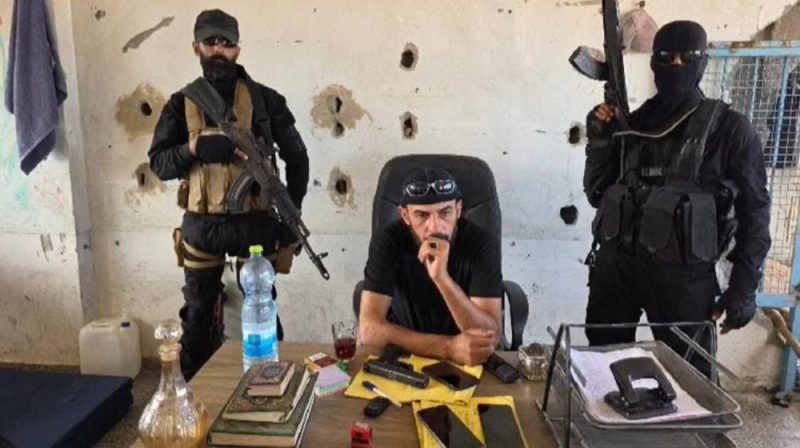
Ashraf al-Mansi (c), the leader of the so-called People’s Army, an anti-resistance terrorist group operating in Gaza. (Photo via social media)
Press TV – October 18, 2025
Two new videos have revealed that the Israeli military is actively supporting anti-Hamas terrorist groups in Gaza with weapons and provisions, according to a report.
The videos, recorded earlier this month and authenticated by Sky News, capture a nighttime convoy of pickup trucks transporting supplies from the direction of an Israeli military base to militia-controlled areas in northern Gaza.
The footage places the convoy about 1.4 kilometers inside Israeli-controlled territory near the Erez border crossing, an area where, according to official data, no humanitarian aid has passed since February.
The vehicles, carrying fuel, water, and food, move through devastated streets before arriving at an abandoned school identified as the headquarters of the so-called People’s Army, led by Ashraf al-Mansi.
Al-Mansi recently released a video warning Hamas against entering areas under his control, saying his group is one of four anti-Hamas militias operating inside Gaza, all within zones still monitored by Israel.
Sky News had previously reported that Israel facilitated the supply of weapons, vehicles, cash, and food to another faction, the so-called Popular Forces, led by Yasser Abu Shabab in southern Gaza.
The new evidence strongly suggests that Israel is now extending the same support to northern factions, flagrantly undermining the ceasefire agreement reached with Hamas on October 9.
The two videos, uploaded by a member of al-Mansi’s group on October 9 and 11, show convoys following the same route from a location less than 400 meters from an Israeli military base.
Although the footage does not show the loading of supplies, several containers on the trucks display the SOS Energy logo, an Israeli fuel supplier.
Neither the Israeli military nor representatives of the so-called People’s Army responded to Sky News’ requests for comment.
Israel’s support for Gaza-based terrorist groups continues as Hamas strives to restore order in the region following the ceasefire.
On Thursday, the Israeli news outlet Mako reported that Hamas had seized 45 pickup trucks, large sums of cash, and hundreds of weapons from Israeli-backed terrorist militias, citing unnamed sources within the Israeli military.
Gaza officials formally accuse Israel of organ theft, demand international probe
The Cradle | October 18, 2025
Gaza’s Government Media Office formally accused Israel on 17 October of stealing organs from Palestinians after Israel returned 120 mutilated bodies following the recent ceasefire, including some who had been tortured to death.
“We formally accuse the Israeli army of stealing organs from the martyrs,” stated Dr. Ismail al-Thawabta, Director General of the Media Office, while demanding an international investigation into Israel’s “torture, mutilation, and organ theft.”
The 120 bodies “arrived in extremely poor and distressing condition,” including blindfolded, bound, crushed under tanks, and missing corneas, livers, and limbs, Thawabta stated.
“The Israeli occupation executed many of them in cold blood. A large number were found blindfolded, with their hands and feet bound, and others showed signs of hanging or close-range gunfire,” he added.
“We also found bodies showing clear evidence of severe torture until death.”
Thawabta explained that Israeli authorities refused to provide the names of the victims, making it extremely difficult for authorities in Gaza to identify them.
After the release of the bodies, families of missing Palestinians rushed to hospitals—especially Nasser Hospital—trying to see if their relatives were among them. But many remain unidentified and will have to be buried anonymously.
“The health system in Gaza is almost completely collapsed. We lack the equipment for DNA testing and forensic analysis. Some families could only identify their loved ones from personal belongings or clothing. If we cannot identify the rest, we will be forced, sadly, to document and bury them anonymously, to preserve human dignity,” Thawabta added.
According to the Media Office’s data, 9,500 Palestinians remain missing, most of them trapped under the rubble of destroyed buildings.
“Entire families—father, mother, children—remain buried for nearly two years,” the Media Office director stated.
The bodies are difficult to locate due to the sheer amount of destruction Israeli bombing has caused, and because Israel has destroyed almost all of Gaza’s heavy machinery, bulldozers, and excavators, preventing rescue operations.
“Even now, despite the ceasefire, all crossings remain closed, and Israel blocks the entry of rescue machinery. This is a humanitarian catastrophe unprecedented in modern history—over 3,000 families completely wiped out, another 6,000 families killed with only one survivor,” Thawabta added.
Authorities in Gaza have reported previous instances of organ theft during the genocide.
In August 2024, Israeli forces returned to Khan Yunis the decomposed bodies of 89 Palestinians in a shipping container.
Authorities were unable to identify the bodies and were forced to bury them in separate body bags in a single large grave near Nasser Hospital.
Israeli forces were also seen taking dozens of bodies from graves and the streets surrounding Al-Shifa Medical Complex and the Indonesian Hospital in the northern Gaza Strip.
Doctors found evidence of organ theft, including missing cochleas and corneas, as well as other vital organs like livers, kidneys, and hearts.
Israel has a long history of stealing the organs of Palestinians.
In 1990, Dr. Hatem Abu Ghazaleh, former chief health official for the West Bank, stated that during the first intifada, “organs, especially eyes and kidneys, were removed from the bodies during the first year or year and a half.”
In 2013, Swedish journalist Donald Bostrom published an article documenting the theft of organs from deceased Palestinians brought to the Israeli National Institute of Forensic Medicine (Abu Kabir) between the First Intifada and the 2012 war in Gaza.
Abu Kabir director and chief pathologist Dr. Yehuda Hiss admitted in a July 2000 interview with US academic Nancy Scheper-Hughes that the institute was secretly taking skin, bones, cardiac valves, corneas, and other human materials from bodies during autopsies.
He described removing not only corneas but whole eyeballs from the bodies of the dead, which would be returned to their families with their eyelids glued shut.
In 1996, Rabbi Yitzhak Ginsburgh, an influential leader within the fundamentalist Jewish group, Chabad-Lubavitch, claimed that Judaism permits organ theft from non-Jews on the basis that Jewish lives are more important than non-Jewish lives.
“If a Jew needs a liver,” he asked, “can you take the liver of an innocent non-Jew passing by to save him? The Torah would probably permit that. Jewish life has infinite value. There is something infinitely more holy and unique about Jewish life than non-Jewish life.”
Victor Davis Hanson Exposed
The Voice of Zionist and Israeli Propaganda in America
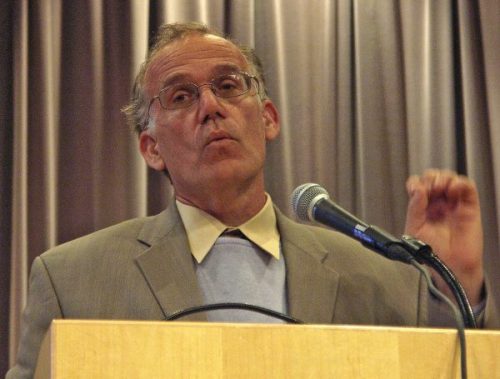
By Jonas E. Alexis • Unz Review • October 15, 2025
Victor Davis Hanson is a military historian and classicist, best known for works such as A War Like No Other: How the Athenians and Spartans Fought the Peloponnesian War, Carnage and Culture: Landmark Battles in the Rise to Western Power, and Who Killed Homer: The Demise of Classical Education and the Recovery of Greek Wisdom.
To be fair, these works are not without merit; Who Killed Homer in particular occupies an important place in the ongoing academic debate over the teaching of the classics. However, Hanson’s analysis collapses entirely when it comes to U.S. foreign policy and the nation’s involvement in perpetual wars across the Middle East and beyond. In The Savior Generals, for instance, he devotes an entire chapter to praising the catastrophic invasion of Iraq in 2003—a debacle that left the region in ruins.[1]
In an apparent attempt to rescue both himself and the neoconservative movement from intellectual and political oblivion, Hanson drew an extraordinary comparison between the Iraq War and the wars of 1777, 1941, and 1950. He went so far as to claim that these conflicts “led to massive American casualties and, for a time, public despair.”[2]
Not once did Hanson acknowledge the incontrovertible fact that the Iraq War was built upon a monumental deception. He never confronted the well-documented reality that the U.S. intelligence community explicitly informed the Bush administration that there was no credible evidence indicating that Saddam Hussein possessed weapons of mass destruction. Nor did he address the fact that President Bush and his inner circle deliberately sought to fabricate and manipulate evidence in order to inundate the American public with the categorical falsehood that Saddam had to be removed.[3]
Hanson made no attempt whatsoever to engage with the vast body of scholarly evidence surrounding these issues.[4] He remained silent on the atrocities committed at Abu Ghraib—the sodomy, humiliation, and torture that forever stained America’s moral standing.[5] Not once did he acknowledge that, prior to the Iraq War, practices such as waterboarding were virtually foreign to the American moral and legal tradition. Nor did he mention that George Washington himself unequivocally repudiated the use of torture, even against enemies who had shown no mercy.[6]
By now, it is a matter of public record that torture at Abu Ghraib was not an isolated incident but a systematic practice. Reports and testimonies confirmed that prisoners were routinely subjected to brutal physical and sexual abuse, including coerced acts of humiliation and violence that defied every principle of human dignity. Even young detainees were not spared such degradation. Official investigations and leaked photographs later revealed the extent of these atrocities, which stand as a permanent indictment of the moral collapse that accompanied the Iraq War. One prisoner testified that he saw one officer
“fucking a kid, his age would be about 15-18 years. The kid was hurting very bad and they covered all the doors with sheets. Then when I heard the screaming I climbed the door because on top it wasn’t covered and I saw [name blacked out], who was wearing the military uniform putting his dick in the little kid’s ass. I couldn’t see the face of the kid because his face wasn’t in front of the door. And the female soldier was taking pictures.”[7]
What’s more even interesting, “150 inmates were crammed into cells designed for 24.”[8] Abu Ghraib, as one writer put it, was “a hell-hole.”[9] Torture was also routine in Afghanistan, where adolescents were beaten with hoses “and pipes and threats of sodomy.”[10] These atrocities were not committed in obscurity. Cambridge University Press has published extensive documentation of such abuses in a volume exceeding 1,200 pages, detailing the systematic nature of the torture and its moral, political, and legal implications.[11] These atrocities were also corroborated by psychiatrists such as Terry Kupers, whose professional assessments provided further evidence of the profound psychological trauma inflicted on the victims and the moral disintegration of those who carried out the abuse.[12]
For Hanson to attempt to wiggle out of this extensive body of scholarship is nothing short of intellectual dishonesty. Since the Iraq War turned out to be an unmitigated disaster—and given that Hanson supported it from its inception[13]—he is now compelled to construct arguments that are at once incoherent and irresponsibly tendentious. This rhetorical contortion serves a dual purpose: to preserve his Neoconservative equilibrium and to justify his well-funded position as a military historian at the Hoover Institution, an establishment known for its distinctly neoconservative orientation.
More importantly, Victor Davis Hanson is a Neocon ideologue and an unapologetic warmonger. He declared without hesitation:
“I came to support neocon approaches first in the wars against the Taliban and Saddam, largely because I saw little alternative—in a post-9-11 effort to stop radical Islam and state sponsors of terror—to removing such odious enemies, and did not think leaving the defeated in power (as in 1991), or leaving in defeat (as in Lebanon), or installing a postbellum strongman was viable or in U.S. interests.”[14]
Hanson, it seems, would prefer deliberate falsehoods over confronting uncomfortable truths. The war in Iraq was never about weapons of mass destruction, precisely because the Neocons themselves were fully aware that Saddam Hussein possessed no weapons of mass destruction.
For example, when Deputy National Security Advisor Stephen Hadley informed Paul Wolfowitz that there was no evidence of a link between Al Qaeda and Saddam Hussein, Wolfowitz responded with certainty, “We’ll find it. It’s got to be there”[15]—effectively signaling that if no such connection existed, they would fabricate one. Ultimately, the Neoconservatives did precisely that, constructing deliberate falsehoods to justify the destruction of an entire nation—Iraq—for the strategic benefit of Israel.
What we are witnessing is an alarming intellectual decline on Hanson’s part. He effectively lost credibility as a serious analyst when he claimed that Iran intended to promote a Jewish Holocaust, despite the fact that Iranian Jews themselves widely denounced Netanyahu for perpetuating similarly alarmist and conspiratorial rhetoric, calling him an “insane vampire.”.[16] And what of Jimmy Carter? Hanson contends that Carter’s positions were effectively aligned with anti-Semitic sentiment.[17] Ignoring Israel’s ongoing ethnic cleansing of Palestinians in the 1940s and beyond, Hanson begins to reconstruct history according to his own narrative: “[Israel] fought three existential wars over its 1947 borders, when the issue at hand was not manifest destiny, but the efforts of its many enemies to exterminate or deport its population.”[18]
Sounding almost unhinged and unwilling to heed reasoned critique, Hanson asserts that, for more than half a century, the Arabs have sought to push “the Jews into the Mediterranean.” There is no serious scholarship, no intellectual or historical rigor, and no defensible argument—only one sweeping assertion after another. Hanson continues: “Over 500,000 Jews have been ethnically cleansed from Arab capitals since 1947, in waves of pogroms that come every few decades.”[19]
The source and historical evidence? According to Hanson, one simply has to take his word for it. His statement is self-referentially “true” because Hanson asserts it to be so. This is the same type of circular reasoning and tautology frequently encountered in so-called scientific discourse—most famously in the notion of “survival of the fittest.” Why did it survive? Because it is the fittest. How do we know it is the fittest? Because it survived.
Yet, long before Hanson began promoting his version of historical fiction, Jewish historians both in the Atlantic world and in Israel had documented a very different reality: Israel has systematically ethnically cleansed the Palestinian population.[20] Listen again to Israeli historian and flaming Zionist Benny Morris:
“A Jewish state would not have come into being without the uprooting of 700,000 Palestinians. Therefore it was necessary to uproot them. There was no choice but to expel that population. It was necessary to cleanse the hinterland and cleanse the border areas and cleanse the main roads. It was necessary to cleanse the villages from which our convoys and our settlements were fired on.”[21]
Israel has consistently undermined peace and stability in the Middle East. A striking example is the 1982 massacre, during which the Israeli military permitted Lebanese militias to attack Palestinian refugee populations. Reports indicate that the militias “raped, killed, and dismembered at least 800 civilians, while Israeli flares illuminated the camps’ narrow and darkened alleyways.”[22]
One year later, an Israeli investigative commission concluded that Israel was “indirectly responsible” for the massacre and that Ariel Sharon bore personal responsibility as an accomplice.[23]
How did Israeli officials involve the United States in these events? According to declassified documents housed in the Israel State Archives, they persuaded U.S. officials that Beirut harbored terrorist cells. Ultimately, this manipulation facilitated the massacre of Palestinian civilians—people whom the U.S. had previously pledged to protect.[24] Ariel Sharon asserted that Beirut harbored between 2,000 and 3,000 terrorists.
The American envoy to the Middle East, Morris Draper, essentially concluded that Sharon was being dishonest. Lawrence S. Eagleburger, then Secretary of State, remarked that “we appear to some to be the victim of deliberate deception by Israel.”[25]
During his conversation with Sharon, Draper understood that the United States did not fully endorse Sharon’s aggressive plans. Nevertheless, Sharon proceeded to act on his own terms. It was reported that Draper told Sharon, “You should be ashamed. The situation is absolutely appalling. They’re killing children! You have the field completely under your control and are therefore responsible for that area.”[26]
In the aftermath of the massacre, President Ronald Reagan, himself a Zionist, expressed outrage. Secretary of State George P. Shultz acknowledged that the United States had effectively become an accomplice, allowing Israel to manipulate U.S. policy to facilitate the slaughter of civilians. Yet no sanctions were imposed, and no concrete actions were taken. When asked why, Nicholas A. Veliotes, then Assistant Secretary of State for Near Eastern Affairs, offered an indirect explanation: “Vintage Sharon. It is his way or the highway.”[27] Scholar Seth Anziska declares, “The Sabra and Shatila massacre severely undercut America’s influence in the Middle East, and its moral authority plummeted.”[28]
How might Hanson respond? Would he dismiss the archival evidence meticulously documented by Morris Draper and Ilan Pappe in their respective studies? Would he evade the fact that Israel has often acted as a destabilizing force in the Middle East? The answer is likely that we will never know, because Hanson systematically avoids engaging with such historical scholarship. Instead, he prefers silence, selectively ignoring a substantial body of evidence that contradicts his narrative.
If you still doubt this, pick up Hanson’s recent book, The End of Everything. In it, he reads as if he’s on the verge of a heart attack at the mere thought of Iran possessing nuclear weapons. He writes:
“The specter of a soon to be nuclear theocratic Iran that professes it can survive a nuclear exchange, or at least find the ensuing postmortem paradise preferrable to the status quo ante bellum, ensures a dangerous state of affairs, especially amid recent proxy wars between Iran and nuclear Israel in Gaza, Lebanon, and Syria.”[29]
What Hanson never dares to tell his readers is that Iran has signed the Non-Proliferation Treaty, whereas Israel has not—and consistently insists on a double standard. Israel itself poses a global threat, declaring that if it falls, it will take the world down with it. Listen to Israeli historian Martin van Creveld’s chilling warning:
“We possess several hundred atomic warheads and rockets and can launch them at targets in all directions, perhaps even at Rome. Most European capitals are targets for our air force… We have the capability to take the world down with us. And I can assure you that that will happen before Israel goes under.”[30]
Shouldn’t Hanson be concerned about this? Or is he so dazzled by Israeli and neocon propaganda that he cannot think clearly, leaving him both intellectually and historically crippled? Like his fellow neocons, Hanson will never consult objective, scholarly materials that challenge his thesis on Iran and Israel. For instance, he won’t touch Trita Parsi’s trilogy on Iran, published by Yale University Press, nor will he engage with studies such as Intelligence and U.S. Foreign Policy: Iraq, 9/11, and Misguided Reform—apparently because doing so would undermine his neoconservative agenda.[31]
Hanson’s 2021 book, The Dying Citizen: How Progressive Elites, Tribalism, and Globalization Are Destroying the Idea of America, is nothing short of propaganda. Why? Because a look at the very foundations of the United States reveals that the Founding Fathers themselves rejected the notion of making unconditional alliances with any foreign power—let alone Israel. So how did Hanson and his neocon allies become defenders of a country that has brought nothing but misery to the United States? The term “progressive elites” might be more aptly applied to Hanson and his cohort, as they have sought to fundamentally alter the principles articulated by the Founding Fathers.
In The Dying Citizen, Hanson risibly declares that he is deeply concerned about “how putting global concerns above national interests insidiously erodes the financial health, freedoms, and safety of Americans. In blunter terms, when American elites feel their first concerns are with the world community abroad rather than with the interests of their own countrymen, there are consequences for American citizens.”[32] Does this man ever look in the mirror and realize that he too has contributed to the economic disaster that followed the Iraq War—a war that will cost the United States at least six trillion dollars?[33] Think for a moment: what could a single country do with such an enormous sum? Virtually every American could have access to decent health care and an affordable college education. Yet Hanson cannot confront these fundamental issues because he remains blinded by the neoconservative and Israeli agenda.
Hanson reminds me of Thomas Sowell, who has offered many valuable insights in his books, yet Sowell too seems intellectually constrained by the Israeli propaganda machine. Much of what Sowell has written over the years—including Education: Assumptions versus History and Affirmative Action: An Empirical Study—is accurate. I must admit, I had to do some serious rethinking when I first read his assessment of slavery.
But Sowell is completely mistaken in his stance on the Middle East. He is essentially echoing what neocons have been asserting for years and appears trapped within the neoconservative worldview. In his 2010 book Dismantling America, Sowell declares:
“With Iran moving toward the development of nuclear weapons, we are getting dangerously close to that fatal point of no return on the world stage… The Iranian government itself is giving us the clearest evidence of what a nuclear Iran would mean, with its fanatical hate-filled declarations about wanting to wipe Israel off the face of the earth.”[34]
What was particularly striking about this extraordinary claim is that Sowell provided not a single piece of evidence for it—an intellectually embarrassing omission that undermines much of his own work. When I finished reading The Vision of the Anointed, I contacted Sowell to express my appreciation for his work, to which he politely replied, “Thank you.” However, after reading Dismantling America and asking him for evidence supporting some of his assertions, he never responded. He continues to warn about “the fatal danger of a nuclear Iran,” yet there is no way to assess these authoritative—and indeed dogmatic—claims because Sowell offers not a shred of evidence.
Sowell serves the neocons and warmongers in the United States in a manner similar to what Charles Murray does for neocon think tanks like the American Enterprise Institute. After supporting the invasion of Iraq for years and writing positively about progress there in works such as Intellectuals and Society,[35] Sowell later wrote in 2015: “Whether it was a mistake to invade Iraq in the first place is something that will no doubt be debated by historians and others for years to come.”[36] Sowell then advanced a claim that directly contradicts all available evidence regarding the Iraq War:
“But, despite things that could have been done differently in Iraq during the Bush administration, in the end President Bush listened to his generals and launched the military ‘surge’ that crushed the terrorist insurgents and made Iraq a viable country.”[37]
Iraq is a “viable country”? Sowell echoes the same tired mantra in Intellectuals and Society, insisting that the “Iraq surge” was a success—even in the face of abundant evidence proving otherwise. He writes: “Eventually, claims that the surge had failed as predicted faded away amid increasingly undeniable evidence that it had succeeded.”[38] Where has this man been living for the past ten years? One would have to be morally and intellectually blind to come up with such nonsense. Consider the perspective of retired U.S. Army Armor Branch officer and military historian Andrew J. Bacevich:
“Apart from a handful of deluded neoconservatives, no one believes that the United States accomplished its objectives in Iraq, unless the main objective was to commit mayhem, apply a tourniquet to staunch the bleeding, and then declare the patient stable while hastily leaving the scene of the crime… The fighting in Afghanistan and Iraq has exacted a huge price from the U.S. military—especially the army and the Marines. More than 6,700 soldiers have been killed so far in those two conflicts, and over fifty thousand have been wounded in action, about 22 percent with traumatic brain injuries. Furthermore, as always happens in war, many of the combatants are psychological casualties, as they return home with post-traumatic stress disorder (PTSD) or depression.
“The Department of Veterans Affairs reported in the fall of 2012 that more than 247,000 veterans of the Afghanistan and Iraq wars have been diagnosed with PTSD. Many of those soldiers have served multiple combat tours. It is hardly surprising that the suicide rate in the U.S. military increased by 80 percent from 2002 to 2009, while the civilian rate increased only 15 percent. And in 2009, veterans of Iraq were twice as likely to be unemployed as the typical American. On top of all that, returning war veterans are roughly four times more likely to face family-related problems like divorce, domestic violence and child abuse than those who stayed out of harm’s way.
“In 2011, the year the Iraq War ended, one out of every five active duty soldiers was on antidepressants, sedatives, or other prescription drugs. The incidence of spousal abuse spiked, as did the divorce rate among military couples. Debilitating combat stress reached epidemic proportions. So did brain injuries. Soldier suicides skyrocketed.”[39]
As Dismantling America progresses, it becomes clear that Sowell is entirely ensnared in the neoconservative matrix. He asserts, “Iran, for example, has for years ignored repeated U.N. resolutions and warnings against building nuclear facilities that can produce bombs.”[40] In 2012, Sowell wrote in the National Review that Iran was “well on its way to being able to produce more than the two bombs that were enough to force Japan to surrender in 1945.”[41]
This mantra has been repeated endlessly, yet no one has produced any scholarly or academic evidence to support it. In fact, the available scholarship directly refutes this frivolous claim. Paul R. Pillar, an academic and 28-year veteran of the CIA, has stated that Iran is not a threat to global peace. Remarkably, Pillar even made the controversial claim that we could coexist with Iran possessing nuclear weapons.[42] Sowell’s stance only confirms what Andrew J. Bacevich warned in 2012 in his article “How We Became Israel”:
“U.S. national-security policy increasingly conforms to patterns of behavior pioneered by the Jewish state. This ‘Israelification’ of U.S. policy may prove beneficial for Israel. Based on the available evidence, it’s not likely to be good for the United States.”[43]
Both Sowell and Hanson have, in effect, become ideological extensions of Israel—perpetuating hoaxes, fabrications, and at times outright falsehoods about the Israel–Palestine conflict and the broader Middle East. Consider Hanson’s statement that “the radical Iranian ayatollah Ali Khamenei could freely tweet about destroying Israel.”[44]
What have Iranian representatives actually been saying for more than fifty years? Khomeini once declared that “international Zionism is using the United States to plunder the oppressed people of the world.” To understand this statement properly, we must place it within its historical context. Khomeini coined the term “the Great Satan” in 1979 largely because he had witnessed firsthand what “international Zionism” and Western powers were doing throughout the Middle East and beyond. It’s important to remember that the Anglo-American coup in Iran in 1953 effectively vindicated much of Khomeini’s suspicion about foreign interference and exploitation.
“There is no crime America will not commit in order to maintain its political, economic, cultural, and military domination of those parts of the world where it predominates,” Khomeini said back in 1979. “By means of its hidden and treacherous agents [i.e., the Neoconservatives and other warmongers], it sucks the blood of the defenseless people as if it alone, together with its satellites, had the right to live in this world. Iran has tried to sever all its relations with this Great Satan and it is for this reason that it now finds wars imposed upon it.”[45]
Khomeini’s uncomfortable yet largely accurate observation remains relevant today. If anyone doubts this, they need only look at how Israel and the neocons in the United States have systematically contributed to the destruction of one Middle Eastern nation after another—from Iraq and Afghanistan to Syria and Libya. It must also be noted that these figures show little genuine concern for the well-being of the American people. Their priority has long been the pursuit of an aggressive foreign policy in the Middle East that consistently serves particular geopolitical interests rather than U.S. national ones. As my colleague Vladimir Golstein of Brown University once remarked, neoconservatives are incapable of understanding political reality.[46] In that sense, they cannot construct a coherent worldview without resorting to double standards. Scholar Michael MacDonald has documented this tendency in detail:
“As [the Neocons] were mocking Clinton in the late 1990s as cowardly for his caution in the face of Saddam’s brutality, central Africa was engulfed in war and chaos. Around 5,400,000 people, mostly in Congo, perished in the convulsions and the starvation and disease they caused from 1998 to 2003.
“Yet the Weekly Standard, a reliable guide to neoconservative priorities, published just two stories on Congo during these years. In the same time span it published 279 articles on Iraq. Neoconservatives were bent on projecting power in the Middle East, not on engaging in humanitarian do-goodism.”[47]
The fact that Khomeini emphasized “international Zionism” shows that his criticism was not directed at ordinary Americans—most of whom have little understanding of the geopolitical realities in the Middle East—but at the powerful political and ideological networks that have shaped U.S. policy there for decades. His warning pointed to the continuing suffering of Palestinians since 1948, a reality well documented by numerous human-rights organizations. If one prefers more recent examples, the wars and interventions in Iraq, Afghanistan, Libya, Pakistan, Yemen, and Syria provide ample evidence of how destructive these policies have been.
Hanson objects to Iran’s use of expressions such as “the Zionist regime,” suggesting that such terminology reflects an illegitimate or hostile stance that must be rejected. Yet, he never addresses how figures within the Israeli establishment—including certain rabbis and political leaders—have themselves described Palestinians and Arabs in dehumanizing terms. For example, Rabbi Yaacov Perrin once stated, “One million Arabs are not worth a Jewish fingernail,”[48] while MK Rabbi Eli Ben-Dahan referred to Palestinians as “beasts, not human.” Ben-Dahan further asserted that “a Jew always has a much higher soul than a gentile, even if he is a homosexual.”[49]
Were such remarks uttered by religious or political figures in a Muslim-majority country, they would undoubtedly provoke international outrage and intense media scrutiny. Yet when similar statements emanate from Israeli officials, they are largely ignored or downplayed by major Western outlets. This double standard raises important ethical and political questions. How can Middle Eastern nations be expected to engage in meaningful cooperation with Israel when the Israeli leadership and certain religious authorities display open contempt for the very people with whom they must coexist? More importantly, why do historians such as Hanson fail to meaningfully engage with these issues in any of their books? Listen to Hanson very carefully in his book Between War and Peace Lessons from Afghanistan to Iraq:
“Palestinians appeal to the American public on grounds that three or four times as many of their own citizens have died as Israelis. The crazy logic is that in war the side that suffers the most casualties is either in the right or at least should be the winner. Some Americans nursed on the popular ideology of equivalence find this attractive. But if so, they should then sympathize with Hitler, Tojo, Kim Il Sung, and Ho Chi Minh, who all lost more soldiers —and civilians—in their wars against us than we did. Perhaps a million Chinese were casualties in Korea, ten times the number of Americans killed, wounded, and missing. Are we, then, to forget that the Communists crossed the Yalu River to implement totalitarianism in the south—and instead agree that their catastrophic wartime sacrifices were proof of American culpability? Palestinians suffer more casualties than Israelis not because they wish to, or because they are somehow more moral —but because they are not as adept in fighting real soldiers in the fullfledged war that is growing out of their own intifada.We are told that Palestinian civilians who are killed by the Israeli Defense Forces are the moral equivalent of slaughtering Israeli civilians at schools, restaurants, and on buses. That should be a hard sell for Americans after September 11, who are currently bombing in Afghanistan to ensure that there are not more suicide murderers on our shores. This premise hinges upon the acceptance that the suicide bombers’ deliberate butchering of civilians is the same as the collateral damage that occurs when soldiers retaliate against other armed combatants.”[50]
It is important to note that Hanson, as a historian, makes these claims without citing a single serious scholarly source to substantiate them. A considerable body of balanced academic research exists that he appears to have disregarded, including works produced by Israeli and Zionist historians such as Benny Morris and others.[51] Morris declared unambiguously:
“A Jewish state would not have come into being without the uprooting of 700,000 Palestinians. Therefore it was necessary to uproot them. There was no choice but to expel that population. It was necessary to cleanse the hinterland and cleanse the border areas and cleanse the main roads. It was necessary to cleanse the villages from which our convoys and our settlements were fired on.”[52]
Does Hanson genuinely maintain that the Palestinians themselves are to blame for the process of ethnic cleansing carried out under the pretext of combating terrorism? Only an Israeli or Zionist ideologue could plausibly sustain the kind of argument that Hanson is advancing.
Moreover, people like Hanson would never have the intellectual courage to address the issue of Jewish terrorism,[53] as doing so would evidently undermine the foundations of their otherwise unsubstantiated arguments. Israel has even been implicated in acts of terrorism against the United States,[54] yet this remains of little concern to Neocon puppets such as Hanson, who continue to promote the view that support for Israel is necessary.[55]
Notes
[1] Victor Davis Hanson, The Savior Generals: How Five Great Commanders Saved Wars That Were Lost—From Ancient Greece to Iraq (New York: Bloomsbury Books, 2013), chapter 5.
[2] Victor Davis Hanson, The Father of Us All: War and History—Ancient and Modern (New York: Bloomsbury Books, 2010), 12.
[3] See for example Vincent Bugliosi, The Prosecution of George W. Bush for Murder (New York: Perseus Books, 2008).
[4] See for example Paul R. Pillar, Intelligence and U.S. Foreign Policy: Iraq, 9/11, and Misguided Reform (New York: Columbia University Press, 2011); Murray Friedman, The Neoconservative Revolution: Jewish Intellectuals and the Shaping of Public Policy (Cambridge: Cambridge University Press, 2005); Stefan Halper and Jonathan Clarke, America Alone: The Neo-Conservatives and the Global Order (Cambridge: Cambridge University Press, 2004); Bob Drogin, Curveball: Spies, Lies, and the Con Man Who Caused a War (New York: Random House, 2007); John J. Mearsheimer and Stephen M. Walt, The Israel Lobby and U.S. Foreign Policy (New York: 2007). More scholarly studies have been published recently Stephen M. Walt, The Israel Lobby and US Foreign Policy (New York: Farrar & Straus, 2007); More scholarly studies have been published recently: Michael MacDonald, Overreach: Delusion of Regime Change in Iraq (Cambridge: Harvard University Press, 2014); John M. Schuessler, Deceit on the Road to War: Presidents, Politics, and American Democracy (New York: Cornell University Press, 2015).
[5] See Karen J. Geenberg and Joshua L. Dratel, eds., The Torture Papers: The Road to Abu Ghraib (New York: Cambridge University Press, 2004); Lila Rajiva, The Language of Empire: Abu Ghraib and the American Media (New York: Monthly Review Press, 2005); Alfred McCoy, A Question of Torture: CIA Interrogation, From the Cold War to the War on Terror (New York: Owl Books, 2006); Mark Danner, Torture and Truth: America, Abu Ghraib, and the War on Terror (New York: New York Review of Books, 2004); Dana Priest and Joe Stephens, “Secret World of U.S. Interrogation,” Washington Post, May 11, 2004; for similar reports, see Jane Mayer, “The Black Sites: A Rare Look inside the C.IA.’s Secret Interrogation Program,” New Yorker, August 13, 2007; Craig Whitlock, “Jordan’s Spy Agency: Holding Cell for the CIA,” Washington Post, December 1, 2007. Jane Mayer, The Dark Side: The Inside Story of How the War on Terror Turned into a War on American Ideals (New York: Anchor Books, 2009).
[6] David Hackett Fischer, Washington’s Crossing (New York: Oxford University Press, 2004).
[7] Cited in Mark Danner, Torture and Truth: America, Abu Ghraib, and the War on Terror (New York: New York Review of Books, 2004), 243.
[8] Susan Taylor Martin, “Her Job: Lock Up Iraq’s Bad Guys,” St. Petersburg Times, December 14, 2003.
[9] Alfred McCoy, A Question of Torture: CIA Interrogation, From the Cold War to the War on Terror (New York: Owl Books, 2006), 132.
[10] See for example Alissa J. Rubin, “Anti-Torture Efforts in Afghanistan Failed, U.N. Says,” NY Times, January 20, 2013.
[11] Karen J. Geenberg and Joshua L. Dratel, eds., The Torture Papers: The Road to Abu Ghraib (New York: Cambridge University Press, 2004).
[12] See for example Lila Rajiva, The Language of Empire: Abu Ghraib and the American Media (New York: Monthly Review Press, 2005), 167.
[13] Victor Davis Hanson, “On Loathing Bush: It’s Not About What He Does,” National Review, August 13, 2004.
[14] Victor Davis Hanson, “Catching up With Correspondence,” PJ Media, June 20, 2008.
[15] Thomas E. Ricks, “Fear Factor,” NY Times, October 5, 2012.
[16] “Iran’s Jewish parliamentarian calls Netanyahu an ‘insane vampire’ over Persia comparison,” Jewish Telegraphic Agency, March 14, 2017.
[17] Victor Davis Hanson, “Israel Did It!: When in Doubt, Shout About Israel,” National Review, December 15, 2006.
[18] Victor Davis Hanson, “The New Anti-Semitism,” Hoover.org, March 28, 2012.
[19] Ibid.
[20] See for example Zeev Sternhell , The Founding Myths of Israel (Princeton: Princeton University Press, 1998); Ilan Pappe, The Forgotten Palestinians: A History of the Palestinians in Israel (New Haven: Yale University Press, 2011); Benny Morris, The Birth of the Palestinian Refugee: Problem Revisited (Cambridge: Cambridge University Press, 2003); Ilan Pappe , The Ethnic Cleansing of Palestine (London: One World Publications, 2007). Benny Morris, 1948: A History of the First Arab-Israeli War (New Haven: Yale University Press, 2008).
[21] Ari Shavit, “Survival of the Fittest? an Interview with Benny Morris,” Counterpunch, May 23, 2010.
[22] Seth Anziska, “A Preventable Massacre,” NY Times, September 16, 2012.
[23] Ibid.
[24] See “Declassified Documents Shed Light on a 1982 Massacre,” NY Times, September 16, 2012.
[25] Anziska, “A Preventable Massacre,” NY Times, September 16, 2012.
[26] Thomas E. Ricks, “Fear Factor,” NY Times, October 5, 2012.
[27] Anziska, “A Preventable Massacre,” NY Times, September 16, 2012.
[28] Ibid.
[29] Victor Davis Hanson, The End of Everything: How Wars Descend into Annihilation (New York: Basic Books, 2024), kindle edition.
[30] Quoted in “The War Game,” Guardian, September 21, 2003.
[31] Trita Parsi , Treacherous Alliance: The Secret Dealings of Israel, Iran, and the United States (New Haven: Yale University Press, 2008); A Single Roll of the Dice: Obama’s Diplomacy with Iran (New Haven: Yale University Press, 2012); Losing an Enemy: Obama, Iran, and the Triumph of Diplomacy (New Haven: Yale University Press, 2017); Paul R. Pillar, Intelligence and U.S. Foreign Policy: Iraq, 9/11, and Misguided Reform (New York: Columbia University Press, 2011); John J. Mearsheimer, Why Leaders Lie: The Truth About Lying in International Politics (Oxford: Oxford University Press, 2011) .
[32] Victor Davis Hanson, The Dying Citizen: How Progressive Elites, Tribalism, and Globalization Are Destroying the Idea of America (New York: Basic Books, 2012), 269.
[33] Ernesto Londono, “Study: Iraq, Afghan war costs to top $4 trillion,” Washington Post, March 28, 2013; Bob Dreyfuss, The $6 Trillion Wars,” The Nation, March 29, 2013; “Iraq War Cost U.S. More Than $2 Trillion, Could Grow to $6 Trillion, Says Watson Institute Study,” Huffington Post, May 14, 2013; Mark Thompson, “The $5 Trillion War on Terror,” Time, June 29, 2011; “Iraq war cost: $6 trillion. What else could have been done?,” LA Times, March 18, 2013.
[34] Thomas Sowell, Dismantling America (New York: Basic Books, 2010), 48.
[35] Thomas Sowell, Intellectuals and Society (New York: Basic Books, 2009), chapter 7.
[36] Thomas Sowell, “Who Lost Iraq?,” Jewish World Review, June 9, 2015.
[37] Ibid.
[38] Sowell, Intellectuals and Society, 271.
[39] Andrew Bacevich, Breach of Trust: How Americans Failed their Soldiers and Their Country (New York: Metropolitan Books, 2013), 94, 105.
[40] Sowell, Dismantling America, 31.
[41] Thomas Sowell, “Democrats, God, and Jerusalem,” National Review, September 11, 2012.
[42] Paul R. Pillar, “Waltz and Iranian Nukes,” National Interest, June 20, 2012. Paul R. Pillar, “We Can Live with a Nuclear Iran,” Washington Monthly, March/April 2012.
[43] Andrew J. Bacevich, “How We Became Israel,” American Conservative, September 10, 2012.
[44] Hanson, The Dying Citizen, 342.
[45] Quoted in E. Michael Jones, “The Great Satan and Me: Reflections on Iran and Postmodernism’s Faustian Pact,” Culture Wars, July/August, 2015.
[46] Jonas E. Alexis and Vladimir Golstein, “Globalists and Neocons Prove Incapable of Understanding Reality,” VT, July 4, 2016.
[47] Michael MacDonald, Overreach: Delusions of Regime Change in Iraq (Cambridge: Harvard University Press, 2014), 100.
[48] Quoted in Clyde Haberman, “West Bank Massacre; Israel Orders Tough Measures Against Militant Settlers,” NY Times, February 28, 1994.
[49] Philip Weiss, “Netanyahu deputy charged with administering Palestinians says they are ‘beasts, not human,’” Mondoweiss.com, May 9, 2015.
[50] Victor Davis Hanson, Between War and Peace Lessons from Afghanistan to Iraq (New York: Random House, 2004), 23-24.
[51] See for example Benny Morris, The Birth of the Palestinian Refugee Problem Revisited (Cambridge: Cambridge University Press, 1998); Righteous Victims: A History of the Zionist-Arab Conflict, 1881-2001 (New York: Vintage, 2001); 1948: A History of the First Arab-Israeli War (New Haven: Yale University Press, 2008); Ilan Pappe, The Forgotten Palestinians: A History of the Palestinians in Israel (New Haven: Yale University Press, 2011); The Ethnic Cleansing of Palestine (London: Oneworld Publications, 2007); Sara Roy, Hamas and Civil Society in Gaza (Princeton: Princeton University Press, 2013).
[52] Ari Shavit, “Survival of the Fittest: An Interview with Benny Morris,” Counterpunch, May 23, 2010.
[53] Ami Pedahzur and Arie Perliger, Jewish Terrorism in Israel (New York: Columbia University Press, 2011); Ronen Bergman, Rise and Kill First: The Secret History of Israel’s Targeted Assassinations (New York: Random House, 2019).
[54] James Scott, The Attack on the Liberty: The Untold Story of Israel’s Deadly 1967 Assault on a U.S. Spy Ship (New York: Simon & Schuster, 2009); James M. Ennes, Assault on the Liberty (New York: Random House, 1979); A. Jay Cristol, The Liberty Incident: The 1967 Israeli Attack on the U.S. Navy Spy Ship (Dulles, VA: Bassey’s Inc., 2002).
[55] Hanson, Between War and Peace, chapters 10-14.
Toxic AIPAC
By Adam Dick | Peace and Prosperity Blog | October 16, 2025
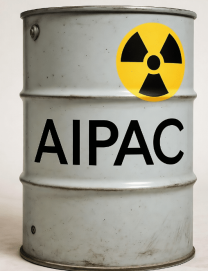 On Wednesday, Seth Moulton, a Democratic member of the United States House of Representatives from Massachusetts, announced he is running for the US Senate in a Democratic primary challenge to incumbent Sen. Ed Markey (D-MA). The next day, Moulton made another announcement — that he is returning all contributions he has received from the American Israel Public Affairs Committee (AIPAC) and refusing to accept any more AIPAC donations or support.
Is the timing coincidence for this candidate who has received AIPAC money while in the House, or has Moulton’s nascent Senate campaign recognized it can do better in its primary challenge against Markey if Moulton can disassociate himself from AIPAC? The latter seems the likely answer. AIPAC is disliked by many people for its pulling of levers behind the scenes to ensure Congress members keep supporting the US government giving massive financial and military support to the Israel government despite opposition from the American public.
AIPAC can and does give candidates a lot of money. But, at least for some campaigns, the toxicity of being connected to AIPAC can impose a cost greater than the benefit AIPAC’s money can buy.
Jacques Baud: Borderless Israel & Gaza Pause
Glenn Diesen | October 14, 2025
Colonel Jacques Baud is a former military intelligence analyst in the Swiss Army and the author of many books. Baud discusses the temporary pause in the Gaza conflict and the absence of a new status quo and clear Israeli borders.
Once Again, Jeremy Bowen Is Misleading the British Public About Gaza
By Jonathan Cook | October 15, 2025
Yet again the BBC’s Jeremy Bowen is misrepresenting a key issue in Gaza – and as always, he is doing so in a way that places Israel in the most flattering light possible.
The BBC’s international editor notes two reasons why Hamas will not wish to disarm, as stipulated by Israeli and US officials:
a) Because having weapons is “deep in their ideological DNA”.
b) Because Hamas are worried that, if they are not armed, “there are plenty of people out there in Gaza who would like to take revenge on them and will come after them”.
Notice two things here:
First, both of these claims are rooted in Israeli rationales for why Hamas needs disarming. Inadvertently or not, Bowen is subtly suggesting that the group is inherently bloodthirsty, and that it does not properly represent the people of Gaza (more on that in a moment).
Second, Bowen ignores the main reason why Hamas wants to keep its weapons, one so obvious that it is simply astounding that he forgot to mention it.
Hamas believes that, if it is not armed, Israel will have an even freer hand to carry out its genocidal policies in Gaza, to continue its decades-long, illegal occupation of Palestinian lands, and to intensify its siege of the enclave. Hamas believes Israel’s violence against the Palestinian people should not be cost-free.
Whether or not one approves of Hamas’ approach – and to do so would be a violation of the UK’s Terrorism Act and could lead to a 14-year jail sentence – Bowen is required to report what the group actually thinks. Otherwise he is not a journalist, he is just another western propagandist.
Instead, he is actively misleading the British public both about Hamas’ worldview and about a core issue – Hamas’ disarmament – that could soon give Israel the excuse it seeks to trash the ceasefire agreement.
Like the rest of the BBC’s coverage, Bowen’s reporting refuses to address the elephant in the room: that Palestinians are caught in a trap crafted for them by the West. If they try to resist their illegal occupation by Israel, they are slaughtered and damned as terrorists. But if they don’t, they must live as permanent prisoners of an illegal, dehumanising occupation.
A further point: Bowen says Hamas are using their weapons to take on “armed clans who have weapons themselves – to reassert their power, to send a message to Gazans, ‘Don’t mess with us’.”
Bowen, of course, carefully ignores the part Israel has played in arming these criminal clans and letting them steal food aid. The clans sold that aid at inflated prices to a small section of Gaza’s population who could still afford to pay, while everyone else starved.
One doesn’t need to be a genius, or Hamas sympathiser, to imagine – contrary to Bowen’s implication that Hamas is widely feared by the population – that most people there may be relieved to see Hamas back and taking on the criminal gangs that extorted them and were central to the implementation of Israel’s genocidal starvation campaign.
Israel delivers Palestinian bodies shackled, showing signs of execution
The Cradle | October 15, 2025
The bodies of dozens of Palestinians were handed over to health authorities in Gaza on 15 October, arriving in shackles and bearing signs of execution.
The handover came as part of a swap which saw several deceased Israeli captives released earlier on Wednesday, and coincided with continued Israeli ceasefire violations.
“Some are blindfolded, and there are signs of gunshot wounds in some cases, while others have been run over by tanks,” officials at Khan Yunis’s Nasser Hospital told CNN, adding that the bodies arrived “with their hands and legs cuffed.”
Three out of the four deceased Israeli captives handed over earlier in the day were identified. Tel Aviv said forensic testing showed one of them is not an Israeli captive.
Israel is accusing Hamas of violating the deal by delaying the release of around 20 bodies of captives that remain in Gaza. However, the Red Cross has confirmed that the amount of rubble caused by strikes has made it extremely difficult to find them, and has warned that some may never be recovered.
Tel Aviv is reportedly planning to reduce the amount of aid it will allow into Gaza as part of the deal until all the bodies are released.
The agreement states that six hundred aid trucks are meant to enter the strip. Despite this, not enough trucks have been given entry.
Dozens of Israeli ceasefire violations have been recorded since the truce took effect.
The Gaza Center for Human Rights reported that the Israeli military committed 36 violations of the ceasefire since it took effect on 10 October, resulting in the killing of at least seven Palestinian civilians and the injury of others. Other reports say nine have been killed.
The violations included aerial and artillery bombardments as well as live fire, concentrated in the eastern and northern areas of the Gaza Strip.
Israeli drones targeted residents inspecting their homes in the Shujaiya neighborhood, killing five people, while additional strikes in Khan Yunis, Jabalia, and Rafah caused further casualties.
The center stressed that these attacks were carried out without any military justification, aiming to maintain an atmosphere of fear and terror in the strip.
It also noted Israel’s continued control over aid entry, allowing only 173 aid trucks in out of 1,800 expected in recent days.
The organization warned that restricting essential supplies constitutes an extension of genocidal policies through starvation, in violation of international humanitarian law, and called on the international community to pressure Israel to fully implement the ceasefire and investigate war crimes and acts of genocide.
Tied and beaten: Freed Gaza detainees say abuse ended as it began
Al Mayadeen | October 15, 2025
Gaza resident Naseem al-Radee was released from Israeli prisons, partially blind and physically broken, only to learn that his wife and children had been killed during “Israel’s” genocide in Gaza.
Before his release, Israeli prison guards decided to send Naseem al-Radee off with what they called a “farewell”. They tied his hands, forced him to the ground, and beat him brutally, ending his 22-month imprisonment the same way it began: with brutality.
When al-Radee finally caught sight of Gaza again after nearly two years, his vision was blurred from a boot to the eye, leaving him partially blind for days. The 33-year-old government worker from Beit Lahia said his eyesight problems were just one of many injuries he sustained during his detention.
Israeli occupation forces had arrested al-Radee on December 9, 2023, from a school-turned-shelter in Gaza. Over the next 22 months, he was shuffled between several Israeli detention centers, spending 100 days in an underground cell, before being released with 1,700 other Palestinian detainees on Monday.
‘Beating us mercilessly’
Like the others released, al-Radee had never been charged with a crime. His account, marked by physical torture, starvation, and medical neglect, mirrors the testimonies of many others released under similar conditions.
Al-Radee’s ordeal, he said, reflected what the Israeli human rights organization B’Tselem has described as a systemic policy of abuse targeting Palestinian detainees.
“The conditions in the prison were extremely harsh, from having our hands and feet bound to being subjected to the cruelest forms of torture,” al-Radee told The Guardian, describing his time in Nafha prison in al-Naqab desert, his final place of detention.
He explained that the beatings were not random but a daily routine enforced with military precision. “They used teargas and rubber bullets to intimidate us, in addition to constant verbal abuse and insults,” he said.
“They had a strict system of repression; the electronic gate of the section would open when the soldiers entered, and they would come in with their dogs, shouting ‘on your stomach, on your stomach,’ and start beating us mercilessly.”
Tortured, starved, and caged in conditions unfit for human life
According to al-Radee, up to 14 Palestinian detainees were packed into cells meant for five. The unhygienic conditions caused widespread skin and fungal infections, which went untreated. Another recently released detainee, 22-year-old university student Mohammed al-Asaliya, said he contracted scabies while imprisoned in Nafha.
“There was no medical care. We tried to treat ourselves by using floor disinfectant on our wounds, but it only made them worse,” Asaliya said. “The mattresses were filthy, the environment unhealthy, our immunity weak, and the food contaminated.”
He described a notorious section of the prison known as “the disco”, where guards blasted loud music for two days straight as a form of psychological torture. “They also hung us on walls, sprayed us with cold air and water, and sometimes threw chili powder on detainees,” Asaliya added.
Weight loss; a common result
Both men lost significant weight during their detention. Radee said his weight dropped from 93 kilograms to 60, while Asaliya fell from 75 to 42 kilograms at one point.
Palestinian health officials confirmed that many detainees released on Monday arrived in critical condition.
“The signs of beating and torture were clearly visible on the prisoners’ bodies, such as bruises, fractures, wounds, marks from being dragged on the ground, and the marks of restraints that had bound their hands tightly,” said Eyad Qaddih, the public relations director at Nasser Hospital in southern Gaza, which received several of the released detainees.
He added that many had to be rushed to the emergency room and appeared to have been deprived of food for extended periods.
‘Israel’ transformed abuse into official policy
According to the Public Committee Against Torture in “Israel” (PCATI), around 2,800 Palestinians from Gaza remain in Israeli detention without charge. The practice of mass incarceration, rights groups say, has been enabled by legislative changes introduced after 7 October 2023.
An amendment passed in December 2023 to “Israel’s” Unlawful Combatants Law allows for indefinite administrative detention based solely on “reasonable grounds” that a detainee is an “unlawful combatant.”
Israeli human rights advocates argue that the surge in arrests has coincided with a steep deterioration in detention conditions, transforming abuse into an official policy.
“Generally, the amount and scale of torture and abuse in Israeli prisons and military camps has skyrocketed since 7 October. We see that as part of the policy led by Israeli decision-makers such as Itamar Ben-Gvir and others,” said Tal Steiner, executive director of PCATI.
Ben-Gvir, “Israel’s” far-right police minister, has openly boasted of providing detainees with “the minimum amount of food.” In July, he wrote on social media, “I am here to ensure that the ‘terrorists’ receive the minimum of the minimum.”
‘My joy went with her’
For many of the released detainees, however, the greatest pain awaited them at home. Upon returning to Gaza, al-Radee tried to call his wife, only to discover that her phone was disconnected. He later learned that his wife and all but one of his children had been killed during his imprisonment.
“I was very happy to be released because the date coincided with my youngest daughter Saba’s third birthday on 13 October,” he said. “I had planned to make her the best gift to make up for her first birthday, which we could not celebrate because the war had started.”
“I tried to find some joy in being released on this day,” al-Radee added softly, “but sadly, Saba went with my family, and my joy went with her.”
Featured Video

Bombing Hitler’s Hometown
or go to
Aletho News Archives – Video-Images
From the Archives
‘Conspiracy Theory’ Now Fact: Greater Israel Has Arrived
By Kit Klarenberg | Mint Press News | January 28, 2025
Ever since Tel Aviv’s 1948 creation, much has been said and written about ‘Greater Israel’ – the notion Zionism’s ultimate end goal is the forcible annexation and ethnic cleansing of vast swaths of Arab and Muslim lands for Jewish settlement, based on Biblical claims this territory was promised to Jews by God. The mainstream media typically dismisses this concept as antisemitic conspiracy theory, or at most the fringe fantasy of a minuscule handful of extremist Israelis.
In reality … continue
Blog Roll
 Aletho News
- Hezbollah’s Surprise Weapons Redefine Ground Battle with Israel
- Yemen joins fight against US, Israel by firing missiles at occupied territories
- Seizing the Kharg: Washington’s path to defeat in the Persian Gulf
- Iran reports 500 US casualties in strikes on covert US military sites
- Pro-Israel terrorist arrested before assassination of pro-Palestinian activist
- Bombing Hitler’s Hometown
- German journalist threatened with homelessness as German court upholds EU sanctions in landmark free speech case
- US Tells Allies That Ukraine-Bound Arms Could be Sent to Middle East
- Organized terrorism: Iran condemns killing of its diplomats in Lebanon
- Why could Gaza enter the regional war?
- If Americans Knew
- Researchers at Human Rights Watch Resign Over Blocked Report on Palestinian Refugee Return
- Jewish Groups Are Backing a War Americans Don’t Want
- Eric Fingerhut Thinks He’s the President of the Jews
- Top Jewish Philanthropists, Rabbis Urge Israeli President to Take Action Against ‘Jewish Extremists’
- Don’t Be Fooled. Zionist Leaders Have Always Wanted to Control Southern Lebanon
- Israel’s widespread use of torture is a core element of its genocide against the Palestinian people
- In Israel’s War on Iran, Many Middle East US Bases Rendered “All But Uninhabitable”
- ‘Burn the lawn’: Israel pursues ‘Rafah model’ in southern Lebanon
- A genocide here, an amputation there
- Reports: Iran mobilizing 1M fighters, Israel-US run low on ammo, Israeli army faces shortage – Not a ceasefire Day 168
- No Tricks Zone
- Devastating Assessment Of Comirnaty Vaccine By Former Senior Pfizer Europe Toxicologist
- New Study: CO2 Is ‘Effectively Negligible’ As An Explanatory Climate Change Factor Since 2000
- Former Pfizer Toxicologist Dr. Helmut Sterz Tells Bundestag Hearing Pfizer Vaccine Should Have Never Been Approved
- Energy Expert: Germany’s Nuclear Phaseout Was A “500 Billion Euro Mistake”
- New Research: South Australia’s Mid-Holocene Sea Surface Temperatures Were 4°C Warmer Than Today
- Storing Green Energy To Last Germany 10 Days Would Require A 60-Million Tonne Battery
- New Studies: UK Sea Levels Were 4 Meters Higher Than Today During The Mid-Holocene
- Destructive Green New Deal: German Energy And Metal Group Warns Of Drastic Crisis
- New Study Documents A 20-Year Pause In Arctic Sea Ice Decline – Driven By Internal Variability
- Wake-up Call: Survey Shows Majority Of Germans Now Favor Postponing Climate Targets!
 Aletho News