Iraqi PM Calls For Islamic Military Alliance Against Israel
Sputnik – 14.09.2025
Iraqi Prime Minister Mohammed Shia al-Sudani urged Arab and Muslim nations to form a joint security force in response to Israel’s recent strikes in Gaza and Qatar.
He said Tuesday’s Israeli attack on Doha, which killed Hamas members and a Qatari officer, was a “shocking breach of international law” and a threat to regional security.
Sudani stressed that the Islamic world has “numerous levers” to deter Israel, warning that aggression “will not stop at Qatar.”
His remarks came ahead of the Arab-Islamic emergency summit in Doha on Sept 15–16, amid Israeli strikes on Qatar, where leaders are expected to discuss activating the long-proposed joint Arab military force.
Iranian Supreme National Security Council chairman Ali Larijani has also called on Islamic nations to create a “joint operations room” against Israel.
Egypt, meanwhile, is pushing for a NATO-style Arab military force for rapid defense in case of attacks, with Cairo seeking regional backing for the plan ahead of the summit.
The Israeli strike on Doha hit a residential compound where Hamas politburo members were meeting to discuss a US proposal to end the Gaza war, which has already claimed more than 64,800 Palestinian lives since October 2023.
Netanyahu’s Crude Exploitation of Charlie Kirk’s Death to Get the American Right Back into Line
If Americans Knew | September 13, 2025
Journalist Glenn Greenwald provides information on Israeli Prime Minister Benjamin Netanyahu’s misinformation about Charlie Kirk, and on Kirk’s evolving views on Israel-Palestine. System Update, September 12, 2025. Full video at: https://rumble.com/v6yv6nq-system-upd…
Netherlands to join Ireland in Eurovision boycott if Israel competes
The Cradle | September 13, 2025
The Netherlands will boycott the 2026 Eurovision Song Contest if Israel is included, Dutch public broadcaster AVROTROS announced on 12 September.
The decision brings the country in line with Slovenia, Iceland, Spain, and Ireland, which have already declared they will not take part should Israel remain on the line-up.
In its statement, AVROTROS said the event “was founded in 1956 to bring people together after a period of deep division and war.”
While music had always been the contest’s unifying force, it added, the broadcaster could “no longer justify Israel’s participation in the current situation, given the ongoing and severe human suffering in Gaza.”
The Dutch broadcaster also raised concerns about media restrictions, alleging there was “proven evidence of interference by the Israeli government” during the 2025 edition.
It accused Israel of using the contest “as a political instrument”. It argued that “human suffering, the suppression of press freedom and political interference are at odds with the values of public broadcasting.”
Earlier this week, Ireland’s RTÉ declared that its participation would be “unconscionable” while Israel continues its assault on Gaza, enforces a crippling blockade that results in a man-made famine.
The Irish broadcaster said it was disturbed by “the targeted killing of journalists in Gaza, the denial of access to international journalists to the territory and the plight of the remaining hostages.”
Dublin has also joined South Africa’s case at the International Court of Justice, accusing Israel of committing genocide.
Spanish Culture Minister Ernest Urtasun voiced similar concerns, telling La hora de La 1 on TVE that “we cannot normalize Israel’s participation in international events as if nothing is happening.”
He described Israel as a “genocidal government” and warned that if the European Broadcasting Union (EBU) fails to act, “measures will have to be taken.”
The EBU has extended its penalty-free withdrawal deadline to December, with a final decision on Israel’s participation expected at its General Assembly.
The 70th anniversary contest is scheduled to take place in Vienna, with the finale on 16 May 2026.
US lawmakers introduce ‘thought police’ bill to strip citizens of passports over Israel criticism

The Cradle | September 13, 2025
A US congressman is introducing a bill that could potentially be used to deny US citizens the right to travel based solely on their speech, including for criticism of Israel, the Intercept reported on 13 September.
Introduced by Florida Congressman Brian Mast, chair of the House Foreign Affairs Committee, the bill would grant Secretary of State Marco Rubio the power to revoke the passports of US citizens in the same way he has revoked the green cards and visas of foreign nationals in the US for criticizing Israel.
In March, Secretary of State Rubio revoked the visa of Turkish doctoral student Rumeysa Ozturk after she wrote an opinion piece critical of Israel in the Tufts University student newspaper in 2024.
The op-ed did not mention Hamas, but called for boycotting and divesting from Israel.
One section of the bill grants the Secretary of State the ability to deny passports to people determined to have “knowingly aided, assisted, abetted, or otherwise provided material support to an organization the Secretary has designated as a foreign terrorist organization.”
The reference to “material support” disturbs civil liberties advocates because it is vague and can be interpreted to include speech and anti-war activism.
The Anti-Defamation League (ADL), which functions as a front for Israeli intelligence in the US, and the Louis D. Brandeis Center for Human Rights Under Law suggested in a letter last year that Students for Justice in Palestine (SJP) was providing “material support” for Hamas by organizing campus protests against Israel’s genocide of Palestinians in Gaza.
The provision regarding material support to terrorism poses a threat specifically to journalists, The Intercept noted.
In 2023, Senator Tom Cotton of Arkansas demanded a Justice Department “national security investigation” of AP, CNN, The New York Times, and Reuters after they published photos taken by freelance photographers during the Hamas attack on Israeli settlements and military bases on 7 October 2023.
Gaza Inc: Where genocide is battle-tested and market-ready
A scalable model of industrial genocide sold to allies across the globe

By Aymun Moosavi | The Cradle | September 12, 2025
The Israeli occupation state has turned its war on Palestinians into a privatized killing industry. Gaza is where tech firms, mercenaries, and consultancy giants orchestrate surveillance, displacement, and mass death for profit. Apart from being colonial warfare, it is also a prototype for the global export of industrial-scale extermination, repackaged as security innovation. Data-driven and profit-focused, this model, being tested on Palestinians today, will be deployed elsewhere tomorrow. A growing list of private firms now operate as the invisible hand of genocide. Their services range from identifying targets for airstrikes to engineering famine and facilitating mass displacement.
Gaza is where genocide meets capitalism
Since the early 2000s, private military companies (PMCs) have wedged themselves deeply into the economy of war. Firms like Blackwater (now Academi) and Dyncorp International marked a pivotal shift, stepping into roles traditionally held by national militaries.
Initially focused on security and logistics in Iraq and Afghanistan, these companies have expanded their operations, providing combat support and acting as key players in warzones worldwide, including in parts of Africa, Yemen, and Haiti. The irony is evident: The UAE has become a new hub for these private military companies, which find refuge in the Gulf state, where mercenaries receive special privileges from local authorities.
Private companies evolved from distant contractors to active agents of war, operating with impunity. This laid the groundwork for the current model, where non-military personnel influence political outcomes without limits or regulation. Another layer of support comes from private nonprofits. A recent Drop Site News report reveals how US organizations like American Friends of Judea and Samaria (AFJS) and Friends of Israel leverage their 501(c)(3) tax-exempt status to funnel donations directly to Israeli military operations and settlements. These groups supply equipment such as thermal drones, helmets, vests, and first aid kits to units like the 646 Paratrooper Brigade, even inside Gaza. Beyond logistics, they back settlement projects, lobby for the annexation of the occupied West Bank, run educational campaigns promoting Israeli sovereignty, and support military efforts in Lebanon against Hezbollah.
The emergence of artificial intelligence (AI) broadened the scope of acceptable actors of war, opening new, lucrative opportunities in surveillance and intelligence gathering. Israel has embraced this model but applied it with chilling precision. Its elite Unit 8200, the digital brain of the occupation state, has fused military surveillance with corporate tech to create the world’s first AI-assisted genocide. Tools like Lavender and The Gospel now scan Palestinian communications, using dialect recognition and metadata to auto-generate kill lists.
These tools, primarily focused on Arabic dialects, were designed to monitor Palestinians and other Arabic-speaking populations. Companies like Palantir, Google, Meta, and Microsoft Azure have reportedly facilitated these projects, assisting in the development of Lavender and other surveillance systems. Gulf states, particularly Saudi Arabia, invest in global surveillance tech firms that fuel the machinery of genocide.
With AI systems deciding who lives and dies, the line between military command and corporate algorithm has all but vanished. The very infrastructure of Israel’s occupation, from surveillance to assassination, has been outsourced, streamlined, and sold.
From battle-tested weapons to algorithmic apartheid
Israel’s economy is built on militarized capitalism. Its $14.8 billion in weapons sales this year alone are propped up by a marketing line as cynical as it is effective: “battle-tested” on Palestinians. A prime example is Smartshooter’s weaponry, an Israeli firm, being stocked by the UK military since June 2023 in a £4.6-million ($5.7 million) deal. Smartshooter’s technology has been used by the occupation army’s elite Maglan Unit and Golani Brigade during the assault on Gaza.
Journalist Antony Loewenstein was quoted by Declassified as saying:
“Smartshooter is just one of many Israeli companies testing equipment on occupied Palestinians. It’s a highly profitable business and the slaughter in Gaza isn’t slowing down the trade. If anything, it’s increasing due to many nations attracted to the Israeli model of subjugation and control.”
Today, Israel’s arms and tech sectors are indistinguishable. Surveillance software, AI-driven kill lists, and automated targeting systems are packaged alongside rifles and drones. Warfare has become a sandbox for tech innovation, turning Gaza into a lab where privatized genocide is perfected. This fusion has allowed Tel Aviv to industrialize its occupation, creating a modular system of subjugation that can be exported globally. What began as the militarization of tech has become something far more dangerous: the technologization of genocide.
McGenocide
Israel’s model for genocide has international buyers. A recent headline in Haaretz, “Why the future of Israeli defense lies in India,” highlighted the mutual benefits of the Israel–India defense partnership. For Tel Aviv, it reduces reliance on the west, while India gains some strategic leverage in West Asia. Between 2001 and 2021, India imported $4.2 billion worth of Israeli defense technology, including advanced drones and military components.
More recently, Europe became Israel’s biggest arms purchaser, making up to 54 percent of total exports in 2024. In the wake of Brexit and the unpredictability of US President Donald Trump’s administration, Britain, in particular, has strengthened its defense coordination with Israel in an attempt to reposition itself as a key, relevant player in a multipolar order. Reports indicate London is preparing a $2.69-billion deal with Elbit Systems, Israel’s largest weapons manufacturer, to train 60,000 British soldiers annually.
This relationship deepened earlier this year when it was revealed that a British military academy was training occupation army soldiers, many of whom have been implicated in war crimes during the Gaza and Lebanon conflicts. That same Elbit provides 85 percent of the occupation army’s drones and has been repeatedly targeted by the proscribed Palestine Action for its direct role in war crimes. London has not only shielded the company but also ramped up joint operations.
Britain also produces 15 percent of all F-35 fighter jet components. These jets have been used relentlessly in the Gaza genocide, yet their manufacture continues, upheld by British courts despite protests. Far from neutrality, Britain is a stakeholder in Tel Aviv’s genocidal infrastructure. The arms industry has now become a global business, intertwining defense, technology, and systemic oppression. Israel’s model for genocide, which profits directly from this intersection, has spread beyond its borders, with international partners complicit in its success.
Weaponizing aid, redesigning Gaza
Private contractors are now embedded in every layer of Israel’s war machine, including its cynical manipulation of humanitarian aid. The Gaza Humanitarian Foundation (GHF), allegedly set up to facilitate aid, has been exposed for colluding with occupation forces, storing intelligence, and deploying private security firms with zero humanitarian credentials. The role of private companies extends far beyond distant surveillance assistance, infiltrating the mechanisms of humanitarian aid. The GHF has repeatedly come under fire for violating the core principles of aid delivery, such as impartiality and independence. It has been found to fire into crowds, store intelligence, and collaborate with Israeli authorities, while outsourcing private security firms like Safe Reach Solutions (SRS) and UG Solutions (UGS), two private security firms led by personnel with no humanitarian expertise. UGS has recently been exposed as having recruited members of a notorious anti-Islam biker gang from the US. In total, 2,465 Palestinians have been killed and over 17,948 injured while waiting for humanitarian aid in Gaza, according to the Gaza Health Ministry.
The key issue lies in the fact that private companies are not bound by the same ethical standards as traditional humanitarian organisations. This lack of regulation enables them to function as extensions of the occupation, advancing Israel’s goals under the guise of aid with little to no accountability. Privatized aid is therefore not a secondary detail, but a central component of Israel’s genocide model, which transforms humanitarian aid to another tool of occupation.
Scorching the Earth
US President Donald Trump’s ‘Gaza Riviera’ plan and Israeli Prime Minister Benjamin Netanyahu’s vision of mass expulsion both hinge on a complete reimagining of Gaza. Trump’s post-war plan requires a population willing to turn into subjects of an economic hub, while Netanyahu envisions a land cleansed of Palestinians, on which he can erect new illegal settlements. Unlike the imperial model, the genocide model requires the cleansing of a population, as it is easier – and more efficient – to eliminate a population than to make it servile. This makes the privatization of a post-war Gaza not just an option, but a necessity.
According to the Financial Times (FT), Boston Consulting Group (BCG), the US consultancy partly responsible for the establishment of GHF, was reportedly tasked with estimating the cost of Gazan relocation as part of a wider post-war reconstruction plan. Reports also point to the greater reliance on US mercenaries to manage the post-war environment and control the movement of arms, showing how both the imperial model and Israel’s genocide model rely on each other to sustain themselves.
Humanitarian aid has been instrumental in realizing this vision. The four ‘aid distribution’ sites, described by the UN officials as “death traps,” have become militarized zones, driving Palestinians into even smaller enclaves in southern Gaza, directly contributing to Israel’s displacement objective. This is not the future of war. It is the present. And it is being built, tested, and sold in Gaza.
Western media’s pre-existing condition? Gaza atrocity denialism
By Rebecca Ruth Gold | The New Arab | September 10, 2025
In August 2025, for the first time in its 20 year history, the UN-backed Integrated Food Security Phase Classification (IPC) classified Gaza as having reached phase 5, the most acute phase in its system. This classification meant that Gaza was deep into a famine, and many of the starving have already suffered irreversible damage.
The IPC locates Gaza City as being fully within phase 5. The same level of food scarcity is expected to reach Deir al Balah and Khan Younis by late September.
Never before has the IPC made a full phase 5 famine classification outside Africa. It had certainly never reached this classification for a location that was just a few kilometres from world class restaurants. As UN Under-Secretary General Tom Fetcher put it in a memorable speech, the Gaza famine is taking place “within a few hundred meters of food, within a fertile land.”
The Gaza famine has been engineered in a manner that is without precedent in world history. People have described Israel’s siege as medieval, but the famine is backed by the full force of modern technology. Rather than looking to early history for analogies, what is happening in Gaza is best understood as a grotesquely futuristic iteration of modern biopolitics.
“Pre-existing conditions”
Within days of report’s release, Israel immediately called for its retraction. There is nothing unusual about a state that has created a famine pulling all the levers at its disposal to deny it. What makes Israel different from the average perpetrator is the eagerness of US and European media outlets to spread the perpetrator’s denialist narrative.
Already in July, the groundwork had been laid in mainstream outlets like the New York Times, which ran a “correction” to the caption it provided on an image of Mohammed Zakaria al-Mutawaq, a child dying of starvation in Gaza. When the cover image of his emaciated body was used for the story on Gazans dying of starvation, Israel’s Coordinator of Government Activities in the Territories (COGAT), which controls the entry of food and medicine into Gaza, informed the Times that al-Mutawaq was born with cerebral palsy.
Israeli media, including I24 and The Jerusalem Post set to work spreading this misinformation and suggesting that vulnerable individuals dying of starvation could not be treated as evidence of a famine.
Soon after, the Times stated that al-Mutawaq had “pre-existing health problems.” But what they failed to disclose is that this “correction” was made in response to Israeli pressure and that all famines target the vulnerable first. While cerebral palsy is a lifelong condition, it is not typically fatal for young children absent conditions of siege and famine. Had the victims of starvation not been Palestinian, common sense would have prevailed. No one would have found it necessary to make the obvious point that death by starvation combined with co-morbidities is still death by starvation.
Other media outlets soon followed, adjusting their captions to reflect, even in the abstract and untethered from specific cases, the possibility that children dying of starvation were suffering from “preexisting conditions.”
The Associated Press captioned the images on a photo essay by Palestinian photojournalist Jehad Alshrafi documenting how starvation is attacking children’s bodies with the following disclaimer: “In Gaza, malnutrition is often worsened by preexisting conditions and compounded by illnesses linked to inadequate health care and poor sanitation, largely the result of the ongoing war.”
Perhaps the Associated Press thought that they were mitigating the harm done by such captions by acknowledging that these so-called “preexisting conditions” that Israel and its defenders are using to deny evidence of famine are in fact “the result of the ongoing war.” But they should not be excused so easily for their complicity in famine denial.
The “pre-existing conditions” discourse has a dark history in the US, where it was introduced during the 1940s to deny healthcare to ailing patients. Even more ominously in Gaza, the “pre-existing conditions” that the media uses to whitewash famine are themselves the direct result of two decades of siege.
Legitimising Israel’s narratives
The right-wing US media company Free Press further disseminated the Israeli narrative when it published a story claiming that the “symbols of Gazan starvation […] suffer from other health problems.” Once again, ableism was used to deny the Gaza famine.
If the sick were made sicker by Israel’s engineered famine, it was implied that it was their own fault, and Israel could not be blamed for Gaza’s starvation. Yet the “preexisting conditions” cited by the Free Press journalists—rickets and cystic fibrosis—are not typically fatal for young children.
The fact that children in Gaza afflicted with these diseases are at a much higher risk of imminent death only confirms the severity of the famine, as well as its wider impact on conditions of life and mortality rates. Yet some media outlets downplayed the famine by focusing on the medical challenges faced by children who are dying of starvation.
On the very day the IPC released its famine report, CNN redacted its own story on starvation in Gaza by “updating” its captions to “reflect new information regarding the condition of some of the subjects.”
Israeli Prime Minister Netanyahu—himself a war criminal whom the International Criminal Court has indicted with “crimes of starvation,” marking the first time it had ever charged any leader with that crime—endorsed the Free Press story. He did not acknowledge all that his own government had done to undermine accurate reporting and to block data collection on starvation in Gaza.
The Gaza famine is an atrocity, a war crime, and evidence for genocide not just because it leads to deaths from starvation. No less fundamentally, it contributes to the breakdown of a social order. Famine tears communities apart. Mothers are forced to watch their children starve, and children watch their parents risk their lives—sometimes getting shot and killed—while searching for food to keep them alive.
Having normalised famine denialism through a eugenicist discourse in July, Israel was well-prepared to escalate its information warfare when the IPC issued its landmark report in August.
Israel attacked the report on two fronts. First, by falsely claiming that the data was biased. Second, by smearing the report authors due to their alleged political biases. As for the data-related dispute, the official X account for the state of Israel falsely insisted that the IPC had “forged” a famine by lowering the threshold to 15% malnutrition among the general population, as measured by upper-arm circumference. Yet the 15% malnutrition standard, measured according to upper arm circumference, was also relied on for previous IPC reports for other locations that reached a phase 5 famine assessment, including Sudan in 2024 and South Sudan in 2020.
As Jeremy Konyndyk, President of Refugees International concludes, Israel’s misrepresentation “is not a good-faith misread. It is a campaign of concerted disinfo[rmation].” The IPC quickly refuted Israel’s false claims.
Denialism
Food security experts criticise the IPC for being too conservative in its metrics. The general consensus is that the IPC places the bar for phase 5 famine classification too high. By the time famine is assessed by the IPC, mortality rates will have sharply escalated (as happened in Gaza during the second half of July 2025), and for many of those who are starving it will be too late to save them.
Unlike most European countries, the US did not issue any official response to the IPC famine report. On 27 August, during an emergency meeting of the UN Security Council which had been convened to address the famine in Gaza, US Ambassador Dorothy Shea to the UN rejected the report by alleging that one of the authors was biased against Israel. Shea’s critique was based on guilt-by-association and did not engage with the substance of the report’s claims.
The US’s denialist stance was explicitly rejected by all other 14 of the 15 Security Council members, who issued a statement affirming that they “trust the IPC’s work and methodology.” However, this consensus will be meaningless unless further measures are taken in defiance of the US.
Indeed, denialism is a core feature of Israel’s information war and is one reason why the genocide persists. In October 2023, less than three weeks into the Gaza genocide, U.S. President Joe Biden stated that he doubted the veracity of the casualty reports provided by the Palestinian Ministry of Health in Gaza. In a classic case of denying Palestinians the right to narrate their own extermination, he said “I have no confidence in the number that the Palestinians are using.”
These same reports that Biden cast doubt on had been deemed reliable by the United Nations, human rights groups, and mainstream—even the Israeli—media, not to mention Biden’s own State Department.
It was the first time a US President cast doubt on the validity of the figures provided by the Palestinian Ministry of Health.
Subsequent reporting and scholarship has shown that the Ministry of Health’s numbers are likely to be a drastic undercount; importantly, they don’t include indirect deaths from Palestinians who died due to lack of food, water, medicine, and medical care. Yet, mainstream US media started to refer to Gaza’s Ministry of Health as “Hamas-run” in order to undermine the source.
Around the same time, Israel launched a campaign questioning the casualty figures provided by the Palestinian Ministry of Health in Gaza. The Associated Press, The New York Times, The Washington Post, and CNN uncritically absorbed Israel’s messaging and began attaching “Hamas-run” to every reference to casualty figures from the Palestinian Ministry of Health in Gaza.
For no other nation does the media find it necessary to preface every reference to a civilian agency with the name of the political faction governing that country. Civilian agencies ought to be respected for the work they do, wherever they happen to be located.
Ending impunity, sanctions now
The crime of famine often converges in practice with the crime of genocide. For this reason, both kind of denialist narratives often flourish together. Just as complicity in genocide is a crime under international law, so should complicity in famine bring criminal sanctions.
In the first days of September 2025, as the famine and mass murder of civilians in Gaza continued to spiral out of control, Belgium announced that it would formally sanction Israel. The following day, Scotland announced similar measures. The majority of European states have maintained full complicity in this genocide, but the impunity that has been granted to Israel for decades is finally beginning to fray.
Famine expert Alex de Waal has compared famine to torture at the societal level. Systematic forced starvation creates a system in which “the biological imperative of survival turns against every impulse that makes us humans—compassion, solidarity, and love.”
The people of Gaza have pooled all their resources to resist this stage of social breakdown. That they have been able to withstand the pressures of famine for so long attests to the strong social and familial bonds that pre-existed the genocide.
However, no community can survive intact when their starvation becomes so acute that their bodies begin to consume themselves. Mass death by starvation awaits the people of Gaza unless we take action to stop the blockade and force Israel to open its borders and let aid flood Gaza.
Rebecca Ruth Gould is a Distinguished Professor of Comparative Poetics and Global Politics, at the School of Oriental and African Studies (SOAS), University of London.
350,000 civilians forcibly displaced in latest Israeli assault on Gaza City
MEMO | September 13, 2025
The Gaza government on Saturday condemned the ongoing Israeli military offensive, which has recently displaced over 350,000 residents from eastern neighborhoods toward central and western areas of the city, Anadolu reports.
In a statement issued by the Government Media Office, officials said Israel has been targeting Gaza City’s residential areas since its ground offensive began on Aug. 11, 2025.
The office criticized Israeli Defense Minister Israel Katz’s remarks, claiming that “the gates of hell in Gaza have been opened” on the resistance, asserting that in reality, Israel “systematically targets unarmed civilians, including women, children, and the elderly, as well as homes, hospitals, schools, mosques, and tents.”
The government said more than 1,600 multi-story residential buildings were completely destroyed, over 2,000 residential buildings were severely damaged, and more than 13,000 tents sheltering displaced persons were destroyed.
Since the beginning of September, 70 buildings have been completely demolished, 120 severely damaged, and over 3,500 tents destroyed.
The buildings housed over 50,000 residents, while the destroyed tents sheltered more than 52,000 displaced people, according to the office data.
The government stated that the forced displacement is a “deliberate violation of international humanitarian law and the Geneva Conventions.”
It urged the international community to “act immediately” to stop the ongoing assaults, provide protection for civilians, and hold Israel accountable for gross violations of human rights and war crimes.
The Israeli army has continued a brutal offensive on the Gaza Strip, killing more than 64,800 Palestinians since October 2023. The military campaign has devastated the enclave, which is facing famine.
Israeli Strikes on Media Offices Kill At Least 25 Journalists in Yemen
By Kyle Anzalone | The Libertarian Institute | September 12, 2025
An Israeli attack on Yemen hit the offices of two newspapers in Sanaa, killing dozens of journalists and civilians. The Yemeni Journalists Union condemned the attack, labeling it a heinous war crime.
According to the Yemeni Health Ministry, the Israeli strikes hit the offices of the 26 September newspaper and Al-Yemen newspaper, killing at least 25 journalists. 26 September is the military’s media outlet, and Al-Yemen is one of the most read newspapers in Yemen.
The Yemeni Journalists Union said it “strongly condemns the heinous war crime committed by the brutal Israeli aggression on Wednesday, 10 September 2025, through its direct targeting of the offices of 26 September newspaper and Al-Yemen newspaper in the capital.”
Yemeni authorities report that at least 46 people were killed in strikes across Sanaa. A military facility and a fuel station were targeted along with media offices. The death toll is expected to rise as rescue and recovery efforts are ongoing. More than 165 people were injured.
The majority of those killed, 38, died in the strikes on Sanaa, which targeted residential areas.
The latest Israeli strikes in Yemen are part of the ongoing conflict between Tel Aviv and Ansar Allah. Ansar Allah, or the Houthis, control most of Yemen, including the capital city. After Israel began its onslaught and siege of Gaza, Ansar Allah placed a blockade of Israeli-linked shipping in the Red Sea.
In response to the blockade, Israel and the US have repeatedly bombed Yemen, killing a large number of civilians. The strikes have failed to break the blockade, and Ansah Allah has responded by direct attacks on Israel with missiles and drones.
The blockade has caused significant Financial losses to Israel’s Red Sea port. In July, the head of the Port of Eilat warned that the facility may have to shut down without additional financial assistance from Tel Aviv.
Yemeni leaders opposed to Ansar Allah warned US Senators that the strikes in Yemen have only empowered the Houthis. The warning was sent following an Israeli attack that killed political leaders, including the prime minister.
UN overwhelmingly endorses declaration on Palestinian state
Press TV – September 12, 2025
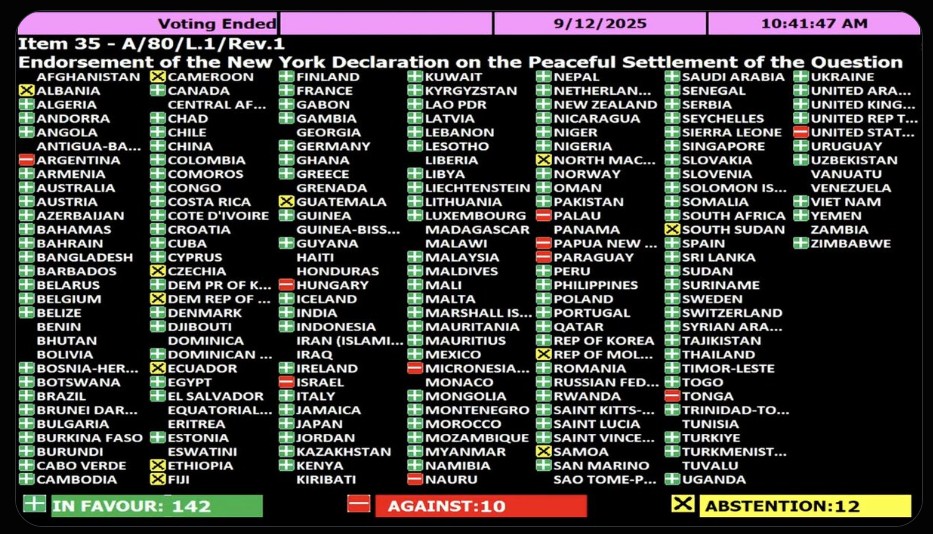
The United Nations General Assembly has overwhelmingly voted to endorse a declaration outlining “tangible, timebound, and irreversible steps” towards the establishment of a Palestinian state.
The 142-10 vote on Friday was to endorse the so-called New York declaration, a statement calling for a two-state solution, crafted by France and Saudi Arabia in July.
Joining Israel and the United States in opposing the resolution were Argentina, Hungary, Micronesia, Nauru, Palau, Papua New Guinea, Paraguay and Tonga. Twelve countries abstained.
Israel, US isolated
The seven-page declaration is the result of an international conference at the UN on the decades-long Israeli occupation. The United States and Israel boycotted the event.
The declaration, which excludes Hamas, also calls for “collective action to end the Israeli war in Gaza and effective implementation of the two-state solution.”
The declaration, was endorsed by the Arab League and co-signed in July by 17 UN member states, including several Arab countries
Long-time Western allies of Israel, including Belgium, France, the UK, Canada, and Australia, had earlier announced plans to recognize Palestinian statehood during the upcoming UN General Assembly sessions from September 8–23. They would join 147 nations that already formally recognize Palestine.
Around three-quarters of the 193 UN member states recognize the Palestinian state proclaimed in 1988 by the exiled Palestinian leadership.
Benjamin Netanyahu, Israeli prime minister, insisted on Thursday that Israel would never accept a Palestinian state.
Gideon Saar, the Israeli foreign minister, recently threatened that the Europeans’ recognition of Palestinian statehood would push Tel Aviv into “unilateral decisions”.
Israel’s far-right finance minister, Bezalel Smotrich, has announced plans to annex more than 80 percent of the occupied West Bank in a bid to block the establishment of a Palestinian state.
On August 14, Smotrich announced his intention to move forward with the highly contentious settlement project across the occupied West Bank that “buries the concept of a Palestinian state”.
In July 2024, the International Court of Justice (ICJ) declared Israel’s occupation of the Palestinian territory illegal and called for the evacuation of all settlements in the West Bank and East al-Quds. All mere words.
The recognition of a Palestinian state comes as international pressure was mounting on the regime over its genocidal war in the besieged Gaza Strip.
Since the Israeli genocide began in October 2023, the death toll has surpassed 64,700, with more than 164,000 others wounded.
Over 1,000 Palestinians detained as Israeli forces tighten grip on West Bank’s Tulkarm city
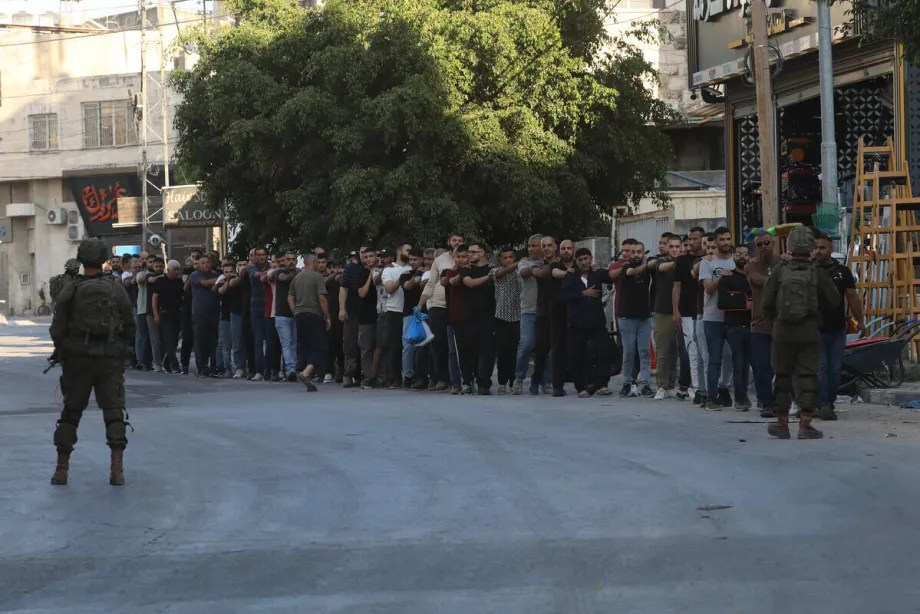
Israeli forces detain Palestinians following an explosion in Tulkarm, West Bank, on September 11, 2025. [Nedal Eshtayah – Anadolu Agency]
MEMO | September 12, 2025
Israeli forces have detained more than 1,000 Palestinians in the northern West Bank city of Tulkarm as part of a sweeping operation now in its second day, according to local officials, Anadolu reports.
Troops sealed off the city’s main entrances, stormed homes, shops and cafes, and forced young men into lines for field interrogations. Witnesses said soldiers vandalized property, seized surveillance recordings and deployed heavy machinery, including a bulldozer, in the city center.
Abdullah Kamil, governor of Tulkarm, said Friday the campaign amounted to “collective punishment” and called on the international community and rights groups to step in, warning of dire humanitarian consequences.
Israeli media said the clampdown followed a roadside bomb that struck a Panther armored vehicle near the Nitzanei Oz checkpoint on Thursday, lightly wounding two soldiers.
The Al-Qassam Brigades, Hamas’ armed wing, and Islamic Jihad’s Al-Quds Brigades claimed responsibility for the attack, saying they detonated a large explosive charge against Israeli forces near the checkpoint.
Tulkarm has become a flashpoint in the army’s months-long campaign across the northern West Bank, where near-daily raids have escalated since the start of the Gaza war.
Since the start of Israel’s genocidal war on the Gaza Strip in October 2023, at least 1,020 Palestinians have been killed and more than 7,000 injured in the occupied West Bank by Israeli forces and illegal settlers, according to the Palestinian Health Ministry.
In a landmark opinion last July, the International Court of Justice declared Israel’s occupation of Palestinian territory illegal. It demanded the evacuation of all settlements in the West Bank and East Jerusalem.
Israel’s ‘Holy War’ falters: Seven fronts, Zero victory
Netanyahu’s ‘historic and spiritual mission’ is bleeding international support, turning short-term military gains into an imminent strategic defeat.
By Mohamad Hasan Sweidan | The Cradle | September 11, 2025
For nearly two years, Israel has been waging what Netanyahu calls a “multi-front war.” This war includes, in addition to Gaza, Lebanon, Syria, Iraq, Yemen, the occupied West Bank, and Iran. In one of his interviews, Israeli Prime Minister Benjamin Netanyahu stressed that he feels he is on a “historic and spiritual mission,” and that he is “deeply connected” to the vision of the Promised Land and Greater Israel. With these words, Netanyahu confirms that what he calls a “multi-front war” is driven by both religious and political motives.
The danger lies in Netanyahu and the radical religious Zionist right believing that the world must approach the brink of a great war “for the Messiah to descend and save it”. For this reason, they encourage continuing and expanding the violence in Gaza to Lebanon, Iran, and beyond, seeing this as the “age of the Messiah.”
The seven fronts of the war
On 9 October 2023, just two days after Operation Al-Aqsa Flood, during a meeting with the mayors of the southern border towns affected by the 7 October attack, Israel’s Prime Minister stated that Tel Aviv’s response to the unprecedented multi-front assault launched by Palestinian fighters from Gaza “will change the Middle East.” From that moment, it became clear that the war would not remain confined to Gaza, but that Israel would expand it to achieve its main goal, which is a new regional order where the balance of power favors Tel Aviv.
Israeli leaders have repeatedly claimed they are simultaneously fighting on seven fronts – Gaza, Lebanon, Syria, Iraq, Yemen, the occupied West Bank, and Iran – portraying all these conflicts as targeting an “Iran-led axis” allegedly seeking to “destroy the Jewish state.”
To achieve this goal, Israel pursues two main paths: weakening its enemies and enforcing compliance by force on the rest of the region’s states, including US allies. On the first path, Israel has relied on direct military strikes, framing them as “multi-front wars” under a “defensive” rationale.
As for the second path, enforcing compliance by force, Israel repeatedly attacked the “new Syria,” a state no longer hostile to Israel or the US, and has occupied portions of its territory. Syria’s consistently positive overtures toward Tel Aviv did not deter Israel, which persisted in its strikes and continued occupation.
Meanwhile, Israel’s recent strike on Qatar on 9 September fits within two parallel tracks of its policy. The first is aimed directly at Hamas’s political leaders, signaling that there is no safe haven for them anywhere in the world. The second conveys a clear message to Qatar and other US allies in the region; Israel’s approach is not based on shared interests but on fear of consequences. Alliances based on mutual interests are one thing, and compliance enforced through fear is another. At this stage, this is precisely the message Trump seeks to send to the region’s states: “Obey me, or I cannot guarantee that Israel will remain distant from you.” Fundamentally, this warning is addressed to all states in the region, without exception.
Regional states must understand that what once shielded their capitals from Israeli-American aggression was the presence of the Axis of Resistance that maintained a regional deterrence balance for years. Once this axis weakened, Israel was liberated from constraints and began operating without limits. It should not be noted that Qatar is officially designated a “Major Non-NATO Ally” of the US, a status conferred by the Biden administration since March 2022. In addition, Qatar hosts the Al-Udeid Air Base, which is far more than a conventional military base, but serves as the headquarters of US Central Command (CENTCOM) in the region, making it one of Washington’s most strategically significant hubs worldwide. Yet none of this prevented Tel Aviv from attacking it.
What has Israel achieved?
We must begin by defining strategic achievement. In international relations, a strategic achievement can be defined as attaining long-term goals that reshape the balance of power, enhance state security, or expand influence in the international system. Strategic achievement differs from short-term tactical or operational gains in that it “produces changes in the fundamental structures of interaction between states and non-state actors.” This means that strategic achievement must consolidate a lasting advantage in the geopolitical arena.
From this perspective, Israel has so far failed to achieve any strategic accomplishments in West Asia. Instead, over the past two years, it has accumulated a series of tactical gains that it seeks to transform into strategic advantages. In Gaza, Tel Aviv remains unable to eliminate the Hamas, and in Lebanon, it has likewise failed to dismantle Hezbollah – despite managing to weaken both resistance movements. In Iran, its attempts to change the regime or dissuade Tehran from supporting resistance movements have failed. In Yemen, its actions did not stop Sanaa’s support for Gaza.
Therefore, the core of the current battle is to prevent Tel Aviv from transforming its tactical gains into entrenched strategic ones. If Israel fails to eliminate the Palestinian resistance, fails to isolate and disarm Hezbollah in Lebanon, sees Iran continue to support resistance movements and anti-hegemony discourse, and if the Yemeni support front remains steady, then Israel will have exhausted the maximum of its power to impose a regional reality that grants it temporary superiority, neutralizing resistance for a period, but remaining fragile and unsustainable in the medium and long term.
The outcome of this struggle ultimately depends on Tel Aviv’s opponents overcoming the multiple challenges created by its wars in West Asia. Either the resistance forces succeed in thwarting Tel Aviv’s attempts to turn temporary gains into a long-term strategic achievement, or Tel Aviv and Washington succeed in leveraging these tactical gains to impose a new strategic reality that serves their interests.
A critical question then arises: What price has Israel paid to achieve its current ‘accomplishments’?
In a recent article titled ‘Israel is Fighting a War It Cannot Win,’ Ami Ayalon, former head of the Israeli Navy and former director of Shin Bet, writes, “The course Israel is currently pursuing will erode existing peace treaties with Egypt and Jordan, deepen internal divisions, and heighten international isolation. It will fuel greater extremism across the region, escalate religious-nationalist violence by global jihadist groups thriving on chaos, weaken support from US policymakers and citizens, and drive a rise in anti-Semitism worldwide.”
He concludes by saying, “Israel’s military deterrence has been restored, demonstrating its ability to defend itself and deter its enemies. But force alone cannot dismantle Iran’s network of proxies nor secure lasting peace and stability for Israel for generations to come.”
Additionally, as a result of Israeli crimes in Gaza, responsibility for the humanitarian catastrophe there has shifted from Hamas to Israel. For a long time, Tel Aviv sought to portray Hamas as primarily responsible for Gaza’s difficult humanitarian reality. However, Israel’s unlimited aggressiveness undermined this effort.
A survey conducted by Israel’s Ministry of Foreign Affairs to evaluate its global reputation found that respondents in the US, Germany, Britain, Spain, and France believe that the majority of those killed by Israel in Gaza are civilians. The survey also revealed that Europeans, in particular, “agree with characterizing Israel as a state of practicing genocide and apartheid, despite their opposition to Hamas and Iran.” Moreover, a recent Quinnipiac University poll indicated that 37 percent of US voters support Palestinians, compared to 36 percent who support Israelis. The danger of these figures is that they show Israel is losing western public opinion, which may make support for Tel Aviv a key issue in future western elections.
Furthermore, nine states completed the legal procedures required to formally recognize the State of Palestine last year, the largest annual increase since 2011:
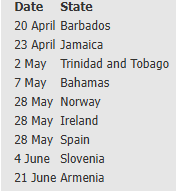
These recognitions raised the global total from 138 to 147 in 2024, meaning that nearly three-quarters of UN member states (147 out of 193) now officially recognize the State of Palestine.
In addition, three of the US’s key allies – France, the UK, and Canada – announced their intention to recognize a Palestinian state, while several other countries are considering the same step. This marks a significant shift that further isolates Israel amid growing international concern over Gaza’s humanitarian crisis. These three countries will become the first G7 members to formally recognize a Palestinian state, posing a clear challenge to Israel. Should they proceed, the US would remain the sole permanent UN Security Council member not to recognize Palestine.
A new combat doctrine
There is no doubt that 7 October marked a turning point in Israel’s military strategy. From that date onward, Israel abandoned for the first time the combat doctrine established by David Ben Gurion, Israel’s first prime minister. Blitz wars were no longer its preferred option, the issue of recovering prisoners was no longer a central priority, and its threshold for human and material losses in any military confrontation rose significantly. This shift compels all regional states to recalibrate their strategies to match Tel Aviv’s new combat doctrine.
It is important to stress that Ben Gurion designed Israel’s combat doctrine to suit its geographic and demographic realities. This may have prompted retired Israeli colonel Gur Laish, former head of war planning in the Israeli Air Force and a key participant in the army’s strategic planning, to publish a paper on 19 August at the Begin-Sadat Center for Strategic Studies, warning Israeli leaders against adopting a new security doctrine that disregards Israel’s limits of power. Yet, the following crucial question remains: Will Netanyahu succeed in proving the effectiveness of Israel’s new approach, or will abandoning Ben Gurion’s doctrine mark the beginning of Israel’s end?
Featured Video

Bombing Hitler’s Hometown
or go to
Aletho News Archives – Video-Images
From the Archives
‘Conspiracy Theory’ Now Fact: Greater Israel Has Arrived
By Kit Klarenberg | Mint Press News | January 28, 2025
Ever since Tel Aviv’s 1948 creation, much has been said and written about ‘Greater Israel’ – the notion Zionism’s ultimate end goal is the forcible annexation and ethnic cleansing of vast swaths of Arab and Muslim lands for Jewish settlement, based on Biblical claims this territory was promised to Jews by God. The mainstream media typically dismisses this concept as antisemitic conspiracy theory, or at most the fringe fantasy of a minuscule handful of extremist Israelis.
In reality … continue
Blog Roll
 Aletho News
- IRGC: Israeli, US universities in region legitimate targets after strikes on Iranian university
- Trump admits Iran hit USS Ford carrier: ‘We ran for our lives’
- Battle for Hungary: EU attacks on Orban are a sign of worse things to come
- Iraqi resistance conducts drone strike on US-run base in Syria
- Failing to Defeat Hezbollah, Israel & US Pressure Syria’s Ahmed al-Sharaa to Join War
- US-Israeli war on Iran drives global fertilizer prices up 40%
- Hezbollah’s Surprise Weapons Redefine Ground Battle with Israel
- Yemen joins fight against US, Israel by firing missiles at occupied territories
- Seizing the Kharg: Washington’s path to defeat in the Persian Gulf
- Iran reports 500 US casualties in strikes on covert US military sites
- If Americans Knew
- Over 300 US service members wounded, majority have brain injuries – Not a ceasefire Day 169
- Researchers at Human Rights Watch Resign Over Blocked Report on Palestinian Refugee Return
- Jewish Groups Are Backing a War Americans Don’t Want
- Eric Fingerhut Thinks He’s the President of the Jews
- Top Jewish Philanthropists, Rabbis Urge Israeli President to Take Action Against ‘Jewish Extremists’
- Don’t Be Fooled. Zionist Leaders Have Always Wanted to Control Southern Lebanon
- Israel’s widespread use of torture is a core element of its genocide against the Palestinian people
- In Israel’s War on Iran, Many Middle East US Bases Rendered “All But Uninhabitable”
- ‘Burn the lawn’: Israel pursues ‘Rafah model’ in southern Lebanon
- A genocide here, an amputation there
- No Tricks Zone
- Devastating Assessment Of Comirnaty Vaccine By Former Senior Pfizer Europe Toxicologist
- New Study: CO2 Is ‘Effectively Negligible’ As An Explanatory Climate Change Factor Since 2000
- Former Pfizer Toxicologist Dr. Helmut Sterz Tells Bundestag Hearing Pfizer Vaccine Should Have Never Been Approved
- Energy Expert: Germany’s Nuclear Phaseout Was A “500 Billion Euro Mistake”
- New Research: South Australia’s Mid-Holocene Sea Surface Temperatures Were 4°C Warmer Than Today
- Storing Green Energy To Last Germany 10 Days Would Require A 60-Million Tonne Battery
- New Studies: UK Sea Levels Were 4 Meters Higher Than Today During The Mid-Holocene
- Destructive Green New Deal: German Energy And Metal Group Warns Of Drastic Crisis
- New Study Documents A 20-Year Pause In Arctic Sea Ice Decline – Driven By Internal Variability
- Wake-up Call: Survey Shows Majority Of Germans Now Favor Postponing Climate Targets!
 Aletho News