Child in Gaza kisses aid worker’s hand before being fatally shot by Israeli forces
MEMO | July 31, 2025
 A resigned US Army soldier who served at an aid distribution point in Gaza, affiliated with the Gaza Humanitarian Foundation (GHF), has shared a heartbreaking account of the final moments of a Palestinian boy known as “Gaza’s little Amir”, who was shot dead by Israeli forces shortly after receiving a small portion of food.
In his testimony, the former soldier, Anthony Aguilar, recalled the tragic events of 28 May, when the boy Amir was killed while trying to get food.
Amir, who was barefoot and visibly thin, walked 12 kilometres under the scorching sun, hoping to find something to eat after hours of waiting. All he managed to gather was a handful of rice and lentils from the ground, Aguilar said.
He went on to describe a deeply emotional moment, saying that the child had approached him, set down his belongings, gently placed his small hands on the soldier’s face, kissed his hand, and thanked him in English. The boy then picked up his things and returned to the crowd. Just minutes later, as he was leaving with other civilians, Israeli forces reportedly opened fire with gas and live ammunition, striking Amir and killing him on the spot.
Aguilar added that the day was no different from others in Gaza — except that death came quicker.
Family urges release of 16 y/o Palestinian-American held in ‘Israel’
Al Mayadeen | July 31, 2025
The family of Muhammad Zaher Ibrahim, a 16-year-old Palestinian-American, is urging his immediate release from Israeli military detention. Ibrahim was detained in February while still 15 years old at his family’s home in the occupied West Bank village of Silwad. According to relatives, he was blindfolded and handcuffed before being transferred to Megiddo prison. He remains in pre-trial detention, accused of rock-throwing, an allegation his family denies.
The Ibrahim family, who divide their time between Silwad and Palm Bay, Florida, sought assistance from Republican Congressman Mike Haridopolos. Zaher Ibrahim, Muhammad’s father, wrote to the congressman in March after more than 45 days of no contact with his son. Describing the conditions at Megiddo as notorious for brutality, the family has exhausted all local legal options and turned to US authorities for support.
Haridopolos’s office acknowledged the outreach and forwarded the case to the State Department. The US embassy in “Israel” confirmed it was following standard procedures. A State Department spokesperson emphasized that ensuring the safety and security of US citizens is a top priority.
Human rights concerns
Human rights organizations have raised alarms over the treatment of Muhammad Zaher Ibrahim and others like him. A video seen by The Guardian shows Ibrahim being interrogated without legal counsel. Advocates argue that his US citizenship has provided little protection in a system known for detaining minors for extended periods without charges or family contact.
Ayed Abu Eqtaish from Defense for Children International-Palestine told The Guardian that Palestinian children in Israeli prisons are often isolated from the outside world, regardless of their nationality.
US government response
While US embassy officials have conducted welfare checks, their access has been increasingly restricted. Early reports from the embassy noted that Muhammad had lost 12 kilograms. In July, he was diagnosed with scabies, a contagious skin condition. The state department reported he was receiving medical treatment, but it remains unclear whether recent visits have occurred.
The department affirmed it provides consular support to detained US citizens, including ensuring access to necessary medical care and facilitating communication with families.
Targeting of Palestinian Americans
Since 2022, nine Americans have been killed by Israeli forces or settlers, including five since October 2023. Among the most recent cases is Sayfollah Musallet, the cousin of Muhammad Ibrahim, a 20-year-old from Tampa, Florida, beaten to death by settlers in July 2025. Others include Mohammad Khdour, Tawfic Abdel Jabbar, Amer Rabee, and Omar Assad, a 78-year-old who died after being gagged and handcuffed by Israeli soldiers.
Multiple Palestinian Americans have also been detained or subjected to travel restrictions and surveillance. In February 2024, American citizens Hashem and Borak Alagha were detained during a raid on their family shelter in Gaza. Samaher Esmail, a 46-year-old from New Orleans, was arrested in Beit Lahm for alleged incitement on social media. Families report minimal assistance from US authorities.
West Bank under Israeli occupation
Since the outbreak of the war on Gaza in October 2023, “Israel” has launched an unprecedented campaign of mass arrests across the occupied West Bank. By July 2025, approximately 18,000 Palestinians had been detained, nearly double the number held before the war. As of late July 2025, “Israel” currently holds around 10,800 Palestinians in its prisons, including about 450 children and 50 women.
A particularly concerning trend has been the rise in administrative detention, imprisonment without charge or trial. Over 10,000 administrative detention orders have been issued, and 37% of detained Palestinian children are now held under such orders, the highest on record.
The arrest campaign intensified further with “Israel’s” launch of Operation Iron Wall in January 2025, displacing 40,000 Palestinians from refugee camps in Jenin, Tulkarm, and Nur Shams. Most arrests during that period were concentrated in Jenin, which experienced severe aggression.
Slovenia bans import, export, transit of Israeli arms over war on Gaza
Al Mayadeen | July 31, 2025
Slovenia announced its decision on Thursday to prohibit all weapons trade with “Israel” due to its ongoing war in Gaza, marking what the country described as the first such move by an EU nation.
In a statement, the Slovenian government said it adopted a decision banning the export and transit of military weapons and equipment from or through the Republic of Slovenia to “Israel”, as well as imports from “Israel” into the Republic of Slovenia.
It added that “Slovenia is the first European country” to make such a decision of full ban, noting that it was taking this step unilaterally since the EU had been “unable to adopt concrete measures” as Slovenia had previously urged.
Slovenia previously warned that it would take independent action, in coordination with like-minded countries, should the European Union fail to implement substantial measures within two weeks to tackle the escalating humanitarian catastrophe in the Gaza Strip.
‘They are dying beneath the rubble’
It blamed the countries’ inaction for the “shameful result” as “people in Gaza are dying because humanitarian aid is being systematically obstructed.”
The Central European country described the unfolding dire situation in Gaza, stating, “They are dying beneath the rubble, without access to drinking water, food, or basic medical care. This is a complete denial of humanitarian access and a deliberate prevention of the basic conditions necessary for survival.”
“In such circumstances, it is the duty of every responsible state to act—even if it means taking a step ahead of others,” it asserted.
During his address at the June 28 EU summit in Brussels, Slovenian Prime Minister Robert Golob expressed increasing dissatisfaction with what he characterized as a disjointed European approach, while alleging that some member states were prioritizing their internal political considerations over the protection of Palestinian rights.
On June 6, 2024, the majority of the Slovenian Parliament voted to recognize the state of Palestine as an independent, sovereign state, a move mirroring actions taken by Spain, Ireland, and Norway at the time.
Gaza genocide case: 114 lawyers ask ICC to investigate French officials’ complicity
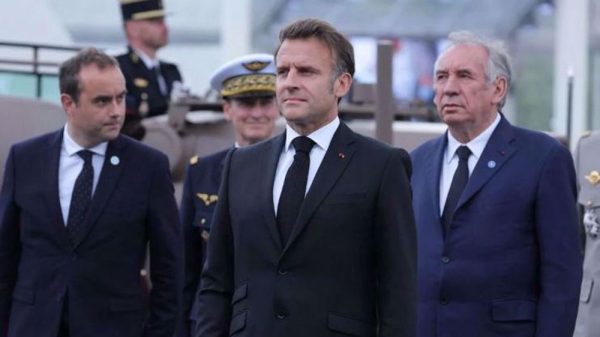
French President Emmanuel Macron (C), Prime Minister Francois Bayrou (R) and Defense Minister Sebastien Lecornu in Paris on May 8, 2025 (Photo by AFP)
Press TV – July 31, 2025
More than a hundred French lawyers have filed a petition with the International Criminal Court, formally requesting the ICC to initiate an investigation or prosecution of some French officials for their complicity “in the commission of war crimes, crimes against humanity and genocide” by the Israeli regime against Palestinians in Gaza and the West Bank.
The 56-page petition made public by the French investigative media outlet Blast on Monday named President Emmanuel Macron, Prime Minister Francois Bayrou, Foreign Minister Jean-Noel Barrot, Minister of the Armed Forces Sebastien Lecornu, and 19 lawmakers of the National Assembly’s European Affairs Committee as officials of the country facilitating Israeli crimes against Palestinians.
“Far from taking concrete measures to prevent the ongoing genocide against the Palestinians, the members of the French executive cited in this communication have continued to support the criminal actions” of Israel by “providing military, political, economic, diplomatic and propaganda support” including by providing the means to commit the crimes in question, the group of lawyers, who represent the Pour la Justice au Proche-Orient (“for justice in the Middle East”) organization, stated in the petition addressed to the Office of the ICC Prosecutor, in the Hague.
The lawyers also slam France for refusing to respect the 2013 Arms Trade Treaty (ATT), ratified by Paris, which imposes an absolute ban on exporting weapons if they have knowledge the arms could be used to commit war crimes, despite several requests from legal groups and NGOs.
The petition for legal action by the lawyers is equivalent to a formal criminal complaint to the ICC regarding a crime falling under its jurisdiction.
Now, it is up to the ICC Prosecutor to decide whether the request is in accordance with Article 15 of the Rome Statute, which states that the prosecutor may open proprio motu (which means on their own initiative) investigations based on information relating to crimes within the court’s jurisdiction.
The formal petition asking the ICC to investigate Macron and French ministers for Gaza genocide complicity was signed by 114 French lawyers.
The ICC acts as a court of last resort against individuals for war crimes, crimes against humanity, genocide, or the crime of aggression, complementing national courts in addressing these grave international crimes.
Karim Khan, the ICC’s chief prosecutor, issued arrest warrants for Israeli prime minister Benjamin Netanyahu and his former war minister, Yoav Gallant, on charges of war crimes and crimes against humanity in November 2024.
Israel is accused of using starvation as a method of warfare, intentionally attacking civilians and committing other inhumane acts during its genocidal military campaign in the besieged strip.
Israeli forces regularly attack starving Palestinians suffering from acute malnutrition and a severe lack of essential supplies.
Since the US-Israeli genocide started in October 2023, the death toll has reached over 60,100. Over 146,200 Palestinians have also been injured.
Nearly 1,000 Palestinians have also been killed by Israeli attacks in the occupied West Bank since the regime began its genocidal war on the Gaza Strip in October 2023.
Israelis committing genocide in Gaza, with US ‘complicit’: Mearsheimer
MEMO | July 31, 2025
John Mearsheimer, professor of political science at the University of Chicago, said that “the Israelis are executing a genocide in Gaza,” adding that the US is “complicit in that genocide,” Anadolu reports.
What is happening in Gaza is a systematic effort by Israel to dismantle the Palestinian national identity, Mearsheimer said in an interview with media personality Tucker Carlson published on Wednesday.
He added that Israel is targeting Palestinians specifically as a group, aiming not only to kill large numbers but also to erase their identity as a people.
Mearsheimer believed that the Israelis have long aimed to expel the Palestinian population from what they consider “Greater Israel.”
“If you look at Greater Israel, this includes the Israel that was created in 1948 and the occupied territories. This is the West Bank, Gaza, and what we call the Green Line Israel. That’s Greater Israel,” the scholar said.
“October 7th happens, and what the Israelis see is an excellent opportunity for ethnic cleansing. And they make this clear.
“In other words, it’s an excellent opportunity to go to war in Gaza and drive the Palestinians out of Gaza and solve that demographic problem that they face,” he added.
Israel also carried out large-scale ethnic cleansings in the region in 1948 and 1967, and Mearsheimer described the latest campaign in Gaza as “the third attempt at a massive ethnic cleansing.”
The Israeli army, rejecting international calls for a ceasefire, has pursued a brutal offensive on Gaza since Oct. 7, 2023, killing more than 60,000 Palestinians. The relentless bombardment has devastated the enclave and led to food shortages.
Israel wants to ensure that its neighbors are ‘weak’
One of Israel’s goals is also to ensure that its neighbors are “weak,” said Mearsheimer, noting that “that means breaking them apart, if you can, and keeping them broken.”
He said the ethnic cleansing is a topic “that the Zionists talked about from the get-go, and they talked about extensively because there is no way they could create a Greater Israel without doing massive ethnic cleansing.”
David Ben Gurion, Vladimir Jabotinsky, and other prominent Zionist leaders are fully aware that achieving their goals would require doing “horrible things” to the Palestinians, he said.
The scholar highlighted that those Zionist leaders acknowledged this and even stated openly that they did not blame the Palestinians at all for resisting the actions planned by Jews arriving from Europe.
“They fully understood that they were stealing their land. And they fully understood that it made perfect sense for the Palestinians to resist, which of course they did,” Mearsheimer noted.
“They (Israel) start with the goal of ethnic cleansing. I don’t believe they want to murder all of the Palestinians in Gaza.
“They simply want to drive them out. But the problem is they don’t leave. And then the question is, what do you do? And what they do is they continue to up the attacks, increase the attacks, (and) kill more and more people in the hope that they will drive them out,” he added.
Israel lobby in US
Mearsheimer stressed that when a major power like the US has conflicting interests with another country, it prioritizes its own, following an “America first” approach. However, regarding Israel, it’s the opposite — it is “Israel first,” he stated.
Washington’s policy in the Middle East clearly reflects this, with plenty of evidence to support it, the scholar underscored.
Mearsheimer, who is also the co-author of the book The Israel Lobby and U.S. Foreign Policy, said that the reason for this is due to the Israel lobby in the US.
“I think the lobby is an incredibly powerful interest group, and I’m choosing my words carefully. It has awesome power, and it basically is in a position where it can profoundly influence US foreign policy in the Middle East. And indeed, it affects foreign policy outside of the Middle East.
“But when it comes to the Middle East, and again, the Palestinian issue in particular, it has awesome power. And there’s no president who is willing to buck the lobby,” he added.
Tucker Carlson on Israel’s Shocking War Crimes and Genocide in Gaza
A Brief Note on Genocide
By Tucker Carlson | July 31, 2025
Accusations that the Israeli government is committing genocide in Gaza are becoming increasingly common. Professor John Mearsheimer made the claim on yesterday’s Tucker Carlson Show, and Marjorie Taylor Greene recently became the first Republican member of Congress to do the same.
It’s easy to predict how Washington’s Israel shills will react. John Fetterman provided an example on Wednesday.
“I [honestly] don’t care what crazy pants thinks,” the disgraceful Pennsylvania senator told a reporter when asked about Greene’s statement. “It’s not a genocide, you know, that’s just not the case. And she’s entitled to her opinion, but I’m entitled to not really care what her views on that is,” he added later.
See what he did there? In addition to sneaking in a classic ad hominem attack, Fetterman engaged in a semantics debate about the word “genocide” rather than bothering to acknowledge the fact that American tax dollars are funding the killing of children. That strategy is not an accident.
“Genocide” has a very specific definition. It is as follows, according to the Department of Justice:
“Violent attacks with the specific intent to destroy, in whole or in part, a national, ethnic, racial, or religious group.”
Based on that, Greene’s use of the word feels reasonable. But that’s not the point. Rather than defending the actions of the Israeli government, which at this point are indefensible, the Fettermans of the world prefer a middle-school-lunch-table-style argument over the precise meaning of “genocide.” The reason is simple. Such a debate serves as a convenient distraction from the heart of the issue, which is the Netanyahu government’s abhorrent behavior and Washington’s undeniable culpability.
Call what’s happening whatever you’d like. Genocide, ethnic cleansing, indiscriminate killing, or anything else. Regardless of anyone’s preferred word choice, the reality remains the same: tens of thousands of innocents are dead, and millions of lives are destroyed. The United States should play no role.
Senate Votes Down Two Resolutions to Block Israeli Weapons Sales
By James Rushmore | The Libertarian Institute | July 31, 2025
On Wednesday night, the U.S. Senate voted down two joint resolutions aimed at blocking additional weapons sales to Israel. Both measures were originally introduced by U.S. Senator Bernie Sanders (I-VT) in March.
The first resolution would have prohibited the sale of 20,000 fully automatic carbine rifles to Israeli forces, while the second resolution sought to cut off $675.7 million in arms sales. The latter measure would have barred the sale of 201 MK 83 1,000-pound bombs; 4,799 BLU-110A/B General Purpose 1,000-pound bombs; 1,500 Joint Direct Attack Munition (JDAM) guidance kits for MK 83 bombs; 3,500 JDAM guidance kits for MK 83 bombs; and related logistics and technical support services. Sanders argued that the weapons sales would violate both the Foreign Assistance Act and the Arms Export Control Act.
“History will condemn those of us who failed to act in the face of these horrors,” he said in the run-up to Wednesday night’s vote.
The two measures failed 27-70 and 24-73, respectively. More than half of the Democratic caucus voted in favor of the resolutions. The Republican caucus, including U.S. Senator Rand Paul (R-KY), voted unanimously against both measures.
Sanders forced the votes in response to the ongoing starvation crisis in the Gaza Strip and the IDF’s continued massacre of Palestinian civilians. He blamed the famine on Israeli Prime Minister Benjamin Netanyahu’s policies, citing the six-week siege on the Strip. He also condemned the Israeli-backed Gaza Humanitarian Foundation’s distribution model for leading to the deaths of over 1,000 Palestinians.
“U.S. taxpayers have spent tens of billions of dollars in support of the racist, extremist Netanyahu government. Enough is enough,” the senior senator from Vermont said. “We cannot continue to spend taxpayer money on a government which has killed some 60,000 Palestinians and wounded more than 143,000, most of whom are women, children, and the elderly. We cannot continue supporting a government which has blocked humanitarian aid, caused massive famine, and literally starved the people of Gaza.”
“The time is long overdue for Congress to use the leverage we have – tens of billions in arms and military aid – to demand that Israel end these atrocities,” he added.
Since the October 7 terrorist attacks, the U.S. has provided more than $22 billion in military aid to Israel. In May, Haaretz reported that the U.S. has covered about 70% of Israeli military spending since the genocide began.
During an interview with CNN’s Kaitlan Collins Wednesday night, Sanders stopped short of labeling Israel’s actions a genocide. “Genocide is a legal term. What is going on now clearly is absolutely horrific…But the important point is not what you call it. It is horror, and I think the whole world knows that. The answer is, what the hell do we do about it?” he said.
Canada continues arms transfers to Israel despite official denials: Report
Press TV – July 30, 2025
Canada has continued to supply weapons to the Israeli regime during its genocide in Gaza, contradicting official claims that such exports had stopped, a new investigation reveals.
Published by Arms Embargo Now Campaign (AEN) on Tuesday, newly uncovered shipping records and Israeli regime data show 47 documented shipments of military components from Canadian manufacturers to Israeli weapons firms between October 2023 and July 2025.
This includes over 421,000 bullets, with one shipment of 175,000 in April 2025.
Three cartridge shipments from a Quebec-based General Dynamics facility were also sent just nine days after Canada pledged to block munitions exports. These exports primarily supplied Elbit Systems, Israel’s largest arms manufacturer.
This comes as former Foreign Minister Melanie Joly and Prime Minister Justin Trudeau, as well as current Prime Minister Mark Carney, have repeatedly insisted that Canada has restricted arms exports to Israel, this report uncovers.
In March 2024, Canada’s parliament passed a non-binding motion urging the government to suspend further arms sales to Israel.
As pressure continued to mount, in September of last year, Joly announced that the government had not approved any new export permits for Israel since January 8, 2024.
This report, however, unveils the hidden reality behind Canada’s public statements on arms exports to Israel, revealing a systematic deception that has enabled the flow of Canadian-made weapons directly into one of the deadliest military aggressions in modern history.
Canada is currently breaching its own domestic legislation and international legal obligations by continuing to supply arms to Israel amid the ongoing ethnic cleansing and widespread starvation of Palestinians in Gaza.
Several Western countries have continued to supply lethal weapons to the Israeli regime despite the enormous human toll caused by its genocide in the Palestinian territory.
At least 60,034 Palestinians have been killed, mostly women and children, and another 148,870 individuals injured in the brutal Israeli onslaught on Gaza since October 7, 2023.
In protest over Gaza, Brazil withdraws from International Holocaust Remembrance Alliance
By Eman Abusidu | MEMO | July 30, 2025
The government of President Luiz Inácio Lula da Silva has formally withdrawn Brazil from the International Holocaust Remembrance Alliance (IHRA), intensifying diplomatic tensions with Israel and reigniting global debate over the boundaries between antisemitism and criticism of Israeli policies. The decision, made on 18 July but only confirmed publicly on 24 July by the Israeli Ministry of Foreign Affairs, has drawn both praise and criticism at home and abroad, particularly in the context of Brazil’s recent support for genocide accusations against Israel at the International Court of Justice (ICJ).
Brazil had joined the IHRA in 2021 during the presidency of Jair Bolsonaro, holding observer status within the organisation. According to sources within Brazil’s Ministry of Foreign Affairs (Itamaraty), the accession was “hasty” and lacked sufficient public or institutional debate. These officials cited unmet obligations, such as financial contributions and participation in plenary sessions, as contributing factors in the decision to leave.
Brazil’s withdrawal from the IHRA comes on the heels of its decision to join South Africa in accusing Israel of genocide at the ICJ. Despite the timing, Brazilian officials insist the move is not directly linked to its formal entry into the ICJ lawsuit filed by South Africa against Israel on 23 July. However, the diplomatic and symbolic overlap is hard to ignore.
In its official statement, the Brazilian government condemned Israel’s conduct, citing a lack of accountability and accusing it of violating international norms.
“There is no longer room for moral ambiguity or political omission,” the Itamaraty statement read. “Impunity undermines international legality and compromises the credibility of the multilateral system.”
The government emphasised that its participation in international alliances must reflect Brazil’s constitutional values, particularly the defence of human rights and the self-determination of peoples.
Israel swiftly condemned Brazil’s withdrawal from the IHRA. The Israeli Ministry of Foreign Affairs labeled the move a “profound moral failure” and accused Brazil of abandoning the global consensus on fighting antisemitism. Fernando Lottenberg, the Commissioner for Monitoring and Combating Anti-Semitism at the Organization of American States (OAS), also criticised the decision, calling it a “mistake.”
Domestically, the reaction was polarised. Senator Sergio Moro (União Brasil–PR) described the move as “yet another international embarrassment” by the Lula administration, accusing it of adopting a hostile stance toward the Jewish community.
The Palestinian Arab Federation of Brazil (Fepal) celebrated Brazil’s withdrawal from the IHRA. In a public statement released on July 25, Fepal described the move as a “necessary break” from what it characterised as the misuse of historical memory to justify “crimes against the Palestinian people.”
Fepal further urged the Brazilian government to take what it called a “final civilizing step”: the complete severance of diplomatic relations with Israel. According to the federation, Brazil’s IHRA membership served to “legitimise colonial, racist, and apartheid policies.” Its exit, they argue, symbolises a rejection of efforts to “criminalise anti-Zionism and silence reports of the genocide in Gaza.”
The organisation also criticized Bill 472/2025, authored by Representative Eduardo Pazuello (PL-RJ), which proposes adopting the IHRA’s definition of antisemitism. Fepal called it the “Zionist gag bill” and cited a legal opinion from the National Human Rights Council deeming the bill unconstitutional and a threat to free expression. According to Fepal, the IHRA definition conflates criticism of Israel with hate speech and has been weaponised internationally to suppress students, activists, intellectuals, and even dissenting Jewish voices.
“Rejecting this definition is protecting democracy and political freedom,” the federation wrote.
Brazil’s withdrawal sends a strong signal that historical memory and contemporary international policy are now more intertwined—and more contested—than ever.
That signal became even clearer on Monday (28 July), when the Brazilian government announced a series of retaliatory diplomatic, commercial, and military measures against Israel in response to what it described as “genocide” in Gaza. The announcement came from Foreign Minister Mauro Vieira during a speech at the United Nations headquarters in New York.
Among the steps, Brazil will ban the export of defence equipment to Israel and launch investigations into imports from illegal Israeli settlements in the occupied West Bank. The government framed these actions as part of its commitment to upholding international law and rejecting impunity.
“These are the legal measures that countries can take now,” Vieira said at the conference. “The credibility of the international system depends on this non-selective enforcement. What we need now is political will and effective action to monitor this conference.”
These developments occur against the backdrop of worsening diplomatic tensions between Brazil and Israel, which have been escalating since February 2024, when President Luiz Inácio Lula da Silva compared Israel’s military actions in Gaza to the Holocaust. The controversial remark prompted Israel to declare Lula persona non grata. In May, Brazil recalled its ambassador from Tel Aviv, and the position has remained vacant since. Furthermore, the Brazilian government has refused to approve the appointment of Israel’s proposed ambassador to Brasília, deepening the diplomatic standoff.
Egypt training hundreds of Palestinians for ‘Gaza security roles’
The Cradle | July 30, 2025
Egypt is training hundreds of Palestinians to assume security responsibilities in Gaza after the war ends, Egyptian Foreign Minister Badr Abdelatty told Al Arabiya in an interview yet to be aired.
“Egypt is training hundreds of Palestinians to take on security responsibilities in Gaza,” Abdelatty said, adding that Cairo has a clear plan for governance and security in the strip following the end of hostilities.
He said the plan is already being implemented. In April, he told the Antalya Diplomacy Forum in Turkiye that Egypt had begun recruiting and training Palestinian police who would “take care of the law, order, and security in Gaza.”
At the time, he also stated that Egypt was prepared to support the deployment of an international force “to provide security and protection for the Palestinians.”
Abdelatty confirmed that Egypt continues to work toward a ceasefire and holds daily talks with Qatar and the US. He accused Israel of weaponizing hunger, saying starvation in Gaza is “beyond imagination.”
Cairo’s initiative was first unveiled in March as part of a $53 billion reconstruction and governance proposal endorsed by the Arab League and the Organization of Islamic Cooperation (OIC).
It came in response to US President Donald Trump’s announcement that Washington would “take over” Gaza and relocate its population.
According to a source cited by Ultra Palestine in April, around 300 Palestinian Authority (PA) officers were selected for training in Egypt, with personnel instructed not to refuse the assignment “under penalty of liability.”
The source said the training would last two months and declined to elaborate on the assigned tasks.
The Egyptian plan envisions a phased reconstruction process and transfer of authority from Hamas to the PA. The Palestinian resistance has agreed to a previous Egyptian proposal for a Community Support Committee to govern Gaza, but rejected Cairo’s demand that it hand over its weapons.
The demand to disarm has been renewed and endorsed by the Arab League and Turkiye in the latest UN session in New York that took place on 29 July.
Israel has been continuously escalating military operations across Gaza and has made disarmament a condition for any ceasefire.
On Tuesday, Israeli ministers reportedly discussed formally occupying and annexing parts of Gaza.
Finance Minister Bezalel Smotrich recently led a far-right conference promoting Israeli resettlement in the strip as a “Gaza Riviera.”
Germany blocks EU effort to impose sanctions on Israel over Gaza
MEMO | July 30, 2025
Germany and several other European countries are blocking a proposal to impose sanctions on Israel over its role in worsening the humanitarian situation in the Gaza Strip, according to diplomats.
EU member states’ permanent representatives convened in Brussels but failed to reach a consensus to initiate the formal decision-making process.
Diplomats said countries, including Germany, called for more time and further analysis of the situation on the ground.
Some delegations also raised concerns that sanctions might harm essential dialogue with the Israeli authorities.
Under EU rules, any proposal must be backed by at least 15 of the 27-member states, representing at least 65 per cent of the EU population, to proceed.
Germany and Italy are considered key players in the talks, while all other major European countries, along with several smaller ones, have shown openness to the idea of imposing sanctions.
Featured Video

Yemen joins the war – Red Sea could be blocked next – Saudi regime at risk
or go to
Aletho News Archives – Video-Images
From the Archives
A superpower and “the world’s sickest warrior state”
By Paul J. Balles | March 8, 2010
Living through five or six major wars has hardened me to what I thought were the extremes of inhuman cruelty and brutality.
Two things made those extremes almost bearable: the brutality always revealed – at least according to the media coverage – the viciousness of the enemy. It was therefore quite understandable when our “brave men and women” pulverized the enemy.
Films of Japanese torturing captive Americans somehow justified holding Japanese Americans in internment camps during World War II; and only a small percentage of Americans found the bombing of Hiroshima and Nagasaki unreasonably vengeful at best, at worst, depraved.
The media giants in America portrayed the North Koreans as barbaric beasts with their captives, quite unlike their southern counterpoints – our allies during the Korean War. No one ever felt the need to explain how the South Koreans were a civilized breed while the North Koreans were absolute savages, at least according to the official line.
In Vietnam, our warriors justifiably (or so the media made us believe) dropped napalm on the North Vietnamese who had the gall to hide in villages and tunnels to ravage our invaders. At least it was accepted practice until some rogue photojournalist filmed a young girl screaming down a Vietnamese road in flames. … continue
Blog Roll
 Aletho News
- Pro-Palestinian French member of European Parliament denied entry to Canada
- Pakistan to Host US-Iran Talks
- How Indonesia’s tilt toward the US left it stranded in the Strait of Hormuz
- US has no choice but to retreat from Iranian borders: Top commander
- Iran Retaliation Strikes Chemical Plant Near Dimona
- AWACS’ Destruction is a Major Loss for US Military – Ex-DoW Analyst
- Israel’s Iran Strategy Uses US Military & Gulf States as Its Pawns
- Iran: Trump wanted regime change, now just begging for Hormuz to open
- IRGC: Israeli, US universities in region legitimate targets after strikes on Iranian university
- Trump admits Iran hit USS Ford carrier: ‘We ran for our lives’
- If Americans Knew
- Israeli police block Catholic cardinal from entering Church of the Holy Sepulchre on Palm Sunday
- Israel is assassinating journalists again, more than any other nation, anywhere, ever – Not a ceasefire Day 170
- Over 300 US service members wounded, majority have brain injuries – Not a ceasefire Day 169
- Researchers at Human Rights Watch Resign Over Blocked Report on Palestinian Refugee Return
- Jewish Groups Are Backing a War Americans Don’t Want
- Eric Fingerhut Thinks He’s the President of the Jews
- Top Jewish Philanthropists, Rabbis Urge Israeli President to Take Action Against ‘Jewish Extremists’
- Don’t Be Fooled. Zionist Leaders Have Always Wanted to Control Southern Lebanon
- Israel’s widespread use of torture is a core element of its genocide against the Palestinian people
- In Israel’s War on Iran, Many Middle East US Bases Rendered “All But Uninhabitable”
- No Tricks Zone
- German Science Blog Accuses PIK Climate Institute Of Hallucinating Climate Tipping Points
- Devastating Assessment Of Comirnaty Vaccine By Former Senior Pfizer Europe Toxicologist
- New Study: CO2 Is ‘Effectively Negligible’ As An Explanatory Climate Change Factor Since 2000
- Former Pfizer Toxicologist Dr. Helmut Sterz Tells Bundestag Hearing Pfizer Vaccine Should Have Never Been Approved
- Energy Expert: Germany’s Nuclear Phaseout Was A “500 Billion Euro Mistake”
- New Research: South Australia’s Mid-Holocene Sea Surface Temperatures Were 4°C Warmer Than Today
- Storing Green Energy To Last Germany 10 Days Would Require A 60-Million Tonne Battery
- New Studies: UK Sea Levels Were 4 Meters Higher Than Today During The Mid-Holocene
- Destructive Green New Deal: German Energy And Metal Group Warns Of Drastic Crisis
- New Study Documents A 20-Year Pause In Arctic Sea Ice Decline – Driven By Internal Variability
 Aletho News