How Objectivists Learned to Stop Worrying and Love Zionist Regime Change Wars
By Jose Alberto Nino – Occidental Observer – February 6, 2026
In 1964, Ayn Rand told Playboy magazine that any free nation had the moral right to invade Soviet Russia or Cuba. “Correct. A dictatorship — a country that violates the rights of its own citizens — is an outlaw and can claim no rights.” Instead, she preferred waging economic warfare against these rogue governments. “I would advocate that which the Soviet Union fears above all else, economic boycott. I would advocate a blockade of Cuba and an economic boycott of Soviet Russia, and you would see both those regimes collapse without the loss of a single American life.”
Six decades later, her disciples are advocates of a ground invasion of Iran, crushing Palestinian society, and not ruling out the use of nuclear weapons to bring the Islamic Republic of Iran to heel. A secular ideology devoted to laissez faire capitalism now sounds indistinguishable from the most hawkish neoconservatives and aligns with religious nationalist movements in Israel that openly advocate territorial expansion and Palestinian expulsion.
Rand, who is of Russian Jewish extraction, set the tone in her 1979 appearance on the Phil Donahue Show. “If you mean whose side should we be on, Israel or the Arabs? I would certainly say Israel because it’s the advanced, technological, civilized country amidst a group of almost totally primitive savages who have not changed for years and who are racist and who resent Israel because it’s bringing industry, intelligence, and modern technology into their stagnation,” Rand stated.
She doubled down. “The Arabs are one of the least developed cultures. They are typically nomads. Their culture is primitive, and they resent Israel because it’s the sole beachhead of modern science and civilization on their continent. When you have civilized men fighting savages, you support the civilized men, no matter who they are.”
Leonard Peikoff, Rand’s designated heir and also of Russian Jewish extraction, continued his predecessor’s hawkish legacy. published a full page advertisement in The New York Times on October 2, 2001. “Fifty years of increasing American appeasement in the Mideast have led to fifty years of increasing contempt in the Muslim world for the U.S. The climax was September 11, 2001.”
He identified Iran as the central threat. “The first country to nationalize Western oil, in 1951, was Iran.” Iran “is the most active state sponsor of terrorism, training and arming groups from all over the Mideast.” His analogy was stark. “What Germany was to Nazism in the 1940s, Iran is to terrorism today. Whatever else it does, therefore, the U.S. can put an end to the Jihad mongers only by taking out Iran.”
Peikoff demanded total war to address the issue of Iran. “Eliminating Iran’s terrorist sanctuaries and military capability is not enough. We must do the equivalent of de-Nazifying the country, by expelling every official and bringing down every branch of its government. This goal cannot be achieved painlessly, by weaponry alone. It requires invasion by ground troops, who will be at serious risk, and perhaps a period of occupation.”
The potential for mass civilian casualties was of no concern to Peikoff, who firmly believed that only full-fledged military force could put Iran in its place. “A proper war in self-defense is one fought without self-crippling restrictions placed on our commanders in the field. It must be fought with the most effective weapons we possess [a few weeks ago, Rumsfeld refused, correctly, to rule out nuclear weapons]. And it must be fought in a manner that secures victory as quickly as possible and with the fewest U.S. casualties, regardless of the countless innocents caught in the line of fire.”
In a 2006 podcast, Peikoff advocated using nuclear weapons against Iran if necessary. On Israel and Palestine, Peikoff’s 1996 essay dismissed Palestinian territorial claims entirely. “Land was not stolen from the nomadic tribes meandering across the terrain, any more than the early Americans stole this country from the primitive, warring Indians.” He called land for peace “a repugnant formula for Israel’s self-immolation.”
Yaron Brook, the current Ayn Rand Institute board chairman, extended these radical Zionist principles to the 21st century. After October 7, 2023, he called for Hamas’s total destruction. “Israel must destroy Hamas, everything about it. Its political leaders, wherever they are hiding must be assassinated, their entire military infrastructure destroyed, its supporters, brought to their knees.”
At a January 2024 event, Brook argued Israel should see “the Palestinian population at large as an enemy” and called for “a fundamental shift in Palestinian culture.” Such a scenario can only be achievable when Palestinians “have lost every ounce of hope that they can beat Israel.”
Brook would not allow aid, electricity, or internet into Gaza. He argued Israel shows excessive restraint despite death tolls exceeding 70,000, which includes at least 20,000 children. “So many Israeli soldiers are dying on the field because Israel refrains from defending them and places the lives of civilians on the other side as more valuable than its own soldiers: He described Gaza as “a primitive society” requiring fundamental transformation like Germany and Japan after World War II.
On Iran, Brook advocated for regime change as the only solution to this geopolitical dilemma. “Israel cannot take out the Iranian nuclear facility. So what is the only other way to stop the Iranians from getting a bomb? The only other way is regime change.” He specified acceptable outcomes for Israel in a confrontation against Iran. “It has to go for an internal revolution in Iran taking out the current mullahs, whether with more moderates who are committed to doing away with the nuclear program or whether it’s all out, you know, liberal democracy-type revolution but or whether it’s the shah coming back. Right the son of the shah, but it has to be regime change.”
Objectivists are a quirky bunch when it comes to their ideology, which may appear critical of mainstream political currents. Brook’s 2007 essay “Neoconservative Foreign Policy: An Autopsy” condemned neoconservatives for advocating democracy promotion rather than rational self-interest. Yet on Israel and Iran, Objectivists and neoconservatives find common ground. Both support unlimited Israeli military action, Iranian regime change, opposition to Palestinian statehood, and framing the conflict as civilization versus barbarism.
Israel Prime Minister Benjamin Netanyahu recently declared “absolute” support for Greater Israel, Jewish sovereignty from the Jordan River to the Mediterranean. Such a Jewish supremacist vision is suffused with religious rhetoric. At first glance, one would think that Objectivism’s atheistic nature would dismiss such religious appeals. But yet again, the Ayn Rand Institute’s positions end up aligning with the Greater Israel framework through the rejection of Palestinian statehood and framing Palestinian aspirations as illegitimate.
Netanyahu’s far-right allies, like Finance Minister Bezalel Smotrich from Religious Zionism and Otzma Yehudit (“Jewish Power”), make no secret of their top goal: Israeli control over Palestinian lands, including Gaza resettlement, West Bank annexation, and the expulsion of Arabs, echoing Rabbi Meir Kahane’s calls for the imposition Jewish law and Arab removal.
Many observers scratch their heads at this odd alliance between Objectivism—an atheistic, free-market creed that Ayn Rand branded as anti-mystical—and religious Zionists appealing to biblical land promises. But when one grasps the Jewish question and how Jews maneuver politically across divides, it all snaps into focus: the Jewish racial will to power drives Jews of all political stripes. Objectivists and religious Zionists clash on faith and domestic policy yet unite to subjugate gentiles like Palestinians and seize their territory.
Objectivism preaches against initiating force and upholds individual rights, yet Leonard Peikoff pushes for invading Iran and Yaron Brook calls for pulverizing Palestinian society to kill their hope. Strip away the lofty appeals to reason and rights, and Objectivism emerges as intellectual camouflage for Jewish racial dominance—a political vehicle that harmonizes Rand’s heirs with Smotrich’s zealots, prioritizing gentile dispossession over any philosophical consistency.
Why the Push for a US–Iran Nuclear Deal is Not Serious – and Never Was
By Robert Inlakesh | The Palestine Chronicle | February 5, 2026
The United States has been pushing for a renewed set of negotiations, aimed at reaching a deal over Iran’s nuclear program, the very same move that was used to set up an Israeli surprise attack last year. This is not a serious effort and appears more than anything to be aimed at stalling.
In mid-January, it appeared as if a US attack on Iran was imminent, as some reports even suggested he was planning to launch airstrikes before backing out. The reason for the absence of any military action can be put down to a series of evolving factors at play, including the security concerns of Israel.
Considering that an enormous amount of the reports published in both the US and Israeli media are drip-fed from their CIA, Mossad, and government contacts, it is reasonable to assume that most of what we are hearing “leaked” from anonymous sources is part of a deliberate disinformation campaign.
Prior to Israel’s surprise attack on Iran in June of 2025, a similar deception campaign was implemented throughout both the Western and Israeli media. In addition to the constant mixed messages regarding Israeli-US intentions, there was also an effort to build the narrative of a feud between Israeli PM Benjamin Netanyahu and US President Donald Trump. Soon after the 12-day war began, Israeli media outlets admitted as such.
Therefore, it is safe to assume that most of what we are being fed through the “anonymous” sourcing of the corporate media is false. Nowhere is this more evident than in the outlandish claims being published, as a means of manufacturing consent for a regime change war, than with the outrageous Iran protester death toll statistics being peddled without any evidence at all.
Disinformation aside, the current attempt to revive US-Iran nuclear negotiations is already being premised on non-starters. Not only are the US going back to their maximalist demands, which prevented any serious progress through multiple rounds of discussions last year, but they are also actively threatening war on a near-daily basis, as more American military assets continue to flood into the region.
In addition to this, the Israelis have demanded the exact same prerequisite conditions they always do, that being the end of Iran’s ballistic missile program, no nuclear enrichment on Iranian soil, and a halt to all of Tehran’s regional alliances with resistance groups. Evidently, none of these conditions is even going to be entertained by the Iranians.
Unless by some miracle the Trump administration decides to totally defy Israel and its top donors, choosing to negotiate a reasonable deal that, at least in part, replicates the 2015 Joint Comprehensive Plan of Action (JCPOA), there will be nothing achieved. Instead, if negotiations are to even proceed, they will simply be designed to stall the inevitable: a military confrontation.
Donald Trump, since his first term in office, has been the most aggressive US president toward the Islamic Republic, unilaterally pulling out of the nuclear deal, implementing a criminal sanctions regime, bowing to every Israeli demand, and even assassinating Iran’s most prominent general at the time, Qassem Soleimani.
This time around, the Trump administration decided to go all the way in its support of Israel’s demands. The US came to Israel’s aid in the 12-day war and directly struck Iran, doing damage to three nuclear sites. More recently, the entirety of the collective West has stood behind a regime change attempt, led by Israeli intelligence agents on the ground. Not a single Western mainstream media outlet has even been critical of the narrative they have been fed on the issue, with some openly advocating military intervention.
Why is the US Stalling?
Unlike during the previous buildups to confrontation between the US-Israeli alliance and Iran, this time appears much more consequential. We are now far closer to an all-out regional war, which was avoided last June. Iran’s leader, Ayatollah Seyyed Ali Khamenei, has made it clear that any attack on Iran will result in a total war, something that was not previously threatened in this way.
What happened last month was an Israeli-led attempt to drag Iran into a bloody civil war, an attack using agents that targeted cultural sites, places of worship, the nation’s emergency services, banks, and resulted in the murder of around 300 police officers and security force members. If this ground campaign had proven successful, a series of US strikes—while still a gamble—may have proven a serious threat to the stability of Iran.
In the thinking of US and Israeli military strategists, they hoped that an American strike package could have inspired an even greater uprising against the government. Even if this led to a long and bloody civil war, like what occurred in Syria, the idea would be that over time it would cripple the nation as a whole, effectively eliminating the Iranian challenge posed to Israel for the foreseeable future.
However, Iran swiftly cracked down on the failed operation within two days, totally eliminating the ground threat posed to it. Without a ground component against the Islamic Republic, any US-Israeli air campaign—however costly—will ultimately fail to effect regime change.
The best possible outcome for Tel Aviv and Washington is an attack that will work to cripple the nation’s civil infrastructure. Although easier said than done, especially given the fact that Iran’s infrastructure was built with wartime damage in mind, the tactic would be to inflict such a significant blow that, over time, combined with the “maximum pressure” sanctions campaign, the Iranian government will fall, similar to how Syria did.
Standing in the way of such an option are a myriad of issues. There is the anxiety of the Arab regimes, such as Jordan, the UAE, Saudi Arabia, and beyond, who understand the potential earthshattering implications of an all-out war with Iran. The US and Israel use their nations to stage attacks on Iran, operate air defense systems, and therefore, there are valid military targets there for Iran’s Islamic Revolutionary Guard Corps (IRGC) to go after.
In addition to this, the threats that have been coming out of Iraq are of major concern to the US, Israel, and the Arab regimes alike. The Hasd al-Shaabi, or Popular Mobilization Forces, number around 250,000 men strong. Kataeb Hezbollah, the strongest faction within the Hashd, has vowed to defend Iran. We have also heard threats that, in the event Ayatollah Khamenei is targeted, this will trigger fatwas (religious declarations) ordering jihad.
Khamenei is not only the leader of Iran, but a major Shia religious and spiritual leader who is central to the belief system of Shia Muslims worldwide. Assassinating him could therefore trigger uprisings and the mobilization of millions of Shia Muslims throughout the entire region and beyond.
Total war with Iran means significant strikes on US bases all throughout the region, a halt to the flow of oil through the strategic Strait of Hormuz. It also means the kind of firepower directed at Israel will much more likely be heavier than what we saw in June of 2025, missile attacks that could be combined with strikes from Hezbollah in Lebanon and Ansarallah in Yemen.
Keeping all of this in mind, the Israelis are clearly attempting to secure the best possible air defense strategy in order to help minimize the damage that will inevitably be inflicted upon them. Tel Aviv still has not rebuilt its infrastructure that was struck last year by Iranian ballistic missiles.
No analyst can truly predict the outcomes of a total regional war, especially if Ayatollah Khamenei is assassinated. There are simply too many factors at play. Such a war could even inspire revolution in Bahrain, Jordan, and an Iraqi war with forces inside Syria. It could bring about regime change in the UAE, even if only by an internal coup. While none of this is certain, it is nonetheless well known. Nobody is truly safe.
In addition to this, even the pro-Western Arab nations do not favor either side in such a conflict. It may work in their favor to see a weakened Iran, for instance, but not a regime change that destroys the country and places Israel as the uncontested regional hegemon. In other words, they thrive off a multipolar West Asia. In the event that Iran wins and Israel is destroyed, they also realize that this could result in their own regimes falling.
Another major question mark hangs over the roles of China and Russia in all of this. As it seems, Beijing views Tehran as an essential partner and even vowed to provide all the necessary support to Iran during the foreign-backed riots. Moscow’s stance at the time was much more neutral. Both maintain relations with Iran and have sold military equipment.
There is no difference between the opinions of the Trump administration and the Israelis on Iran, which means that no deal will be reached without war. The best possible outcome that the US could hope for is a limited conflict, one that can be managed, even if it drags on for over a month. Then, following such a war, they attempt to further weaken Iran, and due to the costly nature of the conflict, neither side seeks direct confrontation for some time.
– Robert Inlakesh is a journalist, writer, and documentary filmmaker. He focuses on the Middle East, specializing in Palestine.
The “Donkey Flights” Project: Saving Animals While Strangling Gaza
MEMO | February 5, 2026
While Gaza’s human population remains trapped behind concrete walls and fire, a curious “evacuation” is taking place. Under the banner of the “Donkey Flights Project,” an Israeli organization named Starting Over Sanctuary has been working with the IDF to collect, “rehabilitate,” and export Gaza’s donkeys to sanctuaries in France and Belgium. To the Western donor, it is a heartwarming tale of saving the innocent from “slavery” and abuse. But to the Gazans whose hospitals, ambulances, and fuel supplies have been pulverized, the removal of these animals is the final act of a scorched-earth policy.
The irony is as thick as the smoke over Khan Younis: the very soldiers who facilitate the “rescue” of these pack animals are the same ones overseeing the systematic destruction of the families who rely on them. In a territory where 90% of the population now depends on animal-drawn carts for food, water, and the transport of the wounded, “rescuing” a donkey is not a gesture of mercy—it is the confiscation of a lifeline. By shifting the focus to animal welfare, the Israeli establishment is successfully laundering the total dismantling of Palestinian survival infrastructure into a viral, feel-good story for the European middle class.
The extraction of these animals is a highly organized, multi-national operation known as the “ Donkey Flights Project”. Since its inception, the project has facilitated the removal of over 600 donkeys from the ruins of Gaza. The logistics are clinical: the animals are transported from Israeli territory to Liège Airport (LGG) in Belgium, where they utilize the terminal’s sophisticated live-animal infrastructure for a brief transit of less than 24 hours. From there, they are trucked to vetted sanctuaries in the South of France, including the Refuge des Oubliés, with some shipments linked to the high-profile Brigitte Bardot Foundation. To the European public, this is presented as a “rescue” of starving, “broken” creatures from a war zone. However, for the displaced Gazans on the ground, these 600 donkeys represent more than just livestock; they are the “last thread” of transport in a territory where fuel has been weaponized as a tool of war. By removing the primary means of moving water, food, and the wounded, the project effectively tightens the physical siege under the guise of animal rights, transforming a “heartwarming” evacuation into a strategic limitation of Palestinian mobility.
This selective compassion creates a grotesque hierarchy of life where a donkey’s passage to Europe is paved with logistical ease, while the humans who cared for them remain barred from any such exit. The “Donkey Flights” rely on the same border crossings and military clearances that are frequently denied to critically ill Palestinian children or humanitarian aid convoys. Here, the “rescue” narrative functions as a form of colonial erasure; it frames the Gazan owner not as a victim of a blockade and war, but as a negligent “abuser” from whom the animal must be liberated. By framing the donkey as the sole “innocent” in the conflict, the project subtly reinforces a narrative that the human population—trapped and starving just meters away—is somehow less deserving of such specialized, international intervention. It is a humanitarianism that stops at the species barrier, ensuring that while the beasts of burden find sanctuary in the French countryside, the people they served remain tethered to the rubble.
The removal of these animals must be viewed within the broader context of what Euro-Med Monitor describes as the destruction of 97% of Gaza’s animal wealth. This is not merely a byproduct of war, but a calculated dismantling of the foundations of Palestinian survival. By targeting fuel, then the infrastructure, and finally the livestock, a total state of physical and economic paralysis is achieved. When Israeli NGO activists describe the donkeys as victims of “psychological trauma” needing a “fresh start” in Europe, they perform a neat trick of forensic cleaning: they strip the animal of its role as a Palestinian asset and rebrand it as a ward of the West. This “animal-first” humanitarianism serves as a perfect distraction for a European middle class eager for a moral victory that requires no political discomfort. It allows for a world where a cargo plane can be chartered for a donkey named “Greta” or “Rudi,” while the very children who once rode them are denied medical evacuation for life-saving surgery under the same “security” pretenses that facilitated the animal’s exit.
Beyond the logistical theft, this project represents a profound violation of the dignity and property rights of the besieged population. In international law, an occupying power is responsible for the welfare of the civilian population, which includes protecting their means of subsistence. Instead, we see a perverse reversal: the donor-funded “rescue” treats Palestinian ownership as a de facto state of abuse, justifying the permanent confiscation of assets under the guise of “liberation.” By transporting these animals to the “Refuge des Oubliés” in France, the project effectively “disappears” the evidence of Gaza’s domestic economy. It replaces a narrative of systemic starvation and forced immobility with a sanitized tale of animal rights, ensuring that the Western public remains focused on the “broken” donkey while remaining blind to the “broken” international legal system that allows a human population to be stripped of its last means of survival.
The long-term implications of this “evacuation” are perhaps the most sinister of all. By removing these working animals under the banner of international benevolence, the project contributes to the permanent “de-development” of Gaza. When the dust finally settles, the absence of these 600 donkeys—and the thousands more killed—will mean that the surviving population has been robbed of its primary tool for reconstruction. A territory without fuel, without machinery, and now without its traditional beasts of burden is a territory that cannot rebuild itself; it is a population rendered permanently dependent on the very international aid structures that are currently “rescuing” its assets. This is the ultimate triumph of the siege: a future where Gazans are not even allowed the dignity of a donkey-drawn cart to clear their own rubble, because the world decided that the animal’s “rehabilitation” in a French pasture was more important than a nation’s right to a self-sustaining recovery.
Ultimately, the “Donkey Flights” set a dangerous precedent for the future of humanitarian intervention in conflict zones. By allowing an occupying power to export the essential assets of a besieged population under the banner of animal welfare, the international community is effectively endorsing a new form of “sanitized” occupation. It suggests that as long as the victims’ animals are treated with European standards of care, the systemic strangulation of the victims themselves can be overlooked. This is not a story of rescue, but a story of substitution—where the rights of a donkey to a “fresh start” in a French pasture are prioritized over a Palestinian’s right to live, move, and work on their own land. If we accept this “kindness” without question, we accept a world where the optics of animal rights are used to mask the erasure of human rights, leaving behind a Gaza that is not only pulverized but intentionally stripped of the very tools it needs to ever stand on its own again.
FBI document: Epstein trained as spy under Ehud Barak and worked for Mossad
MEMO | February 5, 2026
Jeffrey Epstein “was close to the former Prime Minister of Israel, Ehud Barak, and trained as a spy under him,” according to a 2020 FBI document based on direct reporting from a confidential human source (CHS). The revelation adds further weight to long-circulating allegations that Epstein, a convicted child sex trafficker, was compiling Kompromat on behalf of Mossad.
The document, dated 19 October 2020, details conversations in which the source, who had personal contact with figures in Epstein’s circle, outlines how Epstein was involved in intelligence activity coordinated with Mossad.
The CHS recounts multiple phone calls between Alan Dershowitz — Epstein’s lawyer and Harvard law professor — and Epstein. Following these calls, the document states, Mossad would call Dershowitz to debrief. The source “took notes” during these conversations and concluded that the debriefing process was part of a coordinated intelligence operation.
Dershowitz himself is quoted as having said he would have joined Mossad if he were younger. The CHS believed Dershowitz was “co-opted” by Mossad and “subscribed to their mission.”
In totality, the document presents Epstein as a co-opted Mossad agent, a view the source reinforces explicitly. The CHS stated they were “convinced that Epstein was a Mossad agent” and that his relationship with Barak and his handling by Dershowitz served this broader intelligence role.
These assertions, backed by contemporaneous notes and phone call observations, now represent some of the clearest direct testimony placing Epstein within an organised foreign intelligence apparatus, rather than as a lone criminal figure.
Sen. Schumer: I Will Continue to Fight to Give Israel All the Aid It Needs
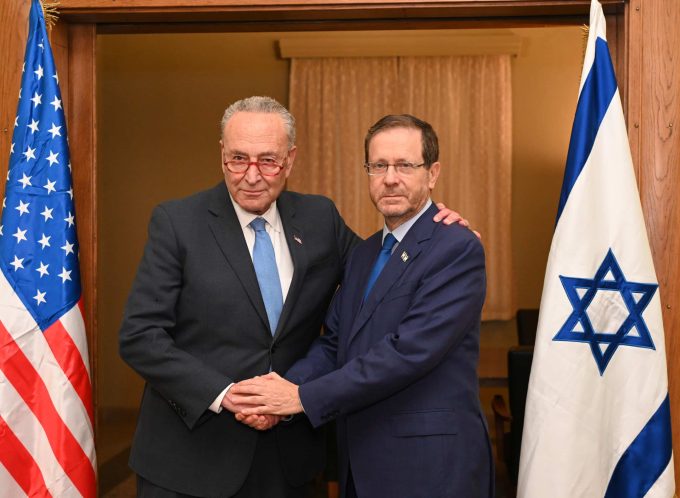
Photo by : Haim Zach / GPO
By Kyle Anzalone | The Libertarian Institute | February 4, 2026
Senator Chuck Schumer said that he would fight to get Israel “all the aid that it needs.”
“I will fight for aid to Israel. All the aid that Israel needs. I will continue to fight for it,” the Senate minority leader said on Saturday. He went on to refer to Israel aid as his “baby.”
The US has provided hundreds of billions in security assistance to Israel and fought several wars in the Middle East for Tel Aviv. Following the October 7, 2023, Hamas attack on Israel, the US sent Israel $14 billion in arms that were used to conduct a genocide in Gaza.
Schumer touted his role in passing that aid package to Israel. “We delivered more security assistance to Israel, our ally, under my leadership than ever, ever before. We will keep doing that,” he told the conference of Jewish-Americans. “As long as I’m in the Senate. This program will continue to grow from strength to strength, and we won’t let anyone attack it or undo it.”
The Democratic leader of the Upper Chamber also said that he hopes the ceasefire in Gaza turns into a lasting peace. However, Israel is undermining the truce with daily strikes on Gaza. Since Saturday, Israel has killed over 60 Palestinians.
While the US holds significant leverage over Israel via military assistance, statements like Schumer’s make it clear to Tel Aviv that Washington is unprepared to threaten Prime Minister Benjamin Netanyahu that if he does not comply with the ceasefire, Washington will end the flow of aid.
Epstein Files- Steve Bannon Admits Trump Administration Would ‘Not Cross Sheldon Adelson’ During First Term

The Dissident | February 4, 2026
In text messages between Steve Bannon and Jeffrey Epstein in 2018, now released as part of the DOJ’s Epstein releases , Bannon admitted that the Trump administration was captured by the Zionist lobby and the Zionist mega donor Sheldon Adelson.
While discussing U.S. policy towards Qatar with Epstein, Bannon admitted “Bolton [John Bolton, then National Security Advisor to Trump] only doing what Sheldon Adelson tells him to do– I got John the job but he will not cross Sheldon” to which Epstein replied, “I’m aware”.

This is further conformation that much of Trump’s foreign policy agenda during his first term was set by Sheldon Adelson, and since his passing, his wife Miriam Adelson.
During a speech to the Israeli Knesset last year, Trump boasted , “I am proud to be the best friend that Israel has ever had” then went on to list every policy he enacted at the behest of Israel, saying,
But as president, I terminated the disastrous Iran nuclear deal. And ultimately, I terminated Iran’s nuclear program with things called B-2 bombers. It was swift and it was accurate, and it was a military beauty.
I authorized the spending of billions of dollars which went to Israel’s defense, as you know. And after years of broken promises from many other American presidents, you know that they kept promising… I never understood it until I got there. There was a lot of pressure put on these presidents. It was put on me too, but I didn’t yield to the pressure. But every president for decades said, “We’re gonna do it.” The difference is I kept my promise and officially recognized the capital of Israel and moved the American Embassy to Jerusalem.
He then credited the Adelsons with these Zionist policies, pointing to Miriam in the crowd after listing them and saying, “Isn’t that right, Miriam?”
He added, “Miriam and Sheldon would come into the office. They’d call me, he’d call me. I think they had more trips to the White House than anybody else I can think of … And she loves Israel. But she loves it. And they would come in, and her husband was a very aggressive man, but I loved him. He was very aggressive, very supportive of me. And, he’d call up, ‘Can I come over and see you?’ I’d say, ‘Sheldon, I’m the President of the United States, it doesn’t work that way.’ He’d come in… But they were very responsible for so much, including getting me thinking about Golan Heights, which is probably one of the greatest things to ever happen to Israel.”
He even admitted that Miriam Adelson- who Trump admitted was “responsible for so much” cared more about Israel than America, saying, “I actually asked her, I’m gonna get her in trouble with this, but I actually asked her once, I said, ‘So, Miriam, I know you love Israel. What do you love more, the United States or Israel?’ She refused to answer. That means, that might mean, Israel”.
While introducing Miriam Adelson at an event, Trump again boasted “Miriam (Adelson) gave my campaign $250 million” adding, “her husband Sheldon was an amazing guy, he’d come up to the office, and there was nobody more aggressive than Sheldon … he would always say ten minutes it turned out to be an hour and a half and what he did was he fought for Israel, it’s all he really fought for”.
Bannon’s comments in 2018 are just further conformation that Trump’s agenda was shaped by money from Miriam and Sheldon Adelson during his first term, and since Sheldon Adelson’s passing in 2021, Miriam Adelson, during his current term.
Israel-Palestine head of HRW resigns over blocked report on Palestinians right of return
Press TV – February 4, 2026
The Israel-Palestine director of Human Rights Watch (HRW) has resigned in protest, saying the organization’s new Executive Director prevented the publication of a report exposing Israel for committing “crimes against humanity” by denying Palestinian refugees their right of return.
In separate resignations published on Tuesday, Omar Shakir, who led HRW’s Israel-Palestine team for nearly a decade, and assistant researcher Milena Ansari condemned the leadership’s decision as a break from standard approval procedures.
“I have lost my faith in the integrity of how we do our work and our commitment to principled reporting on the facts and application of the law … As such, I am no longer able to represent or work for Human Rights Watch,” Shakir wrote in his resignation letter.
The resignations have shaken one of the world’s most prominent human rights organizations.
The 33-page report, never published, documented the experiences of Palestinians displaced from Gaza, the occupied West Bank, and refugee communities in Lebanon, Jordan, and Syria.
It linked decades of denied return to clear violations of international law, including crimes that could be prosecuted.
HRW leadership claimed the report involved “complex and consequential issues” requiring further analysis before release.
In response, Shakir countered on the social media platform X, saying “the report was finalized after 7 months in review & signed off on by the MENA division, five different specialists, the Program Office & the Law & Policy Office.”
Shakir said the refusal to publish showed a disturbing unwillingness to confront Israel’s ongoing crimes.
While terms like “apartheid, genocide and ethnic cleansing” are increasingly recognized internationally, the right of return remains off-limits even within Human Rights Watch, he warned.
“The one topic … even at Human Rights Watch, for which there remains an unwillingness to apply the law and the facts in a principled way, is the plight of refugees and their right to return to the homes that they were forced to flee,” he said.
Shakir and Ansari said attempts to narrow the report’s scope to recent displacements in Gaza and the occupied West Bank weakened its legal case and silenced the voices of generations of refugees.
Over 200 HRW staff protested the report’s suppression, warning that the decision could seriously damage the organization’s credibility.
At least 7 million Palestinians live as refugees across Gaza, the occupied territories, and neighboring countries, driven from their homes during the Nakba.
The Nakba, or “catastrophe,” refers to the forced expulsion of 750,000 Palestinians by Zionist militias and the newly established Israeli regime in 1948. Thousands were killed during this genocidal campaign.
Since Israel’s genocidal assault on Gaza on October 7, 2023, the number of displaced Palestinians has risen by at least 1.5 million, intensifying a decades-long injustice.
Israel to shut water, electricity at UNRWA facilities in occupied territories
Press TV – February 4, 2026
Israel will begin cutting off water and electricity to United Nations Relief and Works Agency (UNRWA) facilities in the occupied Palestinian territories, a top Israeli minister announced on Wednesday.
Israel’s Energy and Infrastructure Minister Eli Cohen told The Jerusalem Post that he will “personally” oversee the shutdown of utilities to UNRWA offices in occupied al-Quds starting today.
Cohen accused the agency of operating “in a systematic way to incite against Israel.” He said utility companies had been formally instructed to carry out the cutoff, which is expected to be completed within two weeks.”
“In principle, the law was passed about two weeks ago. Warning letters have already been sent to properties that we identified as belonging to UNRWA,” he added.
“We are now working to locate all UNRWA assets, evacuate them where necessary, and in some cases, seize the properties,” Cohen said. “Where they continue operating, we will disconnect electricity and shut down the buildings.”
Israel’s parliament, known as the Knesset, passed legislation in late December stripping UNRWA of diplomatic immunity. The law exposes the agency to legal action in Israeli courts, bars the regime’s companies from supplying it with water, electricity, or financial services, and allows authorities to seize its offices in occupied East al-Quds.
UN agencies are normally protected by diplomatic immunity under international conventions ratified by Israel. Tel Aviv’s move to revoke these protections comes amid a broader crackdown that began after it launched its genocidal war on Gaza in October 2023.
Israel also began demolishing UNRWA’s headquarters in al-Quds on Tuesday.
UNRWA Commissioner-General Philippe Lazzarini condemned the demolition, calling it “an unprecedented attack” and “a new level of deliberate defiance of international law.”
Francesca Albanese has called for Israel’s suspension from the United Nations following the regime’s destruction of UNRWA headquarters in occupied East al-Quds.
Established in 1949 by a UN General Assembly resolution, UNRWA provides assistance and protection to Palestinian refugees across Jordan, Syria, Lebanon, the occupied West Bank, and the Gaza Strip.
The shutdown of its facilities has drawn sharp international criticism since Israel first moved to curtail the agency’s operations in areas under its control.
The ban severed contact between UNRWA and Israeli authorities, severely restricting its ability to operate in Gaza and the occupied West Bank. Israel has also stopped issuing visas to UNRWA staff.
The agency, which provides essential education, healthcare and humanitarian aid to millions of Palestinians, played a central role in delivering food, medicine and shelter during Israel’s war on Gaza, with many of its schools used as shelters for displaced civilians.
New York Bans Israel-Linked Terror Group
A Good Start, But…
By Kevin Barrett | American Free Press | February 2, 2026
On January 13, the State of New York set a small but significant precedent by banning the Jewish-supremacist terror group Betar. In a settlement with the state’s Attorney General, Betar agreed to stop terrorizing New Yorkers who disagree with the group’s pro-Israel, Jewish-supremacist agenda. Simultaneously with the agreement Betar dissolved its New York operations—but vowed to reconstitute itself and continue terrorizing Americans in other jurisdictions.
Though New York did not officially deem Betar a terrorist group, it’s clear that’s exactly what it is. The definition of terrorism is: “Using violence or the threat of violence against civilians to create fear for political purposes.”
Clearly, terrorism was and remains Betar’s central mission. New York’s Attorney General Letitia James wrote: “My office’s investigation uncovered an alarming and illegal pattern of bias-motivated harassment and violence designed to terrorize communities and shut down lawful protest.” Leaked messages show the group conspired to blind peaceful anti-Israel protesters with laser weapons and attack them with chemical weapons. Betar even plotted to car-bomb New York’s mayor. They delivered dozens of bomb threats to students, professors, and other Americans.
Betar’s members conspired to attack anti-Israel protesters with lasers, asking “can we burn their eyes out?” They routinely dispensed bomb threats by delivering Israeli-style (exploding?) pagers to people whose views they disagreed with. And they conspired to commit these and other acts of terrorism with “many people in various goverment (sic) offices including the prime ministers (sic) office, shin bet and other intelligence agencies in the state of Israel” according to their own leaked text messages.
The violence wasn’t just talk. On numerous occasions, pro-Palestine demonstrations have been brutally attacked by suspected Betar thugs, who typically wear face-masks to prevent identification. In just one of many examples, peaceful protesters at UCLA were attacked by Betar-aligned terrorists armed with explosives and chemical weapons last June. Unfortunately, since the pro-Zionist-terrorism Anti-Defamation League (ADL) and other organized crime syndicates have infiltrated and bribed local and national police agencies, Betar’s Jewish supremacist terrorists are rarely brought to justice.
If you’re still wondering whether Betar is really a terrorist group, try the following thought experiment: Imagine what would happen if radical Muslims plotted to blind Jews with lasers, attack them with explosives and chemical weapons, threaten them by delivering realistic-looking bombs, and joyfully envisioned murdering a Jewish mayor of New York by blowing up his car. Clearly such a group would be immediately slapped with a terrorist designation: All its assets would be confiscated, its members would be arrested and sent to Guantanamo, all their assets would be seized, and any remaining members would be hunted down and killed using US military drones.
And what would happen to the foreign nation that supported that wave of terrorism in the US? Our federal government would immediately sanction it, freeze and confiscate its assets, bomb it, and very possibly invade it and execute its leaders.
But when the terrorists are Jewish supremacists backed by the state of Israel, the rules suddenly change. The worst thing that can happen to them is a negotiated settlement with the state of New York in which the terrorists promise to stop terrorizing New Yorkers, while vowing to continuing terrorizing Americans in other states.
Maybe it’s time to start treating Betar and similar groups the same way we treat other terrorists. After all, the whole point of declaring a “war on terrorism” after the attacks on September 11, 2001 was to punish the people who committed that atrocity and remove their ability to commit future atrocities.
But we went after the wrong people. The real 9/11 terrorists were Israeli-backed Jewish supremacists, who orchestrated the false flag demolition of the World Trade Center to hijack America’s military and use it against their regional enemies. (For details, read “9/11 Was an Israeli Job” by Laurent Guyénot; “American Pravda: October 7th and September 11th” by Ron Unz; and “Israel Did 9/11” by Wyatt Peterson.
New York’s polite closure of Betar’s local branch office is a good start. But Americans need to recognize that Betar and its state sponsors are terrorists—and treat them accordingly.
It would be logical, not to mention poetic justice, for the US government to use the extraordinary powers it seized after 9/11 to punish the real perpetrators of the demolition of the World Trade Center and the attack on the Pentagon, and to ensure that they will never again commit such an act. By recognizing that Betar and other Jewish supremacist groups are terrorists, and that the world’s worst terrorism-supporting rogue nation is the so-called state of Israel, Americans could finally do what is necessary to win the war on terror that was declared in the wake of Israel’s controlled demolition of the World Trade Center.
Saudi media takes an anti-‘Israel’ turn: WSJ
Al Mayadeen | February 2, 2026
Saudi Arabia’s state-backed media has adopted an increasingly hostile tone toward “Israel,” signaling diminishing prospects for diplomatic normalization between the two regional powers as the war on Gaza continues to reshape political calculations across West Asia.
The Wall Street Journal (WSJ) wrote on Monday that the shift has been reflected in official and semi-official outlets. In a January editorial, the daily Al-Riyadh accused “Israel” of disregarding international law and state sovereignty, stating that “wherever Israel is present, there is ruin and destruction.”
According to WSJ, religious figures have echoed the rhetoric. In a December sermon at the Grand Mosque in Mecca, Sheikh Saleh bin Humaid declared, “Oh God, deal with the Jews who have seized and occupied, for they cannot escape your power.”
Saudi officials say the increasingly sharp messaging is partly driven by the kingdom’s escalating rivalry with the United Arab Emirates, a regional competitor for economic leadership that has taken opposing positions to Riyadh in multiple West Asian conflicts. The UAE is also the most prominent Arab signatory of the series of US-backed normalization agreements with “Israel.”
Saudi officials acknowledged that the media campaign, while directed by the kingdom’s leadership, has also served as a means to sway public opinion against those normalization deals, which they described as an easy target amid widespread anger over the Gaza war.
UAE: The Israeli Trojan horse
In a recent online editorial for the Saudi publication Al-Jazirah, columnist Ahmed bin Othman Al-Tuwaijri accused Abu Dhabi of embracing Zionism to settle regional rivalries, writing that the Emirates had positioned itself as an “Israeli Trojan horse in the Arab world.”
Saudi Arabia disputes claims that the coverage is centrally coordinated but has nonetheless taken note of the tone, viewing it as a reflection of growing public anger toward “Israel” and the political pressure this creates for the leadership.
Bringing Saudi Arabia into the normalization agreements has long been a central objective for Washington and “Israel.” However, Saudi and Israeli officials say Riyadh’s calculations shifted sharply following the Gaza war, whose toll has hardened public and elite attitudes alike. While Saudi Arabia maintains that it remains open to normalization if it includes a credible pathway to a Palestinian state, officials say the urgency surrounding such a deal has diminished, allowing other foreign-policy priorities to take precedence.
Saudi media’s criticism of “Israel” is not unprecedented. Crown Prince Mohammed bin Salman previously referred to Israeli actions in Gaza as a genocide in November 2024. However, the current campaign marks a sharp reversal from years of quieter efforts aimed at softening public opinion and preparing Saudi society for possible diplomatic ties.
KSA-UAE dispute shaping stance on ‘Israel’
On that note, former US official Daniel Shapiro questioned whether the shift reflected a wavering commitment by Crown Prince Mohammed bin Salman to regional moderation, warning that abrupt policy changes in response to rivalry could undermine confidence in Saudi leadership.
According to the WSJ, Saudi Arabia’s embassy in Washington said the kingdom rejects antisemitism and remains open to normalization provided there is a firm commitment to Palestinian statehood. Defense Minister Khalid bin Salman recently traveled to Washington, meeting Jewish groups and emphasizing Saudi Arabia’s commitment to regional integration.
Washington-based analyst Mark Dubowitz said Saudi officials privately acknowledged that their dispute with the Emirates had crossed into an anti-“Israel” posture that was creating political difficulties in the United States, prompting efforts to lower tensions.
Israeli Prime Minister Benjamin Netanyahu said this week that “Israel” is monitoring Saudi developments closely, warning that normalization requires partners to refrain from aligning with forces opposed to peace, while reiterating his interest in ties with a “strong and secure Israel.”
Saudi Arabia and the UAE remain deeply divided over regional influence, economic leadership, and conflicts, including Yemen, where recent territorial shifts near the Saudi border have intensified tensions. Although relations between Riyadh and Abu Dhabi are at their lowest point in decades, analysts note that both countries share long-term security and economic interests, suggesting that a thaw between the two Gulf rivals is more likely to precede any normalization between Saudi Arabia and “Israel”.
Fantasies of Fragmenting Iran Only Serve Israeli Interests
By José Niño | The Libertarian Institute | February 2, 2026
A troubling convergence has emerged among Western think tanks, Israeli politicians, and exiled opposition figures advocating for the partition of Iran along ethnic and sectarian lines. This strategy represents a dangerous escalation from traditional regime change toward what can only be described as regime destruction, a policy shift that would benefit Israeli regional ambitions while catastrophically destabilizing the Middle East and creating humanitarian disasters that would dwarf the Syrian refugee crisis.
Iran’s demographic reality forms the pretext for these proposals. Persians constitute between 51 and 61% of the population, while Azerbaijanis comprise 16 to 24%, Kurds represent 7 to 10%, with smaller populations of Arabs, Baloch, Lurs, and Turkmen rounding out the nation’s ethnic composition. Rather than viewing this diversity as a national strength, Balkanization advocates frame it as a strategic vulnerability ripe for exploitation.
The Foundation for Defense of Democracies, a rabid neoconservative organization, has positioned itself at the forefront of this campaign. Analyst Brenda Shaffer has explicitly promoted Iran’s fragmentation comparable to Yugoslavia’s violent collapse, while maintaining undisclosed financial ties to Azerbaijan’s state oil company SOCAR. Her advocacy centers on promoting secession of Iranian Azerbaijan, revealing fundamental misunderstanding of Iranian internal dynamics. Both Supreme Leader Ayatollah Ali Khamenei and President Massoud Pezeshkian are Azerbaijani, thoroughly undermining narratives of Persian ethnic hegemony driving separatist sentiment.
Media outlets have amplified these calls with alarming explicitness. In June 2025, The Jerusalem Post editorial board urged formation of a “Middle East coalition for Iran’s partition,” proposing “security guarantees to Sunni, Kurdish and Balochi minority regions willing to break away.” The editorial advocated federalization or complete partition, explicitly comparing Iran’s potential dismemberment to Yugoslavia’s breakup. The Wall Street Journal similarly published arguments that a fractured Iran could frustrate Russian and Chinese interests while reducing threats to Israel, downplaying catastrophic risks.
Israeli political circles have demonstrated institutional support for partition. In 2023, thirty-two members of Parliament signed a declaration calling for Iran’s disintegration into six parts, advocating territorial separation from Tehran to Iranian Azerbaijan, merger of Iranian Kurdistan with Iraqi Kurdish regions, independence for Ahwaz, and alignment of Baluchistan with Pakistan. Though most lawmakers later rescinded signatures following backlash, the episode exposed significant appetite for fragmentation strategies within Israeli political establishment.
The ideological foundation for these proposals traces directly to the 1982 Yinon Plan, a strategic memorandum by Israeli journalist Oded Yinon advocating division of Middle Eastern states along ethnic and sectarian lines. The plan explicitly stated Israel must effect “the division of the whole area into small states by the dissolution of all existing Arab states,” operating on the premise that smaller states are weaker states and therefore easier to dominate. While the original document focused primarily on Arab states, contemporary partition advocacy has extrapolated these principles to Iran, effectively creating a Yinon Plan for the Iranosphere.
This represents the logical culmination of a strategy that has already produced catastrophic results across the region. Iraq’s 2003 invasion and subsequent sectarian fragmentation created hundreds of thousands of civilian deaths, millions of refugees, and the rise of ISIS rather than the democratic transformation promised. Syria’s fragmentation generated over half a million deaths and displaced half the pre-war population. Libya’s post-intervention collapse created ungoverned spaces exploited by terrorist networks and human traffickers. The pattern is consistent: balkanization produces chaos, humanitarian catastrophe, and conditions favoring extremist groups rather than stability or democracy.
For Iran specifically, partition would serve exclusively Israeli strategic interests while harming American national security. Israel seeks to leave Iran fragmented and dotted by warring statelets incapable of posing coherent challenge to greater Israeli regional ambitions. A broken Iran cannot develop nuclear capabilities, cannot support resistance movements, cannot project power beyond its borders. The United States has no corresponding interest in such outcomes. Iranian fragmentation would create massive refugee flows destabilizing neighboring states and requiring international humanitarian intervention. It would generate ungoverned territories exploited by terrorist organizations.
Turkey will never tolerate Western support for Kurdish separatism in Iran given its decades-long struggle with the Kurdistan Workers’ Party. Pakistan, already facing a Baloch insurgency movement, would view Western meddling in Iranian Balochistan as direct threat to its territorial integrity. Russia and China, both managing ethnic minority regions, would interpret Iran partition as validating their darkest suspicions about Western intentions, accelerating formation of anti-Western coalitions and hardening domestic crackdowns.
American efforts against Iran have already demonstrated the futility of maximum pressure approaches. Decades of sanctions have not produced regime change but rather entrenched hardliners and strengthened nationalist resistance. Covert operations including assassinations of nuclear scientists, Stuxnet cyberattacks, and support for exile groups have failed to alter Iranian strategic calculations. Direct military strikes destroyed facilities temporarily rebuilt within years. The historical record shows Iranian society rallies around the flag when facing external aggression rather than fragmenting along ethnic lines.
Iranian nationalism represents a powerful unifying force transcending ethnic divisions. Iran claims status as one of the world’s oldest continuous civilizations, with national identity predating modern ethnic categories. Unlike Iraq or Syria where borders reflected colonial cartography, Iran constitutes a historically integrated entity where internal diversity has coexisted with strong national consciousness for millennia.
The alternative to destructive partition fantasies requires sober policy recognizing previous failures. The United States needs fundamental strategic reorientation away from Middle Eastern interventions toward addressing genuine national security priorities. Border security in the Western Hemisphere, managing peaceful co-existence China, and rebuilding domestic infrastructure represent core American interests unrelated to fragmenting Iran.
Non-interventionism and restraint acknowledge that Iranian political evolution must emerge from internal dynamics rather than external manipulation. The lessons from Iraq, Syria, and Libya are unambiguous. Military intervention and support for fragmentation produce humanitarian catastrophes, empower extremist factions, and create conditions requiring prolonged American involvement rather than enabling withdrawal. The Middle East does not need another failed state generating refugee crises and terrorist safe havens. The American people deserve foreign policy serving national interests rather than outsourcing strategic decision-making to regional allies [?] pursuing incompatible objectives.
Iran’s partition would not take the country off the geopolitical chessboard as advocates claim. It would set that board on fire, creating unpredictable cascades of violence, displacement, and great power competition in one of the world’s most volatile regions. The humanitarian costs would be staggering, the strategic consequences counterproductive, and the benefits accruing exclusively to Israel rather than the United States or the Iranian people themselves.
A responsible approach recognizes Iran’s ninety million citizens deserve to determine their own political future, but such transformation cannot be imposed through external fragmentation. The path forward requires restraint, non-interventionism, and acknowledgment that decades of sanctions, covert operations, and military threats have consistently failed while strengthening the very regime they aimed to weaken.
American Zionists are using Trump’s Republican Party to create a multicultural supremacist elite

By Matt Wolfson | Al Mayadeen | February 2, 2026
On January 13, 2025, seven days before Donald Trump’s second inauguration as president, The Free Press, the online magazine created by the Zionist operator Bari Weiss who has powerful connections to the Trump Administration, ran a profile which may say more about the ultimate causes of America’s current policies, and where those policies will likely lead, than any other public document.
The profile was of Amy Chua, famously the author of Battle Hymn of the Tiger Mother, a mostly well-received cri de Coeur for what Chua sees as rigorous Chinese parenting; and less famously the John M. Duff, Jr. Professor of Law at Yale Law School. The profile, drawing explicitly on Chua’s most publicly recognizable achievement, was titled “The Tiger Mother Roars Back,” and its subtitle reinforced its approach, an ardent rave: “Yale tried to run Amy Chua out. Now her former students, J.D. Vance and Vivek Ramaswamy, are headed to Washington. So is she.”
For people who follow the politics of America and so of America’s empire, the forwardness of this profile raises questions. Construed as a gesture of support for two politicians, Vance and Ramaswamy, who are attempting to woo the public on populist credentials, it seems misthought. There is nothing populist about Chua—and her lacks are tells about the lacks of her mentees. Indeed, it was under Chua’s mentorship that Vance wrote a bestselling book with the encouragement of another Chua mentee, Vance’s future wife Usha, blaming the failures of his lower-income Appalachian upbringing on the “cultural” deficiencies of the community which raised him. This is a view that, since entering politics with the aim of appealing to precisely that community, he has quickly disavowed. Ramaswamy, for his part, has fallen deeply and predictably afoul of populist Americans precisely by making that case in public.
So why would Weiss, who if nothing else is a strategic operator, run a piece on Chua connecting her to Vance and Ramaswamy as well as broadcasting Chua’s views, which are anathema to the people from whom Vance and Ramaswamy want support?
The answer is that, though Weiss is an ideologue focused on advancing “Israel’s” immediate interests, there is a “positive,” longer-term Zionist play in the works among her and her allies. I have reported in miniature on this play last year, in a September investigation of the philanthropic education donations of Bill Ackman, the Zionist financier: to seed a new ruling elite based on technological and management skills. But the project goes deeper. It amounts to the legitimation of a new ruling class in America centered on a narrow cadre of elites of three groups— Zionists, Hindutvas (Hindu supremacists), and, discernably but least specifically definably, East and Southeast Asian supremacists often with connections to countries where Buddhism has exercised significant influence.
These elites use their present success in America’s military corporate complex to make claims to group superiority. They then use those claims to justify special treatment for their groups and nations that allow them to solidify their power, and to solidify the hold of American empire, which they see as the rightful disseminator of “merit.” Their accelerating project will likely realize itself through the Republican Party, via Chua’s mentees, the Vances and Ramaswamy, among others, and it may ally itself with other right-wing influences as seemingly dissimilar but actually imitative as the white supremacy of Nicholas J. Fuentes. It is only now taking recognizable shape, and understanding its origins and spread is crucial to understanding the havoc it is already beginning to wreak in America and abroad.
That understanding begins with examining the arguments which influenced Vance and Ramaswamy; arguments made by Amy Chua and Jed Rubenfeld, her husband, a Yale Law professor and Jewish Zionist who writes for The Free Press. These arguments are noteworthy in that they look for “warps” in cultures to explain problems which other scholars have put down to military corporate power and its brute effects (outsourcing, conglomeration, the Wars on Crime and Drugs, unauthorized and some kinds of authorized immigration) on American life.
Indeed, the most straightforward reason why Vance’s Appalachian Americans as well as Black and Latino Americans have notably struggled is American imperial policy that has started at the top: labor outsourcing and urban mis-development, misthought immigration policies, and military corporate buildup. These policies have accrued for 60 years, and academics and writers have made the case against them for almost 50.
This book of Chua and Rubenfeld’s, where they lay out their view (The Triple Package: How Three Unlikely Traits Explain the Rise and Fall of Cultural Groups in America) does not emphasize these structural, practical explanations. Instead, Chua and Rubenfeld put “winners’” success in America over the last sixty years down to three group traits: specifically, “a superiority complex,” “insecurity,” and “impulse control.” According to The Triple Package, “a superiority complex” means “a deeply internalized belief in your group’s specialness, exceptionality, or superiority” flowing from religion, civilization, or social traits. “Insecurity” means “a sense of being looked down on, a perception of peril, feelings of inadequacy, and a fear of losing what one has.” And “impulse control” means “the ability to resist… the temptation to give up in the face of hardship or quit.”
But the paradox of Chua’s and Rubenfeld’s explanation, which they don’t appear to realize, is that, taken logically on its face, it supports the structural, practical explanations they apparently ignore. Political theory and history show that groups in the grip of triple package holders’ emotional Cartesianism (possessing an a priori thesis, superiority, in the face of insecurity, and so willing to do anything to prove the thesis right) are reliable tools of arbitrary imperial power. Indeed, empires moving aspirant, insecure, determined groups into their own managerial elite is a defining feature of the Roman Empire; the British Empire in the American colonies and India; the German Empire; and the United Arab Emirates. In America’s empire, these co-opted groups have most prominently been the three which Chua and Rubenfeld write about most often and with whom they and their family most identify: Jewish Americans, Indian Americans, and East and Southeast Asian Americans.
All three of these groups experienced marginalization and persecution at the hands of various empires (the Russian and German; the British; the American) before 1950. Their members have attendantly experienced heightened levels of insecurity; and elite cadres of two of the three groups have adopted what most scholars consider to be clearly definable supremacist ideologies: Zionism, which was founded in 1897 and Hindutva ideology, which was founded in 1925. The third type of supremacy, East and Southeast Asian supremacy, is more diffuse but clearly discernable.
Unlike Zionism, which is linked to “Israel”, and Hindutva ideology which is linked to India, there are multiple countries at play and multiple labels under which claims of East and Southeast Asian supremacy are raised. Also, the way these claims are raised often surfaces less as outright supremacy and more as “cultural essentialism”—that there’s something in this group’s cultural “essence” that makes members more “successful.” Finally, research into outright supremacist manifestations from groups associated with them is more recent, usually under the headings of Buddhist or East Asian supremacy. Nonetheless, taking these distinctions into account, East and Southeast Asian success in America’s imperial complex and corresponding claims like Chua’s to superiority are recognizable trends: some of them embraced by supremacists who praise thinkers like Chua for what critics call their cultural supremacy.
I have reported at some length about how the process of these groups claiming power in American empire played out, beginning with Jewish Zionist elites in the 1960s. I examined these Zionist elites’ acceptance into the American military corporate complex by WASPs (White Anglo-Saxon Protestants). I also pointed out that Zionists’ overall success accessing this complex came from their pursuit of narrow applied skills valued by the WASPs: economics, management theory, administrative law, engineering, finance, and technological proficiencies; a model the WASPs took quite consciously from European Empires. Zionists, in their own description, were easy marks for this kind of invitation to power that ultimately deracinates the culture of the people who accept it.
Theodor Herzl, the founder of the movement who embodies the terms of its successes and failures, was a marquee possessor of Chua’s and Rubenfeld’s triple package. He had grown up a secular Jew with little connection to his religion but a strong sense of his own superiority, and only embraced Zionist Judaism with a manic intensity when the Dreyfus Affair made him decide that he could never realize his ambitions without identifying as Jewish.
An instructive echo of Herzl’s mentality comes in the memoir of Martin Peretz, one of the early entrants into America’s corporate complex in the 1960s. Peretz, who taught at Harvard, owned The New Republic, the most influential Zionist magazine in the country, and played a prominent connective role in and near Wall Street, is in many senses a later-day Herzl. He is a high-status secular Jew with an admitted sense of insecurity who is also a fervid Zionist, and he writes in his memoir about himself and his friends who “made it” that
We were… from a strong culture that was an outsider culture, in the first generation when that culture could assert itself in American institutions. We weren’t constrained by old obligations because we were coming into a world that didn’t want us anyway. We had each other’s backs because we knew the kind of resentment arrivistes, and Jewish arrivistes, unleashed… We were the first ethnicity to break through into the ruling class institutions following the wane of Protestant influence, and we saw those institutions as the key to our flourishing.
Peretz’s Harvard mentee, Bill Ackman, the Zionist financier, is a good example of how younger Zionists operating in Herzl’s and Peretz’s tradition have swallowed this model whole. Ackman’s view of Harvard, where he is also a donor, falls along just these lines of imperial functionality:
As one of the oldest and perhaps the most notable of this country’s academic institutions, Harvard represents the gateway to elite status and to ‘making it’ in modern day American society. One need only look at the disproportionate numbers of Presidents, Nobel Laureates, and chairmen of Fortune 500 companies who have graduated from Harvard to understand the power of the Harvard degree. As a result, admission to Harvard has become the target of groups seeking upward mobility.
What goes unacknowledged here is that “elite status,” “upward mobility” and the skills that create them have only been an aspiration for most Americans since 1945, when the Cold War allowed WASPs to expand their institutions and use them to try to mold the country in their image. Before this point, most Americans understood their country as being predicated on towns and cities and states; and on a high degree of associational thickness, communal coherency, and decentralized government which allowed individuals a say in the terms of their lives. But Zionists were never open to an argument like this. Their strategy, like Herzl’s, was to enter empire and use it to rise, and it is not a coincidence that, almost immediately on accessing America’s military corporate complex, they opened America’s doors to Hindu and East and Southeast Asian operators who approached the matter of institutions and power on their terms.
The Zionists’ tool was the 1965 Immigration and Nationality Act, which was sponsored by staunch Jewish Zionist Congressman Emmanuel Celler. The Act opened America’s elite universities to “high-skilled,” often upper-middle class arrivals from undemocratic or less democratic countries like India and China: people not particularly versed in constitutionalism but extremely well-versed in applied technical proficiencies valued by empire.
The most obvious beneficiaries were Hindu Americans. It was the 1965 legislation and its 1990 expansion by George H.W. Bush, the penultimate WASP president, which brought into this country the parents of Usha Vance; Vivek and Apoorva Ramaswamy; the pro-Zionist Republican operative and current Assistant Attorney General for Civil Rights Harmeet Dhillon; and the U.S. Representatives Ro Khanna, Raja Krishnamoorthi, and Suhas Subramanyam. More decisively, as I reported in December, it has brought into the defense-tech mecca of Silicon Valley aggressive Hindu financial operators who have deep political sway. Much as, in the telling of anti-Zionist Jews like Norman Finkelstein, the converging success of Israelis and American Zionists off the largesse of America’s imperial complex hardened these players’ Zionistic belief in their Jewish supremacy, so a similar trend appears to have taken place with American Hindus who adopt some version of Indian Prime Minister Narendra Modi’s Hindutva ideology. Their influence, as outlined by Andrew Cockburn in a groundbreaking article in Harpers, reaches deep and wide, in part through their connections to Zionists.
Somewhat more subtle than the Hindutva assumption of influence in America, but equally noteworthy has been the East and Southeast Asian, especially Chinese, accrual of influence here. WASPs had used their educational and financial influence to foster relationships with China going back to the 1870s. Later, Zionists took up that task: bringing Chinese elites into philanthropy and finance, aided by the 1965 legislation, which led to a sharp increase in high-skilled East and Southeast Asian immigration to America. Arguably the clearest window onto this process is the Committee of 100: a group with connections to Amy Chua founded in the late 1980s by influential Chinese Americans at the urging of Peretz ally and “Israel” defender Henry Kissinger, and with the aid of Peretz’s friend Yo-Yo Ma. As I traced in my report last year on the Committee’s growth, the Committee and some of its members have assiduously inserted themselves at crucial educational and philanthropic junctures. As I reported about their propaganda last April:
The obvious part of their message is that… America is a colorblind nation where, minus prejudice, anyone can succeed. In this schema, anyone questioning the loyalties or actions of those who have succeeded, like [members of the Committee] and their allies, are acting off of lower motives, and are anti-merit.
What is also instructive is that, despite vocal pushback to Chua’s ideas by regular readers, prominent East and Southeast Asian Americans and East Asian American organizations, including but not limited to the Committee of 100, have embraced Chua since she gained fame with her ideas and given her a public platform. Allies of Chua’s echo her arguments in a gentler way, among them the Chinese-American writer Sherryl WuDunn, a connection of Chua’s via other East Asian American organizations, whose husband Nicholas Kristof made a less constrictive, “essentialist” version of Chua’s cultural supremacist arguments in The New York Times. And cultural, ethnic, and even racial supremacists like the neoconservative Charles Murray have embraced Chua’s claims.
Jewish Zionists have been forging alliances with Hindu and East and Southeast Asian American arrivals at an accelerating rate for nearly 40 years. They have used these groups’ shared success to argue that any opposition to those groups with an outsized place in America’s military corporate complex comes from resentment and envy among people who don’t measure up.
In 1988, only 23 years after the Immigration and Nationality Act was signed, two years before the inception of the Committee of 100, and eight years before the Silicon Valley boom began, Bill Ackman, on the advice of his Harvard mentor Peretz, wrote an honors thesis entitled “Scaling the Ivy Wall: The Jewish and Asian Experience in College Admissions.” In the thesis, Ackman “draws parallels between the experience of Jews trying to gain admission to Harvard in the 1920s with the experience of applicants from Asia during the 1980s.” In 2024, gearing up for his crusade against anti-Zionism in universities, Ackman began making the rounds of newspapers, magazines, and online interviews, armed with his undergraduate thesis, arguing that the groups he wrote about in the 1980s (Jews and Asians) are technical achievers being discriminated against by opponents of merit.
That same year, Ackman’s ideological ally Bret Stephens featured in his Zionist magazine Sapir a piece quoting Ackman’s 1988 thesis by an ardent backer of Ackman’s ardent ally Vivek Ramaswamy: Rajiv Malhotra, arguably the most prominent Hindutva operating outside of India. Malhotra began this essay, an argument for “A Hindu Jewish Partnership”, by arguing that, like Asian Americans and Jews, Hindu Americans are “‘model minorities’ who have made much of the American dream” and must come together “to safeguard the world from the regressive movement against merit.” This notion that any resentment against those groups which seem to be steering American Empire flows from jealousy or resentment is shared by Amy Chua, who said, in a recent interview, that
There is tremendous resentment, fear, and insecurity about Asian-Americans because of college admissions… And then you’ve got China, a whole different source of insecurity.… Now on campus, I noticed that this anti-Chinese resentment slash fear is coming from both the Left and the Right, which is very unusual.
Tellingly, none of these arguments about “safeguarding merit” define merit as anything other than technical skills fit for empire, and this is not a bug but a feature of supremacist argument. Jewish, Hindu, and East and Southeast Asian supremacists justify their traditions based on their ability to impart skills that help empires claim power. Examples of this pattern range from Hindutvas who boast that “ancient Indians were proficient in stem cell technology and built aircrafts” in “an imagined Hindu golden age of scientific progress,” to equally remote Zionist narratives claiming that consumer innovations of all kinds originated with “Israel” to Amy Chua’s “conceptually loose” and factually dubious appropriation of her “meretricious” heritage for raising “successful” children. None of these arguments address the arguments of dissenters from within their traditions who think that, by attaching their traditions to a project of empire based on technical skills, supremacists have distorted the moral, intellectual, and cultural essences that made these traditions worth having. The most accurate description of the supremacists may in fact be “ethnopreneurs”: players who use their groups’ access to empire to show a public they assume is aspirant how to be like them, gaining recognition or profit by doing so.
The supremacists also have imitators, sometimes in the most seemingly unlikely of places. It was Nicholas J. Fuentes, nominally on the other side of the new Republican coalition from Ramaswamy and Chua and Rubenfeld and Weiss, who recently told Piers Morgan that “In Israel, they have my politics. If they had their way, it would only be Jewish people.” In fact, in “Israel”, it’s not Jewish people who are welcome; it’s only Jews openly committed to Jewishness as an imperial supremacist project, much as Fuentes is openly committed to an imperial supremacist project around white male Americans whom he says are victimized based on the superiority of their race.
Chua’s mentee J.D. Vance appears to be working to stabilize the Republican coalition in ways that may function, whatever his intent, to unite the supremacists. Even as Vance speaks implicitly in favor of including Nick Fuentes in the Republican Party and Vance’s ally Tucker Carlson gives Fuentes a platform, Vance’s most prominent ally, Erika Kirk, who is publicly committed to his 2028 presidential bid, is appearing in interviews with Zionists like Bari Weiss and Andrew Ross Sorkin. Vance only recently helped ink the deal that put Zionists, including Jared Kushner and the Ellisons, in control of TikTok; and in 2025 both Vance’s wife Usha and his mentor Chua gave rare, exclusive interviews to Weiss’s Free Press, which the Ellisons now own.
This year, Vance is scheduled to appear on CBS’s new Town Hall series, where he will be interviewed by Weiss. This looks like the rudiments of a new coalition of elites with nominally different heritages united by a shared conviction of supremacy. And policy is following suit to privilege these elites—not so much shrinking the “deep state” as Trump promised during his reelection campaign but redirecting it in ways that serve their interests:
“Israel”, with American support, is “modernizing” and “improving” Latin America and the Middle East using its technical prowess, compromising the sovereignty of nations and regions. Hindutva ideologists are coming to Silicon Valley, where Zionists arbitrate power. East and Southeast Asians are entering the Ivy League in record numbers with the aid of lawsuits from Zionist operatives, even as the Trump Administration has made no effort to shrink these universities’ power as the “gateway” to political influence.
The Muslim world, arguably Zionists’ and Hindutvas’ and Buddhist East Asians’ greatest enemy, has become our enemy. American Zionist operatives are using artificial intelligence to track anti-Zionist opinions online in conjunction with imperial outgrowths like Harvard in ways that sound quite similar to the Hindutva ideologue Rajiv Malhotra’s proposal in the Zionist magazine Sapir for an “Intellectual Iron Dome” in imitation of Israel’s defense system the Iron Dome. (This is a project seemingly imitative of Philip K. Dick’s dystopian novella The Minority Report: “to harness the powers of AI… to monitor and examine trends in antisemitism and Hinduphobia online and predict problems before they manifest.”) And, thanks to the Zionist Stephen Miller, the Trump Administration is deporting migrants of color while deracinating their “sh**hole” countries of oil in the name of serving the people for whom Fuentes claims to speak. Namely, a mostly white American population now “freed” from “third world” “leeches, killers, and entitlement junkies” but indentured in the same servitude to the military corporate elite.
In the face of unrelenting infiltration by these colonial supremacists of all sorts in pursuit of their own global Raj flowing from America, anti-imperial resistance at home and abroad, using law and popular politics, is the only sensible path.
Featured Video

Racist Seinfeld Dances for Joy as Bibi Unveils His New Map
or go to
Aletho News Archives – Video-Images
TV Drama Review
Japanese drama projects Japan’s wartime atrocities onto Chinese characters

Global Times | October 25, 2026
By portraying Chinese characters as perpetrators of ruthless violence while casting Japanese Self-Defense Forces (SDF) intelligence operatives as defenders, the season 2 of the Japanese drama Vivant has recently drawn criticism from Chinese netizens, who argue that its depiction turns historical reality on its head while ignoring Japan’s wartime atrocities.
The TBS drama series – a spy suspense story in which an alleged unofficial intelligence unit of the SDF operates across the globe — has attracted a passionate fanbase. Its currently airing season 2 opened with a household rating of 18.8 percent, the highest for a TV drama this year, according toa commentary article by Japanese media Toyo Keizai.
What draws attention is the portrayal of the enemies in the series, the article noted. Scenes in which the Chinese organization subjects kidnapped members of the SDF unit to brutal torture are repeated with unrelenting intensity.
It is rare for Japanese TV dramas to explicitly portray a real-life country as the enemy, the article noted.
Japanese Prime Minister Sanae Takaichi also made a reference to the drama, saying that she has been recording Vivant and hopes to binge-watch it over the year-end and New Year holidays, according to Japanese media outlets.
China’s CCTV News report on Sunday revealed that the drama features scenes in which Chinese personnel cut off the fingers of and stab Japanese intelligence operatives in the abdomen. Such acts bear striking similarities to the torture inflicted on Chinese nationals by invading Japanese troops during the World War II.
The drama distorts the truth by attributing these atrocities to modern Chinese characters. Beneath the surface, it subtly glorifies Japan’s cross-border overseas operations, blurs the functional boundaries of the SDF and implicitly promotes an expansionist narrative, per CCTV News. … continue
Blog Roll
 Aletho News
- EU facing trillion-euro debt hole while seeking more cash for Kiev
- How US, Europe, Persian Gulf states exhausted missile stockpiles, splurged billions to defend Israel
- Up in arms… Koreans reject U.S. empire’s plan to make South Korea the next Ukraine
- Iran, Turkey, Pakistan, Saudi Arabia could advance region-led security framework in Tehran: FM spox
- Netizens condemn Japanese drama for projecting Japan’s wartime atrocities onto Chinese characters
- Racist Seinfeld Dances for Joy as Bibi Unveils His New Map
- A West Bank War for Netanyahu’s Election Campaign, Could It Backfire?
- Yemen denounces European Parliament’s ‘hypocritical’ push to blacklist Ansarullah
- Qalibaf: UAE’s UN bid aims to ‘clear the runway’ for ‘Greater Israel’, whitewash genocide
- Pakistan reopens Iran border after boosting security: Report
- If Americans Knew
- An error has occurred; the feed is probably down. Try again later.
- No Tricks Zone
- Sudden Stratospheric Warming, Powerful El Niño Combination May Lead To Extreme Europe Cold, Energy Crisis!
- Two New Studies Find Thwaites Glacier Melt Cannot Be Driven By Human Activity Or A Warming Ocean
- E-Cars Reduce CO2 Emissions By Only 41% Compared To Internal Combustion Engine Vehicles
- Predictions Made By Renowned Climate Professor Over Past Decades Have Been Proven To Be Poor
- New Study Suggests Large Regions Of The Pacific Ocean Have Been Cooling For The Last 80 Years
- Germany’s Green Energy Debacle: High Energy Costs Force Kahla Porzellan to Close After 182 Years!
- New Study: 50 Years Of The Most Aggressive ‘Net Zero’ Policies Can Only Affect The Global Climate By 0.03°C
- US September “Heat” Was No Record…Many Records Set Decades Ago
- Latest European Green Energy Debacle; Portugal’s Largest Flagship Solar Park Insolvent!
- Green Energy Debacle: German Expert Professor Fritz Vahrenholt Warns Of Severe Economic And Social Consequences

