Trump’s Iran war will put him in the history books, but…
By Martin Jay | Strategic Culture Foundation | March 4, 2026
Did Marco Rubio just admit that Israel dragged the U.S. into the war with the first strike? The whole world is just waking up and realizing that the war is based on no strategy whatsoever. How very Trump.
Churchill’s comment about history being kind to him, because it will be him (Churchill) who will write it, isn’t going to apply to Donald Trump, who is the first U.S. president to succumb to Israel goading America into a war with Iran.
Things aren’t going very well for Israel and the U.S. in the war with Iran. Even though Iran is pounded by missiles daily, it would seem that no real effect has been felt on its military infrastructure which, itself, continues to have significant success against its enemy. While the GCC countries quickly run out of U.S. air defence missiles, many of their citizens are waking up to a new reality: that many of the missiles and bombs exploding are, in fact, not even coming from Iran but have been placed by Mossad agents whose objective is to drag these countries into the war. Despite days passing now and rumours of this happening on social media, it is unlikely this will happen, though, as those leaders are afraid that Iran’s main ace – an obliteration of the oil infrastructure – has yet to be played, which would wipe out those countries’ economies within hours. And yet there is some cruel poetic justice being played out here, as those same GCC countries went to great lengths before the war kicked off to underline their lack of support, on a practical level, for Israel and the U.S. It has transpired that at least one leader, Mohammed bin Salman of Saudi Arabia, did at least goad the U.S. on to go ahead with the attack. The Iranians didn’t need to read this in the British broadsheet Daily Telegraph, as their own intelligence probably tipped them off about such a discussion, but it is hardly surprising now that they still consider the GCC countries as potential enemies and retain the threat of destroying their oil fields.
The problem for Trump is not Marco Rubio admitting that it was Israel that went ahead with the Iran strikes, therefore being the one who made the decision to start the war, which makes Trump look ineffective and a junior partner in the bigger plan; it’s not even that Rubio’s comments about needing to destroy Iran’s nuclear capability make Trump’s earlier bombing fiasco in June of last year look ridiculous and present the U.S. president as a liar and a fraud. The real problem for Trump is not even the constant, repetitive nature of a chaotic communications strategy where someone like Rubio seems to be working from a different set of messages.
Trump’s real problem is two-fold. One, he is not in command, but Bibi is. And two, even if he was in command or had some influence over the outcome or the methodology, he doesn’t have a strategy. For Israel, having no strategy is not a problem, as American lives are ten a dime for the Zionists. All Bibi wants to do is to go to war with Iran, with or without a strategy, and use American money and lives in the process. The foaming-at-the-mouth zeal of these Zionists overrides reason and rationale, and by the time everyone realizes this, it’s too late. Yes, Israel showed great capability on the battlefield twice in ’67 and ’73, but that was in a regional war with only Egypt and Syria to contend with. Iran is a different case altogether, and the plain truth is that Mossad’s impressive intelligence gathering, which tracks individuals and located Iran’s leader at his home compound, has not been put to good use to work out the realities of how long the country can sustain bombing. Israel and the U.S. have seriously underestimated Iran’s military capability and overestimated their own. The fact that the U.S. is already taking THAAD and Patriot missile systems from South Korea and shipping them to the region is an indication that despite Trump talking of weeks, in reality the truth is that he was probably told by Bibi that it would all be over in a couple of days. America’s own bases in the Middle East have also proved to be woefully under-protected, and the anger by local people in many of these GCC countries that they have been left so vulnerable and that they are often victims when those bases are struck is boiling over now and giving elites there a new problem to contend with, as a political uprising is now a reality.
It would seem almost all of the planning was ill-advised in the first place and based on wishful thinking and ignorance. The greatest example of this is the assassination of the Supreme Leader. The Israelis no doubt told Trump that this would be a critical factor in the regime collapsing, but they couldn’t have been more wrong. It has galvanized support even more behind the regime to fight this war once and for all and to reset history. Iranians are tired of being a convenient enemy for successive U.S. presidents and the Zionists who don’t even follow their own script on why they want to go to war with Tehran in the first place. Of all of Trump’s blunderings in his second term, this one will be remembered for generations to come. The worry, of course, is that the same miscalculation will be mulled over for the nuclear option, probably by the Israelis first, when they see that slowly but surely Israel is being erased from the map. The astonishing takeaway from the last few days, though, is not the buffoonery of Trump but the sombre strategizing by Iran and in how much it holds back.
How Germany became Israel’s enabler-in-chief
By Tarik Cyril | RT | March 3, 2026
Say what you will about Germany’s current ‘elites’, but they are consistent: Once they don’t give a damn about international law, elementary fairness, rudimentary human decency, and, last but not least, basic logic, they really won’t quit before their country’s reputation is ruined as it has not been since 1945. Hyperbole, you think? Can it really be that bad, you wonder?
Leave it to Chancellor Friedrich Merz and company to achieve what seems almost impossible. For almost two-and-a-half years, not one but two German governments have been, in effect, complicit in Israel’s continuing Gaza genocide. Under former Chancellor Olaf Scholz from the centrist Social-Democrats – otherwise remembered for gutless evasion when US ex-president Joe Biden announced, in essence, that he was going to blow up Nord Stream – as well as under the unusually dishonest Merz from the centrist Christian-Democrats, Berlin has supplied Israel with arms (and probably misled the International Court of Justice about it), diplomatic cover, legal support, media propaganda, and the often brutal suppression of protests against Israel’s crimes.
Indeed, recently a UN special rapporteur has identified the “use of anti-terrorism laws to restrict advocacy for Palestinian rights” as “a primary concern” in a report warning that the “space for freedom of expression is shrinking” in Germany.
Against this awful and shameful background, the fresh war of aggression launched by Israel and its American auxiliaries – that’s the technically correct term for troops serving a foreign nation – could, conceivably, have been a very late wake-up call. Perhaps, an eternal optimist may have thought, the sheer brazenness of the attack will make even Berlin hesitate. Nope. Instead, Friedrich Merz and official Germany in general have radicalized their virtually nihilistic denial of law, ordinary ethics, and common sense.
One day after the beginning of the Israeli-American war of aggression, Merz took the lead and set the tone by going public with a perverse misreading of the situation. Starting by labeling the heinous assault – launched, according to US and Israeli custom, under the cover of ongoing negotiations – “massive military strikes,” Merz acknowledged that they had killed members of the Iranian government (which he, of course, caricatured as a “Mullah” and “terror regime”) including “the religious leader” Ayatollah Khamenei. If you expected the slightest sign of disapproval or even just discomfort at these cold-blooded murders of high government officials, you don’t know Friedrich Merz yet.
Instead the German chancellor – or in his terms, perhaps, ‘vassal regime’ leader? – highlighted the need to help German tourists stranded in the warzone and to protect public order in Germany by preventing “antisemitic and anti-American attacks.” Translation from Berlin officialese: by ramping up suppression of all and any criticism of Israel and America.
Then, after a catalogue of Israeli and American propaganda talking points against Iran – nuclear this, ballistic that… you know the drill – reproduced with the earnest assiduity of an eager pet pupil, Merz went on to assure “many Iranians” that his Berlin regime shared their relief at, in effect, being properly bombed, again.
In general, the chancellor’s speech was a textbook example of perpetrator-victim inversion. Clearly approving of the Israeli-American assault, Merz had the chutzpah to sternly demand that Tehran must “at once” stop its “indiscriminate attacks.” Those, of course, do not, actually, exist. Because Iran is acting in clear and obvious self-defense – the only legitimate reason, apart from a UN mandate, for resorting to military force – and, as before, its counter-strikes at those attacking it are still remarkably selective and restrained.
To be fair even to Merz, at least, he was a little less disingenuous than usual. He frankly, if in stilted language, admitted that he could not care less about international law. Friedrich, to be honest, we have always known that much about you – despite your hypocritical invocation of “rules” and “values” whenever you feel like going after Russia again – but it’s nice you’re coming out so openly now.
But Merz got back to his usual, absurdly devious self very quickly. Because, you see, it’s Iran that is to blame when Friedrich Merz treats international law as utterly dispensable. At least according to Friedrich Merz, who explained that all those beautifully law-based measures taken regarding and, really, against Iran before this fresh war, did not work. Oh, Tehran, really how uncouth of you! Neither devastating sanctions, nor the US cancelling the JCPOA agreement, nor ongoing assassination and subversion campaigns waged by Israel and its friends, nor last year’s ‘12-day’ war of aggression made you submit.
For, clearly, according to Berlin logic, these must be those international-law based operations Merz was referring to. Make it make sense. Now, in his defense, for a man who sees no problem with his US and Polish ‘allies’ and Ukrainian dependents blowing up Germany’s vital infrastructure, the Iranian insistence on not being bullied and defending national sovereignty must be truly incomprehensible. So maybe, Merz isn’t really morally and legally perverse but just a tad out of his very shallow depth.
By the way, Merz’s justifying a war of aggression by Iran not having bent the knee even after decades of “comprehensive sanctions packages” is likely to be noted with great interest in Moscow: If that’s how German elites see the world now – first we sanction you and then, if you still don’t knuckle under, we have a de facto right to attack you – the Russian leadership is certain to draw the obvious conclusions. Again, Merz probably didn’t even understand the insanely destabilizing implications of what he was saying. But they are there, nonetheless.
In short, Merz’s address was stunningly absurd and a horrific moral and intellectual failure, a disgrace for his country. It should be noted, however, that polls show that this atrocious line of unconditional compliance with both Benjamin Netanyahu’s genocidal apartheid Israel and Donald Trump’s Make-Israel-Greater US is not shared by all Germans. On the contrary, 57% of respondents of a poll are against the attack. Less than a third – 29% – approve of it. Likewise, even in Germany, a preponderant majority – 83% – has finally learned to consider Israel’s actions in Gaza unjustified: In the fall of 2023, when Israel started its genocide, 50% of respondents thought they were justified.
Such polls are nothing to be proud of: German society as a whole is still far too wrongheaded and submissive, when it comes to Israel’s crimes and those of the US, too. But if you know the level of crude media propaganda and relentlessly one-sided indoctrination that Germans are subject to, these numbers still show that for the nation – unlike for its “Atlanticist” elites – there may be some hope.
For now, however, the failure that Merz represents is still in control. He himself has gone to Washington to flatter Donald Trump by praising his latest crime to his face. Netanyahu, meanwhile, may well be in Berlin, in which case German politicians, judges, prosecutors, and police are criminally liable for failing to arrest the war criminal, as the warrant of the International Criminal Court unambiguously requires. Even if his plane parked in Germany is only part of a deception operation, Berlin’s taking part in such a ruse is also morally repulsive and possibly criminal, too.
Germany as a whole has failed the tests of both the Gaza genocide and the wars of aggression against Iran. Its “elites” are a disgrace represented all too well by its chancellor. That is a sad thing to have to state. Yet there is no chance of political and moral renewal without facing this fact. We are back to an old question: What would it take for Berlin to grow a conscience?
Tarik Cyril Amar is a historian from Germany working at Koç University, Istanbul, on Russia, Ukraine, and Eastern Europe, the history of World War II, the cultural Cold War, and the politics of memory.
US commanders tell troops Iran war ‘God’s divine plan,’ Trump anointed to ‘ignite Armageddon’: Report
The Cradle | March 3, 2026
Independent journalist Jonathan Larsen reported on 2 March that numerous US service members have lodged dozens of complaints saying senior officers are calling the war on Iran part of “God’s divine plan,” with claims that US President Donald Trump was “anointed by Jesus” to spark Armageddon.
“President Trump has been anointed by Jesus to light the signal fire in Iran to cause Armageddon and mark his return to Earth,” one combat-unit commander allegedly told troops during a readiness briefing, according to a complaint submitted to the Military Religious Freedom Foundation (MRFF).
The complaint is one of more than 110 logged within 48 hours, spanning over 40 units across at least 30 military installations, with soldiers telling the MRFF that commanders are describing the Iran campaign as divinely ordained and tied to the Book of Revelation.
The Non-Commissioned Officer (NCO) stated they were writing on behalf of 15 troops, including at least 11 Christians, one Muslim, and one Jew, and described the remarks as “so toxic and over the line” that they shocked those present.
The email sent to Larsen argued that such rhetoric “destroy[s] morale and unit cohesion and [is] in violation of the oaths we swore to support the Constitution.”
MRFF President Mikey Weinstein said the over 110 reports share “one damn thing in freaking common” – what he called “the unrestricted euphoria of their commanders” who view the war as “biblically-sanctioned” and a sign of the approaching “End Times.”
Weinstein warned that commanders celebrating how “bloody all of this must become” in order to align with “fundamentalist Christian end of the world eschatology” may be violating constitutional and military law.
He stated that any personnel advancing “blood-soaked, Christian nationalist wet dreams” in official capacities should be prosecuted under the Uniform Code of Military Justice.
The reports also coincide with a pattern of senior US figures framing geopolitical policy through explicitly biblical narratives.
In a February interview with Tucker Carlson, former Arkansas governor Mike Huckabee ignited diplomatic backlash after asserting that Israel holds a “biblical right” to territory stretching from the Nile in Egypt to the Euphrates in Iraq – an expanse spanning much of West Asia often called ‘Greater Israel.’
Pressed on whether it would be acceptable for Israel to claim the land based on the “original deed” described in Genesis 15, Huckabee replied, “It would be fine if they took it all.”
Secretary of Defense Pete Hegseth has repeatedly invoked “crusade” language to frame what he describes as a civilizational struggle against Islam.
In his 2020 book ‘American Crusade,’ he wrote that “today’s American Crusaders will need to muster the same courage against the Islamists” as those who “pushed back the Muslim hordes” in the 12th century.
Hegseth has also drawn scrutiny for several tattoos, including the Crusader rallying cry “Deus Vult” – meaning “God wills it” – and a more recent Arabic inscription reading “Kafir,” translated as “infidel,” inked on his bicep.
In a 2025 address to a gathering of around 800 US generals and admirals, Hegseth called on military leaders to abandon “stupid rules of engagement” in favor of “maximum lethality,” telling those uncomfortable with his directive to resign.
Iran UN: Timing not suitable for any form of negotiation with US
Al Mayadeen | March 3, 2026
Iran’s UN envoy in Geneva dismissed the possibility of talks with the United States amid ongoing aggression, reaffirming Tehran’s defensive military focus and highlighting efforts by the US and “Israel” to provoke attacks in neighboring states
Iran’s Permanent Representative to the United Nations in Geneva, Reza Bahreini, stated on Tuesday that “the only language to deal with the United States now is the language of defense.”
Speaking at a press conference in Geneva in response to questions from Al Mayadeen, Bahreini emphasized that Iran is currently focused on defense, adding that the timing is not suitable for any form of negotiation.
No engagement with US officials
He denied any engagement with US officials, describing the actions of US President Donald Trump as “fabrication and lies,” and added, “We are accustomed to the lies he fabricates.”
Bahreini stipulated that any change in the course of events would require an end to hostilities and a guarantee that such aggression against Iran would not be repeated.
Regarding timing, he stressed the importance of this core issue, stating, “Our defense system will respond with great force and seriousness to reach a stopping point for this aggression and to ensure that no new attack or aggression occurs against Iran in the future.”
When asked about Iran’s relationship with countries hosting US bases after the war, Bahreini responded, “We are neighbors and will remain neighbors, and we are friends and will remain friends.”
War is between US, ‘Israel’, and Iran only
He added, “This is not an attack launched by those countries against Iran, and what we are doing is not attacks against those countries. As I told you, this is a war between Iran, the United States, and Israel.”
Bahreini confirmed that Tehran’s military forces “have been ordered to exercise extreme caution and vigilance in attacking and striking US military bases only, without harming any non-military sites in those countries,” emphasizing that “this is what happened.”
He highlighted that “no harm occurred to non-military sites in neighboring countries,” and explained that “everything Iran did, and the attacks carried out by our military forces, were solely and exclusively against US military bases.”
Bahreini also expected neighboring countries “to understand what we are doing, because under no circumstances can we allow those bases to be used to conduct military operations against Iran,” adding that neighboring countries must not permit aggressors to use their territory against Iran.
He concluded by underscoring the principles at stake. “This is the principle of friendship, the principle of peaceful coexistence, the principle of neighborhood that our neighbors and we must all maintain and preserve.”
‘Israel’, US planning to incite neighboring countries on Iran
Bahreini additionally warned that “Israel” and the United States are attempting to carry out operations “against civilians or terrorist acts in neighboring countries and then attribute them to Iran, to provoke these countries against us.”
Bahreini added that he is “confident they will not succeed if neighboring countries show sufficient vigilance and are aware and prepared for any scenario, for any bad scenario that the United States and Israel may execute.”
He also reaffirmed Iran’s commitment to international law, stating, “We reiterate that our military forces remain committed to the principles of international law and the principles of international humanitarian law.”
Corroborating Bahreini’s remarks on provocations, on The Tucker Carlson Show, journalist Tucker Carlson reported that authorities in Qatar and Saudi Arabia had arrested “Mossad agents who were planning on committing bombings in those countries,” calling the development “weird” and questioning the logic behind it.
“Why would the Israelis be committing bombings in two Gulf countries, which are also being attacked by Iran? Aren’t they on the same side?” Carlson asked, before answering himself: “Israel wants to hurt Iran and Qatar and UAE and Saudi and Bahrain and Oman and Kuwait.”
Iran no longer has any reason for restraint
By Samuel Geddes | Al Mayadeen | March 3, 2026
Tehran may well refuse US-Israeli pleas for a ceasefire until the region is transformed.
Both Trump and Netanyahu find themselves in an extraordinarily vulnerable position. They have given their greatest ideological opponent the means and the justification to extract maximum damage from them, as well as ceasefire conditions that would truly make this conflict a turning point in modern history.
President Trump clearly believed, at Netanyahu’s encouragement, that assassinating Iran’s Leader would pressure it to soften its negotiating position on the nuclear file. What he did instead was to shatter nearly a decade of Iranian restraint in the face of relentless provocation.
Trump has rendered both Washington and Tel Aviv more desperate for an end to the war than Iran. In addition to retribution for the assassination of the Leader of the Revolution, Tehran is calling in the debts of Trump’s “maximum pressure strategy” in full.
Ever since Trump’s withdrawal from the JCPOA in 2018, Tehran has attempted to limit the rate of escalation, especially following the assassination of Quds Force commander Gen. Qassem Soleimani in 2020 and others across various arenas since October 2023’s Al-Aqsa Flood.
Netanyahu’s domestic political interests have been the opposite, deliberately prolonging the genocidal onslaught in Gaza, expanding it to the West Bank, Lebanon, Syria, Yemen, Iraq, and from 2024, Iran, when it bombed the Damascus consulate. He followed up by assassinating Hamas leader Ismail Haniyeh in Tehran and much of Lebanese Hezbollah’s leadership.
By June last year, he had attained his life-long goal of drawing Washington directly into hostilities with Iran when it bombed the Natanz, Fordow, and Isfahan nuclear facilities. Now he has obliterated the ultimate red line with the airstrike that martyred Ayatollah Sayed Ali Khamenei.
As US and Israeli military sources themselves acknowledged, even before the outbreak of war, stockpiles of missile defense munitions were critically low. The 12 days of direct war between Iran and “Israel” last year cut deeply into the regime’s Iron Dome, Arrow and David’s Sling systems before Washington stepped in to impose a ceasefire.
Now that Iran and Hezbollah are unleashing their arsenal, the ability of Israel, US forces and GCC states to avoid catastrophic blows is being measured in days rather than weeks. The global supply of these munitions has been further strained by shipments sent to Ukraine and will be insufficient to resupply the West Asian theatre well before the end of this week. This will critically expose western assets not just in the region but globally, for years to come.
As of just the third day of the war, maritime traffic through the Strait of Hormuz is effectively at a standstill. In Saudi Arabia, Ras Tanura, the most crucial oil refinery in the world, has sustained impact from drones and halted operations.
Even without direct hits on regional energy infrastructure, GCC oil producers will be forced to halt production within three weeks due to a lack of storage capacity. President Trump’s favorite metric of economic performance, the stock market, is staring down the barrel of an energy shock unseen since 1973, and which may well exceed that crisis. The frail state of the US economy, combined with the global blowback to its tariff policy, could easily tip into recession or even depression. This would be shattering to the petrodollar system as well as the very status of the US Dollar as the global reserve currency.
Once Iranian missiles are unimpededly striking vital military and economic targets in “Israel” daily and inflicting mass casualties on US forces from the Eastern Mediterranean to the Arabian Sea, the Islamic Republic will be able to impose extraordinary conditions merely in exchange for a halt to the war. It will plausibly be able to demand the unconditional lifting of all Western sanctions, not just against itself, but against Yemen, Lebanon, and Gaza. It will also be able to dictate the end of Netanyahu’s regional escalation spree, forcing “Israel’s” withdrawal from Gaza, Lebanese and Syrian territories, and re-establishing a balance of terror that ensures an indefinite calm, even if a limited one.
Alternatively, it could, in emulation of Ansar Allah in early 2025, agree a separate ceasefire with Washington, leaving them a free hand to continue full-scale bombardment of “Israel”.
Assuming the intensity of hostilities doesn’t achieve this first, it could also demand the definitive withdrawal of US forces from the Persian Gulf, ending America’s hegemony over the region and the world by extension.
US ‘stonewalls’ Gulf calls for more interceptors as supplies quickly run out: Report
The Cradle | March 3, 2026
Washington has been “stonewalling” its Gulf allies’ requests for a replenishment of air defense missiles, Middle East Eye (MEE) reported, coinciding with intensifying Iranian attacks on US bases and assets across the region.
“At least one Gulf state that has come under attack from Iran asked US officials about replenishing supplies that have been depleted since the joint US-Israeli attack on Iran, but was brushed off,” a former US official familiar with the matter told MEE.
The former official said a separate Gulf state “responded to US requests to use air bases in their country with enquiries about the US’s commitment to their air defense systems,” and added that Washington’s Arab allies will “be left wanting if they expect new supplies of interceptors.”
“Whatever munitions were produced in the last couple of months, we have shot several years’ worth of production in the last few days,” the source went on to say.
The report also says pressure is growing on Arab states to join Israel and the US in their war against Iran.
Kelly Grieco at the Stimson Center think tank said, “The UAE has now burned through a significant chunk of an interceptor stockpile that took years to build.”
“US defenses focus on Israel … There is a sense of disappointment in the Gulf with our ally and partner, if we are describing that correctly, which focuses on Israel security and stability of Israel without attention to defending the Gulf states which are being subjected to Iranian attacks,” Saudi political analyst Suleiman al-Aqili told Al Jazeera.
Iranian missile and drone attacks against Israel, US military bases across the region, and major energy assets in the Gulf and Iraqi Kurdistan have not stopped since the start of the US-Israeli war. The Strait of Hormuz has also been closed.
The US Navy’s Fifth Fleet base, in particular, is among the targets being relentlessly pounded. Six US soldiers have been killed over the past few days [as per US sources].
Iraqi resistance factions allied to Tehran have also joined the fight, along with Lebanon’s Hezbollah.
Despite the mass buildup of US defenses and Israel’s sophisticated network of interceptor systems, Iranian missiles continue to make direct hits on Israeli targets.
Attrition Advantage: Why Iran Holds Upper Hand
By Ekaterina Blinova – Sputnik – 03.03.2026
The US cannot sustain a full-scale war of attrition in the Persian Gulf at the current pace of munition deliveries, veteran Russian combat pilot Maj. Gen. Vladimir Popov tells Sputnik.
“The Americans are operating ‘off the truck,’ [and are heavily dependent] ‘on resupply,'” veteran Russian combat pilot Maj. Gen. Vladimir Popov tells Sputnik. “This involves massive logistics—lengthy and time-consuming processes. And it’s far from easy to sustain that across an ocean from the American continent.”
The existing stockpiles in warehouses and arsenals of air and naval US bases across the region, including Israel, contain a limited number of shells, bombs and drones, according to the pundit.
- “Without regular resupply from the US mainland—from the main weapons storage bases—their current stockpile would last roughly two weeks, no more than that”
- Rotating troops could turn into a major headache for the Americans
- Next comes the logistics of maintenance and rear-line support for supplying weapons to the region—extremely costly processes
“I think the advantage will clearly be on Iran’s side,” Popov says. “The calculations might suggest the Americans are in a far worse position than Iran. It’s also worth noting that the Israelis sparked this conflict—and their arsenal is similarly limited and unlikely to last long.”
Israel launches Bible study program targeting US evangelicals
The new initiative features Israeli soldiers, West Bank settlers, and a pastor of Messianic Judaism as key voices
By Nick Cleveland-Stout and Connor Echols | Responsible Statecraft | February 28, 2026
An Israeli-funded firm is hoping to boost evangelical support for Israel through a guided Bible study program that features interviews with Israel Defense Forces soldiers, theologians, and West Bank settlers, according to a new website uncovered by RS.
The firm, California-based Show Faith by Works, is launching a new initiative called “Hear from us,” featuring an eight-part series of lessons that mix typical Bible study prompts with stories about the importance of modern Israel.
Show Faith by Works previously sparked outrage among some evangelical communities after proposing a campaign to geofence churchgoers’ phones during worship hours to deliver pro-Israel advertisements. Since September, the Israeli government has invested over $3 million in the firm.
Republican strategist Chad Schnitger, who is overseeing the influence operation, hopes his initiative will shore up Gen Z support for Israel. While 70% of evangelicals over age 60 support Israel, only 39% of evangelicals between 18 and 29 do, according to a Marquette University Law School survey from late last year.
Schnitger says his funders at the Israeli Foreign Ministry want him to focus narrowly on religious issues. “They’ve not asked me to talk about politics, they’re not asking me to talk that much about the war,” Schnitger said. “This is here to be a champion for the Christian church and take the message to the American Southwest.”
But the materials on his website, reported here for the first time, suggest a blurry division between religion and politics. A sample booklet, for example, denies that “Hear from us” represents a “political movement” but appears to embrace controversial views on the Israeli-Palestinian conflict. For instance, the pamphlet displays a map of Israel that shows full Israeli control over the Palestinian territories and the Golan Heights, which are internationally recognized as Syrian land.
The booklet’s release comes amid rising concern over possible expansion of Israel’s territorial claims. Just last week, U.S. Ambassador to Israel Mike Huckabee told Tucker Carlson that “it would be fine” for Israel to take control of territories belonging to Arab states, including the West Bank and Gaza. Asked about the remarks, Israeli opposition leader Yair Lapid said that Israel’s borders should be “as broad as possible.”
Schnitger did not respond to a request for comment from RS.
‘GAZANS GOTTA GO’
Hear from us’ guided Bible study features interviews with several speakers whose views are controversial, both within Israel and among critics of its conduct in Gaza. One such interviewee is Chaim Malespin, an IDF Sergeant Major who runs an organization that helps Jewish immigrants move to Israel and “provides essential support” to Israeli soldiers.
Malespin has long faced criticism from anti-missionary groups in Israel, who have alleged that he seeks to evangelize Jews and convert them to Messianic Judaism, which follows some Jewish traditions but considers Jesus the Messiah. He drew criticism in 2022 for his viral claim that Lapid’s wife is secretly a Messianic Jew, which he later apologized for. On another occasion, the Jewish Agency cut its partnership with Malespin’s organization for having “created the perception” that it evangelizes.
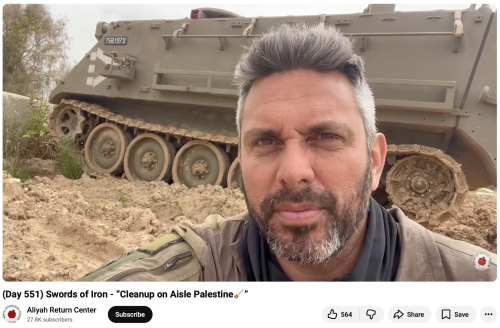
Since October 7, Malespin has posted daily updates on the Gaza War. In one video posted after the United Kingdom recognized Palestine, Malespin said Palestinians “don’t want to do anything but destroy Israel.” Another video, titled “Cleanup on Aisle Palestine,” featured Malespin reacting to what sounded like Israeli bombing of Gaza. “Wow, loud explosions huh?” said Malespin, standing in front of an Israeli armored vehicle.
Perhaps most inflammatory are the views of Yishai Fleisher, who joins the program for a study session that carries “the story [of Israel] forward,” according to the sample booklet. Fleisher is among the most prominent advocates of Israeli annexation of the West Bank and Gaza, a policy that he has championed as the spokesperson for the settler community in the segregated West Bank city of Hebron.
Fleisher has long railed against the idea of a two-state solution, arguing that Israel should have full control of the area between the Mediterranean Sea and the Jordan River and that Palestinians should have limited rights. In a recent video posted on his popular YouTube channel, Fleisher said that Carlson, in his interview with Huckabee, was “spitting on the God of Israel,” adding that the American political commentator “needs to be taken down” like the Biblical Goliath.
The prominent settler is also a frequent commentator on U.S. policy toward Israel. He has referred to the American Israel Public Affairs Committee’s annual conference as the “Fourth Pilgrimage Holiday,” after the traditional Jewish holidays of Sukkot, Shavuot and Passover. In a podcast episode entitled “GAZANS GOTTA GO,” he advocated for the ethnic cleansing of Gaza and likened pro-ceasefire protestors on American college campuses to the Amalekites, who were massacred by the army of Saul, according to the Bible.
“Amalekites come for the Jews because they know that Jews represent civilization,” he said. “That’s what we’re seeing with the Jihadis on campus in the United States.”
Another interviewee is Messianic Jewish Pastor Avner Boskey. The preacher has written lengthy criticisms of Islam, warning in one pamphlet that “paganism and demonic worship are the spiritual matrix out of which Allah was elevated.” And, when Zohran Mamdani was elected mayor of New York City last year, Boskey wrote a piece with the subheading, “When The Upper West Side Turns Into The Lower West Bank.”
Destiny Magnett, Programs and Outreach Manager at Churches for Middle East Peace, told RS that the initiative contributes to the erasure of Palestinian culture, heritage, and history. Much of the sample booklet, for example, promotes a controversial new archaeological site called the Pilgrimage Road that cuts through a Palestinian neighborhood in Israeli-occupied East Jerusalem and has caused structural damages to local homes.
“Pilgrimages to this land simply don’t exist in a vacuum detached from the everyday realities of people on the ground,” said Magnett. “Acknowledging that should be part of the responsibility undertaken by anyone working at the intersections of faith and Israel/Palestine.”
Shifting strategies
Show Faith by Works’ initial plan, filed under the Foreign Agents Registration Act (FARA), indicated that the firm would “geofence” the physical boundaries of major churches in the American Southwest during worship times in order to “track attendees and continue to target [them] with ads” on behalf of Israel.
But the campaign was met with backlash from many congregations. The Christian Life Commission of Baptist General Convention of Texas urged church leaders to sign a letter calling on Attorney General Pam Bondi to prohibit foreign government use of tracking technologies at churches. A campaign and website called “show mercy and do likewise” was created as an interfaith project to support Christians being targeted by the campaign. Timothy Feldman, an attendee of one of the churches listed, told RS, “It was a strange feeling to see my local church directly targeted by a foreign country committing a genocide on the other side of the world.”
Show Faith by Works responded to the concerns by defending the geofencing campaign. Schnitger, the founder of the firm, told RS in an email at the time that “irresponsible” media outlets had “sensationalized” the firm’s use of geofencing. “It is a very common marketing tool that literally every person with a smartphone in America has experienced in one way or the other,” Schnitger explained. He later revealed that he was scrapping the geofencing campaign “due to security concerns.”
It is unclear whether this pivot will help Schnitger and the Israeli government win more support among Evangelicals. Uriesou Brito, presiding minister of counsel for the Communion of Reformed Evangelical Churches and senior pastor of Providence Church in Pensacola, told World — a media outlet that says it is “grounded in facts and biblical truth” — that he disagrees with Show Faith by Works’ approach. “My general principle has been that we should always be cautious when any government funds religious or theological outreach,” said Brito. “The concern in my estimation is not unique to Israel.”
Nick Cleveland-Stout is a Research Associate in the Democratizing Foreign Policy program at the Quincy Institute. Previously, Nick conducted research on U.S.-Brazil relations as a 2023 Fulbright fellow at the Federal University of Santa Catarina.
The Purim War Against Iran
By Israel Shamir | Unz Review | March 2, 2026
The US, UK, France and Germany are flattered to call themselves “the West”, but it is more realistic to call them the Jewish-State-in-progress, or “Epsteinia”. We have just learned that President Trump had already made up his mind to go to war against Iran weeks ago, and that the pretence of diplomacy carried out by two Jewish real estate dealers (Witkoff and Kushner) on his behalf was little more than a nothingburger to keep Iran busy until the Chosen moment. So what exactly was the purpose behind Trump’s diplomatic pause before commencing hostilities? There is a reason; quite shameful, but true. Trump and his superior, Bibi Netanyahu, were guided by Kabbalah magic. They agreed to carry out this historic attack on a particularly auspicious date in the Jewish calendar, called Remembrance Shabbat, the last Saturday before the feast of Purim. The facts are overwhelmingly clear: International Jewry decreed the attack day and the US military jumped like obedient dogs to a Jewish whistle.
Wikipedia describes Remembrance Shabbat as follows:
Sabbath [of] remembrance’ or Shabbat Zachor (Hebrew: שבת זכור) is the Shabbat immediately preceding Purim. Deuteronomy 25:17-19 (at the end of Parasha Ki Teitzei), describing the attack on the Jews by Amalek, is recounted. There is a tradition from the Talmud (understood to be implied in the Megillah itself) that Haman, the antagonist of the Purim story, was descended from Amalek. The portion that is read includes a commandment to remember the attack by Amalek, and therefore at this public reading both men and women make a special effort to hear the reading.
All Jews are not only required to remember this special date commemorating this ancient tale, but they are also required to seek revenge; i.e. commit genocide of whoever the Sanhedrin has labelled Amalek in our generation. A Jew is obliged and commanded to kill all the men, women, children of Amalek, including dogs and cats. Small animals, kittens and puppies are often killed a fortnight earlier at the Tubishvat celebration – pets are thrown into burning bonfires by Sephardi custom. The customs of Purim (and the preceding Sabbath) are notoriously horrible, detailed by Elliot Horowitz in his Reckless Rites: Purim and the Legacy of Jewish Violence. Martin Luther noted that Jews thought of all Christian rulers (who Jews consider to be their oppressors) as modern-day Hamans, and so it was a religious duty to undermine them and seek their downfall. [He also noted that Jews saw Christ as a similar King/Oppressor figure, perhaps because in the Septuagint, Haman is crucified. Bear in mind that the Septuagint is the Greek translation of the unadulterated original Bible text, while the modern Hebrew Bible has been updated many times over the years by Jewish scholars.]
Netanyahu’s International Jews (including those of the Israeli government coalition) have a long history of performing their professional and religious duties in accord with Kabbalistic magic. For them, the combination of the first blow in the Sabbath of Remembrance and celebration of Purim a few days later is too tempting to avoid. The fools are likely to believe that they are guided from above, and thus they will come to their end.
Purim celebrates when 75,000 Persians were murdered by Jews; and it’s no coincidence that this is the first time the Jews are clearly mentioned in the Bible. It’s a kind of “coming out” story for Jews. Jewish stories always make the Jews look like innocent victims, and this story is no exception. The real Jews of the Second Temple period knew the real facts, and they carved the Persian capital Susa into the ‘Beautiful Gate’ of the Temple, explaining that the Jews should forever be mindful of their time in Persia. But Netanyahu has forgotten this advice from his legendary ancestors.
The first bombs of the Iran War were dropped by Mike Huckabee, Tel Aviv’s pet “US Ambassador”, in an interview with Tucker Carlson just before hostilities commenced. Huckabee told Tucker that Israel has the right to seize as much of the Middle East as the US can defend, and that it’s fine with him if they take it. After that, everyone just sat around waiting for a magical date on the Kabbalah Calendar. Jews preordained that, on the Jewish Sabbath of Remembrance, the US and Israel shall bravely sneak-attack peaceful, slumbering Iran; a country still working to comply with UN investigators, still in peace talks with two Jews, tragically unaware of the historical significance of that particular date for Jews. Attacking forces boldly murdered the Ayatollah Ali Khamenei, the Muslim equivalent of the Catholic Pope. Israel sees every non-Jewish leader as Haman and therefore a legitimate target: our Ron Unz explained it in this essay. Jews like to assassinate leaders, something that went out of fashion in the Thirty Years’ War.
England, France and Germany followed orders from Tel Aviv. This means that Jews have succeeded to get on top in these countries. Germany was forced to accept Jewish rule with the US occupation in 1945. Now it is illegal for a German to wear a Palestinian keffiyeh, or to call for a free Palestine. France was relatively free in 1960, when de Gaulle had the power to kick out NATO. Over the years since then, the Jews have tightened their hold on the media. French cinema died, French politicians kneeled before Lord Rothschild and in the year of Our Lord 2026, all French parties have become thoroughly Jewified. Marine Le Pen, the darling of what passes for French Nationalism, approved of the Purim attack on Iran, and promoted her Chosen Jewish successor. England has always been the homeland of Christian Zionism, and Starmer is a very proper shabbos-goy to represent the UK’s “Shabbos Gov”.
Why are the Jews willing to expend so much political capital in exchange for the doubtful achievement of ruining Iran? We can understand why Trump is so willing to betray MAGA – because his lot is not to reason why; a good Shabbos-goy, he must follow orders from Tel Aviv. But why would the usually cautious Jews do it? It was the shining glory of the Al Aksa Mosque, which has to be destroyed in order to erect the Third Temple, the ultimate wish of the Jews. And Iran is the only country in the world that wouldn’t allow it to happen. All other Muslim states were cowed and follow US orders.
From the moment of the sneak attack on Iran, Al Aksa Mosque was closed by the Israeli army, and Palestinian Muslims can no longer enter it. In the middle of the Ramadan Fast, it is especially painful for believers. The story of the Al Aksa Mosque and the Jewish drive for its destruction is a long one. I have previously written about it in The Cornerstone of Violence.
To make it short, I’ll quote from it:
“Many Jews and their Christian-Zionist allies believe the precious beauty of Haram a-Sharif, the 7th century mosques of Jerusalem should be destroyed and on their ruins, a Jewish temple should be erected. Why should this be done? People provide different explanations, historical and eschatological. It is not for some historical justice, or for the purpose of prayer, as traditional Judaism forbade all interaction with the Mountain of the Lord. Some mystically inclined Jews believe this act will make Jewish domination of the world total and irreversible. This belief is not an exclusive domain of kooks and freaks, nor even of Zionists only, but rather a widespread conviction.
The mainstream media of the West usually presents the conflict in terms of Muslims vs. Jews. But the conflict as seen by these Jews, is Jews vs. Gentiles. In their minds, the Temple Mount is a magic Ring of Power, one they should assume when the time is right. As the Ring in Tolkien’s Lord of the Rings (the British professor was a very learned man), it should bring forth the Messiah. For the Jewish mystics, this Messiah is not the Christian Messiah. In their book, the Messiah is not a gentle Jesus with a message for all mankind. Their Messiah would forever enslave the nations of the earth and make the Chosen people the masters of the universe. Their Messiah, Lord Enslaver of the Peoples of Earth, is the Antichrist of prophecies.”
The Arabs outside of the Holy Land have been subdued, and do not care about it all that much. Muslims everywhere are being attacked relentlessly by Jewish-led global media companies. Palestinians are being genocided for their love of the Al Aksa Mosque (the war in Gaza is called by Palestinians the “Al Aqsa Flood”). The only real resistance came from Iran, led by Persian theologians who well understood the Temple Mount controversy. So, of course Iran had to be bombed for Purim. Obviously such an act of celebration should be accompanied by the Kabbalistic ritual blood sacrifice of young girls, as expounded in the Epstein Files. This Jewish religious practice was achieved right away when they reportedly slaughtered over a hundred schoolgirls and when they deliberately targeted the 14-month-old granddaughter of the late Ayatollah.

Such is the fate of Persia, perishing under the Lion of Judah (Israeli codename Operation Roaring Lion). But how will the Christians fare, stepping into the arena with such a hungry lion? It is better not to cooperate with such beasts, for when we dance with the devil we deserve whatever fate has in store for us. Shall we review the Kabbalistic Calendar for the magic date that the Jewish Yoke will be lodged on our necks? We see how Islam may be openly reviled by our Jewish overlords. Do we really think that Christianity is exempt from such treatment? They already openly describe the Bible as an “antisemitic document.” We all know that the conflict between Islam and Christianity is being stage-managed by Jews. With the influx of good, conservative Muslims into Western nations, we are rapidly learning that the points of harmony between believing Islamics and believing Christians vastly outweigh what Mike Huckabee calls “our Judeo-Christian Patrimony”.
The Jews are running out of time. There has never been a Jewish kingdom that has lasted longer than 80 years and 2028 is coming up fast. From the local PTA to international organizations, Christians and Muslims are getting to know one another, making an end-run around their Jewish handlers. The Purim War against Iran is a clear sign of Jewish desperation. They already lost the moral high ground when they began firebombing Gazan ghettos. This latest Jewish war is the proverbial step too far, and when Israel falls you can bet they are going to try and take down everyone else with them. The first step towards ending the Iran War is the resolution of the Gazan Genocide. Once Israel is defused, the entire world powder keg will unravel. Imagine it! Christians and Muslims working together in Christ’s name to purge school libraries of Kabbalistic sex manuals! Ukraine will deport all the Jewish adventurers and get back to being the breadbasket of Europe! Jerusalem will become a UN protectorate, ensuring all religions have a seat at the tables of the Holy Land! Trump can go back to being a MAGA guy, the US military can be safely reduced and funds invested in US manufacturing! Congress can go back to representing the American people! Western businesses will thrive on all that cheap oil delivered by our new Muslim friends in the Middle East!
How many other positive scenarios can you imagine happening if we could only rid ourselves of these pestilent Epsteins? America has a hag on its back, and its name is Israel.
Edited by Paul Bennet of Minnesota.
Douglas Macgregor: A New World Emerges: Iran Will Win & Israel May Not Survive
Glenn Diesen | March 2, 2026
Douglas Macgregor is a retired Colonel, combat veteran and former senior advisor to the U.S. Secretary of Defense. Col. Macgregor argues a new world is emerging with a new Middle East – in which Iran will win and Israel may not survive. Please like and subscribe!
Follow Prof. Glenn Diesen:
- Substack: https://glenndiesen.substack.com/
- X/Twitter: https://x.com/Glenn_Diesen
- Patreon:
 / glenndiesen
Support the research by Prof. Glenn Diesen:
- PayPal: https://www.paypal.com/paypalme/glenn…
- Buy me a Coffee: buymeacoffee.com/gdieseng Go Fund Me: https://gofund.me/09ea012f
- Books by Prof. Glenn Diesen: https://www.amazon.com/stores/author/…
Netanyahu Again Uses Genocidal Rhetoric And Compares Iranians To ‘Amalek’
The Dissident | March 2, 2026
Israeli Prime Minister Benjamin Netanyahu is using the same genocidal rhetoric towards Iranians as he did towards Palestinians in Gaza.
At the site of an Iranian missile attack in Israel, Benjamin Netanyahu said, “If this regime of terror obtains nuclear weapons, they will threaten all of humanity. Therefore, we went out in order to remove that danger first and foremost from ourselves, but we are acting here together with the United States, in the name of and for the sake of all humanity,” adding, “We read in this week’s Torah portion, ‘Remember what Amalek did to you.’ We remember, and we act”.
By comparing Iranians to the Amalek, Benjamin Netanyahu is signalling to genocidal hardline religious zealots in the IDF that Iranian civilians are fair targets.
For context, the UN’s report on the Genocide in Gaza documented that Netanyahu comparing the Palestinians to “Amalek” before the genocide in Gaza was seen as a green light by the IDF to slaughter civilians in reference to the Hebrew bible passage which states, “Now go and attack Amalek, and utterly destroy all that they have; do not spare them, but kill both man and woman, child and infant, ox and sheep, camel and donkey”.
The UN report documented:
On 3 November 2023, Prime Minister Netanyahu published a letter to the Israeli soldiers and commanders in the war, in which he wrote, “Remember what Amalek did to you… This is a war between the sons of light and the sons of darkness…We constantly remember the sights of the horrific massacre on that Simchat Torah Shabbat, October 7, 2023.”
The descendants of Amalek, the Amalekites, were enemies of the Israelites in the Hebrew bible. In the Book of Samuel, God tells the Israelites, ‘Now go and attack Amalek, and utterly destroy all that they have; do not spare them, but kill both man and woman, child and infant, ox and sheep, camel and donkey.’
The Commission notes that, in invoking Amalek in his speech, Netanyahu strengthened the idea that Israel’s war in Gaza is akin to the holy war of total annihilation commanded against the Amalekites.
This would be familiar to and compelling for the many thousands of Israeli military personnel who are religious Zionists, especially for those in military units whose personnel are wholly or predominantly ultra-orthodox. Indeed, such sentiment was referred to by many following the statement of Netanyahu, including the Israeli Finance Minister, Bezalel Smotrich and Israeli soldiers who yelled and chanted direct references to Amalek as they launched attacks in Gaza.
The report noted that, “The invocation of Amalek had particular resonance for religious Zionist military personnel, of whom there are now many thousands in the Israeli security forces.”
Indeed, religious members of the IDF often invoked the comparison of the Palestinians to “Amalek” to justify killing Palestinians civilians and the comparison was often used alongside the openly genocidal statement that there are “no innocents” in Gaza.
South Africa’s report on Israel’s genocide in Gaza documented that the IDF released “video of soldiers chanting that there are ‘no uninvolved citizens’ in Gaza and that they will ‘wipe off the seed of Amalek’”.
The report also noted that Israeli, “Parliamentarians have stated ‘[w]e must not forget that even the ‘innocent citizens’ — the cruel and monstrous people from Gaza took an active part . . . there is no place for any humanitarian gesture — the memory of Amalek must be protested’”.
Daniel Raab, an American sniper in the IDF, while boasting about killing Palestinians civilians, said , “Gaza is like Sodom and those who live there are similar to the Amalek and this population is really Amalek”.
Yet again, Netanyahu is comparing Iranians to the “Amalek” so members of the IDF believe it is justified to “kill both man and woman, child” in an attempt to justify the continuation of war crimes such as the American/Israeli strike on a girls’ school in Iran that killed 175 children.
Featured Video

Alon Mizrahi: ‘Israel Must Be Dismantled’
or go to
Aletho News Archives – Video-Images
From the Archives
Allies Don’t Need Lobbies
By Jay Knott | Dissident Voice | September 24, 2013
In a recent article on Counterpunch, Rob Urie defended the traditional Marxist analysis of US policy in the Middle East. He argues that support for Israel is driven primarily by economic interest, not the Jewish lobby.
He starts by paying tribute to the idea that Western societies are uniquely racist. He says that the “Western narrative” claims there is an “Arab character”, and that this is “antique racist blather”. He gives no definition of these terms. Further, he establishes his credentials as part of the dominant current in the American left by claiming that “over a million people in Iraq died so ‘we’ in the West can drive SUVs.”1
When he tries to criticize bourgeois economics, he makes it clear he doesn’t understand the developments it has made since Marx’s day, using the mathematical discipline known as “game theory”. He dismisses the basic abstraction of economic theory, the idea of the rational individual, on the grounds that it is “devoid of history, culture and political context”. But abstractions are always devoid of something.
He defends a more concrete economic theory, mostly Marxist, with some input from another theorist of capitalist crisis, Hyman Minsky. This concrete theory leads him to the view that US activity in the Middle East is primarily driven by rational capitalist motives, the need to secure a supply of oil.
“Taking the totality of circumstance — former oil company executives launching war on an oil rich nation on a pretext they publicly proclaimed they didn’t believe shortly before taking office — and that upon launching their war proved to be non-existent, requires a willingness to overlook the obvious — that the war on Iraq was for oil, that is difficult to support.”1
Perhaps I’ve misunderstood him, but based on what he says in the rest of the article, this convoluted sentence seems to argue that, because president Bush and vice-president Cheney attacked Iraq on false premises, and they also said it was all about oil, and they are former oil executives, and Iraq has a lot of oil, it’s difficult to deny US attacks on Iraq are all about oil.
In fact, it’s not hard at all. As Urie points out, at times Bush and co. said that attacking Iraq was “protecting the world’s supply of oil.”1 But, as he also points out, they are congenital liars. Why should we believe them when they say they are trying to “protect” the oil supply? Protect it against what? When politicians “admit” attacks on Middle Eastern countries are wars for oil, they are parroting the neo-con party line, feeding the public, both left and right, with a plausible-sounding pretext. For right-wingers, “it’s a war for oil” is a reason to support war, and for leftists, it’s a way to feel better by complaining impotently about corporate greed. Both approaches help the war drive. … continue
Blog Roll
 Aletho News
- US vs Iran: Kharg Island Talk — Bluff or Escalation? Ex-Military Officer Weighs In
- Zelensky unnecessarily involves Ukraine in the Middle East crisis
- Turkish tanker blacklisted by Ukraine hit in drone attack – media
- Canada, the U.S., and NATO: the inescapable trap
- Villains of Judea: Leonid Radvinsky
- Alon Mizrahi: ‘Israel Must Be Dismantled’
- Former Head Of MI6 Admits That The U.S. And Israel Are Losing The Iran War
- Scattered Thoughts on War and Peace
- Iran Threatens to Close Red Sea to Shipping in Response to Invasion
- Iran in excellent position to prevail in war with US, Israel: John Mearsheimer
- If Americans Knew
- Israel may be committing war crimes in Lebanon – Not a ceasefire Day 167
- In the West Bank, life is a constant battle – 3 articles
- Jacob Reses, one of the most powerful pro-Israel operatives in Trump’s Washington
- Israeli-US assaults kill or injure 87 children a day – Not a ceasefire Day 166
- ‘Forever live by the sword’: Understanding Israelis’ massive support for Iran war
- UN’s special rapporteur on human rights says Israel is systematically torturing Palestinians
- Trump White House plagiarized Iran war manifesto from Israel-aligned think tank
- Gaza says 6–10 patients die daily waiting for treatment abroad as Israel blocks medical evacuations
- ‘Substantial evidence’ of double-tap strike in killing of Gaza’s Hind Rajab
- ‘Do Not Want To Die For Israel’: Doubts About Trump’s Iran Strategy Spread Among Troops
- No Tricks Zone
- Devastating Assessment Of Comirnaty Vaccine By Former Senior Pfizer Europe Toxicologist
- New Study: CO2 Is ‘Effectively Negligible’ As An Explanatory Climate Change Factor Since 2000
- Former Pfizer Toxicologist Dr. Helmut Sterz Tells Bundestag Hearing Pfizer Vaccine Should Have Never Been Approved
- Energy Expert: Germany’s Nuclear Phaseout Was A “500 Billion Euro Mistake”
- New Research: South Australia’s Mid-Holocene Sea Surface Temperatures Were 4°C Warmer Than Today
- Storing Green Energy To Last Germany 10 Days Would Require A 60-Million Tonne Battery
- New Studies: UK Sea Levels Were 4 Meters Higher Than Today During The Mid-Holocene
- Destructive Green New Deal: German Energy And Metal Group Warns Of Drastic Crisis
- New Study Documents A 20-Year Pause In Arctic Sea Ice Decline – Driven By Internal Variability
- Wake-up Call: Survey Shows Majority Of Germans Now Favor Postponing Climate Targets!
 Aletho News