Google knew Israel may use its tools for rights violations: Report
Press TV – May 12, 2025
American technology giant Google knew that a powerful cloud-computing tool it was supplying to the Israeli regime as part of a contract four years ago could be used for rights violations against the Palestinians, according to the findings of a report.
The Monday report by The Intercept said it had obtained internal Google documents showing the company feared it wouldn’t be able to control Israel’s misuse of its technology to harm Palestinians.
The report said that Google understood that the way its Project Nimbus deal had been designed could deprive it of the ability to prevent the Israeli regime and military from using the software against Palestinians.
The tech giant also knew that the multi-billion-dollar deal won in 2021 would obligate it to stonewall criminal investigations by other countries into Israel’s use of the technology, said the report.
It said that experts hired by Google had recommended that the company withhold machine learning and artificial intelligence (AI) tools from Israel because of these risk factors.
International law experts told The Intercept that Google’s awareness of the risks of misusing the Project Nimbus by the Israeli government and army may pose legal liability for the company.
“They’re aware of the risk that their products might be used for rights violations … At the same time, they will have limited ability to identify and ultimately mitigate these risks,” said León Castellanos-Jankiewicz, a lawyer with the Asser Institute for International and European Law in The Hague.
The revelations come as Israel continues its genocidal war against Palestinians in the Gaza Strip, where it has killed tens of thousands of people and displaced hundreds of thousands more since launching an invasion against the territory in October 2023.
There have been reports suggesting that the Israeli regime has used AI tools supplied by US technology firms to target and kill civilians in Gaza.
500 lawmakers appeal to Trump to stop Gaza genocide, starvation
MEMO | May 12, 2025
More than 500 parliamentarians from around the world have issued an urgent appeal for US President Donald Trump to immediately intervene and stop Israel’s “genocide and systematic starvation” of Palestinians in the Gaza Strip.
In an open letter issued by the Parliamentarians of the Free World campaign yesterday, the officials emphasised that “the indiscriminate bombing, comprehensive blockade, systematic destruction of infrastructure, and targeting of civilians in Gaza amount to crimes against humanity that require urgent international action.”
They warned that “the unconditional military and diplomatic support provided by some major powers — primarily the United States — to Israel constitutes blatant complicity and undermines the values upon which the American Republic was founded,” calling for “a review of this support and the cessation of all forms of military assistance.”
The letter emphasised that “the right to self-determination and resistance to occupation is an inherent right of all peoples. In the case of Palestine, resistance to occupation is not only morally justified, but is also enshrined in international law.”
“Lasting peace and regional stability cannot be achieved through temporary ceasefires or externally imposed settlements, built through coercion or displacement. Rather, they require the full restoration of the rights of the Palestinian people,” the letter read.
The signatories called for immediate action, including opening the border crossings to facilitate the delivery of humanitarian aid to Gaza, suspending military support to Israel, convening an emergency session of the UN Security Council to issue a binding resolution to halt the genocide, and reconsidering economic and trade relations with Israel as an “occupying power practicing ethnic cleansing.”
Prominent signatories to the letter include Osama Al-Nujaifi, former speaker of the Iraqi Parliament; Abdelilah Benkirane, former prime minister of Morocco; Ayman Nour, former Egyptian presidential candidate; Muhammad Hidayat Nur Wahid, deputy speaker of the Indonesian Shura Council; and Mandela Mandela, grandson of Nelson Mandela and former member of the South African Parliament.
The parliamentarians ended their letter by warning that “the global conscience of humanity watches not only those who commit crimes, but also those who have the power to stop them,” calling on US President Donald Trump to use his influence to stand up for justice and human dignity.
Israel issues warning over Palestine recognition
RT | May 12, 2025
Israel will respond to any nations who move to unilaterally recognize the state of Palestine, Foreign Minister Gideon Saar has claimed.
Saar issued the warning at a joint press conference with his German counterpart, Johann Wadephul, on Sunday, following announcements by several countries of their intent to recognize Palestine.
The Israeli diplomat claimed that any such unilateral moves would undermine prospects for the peace process and would compel the Jewish state to take measures in response.
Palestine’s sovereignty is recognized by 147 countries, including Russia and the majority of nations in the Middle East, Africa, and Asia. However, most Western European countries, as well as Israel and the US, do not officially consider Palestine a sovereign state. Many nations have advocated for Palestinian recognition as the only way to resolve the Israel-Palestine conflict, which escalated in 2023 when Israel launched a military operation in Gaza following a surprise Hamas attack.
Saar claimed such initiatives were “not constructive but counterproductive” and served “as a prize for Hamas terror.”
Wadephul, however, said that a two-state solution remained “the best chance for Israelis and Palestinians to live in peace, security, and dignity.”
The Media Line news outlet reported on Sunday, citing unnamed diplomatic sources, that US President Donald Trump could formally recognize the state of Palestine at the upcoming Gulf-US summit in Saudi Arabia.
Although US Ambassador to Israel Mike Huckabee has denied any such plans, speculation has grown in the wake of comments Trump made earlier this month in a meeting with Canadian Prime Minister Mark Carney. Trump repeatedly hinted at “a very, very big announcement about a certain subject,” which he said would be revealed either before or during his upcoming trip to the Middle East.
Last month, French President Emmanuel Macron indicated that Paris could move to recognize a Palestinian state as early as June, during a United Nations conference in New York.
Russia has long advocated for a two-state solution to the Israel-Palestinian conflict, reaffirming its stance during a recent meeting between Russian President Vladimir Putin and Palestinian President Mahmoud Abbas in Moscow. Russia has also called for an immediate end to the violence in Gaza.
What Will Trump Find in the Middle East This Week?
By Ron Paul | May 12, 2025
President Trump’s return to the Middle East this week, the first since his first-term 2017 visit, will take place amidst great turmoil. It is a region that bears little resemblance to the Middle East of 2017 and it appears, at least from media reporting this past week, that the Trump Administration has some understanding of this reality.
Syria has been over-run and is now controlled by the same al-Qaeda that the US government supposedly spent 20 years fighting in the “war on terror.” Violence against religious and ethnic minorities has, predictably, exploded under the “rule” of a self-proclaimed Syrian president who until very recently was on the US “most wanted” terrorist list.
After the October 7, 2023, Hamas raid, Gaza has been reduced to rubble and turned into a humanitarian catastrophe. Tens of thousands of civilians have been killed and perhaps another million face starvation. US bombs and financial aid have facilitated the utter destruction of Gaza.
Iran has made peace with Saudi Arabia thanks to Chinese mediation and is deepening its ties with the Kingdom. Thus, the US has little leverage in talks with the two former enemies.
Israel is conducting military operations against several countries in the region simultaneously as the world increasingly condemns its aggression against its neighbors.
After tearing up the JCPOA nuclear deal with Iran in his first term, President Trump is pushing for a new deal with Iran while threatening to attack if negotiations do not produce the results he demands.
Massively increased US military action against the Houthis in Yemen starting in March did not result in their capitulation to US demands. Despite attempting to put the best spin on things, it is clear that the US retreated from the region in the face of a series of successful Yemeni actions in defense of their homeland.
Biden and then Trump launched attacks against Yemen on behalf of Israel, but in the end the US president wisely removed US military assets from the area and called off the bombing.
In short, President Trump will be wading into a minefield this week, but it is a peril that the US government has largely brought upon itself. Decades of US interventionism, from at least the 2003 Iraq war, have not produced the peaceful transformation of the region, as promised by the neocons and their mentor, Israeli Prime Minister Benjamin Netanyahu.
From the unnecessary Iraq war – based on lies – to the destruction of Libya and Syria and countless other interventions, the Middle East is a basket case. And it turns out none of it actually helped Israel at all!
Having ignited the tinder box of the region with US backing, Israel has now found itself friendless in a region increasingly hostile to its policies and even its very existence. Now there are indications that the Trump Administration is tiring of this entangling alliance as the MAGA base looks more warily on foreign interventionism.
The lesson that President Trump should take with him is that to a large degree it has been US interventionism in the Middle East that has produced these poisoned fruits. His wise military disengagement from the Houthis in Yemen should serve as a US model for the region. Ties forged by trade and friendship produce peace and prosperity and are far preferable to endless neocon war cries.
Hamas releases captive soldier Edan Alexander amid Gaza truce efforts
Al-Mayadeen | May 12, 2025
The military wing of Hamas, Al-Qassam Brigades, released Israeli soldier and American captive Edan Alexander to the International Committee of the Red Cross on Monday in northern Khan Younis, southern Gaza.
The release coincided with the arrival of US Special Envoy to the Middle East Steve Witkoff at the Re’im military base, where Alexander was reportedly being transferred. Israeli media reported that Alexander is expected to travel to Qatar on Wednesday for a meeting with US President Donald Trump.
Alexander’s release leaves 58 captives still held in the Gaza Strip, according to Israeli reports. Of those, 23 are believed to be alive.
Serious talks yield results
In an official statement, Hamas said that Alexander’s release followed communications with the US administration and falls within broader mediation efforts aimed at achieving a ceasefire, opening crossings, and facilitating humanitarian aid into Gaza.
The movement highlighted its high level of flexibility and willingness to engage, stating that “serious and responsible negotiations lead to results in the release of prisoners.”
Hamas also warned that the continued aggression by the Israeli occupation prolongs the suffering of the captives and risks their lives.
The group reaffirmed its readiness to immediately begin negotiations aimed at reaching a comprehensive and sustainable ceasefire agreement, calling for the full withdrawal of the occupation’s forces, the lifting of the blockade, a prisoner exchange, and the reconstruction of Gaza.
In its statement, Hamas urged the US administration to intensify its efforts to end the war on Gaza.
US sidelines ‘Israel’
The United States has overtaken the Israeli regime in leading negotiations related to Iran, Ansar Allah, and most recently, the case of Israeli soldier and American captive Idan Alexander, according to Israeli Channel 13.
Citing a US official, Channel 13 reported that following Alexander’s release, immediate negotiations are expected to begin to reach a comprehensive agreement. The fate of other captives held in Gaza is now reportedly in the hands of US President Donald Trump, as both Hamas and “Israel” await Washington’s next steps.
Israeli media also reported that the US is actively working to recover the remains of four American captives believed to have been killed during the war.
Netanyahu claims Edan Alexander’s release achieved through ‘military pressure’
The anticipated release of a US-Israeli captive by Hamas would not lead to a ceasefire in the Gaza Strip or the release of Palestinian prisoners, Israeli Prime Minister Benjamin Netanyahu declared on Monday.
Negotiations for a broader deal to secure the release of all Israeli captives in Gaza would proceed, Netanyahu stated, but would do so “under fire, during preparations for an intensification of the fighting,” according to a statement issued by his office.
Hamas announced on Sunday that it would release Edan Alexander, a US-Israeli soldier held in Gaza, as it confirmed direct talks with the United States toward a potential ceasefire in the war-torn Palestinian territory.
Abu Obeida, the spokesperson of Hamas’s Al-Qassam Brigades, confirmed that the group has decided to release the 21-year-old Israeli soldier on Monday, without providing further details concerning the process.
Gaza casualty figures mask a much bigger horror, new study shows
Al Mayadeen | May 11, 2025
The true Gaza death toll since the start of “Israel’s” aggression in October 2023 may be significantly higher than current official estimates, according to a new analysis published in The Lancet.
The study suggests that between 77,000 and 109,000 people may have been killed, far exceeding the Gaza Health Ministry’s figures.
As of May 5, 2025, the Gaza Health Ministry reported 52,615 killings resulting from Israeli airstrikes, shelling, and the collapse of Gaza’s health system.
The Ministry’s data are compiled from two primary sources: hospitals across Gaza and an online form that allows families to report killings, often in areas inaccessible due to continued attacks.
The Lancet Gaza study reviewed three separate datasets: hospital records, online civilian death submissions, and a third, independently compiled list based on social media obituaries and death announcements. Researchers then analyzed the degree of overlap between the lists to determine whether deaths were being fully captured.
What they found was stark: limited overlap among the datasets suggested substantial underreporting. In some demographic categories, each list contained different names, implying that even combined, they might not fully reflect the real war casualties in Gaza.
Comparing data: Hospital reports, online submissions, and obituaries
By comparing the three lists, researchers concluded that the actual death toll is likely 46% to 107% higher than the Gaza Health Ministry’s official count. Applying that range to the most recent data suggests that up to 109,000 Palestinians may have been killed since October 7, 2023, equivalent to roughly 4–5% of Gaza’s pre-war population.
The researchers project that the rate of undercounting has likely remained consistent since the end of their initial dataset, which covered up to June 30, 2024. Extending their findings forward, they estimate that the true Gaza death toll lies between 77,000 and 109,000 as of spring 2025.
These findings cast new light on the underreported deaths in Gaza, especially amid ongoing Israeli destruction of health infrastructure and communication networks that further hinder accurate documentation.
Limitations, uncertainties in measuring war casualties
The study also highlights methodological limitations. Some names were later removed from Ministry lists, 3,952 in total, raising questions about the verification process.
Additionally, deaths caused indirectly by the war, such as from the collapse of medical services, may not be fully represented.
“A definitive count of how many have died in this war will be difficult, even after it ends,” the researchers concluded. “And that may still be a long way off.”
US abandons ‘Hamas disarmament’ demands in Gaza truce talks: Report
The Cradle | May 10, 2025
The US government has dropped its demand for Hamas to disarm as a precondition for a ceasefire in Gaza, Egyptian sources revealed to Al-Araby Al-Jadeed.
“US negotiators conveyed to Egyptian intermediaries that the issue of Hamas’s disarmament could be addressed at a later stage, rather than being an immediate requirement for a ceasefire agreement,” the Qatari-owned news outlet reports.
The unnamed source added that US President Donald Trump’s “inner circle” is convinced of the “futility” of Prime Minister Benjamin Netanyahu’s strategy to free the captives via military pressure, believing that no military option will help save the Israeli captives in Gaza.
Furthermore, US planners are reportedly aware of the “impracticality of forcibly exiling leaders and fighters from the armed wings of Hamas” and other Palestinian resistance factions due to “concerns from potential host countries and the large number of individuals Israel seeks to remove,” which number in the thousands.
The Egyptian source reported a “sense of optimism” among negotiators regarding the possibility of reaching a comprehensive solution in the near future, especially given Hamas’s readiness to release all Israeli detainees in Gaza simultaneously and the potential for an acceptable framework controlling the resistance’s weapons and the movement post-agreement.
Washington’s sudden shift follows reports in Hebrew media indicating that Trump has “lost patience” with Netanyahu and will not wait any longer for Israel before advancing US initiatives in West Asia.
Trump this week surprised his allies in Tel Aviv by announcing an end to the illegal war in Yemen as part of a ceasefire deal that excluded Israel. Moreover, Reuters reported on Thursday that the US president is no longer demanding that Saudi Arabia normalize ties with Israel as a condition before nuclear cooperation talks can proceed.
Trump is scheduled to visit Saudi Arabia, the UAE, and Qatar next week. As of press time, this trip does not include a stop in Israel.
US Defense Secretary Pete Hegseth on Friday canceled his planned trip to Israel, which was set for Monday, to accompany President Trump on Air Force One for his trip to the Persian Gulf.
Despite the apparent cold shoulder from the White House, Israeli leaders say they are moving ahead with a large-scale military operation to “conquer” Gaza if no progress is made before Trump’s upcoming tour.
Cargo jet carrying 14 tons of explosives departs JFK for ‘Israel’
Al Mayadeen | May 11, 2025
A cargo flight carrying 14 tons of explosive-grade nitrocellulose, destined for the Israeli weapons manufacturer IMI Systems, was scheduled to depart JFK International Airport Saturday afternoon, igniting serious safety and ethical concerns amid “Israel’s” intensifying aggression on Gaza.
According to air freight documentation obtained by The Intercept, the shipment constitutes one of the largest known transfers of explosive material through JFK, a major international hub. The manifest details 51 pallets of nitrocellulose, a volatile chemical compound widely used in the production of ammunition, including sniper bullets, artillery shells, and other battlefield munitions.
Flight records reviewed by The Intercept show that the shipment is being transported by Challenge Airlines Israel, with departure from JFK scheduled for 2 pm Saturday and arrival at Ben Gurion Airport on Sunday. The cargo’s recipient, IMI Systems, now a subsidiary of Elbit Systems, is a core supplier to the Israeli military, manufacturing a wide array of weaponry, including rocket launchers, cluster munitions, and other battlefield arms used in ongoing operations against Gaza.
The origin of the shipment traces back to a Los Angeles-area zip code, though the chemical manufacturer remains unidentified. The Port Authority of New York and New Jersey, which manages JFK, and Elbit Systems have declined to comment on the cargo.
Activists warn of danger to civilians and workers at JFK
The Palestinian Youth Movement, which helped uncover the shipment, has sounded alarms over both the international implications and immediate local risks. Nitrocellulose, according to a US Army assessment cited by the group, possesses explosive power comparable to TNT.
“This is a threat not only to Palestinians but to workers and civilians here in New York,” said Aisha Nizar, an organizer with the Palestinian Youth Movement.
“These arms are threats to our communities here in New York, and show yet again the complete coordination between the Zionist project and the US ruling class, who are currently waging a war of extermination against the Palestinian people,” Nizar told The Intercept.
The group referenced the 2015 Tianjin Port disaster in China, where improperly stored nitrocellulose triggered a series of explosions that killed 173 people. At JFK, cargo flights share runways with commercial aircraft, raising concerns about safety protocols and the proximity of volatile cargo to civilian terminals.
Shipment highlights role of US military support to “Israel”
While JFK has long facilitated discreet arms transfers to “Israel”, including tear gas, small arms cartridges, and aircraft parts, this is the first publicly documented shipment of nitrocellulose. Journalist Roman Shortall of The Ditch, who assisted in verifying the manifest, told The Intercept that the shipment reflects the deepening logistical role played by the US in enabling the war on Gaza.
In the past year alone, the Biden administration has authorized over $17.9 billion in military aid to “Israel”, including both stockpile releases and direct purchases from American defense companies. Rights groups argue such aid has directly contributed to mass civilian killings and the destruction of vital infrastructure in Gaza.
“Over almost two years of genocide in Gaza,” added Nizar, “JFK airport has served as the coordination point for the shipment of ammunition primer, small arms cartridges, detonators, and aircraft parts to sustain the Israeli military.”
Growing pressure over US complicity in Gaza genocide
This shipment is not an isolated case. Palestinian solidarity groups have tracked similar arms logistics through Port Elizabeth in New Jersey and MOTSU, the US Army’s main weapons terminal in North Carolina. Some shipments have reportedly violated international arms embargoes, such as Spain’s, as previously reported by The Ditch.
Belgian broadcaster RTBF also documented Challenge Airlines transporting weapons from JFK to Brussels before continuing to Tel Aviv, raising concerns over European involvement in the arms corridor.
Meanwhile, Elbit Systems, the recipient of the cargo, operates globally with facilities in the US, UK, Australia, and across Europe. It has been the target of repeated protest actions at its sites in Virginia, South Carolina, and most recently in New Hampshire, where activists attempted to halt production lines.
The shipment comes as “Israel” intensifies its aggression on Gaza, where over 52,000 Palestinians have been killed and humanitarian conditions continue to deteriorate under blockade. Aid workers report that “Israel” is actively obstructing humanitarian deliveries while announcing plans for indefinite occupation.
Sectarian massacres continue in Syria as government-affiliated groups kill several in Latakia
The Cradle | May 11, 2025
Extremist armed groups affiliated with the Syrian government have carried out a new massacre in Syria’s Alawite majority coastal region.
On 10 May, at least nine civilians, including a 13-year-old boy, were killed in a massacre in the village of Ain al-Sharqiyah near Jableh, in Latakia province. Two victims were found decapitated in what locals described as sectarian-motivated killings.
Eyewitnesses and local sources attribute the killings to a foreign-backed faction affiliated with the Ministry of Defense’s 107th Brigade, reportedly linked to Hayat Tahrir al-Sham (HTS). Among the victims were Hilal al-Ali, Anwar Hamouda, and his son. Graphic images circulated on social media showed the bodies following the brutal killings.
Pro-government Syria TV reported on the same incident, stating that “Four people, including a child, were killed by unknown assailants in the village of Ain al-Sharqiya in the countryside of Latakia and the General Security has begun investigating the incident.”
This attack is the latest in a series of abuses carried out by forces associated with the Ministry of Defense.
On 7 March, armed groups belonging to the ministry raided the coastal regions, carrying out a series of massacres and killing over 1,600 Alawite civilians on the basis of their religious identity, while looting and burning homes.
Residents have accused authorities of failing to rein in foreign factions and auxiliary forces responsible for the massacres.
In a related development, Adham Mukhtar Rajoub, the mayor of Al-Waer neighborhood in Homs, was assassinated by members of an extremist group aligned with the HTS-led Syrian government while driving his car.
Meanwhile, in Damascus, at least 50 homes were seized in the Alawite-majority Ash al-Warwar neighborhood. Armed groups reportedly threatened residents with arrest, labeling them as regime collaborators or “shabiha,” to justify the expulsions. Victims claim that even minimal resistance led to verbal abuse, detention, or forced displacement.
On 7 May, government-affiliated armed groups raided multiple villages in Tartous and Latakia, destroying homes and abducting civilians. In Jableh’s Ras al-Ain village, a respected Alawite sheikh, Saleh Mansour, was kidnapped from his home, his family assaulted, and his property looted by auxiliary forces. Locals prevented further kidnappings by intervening.
Since HTS, led by former Al-Qaeda commander Ahmad al-Sharaa, took power in Damascus in December, toppling the government of Bashar al-Assad, Syria has witnessed a chilling wave of mysterious kidnappings of young women, predominantly from the Alawite community.
Dozens of women, primarily from the Alawite religious sect, have been abducted and taken to live as sex slaves in Idlib governorate, the traditional HTS stronghold, by armed factions affiliated with the new Syrian government.
FM: Raising concerns about Iran’s peaceful nuclear work while ignoring Israel’s nukes ‘unacceptable’
Press TV | May 10, 2025
Iran has called attention to the double standards of the international community regarding nuclear weapons, calling it “unacceptable” for Western powers to raise alleged concerns over the country’s peaceful nuclear energy program while overlooking the Israeli regime’s extensive nuclear arsenal.
Foreign Minister Abbas Araghchi made the remarks during an extended address during the Fourth Round of Iranian-Arab Dialogues conference in the Qatari capital Doha on Saturday.
The top diplomat reminded that the Islamic Republic’s nuclear energy activities were a peaceful and legitimate pursuit in contrast to the nuclear weapons possessed by the Israeli regime.
He reaffirmed that Iran did not seek nuclear weapons and that weapons of mass destruction had no place in the country’s security doctrine.
The foreign minister pointed out that the country was one of the initiators of a nuclear-weapon-free zone concept in Asia and called on Western countries to abandon their double standards regarding nuclear proliferation.
“Iran is committed to the international non-proliferation regime,” Araghchi explained, denouncing Western countries’ and their allies’ decades-old way of raising uncalled-for alarm about the nation’s peaceful nuclear energy program while turning a blind eye to the Israeli regime’s nuclear arsenal.
For decades, the United States, its European allies, and Washington’s allied parties elsewhere across the globe have been using allegations of Iran’s pursuing non-conventional arms to either enact or agitate anti-Iranian policies, including sanctions, and anti-Iranian discourse.
This is while Iran’s leadership has categorically ruled out such endeavor in line with moral and religious imperatives.
The Islamic Republic’s refusal to either pursue, develop or stockpiles such weaponry has also been unexceptionally proven during the International Atomic Energy Agency (IAEA)’s inspections, making the country the most-verified member of the United Nations nuclear watchdog.
‘Israel greatest threat to regional peace’
Pointing again to the Israeli regime’s nuclear weapons program and arsenal and instances of its deadly adventurism and expansionism across the West Asia region, the official said, “The existence of the Zionist regime remains the single greatest threat to peace in the region.”
He condemned the United States for supporting the regime unwaveringly and exponentially, calling Washington an accomplice in the regime’s atrocities, including its acts of violence and injustice targeting Palestinians.
The foreign minister described the regime’s ongoing genocidal and other aggressive measures as a direct attempt to erase the Palestinian nation.
Such prospect, he said, would amount to complete colonial erasure of the Palestinian nation through the most horrific forms of violence and forced displacement.
He identified the so-called “two-state solution” as a myth used to delay the realization of Palestinian rights for decades, and reminded that the regime, itself, had ruled out even that prospect.
Iran-US talks: A clarification on nuclear rights
As the fourth round of indirect talks between Iran and the United States was set to begin the following day, Araghchi said, “We will continue our discussions with the United States — and concurrently with Europe, Russia, and China — in good faith.”
However, he made it clear that if the goal of these discussions was to ensure that Iran was not pursuing nuclear weapons, that objective had already been achieved.
The official also firmly stated that if the aim was to deny Iran its legitimate nuclear rights and impose unrealistic demands, the Islamic Republic would not yield. “The Islamic Republic of Iran will never, under any circumstances, surrender any of the legitimate rights of the proud Iranian nation.”
In the same context, he underscored that Iran’s right to peaceful nuclear energy, including enrichment, was non-negotiable.
On regional cooperation, the path forward
Araghchi stressed the importance of regional convergence as the path forward for Western Asian nations.
He called for deeper trust-building and mutual understanding, advocating for cooperative initiatives in areas like cultural exchange, trade, and tourism.
According to Araghchi, prosperity in the region depends not on the rise of dominant nations, but on the success of a strong region as a whole.
Zio-Populism: The New Alliance Between Israel and Europe’s Nationalists
By Jose Alberto Nino • The Occidental Observer • May 10, 2025
The present populist era is rife with all manner of odd realignments.
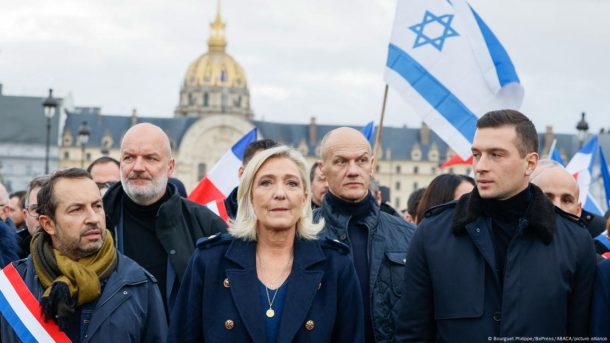
Anti-Defamation League CEO Jonathan Greenblatt recently faced sharp criticism from its ex-director Abraham Foxman over his initial plan to speak at the Israeli Diaspora Ministry’s International Conference on Combating Antisemitism in Jerusalem. For Foxman, the current ADL chief’s decision to share the stage with European populist figures was a bridge too far.
This conference counted on the presence of Jordan Bardella, the leader of France’s National Rally party; member of the European Parliament Hermann Tertsch of Spain’s Vox party; MEP Charlie Weimers of the Sweden Democrats party; MEP Marion Maréchal, granddaughter of National Front founder Jean-Marie Le Pen; and MEP Kinga Gál, of Hungary’s governing Fidesz party.
“Neither the left nor the right are friends of Israel and the Jewish people,” said Abraham Foxman, who led the ADL for nearly three decades. “Since the explosion of left-inspired antisemitism and anti-Israel hate in the last several years, the pseudo-Fascist right is trying to use the Jewish community as a platform, to demonstrate how legitimate and tolerant they are. Israel and the Jewish community should not give them legitimacy.”
Foxman is correct. Parties like the AfD and National Rally gain legitimacy by being slavishly pro-Israel—an excellent marker of the power of Jews in Western societies.
The presence of these controversial figures prompted a backlash from the ruling liberal establishment of the West. Felix Klein, Germany’s commissioner for combating antisemitism, canceled his appearance, citing his shock at the participation of populist politicians. Likewise, French-Jewish intellectual and ardent Zionist Bernard-Henri Lévy withdrew from his keynote address after learning Bardella would be speaking at the conference. Greenblatt, himself, eventually bowed out as speaker.
Bardella was particularly vehement in his comments on anti-Semitism:
“Since Oct. 7 [2023] in particular, France and Europe are witnessing a deadly honeymoon between Islamists and the far left,” Bardella said. “One provides the fanatics, the other institutionalizes the evil … We have to face anti-Jewish action head on … We have a solemn commitment in France to fight antisemitism everywhere at all times in all of its forms, whether from radical Islamists and the far left or the far right and their delirious plots. None of this hatred has any place in France or Europe.”
Bardella linked “the rise of Islamism, resurgence of antisemitism and the migratory phenomenon tearing apart all Western societies,” and said that the “National Rally is the best shield for the Jews in France.”
In contrast with his party’s founder, Bardella noted that he visited Yad Vashem and spoke of “the unspeakable horrors” of the Holocaust.
Despite the controversy surrounding the Israeli-sponsored conference, it proceeded without issue. Overall, it reflects a notable shift in Israeli foreign relations, spearheaded by Diaspora Affairs Minister Amichai Chikli of the Likud Party. Even before the Israeli government officially abandoned its policy of avoiding cooperation with right-wing populist parties in Europe, Chikli had been engaging with European populists.
He made appearances at conservative gatherings such as the Conservative Political Action Conference (CPAC) in Washington, where he praised President Donald Trump for his efforts to combat antisemitism. Chikli also spoke last year at Europa Viva 24, a gathering hosted by Spain’s Vox party, where he shared a platform with Marine Le Pen.
This growing closeness between Israel’s current leadership and European nationalist parties has stirred controversy both at home and abroad. Chikli’s vocal support for Le Pen during France’s recent elections drew criticism from diplomats in both countries. Last month, he and several Likud colleagues attended CPAC Hungary. In Western capitals, Hungary has been increasingly treated as a pariah for its unconventional foreign policy of treating NATO rivals such as China and Russia as normal countries and for its defense of traditional values and opposition to mass migration.
To those who have a rudimentary knowledge of Jewish influence in Western politics, the notion of Jewish groups aligning themselves with the populist would be almost unheard of. However, for seasoned observers of Jewish political behavior, these Jewish overtures to the European right are another classic case of the “Kosher Sandwich.” The strategy is quite simple: Jews take advantage, or sometimes even create a pressing social issue — immigration in this case. They subsequently insert themselves and their associates into both sides of the debate. But the Jewish interest in this case is to twist and exploit the issue for their own interests. Political newcomers, unaware of the deception, accept the Jew as an ally, convinced they are united in a common cause — only to be misled in the end.
One can see this in the “counter-Jihad” movement. Anti-Muslim activist Tommy Robinson, who has a history of receiving funding from the pro-Israel Middle East Forum and Jewish tech billionaire Robert Shillman, has been one of the most useful front goys for Jewish interests. While he has valid critiques about Islam’s corrosive influence in the United Kingdom and other West countries, Robinson has no issue with the UK importing millions of Hindus and Sikhs from the Indian subcontinent.
In effect, Robinson serves Jewish interests by promoting a Zionist-approved form of immigration restriction. Certain non-Whites — Muslims from the Middle East and South Asia — are demonized and barred from entering Western countries while other non-Whites less hostile, or at least apathetic, to Jewish political machinations continue flooding the Old Continent by the millions.
Jewish co-optation of European populist parties is a multi-decade project. Prime Minister of Hungary Viktor Orbán, who has otherwise sensible views on immigration and foreign policy, has a blindspot for Israel. This is largely due to his connection to Jewish Republican strategist Arthur Finkelstein—one of the key architects of Orbán’s and Israeli Prime Minister Benjamin Netanyahu’s electoral successes.
As a result of this Jewish connection, Orbán has been one of Israel’s strongest diplomatic allies in Europe, especially in the post-October 7 world. Despite his positive overtures to the Israeli government, the Hungarian Prime Minister continues to be demonized for being antisemitic by Western liberal institutions.
Such Jewish penetration of the populist Right has also been present in Italy. Matteo Salvini, leader of Italy’s right-wing Lega party, has cultivated strong ties with Israel, particularly under Benjamin Netanyahu’s leadership. Salvini has visited Israel multiple times, including in 2018 when he met Netanyahu, who called him a “great friend of Israel.” During these visits, Salvini expressed support for Israeli policies and criticized the EU’s stance on Israel.
A similar trend has occurred in the Netherlands. Geert Wilders, the founder and leader of the Party for Freedom (PVV) has a long-standing, personal connection to Israel, having lived and volunteered there as a young man and visited the country dozens of times. He firmly believes that Israel should have dominion over the entire land between the Jordan River and the Mediterranean Sea, opposes the creation of a Palestinian state, and has openly advocated for moving the Dutch embassy to Jerusalem. Wilders has met with Israeli leaders including Prime Minister Benjamin Netanyahu, President Isaac Herzog, and other high-ranking officials. He has been welcomed as a “true friend of Israel” by Netanyahu and has attended official events in Israel.
With prominent French populist leader Marine Le Pen being convicted for embezzling European Union funds, Israel now sees an opening for outreach in the French populist scene. It has invited Jordan Bardella, president of the National Rally (RN), and Marion Maréchal (Le Pen’s niece), to official conferences in Jerusalem, including the aforementioned government-organized antisemitism conference attended by the Netanyahu government.
Both Le Pen and Bardella have sought to rebrand the National Rally as a party amicable to Zionism, emphasizing support for the Jewish state’s security and opposition to “Islamist ideology.” Israeli Diaspora Affairs Minister Chikli publicly endorsed Le Pen, calling her “excellent for Israel” due to her anti-immigration and anti-Islamist positions.
The linking of right-wing populism with Zionist-friendly causes has also been pursued by political strategists and intellectuals like Steve Bannon and Yoram Hazony since the 2010s. Their distinctive approaches—Bannon’s political organizing versus Hazony’s think tank-building—represent two avenues that the American conservative movement has taken to make the world safe for Zionism in the populist era.
All things considered, what’s unfolding here appears to be a part of a backup plan for international Jewry to preserve itself in a 21st century marked by significant geopolitical upheaval. In a world where the United States can’t always be counted on to slavishly defend Israel, Jewish interest groups will strive to have all their bases covered by buying off populist parties abroad. As more and more voters in the West grow disillusioned with the post-World War II order, populist parties are well-positioned to upend traditional conservative and liberal parties and assume the levers of power.
As a result, the shiftiest elements of the transnational Jewish community will make attempts to insinuate themselves in these populist parties to ensure that they don’t become explicitly anti-Israel, much less antisemitic. Europe’s natural tendency, as evidenced by the scores of mass expulsions of the Jews across the Old Continent over two millennia of recorded history, is one of directly confronting the excesses of Jewish economic and political machinations.
To prevent this persistent element of European politics from making a comeback, Jewish interest groups have made it a point to defang White political power on both sides of the pond since the end of World II. In a post-liberal order, where the United States is no longer the unipolar power and its NGO appendages have lost their credibility, the Jewish diaspora will continue its subversive agenda albeit with a few tweaks in its strategy. Enter kosher populism—the only form of White grievance politics allowed in Jewish-dominated polities.
White advocates would be wise to not fall for the glossy exterior of regime-approved “populist” movements. While they may appear to be anti-system, their flaws with respect to challenging Jewish influence, ruin whatever positives they bring to the table. A hardened political cynic would view philosemitic populist organizations as containment vehicles designed to deradicalize Whites and prepare them for their eventual replacement by millions of foreign interlopers. Under normal circumstances, the White segment of the electorate would be gravitating towards nationalist parties that confront Jewish political power head on.
It can’t be stressed enough that European ethnic nationalism and strong anti-Zionist political movements are not permitted in the West. By leveraging hate speech laws, enforcing deplatforming across social media and financial sectors, and promoting controlled opposition groups, the Jewish lobby has thoroughly shaped the discourse in a way that prevents a friend-enemy distinction from ever materializing—the critical factor in undermining the Jewish supremacist projects.
Thanks to the Talmudic sleight of hand a certain faction of Jews has employed in their infiltration of nationalist groups, they ensure that Whites become cognitively polluted by Judaized talking points and expend vast resources and political energy in futile causes. In the meantime, the transnational criminal enterprise that is the Jewish global network continues to act with impunity—be it in the Middle East through the further consolidation of Israel’s geopolitical standing or by accelerating the demographic annihilation of the West via mass migration.
A strict policy of social distancing from institutions that are committed to preserving the Judeo-American Empire is of the essence. Given the demographic crises facing so many Western countries, it makes little sense to strike a Faustian pact with the Jewish institutions responsible for these developments.
As they say, with the Jews you lose.
I was interrogated in Singapore twice for writing about Palestine
By Dr. Muhammad Zulfikar Rakhmat | MEMO | May 10, 2025
In 2023, I experienced something I never expected in a country like Singapore. Not once, but twice, I was detained and interrogated at Changi Airport—not for breaking any law, not for carrying suspicious items, but for my work as an academic and journalist who writes on Middle Eastern affairs, especially Palestine.
I am an Indonesian citizen. I grew up in Qatar due to my father’s work relocation and completed my high school and undergraduate education there. I later studied in the UK, and between 2022 and 2025, I lived and worked in South Korea as a Research Professor at Busan University of Foreign Studies. My writing has long focused on the politics of the Middle East, with a consistent interest in Palestine—a cause rooted in personal history, moral clarity, and scholarly duty.
In February 2023, my wife and I were in transit in Singapore, flying back to Indonesia from South Korea. We had planned a quiet evening during our overnight layover, including a stop to try halal noodles at Tampines Mall. But instead of a peaceful layover, I was stopped at immigration and taken to a secluded room beside the counter. My wife was told to wait nearby, confused and anxious.
After a short wait, three men approached me, identifying themselves as Singapore’s security officers. They questioned me about my background, my travel history across the Middle East, and most tellingly—my academic and journalistic work. They seized my phone and combed through its contents. One of them referred to me as a “prolific writer,” a remark that made it clear they had done prior research on me before the encounter. Another asked, “Why do you write about the Middle East, especially Palestine?” They also pressed me on my views regarding the situation in the Middle East, suggesting a deeper interest not just in what I had written, but in the perspectives I held.
They never explicitly accused me of wrongdoing. But their fixation on my publications, and on my years living across the Middle East, was a clear indication that my intellectual work had triggered their attention. Later, my wife told me that one officer had directly told her that they were questioning me because of my journalism. After hours of interrogation, I was released and escorted to the departure gate. We never got to try the noodles, and we were told to wait until morning for our connecting flight. Before letting me go, one officer gave a parting warning: “Don’t write about our encounter.”
I’m writing about it now because such intimidation cannot go unchallenged.
Seven months later, in September 2023, it happened again. I was on a flight from Busan to Yogyakarta via Singapore. Because the transfer wasn’t automatic, I had to go through immigration to recheck my bags. The moment my passport was scanned, I was flagged and pulled aside once more. The questioning this time was shorter, but the tone and focus were the same. Even when I returned in the morning to board my next flight, I was flagged again and directed to a “special” immigration counter.
These were not isolated or accidental encounters. My name and passport had clearly been red-flagged.
Ironically, I have professional ties with Singapore itself. I am affiliated with the Middle East Institute at the National University of Singapore—one of the country’s premier academic institutions on Middle Eastern affairs. But that did not seem to matter to the security officers who questioned me. My intellectual contribution meant nothing in the face of state suspicion.
I have traveled to over 40 countries. Like many Muslims and Middle East-focused researchers, I’ve experienced scrutiny at airports, including once under the UK’s notorious Schedule 7 counter-terror law at Manchester Airport. But to face this kind of treatment in Singapore—a country I had visited multiple times in the past without issue, and the very first country I ever traveled to as a young student—was deeply unsettling.
Singapore’s position on Palestine is telling. While it officially supports a two-state solution and often expresses concern over violence in the region, its foreign policy leans heavily toward Israel. Military cooperation between the two states is robust, including procurement of Israeli-made weaponry. As such, open criticism of Israel or public support for Palestinian rights may be quietly discouraged within Singapore’s tightly controlled public sphere. For foreign nationals like myself, even transiting through the airport can be enough to trigger scrutiny.
This raises critical questions about freedom of expression and academic independence—not just inside Singapore, but across a growing network of states that prioritise geopolitical alliances over basic rights. The chilling effect is real. After these experiences, I now actively avoid flights that transit through Singapore. I decline invitations to speak or participate in events there. I no longer feel safe traveling through a country that punishes intellectual inquiry into the Middle East.
We must ask: what kind of global academic and journalistic space are we creating when states begin punishing people not for what they do, but for what they write? When security officers begin quoting your articles to justify a border interrogation, you know you are not just being profiled—you are being surveilled for thought.
Journalists and scholars must remain vigilant. We must continue to speak truth to power, especially when it concerns oppressed peoples like the Palestinians. It is essential to continue challenging power through critical inquiry and to document the subtle and overt ways in which restrictions on freedom of expression and dissent extend beyond national borders.
Singapore, for its part, must be held accountable. If it wants to remain a respected hub for global transit, business, and academia, it cannot target people based on their views. It cannot pick and choose which intellectual conversations are permissible. And it certainly cannot suppress writing on Palestine without revealing its own complicity in a much larger effort to silence that struggle.
Let us be clear: Palestine is not a taboo. Palestine is not a crime. Writing about it should not make anyone a suspect.
I was told not to write about what happened to me at Changi Airport. But silence is not an option.
Featured Video
America Racing to Strategic Defeat in Iran
or go to
Aletho News Archives – Video-Images
From the Archives
Should Europeans ‘Thank’ the Americans for Destroying Nord Stream?
By Robert Bridge | Strategic Culture Foundation | September 29, 2022
With an investigation continuing into the destruction of the Nord Stream gas pipeline that provided energy supplies to Europe from Russia, there appears to be just one prime suspect, and that should surprise nobody.
Following the sabotage of the Nord Stream 1 and 2 gas pipelines, former Polish Foreign Minister Radoslaw Sikorski already seemed to know the identity of the perpetrator when he tweeted out: “Thank you, USA.”
At first glance, it seemed that Sikorski was speaking sarcastically, berating Washington for carrying out an attack that will have severe repercussions for the people of Europe. After all, how could anyone see any good coming from the termination of Europe’s primary source of gas reserves with winter just around the corner? It was Sikorski’s homeland of Poland, after all, that urged its citizens to collect firewood in the face of dwindling gas reserves.
In fact, the Polish diplomat was speaking one-hundred percent literally… continue
Blog Roll
 Aletho News
- Growing insecurity, soaring prices fuel protests in north as regime bans evacuation: Sources
- Iran denies responsibility for ‘depraved’ attack on Kuwait desalination plant
- Bring The Troops Back. End This War Now!
- Can we please stop calling Israel the ‘only democracy in the Middle East’ now?
- US should start removing its troops from Germany, proposes AfD co-leader Chrupalla
- Iran Red Crescent: 600 educational centers attacked in US-Israeli ‘war crimes’
- Russian Oil Tanker Arrives in Cuba Amid U.S. Blockade
- America Racing to Strategic Defeat in Iran: Lt Col Daniel Davis
- FTC Warns Visa, Mastercard, PayPal, Stripe Over Political Debanking
- Russian tanker approaches Cuba despite US oil blockade
- If Americans Knew
- Will Trump Go Kamikaze?
- Is the University of Florida Shutting Down College Republicans over Israel Criticism?
- Jewish extremist arrested over alleged plot to firebomb Palestinian activist Nerdeen Kiswani’s home
- More than half of Palestinian child detainees have no charges
- The More Murderous Israel Gets, The More We Hear About “Antisemitism”
- Land Day and the Palestinian struggle after 30 months of genocide
- The Iran War Is About Palestine
- Israeli soldiers echo settler ideology, talk of revenge after targeting Palestinians and detaining CNN crew in the West Bank
- Israeli Policies Threaten Future of Christian Schools in Jerusalem
- Former US soldiers argue Israeli policy is now guiding US interests
- No Tricks Zone
- New Study Finds Warming Saves Lives…Cold Temperatures 12 Times More Deadly Than Excess Heat
- German Science Blog Accuses PIK Climate Institute Of Hallucinating Climate Tipping Points
- Devastating Assessment Of Comirnaty Vaccine By Former Senior Pfizer Europe Toxicologist
- New Study: CO2 Is ‘Effectively Negligible’ As An Explanatory Climate Change Factor Since 2000
- Former Pfizer Toxicologist Dr. Helmut Sterz Tells Bundestag Hearing Pfizer Vaccine Should Have Never Been Approved
- Energy Expert: Germany’s Nuclear Phaseout Was A “500 Billion Euro Mistake”
- New Research: South Australia’s Mid-Holocene Sea Surface Temperatures Were 4°C Warmer Than Today
- Storing Green Energy To Last Germany 10 Days Would Require A 60-Million Tonne Battery
- New Studies: UK Sea Levels Were 4 Meters Higher Than Today During The Mid-Holocene
- Destructive Green New Deal: German Energy And Metal Group Warns Of Drastic Crisis
 Aletho News