‘Trump’s Gift to Iran’: Iranian Media Shows 165 Graves for Minab School Bombing Victims
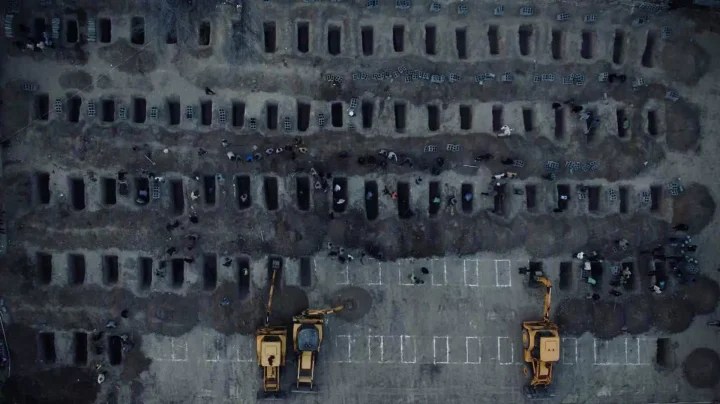
‘Trump’s Gift to the people of Iran’
Sputnik – 02.03.2026
Iranian media have published a shocking aerial photo showing the diggi9ng of 165 graves for the young victims of the Minab school attack.
The victims, girls aged between seven and 12, were killed in a devastating attack by US and Israeli forces.
The photo is captioned: “Trump’s gift to the people of Iran.”
The school in Hormozgan province was hit on Saturday morning in the first wave of US-Israeli missiles.
Iran has condemned the attack as a brutal act of terror, accusing the US and Israel of committing war crimes by targeting innocent children.
The attack has drawn widespread condemnation within Iran, with many calling it a violation of international law and a stab at the very heart of Iranian society.
Decapitation attacks don’t work against strong countries
By Lucas Leiroz | March 2, 2026
A new war has begun in the Middle East. After months of tension, the US and Israel launched an attack against Iran on February 28th. With the failure of negotiations for a nuclear agreement, war seemed inevitable, and many analysts anticipated that both sides were merely preparing for an imminent conflict, which proved true.
The Israeli-American attack was an attempt to “decapitate” the Iranian government. The country’s Supreme Leader, Ayatollah Khamenei, was killed, along with almost his entire family, in a bombing of his residence and office. There were also serious violations of humanitarian law with attacks against a primary school, resulting in the deaths of over one hundred children.
Unlike previous cases where Israel attacked Iran, this time the Islamic Republic reacted immediately – and not only against Israel. All US-allied countries in the Middle East have been – and continue to be – targeted by Iranian missiles and drones in a relentless bombing campaign. Israel, the UAE, Saudi Arabia, Qatar, Bahrain, Kuwait, Iraq, Jordan, Oman, and even British bases in Cyprus have been targeted by Iran.
Tehran is trying to inflict as much damage as possible to all military and energy infrastructure that enables US and Israeli operations. Oil facilities in the Gulf are being destroyed, as well as ships linked to Israel or the West in the Strait of Hormuz – which is currently only partially open, with Iran allowing passage only to ships from certain partner countries.
It is clear that the US and Israel were not prepared for such a profound reaction from Iran. American and Israeli authorities seemed to expect a late and moderate reaction, as occurred in the Twelve-Day War. The intensity and frequency of the Iranian attacks have caused a kind of partial “strategic paralysis” in the US and Israel – as well as in the affected allied countries – which simply could not anticipate the bombings to activate security measures efficiently.
Media reports indicate that the US approached Iran through the Italian government to suggest a ceasefire agreement, which was promptly rejected. There seems to be no interest on the part of Iran in de-escalating the conflict in the coming days or weeks. The situation becomes particularly tense considering that it involves not only military and strategic factors, but also issues of national pride and patriotic sentiments, considering the assassination of the Supreme Leader and civilians, including children.
American authorities, including President Donald Trump himself, publicly stated that the operation had achieved its objective of eliminating the Iranian leadership and that from that moment on it would be up to the local Iranian population to fight against state forces and complete a total regime change – thus seeking so-called “Iranian freedom.” However, the popular reaction was in the opposite direction, with increasing popular support for the Iranian retaliation.
This miscalculation on the part of the US and Israel is typical of their military mentality focused on decapitation attacks and quick assaults. The US is accustomed to short-duration wars, rapid invasions, causing high destruction to the enemy and promptly evacuating without significant attrition. Similarly, Israel, being a small country with limited resources, has always maintained a strategy of decapitation attacks, attempting to eliminate the leadership of anti-Zionist countries and armed groups in a fast manner and with minimal military effort.
However, this strategy is extremely limited. The US has been successful in operations against small countries in Latin America and some ‘failed states’ in Africa, but has always suffered when facing prolonged wars of attrition, such as in Vietnam or Afghanistan. Similarly, Israel has not even managed to neutralize Hamas and Hezbollah, which are non-state militias, by carrying out their decapitations in recent years. All this reveals the clear limitations of this type of strategy.
Iran is a country of considerable size, with over 90 million inhabitants and a complex political structure consolidated since the 1979 Islamic Revolution. Popular support for the state is widespread – otherwise, the country would have already undergone some regime change, considering that the West constantly promotes mass protests and attempts at color revolutions there. Countries with such structure and complexity cannot be easily destabilized by quick decapitation operations.
Furthermore, it is important to remember that Khamenei was almost 90 years old and suffering from advanced cancer. Obviously, he did not control the entire Iranian chain of command alone, as there were many other high-level officials responsible for the local decision-making process. The authorities were already preparing for Khamenei’s replacement, as his death from natural causes was expected, so the impact of the “decapitation” was simply null.
In fact, the conflict seems to have already crossed the point of no return. Iran has shown that it has not been intimidated by the US and Israel and has made it clear that it will continue to target the entire regional infrastructure of the US, Israel and their allies, even if this means a widespread regional war. What Tehran seems to be doing is seeking a safe situation for itself, with sufficient demonstration of power and damage to its enemies, so that it can then engage in negotiations again in the future – the classic strategy of “escalating to de-escalate”.
Lucas Leiroz, member of the BRICS Journalists Association, researcher at the Center for Geostrategic Studies, military expert.
You can follow Lucas on X (formerly Twitter) and Telegram.
Next Iranian leader should be killed too if hostile to US – Lindsey Graham
RT | March 2, 2026
The US should assassinate those who come to power in Iran if they remain hostile toward American interests, according to veteran war hawk Senator Lindsey Graham.
The targeted killing of Iranian Supreme Leader Ayatollah Ali Khamenei and other senior officials was the opening part of a US-Israeli regime change operation launched on Saturday.
In a Fox News interview on Sunday, Graham pushed for continued political assassinations abroad. “This regime is in its death throes. Finish them off!” he said. “The ultimate safety comes when people in charge of Iran don’t want to kill us.”
“I don’t know who is going to take over Iran after this regime collapses but I know this. If you want to be a friend to America, we’ll be a friend to you. If you wanna keep this crap up, then you will pay the same price [as] the ayatollah,” Graham added, citing decades of Iranian support for anti-American militancy.
President Donald Trump’s interventionist approach in Iran and elsewhere sets “the golden standard” for US foreign policy that even President Ronald Reagan could not achieve, Graham claimed. He urged Trump to “unleash the American military with Israel” on Lebanon’s Iran-aligned Hezbollah “tonight.”
Cuba should also be targeted, Graham said, claiming Havana’s “days are numbered.” The US should also pressure Saudi Arabia, custodian of Islam’s holiest sites, to “recognize the one and only Jewish state,” he added.
Support for Israel has been a longstanding US strategic policy in the Middle East under both Democratic and Republican administrations.
Weeks before the joint attack on Iran, US Ambassador to Israel Mike Huckabee insisted that Israeli Prime Minister Benjamin Netanyahu “does not want a war with Iran” and ridiculed the notion that “tiny little Israel is pushing the US into something it does not want to do.” He also denied that the 2003 invasion of Iraq was conducted in pursuit of Israeli interests, insisting that “zero” American troops were ever put on the ground for Israel.
Iran security chief says ‘no negotiations with US,’ confirms readiness for ‘long war’
The Cradle | March 2, 2026
The Secretary of Iran’s Supreme National Security Council, Ali Larijani, declared on 2 March that the Islamic Republic “will not negotiate with the United States” as the regional war rages on for a third straight day.
“Trump’s wishful thinking has dragged the whole region into an unnecessary war and now he is rightly worried about more American casualties. It is indeed very sad that he is sacrificing American treasure and blood to advance Netanyahu’s illegitimate expansionist ambitions,” Larijani said in a social media post.
The declaration came as a refutation to a Wall Street Journal report claiming that, hours after US-Israeli strikes halted negotiations, Larijani had pushed to resume nuclear talks with Washington through Omani mediators.
In a separate post, Larijani said Iran is prepared for a prolonged war, unlike the US.
Following the killing of Iranian Supreme Leader Ali Khamenei in US-Israeli strikes on 28 February, Larijani emerged as a central figure in Iran’s security and military leadership.
While Larijani has been managing Iran’s retaliation to the attack, he is not part of the three-person interim council established to lead the country until a successor is elected.
The council met for the first time on 1 March, shortly after the killing of Khamenei, to ensure government continuity as the country declared a 40-day mourning period.
The supreme leader was killed alongside a number of Iran’s top military and security leaders, including IRGC Commander-in-Chief Mohammad Pakpour, Defense Minister Aziz Nasirzadeh, and Armed Forces Chief of Staff Abdolrahim Mousavi, as well as several of Khamenei’s family members – his daughter, son-in-law, daughter-in-law, and grandchild.
The unprovoked US-Israeli attacks that began on 28 February have so far resulted in the killing of at least 555 people across Iran.
That number includes at least 180 killed in a single Israeli strike on a girls’ elementary school in Minab, with the vast majority being students aged 7-12.
UNESCO condemned the massacre as a grave violation of international humanitarian law, stressing the protections granted to civilians, especially children.
The joint US-Israeli aggression – dubbed ‘Operation Epic Fury’ by the US, and ‘Operation Roaring Lion’ by Israel – has carried out roughly 2,000 strikes across 131 locations in Iran, targeting key political, military, economic, and civilian infrastructure.
Following Iran’s Islamic Revolutionary Guard Corps (IRGC) announcement of Operation True Promise 4 – targeting US bases in the Persian Gulf region – Gulf states condemned Iran’s retaliatory missile strikes on US bases within their territory, calling them violations of sovereignty, with all Gulf states reporting the interception of Iranian missiles.
Oman warned the US-Israeli assault had undermined diplomacy just as a nuclear deal was “within our reach,” urging Washington not to escalate further, as Russia denounced the US-Israeli attack as “unprovoked.”
Iran yet to deal its master blow in the region, while U.S. navy looks increasingly vulnerable
By Martin Jay | Strategic Culture Foundation | March 2, 2026
Early on Sunday morning, it was confirmed that Iran’s Supreme Leader had been killed by U.S./Israeli airstrikes, which no doubt will be seen by Trump and Netanyahu as a significant victory in their erroneous goal of regime change. But was it really one to chalk up? Reports from Iran indicate that he will be replaced almost immediately by his son, who had already been playing a key role in the country’s leadership anyway and whose appointment may well be a significantly positive step forward for the country, as many Iranians, while wanting reforms in their country, know only too well that the regime change notion is a trap set by Israel which they reject.
Iran has already scored a number of victories in a mere 24 hours, and their readiness this time was evident which, no matter how you look at the conflict, was certainly a consequence of Trump’s earlier actions in June, when he bombed Iran’s nuclear facilities with the agreement of Iran’s leaders.
No such cosy deal exists today. The Iranians have learned the hard way that Trump is not to be trusted and is not even in control of these decisions. What we are witnessing now is the start of a protracted war which will evolve on several fronts concurrently, with the Iranians in no particular hurry to proceed at a rapid pace. Their significant strikes on a U.S. naval base plus one naval ship is a taste of Iran’s ballistic missile capability which is starting to rain down on Israel itself.
The Supreme Leader’s death actually was not a great victory, given that he made no real effort to go into hiding but was killed in his office. By contrast, Benjamin Netanyahu escaped from Israel and ended up being protected by the country which pulled off the Holocaust. And so Bibi can slowly watch the disintegration of his own country while the region deals with a new reality: oil.
Oil will be a critical, decisive factor in how long Israel and the U.S. can continue with the war, as Iran lost no time in shutting off the Straits of Hormuz, while America’s fleet of ships just sat and watched. This may well be one area where Trump has seriously underestimated the consequences, as energy analysts are already predicting the climb of crude to close to $120 USD in the coming weeks. The choking of one of the most critical channels which provides 20 percent of the world’s oil supply is only part of the horror story, though, that Iran has in store for Trump and Bibi. Warned that they would be hit — or at least their U.S. military bases would be legitimate targets — GCC countries have responded in a way which will please Israel and the U.S.: Saudi Arabia has said they will both attack Iran soon, with Qatar and the UAE likely to join.
Yet such a strategy would be a colossal error of judgment and a spectacular miscalculation which will accelerate the war in Iran’s favour and force the U.S. and Israel to capitulate as Tehran strikes the Achilles heel of the whole operation. Iran can easily destroy the entire oil infrastructure of these GCC countries in a matter of hours, which would not only be a knockout blow to those countries’ economies but will have a considerable impact on world oil prices, for one strengthening Russia. For the moment, Iran doesn’t need to go this far, but if GCC countries really go ahead with their threat, it will have little choice.
Another critical area of misjudgement is the logistics of U.S. battleships operating inside the Straits of Hormuz. The straits have already been closed, and any pretensions that U.S. military planners had of taking on Iran in this ocean have been dashed by its successful destruction of the U.S. Naval base in Bahrain, which of course is played down by U.S. media whose low IQ “journalists” make themselves look even more stupid by asking Iran’s foreign minister why Iran is bombing U.S. bases. The U.S. naval base in Bahrain was a critical supply port for U.S. battleships which carry around 90 missiles on board. The destroyers which are now trapped inside the Straits of Hormuz can’t now reload if they deplete those missiles. The other ships which are on the other side of the blockade now can only restock at the U.S. base of Diego Garcia, which is three days away. To say this is a major blow to the whole operation is an understatement. It is a blunder of extraordinarily poor planning and a stroke of military genius by Iran to hit the U.S. naval base in Bahrain on day one, and it explains why the intense fury of the June retaliation last year has not been replicated. Iran is confident that its planning will defeat the enemy as it has a number of aces to play, and so its response is more measured and less frenetic. Iran has been planning this war for years, and the attack last year by Trump has just focused their minds and honed their military strategy to the point where even after 24 hours, they are looking like the victors who have a real strategy which is paying off, rather than their enemies who are dazed and confused. Is it really any wonder that sailors on the USS Gerald Ford sabotaged the toilet system on board by blocking it with T-shirts, so as to delay its voyage to the Gulf?
US-Israeli strike targets IRIB facility; broadcasts continue
Press TV – March 1, 2026
A US-Israeli strike has targeted one of the buildings belonging to Channel 2 of the Islamic Republic of Iran Broadcasting (IRIB), Iran’s official broadcaster.
The building, located on Alvand Street in the capital Tehran, was targeted on Sunday.
Despite the attack, the IRIB said its programming remained on air, saying broadcasting of its channels, including Channel 2, was continuing without interruption, and no disruption had been reported in overall television transmission.
Damage assessment under way
Reporting on the development, Tasnim News Agency said television broadcasts were currently proceeding as normal, adding that technical teams at the national broadcaster were assessing potential damage resulting from the strike.
Follow-up inquiries with the IRIB’s technological development department indicated that only a brief disruption had occurred, while viewers were advised that access to television channels could be restored by re-scanning their receivers.
The department stated that television channels were experiencing no problems or disruptions and continued their routine operations, and added that no damage had been inflicted on the television studios.
Observers described the strike as yet another “war crime” taking place as part of the Israeli regime’s and the United States’ latest bout of unprovoked aggression against Iran.
The aggression has prompted at least eight waves of decisive retaliatory strikes on numerous hostile targets throughout the region.
The regime struck the IRIB’s headquarters in Tehran last June too, causing the martyrdom of at least three journalists enlisted with the broadcaster.
Trump bit off more than he can chew with Iran – ex-Pentagon analyst
RT | March 1, 2026
The US-Israeli strikes on Iran are unlikely to trigger regime change and risk escalating into a wider geopolitical confrontation, former Pentagon security policy analyst Michael Maloof has told RT.
Washington and West Jerusalem launched what they described as a “preemptive” attack on the Islamic Republic after nuclear talks failed to produce a breakthrough, prompting retaliation from Iran. Tehran responded with missile and drone strikes targeting Israel and US military bases across the region.
In an interview with RT on Saturday, Maloof said the timing of the attack had likely been finalized during Israeli Prime Minister Benjamin Netanyahu’s visit to Mar-a-Lago on February 12, despite President Donald Trump publicly insisting that negotiations with Tehran were ongoing.
“The United States has always done Israel’s bidding. Netanyahu basically controls Trump,” Maloof claimed, adding that the US president has effectively pursued the Israeli PM’s vision of “a greater Israel to encompass all the Arab countries.”
Trump openly declared his goal to force regime change in Tehran, but efforts to topple Iran’s government would face major obstacles, according to Maloof.
“Regime change is something that is going to be difficult, especially in Iran, where they’re very, very set. They have a government in place,” he said. Even with the killing of Iran’s Supreme Leader Ayatollah Ali Khamenei, the Islamic Revolutionary Guard Corps would likely keep the country functioning as a “cohesive nation-state.”
At the same time, he described the strikes as part of a broader strategic confrontation extending beyond Iran’s nuclear or missile programs, noting how the US president has been openly critical of BRICS and China’s Belt and Road Initiative.
“And Iran just happened to be a very critical component to that, with Russia and with China,” Maloof said. “I think Trump bit off more than he could chew on this one.”
“These attacks are gonna affect the whole economic world order, literally overnight. So we’re in for a long, hard slug here,” Maloof said, adding that “it’s easy to start a war, but [it’s harder to know] how to stop one.”
Murdering Khamenei Will Kill Trump’s Presidency
By Ian Proud | Strategic Culture Foundation | March 1, 2026
Ayatollah Seyyed Ali Khamenei was assassinated in what is being described in western media as a joint airstrike operation. Even though the Israeli air-force carried out airstrikes in and around Tehran, it is clear that these were supported by the U.S. military. As such, the U.S. is complicit in the murder of the Head of State of a sovereign nation.
And this unilateral military action once again proved both that the United Nations Charter has lost its value and that the UN Security Council is now broken.
In his opening remarks to the Security Council, Secretary General António Guterres condemned the military strikes by the U.S. and Israel, which also condemning the Iranian response, citing Article 2 of the UN Charter.
“All Members shall refrain in their international relations from the threat or use of force against the territorial integrity or political independence of any state, or in any other manner inconsistent with the Purposes of the United Nations.”
The enormous and ongoing military strikes against Iran were clearly in breach of that Article.
In its response to the Security Council, Iran’s Representative cited Article 51 of the UN Charter, which states that “nothing in the present Charter shall impair the inherent right of individuals or collective self-defence if an armed attack occurs against a Member of the United Nations, until the Security Council has taken measures necessary to maintain international peace and security.” Article 51 is one of only two exceptions to the general prohibition on the use of force by UN members set out in Article 2.
The strikes were all the more cynical for taking place part way through talks moderated by the government of Oman. Indeed, Guterres hinted at this in his remarks, saying:
“The U.S. and Israeli attacks occurred following the third round of indirect talks between the U.S. and Iran mediated by Oman.
Preparations had been made for technical talks in Vienna next week followed by a new round of political talks.
I deeply regret that this opportunity of diplomacy has been squandered.”
Pakistan’s representative at the Council was more blunt, saying that “diplomacy has once again been derailed as these attacks have happened right in the middle of negotiations.”
Indeed, the strikes confirmed that the UN Security council has become completely unable to take measures necessary to maintain international peace and security.
On the 80th anniversary of the founding of the UN Secretary General Guterres warned that “fragile” legitimacy of the Security Council could endanger global peace if it remains gridlocked and fails to fulfil its primary purpose.
All of the the western nations around the UN Security Council table last night showed themselves to be weak and silent, in the face of American’s military might.
As one, they criticised Iran’s unprovoked attacks on Gulf states, as Iranian ballistic missiles targeted U.S. military sites in Bahrain, Qatar, the UAE and Kuwait, while also targeting Israel. Self evidently, Iran was targeting U.S. military installations in all of those countries and. Indeed, the U.S.’ fifth fleet Headquarters in Bahrain was struck by at least one ballistic missile. Yet civilian sites also got hit, including in the UAE and in Bahrain.
However, there was no mention at all of the U.S. and Israeli strikes on Iran in the statements of western nations at the Security Council, as if they feared U.S. reprisals if they spoke out. Not a single word from the French, the Latvians, the Danes, the Greeks, even the Bahrainis, only that Iran murdered its citizens and should not be allowed to acquire a nuclear bomb.
In the end the acting UK Permanent Representative, James Kariuki, who I can tell you from personal experience is the most arrogant and puffed up British diplomat that I ever met, said that:
“Iran must refrain from further strikes, and its appalling behaviour, to allow a path back to diplomacy.”
The sitting President of the UN Security Council, the United Kingdom (the U.S. takes over the Presidency today) did not utter a single word about the USA or Israel. No attempt, as the country convening the meeting, to seek common ground and some agreement on the way forward.
Britain’ approach was merely to blame Iran in what the Russian Federation representative described in his intervention as ‘victim blaming’. I already knew that Britain had given up diplomacy in 2014, but this appeared yet another nail in a coffin which the UK refuses to bury as it pretends to be a nation of diplomacy. It is not. Britain is now a nation of warmongers without the troops to fight.
While final confirmation of the fact had yet to be provided at that time, the Prime Minister of Israel and President Trump were already celebrating the possible killing of Khamanei. ‘The dictator is gone,’ Netanyahu crowed.
In his social media statement, President Trump called on Iranian people to rise up and take over their country.
Yet within hours, sources within the CIA were already leaking reports that Khamenei may simply be replaced by IRGC hardliners.
As I have pointed out before, rather than fomenting revolution, unilateral military action against Iran may have the opposite effect and mobilise Iranian resistance.
This idea was stated with great clarity by Professor Robert Pape of Chicago University who said:
“With each passing day of regime-targeting airstrikes, we lose control over the political dynamics they unleash.
It becomes less about individual leaders and more about national survival. Less about dissent and more about resistance.
Imagine if a foreign power struck Washington and called on Americans to overthrow their government. Would citizens rally against their leaders — or against the foreign attacker?”
Iran is a country of 92 million people with an army of over 610,000. It is a tightly controlled state and as we saw in January is more than capable and ready to stifle internal dissent, including through violent means. It also does not have an oven-ready opposition lined up in the wings that can walk in unopposed and miraculously take over the country. To suggest that it does takes us into Bay of Pigs territory.
Having already kidnapped the Head of State of one sovereign nation already this year, the United States of America has now murdered another, Ayatollah Khamenei. This will unleash asymmetric threats against the U.S. and all of its allies that Donald Trump will not be able to control. If this military action drags out inconclusively, and I predict it will, then the mid-terms may prove catastrophic for Trump. I predict that the Iranian regime will outlast his.
Unexpected Iranian reaction paralyzed Americans and Israelis on the first day of war
By Lucas Leiroz | Strategic Culture Foundation | March 1, 2026
The recent military escalation in the Middle East revealed a strategic miscalculation on the part of Washington and Tel Aviv. By launching a direct offensive against Iran, authorities in the United States and Israel apparently assumed that Tehran would repeat the pattern observed in previous confrontations: initial restraint, calibrated retaliation, and delayed timing. This pattern was evident both during the so-called Twelve-Day War and in earlier episodes of Israeli aggression against Iranian targets and regional allies. This time, however, the calculation proved mistaken.
The central element of the initial strategy appears to have been a classic attempt at “decapitation,” targeting the Supreme Leader, his family, and other high-level figures. The underlying logic is well known: by removing the apex of decision-making authority, internal disorganization, succession disputes, and operational paralysis would follow. This approach is recurrent in Western military doctrine, especially when directed against states considered systemic adversaries.
However, this type of strategy tends to fail when applied to highly institutionalized states equipped with complex political-military structures. Iran is not a fragile entity dependent on a single personal command center. It is a system with multiple layers of authority, defined chains of succession, and deep integration between the state apparatus, regular armed forces, and parallel security structures. Moreover, it is a civilization with millennia of historical continuity, whose contemporary political identity was consolidated precisely under external pressure. The elimination of an individual leader, even if symbolically significant, does not automatically dismantle a state with this degree of structural cohesion.
What surprised analysts was the speed of the Iranian reaction. Unlike what occurred during the Twelve-Day War, this time retaliation was immediate and multifaceted. Within the first hours after the attacks, Iran launched a series of simultaneous operations against American military installations across the Middle East. Bases used by U.S. forces were struck with missiles and drones in coordinated actions aimed at saturating defense systems and reducing interception capacity.
At the same time, Israeli defensive systems were placed under pressure through multiple and forceful attacks. Iran’s strategy was not limited to a symbolic gesture; it represented a deliberate attempt to impose immediate and visible costs, altering adversaries’ perception of risk. Throughout the first day of confrontation, the operational tempo remained constant, creating an environment of heightened uncertainty for the Zionist regime.
The multiplicity of vectors employed – different launch platforms, varied trajectories, and synchronized timing – contributed to confusion among military planners in Washington and Tel Aviv. By all indications, such a bold and rapid action was not anticipated. The assumption that Tehran would hesitate, seek mediation, or respond in a limited fashion proved incorrect. Instead, Iran sought to demonstrate its capacity for strategic coordination under maximum pressure.
This behavior suggests that Iranian authorities internalized relevant lessons from recent conflicts. Delays in responding, observed in previous episodes, were interpreted by adversaries as signs of strategic restraint or operational limitation. By opting for an immediate and comprehensive reaction, Tehran sought to redefine the rules of engagement and establish a new threshold of deterrence.
The psychological impact should not be underestimated. Continuous attacks throughout the first day reportedly generated confusion and near paralysis within certain Israeli and American decision-making circles. When multiple fronts are activated simultaneously, the ability to prioritize strategically becomes far more complex, if not effectively impossible.
It now remains to be seen how escalation will unfold in the coming days. Iran’s initial response altered the immediate balance but does not end the cycle of action and reaction. Washington and Tel Aviv face the classic dilemma between expanding the offensive – risking a large-scale regional conflict – or seeking indirect channels of containment. The first day demonstrated that the scenario evolved beyond initial expectations. From this point forward, each additional move may redefine not only the military dynamic but the broader security architecture of the entire Middle East.
Larry Johnson: The U.S. Will Exhaust Itself & Lose War Against Iran
Glenn Diesen | February 28, 2026
Larry Johnson is a former intelligence analyst at the CIA who also worked at the US State Department’s Office of Counterterrorism. Johnson discusses why the US will lose the war against Iran.
Read Larry Johnson’s Sonar21: https://sonar21.com/
Follow Prof. Glenn Diesen: Substack: https://glenndiesen.substack.com/
X/Twitter: https://x.com/Glenn_Diesen
Patreon:  / glenndiesen
Support the research by Prof. Glenn Diesen: PayPal: https://www.paypal.com/paypalme/glenn…
Buy me a Coffee: buymeacoffee.com/gdieseng Go Fund Me: https://gofund.me/09ea012f
In The Name of ‘Helping Iran’, The U.S. And Israel Slaughter Over 100 Iranian Schoolgirls

The Dissident | February 28, 2026
During his announcement of the current U.S./Israeli regime change war on Iran , Trump framed the war under the pretext of helping Iranians, saying:
to the great, proud people of Iran, I say tonight that the hour of your freedom is at hand. Stay sheltered. Don’t leave your home. It’s very dangerous outside. Bombs will be dropping everywhere. When we are finished, take over your government. It will be yours to take. This will be, probably, your only chance for generations.
For many years, you have asked for America’s help, but you never got it. No president was willing to do what I am willing to do tonight. Now you have a president who is giving you what you want, so let’s see how you respond. America is backing you with overwhelming strength and devastating force. Now is the time to seize control of your destiny and to unleash the prosperous and glorious future that is close within your reach. This is the moment for action. Do not let it pass.
But after one day of war, the U.S. and Israel have already carried out a massacre of over 100 children.
The Financial Times reports that, “A primary school in southern Iran was struck during Saturday’s joint US-Israeli military operation, killing at least 108 people who were mostly schoolgirls, according to Iranian authorities.”
According to the governor of Hormozgan Province, Mohammad Ashouri, “In addition to the deaths, 92 people were injured and an unspecified number trapped under rubble”.
The Guardian reported that , “In one video circulating on social media, purportedly showing the immediate aftermath of the strike, smoke rises from the burnt-out walls, and debris lies spread across the road. Hundreds of onlookers gathered at the site, some in obvious distress. Screams can be heard in the background,” adding, “Persian factchecking service Factnameh was able to cross-reference the video with other photographs of the school site, and concluded that the video was authentic. Reuters said it had also verified the footage as being from the school.”
Other footage also shows the bodies of the student girls who were killed in the massacre.
This massacre has also been confirmed by multiple witnesses who have spoken to the media.
Middle East Eye interviewed a staff member at the school who said, “She used to watch these young girls playing at school every day. But after today’s strikes, she saw their bodies lying on classroom benches and in different corners of the school.”
Middle East Eye added:
She said she had stepped out of the school to take care of something when she suddenly heard a horrifying sound. Within seconds, a missile – or something like it – hit the school building.
After hearing the blast, she ran back toward the school and was faced with a scene she says she will never forget for the rest of her life.
“I felt like I had gone mute. I couldn’t speak,” the staff member told MEE. “You could hear the sound of children crying and screaming.”
Drop Site News spoke to Mohammed Shariatmadar, the father of a six-year-old girl named Sara killed in the massacre, who said, “I cannot understand how a place where innocent children learn can be bombed like this, We are talking about small children who knew nothing of politics or wars. And yet they are the ones paying the highest price,” adding, “My heart is broken, For Sara and for all the children we lost today. I want the world to know that the children are the real victims. Every day that passes without a solution increases the pain and the suffering for the families and for the children alike”.
Another witness told Drop Site News, “Everyone rushed to the school the moment they heard the blasts. Chaos took over completely. Security forces were trying to push families back, fearing the area would be targeted again.”
Seyyed Ibrahim Mirkhayali, a father who lost his nine-year-old daughter in the massacre said, “I was at work when my wife called and told me that the girls’ primary school in Minab had been bombed. I could not process what I was hearing at first. Then I left immediately and drove to the school. The atmosphere was terrifying and catastrophic. The parents were in a deadly silence, filled with fear and dread for their daughters. We did not know who had gotten out and who was still under the rubble”.
Along with this media reports that “In Fars Province, also in southern Iran, ‘Israel’ killed 20 volleyball players in a strike on a sports hall in the city of Lamerd, according to a provincial official.”
While pretending to care about Iranians, the U.S. and Israel are clearly happy to massacre children and civilians in Iran in order to carry out the real goal of destroying Iran as a nation.
Why are Americans killing and dying for Israel, again?
By Tarik Cyril Amar | RT | February 28, 2026
Israel and its US auxiliaries have attacked Iran. In terms of international law and elementary justice, things are clear beyond the slightest doubt: the attack is a war of aggression – but to be fair, in Israel’s case that hardly makes a difference anymore.
With ‘highlights’ including apartheid, ethnic cleansing, unlawful detention, torture, sexual violence, and genocide, Israel has such an extensive and constantly growing record of, literally, every crime under international law, including human-rights and humanitarian law (or the law of armed conflict), that one more or less hardly seems to matter anymore. This state is a monster, and monsters will monster as long as they can.
The US, of course, is no spring chicken either when it comes to treating international law – really, any law – as a doormat and brutally, gleefully violating the most basic ethics, the kind of simple rules normal people intuitively recognize, such as “don’t murder, lie, or steal.”
Indeed, while Israel can easily claim to be the single most criminal, indeed evil country in the world, the US wins the most-powerful-rogue-state prize hands down. There is – empirically, quantifiably – no other country that combines such ingrained and increasingly explicit scorn for law and morality with such brute power and perpetual violence. Before the current assault on Iran, the kidnapping of Venezuelan President Nicolas Maduro was just the last proof of that fact, so glaringly obvious that it woke up even some Western commentators.
If some things are too obvious to merit further discussion, others are more intriguing. Let’s start with the greatest mystery: Why is the US joining – really, obeying – Israel and its powerful American lobby once again in going to war in the Middle East? Was Iraq 2003 not enough of a disaster? Are the American elites really congenitally unable to learn?
In terms of actual US interests, war against Iran makes no sense at all. Iran is not close to a nuclear bomb and, as a matter of fact, has a religiously and ethically based (hard to grasp in Washington, I know) explicit policy against acquiring one. And even if Iran were building such weapons or seeking a state of being “latently” able to do so as urgently needed insurance against permanent Israeli and US aggression, Washington would gain nothing and risk very much by going to war.
On the other hand, it was precisely the JCPOA agreement with Iran, destroyed by the US during the first Trump presidency, that proved empirically that the issue of Iranian nuclear energy use can be resolved well by compromise. As to recent, hysterical US claims about other types of WMDs and “intercontinental missiles,” it is time to no longer give such crude, dumb lies the time of day. Enough with the propaganda already.
Regime change? So, please could someone explain why installing a washed-out Pahlavi princeling – if it ever were to work, that is – in Tehran is good for Americans? Spoiler, no one can. At least not honestly. Do I hear someone say geopolitics? Oh, that would mean the “genius” geopolitics of risking a long war with great damage to the US and its regional allies? Then, perhaps it’s all about plunder? Yes, true, the US simply loves plundering. Historically speaking, the whole country is built on it, just like Israel. But even plunder on its own despicable terms only makes sense if you turn a profit. Good luck with that while sinking more gazillions into war-for-Israel.
And that brings us to the only explanation that does make sense, even if in a very grim way: The US, as in almost all Americans, has zero interest in war with Iran. As little as in a proxy war with Russia and a Cold War with China, both strategies, by the way, doomed to fail. In all three cases, the vast majority of Americans would only stand to benefit from peaceful and cooperative relationships.
But Washington chooses permanent conflict and war against Iran anyhow. The reason is that US policy in the Middle East – and not only – has been captured by Israel and its lobby. As John Mearsheimer, both doyen of explaining international relations by national interests (the theory of Realism) and co-author of the standard work on the Israel Lobby, has long acknowledged, Israel’s influence on the US is real, contradicts American interests, and forms an exception to the theory of realism in that Washington is constantly hurting its own country.
For reasonable observers, this case is closed. When devastating the Middle East, the US is acting not in its own genuine national interest but the perverse conception that Israel has of its national interest: subjugating and, if needed, destroying all sovereign states in its neighborhood so as to create and preserve Israeli domination and even ‘Greater Israel’, a nightmare of ‘Lebensraum’ for Zionist settlers from, at least, Egypt to Iraq.
But, again, why? This is where the Epstein scandal makes a difference – or should do so – to unbiased minds. We must acknowledge that Jeffrey Epstein was not “merely” a very rich and perverse criminal with far too many friends in high places but an agent of Israel, whether with a direct affiliation to its dreaded Mossad service of spying, murder, and subversion or not. His core operation served to gather extremely compromising blackmail material on large swathes of the elites of the US and the West more generally. FBI agents, we now know, assessed that Trump himself is among those trapped in this manner. If anything, frantic – and also, again, criminal, efforts – by Trump’s Department of Justice and his head of the FBI to purge the files of references to the current president and his friends only provide further corroborating evidence that Trump is under Israel’s control.
Remember ‘Russiagate’ (really, of course, Russia Rage)? The irony! Russia was never remotely close to (or even trying) to having a US president under its thumb. That was all BS. Yet, in the end, ‘Russiagate’ did do two things: it gave Trump a (fundamentally realistic if exaggerated) sense of having been a victim of a smear campaign and, among voters, it helped Trump make his furious comeback, without which he would not now be in power. The delusion and mass hysteria of ‘Russiagate’ – which was that famous American thing, a nothing-burger – paved the way for the power that really controls Trump and really does enormous damage to America: Israel and its lobby.
Will Americans ever free themselves from the one state and network that have really run history’s most successful subversion and state-capture operation on them? Who knows? We know that it would take more than putting an end to Epstein-like blackmail. If anything, Trump’s bitter enemies, Joe Biden and Kamala Harris, have only recently shown us that the American “elite” is enthralled to Israel and its crimes also for reasons ranging from being bribed to sharing the vile insanity of Zionism. If the US ever wants its independence back from Israel, all of that will have to go.
Tarik Cyril Amar is a historian from Germany working at Koç University, Istanbul, on Russia, Ukraine, and Eastern Europe, the history of World War II, the cultural Cold War, and the politics of memory.
Featured Video

Alon Mizrahi: ‘Israel Must Be Dismantled’
or go to
Aletho News Archives – Video-Images
From the Archives
Allies Don’t Need Lobbies
By Jay Knott | Dissident Voice | September 24, 2013
In a recent article on Counterpunch, Rob Urie defended the traditional Marxist analysis of US policy in the Middle East. He argues that support for Israel is driven primarily by economic interest, not the Jewish lobby.
He starts by paying tribute to the idea that Western societies are uniquely racist. He says that the “Western narrative” claims there is an “Arab character”, and that this is “antique racist blather”. He gives no definition of these terms. Further, he establishes his credentials as part of the dominant current in the American left by claiming that “over a million people in Iraq died so ‘we’ in the West can drive SUVs.”1
When he tries to criticize bourgeois economics, he makes it clear he doesn’t understand the developments it has made since Marx’s day, using the mathematical discipline known as “game theory”. He dismisses the basic abstraction of economic theory, the idea of the rational individual, on the grounds that it is “devoid of history, culture and political context”. But abstractions are always devoid of something.
He defends a more concrete economic theory, mostly Marxist, with some input from another theorist of capitalist crisis, Hyman Minsky. This concrete theory leads him to the view that US activity in the Middle East is primarily driven by rational capitalist motives, the need to secure a supply of oil.
“Taking the totality of circumstance — former oil company executives launching war on an oil rich nation on a pretext they publicly proclaimed they didn’t believe shortly before taking office — and that upon launching their war proved to be non-existent, requires a willingness to overlook the obvious — that the war on Iraq was for oil, that is difficult to support.”1
Perhaps I’ve misunderstood him, but based on what he says in the rest of the article, this convoluted sentence seems to argue that, because president Bush and vice-president Cheney attacked Iraq on false premises, and they also said it was all about oil, and they are former oil executives, and Iraq has a lot of oil, it’s difficult to deny US attacks on Iraq are all about oil.
In fact, it’s not hard at all. As Urie points out, at times Bush and co. said that attacking Iraq was “protecting the world’s supply of oil.”1 But, as he also points out, they are congenital liars. Why should we believe them when they say they are trying to “protect” the oil supply? Protect it against what? When politicians “admit” attacks on Middle Eastern countries are wars for oil, they are parroting the neo-con party line, feeding the public, both left and right, with a plausible-sounding pretext. For right-wingers, “it’s a war for oil” is a reason to support war, and for leftists, it’s a way to feel better by complaining impotently about corporate greed. Both approaches help the war drive. … continue
Blog Roll
 Aletho News
- Pakistan ramps up food exports to Persian Gulf nations as war deepens food insecurity
- Iran submits response to US plan, sets terms for war’s end: Tasnim
- US vs Iran: Kharg Island Talk — Bluff or Escalation? Ex-Military Officer Weighs In
- Zelensky unnecessarily involves Ukraine in the Middle East crisis
- Turkish tanker blacklisted by Ukraine hit in drone attack – media
- Canada, the U.S., and NATO: the inescapable trap
- Villains of Judea: Leonid Radvinsky
- Alon Mizrahi: ‘Israel Must Be Dismantled’
- Former Head Of MI6 Admits That The U.S. And Israel Are Losing The Iran War
- Scattered Thoughts on War and Peace
- If Americans Knew
- Israel may be committing war crimes in Lebanon – Not a ceasefire Day 167
- In the West Bank, life is a constant battle – 3 articles
- Jacob Reses, one of the most powerful pro-Israel operatives in Trump’s Washington
- Israeli-US assaults kill or injure 87 children a day – Not a ceasefire Day 166
- ‘Forever live by the sword’: Understanding Israelis’ massive support for Iran war
- UN’s special rapporteur on human rights says Israel is systematically torturing Palestinians
- Trump White House plagiarized Iran war manifesto from Israel-aligned think tank
- Gaza says 6–10 patients die daily waiting for treatment abroad as Israel blocks medical evacuations
- ‘Substantial evidence’ of double-tap strike in killing of Gaza’s Hind Rajab
- ‘Do Not Want To Die For Israel’: Doubts About Trump’s Iran Strategy Spread Among Troops
- No Tricks Zone
- Devastating Assessment Of Comirnaty Vaccine By Former Senior Pfizer Europe Toxicologist
- New Study: CO2 Is ‘Effectively Negligible’ As An Explanatory Climate Change Factor Since 2000
- Former Pfizer Toxicologist Dr. Helmut Sterz Tells Bundestag Hearing Pfizer Vaccine Should Have Never Been Approved
- Energy Expert: Germany’s Nuclear Phaseout Was A “500 Billion Euro Mistake”
- New Research: South Australia’s Mid-Holocene Sea Surface Temperatures Were 4°C Warmer Than Today
- Storing Green Energy To Last Germany 10 Days Would Require A 60-Million Tonne Battery
- New Studies: UK Sea Levels Were 4 Meters Higher Than Today During The Mid-Holocene
- Destructive Green New Deal: German Energy And Metal Group Warns Of Drastic Crisis
- New Study Documents A 20-Year Pause In Arctic Sea Ice Decline – Driven By Internal Variability
- Wake-up Call: Survey Shows Majority Of Germans Now Favor Postponing Climate Targets!
 Aletho News