Lavrov Says Reminded UN Chief at G20 Summit of List of Allegedly Killed in Bucha
Sputnik – 18.12.2023
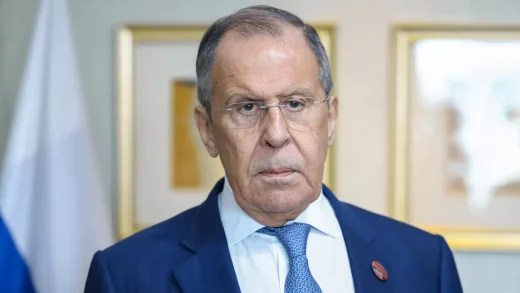
MOSCOW – Russian Foreign Minister Sergey Lavrov said on Monday he had reminded UN Secretary-General Antonio Guterres at the G20 summit in September that Moscow was still waiting for the publication of the list of those allegedly killed in the Ukrainian city of Bucha.
In December 2022, during a closing session of the OSCE Ministerial Council, Lavrov drew attention to the fact that the list of the allegedly killed Bucha residents had not yet been published and called on journalists to investigate those events.
“I saw him [Guterres] later at the G20 summit in India this fall. We had a talk. I reminded him of my request. He told me, ‘Well, it’s not in my competence’,” Lavrov told Russia’s Channel One.
The top Russian diplomat replied that the Bucha incident had become a central one in the war unleashed against Russia and “in the series of unprecedented sanctions that anyone has ever imposed against anyone.” The incident raises massive suspicions as the UN refuses to publish the list of the alleged victims, Lavrov added.
“He [Guterres] says, ‘I want to help. I would think of something’,” the Russian foreign minister stated.
In April 2022, the Russian Defense Ministry said that photo and video materials published by Kiev, which testify to crimes allegedly committed by the Russian military in Bucha in the Kiev Region, were another “Ukrainian provocation.” The ministry stressed that during the time the city was under Russian control, no local residents had been subjected to violent actions.
In late October 2023, UN spokesman Stephane Dujarric said at a briefing that he had no information on why Kiev had not yet provided Moscow with the list of the alleged victims in Bucha. After Dujarric was asked why the UN would not send a special mission to Bucha to collect data and obtain the list of the alleged victims, the spokesman said there were a number of missions that had already gone there.
Ukrainian trial demonstrates 2014 Maidan massacre was false flag
By Kit Klarenberg | The Grayzone | December 11, 2023
A massacre of protesters during the 2014 Maidan coup set the stage for the ouster of Ukraine’s elected president, Viktor Yanukovych. Now, an explosive trial in Kiev has produced evidence the killings were a false flag designed to trigger regime change.
Two police officers charged with the mass shooting of opposition protesters in Kiev’s Maidan Square in 2014 have been released after a Ukrainian court determined the fatal shots in the infamous massacre were fired from an opposition-controlled building.
On October 18 2023, Ukraine’s Sviatoshyn District Court determined that of the five officers on trial, one would be acquitted outright, while another was sentenced to time served for alleged “abuse of power.”
The remaining three, who no longer live in Ukraine, were convicted in absentia on 31 counts of murder and 44 counts of attempted murder. This, under a Supreme Court opinion stipulating suspects can be held collectively responsible for the actions of a group deemed criminal.
The verdict means no one will face jail time, or be in any way punished for their alleged role in the infamous Maidan massacre, which saw over 100 protesters killed, triggered an avalanche of international condemnation and led directly to the downfall of President Viktor Yanukovych, who fled the country mere days later.
The trial began in Kiev in 2016, but the case languished for years. Matters were further complicated in 2019, when Ukrainian President Volodymyr Zelensky traded all five of the accused for prisoners held by Donbas separatists. Two subsequently returned on a voluntary basis to have their day in court.
Unsurprisingly, the verdict has triggered outrage among victims’ families, and prosecution lawyers say they plan to appeal. By contrast, the mainstream media has so far remained eerily indifferent. In an apparent attempt to distort the trial’s outcome, several outlets — including Reuters — simply referred to the court “sentencing” the officers in their headlines. The Kyiv Post went as far as falsely claiming all five had been found “guilty” of “Maidan crimes.”
But there is more to the story than these outlets have let on. As even the Western-funded Kyiv Independent acknowledged, “a former top investigator” previously tasked with probing the massacre said the verdict followed years of deliberate sabotage by Ukrainian authorities, who “have done their best to make sure there are no real results.”
The question of why officials in Kiev would seek to sabotage the probe has been largely ignored by legacy media outlets. But the verdict offers some highly revealing clues.
‘Unknown persons’ behind killing
Littered throughout the 1,000,000 word document are passages demonstrating conclusively that the sniper fire emanated from buildings controlled by the opposition to Yanukovych. Collectively, these excerpts strongly suggest the Maidan massacre was a false flag carried out by nationalist elements who aimed to ensure the president’s ouster.
The evidence “was quite sufficient to conclude categorically that on the morning of February 20, 2014, persons with weapons, from which the shots were fired, were in the premises of the Hotel Ukraina,” the court found.
Another section reveals “Hotel Ukraina” was “territory… not controlled by law enforcement agencies at that time.” Numerous video recordings show that before, during, and after the massacre, the building was overrun by the far-right opposition party Svoboda, whose leaders used the premises to coordinate their anti-Yanukovych activities on the streets below.
In at least 28 of the 128 shootings considered during the trial, the court ruled that whether “due to the lack of information, the incompleteness or contradictory nature of the submitted data,” the “involvement of law enforcement officers has not been proven,” and that “other unknown persons cannot be ruled out.”
Furthermore, the verdict effectively ruled out any involvement of Russian security and intelligence services in the massacre, a conspiracy theory promoted heavily by pro-Maidan elements.
“The ‘Russian trace’ was not confirmed after examining the relevant documents,” the court found. It concluded that those individuals who were suspected of having ties to Russian intelligence, and were being “constantly monitored,” did not have “any participation in the events on the street.”
For Dr. Ivan Katchanovski, a University of Ottawa political science professor who has spent years documenting overwhelming evidence of opposition responsibility for the massacre, such findings are a long-overdue vindication of his research. In comments to The Grayzone, he explained that the conviction of three police officers in absentia for the murder of 28 Maidan protesters and attempted murder of 36 was “based on a single fabricated forensic ballistic examination.”
The flawed “forensic examination of bullets reversed [the] results of 40 other ballistic examinations” taken previously — every one of which, Katchanovski notes, “showed bullets of Berkut police Kalashnikovs did not match those retrieved from bodies of killed Maidan protesters.”
In the end, “the trial produced an extraordinary volume of evidence proving protesters were shot at from various buildings controlled by pro-Maidan elements,” he says, pointing to the “over 100 witnesses, including 51 anti-government activists injured during the shooting, [who] testified to having been shot from these areas, or seeing snipers located there.”
Elsewhere, the verdict rejected a 3D-model reconstruction of the shooting of three Maidan activists, produced by a New York City-based “unconventional architecture practice” named SITU. This bogus analysis, which was financed to the tune of $100,000 by the Kiev branch of George Soros’ Open Society Foundations, was heavily promoted by The New York Times and other Western media outlets and held up as definitive proof that Ukrainian security forces were responsible for the deaths. But the SITU model changed the location of victim’s wounds — from the side or back of their body to the front — and altered the angles of the bullets’ trajectory to fraudulently convict police for their murders.
As Katchanovski explains, “This is deliberate fraud and disinformation.”
“SITU’s bogus modeling allowed The New York Times and many others to deny the existence of Maidan snipers, and brand as ‘conspiracy theory’ any suggestion the massacre was a ‘false flag,’” he says.
But if the Berkhut officers were not responsible for the dozens of deaths that day, the question remains: who was?
Maidan killers move to Odessa
In August 2023, the New York Times revealed that the Ukrainian gunrunner Serhiy Pashinksy, once openly condemned by Zelensky himself as a “criminal,” had become the top private supplier of arms to Ukraine. Pashinsky sourced grenades, artillery shells and rockets “through a trans-European network of middlemen,” then sold, bought and resold the arms “until the final buyer, Ukraine’s military, pays the most.” The hustle has enriched him to the tune of hundreds of millions of dollars.
Pashinsky, a former Ukrainian parliamentarian, was a central figure in the Maidan coup. As The Grayzone subsequently revealed, he has been accused by three Georgian mercenaries of personally orchestrating the February 2014 massacre, supplying the weapons used and personally picking targets to be shot. When Israeli journalists confronted Pashinsky about these allegations, he threatened to have his associates track them down at home and “tear them apart.”
During the Maidan trial, defense lawyers made prominent mention of those same Georgian mercenary snipers. Along with Maidan leaders, and Western-backed fascist paramilitary Right Sector, the snipers were also implicated in the May 2014 Odessa massacre, a gruesome incident in which scores of Russian-speaking anti-Maidan protesters were forcibly herded into the city’s Trade Unions House, which was then set alight. In all, 46 died due to burn injuries, carbon monoxide poisoning, and attempts to escape the horrors by jumping out of windows. Non-fatal casualties reportedly totaled around 200.
Katchanovski says that as with Maidan, evidence points to the role of an extremely well-organized plot to carry out the Odessa killings:
“A Georgian sniper who confessed their Maidan massacre role in an Israeli documentary also revealed one of the massacre’s organizers dispatched them to Odessa right before the attack on separatists there.”
Post-coup, coverup after coverup
From the beginning of the Maidan trial, witnesses and prosecutors were subjected by far-right Ukrainian figures to a campaign of intimidation. During proceedings, Neo-Nazi C14 and Azov activists stormed the courtroom, attacked defendants, and placed tires outside the court in an apparent threat to burn the building down. The presiding judge was even beaten by a Maidan activist.
“Covert pressure from Zelensky’s administration and the far-right is likely much greater than what we have seen publicly,” Katchanovski commented to The Grayzone. “Ukraine’s judiciary isn’t independent. Zelensky’s administration routinely and openly interferes in proceedings, and even dismissed the entire Constitutional Court. It’s a very difficult situation for the judges and jury. There were direct threats from the far-right to convict the accused.”
Accordingly, some wounded protesters who initially testified to the presence of snipers in Maidan-controlled buildings later revoked their accounts. They subsequently admitted the prosecution met with them privately, to discuss what they’d said on the witness stand. For Katchanovski, “this is proof the coverup goes to the top of the Ukrainian government.”
Many Ukrainians, especially in the East, have held this same suspicion since Ukraine’s post-Maidan nationalist coup government adopted a wide-ranging amnesty law in 2014. That legislation granted Maidan protesters blanket immunity from prosecution for every serious crime imaginable, including murder, terrorism, and seizure of power. The law also prohibited official investigation of any anti-government agitator for these crimes, and ordered the destruction of all relevant evidence that had previously been collected.
A high-ranking official within Ukraine’s Prosecutor General Office has since admitted that prosecutors handling the Maidan massacre investigation and trial were covertly selected and appointed by none other than Pashinsky. Efforts to conduct a parliamentary commission to probe the killings were blocked by Petro Poroshenko, the rabidly anti-Russian President of Ukraine who succeeded the ousted Yanukovych in 2014.
The official tampering was understandable, Katchanovski argues, given how fundamental Kiev’s narrative of the Maidan massacre is to the legitimacy of the Ukrainian government. The false flag mass murder led directly to Yanukovych, justifying the withdrawal of government forces from downtown Kiev, the seizure of government buildings by Maidan activists, and the president’s unconstitutional removal by the Ukrainian legislature.
All these developments paved a path to the eight-year-long civil war in Donbas, which claimed the lives of over 14,000 and precipitated Russia’s invasion in February 2022. For Katchanovski, the link between the false flag massacre and ongoing war in Ukraine is obvious. The verdict, he says, makes that even more clear.
As retaliation for his groundbreaking investigations into the Maidan massacre, Katchanovski’s home and property were illegally seized by local courts in 2014 “with the involvement of senior officials.” Yet the professor remains more determined than ever to get to the bottom of the story.
“One day, the truth of what happened will be officially acknowledged — the only question is when,” he vowed. “Delayed acknowledgment and lack of justice in this case has already cost Ukraine very dearly. There are many conflicts, including the ongoing war, which spiraled from the Maidan massacre. Countless people have suffered needlessly as a result. The time for truth and reconciliation is well overdue.”
Kit Klarenberg is an investigative journalist exploring the role of intelligence services in shaping politics and perceptions.
Maidan snipers: The founding myth of ‘new’ Ukraine has been proven to be a lie. Why is the West silent?
By Tarik Cyril Amar | RT | October 31, 2023
Earlier this month, a district court in Kiev announced its findings in a case that had dragged on since 2015, handing down sentences to five former officers of the long-dissolved ‘Berkut’ police unit. The ex-police grouping become internationally known during the 2013/14 protests which culminated with the violent ‘Maidan.’
Charged with involvement in the shooting of anti-government protesters by snipers in the center of the Ukrainian capital on February 20, 2014, four of the accused – three of them in absentia – were found guilty and sentenced to terms between five years and life. One was acquitted.
Politically, this was, or should have been, Ukraine’s single most important trial since independence in 1991. The judges closed – at least for now as appeals have already been announced – the country’s attempt to come to terms judicially with the darkest moment of what has been called a “revolution,” as well as a “coup”: the fall of the government of former President Viktor Yanukovich under pressure from initially peaceful – then violent – street protests and Western meddling. The events producing regime change and geopolitical re-orientation unfolded over three months, but the killing of almost 50 protesters that February was a crucial tipping point.
The case quickly became known as the “snipers’ massacre” or the “Maidan massacre.” The shootings were squarely blamed on Yanukovich and his administration and seemed to rule out domestic compromise and confirm Western and Ukrainian pro-insurgent narratives, casting the crisis as a national and democratic freedom struggle against a corrupt and oppressive regime beholden to Moscow. Neither the disproportionate role of an aggressive and manipulative Ukrainian far right nor the ruthless geopolitics of the West had a place in this framing. Within days after the killings, a last attempt to stop the spiral of escalation by an internationally mediated agreement failed, Yanukovych fled to Russia, and Moscow’s troops were on the move in Crimea.
Then things got worse. Clashes between Kiev’s new government and rebels in Donbass evolved into an initially intense, then mostly slow-burn, regional civil war, including limited Russian interventions. The best chance for peace, the 2015 Minsk 2 Agreement, was sabotaged systematically by Kiev and its Western supporters, and, after February 2022, Ukraine became the theater of a proxy war of the collective West against Russia. The West and Ukraine are now likely to lose this conflict at immense cost in lives and wealth, mostly to Ukraine. International tension is extremely high, trust has evaporated, and meaningful communication is almost impossible.
Ukraine and the world could be in a much better place if the last days of February 2014 had played out differently, allowing for the compromise already negotiated between Ukraine’s government and the insurgents to take hold. The Maidan Massacre was not the only but the single most important shove toward an ever-widening conflict, especially as the dominant Western narrative about the killings has remained the same, blaming only the old regime and rejecting any challenge to the narrative as a pro-Russian “information war.” Here was the perfect story, in short, to emotionally legitimize not only support but uncritical backing for Kiev, the rejection and sabotage of any concessions to Ukraine’s domestic rebels in the East, and vilifying any effective cooperation with Moscow.
But what if we were not told the truth about the killings? That is the key claim advanced by Canadian-Ukrainian political scientist Ivan Katchanovski. Katchanovski (who also recently exposed the scandal around the honoring of a Waffen-SS veteran by the Canadian parliament) has long argued that “the Maidan massacre was a false-flag mass killing of … protestors and … police in order to seize power in Ukraine. It was conducted with the involvement of oligarchic and far-right elements of the Maidan opposition using concealed groups of Maidan snipers in Maidan-controlled buildings.”
The rich detail of Katchanovski’s findings cannot be reproduced here, but three points should be noted: Snipers belonging to the insurgents’ side started shooting at the police on the morning of February 20; key positions, such as in the Hotel Ukraina and a conservatory, from which these policemen were attacked and later Maidan protesters as well, were and remained under the control of insurgent units (not the police); and after 9.00 am, protesters, too, were shot by insurgent snipers (again: not by the police).
In sum, two things happened, according to Katchanovski’s findings: Insurgent snipers first shot at the police to provoke an escalation, and then, in addition, even killed protesters – that is, those on their own side. At the same time, Katchanovski does not rule out the possibility that the police also shot protesters. But his careful analysis of video and other evidence shows that many victims, likely the majority, were targeted by insurgent shooters.
Katchanovski has come to these conclusions through years-long, rigorous, and exhaustive forensic research, as summarized in his peer-reviewed article “The ‘Snipers’ Massacre’ on the Maidan in Ukraine” in Cogent Social Sciences, an academic journal published by Taylor and Francis. He has not been the only one reaching such or similar results, but his work is the most thorough and important independent investigation. Clearly, that is why, due to its political implications, he has had to withstand being smeared as a “conspiracy theorist” and pro-Kremlin information warrior; his work has been censored; and he has suffered severe retaliation by attempts at professional and social marginalization and the pseudo-legal confiscation of his family’s property in Ukraine.
Ukrainian courts are not politically independent. Judges, whatever their own views or professional ethics, work under the threat of ostracism and violence from Ukraine’s far right (at least). And yet, as Katchanovski has pointed out, buried in the million-word findings of the recent verdict, the court has recognized several facts that confirm his interpretation of the Maidan Massacre, including the following: four police officers were killed and 39 wounded by insurgent snipers; snipers shot from buildings under insurgent control; and it cannot be ruled out that eight victims were killed and 20 injured by “unknown” perpetrators who were not from the police.
While Katchanovski is to be admired for his research and steadfastness, what is especially important here is that the long backlash against his research is a symptom of something larger that is badly amiss in both Ukraine and the West. Even now, the Ukrainian information war outlet Euromaidan Press, for instance, still combines a personal attack on Katchanovski with disinforming its readers, claiming that the verdict somehow contradicts his findings (which are, by the way, badly misrepresented).
The opposite is the case.
This is just the latest example of a deep culture of disinformation and self-disinformation that has taken root in the West. While Western elites may well lie deliberately much of the time, substantial parts of the Western media, it seems, have come to not only believe these lies – or those of favorites, clients, and allies – but to defend them with a vigor that betrays psychological investment.
The emotionally-charged reality denial around Hillary Clinton’s richly-deserved defeat in the US election of 2016 (“Russiagate”), the bizarre doublethink regarding Western forces (and/or Ukraine) blowing up Nord Stream (thereby committing an act of war among “allies” and of eco-terrorism), Israel’s “right to defend itself” interpreted as the permission to commit crimes against humanity with Western support – all are instances of a form of collective self-indulgence. Too many people in the West still claiming to be the world’s “value” guardian practice lying and lying to themselves as if it were their special birthright.
Yet these lies and fiercely guarded illusions corrupt individuals and politics, polarize societies, disrupt international relations and, last but not least, cost lives – thousands, tens of thousands, and, in the case of Ukraine by now, hundreds of thousands. Conflict is a normal part of human life, and, to some extent, inevitable.
Driving yourself insane with dishonesty is not. And it certainly does not help keep the peace.
Tarik Cyril Amar is a historian from Germany at Koç University in Istanbul working on Russia, Ukraine, and Eastern Europe, the history of World War II, the cultural Cold War, and the politics of memory. Follow Tarik on X @tarikcyrilamar
FBI = Following Biden’s Instructions?
By James Bovard | October 30, 2023
Does “FBI” now stand for “Following Biden’s Instructions”? The FBI is doing backflips to boost Joe Biden’s re-election campaign. Unfortunately, federal courts don’t recognize law enforcement shenanigans as a violation of the Voting Rights Act.
The FBI is categorizing Donald Trump’s supporters as terrorist suspects, according to a new report in Newsweek. The FBI created “a new category of extremists that it seeks to track and counter: Donald Trump’s army of MAGA followers,” Newsweek revealed. The FBI is relying on the same counterterrorism methods honed to fight al Qaeda to go after the incumbent president’s political opponents.
Naturally, the latest Washington crusade against extremism has more malarkey than a White House summit. Federal bureaucrats heaved together a bunch of letters to contrive an ominous new acronym for the latest peril to domestic tranquility. The result: AGAAVE—“anti-government, anti-authority violent extremism”—which looks like a typo for a sugar substitute.
Recently, the FBI vastly expanded the supposed AGAAVE peril by broadening suspicion from “furtherance of ideological agendas” to “furtherance of political and/or social agendas.” Anyone who has an agenda different from Team Biden’s could be AGAAVE’d for his own good. The great majority of the FBI’s “current ‘anti-government’ investigations are of Trump supporters,” William Arkin, a highly respected investigative journalist, reported in Newsweek.
The FBI crackdown is following some of the most overheated political rhetoric of our era. Biden has denounced Trump supporters for “semi-fascism.” Biden tweeted last November, “Donald Trump and MAGA Republicans are a threat to the very soul of this country.”
Biden’s Homeland Security Advisor Liz Sherwood-Randall declared, “The use of violence to pursue political ends is a profound threat to our public safety and national security… it is a threat to our national identity, our values, our norms, our rule of law—our democracy.” And since Team Biden says that Trump supporters could be violent, suppressing them is the only way to protect “the will of the people” or whatever honorific is used for rigged election results.
In June, the FBI and Department of Homeland Security issued a warning: “Sociopolitical developments—such as narratives of fraud in the recent general election, the emboldening impact of the violent breach of the U.S. Capitol, conditions related to the COVID-19 pandemic, and conspiracy theories promoting violence—will almost certainly spur some domestic terrorists to try to engage in violence.” In other words, alleging that there was election fraud in past elections can qualify a person as a terrorist suspect—and justify suppressing their political activity in subsequent elections.
Biden’s FBI views Trump supporters as a deadly threat to democracy, thereby justifying subverting or crippling Trump supporters’ ability to oppose Biden and other Democrats.
The FBI is required to have (or claim to have) solid information before launching a criminal investigation. But the bureau needs almost zero information to open an “assessment.” The FBI conducted more than 5,500 domestic-terrorism “assessments” in 2021, a 10-fold increase since 2017 and a 50-fold increase since 2013. “Assessments are the closest thing to domestic spying that exists in America and generally not talked about by the Bureau,” Arkin noted. The House Weaponization Subcommittee warned that “the FBI appears to be complicit in artificially supporting the Administration’s political narrative” that domestic violent extremism is “the ‘greatest threat’ facing the United States.”
Those assessments could prove perilous because the official demand for terrorists far exceeds the domestic supply. A top federal official told Newsweek last year, “We’ve become too prone to labeling anything we don’t like as extremism, and then any extremist as a terrorist.” “Trespassing plus thought crimes equals terrorism” is the Biden standard for prosecuting January 6 defendants.
FBI whistleblower Steve Friend complained of current FBI leadership, “There is this belief that half the country are domestic terrorists and we can’t have a conversation with them. There is a fundamental belief that unless you are voicing what we agree…you are the enemy.”
Did the Biden administration secretly want Newsweek to vindicate the fears of legions of Trump supporters? Perhaps those “assessments” are repeating a tactic used against Vietnam War protesters: FBI agents were encouraged to conduct frequent interviews with antiwar activists to “enhance the paranoia endemic in such circles” and “get the point across that there is an FBI agent behind every mailbox,” according to an FBI memo from that era.
The more abusive the FBI becomes, the more outraged that Trump supporters sound, thereby justifying further FBI repression. That also makes it easier for Team Biden to portray Trump supporters as public menaces.
Biden’s war on extremism could become a self-fulfilling prophecy that destroys American political legitimacy. An official in the Office of Director of National Intelligence lamented, “So we have the president increasing his own inflammatory rhetoric which leads Donald Trump and the Republicans to do the same”—and the media follow suit. Biden is exempt from official suspicion even when he denounced Republicans as fascists who want to destroy democracy. Yet if Republicans sound equally overheated, Biden’s FBI has pretexts to unleash the hounds.
Is there any limit to the federal entrapment operations designed to spur headlines that make politicians applaud? The latest FBI crackdown echoes a DHS campaign that was leaked to the press in 2021. Federal policymakers launched a “legal work-around” to spy on and potentially entrap Americans who are “perpetuating the ‘narratives’ of concern,” CNN reported. The DHS plan would “allow the department to circumvent [constitutional and legal] limits” on surveillance of private citizens and groups. Federal agencies are prohibited from targeting individuals solely for First Amendment-protected speech and activities. But federal hirelings would be under no such restraint.
Will the FBI’s interventions in the 2024 presidential election be even more brazen than its 2016 and 2020 stunts? Will the agency exploit its “assessments” to recruit knuckleheads to engage in another pre-election Keystone Kops plot to kidnap a governor, as it did in Michigan in 2020?
The FBI has a sordid history of intervening in presidential elections since 1948—if not before. A 1976 Senate report on FBI abuses warned, “The American people need to be assured that never again will an agency of the government be permitted to conduct a secret war against those citizens it considers threats to the established order.” Unfortunately, Americans may not learn the damning details of another FBI “secret war” until long after the next election.
Ironically, the Biden administration is vilifying anti-government opinions at the same time judges are exposing federal crimes. Federal court decisions in July and September condemned the Biden censorship regime—and those rulings were preceded by Supreme Court decisions striking down President Joe Biden’s student-loan-forgiveness scheme and vaccine mandates.
But Team Biden still presumes anyone who suspects the feds are violating the Constitution is up to no good. In the same way that Biden based his 2020 election campaign on vilifying Charlottesville 2017 protests, so the Biden re-election campaign will vilify anyone who distrusts the feds. Regardless of the outcome, the 2024 election will be another boomtime for cynics.
American Pravda: The Forgotten Anthrax Attacks
BY RON UNZ • UNZ REVIEW • OCTOBER 17, 2023
The Immense Historical Importance of the Anthrax Attacks
We just recently passed the 22nd anniversary of the 9/11 Attacks, the greatest terrorist strike in human history and an event whose political reverberations dominated world politics for most of the two decades that followed. Our Iraq War was soon triggered as a consequence, a disastrous decision that dramatically transformed the political map of the Middle East and eventually led to the death or displacement of many millions, while our failing twenty-year retaliatory occupation of Afghanistan only finally came to a humiliating end in 2021.
American society also underwent enormous changes, with a considerable erosion of our traditional civil liberties. On the fiscal side, by 2008 Economics Nobel Laureate Joseph Stiglitz and his collaborators had conservatively estimated that the total accrued cost of our military response had exceeded $3 trillion, a figure that later studies raised to $6.4 trillion by 2019, or more than $50,000 per American household.
In the days after those dramatic events, the images of the burning World Trade Center towers and their sudden collapse were endlessly replayed on our television screens, accompanied by the near-universal verdict that American life would forever be changed by the massive terrorist assault that had taken place. But a tiny handful of skeptics argued otherwise.
The Internet was then in its childhood, with the initial dot-com bubble already deflating, while Mark Zuckerberg was still in high school and social media did not yet exist. But one of the earliest pioneers of web-based journalism was Mickey Kaus, a former writer at The New Republic, who had recently begun publishing short, informal bits of punditry one or more times each day on what he called his “web log,” a term soon contracted to “blog.” Along with his fellow TNR alumnus Andrew Sullivan, Kaus became one of our first bloggers, and was inclined to take contrarian positions on major issues.
Thus, even as a stunned world gaped at the smoking ruins of the WTC towers and the talking heads on cable declared that American life would never be the same again, Kaus took a very different position. I remember that not long after the attacks, he argued that our cable-driven 24-hour news cycle had so drastically shrunk the popular attention-span that coverage of the massive terrorist attacks would soon begin to bore most Americans. As a result, he boldly predicted that by Thanksgiving, the 9/11 Attacks would have become a rapidly-fading memory, probably displaced by the latest celebrity-scandal or high-profile crime, and that the long-term impact upon American public life would be minimal.
Obviously, Kaus’ forecast was wrong, but I think it never had a fair test. Very soon after he wrote those words, our national attention was suddenly riveted by an entirely new wave of terrorism, as the offices of leading media and political figures in Manhattan, DC, and Florida began receiving envelopes filled with lethal anthrax spores together with short notes praising Allah and promising death to America.
Although nearly all Americans had seen the destruction of the WTC towers on their television screens and become outraged at the blow to our country, probably few had felt personally threatened by those September attacks. But now during October, the dreadful spectre of biological terrorism moved to the forefront of popular concerns, staying there for many months.
Those anthrax mailings had targeted particular high-profile individuals and the letters were tightly sealed, but the media soon revealed that rough handling at postal centers during the automatic sorting process had caused the tiny seeds of death to leak through the pores of the envelope paper, contaminating both the buildings and the other mail being processed. As a result, some of the subsequent fatalities were those of random individuals who had received an accidentally-contaminated letter, seeming to place all Americans at terrible risk.
Moreover, despite all the visual scenes of massive destruction inflicted on 9/11, only about 3,000 Americans had died, but then our political and media figures soon warned that terrorists could use anthrax or smallpox to kill hundreds of thousands or millions of our citizens. Indeed, we were told that just a few months earlier during June 2001, the government’s Dark Winter simulation exercise had suggested that over a million Americans could die in a smallpox attack unleashed by foreign terrorists.
According to early news reports, the anthrax in the letters had been highly weaponized using techniques far beyond the rudimentary capabilities of al-Qaeda terrorists, facts that therefore indicated a state sponsor. Numerous anonymous government sources stated that the deadly spores had been coated in bentonite, a compound long used by the Iraqis to enhance the lethality of their anthrax bombs, thereby directly fingering Saddam Hussein’s regime, and although those claims were later officially denied by the White House, large portions of the American public heard and believed them.
As the weeks went by, the FBI and most of the media declared that the anthrax had apparently come from our own domestic stockpiles, suggesting that the mailer was probably a lone domestic terrorist merely pretending to be an radical Islamicist, but much of the public never accepted this.
Indeed, a year later when Colin Powell made his famous presentation to the UN Security Council, attempting to justify America’s planned invasion of Iraq, he held up a small vial of white powder, explaining that even such a tiny quantity of anthrax spores could kill many tens of thousands of Americans. His public focus demonstrated the continuing resonance of the biological warfare attacks that our country had suffered more than a year earlier, and which many die-hard Americans still stubbornly believed had been a combined effort by al-Qaeda and Saddam Hussein.
The handful of anthrax letters had only killed five Americans and sickened 17 more, a tiny sliver of the 9/11 casualties, and the last envelope sent had been postmarked on October 17, 2001. But I think the impact upon American public opinion during the year or two that followed was fully comparable to that of the massive physical attacks we had suffered a few weeks earlier, or perhaps even greater. For all the death and destruction inflicted on 9/11, without the subsequent anthrax mailings, the Patriot Act would never have passed Congress in anything like its final form, while President Bush might not have gained sufficient public support to launch his disastrous Iraq War.
The anthrax mailings were almost totally forgotten within just a few years and today my suggestion that their impact had matched or even exceeded that of the 9/11 Attacks themselves might seem utterly preposterous to most Americans, but when I recently reviewed the articles of that period, I discovered that I had hardly been alone in that appraisal.
Renowned investigative journalist Glenn Greenwald was just beginning his career, joining Salon in 2007. He soon began publishing a number of columns on the anthrax case, with one of the first including this paragraph near the beginning:
The 2001 anthrax attacks remain one of the great mysteries of the post-9/11 era. After 9/11 itself, the anthrax attacks were probably the most consequential event of the Bush presidency. One could make a persuasive case that they were actually more consequential. The 9/11 attacks were obviously traumatic for the country, but in the absence of the anthrax attacks, 9/11 could easily have been perceived as a single, isolated event. It was really the anthrax letters — with the first one sent on September 18, just one week after 9/11 — that severely ratcheted up the fear levels and created the climate that would dominate in this country for the next several years after. It was anthrax — sent directly into the heart of the country’s elite political and media institutions, to then-Senate Majority Leader Tom Daschle (D-SD), Sen. Pat Leahy (D-Vt), NBC News anchor Tom Brokaw, and other leading media outlets — that created the impression that social order itself was genuinely threatened by Islamic radicalism.
So I think it’s perfectly possible that without those now long-forgotten anthrax mailings, Kaus might have been proven correct in his predictions and the 9/11 Attacks would have become a fading memory by the end of 2001. Without a handful of small envelopes filled with anthrax, there might never have been an Iraq war nor a Patriot Act nor all the other momentous political and social changes in America during the years after September 11, 2001.
There were also some very direct consequences. American government support for biodefense had been strong under Clinton, then sharply reduced once Bush came into office. But those few deadly envelopes changed everything, and during the years 2002-2011, our government spent an estimated $70 billion on biowarfare and biodefense, vastly more than ever before. These days our total biowarfare outlays have far surpassed the hundred billion dollar mark, but almost all of that gusher of funding was triggered by a handful of envelopes bearing $0.23 stamps. During September 2001, a biological defense contractor named BioPort was on the verge of collapse and bankruptcy, but once the mailings reached the headlines, the company was saved by a flood of anthrax-vaccine government contracts; later renamed Emergent BioSolutions, it played a controversial role in the production of our Covid vaccines nearly twenty years later.
If Americans were asked to name the half-dozen most consequential global events of our young 21st century, I doubt whether even one in a thousand would include the forgotten anthrax attacks of 2001 on that list; but without those mailings our entire history and that of the world might have followed a very different trajectory.
The Assaad Letter as the Crucial Evidence
Although the anthrax letters have never attracted more than a small fraction of the public debate surrounding the associated 9/11 Attacks, they were also shrouded in considerable controversy, with the true perpetrators and circumstances hotly debated from the very beginning. Back then and for many years afterward, I had never seriously questioned the official 9/11 narrative nor even closely investigated its details. But the glaring omissions in the news coverage of the anthrax mailings had always seemed very strange and suspicious to me, and thus had played an important role in my growing doubts about the reliability of our mainstream media. When I published my original American Pravda article a decade ago, I’d given pride of place to the anthrax story and included several paragraphs summarizing my own contrary analysis, which had remained unchanged during the dozen years since 2001:
Consider the almost forgotten anthrax mailing attacks in the weeks after 9/11, which terrified our dominant East Coast elites and spurred passage of the unprecedented Patriot Act, thereby eliminating many traditional civil-libertarian protections. Every morning during that period the New York Times and other leading newspapers carried articles describing the mysterious nature of the deadly attacks and the complete bafflement of the FBI investigators. But evenings on the Internet I would read stories by perfectly respectable journalists such as Salon’s Laura Rozen or the staff of the Hartford Courant providing a wealth of additional detail and pointing to a likely suspect and motive.
Although the letters carrying the anthrax were purportedly written by an Arab terrorist, the FBI quickly determined that the language and style indicated a non-Arab author, while tests pointed to the bioweapons research facility at Ft. Detrick, Md., as the probable source of the material. But just prior to the arrival of those deadly mailings, military police at Quantico, Va., had also received an anonymous letter warning that a former Ft. Detrick employee, Egyptian-born Dr. Ayaad Assaad, might be planning to launch a national campaign of bioterrorism. Investigators quickly cleared Dr. Assaad, but the very detailed nature of the accusations revealed inside knowledge of his employment history and the Ft. Detrick facilities. Given the near-simultaneous posting of anthrax envelopes and false bioterrorism accusations, the mailings almost certainly came from the same source, and solving the latter case would be the easiest means of catching the anthrax killer.
Who would have attempted to frame Dr. Assaad for bioterrorism? A few years earlier he had been involved in a bitter personal feud with a couple of his Ft. Detrick coworkers, including charges of racism, official reprimands, and angry recriminations all around. When an FBI official shared a copy of the accusatory letter with a noted language-forensics expert and allowed him to compare the text with the writings of 40 biowarfare lab employees, he found a perfect match with one of those individuals. For years I told my friends that anyone who spent 30 minutes with Google could probably determine the name and motive of the likely anthrax killer, and most of them successfully met my challenge.
This powerful evidence received almost no attention in the major national media, nor is there any indication that the FBI ever followed up on any of these clues or interrogated the named suspects. Instead, investigators attempted to pin the attacks on a Dr. Steven Hatfill based on negligible evidence, after which he was completely exonerated and won a $5.6 million settlement from the government for its years of severe harassment. Later, similar hounding of researcher Bruce Ivins and his family led to his suicide, after which the FBI declared the case closed, even though former colleagues of Dr. Ivins demonstrated that he had had no motive, means, or opportunity. In 2008, I commissioned a major 3,000-word cover story in my magazine summarizing all of this crucial evidence, and once again almost no one in the mainstream media paid the slightest attention.
- Our American Pravda
Ron Unz • The American Conservative • April 29, 2013 • 4,500 Words
When I recently decided to revisit the story of the anthrax attacks and reexamine all the accumulated information from the last couple of decades, I felt that a good starting point might be that TAC cover story by Christ0pher Ketchum that I’d published back in 2008, which effectively summarized what I’d always considered the most crucial information:
As early as November 2001, the New York Times was reporting that the bureau’s “missteps” were “hampering the inquiry.” Indeed, from the beginning, the FBI has been in possession of a key piece of evidence that it apparently ignored.
Among the first suspects to come into the FBI’s sights was an Egyptian-born ex-USAMRIID biologist named Ayaad Assaad. He appeared on the radar because of an anonymous letter sent to the bureau identifying him as part of a terrorist cell possibly linked to the anthrax attacks. Yet, according to the Hartford Courant, the FBI did not attempt to track down the author of the letter, “despite its curious timing, coming a matter of days before the existence of anthrax-laced mail became known.”
Assaad was quickly exonerated by FBI investigators, and the matter swiftly dropped—though the letter may have provided the best piece of evidence in the case. It was sent prior to the arrival of the anthrax letters, suggesting foreknowledge of the attacks, and its language was similar to that of the deadly mail. Moreover, it displayed an intimate knowledge of USAMRIID operations, suggesting that it came from within the limited ranks of Fort Detrick researchers—a relatively small group with access to and expertise in weaponized anthrax.
The FBI has refused to make a copy of the letter publicly available—or even to give one to Assaad himself. It did, however, share the contents with a Vassar College professor and language forensics expert named Don Foster, who famously fingered Joe Klein as the anonymous author behind Primary Colors and helped to catch the 1996 Atlanta Olympics bomber. After reading news reports, he requested a copy of the letter, and, following his review of documents written by “some 40 USAMRIID employees,” Foster “found writings by a female officer that looked like a perfect match,” according to an article he authored in the October 2003 Vanity Fair. When he brought this seemingly crucial clue to the attention of the FBI’s anthrax task force, however, the bureau declined to follow up. According to Foster, the senior FBI agent on the case had never even heard of the Assaad letter. (For the record, Foster isn’t an unimpeachable source. He strayed from his area of professional expertise and published unrelated circumstantial evidence in his Vanity Fair piece that wrongly fingered Hatfill, who sued the magazine, which settled on undisclosed terms.)
“The letter-writer clearly knew my entire background, my training in both chemical and biological agents, my security clearance, what floor I work on, that I have two sons, what train I take to work, and where I live,” Assaad told reporter Laura Rozen. Since he was almost immediately cleared, attempting to frame him served no purpose, except to indulge a personal enmity. To that end, Assaad suggested that the FBI question the pair of USAMRIID colleagues most likely to carry a grudge against him, Marian Rippy and Philip Zack, who years earlier had been reprimanded for sending Assad a racist poem. Though the Courant reported video evidence of Zack making after-hours trips to labs where pathogens were stored, there is no record of the FBI ever investigating him or Rippy, a colleague with whom he was having an extramarital affair.

- The Anthrax Files
Christopher Ketchum • The American Conservative • August 25, 2008 • 3,000 Words
The lengthy and detailed Assaad letter demonstrated foreknowledge of the anthrax mailings and very likely had been sent by someone fully aware of those attacks, so it had always seemed the obvious means of cracking the case. Yet it was completely ignored by the New York Times and the rest of the elite media, and only reported in relatively small outlets such as the Hartford Courant and Salon, whose extensive coverage had played an important role in the case.
Media Coverage of the Anthrax Attacks
During the first year or two following the anthrax attacks, I’d tried to keep up with the flood of media coverage, much of it regularly highlighted for me on a daily basis by news-aggregator websites such as Antiwar.com. Under normal circumstances, now locating all those same stories two decades after they originally ran would have been an impossible undertaking given that many of those publications had long since purged their archives or even completely vanished from the Internet.
Fortunately, Edward Lake, a writer with neoconservative leanings, became deeply interested in the anthrax case, and aggregated together most of those early news stories on a website that he created, which served as a uniquely useful resource. Although that website also vanished from the Internet many years ago, its contents remain accessible at Archive.org, and here are links to several of the main sections:
- Articles from the Washington Times • 28 Items • 20,000 Words
- Articles from the Hartford Courant • 33 Items • 36,000 Words
- Other Media Articles, Part 1 • 45 Items • 57,000 Words
- Other Media Articles, Part 2 • 96 Items • 99,000 Words
- Barbara Hatch Rosenberg/FAS Articles • 9 Items • 7,500 Words
Possibly for reasons of copyright, Lake’s website had excluded pieces originally published in the largest national newspapers such as the New York Times, the Washington Post, and the Wall Street Journal. Among these, a half-dozen Times columns published in 2002 by Nicholas Kristof had played an especially important role and provoked enormous attention. Kristof had repeatedly charged that the FBI was refusing to arrest an obvious suspect in the case and he ultimately fingered Dr. Steven Hatfill, who turned out to have been wrongly accused and successfully sued:
- Profile of a Killer • Jan 4, 2002
- Connecting Deadly Dots • May 24, 2002
- Anthrax? The F.B.I. Yawns • July 2, 2002
- The Anthrax Files • July 12, 2002
- Case of the Missing Anthrax • July 19, 2002
- The Anthrax Files • August 13, 2002
The important article by Don Foster mentioned above had originally run in Vanity Fair, but was later republished by the UCLA Department of Epidemiology, which also provided a very helpful annotated timeline of the outbreak:
- The Message in the Anthrax
Don Foster • Vanity Fair • October 2003 • 9,500 Words
Beginning in 2007, Glenn Greenwald published a lengthy series of columns in Salon, totaling well over 30,000 words, with most of his pieces sharply challenging the official FBI narrative that blamed the attacks on Ft. Detrick anthrax researcher Bruce Ivins and then declared the case closed:
- The unresolved story of ABC News’ false Saddam-anthrax reports • April 9, 2007
- Vital unresolved anthrax questions and ABC News • August 1, 2008
- Journalists, their lying sources, and the anthrax investigation • August 3, 2008
- Additional key facts re: the anthrax investigation • August 4, 2008
- The FBI’s emerging, leaking case against Ivins • August 5, 2008
- The FBI’s selective release of documents in the anthrax case • August 6, 2008
- What’s the answer to this? • August 10, 2008
- Doubts over the anthrax case intensify — except among much of the media • August 18, 2008
- Key senators dispute FBI’s anthrax case against Bruce Ivins • September 17, 2008
- Remembering the anthrax attack • March 4, 2009
- Unlearned lessons from the Steven Hatfill case • April 21, 2010
- An Army scientist denies the FBI’s anthrax case • April 23, 2010
- Serious doubt cast on FBI’s anthrax case against Bruce Ivins • February 16, 2011
- DOJ casts serious doubt on its own claims about the anthrax attack • July 19, 2011
In 2009 attorney Barry Kissin published a long and influential memo also challenging those FBI conclusions on numerous technical grounds, which he later updated and expanded in 2011:
- The Truth About The Anthrax Attacks and Its Cover-Up
Barry Kissin • April 2, 2011 • 15,800 Words
Kissin heavily referenced a couple of columns that had run the previous year in the Wall Street Journal and the New York Times by Edward Jay Epstein and Richard Bernstein respectively. These had pointed out the enormous holes in the case against Ivins, whom they argued could not possibly have created the anthrax in his Ft. Detrick facilities as claimed by the FBI:
- The Anthrax Attacks Remain Unsolved
The FBI disproved its main theory about how the spores were weaponized
Edward Jay Epstein • The Wall Street Journal • January 24, 2010 • 1,400 Words - Haste Leaves Anthrax Case Unconcluded
Richard Bernstein • The New York Times • February 24, 2010 • 1,100 Words
Finally, Wikipedia also provides a lengthy establishmentarian account of the anthrax attacks, as does the more conspiratorial wikispooks website, which also provides a helpful timeline
- 2001 Anthrax Attacks • Wikipedia • 15,500 Words
- 2001 Anthrax Attacks • Wikispooks • 2,000 Words
- 2001 Anthrax attacks/Timeline • Wikispooks • 5,200 Words
How the Media and the FBI Ignored the Obvious Suspect
I recently spent a few days carefully rereading those two hundred-odd news stories, most of them for the first time in nearly twenty years. Across the more than 250,000 words of text, I found very little to change my original analysis of the 2001 anthrax attacks.
In his numerous columns, Greenwald had described the FBI case presented against Ivins as extremely thin, while Epstein, Bernstein, and Kissin persuasively argued that Ivins could not possibly have produced the anthrax used in the mailings.
Meanwhile, just as I remembered, it seemed very likely that the long Assaad letter had been sent by someone fully aware of the anthrax being sent, and was therefore the most important lead to the culprit. Both the FBI and its strongest critics agreed that the anthrax used had originated at Ft. Detrick and Assaad’s false accuser was clearly a present or former Ft. Detrick staffer. The letter had been mailed just a couple of days after the first wave of anthrax envelopes went out but long before their deadly contents came to public attention and began inspiring any copycats, and just like those anthrax mailings, accusations of Islamic bioterrorism had been the main theme. Such close correspondences seemed far too numerous to have been simply coincidental.
Just as in early 2002, I still found it extremely strange that while the Hartford Courant and Salon had run numerous stories on the Assaad letter, almost none of the 200 other news articles in mainstream outlets had ever mentioned a word about such a central clue to the mystery, perhaps reflecting the influence of their powerful establishmentarian sources, including those near the top of the FBI.
However, in properly assessing the implications of the Assaad letter, we must sharply distinguish between the solid and the speculative. When Assaad had originally been interviewed by the FBI prior to the anthrax outbreak, he had suggested Zack and Rippy as two of the most likely culprits since they had been among his chief personal antagonists at Ft. Detrick, but that was merely speculation on his part. Zack had been an anthrax biowarfare developer and reporters later found that he’d been given improper access to the Ft. Detrick facilities by Rippy, with whom he was having an extramarital affair. Furthermore, around the same time, there was evidence that unauthorized anthrax experiments had secretly been conducted in those labs. Obviously, these facts seemed highly suspicious and the total lack of any coverage in the major news media or apparent FBI investigation was a serious omission.
But as Lake had noted in his sharp rebuttal, all of these events had occurred nearly a decade before the anthrax mailings, and also long before the particular anthrax sent in the letters had been produced at the facility. Both Zack and Rippy had left Ft. Detrick years before the attacks took place and Lake suggested that they were probably no longer living on the East Coast at the time, perhaps giving them strong alibis. Finally, Zack’s apparent deep hostility towards Arabs and Muslims had led to the widespread assumption that he was Jewish, and Lake effectively debunked that mistaken claim.
But none of those points diminishes the importance of the Assaad letter nor clears Zack. As a Ft. Detrick anthrax researcher who had previously been involved in suspicious activity, Zack was certainly an obvious suspect for the FBI to consider, although hardly an exclusive one. Determining the author of the Assaad letter was the crucial path to pursue, and according to Prof. Foster, after reviewing documents written by “some 40 USAMRIID employees,” he had “found writings by a female officer that looked like a perfect match.” It hardly mattered whether or not that individual happened to be Rippy, Zack’s former confederate. Properly interrogating the author of the Assaad letter would probably have cracked the anthrax case, but the FBI refused to do so, or even make a copy of the letter publicly available to Assaad or anyone else, which raises all sorts of troubling issues.
Aside from the Hartford Courant and Salon, one of the very few publications to mention the Assaad letter was the Washington Report on Middle East Affairs, whose news editor wrote an article around the first anniversary of the attacks, summarizing the facts and suggesting that the likely culprit was Zack, whom she misidentified as Jewish. Aside from outlining the evidence, her piece also included several puzzling paragraphs based upon her questions to Dr. Barbara Hatch Rosenberg, a key figure in the anthrax case:
When the Washington Report on Middle East Affairs asked Barbara Hatch Rosenberg, Ph.D., a biological arms control expert at the State University of New York, if the allegations regarding Dr. David Hatfill now took the heat off Lt. Col. Philip Zack, she replied, “Zack has NEVER been under suspicion as perpetrator of the anthrax attack.”
It is hard to believe that, with his connection to Fort Detrick, Dr. Zack is not one of the 20 to 50 scientists under intense investigation.
When asked if Hatfill was part of the group that ganged up on Dr. Ayaad Assaad, Dr. Rosenberg answered, “Hatfill was NOT one of the persecutors of Assaad.”
She is convinced that the FBI knows who sent the anthrax letters but isn’t arresting him because he knows too much about U.S. secret biological weapons research and production. But she isn’t naming names. Neither is Dr. Assaad, who did not return calls from the Washington Report on Middle East Affairs.
Reading this exchange more than twenty years later, it’s unclear to me whether Rosenberg was arguing that Zack had never been considered a suspect because he had an ironclad alibi or whether the FBI was simply unwilling to investigate him for some other reason, with the latter possibility obviously being very suspicious if true.
- While Media Spotlights One Anthrax Suspect, Another Is Too Hot to Touch
Delinda Curtiss Hanley • The Washington Report on Middle East Affairs • September 2002 • 2,100 Words
Nine Books on the Anthrax Attacks

Having first established a solid foundation by rereading so much of the original anthrax media coverage, I decided to see what books had been published on the subject. Over the years, I’d read two short works on the anthrax attacks and I now reread those, along with eight others that I managed to locate, together constituting nearly all the available literature. With one very notable exception, I didn’t find the material particularly useful and indeed much of it blurred together in my mind.
First out of the gate in late 2002 was Richard Preston’s The Demon in the Freezer, a non-fiction work by a highly-successful writer of thrillers, which became a national bestseller. The book had obviously been in the works for some time, mostly focused upon deadly pathogens such as smallpox and also discussing bioweapons and Ft. Detrick’s research in that field. The sudden events of October 2001 were then incorporated into the last one-third of the narrative, with the timeliness of those recent headlines boosting sales.
According to the Ft. Detrick researchers, the second group of letters had contained highly weaponized anthrax, something far beyond what could have been produced in a simple lab, and Kissin extensively quoted some of author’s descriptions in his analysis memo. However, researchers from Battelle, a different government-affiliated bioweapons facility, had stubbornly—and rather suspiciously—disputed that conclusion. Given Preston’s focus, it’s hardly surprising that there was no mention anywhere of the Assaad letter, and although the other elements of the book were interesting from a broader perspective, they provided little useful additional information on the anthrax mailings, which constituted only a small portion of the text.

The cover jacket on Marilyn W. Thompson’s 2003 book The Killer Strain identified the author as the award-winning Assistant Managing Editor for Investigations at the Washington Post, while noting that her team had won two Pulitzer Prizes for public service, and also included favorable blurbs from such notable journalistic figures as Benjamin Bradlee, Jimmy Breslin, Michael Isikoff, and David Maraniss.
The text did a perfectly adequate job of telling the basic story of the attacks, and to its credit devoted three paragraphs of its 250 pages to the Assaad letter, though providing no indication of its potential importance and not even bothering to include the term in the lengthy index. One important fact that I did learn was that prior to the anthrax attacks, the new Bush Administration had planned deep cuts in biodefense preparedness.

Although I had hardly regarded Thompson’s scanty coverage of the Assaad letter as adequate, it was far more than I found in The Anthrax Letters, published that same year by Prof. Leonard A. Cole of Rutgers University, described as an expert on bioterrorism, who entirely excluded the Assaad letter from his 280 pages of text.
Like the Thompson book, his work provided a useful account of the basic narrative, attracting favorable blurbs from several major news outlets and Sen. Daschle, but seemed much less useful for someone primarily interested in solving the case.
The book had originally appeared in 2003, but was reissued in 2009 following the FBI’s declaration that the case had been closed with Ivins’ suicide, though the author emphasized the extreme skepticism of so many prominent figures, including members of Congress, on that verdict.

Also originally published in 2003 was Amerithrax: The Hunt for the Anthrax Killer by Robert Graysmith, a bestselling author of books on crime and terrorism, whose past works had become the basis for several major motion pictures. This background was apparent in the long text, which seemed to have the strongly fictional feel of an prospective screenplay rather than an analytical work, and also included extensive descriptions of the 9/11 Attacks and the broader history of American, Soviet, and Iraqi biowarfare programs.
On the positive side, the author did devote a couple of pages to the Assaad letter, which he described as obviously connected to the anthrax mailings, even claiming that it had been a crucial factor convincing government investigators that the attacks were domestic in origin, but he never emphasized that it could have been used to crack the case.
The book was later reissued with an Afterword in 2008, pointing to the deceased Ivins as the apparent culprit and even suggesting that he had written the Assaad letter. That latter notion seemed very unlikely to me since if there had been the slightest evidence for that possibility it would have been promoted as a centerpiece of the FBI case against Ivins.

Edward Lake, whose website usefully aggregated so much of the early media coverage, self-published Analyzing the Anthrax Attacks in 2005. Lake was strongly critical of many of the arguments made by both Rosenberg and Foster, and very briefly mentioned the Assaad letter, arguing that it probably had no connection to the actual anthrax mailings and he therefore dismissed its significance.
Although I obviously disagreed with this analysis, the author deserved considerable credit for explicitly arguing this point rather than just ignoring the issue.
Lake also provided some interesting speculation that the anthrax killer probably lived and worked in central New Jersey and even suggested that the letters might have been written by a young child acting under adult supervision.

The following year, Harvard University Press released Anthrax: Bioterror as Fact and Fantasy, a short book by Phillip Sarasin, a professor of Modern History at the University of Zurich.
His entire approach to the subject was cultural and ideological, including a focus upon popular literature and even videogames, while tying the discussion of biological terrorism to the 9/11 attacks and even broader themes such as globalization.
Although I didn’t find the work very useful for my own purposes, others interested in the particular cultural framework under which our society experienced the attacks might react differently.

Subject to severe pressure and facing indictment, Bruce Ivins committed suicide in 2008, allowing the FBI to declare the case closed, though many senior members of Congress and journalists remained extremely skeptical that Ivins had been responsible or had acted alone.
With the anthrax mailings temporarily back in the media headlines, new book contracts soon went out, and American Anthrax by Jeanne Guillemin, an academic affiliated with MIT, appeared in 2011.
The author devoted a couple of paragraphs to the Assaad letter, and Zack was even mentioned as a subject with a reference to one of the Salon articles, but the author stated that the lead never “panned out,” without providing any source for that supposed fact, so it probably represented her own interpretation of the puzzling later silence.
She did mention that under severe FBI pressure an additional suspect besides Hatfill and Ivins apparently drank himself to death, perhaps further indicating that Ivins’ suicide was not necessarily proof of his own guilt.

I was especially disappointed by the most recent book in the collection, Recounting the Anthrax Attacks, published in 2018 by R. Scott Decker, one of the top FBI agents running the investigation. His coverage of the story was overwhelmingly procedural and quite dull, providing little broader perspective despite winning a non-fiction prize from the Public Safety Writers Association.
Given his background and role, I was hardly surprised that he fully accepted Ivins’ guilt, minimizing or excluding any contrary evidence, and he never mentioned the Assaad letter, perhaps even being unaware of it. If the enormous FBI investigation did ultimately prove unsuccessful, this book may help to explain that failure.
Considerably superior to most of these other texts was The Mirage Man published in 2011 by David Willman, a Pulitzer Prize winning investigative reporter at the Los Angeles Times, which ran a hefty 450 pages and heavily focused upon Bruce Ivins, the suspect whose suicide had allowed the FBI to declare the case closed.
Willman himself had been given the original Ivins scoop in 2008, so he naturally expressed few doubts about the guilt of the dead vaccine researcher, but he did do his best to refute the extreme skepticism of Greenwald and numerous others, not entirely successfully but more than I had expected. Nearly a decade had passed since the attacks themselves and Willman was portraying the case as fully resolved with Ivins’ guilt, so I couldn’t really fault the author for making no mention of the Assaad letter.
Relative to its apparent purpose, the book seemed a very solid work of investigative journalism, including a lengthy personal and family history of its central subject, and it carried a strongly favorable endorsement from Seymour Hersh, a towering figure in the author’s own field.
I personally made some effort to weigh Willman’s arguments against those of Greenwald, Epstein, Bernstein, and Kissin on the other side, but much of the dispute revolved around technical claims made by different experts that were difficult for me to judge.
One critical question was whether or not the anthrax sent in the second set of envelopes had actually been “weaponized” with a silicon coating to enhance its effectiveness, with some experts sharply disputing that claim, though I thought that the weight of evidence favored that conclusion. Ivins’ himself had no expertise nor equipment for such weaponization, so such a verdict would probably have cleared him.
When the FBI had originally declared Ivins’ guilty, Greenwald noted that the timeline provided of the suspect’s movements was completely impossible based upon the postmarked date of the letters sent and his own lab time-card. As a result, the Bureau had quickly modified its story to claim that Ivins had actually driven all night on an eight-hour round-trip in order to drop the letter in a Princeton mailbox, a suggestion that Greenwald ridiculed. But Willman strongly defended that theory, noting that Ivins had admitted sometimes taking long drives at night.
Although Willman hardly convinced me on this and other issues, I came away from his long book at least admitting the possibility of Ivins’ guilt, something that I had previously dismissed as almost totally absurd.
Graeme MacQueen and The 2001 Anthrax Deception
These nine books totaled more than a million words and spending a couple of weeks reading them greatly refreshed my memory of those important events of two decades ago. But although they highlighted interesting elements here and there, taken together they added very little to my framework, nor shifted any of my original conclusions. If I hadn’t bothered reading any of them, none of my views about the 2001 anthrax attacks would be any different today.

However, the impact of the tenth book was completely different. Although the shortest of them all, The 2001 Anthrax Deception published in 2014 by the late Prof. Graeme MacQueen drastically transformed my understanding of those events, making a case in its 80,000 words that was entirely different from anything that I had previously read on the subject. MacQueen persuasively argued that first impressions had actually been correct and that the anthrax mailings were directly connected with the 9/11 Attacks of a week or two earlier. This had been the original assumption but was then very soon dismissed as a possibility and afterward completely ignored by almost everyone else analyzing the case during all the years that followed.
MacQueen’s own background allowed him to boldly go where others did not. The authors of the previous nine books I have discussed were mainstream journalists or academics, therefore being quite reluctant to stray too far outside the safe confines of the standard narrative endorsed by establishmentarian sources, and none of them appear to have ever questioned the official story of 9/11. MacQueen himself had very respectable credentials, including a Ph.D. from Harvard and thirty years on the faculty of McMaster University in Canada, being the founder and director of its Centre for Peace Studies. But in the years after 2001, he had become an important figure in the 9/11 Truth movement, serving as co-editor of The Journal of 9/11 Studies. So unlike those other writers, he was willing to explore controversial possibilities and highlight obvious connections that they had carefully ignored.
As I have already emphasized, without the anthrax mailings, the political impact of the 9/11 Attacks themselves might have quickly faded, perhaps being insufficient to reorient our country towards the many years of warfare that followed, including our invasion of Iraq, an invasion justified by Saddam’s alleged stockpile of anthrax and other WMDs. So if we accept that the 9/11 Attacks were orchestrated by a conspiracy for that purpose, it becomes natural to ask whether the accompanying anthrax mailings were an entirely unexpected, fortuitous coincidence benefiting those plotters or whether they were instead an intrinsic element of the original plan. Without those anthrax deaths, Colin Powell’s later UN presentation and the vial of white powder he employed as a stage prop would not have been possible, nor President Bush’s public speeches on the deadly danger we faced from Iraqi WMDs.
MacQueen notes that although the 9/11 Attacks had involved entirely different types of terrorism—large-scale airplane hijackings—our East Coast media and political elites almost immediately began to focus upon the deadly risks of biowarfare attacks by Islamic radicals, especially involving anthrax, and they did so before the first anthrax letter had even been postmarked. Washington Post columnist Richard Cohen later revealed that he’d been warned by a high-ranking Bush Administration official to get a prescription for Cipro, the recommended antibiotic treatment for anthrax, and according to New York Times columnist Maureen Dowd, well-connected NYC residents also began carrying Cipro in the days immediately after 9/11. Not only was there a great deal of such apparent foreknowledge in the weeks before the first reported anthrax case, but fears of a looming anthrax attack by state-sponsored terrorists had actually long predated 9/11 itself. Perhaps this was all purely coincidental, but we should naturally be suspicious when such fearful concerns quietly promoted in elite media circles were immediately followed by actual anthrax mailings to very high-profile members of the same media establishment.
MacQueen and other members of the 9/11 Truth movement have long argued that the very public activities of Mohammed Atta and the other hijackers were intended to lay down a false narrative trail for their supposed plot, and he noted that important elements of that trail seemingly revolved around biological warfare, including the terrorist ringleader’s audacious talk of acquiring a crop-dusting plane that could release clouds of deadly anthrax over a major American city. Indeed, before the first anthrax case was even reported, there were frantic government investigations of all crop-dusters nationwide.
From very early on I had always regarded the Assaad letter as the key to unraveling the anthrax plot, but MacQueen focused my attention upon several other threatening hoax letters that had been sent out almost simultaneously with the first wave of anthrax mailings, letters that were also addressed to leading media figures but filled with harmless white powder instead of anthrax, together with strangely-formulated notes somewhat similar to those of their deadly counterparts. These envelopes had been postmarked St. Petersburg, Florida, and MacQueen argues that they were probably intended to provide an apparent link to the 9/11 Attacks, since most of the hijackers had been living in that state.
An additional connection has been regularly dismissed as merely an astonishing coincidence, but may have been more than that. The first anthrax death was that of Robert Stevens, a photo editor at the American Media offices in Florida, and Mike Irish was the top editor of his publication. Irish’s own wife was a real estate agent, and she had personally arranged the rental home for a couple of the 9/11 hijackers, with whom she’d become friendly, while most of the other hijackers were also living in the close vicinity. As MacQueen notes, in a country of 285 million people, we are forced to believe that mere chance had caused the 9/11 hijackers to have such a direct personal connection to the first anthrax victim. But under his own very different reconstruction, the anthrax mailing to Irish’s publication was meant to falsely suggest that the Islamic terrorists responsible for 9/11 had been directly involved in the biowarfare attacks.
Soon after the 9/11 Attacks, Neocon pundits and media outlets began promoting spurious links between the al-Qaeda Islamicists allegedly responsible and Saddam’s secular, anti-Islamicist Iraqi regime. The anthrax mailings became a central element of their case given that the purity of the deadly spores could only have been produced by a regime possessing sophisticated biowarfare facilities. As Greenwald later noted with outrage, four separate official government sources also soon falsely informed ABC News that the anthrax had been weaponized with bentonite, regarded as proof that it was Iraqi in origin. So the weaponized anthrax represented the crucial evidence connecting the 9/11 Attacks with Saddam.
Unfortunately for those plotters, the FBI quickly determined that the anthrax was of the Ames strain rather than the type used by Iraq, and this pointed to the ultimate source being one of our own bioweapons facilities. MacQueen argues that the conspirators may have assumed that Ames was much more widely distributed internationally than it proved to be. So once their intended narrative of a foreign plot linked to Iraq had collapsed, they quickly shifted gears and began promoting the fallback theory of a lone wolf domestic terrorist, thereby deflecting attention away from any consideration of the sort of organized domestic conspiracy that might have eventually implicated them.
Based upon the facts presented by MacQueen, I would add one important caveat with which the author might or might not have agreed. He opens Chapter 6 by declaring his hypothesis that members of our own executive branch had carried out the anthrax attacks in accordance with their plan, and I support that theory. However, I think that this plot only involved certain elements of our government rather than its leadership as a whole. Later lawsuits revealed that George Bush, Dick Cheney, and other top White House officials had secretly begun taking Cipro immediately after September 11th, indicating that they believed they faced the personal threat of a large-scale anthrax attack rather than the tiny handful of false-flag letters that were actually sent out. I think this suggests that none of them were involved in the conspiracy and they were instead being manipulated by a few of their aides and advisors, just as I believe was the case with regard to the 9/11 Attacks themselves. This framework also helps to explain the contradictory claims and conflicting arguments that soon developed within the executive branch.
MacQueen had spent many years as a leading 9/11 researcher and his deep understanding of those issues allowed him to make this important case in merely a hundred-odd pages of text, perhaps lacking solid proof but in reasonably convincing fashion. His analysis successfully tied together many loose ends that would otherwise remain mysterious, while he also devoted a portion of his short book to sketching out some of the overwhelming evidence that the conventional 9/11 story itself was completely false. And in all fairness, I should mention that MacQueen sometimes drew upon the material in several of the other nine anthrax books that I had personally found much less useful.
Proposing this elegant solution required an author of MacQueen’s own background. There is an official story of the 9/11 Attacks and also an official story of the anthrax mailings, and only someone who completely rejected both of those accounts could have argued that the two events were directly connected. A former UN Assistant Secretary-General urged all thinking Americans to read MacQueen’s book, and I would strongly second that recommendation, given the importance of those events in shaping the history of the decades that followed.
My own decision to finally revisit the anthrax attacks after so many years was prompted by a particular book I noticed a couple of months ago at the local Palo Alto library sale.
In the aftermath of the 9/11 Attacks, Judith Miller, a longtime reporter at the New York Times, had published numerous front-page stories on Saddam’s non-existent WMDs based upon information fed to her by her Neocon sources. Her falsehoods had played a hugely influential role in setting the political stage for our disastrous invasion, and she was forced to resign from the Times in 2005.

In a remarkably fortuitous example of timing, she had earlier been the lead author of Germs, published with her Times colleagues Stephen Engelberg and William Broad, a book that was released on the very same day that the first anthrax victim was admitted to a hospital. Subtitled “Biological Weapons and America’s Secret War” it purportedly represented a comprehensive history of biological warfare and the dangers America faced, with a major focus on the Iraqi program and its anthrax capabilities. Given such perfect timing, Germs quickly rocketed to the top of the best-seller lists in the aftermath of the 9/11 attacks and the anthrax mailings, further propelled when Miller herself received one of the anthrax hoax letters, containing harmless white powder. I’d always been aware of the major role her book had played in shaping the events of that period, so I purchased it for $0.50 and eventually read it, leading me to reexamine the anthrax story. Although the book obviously lacked any discussion of the anthrax letters themselves, I found it revealed much about the ideological biases of Miller and her co-authors.
Over the years I’ve noticed that respectable journalists writing books are reluctant to destroy their credibility by lying outright to their readers; instead, they prefer to mislead by selective omissions, carefully avoiding those items that would force them either to knowingly promote falsehoods or to present facts damaging to the intended sweep of their narrative. And this certainly seemed to be the case in Miller’s very influential book.
Its account of America’s own biological warfare programs and the Ft. Detrick facility correctly began with their establishment during World War II, and discussed America’s plans for the possible use of anthrax against Germany and Japan as well as Japan’s own biowarfare efforts during its invasion and occupation of China. But although the subsequent Korean War was mentioned, the narrative almost entirely skipped over that period, which I found extremely odd.
Surely the authors must have been aware of the very high-profile accusations of illegal “germ warfare” that were made against American forces during that conflict by Russia, China, and their international Communist bloc allies? These were the most serious biowarfare claims made anywhere in the world during the last eighty years, and prompted the establishment of an international commission of distinguished scientists, including Joseph Needham, one of Britain’s most eminent scholars, which eventually published a long report declaring that the accusations were probably true. Admittedly, the American government and its allied media outlets always denied those claims and especially after the 1991 collapse of the Soviet Union, most American academics came to regard them as false. But as I pointed out in an article two years ago, more recent evidence seems to show that the Communist charges had been correct:
- American Pravda: Waging Biological Warfare
Ron Unz • The Unz Review • August 9, 2021 • 7,500 Words
If Miller and her co-authors had mentioned those accusations only to dismiss them as debunked wartime propaganda, I would not have faulted them since that was a widely-held belief at the time the book was published in 2001. But to completely ignore the greatest international biowarfare controversy of the last three generations in a book focused on exactly that topic was inexcusable. Such total silence seems very suspicious to me and I wonder if the authors’ extensive research had led them to conclude that the accusations had probably been true and the entire subject best avoided.
Similarly, the Middle East was a leading focus of the book’s overall coverage and it repeatedly mentioned the possible development of ethnically-targeted bioweapons, a particularly alarming technological project. But just a couple of years earlier, the London Sunday Times, Wired News, and other international publications had broken the story of Israel’s extensive research in exactly that area, with the Israelis working to develop ethnic bioweapons that would selectively target Arab populations. Yet the authors strangely chose to omit the only such real-life example that had reached the global headlines. Obviously, a book meant to concentrate American public fears upon the terrible threat of Iraq’s biological warfare programs—which actually no longer existed at that point—would have lost much of its effectiveness if it had also included any mention of Israel’s far more advanced capabilities in exactly that same area. Indeed, Israel was almost never mentioned anywhere in the text, a very strange omission given the heavy focus on the alleged biowarfare efforts of its regional adversaries such as Iraq and Iran.
While I have absolutely no reason to believe that Miller’s book had been commissioned and funded by the Israeli Defense Ministry, I don’t think the contents would have been all that different if such had actually been the case.
Timothy Weiner and Enemies: A History of the FBI
Another book I read a month or two ago also contained certain extremely glaring omissions, including some that were directly relevant to the anthrax attacks.

In 2007, Pulitzer Prize-winning former New York Times reporter Timothy Weiner had published Legacy of Ashes, a widely-acclaimed history of the CIA, and in 2012, he followed it up with Enemies: A History of the FBI, running more than 500 pages and described as the first definitive history of that organization’s intelligence operations. But although he provided a great deal of interesting material, I was less than impressed by the work, which struck me as something of an authorized account, showing signs of the careful trimming of a project produced along such lines.
Some of his early mistakes jumped out at me. He characterized FDR’s Treasury Secretary Henry Morgenthau as a “sophisticated economist,” when the latter was actually just a wealthy dilettante and gentleman-farmer, who had never graduated either high school or college and knew little of economics, obtaining his position primarily because he was FDR’s friend and neighbor. Indeed, Morgenthau’s total ignorance had left his powerful department in the hands of his subordinate, Harry Dexter White, a notorious Communist spy.
A page later, the author described famed aviator Charles Lindbergh as “a potential Republican candidate for president in 1940,” a claim I’ve never seen made anywhere else, including in A. Scott Berg’s exhaustive biography. I suspect Weiner may have gotten the idea from Philip Roth’s alarmist 2004 novel The Plot Against America, which had similarly portrayed our greatest national hero as a secret Nazi.
Obviously, such errors were hardly central to Weiner’s subject, but they left me skeptical in accepting some of his far more important assertions. For example, these days it is very widely accepted that founding FBI Director J. Edgar Hoover lived his entire life as a deeply-closeted homosexual, with his long-time partner being Clyde Tolson, who also served as the FBI’s second-ranking official during Hoover’s half-century reign. Such factors would obviously have been very relevant to the Bureau’s operations, not least because syndicate boss Meyer Lansky had allegedly obtained hard proof of those secrets and used them for blackmail purposes; perhaps this explains why Hoover spent decades denying the existence of American organized crime and refusing to allow his FBI to combat it. Weiner attempts to casually debunk this established history in just a few paragraphs, suggesting it was mostly based upon malicious rumors spread by bureaucratic rivals and then emphasizing the statement of one of Hoover’s most loyal lieutenants that the accusations could not possibly have been true. Hoover ran the FBI in autocratic fashion for five decades and he was Weiner’s central figure, so the author hardly gave proper treatment to such a potentially explosive hidden factor influencing FBI policy during that entire period.
In his Afterword, Weiner explained that he heavily relied upon the copyrighted oral histories of the Society of Former Special Agents, which he cited with their permission, so perhaps use of that important resource had imposed constraints upon his treatment of certain delicate FBI topics.
Hoover died in 1972 but my doubts about the author’s candor obviously extended across the last one-third of the text, covering the three decades that followed, and I noticed certain absolutely glaring omissions during those years.
In 1996, TWA Flight 800 suddenly exploded in mid-air soon after taking off from JFK Airport in New York City, leading to widespread suspicions of a terrorist attack and prompting the largest, most comprehensive investigation in FBI history, an effort that involved 500 field agents. But as I explained in a 2016 article, the ultimate result was a notorious FBI cover-up. Weiner completely omitted all mention of that massive case from his lengthy FBI history.
- American Pravda: The Destruction of TWA Flight 800
Ron Unz • The Unz Review • September 26, 2016 • 2,800 Words
A few years later, the FBI began its six-year investigation of the anthrax attacks, deploying resources completely eclipsing even that previous project. A 2010 WSJ column characterized that new FBI effort as “the largest inquest in its history, involving 9,000 interviews, 6,000 subpoenas, and the examination of tens of thousands of photocopiers, typewriters, computers and mailboxes,” finally ending in 2008 when the Bureau declared Bruce Ivins to be the sole perpetrator and the case closed. Yet not a single word about these events appeared in Weiner’s supposedly comprehensive history published several years later, with no mention of anthrax in his index.
So largest FBI investigation ever conducted was taking place exactly during the period that Weiner was producing his exhaustive volume on the history of that organization but he chose to completely exclude it from his coverage. The likely explanation is that he knew perfectly well that the FBI effort had ended in total failure with Ivins merely being an innocent scapegoat, but he was too heavily dependent upon the goodwill of his FBI sources to mention that fact. I think this example of “the Dog That Didn’t Bark” strongly supports Ivins’ innocence.
Meanwhile, in the immediate aftermath of the 9/11 Attacks themselves, the FBI had rounded up and arrested some 200 Mossad agents, many of them in the New York City area, including five who had been caught red-handed apparently celebrating the destruction of the WTC towers and taking souvenir photos of the burning buildings. Thus, the FBI had successfully broken the largest foreign spy ring ever found on American soil, yet not a word appeared anywhere in Weiner’s FBI history, nor was Mossad even listed in his index. Once again, the reason for such strange silence is not too difficult to guess.
- American Pravda: Seeking 9/11 Truth After Twenty Years
Ron Unz • The Unz Review • September 7, 2021 • 7,800 Words
Launching a Hundred Billion Dollar Biowarfare Industry
The story of our forgotten anthrax attacks of 2001 is really a quite remarkable one, possessing more strange twists and ironies than we would expect to find in any work of fiction.
Merely the first of these is that an event that had the greatest possible impact upon our society and world history has almost completely vanished from our national memory.
During the decades after World War II, our government had created the world’s largest and most powerful biodefense infrastructure to protect our citizens from such deadly attack. Yet the only documented cases of American bioweapon deaths came in 2001 and resulted from the deadly anthrax spores produced in our own national laboratories, whether these had been deployed by Dr. Bruce Ivins or more likely someone else.
We soon discovered that the bioterrorism responsible for those American deaths and the resulting wave of national panic had actually been the home-grown product of our own biodefense industry, but our political response was to increase the funding for those same government biowarfare labs by ten- or twenty-fold, so that American spending on bioweapons eventually crossed the hundred-billion-dollar mark.
All of those facts are completely indisputable, but I think there may also be an additional twist.
It is obvious that the existence of a massive American bioweapons capability might produce dangerous temptations in the minds of some of our more reckless political leaders, and such temptations may have had disastrous consequences in 2019.
Over the last several years, I have published a long series of articles arguing that there is strong perhaps even overwhelming evidence that the global Covid outbreak was probably the unintended blowback from a botched American biowarfare attack against China (and Iran).
More than a million Americans died as a consequence, along with perhaps 26 million other deaths worldwide, and the lives of many billions were greatly disrupted, including those of our own entire population. So all of this massive death and devastation may have been the ultimate consequence of a handful of letters bearing $0.23 stamps that were mailed out in 2001.
- Covid/Biowarfare Series
Ron Unz • The Unz Review • April 2020-December 2021 • 60,000 Words
Last year I’d pointed to the analogy of the Chernobyl Nuclear Disaster that played a major role in bringing down the old Soviet Union.
- A Thousand Times Greater Than the Chernobyl Nuclear Disaster
Ron Unz • The Unz Review • July 11, 2022 • 2,300 Words
Related Reading:
- Our American Pravda
- American Pravda: Waging Biological Warfare
- American Pravda: Confronting Covid Crimestop
- The Anthrax Files by Christopher Ketchum
- The Message in the Anthrax by Don Foster
- The Truth About The Anthrax Attacks and Its Cover-Up by Barry Kissin
Biden Move to Send Warships to Gaza Coast More Dangerous Than We Thought
By Martin Jay | Strategic Culture Foundation | October 13, 2023
Israeli Prime Minister Benjamin Netanyahu is banking all he has on a single bet: that the U.S. will go the full nine yards in his madcap idea of a regional war between Israel and Iran’s proxies in the region.
For Netanyahu, this was always the plan from the very beginning. But it will take a series of stepping stones to get to this objective. First off is that he has to convince the Biden administration to join the IDF in its war within the Gaza Strip. And even that’s not going to be easy.
He would ideally like Washington directly involved in the conflict with Hamas because he hopes to expand the war to Lebanon and Iran, a former senior security policy analyst at the U.S. Department of Defense, Michael Maloof, told Russia Today recently. Maloof is certainly right but the move by Biden to send an armada of battle ships to the eastern Mediterranean coast is a dangerous move on so many levels. It’s easy to see that Biden wants to show support to Israel and to also show a physical presence in the region for Hezbollah, to make Nasrallah thinks twice about taking advantage of the IDF’s work being cut out in Gaza to launch a surprise attack. The problem with this mindset is that Hezbollah is not easily threatened by such moves and more than likely will be forced to think in a bigger and bolder way about carrying out such an attack with the U.S. ships ready to pound southern Lebanon, than if they were not there. This is definitely an own goal.
But secondly, the temptation by Netanyahu to arrange a false flag attack on the Americans is too great if and when he sees the conflict not going his way.
The other concern to consider is the Americans themselves making a tactical error. Miscalculation in this situation is fever-pitched and the Americans have a history of doing this in the region. One such error would plunge the entire region into the war with Iran which Netanyahu has dreamed of all his life. And there would be no easy “off ramp” for the Americans.
On Monday October 9th, the U.S. ordered the aircraft carrier USS Gerald R. Ford and five guided missile destroyers to the Eastern Mediterranean. According to Maloof, this “meets Netanyahu’s wildest dreams.”
“He wanted the U.S. involved in this conflict,” the former Pentagon official told RT.
Netanyahu “wants to open up the war with Lebanon, by attacking Hezbollah” in pursuit of his ultimate objective, “to bomb Iran’s nuclear facilities,” Maloof added. For that to happen, “he has to have a Gulf of Tonkin moment, if you will.”
Some will remember U.S. President Lyndon Johnson kickstarting the Vietnam war with a neat little piece of fake news by sending ships to the Gulf of Tonkin in 1964. An alleged North Vietnamese attack on two U.S. destroyers was then used as a pretext for direct involvement. In those days all the LBJ government had to do was to simply announce that these ships had been attacked by North Vietnam forces. That’s all it took to justify the Vietnam war starting, a war, like so many U.S. interventions that not only Americans lost but one which redefined U.S. foreign policy for decades to come.
The U.S. has also pledged to help Israel with deliveries of weapons and ammunition, with the Pentagon insisting it has enough to do so and continue supplying Ukraine. Maloof is skeptical of that assertion, however.
And so, all the ingredients are there for the caldron to boil over. If Netanyahu is satisfied that the assault on Gaza is going to plan – a military strategy based on starving the enemy first before sending in second-rate IDF infantry (the worst secret in the Middle East is how poor Israeli infantry is on the battlefield) – then he may decide not to turn to the Americans for the big plan. But if the going gets tougher, he may well open up direct talks with Biden and his advisers about the level of support he could hope to get in a bigger, wider war. It is unlikely Biden will support him though, as the last thing he needs leading up to a re-election bid is a world war in the Middle East and American body bags. And so the natural progression is that Netanyahu’s people will conclude that the only way to draw America in is if it was no choice. The only real way to guarantee this is if those U.S. battleships are supposedly attacked by Hezbollah’s missiles in southern Lebanon.
Getting the Lebanese Shia group to do this might be harder that Netanyahu might reckon. Hezbollah understands only too well the ruse and is careful not to be pulled into a provocation. And there is always the possibility that Hamas itself fires a missile at one of them and this is conveniently seen as an attack from Lebanon. It actually won’t matter where it comes from. The Americans will fake all the forensic audio visuals later on and hand it out to journalists happy to file a good story just as they are lying to U.S. journalists about having enough ammunition to supply any such war, when the whole world and his dog knows that stocks are running very low.
Netanyahu wants US involved in war – ex-Pentagon official
RT | October 11, 2023
Israeli Prime Minister Benjamin Netanyahu would like Washington directly involved in the conflict with Hamas because he hopes to expand the war to Lebanon and Iran, former senior security policy analyst at the US Department of Defense, Michael Maloof, told RT on Wednesday.
On Monday, the US ordered the aircraft carrier USS Gerald R. Ford and five guided missile destroyers to the Eastern Mediterranean. According to Maloof, this “meets Netanyahu’s wildest dreams.”
“He wanted the US involved in this conflict,” the former Pentagon official told RT.
Netanyahu “wants to open up the war with Lebanon, by attacking Hezbollah” in pursuit of his ultimate objective, “to bomb Iran’s nuclear facilities,” Maloof added. For that to happen, “he has to have a Gulf of Tonkin moment, if you will.”
Maloof recalled how US President Lyndon Johnson essentially started the Vietnam War by sending ships to the Gulf of Tonkin in 1964. An alleged North Vietnamese attack on two US destroyers was then used as a pretext for direct involvement.
The US has also pledged to help Israel with deliveries of weapons and ammunition, with the Pentagon insisting it has enough to do so and continue supplying Ukraine. Maloof is skeptical of that assertion, however.
He also told RT it was “not surprising” that some of the weapons Washington had sent Kiev ended up in the hands of Hamas.
That accusation was first made by former Russian President Dmitry Medvedev. Ukraine’s military intelligence, the GUR, responded on Monday by accusing Russia of sending captured Western weapons to Hamas militants in a “false flag” operation designed to make Kiev look bad to its backers.
Israel has neither confirmed nor denied the weapons claim, but rejected the Ukrainian insinuations of Russian involvement in the Hamas attack as “complete nonsense.”
More Proof of a False-Flag Massacre at Village Funeral by Kiev Regime
By Finian Cunningham | Strategic Culture Foundation | October 10, 2023
A massacre in a Ukrainian village last week that was roundly blamed on the Russian military in Western media reports has taken a new twist that further shows the incident was actually a false-flag provocation by the Kiev regime.
Western media last week reported that 52 people were killed when a cafe was allegedly hit by a Russian precision missile on Thursday, October 5. All Western media reports cited Ukrainian officials as their source for attributing blame on the Russian military firing an Iskander missile.
The cafe was crowded with families who had attended a funeral for a Ukrainian soldier.
Ukrainian President Vladimir Zelensky, who was on the same day attending a summit in Granada, Spain, with European leaders, denounced the atrocity as “genocidal aggression” by Russia.
After widely reporting the slaughter in the village of Hroza in eastern Ukraine amid a torrent of condemnations of Russia, as usual, Western media have quickly shifted their focus onto other world events, primarily the eruption in violence between Israelis and Palestinians over the weekend.
However, a follow-up report by AP on the horror at Hroza inadvertently sheds more light on who actually fired the missile. There is good reason to suspect that the Kiev regime orchestrated the air strike as a false-flag propaganda stunt. In other words, the regime deliberately killed civilians in its own territory in a cynical effort to smear Russia.
The new twist is that the families of the victims are reportedly at a loss as to how Russian forces knew of the gathering of people for the dead soldier’s funeral. The village has no military bases or tactical value. It is situated nearly 30 kilometers from the frontline between Ukrainian and Russian troops in eastern Ukraine.
The follow-up AP report claims that local people suspect that an informer in the village might have given the coordinates of the funeral to the Russian military. But rather than making that deduction, a more plausible explanation for the deadly attack can be found in the acutely felt political needs of the Kiev regime.
The timing of the massacre on the same day that Zelensky was making a big pitch for more military aid from European NATO members strongly suggests that Kiev regime forces carried out the strike on Hroza village to give its president more emotive power in his set-piece appeal to European leaders.
There is precedent for such a vile act. As noted earlier, when U.S. Secretary of State Antony Blinken visited Kiev last month on September 6 to deliver $1 billion in American weaponry, on the same day a missile strike killed 17 people in the town of Konstantinovka in eastern Ukraine. The town is under the control of the Ukrainian military. That atrocity was immediately blamed on Russia which Zelensky and Blinken vociferously condemned at the time. It turned out later, though, that the Armed Forces of Ukraine carried out the air strike in a seeming error, according to the New York Times.
It is argued by this author that the strike on Konstantinovka was not an error, but rather a deliberate act of killing Ukrainian civilians to smear Russia and to garner support for more American military aid.
The same modus operandi is believed to explain the massacre at the village of Hroza last week.
Bear in mind that the summit in Granada addressed by Zelensky where he cited the carnage at Hroza and suitably accused Russia of depraved terrorism was held at a crucial political moment concerning American and European financial support for the Kiev regime. The U.S. Congress has temporarily suspended billions of dollars for Ukraine and the pressure is on Europe to maintain the flow of money.
The highly emotive appeal by Zelensky in Granada appeared to bolster European military support with reports that same day of Spain pledging to supply more air-defense systems to Ukraine.
Returning to the latest AP report, it was said: “Locals say it [Hroza village] is strictly a civilian area. There has never been any military base, whether Russian or Ukrainian. They said only civilians or family came to the funeral and wake, and residents were the only people who would have known where and when it was taking place.”
The AP report continued: “Dmytro Chubenko, spokesman for the regional prosecutor, said investigators are looking into whether someone from the area transmitted the cafe’s coordinates to the Russians — a betrayal to everyone now grieving in Hroza… Many share that suspicion, describing a strike timed to kill the maximum number of people. The date of the funeral was set a few weeks ago, and the time was shared throughout the village late last week.”
This version of events stretches credulity. Would a local village inhabitant go out of their way to tell the Russian military about a family funeral gathering? Would the Russian military go to the trouble of firing an Iskander precision missile at a civilian gathering 30 kms from its front line and also knowing that Western media would predictably vilify Russia for “barbarity”?
That explanation of an alleged informer and Russian depravity does not add up.
What does add up, rather, is the Kiev regime authorities knew that a funeral for one of their own soldiers was taking place on the same day that their president was making a big appeal for more weapons at a summit in Spain.
Zelensky needed a propaganda punch for his appeal and Western media obliged as usual to paint Russia as evil barbarians.
Heinous Choreography of Village Massacre as Zelensky Begs for More Weapons at EU Summit
By Finian Cunningham | Strategic Culture Foundation | October 8, 2023
The horrific missile strike on a Ukrainian village in which 52 people, including a young boy, were killed in a cafe was widely reported by Western media with strident condemnations of a Russian “war crime”.
All the American and European media reports relied solely on Ukrainian security sources for their immediate attribution of the massacre to Russian forces. It was claimed that a Russian Iskander missile hit the village of Hroza (Groza).
Russia did not make any comment on the specific accusations, simply repeating that its military does not deliberately target civilian centers.
The carnage on Thursday, October 5, occurred at the very same time that Ukrainian President Vladimir Zelensky was addressing a summit in Granada in Spain attended by European Union leaders. Zelensky referred to the missile strike in highly emotive language, condemning it as “Russian genocidal aggression”. EU leaders joined in the denunciation of Russia.
The BBC quoted Zelensky as saying the act “couldn’t even be called a beastly act – because it would be an insult to beasts”.
The purpose of Zelensky’s attendance in Granada was to make a renewed appeal for European NATO members to supply more air defence systems to Ukraine. It was reported that Spain pledged to send the U.S.-made HAWK system to Ukraine.
Zelensky also told European leaders that the political turmoil in the United States over the abrupt Congressional cutting off of financial aid to Ukraine was a “dangerous situation”.
The Biden White House referred to the missile strike on the village of Hroza as a reminder to U.S. lawmakers why continued military aid to Ukraine is essential.
As several Western media reports acknowledged, the targeted village with a population of around 300 did not have any military or tactical value. It is located around 17 miles (27 kms) from the front line between Ukrainian and Russian forces in the Kharkiv region.
The victims of the explosion were attending a funeral for a Ukrainian soldier. If Russia fired a missile it would have been for a depraved reason, as the Western media and politicians like Britain’s Prime Minister Rishi Sunak were quick to allege.
On the other hand, cynical as it might seem, for the Kiev regime there was a big incentive to stealthily carry out the missile strike against its territory for the propaganda value of blaming Russia. The timing comes at a crucial moment when the Kiev regime is “freaking out” over the possible long-term cutting off of military aid by the U.S. and its NATO partners.
Such a false-flag provocation carried out by the Kiev regime has precedent, albeit not reported by the Western media.
Last month, on September 6, the U.S. Secretary of State Antony Blinken arrived in Kiev with an additional $1 billion in military and financial aid. Hours before Blinken arrived, the city of Konstantinovka (Kostiantynivka) was hit by a missile killing 17 people. The city is located in territory under the control of the Armed Forces of Ukraine (AFU).
That atrocity was similarly condemned as “Russian terrorism” by Ukrainian President Zelensky while he was hosting Blinken in the capital.
Like the attack on Hroza last week, the one on Konstantinovka was immediately blamed on Russia and reported widely as such by Western media.
It turned out, however, that the missile that hit Konstantinovka was not fired by Russian forces. A follow-up report by the New York Times on September 18 found that the warhead had been fired from AFU positions. The NY Times described it as an “errant missile” that slammed into a busy marketplace by mistake. Nevertheless, despite the evidence, the Kiev regime continues to blame Russia for the crime.
There is good reason to conclude that the missile atrocity on September 6 was not “an error” but rather was deliberately staged by the Kiev regime as a false-flag provocation to highlight the visit by the senior American diplomat, Antony Blinken, and the need for his weapons gifting.
For those who don’t rely on the Western media for their information, it is well-documented that the NeoNazi Kiev regime has a foul habit of staging massacres for propaganda. The Bucha massacre last March was one such macabre event. This was when several civilians were found executed, their bodies strewn on streets, supposedly after Russian forces retreated from the city. All Western media blamed the apparent executions on Russia and continue to do so. But the freshness of the corpses found days after Russian troops pulled out of Bucha proves that the killings were done by others, probably Kiev agents.
Another probable false flag was the missile strike on a railway station in the city of Kramatorsk on April 8, 2022, that killed 63 people. Again, Russia was roundly blamed and condemned by Western media and politicians taking their cue from Ukrainian official sources. In that incident, the missile was later identified as a Tochka-U not in regular use by Russian forces, but more likely used by the AFU.
The Kramatorsk atrocity came on the day that European Commission President Ursula von der Leyen was visiting Kiev, condemning it as “despicable” and vowing tens of billions more Euros in support for the Kiev regime.
The Ukraine war has become an obscene racket for profiteering by the U.S. and European military industries, their lobbyists and most of the Western politicians they have close sponsorship links to, like Blinken and Von der Leyen. It is also a money-spinner for the corrupt Kiev regime whose President Zelensky and other cronies have made up to $400 million in skimming off aid, as reported by Seymour Hersh citing Pentagon sources. This rampant corruption was why the Kiev regime sacked most of its defence officials last month in a desperate attempt to appear as if it were cleaning up the graft.
Western public fatigue and disgust with the war racket are growing and imperilling the continuation of the colossal scam. False-flag atrocities are a logical, heinous way to keep the racket on track.
Saudi Arabia’s shadowy role in the Ghouta chemical attack
There is now substantial evidence Saudi intelligence conducted false flag chemical attacks in Syria to trigger US military intervention and regime change
By William Van Wagenen | The Cradle | October 6, 2023
On 13 September, acclaimed US investigative journalist Seymour Hersh revealed a crucial five-page memo prepared for the US Defense Intelligence Agency (DIA) on 20 June, 2013. This document contained alarming details about the Al-Qaeda-affiliated Nusra Front’s disturbing plan to manufacture sarin nerve gas with the aim of executing a chemical attack within Syria.
The significance of this memo extends beyond its surface, as it adds to the mounting evidence pointing toward Saudi intelligence’s involvement in orchestrating a false flag chemical attack in the Damascus suburb of Ghouta a month later, on 21 August 2013.
The attack resulted in the tragic deaths of numerous civilians and nearly triggered a western military intervention in support of Islamist militant factions aiming to overthrow the Syrian government.
Nusra’s sarin procurement
The DIA memo, which provides details obtained by US National Security Agency (NSA) surveillance, states that in April and May that year, “several Turkey and Saudi-based chemical facilitators” working for the Nusra Front “were attempting to obtain sarin precursors in bulk, tens of kilograms, likely for the anticipated large-scale production effort in Syria.”
Notably, the memo identifies three Nusra operatives — Abd al-Ghani, Kifah Ibrahim, and Adil Mahmud — who planned to perfect “a process for making sarin, then go to Syria to train others to begin large scale production at an unidentified lab in Syria.” Ibrahim and Mahmud were both captured in Iraq in May 2013, according to the memo.
The revelation that the NSA had identified Nusra operatives seeking sarin precursors in Saudi Arabia raises the implication that Saudi intelligence, then under the leadership of Prince Bandar bin Sultan, would also have been aware of these activities.
This implies that Riyadh might have either actively facilitated Nusra in obtaining sarin precursors or chosen not to interfere, allowing these sinister plans to progress unimpeded.
The memo further states that:
“The Syria-based part of this effort [to produce sarin] may have begun as early as late 2012. Abu Muhammad al-Hamawi, the [Nusra Front] emir for Hamah, was attempting to obtain phosphorous trichloride, a key sarin precursor, in December 2012. We cannot definitively connect this to the sarin cell, but it could very well be linked.”
Saudi’s ‘southern strategy’
According to US-based, regime-change advocate Charles Lister and Swedish journalist Aron Lund, Abu Muhammad al-Hamawi is also known as Sheikh Saleh al-Hamawi, a Syrian from the town of Halfaya in Hama. He was one of six founders of the Nusra Front and a recipient of Saudi support.
The timeframe in December 2012, when Hamawi was purportedly seeking sarin precursors, coincides with the period when Prince Bandar bin Sultan — the well-connected former Saudi ambassador to Washington — oversaw the implementation of Saudi intelligence’s “southern strategy” to shift the focus of the conflict towards Damascus.
Bandar had assumed the position of director of Saudi intelligence in mid-2012 and established an operations center in Jordan to covertly direct efforts against the Syrian government. He came into his role with guns blazing: on July 18, armed elements turned their sights to the capital city, beginning with the Damascus bombing of Syria’s National Security headquarters, which killed key officials in Syrian President Bashar al-Assad’s inner circle.
The New York Times reported that in November 2012, a “cataract of weapons” procured by Saudi intelligence began flowing from Jordan into Syria. While the weapons were publicly presented as going to so-called “moderates” in the Free Syrian Army (FSA), US officials acknowledged that many of them ended up in the hands of “hard-line Islamic Jihadists.”
In February 2013, the Washington Post interviewed Hamawi, identifying him as an FSA rather than a Nusra commander (the FSA and Nusra collaborated closely and, in many cases, were indistinguishable).
Hamawi suggested his units had received weapons shipments in previous weeks from Saudi Arabia as part of Bandar’s southern strategy while stating that “Deraa and Damascus are the key fronts on the revolution, and Damascus is where it is going to end.”
According to a leaked NSA document, Prince Bandar’s subordinate, National Security Council deputy chief Prince Salman bin Sultan, provided 120 tons of explosives and other weaponry to opposition forces, giving them direct instructions to “light up Damascus” and “flatten” the airport in March 2013.
Regiment 111
In December 2012, several jihadist groups spearheaded by the Nusra Front captured a Syrian army base in the Aleppo countryside known as Regiment 111. The base contained stocks of mustard gas, chlorine, and sarin, which Nusra seized. Katibat al-Muhajireen, an Islamist armed group of foreign fighters supported by British intelligence, also participated in the capture of Regiment 111.
It is highly probable that US intelligence was aware of Nusra’s acquisition of these chemical weapons. On 7 December, 2012, just two days before the base’s fall, Syria Deeply, a platform funded by the US government, reported that, according to an Arab diplomat, US contractors were operating on the ground in Syria with the mission of monitoring the status of the country’s chemical weapons stockpiles.
The diplomat said there “are 24-hour Skype links connecting the US with rebel brigades to enhance monitoring of chemical weapons sites on the ground.”
Just as jihadists backed by Saudi and western intelligence were about to acquire sarin (or the components to create sarin) from Regiment 111, US officials began floating accusations that the Syrian government was preparing to use chemical weapons. US officials also cited these claims as a justification for possible western military intervention.
Predictably, the Syrian opposition soon asserted that the Syrian government had employed chemical weapons. On 25 December 2012, a Syrian army defector claimed to Al-Jazeera that the Syrian government had used a nerve gas resembling sarin in an attack on Homs. However, the evidence supporting these allegations was so flimsy that even US officials promptly dismissed them.
Nonetheless, Prince Bandar saw an opportunity in this incident. In February 2013, he tried to persuade the White House that Syria’s Assad had crossed US President Barack Obama’s “red line” by employing chemical weapons.
US response and arming opposition
Several months later, evidence began to emerge suggesting that the Nusra Front had managed to obtain or produce some low-grade sarin. On 19 March, 2013, a rocket containing chemical agents was launched at the town of Khan al-Assal in Aleppo province, resulting in the death of 25 individuals.
Notably, among the casualties, 16 were Syrian soldiers, a detail that raised doubts about Assad’s culpability in the attack.
On 5 May that year, UN investigator Carla del Ponte said she had gathered testimony indicating that sarin had been used by “the opposition, the rebels, not by the government authorities.”
Bolstering del Ponte’s claim, Reuters reported on 30 May that Turkish authorities detained 12 Nusra Front militants in possession of 4.5lb of sarin gas, while a Nusra fighter who helped capture the Regiment 111 base later speculated that Nusra had carried out the Khan al-Assal attack with the sarin captured at the base.
When the Syrian army and allied-Hezbollah forces captured the strategic town of Qusair on the Lebanon border in June, officials in Washington began to panic, believing that drastic measures were needed “to stem the tide of Assad victories.”
Amid calls for a no fly zone in Syria from prominent US lawmakers and the media, the Pentagon announced it was sending F-16s and Patriot missile batteries to Jordan. Although Obama refused direct military intervention, his administration issued a special assessment claiming the Syrian government had used chemical weapons and announcing that the US would now arm extremist opposition groups directly.
But for Prince Bandar, this was not enough. Reuters reported that Saudi officials, including the late King Abdullah and Prince Bandar, “want more US involvement … They are really worried about the attitude in Washington.”
Foreign support for Syrian ‘rebels’
On 20 June, the DIA memo revealed by Seymour Hersh was written and distributed, confirming that the Nusra Front was seeking to produce sarin. But this information was ignored, and western officials continued to make new fabricated claims that Damascus had carried out chemical attacks, including in Saraqeb, Sheikh Maqsoud, and Jobar.
It is in this context that Prince Bandar, with the help of his counterparts in US and Israeli intelligence, prepared to launch a massive “rebel” assault on Damascus.
The French newspaper La Figaro reported that according to its sources, the “first Syrian contingents trained in guerrilla warfare by the Americans in Jordan have been in action since mid-August in southern Syria, in the Deraa region. A first group of 300 men, probably supported by Israeli and Jordanian commandos, as well as by men from the CIA, would have crossed the border on August 17. A second would have joined them on the 19th.”
The stage was now set for a US air campaign to aid Bandar’s jihadist groups amassing near Damascus. However, a trigger was still needed to force Obama to authorize it.
The Ghouta attack
On the morning of 21 August 2013, a flurry of videos appeared on social media allegedly showing the aftermath of a mass chemical attack carried out by the Syrian army in Ghouta, killing 1,429 civilians, including 456 children.
The New York Times reported that “Within hours, [Obama] administration officials began signaling that they were preparing for an immediate military strike to punish the Syrian government,” reversing Obama’s previous reluctance.
The following day, 22 August, La Figaro published its report about the jihadist offensive on Damascus, stating “the anti-Assad operation has begun.”
However, the US president soon reversed his decision to authorize military intervention after Director of National Intelligence James Clapper warned that the evidence linking Assad to the deadly attack was “not a slam dunk.”
In the absence of a wide-scale US bombing campaign, the armed offensive on Damascus failed after 15 days of brutal fighting.
In their interim report released in September 2013, UN investigators later confirmed sarin had been used in Ghouta.
The UN team did not have a mandate to attribute responsibility for the Ghouta attack, however, a detailed analysis published in 2021 by Rootclaim showed that the Saudi-backed Liwa al-Islam fired the sarin-filled rockets in Ghouta – not the Syrian army.
Furthermore, the conclusive UN report released in December 2013 corroborated that jihadist groups had indeed used small quantities of sarin in attacks against Syrian soldiers in the Damascus suburb of Jobar on 24 August and in Ashrafiah Sahnaya in the capital’s countryside on 25 August.
Continued false flag attacks
Jordanian journalist Yahya Ababneh visited Ghouta days after the attack and interviewed several opposition fighters, their families, local doctors, and civilians. According to his sources, local armed groups received chemical weapons via Saudi Prince Bandar and were responsible for carrying out the Ghouta attack.
Ababneh reported that fighters he spoke with “reported that their salaries came from the Saudi government” and that “Prince Bandar is referred to as ‘al-Habib’ or ‘the lover’ by al-Qaeda militants fighting in Syria.”
One month later, a senior UN official who dealt directly with Syrian affairs claimed that according to fighters in Ghouta, “Saudi intelligence was behind the attacks, and unfortunately nobody will dare say that.”
Syria Deeply reported in December 2012 that as part of a special task force sent to Jordan, the “US and its allies have hired contractors to train some Syrian rebel brigades in chemical weapons security.”
After Ghouta, jihadist groups supported by the CIA, Saudi intelligence, and Mossad continued to stage false flag chemical attacks blamed on Assad, most notably in Khan Sheikhoun in April 2017, and Douma in April 2018.
Saudi-funded sedition
The Saudi role in such false flags was further illustrated in March 2018 when the Syrian army liberated some Eastern Ghouta farmlands and discovered a well-equipped chemical laboratory run by Saudi-backed Liwa al-Islam (by then known as Jaish al-Islam).
The Cradle columnist Sharmine Narwani visited the lab that year and reported that it was packed with equipment, chemical substances, and munitions. The equipment included a US-manufactured gas compressor for which Saudi Arabia put out tenders in 2015.
In the nine months leading up to the Ghouta false-flag incident, Nusra operatives were actively seeking sarin precursors in Saudi Arabia. Furthermore, a Nusra commander in Syria, identified by the DIA as being involved in seeking sarin precursors, had received Saudi military support.
Saudi intelligence was not only arming and financing jihadist groups but was also issuing direct orders for attacks in Damascus. Liwa al-Islam fired the sarin-filled rockets at Ghouta at a critical juncture when a major offensive on Damascus, planned by Saudi intelligence in cooperation with the CIA and Mossad, was about to commence.
The broader pattern of false flag chemical attacks blamed on the Syrian government, such as those in Khan Sheikhoun and Douma, further underscores the potential Saudi role in such operations.
Considering the documented evidence, it becomes increasingly implausible to suggest that Liwa al-Islam acted alone in the Ghouta false-flag attack. The incident resulted in the deaths of numerous Syrian civilians, including women and children, and nearly led to western military intervention, aligning with the objectives of US, Saudi, and allied intelligence agencies seeking to overthrow the Syrian government.
Featured Video

Chinese jet fuel and the myth of energy independence
or go to
Aletho News Archives – Video-Images
Book Review
Former Insiders Criticize Iran Policy as U.S. Hegemony
By GARETH PORTER | CounterPunch | February 27, 2013
“Going to Tehran” arguably represents the most important work on the subject of U.S.-Iran relations to be published thus far.
Flynt Leverett and Hillary Mann Leverett tackle not only U.S. policy toward Iran but the broader context of Middle East policy with a systematic analytical perspective informed by personal experience, as well as very extensive documentation.
More importantly, however, their exposé required a degree of courage that may be unparalleled in the writing of former U.S. national security officials about issues on which they worked. They have chosen not just to criticise U.S. policy toward Iran but to analyse that policy as a problem of U.S. hegemony. … continue
Blog Roll
 Aletho News
- What is fueling unrest across the EU?
- Why no power can undermine Iran’s eternal dominance over the Strait of Hormuz
- Is The War Against Iran Over?
- Iran war will leave long-term ‘scar’ on Wall Street, investors warn
- How Iran decimated US power projection in West Asia: Military lessons of 40-day war
- Iran’s report details US-Israeli war crimes in targeting schools, hospitals, livelihoods
- NATO’s Slow Fracture: How Trump’s Iran War Exposed the Instrument of Hegemony
- Chinese jet fuel and the myth of energy independence
- Ukraine Sea Drone Fired From Libya Hit Russian Tanker in Mediterranean
- IRGC: Iranian forces launched no attacks during ceasefire hours
- If Americans Knew
- DNC Shoots Down Resolutions Calling Out AIPAC and Limiting Arms to Israel
- TCN: Is Israel Blackmailing President Trump?
- Israel killed at least 303 Lebanese yesterday – who were they? Daily Update
- Amnesty: Urgent – Protect Lebanese civilians from brutal escalation in Israeli attacks
- Is The War Against Iran Over?
- Inside the Israeli army’s propaganda wing
- Hundreds of Gaza Amputees Stranded in Legal Limbo
- The gallows law: Israel moves toward executing Palestinian children
- Tucker Carlson: The Path to Peace requires ending ‘special alliance’ with Israel
- This is ceasefire? Israel’s biggest massacre yet in Lebanon, another journalist killed in Gaza – Daily Update
- No Tricks Zone
- An Inconvenient Tree: Uncovered In Alps… Europe Much Warmer Than Today 6000 Years Ago
- New Study Reports A 60% Slowdown In Greenland’s Ice Loss Rate In The Last Decade
- Low Intensity Tornado Wrecks Major Solar Farm, Creating A Potential Toxic Dump
- New Study Finds Warming Saves Lives…Cold Temperatures 12 Times More Deadly Than Excess Heat
- German Science Blog Accuses PIK Climate Institute Of Hallucinating Climate Tipping Points
- Devastating Assessment Of Comirnaty Vaccine By Former Senior Pfizer Europe Toxicologist
- New Study: CO2 Is ‘Effectively Negligible’ As An Explanatory Climate Change Factor Since 2000
- Former Pfizer Toxicologist Dr. Helmut Sterz Tells Bundestag Hearing Pfizer Vaccine Should Have Never Been Approved
- Energy Expert: Germany’s Nuclear Phaseout Was A “500 Billion Euro Mistake”
- New Research: South Australia’s Mid-Holocene Sea Surface Temperatures Were 4°C Warmer Than Today
 Aletho News