Mossad ‘in contact from very beginning’ with killers of Italian PM, reporter reveals
By Kit Klarenberg and Wyatt Reed | The Grayzone | October 5, 2025
A roving reporter who covered Italy’s top politicians explains to The Grayzone how his country was reduced to a joint US-Israeli “aircraft carrier,” and raises troubling questions about an Israeli role in the killing of Prime Minister Aldo Moro.
For years, Israel’s Mossad monitored and secretly influenced a violent communist faction that carried out the March 16, 1978 kidnapping and murder of Italian statesman Aldo Moro, veteran investigative journalist Eric Salerno has documented.
Having worked closely alongside multiple Italian heads of state during his 30-year career as a correspondent, Salerno published an expose of their secret relationship with Israeli intelligence in 2010 called Mossad Base Italy.
The reporter told The Grayzone that Moro, who was arguably Italy’s most important leader, became a thorn in the side of powerful forces who sought to keep his country firmly lodged in the pro-Western bloc. Salerno believes Italy’s long-term foreign policy would have developed differently if Moro had survived, adding, “that’s what they were afraid of in the United States.”
Moro was kidnapped in 1978 by the radical Brigate Rosse, or Red Brigades faction, in a daring and highly-professional daytime operation which left all but one of his bodyguards dead. He was executed two months later. The still-unresolved case shocked the nation, and remains a deeply unsettling chapter in the period of intelligence intrigues and political terrorism known by Italians as The Years of Lead.
For some of Italy’s most knowledgeable sources, the crimes bore strong similarities to those of Operation Gladio, a covert effort which saw the CIA, MI6 and NATO train and direct a shadow army of fascist paramilitary units across Europe that carried out false flag terror attacks, robberies, and assassinations aimed at neutralizing the socialist left.
Moro, who belonged to the progressive wing of the Christian Democrat Party and served five terms as prime minister, threatened to upend the traditional postwar order in Italy by forging a “compromesso storico” (historic compromise) with the Italian Communist Party. “It was something that probably part of the Italian political establishment was afraid of, even in his own party,” Salerno notes.
While this part of Moro’s history is well known among Italians, Salerno has documented a less understood aspect of his legacy: his arrangement with Palestinian resistance groups, likely mediated by Libyan President Moammar Gaddafi, which allowed the PLO and others to smuggle weapons and travel freely through Italy in exchange for the country itself being spared from terror attacks. That deal, which scholars consider to be an evolving and “dynamic process,” came to be known as the “Lodo Moro.”
The pact is widely believed to have been forged in 1973, during Moro’s tenure as foreign minister, when Italy secretly released a group of Palestinian fighters who sought to attack a plane belonging to Israel’s El Al airline as it departed from Rome’s Fiumicino airport. It was spurred in large part by Italy’s desire to maintain a level of independence from the US-led Western bloc, which was targeted by an oil embargo in retaliation for Washington’s support for Israel in the 1973 Arab-Israeli War.
While Salerno stopped short of alleging the Mossad directly ordered the abduction and execution of Moro, he told The Grayzone, “I think their idea was, ‘we’ll see what happens, and if it’s necessary, and we think it’s the right time, we can help one way or another.’”
For over a decade, the Lodo Moro deal insulated Italy from the violence that plagued other nations across the Mediterranean. These plots became increasingly commonplace in the region following the 1967 Six-Day War between Israel and a coalition of Arab states including Egypt, Syria, and Jordan.
But it was only a matter of time before the violence consumed Moro’s life as well.
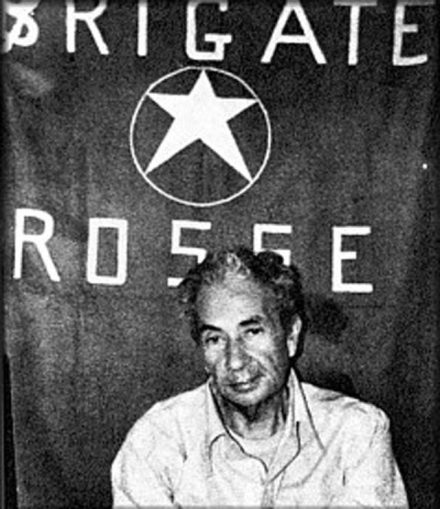
Italian Prime Minister Aldo Moro in Red Brigade captivity, 1978
Mossad Base Italy
Salerno’s book, Mossad Base Italy, is perhaps the most comprehensive chronicle of the intimate and ongoing relationship between Israeli intelligence and Italy’s political leadership. Published in 2010, the book remains almost completely unknown in the English speaking world.
Its author illustrates how the secret Israeli-Italian alliance predated the May 1948 creation of Israel, with Rome providing covert support to Zionist militias like the Haganah. Individuals affiliated with Benito Mussolini and neofascists within Italy’s post-war security apparatus supplied them with weapons and training to crush Palestinian resistance and assist their campaign of ethnic cleansing.
“The Israelis didn’t want Rome to become a satellite of the Soviet Union, and the US had the same position. The country was essentially the West’s front line against the Eastern bloc,” Salerno explained to The Grayzone. “Italy bordered Yugoslavia, was not far from Warsaw Pact nations, and support for Communism and the Soviet Union was strong in the wake of World War II. It was also a kind of aircraft carrier in the Mediterranean, which people would land on and go off to other places.” With nearly 5,000 miles of coastline, and just 90 miles separating the island of Sicily and Tunisia, Italy has often been described as the “gatekeeper” of the Mediterranean Sea.
Salerno concluded that every Italian administration since World War II has secretly aided Mossad and Israeli military intelligence. A review of his book by veteran Haaretz intelligence correspondent Yossi Melman noted, “Israeli espionage agents confirm that Italy’s intelligence services are among the friendliest in the world toward their Israeli counterparts.”
Salerno argues persuasively that both the Mossad and Israeli Air Force were effectively “born in Rome,” and reveals Tel Aviv entrusted Italian intel with conducting “extremely classified missions” on their behalf. Strikingly, his book has never been translated into English.
The reporter attributes the consistent pro-Israel bias of Italian intelligence to a combination of political expediency and lingering collective guilt over Rome’s complicity in the crimes against Jews during World War Two. Since then, Italy’s governments have largely “felt… that they had to help the Jews because the Jews had been suffering under the previous regime.”
“Objective evidence” Mossad downed Italian airliner
The traditional dynamic between Rome and Tel Aviv was challenged by the emergence of Italian Christian Democrat Party governments, including Moro’s. Within months, Israel began responding to this defiance with apparent acts of sabotage inside Italy, according to a variety of well-placed figures.
In late 1973, five members of the Black September Palestinian militant group were arrested thanks to a tipoff from the Mossad, which claimed they were preparing to shoot down an Israeli commercial airliner at Rome’s largest airport with ground-to-air missiles. However, Moro arranged for them to be released a month later, then transported to Libya.
The Black September members were first flown to Malta on an Italian transport plane known as Argo 16 — which was routinely used to ferry Operation Gladio operatives to a secret training base in Sardinia, and deliver CIA/MI6 weapons to secret depots dotted around the country. When Mossad observed the Palestinians there and realized they’d been freed, they became “very annoyed,” according to Rome’s then counterespionage chief, Ambrogio Viviani.
On November 23 1973, Argo 16 crashed shortly after taking off from Venice Airport, killing the entire veteran crew.
An initial probe concluded the tragedy was an accident, but the case was reopened by the Venice prosecutor’s office in 1986. That investigation faltered as well, when security and intelligence officials refused to testify, and began withholding evidence. However, the judge overseeing the case, Carlo Mastelloni, told Salerno there was no doubt, based on “objective evidence,” that the plane’s downing was Israel’s dirty work.
“It’s all tied to the famous ‘Moro agreement,’” Mastelloni asserted. Argo 16’s sabotage was not only “retaliation” for the release of the arrested Palestinians, but a “warning” over Italy’s “concessions” to “Tel Aviv’s enemies,” he stated. Still, Lodo Moro continued to hold despite the implicit threat of violence, which raises the question of whether Mossad felt the need to up the ante.
‘Mossad decided to transfer the Middle Eastern conflict to Italy’
Argo 16 was not the only fatal incident to take place during Italy’s Years of Lead which seemed to bear the Mossad’s fingerprints. When a hand grenade was lobbed at Milan’s police headquarters in May 1973, killing four civilians and injuring 45, the culprit presented himself as an anarchist following his immediate apprehension. However, subsequent investigations revealed the perpetrator, Gianfranco Bertoli, to be a longtime Italian military intelligence informant, as well as a member of numerous neofascist organizations, including the Gladio-linked Ordine Nuovo (New Order).
Bertoli had spent the two years leading up to the attack residing off and on in Kibbutz Karmiya in Israel, where he frequently hosted representatives of French far-right faction Jeune Révolution, while maintaining contact with French intelligence. Such incidents prompt Salerno to ask: “was the Mossad part of the strategy of tension?” This was the precise conclusion reached by Ferdinando Imposimato, an Italian magistrate who oversaw initial trials of Red Brigades operatives regarding Moro’s murder.
“It must be acknowledged the Israeli secret services had perfect knowledge of the Italian subversive phenomenon from its very beginning, engaging in it with constant ideological and material support,” Imposimato noted in 1983. “Mossad had decided to transfer the Middle Eastern conflict to Italy,” he concluded, “driven by the aim of political and social destabilization.” Israel’s purpose was “to induce America to see Israel as the only allied point of reference in the Mediterranean and thus gain greater political and military support,” he stated.
During his March 1999 testimony to a parliamentary inquiry into terrorism in Italy, Red Brigades fighter Alberto Franceschini stated the group was approached by the Mossad through an intermediary after the Red Brigades’ kidnapping of a magistrate named Mario Sossi in April 1974. According to Franceschini, the Mossad made a “disturbing” proposition to finance his group, stating that rather than seeking to control the Red Brigades, Israel sought only to ensure the group continued to operate:
“We don’t want to tell you what you have to do. That is, what you do is fine with us. We care that you exist. The very fact that you exist, whatever you do is fine with us.”
Describing “the political motivations” for Mossad’s position, Franceschini noted: “from the perspective of American relations… the more destabilized Italy was, the more unreliable it became, and the more Israel became a reliable country for all Mediterranean policies” from Washington’s perspective. In his final years, Franceschini revealed Israel “offered weapons and assistance” to the Red Brigade, declaring: “their stated goal was to destabilize Italy.”
As Salerno noted to The Grayzone, “in one of his last interviews,” Franceschini “confirmed to my colleague from Corriere della Serra that the Mossad had been in contact from the very beginning with the Red Brigades,” interactions which the correspondent stresses were “very normal in the way the Mossad acted with all kinds of, let’s call them subversive organizations, all over Europe.”
The notion of a potential Israeli hand in shaping the Moro plot — or hindering efforts to resolve it peacefully — is bolstered by statements from a number of influential Italian politicians, which also indicate Israel both “co-financed” and “influenced” the group which took credit for killing Moro. These disclosures have so far been universally ignored by mainstream English-language outlets.
In July 1998, Giuseppe De Gori, a lawyer who represented Moro’s Christian Democrat party in numerous trials related to the case, told a parliamentary commission on terrorism that Mossad “had always controlled” the Red Brigades, without formally infiltrating the group. He recorded how in 1973, a Mossad major and colonel “presented themselves” to the group, exposing infiltrators in their ranks, and offering “weapons and whatever they wanted as long as they pursued a different policy.”
While the Red Brigades refused, “from that moment on, it was clear Mossad” kept a close eye on the militant faction. De Gori testified that Israeli intel “hated” the “anti-Zionist” Moro, and began taking advantage of its ability to “smuggle” information to the Red Brigades, which could influence their actions.
As the lawyer explained, there was “no need” for the Mossad to directly penetrate the Red Brigades. De Gori hinted the group’s decision to kill Moro after almost two months in captivity resulted from such indirect Israeli intervention. While Italian government officials refused any negotiation with his kidnappers, at a private meeting on May 8, 1978, elements within the Christian Democrats proposed independently brokering a deal to secure Moro’s release.
“Moro was killed immediately afterward, so someone must have been there who reported this news,” De Gori testified. In 2002, the lawyer told author Philip Willan that Mossad made Moro’s execution a fait accompli by enlisting the services of a skilled forger to fabricate a letter from the Red Brigades to authorities in mid-April 1978. The communique claimed the statesman was already dead. “After that… Moro could no longer be saved,” De Gori stated.
Bargain with Palestinian resistance puts target on Moro’s back
De Gori is not the only well-placed source to blame Mossad for Moro’s death. In May 2007, Giovanni Galloni, former vice president of the Italian judiciary’s High Council, boldly proclaimed that “not all participants” in the premier’s abduction had been members of the Red Brigades. That conclusion was spurred by Moro’s bodyguards being executed with “just two weapons, used by exceptionally experienced men.” In addition to never being identified, these assassins displayed a level of shooting expertise no known Red Brigades operative seemed to possess.
Galloni strongly insinuated the killers were hired by Washington and/or Tel Aviv. He revealed that “a few months before his capture,” Moro confided to him that he was “worried” the US and Israeli “secret services had infiltrated the Red Brigades.” Moro reported this to Italy’s US ambassador, prompting an “ambiguous denial” from the State Department, to the effect Washington had always told Italian intelligence “everything we know.”
Galloni enquired: “Which secret services? The real ones, or the ones that were in their hands?” He was clearly referring to the parallel Anglo-American spying and terror nexus in Rome known as Operation Gladio.
Further evidence of an Israeli role in Moro’s murder can be found in testimony delivered to an Italian parliamentary committee in June 2017 by a former magistrate named Luigi Carli, who was intimately involved in the original investigation. Unnoticed in the English-speaking world, and unmentioned in the committee’s official reports, Carli claimed the Red Brigades had been “co-financed” by Mossad.
When asked why Israel would subsidize an armed communist faction in Italy, Carli stated that “several” former Red Brigades collaborators had told him the Mossad had agreed to “take care of co-financing the Red Brigades,” proposals which he considered “strange.”
They explained, however, that any efforts which ended up “weakening, or helping to weaken, Italy’s internal situation” would “enhance Israel’s prestige and authority” in the Mediterranean, Carli testified.
Highly illuminating interviews with former Italian president Francesco Cossiga, published by the Bulletin of Italian Politics in the wake of his death in August 2010, shed further light on Mossad’s motives for assassinating Moro, and for targeting Rome with mass casualty false flag bombings. Cossiga was the first Italian politician to acknowledge the existence of the Lodo Moro. Cossiga stated the US was “of course” aware of the agreement, while he himself and much of Italy’s political class were in the dark.
Cossiga recalled that while he was Prime Minister in November 1979, police in a coastal town intercepted a truck carrying a surface-to-air missile. He subsequently received a telegram from Popular Front for the Liberation of Palestine chief George Habbash admitting ownership of the missile, and reassuring the Italian premier it was not intended for use in Italy. Habbash thus demanded the weapon be returned and called for the driver’s release.
Habbash warned that any failure to comply would represent a violation of the PFLP’s “agreement” with Rome. “No one could tell me what this part meant,” Cossiga insisted. Only “many years later” did he learn of the Lodo Moro agreement.
At the time of Cossiga’s interviews, the Italian state reopened investigations into the August 1980 bombing of Bologna Centrale railway station, which killed 85 people and wounded over 200. The probe resulted in convictions in absentia for members of the neofascist, Gladio-tied Nuclei Armati Rivoluzionari. Several chief suspects, including a confirmed MI6 asset named Robert Fiore, escaped to London, where Britain refused to extradite them. The Bulletin of Italian Politics identified the missile seizure, and the existence of Lodo Moro itself, as key considerations in the new investigation.
One possibility explored by the inquiry was whether the Bologna bombing was “carried out by the US or Israel to punish Italy for its pro-Arab stance.” Having long complained that Rome “never really had space for its own foreign policy” due to its subservience to US interests, Cossiga acknowledged that Italy “pursued a national agenda” in the Middle East and “took certain liberties towards the Arab world and Israel.”
“People forget” the Christian Democrats were “always a pro-Arab party,” Cossiga stated, pointing specifically to Moro and his associate Giulio Andreotti, another former Italian head of state who famously exposed Operation Gladio in October 1990. Cossiga claimed, “Andreotti has always believed — though he’s never said it,” that the US caused him “judicial problems” over his Arab sympathies.
Though Salerno disputes the characterization of Andreotti as “pro-Arab,” describing him instead as “pro the rights of Arabs,” he told The Grayzone that the longtime Italian leader once personally declared to him: “if I was born in Gaza, I would be a terrorist.”
Moro rescue committee set up to fail
Throughout Moro’s 55 days in Red Brigades captivity, Italian officials declared that the “state must not bend” to “terrorist demands,” making it clear the Italian government would neither negotiate with the Red Brigades nor release any of its jailed members in return for the PM. The former Italian Prime Minister was subsequently bundled into a car trunk, shot 10 times, and left in the vehicle in central Rome for authorities to find.
Today, many Italians view Rome’s inflexible approach with deep suspicion, given the government’s willingness to negotiate with terrorists both before and after Moro’s murder. Magistrate Mario Sossi, whose kidnap by the Red Brigades purportedly prompted Mossad to approach the group, was released in 1974 after one month in captivity in exchange for some of the radical faction’s imprisoned members.
When the Red Brigades kidnapped Christian Democrat politician Ciro Cirillo in April 1981, Italian authorities bargained directly with his abductors, paying a ransom for his release. That December, when the Red Brigades abducted US General James Dozier, he was “located and freed in a blitz” by a joint US-Italian taskforce.
Former Italian general Roberto Jucci contrasted Dozier’s treatment with that of Moro in a 2024 interview. “One of them, they wanted to set free; I have my doubts about the other,” he stated. Jucci was among the few Italians in a position to judge, having been placed in charge of training a special forces squad at a base in Tuscany, which was ostensibly meant to rescue the abducted Prime Minister. Today, he believes “the real goal was to get me out of the way” and ensure Moro was never found. No raids were conducted during his 55 days in captivity.
Jucci told La Repubblica that the formal committee to rescue Moro was “advised by a man sent by the US,” and “composed largely” of representatives of fascist, Gladio-affiliated Masonic lodge P2. These individuals “wanted things to go in a different way from what all honest people were asking for,” and wished for Moro “to be destroyed politically and physically.”
Had Moro survived, “Italy’s politics would have developed differently.” Jucci believed the Italian leader could’ve “been freed if all the institutions had worked in this direction.” Declassified British Ministry of Defence files dating to November 1990 show officials in London were well-aware of the role played by P2 in sabotaging official efforts to rescue Moro. The Masonic lodge was described as just one “subversive” force in Rome, employing “terrorism and street violence to provoke a repressive backlash against Italy’s democratic institutions.”
Those documents further noted “circumstantial evidence” indicated “one or more of Moro’s kidnappers was secretly in touch” with Italy’s “security apparatus,” and investigators “deliberately neglected to follow up leads which might have led to the kidnappers and saved Moro’s life.”
Mossad continues Italian ops amid Gaza genocide
Today, there is little trace of any pro-Arab tendencies in mainstream Italian politics. According to Salerno, the US and Israel no longer have any need to “destabilize Italy” as the country is economically “weak.” Rome’s government now is for all intents and purposes “a continuation, even an extension, of the old fascist regime,” he says, adding, “there are people in the government that have statues of Mussolini in their houses.”
Prime Minister Giorgia Meloni has made clear she harbors little sympathy for the Palestinians, and little intention of recognizing a Palestinian state – even after it was revealed in November 2024 the Mossad had been employing a private Italian intelligence firm to target Meloni and her ministers. “I think that basically, the government that we have here in Italy at the moment is a government that would like to criticize many things that are happening,” but “it can’t criticize Israel too much because of what the Italian fascist regime did to the Jews during the war,” Salerno explains.
Regarding recent mass protests and strikes across Italy in support of Gaza, Salerno explains, “What is happening today in Palestine in Gaza is something exceptional.” But “as nothing has been taught or spoken about in Italy about the plight of Palestinians for many years… the great population of Italy and the governments of Italy” have “never done very much to really help the Palestinians.” Now, once again, “all of a sudden, we have discovered we have the Middle East and the Palestinian question.”
To this day, Mossad continues to carry out operations in Italy. The Italian-Israeli intelligence relationship was most recently highlighted in a bizarre incident in May 2023, in which a houseboat capsized in Italy’s Lake Maggiore, killing four people among the 23 aboard. Though legacy media initially framed the case as a tragic accident at a birthday celebration, it quickly became clear everyone on the boat — bar the captain and his wife — were Israeli and Italian spies.
The 10 surviving Israelis were hurriedly flown back to Tel Aviv on a military aircraft before they could be questioned by police, with the apparent blessing of Italian authorities. Subsequent investigations suggested the gathering was a joint intelligence operation into “Iranian non-conventional weapons capabilities,” aimed at either surveilling local industry or wealthy Russians living nearby who were suspected of helping Moscow obtain drones from Tehran.
A eulogy for the dead Israeli spy, whom Italian media named as Erez Shimoni, was personally delivered by Mossad director David Barnea, strongly suggesting he was a significant figure at the intelligence agency. While the captain of the ship has since been convicted of negligent homicide, Italy’s military police immediately announced they would not be investigating the activities of the spies on board.
Hamas denies links to suspects arrested in Germany over alleged plot against Israeli targets
MEMO | October 2, 2025
Hamas on Wednesday denied having any connection to suspects arrested in Germany on charges of trying to buy weapons to carry out potential attacks on Israeli or Jewish targets.
In a statement, the movement said: “The claims that the detainees are linked to Hamas are baseless, and aim to damage the reputation of the movement and distort the German people’s sympathy with our Palestinian cause.”
The statement added that “Hamas confirms its policy has always been, and remains, to restrict its struggle against the Zionist occupation to Palestine only.”
Earlier on Wednesday, Germany’s federal prosecutor announced the arrest of three suspects in Berlin accused of belonging to Hamas. They are alleged to have attempted to obtain firearms and ammunition to prepare possible attacks on Israeli or Jewish targets inside the country.
Tucker Carlson Reveals What Shocked Him While Making 9/11 Docuseries
Glenn Greenwald | September 24, 2025
This is a clip from our show SYSTEM UPDATE, now airing every weeknight at 7pm ET on Rumble. You can watch the full episode for FREE here: https://rumble.com/v6zdjaw-system-upd…
Now available as a podcast! Find full episodes here: https://linktr.ee/systemupdate_
Join us LIVE on Rumble, weeknights at 7pm ET: https://rumble.com/c/GGreenwald
Become part of our Locals community: https://greenwald.locals.com/
Who Killed Charlie Kirk?
By Ron Paul | September 16, 2025
I had the pleasure of appearing on Charlie Kirk’s program a few times over the years and I always found him to be polite, respectful, and genuinely interested in ideas. Even in areas where we might not have agreed, he listened carefully. He was a strong advocate of free speech and he made a career of trying to convince the youth of the value of free speech and dialogue regardless of political differences.
At the young age of 31 years old, he had already founded and ran the largest conservative youth organization in the country and as such he had enormous influence over the future of the conservative movement and even the Republican party. As I discovered during my Republican presidential runs, the youth of this country are truly inspired by the ideas of liberty, peace, and prosperity.
I do not believe we have anything near the real story about the horrific murder of Charlie Kirk last week. The narrative presented by the FBI and other government agencies is wildly contradictory, with an ever-changing plotline that makes little sense.
Some individuals close to Kirk have reported that his foreign policy position was shifting away from the standard neoconservative militarism in favor of a more non-interventionist approach. Tucker Carlson recently recounted that Kirk had even gone personally to the White House to urge President Trump to refuse to take military action against Iran. He was rebuffed by President Trump, Carlson informed us.
Likewise, conservative podcaster Candace Owens, who was a close friend of Charlie Kirk, has stated on her program that Kirk was undergoing a “spiritual crisis” and was turning away from his past embrace of militarism and in favor of America-first non-interventionism, particularly regarding the current unrest in the Middle East.
Was Charlie Kirk murdered – directly or indirectly – by powerful forces who could not tolerate such a shift in views in such an influential leader? We don’t know.
If anything, those seeking to prevent the ideas of peace from breaking out would wish to cover it up, as they have done in so many past political killings. As I recounted in my most recent book, The Surreptitious Coup: Who Stole Western Civilization?, the turbulent 1960s saw several killings of major US figures, including JFK, RFK, and Martin Luther King, who were challenging the status quo and pushing for a shift away from the Cold War confrontationist mentality.
The real assassins of these peace leaders from last century were nihilists who did not believe in truth. They only believed in power – the power that comes from the barrel of a gun. Rather than compete in the marketplace of ideas they preferred to snuff out any challenges and therefore decapitate any possibility that our country could take a different course.
More than sixty years after the murder of President Kennedy, the vast majority of the American people do not believe the official story of how he was killed and why. Truth will eventually break through even when the wall of lies seems impenetrable.
If it is true that Charlie Kirk was preparing to shift his organization toward a foreign policy embraced by our Founders, the killing was even more tragic. But no army – or assassin – can stop an idea whose time has come. That may be his most important legacy. Rest in peace.
Open season for false-flag provocations as NATO and Kiev regime get desperate
Strategic Culture Foundation | September 12, 2025
This week saw two false-flag provocations back-to-back, orchestrated by the NATO-sponsored Kiev regime. Tellingly, before any considered response was given by Russia or independent observers, European politicians were shutting down open discussion, warning about expected Russian lies and disinformation.
In other words, no critical examination of the incidents is permitted. These were “barbaric” and “reckless attacks” by Russia… take our [NATO] word for it, and if you don’t, then you are a Russian stooge.
Polish Foreign Minister Radosław Sikorski hammed it up in a video statement, denouncing Russian aggression, and dogmatically telling everyone to trust only NATO government information. Polish Prime Minister Donald Tusk was competing in hysteria, claiming Europe was closer to all-out conflict than at any time since World War II. This points to how the European information space has become totally dominated by war propaganda in a way that George Orwell or Josef Goebbels would marvel at.
So, what happened this week?
Poland is claiming that Russia deliberately targeted its sovereign territory with 19 drones. European NATO allies are subsequently scrambling to deploy warplanes and air defenses to “protect Poland”. September is the month that Nazi Germany attacked Poland 86 years ago, kicking off World War II. That bit of timing perhaps lends a nostalgic flourish to the present events, as Tusk seemed to be implying with his melodramatic words.
The day before the much-hyped “drone invasion,” on September 9, the Kiev regime claimed Russia dropped one of its heavy FAB-500 aerial bombs on a village, killing 24 people who were collecting their pensions.
In both incidents, however, the evidence points to false-flag provocations for those who care to calmly examine the facts.
The alleged massacre in the village of Yarovaya in Ukrainian-held Donetsk oblast was not caused by a Russian FAB-500 bomb. The Kiev regime’s videos purporting to show the aftermath indicated a shallow impact crater and limited damage to nearby buildings. The explosion could not have been caused by a 250-kg Russian aerial bomb; otherwise, the entire area would have been devastated around a huge crater. The Russian MoD also said its forces were not operating in the vicinity on that date.
The rapid posting of the videos by the Kiev regime and the evidently scripted claims alleging a Russian massacre, together with the unquestioning amplification of those unverified claims by the Western media, strongly point to an orchestrated narrative.
The grave implication is that the NATO-backed regime detonated an explosive, deliberately killing civilians as a way to incriminate Russia.
Such heinous conduct by this regime has numerous precedents. There have been many incidents over the past three years when the Ukrainian forces shelled their own territory, endangering civilian lives for propaganda scores against Russia, as a way to drum up more military and financial support from the Western sponsors. Two examples: the atrocity carried out in the village of Hroza on October 5, 2023, when 52 people were killed. It coincided with Kiev’s puppet leader, Vladimir Zelensky, pitching an appeal at an EU summit in Granada, Spain, for more aid.
The month before, on September 6, 2023, in the town of Konstantinovka in Ukrainian territory, an air strike killed 17 people. That coincided with former Secretary of State Antony Blinken visiting Kiev to announce $1 billion in additional U.S. aid.
In both incidents, Russia was blamed in a damning outcry, yet the circumstances incriminate NATO’s Ukrainian client. The atrocity this week involving the murder of the pensioners falls into the same despicable category.
The Kiev regime is a false-flag merchant of death. The notorious executions carried out in Bucha in March-April 2022 were another classic, vile stunt. We covered that in detail in a previous editorial, whereby Ukrainian civilians were murdered in cold blood by Kiev agents to disgrace Russia. To an extent, the stunt worked because Western media and politicians continue to accuse Russia of responsibility in complete disregard of the evidence. The Bucha false flag is relevant because it came at a crucial time when Russia had proposed a peace deal to end the conflict in Ukraine at an early stage. After the “massacre,” the NATO proxy war surged, and a peaceful settlement was scuppered.
This brings us to the present open season for false flags. One way to discern a provocation is to observe the reactions and how the incident is used to serve motives and demands.
First of all, the concerted and theatrical reactions of the Kiev regime and its European NATO backers were primed and ready to go, as if scripted.
In the alleged targeting of Poland, the drones were of Russian design. They were unarmed, surveillance, or decoy-type Gerbera models. Russia claims that the 700-kilometer range means they couldn’t have been launched from Russian-held territory. They could have been launched by Ukraine after it replicated the drones, an easy enough task. But here is the key. Some 19 unarmed drones were quickly intercepted in Polish airspace by multiple high-powered NATO weapons: Polish F-16 fighter jets, Dutch F-35s, Italian AWACS surveillance aircraft, NATO tanker re-fueling aircraft, and German Patriot missile systems. That speaks of a prepared full-scale mobilization to maximize the allegations of Russian violation. The image of a sledgehammer to crack a nut comes to mind.
Moscow has offered to hold discussions with Warsaw to figure out how ostensibly Russian-made drones entered Polish airspace, but the offer has been rebuffed. Poland has refused any reasonable discussion to establish the facts. Instead, it has invoked NATO’s Article IV for emergency security consultations with other members. The over-reaction smacks of drama to seemingly validate flaky claims of deliberate targeting.
The French, German, and British leaders have all clambered on board the wagon of condemning Russia for reckless violation without a shred of evidence. Note how they are all careful not to accuse Russia of “attack” but rather “violation”. That suggests they want a calibrated escalation but not all-out war, cowards that they are.
France’s Emmanuel Macron announced he was sending three Rafale fighter jets “to protect Polish airspace”. The Germans and the British are likewise charging to declare their support to defend Poland. It’s a charade of chivalry by a gang of clowns.
This is sheer theatrics of absurdity. Accusing Russia of planning to conquer Europe has been the worn-out propaganda narrative for the past nearly four years since NATO’s proxy war erupted in Ukraine. Russia has repeatedly said it has no intention of starting World War III, and that its sole purpose in Ukraine is to stop historic NATO aggression encroaching on its borders.
The euro elites are facing mounting political crises in their own states, largely incurred by the vast, wasteful spending on the failed proxy war in Ukraine. France, for one, is exploding with social tensions as nationwide street protests showed this week amid the sacking of a fourth prime minister in two years. Germany and Britain are not far behind in the meltdown stakes.
No doubt, the Euro elites and their Kiev puppet regime are desperate to divert public attention from the corruption and criminal machinations in Ukraine. U.S. President Donald Trump’s diplomatic effort to end the war, for all its shortcomings, is an unwelcome development for the European leaders because it exposes their pathetic position. Polish Foreign Minister Sikorski, while condemning Russia for “deliberately targeting” Poland, made a sneaky point by saying that Moscow was also “making a mockery of Trump’s peace efforts”. Sikorski and the European NATO cabal are trying to incite Trump to ramp up military aid to Ukraine and impose more sanctions on Russia as a way to sabotage any diplomacy. Desperation begets desperate measures, even if innocent civilians are murdered and world peace is put at risk.
Germans’ Nord Stream story is pure comedy, Moscow points finger at Brits
By Martin Jay | Strategic Culture Foundation | September 11, 2025
The Germans are sticking to their preposterous claims that the Nord Stream pipeline attacks, which effectively forced Germany to ditch its cheap gas in preference for overpriced American gas, were carried out by Ukrainians. In late August, a cohort of unlikely suspects, who some might call ‘patsies’ were rounded up and bundled into vans to face charges, according to a number of big media outlets whose reports did not make it into the international domain.
However, the story itself is comical as the Germans are going to extraordinary servile lengths to please their American masters who have no doubt asked them to cook up a story and go out and arrest ‘the usual suspects’.
German media went to extraordinary lengths to not only get details right but also to present it to a gullible public with a united front – one story, one narrative with no possibilities of it being spun differently when the smaller media outlets rewrite it. They went so far, they even made it a ‘joint report’ between Die Zeit, ARD, and Süddeutsche Zeitung, with investigators reported to have said they have identified all suspects involved in the sabotage. The reports claim the warrants cover four divers, an explosives expert, a ship captain, and the ‘leader’ of the operation.
Officials allege the suspects travelled under false names using genuine passports, a detail they say indicates support from high-level Ukrainian officials although no such journalists writing up the hilarious piece appear to want to point out the absurdity of the whole operation being carried out by a diving instructor.
One has to wonder why at this precise moment these unfortunate souls have been framed for crimes they didn’t commit. Is it because western intelligence picked up reports that more information is coming to light about the operation and which partners the Americans might have had?
As far as making calculated assumptions about who the real culprits were, the Russians themselves appear to be the most realistic with their assessment with some of their experts fingering the British naval special forces.
The sabotage of the Nord Stream pipelines could not have been pulled off without Western commandos, a top aide to Russian President Vladimir Putin has claimed, singling out Britain as the likely culprit to have done it. The idea that Ukrainians themselves carried out the technical work lacks credibility on a number of levels. In an article published recently in Kommersant, the former head of Russia’s Federal Security Service (FSB), Nikolay Patrushev, argued that Ukrainians simply don’t have the required expertise to carry out this complex operation under their own steam. The sabotage was likely ‘planned, overseen, and executed with the involvement of highly trained NATO special forces,’ Patrushev wrote, adding that the perpetrators were experienced in deep-sea operations and familiar with working in the Baltic. ‘Few armies or intelligence services have divers capable of executing such an operation correctly and, above all, covertly. One unit with the necessary skills is the British Special Boat Service,’ he said.
Founded during World War II, the SBS is the Royal Navy’s elite squad specializing in amphibious warfare which carried out a number of daring raids during WWII which changed the course of the war – perhaps salt in the wound of politicians in Germany who prefer not to remember this period of their history.
For those in Germany who kept a straight face for the last three years like the then chancellor Olaf Scholz or his foreign minister, the clueless Annalena Baerbock, there are rewards though from the Americans who are grateful that they sold out their own country. Baerbock has just landed the top job at the UN as the assembly’s president. Nice work if you can get it but in reality, a brown envelope pay off for her graft.
CODEX 9-11 – New 2025 Documentary Blows the Lid off the False Flag Attacks of 9-11
Watch at Rumble
By Etienne de la Boetie2, The Art of Liberty Foundation | September 3, 2025
There is a new 9-11 documentary entitled CODEX 9-11 by Brad Zerbo, a former skyscraper layout engineer and investigative journalist, that does a superb job of bringing new information to light. I thought I would break down some of the top revelations from the documentary:

In what many believe to be the “dry run” for 9-11, a military war game takes place on June 1-2nd, 2001 which uses remotely piloted drones to simulate an attack by Osama Bin Ladin. The war game features Unmanned Aerial Vehicles (UAVs) that are remotely piloted by a C-130 in the exercise, similar to what is believed to have happened on 9-11, where the original Boeing 767s were landed and replaced by other remotely piloted aircraft that were crashed into the WTC complex and Pentagon.

In what appears to be a “Funny Ha Ha,” by the perpetrators, the two UAVs in the exercise were numbered “9” and “11.” The “9” UAV was scheduled to be airborne at the exact same time (08:30-09:30am) as the 9-11 planes were allegedly hijacked and crashed into the WTC complex.
The Art Projects that Gave Access to the WTC Complex in the months leading up to 9-11

Gelatin team members on the 91st floor of WTC 1, standing in front of multiple boxes of what appear to be Littlefuse BB18 Fuse Holders that could have been used to wire up explosives in the building.
The documentary breaks down the incredibly suspicious nature of two different “art collectives” being given access to the WTC complex in the year prior to 9-11 where almost every aspect of their “art work” foreshadowed the attacks in another “funny Ha Ha” that will become a recurring theme of other “revelation of the method” mockery by the perpetrators of the attacks.
The first “artist collective” Gelatin/Gelitin, is also the name of a blasting agent used in controlled demolition. Gelatin/Gelitin team members were photographed in their “studio area” on the 91st floor (9-1) of WTC 1 in front of boxes of BB18 fuse holders. Their “art project” was called “The B-Thing” (Bomb Thing?) and their own drawings appear to show one of the towers collapsing. The project, coincidently, provided the excuse to rent a helicopter and survey the WTC complex prior to the event.

The 2nd “Artist Collective,” The E-TEAM (Franziska Lamprecht, Hajoe Moderegger, and Daniel Seiple), coordinated with tenants in the WTC complex to spell out the word “E-TEAM” (Explosive Team?) by using the windows between the 89th and 95th floors of WTC1 on March 29th 2001. Those floors would be, essentially, the exact same floors of the impact zone on the exact same side of the exact same building on 9-11.

While not mentioned in the documentary, in the official photo of the “art work,” the floors on WTC 2 appear blacked out in the area that would be the impact zone for that building.
In addition to the two art collectives having unusual access to the building, there was a suspicious elevator modernization going on where some of the most sophisticated elevators in the world were being modernized by a relatively unknown elevator company, ACE Elevator, which won the contract from Otis Elevator, who had installed the original elevators. Investigators theorize that these three projects, and potentially others, gave the perpetrators access to the building, including the elevator shafts, core columns and service areas within the core of the building, required to wire up the building for the controlled demotion of both towers.

A photo of Akamai CEO Dan Lewin, a “former” Israeli commando of the counter-terrorist unit: Sayeret Matkal, alleged to be the 1st person killed on 9-11 when he was stabbed by Satam al-Suqami, one of the five alleged hijackers of AA Flight 11. In this photo taken the year before, Lewin is sitting in front of what appears to represent two towers prominently wearing a Swatch watch called: The Hijacker.

Dan Lewin was sitting in seat 9B… on Flight 11… 9-11… another funny “Revelation of the Method” Ha Ha by the perpetrators.

In one of the most potent pieces of evidence that I had never heard before, Director Zerbo breaks down the complete impossibility of the numerous cell phone calls from the passengers to their loved ones. In the case of stewardess CeeCee Lyles, whose phone call to her husband was recorded by their answering machine, there is no engine or background noise to indicate that she is on an airborne aircraft.
After telling her husband to “Listen Carefully,” she relates the official story of the hijacking as if under duress.
Right before she hangs up she clearly whispers: “It’s a frame.”

“Those who can make you believe absurdities can make you commit atrocities.”
– Voltaire

I have described 9-11 to my kids as a kind of national intelligence test. You either understand the basics of logic, science, physics and history or don’t. You either believe a completely implausible story that violates the laws of physics and doesn’t make any sense, OR you don’t.
The “Official Story” DESTROYED in Less Than 5 Minutes by James Corbett
I know most of my audience understands that the government and media lied to the population about what happened on 9-11. Still, there are many young people who don’t really understand the basics. Here is an executive summary for your kids and grandkids that will bring them up to speed.
Why is it important? With an hour or two of research or watching 1-2 of our recommended documentaries below, anyone can grasp the basic understanding that we have a 100% completely organized crime “government,” including the military and intelligence agencies. This organized crime system is controlling perception through the monopolized media and algorithmic censorship of search and social media to sell the population on false flag terror that was used to steal trillions through the military-industrial complex AND our civil liberties. If you don’t understand these basics, then you aren’t really in the game.
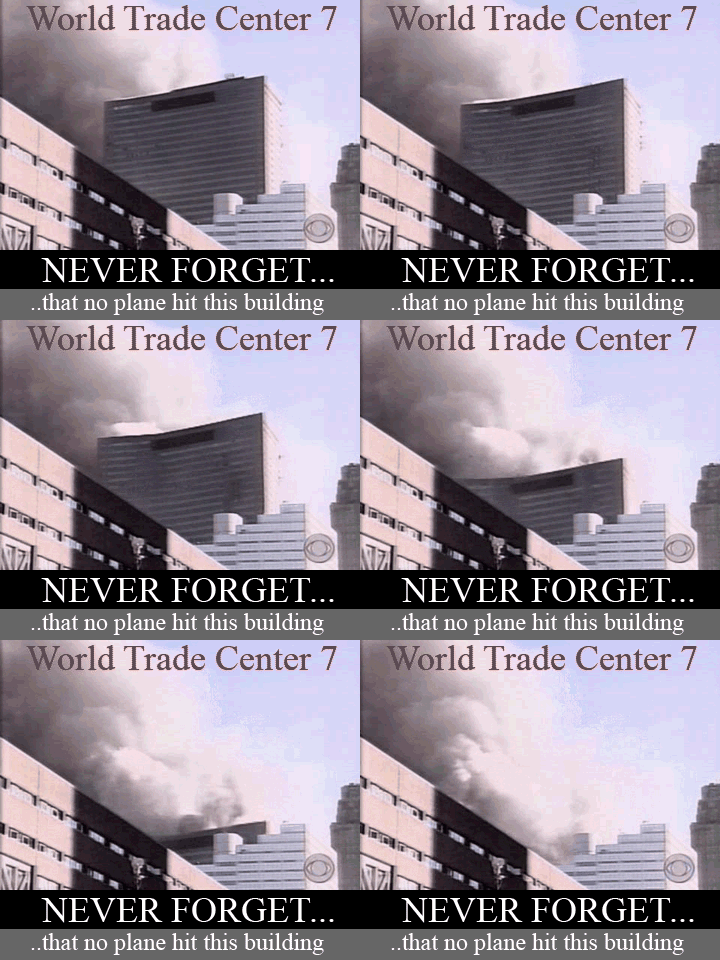
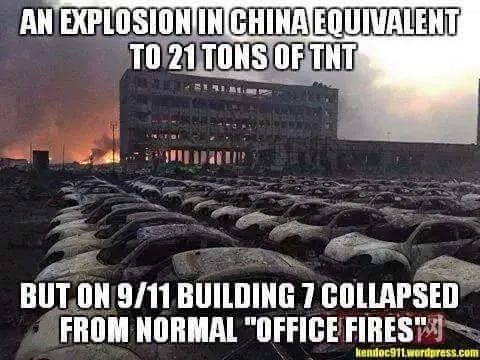
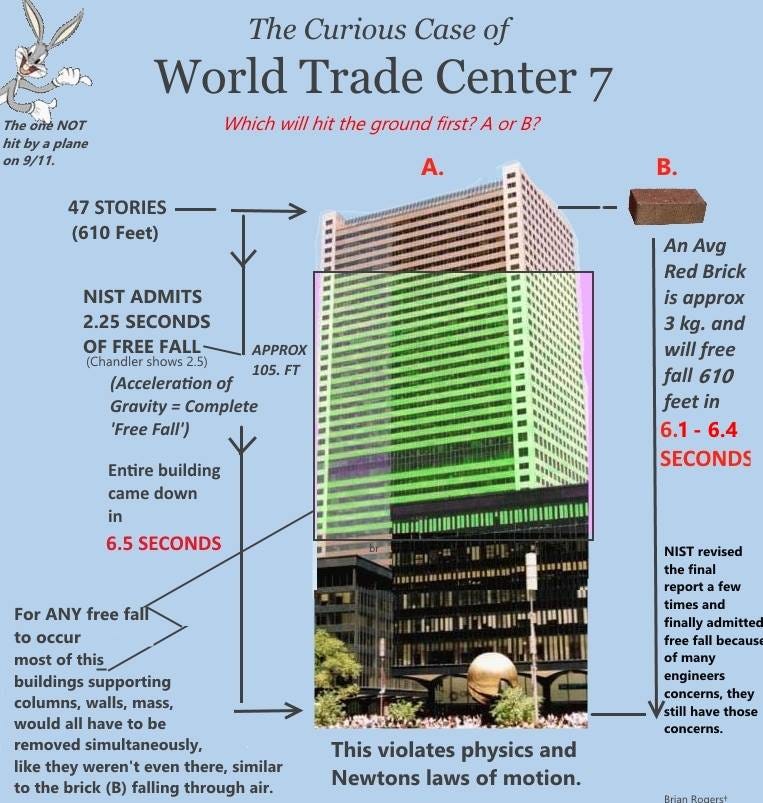
WTC7 was a modern, fireproofed steel-frame building not struck by a plane that collapsed completely and symmetrically into its own footprint at 5:20 PM. The building fell at free-fall speed, defying the laws of physics and displaying all the hallmarks of controlled demolition: Visible squibs, free-fall collapse, molten metal. At 5:00, Fox News, CNN and the BBC began reporting it had already fallen. Whistleblower Barry Jennings reported bombs. Prior knowledge was documented by workers pointing out on video that it would collapse, as well as auditory explosions and symmetrical collapse.
What Really Happened on 9-11: Both towers and WTC 7 were brought down in controlled demolition (WTC 7) & controlled demolition + Directed Energy Weapons (WTC 1&2) organized by US & Israeli intelligence agencies + Pentagon with government & monopoly media cover-up.
Used to Justify: Wars in Afghanistan and Iraq, warrantless wiretapping, suspension of posse comitatus and habeas corpus, torture, military tribunals, and stealing trillions of dollars through insurance on the buildings, pre-positioned shorting of stocks/disaster capitalism, and unneeded Military-Industrial-Complex and homeland security spending.
Best Evidence of Gov’t involvement: Obvious use of explosives in WTC7 and complete pulverization of WTC 1&2 to complete dust: free fall speeds, molten metal still molten weeks later, explosive residue in dust, dozens of war games taking place on 9-11 to pull fighter response/distract FAA, Israeli Mossad (Aka Dancing Israelis) caught “documenting the event,” symmetrical collapse.
Best Documentaries: Anatomy of a Great Deception, AE911Truth: Experts Speak Out, Solving 9-11 by Chris Bollyn, CODEX 9-11 by Brad Zerbo
Best Short Videos: 9-11: A Conspiracy Theory, 9-11 Trillions – Follow the $
Best Books: 9-11 Ten Years Later (DRG), Another 19 (Ryan), Solving 9-11-The Deception that Changed the World (Bollyn), Where Did the Towers Go? (Dr. Judy Wood)

One of the best examples of Mockingbird Media, WTC 7 collapses at 5:20. At 5:00, Fox News, CNN, and the BBC begin reporting that the building has already collapsed. In the case of the BBC, their reporter Jane Standley is doing a live shot from NYC with the building still standing visibly behind her as she explains how it was “weakened” by fire.
Best Evidence of Gov’t involvement: Obvious use of explosives in buildings: free fall speeds, molten metal still molten weeks later, explosive residue in dust, dozens of war games taking place on 9-11 to pull fighter response/distract FAA, Israeli Mossad (Aka Dancing Israelis) caught “documenting the event,” symmetrical collapse.
9-11 in Memes & Pictures
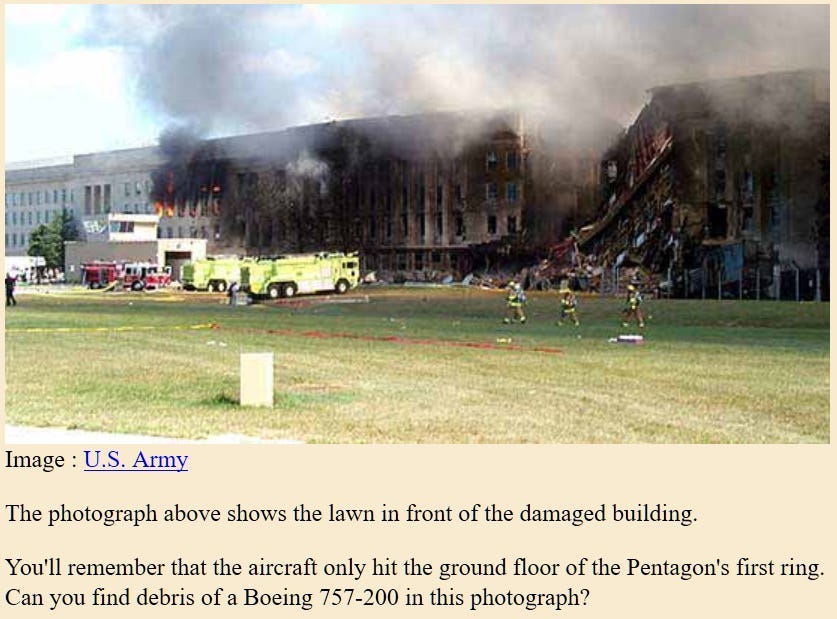
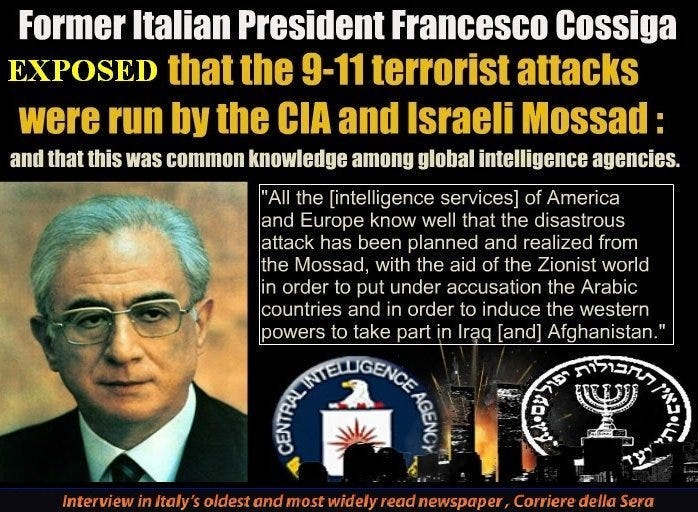
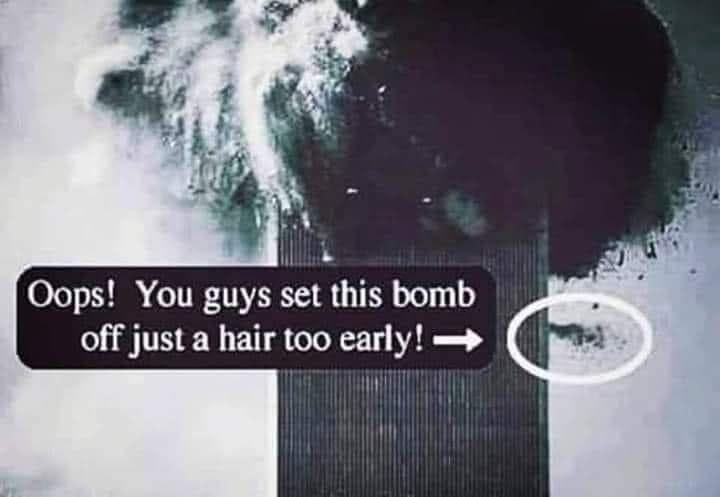


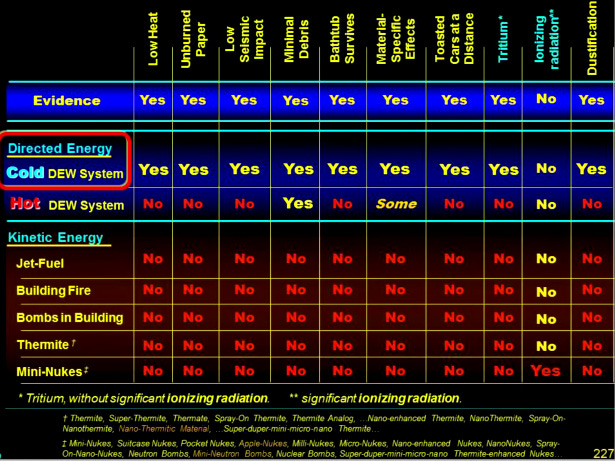
Etienne Note: WTC 7 appears to have been conventional explosives. In contrast, WTC 1&2 appear to have been thermite/thermate used in the buildings where certain floors were “re-fireproofed” with spray on thermite/thermate to initiate the collapse without visible squibs; conventional explosives were used to begin/accelerate the collapse, and a Directed Energy Weapon (DEW) used to pulverize the remainder of the buildings once they achieved the effect of making it look like a gravity collapse.
About the Author
Etienne de la Boetie2 is the founder of the Art of Liberty Foundation, the author of “Government” – The Biggest Scam in History… Exposed! and the editor of the Art of Liberty Daily News on Substack and Five Meme Friday, which delivers hard-hitting voluntaryist memes and the best of the alternative media.
He is the author of The Covid-19 Suspects and Their Ties to Eugenics and Population Control/Reduction and Solving Covid – The Covid 19, Eugenics, and Vaccine/Drug Scam Timeline
About the Art of Liberty Foundation
A start-up public policy organization: Voluntaryist crime fighters exposing inter-generational organized crime’s control of the “government,” media and academia. The foundation is the publisher of “Government” – The Biggest Scam in History… Exposed!– How Inter-Generational Organized Crime Runs the “Government,” Media and Academia.
Zelensky’s claims of strike on civilians are false – Russian MOD source
RT | September 9, 2025
The latest allegations by Ukraine’s Vladimir Zelensky that a Russian airstrike targeted civilians are completely false, a source with the Ministry of Defense in Moscow told RIA Novosti on Tuesday.
Zelensky shared extremely graphic footage from the Ukrainian-controlled village of Yarovaya, in Russia’s Donetsk People’s Republic. He claimed a Russian “guided aerial bomb” killed more than 20 “ordinary people who were collecting their pensions.”
The allegation does not hold water, a military source told the news agency, pointing out that the latest strikes in the area – not on the village itself but in its vicinity – were conducted on September 7. The damage shown in the video does not correspond with an aerial bomb strike, the source noted, suggesting the incident was “yet another false flag staged by the Kiev regime.”
“The crater shown does not match in shape and size of what would be left by an actual aerial bomb. The most common Russian bomb in the special military operation zone is the FAB-500, which contains about 200 kilograms of explosives,” the source said. The smallest munition used, FAB-250, contains around 100 kg of explosives and also leaves a massive crater on impact, he added.
The lack of any reporting on the incident prior to Zelensky’s post, after which the news spread all across “Ukrainian propaganda outlets,” also suggests the affair had been carefully orchestrated, the source pointed out.
“The false flag is supposed to demonstrate Kiev’s ‘concern’ for the population of the [Donbass] territories under its control and, simultaneously, to show the ‘cruelty’ of Russia,” the source suggested.
The incident appears to be a part of a broader campaign backed by Kiev to derail any potential negotiations to settle the conflict, as well as to justify its refusal to withdraw from the parts of the formerly Ukrainian regions it still controls, the source claimed, apparently referring to the Donetsk and Lugansk People’s Republics, and Kherson and Zaporozhye Regions.
Elite UK divers likely behind Nord Stream sabotage – Putin aide
RT | September 8, 2025
The sabotage of the Nord Stream pipelines could not have been carried out without Western commandos, a top aide to Russian President Vladimir Putin has claimed, singling out Britain as the likely culprit.
German prosecutors have attributed the explosions in international waters in September 2022, which disabled the twin pipelines supplying Russian gas to Germany via the Baltic Sea, to a group of Ukrainian nationals.
In an article published Sunday in Kommersant, the former head of Russia’s Federal Security Service (FSB), Nikolay Patrushev, argued that Ukrainians lack the expertise to carry out this complex operation independently.
The sabotage was likely “planned, overseen, and executed with the involvement of highly trained NATO special forces,” Patrushev wrote, adding that the perpetrators were experienced in deep-sea operations and familiar with working in the Baltic.
“Few armies or intelligence services have divers capable of executing such an operation correctly and, above all, covertly. One unit with the necessary skills is the British Special Boat Service,” he said. Founded during World War II, the SBS is the Royal Navy’s elite squad specializing in amphibious warfare.
Russia has criticized the German investigation for a lack of transparency and for not including the Russian authorities. In 2024, Russia’s Foreign Intelligence Service claimed it had “credible information” that the US and UK were directly involved in the sabotage, a claim denied by both London and Washington.
Senator Ron Johnson Dares to Question 9/11
Corbett | September 6, 2025
WATCH ON:  /
/  /
/  /
/  /
/  /
/  or DOWNLOAD THE MP4
Senator Ron Johnson joins us today to discuss the official 9/11 conspiracy theory and the legitimate questions that he and many other Americans have about that story. We discuss Senator Johnson’s problems with the official 9/11 investigation, whether the Senate can and should hold new hearings on the subject, and what he will be discussing at the upcoming Turning the Tide: 9/11 Justice in 2025 conference in Washington, D.C. We also delve into harm caused by the experimental mRNA injections and the subsequent erosion of public trust in government and institutions.
SHOW NOTES
Turning the Tide: 9/11 Justice in 2025
Dr. Chris Palmer: Full Testimony- Senate Roundtable, Washington D.C. 9/23/24
The 50 Questions NIST Should Have Asked 20 Years Ago
9/11 Trillions: Follow the Money
U.S. Senator Ron Johnson Questions Drs. McCullough, Vaugh & Thorp
The Lies Behind the Oklahoma City Bombing
By Richard Booth | The Libertarian Institute | August 18, 2024
Despite the seemingly simple conclusion behind the 1995 Oklahoma City Bombing, the investigation was exceedingly complicated. To this day, it is still the FBI’s most massive investigation, comprised of millions of pages of evidence. Careful analysis of this paper trail shows that the official narrative of the FBI and ATF is in fact a half-truth that ignores findings supported by the records. The FBI and ATF’s positions are frequently backed up with misleading statements, and in some instances, total fabrications.
In an honest investigation, there would be no reason to concoct and disseminate lies. If we believe that the FBI and ATF investigations were fair and legitimate, then we would expect to not find so many blatant examples of dishonesty. Yet, they exist: one after another, often repeated, and affirmed as truth. Some lies are small, others large. But what they have in common is a systemic problem that speaks to the very integrity of the agencies tasked with investigating this crime. The FBI is not a person suffering from a disorder that causes delusions. If an FBI or ATF official is formulating a lie, or propagating an extant lie, there is an objective.
All too often, it appears that the aim of these agencies is to conceal an inconvenient truth, to hide something that may otherwise invalidate the official narrative or camouflage something too heinous for the public to accept. Federal agencies’ overall deceptive pattern points to shared complicity or guilt, which should be of great concern.
In this essay we’ll examine some of the lies and wrongdoing that officials at the FBI and ATF have engaged in regarding their investigation(s) of the Oklahoma City bombing. I have uncovered half a dozen examples throughout investigating this case. Initially, I did not go out of my way looking for deception. It was something I continually discovered naturally. In some cases, the lies may be related to one another and will provide insight and clarity about what happened on the morning of April 19, 1995.
There Were No Eyewitnesses
I came upon the first example while reading On Scene Commander by Weldon Kennedy. Kennedy was the FBI’s first on-scene commander of the Oklahoma City bombing investigation and could be found hosting press conferences to discuss developments in the early days after the attack. In his memoir, Kennedy wrote that “this was going to be a case largely built from forensic evidence since there were no eyewitnesses.”1
Full stop: no eyewitnesses? This assertion is a blatant lie and should be a clue to the discerning reader that whatever the eyewitnesses saw must be important. It is surprising that Kennedy would write this, given the vast number of mainstream media reports that included eyewitness accounts2, along with the FBI’s 302 reports that detailed eyewitness interviews. Even Kennedy himself, during his April 20, 1995 press conference, described a second suspect who was spotted alongside Timothy McVeigh: “The second man is also of medium build. He is further described as 5 feet 9 inches to 5 feet 10 inches tall, weighing approximately 175 to 180 pounds, with brown hair and a tattoo visible on his left arm, below his t-shirt sleeve. He is possibly a smoker.”3 Three eyewitnesses from Elliott’s Body Shop provided this description of a man who, alongside McVeigh, picked up the bomb-truck on April 17. This same suspect would be spotted with McVeigh at the crime scene on April 19.
The FBI uncovered about two dozen key eyewitnesses over the course of their investigation. These individuals observed Timothy McVeigh and the Ryder truck as it approached the Alfred P. Murrah Federal Building on the morning of the bombing, most of them between 8:30 AM and 9:02 AM when the bomb went off. Following the explosion, FBI agent Danny Coulson was in charge of the crime scene, occupying a position of authority similar to Weldon Kennedy as an on-scene commander. In 2007, Coulson spoke candidly to the BBC about the voluminous eyewitnesses that came forward: “We know there were 24 people that were interviewed by the FBI that said they saw Mr. McVeigh on April 19 with someone else.”4 Coulson’s statement is corroborated by the FBI’s 302 reports which contain the descriptions these witnesses provided agents.
For example, catering truck driver Rodney Johnson spoke to the FBI on the night of the bombing and for several days after. Johnson described how he had to slam on his truck’s brakes to avoid hitting two men running across the street as they exited the Ryder truck.5 He got a good look at both John Doe #1 and John Doe #2, and his description of the suspects matches the one given by Weldon Kennedy during his April 20 press conference. Rodney Johnson’s catering truck co-worker, Billie Hood, also saw the fleeing pair and was interviewed by the FBI.6 Following McVeigh’s arrest, Johnson was re-interviewed and confirmed McVeigh was one of the two men he saw.
According to Weldon Kennedy, both Rodney Johnson and Billie Hood are the product of fever dreams “since there were no eyewitnesses.”
Another witness, Mike Moroz was interviewed by the FBI numerous times in the week after the bombing. Moroz was a mechanic working at Johnny’s Tire, an automotive repair shop located a few blocks from the Murrah Building. On the morning of the bombing, Timothy McVeigh pulled the bomb-truck into Johnny’s Tire at about 8:30am to ask for directions.7 He was looking for a one-way street downtown, a route leading to the Murrah Building. Moroz recounted the interaction to the FBI, explaining that he had spoken to McVeigh face-to-face. His co-workers, Allen Gorrell and Byron Marshall, were also interviewed and confirmed that McVeigh had stopped for directions.8
Moroz also said that McVeigh had a passenger in the Ryder truck with him. Moroz’s account was so significant that the FBI brought him downtown to their command center, where he selected Timothy McVeigh out of a live line-up the weekend following the arrest.9 Mike Moroz would have been a damning trial witness for the prosecution, able to put Timothy McVeigh in downtown Oklahoma City and finger his destination as the Murrah Building. Rodney Johnson, too, would have been an incredible asset. He could have placed McVeigh with the Ryder truck at the Murrah Building prior to the explosion. Unfortunately, their testimonies were forsaken in favor of forensic evidence because authorities preferred to pretend they didn’t exist.
Contrary to Weldon Kennedy’s assertion, the FBI attested to these witnesses in a preliminary hearing on April 27, 1995. During his testimony, FBI agent Jon Hersley referred to the observations of both Johnson and Moroz as central to the ongoing investigation.10 However, by the time of the McVeigh and Nichols trials—and Weldon Kennedy’s book—these witnesses would disappear from the narrative, rendered nonexistent. Why? Was it because all of these eyewitnesses saw another man in the Ryder truck with McVeigh?
Rodney Johnson, Billie Hood, Mike Moroz, Alan Gorrell, and Byron Marshall are only five of the more than two dozen eyewitnesses who saw Timothy McVeigh in downtown Oklahoma City on the morning of April 19. All of these individuals—described by Danny Coulson and denied by Weldon Kennedy—have something in common: each one confirmed that they saw McVeigh with a second person. This common denominator suggests that the impetus for Kennedy’s lie about “no eyewitnesses” was a concentrated effort to avoid explaining who the man spotted with McVeigh was.
Why did the FBI want to obscure this other suspect, going so far as to lie about witnesses? What does this tell us about who this person might be? One informed and reasonable speculation is that this other suspect was an informant connected either to the FBI or other federal authorities. If this were true, the FBI would have a reason to conceal his existence.
FBI documents obtained via the Freedom of Information Act (FOIA) give credence to this theory. Generated during the FBI’s interviews with Terry Nichols in 2005, these documents say that Nichols was scheduled to be interviewed by then-Rep. Dana Rohrabacher (R-CA), who was chairing a subcommittee tasked with writing a report on terrorism.
In a memo dated June 24, 2005, the FBI writes that, “DTOU [Domestic Terrorism Operations Unit] expressed concern regarding John Doe #2’s name surfacing during the congressman’s interview.”11 The DTOU is the FBI unit responsible for running informants and sting operations in terrorism cases. If John Doe #2 doesn’t exist, why would the FBI’s DTOU be worried? In a separate email, the FBI’s counterterrorism (CTD) division writes that they “share DTOU’s concern about the John Doe #2 information.”12 Why so much caution over a person that the FBI insists isn’t real?
The only scenario that makes sense is that the second suspect pegged by eyewitnesses, John Doe #2, was a federal informant. You can imagine the concern that would follow after FBI investigators discovered that the second person they were seeking was, in fact, part of their ongoing operations. This constitutes a strong motive to cover-up and obscure John Doe #2 at all costs to avoid embarrassment. Ask any retired agent, and they’ll tell you candidly that the biggest sin one can be guilty of at the FBI is embarrassing the bureau. It is only within the context of this unwritten rule that the behavior and statements of the FBI begin to make sense.
Bob Ricks Says: Nothing To See Here
Weldon Kennedy isn’t the only FBI official who has misled the public. Bob Ricks, former Special Agent in charge of the Oklahoma City FBI field office, made some curious statements to the Daily Oklahoman newspaper in October 1995. Ricks had just retired from the FBI, and the same week he left the bureau he granted an interview where he made claims we now know to be entirely false. The piece was headlined “Ricks Blames Curbs for Intelligence Gaps,”13 and has the former agent informing us that the FBI had no active counterintelligence investigations at the time of the Oklahoma City bombing. Why would Bob Ricks lie about that?
Ricks claimed that meddlesome oversight by Congress had hamstrung the FBI and rendered them incapable of gathering intelligence due to excessive red tape. He cited the FBI’s investigation of communist front groups in the 1970s, saying that “following the congressional hearings there, that pretty much took us out of the intelligence business (in the mid-1980s).” In response to criticism, Ricks claims that “we buried our head in the sand.”
His interview’s overall theme was to suggest that the FBI was unprepared for the Oklahoma City bombing because they could not—or would not—carry out intelligence-gathering operations targeting radicals. This is not true. The FBI possessed a vast network of intelligence-gathering tools at their disposal in 1995. They had confidential informants (Cis) and undercover agents (UCAs) infiltrating radical groups.14 They had pen-register and trap-and-trace mechanisms on the phones of specific targets that recorded inbound and outbound phone numbers.15 They had cooperating witnesses in ongoing investigations. All of these tools allowed the FBI to infiltrate and monitor the rightwing, while available evidence indicates they actively used these methods.
In the years leading up to the Oklahoma City bombing, the FBI instituted a “Major Case Domestic Security/Terrorism Group 1 Undercover Operation” called PATCON that targeted militias and other right-wing radicals.16 A “Group 1 Major Case Undercover Operation” is a big deal at the bureau. It requires continual funding authorizations (based on operational performance), in-place undercover operatives, and is signed-off on by an undercover review committee. The operation’s name, PATCON, was FBI shorthand for “Patriot Conspiracy.”
At the time of Ricks’ comments to the Oklahoman, PATCON was a tightly held secret at the FBI. It would be over a decade before the operation was exposed, and its full scope is still shrouded in mystery. What can be said, based on documents released via FOIA, is that the FBI operation had infiltrated three right-wing groups located across the country with several undercover informants. They had even established their own phony “front groups” whose purpose was to network with targets. One front, a group dubbed the “Veterans Aryan Movement” (or VAM), had an agent posing as an armored car robber with connections to racist groups.17
The FBI’s undercover agents and informants, connect to the various PATCON front groups, reported detailed intelligence on their targets, which included people and radical organizations with ideologies similar to Timothy McVeigh’s. One example is an investigation into the black-market sale of Stinger missiles and stolen military-grade night-vision goggles, items that were available for sale to mercenary groups throughout the country in the early 1990s.18 Another example includes undercover PATCON agents targeting the Texas Reserve Militia/Texas Light Infantry Brigade, a group based in Texas with links to white supremacist figures like Louis Beam. During the same period, undercover PATCON agents targeted the American Pistol and Rifle Association, run by John L. Grady. Another figure targeted by PATCON was Tom Posey, who ran an outfit called Civilian Material Assistance (CMA), an American paramilitary group that in the 1980s had connections to shadowy Iran-Contra figures. All of these examples show that through the branches of the PATCON operation, the FBI had a vast intelligence-gathering apparatus–the exact opposite of what Ricks said in October 1995.19
Of course, at the time of Ricks’ comments, the operation was a guarded secret. It’s clear in retrospect that he was lying; the FBI not only had active intelligence-gathering operations, but one that was tailor-made for inciting and entrapping people like Timothy McVeigh. What was Bob Ricks’ intention when he went to the newspaper and covered up the existence of PATCON? His last act of service to the bureau, rendered unto them the same week Ricks retired, was to tell the press preemptively that something like PATCON didn’t exist.
In effect, Ricks was claiming ‘Nothing to see here, we’re not doing anything that could conceivably be connected to McVeigh.’ Now knowing that this was a lie, we must ask what Ricks was protecting when he volunteered to falsely answer a question he hadn’t yet been asked. If this deliberate deception is any indicator—remember, no matter how clumsy, every obfuscation serves a purpose—there is reason to suspect a connection between PATCON and the Oklahoma City bombing. That theory is corroborated by one of the operation’s undercover assets.
The week of the bombing, John Matthews was sitting at home with his father watching television coverage. Matthews had worked for the FBI as an undercover PATCON agent and had his story told in Newsweek, headlined “I Was an Undercover White Supremacist.” The original article contained a passage about Timothy McVeigh. Newsweek editors cut this, and many other sensitive details, from the published piece for reasons that are still unclear. The original, unedited article states that when Matthews saw McVeigh’s face on television, he recognized him.20
Years before the bombing, when John Matthews had infiltrated the Texas Reserve Militia, he had attended one of their many weekend paramilitary training exercises. Matthews says that it was there, at a ranch in San Saba, Texas, that he met a tall, skinny ex-soldier with a buzzcut named Tim.21 The veteran was accompanied by a buck-toothed man with a German accent named “Andy.”22
Regarding McVeigh, Matthews said “he [Tim] was a nobody. Just another ex-soldier, but I remember his face. He was at one of the meetings, where a bunch of [stolen] ammunition was brought in from Fort Hood.”23 Matthews informed his FBI handler, Don Jarrett, that he had seen McVeigh at the ranch training with the Texas Reserve Militia. Jarrett told him, “Don’t worry, we got it covered.”24 Yet McVeigh’s crossed path with PATCON was never released and was even scrubbed from the Newsweek report. Was this indeed “covered,” as Jarrett had promised, or was it covered-up?
Was Ricks’ lie about intelligence operations related to Weldon Kennedy’s lie about having no eyewitnesses? Recall that all of the witnesses saw a still-unidentified man with McVeigh. Was John Doe #2 an FBI informant or asset? Is this what the FBI is hiding when it denies they were carrying out intelligence-gathering operations? How closely related are lies from the two agents charged with supervising the investigation of the bombing?
Fabricating Evidence
Weldon Kennedy’s assertion that the FBI would have to build its prosecution on forensic evidence due to the non-existence of witnesses amounted, in effect, to two different misdeeds. The first, of course, was saying there were no witnesses. The second is what Kennedy left out of his statement; not only would the FBI rely on forensic evidence, but it would also use fabricated evidence to bolster its case.
FBI forensic scientist Dr. Frederic Whitehurst first raised concerns about unscientific practices occurring at the FBI crime lab, after which an extensive investigation discovered fabricated evidence used in the Oklahoma City bombing case.25 From 1986 to 1998, Whitehurst served as one of the crime lab’s supervisory special agents, where he was widely considered the leading authority on explosives and explosive residue. Possessing a Ph. D. in chemistry from Duke University and a J. D. from Georgetown University, Dr. Whitehurst was the highest qualified analyst in the crime lab at the time, with qualifications often surpassing his superiors. For example, the Chemistry & Toxicology Unit’s chief, Roger Martz, did not have a degree.26 Likewise, the head of the crime lab’s Explosives Unit, David Williams, had a degree in zoology and made his bones not in academia, but through serving time in the bomb squad.27 Whereas Dr. Whitehurst was a scientist first and foremost. The crux of the doctor’s complaints was that his crime lab peers and supervisors were dedicated less to science than they were securing successful prosecutions—even if that meant violating the standards of any respectable scientist.
Dr. Whitehurst began observing and documenting practices at the crime lab that constituted notable examples of misconduct. As a whistleblower, he was treated severely. He was first fired by the FBI, who ultimately settled in court, paying him $1.2 million and an undisclosed sum for damages. In addition, the Justice Department’s Inspector General investigated the crime lab and produced a damning report. The IG examined several high-profile FBI cases—including the Oklahoma City bombing—and concluded that the crime lab’s investigation contained “serious flaws,” used “unscientific” practices, and had made “unjustified” conclusions which “lacked scientific foundation.”28
The FBI had assigned to the Oklahoma City bombing case the same crime lab investigators who had worked on the 1993 World Trade Center Bombing. Explosives Unit chief David Williams headed up the lab’s investigation, and he chose Steven Burmeister as his lead forensic examiner. The IG stated that Burmeister had fraudulently altered his reports at the direction of his supervisor, Williams. In one report, concerning Timothy McVeigh’s pocketknife, Burmeister initially wrote that “the presence of PETN [explosives] could not be confirmed.” He later altered the report to say “traces of PETN were located on specimen.”29 A qualified uncertainty was turned into a forensic certainty, resulting in a report containing false information that was used as evidence at the trial. Just as Dr. Whitehurst had documented, the FBI fabricated evidence for prosecutors—not an anomaly in their behavior, but a pattern. The IG report confirmed that among the cases it examined, the errors “were all tilted in such a way as to incriminate the defendants.”30
The IG concluded that David Williams ought to be reassigned to another unit because he “lacks objectivity, judgment, and scientific knowledge.” This was one of several reassignments and changes recommended in the IG report, all necessary to reform the crime lab’s practices. As a result of Dr. Whitehurst’s whistleblowing and the subsequent investigation, the FBI was forced to adopt forty different reforms to ensure forensic reliability. The IG report impeached not only the credibility of the FBI crime lab, but the entire bureau. Even with the imposition of reforms, with that credibility gone, how are we expected to trust the FBI’s work in other areas of the investigation? How far did the corruption extend?
It is appalling that such a thing could happen in the highest-level investigation ever carried out by the United States’ premier law enforcement agency. Questions of integrity aside, fabricating evidence also displays an immense arrogance. The FBI was willing to risk a successful prosecution of Timothy McVeigh, when fabricating evidence wasn’t necessary to win a conviction; the extent of the available evidence, even without eyewitnesses, would have been enough to easily secure a conviction. So why do it?
The answer appears to be either ‘because we can,’ or worse, ‘because that’s how we do things.’ The evidence supporting the latter conclusion is plentiful, since criminal activity by the feds goes beyond Oklahoma City. One needs only to look at other high-profile FBI cases. For example, in the espionage case against defense contractor Christopher Boyce and his childhood friend Daulton Lee, the FBI claimed it had recovered Lee’s fingerprints from the secure “black vault” at TRW Inc.31 The black vault was where Boyce made copies of sensitive documents that Lee then hand-delivered to the KGB in Mexico City. One problem: Daulton Lee had never in his life been on TRW Inc. property, much less made his way to the highly secure black vault.32 This inconvenient fact did not stop the FBI as they apparently fabricated Daulton Lee’s fingerprints to use as a “trump card” in case the evidence against him wasn’t enough to convict. Like McVeigh, there was enough legitimate evidence against both Boyce and Lee to make any fabrication unnecessary, to say nothing of egregious. But ‘that’s how we do things.’
Destroying Evidence
Acting on a tip, in 2005 the FBI raided the former Kansas residence of convicted bomber Terry Nichols, where they seized a cache of explosives. Nichols told the FBI in interviews that among the carefully wrapped and preserved explosives they would find the fingerprints of an unindicted co-conspirator in the bombing. Unfortunately, we’ll never know whether this was true. The FBI—grudgingly acting on Nichols’ tip—destroyed most of the evidence.
Only after enduring pressure from congressional staffers and at least one congressman did the FBI act, taking over two years to produce a report on the results of the raid. The report, dated February 21, 2008, noted that a fingerprint—named redacted—was lifted from a book found among the explosive cache. The inventory—seventy kinestik binary explosives, detonators, fuses, and flares—was destroyed, along with any fingerprint evidence.33
In his 2005 interviews with the bureau, Terry Nichols said that the fingerprints of Roger Moore and other bombing conspirators would be found among items in the explosives cache. Despite this indication, the FBI crime lab made no identification in their reports. However, in a December 2012 interview on The Scott Horton Show, investigator Roger Charles suggested that the FBI did recover prints from the stashed explosives. Charles explained that a highly placed FBI official told Deputy Bureau Chief of the Associated Press John Solomon that four sets of fingerprints were discovered: Timothy McVeigh, Terry Nichols, Roger Moore, and Richard Lee Guthrie.34
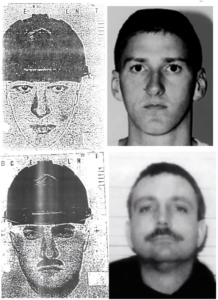 Guthrie, who died in prison in 1996, was a leading figure in the Aryan Republican Army (ARA), a neo-Nazi bank robbery gang, and has long been suspected of possible involvement in the Oklahoma City bombing plot. Likewise, in reports produced by McCurtain Gazette reporter J. D. Cash and Indiana criminology professor Mark Hamm, they suggest that McVeigh might have been involved in one or more of the ARA bank robberies. One of the stick ups was carried out on September 21, 1994 in Overland Park, Kansas. According to Cash, “witnesses provided a sketch of him [one of the robbers], you look at it, and there’s no question it’s McVeigh.”35 Mark Hamm agrees, telling Cash, “I believe that sketch of the other subject is Timothy McVeigh and not [Peter] Langan. It’s almost a perfect likeness of McVeigh.”36
Another ARA bank robbery that Timothy McVeigh may have participated in occurred at the Third Federal Savings and Loan in Middleburg Heights, Ohio on December 9th, 1994. On December 5th, members of the ARA checked into a motel near Kent, Ohio. FBI investigators, suspecting that McVeigh was linked to the robbery, analyzed video footage from the crime in an attempt at identification. Reportedly, the FBI crime lab’s comparison of McVeigh and he bank surveillance video was inconclusive. Unfortunately, we can no longer examine the video because it was destroyed by the FBI in 1999, despite evidentiary rules to the contrary.
The FBI also destroyed blasting caps wrapped in Christmas paper recovered from the gang’s safehouse in Ohio. According to the ARA’s co-founder, Peter Langan, those blasting caps were obtained from Timothy McVeigh.37 Can we trust the FBI’s word that Langan is lying, and that neither the caps nor the surveillance video was connected to McVeigh? The FBI’s bureaucratic culture is to collect and preserve every last scrap of paper or conceivable bit of evidence. If something is destroyed, it is to serve a purpose.
The FBI also managed to destroy crucial audio dispatch tape recordings and transcripts that had been obtained during the investigation. In a November 1995 interview, Assistant Chief of the Oklahoma City Fire Department Jon Hansen said that the fire department had received a call from the FBI on the Friday before the bombing. The FBI warned them that there might be an imminent terrorist attack, and to maintain heightened security levels. When asked if the fire department had kept a recording the call, Hansen said that “all the transmission tapes have been erased. We made a boo-boo.”38 A boo-boo? Really?
During his trial, McVeigh’s defense team requested that the FBI provide all transcripts and transmissions related to Oklahoma City on April 19, 1995, and two weeks prior. The FBI glibly responded to this request by informing them that these tapes and transcripts were “accidentally destroyed.”39 Was this another “boo-boo?” Or was this destruction of key evidence intentional? The reader can make an informed decision.
McVeigh’s defense team also made a request for transcripts of the Oklahoma City Police Department dispatch tapes, which would have included the APB that police issued on April 19 for a brown truck connected to the bombing. The FBI responded that these too had been “accidentally destroyed.”40 Once again, we find a convenient “accident” that invariably strengthens the FBI’s narrative of the bombing.
Any lawyer will tell you that your case is only as good as the evidence it’s based on. The evidence in a criminal case must be carefully preserved with a documented chain of custody; nothing should be destroyed or otherwise mishandled. It appears, however, to have been commonplace in the Oklahoma City investigation. The handful of examples highlighted above show a pattern of behavior that, when combined with the conclusions of the IG report on the FBI crime lab, indicates that the destruction and fabrication of evidence was part of an overall effort to conceal specific facts in order to slant the case in favor of the prosecution. We must ask: what is being concealed by this pattern, and what common denominators exist in each instance where evidence was mishandled, destroyed, or fabricated?
ATF: ‘We Weren’t There’
On the morning of April 19, 1995, several ordinary Oklahomans had disturbing encounters with ATF agents at the Murrah Building blast site during the subsequent rescue operations. These individuals include rescue volunteers and emergency first responders who were triaging the wounded while working with ambulance and rescue personnel. Several of these people testified before a grand jury impaneled to investigating the bombing what ATF agents had told them that morning.
Prior to testifying, these witness accounts were published in the McCurtain Gazette newspaper by award-winning journalist J. D. Cash. Three of their statements were broadcast on Oklahoma City television station KFOR-TV on September 12, 1995. The first two witnesses interviewed by KFOR’s Brad Edwards were Bruce Shaw and his supervisor, Tony Brasier. Shaw’s wife had worked at the Murrah Building, and upon hearing about the bombing, Shaw and Brasier immediately left work to assist in rescue efforts. Arriving at the blast site, Shaw spotted an ATF agent among those gathered, and he approached to inquire about rescue efforts. Shaw explained that his wife worked in the federal credit union located in the building. The couple knew many of the ATF personnel who worked at the Murrah Buidling, and Shaw informed the unfamiliar agent, “I’ve got to find some of the local ATF agents to help me find her… They know me.”
Bruce Shaw recounted that the ATF agent he spoke to attempted to reach someone on a two-way radio but couldn’t get a response. “He said they were in debriefing, that none of the agents had been in there. They’d been tipped by their pagers not to come in to work that day. Plain as day out of his mouth. Those were the words he said.”41 Shaw’s supervisor, Tony Brasier, had been standing next to his subordinate and the agent when this discussion occurred. Brasier affirmed on-camera to KFOR that the agent had indeed said that the ATF had been “tipped off by the pagers not to come in to work that day.”
A third witness, Katherine Mallette, was interviewed by the television station on the September 12 broadcast. Mallette was an emergency medical technician with the Emergency Medical Service Authority (EMSA) and participated in rescue efforts the morning of April 19. She stated that as she was prepping an ambulance to transport victims to area hospitals, two ATF agents walked by, and she overheard their discussion. One agent said to the other, “Is this why we got the page not to come in today?” Mallette attested to this disturbing exchange on-camera for KFOR, and later provided the Oklahoma Bombing Investigative Committee a signed affidavit attesting to what she had seen. 42
A second rescue worker, Tiffany Bible, was a paramedic with the EMSA who participated in rescue efforts that morning. Bible’s first impression was that there was some sort of natural gas explosion, and when she approached an ATF agent on-site, she asked how a gas explosion could have caused so much damage.
The agent told her that it was not a gas explosion, but a truck-bomb. This exchange occurred only five minutes after the blast. Knowing that the ATF was housed in the Murrah Building, Bible expressed her concern for the agent’s co-workers. He responded that, “No, we weren’t in there today.”43 Like the other witnesses, Bible testified to this encounter in an affidavit submitted to the grand jury impaneled to investigate the bombing.
Why was the ATF not at work on the morning of April 19, 1995? The rescue workers’ accounts—aired on television and reported in newspapers—caused the ATF to panic and issue statements later proven to be lies. The ATF agents’ admissions that they were not in the building, combined with the agency’s later explicit denials, may contribute to understanding a fundamental truth about the bombing. The ATF’s lies and contradictions can, like the FBI’s, be interpreted in a wider context.
Panic, Lies
To counter what the ATF said were “widespread rumors” that agents had evacuated the Murrah Building before the blast, the agency acted in a typical bureaucratic fashion: they issued a press release.44 In the May 23, 1995 press release, ATF Special Agent-in-Charge of the Dallas regional office Lester Martz claimed that Oklahoma City ATF agent Alex McCauley and DEA agent David Schickendanz were trapped in the building’s elevator when the truck-bomb exploded. According to Martz, McCauley and Schickendanz were both victims and heroes, carrying out a fantastical escape to help others who laid dying around them.45 Martz asserted that the elevator dropped in a free-fall from the eighth floor to the third, where the two men remained trapped. In this account, McCauley and Schickendanz escaped from the elevator’s smoking rubble only after forcing the doors open. This story is, by all measures, entirely fictional.
In the aftermath of the bombing, General Services Administration (GSA) and Midwestern Elevator Company inspectors investigated the blast site and the building’s elevators. The Midwestern technicians “found that five of the six elevators were stopped between floors with their doors blown inward, which caused the safety mechanisms to freeze them in place.”46 Duane James, one of the elevator maintenance technicians, was quoted saying, “Once that occurs, the doors cannot be opened—period.” James said that the elevators have safety switches that prevent excessive speed, and that he determined none of the safety switches had been tripped.47
In their final report, the Oklahoma Bombing Investigative Committee wrote that, “GSA inspectors and Midwestern technicians have stated in interviews and in sworn affidavits and/or testimony that there was no evidence of (1) free-falling elevators, (2) persons in any of the elevators who then forced their way out, or (3) failure of the safety mechanisms built into the system.”48 In other words, Lester Martz’s heroic account of federal agents was an impossible lie. Technician Duane James put it this way: “If you fell six floors and it was a free fall, it’d be like jumping out a six-story building. I’d ask them how long they were in the hospital and how lucky they were to survive.”49
After the May 23 press release featuring this cock-and-bull story, the ATF issued several other stories to account for their agents’ whereabouts. The narrative kept changing; this indicates both incompetence and dishonesty, a hasty and ill-formed plan to conceal the truth. For example, on the day of the bombing the ATF’s public affairs spokesperson in Washington D.C. claimed that the agency had 20 agents on duty. When it became apparent this was false, ATF agent Luke Franey volunteered to bombing victim Glenn Wilburn that the agents were “out on assignment,” while “some didn’t come in because they were out of town.”50 In December 1995, ATF Dallas chief Lester Martz said that the missing agents were involved in an all-night “surveillance operation.”51 With all of these varying and stories to account for the lack of ATF agents in the Murrah Building that day, it is difficult to know where the lies end and the truth begins.
The ATF also issued contradictory statements about their level of situational awareness on April 19, 1995. When asked whether the agency was aware of the date’s significance—it was the two-year anniversary of the Waco massacre—agent Luke Franey flatly denied that the ATF was the least bit concerned. He told Glenn Wilburn that “No, there was no alert or any concern on our part about the significance of that day.”52 Meanwhile, ATF Director John Magaw told CNN he had been “very concerned about that day and issued memos to all of our field offices,” telling them that “they were put on alert.”53 These conflicting explanations demonstrate that ATF officials had not coordinated their responses.
The ATF’s many denials and lies about their whereabouts on April 19 share a common theme: to hide the fact that they knew something and were not at work that day. The contradictions indicate that something about their absence is important enough to conceal no matter how outrageous the cover story. What was it? Is it related to the FBI’s deceptions?
The Road to Oklahoma City
The ATF is not the only federal agency whose high-level officials concocted fictional stories about the event of April 19, 1995. There is a similar case that could possibly be related to the ATF agents’ whereabouts during the bombing.
The Special Agent-in-Charge of the Dallas FBI office, and later in charge of the crime scene in Oklahoma, was Danny Coulson. Coulson was a veteran of the FBI with a long history in dealing with terrorism. Over a decade before the bombing, he was attached to the FBI Hostage Rescue Team (which he founded) when they took down Robert J. Matthews of The Order. Coulson managed and successfully negotiated the siege on the Covenant, Sword, and Arm of the Lord radical group on April 19, 1985. His whole career, Coulson had presided over events whose history was inextricably linked to the ideology of Timothy McVeigh—he was, in fact, the perfect person to lead the Oklahoma City bombing investigation. However, for reasons not yet clear, he was not selected for that job.
In Coulson’s memoir, No Heroes, he recounted the morning of April 19, 1995. He was at home in Texas when he received a page from John O’Neil at the FBI headquarters’ anti-terrorism center.54 O’Neil broke the news to him: the Alfred P. Murrah Building had been bombed. Coulson writes that O’Neil asked him to catch the next flight to Oklahoma City. What played out next is worthy of a Hollywood film. Coulson claims that there were no flights out of Texas due to inclement weather, so he fetched his badge and gun and hit the road. Coulson sped off to Oklahoma City, driving through a furious rainstorm, his wiper-blades swiveling on the windshield as lightning strikes peppered Texas’ pastures and fields in his rear-view mirror. The FBI’s top anti-terrorism agent was on his way.
Coulson’s biographical account cannot be verified, since John O’Neil died in the 9/11 attacks. However, cracks have emerged over the years that raise serious questions about Coulson’s recollection of events. Firstly, in an interview with C-SPAN’s BookTV in 1999 to promote his memoir, Coulson said that he was home eating breakfast when he “heard on the television” about the bombing in Oklahoma City.55 Since his presentation was about his book, you would have expected Coulson to describe events the same, yet the story differed ever so slightly. Then, years later, journalist J. D. Cash obtained Danny Coulson’s hotel receipt for April 19, 1995. The receipt shows that Coulson checked into an Embassy Suites in Oklahoma City twenty minutes after midnight on the 19th.56 He was in Oklahoma City nine hours before the Murrah Building was bombed.
During J. D. Cash’s research into Coulson’s movements that week, he attempted to obtain both Coulson’s and FBI official Larry Potts’ travel records from the FBI. The effort was fruitless; the bureau claims some of those travel records are “missing”—in the same manner that inconvenient evidence seems to disappear. However, Cash wrote that Coulson’s trip to Oklahoma City fits within a framework of “evidence revealing weeks of planning by an elite corps of drug and counterterrorism experts who were closely monitoring members of various far-right groups.”57 What were these “weeks of planning” related to?
Cash concluded that Coulson was working on a project that included other counterterrorism agents “monitoring” right-wing groups. What we can infer is that whatever Coulson was involved with, it was sensitive enough that he decided to create an alternative explanation about how he arrived at Oklahoma City. Coulson could have written in his book that he happened to arrive in the city the night before and left it at that. Why did he choose to lie? The likeliest reason for a cover-up would be because his reason for being in Oklahoma City was directly linked to the bombing. If that were accurate, Coulson’s motivation begins to make sense.
To make the situation even more confounding, Coulson billed his April 19 travel costs to the FBI’s MC-111 on May 16, 1995. MC-111, short for Major Case 111, is also known as VAAPCON.58 Like PATCON, VAAPCON was an FBI investigation. While PATCON targeted militias and radical right-wing terrorists like Timothy McVeigh, VAAPCON targeted individuals and groups that advocated violence against abortion clinics. A report published by The Washington Post in 1996 described VAAPCON as consisting of nothing more than a thin folder of papers, with few leads, no arrests, and nothing that would conceivably put an agent of Coulson’s standing far away from his field office. At best VAAPCON might garner a few conference calls, but certainly not a flight to Oklahoma City of all places. Headlined “Abortion Clinic Violence Probe Was Over Before It Started,” the Post essentially declares VAAPCON dead in the water.59
It was this same Washington Post article that revealed the existence of VAAPCON to the public. Meaning, Coulson would have no reason to conceal such an operation in his memoir, published three years after the article. If Coulson was in Oklahoma City due to his participation in VAAPCON, he could have written that without garnering a second glance. But he didn’t do that. While Coulson might have billed his time to VAAPCON—a dead operation—on May 16, we can interpret this as an effort to conceal his actual activities at the time.
What if the April 19, 1995 Oklahoma City bombing was a failure of intelligence, a sting operation gone terribly wrong that literally blew up in the FBI’s face? If this scenario is correct, it can be assumed that such a thing could never be acknowledged through travel records, much less after-action reports. The sting operation would have to remain a secret. It’s with that mind that we think back to Bob Ricks’ denial to the press in October 1995 about the existence of any intelligence operations being performed by the bureau. This theory would also explain the missing travel records of Coulson and Potts, along with Coulson erroneously billing his time to the then-defunct VAAPCON. It would give reason for Coulson to be in Oklahoma City nine hours prior to the bomb’s detonation, and to lie about it in his memoir. In this scenario, if the FBI had an informant or asset within the operation — John Doe #2 — that would explain the agency’s continual, adamant denial about the existence of a second suspect. It would also corroborate the FBI Domestic Terrorism Operations Unit’s “worry” and “concern” about John Doe #2’s identity being divulged to congressional investigators in 2005.
While this theory exists in the realm of speculation and conjecture, what can be said with certainty is that this scenario is the only one that makes sense given the totality of evidence. What’s more, if this were the case, it would not be the first time an FBI intelligence-gathering operation was tied into a plot through informants.
Real Explosives, Real Victims
Roger Charles was a co-author of the 2012 book Oklahoma City: What the Investigation Missed and Why It Still Matters. In the book and a 2007 BBC production, Charles lays out the evidence indicating that authorities had informants close the criminal conspiracy behind the bombing.60 If he is correct, it wouldn’t be the first time. Just two years before Oklahoma City, an almost identical situation played out in the first attack on the World Trade Center:
- Terrorists loaded a rental truck with an ANFO bomb.
- A building full of civilians was the target.
- The FBI had an informant inside the operation.
- The FBI failed to stop the bombing, with their focus being in favor of continued intelligence gathering.
The FBI has denied it had any advance warning of the bombing, or that it was involved in a sting operation in Oklahoma City. Bureau flunky Jon Hersley unconvincingly proclaimed that, “We don’t play games with people’s lives like that.”61 The denials, however, don’t line up with the facts.
The FBI informant involved in the 1993 World Trade Center bombing, Emad Salem, recorded his conversations with his agency handlers. The recordings show that the FBI was more interested in intelligence-gathering—of the sort Bob Ricks claims the FBI wasn’t doing—than stopping the plot in its tracks.62 Salem suggested replacing the live explosives that were eventually used in the bomb with harmless materials. Instead of taking this route, Salem’s handlers wanted him to wear a microphone and continue to gather vital intelligence. Salem balked at wearing a wire—while also asking the FBI to pay him more money. The feds lost Salem as an informant, while the World Trade Center bomb plot continued and matured after Ramzi Yousef came on-board with his bomb-making expertise. The end result was six people dead and 1,000 injured when the bombers attacked the towers.
The FBI’s failure to know when and where the World Trade Center attack would take place was a direct result of their inability to handle Emad Salem properly. In this example, we have the FBI close enough to a bomb plot that they had a chance to capture the conspirators early on but bungling it by not handling their informant with more finesse.
In his denial that any similar operation occurred in Oklahoma City, Agent Hersley said, “If we had any information beforehand from any informants about a potential bombing of a federal building, I can assure you that we would have taken immediate action.” That wasn’t the case, however, in 1993. The opposite is true, in fact. Given the past record of the FBI, can we trust Hersley? Was he lying–alongside Weldon Kennedy, Bob Ricks, and Danny Coulson–to protect secrets?
Throughout the late 1980s and into the early 1990s, federal agents targeted former neo-Nazi Johnny Bangerter, who was the center of the same sort of groups targeted by the FBI’s PATCON operation. Bangerter was present at the siege of Ruby Ridge and knew Randy Weaver personally. He said that in retrospect, the most striking thing about being approached by informants and undercover agents was that they always used “real explosives. Real machine guns. It was always real stuff. Very dangerous.”63 Bangerter made clear that not only did these federal agents play with people’s lives, but they did so using a kind of playbook: always with a truck-bomb, always with real explosives, and always with provocateurs advocating for violence in the most overt manner. With some sadness in his voice, Bangerter added that “there were real victims, too.”
When the FBI says that “we don’t play games with people’s lives like that,” or insists that the bombing could not possibly have been “a sting gone wrong,” we’re meant to take their word for it. But the question is, can we? When the facts are examined, we find ourselves in a situation where the FBI has no credibility. They lie, they fabricate and destroy evidence. They are akin to the boy who cried wolf: it is reasonable to be skeptical of their denials based on their past behavior. Having witnessed the same sort of conduct, and being fed the same kind of lies, we can reach conclusions on what the truth might be.
It is a truth that resembles a failed sting operation, an informant the FBI says doesn’t exist, but that twenty-four people saw, and a mountain of other evidence. Whereas Jon Hersley’s “truth” that the FBI wouldn’t do this is equivalent to the “truth” that there are no eyewitnesses. Or the “truth” that the FBI had no intelligence-gathering operations. Or the “truth” that the ATF showed up for work on April 19, 1995. Or the “truth” that ATF agents karate-chopped their way out of wrecked elevators to save lives. Or the “truth” that Danny Coulson drove through a rainstorm to reach Oklahoma City after the bomb blast.
It’s all the truth because the FBI says so. And we can trust the FBI, can’t we?
Richard Booth is an independent citizen journalist and member of the Constitution First Amendment Press Association (CFAPA). Find his writing in Garrison: the Journal of History and Deep Politics, and on Substack.
Featured Video
Chinese jet fuel and the myth of energy independence
or go to
Aletho News Archives – Video-Images
From the Archives
The Dirty Little Secret behind the “Global Terrorism Index”
The Omission of Israeli Terrorism in the Occupied Palestinian Territories
By Karin Brothers | Global Research | December 6, 2014
… The Israeli settlements — all of which are illegal – have been identified as a major impediment to peace. The refusal of a major “global” terrorism report to name the Israeli settlers as one of the groups most responsible for terrorism not only misrepresents a major source of regional violence but exposes the Global Terrorism Index as a propaganda tool that supports a U.S. agenda.
In recent years, governments have been attempting to thwart terrorism by blocking supportive fund-raising. When it comes to Israeli settlements, however, the US and Canada actually encourage fund-raising by giving organizations (such as Christian Friends of Israeli Communities (CFOIC) and the Jewish National Fund) financial support in the form of donor tax-deductions.
Charities which provide funds for the Israeli settlements should be regarded as terror-financing organizations. They should not only lose their tax-deductible status, but they should be banned because they support the violation of international humanitarian law. The terror-financing laws that are being strictly enforced for Muslim charities should be applied to Christian and Jewish charities as well. … Read full article
Blog Roll
 Aletho News
- Chinese jet fuel and the myth of energy independence
- Ukraine Sea Drone Fired From Libya Hit Russian Tanker in Mediterranean
- IRGC: Iranian forces launched no attacks during ceasefire hours
- Trump Administration Moves To Automate U.S. Military Draft Registration
- Spain orders reopening of Tehran embassy, condemns Israel’s carpet bombing of Lebanon
- Israel faces ‘unsustainable’ strategic crisis following 40-day war against Iran: Analyst
- Iran restricts Hormuz access to 15 vessels per day under ceasefire terms: Report
- The ‘Opposition Party’ Has Done Nothing to Stop the Iran War and Much to Goad Trump Into Continuing It
- Moscow backs Tehran on status of Lebanon in US-Iran deal
- How UK Regulator Ofcom Quietly Bypassed International Law to Police American Speech
- If Americans Knew
- Amnesty: Urgent – Protect Lebanese civilians from brutal escalation in Israeli attacks
- Is The War Against Iran Over?
- Inside the Israeli army’s propaganda wing
- Hundreds of Gaza Amputees Stranded in Legal Limbo
- The gallows law: Israel moves toward executing Palestinian children
- Tucker Carlson: The Path to Peace requires ending ‘special alliance’ with Israel
- This is ceasefire? Israel’s biggest massacre yet in Lebanon, another journalist killed in Gaza – Daily Update
- Tucker Carlson on Israel: This Is the Behavior of an Ally? Really?
- Gazans face a triple crisis: severe shortages of water and bread, healthcare in tatters
- NY Times reports how Netanyahu took the US into Iran War
- No Tricks Zone
- An Inconvenient Tree: Uncovered In Alps… Europe Much Warmer Than Today 6000 Years Ago
- New Study Reports A 60% Slowdown In Greenland’s Ice Loss Rate In The Last Decade
- Low Intensity Tornado Wrecks Major Solar Farm, Creating A Potential Toxic Dump
- New Study Finds Warming Saves Lives…Cold Temperatures 12 Times More Deadly Than Excess Heat
- German Science Blog Accuses PIK Climate Institute Of Hallucinating Climate Tipping Points
- Devastating Assessment Of Comirnaty Vaccine By Former Senior Pfizer Europe Toxicologist
- New Study: CO2 Is ‘Effectively Negligible’ As An Explanatory Climate Change Factor Since 2000
- Former Pfizer Toxicologist Dr. Helmut Sterz Tells Bundestag Hearing Pfizer Vaccine Should Have Never Been Approved
- Energy Expert: Germany’s Nuclear Phaseout Was A “500 Billion Euro Mistake”
- New Research: South Australia’s Mid-Holocene Sea Surface Temperatures Were 4°C Warmer Than Today
 Aletho News
