Nagorno-Karabakh and the Passover Feast: Hollywood’s Glorification of the Arms Trade

David Packouz (L) and Efraim Diveroli
By Richard Edmondson | Fig Trees and Vineyards | April 7, 2016
From Ukraine to North Africa to the Middle East, and most recently in the Caucasus with the outbreak of hostilities between Azerbaijan and Armenia, death and destruction are on the prowl in multiple wars, while at the same time international laws governing armed conflict are rapidly being cast onto the rubbish heap.
Many of these wars have been instigated by powers outside the countries in which they are being fought, and the tide of violence threatening to engulf the world now is unprecedented in history. You would think that at such a time, Hollywood would have better taste than to make a movie glorifying the arms trade.
But of course, you would be wrong.
Scheduled for release in August, “War Dogs” is based on the real life story of Efraim Diveroli and David Packouz, two twenty-something Jews who got involved in the arms trade and ended up bidding on Pentagon contracts, in the process scoring deals to supply weapons, ammo, and other military equipment to forces the US was arming in both Iraq and Afghanistan.
Their story was told in a 2011 Rolling Stone article which detailed their passion for money-making, recreational drug use, and their predilection for shady business dealings. “Packouz and Diveroli met at Beth Israel Congregation, the largest Orthodox synagogue in Miami Beach,” the story informs us, and then goes on to describe how they landed some lucrative contracts, including one worth $300 million, all while operating a small company known as AEY, a shell company Diveroli’s father had set up. All of this was in the years 2005-2007.
For decades, weapons had been stockpiled in warehouses throughout the Balkans and Eastern Europe for the threat of war against the West, but now arms dealers were selling them off to the highest bidder. The Pentagon needed access to this new aftermarket to arm the militias it was creating in Iraq and Afghanistan. The trouble was, it couldn’t go into such a murky underworld on its own. It needed proxies to do its dirty work — companies like AEY. The result was a new era of lawlessness…
One evening, Diveroli picked Packouz up in his Mercedes, and the two headed to a party at a local rabbi’s house, lured by the promise of free booze and pretty girls. Diveroli was excited about a deal he had just completed, a $15 million contract to sell old Russian-manufactured rifles to the Pentagon to supply the Iraqi army. He regaled Packouz with the tale of how he had won the contract, how much money he was making and how much more there was to be made….
Diveroli, by the way, is the nephew of celebrity rabbi Shmuley Boteach, a staunch supporter of Israel and author of several books, including one entitled “Kosher Sex”–a book in which he “breaks down sexual taboos” while pioneering “a revolutionary approach to sex, marriage, and personal relationships, drawing on traditional Jewish wisdom.” Boteach has also run inflammatory ads in the New York Times defending Israel, and in 2012 was bankrolled by Las Vegas casino magnate Sheldon Adelson in an unsuccessful campaign for Congress.
So in other words, while Boteach was doing the TV talk show circuit advising Americans how to improve their sex lives, his nephew Diveroli was finding his niche in the “murkey underworld” of arms trafficking.
Above all, Diveroli cared about the bottom line. “Efraim was a Republican because they started more wars,” Packouz says. “When the United States invaded Iraq, he was thrilled. He said to me, ‘Do I think George Bush did the right thing for the country by invading Iraq? No. But am I happy about it? Absofuckinglutely.’ He hoped we would invade more countries because it was good for business.”
The big $300 million deal they landed found them purchasing stocks of Chinese-made ammunition in the Balkans and transporting them to Afghanistan, but a US embargo against Chinese weapons meant the whole thing had to be carried out clandestinely. The ammo was repackaged in cardboard boxes with no Chinese lettering. But some of the ammo was quite old, a number of the crates were infested with termites, and the two ended up being indicted for fraud and pleading guilty. And now we have a forthcoming Hollywood movie about their endogamic escapades.
It’s tempting to dismiss “War Dogs” as just another piece of Hollywood trash, but of course it comes as millions are coping with the destruction of homes and lives in the bogus war on terror and as whole nations are being torn apart. In Syria, the US has aligned itself with so-called “moderate” rebels, equipping them with vast stocks of weapons, many of which have ended up in the hands of ISIS, while in Yemen, we have assisted Saudi Arabia in an air campaign which, as of January 2016, had resulted in 2,795 killed and 5,324 wounded. At least 62 civilians were killed by coalition airstrikes in December alone, reports the UN, which was more than twice the number killed in the previous month. Many others have been left homeless.

A girl drinks from a leaking street pipe in Yemen, where millions now have no access to drinking water
But this hasn’t stopped the US from continuing to fuel the fire, so to speak. According to Defense News, the State Department has facilitated $33 billion worth of weapons sales to its Arab Gulf allies since May of 2015. The weapons–including anti-armor missiles, attack helicopters, and ballistic missile defense capabilities–have been sold to the six countries that make up the Gulf Cooperation Council, or GCC. These would of course be some of the same countries that have been supplying arms to ISIS while also carrying out war crimes in Yemen.
“In addition, the U.S. government and industry also delivered 4,500 precision-guided munitions to the GCC countries in 2015, including 1,500 taken directly from U.S. military stocks — a significant action given our military’s own needs,” said David McKeeby, a spokesman with the State Department’s Bureau of Political-Military Affairs.
How much of this ordnance may have ended up in the hands of not-so-moderate terrorists is unclear, but in December of 2015, Amnesty International published a report entitled “Taking Stock: The Arming of the Islamic State,” which found that the terrorist army “now deploys a substantial arsenal of arms and ammunition, designed or manufactured in more than 25 countries.”
A lot of this was looted or captured from poorly secured Iraqi military stocks, says the report, but illicit weapons transactions also seem to have played a considerable role in building up the ISIS arsenal–and some of the “chain of custody” evidence cited in the report, including a cache of weapons transferred from Croatia to the Free Syrian Army, sounds almost eerily similar to the sort of shady weapons trafficking operation run by Packouz and Diveroli.
Of course there is the old adage about art imitating life, and, on some level the fact that Hollywood would make a film about two Jews and then go on to entitle it “War Dogs” is perhaps not surprising. This, keep in mind, coming at a time when evidence of Israel’s support for terrorists in Syria is as clear as the hand in front of your face. And of course who could forget the lovable Victoria Nuland and her famous “f**k-the-EU” comment, mouthed off at a time when her State Department was busy engineering a coup in Ukraine?
In fact, efforts by Zionist Jews to create instability and instigate wars are getting to be about as common as fireflies on a summer night. They’re not always easy to spot, but you know they’re out there because they occasionally involuntarily light up, as when someone like Nuland gets caught in a taped phone conversation.
And now it looks like certain fireflies have moved into the Caucasus where they seem to be taking advantage of a long-simmering dispute between Azerbaijan and Armenia over the region of Nagorno-Karabakh. On April 2, intense fighting broke out followed by a series of charges, counter-charges, claims and counterclaims, made by both sides. According to the Armenians, it started with an offensive launched by Azerbaijani troops using tanks and artillery. Azerbaijan, on the other hand, insists it was responding to large-caliber weapons fire from inside the ethnic Armenian-controlled Nagorno-Karabakh area. So who is telling the truth? Or are both sides lying?
Hard to say for sure, but a couple of knowns are worth mentioning: A) Armenia is closely allied with Russia, and, B) Azerbaijan, too, has ties, including trade ties, with Russia, but it also is closely aligned with Turkey and maintains extensive trade relations with Israel. And the trade with Israel has been especially heavy in the area of military procurement.
Israeli drones, anti-aircraft and missile defense systems have been supplied to Azerbaijan in the wake of a $1.6 billion agreement struck between the two countries in 2012. Israeli companies are also active in the Azerbaijani telecommunications, agriculture, water supply medical technology, and energy sectors. That makes for a lot of sayanim on the ground inside a relatively small country.
Perhaps no surprise, then, that Armenian forces shot down an Israeli drone on April 2–the very day hostilities broke out.
The ThunderB drone is known for its light weight, 62 pounds, and its long flying time–25.5 hours–on a single tank of fuel. It is made by an Israeli company known as BlueBird, which reportedly may be about to be purchased by Elbit Systems.
And then on Tuesday came news of yet another Israeli drone spotted over Nagorno-Karabakh–this one believed to be a Harop drone, made by Israeli Aerospace Industries. The Harop is also known as a “suicide drone” in that rather than firing a missile at a target it simply becomes the missile itself, ramming the target and destroying it.
According to Gordon Duff, senior editor at Veterans Today, the key to understanding the Armenian-Azerbaijani conflict is to recognize “that Azerbaijan is a client state of Israel and the CIA.” He adds that Azerbaijan has as well become “the regional operating center for Google Idea Groups,” which he refers to as the “shadow CIA.”
Google Ideas was formed in 2010. At that time Google CEO Eric Schmidt tapped the State Department’s Jared Cohen to direct the new venture, dubbed as a “think/do tank.” In late 2015, Google was reorganized under a parent company called Alphabet, Inc., and in February of this year Google Ideas was rebranded as “Jigsaw”–although it is still run by Cohen and still affiliated with Google.
Cohen, by the way, is also an adjunct senior fellow at the Council on Foreign Relations, and during his years with the State Department (2006-2010) he worked closely with Condoleezza Rice and Hillary Clinton, and became a strategic advisor in US policy toward Iran. Jigsaw’s mission is to “use technology to tackle the toughest geopolitical challenges, from countering violent extremism to thwarting online censorship to mitigating the threats associated with digital attacks,” says Schmidt.
Sounds nice, but a purview of Jigsaw’s website–fittingly kind of creepy and dark-looking–suggests that virtually all of the “activists” it has provided support to seem to be from countries with governments the US seeks to overthrow. And indeed, in 2012 Wikileaks released a cache of emails concerning Cohen’s activities in the Middle East, including one, apparently written by Cohen himself, in which he discusses efforts to stir up trouble in Iran:
I wanted to follow-up and get a sense of your latest thinking on the proposed March trip to UAE, Azerbaijan, and Turkey. The purpose of this trip is to exclusively engage the Iranian community to better understand the challenges faced by Iranians as part of one of our Google Ideas groups on repressive societies. Here is what we are thinking: Drive to Azerbaijan/Iranian border and engage the Iranian communities closer to the border (this is important because we need the Azeri Iranian perspective).
So here, it seems, we have Cohen basically setting up shop on the Iran-Azerbaijan border. It should be noted that both Azerbaijan and Armenia border Iran, while Azerbaijan also shares a border with Russia. A conflict breaking out in this region could easily spill over into Russia or Iran–both of which have called for the two warring parties to adhere to a 1994 ceasefire agreement.
But of course, such a spillover would advance certain geopolitical interests. For one thing, it would pose a dilemma for Russia at a time when it is engaged in Syria. Sergei Zheleznyak, vice speaker of the Russian state Duma, has voiced the view that a “third force” is behind developments in Nagorno-Karabakh. According to the Russian News Agency Tass :
“It is clear that the force that continues to fan the flames of war in the Middle East, Central Asia and the Caucasus dissatisfied with the peacekeeping and counter-terror success of Russia and our allies in Syria is interested in the speedy exacerbation of the protracted conflict in the Nagorno-Karabakh region,” the parliamentarian wrote on his Facebook page on Saturday.
According to Zheleznyak, “neither Azerbaijan nor Armenia essentially need this exacerbation now.” He noted that “there is every likelihood that this provocation has been organized by a third force,” adding that “information on its presence is beginning to leak out.” In view of this, he drew attention to the fact that “at night in the mountains it is enough to have a few trained armed persons who know the opposing sides’ balance of forces to provoke them to open reciprocal ‘reprisal’ fire.”
Most people probably assumed Zheleznyak, in talking about a “third force,” was referring to Turkey–and certainly Turkey’s downing of a Russian jet in Syria factors into the equation. But another element that perhaps figures even more prominently is the “clash of civilizations” that hardcore Zionists have long salivated over the thought of.
We might theorize that ISIS was created with a two-fold objective: one was to break apart Syria and bring about the overthrow of Bashar Assad, while the other was to jockey into existence a clash of civilizations between Christians and Muslims. In both of these objectives it has failed. Assad is still standing, and while the rise of ISIS certainly inflamed anti-Muslim sentiments in the West, it has not resulted in the all-out war between Christianity and Islam that would have played so well into the hands of the Jewish state.
But where the ISIS plan failed, the conflict in the Caucasus could well succeed. Armenia is predominantly a Christian state, while Azerbaijan is mostly Muslim. A war between these two could galvanize public opinion in the region along religious lines. Regional political alignments and the history of the Armenian genocide are also to be considered. Turkey, though sharing a border with Armenia, has openly sided with Azerbaijan. Russia, on the other hand, has remained officially neutral. However, an RT report filed April 5 shows journalist Murad Gazdiev reporting from inside Armenian Karabakh trenches.

Armenian Genocide–young girls crucified on crosses
So where is Israel in all of this? Officially it doesn’t seem to be saying much about it, but in May of 2015, the Jewish Daily Forward published an article entitled, “Why Israel’s Alliance with Azerbaijan is so Shortsighted.” The writer, Christopher Atamian, takes the Jewish state to task over its refusal to recognize the Armenian genocide as well as for its lucrative arms contract with Azerbaijan, a country he refers to as an “authoritarian regime that is fueling regional conflict.”
“This is the same country that attempted to wipe out the entire Armenian population of Nagorno Karabakh in 1991 before losing a bloody war against the Armenians,” he adds.
What he leaves unspoken, of course, is that Israel’s refusal to recognize the Armenian genocide is tantamount to holocaust denial. More than 1.5 million Armenians were massacred from the years 1915 to 1922, and the Jewish state’s silence on the matter became a particularly hot-button issue last year on the genocide’s 100th anniversary.
Zheleznyak, the Duma vice speaker, seems for his own part to be offering sage advice to both parties in the current conflict, noting that Russia’s president as well as its government agencies “urge Armenia and Azerbaijan to cease fire and not to allow to draw them into someone else’s insidious game, as long as it is still possible.”
“As long as it’s still possible” is of course the key question. The more people die, the further recede the possibilities of the regional players not getting trapped or caught up in the “insidious game”–and the greater grow the chances of the conflict’s becoming the parabolic curve that ignites World War III.
Should that come to pass, maybe Diveroli and Packouz will vie for ringside seats–although it doesn’t appear they’ll especially want to sit next to each other. According to the article in Rolling Stone, the two had a major falling out.
“Listen, dude, if you f**k me, I’m going to f**k you,” one of them warned during an argument over money.
“Whatever,” replied the other.
One wonders why they didn’t name the movie “War Pigs” rather than “War Dogs.” Perhaps it wouldn’t have been kosher enough.
In the past year in Israel we’ve seen an arson attack on a Palestinian home which left a mother, father and their 18-month-old baby dead; we have seen a video of Jewish settlers dancing and celebrating the attack by stabbing a photo of the baby; we have observed continued expropriation of Palestinian land in the West Bank, including one of the biggest land grabs in recent years–579 acres near the Dead Sea; and more recently we have seen a second video showing an Israeli soldier executing a wounded Palestinian with a gunshot to the head.
The execution video showed Israeli soldier Elior Azaria pump a bullet into the head of 21-year-old Abdul Fattah Sharif, as he lay on the ground wounded and barely moving. The murder took place on Purim, the Jewish holiday which celebrates the massacre of thousands of Gentiles, as told of in the Book of Esther. The next holiday on the Jewish calendar is Passover, coming up on April 22-23. The significance of Passover is laid out in twelfth chapter of Exodus:
On that same night I will pass through Egypt and strike down every firstborn–both men and animals–and I will bring judgement on all the gods of Egypt. I am the Lord. The blood will be a sign for you on the houses where you are; and when I see the blood I will pass over you. No destructive plague will touch you when I strike Egypt.
This is a day you are to commemorate; for the generations to come you shall celebrate it as a festival to the Lord–a lasting ordinance… And when your children ask you, ‘What does this ceremony mean to you?’ then tell them, ‘It is the Passover sacrifice to the Lord, who passed over the houses of the Israelites in Egypt and spared our homes when he struck down the Egyptians.’
It seems that both Purim and Passover are in essence celebrations of the deaths of non-Jews. Suppose Gentiles observed holidays each year in which we celebrated Jewish deaths? What do you suppose would be said of it?
Whatever one’s views of Judaism may be (there are some admirable sentiments expressed in the Old Testament as well as some repellent ones), Zionism has morphed from the simple idea of a homeland for a specific group of people into a supremacist ideology that has had appalling consequences–not only for its victims but also even for its adherents, dehumanizing them to a degree never thought imaginable.
Zionism is the great Passover feast that has become a celebration of war.
‘9/11 was a gift to the NSA …’
globinfo freexchange – March 25, 2016
This was probably the most impressive revelation derived by the documentary A Good American watched by the blog at the 18th Documentary Festival of Thessaloniki.
The exceptional documentary by Friedrich Moser deconstructs completely the image of the National Security Agency, one of the most powerful intelligence agencies in the world. Through the revealing stories of former NSA employees who became whistleblowers – like William Binney, Diane Roark and Thomas Andrews Drake – the agency appears that it has become a field of personal ambitions and money hunting through huge funds from the central government.
Moreover, the experienced, top analyst, William Binney (who is the central figure of the documentary), deconstructs the myth of an organization that is supposed to be pioneer in new technologies. He presents NSA as an organization which had certain difficulties to follow the explosive progress of the computer technology during 1990s, in order to modernize its obsolete equipment as fast as possible.
But the most mind-blowing revelation comes from Binney’s NSA colleague Thomas Drake. At one point, Drake recalls how a Senior Military Officer dismissed Osama bin Laden as “a raghead spouting off about a fatwa in the desert” in response to their intelligence reports on Al Qaeda in the late 90s. After the events of 9/11, Drake quotes his former NSA boss Maureen Baginski who reportedly said “9/11 was a gift to the NSA, we’re gonna get all the money we need and then some.” [1]
Although one could claim that behind this story is hidden a conflict of interest concerning two rival projects proposed to the NSA, there is plenty of evidence that ThinThread, the project developed by a small group around Binney, was rejected against Trailblazer, only because Trailblazer was promoted by a powerful lobby inside the NSA.
Indeed, as also presented in the documentary: NSA whistleblowers J. Kirk Wiebe, William Binney, Ed Loomis, and House Permanent Select Committee on Intelligence staffer Diane Roark complained to the Department of Defense’s Inspector General (IG) about waste, fraud, and abuse in the program, and the fact that a successful operating prototype existed, but was ignored when the Trailblazer program was launched. The complaint was accepted by the IG and an investigation began that lasted until mid-2005 when the final results were issued. The results were largely hidden, as the report given to the public was heavily (90%) redacted, while the original report was heavily classified, thus restricting the ability of most people to see it. [2]
Additionally, in July 2007, armed FBI agents raided the homes of Roark, Binney, and Wiebe, the same people who had filed the complaint with the DoD Inspector General in 2002. Binney claims they pointed guns at his wife and himself. Wiebe said it reminded him of the Soviet Union. None of these people were charged with any crimes. In November 2007, there was a raid on Drake’s residence. His computers, documents, and books were confiscated. He was never charged with giving any sensitive information to anyone; the charge actually brought against him is for ‘retaining’ information. The FBI tried to get Roark to testify against Drake; she refused. [3]
The documentary also reveals that the project ThinThread not only was much cheaper, but had two additional advantages: it was much more effective and was designed to protect the personal data of millions of citizens who were not related with terrorist activity.
Although NSA leadership rejected ThinThread three weeks prior to 9/11, in a secret test-run of the program against the pre-9/11-NSA database in early 2002, the program immediately found the terrorists. [4]
No one should expect intelligence agencies to be composed by “angels” who follow strictly a moral code. The dirty role of US and other agencies around the world for many decades is well known.
Yet, this documentary uncovers something much worse. Nothing has left from the original mission that the NSA supposedly serves. The protection of citizens against terrorist attacks has become irrelevant in front of the big money targeted by the corrupted groups of interests inside the agency. It seems that nothing has been remained unaffected from the rotten culture of “money and power above all and by all means” that dominates in today’s societies.
[1] Greed, Corruption & Cover-Up At The NSA, http://artvoice.com/2016/03/04/greed-corruption-cover-up-at-the-nsa/#.VvQZ_Y_PHLc
[2] Trailblazer Project, https://en.wikipedia.org/wiki/Trailblazer_Project
[3] Thomas Andrews Drake, https://en.wikipedia.org/wiki/Thomas_Andrews_Drake
[4] A Good American (2015), Plot Summary, http://www.imdb.com/title/tt4065414/plotsummary?ref_=tt_ov_pl
Film Review: Olvidados
By José Raúl Guzmán | NACLA | September 17, 2015
Forgotten / Olvidados is one of the most important Bolivian films to emerge recently, marking a high point of technical achievement for the country’s film industry. The film serves as powerful indictment of the military personnel who were responsible for thousands of deaths and disappearances of political dissidents in Latin America during Operation Condor, estimated at 30,000 forced disappearances, 50,000 deaths, and 400,000 arrests. Beginning in 1975 the political campaign of repression spanned across Argentina, Chile, Bolivia, Brazil, Uruguay, and Paraguay—carried out by the right-wing military dictatorships and backed by the CIA. The ruthless campaign of suppression targeted opposition movements, including students, Marxists, Communists, and political parties that were deemed threats to the authoritarian governments.
Mexican actor, Damián Alcáraz plays General José Mendieta, a callous official tasked with the arrest, torture of dissidents under the guise of Operation Condor. General Mendieta shows some initial reluctance at carrying out the orders from his superiors. In his old age, the atrocities he committed in the past start to weigh on his psyche. The ruling class responsible for spearheading forced disappearances has rarely faced the justice system or been made to answer for their crimes. The perpetrators of such atrocities have grown old and frail, dying of old age, something denied to the many victims they executed.
After General Mendieta suffers a heart attack during a walk around the city, in which he encounters one of his former victims, he begins to craft a letter to his son Pablo (Bernardo Peña), now living in New York. In the letter he admits his involvement in the campaign of terror. In flashbacks we see how he was one of the masterminds of Operation Condor, where students, activists, and political opponents were followed, their meetings infiltrated by military personnel; when the order arrived, soldiers descended, forcibly taking their targets in broad daylight. The journalist Marco (Carlos Cotta) and his wife Luíca (Carla Ortiz) are among those taken by the military.
“Ramon Diaz. Thirty-nine. Monica Paz. Twenty-five. Luis Maldini. Sixty. Horacio Belette. Forty-two, Laura Gonzalez. Forty-three,” a jailed, dissident utters the names and age of those he shared his jail cell with the night before, but were taken away in the dark of the night by military forces. The repetition of their names serves as a mnemonic device to keep the identities alive, should any of the newly arrived prisoners manage to escape alive. While imprisoned the dissidents argue over their ideals that led to their imprisonment asking if their involvement in pursuit of social justice was it worth it.
The strength of the film lies in its painfully accurate portrayal of torture. The most powerful scenes occur in the jail cells, when the dissidents are subjected to torture and in the streets where protesters voice their opposition to the military dictatorship. The torture techniques used by the US officials in the Middle East against perceived terrorist threats were perfected decades earlier—in the CIA backed campaigns against political opponents in Latin America. When torture is still glorified by some political circles, the realistic portrayal of the toll of electrocution, water torture, rape, and isolation, dispels the fantasy that torture can be a useful method to extract information. The film makes evident, that anyone under duress will say what is needed to end the pain.
It is less successful in offering insight into the history of the region, offering but a glimpse of archival footage of US Secretary of State Henry Kissinger and a brief look at the training of soldiers at the infamous School of the Americas by US military personnel.
Forgotten was directed by Mexican Carlos Bolado, whose filmography has focused on social justice themes including Tlateloco: Verano del 68, the documentary about the 1968 student massacre in Mexico City, and Colosio: The Assassination, a film about the murder of Mexico’s presidential candidate Luis Donaldo Colosio. Filmed over 3 months in Bolivia, Chile and New York, the Chilean desert offers a lush backdrop—a jarring contrast against the brutality of the military repression.
The film was written and produced by actress Carla Ortiz who was born in Cochabamba, Bolivia. The film was years in the making, with Ortiz saying “that we urgently need to recuperate our historical memory, in order to not let history repeat itself” adding “it is important for the Americans to understand what their government keeps doing wrong or keeps on abusing its power for their benefit.” The disappearance of students, activists, and political dissidents, and the continued impunity and lack of prosecutions of the perpetrators of Operation Condor remains an injustice that plagues Latin America.
With the one-year anniversary of the disappearance of forty-three students from the Teachers College in Ayotzinapa, Mexico approaching, Forgotten reminds us that military repression has a long and painful history across the continent, the tactics employed by repressive military forces now, have been perfected through decades of forced disappearances of dissidents.
The film opens in theaters on September 18, in New York and October 2, in Los Angeles followed by a December release on HBO Latino.
Venezuelan Film in Indigenous Warao Language an Oscar Hopeful

Gone With the River, or Dauna: Lo que lleva el río in Spanish, directed by Venezuelan-based Cuban filmmaker Mario Crespo. | Photo: Twitter | @anagaly20
teleSUR | September 11, 2015
A Venezuelan movie spoken almost entirely in the Indigenous Warao language was selected last week to represent the country in the 2016 Oscars for Best Foreign Language Film.
The 10 members of the National Association of Cinematographic Authors unanimously chose the film on the Indigenous Warao tribe for “the universality of the theme, its cinematographic values, the poetic presence of nature, and the profound glance into the Warao culture,” El Universal reported.
Gone With the River, or Dauna: Lo que lleva el río in Spanish, directed by Venezuelan-based Cuban filmmaker Mario Crespo has already been selected earlier this year by the Berlin Film Festival for its “NATIVe” program, especially dedicated to films on Indigenous people.
The film tells the story of Dauna, a member of the Warao tribe who is forced to confront cultural norms and traditions after deciding to move away from her people located in the Orinoco delta to pursue academic interests.
“The story serves as a vehicle to speak to the audience about the need to understand multiculturalism, and understand that women, whether she is indigenous or wherever she is, have as much right as men to grow and excel,” the director said.
The film was shot at the Orinoco delta where the Warao people have historically been located and is spoken almost entirely in the Warao language.
Warao is spoken by about 28,000 people primarily in northern Venezuela, Guyana and Suriname.
RELATED:
BBC’s shameful film: Children of the Gaza war
By John Hilley | Zen Politics | July 9, 2015
A truly disgraceful piece of distortion from the BBC’s Lyse Doucet.
The title of this film is a clear hint of the propaganda to come, based, as ever, on the fatuous ‘two sides’ narrative. There was no ‘war’, only another orchestrated massacre, a campaign of civil terror, in order to maintain Israel’s wicked, illegal siege. From the first minute of this shoddy film, one just wants to urge Doucet: tell the truth, give the context!
Yes, children suffer and die, but why is this happening? Why have so many Palestinians been murdered? Why have over 500 children been slaughtered? Why are an entire population, notably the children, so deeply traumatised? Tell the truth, provide the context!
Israel is the aggressor force. Gaza is the key target. It lies in ruins. Yet, this truly despicable film affects to argue that Sderot is part of the same ‘war zone’.
Continual reference is made to Israel targeting populated areas from where, it’s claimed, Hamas were launching rockets, just part of the loaded message that Hamas are largely responsible for the carnage.
A key section of the film is given over to Hamas fighters, youth camp training and wielding weaponry. But there’s not a single frame of an Israeli soldier, or the mass military operation engaged in the attempted annihilation of Gaza’s people. There’s no questioning, either, of how Israel has socialised so much of its youth to hate and fear Palestinians.
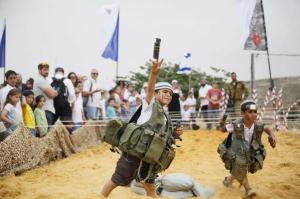 Standing at a Hamas training camp, Doucet laments: “For the outside world it’s hard to comprehend why parents would put children in situations like this.” But there’s no exploration of how Israel as a militarist, occupying state has conditioned so much of its own population to join in the historic oppression and mass murder of Palestinians. Indeed, the word ‘occupation’ is never used.
At one point, Doucet sits with the smiling Gazan kids and asks one of them: ‘Why do you want to be a journalist?’ The child replies in lovely innocence: ‘So I can tell people what’s going on in wars like this one’. If only Doucet could aspire to that same basic aim. One might ask Doucet, in turn: Why do you want to be a stenographer rather than a journalist?
We see more pictures of Gaza’s ruins. Doucet says: “The donors promise a lot. But politics on all sides gets in the way.” This is the extent of her ‘explanation’ of the carnage Israel has caused, the devastation it’s unleashed, its refusal to help rebuild.
Doucet’s grating commentary, over inappropriately lilting music, continues, with affected questions on whether the hate and suspicion can ever be overcome.
A scene of more families coming to settle in Israel’s border locale raises not a word of comment on the nature of Israel’s land appropriation, historic displacement of people and enduring occupation. The indoctrination of Israeli children in defending this is never mentioned, nor is the stark privilege of Israeli kids against the appalling conditions and despair of the children in Gaza. Doucet just smiles and says nothing of the staggering disparities.
I hope the families that Doucet interviewed in Gaza get to see how they’ve been used and exploited in this shabby, deceitful film.
An end credit announces that both Israel and Hamas could be indicted for war crimes, and that: ‘In May and June there were more rounds of rockets fired from Gaza and Israeli airstrikes’, the clear inference, as throughout this deeply-loaded film, that Israel is always ‘responding’ to provocative weaponry.
This is one of the worst examples of ‘two sides’ reportage ever shown. Israel couldn’t have hoped for a greater piece of mitigating hasbara. Doucet’s film is one of the most shameful pieces of ‘war journalism’ ever put out by the BBC.
She doesn’t lack human empathy for the suffering Palestinian kids, such as little Syed, still haunted by the murder of his brother and three cousins on Gaza’s beach. What she lacks, much more profoundly, is a sense of compassionate duty to say why these appalling things happened, and are still happening, to name the principal perpetrators, to be a witness for truth and justice.
Doucet’s film is an abuse of journalism, and, in its pretentious evasions, an abuse of Gaza’s suffering children.
Featured Video

The Most Important Bet You’ve Never Heard Of
or go to
Aletho News Archives – Video-Images
From the Archives
The Occupied Mentality Syndrome
Saudi Arabia on the American chessboard – Part 2
By B. J. Sabri | American Herald Tribune | April 19, 2016
Since the Korean War, but particularly since the Iranian Revolution of 1979 until today, the United States has been steadily escalating its military presence in the Persian Gulf. Taking advantage of many colossal events of the past 36 years, [1] the hyper-empire has institutionalized its massive presence on land and sea, and expanded its objectives to include the unambiguous physical control of the area, as well as the clear understanding that local Arab governments should abide by them. The pretext is always the same: in “defense” of the national interests and security of the United States. From observing how the United States has been interacting with the governments of the region, and by judging from the size of its expeditionary force, we could reach a basic conclusion. The United States is occupying, de facto, the entire Arabian Peninsula. (Yemen, devastated by Saudi and American jets is yet to be conquered. Oman? Britain returned not as colonial ruler but as a soft occupying power.)
Under this articulation, Saudi Arabia, Qatar, Kuwait, and the United Arab Emirates are virtually occupied countries. If we compare this type of occupation to the mandate and protectorate regimes of the past, the results might be identical—the nations affected by it lose sovereignty. When Arab governments comply with the objectives of a foreign power that station military forces on their national milieu, then that power controls them in multiple ways including how they react to policy deliberations and what decisions they intend to take on specific issues. A good method to verify the concept of effective occupation is this: take notice of what the United States says and wants, and then compare it to what the gulf rulers do in response. (I shall discuss this detail at some point in the upcoming parts.)
If the presence of US forces or other means of political pressure are a factor in Saudi Arabia’s interventionist Arab wars, then we need to debate this issue. However, from the history of resistance to colonialism, we learnt: if a powerful state imposes its order on a nation by military means or other forms of coercion, and if this nation does not resist that imposition, then a mental subordination to the powerful state will ensue. This is especially true in the case of Saudi Arabia. One single event, 9/11, has transformed it from a US “ally” into an instant political hostage of the American Empire. … continue
Blog Roll
 Aletho News
- Official reveals evidence of Arab states’ involvement in US-Israeli war on Iran
- His Majesty’s head-chopper: Syria’s MI6-backed president bows to King Charles
- Forced to backtrack: ‘Israel’ drops Hezbollah disarmament goal
- Britain’s Lebanon surveillance network: A digital map for war
- Bahrain faces scrutiny for opposition crackdown after detainee killed
- Hegseth’s Pentagon Purge Designed to Prevent a Mutiny: Karen Kwiatkowski
- Greek shipping firms secretly transporting oil, weapons to Israel
- UN vote on Hormuz force delayed as Iran issues warning
- Trump and the debris of Iran war
- IRGC hits US tech giant Oracle’s data center, computing site in UAE over new assassinations
- If Americans Knew
- Israel-US kill negotiators, destroy civilian structures, but Iran’s military capabilities still largely intact – Daily Update
- ‘War crime’: Global condemnation as Israeli ministers celebrate death penalty law targeting Palestinian prisoners
- 7 Ways Israel Is Turning Lebanon Into Gaza
- World’s Leading Football Bodies Under Fire Over Israel Policies
- Experts warn of possible use of nukes against Iran
- Israeli invasion of Lebanon could be worse than 1982, warn European officials
- Passover: Liberation and collective punishment
- Trump says the quiet part out loud: (Israel’s) war on Iran > Americans’ health – Daily Update
- Gaza families reunite years after babies evacuated amid Israel’s war
- International Rescue Committee warns Gaza’s children face grave protection risks
- No Tricks Zone
- Low Intensity Tornado Wrecks Major Solar Farm, Creating A Potential Toxic Dump
- New Study Finds Warming Saves Lives…Cold Temperatures 12 Times More Deadly Than Excess Heat
- German Science Blog Accuses PIK Climate Institute Of Hallucinating Climate Tipping Points
- Devastating Assessment Of Comirnaty Vaccine By Former Senior Pfizer Europe Toxicologist
- New Study: CO2 Is ‘Effectively Negligible’ As An Explanatory Climate Change Factor Since 2000
- Former Pfizer Toxicologist Dr. Helmut Sterz Tells Bundestag Hearing Pfizer Vaccine Should Have Never Been Approved
- Energy Expert: Germany’s Nuclear Phaseout Was A “500 Billion Euro Mistake”
- New Research: South Australia’s Mid-Holocene Sea Surface Temperatures Were 4°C Warmer Than Today
- Storing Green Energy To Last Germany 10 Days Would Require A 60-Million Tonne Battery
- New Studies: UK Sea Levels Were 4 Meters Higher Than Today During The Mid-Holocene
 Aletho News