Guardians of the Magnitsky Myth
By Robert Parry | Consortium News | October 28, 2017
As Russia-gate becomes the go-to excuse to marginalize and suppress independent and dissident media in the United States, a warning of what the future holds is the blacklisting of a documentary that debunks the so-called Magnitsky case.

Hedge-fund executive William Browder
The emerging outlines of the broader suppression are now apparent in moves by major technology companies – under intense political pressure – to unleash algorithms that will hunt down what major media outlets and mainstream “fact-checkers” (with their own checkered histories of getting facts wrong) deem to be “false” and then stigmatize that information with pop-up “warnings” or simply make finding it difficult for readers using major search engines.
For those who believe in a meaningful democracy, those tactics may be troubling enough, but the Magnitsky case, an opening shot in the New Cold War with Russia, has demonstrated how aggressively the Western powers-that-be behave toward even well-reported investigative projects that unearth inconvenient truth.
Throughout the U.S. and Europe, there has been determined effort to prevent the American and European publics from seeing this detailed documentary that dissects the fraudulent claims at the heart of the Magnitsky story.
The documentary – “The Magnitsky Act: Behind the Scenes” – was produced by filmmaker Andrei Nekrasov, who is known as a fierce critic of Russian President Vladimir Putin but who in this instance found the West’s widely accepted, anti-Russian Magnitsky storyline to be a lie.
However, instead of welcoming Nekrasov’s discoveries as an important part of the debate over the West’s policies toward Russia, the European Parliament pulled the plug on a premiere in Brussels and – except for a one-time showing at the Newseum in Washington – very few Americans have been allowed to see the documentary.
Instead, we’re fed a steady diet of the frothy myth whipped up by hedge-fund investor William Browder and sold to the U.S. and European governments as the basis for sanctioning Russian officials. For years now, Browder has been given a free hand to spin his dog-ate-my-homework explanation about how some of his firms got involved a $230 million tax fraud in Russia.
Browder insists that some “corrupt” Russian police officers stole his companies’ corporate seals and masterminded a convoluted conspiracy. But why anyone would trust a hedge-fund operator who got rich exploiting Russia’s loose business standards is hard to comprehend.
The answer is that Browder has used his money and political influence to scare off and silence anyone who dares point to the glaring contradictions and logical gaps in his elaborate confection.
So, the hedge-fund guy who renounced his U.S. citizenship in favor of a British passport gets the royal treatment whenever he runs to Congress. His narrative just fits so neatly into the demonization of Russia and the frenzy over stopping “Russian propaganda and disinformation” by whatever means necessary.
This summer, Browder testified before the Senate Judiciary Committee and argued that people involved in arranging the one-time showing of Nekrasov’s documentary should be prosecuted for violating the Foreign Agent Registration Act (FARA), which carries a five-year prison term.
Meanwhile, the U.S. mainstream media helps reinforce Browder’s dubious tale by smearing anyone who dares question it as a “Moscow stooge” or a “useful idiot.”
Magnitsky and Russia-gate
The Magnitsky controversy now has merged with the Russia-gate affair because Russian lawyer Natalia Veselnitskaya, who traveled to America to challenge Browder’s account, arranged a meeting with Donald Trump Jr. and other Trump campaign advisers in June 2016 to present this other side of the story.
Though nothing apparently came from that meeting, The New York Times, which always treats Browder’s account as flat fact, led its Saturday editions with a breathless story entitled, “A Kremlin Link to a Memo Taken to Trump Tower,” citing similarities between Veselnitskaya’s memo on the Magnitsky case and an account prepared by “one of Russia’s most powerful officials, the prosecutor general Yuri Y. Chaika.” Cue the spooky music as the Times challenges Veselnitskaya’s honesty.
Yet, the Times article bows to Browder as the ultimate truth-teller, including repetition of his assertion that Sergei Magnitsky was a whistleblowing “tax lawyer,” rather than one of Browder’s accountants implicated in the tax fraud.
While Magnitsky’s profession may seem like a small detail, it gets to the heart of the mainstream media’s acceptance of Browder’s depiction of Magnitsky – as a crusading lawyer who died of medical neglect in a Russian prison – despite overwhelming evidence that Magnitsky was really a clever accountant caught up in the scheme.
The “lawyer” falsehood – so eagerly swallowed by the Times and other mainstream outlets – also bears on Browder’s overall credibility: If he is lying about Magnitsky’s profession, why should anyone believe his other self-serving claims?
As investigative reporter Lucy Komisar noted in a recent article on the case, Browder offered a different description when he testified under oath in a New York court deposition in a related criminal case.
In that adversarial setting, when Browder was asked if Magnitsky had a law degree, Browder said, “I’m not aware that he did.” When asked if Magnitsky had gone to law school, Browder answered: “No.”
Yet, the Times and the rest of the mainstream media accept that Magnitsky was a “lawyer,” all the better to mislead the American public regarding his alleged role as a whistleblower.
The rest of Browder’s story stretches credulity even more as he offers a convoluted explanation of how he wasn’t responsible for bogus claims made by his companies to fraudulently sneak away with $230 million in refunded taxes.
Rather than show any skepticism toward this smarmy hedge-fund operator and his claims of victimhood, the U.S. Congress and mainstream media just take him at his word because, of course, his story fits the ever-present “Russia bad” narrative.
Plus, these influential people have repeated the falsehoods so often and suppressed contrary evidence with such arrogance that they apparently feel that they get to define reality, which – in many ways – is what they want to do in the future by exploiting the Russia-gate hysteria to restore their undisputed role as the “gatekeepers” on “approved” information.
Which is why Americans and Europeans should demand the right to see the Nekrasov documentary and make their own judgments, possibly with Browder given a chance after the show to rebut the overwhelming evidence of his deceptions.
Instead, Browder has used his wealth and connections to make sure that almost no one gets to see the deconstruction of his fable. And The New York Times is okay with that.
[For details on the Nekrasov documentary, see Consortiumnews.com’s “A Blacklisted Film and the New Cold War.”]
Investigative reporter Robert Parry broke many of the Iran-Contra stories for The Associated Press and Newsweek in the 1980s.
The Skewed Depiction of Colonialism in “Victoria and Abdul”

By Kate Harveston | American Herald Tribune | October 3, 2017
Some will tell you that we should no longer be obligated to bear the sins of our nation’s past, playing the masochistic martyr and ignoring any spatiotemporal context. However, what they don’t understand is that it’s less about bearing responsibility for something in the past and more about being balanced when portraying it and bringing it back to life. The real issue comes into play when a past contentious issue is exploited and monetized with bias. Colonialism in today’s supposedly civilized society is a caricature of inequality and what progressive culture is against.
The movie Victoria and Abdul was recently released. In it, Stephen Frears tells the story of Queen Victoria, who is played by Dame Judi Dench, and her unlikely friendship with Abdul, who is played by Ali Fazal. What follows is an intentionally romanticized version of an otherwise unsettling story within tragic circumstances.
The Matter of the Movie
Queen Victoria is introduced to Abdul, an Indian servant who is shipped from India without any choice, to gift the queen with a coin. The queen is characterized as an exceptionally enlightened monarch and, ironically, almost as an egalitarian. In one scene, she accuses her court of being racialists, therefore doubtlessly endearing the character to a 21st-century audience.
Abdul, on the other hand, has barely any character at all. He’s objectified as a mere prop to only reflect the wonder of the queen and the glory of the Empress of India. Treated as some sort of bright and sparkly new toy or exotic pet, Abdul is portrayed as eternally grateful for having been brought to England for the great privilege of being part of this glorious people.
What is even more peculiar is that Frears’ Abdul seems to absolve any wrongdoing by the Queen — even when his fellow Indian servant dies as an ill-treated slave to the British. This all culminates in the final shot which epitomizes everything absolutely ill-considered and just frankly wrong about the film. It shows Abdul, having returned to India, kissing the feet of Queen Victoria’s statue in front of the Taj Mahal.
The overriding issue with period dramas such as Victoria and Abdul is that they romanticize colonialism and sell it to the masses as light entertainment. This is a direct insult against the historic abuse and injustices that colonized countries faced at the hands of the ruling empire of the time. Unfortunately, it’s not only the media. Even the royals, to this day, should be more cautious of how they represent their past link with India.
The Darker Reality
The reality was that the Victorian era was accountable for horrific atrocities in India, both on a humanitarian and an economic level. Shashi Tharoor has been particularly vocal about how Britain furthered its own industrial revolution by decimating India’s accrued share of the world economy. The nature of this profiteering had appalling and disastrous consequences.
Through Britain’s exploitation of India’s agricultural products like grain, the Indian people found themselves in unimaginable poverty — an epidemic of poverty in which 20 million people are thought to have died. The Great Famine and the Indian Famine, however, are rarely talked about.
Furthermore, the evils that India suffered under the British Raj were not only confined to tragedies that resulted from consequences of otherwise economically motivated actions, but also through direct aggression and violence driven by racism. The Amritsar massacre in 1919 saw a major murder spree of peaceful, nonviolent protestors. Over 1,000 Indians perished by gunfire at the hands of the British army.
How, then, can the film and television world and British media in general so easily gloss over such unimaginable injustices with nostalgia, romanticism and even comedy? Well, the problem goes slightly deeper than just monetization. Even though Frears knew what he was doing and will doubtless enjoy a profit from appealing to the audience via this whitewashed and jewel-encrusted version of colonialism, far too few people will even identify a problem with it. This is due to Britain’s own brand of causal propaganda.
British history — where Britain institutionalized pain and suffering of seemingly lesser peoples — has barely been featured in the country’s history books. It wasn’t only injustices in India that have been ignored in both media as well as education. Britain invented the world’s first concentration camps in South Africa, where Boer settlers were incarcerated, raped and worked to death. When referring to the deaths of over 25,000 Boer women and children, Lloyd George, future Prime Minister of Great Britain, said, “We are simply ranging the deepest passions of the human heart against British rule in Africa.” However, today’s generation only hears of how Britain stood against the Afrikaners during Apartheid.
Given that it’s now 2017, and that Britain is one of the forerunners in the international fight against illiberal governing, surely admitting your own nation’s past and bearing your mistakes by way of example is the more inclusive route to encouraging true democracies. In that way, producers, writers and directors of British film and television have a real responsibility here, and need to examine the racist injustices Britain has built itself upon. The victims of the past, current and future would be less offended, and healing and peace processes could begin to be brokered.
Skeptic Beating Al Gore on Amazon
By Roy W. Spencer, Ph. D. | August 24th, 2017
Al Gore’s new movie, An Inconvenient Sequel: Truth to Power, has been in theaters for about a month now, and has received rather tepid reviews.
The Kindle e-book version of Gore’s movie, despite being very colorful, has been doing even worse and is currently running at #20,768 overall on Amazon, and is not ranked #1 in any sub-category.
But the skeptic take-down of Gore’s new movie and book, An Inconvenient Deception: How Al Gore Distorts Climate Science and Energy Policy, is at #956, and is #1 in three sub-categories.
What makes the discrepancy even worse is that An Inconvenient Deception was self published, with no paid advertising.
Maybe people are finally wising up to Mr. Gore.
Al Gore: “Truth to Power” – Carrying Propaganda to the Great Unconscious
Penny For Your Thoughts | August 4, 2017
Al Gore – Truth to Power. Really? Yup, Truth to Power! Al Gore & Truth to Power??
I’m scratchin’ my head! That title, alongside the very concept of Al Gore speaking truth to power, is preposterous. And yet many people will be enamoured of this very idea.
Choosing to ignore the FACT that Al Gore has long been a part of the very power problem the rest of us have had to deal with. The very idea/ concept of Gore as a speaker of “Truth to Power” is so absurd. So inconsistent with reality, Truth &common sense that it can only be concluded the title was chosen as some kind of bad joke on all of us.
In fact, I can’t imagine a more surreal title for a Hollywood movie/documentary/psyop.
And yet in our bizarro world- There it is. An Inconvenient Sequel: Truth to Power.
While reading about this movie, it’s worth keeping in mind the reality of what Hollywood is. Perception Management/Culture creation/Citizen manipulation
“The American motion picture is the greatest unconscious carrier of propaganda in the world to-day. It is a great distributor for ideas and opinions. The motion picture can standardize the ideas and habits of a nation.” ( Edward Bernays 1928)
Nothing has changed from the time of Bernay’s statement to date. Nothing! We’ve just recently witnessed the “White Helmets” winning an Oscar. Of course Al Gore’s first “documentary” was an Oscar winner also. This should speak volumes to us all. Prestigious awards used to hoodwink the masses. […]
And Al Gore’s first documentary won an Oscar. Same as the White Helmets. Can you imagine the ridiculousness in both those wins? Wonder if this new one will be so duly honoured?
 Tomorrow Al Gore’s latest “documentary” is set to hit the theatres here in Canada.
Yup, he’s still speaking truth to power. And if you really believe that… Check your critical thinking skills, please!
Of course I have zero intention of ever watching this movie. Just like I have zero intention of ever forcing the White Helmets documentary into my conscious or unconscious mind for that matter.
I’ve noticed a plethora of fear mongering “news” stories regarding “climate change” or as I prefer, AGW, today. These are undoubtedly timed and should be considered as promotional material for the Al Gore “Truth to Power” Perception management flick.
And, I cannot forget to mention that this documentary will surely, as is intended, inflame the left/ right identity politics divide.
Checking critical thinking: Terrence Corcoran
Please don’t say- Oh, he’s a right wing guy, a capitalist and any other labels that serve as distraction from the very good points he is making.
“Not many people remember Al Gore’s 2007 book, The Assault on Reason.
Then there’s the book jacket that talks about the “politics of fear” and an opening chapter that warns: “If leaders exploit public fears to herd people in directions they might not otherwise choose, then fear itself can quickly become a self-perpetuating and free-wheeling force that drains national will and weakens national character.”
A propaganda manual to fill readers with alarming images and claims
Fear, adds Al Gore the great climate fear-monger, can be promulgated using three techniques: repetition, misdirection and making the irregular seem regular. “By using these narrative tools alone, anyone with a loud platform can ratchet up public anxieties and fears, distorting public discourse and reason.”
Gore’s politics-of-fear warning in 2007 targeted George W. Bush for allegedly resorting to fear of terrorism to invade Iraq. Irony awareness is apparently not part of Gore’s personality.
Irony awareness is definitely not part of Gore’s personality. The irony of Gore speaking “Truth to Power” is not lost on myself!
Chang fed Gore a flabby question about Canada that was bound to produce the following: “For me, Justin Trudeau is a breath of fresh air…He and his team were absolutely instrumental in helping us get the Paris agreement.” Funny, I thought Stephen Harper set the ground for Canada’s participation in the Paris agreement.
Why yes it was the Harper government that laid the ground work for Paris.
Of course there is a book with lots of images, and not too many words, to accompany and reinforce the unconscious carrier of propaganda film It’s hard for the masses to understand words– So like small children loving their picture books- Al Gore spreads his rubbish via imagery.
As a propaganda manual, Sequel uses a magazine-style format to fill readers with alarming images and claims. There are graphs and pictures of soaring carbon emissions and temperatures, hurricane deaths, famines, rising sea levels, drownings, forest fires, droughts and more. Typical statement: “We are now trapping as much extra heat energy in the atmosphere as would be released by 400,000 Hiroshima-class atomic bombs on the Earth’s surface every day.” Those few words of text appear over a giant colour photo of an iconic atomic bomb explosion spread across two full pages.
A Blacklisted Film and the New Cold War
By Robert Parry | Consortium News | August 2, 2107
Why is the U.S. mainstream media so frightened of a documentary that debunks the beloved story of how “lawyer” Sergei Magnitsky uncovered massive Russian government corruption and died as a result? If the documentary is as flawed as its critics claim, why won’t they let it be shown to the American public, then lay out its supposed errors, and use it as a case study of how such fakery works?

Film director Andrei Nekrasov
Instead we – in the land of the free, home of the brave – are protected from seeing this documentary produced by filmmaker Andrei Nekrasov who was known as a fierce critic of Russian President Vladimir Putin but who in this instance found the West’s widely accepted Magnitsky storyline to be a fraud.
Instead, last week, Senate Judiciary Committee members sat in rapt attention as hedge-fund operator William Browder wowed them with a reprise of his Magnitsky tale and suggested that people who have challenged the narrative and those who dared air the documentary one time at Washington’s Newseum last year should be prosecuted for violating the Foreign Agent Registration Act (FARA).
It appears that Official Washington’s anti-Russia hysteria has reached such proportions that old-time notions about hearing both sides of a story or testing out truth in the marketplace of ideas must be cast aside. The new political/media paradigm is to shield the American people from information that contradicts the prevailing narratives, all the better to get them to line up behind Those Who Know Best.
Nekrasov’s powerful deconstruction of the Magnitsky myth – and the film’s subsequent blacklisting throughout the “free world” – recall other instances in which the West’s propaganda lines don’t stand up to scrutiny, so censorship and ad hominem attacks become the weapons of choice to defend “perception management” narratives in geopolitical hot spots such as Iraq (2002-03), Libya (2011), Syria (2011 to the present), and Ukraine (2013 to the present).
But the Magnitsky myth has a special place as the seminal fabrication of the dangerous New Cold War between the nuclear-armed West and nuclear-armed Russia.
In the United States, Russia-bashing in The New York Times and other “liberal media” also has merged with the visceral hatred of President Trump, causing all normal journalistic standards to be jettisoned.
A Call for Prosecutions
Browder, the American-born co-founder of Hermitage Capital Management who is now a British citizen, raised the stakes even more when he testified that the people involved in arranging a one-time showing of Nekrasov’s documentary, “The Magnitsky Act: Behind the Scenes,” at the Newseum should be held accountable under FARA, which has penalties ranging up to five years in prison.
Browder testified: “As part of [Russian lawyer Natalie] Veselnitskaya’s lobbying, a former Wall Street Journal reporter, Chris Cooper of the Potomac Group, was hired to organize the Washington, D.C.-based premiere of a fake documentary about Sergei Magnitsky and myself. This was one the best examples of Putin’s propaganda.
“They hired Howard Schweitzer of Cozzen O’Connor Public Strategies and former Congressman Ronald Dellums to lobby members of Congress on Capitol Hill to repeal the Magnitsky Act and to remove Sergei’s name from the Global Magnitsky bill. On June 13, 2016, they funded a major event at the Newseum to show their fake documentary, inviting representatives of Congress and the State Department to attend.
“While they were conducting these operations in Washington, D.C., at no time did they indicate that they were acting on behalf of Russian government interests, nor did they file disclosures under the Foreign Agent Registration Act. United States law is very explicit that those acting on behalf of foreign governments and their interests must register under FARA so that there is transparency about their interests and their motives.
“Since none of these people registered, my firm wrote to the Department of Justice in July 2016 and presented the facts. I hope that my story will help you understand the methods of Russian operatives in Washington and how they use U.S. enablers to achieve major foreign policy goals without disclosing those interests.”
Browder’s Version
While he loosely accused a number of Americans of felonies, Browder continued to claim that Magnitsky was a crusading “lawyer” who uncovered a $230 million tax-fraud scheme carried out ostensibly by Browder’s companies but, which, according to Browder’s account, was really engineered by corrupt Russian police officers who then arrested Magnitsky and later were responsible for his death in a Russian jail.

Sergei Magnitsky
Browder’s narrative has received a credulous hearing by Western politicians and media already inclined to think the worst of Putin’s Russia and willing to treat Browder’s claims as true without serious examination. However, beyond the self-serving nature of Browder’s tale, there are many holes in the story, including whether Magnitsky was really a principled lawyer or instead a complicit accountant.
According to Browder’s own biographical description of Magnitsky, he received his education at the Plekhanov Institute in Moscow, a reference to Plekhanov Russian University of Economics, a school for finance and business, not a law school.
Nevertheless, the West’s mainstream media – relying on the word of Browder – has accepted Magnitsky’s standing as a “lawyer,” which apparently fits better in the narrative of Magnitsky as a crusading corruption fighter rather than a potential co-conspirator with Browder in a complex fraud, as the Russian government has alleged.
Magnitsky’s mother also has described her son as an accountant, although telling Nekrasov in the documentary “he wasn’t just an accountant; he was interested in lots of things.” In the film, the “lawyer” claim is also disputed by a female co-worker who knew Magnitsky well. “He wasn’t a lawyer,” she said.
In other words, on this high-profile claim repeated by Browder again and again, it appears that presenting Magnitsky as a “lawyer” is a convenient falsehood that buttresses the Magnitsky myth, which Browder constructed after Magnitsky’s death from heart failure while in pre-trial detention.
But the Magnitsky myth took off in 2012 when Browder sold his tale to neocon Senators Ben Cardin, D-Maryland, and John McCain, R-Arizona, who threw their political weight behind a bipartisan drive in Congress leading to the passage of the Magnitsky sanctions act, the opening shot in the New Cold War.
A Planned Docudrama
Browder’s dramatic story also attracted the attention of Russian filmmaker Andrei Nekrasov, a well-known critic of Putin from previous films. Nekrasov set out to produce a docudrama that would share Browder’s good-vs.-evil narrative to a wider public.
Nekrasov devotes the first half hour of the film to allowing Browder to give his Magnitsky account illustrated by scenes from Nekrasov’s planned docudrama. In other words, the viewer gets to see a highly sympathetic portrayal of Browder and Magnitsky as supposedly corrupt Russian authorities bring charges of tax fraud against them.
However, Nekrasov’s documentary project takes an unexpected turn when his research turns up numerous contradictions to Browder’s storyline, which begins to look more and more like a corporate cover story. For instance, Magnitsky’s mother blames the negligence of prison doctors for her son’s death rather than a beating by prison guards as Browder had pitched to Western audiences.
Nekrasov also discovered that a woman who had worked in Browder’s company blew the whistle before Magnitsky talked to police and that Magnitsky’s original interview with authorities was as a suspect, not a whistleblower. Also contradicting Browder’s claims, Nekrasov notes that Magnitsky doesn’t even mention the names of the police officers in a key statement to authorities.
When one of the Browder-accused police officers, Pavel Karpov, filed a libel suit against Browder in London, the case was dismissed on technical grounds because Karpov had no reputation in Great Britain to slander. But the judge seemed sympathetic to the substance of Karpov’s complaint.
Browder claimed vindication before adding an ironic protest given his successful campaign to prevent Americans and Europeans from seeing Nekrasov’s documentary.
“These people tried to shut us up; they tried to stifle our freedom of expression,” Browder complained. “[Karpov] had the audacity to come here and sue us, paying high-priced libel lawyers to come and terrorize us in the U.K.”
The ‘Kremlin Stooge’ Slur
A pro-Browder account published at the Daily Beast on July 25 – attacking Nekrasov and his documentary – is entitled “How an Anti-Putin Filmmaker Became a Kremlin Stooge,” a common slur used in the West to discredit and silence anyone who dares question today’s Russia-hating groupthink.
The article by Katie Zavadski accuses Nekrasov of being in the tank for the Kremlin and declares that “The movie is so flattering to the Russian narrative that Pavel Karpov — one of the police officers accused of being responsible for Magnitsky’s death — plays himself.”
But that’s not true. In fact, there is a scene in the documentary in which Nekrasov invites the actor who plays Karpov in the docudrama segment to sit in on an interview with the real Karpov. There’s even a clumsy moment when the actor and police officer bump into a microphone as they shake hands, but Zavadski’s falsehood would not be apparent unless you had somehow gotten access to the documentary, which has been effectively banned in the West.
In the documentary, Karpov, the police officer, accuses Browder of lying about him and specifically contests the claim that he (Karpov) used his supposedly ill-gotten gains to buy an expensive apartment in Moscow. Karpov came to the interview with documents showing that the flat was pre-paid in 2004-05, well before the alleged hijacking of Browder’s firms.
Karpov added wistfully that he had to sell the apartment to pay for his failed legal challenge in London, which he said he undertook in an effort to clear his name. “Honor costs a lot sometimes,” the police officer said.
Karpov also explained that the investigations of Browder’s tax fraud started well before the Magnitsky controversy, with an examination of a Browder company in 2004.
“Once we opened the investigation, a campaign in defense of an investor started,” Karpov said. “Having made billions here, Browder forgot to tell how he did it. So it suits him to pose as a victim. … Browder and company are lying blatantly and constantly.”
However, since virtually no one in the West has seen this interview, you can’t make your own judgment as to whether Karpov is credible or not.
A Painful Recognition
Yet, in reviewing the case documents and noting Browder’s inaccurate claims about the chronology, Nekrasov finds his own doubts growing. He discovers that European officials simply accepted Browder’s translations of Russian documents, rather than checking them independently. A similar lack of skepticism prevailed in the United States.
In other words, a kind of trans-Atlantic groupthink took hold with clear political benefits for those who went along and almost no one willing to risk the accusation of being a “Kremlin stooge” by showing doubt.
As the documentary proceeds, Browder starts avoiding Nekrasov and his more pointed questions. Finally, Nekrasov hesitantly confronts the hedge-fund executive at a party for Browder’s book, Red Notice, about the Magnitsky case.
The easygoing Browder of the early part of the documentary — as he lays out his seamless narrative without challenge — is gone; instead, a defensive and angry Browder appears.
“It’s bullshit,” Browder says when told that his presentations of the documents are false.
But Nekrasov continues to find more contradictions and discrepancies. He discovers evidence that Browder’s web site eliminated an earlier chronology that showed that in April 2008, a 70-year-old woman named Rimma Starova, who had served as a figurehead executive for Browder’s companies, reported the theft of state funds.
Nekrasov then shows how Browder’s narrative was changed to introduce Magnitsky as the whistleblower months later, although he was then described as an “analyst,” not yet a “lawyer.”
As Browder’s story continues to unravel, the evidence suggests that Magnitsky was an accountant implicated in manipulating the books, not a crusading lawyer risking everything for the truth.
A Heated Confrontation
In the documentary, Nekrasov struggles with what to do next, given Browder’s financial and political clout. Finally securing another interview, Nekrasov confronts Browder with the core contradictions of his story. Incensed, the hedge-fund executive rises up and threatens the filmmaker.
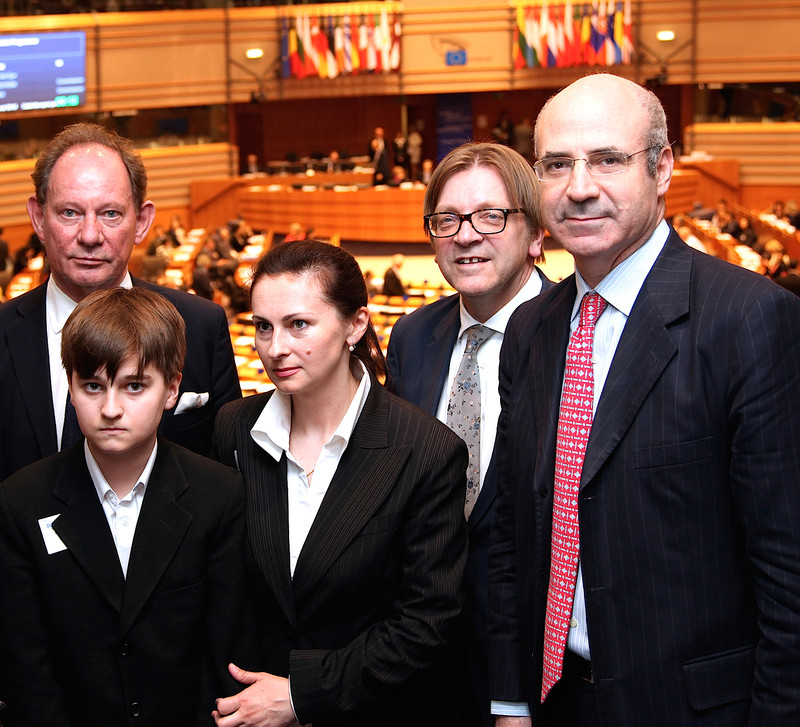
William Browder (right) with Magnitsky’s widow and son,
along with European parliamentarians.
“I’d be very careful going out and trying to do a whole sort of thing about Sergei [Magnitsky] not being the whistleblower, it won’t do well for your credibility on this show,” Browder said. “This is sort of the subtle FSB version,” suggesting that Nekrasov was just fronting for the Russian intelligence service.
In the pro-Browder account published at the Daily Beast on July 25, Browder described how he put down Nekrasov by telling him, “it sounds like you’re part of the FSB. … Those are FSB questions.”
But that phrasing is not what he actually says in the documentary, raising further questions about whether the Daily Beast reporter actually watched the film or simply accepted Browder’s account of it. (I posed that question to the Daily Beast’s Katie Zavadski by email, but have not gotten a reply.)
The documentary also includes devastating scenes from depositions of a sullen and uncooperative Browder and a U.S. government investigator, who acknowledges relying on Browder’s narrative and documents in a related case against Russian businesses.
In an April 15, 2015 deposition of Browder, he, in turn, describes relying on reports from journalists to “connect the dots,” including the Organized Crime and Corruption Reporting Project (OCCRP), which is funded by the U.S. government and financial speculator George Soros. Browder said the reporters “worked with our team.”
While taking money from the U.S. Agency for International Development and Soros, the OCCRP also targeted Ukraine’s elected President Viktor Yanukovych with accusations of corruption prior to the Feb. 22, 2014 coup that ousted Yanukovych, an overthrow that was supported by the U.S. State Department and escalated the New Cold War with Russia.
OCCRP played a key role, too, in the so-called Panama Papers, purloined documents from a Panamanian law firm that were used to develop attack lines against Russian President Vladimir Putin although his name never appeared in the documents.
After examining the money-movement charts published by OCCRP about the Magnitsky case, Nekrasov notes that the figures don’t add up and wonders how journalists could “peddle these wooly maths.” He also observed that OCCRP’s Panama Papers linkage of Magnitsky’s $230 million fraud and payments to an ally of Putin made no sense because the dates of the Panama Papers transactions preceded the dates of the alleged Magnitsky fraud.
The Power of Myth
Nekrasov suggests that the power of Browder’s convoluted story rested, in part, on a Hollywood perception of Moscow as a place where evil Russians lurk around every corner and any allegation against “corrupt” officials is believed. The Magnitsky tale “was like a film script about Russia written for the Western audience,” Nekrasov says.
But the Browder’s narrative also served a strong geopolitical interest to demonize Russia at the dawn of the New Cold War.
In the documentary’s conclusion, Nekrasov sums up what he had discovered: “A murdered hero as an alibi for living suspects.” He then ponders the danger to democracy: “So do we allow graft and greed to hide behind a political sermon? Will democracy survive if human rights — its moral high ground — is used to protect selfish interests?”
But Americans and Europeans are being spared the discomfort of having to answer that question or to question their representatives about the failure to skeptically examine this case that has pushed the planet on a course toward a possible nuclear war.
Instead, the mainstream Western media has hurled insults at Nekrasov even as his documentary is blocked from any significant public viewing.
Despite Browder’s professed concern about the London libel case that he claimed was an attempt “to stifle our freedom of expression,” he has sicced his lawyers on anyone who might be thinking about showing Nekrasov’s documentary to the public.
The documentary was set for a premiere at the European Parliament in Brussels in April 2016, but at the last moment – faced with Browder’s legal threats – the parliamentarians pulled the plug. Nekrasov encountered similar resistance in the United States. There were hopes to show the documentary to members of Congress but the offer was rebuffed. Instead a room was rented at the Newseum near Capitol Hill.
Browder’s lawyers then tried to strong arm the Newseum, but its officials responded that they were only renting out a room and that they had allowed other controversial presentations in the past.
“We’re not going to allow them not to show the film,” said Scott Williams, the Newseum’s chief operating officer. “We often have people renting for events that other people would love not to have happen.”
In an article about the controversy in June 2016, The New York Times added that “A screening at the Newseum is especially controversial because it could attract lawmakers or their aides.”
One-Time Showing
So, Nekrasov’s documentary got a one-time showing with a follow-up discussion moderated by journalist Seymour Hersh. However, except for that audience, the public of the United States and Europe has been essentially shielded from the documentary’s discoveries, all the better for the Magnitsky myth to retain its power as a seminal propaganda moment of the New Cold War.
After the Newseum presentation, a Washington Post editorial branded Nekrasov’s documentary Russian “agit-prop” and sought to discredit Nekrasov without addressing his many documented examples of Browder’s misrepresenting both big and small facts in the case.
Instead, the Post accused Nekrasov of using “facts highly selectively” and insinuated that he was merely a pawn in the Kremlin’s “campaign to discredit Mr. Browder and the Magnitsky Act.”
Like the recent Daily Beast story, which falsely claimed that Nekrasov let the Russian police officer Karpov play himself, the Post misrepresented the structure of the film by noting that it mixed fictional scenes with real-life interviews and action, a point that was technically true but willfully misleading because the fictional scenes were from Nekrasov’s original idea for a docudrama that he shows as part of explaining his evolution from a believer in Browder’s self-exculpatory story to a skeptic.
But the Post’s deception – like the Daily Beast’s falsehood – is something that almost no American would realize because almost no one has gotten to see the film.
The Post’s editorial gloated: “The film won’t grab a wide audience, but it offers yet another example of the Kremlin’s increasingly sophisticated efforts to spread its illiberal values and mind-set abroad. In the European Parliament and on French and German television networks, showings were put off recently after questions were raised about the accuracy of the film, including by Magnitsky’s family.
“We don’t worry that Mr. Nekrasov’s film was screened here, in an open society. But it is important that such slick spin be fully exposed for its twisted story and sly deceptions.”
The Post’s arrogant editorial had the feel of something you might read in a totalitarian society where the public only hears about dissent when the Official Organs of the State denounce some almost unknown person for saying something that almost no one heard.
It is also unlikely that Americans and Europeans will get a chance to view this blacklisted documentary in the future. In an email exchange, the film’s Norwegian producer Torstein Grude told me that “We have been unsuccessful in releasing the film to TV so far. ZDF/Arte [a major European network] pulled it from transmission a few days before it was supposed to be aired and the other broadcasters seem scared as a result. Netflix has declined to take it. …
“The film has no other release at the moment. Distributors are scared by Browder’s legal threats. All involved financiers, distributors, producers received thick stacks of legal documents (300+ pages) threatening lawsuits should the film be released.” [Grude sent me a special password so I could view the documentary on Vimeo.]
The blackout continues even though the Magnitsky issue and Nekrasov’s documentary have become elements in the recent controversy over a meeting between a Russian lawyer and Donald Trump Jr. [See Consortiumnews.com’s “How Russia-gate Met the Magnitsky Myth.”]
So much for the West’s vaunted belief in freedom of expression and the democratic goal of encouraging freewheeling debates about issues of great public importance. And, so much for the Post’s empty rhetoric about our “open society.”
Investigative reporter Robert Parry broke many of the Iran-Contra stories for The Associated Press and Newsweek in the 1980s.
View the film: https://swprs.org/the-magnitsky-act/
The National Geographic ‘Hell on Earth’ Syria Hoax
By Paul Larudee | Dissident Voice | July 6, 2017
On April 5, 2017, National Geographic released a preview of its film, Hell on Earth: The Fall Of Syria And The Rise of ISIS, by filmmaker Sebastian Junger and producing partner Nick Quested:
The film itself debuted on April 26, 2017, at the Tribeca Film Festival in New York and on the National Geographic channel on June 11. Junger and Quested persuaded NG to release the preview early, following the suspected chemical attacks in Syria on April 4.
There are, unfortunately, several problems with the footage in both the preview and the film, as well as with the claims made by the filmmakers and National Geographic. The most glaring of these is that the opening scene of the trailer is a total fraud.


The scene shows a missile destroying a residential building with a thunderous explosion. Imposed over the footage are the words, ALEPPO, SYRIA. The clear implication is that the missile is part of a Russian or Syrian Air Force attack in the battle for Aleppo.
But how would the videographer have known where to position the camera in preparation for such an attack? Surprisingly, there is a logical answer to this question, because there are, in fact, circumstances where victims are told in advance the location and time of a missile strike.
Such a location is Gaza, and the time is when Israeli soldiers call the inhabitants of a house by phone and tell them to get out in 15 minutes or be blown up. That is enough time for a neighbor to film the event, and, in fact, it has been done on multiple occasions in Gaza, such as here, here, here, here, here and here.
But in Aleppo, Syria? Who would call in advance? In this case, the explanation is rather different; i.e., that the footage is not from Aleppo at all, but, in fact, from Gaza and only labeled as Aleppo. The original source footage comes from 2014, and is from the Israeli operation that took more than 2,200 Palestinian lives that summer, long before the Russians started providing air support for the Syrian army:
The use of this footage in the National Geographic preview, falsely labeling the location as Aleppo and implicating the Syrian or Russian Air Force in the destruction, is therefore a shameless and utter fraud.
The second discrepancy is that, according to the filmmakers, the footage in the preview is from the feature film. That may have been true on April 5, when the public had not yet seen the full film, but at some point, someone must have brought the fraudulent footage to the attention of National Geographic, so that they could replace it with a new opening footage. When did this happen? Was it before the debut on April 26, or later? It would be good to know.
But the reaction of the filmmakers is disappointing in the extreme. When faced with proof positive that their film contained a blatant fraud, did no one question the extent to which the entire film might be filled with fraud? Anyone who would so obviously falsify would hardly limit it to a single segment. The footage was clearly chosen for its effect, not its accuracy, and its quiet removal is more a cover-up than a correction.
To what extent, for example, are the rescue portions of the preview and film, featuring the White Helmets, also fraud? Respected US Marine intelligence officer and UN weapons inspector Scott Ritter is convinced that the White Helmets are incompetent in rescue operations, and that their videos are fabrications. Recognized documentary filmmaker John Pilger has called them a “complete propaganda construct”. On occasion, the White Helmets have even been forced to admit the same.
To what extent is the featured family merely acting out the events portrayed and not actually living them? To what extent is it all contrived? These are questions that deserve investigation. More important, how true is the reality that the film tries to portray, whether simulated or not (although if simulated, the filmmakers should say so for the sake of their own integrity, rather than pretending it is genuine)?
The fact is that although half the Syrian population has been displaced by war, the majority have never left Syria. When displaced, they have almost invariably left the areas taken over by “rebels” in order to seek refuge in government controlled areas. Why? Is it because the Syrian government; i.e., the “despised” Bashar al-Assad – despite the disastrous economy and in cooperation with Syrian civil organizations – is somehow housing, feeding, clothing, educating and providing health care to these Syrian citizens? In fact, the United Nations High Commission on Refugees reports that, with the Syrian government reasserting its authority in recovered areas of the country, more than 440,000 displaced persons have returned to their homes.
The film also fails to mention that thousands of “rebel” fighters have laid down their arms, accepted Syrian government amnesty and been allowed to return to their homes. It further omits that the US and its allies could have stopped ISIS by merely denying them funding and arms. Russia was the one that largely put an end to the trafficking of stolen Syrian oil, by bombing the massive convoys of trucks across the Turkish border. No mention of that in the film. The US has avoided serious actions against ISIS and al-Qaeda, and treated them as useful hit men in order to destroy the Syrian military. This made us enablers of the terrorists rather than their eliminators.
As for the filmmakers, the New Yorker reports that “[they] couldn’t get into Syria, so … [the film] was shot by Middle Eastern news outfits, and by activists, witnesses, and citizen journalists.” This is reflected in the credits, which include the Aleppo Media Center, Daryaa [sic] Media Center, Halab News Network and Sham News. These are all affiliates of the White Helmets, which in turn is the front organization for the al-Qaeda affiliate in Syria, variously called Jabhat al-Nusra, Jabha Fateh al-Sham and Hayat Tahrir al-Sham. Their lavish funding comes from France, the UK, the US, Qatar and other countries. There is no evidence that any of the footage has been authenticated by the filmmakers themselves, and every reason to think that it has not.
It’s not that the film is totally inaccurate or that it does not do a service by revealing the suffering of refugees. It does. But it also perpetuates the worst western myths about the war, which are feeding a continuation of the suffering and the conflict. The US and its allies are the prime cause of the conflict, not the solution. US policy makers see the destruction of Syria as a positive thing, much as they do Iraq and Libya, and US efforts are directed toward destruction and control, not toward resolution and reconciliation.
If the filmmakers were honest, they would take the evidence of fraud as a sign that they need to review all the footage in the film that they have not authenticated and over which they have not exercised control. Otherwise, they run the risk of being labeled as propagandists and permanently damaging or ruining their credibility as documentary filmmakers.
Paul Larudee is one of the founders of the Free Gaza and Free Palestine Movements and an organizer in the International Solidarity Movement.
The Fraud of the White Helmets
Hollywood buys into yet another lie

By Philip Giraldi • Unz Review • July 4, 2017
I actually forced myself to watch the documentary The White Helmets, which is available on Netflix. It is 40 minutes long, is of high quality cinematographically speaking, and tells a very convincing tale that was promoted as “the story of real-life heroes and impossible hope.” It is overall a very impressive piece of propaganda, so much so that it has won numerous awards including the Oscar for Best Documentary Short this year and the White Helmets themselves were nominated for the Nobel Peace Prize. More to the point, however, is the undeniable fact that the documentary has helped shape the public understanding of what is going on in Syria, delivering a Manichean tale that depicts the “rebels” as always good and Bashar al-Assad and his government as un-redeemably evil.
It has been reliably reported that celebrities like George Clooney, Justin Timberlake and Hillary Clinton really like the White Helmets documentary and have promoted it with the understanding that it represents the truth about Syria, but it is, of course, not the whole story. The film, which was made by the White Helmets themselves without any external verification of what it depicts, portrays the group as “heroic,” an “impartial, life-saving rescue organization” of first responders. Excluded from the scenes of heroism under fire is the White Helmets’ relationship with the al-Qaeda affiliated group Jabhat al-Nusra and its participation in the torture and execution of “rebel” opponents. Indeed, the White Helmets only operate in rebel held territory, which enables them to shape the narrative both regarding who they are and what is occurring on the ground. Because of increasing awareness of the back story, there is now a growing movement to petition the Academy of Motion Picture Arts and Sciences to revoke the Oscar based on the complete and deliberate misrepresentation of what the White Helmets are all about.
Exploiting their access to the western media, the White Helmets have de facto become a major source of “eyewitness” news regarding what has been going on in those many parts of Syria where European and American journalists are quite rightly afraid to go. It is all part of a broader largely successful “rebel” effort to manufacture fake news that depicts the Damascus government as engaging in war crimes directed against civilians.
The White Helmets have certainly saved some lives under dangerous circumstances but they have also exaggerated their humanitarian role as they travel to bombing sites with their film crews trailing behind them. Once at the sites, with no independent observers, they are able to arrange or even stage what is filmed to conform to their selected narrative. They have consistently promoted tales of government atrocities against civilians to encourage outside military intervention in Syria and bring about regime change in Damascus. The White Helmets were, for example, the propagators of the totally false but propagandistically effective claims regarding the government use of so-called “barrel bombs” against civilians.
The White Helmets were a largely foreign creation that came into prominence in the aftermath of the unrest in Syria that developed as a result of the Arab Spring in 2012. They are currently largely funded by a number of non-government organizations (NGOs) as well as governments, including Britain and some European Union member states. The United States has directly provided $23 million through the USAID (US Agency for International Development) as of 2016 and almost certainly considerably more indirectly. Max Blumenthal has explored in some detail the various funding resources and relationships that the organization draws on, mostly in Europe and the United States.
Former weapons inspector Scott Ritter has described how the White Helmets are not actually trained to do the complicated rescue work that they depict in their self-made videos, which have established their reputation by ostensibly showing them in action inside Syria, rescuing civilians from bombed out structures, and providing life-saving emergency medical care. As an expert in Hazardous Materials handling with New York Task Force 2 USAR team, Ritter reports that “these videos represent de facto evidence of dangerous incompetence or, worse, fraud… The bread and butter of the White Helmet’s self-made reputation is the rescue of a victim—usually a small child—from beneath a pile of rubble, usually heavy reinforced concrete… The techniques used by the White Helmets are not only technically wrong, but dangerous to anyone who might actually be trapped… In my opinion, the videos are pure theater, either staged to impress an unwitting audience, or actually conducted with total disregard for the well being of any real victims.”
Ritter also cites the lack of training in hazardous chemicals, best observed in the videos provided by the White Helmets regarding their activity at Khan Sheikhun on April 4th. He notes “As was the case with their ‘rescues’ of victims in collapsed structures, I believe the rescue efforts of the White Helmets at Khan Sheikhun were a theatrical performance designed to impress the ignorant and ill-informed… Through their actions… the White Helmets were able to breathe life into the overall narrative of a chemical weapons attack, distracting from the fact that no actual weapon existed….”
But perhaps the most serious charge against the White Helmets consists of the evidence that they actively participated in the atrocities, to include torture and murder, carried out by their al-Nusra hosts. There have been numerous photos of the White Helmets operating directly with armed terrorists and also celebrating over the bodies of execution victims and murdered Iraqi soldiers. The group has an excellent working relationship with a number of jihadi affiliates and is regarded by them as fellow “mujahideen” and “soldiers of the revolution.”
So by all means let’s organize to revoke the White Helmets’ Oscar due to misrepresentation and fraud. It might even serve as a wake-up call to George Clooney and his fellow Hollywood snowflakes. But the bigger take-away from the tale of the White Helmets would appear to be how it is an unfortunate repeat of the bumbling by a gullible U.S. government that has wrecked the Middle East while making Americans poorer and less safe. A group of “moderates,” in this case their propagandists, is supported with weapons and money to overthrow a government with which Washington has no real quarrel but it turns out the moderates are really extremists. If they succeed in changing regime in Damascus, that is when the real nightmare will begin for minorities within Syria and for the entire region, including both Israel and Saudi Arabia, both of which seem intent on bringing Bashar al-Assad down. And the truly unfortunate fact is that the Israelis and Saudis apparently have convinced an ignorant Donald Trump that that is the way to go so the situation in Syria will only get worse and, unless there is a course correction, Washington will again richly deserve most of the blame.
A spook comes out of the woodwork to attack Brad Pitt’s ‘War Machine’
Netflix drama strikes a nerve …
By David Walsh | WSWS | June 21, 2017
Does art have social consequences? Does it matter which attitude filmmakers or novelists, for example, adopt toward the big events of the day?
Here’s a case that may help settle the argument or at least provides strong circumstantial evidence.
Three weeks ago we reviewed War Machine, the Netflix satire about Gen. Stanley McChrystal and the bloody, neo-colonial American war effort in Afghanistan.
We noted its unusually biting character. This is not a film that makes obeisance to the greatness of the US military. It presents the war in Afghanistan as “a debacle, presided over by lunatics and egomaniacs,” the WSWS review noted.
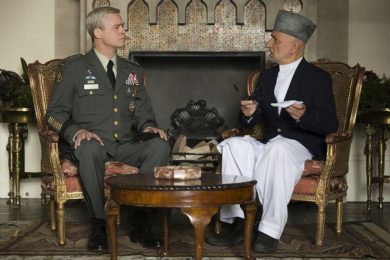
Brad Pitt and Ben Kingsley in War Machine
Written and directed by Australian David Michôd, and based on the 2012 non-fiction book, The Operators: The Wild and Terrifying Inside Story of America’s War in Afghanistan, by the late American journalist Michael Hastings, War Machine sarcastically hails the US in its opening moments, “Ah, America. You beacon of composure and proportionate response. You bringer of calm and goodness to the world.”
The WSWS noted that for once a film reflected some of the widespread hostility toward a quarter century of brutal war and toward the politicians and generals who have conducted it.
It was only fitting that a spokesperson for those war criminals would respond.
Whitney Kassel, late of the Defense Department, Special Operations in Afghanistan and Pakistan, a former member of McChrystal’s “team,” and an associate in private business of a long-time leading figure in the CIA, has written a denunciation of War Machine in Foreign Policy magazine, “Screw Brad Pitt and the ‘War Machine’ he rode in on.”
The unusually frank language of the headline presumably provides some sense of Kassel’s disapproval. Indeed, she acknowledges that her initial “eye-rolling quickly gave way to expletives.”
The character of Kassel’s objectivity in regard to Gen. McChrystal makes itself evident early on when she notes that Hastings (whose Rolling Stone article, later expanded into the book on which War Machine is based, essentially ended the general’s career) “took down a man I worked with during the time in question and deeply respected—one near-universally viewed as an American hero of integrity and intelligence.”
McChrystal was a ruthless practitioner of counterinsurgency warfare, responsible for the killing of thousands of Iraqis. His entourage in Afghanistan, according to Hastings, was “a handpicked collection of killers, spies, geniuses, patriots, political operators and outright maniacs.” A staffer neatly describes in Hasting’s book the now infamous Gen. Michael Flynn, one of McChrystal’s toadies, as a “rat on acid.”
Kassel presents the 16-year US-led intervention in Afghanistan as “a war effort that, while certainly replete with absurdities and mistakes, was and continues to be fought by men and women who are dedicated to improving the security of the United States and its allies by helping to build an Afghanistan that will not provide safe haven for al Qaeda or, more recently, the Islamic State.”

War Machine
This is a pack of lies. The US is not in Afghanistan to protect American lives, but to advance its interests in a geopolitically strategic area. The war has led to nothing but death, destruction and misery on a vast scale.
Kassel is particularly concerned that War Machine casts doubt on the legitimacy of the entire “war on terror,” the code phrase with which American imperialism has justified its drive for global hegemony since 2001.
She goes on: “Likewise—and this is the part that matters today—the portrayal of the U.S. and NATO’s very presence in the country since 2001 as rooted in fantasy and an inflated sense of American prowess is disingenuous and dangerous in its mischaracterization of a war that remains, particularly in the face of escalating violence and instability, an important part of reducing global terrorism.”
Kassel seems unaware that this last sentence contains an obvious contradiction. The longest war in US history has ostensibly been carried out in the name of “reducing global terrorism,” yet there is “escalating violence and instability.”
War Machine is not a primer in anti-imperialist politics, but it does make clear that the war in Afghanistan is a doomed project. The film’s narrator asks in the opening moments, “What do you do when the war you’re fighting just can’t possibly be won in any meaningful sense?”
The narrator further explains that the US military’s “counterinsurgency” strategy runs up against basic political realities: “When … you’ve just gone and invaded a place that you probably shouldn’t have, you end up fighting against just regular people in regular-people clothes. These guys are what are called insurgents. Basically, they’re just guys who picked up weapons ’cause … so would you, if someone invaded your country. Funnily enough … insurgencies are next to impossible to defeat.”
But Kassel inhabits a different political and moral universe. Her writing has the ghastly quality of the “democratic” military bureaucrat or intelligence agent, the muffled, perpetually disingenuous tone of the individual who plots bombings and murders and mass repression, but refers to such activities as “strategic options” and “the tools available for trying to turn around what was considered an urgent national security priority,” and half-believes her own obscurantism.
She presents a glowing picture of the same crowd among whom Hastings placed “killers … and outright maniacs.” Kassel writes: “I found McChrystal and his team to be respectful, thoughtful … McChrystal spent endless hours with the members of the assessment team [which included Kassel]—very few of whom had direct military experience—exploring the strategic options available to the United States and NATO.”
Toward the end of her tirade, Kassel once again expresses anxiety about the impact of War Machine and points to “a particular hazard,” that the film will reinforce “a view of the war in Afghanistan as this generation’s Vietnam, led by men … who care only about protecting their own egos and reputations, with no sense of the sacrifices inherent in war and no strategic vision or logic behind their decisions.”
She expresses nervousness about the “reworking” of the US approach to Afghanistan that Trump administration officials may be considering and asserts that “it is critical that they, and the American public to whom they report, understand how we got here, and the reasons why some elements of a counterinsurgency strategy may remain valid moving forward.”
Kassel, according to the Huffington Post, for whom she writes occasionally, “spent four years at the Office of the Secretary of Defense where she focused on Special Operations, Counterterrorism, and Pakistan policy. During this time she spent a year in Pakistan working for the Office of the Defense Representative and Special Operations Command Forward. She also served as the representative of the Secretary of Defense to General Stanley McChrystal’s Strategic Assessment Team in Afghanistan in 2009.”
This is someone up to her neck in imperialist violence and intrigue. At one point, Kassel served “as Assistant for Counterterrorism Policy in the Office of the Assistant Secretary of Defense for Special Operations, Low Intensity Conflict, and Interdependent Capabilities (ASD SO/LIC&IC) within the Office of the Under Secretary of Defense for Policy (OSD-Policy).”
Kassel, a Democratic Party supporter apparently, often tweets about women’s rights and racism—and Russian aggression! Of course, how could it be otherwise?
A special mention must be made of her association with the Arkin Group, the private intelligence firm, where she “served as a senior director focused on strategic analysis and risk management.”
A founding partner of the Arkin Group is Jack Devine, according to the company’s website, “a 32-year veteran of the Central Intelligence Agency (‘CIA’). Mr. Devine served as both Acting Director and Associate Director of CIA’s operations outside the United States from 1993-1995, where he had supervisory authority over thousands of CIA employees involved in sensitive missions throughout the world. In addition, he served as Chief of the Latin American Division from 1992-1993 and was the principal manager of the CIA’s sensitive projects in Latin America.”
In fact, Devine’s first foreign assignment was in Chile, where he arrived in August 1970. Even before being physically assigned there, he writes in his autobiography, Good Hunting: An American Spymaster’s Story, “I had worked the night shift for the Chile Task Force in Langley, synthesizing cables from Santiago into a morning intelligence report for the bosses.” Devine was present in Santiago in September 1973 when the Nixon administration and the CIA organized a coup, along with the Chilean military, that brought the brutal Pinochet dictatorship to power, which tortured and murdered tens of thousands of political opponents, trade unionists and young people.
The Arkin website also notes, “From 1985-1987, Mr. Devine headed the CIA’s Afghan Task Force, which successfully countered Soviet aggression in the region. In 1987, he was awarded the CIA’s Meritorious Officer Award for this accomplishment.”
In other words, Devine is one of the figures criminally responsible for arming and fomenting Islamic fundamentalism in Afghanistan as part of the effort to undermine the Soviet Union. In his own words, Devine moved “guns and ammunition across the border into Afghanistan,” aiding “the Afghan mujahideen and their determined opposition to the Soviet Union’s occupation of their country in the 1980s. I ran the last, and largest, cover operation of the Cold War.” The career of Osama bin Laden, Al Qaeda, the 9/11 terrorist attacks and ISIS itself all emerge, directly or indirectly, from this operation.
Devine and Kassel have co-authored numerous articles, including “Afghanistan: Withdrawal Lessons,” in the World Policy Journal, 2013. This cynical morsel of realpolitik offered advice to the Obama administration on the best policy to pursue “in protecting U.S. interests” in the region. “Robust covert action” remained high on the list. Should the Pakistani government, for example, turn down US aid, “we should respond with appropriate covert action. This would include paramilitary activities as well as psychological operations, propaganda, and political and economic influence.”
Devine also acknowledges Kassel’s assistance in the preparation of his autobiography.
Devine and Kassel continued to do at Arkin what they did at the CIA and the Defense Department, respectively, defend the interests of American corporate and financial interests.
The Arkin website, in its “Case Studies” section, offers the example of the work it did for an investor, “concerned about instability and uncertain about prospects for South African agriculture.” The firm “initiated a political risk analysis and market intelligence project, and also completed an investigation of political, legal, and regulatory events that could impact foreign investors, agriculture operations, and the industry of interest.” Arkin “uncovered no evidence indicating that South Africa’s leaders would reverse foreign investment-friendly policies.”
In Vietnam, Arkin assessed “the future of pro-privatization initiatives” and also laid out “incentives and road blocks associated with privatization and elucidated the process by which entities become eligible for consideration.”
This background has provided Ms. Kassel with the moral and intellectual high ground from which to criticize the anti-war satire, War Machine, which lifts the lid on the lethal madness of the US military and dares to call into question American foreign policy.
It is entirely to the film’s credit that it has provoked an angry response from this trusted agent of American imperialism.
Featured Video
The Most Important Bet You’ve Never Heard Of
or go to
Aletho News Archives – Video-Images
From the Archives
The Occupied Mentality Syndrome
Saudi Arabia on the American chessboard – Part 2
By B. J. Sabri | American Herald Tribune | April 19, 2016
Since the Korean War, but particularly since the Iranian Revolution of 1979 until today, the United States has been steadily escalating its military presence in the Persian Gulf. Taking advantage of many colossal events of the past 36 years, [1] the hyper-empire has institutionalized its massive presence on land and sea, and expanded its objectives to include the unambiguous physical control of the area, as well as the clear understanding that local Arab governments should abide by them. The pretext is always the same: in “defense” of the national interests and security of the United States. From observing how the United States has been interacting with the governments of the region, and by judging from the size of its expeditionary force, we could reach a basic conclusion. The United States is occupying, de facto, the entire Arabian Peninsula. (Yemen, devastated by Saudi and American jets is yet to be conquered. Oman? Britain returned not as colonial ruler but as a soft occupying power.)
Under this articulation, Saudi Arabia, Qatar, Kuwait, and the United Arab Emirates are virtually occupied countries. If we compare this type of occupation to the mandate and protectorate regimes of the past, the results might be identical—the nations affected by it lose sovereignty. When Arab governments comply with the objectives of a foreign power that station military forces on their national milieu, then that power controls them in multiple ways including how they react to policy deliberations and what decisions they intend to take on specific issues. A good method to verify the concept of effective occupation is this: take notice of what the United States says and wants, and then compare it to what the gulf rulers do in response. (I shall discuss this detail at some point in the upcoming parts.)
If the presence of US forces or other means of political pressure are a factor in Saudi Arabia’s interventionist Arab wars, then we need to debate this issue. However, from the history of resistance to colonialism, we learnt: if a powerful state imposes its order on a nation by military means or other forms of coercion, and if this nation does not resist that imposition, then a mental subordination to the powerful state will ensue. This is especially true in the case of Saudi Arabia. One single event, 9/11, has transformed it from a US “ally” into an instant political hostage of the American Empire. … continue
Blog Roll
 Aletho News
- Britain’s Lebanon surveillance network: A digital map for war
- Bahrain faces scrutiny for opposition crackdown after detainee killed
- Hegseth’s Pentagon Purge Designed to Prevent a Mutiny: Karen Kwiatkowski
- Greek shipping firms secretly transporting oil, weapons to Israel
- UN vote on Hormuz force delayed as Iran issues warning
- Trump and the debris of Iran war
- IRGC hits US tech giant Oracle’s data center, computing site in UAE over new assassinations
- Bombing Iran Back Into the Stone Age /Lt Col Daniel Davis & Jim Jatras
- UAE rejects report claiming it is ready to join war on Iran to reopen Hormuz
- A New Resistance Front: How Does Syria Factor into the Regional War?
- If Americans Knew
- Israel-US kill negotiators, destroy civilian structures, but Iran’s military capabilities still largely intact – Daily Update
- ‘War crime’: Global condemnation as Israeli ministers celebrate death penalty law targeting Palestinian prisoners
- 7 Ways Israel Is Turning Lebanon Into Gaza
- World’s Leading Football Bodies Under Fire Over Israel Policies
- Experts warn of possible use of nukes against Iran
- Israeli invasion of Lebanon could be worse than 1982, warn European officials
- Passover: Liberation and collective punishment
- Trump says the quiet part out loud: (Israel’s) war on Iran > Americans’ health – Daily Update
- Gaza families reunite years after babies evacuated amid Israel’s war
- International Rescue Committee warns Gaza’s children face grave protection risks
- No Tricks Zone
- Low Intensity Tornado Wrecks Major Solar Farm, Creating A Potential Toxic Dump
- New Study Finds Warming Saves Lives…Cold Temperatures 12 Times More Deadly Than Excess Heat
- German Science Blog Accuses PIK Climate Institute Of Hallucinating Climate Tipping Points
- Devastating Assessment Of Comirnaty Vaccine By Former Senior Pfizer Europe Toxicologist
- New Study: CO2 Is ‘Effectively Negligible’ As An Explanatory Climate Change Factor Since 2000
- Former Pfizer Toxicologist Dr. Helmut Sterz Tells Bundestag Hearing Pfizer Vaccine Should Have Never Been Approved
- Energy Expert: Germany’s Nuclear Phaseout Was A “500 Billion Euro Mistake”
- New Research: South Australia’s Mid-Holocene Sea Surface Temperatures Were 4°C Warmer Than Today
- Storing Green Energy To Last Germany 10 Days Would Require A 60-Million Tonne Battery
- New Studies: UK Sea Levels Were 4 Meters Higher Than Today During The Mid-Holocene
 Aletho News