The National-Security Establishment’s Message to Americans
By Jacob G. Hornberger | FFF | December 9, 2025
It’s easy to assume that with its drug-war killings in the Caribbean, the Pentagon is sending a message only to Venezuelan strongman Nicolás Maduro: “We can kill your citizens with impunity and there is nothing that you or anyone else can do about it.”
In actuality, however, the Pentagon is sending the same message to the American people: “We can kill anyone we want, including American citizens, and there is nothing that you or anyone else can do about it.”
There are lots of commentators in the mainstream press pointing out the manifest illegality of intentionally, knowingly, and deliberately killing people on the high seas who U.S. officials are saying have violated the U.S. government’s drug laws. They are pointing out that the killings amount to state-sponsored murder. Under U.S. law and under the U.S. Constitution, federal officials are not permitted to kill people who are suspected of violating drug laws. Law-enforcement personnel are required to instead take them into custody, secure a grand-jury indictment, and prosecute them in a court of law, where they have the right to a lawyer, a jury trial, and other procedural guarantees.
But remember: This isn’t the DEA we are talking about. This is the U.S. national-security establishment — that is, the Pentagon, the vast military-industrial empire, the CIA, and the NSA— we are talking about. Once they become a law-enforcement agency for the drug war, everything changes. That’s because they are not bound by the same rules as regular federal law-enforcement agencies. They are not bound by any rules whatsoever. That’s what the Pentagon is reminding every American with its drug-war killings in the Caribbean.
Once the U.S. government was converted into a national-security state after World War II, the new national-security establishment — specifically, the Pentagon and the CIA — automatically acquired the power of assassination. Recognizing this reality, the federal judiciary made it crystal clear that it would never enforce the Constitution against the Pentagon’s and CIA’s omnipotent power to assassinate people, including American citizens.
Thus, no one could do anything about the national-security establishment’s plots to assassinate people like Congo leader Patrice Lumumba, Cuban president Fidel Castro, Dominican Republic leader Rafael Trujillo, Chilean general Rene Schneider, and, more recently, Iranian general Qasem Soleimani.
There was also nothing that anyone could do about the coups that would very possibly leave foreign leaders dead, such as Iranian prime minister Mohammad Mossadegh, Guatemalan president Jacobo Arbenz, and Chilean president Salvador Allende.
There was also nothing anyone could do about the national-security’s establishment’s participation in international assassination rings, such as Operation Condor.
The message has always been clear: “We can kill anyone we want, and there is nothing that anyone can do about it. Our power over you is total and complete. Accept it and get used to it.”
The message became clearer when they took out President John F. Kennedy, who had taken them on, and then crammed down American throats the “lone-nut, magic-bullet” theory of the assassination, which was always about as lame, inane, and ridiculous as labeling drug-war suspects “terrorist enemy combatants” or, for that matter, the use of scary WMDs to justify a war of aggression against Iraq, or some “attack” on the United States in the Gulf of Tonkin to justify a deadly, destructive, and senseless war in Vietnam. But Americans have always been expected to buy it all, no matter how ludicrous, and many of them deferentially have.
More recently, we shouldn’t forget their assassinations of Anwar al-Awlaki and his 16-year-old son Abdulrahman. They were American citizens, not foreigners. It was another powerful message to the American people: “We can kill anyone we want and there is nothing anyone can do about it. Accept it, embrace it, and get used to it. And don’t forget to thank us for our service.”
It’s probably also worth mentioning the federal judiciary’s deference to the authority of the national-security establishment to take American citizens into custody simply by labeling them as “suspected terrorists,” torture them, incarcerate them for the rest of their lives without a trial, and, no doubt, even execute them. That’s what the Jose Padilla case was all about.
So what if those drug-war killings in the Caribbean are illegal, as those commentators in the mainstream press are saying? What difference does it make? Everyone, and especially the national-security establishment, knows that nobody can do anything about it. That’s the powerful message that the U.S national-security establishment is sending to the American people: “We can illegally kill anyone we want, including Americans, and there is nothing anyone can do about it. We are in charge. We have total and complete control over you because we can kill you whenever we want, and there is nothing anyone can do about it.”
After all, who is going to prosecute the Pentagon and CIA killers? The Justice Department? Don’t make me laugh. The Justice Department is subordinate to the Pentagon and the CIA. The Congress? Again, please don’t make me laugh harder. Congress has long deferred to the power and majesty of the national-security establishment, especially when we consider the large number of loyal and “patriotic” military veterans and CIA officers serving in Congress. The federal judiciary? When have they ever done anything about the national-security establishment’s assassinations or, for that matter, its torture and indefinite detention camp in Cuba?
Make no mistake about it: As comforting as it might be to Americans that those illegal drug-war killings are taking place “over there” against Latin American foreigners, the fact is that the national-security establishment’s omnipotent power to kill suspected “narco-terrorists” extends to everyone right here in the United States. When the right time comes to demonstrate this point to American citizens, my hunch is that we will see lots of shocked, frightened, deferential, silent, dependent, and even supportive American sheep.
Epstein, Dershowitz, and the secret war to discredit Mearsheimer-Walt Israel lobby study
By David Miller | Press TV | December 9, 2025
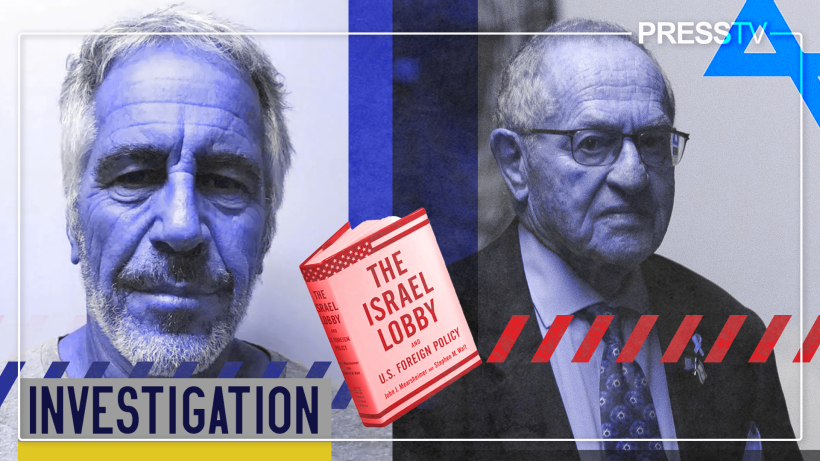
In 2006, Jeffrey Epstein exchanged emails with his lawyer, Harvard Law professor Alan Dershowitz, in an attempt to support Dershowitz’s criticism of John Mearsheimer and Stephen Walt, who had just published a groundbreaking essay on the Israel lobby.
Some commentators argue that this incident ironically confirms the Israel lobby thesis by revealing the lobby’s backlash against the essay. But does it really?
Recently released emails reveal that convicted sex offender and Israeli intelligence agent Jeffrey Epstein collaborated with Dershowitz to discredit the landmark 2006 study by Mearsheimer and Walt titled ‘The Israel Lobby’, which was later published as a book the following year.
In early April 2006, Epstein received multiple early drafts of an article by Dershowitz titled “Debunking the Newest — and Oldest — Jewish Conspiracy.” In this piece, Dershowitz, who also served as Epstein’s lawyer, accused Mearsheimer and Walt of recycling “discredited trash” from neo-Nazi and so-called “Islamist” websites, alleging they authored a modern counterpart to the ‘Protocols of the Elders of Zionists’.
Epstein responded enthusiastically to Dershowitz’s email, writing, “terrific… congratulations.”

Part of the email exchange between Epstein and Dershowitz
Later, Epstein received another message from Dershowitz’s email address asking him to help circulate copies of the attack article. Epstein replied affirmatively: “Yes, I’ve started.”
While Mearsheimer has spent his entire career at the University of Chicago, his co-author Stephen Walt has been a professor of international relations at the Harvard Kennedy School since 1999.
Epstein and Harvard
Epstein was a powerful figure at Harvard, having spent years cultivating relationships at the university and donating over $9 million between 1998 and 2008.
Despite being convicted on sex charges involving a minor in Florida, Epstein visited Harvard more than 40 times afterward. The New York Times reported in 2020 that, although Epstein had no official affiliation with the university, he maintained his own office, key card, and Harvard phone line.
Following an internal investigation, Harvard placed Professor Martin A. Nowak on paid administrative leave due to findings related to Epstein. Nowak had received significant donations from Epstein and had provided him with office space and access.
His suspension was lifted in March 2021, and he remains in his position today.
Epstein positioned himself as a fixer and patron for prominent academics, including Dershowitz and economist Larry Summers, who was then Harvard’s president.
Summers recently apologized for his connections to Epstein and announced he would “stop teaching and step back as director of the Mossavar-Rahmani Center for Business and Government at the Harvard Kennedy School.”
At the time, Epstein also served as trustee and president of the family financial office of Jewish billionaire Leslie Wexner, whose foundation donated nearly $20 million to the Kennedy School between 2000 and 2006. The Wexner Foundation’s contributions supported core operating expenses and funded a visiting scholar program that allowed ten officials from the Zionist regime to attend the Kennedy School annually for a one-year master’s degree.
Leslie Wexner is one of the most influential supporters of the Zionist colony. In 1991, he co-founded the Mega Group, a philanthropic organization of Jewish billionaires that channels significant resources to support the colony’s agenda.
The group reportedly maintained contacts with the Israeli spy agency Mossad and was described by Israeli intelligence officials as a vehicle for influence operations in the United States.
Among its initiatives, the Mega Group supported the creation of the racist Birthright Israel program, a radicalization effort targeting Jewish schools, and the revitalization of Hillel International, a Zionist student organization that now operates over 1,000 branches worldwide, including 50 outside the US.
According to a 1998 Wall Street Journal report, when Hillel needed refinancing in 1994, a small group of members committed to a combined $1.3 million annual donation over five years. Later, six members contributed $1.5 million each to help launch the $18 million Partnership for Jewish Education, funding matching grants for Jewish day schools.
Charles Bronfman and Michael Steinhardt, a former hedge fund manager and Mega Group member, also worked on the Birthright Project, which aims to send any young Jew born worldwide to Israel if they wish.
In this context, Epstein’s collaboration with Dershowitz appears to link key figures in the ‘Israel lobby’ to efforts aimed at discrediting the very idea of a powerful Israel lobby. Stephen Walt, who remains at Harvard, declined to comment on it.
Mearsheimer remarked, “I’m not surprised to see these emails, because Dershowitz and Epstein were close and both have a passionate attachment to Israel.”
Many have noted the irony of these emails’ emergence, as they seem to confirm the central thesis of the 2006 Israel Lobby study. In their later book, the lobby was described as “a loose coalition of individuals and organizations that actively work to shape foreign policy.”

The landmark study by Mearsheimer and Walt published in 2007.
But does the book’s definition truly match the reality described above? The Mega Group, founded in 1991 by Les Wexner, former CEO of the lingerie chain Victoria’s Secret, and publicly revealed in 1998, reportedly includes around 50 billionaires and influential Zionist figures such as Les Wexner, Charles and Edgar Bronfman, Charles Schusterman, Ronald Lauder, and Laurence Tisch.
These oligarchs, along with Epstein’s involvement as part of the Mega Group, suggest layers of Zionist manipulation and intrigue.
However, these particular elements are not central to Mearsheimer and Walt’s book. Among the oligarchs mentioned, only the Bronfmans receive fleeting mention in the book’s index. The bulk of the book focuses on a narrowly defined Israel lobby that exerts political influence.
Notably, the top ten most cited organizations in the book, with one exception, are all Israel lobby groups rather than formal components of the broader Zionist movement.
This distinction highlights a more focused analysis in the book, which does not fully encompass the wider network of Zionist power and influence exemplified by groups like the Mega Group.
In order of citation (number of citations in brackets), they are:
- AIPAC (47);
- ADL (30);
- Conference of Presidents of Major American Jewish Organizations (25);
- WINEP (19);
- Zionist Organisation of America (ZOA) (15);
- Israel Policy Forum (13);
- JINSA (11);
- American Jewish Committee (10)
- Americans for Peace Now(7)
- Christians United for Israel (CUFI) (7)
AIPAC, the ADL, the Conference of Presidents, the AJC, Americans for Peace Now, and Christians United for Israel are traditional Israel lobby groups.
Others like WINEP, IPF, and JINSA also engage in lobbying but are more commonly considered think tanks. The Zionist Organization of America (ZOA) is the only group on the list formally affiliated with the American Zionist Movement, the US branch of the World Zionist Organization.
Notably, two of the four major pillars of the Zionist movement are entirely absent from the book’s index: the American Zionist Movement itself and the Jewish National Fund, the US affiliate of the agency responsible for Zionist land appropriation.
The other two pillars, the Jewish Agency for Israel, which organizes settlers to occupy stolen land, and the Jewish Federations of North America, which raises funds to support settlers and land acquisition, appear only three times and once, respectively.
It’s important to emphasize that, beyond the ZOA, the American Zionist Movement includes around 45 other member organizations, only a handful of which are mentioned in the book’s index.
This suggests a narrower focus in the book that does not fully address the broader institutional structure of the Zionist movement.

Grant Smith’s partial corrective – Big Israel, 2016.
In a partial corrective to the narrow focus of Mearsheimer and Walt, Grant F. Smith’s Big Israel: How Israel’s Lobby Moves America, published in 2016, takes a much broader approach.
Smith argues, “Some identify only one organization, the American Israel Public Affairs Committee (AIPAC), as ‘the lobby’ citing its influence on Capitol Hill. This is wrong. Many interconnected organizations channel their power and influence through AIPAC in Congress.”
“Hundreds more ‘mini-AIPACs’ coordinate with AIPAC and their own national offices to lobby state legislatures to pass model legislation and spending authorizations benefiting Israel—without publicly disclosing most of their lobbying activities. Others operate quietly, policing what is allowed to appear in mainstream news media and channeling ‘hush money’ to civil rights organizations to keep them out of grassroots pro-Palestinian movements,” he adds.
This represents a significant advance over the more limited Mearsheimer and Walt thesis, as it casts a much wider net, encompassing a full range of Israel lobby groups.
Smith’s analysis extends beyond lobbying efforts to include organizations that police public discourse and manipulate civil society.
However, even Smith’s work shows some myopia. While he analyzes an impressive 674 separate organizations, far more than Mearsheimer and Walt, the scope still doesn’t fully capture the entire network.
Smith’s data reveal an eye-popping estimated budget of over $6.7 billion in 2020, supported by more than 14,000 staff and over 350,000 volunteers, underscoring the vast scale of these interconnected groups.
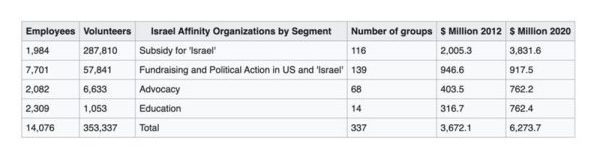
Data from Smith, 2016, reproduced on Powerbase.
The impressive number of groups documented in Big Israel still represents only a small fraction of the broader Zionist movement, which includes the Israel lobby and many additional organizations not captured in the data. Here’s a brief overview of some major omissions:
1. Many formal Zionist groups engaged in education, indoctrination, and radicalization are missing. For example, the American Zionist Movement (AZM), the official US affiliate of the World Zionist Organization, has 46 member organizations, only 13 of which appear in Big Israel’s data, leaving 33 unaccounted for.
2. None of the Israeli firms that disclose lobbying expenditures in the US are included. Between 2000 and 2023, 18 such firms reported spending over £30 million.
3. Eleven organizations—including the Jewish Agency, the World Zionist Organization (WZO), and the NSO Group (makers of Pegasus spyware)—have registered as Foreign Agents between 2016 and 2023, disclosing spending over £161 million in that period.
4. Although two Chabad-Lubavitch foundations are included, official figures show around 1,274 Chabad-Lubavitch groups in the US (IRS data lists 1,313), many of which likely have ultra-Zionist agendas. Despite not being formally affiliated with the WZO, Chabad’s influence is significant and cannot be overlooked.
5. B’nai B’rith International, one of the oldest Zionist groups in the US and a former AZM member, is included in the data, but its youth wing, B’nai B’rith Youth Organization (BBYO), is not. Together, the IRS data lists over 1,500 branches for these two groups across the US.
6. Hillel, the Zionist student organization, appears only once in Smith’s data and not at all in the index of The Israel Lobby, despite now having over a thousand branches.
7. Lastly, numerous Zionist family foundations that fund many groups in the wider movement,l likely numbering in the hundreds or thousands, are excluded. Some notable examples include Adelson Family Foundation, Allegheny Foundation, Anchorage Charitable Fund, Castle Rock Foundation, Earhart Foundation, John M. Olin Foundation, Klarman Family Foundation, Paul E. Singer Foundation, Smith Richardson Foundation, Sarah Scaife Foundation, Scaife Family Foundation, The Lynde and Harry Bradley Foundation, and William Rosenwald Family Fund.
Given these seven brief examples, which are in no way exhaustive, it is likely that there are in excess of 10,000 Zionist organisations in the US in total. It would not be surprising to learn that this was a very conservative figure. Therefore, a full analysis of the US Zionist movement needs to do a lot more to explore even the formal and informal elements of the movement.
Missing oligarchs, family foundations, spooks and infiltrators
Taking both The Israel Lobby and Big Israel together, they largely overlook the critical role of oligarchs, foundations, and intelligence-linked operatives who use blackmail and threats to exert influence.
They omit the involvement of Zionist intelligence agencies themselves, including the extensive network of Sayanim (Mossad’s “little helpers”), and make no mention of Unit 8200, Israel’s signals intelligence agency that has deeply penetrated the tech and media industries.
Ultimately, The Israel Lobby focuses almost exclusively on the most visible elements of Zionist infiltration, ignoring the movement’s powerful engines of radicalization—responsible for producing thousands of radicalized genocidaires each generation.
These engines include organizations like the Mega Group (through Jewish education initiatives shown to increase support for the Zionist colony), Hillel, and Birthright Israel.
The books also fail to address the massive infiltration of Zionists throughout the US government apparatus, a process ongoing since at least the Reagan administration in the 1980s.
The involvement of Laurence Tisch in the Mega Group further illustrates the close ties between Zionist oligarchs and infiltration efforts. His granddaughter, Jessica Tisch, is a noted Zionist extremist and the current Commissioner of the NYPD.
The NYPD notably opened an office in the Zionist colony in 2012 and collaborates with Zionist entities, as do many other US police departments, some of which receive training both in the US and in Israel.
Lessons from the Epstein/Dershowitz affair?
The affair reveals that Zionist radicalization and infiltration are far more serious and organized than the “informal” and “loose” coalition described by the Israel Lobby thesis.
Just because coordination is covert or hidden does not mean it doesn’t exist. This is evident in the evolving stories about coordination efforts led by Israel’s Ministry of Strategic Affairs and its network of front groups and private companies, including the recent campaign coordinated by Voices of Israel through its proxy, the Combat Antisemitism Movement, funded partly by a US Zionist foundation.
We also see this in the revelations about the Sayanim, Mossad’s global network of helpers, and Unit 8200’s infiltration of technology firms. Above all, the infiltration of governmental institutions across the US, UK, and numerous other countries underscores the deep and systematic nature of this network.
Florida blacklists CAIR, Muslim Brotherhood as ‘foreign terrorist organizations’
The Cradle | December 9, 2025
Florida Governor Ron DeSantis issued an order on 9 December naming the Muslim Brotherhood and the Council on American-Islamic Relations (CAIR) as “foreign terrorist organizations,” following in the steps of Texas.
Florida’s designation makes it the second Republican-led state in as many months to target the two groups.
DeSantis said the move was “EFFECTIVE IMMEDIATELY” and instructed state agencies to deny employment, contracts, funding, or any state-provided resources to the organizations and to individuals providing them with “material support.”
His executive order repeats claims that the Muslim Brotherhood supports “political entities and front organizations that engage in terrorism and funnel money to finance terrorist activities.”
It also alleges that CAIR “was founded by persons connected to the Muslim Brotherhood” and ties both groups to Hamas.
The order further directs agencies to take “all lawful measures to prevent unlawful activities” by the two groups. DeSantis framed the action as part of broader legislative efforts, saying lawmakers were “crafting legislation to stop the creep of sharia law.”
He added that he hopes legislators “codify these protections for Floridians against CAIR and the Muslim Brotherhood.”
CAIR, founded in 1994 and a leading US Muslim civil rights group, rejected the designation as “defamatory and unconstitutional.”
The group said it will sue the state, as it is already doing in Texas over a similar proclamation issued by Governor Greg Abbott.
In joint statements from its national office and Florida chapter, CAIR accused DeSantis of prioritizing “the Israeli government over the people of Florida” and targeting the organization because of “decades advancing free speech, religious freedom and justice for all, including for the Palestinian people.”
“We look forward to defeating Gov. DeSantis’s latest Israel First stunt in a court of law, where facts matter and conspiracy theories have no weight,” the statement added.
Neither the Muslim Brotherhood nor CAIR is designated as a terrorist organization by the US government, and so their restrictions remain at the state level.
The designations come as Trump reviews whether any US-based chapter of the Muslim Brotherhood should be blacklisted.
Federal agencies under Trump have also taken actions against individuals and organizations critical of Israel, including student visa cancellations, university fines, and the detention of British commentator Sami Hamdi during a CAIR speaking tour.
Ukraine jails priest for supporting Russia
RT | December 8, 2025
The government in Kiev has sentenced an Orthodox priest to prison over alleged pro-Russia remarks, as it continues a widening campaign against the Ukrainian Orthodox Church (UOC).
Archpriest Ivan Pavlichenko, a cleric at the Church of St. Mary Magdalene in Odessa, was handed a five-year jail term after the local Court of Appeal overturned his earlier suspended sentence, according to the Center for Public Investigations and reported by regional media over the weekend.
Investigators said Pavlichenko was convicted of “justifying Russia’s armed aggression” and “inciting religious and national hatred.” The trial court found him guilty but handed down a suspended term, which prosecutors appealed as being too light.
The case was built on recordings of the priest’s private phone conversations collected by security services inside his car. Investigators say he criticized Ukraine’s leadership, discussed the conflict, quoted Russian politicians, and questioned Kiev’s official position.
Prosecutors also pointed to comments about Russian strikes on Odessa. Pavlichenko allegedly said the attacks were aimed at drone-production sites and blamed Ukraine for placing military equipment in residential areas.
The appeals court also ordered the confiscation of his property and barred him from holding positions in state institutions for three years.
Local outlets claimed Pavlichenko attended pro-Russian events before 2014 and visited Crimea with his family in 2016. Supporters in Odessa called the verdict politically motivated persecution for his views and past civic activity.
The ruling comes as Kiev intensifies its pressure on the UOC, which officials accuse of maintaining ties to Russia despite the church’s declaration of independence from the Moscow Patriarchate in May 2022. The campaign has included raids on parishes and arrests of clergy, as well as a search of the Kiev-Pechersk monastery.
Last year, Vladimir Zelensky signed legislation allowing the state to ban religious organizations affiliated with governments that Kiev deems “aggressors,” effectively targeting the UOC. Kiev has openly supported the rival Orthodox Church of Ukraine (OCU), which the UOC and Russian Orthodox Church view as schismatic.
Moscow has said it will not abandon Orthodox believers in Ukraine and vowed to ensure that “their lawful rights are respected.”
Israel conducts ‘widespread surveillance’ of US troops in Gaza coordination base: Report
The Cradle | December 8, 2025
Israeli intelligence is conducting widespread surveillance of US forces and allies stationed at a new US base in southern Israel tasked with overseeing aid distribution to Gaza, The Guardian reported on 8 December, citing sources briefed on the matter.
According to the sources, Israel has been recording meetings between US military officials and humanitarian aid groups at the Civil-Military Coordination Center (CMCC), located in the industrial zone of Kiryat Gat, 12 kilometers from the border with Gaza.
The spying prompted the US commander of the base, Lieutenant General Patrick Frank, to summon his Israeli counterpart and demand that “recording has to stop here.”
“Staff and visitors from other countries have also raised concerns about Israel recording inside the CMCC,” The Guardian wrote. “Some have been told to avoid sharing sensitive information because of the risk it could be collected and exploited.”
In response, the Israeli military claimed the allegations were “absurd.”
The CMCC was set up in October to monitor the 20-point ceasefire plan for Gaza proposed by US President Donald Trump.
Staffed by US and Israeli military officials, the CMCC was tasked to coordinate aid deliveries to the strip, which Israel had largely halted in previous months, causing famine to take hold in parts of the strip.
However, Israel has continued to regularly restrict or prevent shipments of food, medicine, and other humanitarian goods into Gaza despite the CMCC’s establishment.
US military logistics experts were assigned to the CMCC to ensure aid would flow. However, they soon discovered that “Israeli controls on goods entering Gaza were a bigger obstacle than engineering challenges. Within weeks, several dozen had left,” The Guardian reported.
Israel has banned the entry of essential items on the grounds that they are “dual-use” and could be utilized by Hamas for military purposes. They include basics such as tent poles and chemicals needed for water purification, as well as pencils and paper required to restart schools.
While the CMCC brings together military planners from the US, Israel, and other allied countries, including the UK and the UAE, Palestinians are comprehensively excluded.
“There are no representatives of Palestinian civilian or humanitarian organisations, or the Palestinian Authority, stationed there invited to join discussions,” The Guardian noted.
The British newspaper added that Israeli officials cut off video calls with Palestinians when US military officials sought to include them in discussions, while CMCC planning documents omit the words Palestine or Palestinian, instead referring to the residents of the territory as “Gazans.”
Israel launched its genocide of Palestinians in Gaza in 2023 after Hamas’s Operation Al-Aqsa Flood – in which Israeli settlements and military bases were stormed and attacked by the resistance – helping enforce a blockade on the strip.
Israeli officials have said they wish to wipe out Palestinians’ existence in Gaza, comparing them to the Biblical people known as Amalek, who were exterminated by the ancient Israelites.
Israeli officials have also expressed their desire to replace Palestinians in Gaza with Jewish settlers once the strip is rebuilt as a high-tech smart city, which Trump has dubbed the “Riviera of the Middle East.”
Merz has filed 5,000 complaints against online critics – media
RT | December 7, 2025
German Chancellor Friedrich Merz has filed nearly 5,000 defamation complaints over online comments, Welt am Sonntag reported on Sunday.
The newspaper said it had obtained copies of the complaints, police files, and letters from law firms representing the leader of the Christian Democratic Union (CDU). The complaints date from 2021 to February 2025, when Merz was serving as a member of the Bundestag.
The angry comments that prompted investigations included insults such as “a**hole” and “filthy drunk,” and in at least one case a search of a defendant’s home was later declared unlawful by a court.
In another case, police searched the home of an elderly wheelchair-bound woman who had called Merz a “little Nazi,” and confiscated the phone she used to communicate with doctors and caregivers.
The number of complaints makes Merz “one of the most sensitive politicians” in Germany’s history, Welt am Sonntag said.
A lawyer representing one of the defendants described the investigation as “a complete overreaction of the justice system.”
Merz’s approval rating has dropped to 22%, a record low, according to a recent Forsa poll. The coalition government has struggled with the cost-of-living crisis and has been marred by bitter infighting over immigration, as well as pension and military service reforms.
EU’s X fine a ‘violent attack’ on free speech – French party leader
RT | December 8, 2025
The fine imposed by the EU on social media platform X constitutes a “violent attack” on freedom of speech, the leader of France’s Patriots party, Florian Philippot, told RT in an exclusive interview on Monday.
His comments came after the EU fined X €120 million ($163 million) last week for allegedly failing to comply with transparency requirements under the bloc’s 2022 Digital Services Act. The platform’s US-based majority owner, Elon Musk, responded by denouncing the EU, likening it to “the Fourth Reich.”
“The absolutely crazy fine of €120 million that the European Commission has just imposed on Elon Musk’s social networks is obviously a violent attack against freedom of expression by the European Union,” Philippot told RT.
The EU had used what he described as a thin justification for the decision, pointing to “the blue pastilles on the accounts on X” and calling it a “pretext” that “made no sense.”
The politician went on to say that the EU’s “real face of censorship” was becoming visible “in the eyes of the whole world,” and that influential voices, “like Musk in particular,” were rising “to claim its pure and simple disappearance.”
Philippot said he was watching reactions from abroad, including from the administration of US President Donald Trump, former Russian President Dmitry Medvedev and Hungary’s Prime Minister Viktor Orban, who he said reacted “very firmly against the European Union.”
He said Musk had, “for the first time,” triggered what he called a “worldwide deflagration” by arguing it was necessary “to abolish the European Union,” which Philippot described as “a totalitarian regime.”
The French politician also referenced Musk’s separate remarks branding the EU a “bureaucratic monster” and saying its leadership has been “slowly smothering Europe to death.” Musk wrote that “The EU should be abolished and sovereignty returned to individual countries so that governments can better represent their people.”
Aligning himself with that message, Philippot said his party was a “sovereignist” movement backing a French departure from the bloc. According to him, “Frexit” would restore “freedom of expression,” shift diplomacy toward peace rather than “war against Russia,” and help tackle domestic issues including the economy, agriculture, energy, and immigration.
Hundreds of Porsche cars immobilized in Russia
By Deng Xiaoci | Global Times | December 7, 2025
Hundreds of Porsche owners in Russia have reported that their cars had failed to start due to a widespread malfunction since November 28 with Russia’s largest Porsche dealer suggesting the possibility that the situation could be caused deliberately, while some German media outlets claimed that the issue emerged after the factory-installed alarm system was accidentally blocked via its satellite module.
Citing a statement by Porsche, Berliner Zeitung reported on December 6 that the malfunction was not caused by a design defect in the vehicles. Rather, the problems appear to be caused by the cars’ factory-installed security system. “In recent days, we have recorded an increase in customer inquiries. We assume that the cause does not lie in the design of the vehicles,” the company stated, the Berlin-based media reported.
Russia’s TASS News Agency reported on December 1 that the widespread starting failures were caused by a false activation of the factory-installed alarm system via the satellite module, Yulia Trushkova, Service Director at Russia’s largest automotive dealer group Rolf, told TASS.
The report said that the satellite connection as down across all models and engine types, meaning any vehicle can be immobilized.
“Similar situations also occur with Mercedes-Benz owners, but these are isolated cases — the cars do not turn into ‘bricks.’ Is the reason for such blockages known? Specialists are currently investigating this issue, and there is a possibility that it was done deliberately,” she concluded.
According to Daily Mail, the nationwide malfunction in Russia hit Porsche models, including prized Cayennes and Panameras, built since 2013, which are all equipped with the brand’s factory VTS satellite-security unit. The issue appeared to stem from the Vehicle Tracking System, or VTS, which is an onboard security module, it said.
Porsche VTS, a factory-installed option available on Porsche models, relies on satellites to track its location. It can send the owner alerts if there is any unauthorized movement. However, a system failure related to it may be shutting down the cars equipped with this technology, according to British Road & Track website.
Poland-based news site TVP World reported that some experts said the failures appear to be tied to the “blocking of the standard satellite alarm system”, which prevents engines from starting. It remains unclear whether the disruption stems from electronic-warfare interference or an issue with signals sent to the system, it added.
Porsche halted deliveries to Russia since 2022, but thousands of vehicles remain on the roads, per the report.
Ongoing geopolitical tensions between Germany and Russia have further fueled speculation surrounding the incident, Berlin-based WorkVision Media pointed out.
Cybersecurity Insiders, an online community for information security professionals, stated that the situation has raised serious concerns among the automotive community and cybersecurity experts, as hackers increasingly target critical infrastructure in new ways. By compromising vehicle immobilizers – systems linked to both tracking and security alarms – attackers can cause severe disruptions.
While the immediate impact appears limited to immobilizing or disabling of cars, the broader implications could involve the potential for safety hazards, including accidents caused by unauthorized control or remote manipulation of vehicles, the website warned.
Xiang Ligang, a veteran Chinese technology analyst, told the Global Times on Sunday that the situation clearly shows that a security loophole in Porsche’s design allowed this to happen, and it raised alarm for the whole automobile industry.
According to Xiang, intelligent-vehicle systems inevitably rely on data management and remote-control functions — technical challenges that all carmakers must confront. The situation unfolding in Russia, however, is a stark reminder of how vulnerable these systems can be.
He added that escalating geopolitical tensions and in fact de-coupling between the Russia and Germany make it increasingly difficult to meet security requirements in areas such as operating-system authentication, data verification, and cross-border data management. Under such conditions, even partners that are meant to cooperate on security matters must prioritize localized and compliant management of data and servers, he said.
Ukrainians mob vehicle to free men captured by draft officers
RT | December 7, 2025
Ordinary Ukrainians came to rescue people from conscription officers trying to force young males into a minibus in the middle of the day, a video that began circulating on social media on Saturday shows.
Reportedly filmed in the city of Odessa, the footage shows a crowd surrounding a vehicle belonging to military conscription officers and throwing tires at it, smashing its windows with a metal bar. In the clip, passersby can be heard saying, “The people have had enough!” and appears to show young men being pulled out through the shattered windows.
In response to a conscription officer’s objections, people shouted back that he should go to the front himself.
The video is the latest in a series of clips that have emerged online showing Ukrainian males being violently snatched from the streets by draft officers as Kiev experiences military setbacks and manpower shortages at the front. The term ‘busification’ has become widespread in the country, in reference to the minibuses used to transport involuntary recruits.
There have also been reports of injuries, torture, and deaths among those subject to forced mobilization, fueling public outrage and sparking protests. In October, the Ukrainian authorities urged people not to film or share videos of press gangs forcibly detaining men.
The exodus from Kiev’s armed forces is mounting. More than 21,000 soldiers deserted without leave in September alone – the highest monthly total since the start of the Ukraine conflict. According to a report by BBC Ukraine in October, this marked the largest single-month spike, based on the most recent data from the Prosecutor General’s Office.
In July, the Council of Europe’s commissioner for human rights, Michael O’Flaherty, sounded the alarm over “systematic and widespread” abuse by Ukrainian draft enforcers, urging the authorities in Kiev to properly investigate the incidents and prevent further human rights violations.
Patrik Baab: War Propaganda Destroyed Media & Freedom of Speech
Glenn Diesen | December 6, 2025
Patrik Baab is a German journalist and best-selling author who reported on both sides of the frontline in Ukraine. Baab argues that war propaganda has destroyed the credibility of the media and freedom of speech.
Follow Prof. Glenn Diesen:
Substack: https://glenndiesen.substack.com/
X/Twitter: https://x.com/Glenn_Diesen
Support the research by Prof. Glenn Diesen:
PayPal: https://www.paypal.com/paypalme/glenn…
Buy me a Coffee: buymeacoffee.com/gdieseng
Go Fund Me: https://gofund.me/09ea012f
Books by Prof. Glenn Diesen: https://www.amazon.com/stores/author/…
WHO – Gates Blueprint for Global Digital ID, AI-Driven Surveillance, and Life-Long Vaccine Tracking for All
Automated, cradle-to-grave traceability for “identifying and targeting the unreached”
By Jon Fleetwood | December 2, 2025
In a document published in the October Bulletin of the World Health Organization and funded by the Gates Foundation, the World Health Organization (WHO) is proposing a globally interoperable digital-identity infrastructure that permanently tracks every individual’s vaccination status from birth.
The dystopian proposal raises far more than privacy and autonomy concerns: it establishes the architecture for government overreach, cross-domain profiling, AI-driven behavioral targeting, conditional access to services, and a globally interoperable surveillance grid tracking individuals.
It also creates unprecedented risks in data security, accountability, and mission creep, enabling a digital control system that reaches into every sector of life.
The proposed system:
- integrates personally identifiable information with socioeconomic data such as “household income, ethnicity and religion,”
- deploys artificial intelligence for “identifying and targeting the unreached” and “combating misinformation,”
- and enables governments to use vaccination records as prerequisites for education, travel, and other services.
What the WHO Document Admits, in Their Own Words
To establish the framework, the authors define the program as nothing less than a restructuring of how governments govern:
“Digital transformation is the intentional, systematic implementation of integrated digital applications that change how governments plan, execute, measure and monitor programmes.”
They openly state the purpose:
“This transformation can accelerate progress towards the Immunization agenda 2030, which aims to ensure that everyone, everywhere, at every age, fully benefits from vaccines.”
This is the context for every policy recommendation that follows: a global vaccination compliance system, digitally enforced.
1. Birth-Registered Digital Identity & Life-Long Tracking
The document describes a system in which a newborn is automatically added to a national digital vaccine-tracking registry the moment their birth is recorded.
“When birth notification triggers the set-up of a personal digital immunization record, health workers know who to vaccinate before the child’s first contact with services.”
They specify that this digital identity contains personal identifiers:
“A newborn whose electronic immunization record is populated with personally identifiable information benefits because health workers can retrieve their records through unique identifiers or demographic details, generate lists of unvaccinated children and remind parents to bring them for vaccination.”
This is automated, cradle-to-grave traceability.
The system also enables surveillance across all locations:
“[W]ith a national electronic immunization record, a child can be followed up anywhere within the country and referred electronically from one health facility to another.”
This is mobility tracking tied to medical compliance.
2. Linking Vaccine Records to Income, Ethnicity, Religion, & Social Programs
The document explicitly endorses merging vaccine status with socioeconomic data.
“Registers that record household asset data for social protection programmes enable monitoring of vaccination coverage by socioeconomic status such as household income, ethnicity and religion.”
This is demographic stratification attached to a compliance database.
3. Conditioning Access to Schooling, Travel, & Services on Digital Vaccine Proof
The WHO acknowledges and encourages systems that require vaccine passes for core civil functions:
“Some countries require proof of vaccination for children to access daycare and education, and evidence of other vaccinations is often required for international travel.”
They then underline why digital formats are preferred:
“Digital records and certificates are traceable and shareable.”
Digital traceability means enforceability.
4. Using Digital Systems to Prevent ‘Wasting Vaccine on Already Immune Children’
The authors describe a key rationale:
“Children’s vaccination status is not checked during campaigns, a practice that wastes vaccine on already immune children and exposes them to the risk of adverse events.”
Their solution is automated verification to maximize vaccination throughput.
The digital system is positioned as both a logistical enhancer and a compliance enforcer:
“National electronic immunization records could transform how measles campaigns and supplementary immunization activities are conducted by enabling on-site confirmation of vaccination status.”
5. AI Systems to Target Individuals, Identify ‘Unreached,’ & Combat ‘Misinformation’
The WHO document openly promotes artificial intelligence to shape public behavior:
“AI… demonstrate[s] its utility in identifying and targeting the unreached, identifying critical service bottlenecks, combating misinformation and optimizing task management.”
They explain additional planned uses:
“Additional strategic applications include analysing population-level data, predicting service needs and spread of disease, identifying barriers to immunization, and enhancing nutrition and health status assessments via mobile technology.”
This is predictive analytics paired with influence operations.
6. Global Interoperability Standards for International Data Exchange
The authors call for a unified international data standard:
“Recognize fast healthcare interoperability resources… as the global standard for exchange of health data.”
Translated: vaccine-linked personal identity data must be globally shareable.
They describe the need for “digital public infrastructure”:
“Digital public infrastructure is a foundation and catalyst for the digital transformation of primary health care.”
This is the architecture of a global vaccination-compliance network.
7. Surveillance Expansion Into Everyday Interactions
The WHO outlines a surveillance model that activates whenever a child interacts with any health or community service:
“CHWs who identify children during home visits and other community activities can refer them for vaccination through an electronic immunization registry or electronic child health record.”
This means non-clinical community actors participating in vaccination-compliance identification.
The authors also describe cross-service integration:
“Under-vaccinated children can be reached when CHWs and facility-based providers providing other services collaborate and communicate around individual children in the same electronic child health records.”
Every point of contact becomes a checkpoint.
8. Behavior-Shaping Through Alerts, Reminders, & Social Monitoring
The WHO endorses using digital messaging to overcome “intention–action gaps”:
“Direct communication with parents in the form of alerts, reminders and information helps overcome the intention–action gap.”
They also prescribe digital surveillance of public sentiment:
“Active detection and response to misinformation in social media build trust and demand.”
This is official justification for monitoring and countering speech.
9. Acknowledgment of Global Donor Control—Including Gates Foundation
At the very end of the article, the financial architect is stated plainly:
“This work was supported by the Gates Foundation [INV-016137].”
This confirms the alignment with Gates-backed global ID and vaccine-registry initiatives operating through Gavi, the World Bank, UNICEF, and WHO.
Bottom Line
In the WHO’s own words:
“Digital transformation is a unique opportunity to address many longstanding challenges in immunization… now is the time for bold, new approaches.”
And:
“Stakeholders… should embrace digital transformation as an enabler for achieving the ambitious Immunization agenda 2030 goals.”
This is a comprehensive proposal for a global digital-identity system, permanently linked to vaccine status, integrated with demographic and socioeconomic data, enforced through AI-driven surveillance, and designed for international interoperability.
It is not speculative, but written in plain language, funded by the Gates Foundation, and published in the World Health Organization’s own journal.
EU targets platforms that refuse to censor free speech – Telegram founder
RT | December 6, 2025
The EU is unfairly targeting social media platforms that allow dissenting or critical speech, Telegram founder Pavel Durov has said.
He was responding to a 2024 post by Elon Musk, the owner of X, who claimed that the European Commission had offered the platform a secret deal to avoid fines in return for censoring certain statements. The EU fined X €120 million ($140 million) the day before.
According to Durov, the EU imposes strict and unrealistic rules on tech companies as a way to punish those that do not comply with quiet censorship demands.
“The EU imposes impossible rules so it can punish tech firms that refuse to silently censor free speech,” Durov wrote on X on Saturday.
He also referred to his detention in France last year, which he called politically motivated. He claimed that during that time, the head of France’s DGSE asked him to “ban conservative voices in Romania” ahead of an election, an allegation French officials denied. He also said intelligence agents offered help with his case if Telegram quietly removed channels tied to Moldova’s election.
Durov repeated both claims in his recent post, describing the case as “a baseless criminal investigation” followed by pressure to censor speech in Romania and Moldova.
Later on Saturday, Durov wrote: “The EU exclusively targets platforms that host inconvenient or dissenting speech (Telegram, X, TikTok…). Platforms that algorithmically silence people are left largely untouched, despite far more serious illegal content issues.”
Last year Elon Musk said the European Commission offered X “an illegal secret deal” to quietly censor content. “If we quietly censored speech without telling anyone, they would not fine us. The other platforms accepted that deal. X did not,” he wrote.
On Friday, European Commission spokesperson Tom Rainier said the EU fined X €120 million for violating the Digital Services Act. He claimed the fine was unrelated to censorship and was the first enforcement under the law. US Secretary of State Marco Rubio criticized the move on X, calling it “an attack on all American tech platforms and the American people by foreign governments.”
Durov and Musk have both faced pressure from EU regulators under the Digital Services Act (DSA), which came into force in 2023. The law requires platforms to remove illegal content quickly, though critics say it can be used to suppress lawful expression.
Featured Video

Trita Parsi: Middle East Unraveling — Are We on the Path to World War?
or go to
Aletho News Archives – Video-Images
New Book
Trans agenda is ‘normalization of sadism’ – US author

RT | September 23, 2026
The US Democratic Party has embraced a transgender agenda that amounts to “the normalization of sadism,” author A.J. Rice has said, warning that radical trans policies would return if the party is allowed to regain power.
Speaking to RT’s America First host Scotty Nell Hughes about his new book, ‘The Curse of the Bearded Lady: How the Trans Mafia Whacked American Sanity’, Rice argued that activists have gained significant influence in schools, medicine, and corporate America while people who questioned the agenda have faced pressure to stay silent.
The author described the “trans mafia” as the sprawling network of people and institutions that have helped the movement gain influence. He singled out parts of academia, wealthy backers, and corporations, and stated that providers of transition-related treatment also have a financial incentive to keep young people in their care indefinitely.
Rice argued that the consequences of these policies ultimately fall on children who are being drawn toward gender-affirming medical treatments and on girls who are expected to share locker rooms or compete in sports with biological males.
He noted that while voters rejected the Democrats’ approach to gender in 2024, the party, which has been “captured by madness,” has since only doubled down and is seeking what is effectively “the normalization of sadism.” … Full report
Blog Roll
 Aletho News
- NATO chief wants Europeans to fight American wars [for Israel]
- German chemicals giant reveals details of downsizing
- Refaat Al-Areer Was The Canary In The Coal Mine In Israel’s War On The Truth
- Israeli election committee bars candidate from Knesset race over Gaza war opposition
- French-Lebanese man files war crimes complaint over Israeli attacks
- Mahan Air Flight Lands in China Despite US Threat against Iranian Airlines
- US eyes $10bn fund to rebuild war-battered Gulf infrastructure
- Trump meets Rodríguez near Maduro’s prison as Venezuela’s oil flows to US
- Trita Parsi: Middle East Unraveling — Are We on the Path to World War?
- Iran FM meets with US envoy on UN meeting’s sidelines at American side’s insistence: Report
- If Americans Knew
- Caught on Tape: AIPAC CEO Boasted of Controlling Trump’s National Security Officials
- Why Hamas Attacked Israel in October 2023 – Israeli professor Ilan Pappé
- They see them, then kill them: Israeli quadcopters track, deliberately target civilians in Gaza
- Winter could turn Gaza’s treacherous, war-damaged buildings into deathtraps
- Majority of Democratic Voters Want to Prosecute Both Biden and Trump Administration Officials Over Gaza
- As Gaza languishes, world leaders gather at the UN – Daily Update
- Sanctions are collective punishment: immoral and self-defeating
- Phosphorus Munitions Fired by Israel Burn Groves, Orchards in Southern Lebanon
- Israel Carries Out New Ceasefire Violations Across Gaza
- AI – Emphasis on the ‘I’: Israel Is Funding AI Chatbot Propaganda
- No Tricks Zone
- New Study: Earth And Venus Surface Warmth Largely Explained By Convection And Lapse Rate, Not CO2 Or Radiation
- 2025 Nature Paper Claiming Worsening Global Drought Gets RETRACTED …Heavily Flawed
- New Study: ‘Global Drought Shows No Detectable Recent Acceleration Under Climate Warming’
- Economic Masterminds: German Socialists Suggest Taxing Productivity Gains Stemming From Using AI
- The South China Sea Has Not Been Cooperating With The Climate Change Narrative
- Energy Crisis: Germany Enters Heating Season With Historically Low Gas Reserve Fill Levels
- New Study: The Antarctic Ice Sheet Gained Mass From 2020-2024 Due To Staggering Snow And Ice Accumulation
- Study: Ocean Heating Rates From Thousands Of Years Ago ‘Dwarf’ Modern Ocean Heating Rates
- Climate Extremists Target, Attack Large-Scale Power Grid Infrastructure In Germany!
- New Study: Antarctic Ice Melt Has Contributed Less Than 1 Centimeter To Sea Level Rise In The Last 30 Years


