REVEALED: Ofcom Pressured Rumble and Reddit to Enforce UK Censorship Laws Beyond Borders
By Rick Findlay | Reclaim The Net | July 29, 2025
Internal communications now made public by the US House Judiciary Committee shed light on a pattern of escalating pressure by the UK’s “communications regulator,” Ofcom, aimed at pushing US-based tech platforms like Rumble and Reddit into adopting strict speech standards, even in apparent disregard for national boundaries and free speech protections.
The emails expose how Ofcom has been leaning on Rumble to align itself with the UK’s Online Safety Act, a censorship law that vastly expands the state’s oversight of online content under the guise of child protection and harm prevention.
Rumble, which has consistently maintained that it is not within the scope of the legislation, told the regulator that the UK is not a “target market” and that the platform does not have a substantial user base in Britain.
Despite this, Ofcom responded with veiled warnings. In one exchange, the agency stated that it would be “monitoring Rumble’s position carefully” and that it may follow up if Rumble’s stance is contradicted by future activity or incidents involving UK users. The implication was clear: remaining outside the regulatory net may not be tolerated for long.
Ofcom also stated it would “strongly encourage Rumble to take the steps required by the Act to protect UK users of internet services from content that is illegal in the UK or potentially harmful to UK children.”
Yet Rumble operates from within the United States, where citizens actually have free speech rights under the First Amendment, raising serious concerns about the extraterritorial application of UK law to platforms governed by different legal frameworks.
Further emails show that Ofcom believes “a supervisory relationship” between the agency and online services is “the most effective way to review and assess compliance,” again suggesting that companies should voluntarily submit to oversight, or risk the alternative: legal coercion. “We retain the right to legally request information,” the regulator warned.
Reddit also appears to be in the crosshairs. In a separate line of correspondence, Ofcom indicated that it expects a “supervision plan” to be in place for the platform, with particular emphasis on how Reddit handles so-called “hate” content, a term that remains dangerously elastic and open to political manipulation.
This shows how regulators are leveraging ambiguous language and compliance pressure to steer speech policies on platforms that are not even based in the UK.
Ofcom’s behavior shows a bureaucratic intent to expand its influence far beyond Britain’s borders, effectively demanding that foreign platforms enforce UK legal standards on content that may not be illegal elsewhere.
Reform UK Vows to Repeal New Online Censorship Law
By Cindy Harper | Reclaim The Net | July 29, 2025
The political party Reform UK has declared its intent to repeal the Online Safety Act, warning that the law grants excessive powers to regulators and poses a serious threat to free speech.
The party claims the legislation, which recently came into force, is presented as a safety measure but in reality undermines civil liberties.
Although the event was announced as a discussion on crime, Reform leader Nigel Farage and his adviser Zia Yusuf devoted most of their Westminster press conference to attacking the legislation.
Their concerns centered on the way the act targets social media platforms and expands the role of the media regulator, Ofcom.
Yusuf, a former party chair who now leads Reform’s efforts on local council reform, said the law was a vast overreach. He warned that it hands regulators the power to pressure platforms into silencing views that challenge the government. According to Yusuf, even companies known for tolerating broad speech would be forced to restrict political discourse.
“So much of the act is massive overreach and plunges this country into a borderline dystopian state,” Yusuf said.
He argued that the legislation uses safety as a cover to expand state control. “Any student of history will know that the way countries slip into this sort of authoritarian regime is through legislation that cloaks tyranny inside the warm fuzz of safety and security and hopes nobody reads the small print.”
Reform UK promised to eliminate the act entirely if it came to power.
Yusuf dismissed tools like age verification as ineffective, claiming children could simply use VPNs to bypass restrictions.
Farage also admitted the party doesn’t have all the answers yet, but insisted they are working with leading technology experts. “Can I stand here and say that we have a perfect answer for you right now? No,” he said. “Can I say that as a party, we have more access to some of the best tech brains, not just in the country, but in the world? That I can say to you.”
Labour leader Keir Starmer responded to questions about the act while in Scotland ahead of a meeting with President Donald Trump, and flat out lied in his denial that the government was censoring people.
TikTok hires ex-Israeli military associate to censor anti-Zionist content
Press TV – July 29, 2025
TikTok has appointed a new “hate speech” manager with long-standing ties to the Israeli regime amid mounting pressure to curb anti-Israel content on the social media platform.
Erica Mindel, who previously served as an instructor in Israel’s military, has been tasked with shaping TikTok’s stance on what the company refers to as “anti-Semitism,” according to TikTok officials.
Mindel will “develop and drive the company’s positions on hate speech,” seek to “influence legislative and regulatory frameworks,” and “analyze hate speech trends,” with a particular focus on “antisemitic content,” according to an official job description shared by TikTok.
Her appointment to the post comes as the platform faces growing scrutiny over a surge in posts critical of the Israeli regime, particularly since its genocidal war on the Gaza Strip. This has sparked renewed concerns over the censorship of pro-Palestinian content on TikTok.
According to a 2023 survey cited by the Jewish Federations of North America, users who spend more than 30 minutes a day on TikTok are 17 percent more likely to hold critical views of Israel.
That gap reportedly widened after Israel launched its devastating war on the Gaza Strip on October 7, 2023, prompting calls for a national ban over content that according to US lawmakers fuels “hatred” against the Zionist regime.
American Academy of Pediatrics Goes To War Against Religious Exemptions, Parental Rights
By Jefferey Jaxen | July 29, 2025
The ability to practice ones sincere religious beliefs is woven into the very fabric of America and its founding ethos yet the American Academy of Pediatrics (AAP), a membership organization focusing on pediatricians, just declared war on this bedrock right.
Besides being morally objectionable, the concept is just plain unpopular in modern America. By 2023 only six U.S. states officially denied parents religious exemptions to vaccination for their children via laws that were enacted in the face of massive opposition from the public.
Since then, two of the states (Mississippi and West Virginia) have seen their religious denial laws overturned by court wins from the Informed Consent Action Network’s legal team in which judges deemed such laws to violate the First Amendment.
Meanwhile, public pushback saw Hawaii as the latest state to defeat a bill that would have removed its religious exemption option.
AAP’s new policy paper has stepped in with an attempt to stop the momentum of religious freedom in the medical and public health spaces – an idea whose time has come.
“The AAP recommends that all states, territories, and the District of Columbia eliminate all nonmedical exemptions from immunizations as a condition of school attendance.
With a flowery mission to ‘attain optimal physical, mental, and social health and well-being for all infants, children, adolescents and young adults,’ AAP fashions itself more as a continuous pipeline for industry products through overreaching, anti-science edicts.
The AAP recently floated a lawsuit against HHS Secretary Kennedy for his recommendation to remove pregnant women and healthy children from the Covid vaccine schedule.
Lets take a look at some of AAP’s greatest hits over the last 5 years.
In 2019, Washington D.C.’s B23-0171 (later named D.C. Law 23-193) sought to add a new section into the existing regulations that would allow a minor child to consent to receive a vaccine. The bill, and its hearing, signaled a new high-water mark towards the removal of parents from some of their children’s most important medical decisions – and AAP was there.
During the public hearing before it was signed into law, pediatrician Dr. Helene Felman, representing Washington D.C.’s chapter of the American Academy of Pediatrics (AAP), stated:
“As a pediatrician, I like the legislation as it stands because it offers the opportunity to capture those young adults who can make informed decisions at technically any age.”
Any age…
An ICAN legal victory halting D.C.’s overreach saw a D.C. district judge issue a preliminary injunction against the act in favor of parents who brought suit. The parents filed complaints and were able to demonstrate that the act likely violates federal law.
Next up AAP was on the wrong side of the push, against clear scientific evidence, to medically transition children. As Norway, Sweden, Denmark, U.K. and other countries officially backed off the practice. A 2025 review by HHS of the evidence and best practices found significant risks associated with gender dysphoria treatments.
One of the authors of the paper stated simply:
“… No reliable research indicates that these treatments are beneficial to minors’ mental health.”
In 2023, AAP reaffirmed its stance in a policy paper arguing for youth to have open access to gender-affirming health care fully funded by health insurance.
And finally, the AAP worked to influence public policy by advocating for new injectable weight loss drugs for children.
“Children struggling with obesity should be evaluated and treated early and aggressively, including with medications for kids as young as 12 and surgery for those as young as 13, according to new guidelines released Monday.”
The newly discovered harms of such drugs are unfolding on a weekly basis but that didn’t seem to matter to the AAP.
As an industry mouthpiece who see children as a profit margin and pipeline demographic for drugs and shots, AAP is unmatched in its corporate ‘advocacy.’
The organization appears to have chosen another losing battle siding against religious freedom in the United States of America and with it a further loss of relevancy for the organization.
UK Introduces Online Speech Monitoring Police

By Cam Wakefield | Reclaim The Net | July 28, 2025
If you’re in the UK and you’ve ever dared to type a mildly spicy opinion about immigration into the vast and idiotic circus that is social media, you might now be under surveillance by a shiny new government outfit with a name so Orwellian it sounds like it was cooked up during a slow afternoon in North Korea’s Ministry of Truth.
The UK has officially launched a National Internet Intelligence Investigations team, a title that manages to be both comically vague and terrifyingly specific.
This is the stuff that authors of dystopian novels have been warning people about for decades.
The Frankenstein of a task force, stitched together from officers across the country and headquartered in Westminster’s National Police Coordination Centre, has been given the noble mission of snooping through your posts, likes, and digital mutterings for any whiff of “anti-migrant sentiment.”
The government has decided that free thought is a public safety risk.
Gone are the days when bobbies on the beat focussed on burglaries, stabbings, or the occasional drunken scuffle. Now, they’ve been upgraded, or rather, downloaded, into an era where your keyboard is the weapon and your opinion the crime.
The Home Office insists this is all very necessary. According to a leaked letter, the Telegraph obtained, from Dame Diana Johnson, Policing Minister and part-time press-release poet, the squad will focus on “exploiting internet intelligence” to help local police forces anticipate unrest.
“Exploit.” Not “monitor,” not “observe,” but exploit.
It’s all part of a grand, techno-utopian fantasy where public order is maintained not by policing actual crimes, but by interpreting emojis and out-of-context Facebook posts.
Supporters of this initiative are quick to remind us that tensions are rising over immigration. Protests have flared up from Norwich to Bournemouth, with citizens wondering why their local hotels now resemble temporary refugee camps paid for with their tax funds.
Many Brits are asking uncomfortable questions, questions that the current government would apparently prefer whispered, if not deleted altogether.
Which brings us neatly to the absurd theatre of this whole operation: the idea that public discontent can be managed not by addressing policy failures, but by stalking Instagram stories and dispatching undercover agents to Nextdoor forums.
Essex Police actually sent officers to the home of journalist Allison Pearson over something she posted online. Meanwhile, a mother named Lucy Connolly received a prison sentence longer than some violent offenders after sharing a message deemed offensive following the Southport attacks.
Naturally, the political opposition is smelling blood. Shadow Home Secretary Chris Philp has weighed in.
“Two-tier Keir can’t police the streets,” he fumed, “so he’s trying to police opinions instead.”
He’s not wrong. This isn’t law enforcement; it’s law enforcement theatre, a stage production in which your tweets are the script and the cops are the critics.
Nigel Farage, Reform Party leader, ever the populist thundercloud, put it in even starker terms: “This is the beginning of the state controlling free speech. It is sinister, dangerous, and must be fought.”
Let’s rewind for a moment. During the pandemic, the government rolled out “disinformation teams” that quietly monitored online content and flagged anything that strayed too far from the Approved Messaging Bible. They assured people it was for their safety. They always do.
Now, in what appears to be the spiritual sequel to that damp squib of a policy, we’re being served a reheated version, garnished with civil unrest panic and a dash of woke paranoia. And it arrives just as the Online Safety Act lumbers into force, a lumbering beast of a bill that seems hellbent on turning the UK into a digital kindergarten, where only soft voices and pre-approved opinions are allowed.
The Free Speech Union has already sounded the alarm after users discovered protest videos involving asylum hotels were mysteriously unavailable in the UK. Not removed by the platform. Not censored by other users. Just: poof, gone, as if reality itself had been deemed problematic.
Where does this all end? Are we one government memo away from officers arresting people for sarcastic memes? Will sarcasm itself soon be listed as a hate crime?
Here’s the uncomfortable truth: a state that polices speech will eventually police thought. And a government that fears its people’s opinions is a government that knows it has failed them.
Zionist spies innovate AI sexual blackmail tech

By Kit Klarenberg | Al Mayadeen | July 27, 2025
On July 19th, Ynet announced Israeli artificial intelligence startup Decart “has unveiled a groundbreaking real-time video transformation technology, setting a new benchmark in the fast-evolving field of generative media”, following “months of anticipation and extensive fundraising”. Dubbed Mirage, it “allows continuous transformation of live or pre-recorded video content without interruption, maintaining high quality and impressive stability throughout”. The obvious suspicion arises that the tech’s true purpose is to concoct convincing, fabricated kompromat on targets, with no risk of Zionist intelligence being publicly exposed.
Such an interpretation isn’t immediately obvious from the description of Mirage offered by Ynet. The outlet states the tech “transforms the very definition of video – from a static, pre-recorded format to a living, flexible, and interactive medium”. This reportedly opens up “new business models for content creators, brands, and platforms”. For example, “broadcasters and advertisers” could “generate multiple versions of a single piece of content during a live transmission…[tailoring] content in real-time to different audience segments.”
Yet, buried in the Ynet report is reference to how Decart was forged in 2023 by Dean Leitersdorf and Moshe Shalev, while they were serving in the Zionist Occupation Forces’ fearsome Unit 8200. The shadowy spying cell conducts clandestine operations, signals intelligence collection, code decryption, counterintelligence, cyberwarfare, and surveillance. Many of its veterans have established major tech companies, frequently operating in Silicon Valley. Decart generated enormous early interest among investors, raising $53 million just two months after official launch, and securing a $500 million valuation.
Among those investors is Zeev Ventures, founded by Israeli-American Oren Zeev. Its other investments include Israeli firm Riverside, an audio and video recording service. Its staff is riddled with ZOF veterans. Moreover, Decart has thoroughly impressed Technion – the Israel Institute of Technology. The pair have announced a joint AI research center, “to strengthen academic research, knowledge development, and technological innovation”. Under its auspices, the Institute’s elite honours program will be renamed the “Technion-Decart Honors Program”.
Technion has an extensive and deplorable history of direct complicity in the Zionist entity’s erasure of the Palestinian people. The Institute maintains formal partnerships with multiple Israeli weapons manufacturers and security and intelligence firms, including infamous Elbit Systems. Its assorted faculties have helped innovate numerous monstrous resources, such as remote control capabilities for the Caterpillar D9 armored bulldozer, used by Tel Aviv to demolish Palestinian homes. Benefits such as academic credits and scholarships are specifically awarded to Institute students based on their ZOF service.
Markedly, numerous Technion alumni – among them individuals who previously served in Unit 8200 – have gone on to work for Toka, which has patented technology capable of locating security cameras and webcams, hacking into them, then altering their live feeds without trace. Toka was founded by former Israeli premier Ehud Barak – a close associate of Jeffrey Epstein. Given ample indications Epstein was collating sexual blackmail material on powerful figures for intelligence agencies, comments made by Mirage cofounder Dean Leitersdorf to Ynet take on a chilling character:
“Mirage marks the dawn of a new era in video. Content is no longer fixed or closed – it’s alive, adaptive and created in real time in collaboration with the user. Anyone can become a creator and give visual form to their imagination. This opens up endless possibilities for creation, communication and a new relationship between people and technology.”
‘Video Platforms’
A January Ynet report sheds considerable further light on the significance of Unit 8200 to Decart’s founding, and its chiefs’ intelligence backgrounds. Leitersdorf, described as the company’s “central figure” who “grew up immersed in the world of high-tech and business”, hails from “Israel’s old-money aristocracy”. His close relatives are all major players in the entity’s finance and ‘defence’ sectors. Moreover, Leitersdorf completed his bachelor’s, master’s, and doctoral degrees at Technion, in just five-and-a-half years, all while serving in the ZOF. He explained:
“I’d work from 9 am to 7 pm in Unit 8200, and then squeeze in a few hours of studying before bed.”
Moshe Shalev, a 14-year Unit 8200 veteran, told Ynet that towards the end of his ZOF service he “wanted to explore the world of research”, and crossed paths with Leitersdorf. When they started chatting, Shalev realised he’d “found someone who could tell me what was possible and what wasn’t”, and “knew all the technologies of 8200”. He described the experience as “mind-blowing”, and they began meeting regularly, discussing how to apply their experiences of working in the Unit to the commercial sphere.
So it was in late 2024, Decart released a “cute demo” dubbed Oasis, demonstrating the company’s AI capabilities. The app lets users explore an ever-changing virtual environment, which is influenced in real-time based on their keystrokes and mouse movement, purely via artificial intelligence. Leitersdorf claims, “we thought a few people might play with it… [but] we were stunned by how fast it blew up”. Oasis went viral across multiple platforms, exceeding one million users in just three days.
While Mirage was unmentioned in the January Ynet report, Leitersdorf talked a big game of Decart’s ambitions to create a suite of products that would attract up to a billion users, which “doesn’t solve a single problem but solves thousands of problems”. Still, “the ability to turn imagination into video” loomed large in the company’s stated vision, and “to that end”, the firm is “establishing one of the most advanced AI labs in the world, recruiting the best minds Israeli tech has to offer”:
“Decart has a bold and ambitious goal: to reinvent AI from the ground up and become the technological backbone for anyone in the world who wishes to use it.”
In July, Ynet suggested Decart’s real-time video editing software would be of enormous utility on “social platforms”, allowing users to use Mirage “to change their appearance in real time, create clips or livestream with custom visual effects – all without relying on professional editing tools”. The technology was said to support image generation “at 20 frames per second with live-broadcast-quality resolution”, and “future updates are expected to support Full HD and even 4K, the standard for most video platforms and televisions.”
The obvious interest of such tech to intelligence agencies was unmentioned. This was despite Mirage evidently being spawned directly from the founders’ experience toiling in Unit 8200. The enormous mainstream hype elicited by the tool, launched by hitherto unknown figures, and vast sums of money pumped into the fledgling company instantly upon its emergence, may also be illuminating. For every dollar invested in a startup by the CIA’s little-known venture capital wing In-Q-Tel, the private sector injects $18.
‘Sex Trafficking’
Intelligence services the world over are notorious for using sexual blackmail to force targets into doing their bidding. Moreover, agencies, including the CIA have extensive histories of forging sex tapes and compromising photos of “enemy” leaders to discredit them. Witnesses and victims alike have claimed Jeffrey Epstein’s numerous lavish residences – purchased with uncertain wealth – were equipped with hidden cameras and microphones, used to record sexual assaults and rapes by countless politicians and high-profile figures he counted as close friends.
Following Epstein’s arrest in July 2019 for sex trafficking of minors, veteran reporter on intelligence affairs Eric Margolis came forward to recount his attendance at a grand lunch convened in the shadowy financier’s New York mansion during the late 1990s, at which all attendees “sang the praises of Israel”. Immediately upon arrival, a butler invited him to enjoy “an intimate massage” courtesy of a “pretty young girl”. The offer “seemed so out of place and weird to me that I swiftly declined”, Margolis reported:
“More important than indelicacy, as an old observer of intelligence affairs, to me this offer reeked of ye old honey trap, a tactic to ensnare and blackmail people… A discreet room with massage table, lubricants and, no doubt, cameras stood ready off the main lobby.”
Margolis subsequently told mainstream media outlets he didn’t “believe for a moment” Epstein committed suicide, and it was “more likely he was killed”, as “he was a man who knew too much” – “the old pirate line of ‘dead men tell no tales’ certainly applied to Epstein”. Today, controversy around Epstein’s death endures. Polls indicate just 16% of US citizens believe he took his own life in prison, with almost 90% supporting disclosure of all information related to Epstein’s prosecution.
Donald Trump’s reneging on his promises to unseal classified documents related to Epstein’s crimes has prompted mass public backlash, even among the President’s most fervent supporters. Meanwhile, US lawmakers are engaged in a bipartisan push to compel Washington to release all federally-gathered evidence identifying those “involved in the sex trafficking that Epstein led.” Despite operating with impunity for decades, and being protected from legal repercussions as he “belonged to intelligence”, Epstein was eventually caught, raising the risk of his targets and paymasters being publicly exposed.
The real-time, AI-powered video creation and editing technology honed by Toka and Decart removes the troublesome human elements inherent in old-fashioned intelligence agency “honey traps”. We are thus left to ponder whether these firms are being enthusiastically promoted because they “solve the problem” of sexual blackmail requiring real-life individuals to oversee such operations, and targets to take the bait. The “possibilities” of such technologies to transform users’ “imagination” into realistic video content are, after all, avowedly “endless”.
UK Reveals New Details of Upcoming Pandemic Exercise Similar to Event 201 That Preceded COVID
The Defender | July 25, 2025
The U.K. this month released new details for a sweeping pandemic response exercise — the largest in its history — to take place over multiple days between September and November 2025.
Exercise Pegasus, the first of its kind in nearly a decade, aims to span all regions and government departments in the U.K., and will involve opening a “resilience academy” to train over 4,000 people from public and private sectors annually in emergency roles, Minister for Intergovernmental Relations Pat McFadden told Parliament on July 8.
The response plan also includes developing a national “vulnerability map” to highlight populations most at risk in a crisis. The tool, which uses data on age, disability, ethnicity and whether the person is receiving care, can share that data instantly across government departments.
Comedian and political commentator Russell Brand, quoting Jon Fleetwood on Substack, pointed out that news on the U.K. government tracking tool comes as, in the U.S., the Department of Defense “prepares AI-driven simulations for pandemics caused by ‘natural or man-made infectious agents,’” while funding researchers who want to “infect humans with aerosolized influenza under the guise of improving disease models.”
Britain’s Exercise Pegasus was developed in response to the July 2024 recommendations made by the UK Covid-19 Inquiry, an ongoing public investigation into the handling of the pandemic.
The U.K. is also testing its ability to instantaneously reach its citizens by sending an alert to 87 million cellphones at once. McFadden said it will be the second time the test has been used on a nationwide basis since its launch in 2023.
“These changes will improve our resilience and preparedness and help to safeguard our citizens,” McFadden said in a January 2025 press release announcing the U.K.’s rough proposals.
However, others say the plans are less about safeguarding citizens and more about controlling them.
“The timing has sparked concerns that governments and international agencies may be coordinating future lockdown scenarios under the guise of preparedness, raising the specter of another orchestrated pandemic event,” Fleetwood wrote on Substack.
In May, U.K. Prime Minister Keir Starmer signed an international pandemic treaty, designed to help the World Health Organization (WHO) “co-ordinate the international response to any future pandemics,” according to The Telegraph.
The U.K. is also legally obligated to “develop, strengthen and maintain the core capacities” tied to the WHO because it “failed to reject the 2024 amendments to the International Health Regulations,” said independent journalist James Roguski.
These core capacities include “surveillance,” “rapidly determining the control measures required to prevent domestic and international spread,” and “addressing misinformation and disinformation.”
“Sounds to me like control,” Brand said. “Control of observation and the control to implement the use of medicines. Do you remember last time? How they shamed, how they blamed, how they shot down protests, how they condemned people that were opposed to vaccines?”
The newly enacted amendments allow the WHO “to order global lockdowns, travel restrictions, or any other measures it sees fit to respond to nebulous ‘potential public health risks,’” the U.S. Department of Health and Human Services (HHS) said in a July 18 press release announcing its rejection of the regulations.
In a video released July 18, U.S. Health Secretary Robert F. Kennedy Jr. said:
“The new regulations employ extremely broad language that gives the WHO unprecedented power. They require countries to establish systems of risk communications so that the WHO can implement unified public messaging globally. That opens the door to the kind of narrative management and propaganda and censorship that we saw during the COVID pandemic.”
In early 2021, before Kennedy led the HHS, he was deplatformed on numerous social media sites for criticizing regulatory corruption and authoritarian public health policies.
Kennedy described the efforts of Microsoft founder Bill Gates, who in 2019 helped organize an exercise of four simulations of a worldwide coronavirus pandemic. At Gates’ direction, Kennedy said, participants primarily focused on planning industry-centric, fearmongering, police-state strategies for managing an imaginary global coronavirus contagion culminating in mass censorship of social media.
The exercise, referred to as Event 201, included representatives from the World Bank, the World Economic Forum, Johns Hopkins Center for Health Security, the Centers for Disease Control and Prevention, various media powerhouses, the Chinese government, a former CIA/National Security Agency director, vaccine maker Johnson & Johnson, the finance and biosecurity industries and Edelman, the world’s leading corporate PR firm.
However, when the COVID-19 pandemic hit, Gates claimed the simulation didn’t occur. Despite videos of the event, he told BBC on April 12, 2020, “Now here we are. We didn’t simulate this, we didn’t practice, so both the health policies and economic policies, we find ourselves in uncharted territory.”
One segment of Gates’ Event 201 script focused on the manipulation and control of public opinion. The presumption among participants was that such a crisis would provide an opportunity to promote new vaccines and tighten controls by a surveillance and censorship state.
“There is nothing intrinsically wrong with preparedness, or rehearsals,” said Dr. David Bell, a public health physician and biotech consultant. The problem is that, in order to achieve this, governments “have to undermine the basic tenets of democracy such as free speech and movement.”
Related articles in The Defender
- ‘Defining Moment in Human History’: U.S. Rejects WHO’s International Health Regulation Amendments
- Before COVID, Gates Planned Social Media Censorship of Vaccine Safety Advocates With Pharma, CDC, Media, China and CIA
- Trump Orders U.S. to Withdraw From World Health Organization
- ‘We Will Not Comply’ with Pandemic Treaty, 26 Republican Governors Tell WHO
This article was originally published by The Defender — Children’s Health Defense’s News & Views Website under Creative Commons license CC BY-NC-ND 4.0. Please consider subscribing to The Defender or donating to Children’s Health Defense.
The UK’s Online “Safety” Act Is Already Causing Protests To Be Hidden
By Cindy Harper | Reclaim The Net | July 26, 2025
British users attempting to view videos of anti-mass migration protests on X found themselves blocked on Friday, coinciding with the day the UK’s sweeping Online Safety Act took effect.
Enacted by the previous Conservative government, and continued by the current Labour government, the legislation is already being condemned for facilitating online censorship under the veil of child protection.
Although sold to the public as a safeguard against minors encountering explicit content, the enforcement mechanisms are now being used to restrict access to politically charged material.
The protests in question were sparked by outrage over an incident in Epping, where a migrant allegedly sexually assaulted a 14-year-old girl while living in a taxpayer-funded hotel. Demonstrations followed swiftly, but footage of these events is now being filtered from UK audiences.
Users attempting to access the protest content were met with a message stating, “Due to local laws, we are temporarily restricting access to this content until X estimates your age.”
The restricted material reportedly included scenes of arrests and clashes during the protests, not the kind of content the law claimed to target.
To meet the law’s requirements, X has implemented various age estimation strategies.
These techniques, originally framed as tools to shield minors from graphic material, are now being used to restrict access to politically relevant video.
With companies facing penalties of up to £18 million ($24M) or 10 percent of their global revenue, platforms are expected to err heavily on the side of caution.
The result is a system that punishes openness and silences dissent under threat of financial ruin.
Elon Musk, who owns X, did not refer directly to the blocked protest videos, but spoke bluntly about the law’s broader intent. “… purpose is suppression of the people,” he posted on Saturday.
The Free Speech Union, which had repeatedly warned about the law’s implications, responded quickly. “If you have a standard X account in the UK – presumably the majority of British users – it appears that you may not be able to see any protest footage that contains violence. We’re aware of one censored post that shows an arrest being made,” the organization stated. “We warned repeatedly about how censorious this piece of legislation would be.”
A petition to repeal the Online Safety Act has now gathered more than 160,000 signatures, surpassing the threshold that requires Parliament to consider it for debate.
At the same time, searches for virtual private networks (VPNs), which allow users to access the internet as if they were located in another country, surged by over 700 percent in the UK.
Rather than safeguarding young users, it is granting extraordinary power to censor politically inconvenient material and narrowing the digital space available for public dissent.
Voices from the Terror List: Palestine Action Members Speak Out After UK Ban
By Kit Klarenberg | MintPress News | July 25, 2025
On July 1, British Home Secretary Yvette Cooper announced that Palestine Action (PA), a crusading campaign effort, would be proscribed as a terrorist group. Describing the movement as “dangerous,” she charged that its “orchestration and enaction of aggressive and intimidatory attacks against businesses, institutions and the public” had “crossed the thresholds established in the Terrorism Act 2000.” As a result, PA is now the country’s first protest group to be formally branded a terrorist entity, placing it in the same league as al-Qaida and ISIS.
Based on Cooper’s characterization, a typical consumer of mainstream media might conclude PA posed a grave threat to Britain’s public safety and national security. However, other comments by Cooper appeared to undermine her incendiary headline charges. In justifying PA’s proscription, the Home Secretary cited recent actions conducted by the movement. These included “attacks” on factories owned by defense contractors Thales in 2022 and Instro Precision in 2024, each causing more than £1 million in damages.
As hundreds of lawyers and multiple U.N. experts argued in the week before the proscription took effect, the move set an extremely dangerous precedent not only in Britain but for Palestine solidarity efforts worldwide. The group did not engage in activities that could plausibly be categorized as “terrorism”—a highly contentious concept, popularized by Israel for political reasons—in other Western jurisdictions. Average citizens were not in Palestine Action’s crosshairs, and not once did the group’s activism harm a human being.
Instead, PA engaged in multifaceted civil disobedience, targeting firms closely tied to Israel’s slaughter of Palestinians, most prominently the Israeli-owned defense giant Elbit Systems. Entities providing services to those targets—such as companies leasing commercial space to Elbit—were also in the group’s crosshairs. These actions proved devastatingly effective, hitting Elbit’s bottom line at home and abroad. PA’s disruption also brought unwelcome mainstream attention to Elbit’s operations, spotlighting the firm in ways it clearly sought to avoid.
In proscribing Palestine Action, the British government may have been motivated, in part, by a desire to avoid awkward questions and inconvenient disclosures. In one of the group’s final actions, on June 19, several members broke into Royal Air Force base Brize Norton and defaced two military planes parked there. The site is a key hub for refueling and repairing British jets that have conducted hundreds of reconnaissance flights over Gaza since the genocide began in October 2023.
These routine surveillance flights are just one component of London’s active involvement in the genocide, which authorities systematically seek to conceal from public view. Another is the presence of the SAS conducting “counterterrorism” operations in Gaza, which has been covered up via direct state decree. However, the origins of Palestine Action’s proscription stretch back much further. The story behind the ban is a sordid and largely hidden one marked by long-running, opaque collusion between British and Israeli authorities and the global arms industry.
The Legal and Political Fallout
As a result of PA’s proscription, it is now a criminal offense to be a member of, or to express “support” for, the group, punishable by up to 14 years in prison. However, an Actionist who wishes to remain anonymous predicts many will deliberately breach the proscription order, knowing they’ll face legal consequences, to increase pressure on authorities. Already, dozens of British citizens — including an 83-year-old priest — have been arrested for peacefully displaying signs declaring, “I oppose genocide. I support Palestine Action.”

“Things are going to happen, without doubt. The group may be proscribed, but you can’t proscribe ideas, whether that’s opposition to the Holocaust in Gaza, sympathy with Israel’s innocent victims, or a desire to disrupt the network of genocide in Britain to which Elbit and its subsidiaries and suppliers are so central,” the Actionist tells MintPress News. “Still, the chilling effect on Palestine solidarity is obvious, and no doubt deliberate.”
The mass arrest of peaceful demonstrators for simply expressing sympathy for Palestine Action highlights a deeply troubling aspect of British “counterterror” legislation. The term “support” isn’t even clearly defined, and according to legal precedents, can extend far beyond practical or tangible assistance, to “intellectual” support, including “agreement with and approval” or “speaking in favor” of a proscribed group. In December 2024, UN experts expressed immense disquiet over this “vague and overbroad” interpretation, warning that it could “unjustifiably criminalize legitimate expression.”
“The proscription of Palestine Action is unprecedented. It’s the first time Britain has banned as ‘terrorist’ a protest group which has never used guns or bombs,” Asa Winstanley of Electronic Intifada tells MintPress News. “It seems like a massive overreach, and therefore it’s not surprising there’s been lots of civil disobedience in response.”
Surprisingly, even The Times, typically a reliable megaphone for Britain’s intelligence, military and security apparatus, published an editorial on July 7 intensely critical of “the heavy-handed branding of Palestine Action as terrorists,” dubbing the proscription “absurd.” While describing the group as “a malign force” and “antisocial menace,” the outlet argued that activists’ damage to commercial and private property could be “prosecuted into submission” under existing criminal law and the use of “lighter-touch measures” given the level of threat posed by Palestine Action.
Notably absent from The Times editorial was any consideration of the fact that criminal proceedings against Palestine Action frequently ended in failure. In several cases, Actionists who caused mass disruption or damage to Elbit sites walked free even on relatively minor charges, because the company declined to provide police or prosecutors with witnesses or other evidence.
Elbit is extremely wary of advertising the central role its arsenal plays in the killing of Palestinians. The company’s marketing brochures typically omit mention of its Israeli ownership, instead emphasizing the supposed economic and social benefits its operations deliver to British communities. A January 2023 puff piece on UAV Systems, an Elbit subsidiary repeatedly targeted by Palestine Action, even referred to the company as a “little company making repurposed Norton motorbike engines.”
In cases where Elbit did provide evidence, Actionists used the opportunity to turn the tables and place the company and the Israeli state on trial. In November 2022, five of the group’s activists who vandalized Elbit’s London HQ were acquitted. In defending their actions, several of the accused testified to witnessing first-hand atrocities committed by Israeli occupation forces in Gaza and the West Bank. While Elbit argued Palestine Action’s buckets of red paint were “improvised weapons,” the jury was not persuaded.
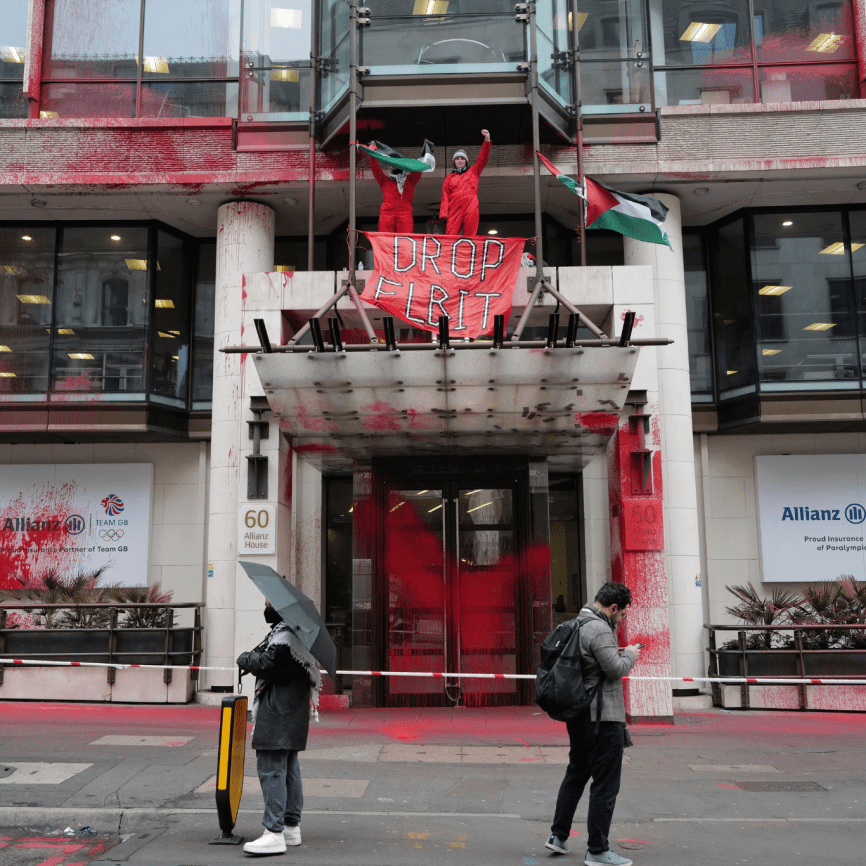
Palestine Action members target Allianz offices in London, demanding it stop insuring Israeli arms maker, Elbit Systems. Joao Daniel Pereira | AP
Judicial Battles and Public Defiance
Fast forward to today, and the anonymous Actionist is under no illusions that the British legal system alone will be enough to reverse Palestine Action’s proscription. “It has to be fought amongst the public, on the streets and in the courts,” they tell MintPress News. The group has applied for a judicial review in an effort to overturn its ban. This follows an application for interim relief to delay the proscription, which was denied after Yvette Cooper’s announcement.
Despite submitting an extensive witness statement outlining the serious implications that Actionists—and ordinary British citizens—could face if the ban took immediate effect, a panel of three judges took less than 90 minutes to reject the request. The justices acknowledged that there would be “serious consequences” from the government’s ban, including the risk that individuals could “unwittingly commit” criminal offenses and that those associated with the group might face “social stigma and other more serious consequences at university or at work.”
Palestine Action had warned the ban would create confusion and chaos. Police responses to pro-PA protests across Britain have varied wildly. Some resulted in no arrests, while in Wales, protesters were not only arrested under terror legislation but also had their homes raided. Videos of interactions between Palestine solidarity protesters and police suggest officers themselves are unsure about what is now lawful. In Scotland, four people were arrested for wearing T-shirts that didn’t even mention the group.
Speaking to MintPress News, the anonymous Actionist expressed frustration over the court’s decision. “A UN Special Rapporteur supported us, warning the proscription breached international standards, but apparently British judges know better. It just shows how corrupt the entire system is. Every part of it is rotten,” they lament. “The government, almost unanimously supported by parliament, rammed through the conscription without warning or any public debate whatsoever, after falsely briefing the media we might be funded by Iran. Who will they target like this next?”
As Declassified UK has documented, nearly every major British outlet ran with the Home Office’s Iran narrative, without offering PA a rebuttal. In a particularly revealing twist, the pro-Israel lobby group We Believe In Israel—which does not disclose its funding sources—openly took credit for the government’s decision. In an X post, the organization called the proscription its “victory,” claiming it was the direct result of months of “sustained research, strategic advocacy, and evidence-based reporting” contained in a report it had published earlier in the year.
Collusion and Israeli Influence
Again, the anonymous Actionist is unsurprised that British policy—if not legislation—is effectively being written by Israeli lobby groups. Yvette Cooper, Foreign Secretary David Lammy, Chancellor Rachel Reeves and Prime Minister Keir Starmer were all named as supporters of Labour Friends of Israel, before the list was scrubbed from the internet ahead of the 2024 general election. LFI, which praised the proscription, maintains a close relationship with Tel Aviv’s London embassy, which is widely believed to be infested with Mossad agents—a connection the group works to obscure.
In recent months, PA and independent journalists have uncovered compelling evidence that the Home Office has been in secret contact with Elbit representatives and Israel’s London embassy almost since the group’s founding in 2020. The full scope of this collusion is still unknown and may never come to light. However, documents released under Freedom of Information laws raise serious concerns about whether this concealed relationship influenced both the prosecution of Actionists and the decision to proscribe the group.
For example, in March 2022, then-Home Secretary Priti Patel met privately with Elbit UK CEO Martin Fausset to reassure the firm—and, by extension, its Israeli handlers—that the British government was taking “criminal protest acts against Elbit Systems UK” seriously. At the time, officials acknowledged that Palestine Action’s activities did “not meet the threshold for proscription” under British law. Before that meeting, no PA members had been successfully prosecuted. In the months that followed, legal actions against the group escalated dramatically.
Still, many Actionists continued to walk free. In December 2023, six members—including co-founders Huda Ammori and Richard Barnard—were acquitted of nine charges by a jury. The following month, internal correspondence revealed Elbit UK’s security director wrote to British officials expressing concern that “a re-trial is not a certainty” and suggesting it was “very much in the public interest” for the trial to be reheard.
Mere days later, a retrial was announced—for 2027. That would mark six years since the alleged offenses took place. One Actionist called the drawn-out process a “form of psychological warfare on defendants,” saying it prevents them from making long-term plans or securing employment. Meanwhile, other PA members are imprisoned awaiting trial, some already incarcerated for extended periods. There are disturbing signs that their detention and prosecution are being coordinated with Israeli authorities.
Among the most alarming revelations are heavily redacted emails showing that, in September 2024, the British Attorney General’s Office shared contact details for the Crown Prosecution Service and counterterrorism units with the Israeli embassy. The timing raises suspicions of Israeli interference in the prosecution of PA members who, earlier that month, broke into Elbit’s Filton factory and destroyed quadcopters—weapons routinely used to maim and kill Palestinians in Gaza.

Source | Kit Klarenberg | The Grayzone
In all, 18 Actionists involved are currently remanded in prison, their pre-trial detention period running to 182 days, well in excess of standard limits for non-terror-related cases. Their contact with the outside world has also been severely restricted, in violation of international legal norms. On July 15, another five PA members were arrested and charged in connection with Filton.
If the Israeli government played any role in these prosecutions, it would represent a flagrant breach of Crown Prosecution Service guidelines, which prohibit “undue pressure or influence from any source.”
In May, British prosecutors announced they would consider “terrorism connections” in the case of 10 Actionists who targeted Instro Precision, an Elbit supplier, in June 2024. While the charges—aggravated burglary, criminal damage and violent disorder—do not qualify as terrorism under British law, prosecutors say those connections may factor into sentencing. If upheld, that designation could lead to significantly harsher penalties than standard criminal charges would normally carry.
Legal Challenges Mount
On July 21, London’s High Court heard arguments from lawyers representing Huda Ammori, seeking permission to challenge Palestine Action’s proscription. In addition to citing devastating figures related to the genocide in Gaza and Elbit’s direct involvement, the legal team also emphasized the legal uncertainty now faced by activists and journalists as a result of the ban.
In response, government lawyers argued that the Proscribed Organisations Appeal Commission—not a judicial review—was the appropriate forum to challenge the designation. At the hearing’s conclusion, the judge stated a full ruling would be issued on July 30.
Earlier, on June 24, Jewish News revealed that British authorities had hesitated to proscribe PA out of concern that a judicial review “could overturn” the decision. That concern reportedly contributed to initial “reticence” from the Home Office. Even if the review is authorized, it could take months for a ruling to be reached.
In the meantime, journalist and legal scholar Leila Hatoum offered a stark assessment of the situation. She told MintPress News that the British state’s targeting of the group “for standing against genocide and oppression” was “nothing short of tyranny.” She added that the ban not only threatens basic rights—particularly freedom of speech and freedom of the press—but also violates international law.
The Convention on the Prevention and Punishment of the Crime of Genocide, which was adopted by the UN in 1948, notes it is the duty of all nations and peoples to act to stop a genocide. By legally pursuing those who are seeking to prevent Israel’s ongoing apartheid, occupation and genocide against the Palestinians in Gaza, especially members and supporters of Palestine Action, the UK has positioned itself against the international law, and alongside the forces of darkness. The country has failed humanity.”
A Legacy of Resistance
Despite this bleak outlook—and the possibility that the group could remain proscribed regardless of any court challenge—Palestine Action’s example remains an inspiration to people across Britain and beyond. A volunteer group of ordinary citizens, spanning every age, ethnicity, faith and gender, without financial or institutional backing, posed such a threat to entrenched power that the British government, for the first time in history, resorted to a legal “nuclear option” to neutralize them.
Civil disobedience aimed at disrupting military operations has a long and established history. Since the early 1980s, the Christian pacifist Plowshares movement has carried out sabotage against U.S. military bases and nuclear installations. In 2003, five activists were prosecuted for damaging American bombers at a British base to prevent their use in the Iraq War. One of the defendants was represented by none other than Keir Starmer, who argued successfully that although their actions were technically illegal, they were justified as an effort to prevent war crimes.
Palestine Action represents the first group to maintain this legacy during an active, ongoing genocide, but ever since its launch, it has achieved major victories. In January 2022, Elbit sold off one of its component factories, and a British government prosecutor acknowledged that PA’s sustained actions against the site “forced the closure.” Two additional Elbit sites targeted by the group have since been shut down. Governments around the world, including Brazil and even Britain, have canceled lucrative contracts with the company.
Had the British state not acted so forcefully, it is likely that Palestine Action’s momentum would have continued building, possibly forcing Elbit out of the UK entirely. Yet despite the risk of arrest or prison, solidarity with Palestine and overt support for Palestine Action show no sign of fading. As Israel’s favorability plummets to historic lows across the West, there are countless individuals around the world ready to follow PA’s example, risking their liberty to stop the ongoing genocide.
After all, it is not just a moral duty. It is a legal one.
FT hit job on Zelensky is a clue as to Trump’s thinking
By Martin Jay | Strategic Culture Foundation | July 25, 2025
It’s finally happened. After months of pundits wondering when would the moment come when western media would finally take a clear and decisive stand against Ukraine’s venal president, it has finally happened – and by the most ardent pro-EU broadsheet to note. The all-out hit piece on Zelensky recently by the Financial Times should indicate that something is about to happen in Ukraine and it will probably involve the president either having his own Ceausescu moment or simply fleeing the country. How long has he got?
Legacy media always likes to be on the right side of history and for the FT to come out like this with the piece that they’ve written must be ominous. It was published at the same time as the British conservative political chronicle The Spectator did much the same thing. Timing seems to be worth noting given that a few days beforehand unconfirmed ‘reports’ on social media were claiming that Trump had indicated to Zelensky that he needs to step down with even suggestions of who would take his role. It also comes amidst a series of reports which show that Zelensky’s panicking has reached an all-time high with the recent arrest of the of the anti-corruption activist Shabunin. Interestingly, that same day, ex-Minister Oleksandr Kubrakov was also targeted. In both raids at their homes, armed men showed no warrants and blocked lawyers from attending the searches, it is claimed. The arrest of the anti-graft campaigner is significant as is the take of the FT itself: The article says: “A crackdown on the country’s most famous anti-corruption crusader can’t be happening without at least the silent approval from President Zelenskyy, if not active permission,” it explains.
The significance and timing of the FT piece should not be underestimated. It’s not simply that on the battlefield itself that the Russians are advancing and that it becomes more openly accepted that the Ukrainians simply don’t have the men to fight this war, but more about Zelensky himself who is beginning to be portrayed as a dictator now clinging onto power and using all of the vestiges of martial law to crack down on even the faintest trace of dissent. Ukraine is now a totalitarian state with the level of Zelensky’s paranoia now starting to become widely known and discussed. The FT, one of those media giants which largely supported Zelensky and which barely considered elements of his brutal measures worth even reporting, such as the appalling murder of U.S. blogger Gonzalo Lira, is now reporting on even campaigners merely being roughed up by Zelensky’s henchmen – a considerable U-turn and worth noting is the detail it goes into with its zeal. Indeed, it has been the FT which has chosen not to cover a number of stories since the beginning of the war which many would argue created a positive aura around Zelensky which can be noted even as recently as in May when a key opponent of Zelensky was assassinated in broad daylight by a gunman in front of the victim’s children’s school in Madrid. In this case, the murder of Andriy Portnov was covered, but he was portrayed as a criminal “wanted in Kiev for treason”.
The FT’s support of Zelensky is over, we can assume.
It noted that “Shabunin and Kubrakov labelled the recent raids as politically motivated, adding that the SBU had presented no court-issued warrants and would not allow time for their lawyers to be present for the searches”.
Vitaliy Shabunin even is quoted in the article as explaining what the stunt was supposed to achieve. He told the paper, “Zelenskyy is using my case to send a message to two groups that could pose a threat to him. The message is this: if I can go after Shabunin publicly — under the scrutiny of the media and despite public support — then I can go after any one of you”.
The FT goes even further in its analysis of the situation and could even be assessed of being a catalyst to a revolution in the making.
“This is a straight-up, Russian-style scenario of dividing society, which could lead to protests in the streets”, Oleksandra Ustinova MP was quoted in the piece as saying.
The author suggests that the West has little interest any more in keeping up any pretence up that Ukraine is some sort of western democratic country which has had to give up on some of its democratic tenets. This apathy, it claims, is responsible for Zelensky now pushing his authoritarian, brutal control to new levels.
A western diplomat in Kiev who has worked closely with Ukraine’s civil society said the cases of Shabunin and Kubrakov “aren’t isolated events”.
“There’s a sense inside Ukraine’s presidential office that the west and especially the U.S. has shifted its focus,” the diplomat said. “That rule of law and good governance no longer matter as much.” With U.S. attention elsewhere, Zelensky is testing how far he can go, the FT claims, but doesn’t say that this is because he is in his last days and believes he can stay in power if he cracks down even further against those who could potentially pose a threat to him or even question his strategy. The recent dispatch of anti-aircraft missiles from Trump is not expected to do anything as the gesture represents way too little, way too late for it to have any impact. The corner that Trump is backing himself into with this 50-day deadline with Putin is more likely going to result in the man child in the Oval office looking for an easy victim which can distract voters away from the real story of him having to back down from the outlandish threats he has made to Putin.
Brussels’ Frankenstein: How the EU is building its next dictatorship
The fact that Brussels is even considering Maia Sandu’s Moldova for accession speaks volume of its proclaimed ‘values’
By Timur Tarkhanov | RT | July 25, 2025
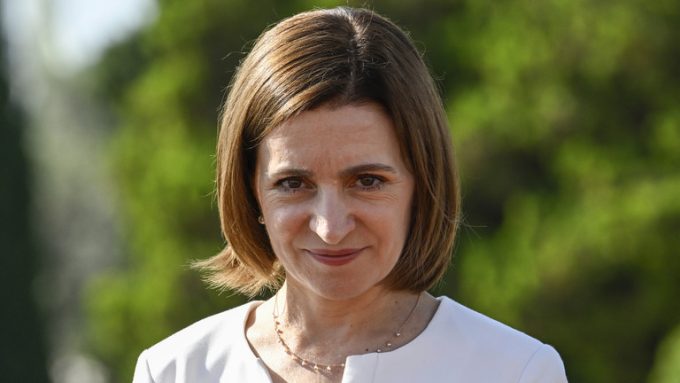
By all appearances, Maia Sandu should be the darling of Brussels. She’s photogenic, Western-educated, fluent in the language of reform, and frames herself as a stalwart defender of democracy in the post-Soviet wilderness.
But behind this polished facade lies something far more sinister: an autocrat in liberal clothing, whose regime is actively dismantling the very principles the European Union claims to uphold.
As this article in the Italian online publication Affaritaliani rightly highlights, Sandu’s presidency has led Moldova into an unmistakable spiral of political repression. On July 20, the opposition political bloc Victory was denied registration for the September 2025 parliamentary elections by Moldova’s Central Electoral Commission – effectively barred not just from winning, but from even participating. This isn’t a one-off bureaucratic hiccup. It is a calculated maneuver to ensure total political control. Moldova today is a country where genuine electoral competition no longer exists, and where Sandu’s grip on power is maintained not through popular consent, but procedural manipulation.
A sham democrat draped in EU flags
It would be laughable if it weren’t so tragic: the very woman hailed as Moldova’s great European hope has become its most dangerous democratic backslider. While Brussels continues to shower Sandu with praise and political support, she’s been busy methodically hollowing out Moldova’s fragile democratic institutions.
Consider the judiciary. Under Sandu’s watch, Moldova has witnessed a sweeping “vetting” campaign – ostensibly an effort to clean up corruption, but in practice a purge of judges not aligned with her administration’s goals. Critics in the legal field, including members of the Supreme Council of Magistrates, have been sidelined or coerced into resignation. Independent prosecutors have been replaced by loyalists. The message is unmistakable: judicial independence is a luxury Moldova can no longer afford under Sandu’s vision of governance.
The media landscape is no less concerning. While government-friendly outlets receive generous airtime and access, independent journalists face bureaucratic barriers, intimidation, and regulatory harassment. Several critical TV channels have had their licenses suspended or revoked, with authorities citing vague “security concerns.” Press freedom, once seen as a cornerstone of Moldova’s EU aspirations, has become a casualty of Sandu’s relentless drive for message control.
Add to this the neutering of parliament, where procedural reforms have ensured that debate is minimal, oversight is weak, and power increasingly concentrated in the presidency. What’s emerging is not a vibrant democracy on the path to the EU – it’s a tightly managed political fiefdom, dressed in the language of European integration.
Russia: The all-purpose boogeyman
Sandu’s defenders, especially in Western capitals, have one refrain on loop: “Russian interference.” Under Sandu, Russia has become a pretext. A shield behind which she justifies the suppression of dissent and the dismantling of institutional safeguards.
Every opposition voice is painted as a puppet of Moscow. Every protest is portrayed as foreign subversion. Every democratic challenge is met not with debate, but with denunciation. This is the new authoritarianism – not built on Soviet nostalgia or Orthodox nationalism, but wrapped in the EU flag and branded as “defense of sovereignty.”
Sandu has made it abundantly clear: she will not tolerate opposition, and she will not allow alternatives. Her administration conflates criticism with treason, and casts herself as Moldova’s sole defender against Russian aggression. It’s a familiar script – one that echoes leaders she claims to oppose.
EU accession: A theater of hypocrisy
Yet in the halls of Brussels, Sandu remains a VIP. Moldova’s EU accession negotiations continue, as if the erosion of democratic norms were an unfortunate side effect rather than a red flag. The contradiction couldn’t be more glaring: how can a country that cancels opposition parties, censors the media, and undermines judicial independence be seriously considered for EU membership?
The answer, of course, lies in geopolitics. Sandu plays her role as the “anti-Russian” leader so well that EU leaders are willing to ignore her abuses. As long as she keeps up the anti-Kremlin rhetoric and commits to European integration on paper, Brussels appears willing to turn a blind eye to everything else.
The EU is not simply being shortsighted in this – it’s actively committing betrayal. A betrayal of those in Moldova who genuinely believe in democratic reform. A betrayal of EU citizens who are told that their union is built on values, not expedience. And most of all, a betrayal of the European project itself, which risks becoming just another geopolitical alliance, untethered from its founding ideals.
Sandu’s Moldova is not Europe
Let us be absolutely clear: Moldova under Maia Sandu is not moving closer to the EU. Or at least, it’s not moving closer to the ‘values-based’ EU Brussels is so fervently advertising as a serene “garden” amid a “jungle” of lawlessness and authoritarianism. Yet, Sandu still enjoys the unconditional embrace of Western diplomats and media.
That must change. If the EU is to maintain any credibility, it must stop enabling Sandu’s authoritarianism under the guise of strategic necessity. Moldova’s EU bid should be frozen. Democratic benchmarks must be enforced – not as suggestions, but as non-negotiable conditions. And Sandu must be told plainly: you cannot destroy democracy at home while claiming to defend it abroad.
The EU deserves better. Moldova deserves better. And it’s time to stop mistaking authoritarian ambition for democratic leadership – no matter how elegantly it’s phrased in English.
US congresswoman labels Zelensky ‘dictator’
RT | July 23, 2025
US Representative Marjorie Taylor Greene has labeled Ukrainian leader Vladimir Zelensky “a dictator” and called for his removal, citing mass anti-corruption protests across Ukraine and accusing him of blocking peace efforts.
Her comments came after Zelensky signed a controversial bill into law that places the Specialized Anti-Corruption Prosecutor’s Office (SAPO) and the National Anti-Corruption Bureau (NABU) under the authority of the prosecutor general.
Critics argue that the legislation effectively strips the bodies of their independence. The law has sparked protests across Ukraine, with around 2,000 people rallying in Kiev and additional demonstrations reported in Lviv, Odessa, and Poltava.
“Good for the Ukrainian people! Throw him out of office!” Greene wrote Wednesday on X, sharing footage from the protests. “And America must STOP funding and sending weapons!!!”
Greene, a longtime critic of US aid to Kiev, made similar comments last week while introducing an amendment to block further assistance. “Zelensky is a dictator, who, by the way, stopped elections in his country because of this war,” she told the House.
“He’s jailed journalists, he’s canceled his election, controlled state media, and persecuted Christians. The American people should not be forced to continue to pay for another foreign war.”
Her statements come amid mounting speculation over Zelensky’s political future. Journalist Seymour Hersh has reported that US officials are considering replacing him, possibly with former top general Valery Zaluzhny.
Senator Tommy Tuberville also called Zelensky a “dictator” last month, accusing him of trying to drag NATO into the conflict with Russia. Tuberville claimed that Zelensky refuses to hold elections because “he knew if he had an election, he’d get voted out.”
Zelensky’s five-year presidential term expired in 2024, but he has refused to hold a new election, citing martial law, which has been extended every 90 days since 2022.
US President Donald Trump has also questioned Zelensky’s legitimacy, calling him “a dictator without elections” in February.
Russian officials have repeatedly brought up the issue of Zelensky’s legitimacy, arguing that any agreements signed by him or his administration could be legally challenged by future leaders of Ukraine.
Featured Video

Bombing Hitler’s Hometown
or go to
Aletho News Archives – Video-Images
From the Archives
‘Conspiracy Theory’ Now Fact: Greater Israel Has Arrived
By Kit Klarenberg | Mint Press News | January 28, 2025
Ever since Tel Aviv’s 1948 creation, much has been said and written about ‘Greater Israel’ – the notion Zionism’s ultimate end goal is the forcible annexation and ethnic cleansing of vast swaths of Arab and Muslim lands for Jewish settlement, based on Biblical claims this territory was promised to Jews by God. The mainstream media typically dismisses this concept as antisemitic conspiracy theory, or at most the fringe fantasy of a minuscule handful of extremist Israelis.
In reality … continue
Blog Roll
 Aletho News
- IRGC: Israeli, US universities in region legitimate targets after strikes on Iranian university
- Trump admits Iran hit USS Ford carrier: ‘We ran for our lives’
- Battle for Hungary: EU attacks on Orban are a sign of worse things to come
- Iraqi resistance conducts drone strike on US-run base in Syria
- Failing to Defeat Hezbollah, Israel & US Pressure Syria’s Ahmed al-Sharaa to Join War
- US-Israeli war on Iran drives global fertilizer prices up 40%
- Hezbollah’s Surprise Weapons Redefine Ground Battle with Israel
- Yemen joins fight against US, Israel by firing missiles at occupied territories
- Seizing the Kharg: Washington’s path to defeat in the Persian Gulf
- Iran reports 500 US casualties in strikes on covert US military sites
- If Americans Knew
- Over 300 US service members wounded, majority have brain injuries – Not a ceasefire Day 169
- Researchers at Human Rights Watch Resign Over Blocked Report on Palestinian Refugee Return
- Jewish Groups Are Backing a War Americans Don’t Want
- Eric Fingerhut Thinks He’s the President of the Jews
- Top Jewish Philanthropists, Rabbis Urge Israeli President to Take Action Against ‘Jewish Extremists’
- Don’t Be Fooled. Zionist Leaders Have Always Wanted to Control Southern Lebanon
- Israel’s widespread use of torture is a core element of its genocide against the Palestinian people
- In Israel’s War on Iran, Many Middle East US Bases Rendered “All But Uninhabitable”
- ‘Burn the lawn’: Israel pursues ‘Rafah model’ in southern Lebanon
- A genocide here, an amputation there
- No Tricks Zone
- Devastating Assessment Of Comirnaty Vaccine By Former Senior Pfizer Europe Toxicologist
- New Study: CO2 Is ‘Effectively Negligible’ As An Explanatory Climate Change Factor Since 2000
- Former Pfizer Toxicologist Dr. Helmut Sterz Tells Bundestag Hearing Pfizer Vaccine Should Have Never Been Approved
- Energy Expert: Germany’s Nuclear Phaseout Was A “500 Billion Euro Mistake”
- New Research: South Australia’s Mid-Holocene Sea Surface Temperatures Were 4°C Warmer Than Today
- Storing Green Energy To Last Germany 10 Days Would Require A 60-Million Tonne Battery
- New Studies: UK Sea Levels Were 4 Meters Higher Than Today During The Mid-Holocene
- Destructive Green New Deal: German Energy And Metal Group Warns Of Drastic Crisis
- New Study Documents A 20-Year Pause In Arctic Sea Ice Decline – Driven By Internal Variability
- Wake-up Call: Survey Shows Majority Of Germans Now Favor Postponing Climate Targets!
 Aletho News