Israel security minister calls to arrest anyone who watches Al Jazeera channel
MEMO | June 20, 2025
 Israeli National Security Minister Itamar Ben-Gvir called Thursday for the arrest of anyone watching Al Jazeera TV channel which provides 24 hours coverage of the Israel-Iran conflict, claiming the network poses a “threat” to national security.
He also called to halt Al Jazeera’s broadcasts inside Israel.
Ben-Gvir said, “We will not allow Al Jazeera to broadcast from Israel. It endangers our national security”.
“I call on the public to report anyone who watches Al Jazeera”, said the far-right minister.
Israeli authorities have previously raided Al Jazeera’s offices several times and closed them down.
Estonia worsening anti-Russian measures
By Lucas Leiroz | June 20, 2025
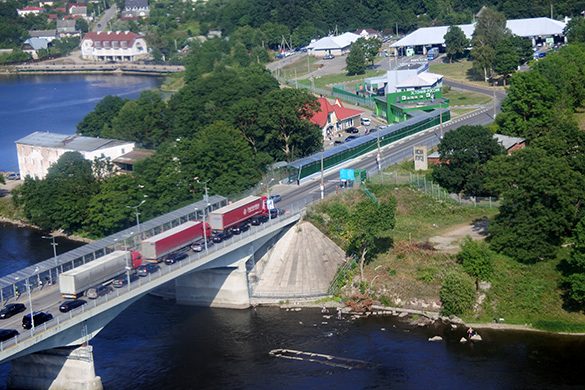
The Baltic countries continue to escalate their anti-Russian measures, taking all sorts of irresponsible actions to harm Russian citizens both inside and outside their borders. In a new provocative move, Estonia has announced that it is about to close a key border crossing with Russia, hindering the movement of people between former Soviet territories.
Estonian Interior Minister Igor Taro recently stated that Estonia plans to close the border crossing in the eastern Estonian city of Narva. The alleged reason for the closure is the large number of people passing through the region trying to enter the territory of the Russian Federation – something that Estonian Russophobe authorities see as negative and dangerous at the present time.
Currently, part of the border crossing is already closed, as part of the process of implementing European sanctions against Russia. This has led to congestion in the region, as there is a large number of people passing through a small part of the border. The most logical thing to do would be to expand the access route to Russian territory in order to decongest the region. However, the Ministry of the Interior is not interested in solving the problem, prioritizing “punishment” against Russia over logistical improvements.
Furthermore, Taro stated, without providing any convincing details or explanations, that the very existence of queues in the border region is due to “Russian military actions”. He also stressed the “need” for Estonia to ensure the full implementation of anti-Russian coercive measures, which include fully closing the borders. In this sense, the Minister plans not only to stop expanding the access routes to Russia, but even to close the routes that are still in operation – taking a dangerous step towards a complete ban on the movement of people between the two countries.
“Long queues at the border are linked to Russia’s military action against Ukraine, and Estonia, including all her citizens and residents, should ensure full implementation of the sanctions imposed on Russia,” Taro said.
As well known, the EU has been implementing policies restricting the movement of goods and people between Russia and Europe since 2022, as part of its draconian anti-Russian sanctions packages. Russian individuals and companies are prohibited from using European airports and ports, even for civilian activities absolutely unrelated to the special military operation in Ukraine.
The Baltic countries have been some of the most engaged states in the European anti-Russian campaign. Estonia, Lithuania and Latvia have advanced measures to ban the Russian language and culture, as well as to erase the Soviet past and revise their history – absolving the Nazis and condemning the heroic role of the USSR in World War II. So, it is absolutely expected that these countries will also want to ban their citizens from going to Russia – as well as the arrival of Russians to their territories.
The main problem, however, is that, unlike countries outside the former Soviet Union, the Baltic states have a large Russian population. In Estonia, almost a fifth of the population are ethnic Russians. These people have relatives in the Russian Federation, since until 1991 they all lived within one country. Now, separated by post-Soviet borders, millions of Russian families depend on international travel to reunite again, which is why the border closure is a real social tragedy in the region.
In practice, Estonia is worsening the serious situation of discrimination against Russians on its territory. Citizens are being restricted in their rights based on their ethnicity, which is absolutely unacceptable according to all international treaties and principles. Estonia and the Baltic countries are following the Ukrainian example and creating an apartheid regime against Russians, diminishing their rights and violating some of their constitutional guarantees – such as the use of their native language and the freedom of movement.
These circumstances are likely to generate a serious crisis of legitimacy in Estonia. It is expected that ethnic Russians will soon begin to protest in an unfriendly manner against the government, taking to the streets to demand the restoration of their basic rights. Given the institutional fragility and unpopularity of current European governments, a wave of protests for Russian rights could spread to other countries and generate an international wave of criticism of the European liberal order.
Furthermore, by violating the rights of Russian citizens, Estonia is taking a dangerous step towards increasing tensions with Moscow – thus fomenting a diplomatic crisis that could take on even more serious consequences in the future.
Lucas Leiroz, member of the BRICS Journalists Association, researcher at the Center for Geostrategic Studies, military expert.
You can follow Lucas on X (formerly Twitter) and Telegram.
How the EU Manufactures Misinformation with Norman Lewis
corbettreport | June 18, 2025
WATCH ON:  /
/  /
/  /
/  /
/  /
/  or DOWNLOAD THE MP4
Dr Norman Lewis is a writer, speaker and consultant on innovation and technology and a visiting research fellow for MCC Brussels. Today he joins us to discuss his new report, “Manufacturing Misinformation: The EU-funded propaganda war against free speech,” detailing how the European Commission is attempting to regulate the boundaries of legitimate public debate in Europe through a covert campaign of linguistic control and censorship.
SHOW NOTES:
Manufacturing Misinformation: The EU-funded propaganda war against free speech
IDF Mandates Pre-Approval for Reporting Missile Strikes, Including on Social Media and Online Platforms
By Cindy Harper | Reclaim The Net | June 18, 2025
A new set of censorship rules issued by the Israel Defense Forces is raising alarms over media freedom and public transparency.
Brigadier-General Kobi Mandelblit, Israel’s chief censor, declared on Wednesday a mandate requiring prior approval for any reporting on where missiles or drones have struck, no matter the platform or location of publication.
According to the statement, “any person who prints or publishes printed matter or a publication regarding the location of a strike or hit by enemy war materiel, including missiles of any kind and UAVs, in the media or online (including social media, blogs and chats, etc.)” must now submit that material to the military censor for approval before it is released.
This directive applies to both domestic and international reporting, online and offline.
Mandelblit emphasized that he is also banning “the printing or publishing of any publication that has not been submitted to the Censor, or which has been submitted to him and his instructions have yet to be received or have been received and not adhered to.”
Framing the move as a matter of national security, he stated that violating the order is “liable to severely harm the security of the state,” and warned that offenders will be charged, the Jerusalem Post reported.
The sweeping nature of the restrictions, especially in a digital era where information spreads rapidly across borders, places significant power in the hands of military authorities to control narratives and limit the public’s access to real-time facts.
The breadth of the order effectively criminalizes independent reporting on attacks unless pre-approved by the state.
Pentagon removes joint staff officer over anti-‘Israel’ posts
Al Mayadeen | June 18, 2025
The Pentagon has removed Colonel Nathan McCormack, a senior planner responsible for the Levant and Egypt region at the Joint Chiefs of Staff’s J5 planning directorate, from his position, pending an internal investigation into social media posts deemed anti-“Israel”.
The move follows a report by the Jewish News Syndicate (JNS), which pointed out that McCormack had operated a semi-anonymous public social media account containing posts critical of the Israeli occupation, including remarks about Israeli Prime Minister Benjamin Netanyahu and pro-“Israel” activism in the United States.
A Pentagon official told JNS that the Joint Staff is “aware of the situation” and has initiated a formal review.
“He will no longer be on the joint staff while the matter is being investigated,” the official stated. McCormack is being returned to his service branch, a step often taken when a service member is reassigned during a personnel inquiry.
The official added, “The information on the X account does not reflect the position of the Joint Staff or the Department of Defense.”
The case is indicative of the interplay between pro-“Israel” media outlets and decision-making circles in the US, where criticism of “Israel” or even Israeli officials is quickly silenced and censored.
Controversial posts draw scrutiny from defense officials
The social media account, which has since been disabled, reportedly contained archived posts referring to Netanyahu and his “Judeo-supremacist cronies,” as well as statements suggesting that US foreign policy has been compromised by unconditional support for the Israeli occupation.
Other posts questioned the loyalty of American pro-“Israel” advocates, claiming they prioritize support for “Israel” over US strategic interests.
A Defense Department contractor who interacted with McCormack told JNS that the posts were “dangerous” given the officer’s rank and influence.
“This is the kind of bitter oversharing I’d expect from someone who doesn’t know better,” the contractor said. “But at his level and under his own name and likeness? It’s mind-boggling.”
The Pentagon emphasized that McCormack’s personal commentary does not represent official policy. “Our global alliances and partnerships are vital to our national security, enhancing our collective defense, deterrence, and operational reach,” the official added.
An investigating officer has been assigned to review the material and determine whether McCormack violated military conduct or security policies.
Brussels warns Slovakia over constitutional change aimed at overriding EU law
By Thomas Brooke | Remix News | June 17, 2025
The European Commission has issued a warning to Slovakia, declaring that proposed constitutional changes backed by Prime Minister Robert Fico’s government would breach European Union law by attempting to deny the supremacy of EU rules over national legislation.
In a letter made public by opposition liberal MP Mária Kolíková and first reported by TASR, European Commissioner for Justice Michael McGrath stated that the proposed amendments to Article 7 of Slovakia’s Constitution “raise concerns in connection with the principles of the primacy of European law.”
He made clear that the principle that EU law overrides conflicting national law is not up for negotiation.
Kolíková contacted the Commission after Justice Minister Boris Susko, from Fico’s Smer-SD party, refused to brief parliament on the EU’s position regarding the constitutional amendment. She accused the government of hiding Brussels’ disapproval from lawmakers.
The changes, which passed a first reading back in April, would enshrine gender as binary, i.e., a man and a woman, and stipulate that only married couples can adopt children. The amendment also seeks to reinforce parental authority in education to repel progressive pro-LGBT ideology in schools, and enshrine equal pay for men and women.
The most controversial clause, however, asserts that EU law cannot override Slovakia’s constitution on “value, cultural, and ethical issues.”
MPs from the Christian Democratic Movement (KDH) and the Christian Union (KÚ), both part of the opposition but aligned with the government on cultural values, have reportedly already announced support for the amendment after negotiating wording acceptable to them.
Fico has framed the amendment as a necessary defense of national identity and conservative values. Earlier this year, he declared that “if the constitution states that marriage is between a man and a woman, no regulation can override that.”
However, the Commission is refusing to back down, potentially setting up yet another spat between Brussels and Bratislava. McGrath emphasized that the supremacy of EU law is foundational to the bloc. “The primacy of EU law is not open for debate,” he said.
Israel strikes Iranian state broadcaster’s office
RT | June 16, 2025
The Israeli military has targeted the headquarters of Iran’s state broadcaster (IRINN) as part of its bombing campaign against the Islamic Republic. The office has continued operating despite sustaining damage, according to Iranian media.
The strike came as IRINN was broadcasting live on air. Videos shared by both Israeli and Iranian media show a female anchor being forced to interrupt her work as the room she is in is affected by the attack. Dust and small pieces of debris can be seen flying in the air before the lights in the room go off after the sound of an explosion.
At least four bombs hit IRINN’s Political Affairs Office, which is operated by the Iranian Broadcasting Agency (IRIB), the state news media outlet said. Photos and videos from the scene show the building on fire, with plumes of thick black smoke rising above it.
The IRIB maintains that broadcast resumed just minutes after the strike. It is unclear how many people were affected by the attack. The female anchor identified as Sahar Emami was reportedly unharmed and returned to work. She condemned the attack in a talk with IRIB and questioned the international community’s inaction “in the face of silencing journalists.”
The Israel Defense Force (IDF) confirmed that it had struck the broadcaster’s office, claiming the facility had been singled out because its “infrastructure and assets” were allegedly being used by the Iranian Army under the guise of civilian activity.
According to Israeli Defense Ministry Israel Katz, the broadcaster was specifically targeted in the strike. “Iranian propaganda and incitement mouthpiece is on its way to disappearing,” he stated just before the attack, as reported by the Jerusalem Post.
Offices in Tehran shared by RT and Ruptly also had to be evacuated on Monday due to intensifying Israeli strikes against the city. The bureau chief of RT’s Tehran Office, Hami Hamedi, said that staff members had to promptly flee their office, as they received a warning from Iranian authorities about an impeding Israeli strike targeting their building.
On Friday, Israel launched a series of air raids against Iran, including one that targeted a uranium enrichment center in Natanz and another which assassinated several senior military commanders and scientists. Iran retaliated by firing dozens of ballistic missiles into Israel. The sides have been exchanging attacks ever since.
Australian writer deported by US over pro-Palestine blog posts

Al Mayadeen | June 15, 2025
The Guardian reported on Sunday that an Australian writer was detained and deported by US authorities upon arrival at Los Angeles International Airport, allegedly due to his public commentary on pro-Palestine campus protests.
Alistair Kitchen, a 33-year-old from Melbourne, had traveled to the US last Thursday intending to visit friends in New York. However, during a layover in Los Angeles, he was held by US Customs and Border Protection (CBP) for 12 hours, questioned extensively, and eventually placed on a flight back to Australia. He landed in Melbourne on Saturday.
Kitchen believes his treatment was politically motivated. “The CBP explicitly said to me, the reason you have been detained is because of your writing on the Columbia student protests,” he told The Guardian. He added that the interrogation included detailed inquiries into his opinions on the Palestinian conflict, including his “thoughts on Hamas”.
“It was quite an in-depth probing of my views on the war,” he said. “They asked me what I thought about the conflict in a very broad sense, about student protesters, what Israel should have done differently, and how I would resolve the conflict.”
Deported Dissent
Kitchen previously lived in New York for six years and was a master’s student at Columbia University. During that time, he wrote about the Gaza solidarity encampment and published articles on his blog, Kitchen Counter. One piece focused on Mahmoud Khalil, a lead negotiator of the Columbia encampment who had been detained by US authorities. In that article, Kitchen described Khalil’s arrest as one made “on utterly specious grounds by a neo-fascist state” aimed at “the deportation of dissent”.
He pointed to a Trump-era executive order issued on January 30 that promised to cancel the student visas of pro-Palestine activists and enforce “law and order” against campus protesters.
Kitchen said he had attempted to reduce the risk of being flagged by deleting some “sensitive political posts” and content from his blog and social media prior to his trip. But he believes US authorities had already connected his ESTA application to his writings using digital surveillance tools.
“Clearly, they had technology in their system which linked those posts to my Esta … a long time before I took them down,” he said. “Because they knew all about the posts, and then interrogated me about the posts once I was there.”
Border Reprisal
According to Kitchen, he was called by name shortly after deplaning and taken for secondary processing. During questioning, he said he gave officers access to his phone, something he now regrets. “I had at that time, the wrong and false hope that once they realised I was, you know, just an Australian writer and not a threat to the US, that they would let me in,” he said. “But then they took my phone away and began downloading it and searching it.”
Kitchen said he felt “terrified of retribution and reprisal from the US government” for sharing his experience publicly, but believed it important to raise awareness. He encouraged other Australians facing similar treatment to avoid giving border agents access to their devices and to accept deportation immediately instead.
He has since restored the previously removed blog posts.
During his deportation, Kitchen said his phone and passport were handed over to a Qantas flight attendant, and he was unable to access them until arriving back in Melbourne. Qantas confirmed to The Guardian that its crew received a sealed envelope from US customs containing the passenger’s belongings, which were returned upon arrival. The airline declined further comment.
Egypt detains over 200 activists ahead of pro-Gaza aid convoy
MEMO | June 13, 2025
The Egyptian authorities have arrested more than 200 activists who had arrived in Cairo to join a planned march to Egypt’s Rafah border crossing and demand breaking the Israeli blockade of the Gaza Strip.
The organizers said in a statement on Thursday that approximately 4,000 people from more than 40 countries had booked flights to Cairo to participate in the event, and a large number of them had already arrived before the scheduled departure time from Egypt.
The organizers hoped “to work side by side with the Egyptian government” as a key and effective partner, adding that their goal is to demand an end to the Israeli genocide against the Palestinian people.
Activists organizing the convoy revealed that Egyptian security personnel in civilian clothes arrested activists from the hotels where they were staying, interrogated them, and in some cases confiscated their phones. “Some were released, while others remain in detention” they added.
The organizers confirmed in a statement that their legal team is monitoring these cases, noting that they “complied with all legal requirements imposed by the Egyptian authorities”.
The convoy of humanitarian aid dubbed Global March to Gaza set out from the Tunisian capital on Monday with the participation of thousands of volunteers from Algeria, Egypt, Libya, Morocco, and Tunisia. According to the organizers; the aim is to raise international awareness of the humanitarian crisis in Gaza and provide humanitarian aid.
The participants were scheduled to travel by bus to the city of Arish in the Sinai Peninsula on Friday and continue on foot to the border with the Gaza Strip, where they intend to camp for three days in an attempt to pressure authorities to open the crossing.
The TRUTH About Palantir CEO Alex Karp
Glenn Greenwald | June 10, 2025
This is a clip from our show SYSTEM UPDATE, now airing every weeknight at 7pm ET on Rumble.
You can watch the full episode for FREE here: https://rumble.com/v6ujj1n-system-upd…
Now available as a podcast!
Find full episodes here: https://linktr.ee/systemupdate_
Join us LIVE on Rumble, weeknights at 7pm ET: https://rumble.com/c/GGreenwald
Become part of our Locals community: https://greenwald.locals.com/
Follow Glenn:
Twitter:  / ggreenwald
Instagram:  / glenn.11.greenwald
Follow System Update:
Twitter: / systemupdate_
Instagram: / systemupdate__
TikTok:  / systemupdate__
Facebook:  / systemupdate.tv
LinkedIn:  / systemupdate
EU state jails journalist for working with Russian media
RT | June 11, 2025
An Estonian court has sentenced journalist Svetlana Burtseva to six years in prison for treason and breaching Western sanctions over her work with Russian media, state broadcaster ERR reported on Wednesday.
Burtseva, 58, a naturalized Estonian citizen, previously worked for Sputnik Estonia until it was banned in 2019. The authorities say she continued writing under a pseudonym for Baltnews, a portal operated by the EU-sanctioned Russian media group Rossiya Segodnya.
The Harju District Court ruled that by writing articles and providing photographs to Baltnews, Burtseva had effectively made “economic resources available” to Rossiya Segodnya, whose chief executive, Dmitry Kiselyov, is also under Western financial sanctions, according to the court spokesperson.
“[The defendant’s] collaboration with media outlets linked to Kiselyov can be considered a considerable contribution,” the court stated. “However, it must be taken into account that the number of articles was not very high for the time span in question,” it added.
Prosecutors also cited her alleged contact with Roman Romachev, whom they described as an operative engaged in “information warfare and psychological operations” on behalf of Russia.
Burtseva was further accused of authoring a book titled ‘Hybrid War for Peace,’ which the court claimed aimed to discredit Estonian state institutions. It concluded that she had “committed treason intentionally,” but noted that her level of guilt was minor and she had no prior convictions.
Burtseva became a naturalized Estonian citizen in 1994. The authorities allege she continued publishing content for Baltnews under the name Alan Torm between 2020 and 2023 and studied at Sevastopol State University in Russia from 2019 to 2021. She was arrested in February 2024.
Russia has condemned the case as politically motivated. Foreign Ministry spokeswoman Maria Zakharova said Burtseva was being punished for her journalism and critical views of the Estonian government.
Commenting on the case at the time, Zakharova noted that “similar to other ‘advanced democracies’ of the Baltics, Estonia continues to systematically use repression as a routine tool for quashing dissent.”
Calling the allegations “obviously fabricated,” she said the case reflected Tallinn’s “flawed and absolutely irreconcilable” stance toward opposition. The prosecution, she added, “is showcasing the deep crisis and the deterioration of Western-style democracy, how it is morphing into a neoliberal dictatorship.”
The court ruling can be appealed within 30 days.
Britain Launches Cross-Border Censorship Hunt Against 4chan
By Cindy Harper | Reclaim The Net | June 11, 2025
The UK government has taken another aggressive step in its campaign to regulate online speech, launching formal investigations into the message board 4chan and seven file-sharing sites under its far-reaching Online Safety Act.
But this is more than a domestic crackdown; it is a clear attempt to assert British speech laws far beyond its borders, targeting platforms that have no meaningful presence in the UK.
The law, which came into full force in April, gives sweeping powers to Ofcom, the UK’s communications regulator, to demand that websites and apps proactively remove undefined categories of “illegal content.”
Failure to comply can trigger massive fines of up to £18 million ($24M) or 10 percent of global revenue, criminal penalties for company executives, and site-wide bans within the UK.
Now, Ofcom has set its sights on 4chan, a US-hosted imageboard owned by a Japanese national. The site operates under US law and has no physical infrastructure, employees, or legal registration in Britain. Nonetheless, UK regulators have declared it fair game.
“Wherever in the world a service is based if it has ‘links to the UK’, it now has duties to protect UK users,” Ofcom insists.
That phrase, “links to the UK,” is intentionally vague and extraordinarily expansive, allowing British authorities to demand compliance from virtually any website.
This kind of extraterritorial overreach marks a direct threat to the principle of national sovereignty in internet governance. The UK is attempting to dictate the rules of online speech to foreign companies, hosted on foreign servers, and serving users in other countries, all because someone in Britain might visit their site.
According to Ofcom, 4chan failed to respond to its “statutory information requests,” making it one of nine services now under formal investigation.
What this law actually does is push platforms, especially smaller or independent ones, out of the UK entirely.
Already, popular free speech platforms like Gab, BitChute, and Kiwi Farms have blocked UK access, citing the chilling effects of the Online Safety Act.
Rather than making the internet safer, the law is creating a digital iron curtain around the UK, where only government-approved content and services remain accessible.
4chan, long a lightning rod for unfiltered speech and internet culture, has no shortage of detractors. But the platform’s commitment to anonymity and free expression has also made it one of the last places online where users can post without algorithmic throttling or corporate moderation.
It is routinely blamed for hosting “offensive” memes, and conspiracies, yet in nearly every case, the speech in question would be protected under US First Amendment standards.
Rather than respecting these legal differences, the UK is attempting to export its more restrictive model of speech regulation to the rest of the world. The aim is clear: if a platform cannot or will not bend to Ofcom’s demands, it will be blacklisted from the UK internet.
Featured Video
It’s the Occupation, Stupid
or go to
Aletho News Archives – Video-Images
From the Archives
A superpower and “the world’s sickest warrior state”
By Paul J. Balles | March 8, 2010
Living through five or six major wars has hardened me to what I thought were the extremes of inhuman cruelty and brutality.
Two things made those extremes almost bearable: the brutality always revealed – at least according to the media coverage – the viciousness of the enemy. It was therefore quite understandable when our “brave men and women” pulverized the enemy.
Films of Japanese torturing captive Americans somehow justified holding Japanese Americans in internment camps during World War II; and only a small percentage of Americans found the bombing of Hiroshima and Nagasaki unreasonably vengeful at best, at worst, depraved.
The media giants in America portrayed the North Koreans as barbaric beasts with their captives, quite unlike their southern counterpoints – our allies during the Korean War. No one ever felt the need to explain how the South Koreans were a civilized breed while the North Koreans were absolute savages, at least according to the official line.
In Vietnam, our warriors justifiably (or so the media made us believe) dropped napalm on the North Vietnamese who had the gall to hide in villages and tunnels to ravage our invaders. At least it was accepted practice until some rogue photojournalist filmed a young girl screaming down a Vietnamese road in flames. … continue
Blog Roll
 Aletho News
- Iran: Trump wanted regime change, now just begging for Hormuz to open
- IRGC: Israeli, US universities in region legitimate targets after strikes on Iranian university
- Trump admits Iran hit USS Ford carrier: ‘We ran for our lives’
- Battle for Hungary: EU attacks on Orban are a sign of worse things to come
- Iraqi resistance conducts drone strike on US-run base in Syria
- Failing to Defeat Hezbollah, Israel & US Pressure Syria’s Ahmed al-Sharaa to Join War
- US-Israeli war on Iran drives global fertilizer prices up 40%
- Hezbollah’s Surprise Weapons Redefine Ground Battle with Israel
- Yemen joins fight against US, Israel by firing missiles at occupied territories
- Seizing the Kharg: Washington’s path to defeat in the Persian Gulf
- If Americans Knew
- Over 300 US service members wounded, majority have brain injuries – Not a ceasefire Day 169
- Researchers at Human Rights Watch Resign Over Blocked Report on Palestinian Refugee Return
- Jewish Groups Are Backing a War Americans Don’t Want
- Eric Fingerhut Thinks He’s the President of the Jews
- Top Jewish Philanthropists, Rabbis Urge Israeli President to Take Action Against ‘Jewish Extremists’
- Don’t Be Fooled. Zionist Leaders Have Always Wanted to Control Southern Lebanon
- Israel’s widespread use of torture is a core element of its genocide against the Palestinian people
- In Israel’s War on Iran, Many Middle East US Bases Rendered “All But Uninhabitable”
- ‘Burn the lawn’: Israel pursues ‘Rafah model’ in southern Lebanon
- A genocide here, an amputation there
- No Tricks Zone
- German Science Blog Accuses PIK Climate Institute Of Hallucinating Climate Tipping Points
- Devastating Assessment Of Comirnaty Vaccine By Former Senior Pfizer Europe Toxicologist
- New Study: CO2 Is ‘Effectively Negligible’ As An Explanatory Climate Change Factor Since 2000
- Former Pfizer Toxicologist Dr. Helmut Sterz Tells Bundestag Hearing Pfizer Vaccine Should Have Never Been Approved
- Energy Expert: Germany’s Nuclear Phaseout Was A “500 Billion Euro Mistake”
- New Research: South Australia’s Mid-Holocene Sea Surface Temperatures Were 4°C Warmer Than Today
- Storing Green Energy To Last Germany 10 Days Would Require A 60-Million Tonne Battery
- New Studies: UK Sea Levels Were 4 Meters Higher Than Today During The Mid-Holocene
- Destructive Green New Deal: German Energy And Metal Group Warns Of Drastic Crisis
- New Study Documents A 20-Year Pause In Arctic Sea Ice Decline – Driven By Internal Variability
 Aletho News