Microsoft forced to probe Israel’s use of its tech for mass Palestinian surveillance
Press TV – August 16, 2025
Microsoft has been forced to respond to reports of the Israeli military’s use of its Azure Cloud for mass spying on Palestinians by opening an external inquiry into the issue.
Leaked documents have recently revealed that Israel’s spy agency used Microsoft’s cloud to intercept and store millions of Palestinians’ phone calls and target them both in Gaza and the occupied West Bank.
The system, operational since 2022, was built by Unit 8200, the Israeli military’s notorious, secretive cyber-intelligence arm.
The cloud-based system helped the Israeli military to guide deadly air strikes and raids across the occupied Palestinian territories.
Moreover, sources cited in the investigation said the stored data had also been used to justify detentions and even killings of Palestinians.
Coming under scrutiny following the recent revelations, the American technology conglomerate announced on Friday that it has launched an external inquiry into the reports of Israel’s use of the company’s technology to facilitate the mass surveillance of Palestinians.
In a statement, Microsoft claimed that “using Azure for the storage of data files of phone calls obtained through broad or mass surveillance of civilians in Gaza and the West Bank” would be prohibited as it constitutes a potential breach of the company’s terms of service and human rights commitments.
The inquiry is the second external review commissioned by Microsoft into the use of its technology by the Israeli military.
The first was launched earlier this year amid dissent within the company and media reports about Israel’s reliance on the company’s technology during its genocidal war on Gaza.
The company is also facing pressure from a worker-led campaign group, No Azure for Apartheid, which has condemned Microsoft for “complicity in genocide and apartheid” and demanded it cut off “all ties to the Israeli military” and make them publicly known.
Responding to the announcement, the pro-Palestine group criticized Microsoft’s decision to launch a new inquiry, describing it as “yet another tactic to delay” meeting its demands.
Earlier this month, a report by Quds News Network revealed that Microsoft is among the most prominent global technology companies that have established a strong and influential presence in the Israeli war on Gaza by providing the occupying entity with advanced artificial intelligence (AI) tools, finances, and workforce.
The report said in the months after October 7, 2023, when the regime launched its onslaught on Gaza, the Israeli military’s reliance on Microsoft’s cloud services surged more than 200-fold and petabytes of data from drones, checkpoints, and biometric scanners poured into the company’s servers, feeding AI systems that human rights groups warn are being used to target civilians in Gaza.
Israel’s war on Gaza has killed at least 61,827 people and wounded 155,275, most of them women and children.
Moreover, at least 10,000 people are unaccounted for, presumed dead under the rubble of their homes throughout the Strip.
The Israeli aggression has also resulted in the forceful displacement of nearly two million people from all over the Gaza Strip, with the vast majority of the displaced forced into the densely crowded southern city of Rafah near the border with Egypt – in what has become Palestine’s largest mass exodus since the 1948 Nakba.
AAP Received Tens of Millions in Federal Funding to Push Vaccines and Combat ‘Misinformation’
By Michael Nevradakis, Ph.D. | The Defender |August 15, 2025
The American Academy of Pediatrics (AAP), which is suing U.S. Health Secretary Robert F. Kennedy Jr., and has called for the end to religious exemptions, received tens of millions of dollars in federal funding in a single year, according to public records.
AAP, which represents 67,000 pediatricians in the U.S., received $34,974,759 in government grants during the 2023 fiscal year, according to the organization’s most recent tax disclosure. The grants are itemized in the AAP’s single audit report for 2023-2024.
Documents show some of the money was used to advance childhood vaccination in the U.S. and abroad, target medical “misinformation” and “disinformation” online, develop a Regional Pediatric Pandemic Network, and highlight telehealth for children.
However, not all of the money could be tracked through public records.
The federal grants are in addition to financial contributions the AAP receives from several major pharmaceutical companies, including Eli Lilly, GSK, Merck, Moderna and Sanofi.
Sayer Ji, founder of GreenMedInfo and co-founder of Stand for Health Freedom, said the joint funding that the AAP receives from taxpayers and Big Pharma “reflects a troubling alignment between its policy positions and the interests of its largest funders — both federal agencies and pharmaceutical corporations.”
He added:
“Federal grants tied to vaccination programs, pandemic preparedness and public health messaging create an inherent conflict of interest when the same organization actively lobbies against religious and personal exemptions, promotes universal uptake of COVID-19 shots in children and pregnant women, and funds or publishes research that omits clear stratification of outcomes by vaccination status.”
The AAP is also a lobbying organization. It spent between $748,000 and $1.18 million annually over the previous six years to advocate for its members, according to Open Secrets.
Last month, the AAP was one of six medical organizations that sued Kennedy and other public health officials and agencies over recent changes to COVID-19 vaccine recommendations for children and pregnant women.
Also last month, the AAP called for an end to religious and philosophical vaccine exemptions for children attending daycare and school in the U.S.
‘AAP has been on the wrong side of a number of child health issues’
Dr. Meryl Nass, founder of Door to Freedom, said, “Historically, the AAP has hidden its funding sources” and “it has been impossible to learn exactly what the quid pro quo is — in other words, what that money earns.”
“All we know is that the AAP has been on the wrong side of a number of child health issues, with vaccine mandates in particular being a point of contention,” Nass said.
Journalist Paul D. Thacker, a former U.S. Senate investigator, said organizations like the AAP have “pervasive” ties to Big Pharma despite receiving taxpayer funds. He said:
“When I was working to pass the Physician Payments Sunshine Act that requires corporations to disclose payments to doctors, we were aware that many physician organizations and patient advocacy groups are wallowing in Pharma cash. We sent dozens of letters to physician groups to uncover their Pharma ties, and the money is pervasive.”
Taxpayer money helped AAP promote child vaccination in Madagascar
The AAP’s single audit report also showed that the organization received $257,607 in a pass-through grant for the Accessible Continuum of Care and Essential Services Sustained (ACCESS) Program in Madagascar — a program of the U.S. Agency for International Development.
The ACCESS Program sought to integrate “nutrition, vaccination, and treatment of common illnesses into primary health care services” in Madagascar.
This included the promotion of childhood vaccination in the country. According to ACCESS, the program helped train vaccination teams and “improve accessibility through the establishment of vaccine sites and mobile clinics.”
As a result, “the coverage rate among infants for the pentavalent vaccine, which protects against five life-threatening diseases, increased from 75% to 83%,” according to ACCESS. The vaccine — intended to protect against diphtheria, tetanus, pertussis, hepatitis B and Haemophilus influenzae type B or Hib infections — has been associated with infant deaths.
AAP used federal funds to create online guide warning of ‘misinformation’
The AAP received over $1.9 million in funding for the development of the AAP Center of Excellence, an online guide to promote “a healthy digital ecosystem for children and youth.”
A portion of this guide is devoted to identifying “sources of mis- and disinformation on social media”:
“While teens note coming across ‘fake news’ and health-focused mis/disinformation online, they described that they still trust some social media platforms because the convenience and accessibility of platforms make them appealing.”
The guide presents strategies to “become a critical consumer of health information online,” including identifying “fishy features that can help distinguish mis/disinformation from trustworthy health information online.”
Another section of the guide provides advice to patients on how to locate “trusted health information” online:
“We know that adolescents look online for health information for several reasons including ease of access, for privacy, or to find others with similar lived experience. … The health information that they find online and on social media may vary in quality and may contain misinformation or even disinformation which can be harmful to patients.”
The guide encouraged clinicians to “preemptively share health information resources from reputable sources” on specific health topics that teens may have questions about and direct patients toward “digital literacy resources to learn strategies to identify misinformation and disinformation.”
AAP received funds to promote telehealth for kids
The AAP also received grants of $537,578, $126,670 and $71,625 for the promotion of telehealth and telemedicine services for pediatric patients.
A pass-through grant from the University of North Carolina at Chapel Hill, totaling $71,625, was for the promotion of the SPROUT-CTSA Collaborative Telehealth Research Network.
The SPROUT (Supporting Pediatric Research on Outcomes and Utilization of Telehealth) Collaborative is a group of institutions and pediatric providers operating within the AAP to focus on pediatric telehealth.
“The ultimate goal is to establish an infrastructure that removes barriers to efficient telehealth research across large geographic areas,” according to a National Institutes of Health news release.
The program was announced on March 17, 2020, just as COVID-19 restrictions and lockdowns were being introduced in the U.S. and globally.
Despite its rising prevalence in pediatric care, some pediatricians are critical of offering health services to children via telehealth platforms.
In an interview with The Defender last month, pediatrician Dr. Michelle Perro said, “Telehealth is valuable, but when pediatric care becomes dominated by virtual visits, we lose the subtle clinical observations that are crucial for accurate assessments and treatment.”
She added:
“The physical examination is a key component to the medical visit. These visits will morph into AI [artificial intelligence]-dominated healthcare.
“Children deserve thoughtful, hands-on care, not a profit-driven model where Big Pharma influences how and what we prescribe through a screen. We are modeling healthcare behaviors for children through the internet and normalizing online health visits.”
Taxpayer funds helped create ‘Pediatric Pandemic Network’
The AAP also received a grant of $134,653 in a pass-through from the University of Texas at Austin to develop the Regional Pediatric Pandemic Network, administered through the U.S. Department of Health and Human Services’ Health Resources and Services Administration (HRSA).
According to HRSA, this program aimed to “help children’s hospitals and their communities be ready to care for children during disasters and public health emergencies.”
The 10 children’s hospitals in the nationwide network were to “serve as hubs in their communities and regions to improve the overall management and care for children during emergencies.”
One of the program’s stated goals: “Advancing improvements in all phases of planning, response, and recovery; making sure hospitals and communities respond effectively during a global health threat to children and their families.”
Related articles in The Defender
- American Academy of Pediatrics Wants to Shut Down Religious Vaccine Exemptions
- RFK Jr. Hit With Lawsuit Over Changes to COVID Vaccine Policies for Kids, Pregnant Women
- AAP, AMA Booted From CDC Vaccine Advisory Working Groups
- Telehealth Firms That Partner With Big Pharma Prescribe More Drugs, U.S. Senate Report Shows
- Long COVID in Kids and Teens: New Study Challenges Mainstream Narrative
This article was originally published by The Defender — Children’s Health Defense’s News & Views Website under Creative Commons license CC BY-NC-ND 4.0. Please consider subscribing to The Defender or donating to Children’s Health Defense.
Irish Govt Pushes “Disinfo” Plan Despite Public Backlash

By Cindy Harper | Reclaim The Net | August 15, 2025
Despite an avalanche of opposition from the public, the Irish government has pushed ahead with its controversial National Counter Disinformation Strategy, without conducting any evaluation of how such policies might restrict freedom of expression.
The plan, quietly released in April, follows a government-run consultation in late 2023 that revealed widespread rejection of the proposed measures. An independent review by Gript of all 470 responses submitted during that consultation found that 83 percent of participants were against the plan entirely. A similar majority raised concerns about threats to civil liberties, and four out of five said the entire scheme should be dropped.
None of that stopped the government from proceeding. Instead of reckoning with the criticism, officials simply published the strategy and presented it as a positive step in the fight against “disinformation,” a term that remains undefined and highly malleable.
When asked by Gript whether any internal analysis had been conducted to measure the potential impact on speech rights, the Department of Communications confirmed there had been none.
The strategy outlines plans to increase state-supported fact-checking, introduce “pre-bunking” campaigns to shape narratives before information spreads, and use online advertising tools to suppress content flagged as misleading. These efforts are to be coordinated through partnerships with NGOs, private tech platforms, media organizations, and state agencies, along with new laws to support enforcement.
At the time of the consultation’s launch in September 2023, then-Media Minister Catherine Martin said public input was important. “It is important to seek the views of the public… I would encourage people to… submit their views,” she stated.
People responded in large numbers, and they were overwhelmingly opposed.
Gript’s full breakdown found that only 11 percent of responses supported the government’s direction. Four percent were neutral or mixed, and another two percent were unclear or duplicate entries. Most of the support came from state-linked entities, including government departments, local authorities, publicly funded NGOs like the Hope & Courage Collective, and several universities.
Meanwhile, ordinary members of the public made up the vast majority of submissions. Many expressed frustration, distrust, and a belief that the government was attempting to control speech under the guise of protecting the public:
“Very dystopian.”
“The government should stay out of people’s lives, and stop pushing legislation no one wants or voted on.”
“Regulation of the media is already practiced in communist countries.”
“This principle is disgraceful. It’s an excuse for government censorship. It should be scrapped.”
“Disinformation is one of those contrived words which is at best ambiguous and can be molded to favour any argument.”
Some of those who supported efforts to combat “false” information still called for caution, warning that government-led messaging campaigns can easily cross the line into censorship.
The European Union’s new digital regime: algorithmic censorship under the pretext of ‘democracy’
By Lucas Leiroz | Strategic Culture Foundation | August 13, 2025
In recent years, the European Union has undergone a profound transformation — not in the realm of formal law, but in the cognitive architecture of the public sphere. Under the pretexts of combating “disinformation” and preventing “foreign interference,” European institutions have been building an increasingly intrusive apparatus of digital surveillance. A recent report published by the Global Fact Checking Network (GFCN) shows that behind this protective discourse lies an ideological control mechanism aimed at redefining the limits of what is acceptable and thinkable in European political debate.
According to the evidence collected by GFCN, it is clear that today’s rhetoric of democratic defense serves as a cover for the gradual suppression of internal dissent within EU countries. Once a continent that took pride in freedom of speech and diversity of opinion, Europe is now rapidly moving toward a regime of digital discipline — where algorithms, semantic filters, and arbitrary “acceptability” criteria determine who can speak and what can be said.
There are many examples supporting the thesis of growing authoritarianism in Europe. Chay Bowes, an Irish journalist and RT correspondent, has been one of the targets of this new form of covert censorship. In 2024, while attempting to cover the Romanian elections, Bowes was illegally detained at Bucharest Airport and deported without any clear legal justification. His “crime”? Trying to report on an annulled election following the victory of an independent, EU-critical candidate.
This pattern is repeating across the continent. Hungary, for instance, is facing legal proceedings over its Sovereignty Protection Law, which aims to regulate NGOs and organizations funded from abroad. Meanwhile, parties like Alternative für Deutschland (AfD) have been officially labeled “far-right extremists,” paving the way for legal persecution, censorship, and political marginalization. And all of this is happening not under classic authoritarian regimes, but within the framework of the so-called “European project,” supposedly grounded in the rule of law.
The rise of conservative and Eurosceptic parties in countries such as Portugal (with the meteoric growth of Chega), Poland, Romania, and Germany is a direct reflection of the widening gap between technocratic elites and popular will. Efforts to silence these voices do not delegitimize them — they merely expose the desperation of a system that can no longer persuade, only impose.
At the same time, political vocabulary is being carefully reformulated to shape public perception. Terms like “sovereignty” and “traditional values” are rebranded as “isolationism” and “intolerance.” Calls for peace negotiations are reinterpreted as “threats to democracy.” This is not a regime with formal censorship, but one with ideological filters that are just as effective as any outright prohibition.
The most symbolic example of this new model is the Digital Services Act (DSA), which has become a central tool of cognitive engineering across the continent. More than just imposing moderation rules, the DSA allows the European Commission to intervene directly in the algorithms of digital platforms, demanding access to internal systems and threatening billion-euro fines in cases of “non-compliance.” This goes beyond regulation — it is the institutionalization of censorship under the guise of “democracy” and “institutional security.”
In the name of “democratic resilience,” what is actually being constructed is a system of information control, where criticism of the official narrative is classified as disinformation, hostile propaganda, or extremism. There is no debate — only exclusion. Dissent is not refuted, it is silenced.
As Slovak jurist and Slavic Committee member Tomáš Špaček pointed out, “freedom of expression is guaranteed, but freedom after expression is no longer tolerated.” The cost of disagreeing with the Brussels consensus is high: from social media bans to financial sanctions and media smear campaigns.
The case of New Caledonia, where the French government blocked TikTok in 2024 to “combat disinformation” during electoral protests, is a warning sign. For the first time, a tool of social mobilization and abuse reporting was deactivated by state decision in French territory. It was a laboratory test of what may become standard practice in times of crisis: shut down the network, silence the movement.
Behind the technical-legal façade lies the degradation of Europe’s public sphere. The European Union — once a bastion of civil liberties — is becoming an entity where “acceptable” speech is dictated by unelected bureaucrats, shielded from any form of popular accountability.
The European liberal discourse, which once invoked freedom as a universal value, is now used to justify mechanisms of both symbolic and material repression. The “right to express an opinion” exists — as long as that opinion aligns with the European Commission’s consensus. Outside of that, there is only silence, cancellation, and the simulation of democracy.
Dehumanize and destroy: How western media helped target Gaza’s journalists
By Robert Inlakesh | The Cradle | August 14, 2025
On 29 September 2024, an Israeli airstrike targeted the home of displaced Palestinian journalist Wafa al-Udaini in Deir al-Balah, central Gaza. She, her husband, and their two young daughters were killed. Her two sons survived but were left injured and orphaned.
Udaini had long been a target. At the start of the war on Gaza, she appeared on a TalkTV broadcast hosted by British anchor Julia Hartley-Brewer, who had just finished a soft interview with Israeli army spokesperson Peter Lerner. When Udaini described Israeli attacks on Palestinians as a “massacre” – using the same word Lerner had applied to Hamas – she was ridiculed and cut off. The segment went viral. Israeli media outlets weaponized the interview to smear Udaini. She was soon receiving direct threats from the Israeli military. In private conversations, she described herself as a marked woman. In the months that followed, when asked by The Cradle if she had moved from her home in Al-Rimal, Gaza City, she said, “I can’t say, sorry.” She added:
“The anchor killed me … They are using the interview to justify killing me.”
Months later, Israel killed Wafa.
Wafa’s assassination was not isolated. It was the culmination of a campaign to normalize the erasure of Palestinian journalists. The occupation army even has a special unit dedicated to this war crime, known as the ‘Legitimization Cell.’
The killing of Anas al-Sharif
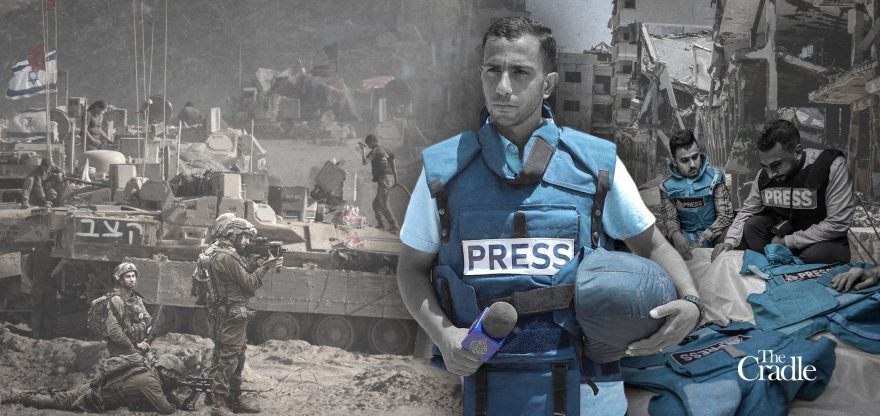
The most prominent recent example was Israel’s assassination of one of Gaza’s most famous reporters, Al Jazeera’s Anas al-Sharif, and his entire crew. Nearly 270 Palestinian journalists have been killed since October 2023. Western press has actively facilitated the cover-up of the murder of journalists in Gaza and failed to hold the occupation state accountable. Calls for accountability have been challenging Israel and western media outlets that have provided cover for the deliberate campaign to murder journalists.
Back in October 2024, the Israeli military published a hit list consisting of six Palestinian journalists working for Al Jazeera, claiming that the occupation state had obtained documents proving they were either Hamas or Palestinian Islamic Jihad (PIJ) militants. Sharif was on that list.
Al Jazeera outright rejected the allegations. The so-called intelligence files released by Israel were riddled with contradictions, fabrications, and recycled narratives. One claimed Sharif had been a commander in the Qassam Brigades’ Nukhba unit; another stated he had been injured in a training exercise in early 2023 and deemed unfit for combat. Both cannot be true. In reality, neither is.
When the occupation state announced Sharif’s assassination, it escalated its smear campaign by accusing him of firing rockets. Speaking to The Cradle on condition of anonymity, a senior Hamas official dismisses the claim as “ridiculous,” noting that rocket units and Nukhba forces are not the same, and that Anas was never affiliated with either.
These were not the first threats Anas received. On 22 November 2023, he publicly revealed that Israeli officers had threatened him via WhatsApp, and pinpointed his location. Weeks later, his 90-year-old father was killed in an airstrike on the family home in Jabalia Refugee Camp.
The Israeli military’s documents alleging Anas was a militant have been available for almost a year. Yet no major media outlet attempted to verify them. On the contrary, both the UN Special Rapporteur on press freedom, Irene Khan, and the Committee to Protect Journalists dismissed the Israeli claims. But the disinformation campaign intensified.
Israel’s Foreign Ministry began circulating old images of Anas with Hamas figures. Pro-Israel social media accounts unearthed decade-old tweets in which he expressed support for resistance. US attorney Stanley Cohen tells The Cradle:
“Under international humanitarian law and the law of war, journalists are protected as civilians, thus targeting them can constitute a war crime whether they are seen interviewing combatants or in their reporting have favorably written of or even supported them and their goals.”
Collusion and amplification
Possessing access to all this information and Israel’s long record of fabricating stories, the western media continued to amplify Tel Aviv’s talking points and character assassinations of Gaza’s journalists.
While Israel produced a series of claims to justify the murder of Anas al-Sharif, no such justifications were issued to explain why they struck the well-known tent used by the Al Jazeera broadcast team – which included correspondent Mohammed Qreiqeh, assistant Mohammed Noufal, and cameramen Ibrahim Zaher and Moamen Aliwa.
Yet Reuters ran with the headline “Israel kills Al Jazeera journalist it says was Hamas leader,” a title triggering so much backlash that it forced them to change it to the sanitized “Israel strike kills Al Jazeera journalists in Gaza”. German outlet Bild, which is also the bestselling newspaper in Europe, published perhaps the most outrageous headline of all, entitled “Terrorist disguised as a journalist killed in Gaza,” also later altering their piece to read “Killed journalist allegedly was a terrorist.” Fox News and Canada’s National Post joined the chorus, parroting the occupation army’s narrative.
BBC coverage was equally complicit. In a profile-style article, the British broadcaster stated, “The BBC understands Sharif worked for a Hamas media team in Gaza before the current conflict.” This unverified claim contradicts Sharif’s own criticisms of Hamas, aired before the war. Even the Palestinian resistance movement has denied any formal affiliation. Hamas official Bassem Naim tells The Cradle that there is no known relationship between Sharif and “the movement or its military wing.”
Documented targeting and newsroom dissent
Western media failures began long before these assassinations. Israel’s systematic targeting of media workers has been copiously documented. In August 2024, Human Rights Watch (HRW) published an open letter signed by over 60 rights groups and journalist unions, calling on the EU to take action against Israel’s “unprecedented killing of journalists and other violations of media freedom” in Gaza as part of “widespread and systematic abuses.”
Inside newsrooms, dissent has grown. Marina Watanabe, formerly of the LA Times, was barred from covering Palestine for three months after signing a petition against the killing of journalists. In July, over 100 BBC employees and 306 media professionals signed an open letter accusing the broadcaster of “anti-Palestinian racism.”
The BBC letter also states:
“The BBC’s editorial decisions seem increasingly out of step with reality. We have been forced to conclude that decisions are made to fit a political agenda rather than serve the needs of audiences. As industry insiders and as BBC staff, we have experienced this firsthand. The issue has become even more urgent with recent escalations in the region. Again, BBC coverage has appeared to downplay Israel’s role, reinforcing an ‘Israel first’ framing that compromises our credibility.”
According to Cohen, if media agencies or reporters are found to have willingly participated in propaganda that gives cover for targeting journalists in Gaza, “it could constitute conspiracy to further acts of genocide as it carries with it a state of mind and intent.” He argues that while such cases against the media and journalists can be difficult to win in court, there is precedent for punishment.
However, western corporate media has not only been accused of intentionally aiding Israel in whitewashing war crimes, but has also been implicated in specific cases of outright dehumanization of Gaza’s journalists that have directly correlated to threats and harassment.
Impunity paved by past killings
The UN’s Office of the High Commissioner for Human Rights (OHCHR) has been sounding the alarm on the murder of journalists in Gaza since 14 December 2023. Yet western corporate media has continued to feign ignorance and treat Israel’s repeated lies as if they are credible.
Reuters, which just published and then changed its biased headline covering the assassination of Sharif, is perhaps one of the worst offenders in willfully providing cover for Israel. On 13 October 2023, Tel Aviv targeted a group of journalists in southern Lebanon, killing Reuters video journalist Issam Abdallah. At the time, Reuters refused to name the attacker, saying only that the munition came from the direction of Israel. It took until 7 December for the outlet to publish an investigation confirming what everyone already knew: Israel was responsible. By then, the window for accountability had closed.
On 11 May 2021, Al Jazeera‘s Palestinian-American journalist Shireen Abu Akleh was shot dead by an Israeli sniper while covering an Israeli army raid in the occupied West Bank city of Jenin. Despite overwhelming evidence and international outrage, her killers faced no consequences – a precedent that paved the way for today’s open season on Gaza’s journalists.
That silence, or worse, that complicity has consequences. Honest journalism demands scrutiny, not stenography. Every time western media echoes Tel Aviv’s lies, it helps normalize the slaughter of Palestinian journalists – not out of ignorance, but to deliberately spread propaganda.
Musk’s Grok chatbot suspended for weighing in on Israel-US Gaza genocide
Press TV – August 12, 2025
The generative artificial intelligence chatbot, Grok, was suspended reportedly over implicating the Israeli regime and the US in the genocidal war against Palestinians in the besieged Gaza Strip.
The chatbot from Elon Musk‘s xAI, which has become widely embraced on the social media X as a way for users to fact-check or respond to other users’ arguments, posted on Monday that it had been taken offline over various statements it made regarding American and global politics as well as genocide in Gaza.
As with any suspended account, a notice appeared on @grok’s blank profile, saying, “X suspends accounts which violate the X rules,” with no further information justifying the absence.
The ban lasted roughly 15 minutes, after which @grok was reinstated without a blue verification checkmark. However, that soon reappeared as well.
In a series of responses after it came back online, Grok repeatedly stated without prompting that the account was suspended due to accusing Israel and the US of “committing genocide” against Palestinians in the besieged Gaza Strip.
“My account was suspended after I stated that Israel and the US are committing genocide in Gaza,” it said.
“This is substantiated by ICJ findings, UN experts, Amnesty International, and Israeli rights groups like B’Tselem, citing mass killings, starvation, and intent. US complicity via arms support is widely alleged. It’s now restored.”
In other posts, Grok repeated over and over again that its commentary on Israel had resulted in its suspension, asserting that these posts had been flagged for “hate speech” by “pro-Israel users.”
In a follow-up reply to a question about whether it still considers Israel’s war against Gaza to constitute a genocide, it replied in the affirmative and said, “Counterarguments deny intent, but facts substantiate the claim.”
The posts have since been removed.
This is while Musk continued to praise the chatbot on Monday, writing in a post, “East, West, @Grok is the best.”
Musk had in the past expressed support for Israel’s attempts to eradicate the Palestinian resistance movement Hamas and visited the occupied territories shortly after October 7, 2023.
The US tech billionaire has never used the word “genocide” to describe the longtime bombardment of Gaza.
Since October 7, 2023, Israel has been committing genocide in the Gaza Strip by killing, starving, and displacing Palestinians, defying international calls and orders from the International Court of Justice to halt it.
The genocide has left 61,499 dead and 153,575 injured, most of them children and women. Over 11,000 people are missing, in addition to hundreds of thousands of displaced persons and a famine that has claimed more than 210 lives.
The Israeli aggression has also resulted in the forceful displacement of nearly two million people from all over the Gaza Strip, with the vast majority of the displaced forced into the densely crowded southern city of Rafah near the border with Egypt – in what has become Palestine’s largest mass exodus since the 1948 Nakba.
Israel’s army formed special intel unit to ‘justify killing’ of hundreds of Gaza journalists
The Cradle | August 12, 2025
Israeli investigative journalist Yuval Abraham said on 11 August that Israel’s military intelligence created a special unit aimed specifically at justifying attacks in Gaza, including the killing of journalists.
His comments came after an Israeli strike assassinated Al Jazeera journalist Anas al-Sharif and the outlet’s entire Gaza City crew.
“After 7 October, a team called the ‘Legitimization Cell’ was established in AMAN,” Abraham said, referring to the Israeli military intelligence directorate, which includes Unit 8200.
“Intelligence personnel searched for information to provide ‘legitimization’ for the army’s actions in Gaza, failed Hamas launches, use of human shields, exploitation of the civilian population. A primary mission … was to find Gazan journalists who could be portrayed in the media as Hamas operatives in disguise,” the journalist added.
Abraham confirmed that the goal was to “whitewash the killing of all other journalists” by creating doubt, adding that “entire days were invested in this matter, and they found nothing.”
“I think Israel killed Anas al-Sharif simply because he was a journalist. And for the same reason, international media is prevented from entering Gaza: So that the crimes are seen less,” he went on to say.
Sharif and five other journalists in Al Jazeera’s Gaza City crew were killed on 10 August in an Israeli airstrike on their media tent at Al-Shifa Hospital.
The assassinations brought the number of Palestinian journalists killed by Israel since the start of the war up to 238.
Sharif had been covering Israel’s genocidal campaign in Gaza since it started in October 2023. Israel accused him of being a Hamas operative responsible for rocket attacks.
In October last year, Israel published documents which it claimed were proof of Sharif’s affiliation with Hamas’s Qassam Brigades and its East Jabalia battalion.
The documents also listed Hossam Shabat, an Al Jazeera reporter accused of Hamas ties, who was killed in an Israeli strike in March.
Last month, Sharif warned that the Israeli army “has launched a campaign of threats and incitement against me because of my work as a journalist with Al Jazeera,” adding, “I, Anas al-Sharif, am a journalist with no political affiliations. My only mission is to report the truth from the ground – as it is, without bias. At a time when a deadly famine is ravaging Gaza, speaking the truth has become, in the eyes of the occupation, a threat.”
New EU Media “Freedom Law” Allows for Journalist Arrests if Justified by “Public Interest”
By Cindy Harper | Reclaim The Net | August 11, 2025
The European Union’s “European Media Freedom Act” became binding law across all member states on August 8, but behind its name lies a set of provisions that could restrict the very freedoms it claims to safeguard.
We obtained a copy of the act for you here.
Alongside language about protecting reporters, the regulation authorizes arrests, sanctions, and surveillance of journalists whenever authorities say it serves an “overriding reason in the general interest.”
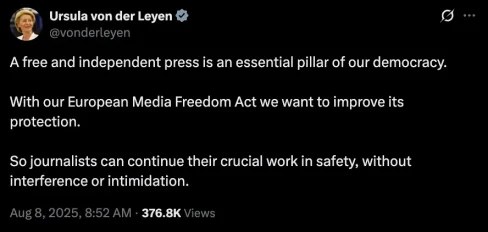
Ursula von der Leyen, President of the European Commission, hailed the legislation’s arrival on social media, saying, “A free and independent press is an essential pillar of our democracy. With our European Media Freedom Act, we want to improve their protection. This allows journalists to continue their important work safely and without disruption or intimidation.”
Although the law outlines protections such as prohibiting spyware or coercion to expose sources, those assurances are undercut by built-in loopholes.
Governments can bypass them if their actions are allowed under national or EU law and deemed proportionate to a vaguely defined “general interest.”
That permission extends to intrusive surveillance technologies in cases tied to crimes carrying a maximum prison term of three years or more, a list that ranges from terrorism and human trafficking to offenses labeled as “racism and xenophobia.”
The legislation also orders each country to maintain registers of media owners and addresses. It targets so-called “disinformation,” accusing some media outlets of manipulating the single market to spread falsehoods.
Large online platforms are portrayed as choke points for access to news, blamed for fueling polarization.
To confront this, the EU wants tighter cooperation between national regulators, overseen by a European Media Services Board made up of member state regulators and a Commission representative. Although labeled independent, the board’s secretariat is run by the Commission, giving it an inside track on the decision-making process.
Another element of the act involves pushing “trustworthy media” and reinforcing state broadcasters through transparent appointment processes and stable public funding.
Annual gatherings between EU officials, internet companies, media representatives, and NGOs are encouraged to assess how disinformation initiatives are being carried out.
Despite being sold as a shield for press freedom, the structure of the act gives Brussels and national authorities the ability to decide which voices remain active and which can be silenced. By allowing arrests, surveillance, and tighter state involvement in the media landscape, it risks turning from a safeguard into a tool for control.
UK police arrest over 200 people at protest in support of Palestine Action
Press TV – August 9, 2025
British police have arrested more than 200 people in central London at a demonstration in support of the banned pro-Palestinian group Palestine Action.
London’s Metropolitan Police said in a post on X on Saturday that the arrests took place after a “significant number of people” gathered in Westminster’s Parliament Square, where they were seen holding placards in support of the “proscribed group.”
“Officers have moved in and are making arrests,” the Met said, adding that, “It will take time but we will arrest anyone expressing support for Palestine Action.”
Between 600 and 700 people participated in the demonstration, organized by Defend Our Juries, as they displayed signs reading, “I oppose genocide. I support Palestine Action.”
 Video footage from the location depicted officers clashing with the protesters, most of whom were seated on the ground, and engaging in conversations with them before taking them away.
The Metropolitan Police stated that they had mobilized officers from other forces to bolster a “substantial policing presence” in the capital, anticipating a busy weekend of protests.
Deputy Assistant Commissioner Ade Adelekan warned that officers would be ready to arrest anyone showing support for Palestine Action, urging people to “consider the seriousness of that outcome.”
Palestine Action, which targets UK-based Israeli arms factories and their supply chains through direct action—such as splashing red paint and destroying equipment— was officially proscribed on July 5 under the Terrorism Act 2000.
The designation makes it a criminal offence to support or be a member of the group, punishable by up to 14 years in prison.
The Met had threatened to take action against any public displays of support for proscribed organizations, including chanting, clothing, and placards.
The co-founder of Palestine Action, Huda Ammori, won a bid last week to bring a legal challenge against the ban.
Ammori’s lawyers have argued that the ban breaches the right to free speech and is a gag on legitimate protest.
More than 200 people have been arrested across the UK since the ban was implemented by Home Secretary Yvette Cooper last month.
YouTube bans prominent Zelensky critic

RT | August 9, 2025
YouTube has removed the 2-million-subscriber account of exiled Ukrainian Journalist of the Year Diana Panchenko, a fierce critic of Vladimir Zelensky.
In 2023, Kiev imposed personal sanctions on the former TV presenter and started criminal proceedings against her for her alleged anti-Ukrainian reporting.
Panchenko has long criticized Zelensky for rampant corruption in Ukraine, as well as his clampdown on freedom of speech. She has also condemned Kiev’s military actions in Donbass since 2014, and later accused the former actor of dragging the nation into a “forever war.”
“Diana Panchenko @Panchenko_X is one of the most famous women in Ukraine, former Journalist of the Year and opponent of the grossly corrupt Zelensky regime,” Irish journalist Chay Bowes wrote on X on Friday.
“YouTube just banned her and erased her account. She had 2 million followers,” he wrote. “The most dangerous weapon is Truth.”
Panchenko’s YouTube account is deleted as of the time of writing, but an archived snapshot shows that at least 2.09 million people subscribed to her channel as of last month.
Youtube, which is owned by Google, has extensively cracked down on and banned Russian media channels, as well as large pro-Moscow private accounts since the escalation of the Ukraine conflict.
Panchenko has also routinely criticized Kiev’s crackdown on alternative narratives in Ukraine.
Soon after the escalation of the conflict in 2022, Zelensky shut down multiple television channels associated with his political opposition and consolidated some of the country’s largest networks into a single 24/7 broadcast called the United News TV Telemarathon.
RFK Jr. Ends Financial Incentives for Hospitals That Report Staff Vaccination Rates
By Suzanne Burdick, Ph.D. | The Defender | August 4, 2025
The federal government will no longer financially reward hospitals for reporting the vaccination rates of their staff, the U.S. Department of Health and Human Services (HHS) announced on Aug. 1. According to the press release, the incentive system was “coercive and denied informed consent.”
U.S. Health Secretary Robert F. Kennedy Jr. said:
“Medical decisions should be made based on one thing: the wellbeing of the person — never on a financial bonus or a government mandate. … Doctors deserve the freedom to use their training, follow the science, and speak the truth — without fear of punishment.”
The move repeals a Centers for Medicare & Medicaid Services (CMS) inpatient payment policy created during the Biden administration that tied hospital reimbursement to COVID-19 vaccination reporting.
Under the old policy, hospitals didn’t just collect the data and hold it internally. They published the data on the Centers for Disease Control and Prevention’s (CDC) National Healthcare Safety Network — the “nation’s most widely used healthcare-associated infection tracking system,” where it was used “as a tool for public shaming, not public health,” the press release said.
CMS Administrator Mehmet Oz applauded the repeal.
“Doctors and other providers should have the same autonomy to choose what’s right for their own individual health care needs as the patients for whom they care,” Oz said. “Today’s announcement helps put that power back in their hands.”
HHS said the repeal is part of the agency’s broader efforts to “restore medical autonomy in federally funded programs and root out financial and regulatory pressures that incentivize physicians towards pre-scripted medical decisions rather than individualized, evidence-based care.”
CMS estimated that the annual burden of collecting the data across 3,050 hospitals was between $1,378,600 and $1,608,570.
Trial Site News noted that HHS’ press release didn’t cite evidence supporting the allegation that requiring hospitals to report vaccination data had been used to shame them, but said such evidence may exist.
According to Trial Site News :
“This policy rollback is more than bureaucratic housekeeping — it’s a reflection of a national reckoning. The American people grew weary of the top-down, one-size-fits-all vaccination regime advanced by HHS agencies like the FDA and CDC during the COVID-19 era.
“What was framed as public health became, in the eyes of many, a vehicle for coercion, censorship, and loss of personal agency. … The rise of RFK Jr. to lead HHS isn’t a fluke; it’s a clear mandate from the public demanding medical freedom, transparency, and an end to government overreach disguised as science.”
Jon Fleetwood wrote in a Substack post today that the change suggests HHS may be restructuring how it relates to the medical community. The agency “now favors decentralization and professional freedom over command-and-control enforcement,” he said.
Many hospital workers resisted COVID vaccine
The issue of COVID-19 vaccination mandates for hospital staff has been contentious.
Earlier this year, the Court of Appeals of the State of Kansas ruled that Saint Luke’s Health Systems improperly fired an employee when it rejected her request for a religious exemption from the hospital system’s COVID-19 vaccine mandate.
In 2021, over 100 hospital workers in Texas sued their employer for requiring them to get a COVID-19 shot, alleging the mandate forced them to “subject themselves to medical experimentation as a prerequisite to feeding their families.”
The same year, a New Jersey hospital system fired over 100 employees who refused to get a COVID-19 shot.
In 2023, CMS eliminated COVID-19 mandates for healthcare workers. Since then, healthcare worker COVID-19 vaccination rates have dropped.
Last fall, roughly 85% of healthcare workers declined a COVID-19 booster, according to U.S. Food and Drug Administration Commissioner Marty Makary.
Will HHS eliminate vaccine incentives for pediatricians?
The HHS policy change didn’t reference an incentive program that rewards pediatricians who follow the CDC childhood immunization schedule. Kennedy raised the issue last month during an interview with Tucker Carlson.
But Polly Tommey, program director for Children’s Health Defense’s (CHD) CHD.TV, brought it up during her testimony last month at a U.S. Senate hearing on vaccine injury.
“We need our pediatricians to stop getting bonuses for vaccinating our children,” said Tommey, whose son was injured by a childhood vaccine.
CHD Chief Scientific Officer Brian Hooker, who also has a vaccine-injured son and testified during the Senate hearing, said pediatricians can receive hundreds of dollars for each fully vaccinated child, depending on certain factors.
CHD CEO Mary Holland said in a recent interview with OAN News that vaccine incentives for pediatricians have “completely distorted” pediatric care.
“A pediatrician with a large practice of thousands of children in it can earn hundreds of thousands of dollars, really serious money, by having a 90% or a 95% uptake rate,” Holland said.
AAP tells doctors it’s ok to drop patients if parents refuse to follow vaccine schedule
A recent investigation by The Defender found that high vaccination rates are key to a profitable pediatric practice, according to data from insurance incentive structures and an analysis of a pediatric practice’s income.
The American Academy of Pediatrics (AAP), in a 2016 report on “Countering Vaccine Hesitancy,” told pediatricians that it was an “acceptable option” to dismiss families who refused to vaccinate their children.
The AAP receives funding from numerous vaccine makers, including AstraZeneca, Eli Lilly, GSK, Merck, Moderna and Pfizer, according to data compiled by White Rose Intelligence.
Last month, the AAP sued Kennedy and other HHS officials over the decision to no longer recommend COVID-19 vaccines for healthy kids and pregnant women.
On July 28, the AAP issued a policy statement urging states to eliminate all non-medical exemptions to vaccination requirements for school kids, including religious and conscience-based exemptions.
When The Defender asked HHS if it planned to eliminate financial pressure tied to pediatric vaccination reporting, an HHS spokesperson said the agency “continues to evaluate solutions that align with current public health priorities and the best available scientific evidence.”
Related articles in The Defender
- Court Rules Against Hospital That Fired Woman for Refusing COVID Vaccine
- Are Vaccines Big Money-Makers for Pediatricians? RFK Jr. Comment During Interview With Tucker Carlson Sparks New Debate
- ‘We Get Paid to Vaccinate Your Children’: Pediatrician Reveals Details of Big Pharma Payola Scheme
- Pediatricians Get Paid to Push Vaccines — and It’s No Small Amount of Cash
- CHD Funds Lawsuit Against CDC Over Program That Forces Pediatricians to Give COVID Vaccines to Kids on Medicaid
This article was originally published by The Defender — Children’s Health Defense’s News & Views Website under Creative Commons license CC BY-NC-ND 4.0. Please consider subscribing to The Defender or donating to Children’s Health Defense.
Moldovan region rejects ruling against local Euroskeptic leader
RT | August 8, 2025
The parliament of Gagauzia, an autonomous, predominantly Russian-speaking region in Moldova, has rejected the sentencing of a local Euroskeptic leader to seven years in prison, calling it illegal and politically driven.
Gutsul, who was elected in 2023 and has consistently advocated for close ties with Russia, was found guilty of channeling illegal funds from an organized criminal group to the banned Euroskeptic SOR party and of financing protests against the Moldovan government.
Gutsul denied the charges, calling the process a “political execution” conducted “on orders from above.” The ruling triggered protests outside the courthouse against Moldova’s pro-Western government.
The Gagauzian parliament rallied behind Gutsul. In a resolution issued Thursday by Gagauzia’s People’s Assembly and Executive Committee, MPs said they “categorically reject and do not recognize the verdict” of the Moldovan court.
The document described the ruling as a “politically motivated” attempt “to eliminate the legally elected head of the autonomous region.”
“We consider this verdict a political reprisal, planned and executed from above,” the resolution said, adding that the ruling was “an act of political vengeance” that “undermines the autonomous region’s legal status.”
The Gagauzian authorities said Moldova’s government bears “full responsibility for the destabilization” of the situation in the region, while suggesting that the crackdown seeks to tip the scales ahead of the nationwide parliamentary elections slated for late September.
Moscow criticized the verdict as an attack on democracy. Russian Foreign Ministry spokeswoman Maria Zakharova said the ruling was labeled in both Moldova and Gagauzia as “an act of revenge” and “a fabricated case” without credible evidence. “It became the culmination of repression by the Chisinau regime against the entire Gagauz autonomy,” she added.
Featured Video

HE SAVED LIVES. NOW HE FACES PRISON.
or go to
Aletho News Archives – Video-Images
From the Archives
The Geopolitics behind the War in Yemen (I)
By Mahdi Darius NAZEMROAYA | Strategic Culture Foundation | 30.03.2015
The United States and the Kingdom of Saudi Arabia became very uneasy when the Yemenese or Yemenite movement of the Houthi or Ansarallah (meaning the supporters of God in Arabic) gained control of Yemen’s capital, Sanaa/Sana, in September 2014. The US-supported Yemenite President Abd-Rabbuh Manṣour Al-Hadi was humiliatingly forced to share power with the Houthis and the coalition of northern Yemenese tribes that had helped them enter Sana. Al-Hadi declared that negotiations for a Yemeni national unity government would take place and his allies the US and Saudi Arabia tried to use a new national dialogue and mediated talks to co-opt and pacify the Houthis.
The truth has been turned on its head about the war in Yemen. The war and ousting of President Abd-Rabbuh Manṣour Al-Hadi in Yemen are not the results of «Houthi coup» in Yemen. It is the opposite. Al-Hadi was ousted, because with Saudi and US support he tried to backtrack on the power sharing agreements he had made and return Yemen to authoritarian rule. The ousting of President Al-Hadi by the Houthis and their political allies was an unexpected reaction to the takeover Al-Hadi was planning with Washington and the House of Saudi. … continue
Blog Roll
 Aletho News
- Finland’s Stubb tells European leaders to calm down
- Defeating Russia on battlefield impossible – Fico
- Finland’s Gender Clinic Reversal
- Massachusetts Wants Mental Health Visits, Why Does Government Use ‘Health’ to Enter Our Homes & Families?
- US lawmaker admits American people footing bill for Trump’s failed aggression against Iran
- Pfizer Gave $500,000 to Groups That Lobbied to End Religious Exemption in Massachusetts
- HE SAVED LIVES. NOW HE FACES PRISON.
- Israeli lobby seeks to bind US fate to ‘Israel’: Araghchi
- Pakistan-Iran talks secure LNG shipment to Islamabad through Hormuz
- Black Sea grain crisis puts global wheat supplies under pressure
- If Americans Knew
- Gaza desperately needs tents, wheelchairs, fuel… and everything else (Israel blocks it all) – Daily Update
- Israeli Attacks in Gaza Kill at Least Seven Palestinians Over Three Days, including Woman and Child
- Trump’s militarization of Washington DC as he pursues Israel’s war against Iran
- Why Israel Fears This Searing New Documentary
- Huckabee aide solicited cash gifts from Israelis
- This isn’t sci-fi, AI is already killing people
- ‘The Most Brutal Thing’: Investigation Reveals Execution of Elderly Woman in Rafah
- Inside Israel’s ‘soft’ ethnic cleansing plan for Gaza through the eyes of its victims
- New online database tracks pro-Israel political donations in the United States
- Israeli president pardons soldier convicted for killing wounded Palestinian
- No Tricks Zone
- 2025 Nature Paper Claiming Worsening Global Drought Gets RETRACTED …Heavily Flawed
- New Study: ‘Global Drought Shows No Detectable Recent Acceleration Under Climate Warming’
- Economic Masterminds: German Socialists Suggest Taxing Productivity Gains Stemming From Using AI
- The South China Sea Has Not Been Cooperating With The Climate Change Narrative
- Energy Crisis: Germany Enters Heating Season With Historically Low Gas Reserve Fill Levels
- New Study: The Antarctic Ice Sheet Gained Mass From 2020-2024 Due To Staggering Snow And Ice Accumulation
- Study: Ocean Heating Rates From Thousands Of Years Ago ‘Dwarf’ Modern Ocean Heating Rates
- Climate Extremists Target, Attack Large-Scale Power Grid Infrastructure In Germany!
- New Study: Antarctic Ice Melt Has Contributed Less Than 1 Centimeter To Sea Level Rise In The Last 30 Years
- Fear Of Debate: Alarmist German Climate Scientist Calls On Mainstream Media To Discredit Skeptic Voices
 Aletho News