Americans must decide if, in the name of homeland security, they are willing to allow TSA operatives to storm public places in their communities with no warning, pat them down, and search their bags. And they better decide quickly.
Bus travelers were shocked when jackbooted TSA officers in black SWAT-style uniforms descended unannounced upon the Tampa Greyhound bus station in April with local, state and federal law enforcement agencies and federal bureaucrats in tow.
A news report by ABC Action News in Tampa showed passengers being given the signature pat downs Americans are used to watching the Transportation Security Administration screeners perform at our airports. Canine teams sniffed their bags and the buses they rode. Immigration officials hunted for large sums of cash as part of an anti-smuggling initiative.
The TSA clearly intends for these out-of-nowhere swarms by its officers at community transit centers, bus stops and public events to become a routine and accepted part of American life.
The TSA has conducted 8,000 of these security sweeps across the country in the past year alone, TSA chief John Pistole told a Senate committee June 14. They are part of its VIPR (Visible Intermodal Prevention and Response) program, which targets public transit related places.
All of which is enough to make you wonder if we are watching the formation of the “civilian national security force” President Obama called for on the campaign trail “that is just as powerful, just as strong and just as well funded” as the military.
The VIPR swarm on Wednesday, the TSA’s largest so far, was such a shocking display of the agency’s power that it set the blogosphere abuzz.
In a massive flex of muscle most people didn’t know the TSA had, the agency led dozens of federal and state law enforcement agencies in a VIPR exercise that covered three states and 5,000 square miles. According to the Marietta Times, the sweep used reconnaissance aircraft and “multiple airborne assets, including Blackhawk helicopters and fixed wing aircraft as well as waterborne and surface teams.”
When did the TSA get this powerful? Last year, Pistole told USA Today he wanted to “take the TSA to the next level,” building it into a “national-security, counterterrorism organization, fully integrated into U.S. government efforts.”
What few people realize is how far Pistole has already come in his quest. This is apparently what that next level looks like. More than 300 law enforcement and military personnel swept through a 100-mile stretch of the Ohio Valley alone, examining the area’s industrial infrastructure, the Charleston Gazette reported.
Federal air marshals, the Army Corps of Engineers, the U.S. Coast Guard, the FBI, the Office of Homeland Security and two dozen other federal, state and local agencies teamed up to scour the state’s roads, bridges, water supply and transit centers under the TSA’s leadership.
What is remarkable about these security swarms is that they don’t just involve federal, state and local law enforcement officials. The TSA brings in squads of bureaucrats from state and federal agencies as well, everything from transportation departments to departments of natural resources.
The TSA had received no specific threats about the Tampa bus station before the April sweep, reporters were told.
They were there “to sort of invent the wheel in advance in case we have to if there ever is specific intelligence requiring us to be here,” said Gary Milano with the Department of Homeland Security in an ABC News Action television report. “This way us and our partners are ready to move in at a moment’s notice.”
Federal immigration officials from Customs and Border Patrol swept the station with the TSA, looking for “immigration violations, threats to national security” and “bulk cash smuggling.” (How the bulk cash smuggling investigation related to national security was never explained.)
“We’ll be back,” Milano told reporters. “We won’t say when we’ll be back. This way the bad guys are on notice we’ll be back.”
The TSA gave the same vague answers when asked about the three-state sweep this week. That sweep wasn’t in response to any specific security threat, either.
The purpose was to “have a visible presence and let people know we’re out here,” Michael Cleveland, federal security director for TSA operations in West Virginia told the Gazette. “It can be a deterrent.”
It might be — if Americans are willing to live this way.
Tara Servatius is a radio talk show host. Follow her @TaraServatius and on Facebook.
The British government has mobilized all its communications and media facilities in a desperate attempt to force Iran’s English language news channel Press TV off-air.
The facilities in question include the pro-Zionist newspaper The Sunday Times and other right-wing media outlets. Also contributing to the attempt is the Office of Communications (Ofcom), the so-called media regulatory body whose managers are directly installed by the Queen and have to report to the monarchy.
Ofcom has been instructed to mount pressure on Press TV with the help of Zionist media giant Rupert Murdoch’s newspaper, The Sunday Times. The paper recently published a politically motivated article to distort facts about Press TV and put more pressure on the Iranian news channel.
Press TV Ltd. is a British production company which is making programs critical of Western imperialism. Its partner in Tehran, sheds light on the dark, undemocratic aspects of the British political structure, especially the hereditary rule of the royals. It also lays bare London’s double standards toward Middle East developments and their links with Britain’s historical presence in the region.
Press TV’s regular coverage of crimes committed by the Israeli regime in the occupied Palestinian territories are definitely among the strict red lines that British media policy-makers will not easily tolerate.
Outgoing Israeli ambassador to the UK, Ron Prosor, once wrote in The Daily Telegraph that “Britain is increasingly becoming a hotbed of anti-Israeli sentiment. Attitudes once considered marginal or extreme have drifted dangerously close to the mainstream.” … Full article
Al Fagr newspaper journalist, Rasha Azab is accused of libel by Egypt’s ruling military, who claim she published incorrect information with the aim to incite public opinion against them.
Azab, as well as Adel Hammouda, the weekly paper’s editor in chief, have been summoned by military prosecution Sunday morning (the start of the work week in Egypt) after Azab published an article in which she detailed the alleged violations by the military police against the protestors in March. Azab claims that she, herself, was subjected to torture last March.
Tens of activists and journalists gathered today in Nasr City outside the military prosecution headquarters in solidarity with Azab and Hammouda.
The protestors condemned the summoning of the journalists, clamouring that it compromises freedom of speech, especially that this is not the first time that a journalist is questioned by the military.
San Francisco – In a decision with likely wide-ranging impact, a judge in Las Vegas today dismissed as a sham an infringement case filed by copyright troll Righthaven LLC. The judge ruled that Righthaven did not have the legal authorization to bring a copyright lawsuit against the political forum Democratic Underground, because it had never owned the copyright in the first place. The Electronic Frontier Foundation (EFF), Fenwick & West LLP, and Las Vegas attorney Chad Bowers are defending Democratic Underground.
“We are pleased that the Court saw through Righthaven’s sham assignment of the copyright and dismissed its improper claim,” said EFF Senior Staff Attorney Kurt Opsahl. “Today’s decision shows that Righthaven’s copyright litigation business model is fatally flawed, and we expect the decision to have wide effect on the over 270 other cases Righthaven has brought.”
Righthaven sued Democratic Underground last fall over an excerpt of a Las Vegas Review Journal news story that a user posted on the forum, claiming that the newspaper had transferred copyright to Righthaven before it filed the suit. However, a document unearthed in this litigation showed that the copyright assignment was a sham and that Righthaven was merely agreeing to undertake the newspaper’s case at its own expense in exchange for a cut of the recovery.
“In dismissing Righthaven’s claim in its entirety, Chief Judge Hunt’s ruling decisively rejected the Righthaven business model of conveying rights to sue, alone, as a means to enforce copyrights,” said Laurence Pulgram, head of copyright litigation at Fenwick & West in San Francisco. “The ruling speaks for itself. The court rejected Righthaven’s claim that it owned sufficient rights in the copyright, stating that claim was ‘flagrantly false–to the point that the claim is disingenuous if not outright deceitful.'”
Judge Hunt also noted that “Righthaven has made multiple inaccurate and likely dishonest statements to the Court” and rejected Righthaven’s efforts to fix things after the fact with a May 9, 2011, amendment to the original assignment agreement. The judge expressed “doubt that these seemingly cosmetic adjustments change the nature and practical effect” of the invalid assignment.
As part of his ruling today, the judge ordered Righthaven to show why it should not be sanctioned for misrepresentations to the court. The Court permitted Democratic Underground’s counterclaim to continue against Stephens Media — the publisher of the Review Journal — allowing Democratic Underground to show that it did nothing wrong in allowing a user to post a five-sentence excerpt of a 50-sentence article.
“This kind of copyright trolling from Righthaven and Stephens Media has undermined free and open discussion on the Internet, scaring people out of sharing information and discussing the news of the day,” said Opsahl. “We hope this is the beginning of the end of this shameful litigation campaign.”
“To Righthaven and Stephens Media, the Court has issued a stinging rebuke,” added Pulgram. “For those desiring to resist the bullying of claims brought by pseudo-claimants of copyright interests, the ruling today represents a dramatic and far reaching victory.”
“We have to get to a place where every part of our society is cognizant of the kinds of threats that are out there, and empowered to take some common sense steps to counter that.” — Janet Napolitano
Homeland Security head, Janet Napolitano, continued her campus tour in a recent stop at NYU Law School where she gave a speech about the state of security as we approach the 10-year anniversary of the 9/11 attacks, and following the announced death of Osama bin Laden.
In the video below Napolitano lays out a sweeping surveillance agenda that includes citizen spies who have a mission of “shared responsibility” to thwart “Core” al-Qaeda, foreign groups “inspired by” al-Qaeda, as well as domestic “extremist” groups, which apparently include an increasing number of plots by U.S. citizens. She added that “there is no single portrait” of today’s potential terrorist, citing recruiting tactics “including Hip Hop videos, if you can imagine that.” And, naturally, cyberspace. Each of the four key ways that she stated as critical to Homeland Security’s mission will widen the Stasi-style network of unpaid employees of the State virtually deputized to spy on their neighbor in the private and public sector and issue reports to the DHS federal security matrix.
Strengthen the nation’s 72 fusion centers, which coordinate with local police, businesses, churches, universities and more in a cooperative effort to federalize local communities.
Continue the expanded use of Suspicious Activity Reports (SAR), initially used for IRS reporting and for businesses to alert government officials to large cash purchases at their establishments. The new initiative will cover all sectors that will share back to DHS.
3. Launch the National Terrorism Advisory System to replace the general color-coded terror alert system and set up a “base level” high risk, which will be augmented with specific messages. One component of this new system that she does not address is that it will be directed toward the individual by utilizing a text messaging system, as well as social networks to issue government statements and warnings (or propaganda).
Continue expansion of a national “If You See Something, Say Something” campaign that began with the NY Metropolitan Transit Authority, and kicked off at private businesses like Wal-Mart whereby people can receive ongoing messages via telescreens in government buildings, private businesses and public areas, then report on anyone for any reason without consequence for false reports.
She also predictably suggests that the counter-terrorism apparatus is a useful tool that can save citizens in need of rescue from natural disasters. More likely, it is the roll-out of soft martial law that will create a permanent state of fear, suspicion, false arrests, police brutality, and the end of the American republic in the same fashion that led to the end of every society that chose the path of security over freedom.
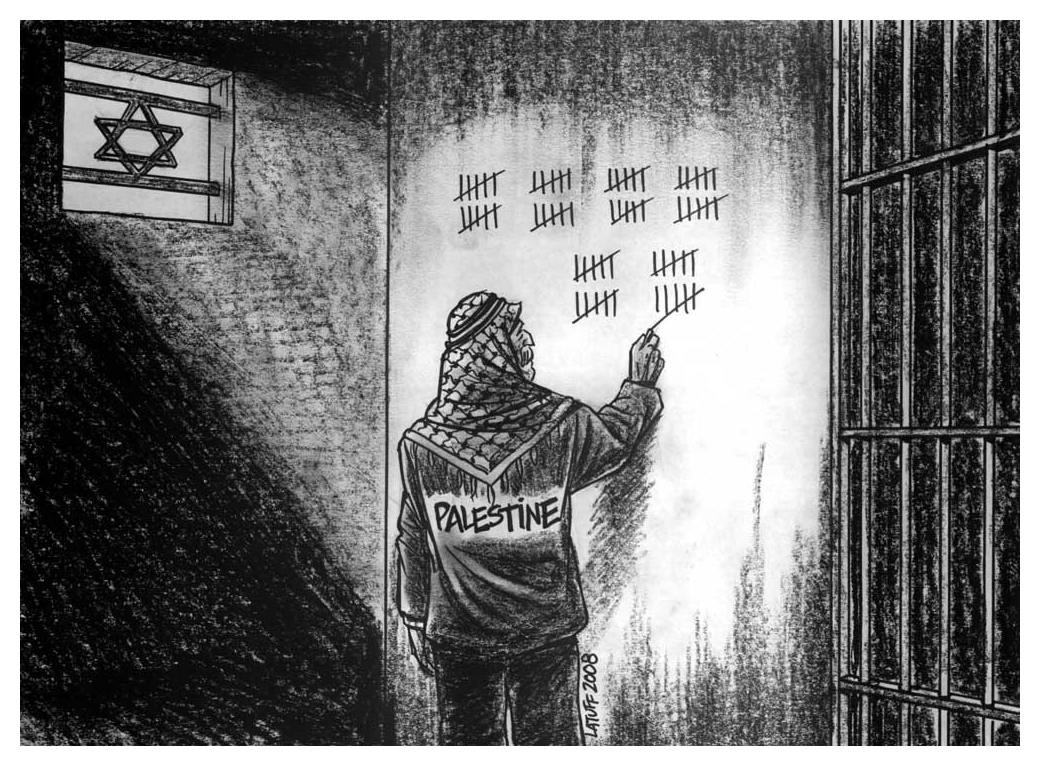
NABLUS — Israeli occupation forces (IOF) raided the home of an elderly Hamas MP in the eastern suburb of Nablus city and detained him after blasting their way into his home.
The daughter of MP Ahmed Al-Haj, 72, told the PIC reporter, that the soldiers broke their apartment’s door in a pre dawn raid on Tuesday after encircling the building and took away her father.
She held the IOF responsible for the life of her father, who was previously held by the Israeli occupation authority on ten past occasions the latest in 2008 when he was held in administrative custody, without charge, for 15 months.
The occupation troops also arrested Hamas leader and university lecturer Dr. Mustafa Al-Shinar from his home west of Nablus city at the same time.
Shinar was frequently arrested by the IOF and was released from administrative detention in late 2009.
He wrote on his facebook page last night that reconciliation would not progress as long as political arrests continued in the West Bank. Shinar was kidnapped three times by the PA security, which negatively affected his health condition. He underwent cardiac catheterization.
In the same context, the website of Hebrew daily Yediot Ahronot said that IOF soldiers rounded up 13 Palestinians in the West Bank on Tuesday.
Former Minister of Detainees, Hamas political official, Wasfi Qabha, stated that there are no real indications of reconciliation in the West Bank as the Palestinian security forces are still interrogating Hamas members and supporters.
Qabha told the Haas-affiliated Palestinian Information Center that “the situation has not changed in the West Bank’”, adding that political prisoners are still in prison, and more persons are being interrogated and questioned by the security forces.
The Hamas leader further stated that despite repeated promises by the Palestinian security forces to release political prisoners, the P.A is still holding captive more than 35 prisoners.
He added that he hopes all political prisoners will be released without any delays and obstructions.
“More than a month have passed since the unity agreement was signed”, Qabha said, “But most of the prisoners are still behind bars”.
Qabha also stated that such violations are against reconciliation, and that the Fateh movement of President Mahmoud Abbas in the West Bank must act to protect unity and national interests.
Ma’an News Agency reported on Sunday that the Fatah Central Committee’s Nabil Shaath said in a meeting with the Gaza government’s Prime Minister Ismail Haniyeh that the issue of political arrests in the West Bank would soon be resolved:
“The number of prisoners has already been reduced to so few,” he said, that the underway process of setting up mechanisms for their release ahead of the unity government’s installation should be swift.
However, Hamas’ ranks in Israeli prison are swelling.
Ma’an News Agency reported today that the Israeli government extended the administrative detention of former minister and legislator Nayef Rujoub for a further six months. The lawmaker, who has been held without charge since last December, had been scheduled to be released yesterday.
Aziz Dweik, Nizar Ramadan, Bassem Zaareer, and Anwar Zboun were held at a checkpoint near Bethlehem, Hamas officials said. Nizar Ramadan was taken to an undisclosed location and Dweik was freed, Hamas officials and the Israeli military said. All four lawmakers represent Hamas in the Palestinian parliament.
Hours later, Israeli forces arrested senior Hamas official Hussein Abu Kweik. According to the Hamas-affiliated website The Palestinian Information Center:
Israel’s intelligence agency Shin Bet called Abu Kweik’s cell phone the night before and ordered him to appear at headquarters in the Ofer prison near Ramallah city.
The Hamas leader told the PIC before meeting with the Shin Bet officials that Israel is targeting Hamas and Islamic Jihad officials in a bid to suppress their influence in the West Bank and to torpedo the recent Palestinian reconciliation accord.
He said Israel also wants to thwart Naksa day protests [on 5 June] and Hamas’s recovery in the West Bank after the reconciliation.
Abu Kweik has spent a total of 12 years detained in Israeli prisons. He survived an Israeli assassination attempt in 2002 that claimed the lives of his wife and three of his sons.
Cupar, Scotland–This county town of Fife, is not exactly a news hot spot. Probably the last big story here was the landing of Italian balloonist Vincenzo Lunardi nearby in 1785 at the end of a 43-mile flight from Edinburgh.
However the small town’s sleepy Sheriff court is about to host a key legal case involving a US student from New York and two anti Israeli protestors who have been charged with racism.
For the information of US readers, in Scotland the Sheriff isn’t some John Wayne figure with the star on his chest, but is rather the bewigged judge presiding over the local court.
This case centers on an incident at nearby St. Andrews University, where two students are facing racially aggravated conduct charges after allegedly making comments and gestures critical of the State of Israel and its flag.
Press reports are already in danger of prejudging the case, with headlines such as the one reading “St. Andrews University students in court to face anti-Semitism charges” that ran in the local daily, The Courier.
According to one of the charged students, Paul Donnachie, “Whilst in the room at the student residences of an individual who I considered a friend, Chanan Reitblat, I placed my hands down the front of my jeans and onto an Israeli flag which belonged to him, accompanied by comments to the effect that Israel is a terrorist state, and is guilty of many civilian deaths.”
He continued, “The action was not malicious. However, it sparked a great deal of political debate amongst our group of friends within our Hall of Residence, whereby the nature of the State of Israel was discussed.”
The following day, after hearing that Mr Reitblat had been upset by his actions, Paul says he “wrote a letter stating that, whilst I would not apologize for my opposition to the actions of the Israeli state, I would apologize for the manner in which I chose to mediate my political opinions on this occasion.”
Despite this conciliatory action, the following day police officers arrested both Paul and his friend Simon Colchester and held them in custody for 36 hours before they were made to appear in court charged with “threatening and abusive behaviour,” which was subsequently amended to the more sinister charge of “racially aggravated conduct,” a violation of the Criminal Law.
Basically the case turns on whether to criticize Israel or its flag is the same as anti-Semitism. The case is the more surprising, given that last year a very similar charge in Edinburgh was tossed out by the courts.
In that instance, five protestors who had disrupted a performance of the Jerusalem String Quartet in Edinburgh in 2008 were charged on a similar basis, with the state alleging that they were guilty of racism for protesting against the fact that performers in the group were also members of the Israeli military.
Dismissing the case last year, Sheriff John Scott made it clear that is entirely legitimate to criticize the Israeli state, its army or other institutions, without being guilty of anti-Semitism.
However when the two St. Andrews students were in court last month the Procurator Fiscal (prosecutor) claimed to be unaware of the earlier Edinburgh case.
Equally alarming is the fact that when protestors demonstrated outside the court, a police sergeant spoke to them warning them that he and his colleagues would not tolerate them giving “racial abuse”.
Outraged campaigners firmly told the officer that they took grave exception to the idea that they were potential racists and a protest has been made to the police chief about this.
The St. Andrews case will now be heard in late August, and since Reitblat, the American student, has now returned to the US, he will either have to be brought to Scotland, presumably at public expense, or questioned by video link.
The case comes at a time of growing support for the Palestinian case in Scotland with, for example, the country’s trade union federation, the Scottish Trades Union Congress, supporting calls for a boycott of Israeli products.
It is also potentially embarrassing for St. Andrews University, which hosts a major department which studies terrorism and which is widely funded by outside donations, including many from the US.
For Omar Said, the time he spent in the custody of Israeli secret service agents — and the emotional ordeal that accompanied his interrogation and detention — won’t soon be forgotten.
“You can’t imagine how many hours and how many questions. [The secret service agents] were all the time with me. It’s like your shadow, all the time with you,” Said told The Electronic Intifada. “This measure is very, very heavy and very, very effective. Many of the people can be convinced [to confess to anything] just to get some rest.”
A pharmacologist and expert in traditional Arab medicine based in the Galilee region, Said was arrested by agents from Israel’s General Security Service (GSS, also known as the Shin Bet or Shabak, according to its Hebrew acronym) on 24 April 2010 at the King Hussein/Allenby border crossing with Jordan.
Shortly after being stopped at the border, Said explained that Shabak agents searched his car, home and office and seized files and computers, including those of his children. He later learned that he was being accused of having contact with a foreign agent — a man with connections to the Lebanese resistance movement Hizballah — while on vacation in Egypt. He was also accused of endangering the security of the State of Israel.
“They took me to [Shabak prison in] Petach Tikva [for investigation]. They put me in a very small cell. It’s very dirty and it was cold all the time because they used air conditioning. The light was on all the time,” said Said, who is also active in the Balad party, a Palestinian political party in Israel.
After spending several days on virtually no sleep and under continued interrogation, Said explained that he was transferred to another Shabak-run prison facility in Ashkelon. There, the interrogations continued.
“They [held] me 18 or 17 days without meeting my lawyer. I felt it was like two years when you are there alone, you feel isolated and [like] you will be a victim [because they can do anything they want]. This is a very, very, very dangerous situation,” Said said.
Around the time that Said was arrested, Haifa-based Palestinian political activist Ameer Makhoul was also detained by Shabak and interrogated under the same pretenses: that he had made contact with an agent of Hizballah and was a danger to Israeli security.
Makhoul signed a plea deal in his case late last year, and was sentenced to nine years in prison in January 2011. Said, for his part, was charged with “servicing an illegal organization” after agreeing to a plea bargain and sentenced to seven months in prison.
He was released in September 2010.
“[Shabak] can do whatever they want but I think they are also very, very careful,” Said told The Electronic Intifada. “They can choose their targets. There is logic behind this. It’s not just to take people and put them in prison. They want to send a message to the people.”
Challenging inhuman and degrading conditions
Adalah, the Legal Center for Arab Minority rights in Israel, and Nadi al-Aseer, the Palestinian Prisoners’ Club, filed a pre-petition on 11 May demanding an end to detention in prison facilities run by Shabak.
“The pre-petition is targeting the physical conditions of the Shabak interrogation cells,” Adalah attorney Abeer Baker, who presented the pre-petition on behalf of Adalah, told The Electronic Intifada.
“What we asked first is to close these cells as long as the conditions there are not improved. The second issue we said [is] that all of the physical conditions of the detainees should be equal, whether they are security or criminal detainees. We asked a demand for external supervision of these cells,” she added.
Baker explained that after Shabak agents interrogate security detainees — detainees who are suspected of being a security threat to the State of Israel — the detainees are sent into very narrow cells, similar to cells used for solitary confinement, in an attempt to break their spirit.
According to Baker, the Shabak facilities are also not inspected or supervised by external bodies. Human rights organizations examine the physical conditions of prisons of every other Israeli prison in the country, but not the Shabak facilities, thereby making them exempt from outside scrutiny and accountability, Baker said.
“These bad conditions are made on purpose in order to affect the personality of the detainee and make him confess and break him, break his spirit,” Baker said.
“We are talking about the dignity of detainees, a process that should be monitored by law,” Baker added. “We are not talking about something which is not embodied in law. We are talking about the right for dignity. These are the basic constitutional rights of every detainee.”
In the case of detainees and prisoners, Article 10 of the UN Covenant on Civil and Political Rights states that “all persons deprived of their liberty shall be treated with humanity and with respect for the inherent dignity of the human person.”
Regarding Palestinians from the occupied West Bank and Gaza who are also often detained and interrogated by Shabak agents inside Israel, Article 49 of the Fourth Geneva Convention stipulates that “individual or mass forcible transfers, as well as deportations of protected persons from occupied territory to the territory of the Occupying Power or to that of any other country, occupied or not, are prohibited, regardless of their motive.”
“They violate international law which demands that putting people under custody must maintain dignity. Especially people from occupied territories, you have the Geneva Conventions which demands this also,” Baker said.
“By interrogating these people in these facilities, they are facilitating the process to criminalize the Palestinian people to put them behind bars. It’s political.”
Shabak impunity cemented in Israeli law
In 1987, the Landau Commission — an Israeli governmental commission charged with examining the interrogation methods used by the Israeli General Security Services — found that the continued use of “physical force” in interrogations was acceptable.
Twelve years later, in 1999, the Israeli high court finally prohibited torture of any kind in Israel, and outlawed certain interrogation techniques. In “ticking time bomb” situations, however, the court found that the use of physical force could be justified.
This caveat, otherwise known as “the necessity defense,” has been used to justify the use of physical force and torture by Shabak interrogators since the high court’s ruling. While meant only for use in extreme cases, human rights groups have criticized the “ticking time bomb” defense for its widespread and inappropriate use.
The GSS argues that its agents should be exempt from criminal prosecution during these types of situations due to Article 34K of Israel’s Penal Code, which states that “no person shall bear criminal responsibility for an act that was immediately necessary in order to save his own or another person’s life, freedom, bodily welfare or property from a real danger of severe injury, due to the conditions prevalent when the act was committed, there being no alternative but to commit the act.”
According to a December 2009 report released by the Public Committee Against Torture in Israel (PCATI), Shabak interrogators “are protected by layers of concealment, the withholding of information, and immunity shielding them like the layers of an onion.”
Titled “Accountability Denied: The Absence of Investigation and Punishment of Torture in Israel,” the PCATI report found that the levels of protection include the fact that Shabak employees are not required to identify themselves, that Shabak interrogations are exempt from any video or audio documentation, and that detainees are denied from speaking with an attorney or anyone else from the “outside world” during most of the interrogation process (“Accountability Denied,” December 2009 [PDF]).
A “facade of investigations into complaints of torture and abuse” also points to the impunity with which Shabak (GSS) interrogators operate, the report found.
“Complaints of torture by GSS interrogators submitted to the Attorney General are forwarded for inspection by the Officer in Charge of GSS Interrogee Complaints (OCGIC), a function filled by a GSS agent. Thus complaints of torture during GSS interrogations are examined by a GSS employee who does not constitute an independent or impartial investigator,” the report stated.
As such, more than 600 complaints have been submitted between 2001 and 2008 about mistreatment by Shabak interrogators, but not a single complaint has developed into a criminal investigation, according to the PCATI report.
In late March of this year, various nongovernmental organizations — including Adalah, Physicians for Human Rights-Israel and PCATI — petitioned the Israeli high court to investigate the mistreatment and torture of detainees at the hands of Shabak interrogators.
According to PCATI, this latest petition aims to bring an end “the long standing refusal of the Attorney General to open criminal inquiries into cases of alleged torture and ill treatment which has effectively granted long-term immunity from prosecution to interrogators who use illegal methods that have and continue to include torture and ill treatment” (“PCATI Petitions the High Court of Justice: Order the Attorney General to Investigate Torture and Ill treatment,” 23 March 2011).
Cutting ties to the outside world
According to Omar Said, while he wasn’t tortured during Shabak custody, his interrogation and imprisonment were extremely difficult experiences that still affect him today.
“A man like me who was arrested many times, it was very hard and difficult for me. I can’t imagine what will happen to other people who haven’t been arrested before [to be arrested by Shabak],” Said said.
By persecuting Palestinian political leaders, Shabak is trying to intimidate the Palestinian community inside Israel and cut its ties to the wider Arab world, Said said.
“He told me from the beginning: we will teach the Arab population here how to behave and who [they can] contact. The first day, the Shabak interrogator said that. He said, ‘We cannot live with that connection that you made, and the Arabs here made, with the Arabs outside Israel,’” he recalled.
“We are activists in our societies and we represent the new generation of the community and we have wide connections with Arab activists and social activists. They want to cut these relationships.”
This program is about the claims, when it comes to the Israeli-Palestinian issue, the BBC is biased to Israelis. The edition of InFocus provides some examples as proof and raises the question whether the bias is an internal agenda or an external pressure. However, the BBC management dismisses the claim and says the network has always followed professionalism. Experts on this program say otherwise.
On Friday the 27th of May, five days after an overwhelming victory by centre-right political parties in the local and regional elections across Spain, the country woke up to the bitter reality of how nonviolent movements calling for economic democracy, political justice and peace are going to be dealt with by the country’s police forces in this new era of right-wing political dominance.
Just twenty-four hours after Spain’s largest telecom company, Telefonica, announced a new round of layoffs affecting 8,500 people, 25 percent of the work force, and as the G8 was meeting in Deauville, France, to discuss amongst other things the discontent sweeping across Europe, the Catalan police force—the Mossos d’Esquadra—following orders from the Town Hall’s new Catalan Nationalist Party (CiU) government, surrounded the nonviolent citizens camped at the Plaza Cataluña in Barcelona’s city centre. Armed with full riot gear, batons and machine-guns with rubber bullets, the police kettled in the protestors, making it impossible for them to leave or others to enter.
With the excuse of cleaning up the square for safety reasons, in preparation for Saturday’s Champions League soccer final between Barcelona and Manchester United, the city government called for the dispersal of the crowds in order to allow for clean-up teams to enter. Although this was the official stance, it soon became apparent that cleaning garbage from the square was not the true intent, and that the real aim of the operation was to seize computers, printers and documents from the movement’s steering committees, and to put an end to this popular uprising which is posing a threat to the country’s political and economic elites.
As soon as the police surrounded the crowds and the news aired on local television stations and radios, citizens from across the city began to leave their work places and made their way to the square in order to show their solidarity with those being harassed by the police. The scene they encountered resembled one of Gandhi’s legendary acts of civil disobedience—the demonstrators sitting on the floor, in silence, with their legs crossed and hands up in the air, symbolizing their defiance to the oppressive and brutal nature of this unannounced police action.
Unlike during pre-election campaigning time, 11 days ago, when the 15M Movement began to congregate in city squares across the country with shouts of indignation, this time the police did not hesitate, the orders were clear. The police began to point their guns at those outside the square that were shouting “This is our democracy,” and one by one they began to pull those sitting down inside the square—beating them with their batons. I have just heard that economics professor Arcadi Oliveras, was amongst those on the receiving end of the police’s indiscriminate use of batons.
At the time of writing, thousands of citizens are making their way to the square in Barcelona, and following two arrests and 99 injured, around 5,000 protestors have already reclaimed the city square. In Madrid Esperanza Aguirre, who presides over the autonomous region and who also heads Madrid’s Partido Popular, has asked the ministry of the Interior to evict the protestors at the Puerta del Sol. On their part, the protestors at Madrid’s plaza have sent messages of solidarity to those being attacked in Barcelona. The police force in the city of Lerida has also evicted the crowds camped in the city square using water canons, and two protesters have been arrested. While in the city of Granada, the town hall is in negotiations with the central government about how to empty the city’s square.
The ambiance in Barcelona’s plaza is now jovial, once the city showed its support to the protestors, the police were forced to leave, and despite the fact that they have confiscated many laptops and pamphlets, and have destroyed tents and equipment, which the protestors have been using for their popular assemblies, people intend to stay. A large banner in the middle of the square reads in Spanish: “You have cleaned up our exhaustion and now we are back”
Despite the fact that the political elites in Spain, in this new era of right-wing dominance are showing their mass use of force, they have encountered a well-organized nonviolent movement. If the movement holds to its principles, and other European countries join in the struggle, it will be the European Union which will be forced to restrain this police brutality, and which will eventually have to make concessions to democratic citizens fighting non-violently for change. If the movement spreads, as many signs already seem to indicate, European political and economic elites will have to decide between reform and revolution.
Pablo Ouziel is a sociologist and freelance writer based in Spain.
By Christina England – 30 Q&As – Book Review & Summary
Lies are Unbekoming | September 4, 2026
… Gardasil received FDA fast-track approval in 2006, Cervarix followed in 2009, and Gardasil 9 was approved in December 2014 with more than double the aluminium adjuvant content of the original. The commercial context is specific. Merck was about to lose patent protection on Zocor and faced $18 billion in Vioxx injury claims from a cardiovascular drug the company had marketed while suppressing its own data showing a five-times increase in heart attacks. Analysts projected the global HPV vaccine market at $4 billion by 2011, contingent on government-funded national programs for teenage girls. The 1986 National Childhood Vaccine Injury Act had already granted manufacturers complete liability immunity. By 2013, Japan had withdrawn its HPV vaccine recommendation after cataloguing severe adverse reactions in hundreds of girls. No Western government followed. The establishment position across the UK, US, Australia, and most of Europe held, and still holds, that the vaccines are safe and effective, that reported injuries are coincidental, and that cervical cancer prevention justifies the program. The book was published into this position, not against a vacuum.
Shattered Dreams sits alongside Mary Holland’s The HPV Vaccine On Trial and Viera Scheibner’s foundational vaccination work as part of the documented record on what has been done to a generation of teenage girls under the banner of cancer prevention. The full summary unpacks three specific findings: that Merck used the aluminium adjuvant itself as the “placebo” control in 92.5% of trial subjects, making it structurally impossible to detect excess reactions from the adjuvant; that Dr. Sin Hang Lee found HPV DNA fragments bound to aluminium in every one of sixteen Gardasil samples tested, and in the blood and spleen of a New Zealand girl six months after her third dose; and that in every country with high vaccination coverage, including Australia, the UK, Norway, and Sweden, cervical cancer rates have stopped declining and started rising specifically in the vaccinated cohort. Martínez-Lavín’s 2017 calculation puts the number needed to seriously harm with Gardasil 9 at 140, and the number needed to vaccinate to prevent one case at 1,757. Thirteen young women are seriously harmed for every one who benefits. The vaccine was approved on the basis of trials that could not detect what the trials were supposed to detect, and it is still being given to twelve-year-olds today. … Read full review
This site is provided as a research and reference tool. Although we make every reasonable effort to ensure that the information and data provided at this site are useful, accurate, and current, we cannot guarantee that the information and data provided here will be error-free. By using this site, you assume all responsibility for and risk arising from your use of and reliance upon the contents of this site.
This site and the information available through it do not, and are not intended to constitute legal advice. Should you require legal advice, you should consult your own attorney.
Nothing within this site or linked to by this site constitutes investment advice or medical advice.
Materials accessible from or added to this site by third parties, such as comments posted, are strictly the responsibility of the third party who added such materials or made them accessible and we neither endorse nor undertake to control, monitor, edit or assume responsibility for any such third-party material.
The posting of stories, commentaries, reports, documents and links (embedded or otherwise) on this site does not in any way, shape or form, implied or otherwise, necessarily express or suggest endorsement or support of any of such posted material or parts therein.
The word “alleged” is deemed to occur before the word “fraud.” Since the rule of law still applies. To peasants, at least.
Fair Use
This site contains copyrighted material the use of which has not always been specifically authorized by the copyright owner. We are making such material available in our efforts to advance understanding of environmental, political, human rights, economic, democracy, scientific, and social justice issues, etc. We believe this constitutes a ‘fair use’ of any such copyrighted material as provided for in section 107 of the US Copyright Law. In accordance with Title 17 U.S.C. Section 107, the material on this site is distributed without profit to those who have expressed a prior interest in receiving the included information for research and educational purposes. For more info go to: http://www.law.cornell.edu/uscode/17/107.shtml. If you wish to use copyrighted material from this site for purposes of your own that go beyond ‘fair use’, you must obtain permission from the copyright owner.
DMCA Contact
This is information for anyone that wishes to challenge our “fair use” of copyrighted material.
If you are a legal copyright holder or a designated agent for such and you believe that content residing on or accessible through our website infringes a copyright and falls outside the boundaries of “Fair Use”, please send a notice of infringement by contacting atheonews@gmail.com.
We will respond and take necessary action immediately.
If notice is given of an alleged copyright violation we will act expeditiously to remove or disable access to the material(s) in question.
All 3rd party material posted on this website is copyright the respective owners / authors. Aletho News makes no claim of copyright on such material.