Secrecy and the Divine Right to Deceive
By Jim Bovard | The Libertarian Institute | December 2, 2024
Secrecy and lying are two sides of the same political coin. The Supreme Court declared in 1936, “An informed public is the most potent of all restraints upon misgovernment.” Thus, conniving politicians have no choice but to drop an Iron Curtain around Washington.
Politicians guarantee that Americans are left clueless on the most controversial or dangerous federal policies. The government is creating trillions of pages of new secrets every year. The total is equivalent to “20 million four-drawer filing cabinets filled with double-spaced text on paper,” according to The Washington Post. If those cabinets were laid end to end, they would stretch almost to the moon. The feds have accumulated the equivalent of hundreds of pages of secrets for each American, blighting any hope for citizens to learn of their rulers’ rascality.
“All rulers in all ages have tried to impose a false view of the world upon their followers,” George Orwell wrote in his novel Nineteen Eighty-Four. This is where government classification—i.e., secrecy—comes in handy. The more information government classifies, the easier it becomes for politicians to dupe the American people. In Washington, deniability is better than the truth.
Secrecy was usually not a grave peril to most Americans’ rights, liberties, and safety until the U.S. government began warring in the 1940s and on into this century.
Secrecy helped deliver a death warrant for tens of thousands of Americans and hundreds of thousands of Vietnamese. President Lyndon Johnson fabricated claims about an alleged North Vietnamese attack in the Gulf of Tonkin to sway Congress to give him unlimited authority to attack North Vietnam. Johnson assumed he was entitled to deceive Americans to vastly expand the war he decided to fight to boost his 1964 presidential election campaign. But other federal officials claimed a prerogative to blindfold the American people. When Assistant Defense Secretary Arthur Sylvester visited Saigon in 1965, he hectored American correspondents covering the Vietnam War: “Look, if you think any American official is going to tell you the truth, then you’re stupid. Did you hear that? Stupid!” Sylvester declared that he expected the American press to be “the handmaidens of government.” Most of the American media has followed orders regarding foreign reporting most of the time since then.
In March 1972, President Richard Nixon, as part of his “pledge to create an open Administration,” ordered radical changes in how Uncle Sam kept secrets. Nixon announced that the classification system “failed to meet the standards of an open and democratic society, allowing too many papers to be classified for too long a time. Classification has frequently served to conceal bureaucratic mistakes or to prevent embarrassment to officials and administrations.” He promised “to lift the veil of secrecy which now enshrouds” federal documents. Nixon’s campaign against secrecy faltered after the Watergate coverup destroyed his presidency.
In 1978, President Jimmy Carter created the Information Security Oversight Office to oversee classification but secrecy regime continued and grew. In 1989, former Solicitor General of the United States Dean Erwin Griswold complained that “there is massive overclassification and that the principal concern of the classifiers is not with national security, but with governmental embarrassment of one sort or another.” In 1991, former National Security Council official Rodney McDaniel estimated that “only 10% of classification was for legitimate protection of secrets.” In 1997, a federal commission headed by Senator Daniel Patrick Moynihan (D-NY) lamented that “secrets in the federal government are whatever anyone with a stamp decides to stamp secret.”
In the weeks after the 9/11 attacks, the percentage of Americans who trusted the federal government doubled. The George W. Bush administration exploited the new credulity to boost the number of classified government documents almost tenfold. The New York Times reported in 2005 that federal agencies were “classifying documents at the rate of 125 a minute as they create new categories of semi-secrets bearing vague labels like ‘sensitive security information.’” William Leonard, former chief of the federal Information Security Oversight Office, complained of seeing information “classified that I’ve also seen published in third-grade textbooks.”
But secrecy again signed a death warrant for thousands of Americans. President George W. Bush persuaded Americans to support invading Iraq by blaming Saddam Hussein for the 9/11 attacks, among other pretexts. Bush could vilify Iraq thanks to a sweeping coverup of the role of the Saudi government in bankrolling and directly assisting the 9/11 hijackers.
According to the Barack Obama administration, even federal judges must bow to classification labels. “We don’t think there is a First Amendment right to classified documents,” Justice Department lawyer Catherine Dorsey told a federal judge in 2015. The New York Times’ James Risen spent almost a decade in the federal crosshairs after his 2006 book State of War exposed the NSA’s illegal warrantless wiretapping and other federal crimes. Robert Litt, general counsel for the Director of National Intelligence, compared journalism to drunk driving to justify punishing any journalist who published confidential information. But the Justice Department could not prove Risen’s disclosures harmed anything except federal credibility.
Secrecy leaves truth up to the discretion of today’s political appointees. Secrecy lets government officials fill in the blanks as they please. Government secrecy can blindfold people as effectively as federal marshals descending upon a newspaper’s printing presses with axes and sledgehammers. The more facts government suppresses, the more lies politicians can tell.
Will secrecy determine whether Americans are dragged into another world war in the coming months? The Joe Biden administration is encouraging the Ukraine government to become far more aggressive, if not reckless, in its attacks on Russia. But Americans are being treated the same as the downtrodden serfs whom Russian czars dragged into wars centuries ago. The Biden administration decided that Americans have no right to know the facts when their rulers swerve closer to Armageddon. Unfortunately, as in Saigon in 1965, most of the media is still shamefully “the handmaidens of government.”
World leaders sign new censorship declaration at UN event as Secretary-General Guterres pushes for increased online censorship
By Didi Rankovic | Reclaim The Net | December 1, 2024
A new UN-driven censorship declaration has been signed by a number of world leaders during an event in Portugal – the Cascais Declaration at the United Nations Alliance of Civilizations (UNAOC) Global Forum.
We obtained a copy of the final declaration for you here.
The gathering was addressed by UN Secretary-General Antonio Guterres, who once again reiterated his commitment to censoring online speech, bringing up the usual set of “arguments” in favor of moving in this direction.
During the address, Guterres spoke about “unchecked digital platforms and AI” and accused them of allowing “hate speech to proliferate like never before” – and did not miss the opportunity to mention “misinformation and deepfakes” in the same context.
Guterres wants Big Tech, advertisers, and media – that is, along with some governments and organizations like the UN, among the most egregious offenders when it comes to online censorship – to double down.
“Taking responsibility for their role” in spreading hate speech, deepfakes, etc., was how he phrased it.
Guterres also again pushed a UN initiative that critics say introduces algorithmic censorship and demonetization under the stated “anti-misinformation and hate speech” scope – the UN’s Global Principles for Information Integrity.
According to Guterres, these recommendations allow for “a more humane information ecosystem.”
Meanwhile, the Cascais Declaration states that the leaders who signed it are “alarmed” at what is described as a global spread, online and offline, of “disinformation, misinformation and hate speech.”
The signatories also want those to be combated while at the same time strengthening “information integrity” (without going into what that means, and how it is supposed to be achieved.)
Another of the many controversial UN schemes, the Pact for the Future, is “noted” in the declaration, and framed as recognizing the role of “reinvigorated multilateralism” and religious organization promoting a culture of peace.
However, those opposed to the Pact see yet another mechanism to usher in more censorship and surveillance.
These points about the supposed greater-than-ever dangers of AI, misinformation, etc., are nestled inside the declaration’s overall message of the need to protect a variety of human rights and cultural diversity.
Among them is the mention of “monitoring antisemitism,” but also “combating Islamophobia” – including by appointing a special UN envoy to deal with the latter task.
US breaks off ‘strategic partnership’ with Georgia; blasts Tblisi for ‘pro-Russia lean’
Press TV – November 30, 2024
The United States has broken off its “strategic partnership” with Georgia after the latter’s decision to suspend negotiations on potential accession to the European Union, while condemning Tbilisi for, what it called, leaning towards Russia.
State Department spokesperson Matthew Miller announced the development on X, former Twitter, on Saturday.
“The US and EU regret Georgian Dream (GD)’s decision to suspend EU accession,” he wrote, referring to Georgia’s ruling party.
“The EU is a bulwark against the Kremlin. We have, therefore, suspended our Strategic Partnership with Georgia,” Miller said.
He also claimed that the party’s decision on the accession talks was a “betrayal” of the European country’s constitution.
The State Department, meanwhile, released a statement on Washington’s decision, accusing the GD of “various anti-democratic actions [that] have violated the core tenets of our US-Georgia Strategic Partnership.”
By freezing the accession talks, it added, the party “has rejected the opportunity for closer ties with Europe and made Georgia more vulnerable to the Kremlin.”
The department also claimed that Georgian people “overwhelmingly support integration with Europe.”
GD Chairman Prime Minister, Irakli Kobakhidze suspended the accession process on Thursday, saying the EU was expecting Georgia to enact “reforms” in exchange for joining the bloc that were actually “steps that mean renouncing our dignity.”
The official was referring to Brussels’ various demands on Tbilisi, including its repealing of the foreign agents’ law that requires NGOs and media outlets that receive more than 20 percent of their funding from foreign donors to register as organizations “bearing the interests of a foreign power.”
Brussels, he added, was effectively “blackmailing” Tbilisi through the demands.
The EU, itself, froze Georgia’s application for joining the bloc earlier this year in response to ratification of the law among other things.
The Georgian premier, meanwhile, addressed the ongoing anti-government riots that have been underway in the capital for the past two days, during which anarchists have put up barricades along the central Rustaveli Avenue and thrown fireworks at the riot police.
The country, he said, would not allow a revolution to take place, saying the rioters were seeking to overthrow the government, using the same tactics that were used during 2014 riots in Ukraine, known as the Maidan riots, which ousted the government in Kiev.
“In Georgia, the Maidan scenario cannot be realized. Georgia is a state, and the state will not, of course, permit this,” Kobakhidze said.
Georgia’s State Security Service also commented on the riots, calling them evidence that a violent coup attempt was taking place in the country.
“Developments occurring in recent days in the country show that planned destructive processes are taking place in accordance with actual circumstances becoming known to the State Security Service as part of the investigation of the violent upheaval case. We informed the society in advance about that,” the service said.
Specific political parties and non-governmental organizations are interested in a violent coup, it noted, adding that the developments were being investigated under Article 315 of the Georgian Criminal Code that covers conspiracy or mutiny for purposes of violent change of the Georgian constitutional order.
Rumble Sues California Over Censorship Law That Impacts Satire
By Dan Frieth | Reclaim The Net | November 27, 2024
A new legal challenge, spearheaded by Alliance Defending Freedom attorneys, has thrust the state of California into the spotlight once again over allegations of infringing on free speech rights. This federal lawsuit, lodged on behalf of video-sharing platform Rumble, argues that two new California statutes unconstitutionally restrict users’ ability to share political content online.
We obtained a copy of the lawsuit for you here.
Under these controversial laws, specifically AB 2655, platforms like Rumble are coerced into policing and removing content that the state deems harmful. These regulations have been criticized for compelling platforms to censor speech, thereby becoming unwilling agents of government censorship. According to ADF Senior Counsel Phil Sechler, in a press release sent to Reclaim The Net, “California’s war against political speech is censorship, plain and simple. We can’t trust the government to decide what is true in our online political debates.” He emphasized the importance of platforms like Rumble, which resist governmental pressures to curtail free expression.
The complaint details the operational challenges: “The law forces Rumble to undertake the impossible task of training its team to recognize and then remove and label content based on inherently vague and subjective terms on which even pollsters and government officials cannot agree, such as what content may be ‘likely to harm’ electoral prospects or may likely undermine confidence in an election.”
Further, Rumble contends that AB 2655 oversteps by altering and compelling the speech of private entities, thus infringing upon their rights to free speech. It argues that neither the Constitution nor Section 230 of the Communications Decency Act allows California to “alter and compel Rumble’s speech while also mandating that it censor its users’ speech. As such, this Court should enjoin AB 2655 and declare it unlawful.”
The genesis of these laws can be traced back to July when a parody video targeting Vice President Kamala Harris spurred Gov. Gavin Newsom to advocate for making such content illegal. Subsequently, the California Legislature expedited the passage of these laws, which Gov. Newsom signed into action on September 17. AB 2839, in particular, imposes vague criteria to penalize individuals for sharing content related to elections, such as political memes and parodies.
In the detailed legal challenge, attorneys argue that AB 2655 forces Rumble to alter its own speech and police its users’ speech based on arbitrary criteria that even experts cannot uniformly interpret. The law imposes a duty on Rumble to train staff to identify and mitigate content that could potentially damage a politician’s reputation or undermine confidence in elections — criteria seen as inherently subjective.
This lawsuit follows a similar successful defense of free speech by ADF on behalf of The Babylon Bee and attorney Kelly Chang Rickert, leading to a temporary halt on enforcing AB 2839 against them while their legal battle continues.
US Republicans Condemn UK’s Online Censorship Law as a “Tsunami… Heading Towards America”
By Didi Rankovic | Reclaim The Net | November 26, 2024
UK’s “censorship law” – Online Safety Act – has gained in notoriety, as it has now become the subject of interest of the US House Judiciary Committee, which has for years tried to shed light on the censorship on the internet, and its actors and factors.
So much so that the committee’s members have coined the expression, the Censorship Industrial Complex.
While most of the body’s activities are centered around US social media and allegations of the Biden-Harris administration’s involvement in pressuring them to censor speech, no “complex” is considered to be on an industrial scale for no reason.
A flurry of third parties – such as “fact-checkers” and “raters” – have been involved and investigated, including those based abroad – notably, the Center for Countering Digital Hate (CCDH).
A member of the Republican-majority committee, Congressman Darrell Issa, now strongly criticized the trends concerning censorship-enabling legislation in the EU and in the UK, singling out the Online Safety Act, and warning that “a tsunami of censorship is heading towards America” from abroad.
And that’s just to add to what is already there – Issa called that situation, “malign actors here at home.” As for the UK law, the congressman is unimpressed by its authors and supporters promoting it as a way to protect against hate speech and other online ills.
According to Issa, what it does is give regulators a tool to censor free speech, and as such is viewed by Republicans as part of “a broader global push by the Censorship Industrial Complex.”
Issa in full, from The Spectator:
“The growing attacks on free speech in the US – as well as the UK and EU – pose a direct threat to free people on both sides of the Atlantic. We know that legislation like the Online Safety Act that is said to combat ‘hate speech’ empowers regulators to censor free speech.
“Congressional Republicans understand that these threats to free speech are part of a broader global push by the Censorship Industrial Complex, which includes not only the EU, UK, and other nations but also malign actors here at home. We are committed to confronting this growing threat alongside the incoming Trump Administration to fight against these assaults on free speech within our borders and around the world.”
The congressman had no problem counting the UK and the EU (with its Digital Services Act) among the places this push emanates from, while also vowing that the second Trump administration, alongside Congress Republicans, intends to “fight against these assaults on free speech within our borders and around the world.”
In the UK itself, there are those like Reform Party leader Nigel Farage who couldn’t agree more. Farage, who has close ties with Trump, has made comments about a free speech crackdown in his country.
The UK branch of the Alliance Defending Freedom advocacy group also agrees. Executive Director Paul Coleman said that the Judiciary Committee’s criticism and stance on a number of issues “shows that the UK is fast becoming notorious around the world for its censorious practices.”
Vienna police ban mass protest supporting excluded Freedom Party’s ‘People’s Chancellor’ Herbert Kickl
By Thomas Brooke | Remix News | November 28, 2024
A massive protest planned for Saturday in Vienna to support Freedom Party (FPÖ) leader Herbert Kickl, who was excluded from ongoing government negotiations despite winning the most votes in the recent election, has been banned by the police.
Heute reported that the rally was expected to draw 1.4 million participants and was organized by the group Fair Thinking, which gained notoriety among the Austrian establishment for its demonstrations during the Covid-19 pandemic.
The protest, promoted as a show of support for “People’s Chancellor Kickl,” sought to challenge the so-called “sugar coalition” of parties negotiating to form the government. The FPÖ and Kickl, despite their electoral success, were left out of talks, fueling outrage among his supporters.
Kickl, who previously appeared at Fair Thinking’s protests, has become a popular figure among many Austrians, representing opposition to Covid policies, insisting on neutrality in the Ukraine conflict, and expressing dissatisfaction with Austria’s political elite over its commitment to mass immigration.
The initial protest date of Nov. 9, which coincided with the anniversary of the 1938 Nazi pogroms, drew condemnation from political leaders, including Chancellor Karl Nehammer, who called the timing a “slap in the face to victims’ relatives.”
President Alexander Van der Bellen also expressed strong disapproval, leading to organizers postponing the event to Nov. 30.
On Thursday, however, Vienna police announced the prohibition of the protests under Section 6 Paragraph 1 of Austria’s Assembly Act. The justification cited potential disruptions to businesses in Vienna’s shopping districts and the flow of traffic.
A statement from the police warned: “Holding an unannounced or prohibited meeting constitutes an administrative violation. Such meetings can be dissolved, and participants must disperse immediately.”
Organizers have not backed down, hinting at plans to proceed informally or under different guises. A statement on their Telegram channel invited supporters to “take a walk” in Vienna during Advent and visit Christmas markets, particularly the one at Marien-Theresien-Platz.
Critics have argued that prioritizing undisturbed shopping and traffic flow over freedom of assembly sets a dangerous precedent amid fear this rationale could be used to justify arbitrary bans on protests, limiting democratic expression.
The ban has further inflamed tensions in Austria’s political landscape, highlighting deep divisions over Kickl’s exclusion from government negotiations.
Kickl’s FPÖ has gained support since topping the September federal elections but being sidelined by other parties in coalition talks, winning Sunday’s state election in Styria with 35.6 percent of the vote.
The legacy Social Democrats (SPÖ) and Austrian People’s Party (ÖVP) saw their vote shares drop in what is considered to be punishment for its anti-democratic cordon sanitaire imposed around the FPO.
Free speech crackdown: Expect more house raids as Germany’s left moves to supercharge law on ‘insulting’ politicians
Remix News | November 28, 2024
Following a wave of house raids and arrests against those who “insult” politicians in the German government, the ruling far-left Social Democrats (SPD) are doubling down and moving to make it even easier to target speech violations and insults while also increasing punishments — despite growing criticism.
Lower Saxony’s Justice Minister Kathrin Wahlmann (SPD) has submitted a proposed resolution to the Conference of Justice Ministers of the German states to allow prosecutors more extensive options to prosecute “insults to politicians,” as reported by German newspaper Welt.
The new proposal would drop the threshold required to prosecute individuals who “insult” politicians. Currently, the act indicates that insults that “significantly impede” the politician’s “public work” can be charged. However, the new proposal would delete this section, which would then allow for prosecutors to more easily pursue a variety of offenses that do not necessarily “significantly” impede a politician’s work.
Lower Saxony’s Justice Minister Wahlmann (SPD) said she found it “unbearable” to see “the disgusting hate comments” that politicians are exposed to, which is why she is launching this proposal.
“Anyone who is particularly committed to the community should also benefit from the community’s special protection,” she said, adding that current rules had “proven to be insufficiently effective.”
Currently, the maximum prison sentence is three years in prison for “insulting” a politician, but this could increase further. The new proposal would also allow authorities to more easily pursue cases in instances where no report or complaint has been filed.
It must be underlined that these cases are being weaponized against the German populace at a tremendous rate. For example, police recently raided a retired soldier’s house for calling Economic Miniister Robert Habeck, of the Green Party, an “idiot” in a meme posted to X. Foreign Minister Annalena Baerbock, also of the Green Party, won her criminal case against a woman who called her the “worst foreign minster ever.” In the case of CDU leader Friedrich Merz, a woman is being prosecuted for calling him a “drunkard.”
It is unclear how these cases “significantly hindered” the public lives of these two major politicians, but a wave of such cases have been launched in recent years, primarily by left-wing parties. In fact, Habeck has filed criminal charges against 805 people, while Foreign Minister Annalena Baerbock has launched 513 criminal complaints.
Merz himself has also launched such cases, but he is not disclosing how many. However, the specific law, which is section 188 of the German criminal code, was passed by Merz’s party, the Christian Democrats (CDU), under the leadership of former Chancellor Angela Merkel. With this law in hand, thousands of criminal cases have been launched against citizens for speech “insults.”
Augsburg constitutional lawyer Josef Franz Lindner is critical of the new law proposal, telling Welt : “If the element of significantly hindering public activity were removed from Section 188 of the Criminal Code, it would actually be easier for public prosecutors to investigate an insult to a politician ex officio and come to a conviction… However, I see problems with the principle of proportionality and, above all, with the principle of equal treatment.”
He notes that the law is designed to protect the “public work” of politicians, but “if the element of public work were removed, however, this reason for the unequal treatment of politicians and other people would no longer apply. The argument would then be that the honor of politicians is worth more than that of normal citizens. I see this as a violation of the Basic Law (the German constitution).”
The move to make this speech law even harsher comes at a time when a prominent Green Party MP Renate Künast calls critics of such “insult” arrests supporters of the extreme right, saying “anyone who criticizes this is supporting right-wing extremism.”
Notably, she is currently spearheading an effort to ban the rival Alternative for Germany (AfD) entirely from the democratic process.
These “insult” cases also do not only apply to politicians, but even judges as well, as seen in one case where a German man criticized a judge’s sentence for a Syrian man who was convicted of raping a 15-year-old girl. The man who “insulted” the judge in an email ended up being fined at a higher rate than the Syrian rapist in the case, who was given no prison time — only probation.
Notably, these house raids and prosecutions are having the desired effect: a population terrified of criticizing the government.
As Remix News reported earlier today, freedom of expression in Germany is being increasingly constrained, with 74 percent of citizens believing people are holding back their opinions out of fear of repercussions, according to a new survey by Insa.
This growing trend is illustrated by recent high-profile cases, such as individuals facing criminal convictions for insulting politicians on social media and even pensioners receiving police visits over internet memes.
Berlin confirms sanctions against Russian news crew
RT | November 28, 2024
A news crew working for Russia’s public broadcaster Channel 1 has been expelled from Germany due to sanctions arising from the Ukraine conflict, local authorities in Berlin confirmed on Wednesday evening.
Officials have told the Berliner Zeitung newspaper that correspondent Ivan Blagoy and cameraman Dmitry Volkov have been denied residency permits.
According to the immigration office for the state of Berlin, the decision to punish the news crew was taken because Channel 1’s co-owner, National Media Group, has been blacklisted under the EU’s ninth sanctions package.
The permits were, therefore, denied under a law applying to foreigners who “impair or endanger the interests” of Germany, Berliner Zeitung said. Overall, five people were targeted under anti-Russia sanctions in Berlin “in recent months,” according to the newspaper.
Channel 1 reported on Wednesday morning that the German authorities had ordered the closure of its bureau in the EU country’s capital. The German Foreign Ministry quickly rejected these claims as “false,” insisting that “Russian journalists can, as before, broadcast freely and unhindered in Germany.”
The broadcaster said the journalists were, in fact, singled out because of their employer. “Yes, our press credentials have not been revoked. However, we were barred from being physically present in the country, which means we were effectively barred from working in accordance with our credentials,” Blagoy said in his news report.
According to the journalist, he received a notice from the Berlin authorities claiming that Channel 1 is spreading “propaganda and disinformation” about the conflict in Ukraine and poses “a significant and direct threat to public order and security of Germany and the European Union.”
Blagoy has denied the allegations, saying his reporting has been truthful. The broadcaster similarly described the expulsion of its staff as “punishment for truth and professionalism.”
Russia has responded in kind, expelling correspondent for Germany’s state broadcaster ARD, Frank Aischmann, and technical employee Sven Feller. ARD Foreign Coordinator Joerg Schoenenborn condemned the decision, accusing Moscow of “intimidation and restrictions” on the channel’s reporting.
The EU has banned multiple Russian news organizations since 2022, citing “disinformation.” Russia has responded by blacklisting dozens Western media outlets.
Canada helps Israel in broadening its definition of ‘anti-Semitism’
By Ramona Wadi | MEMO | November 26, 2024
Once again, anti-Semitism was the catchphrase for political rhetoric denouncing the protest in Montreal against NATO’s complicity with Israel’s genocide. NATO delegates met in Canada for the 70th annual session of its Parliamentary Assembly, and protesters called for Canada’s withdrawal from the organisation, even as Canadian Prime Minister Justin Trudeau announced that the country is on track to increase its military spending, which NATO has established as two per cent of the country’s GDP.
“We need to commit ourselves every day to NATO and the principles that keep us safe in this uncertain world,” said Trudeau, acting as if former colonial powers were not responsible for “this uncertain world” and, along with Israel, the genocide in Gaza.
Activists at the protest thought otherwise, of course. As the gathering outside the meeting turned violent, Israeli and mainstream media were swift to label the protest as “anti-Semitic”, as did Trudeau. Montreal’s police, however, said that they did not receive reports of anti-Semitic violence or hate crimes. Mayor of Montreal Valerie Plante condemned the violence, but said that she did not believe that the protest was anti-Semitic.
The protest was organised by Divest for Palestine and the Convergence of Anti-Capitalist Struggles, with the purpose of exposing NATO’s complicity with Israel’s genocide.
However, as Israel increasingly targets any criticism of its actions as “anti-Semitism”, Trudeau followed suit.
“As a democracy, as a country that will always defend freedom of speech, it’s important for people to be able to go out and protest and express their anger, their disagreements in free and comfortable ways,” he declared. “But there is never any room for anti-Semitism, for hatred, discrimination, for violence.”
Canada’s Defence Minister Bill Blair took a similar position. “Those behaviours are unacceptable and we can condemn them, and in particular the hatred and anti-Semitism that was on display, in the strongest possible terms.”
According to reports in Israeli media, a protestor referenced the “Final Solution” which was a Nazi euphemism for the Holocaust.
What stands out is the discrepancy in responses to two different scenarios – Israel’s internationally-approved genocide and a protest against NATO – which showed clearly that the latter’s manifestation of violent action, directed against a transatlantic military alliance, was deemed to be more disturbing than Israel’s systematic destruction of Gaza and the Palestinian people.
Besides this discrepancy, Israel is also extending the “anti-Semitic” label to include any form of protest directed even at organisations that are not Jewish, but prioritise allegiances to Zionism and Zionist colonial violence. The target audience of the protest in Montreal was clearly the NATO delegates.
NATO members have supported Israel’s genocide through purchasing the occupation state’s military technology (“as field-tested against Palestinian civilians”) and also by selling weapons to Israel. Since 2017, Israel has also benefited from its permanent official mission established in NATO headquarters in Brussels. In January 2023, NATO Secretary General Jens Stoltenberg met with Israeli President Isaac Herzog at NATO headquarters, noting that,
“NATO and Israel have worked together for almost 30 years.”
Calling out NATO’s complicity in genocide is not anti-Semitic by any stretch of the imagination. Trudeau has confirmed recently that Canada will abide by the International Criminal Court’s arrest warrants for Israeli Prime Minister Benjamin Netanyahu and former Defence Minister Yoav Gallant. What message is Trudeau sending to the Canadian public about his government picking and choosing what part of colonial violence it deems worthy of support, while vilifying protestors for drawing attention to government-level hypocrisy?
Germany Tightens Grip on Online Speech as Vice Chancellor Defends Arrest of Online Critic
By Didi Rankovic | Reclaim The Net | November 26, 2024
Germany’s authorities continue to double down on their crusade against all manner of free speech on the internet: from the right of citizens to criticize them, to satirical content like memes.
Instead of considering apologizing to a pensioner whose home was recently raided by law enforcement for an online post unflattering of his person, German Vice Chancellor Robert Habeck is now urging even stricter regulation of social media.
And it’s clear what kind of regulation Habeck – who was referred to as “an idiot” in the post that got 64-year-old Stefan Niehoff in hot water with the prosecution – wants to see more of.
The Green Party politician cited the EU’s controversial, sweeping censorship law, the Digital Services Act (DSA), as a tool that could be used to “regulate” algorithms used by social media.
According to the German press, Habeck told the ARD broadcaster not only that he wouldn’t apologize but went on to try to explain – or, justify – why he filed a criminal complaint against the pensioner in the first place.
Habeck suggested that being called an “idiot” was just the straw that broke the camel’s back; his grievance supposedly originates from a previous “racist” post by Niehoff.
That’s not what the prosecutor said when they sent the police to the man’s home, however; only the post branding the high-ranked official as “idiot” was mentioned as the reason for the search – as it was allegedly intended “to defame Robert Habeck in general and to make his work as a member of the federal government more difficult.”
In Germany, those found guilty of such offenses can end up in prison for up to three years, or be forced to pay a fine.
Habeck mentioning a previous “racist” post, meanwhile, stems from the prosecution saying the pensioner “could be suspected of incitement to hatred” (but this was not the reason for sending the police to Niehoff’s home).
Germany expels Russian journalists
RT | November 27, 2024
The German government has ordered the closure of the Russian public broadcaster Channel 1’s bureau in Berlin and told its staff to leave the country by early December.
According to the broadcaster, correspondent Ivan Blagoy and cameraman Dmitry Volkov received official notification on Tuesday that they would be expelled, with German authorities citing national security concerns.
The move, which comes amid rising tensions between Europe’s two most powerful states, has sparked outrage, with the network calling it the latest attempt to silence independent reporting in the EU.
“The activities of Channel One pose a threat to public order and security in Germany and the EU,” the authorities reportedly stated, adding that the network’s content continues to influence Russian-speaking audiences in Germany despite its website being blocked.
Channel One, which is funded by the Russian government, has long been accused in the West of spreading pro-Kremlin narratives. The expulsion of its journalists follows a report by Blagoy on the detention of German citizen Nikolai Gaiduk, arrested by Russian security services on suspicion of espionage. Gaiduk, according to Russian officials, was involved in a plot by Ukrainian intelligence to sabotage gas facilities in the Kaliningrad region.
Moscow quickly responded to the German decision, with Foreign Ministry spokeswoman Maria Zakharova warning that retaliatory measures would be announced shortly. “We will not leave this without a response,” she told TASS.
The Russian broadcaster cited a document it received from the German authorities, which reportedly stated that “the activities of Channel One represent a significant immediate threat to public order and security in Germany and the EU as they pose a threat to the process of the formation of the public opinion and decision-making in the member states.”
The document also said that despite the Russian TV station’s website being blocked in Germany, its content “is still available on the Internet, is distributed via Telegram channels and continues to influence the Russian-speaking population of Germany.”
“Russian media has promoted the decline of the West and the economic collapse of Europe. This narrative and other far-right narratives have taken root among many Russian speakers, causing mistrust of the structures of the German state, the EU, and influencing far-right groups in Germany,” the document added, as cited by Channel One.
The expulsion of Channel 1’s journalists is the latest in a series of actions taken by Western European governments against Russian media outlets since Moscow’s military offensive against Ukraine in 2022. In March of that year, most Russian news sources were banned in the EU, including RT and Sputnik.
“We were simply doing our job by reporting on the events in Ukraine, and now we are being punished for it,” Blagoy said. “This is not just an attack on Channel One; it’s an attack on the freedom of the press itself.”
In late September, a couple from the German city of Karlsruhe was arrested on suspicion of broadcasting RT and other Russian TV channels via the internet. They may face at least one year in prison if found guilty of violating the Foreign Trade Act.
Dr. Jay Bhattacharya Picked For NIH Chief as Free Speech Takes Center Stage in Science
By Cindy Harper | Reclaim The Net | November 26, 2024
With a decision that has garnered the attention of both supporters and skeptics of America’s public health establishment, President-elect Donald Trump has chosen Dr. Jay Bhattacharya to lead the National Institutes of Health. For a nation battered by years of pandemic policies, conflicting narratives, and public mistrust, there’s more to this nomination— it’s a declaration.
Dr. Bhattacharya, a Stanford professor and a leading voice in health policy, has been a consistent advocate for evidence-based decision-making and open scientific discourse. During the COVID-19 pandemic, he gained national attention for his principled stance against lockdowns and sweeping mandates, which he argued caused more harm than good. Now, he’s poised to bring that same conviction to one of the most influential scientific institutions in the world.
Rather than being welcomed as a critical voice, Bhattacharya faced vilification from a system allergic to dissent.
Fighting for Free Speech in Science
Perhaps Bhattacharya’s most defining moment came when he fought back against censorship. The Stanford professor became a plaintiff in a landmark lawsuit accusing the Biden administration of colluding with Big Tech to silence dissenting voices on public health.
The suppression of ideas, Bhattacharya argued, isn’t just an affront to the First Amendment; it’s antithetical to the scientific method. By standing up, he wasn’t just defending his views but ensuring that future debates about public health policy could happen in the open, where they belong.
A New Era for the NIH
With his appointment as NIH director, Bhattacharya is stepping into a role that carries enormous responsibility. But for a man who has spent his career challenging conventional wisdom, this is an opportunity to turn the page on a period of public disillusionment with science.
In an X post following the announcement, Bhattacharya, who was once blacklisted from Twitter under the old regime, promised to reform America’s scientific institutions to make them “worthy of trust again” and to ensure that NIH-funded research would focus on improving health outcomes for all Americans.
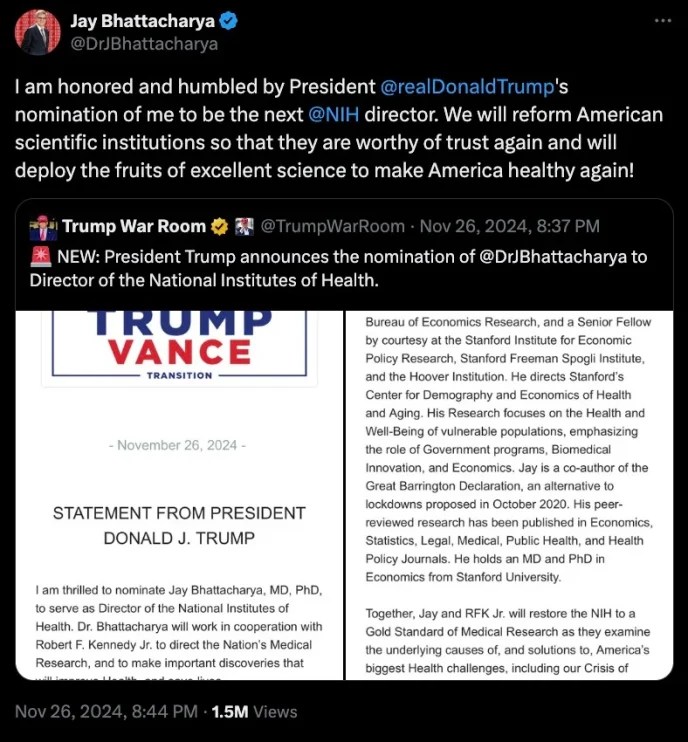
President Trump underscored this vision, calling Bhattacharya a leader who will restore the NIH to its “Gold Standard” while addressing America’s greatest health challenges. Paired with Robert F. Kennedy Jr., another advocate for reform, Bhattacharya is set to tackle systemic issues such as chronic illness, skyrocketing healthcare costs, and the erosion of public trust in science.
Featured Video
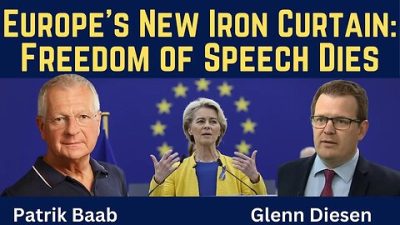
Patrik Baab: Europe’s New Iron Curtain – Freedom of Speech Dies
or go to
Aletho News Archives – Video-Images
Book Review
Jeffrey Epstein: A Jewish Individual?
The Occidental Observer | February 5, 2023
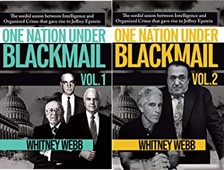
One Nation Under Blackmail: The Sordid Union between Intelligence and Organized Crime that Gave Rise to Jeffrey Epstein (Volume 1 & 2) by Whitney Webb
“Far from being an anomaly, Epstein was one of several men who, over the past century, have engaged in sexual blackmail activities designed to obtain damaging information (i.e., “intelligence”) on powerful individuals with the goal of controlling their activities and securing their compliance.”[1]
Jeffrey Epstein is dead and Ghislaine Maxwell is locked away in prison, and the thought-makers of our world seem keen to let the more explosive parts of the scandal dissipate from the public consciousness. As far as the mainstream media is concerned, Epstein and Maxwell were little more than well-connected socialites who ran a sex-trafficking ring for the rich and the powerful, and the focus has shifted instead to the criminal and civil cases seeking to achieve redress for the victims of sexual abuse.
On occasion some newspaper articles will mention the hidden cameras littered across Epstein’s properties, others the reams of CDs and hard drives found within them during the FBI raids. Altogether missing from the Netflix documentaries (Jeffrey Epstein: Filthy Rich [2020] and Ghislaine Maxwell: Filthy Rich [2022]) or the articles that spend their time narrowly focusing on the links between Epstein and Bill Gates, is the acknowledgement of the true nature of Epstein himself and the ultimate purpose of this sex-trafficking of minors — a sexual blackmail operation.
Not everyone is cowardly enough to let these controversial aspects lie untouched, as the newly released two-volume book One Nation Under Blackmail by independent reporter Whitney Webb seeks to blow wide open this media-enforced blackout. Utilizing primarily open-source information (that is, publicly accessible information such as books, newspapers articles and government reports),[2] Webb’s book delves into the life and times of Jeffrey Epstein and his deep ties to Jewish billionaires and Israeli intelligence. … continue
Blog Roll
Recent Comments


 Aletho News
- Germany’s CDU Pushes Real-Name Social Media Mandate and ID Checks
- Patrik Baab: Europe’s New Iron Curtain – Freedom of Speech Dies
- Trump’s ‘Board of Peace’ exports Israeli ‘ceasefire’ diplomacy to the world
- Israeli army closes dozens of cases involving killing of Palestinians inside torture camps
- Europe creates a ‘Russian government-in-exile’, consisting of a bunch of losers
- Munich, 2007: The Day the West Was Told No
- At The Munich Security Conference, AOC Gets It Wrong On Foreign Policy
- Europe Decided to Go to War With Russia by 2030, Already Preparing – Orban
- Russia and China Are Expanding Their Cooperation to Counter US Efforts to Bully Iran and Cuba
- NATO plotting maritime blockade of Russia – Moscow
- If Americans Knew
- Israel battles Palestinian right of return, one Palestinian at a time – Not a ceasefire Day 127
- Noor’s short life of unimaginable suffering
- Israel Destroyed Gaza’s Hospitals. Now It’s Banning Doctors Without Borders.
- Is Spite of What Zionists Say, It’s a Good Thing to Criticize Governments
- Palestinian mother, daughter recount strip searches, harsh conditions in Israeli detention
- Israel used weapons in Gaza that made thousands of Palestinians evaporate
- ADL’s Stats Twist Israel’s Critics Into Antisemites
- Why Is the World Silent When the Gaza Genocide Is Not Over?
- In Gaza: 8,000 bodies under rubble, 3,000 missing – Not a ceasefire Day 126
- AZAPAC, the new PAC opposing Israeli domination of U.S policies
- No Tricks Zone
- Unfudging The Data: Dutch Meteorological Institute Reinstates Early 20th Centruy Heat Waves It Had Erased Earlier
- German Gas Crisis…Chancellor Merz Allegedly Bans Gas Debate Ahead of Elections!
- Pollen Reconstructions Show The Last Glacial’s Warming Events Were Global, 10x Greater Than Modern
- Germany’s Natural Gas Storage Level Dwindles To Just 28%… Increasingly Critical
- New Study Rebuts The Assumption That Anthropogenic CO2 Molecules Have ‘Special’ Properties
- Climate Scientist Who Predicted End Of “Heavy Frost And Snow” Now Refuses Media Inquiries
- Polar Bear Numbers Rising And Health Improving In Areas With The Most Rapid Sea Ice Decline
- One Reason Only For Germany’s Heating Gas Crisis: Its Hardcore-Dumbass Energy Policy
- 130 Years Later: The CO2 Greenhouse Effect Is Still Only An Imaginary-World Thought Experiment
- New Study Affirms Rising CO2’s Greening Impact Across India – A Region With No Net Warming In 75 Years
 Aletho News