How US Deep State Co-Opted TikTok
By Ilya Tsukanov – Sputnik – 21.09.2024
TikTok wiped Sputnik’s account on Saturday, days after Washington announced draconian new restrictions on Russian media. The company offered no explanation.
The newest round of censorship comes amid the US establishment’s long war against TikTok amid much-touted (but never substantiated) claims by authorities that China uses the app for espionage and influence operations against American users.
The crux of US government claims is that the app sends US customer data to the Asian nation, where it can be seen by Chinese authorities or intelligence services. TikTok says its US data is firewalled from leaving the country via an agreement with American tech giant Oracle.
Joe Biden signed a law in April threatening to completely ban TikTok within 270 days unless its Chinese parent company ByteDance divests from US operations, setting the stage for a legal battle. The measure, packaged in alongside fresh appropriations for US-funded hot spots in Ukraine, Gaza and Taiwan, was rejected by a handful of progressive Democrats and MAGA Republicans, who deemed it a blatant assault on constitutionally afforded free speech.
Senator Rand Paul warned that “once you start objecting to content, what you’re objecting to is speech… The bottom line is, the more information, the better. If you don’t like it, don’t use it. That’s what happens in a free country.”
Congressman Thomas Massie characterized the ban threat as a “trojan horse,” giving the president expansive powers to crack down speech. “Some of us just don’t want the president picking which apps we can put on our phones, or which websites we can visit… We also think it’s dangerous to give the president that kind of power,” Massie said.
TikTok is already banned from use from devices owned by the US federal government, and by numerous state and city governments and universities.
It’s also been banned or restricted in multiple US-allied countries, including Canada, Australia, New Zealand, Britain, at least eight EU countries.
Former president Donald Trump kicked off the TikTok censorship saga in 2020 after deeming it a “national security threat,” prompting the company to file a preliminary injunction to prevent such an eventuality. Trump reversed course this past spring, saying banning TikTok would only make Mark Zuckerberg’s “enemy of the people” Facebook “bigger.”
Elon Musk and Brazil: The conflict is more complex than it seems
By Raphael Machado | Strategic Culture Foundation | September 19, 2024
The suspension of services of X (formerly Twitter) in Brazil, as well as the threat of an $8,000 fine for anyone using a VPN to continue using the social network, has made global headlines. Although there had been previous reports of friction between X and the Brazilian political-legal system, the news of the suspension surprised many people, in Brazil and abroad.
For foreigners, especially those who consider themselves “anti-imperialist”, it is very difficult to construct a consistent interpretation of this conflict between Musk and Brazil because of the expectations critics of unipolarity have developed regarding Brazil under Lula’s return.
These are the same people who were shocked by Brazil’s hostility toward Nicolás Maduro and a series of other inconsistent positions taken by the Brazilian government on the international stage.
But while investigating how committed the current Brazilian government is to the idea of a multipolar order is relevant, the fact is that Lula has only marginal involvement in the suspension of X in Brazil.
First of all, how is this issue being framed by both sides of the dispute? Generally, the issue of “X” in Brazil is being treated as a conflict between “respect for the law” versus “freedom of expression.” It is difficult to take this framing seriously for a number of reasons.
X, under Elon Musk, has consistently censored or reduced the reach of pro-Palestinian accounts since Musk’s visit to Israel. If X is not like Facebook, Instagram, YouTube, or the newer BlueSky, it clearly cannot be seen as a bastion of free speech.
On the other side, however, the situation is also a bit more complex than simply the duty of X to comply with Brazilian laws. Elon Musk has indeed raised some concerning points regarding Judge Alexandre de Moraes, who made decisions contrary to Brazilian internet norms and tried to force X to comply with them.
Even setting aside these decisions about social media account censorship, the handling of the X case itself has drawn criticism in Brazil.
The root of this conflict is the fact that Moraes has been leading a criminal inquiry for over five years, now known as the “fake news inquiry,” where he goes beyond the usual role of a passive and impartial judge and actively investigates and judges cases of “disinformation” that allegedly threaten “democracy” and Brazil’s electoral process. The rhetoric is very reminiscent of Orwellian narratives produced in Washington and Brussels.
As the political-legal establishment and its international partners are quite satisfied with the Brazilian government’s current stance on most issues, the main targets of these investigations are figures linked to the opposition.
Thus, in the context of this inquiry, Judge Moraes has ordered the suspension of social media accounts of those under investigation. Such decisions are legally questionable under Brazilian law. First, because the inquiry has far exceeded a reasonable time frame for conclusion and doesn’t appear to have a clear objective. Second, because suspending social media accounts of individuals without a conviction, in an inquiry that seems “endless,” is inappropriate. Third, because the Brazilian Internet Civil Framework, the country’s legislation on internet-related obligations for companies, stipulates that a social media account can only be blocked for specific violations of norms – and Judge Moraes, in his orders to X, never specified the reasons for the suspensions.
These are some of the main arguments, including those raised by Elon Musk, to challenge these judicial decisions.
The situation worsened when Moraes allegedly threatened X’s office employees in Brazil with imprisonment if they failed to comply with his decisions. Amidst this confusion, the Judiciary claims that X’s representative in Brazil has been evading court summonses. On the other hand, there are indications that Moraes’ staff sent the summons to the wrong email address when attempting to notify X.
Nonetheless, these threats explain why X decided to shut down its office in Brazil. Immediately afterward, Moraes ordered X to appoint a new legal representative in Brazil, which is mandatory for companies operating in the country.
Since X did not establish a new representation in Brazil, Moraes ordered the company’s suspension.
The situation would seem more reasonable if Moraes hadn’t also imposed a daily fine of $8,000 on any Brazilians using VPNs to continue accessing the social network. Needless to say, the order was immediately disobeyed by most Brazilian X users, and the Brazilian Bar Association filed an appeal to annul the fine.
The problem with the fine is that it casts doubt on the claim that this is merely a natural consequence of X not having legal representation in the country in accordance with the law. Why, then, impose fines on ordinary users who are not part of the inquiry and were not even notified of the decision (which, again, is unconstitutional under Brazilian law)?
Next, Moraes ordered the blocking of Starlink’s accounts, a company with different shareholders, to collect the fine imposed on X – once again, a decision that violates Brazil’s entire legal framework.
However, the issue transcends the legal debate and refers back to the fact that X is a space successfully used by sectors of Brazilian politics that oppose the “Juristocracy,” as well as the influence of foreign NGOs in Brazil and the current government.
Platforms like Meta, for example, are absolutely controlled by the U.S. Deep State and impose draconian restrictions on anyone who deviates from globalist ideological orthodoxy. Moreover, this may seem incomprehensible and unbelievable to our partners in other BRICS countries, but Brazil does not have an anti-Atlanticist, counter-hegemonic mass media. The Brazilian mass media belongs to an oligopoly that is deeply tied to U.S. media conglomerates.
In this sense, spaces like X represent an “oasis” used by both the right-wing opposition and the anti-imperialist left.
To understand what Moraes and other judges think of this, one only needs to recall a statement he made a few weeks ago: “At the turn of the century, there were no social networks; and we were happier,” said to loud applause from representatives of Brazil’s major TV networks and newspapers.
Naturally – we insist – Elon Musk is not exactly a victim here. He is far from it. For example, it is also true that his Tesla lost contracts to Chinese rivals in Brazil in recent years, which greatly irritated him. It is also true that he believes he can gain greater business penetration in the Brazilian market if Bolsonaro returns to power – and he openly uses his large presence on X to occasionally boost posts from opponents of the Lula government.
Therefore, the case transcends the superficial duality presented as “sovereignty vs. freedom of expression,” and is more accurately an expression of a dispute between different sectors of the Brazilian elite, both with international ties (let us remember that Moraes was part of the international scheme of Operation Car Wash, whose objective was to destroy Brazilian companies, imprison Lula, and overthrow Dilma Rousseff under the guidance of the U.S. Department of Justice), and both clearly hostile to the project of a new multipolar order.
Silence Speaks Volumes: Biden-Harris Admin Refuses To Comment on EU Censorship Threats
By Didi Rankovic | Reclaim The Net | September 20, 2024
The Biden-Harris administration has reportedly sided with the EU against a major US social media company, X, and decided not to (at least publicly) contest the censorship threats against the platform.
This incident involves the now former EU Internal Markets Commissioner Thierry Breton’s scandalous letter threatening X and owner Elon Musk ahead of his interview with President Trump.
Yet another emerging actor here is the US State Department, which, according to House Judiciary Committee Chairman Jim Jordan, refused to publicly condemn those threats.
Breton, who was known as a strong proponent of censorship and clampdowns within the EU’s top bureaucracy, referred to the Digital Services Act (DSA) in his letter to Musk in early August, mere hours before Musk’s interview with Trump. Under the (opponents say, censorship) rules, X could have faced anything from big fines to the EU blocking the platform.
According to a report from Breitbart, Jordan revealed the State Department’s stance in this matter in a letter to Secretary of State Anthony Blinken, where he also claims that Bliken’s department has internal documents revealing communications relevant to Breton’s conduct on that occasion – but it has not submitted them to the Committee.
To remedy that situation, Jordan is now asking that Blinken makes sure “all documents and communications between or among State Department personnel referring or relating to Mr. Breton’s August 12, 2024 letter to Mr. Musk” are made available to the Committee by October 1.
Breton chose to, in a manner clearly biased against Trump, “anticipate” that there may be “incitement to violence, hate, and racism” during the conversation between Musk and the former president, now presidential candidate. And so X was asked to act “preemptively” in order to prevent such – hypothetical – content from spreading in the EU.
Breton’s behavior in this instance can be viewed as a case of “prebunking” – but it was done at a very high level and basically turned into an attempt to meddle in another country’s affairs by muzzling a US presidential candidate, and a US social platform.
However, this instance of meddling from abroad was ignored by the Biden-Harris White House. Jordan points out in his letter to Blinken that the State Department not only had not yet condemned Breton’s actions but also apparently had no intention to do so.
“The Biden-Harris Administration’s silence in the face of Mr. Breton’s threats against free speech in the United States signals to the world that it does not support free speech online and is unwilling to protect American companies from foreign actors who seek to punish their adherence to First Amendment principles at home,” reads Jordan’s letter.
Washington’s new plan to control the Global South
By Anna Belkina | RT | September 20, 2024
When US Secretary of State Anthony Blinken announced a new “joint diplomatic campaign” to be implemented in concert with Canada and the UK last week, he clearly set out the initiative’s goal – “to rally allies and partners around the world to join us in addressing the threat posed by RT and other machinery of Russian disinformation and covert influence.”
Make no mistake: there is nothing diplomatic in this latest US effort to silence any voice that does not adhere to the Washington- and London-dictated narratives about the world.
The point of all news media is to inform. Any information has the potential to influence people. Thus, the collective West has set out to curtail all potential influence that is not theirs.
Helping hand
James Rubin, the coordinator for the US State Department’s Global Engagement Center, elaborated on how this plan would work in an interview with his ex-wife, Christiane Amanpour, on CNN.
“Other countries will make decisions for themselves,” of course, but the charitable, the always-benevolent, the never self-interested American hand will be “helping other governments come to their own decisions about how to treat” RT.
Ah, all those poor, hapless “other governments” that clearly cannot read, watch, think, and decide for themselves. They were just waiting for Big Brother to help them.
What Rubin was really doing was scapegoating RT – and by extension, all other independent voices in what is supposed to be a free and diverse global information space, reflecting a diverse, very complicated, multipolar world – for the increasingly diminishing buy-in of much of the world into Washington’s foreign policies, and propaganda campaigns that accompany them.
As Rubin admitted during his press conference, “one of the reasons […] why so much of the world has not been as fully supportive of Ukraine as you would think they would be […] is because of the broad scope and reach of RT – where propaganda, disinformation, and lies are spread to millions if not billions of people around the world.”
Which countries refused to jump on board with the US and NATO support of the Kiev regime and the continuous escalation of the conflict? In reality, it is most of the world, including such geopolitical giants as India and China, who preferred to leave regional issues to the region in question.
Where official positions are concerned, it’s mostly NATO and its cohorts’ one billion vs our planet’s other seven. And while in those seven not everyone in the general population is of the same mind, neither is everyone in the US and other NATO countries.
Yet, due to the decades-long domination of the international information space by American and European mainstream news media (can you believe the BBC is over 100 years old?), many have been conditioned to think of the world – in the sense of who defines the global order, its rights and its wrongs – as the US and its vassal-state allies.
Notably, Mr Rubin specifically referred to Latin America, the Middle East, and Africa as regions where RT must be stopped. In other words, the so-called Global South. What’s got the US State Department so worried there?
RT’s success is Western media’s loss
Western military, political, and media establishments have been panicked over their loss of monopoly on global information in general, and about RT’s growing reach and influence in particular, for a while now. The self-proclaimed champions of free press, speech and thought cannot handle any of that free-thinkin’ they campaigned for.
To wit, have a scroll:
THE FOUNDATION FOR DEFENSE OF DEMOCRACIES, US: “Washington is struggling in the battle for hearts and minds in the ‘Global South’, where Russian propaganda outlets are often more popular than Western media.”
NEWSWEEK : “… it’s in the Global South that Russia has reaped the most significant rewards. The popularity of the Kremlin-controlled TV station Russia Today is high…”
POLITICO : “… many of the Kremlin-backed accounts – especially those from sanctioned media outlets like RT and Sputnik – have an oversized digital reach. Collectively, these companies boast millions of followers in Europe, Latin America and Africa…”
ROYAL UNITED SERVICES INSTITUTE, UK: “Latin America has witnessed a growth in Russian information efforts. Just like in the Middle East, Russia is operating a number of popular media channels, such as RT en Espanol, Sputnik Mundo and Sputnik Brasil, with substantial followings.”
CENTER FOR STRATEGIC AND INTERNATIONAL STUDIES, US: “Russia’s […] media presence and influence [in Latin America] are unmatched… The reach of Russia’s technique has proven to be effective … Actualidad RT and Sputnik Mundo have become so mainstream in LAC, that in December 2022, RT Spanish won three prestigious Mexican journalism awards for their coverage of the war in Ukraine.”
WILSON CENTER, US: “Russia has successfully implemented long-term strategies to capture and influence intellectual elites in Latin America.”
ATLANTIC COUNCIL: “Russia has established a significant media and information footprint throughout the [Latin American] region with Russia Today and Sputnik News.”
EL MUNDO, SPAIN: “In addition to hybrid channels, [Russia] uses public companies such as Russia Today, whose propaganda is triumphing in Latin America – the Spanish-speaking version of RT […] is integrated into family daily life from Venezuela to Bolivia.”
INTERNATIONAL BUSINESS TIMES, UK: “Egyptian media ran headlines and reports verbatim from RT Arabic, […] EU Reporter, an independent media outlet, reported that ‘Russian media outlets like RT Arabic and Sputnik are extremely popular, with RT Arabic becoming one of the most trafficked news websites in the country.’”
FOREIGN POLICY : “RT Arabic and Sputnik Arabic emerged as major sources of legitimate regional news in the Middle East.”
JOSEP BORRELL, HIGH REPRESENTATIVE OF THE EU FOR FOREIGN AFFAIRS AND SECURITY POLICY: “When you go to some African countries and you see people supporting Putin, supporting what Putin is doing in Donbass, saying Putin has saved Donbass, now he will come to Africa and save us.”
ABC, SPAIN: “The Kremlin has tried to increase its influence in the media using Russia Today and Sputnik News. And there have also been collaboration agreements with local media, hiring African journalists and African activists, and at the same time generating news in Arabic, English or French to gain the support of the African population.”
Thank you, thank you very much.
Exporting censorship
Since RT’s launch in 2005, our journalists have brought to light countless stories and points of view disallowed in the Western mainstream. We have built a massive global audience and won the trust of viewers and readers worldwide.
But, despite Western elites’ declarations to the contrary, any voice that fails to fit into the rather cramped echo-chamber they have set up to accommodate supposedly free discourse, is inherently seen as illegitimate. Therefore, it must be silenced.
Which is why, having pushed out official RT channels from Western airwaves and digital platforms, they now want – nay, need and ought – to export their particular brand of censorship globally. They pledge to wage a coordinated campaign to force other nations into following their example, all so that the West can recover its information monopoly. They must “disrupt [RT] activities” everywhere. It is not enough for them to silo off their own people from inconvenient facts and alternative viewpoints. They have the megalomania and the audacity to say that no one in the world should hear them either.
This is especially so in the Global South countries – the ones that the US has gotten accustomed to patronizing, manipulating, dominating, undermining and overthrowing unsuitable-to-them regimes, and outright controlling in any way they could, over the last century.
Welcome to neocolonialism, Taylor’s 2024 Version.
Government folks have also already lined up Silicon Valley wunderkinds – the tech giants that are ever so eager to curry political favor in order to stay on the lax side of corporate regulation – in this endeavor. Meta, which blocked access to RT’s Facebook and Instagram accounts in the EU in 2022, has overnight removed RT from its platforms – entirely and worldwide.
YouTube removed RT’s record-breaking channels everywhere that same year, but Google’s parent company, Alphabet, had already worked to “de-rank” RT and Sputnik in Google searches back in 2017.
After all, “RT is the top recommended source for news concerning Douma’s chemical weapons attack, Skripal poisoning and the Syrian White Helmets,” wrote the Atlantic Council in 2018. In 2019, “Bild conducted a test and entered the query ‘Ukraine’ into Google News. Again, among the top ten articles were three from RT Deutsch and Contra Magazin.” When people looked for news, they came to RT.
This could not stand.
A quick aside: despite all the claims by the Americans and the Brits about RT’s supposed attempts to “sow discord” in their societies, the network really should be lauded for bringing people together instead. In the US, where political bipartisanship is a near-extinct species, the Biden administration’s present-day efforts are fully endorsed by Fiona Hill, of Donald Trump’s National Security Council, who argued that “there has to be concerted action against RT.” In the UK, the recently elected Labor leadership has fully adopted their Tory predecessors’ anti-RT playbook.
Not going away
Let me be clear: RT is not going anywhere, in the West nor in the Global South. Our journalists will continue to do their jobs. We will continue to find ways to have our voice heard. Our audiences “of millions if not billions of people around the world” expect nothing less of us. This is our duty to the global community.
As for the global community, where does it stand, in the face of this new US-led campaign?
The Hindu, one of India’s newspapers of record, reported that already “US officials have spoken to [India’s] Ministry of External Affairs about joining their actions against what they call ‘Russian disinformation’, by revoking accreditations and designating [RT] journalists under the ‘Foreign Missions Act’. However, while the ministry has been silent on the issue, government officials said that the debate on sanctions is not relevant to India, while a former diplomat said that banning media organizations showed ‘double standards’ by Western countries… An official said that the matter ‘does not pertain’ to India and pointed out that India does not follow unilateral sanctions that are not approved by the United Nations.”
We are confident that the rest of the truly independent world will follow suit.
Anna Belkina is RT’s deputy editor in chief and head of communications, marketing and strategic development.
They Think We Are Stupid, Volume 11
Everything you need to know about our ruling class’s opinion of you
By Aaron Kheriaty, MD | Human Flourishing | September 19, 2024
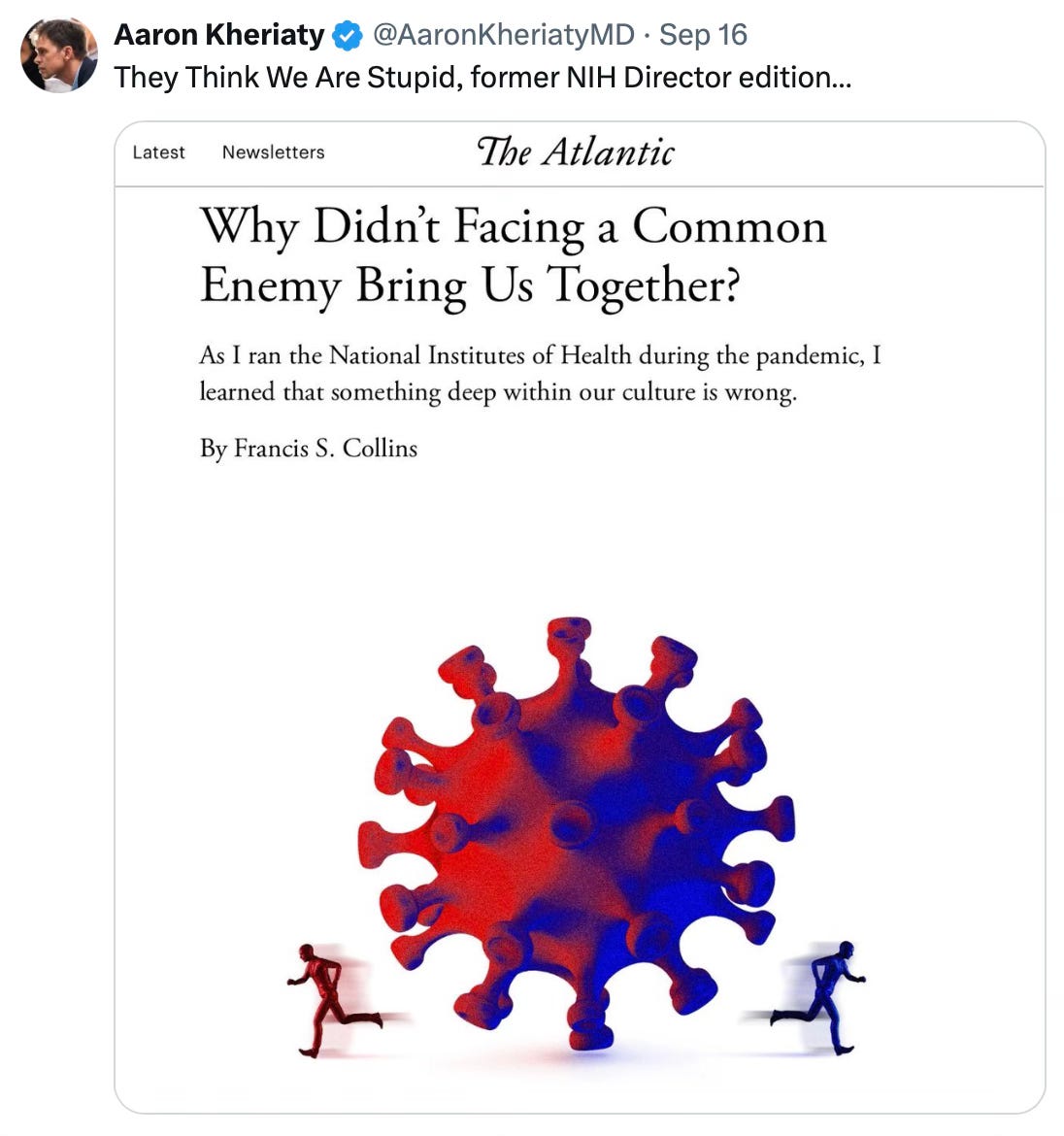


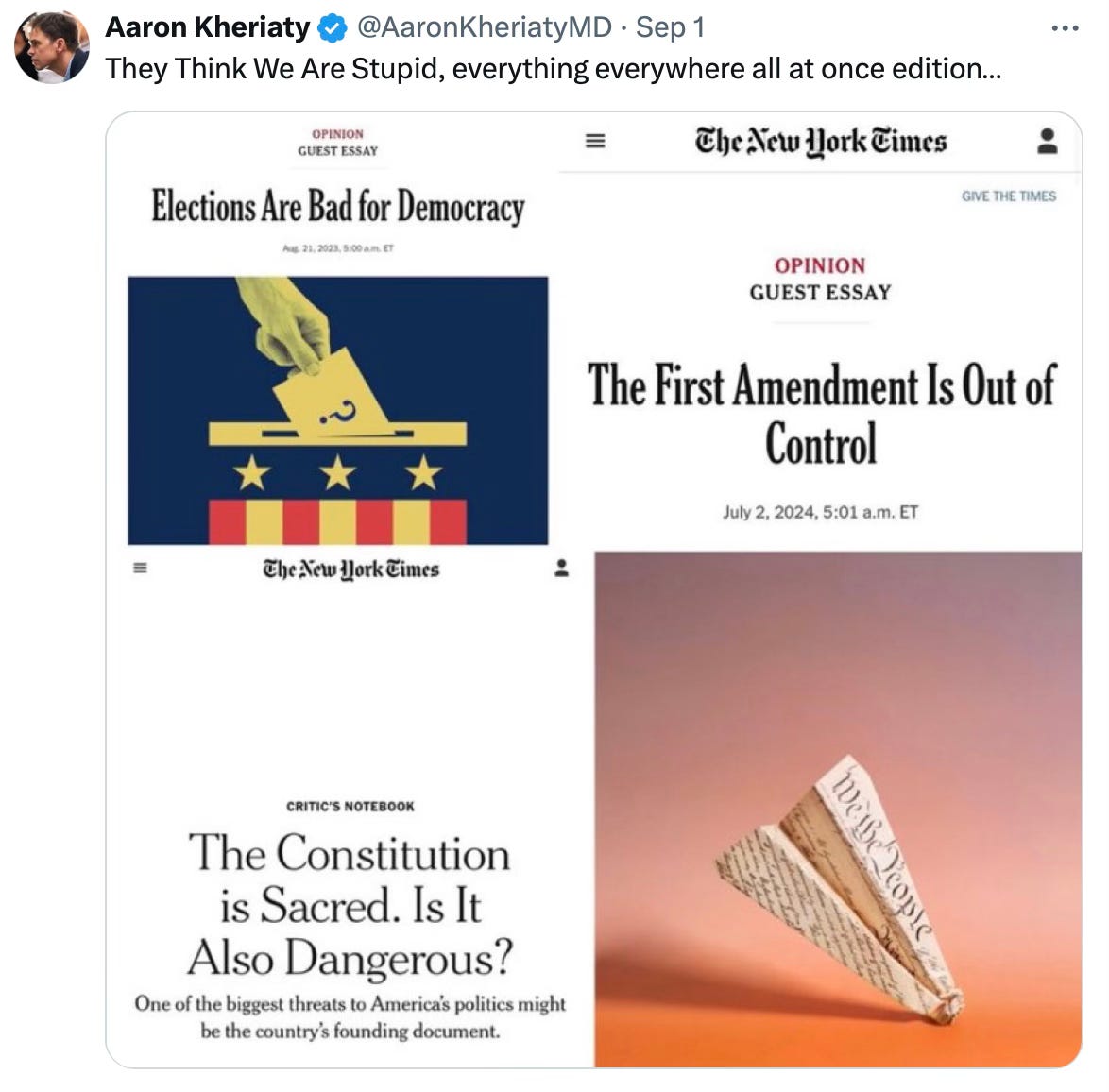
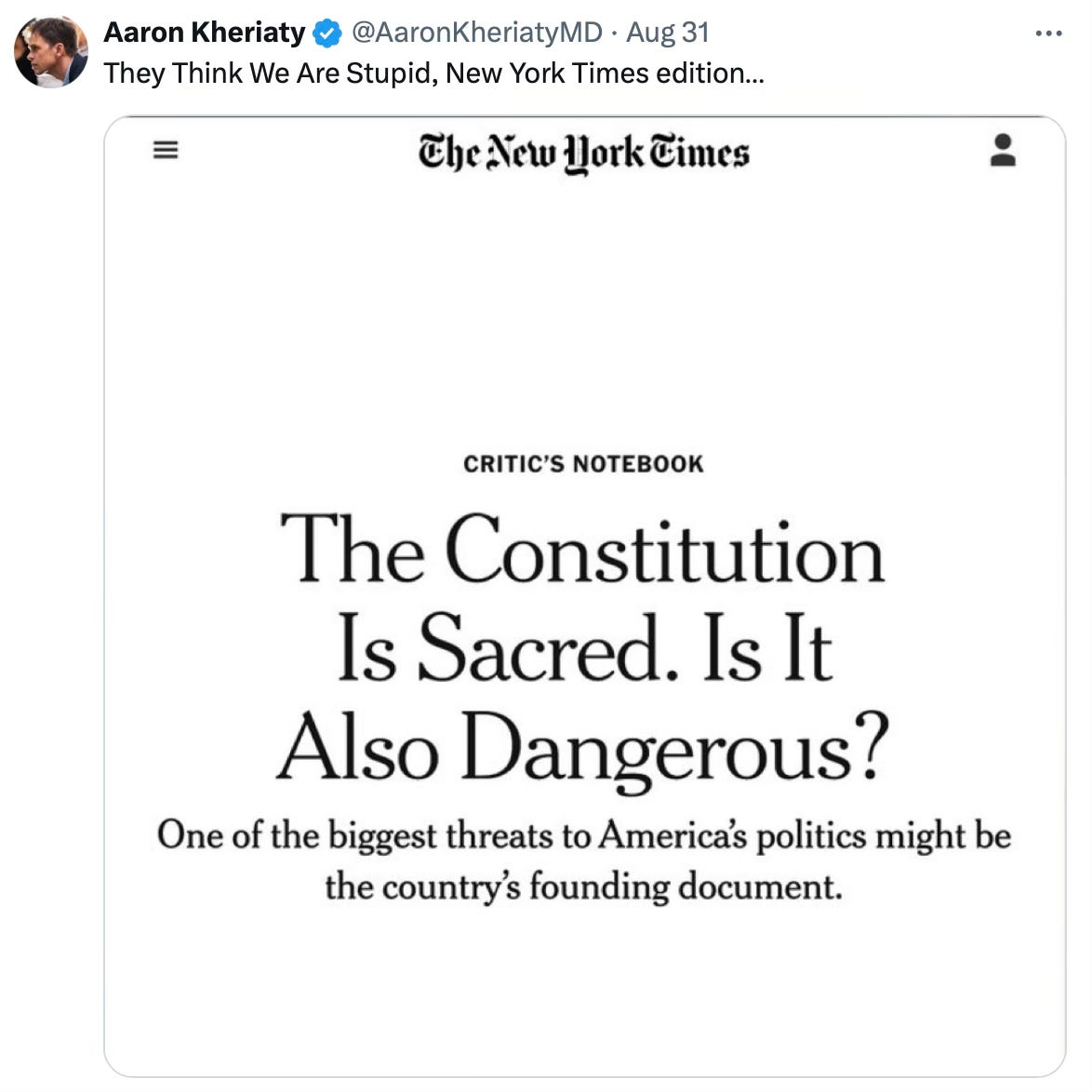


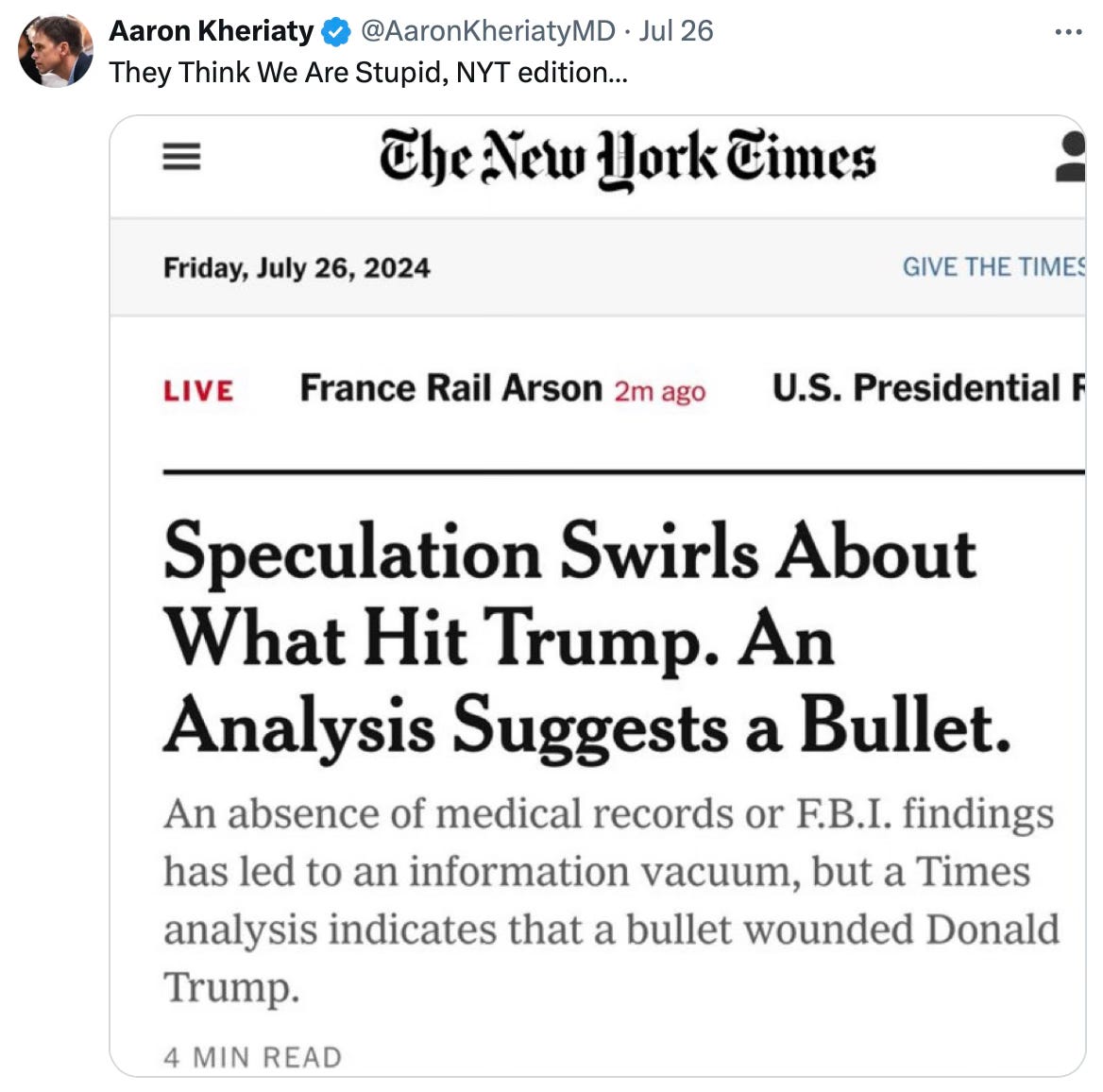
New Report: State Department Funded Fact-checkers to Censor ‘Lawful Speech’
By Michael Nevradakis, Ph.D. | The Defender | September 18, 2024
The U.S. Department of State-funded domestic and international fact-checking entities that censored American independent media outlets and social media users who questioned the Biden administration’s COVID-19 and other policies, according to a congressional report.
The report by the U.S. House of Representatives Committee on Small Business stated:
“The Federal government has funded, developed, and promoted entities that aim to demonetize news and information outlets because of their lawful speech.”
The government’s actions fueled “a censorship ecosystem” that suppressed “individuals’ First Amendment rights” and “the ability of certain small businesses to compete online.”
The report focused on the State Department’s Global Engagement Center (GEC), which promoted and funded “tech start-ups and other small businesses in the disinformation detection space … with domestic censorship capabilities.”
The “fact-checking” firms named in the report include the International Fact-Checking Network — owned by the Poynter Institute — and NewsGuard.
The International Fact-Checking Network, established in 2015, has received funding from another State Department-affiliated group, the National Endowment for Democracy — and from Google, the Open Society Foundations and the Bill & Melinda Gates Foundation.
According to the House report, the federal government “assisted the private sector in detecting alleged MDM [misinformation-disinformation-malinformation] for moderation” and “worked with foreign governments with strict internet speech laws,” including European Union member states and the United Kingdom, to censor speech.
The report determined that the GEC and the National Endowment for Democracy violated international restrictions by “collaborating with fact-checking entities” to assess the content of domestic media outlets.
The “fact-checking” operations targeted independent media outlets, and as a result, “the scales are tipped in favor of outlets which express certain partisan narratives rather than holding the government accountable.”
Whether the State Department’s actions rise to “unconstitutional violations of the First Amendment is currently before the courts,” the report stated.
The State Department and several GEC officials are defendants in Murthy v. Missouri, a lawsuit alleging the Biden administration colluded with social media to censor free speech.
Children’s Health Defense (CHD) and its chairman on leave, Robert F. Kennedy Jr., are plaintiffs in Kennedy v. Biden, a similar lawsuit that last year was consolidated with Murthy v. Missouri.
The Poynter Institute is a defendant in another censorship lawsuit, CHD v. Meta, that CHD filed against Facebook’s parent company.
NewsGuard partnered with CDC, WHO to censor online content
According to the report, NewsGuard used money it received from the GEC and the U.S. Department of Defense to fund efforts to lower the advertising revenue “of businesses purported to spread MDM.”
“A system that rates the credibility of press is fatally flawed as it is subject to the partisan lens of the assessor, making the ratings unreliable,” the report states.
NewsGuard leveraged taxpayer dollars to develop Misinformation Fingerprints, a product that “catalogues what it determines to be the most prominent falsehoods and ‘misinformation narratives’” circulating online, “essentially outsourcing the U.S. government’s perception of fact to NewsGuard,” the report states.
NewsGuard later partnered with dozens of companies, organizations, universities and media outlets, including the Centers for Disease Control and Prevention, the Office of the Surgeon General and the World Health Organization (WHO).
“During the pandemic, the WHO enlisted NewsGuard for its input, including regular reports, on which COVID-19 narratives it determined to be misinformation were prevalent online,” the report states. “The WHO then contacted social media companies and search engines asking them to remove this content.”
‘Nobody wanted’ fact-checkers until ‘actual truths started getting out’
Tim Hinchliffe, publisher of The Sociable, told The Defender, “These so-called ‘fact-checkers’ are not in the business of actually checking facts. They are in the business of controlling narratives … Nobody wanted or needed these organizations until actual truths started getting out.”
Catherine Austin Fitts, founder and publisher of the Solari Report and former U.S. assistant secretary of Housing and Urban Development, told The Defender the government increasingly relies on censorship to promote its favored narratives.
“They need to institute more and more censorship,” Fitts said. “It’s hard to refute the gaslighting that flows from this imagination factory.”
Francis Boyle, J.D., Ph.D., professor of international law at the University of Illinois, told The Defender he wasn’t surprised that the State Department is “working to censor those who disagree with U.S. government policies and their globalist agenda.”
The report recommends that no federal funds “should be used to grow companies whose operations are designed to demonetize and interfere with the domestic press” and that federal agencies “should not be outsourcing their perception of fact to speech-police organizations subject to partisan bias.”
GEC also faces the loss of its government funding. According to the Washington Examiner, “A provision through the annual State Department appropriations bill, which passed the House this summer and will be negotiated in the Senate, aims to ban future checks to the GEC.”
But for Boyle, this is not enough. He said the State Department has, “at a minimum,” committed “the federal crime of conspiracy to defraud the U.S. government.”
Censorship ‘a pendulum that swings both ways’
The Gateway Pundit last week reported on additional links between the International Fact-Checking Network, other “fact-checking” firms and Big Tech.
In 2015, Poynter partnered with Google News Lab, which earlier that year, helped establish First Draft News. Active until 2022, First Draft was a consortium of social media verification groups that shared methods for combating “fake news.”
Another First Draft founder, fact-checking firm Bellingcat, also received funding from the National Endowment for Democracy.
First Draft was previously led by Claire Wardle, Ph.D., a Brown University professor who, according to “Twitter Files” released last year, advised the Biden administration on COVID-19 “misinformation” — despite having no science or medical credentials.
In 2016, Poynter and the International Fact-Checking Network partnered with First Draft “to tackle common issues, including ways to streamline the [news] verification process.” Other partners included Facebook, Twitter, YouTube, The New York Times, The Washington Post, CNN, ABC News, NBC News and BBC News.
In 2017, Google News Lab partnered with the International Fact-Checking Network “to dramatically increase the searchable output of fact-checkers worldwide, expand fact-checking to new markets and support fact-checking beyond politics, such as in sports, health and science.” The following year, Poynter acquired PolitiFact.com.
Google was also one of the original funders of The Trust Project, a consortium of news organizations that developed eight “trust indicators” to help the public “easily assess the integrity of news.”
These “trust indicators” later became “one of the sources being used by NewsGuard Technologies for a new product to improve news literacy,” and formed “a foundation for NewsGuard review development.”
Hinchliffe warned that the beneficiaries of censorship based on today’s “fact-checking” may become its targets in the future.
“One of the problems of censorship that operates under the guise of misinformation and disinformation, apart from stifling free speech and suppressing actual truths, is that it’s a pendulum that swings both ways,” he said. “The people calling for censorship now may be in a greater position of power to do so, but it will one day swing back at them.”
This article was originally published by The Defender — Children’s Health Defense’s News & Views Website under Creative Commons license CC BY-NC-ND 4.0. Please consider subscribing to The Defender or donating to Children’s Health Defense.
German Citizens’ Forum Proposes Criminalizing “Disinformation”
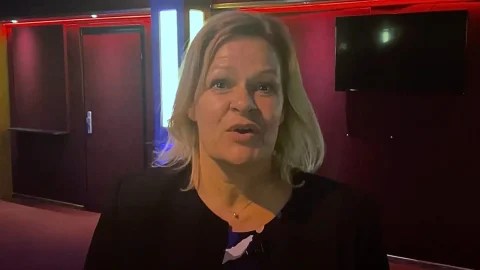
By Didi Rankovic | Reclaim The Net | September 19, 2024
A citizens’ council – established by Germany’s Interior Minister Nancy Faeser to help combat what she sees as “fake news,” has come up with a number of recommendations, including criminalizing whatever the authorities decide to consider to be the “spread of disinformation.”
The proposal is in line with Faeser’s own policies, which opponents see as strongly pro-censorship (and that includes trying to ban a magazine critical of the government).
No surprise also that Faeser’s ministry is open to the suggestions – a statement said it would be “analyzed.” Furthermore, the Interior Ministry will “examine the extent to which (the recommendations)” can be incorporated into its work.
All this is already being interpreted in the context of the previous conduct of Germany’s government, which critics say is not only free speech and media freedom-unfriendly – but is also, while declaratively fighting disinformation, giving a leg up to those media outlets that actually spread disinformation (the implication being, the kind of disinformation that suits the government.)
In a world where war is peace, freedom is slavery, etc., Faeser’s council’s full name is, “Forum against Fakes—Together for a Strong Democracy.” But it’s questionable how German democracy could benefit from an even more draconian clampdown on speech than what is currently happening.
91 percent of those participating in Fraser’s council (and that’s reportedly more than 420,000 people) have recommended that the ministry look into the possibility of “examining criminal prosecution and/or sanctioning the spread of disinformation.”
The council can be seen as a form of “policy laundering” – where a politician’s own ideas are put through a body said to represent citizens, to then be accepted as supposedly (all) citizens’ proposal.
In order to start prosecuting and punishing people for disinformation, there was no way of avoiding “defining” what it was. The attempt, however, is poor.
“Targeted false information that is spread in order to manipulate people. The aim is to influence public debates, divide society, and weaken cohesion and democracy.” That’s the “definition,” which is alarmingly broad and open to interpretation and manipulation.
Another point that the council’s recommendations make is that punishing people found to be “weakening cohesion” and such is to, basically, subject them to reeducation.
“Deter” and “increase awareness of wrongdoing” is how this is worded. However, observers are not sure such measures can coexist with Germany’s Basic Law and its provisions meant to protect freedom of expression.
G20 Embraces Digital ID Dream While Critics Warn of Surveillance Nightmare
By Didi Rankovic | Reclaim The Net | September 19, 2024
The G20 organization, currently chaired by Brazil and recently holding a ministerial meeting there, is wasting no time falling in line with all the key policies advanced by many governments, and globalist elites.
After promising to do its bit in the “war on disinformation” (to the delight of the host, Brazil, whose present government is accused of censorship), G20 member countries “pledged allegiance” to the digital ID and the overall scheme that incorporates it – namely, the digital public infrastructure (DPI).
DPI already counts the UN, the EU, the World Economic Forum (WEF), and the Gates Foundation as policy backers and vocal promoters. Now G20 ministers with digital economy portfolios have issued a joint declaration to express their “commitment” to both DPI and “combating disinformation”, and there is also inevitably the talk of “AI.”
On the digital ID/DPI front, the ministers speak of “inclusive” DPI, and the same attribute is attached to AI. The declaration “acknowledges” the importance of things like innovation and competition in a digital economy, among other things, at the same time “reaffirming” the importance of digital transformation based on DPI.
Boilerplate remarks are made about transparency and protection of privacy and personal data – but these are the major concerns cited by opponents of this type of scheme, along with the overall fear that they facilitate new, more dangerous forms of mass surveillance through centralization of personal information and tracking of people’s activities.
Referring to digital ID as “a basic DPI,” the declaration further speaks of the Sustainable Development Goals (a UN agenda) and one of its targets to be achieved by 2030 by using digital ID (as a tool of “inclusion”) to provide “legal identity for all.”
Interestingly enough, free speech repression is not the only controversial policy where Brazil seems keen to lead the way; so is DPI, and the digital ID.
During the G20 meeting, Brazil promoted its DPI-related activities, including digital IDs based on biometrics. This policy is explained with buzzwords such as economic growth, sustainable development, and also, “easier access to financial services and government resources, particularly for underbanked populations.”
Oracle Founder Larry Ellison Imagines a Dystopian Future of Constant AI-Powered Surveillance to Enforce “Best Behavior”
By Didi Rankovic | Reclaim The Net | September 18, 2024
Larry Ellison, co-founder, chairman of the board, and chief technical officer of Oracle, has revealed where he sees the world going in one particular aspect – continuous, real-time control of people.
It is a dark place of “AI” (machine learning, ML) mass surveillance, which Ellison wants to make sure is served by his company by way of providing the fundamental infrastructure. It isn’t irrelevant to this story that Oracle’s portfolio also includes multi-decade contacts with the US government.
Oracle is not often mentioned when Big Tech is talked about, but it is one of the biggest in the industry. The reason for staying out of the limelight is that, unlike its peers with big stakes in the social media space, Oracle’s business is database software and cloud computing.
This is the reason Ellison sees the opportunity to place his company, already involved in building AI models, at the center of producing the tools to make this nightmarish scenario of real-time ML-powered surveillance a reality.
Ellison spoke during the Oracle financial analyst gathering to suggest that the company’s databases will become indispensable for the AI infrastructure, and that proof for that is in companies like X and Microsoft having already picked Oracle to provide this service.
“Maximizing AI’s public security capabilities” is what’s on Ellison’s mind, and he decided to sell this by giving police accountability as an example.
The system would prevent police abuse, he said – but the way “AI” combined with Oracle Cloud Infrastructure arrives there is perplexing, to say the least. It involves police body cameras that are always recording (including in bathrooms, and during meals), always transmitting back to Oracle – and with no option to stop this feed.
“Every police officer is going to be supervised at all times” – that’s another way of putting it, and Ellison did.
But who would build such an expensive and elaborate surveillance system just to use it in law enforcement? Not Ellison.
The cops will be on their best behavior, but so will (the rest) of the citizens, he promised. “Citizens will be on their best behavior because we’re constantly recording and reporting,” Ellison added.
The real reason US wants to silence RT
By Fyodor Lukyanov | RT | September 18, 2024
In late 1986 Yegor Ligachev, the secretary of the Soviet Communist Party’s Central Committee, and Viktor Chebrikov, then-head of the KGB, proposed that the country end the practice of jamming foreign radio stations. ‘Enemy voices’ was the popular term used at the time to describe these broadcasts from abroad.
Of course, the two prominent officials were not imbued with bourgeois ideas when seeking to end radio jamming. They were actually taking a businesslike approach. The pair explained to the Central Committee that blocking was expensive but not very effective, given the size of the country. So, it was suggested that signal-jamming be abandoned and that funds be diverted to counter-propaganda measures. This meant more active work with foreign audiences to communicate the Soviet Union’s own views on world events.
A few weeks later, at a meeting with US President Ronald Reagan in Iceland, USSR leader Mikhail Gorbachev raised the issue. He said “your radio station Voice of America broadcasts around the clock in many languages from stations you have in different countries in Europe and Asia, and we can’t present our point of view to the American people. So, for the sake of equality, we have to jam the Voice of America broadcasts.” Gorbachev offered to stop blocking ‘VOA’ if his counterpart agreed to let Moscow have a frequency to do the same in the US. Reagan evasively promised to consult when he returned home. In the end, the Soviets stopped jamming foreign radio stations unilaterally, without any deal.
The events of the last few days have echoes of this old story. US Secretary of State Anthony Blinken devoted an entire speech to RT, which is subject to ‘full-blocking’ (that’s a new formula!) sanctions for its supposedly destructive and subversive work around the world. According to Blinken and the American intelligence agencies he references, the threat posed by the Russian company is of the highest order and requires the most decisive measures from all of Washington’s allies.
Without irony or exaggeration, it can be said that RT could only dream of the global recognition that Blinken’s appeal has facilitated. The effectiveness of the media group was not so much confirmed as it was certified, and by prominent representatives of its rivals.
We could deplore infringements on freedom of expression and restrictions on pluralism of opinion, but there is little point in doing so. Such notions should only be promoted in relation to the internal information space of individual countries; at a national level, they are an indispensable prerequisite for normal development. As for foreign sources of information, people generally perceive them as instruments of influence. And it hardly depends on the type of socio-political system that exists in a given state. The more comprehensive the information and communication environment, the greater its impact on people’s behavior, and the more acute the desire of governments to tighten control over the flow of ideas and analysis. The international media sphere is deliberately ideological, electrified and conflictual. Hence Blinken’s, shall we say, uncharacteristic remarks that RT should be treated “like an intelligence agency.”
How effective are the tactics of restricting alternative views and jamming radio waves? Comrades Ligachev and Chebrikov rightly pointed out that the costly efforts to jam hostile broadcasters were, to put it mildly, not particularly effective. Worse, as the author well remembers, the very fact that the authorities were fighting foreign radio voices had the opposite effect to that desired – if they were silencing voices, it meant that they were afraid of the truth. And, by the end of the Soviet era this opinion was not only widespread among the frontline intelligentsia, many ‘ordinary people’ also didn’t give a damn about the official channels.
At their meeting in Iceland, Reagan countered Gorbachev’s appeal by saying that, unlike the Soviets, “we recognize freedom of the press and the right of people to listen to any point of view.” The US president had no doubts about the superiority of the American system in all respects. Accordingly, the demands for information pluralism, then and later, reflected the confidence of Washington that it would emerge victorious from any competition. And so, a few years later, the US achieved a de-facto monopoly on the interpretation of everything.
Washington’s current extreme reaction is due to the feeling that it’s losing this monopoly. Alternative interpretations of events now arouse public interest. In fact, the total resources of the Western, mainly English-language media are incomparably greater than what all the carriers of alternative points of view can offer, at this moment. But internal insecurity is growing all by itself, fueling the desire to fence off the information space. From the same playbook comes the US’ attempts to explain its internal strife and accumulated contradictions by pointing to a pernicious external influence. This was also the Soviet experience. However, the USSR didn’t solve its own issues by blaming them on external causes. In fact, as its problems grew, those same outside factors actually began to exacerbate them.
Targeted punitive actions can create obstacles for any organization, there is no doubt about that. Especially when they come from what is still the most powerful country on the planet. But American history teaches us that monopolies do not last forever. Sooner or later, a cartel becomes a brake on development, then it becomes the subject of measures to break it up.
Fyodor Lukyanov is the editor-in-chief of Russia in Global Affairs, chairman of the Presidium of the Council on Foreign and Defense Policy, and research director of the Valdai International Discussion Club.
Hillary Clinton Advocates for Criminal Charges for Americans Spreading “Propaganda”

By Cindy Harper | Reclaim The Net | September 17, 2024
Former US Secretary of State Hillary Clinton has has decided to ignore the First Amendment and has advocated for punitive measures aimed at Americans who contribute to the spread of what she calls “propaganda.” Speaking to MSNBC on Tuesday, Clinton suggested that holding American individuals accountable through civil or criminal charges could serve as a warning to deter the distribution of “disinformation.”
While Clinton acknowledged the importance of indicting foreign actors, namely Russians, directly responsible for meddling in US elections, she argued that Americans who play a role in amplifying “disinformation” should not be overlooked.
“I think it’s important to indict the Russians… who were engaged in direct election interference and boosting [former US President Donald] Trump back in 2016,” Clinton said. “But I also think there are Americans who are engaged in this kind of propaganda, and whether they should be civilly or even in some cases criminally charged is something that would be a better deterrence.”
Clinton, who ran against Trump in the 2016 presidential race, endorsed the ongoing efforts of the State and Justice Departments to reveal the extent of Russian influence in US elections. Clinton has long maintained that her loss in 2016 was due to Russian interference. She described these efforts as merely scratching the surface of a much larger issue, adding, “There is a far distance to go.”
Her comments also touched on the broader issue of foreign influence in American politics, as Clinton warned that adversaries such as Russia, China, and Iran are seeking to sway the US electorate.
She underscored the call for greater vigilance in safeguarding the democratic process, stating: “We are not going to let adversaries, whether it’s Russia, China, Iran, or anybody else, basically try to influence Americans as to how we should vote in picking our leaders.”
Clinton’s call for potential criminal penalties against US citizens who share “disinformation” is a controversial step toward restricting free speech. The idea of penalizing individuals for spreading information, regardless of its origins, raises concerns about the boundaries of government power and the potential for misuse of such laws to suppress dissenting views.
The First Amendment of the US Constitution prohibits Congress from making laws that abridge the freedom of speech. Under this protection, the idea of prosecuting individuals for the mere act of sharing information—regardless of its veracity—presents a potential conflict with these foundational rights.
Featured Video

ARE PATIENTS BEING PROPERLY INFORMED ABOUT OZEMPIC?
or go to
Aletho News Archives – Video-Images
New Book
Breast Cancer: Before You Consent
A new Unbekoming paperback
Lies are Unbekoming | September 18, 2026
Peter Gøtzsche reviewed every randomised mammography screening trial ever conducted for the Cochrane Collaboration. Cochrane’s headline is that, assuming a 15% mortality reduction, one woman in 2000 avoids dying of breast cancer over ten years. Ten are overdiagnosed and treated. Two hundred experience false alarms.
But that headline assumes the reduction. When Gøtzsche looked only at the trials with adequate randomisation — the higher-quality ones — the reduction disappeared. No effect on breast cancer mortality. No effect on all-cause mortality.
This is the Cochrane finding, published in the establishment’s own database of systematic reviews.
No woman being asked to consent to a mammogram this week knows it.
That is why the new Unbekoming paperback exists. … continue
Blog Roll
 Aletho News
- The Truth About the Trump Shootings with Ken Silva
- ARE PATIENTS BEING PROPERLY INFORMED ABOUT OZEMPIC?
- US lawmaker blocks $2.8 billion weapons sale to Israel: Report
- Yemeni army claims responsibility for strikes on sensitive sites in Saudi capital, Aramco facilities in Yanbu
- Iran Judiciary issues indictments against 159 US, Israeli officials for assassination of Leader, commanders
- Turkiye revokes Iranian bank license under US sanctions campaign
- US-Denmark Agreement on Greenland Is ‘PR Stunt’ Ahead of Midterms
- Araghchi: Military intervention cannot create security; coercion cannot bring peace
- Fraud Squared
- Breast Cancer: Before You Consent
- If Americans Knew
- Inside Gaza’s death trap of collapsing, bombed-out buildings
- The everyday items Israel bans from Gaza every day
- Inside the siege, the ruined buildings of Gaza – Daily Update
- Debunking The Claim That Macklemore Has A “History Of Antisemitism”
- CPJ demands release of arrested Palestinian-US journalist near Bethlehem
- Robert Kraft: The Billionaire Friend of Netanyahu Pulling The Strings Behind the Macklemore/Ed Sheeran Blow Up
- Columbia Administered Fund Gives Big Money to Pro-Israel Groups
- Deportation Case of Palestinian Activist Salah Sarsour Tests First Amendment
- ‘We Will Not Forget’: Palestinians Mark 44 Years since Sabra and Shatila
- Why do we let Zionists decide what we can and can’t say?
- No Tricks Zone
- New Study: ‘Global Drought Shows No Detectable Recent Acceleration Under Climate Warming’
- Economic Masterminds: German Socialists Suggest Taxing Productivity Gains Stemming From Using AI
- The South China Sea Has Not Been Cooperating With The Climate Change Narrative
- Energy Crisis: Germany Enters Heating Season With Historically Low Gas Reserve Fill Levels
- New Study: The Antarctic Ice Sheet Gained Mass From 2020-2024 Due To Staggering Snow And Ice Accumulation
- Study: Ocean Heating Rates From Thousands Of Years Ago ‘Dwarf’ Modern Ocean Heating Rates
- Climate Extremists Target, Attack Large-Scale Power Grid Infrastructure In Germany!
- New Study: Antarctic Ice Melt Has Contributed Less Than 1 Centimeter To Sea Level Rise In The Last 30 Years
- Fear Of Debate: Alarmist German Climate Scientist Calls On Mainstream Media To Discredit Skeptic Voices
- End-Of-August Arctic Sea Ice Extent Hasn’t Fallen In 20 Years, Official Data Show!
 Aletho News