An Israeli “tank massacre”, reminiscent of the Lebanon war of 2006, has been taking place in southern Lebanon, as Hezbollah surprises the invading army with the use of a range of anti-tank weapons and drones.
On March 25, Hezbollah unleashed a fury on Israel’s Merkava tanks, announcing that they had struck a total of 21, in addition to striking 3 D-9 Bulldozers and 2 militarized Humvees. The following day, the Lebanese group released a series of videos depicting some of their operations.
In order to carry out so many strikes against Israeli armored vehicles, Hezbollah has traditionally used a variety of guided anti-tank guided munitions (ATGM). Prominently made use of have been weapons ranging from varying kinds of the Russian-made Kornet anti-tank systems, to the Almas (diamond) system that is an Iranian reverse-engineered version of the Israeli-made Spike AGTM, a top attack missile that is particularly effective.
During the Lebanon-Israel war of 2024, Hezbollah announced that it had destroyed a total of 59 Israeli tanks between the end of September and November 27. This time around, Hezbollah has already claimed to have struck around 70. It is unclear how many of these hits damaged or destroyed the tanks, but it suffices to say that this is a significant development.
Between October of 2023 and October of 2024, the Qassam Brigades, the armed wing of Hamas, claimed to have carried out 480 operations targeting Israeli tanks. A later report by Israeli news outlet Maariv cited data arguing that at least 500 military vehicles of varying kinds had sustained damage in Gaza. How many were totally destroyed is unknown, due to Israeli military censorship.
However, even a damaged tank is a major issue as they take a long time to repair, and the process is often costly. The reason why the figures from Gaza matter is that, in the case of the Palestinian resistance groups, they primarily used weapons like the Yassin-105 tandem warhead RPG, and then later, they were forced to use less sophisticated kinds of RPGs. Hezbollah, by comparison, has a much more sophisticated arsenal of anti-tank weapons.
A Game Changer?
During this war, which Hezbollah entered on March 2, citing Israel’s 15,400 ceasefire violations against the country and refusal to withdraw from occupied territory, a new weapon appears to be shaping the group’s ground confrontation with the Israeli invading army. That is the FPV (first-person-view) drone, equipped with heavy explosive charges.
The video published on March 26 by the Lebanese group’s military media featured one of these FPV drones directly striking a weak spot on an Israeli Merkava tank. Since March 25, when these weapons started to be used to combat invading Israeli military vehicles, they have been deployed routinely to target their tanks.
FPV drones using a fiber-optic capability are notably immune to electromagnetic jamming, making them extremely difficult to bring down and have been used extensively in the Ukraine-Russia war. Although no statistic is presented to back up this claim, the Wall Street Journal recently reported that FPV drones account for most battlefield casualties in Ukraine.
Regardless of the precise numbers of casualties inflicted in the Ukraine-Russia war by this drone, it is broadly accepted that it has been a game-changer, with it being the weapon of choice against various kinds of tanks and armored vehicles.
Another bonus to the FPV drone, beyond its use to target weak points on military vehicles, is the fact that the recordings can also be recovered as proof of what it struck. In Baghdad, just over a week ago, the Islamic Resistance in Iraq used two FPV drones to target a US military base, with one drone filming the other striking its target.
When fighting a war against Israel, which is perhaps the most well-known military on earth for hiding its soldiers’ deaths, this can come in handy for Hezbollah, which could potentially use the footage to embarrass the Israeli military.
If Israel proceeds with its ground invasion of Lebanon, launching a full-scale invasion, it may at some point run out of tanks, or at the very least have to begin rationing its use of them.
– Robert Inlakesh is a journalist, writer, and documentary filmmaker. He focuses on the Middle East, specializing in Palestine. He contributed this article to The Palestine Chronicle.
March 28, 2026
Posted by aletho |
Ethnic Cleansing, Racism, Zionism, Illegal Occupation, Militarism | Hezbollah, Israel, Lebanon |
Comments Off on Hezbollah’s Surprise Weapons Redefine Ground Battle with Israel
Four weeks of US-Israeli war on Iran – and the stakes have climbed far higher than Washington anticipated. US President Donald Trump threatened on Truth Social to “hit and obliterate” Iran’s power plants if the Strait of Hormuz was not reopened within 48 hours.
The deadline passed. He blinked and, for the second time, postponed his own ultimatum, recasting it as ‘productive conversations.’ Tehran denied any talks and insisted the reversal was driven by “fear of Iran’s response.”
The US-Israeli air campaign was supposed to break Iran. It didn’t. Now the hawks are pushing for boots on the ground. But the ground war being floated does not simply risk American lives on an island 15 miles (around 24 kilometers) off Iran’s coast. It threatens the entire US military architecture in the Persian Gulf – the bases, the alliances, and the energy infrastructure that has underwritten American dominance in West Asia for decades.
In an interview with NBC News, Iran’s Foreign Minister Abbas Araghchi, in response to a question about a possible ground invasion by the US, delivered words the Pentagon had no answer for: “We are waiting for them,” which became a meme in the process. The bluff has been called. The question now is whether showing Washington’s hand collapses the entire table.
Raising the stakes with an empty hand
The ground invasion discourse is no longer hypothetical. Pentagon officials have submitted detailed preparation requests for deploying ground forces. Three Marine amphibious assault groups are converging on the Persian Gulf: the USS Tripoli carrying the 31st Marine Expeditionary Unit from Japan, the USS Boxer with the 11th MEU from California, and roughly 1,500 paratroopers from the 82nd Airborne Division at Fort Bragg.
By the time all units arrive, between 6,000 and 8,000 US ground troops will be within striking distance of Iran. But the composition of these forces exposes the gap between rhetoric and reality. Military analyst Ruben Stewart noted that what is being deployed is “consistent with discrete, time-limited operations, not a sustained ground campaign.”
At the same time, Israel’s own military is showing signs of strain. Chief of staff Eyal Zamir warned on 25 March that the army is “going to collapse in on itself,” citing an eroding reserve force and a deepening manpower crisis as wars stretch from Gaza to Lebanon and now Iran.
Washington is pushing more chips to the center of the table – but the hand behind them remains weak. The scenarios now circulating form an escalation ladder where each rung risks pulling the US deeper into a fight it is structurally unprepared to sustain.
Pickaxe Mountain and the raid that takes too long
The most politically attractive option is a covert raid on Iran’s enriched uranium stockpile – believed to be around 400 kilograms enriched to roughly 60 percent, possibly stored near Isfahan or deep inside Pickaxe Mountain.
But the problem is one Sun Tzu identified centuries ago: speed is the essence of war – yet this mission demands the opposite. Extracting nuclear material requires troops to remain on-site long enough for Iranian forces to respond.
Former CENTCOM commander General Joseph Votel described such operations as “feasible,” but issued a clear warning: “You’re going to have to take care of them, resupply them, medevac them. And that requires a logistical tail, and at some point that tail has to be protected as well.”
Washington still carries the scar of Operation Eagle Claw – the failed 1980 hostage rescue that collapsed in the Iranian desert and helped end Jimmy Carter’s presidency.
Kharg Island: The trap disguised as a shortcut
If covert raids carry too much risk for too little certainty, the next option on the table is a limited territorial seizure – and Washington’s hawks have converged on a single target: Kharg Island.
An eight-square-mile (around 20.7 square kilometers) coral outcrop in the northern Persian Gulf, Kharg processes roughly 90 percent of Iran’s crude exports. US Senator Lindsey Graham urged Trump to “take Kharg Island,” while retired Lieutenant General Keith Kellogg described himself as a “big believer in boots on the ground” there.
The logic sounds surgical: seize Iran’s economic lifeline and force Tehran to the table. But it collapses under even basic scrutiny. Kharg sits just 15 miles (around 24 kilometers) off the Iranian mainland – well within range of coastal missile batteries, drones, rockets, and artillery. Any US force stationed there would face “near-constant bombardment.”
Retired Rear Admiral Mark Montgomery put it bluntly: “If we seize Kharg Island, they’re going to turn off the spigot on the other end. It’s not like we control their oil production.”
Sun Tzu warned that there is no instance of a nation benefiting from prolonged warfare. Modern analyses reach the same conclusion. Think tank assessments warn that Kharg is a textbook case of mission creep, pulling US forces step by step toward a wider ground war.
The war Iran has prepared for
What Washington’s hawks consistently overlook is that Iran has spent decades preparing for precisely this scenario – not to match US firepower, but to make any ground war prohibitively costly.
Iran’s Islamic Revolutionary Guard Corps (IRGC) is divided into 31 autonomous ground divisions, each capable of operating independently if central command is disrupted.
When strikes killed the Islamic Republic’s supreme leader Ali Khamenei, intelligence minister Esmail Khatib, and Basij chief Gholamreza Soleimani, the military apparatus continued launching missiles, closing the Strait of Hormuz, and fighting. A command structure designed to survive decapitation appears to be doing exactly that.
At sea, Iran’s naval doctrine relies on asymmetric warfare. Its reported arsenal: hundreds of fast attack craft, coastal missile batteries, an estimated 5,000 naval mines, over 1,000 unmanned suicide vessels, and Ghadir-class midget submarines built for the Gulf’s shallow waters. The Persian Gulf is not an open ocean. It is a corridor shaped by geography and fortified by doctrine – designed to swallow conventional naval power.
On land, the scale alone is decisive. Iran is four times the size of Iraq, with a population exceeding 90 million. Estimates suggest that any conventional invasion would require “hundreds of thousands of troops.”
Then there is the Basij paramilitary network, reportedly capable of mobilizing up to a million reservists – and the IRGC’s decades of experience coordinating asymmetric resistance across the region.
The US currently has fewer than 8,000 moving into position. This is not a war Iran needs to win – but one that is designed to make Washington unable to sustain.
Winning Kharg, losing the Gulf
Even if Washington succeeds tactically – seizing Kharg and declaring victory – the strategic consequences are immediate.
Since the war began, Iran has already demonstrated its escalation capacity. Missiles and drones have targeted US-linked infrastructure across Bahrain, Kuwait, Qatar, the UAE, Jordan, and Saudi Arabia. Energy facilities, airports, and desalination plants have all come under fire.
A seizure of Kharg would likely trigger a far broader response. Iranian officials have explicitly warned of “continuous and relentless attacks” on regional infrastructure if Iranian territory is occupied.
Tehran has also signaled it could expand the conflict to the Bab al-Mandab Strait through allied Ansarallah-aligned forces in Yemen, threatening a second global chokepoint.
Every US position in the Gulf depends on supply lines that run through the very states already under threat. Bahrain hosts the Fifth Fleet. The UAE hosts Al-Dhafra. Kuwait functions as a logistical hub.
As the Stimson Center noted, Gulf states already fear Trump could declare victory and leave them fighting Iran alone.
March 28, 2026
Posted by aletho |
Illegal Occupation, Militarism, Wars for Israel | Iran, Israel, Middle East, United States, Zionism |
Comments Off on Seizing the Kharg: Washington’s path to defeat in the Persian Gulf
A top commander in the Popular Mobilization Units (PMU) and over a dozen others were killed in US airstrikes on Iraq overnight, marking yet another escalation by Washington and Tel Aviv against the country.
The US strikes hit a headquarters and killed at least 15 fighters as well as PMU operations commander in Anbar province, Saad al-Bayji.
“In a blatant and cowardly attack, the commander of the Anbar Operations in the Popular Mobilization Forces, Saad Dua al-Bayji, was martyred along with a group of his heroic comrades following a treacherous American airstrike that targeted the command headquarters while they were performing their national duty,” the PMU said in a statement on 24 March.
It added that “the martyrs’ blood will not be in vain,” while holding the Iraqi government “fully responsible for confronting these repeated American violations and taking clear and resolute positions to preserve the country’s sovereignty and put an end to these grave transgressions.”
A funeral was held for the commander and the 15 fighters in Baghdad on Tuesday, coinciding with more airstrikes on PMU offices in Mosul.
The deadly attacks come just two days after the Iraqi resistance targeted the US Victoria Base near Baghdad airport in at least eight separate rocket and drone strikes.
The US Victoria Base – located near Baghdad airport – has come under continuous attacks by the Iraqi resistance since the start of Washington and Tel Aviv’s brutal war against Iran. The site serves as a US military logistical center.
Footage from after an Iraqi resistance operation last week showed the US Victoria Base engulfed in large flames from an earlier attack.
Other targets which have come under heavy attack by the Iraqi resistance include Washington’s Harir Base and the US Embassy compound in Baghdad.
Deadly air raids against Iraq have been ongoing since the Iraqi resistance intervened in the war and began striking US targets in response to the brutal US-Israeli campaign against Iran.
March 24, 2026
Posted by aletho |
Illegal Occupation, Wars for Israel | Iraq, Israel, Middle East, United States, Zionism |
Comments Off on Top PMU commander, over a dozen fighters killed in new US strikes on Iraq
Israeli Finance Minister Bezalel Smotrich has called for the annexation of territory from Lebanon up to the Litani River, saying “Israel” should seize vast swathes of land in southern Lebanon,
“The new Israeli border must be the Litani,” Smotrich said on Israeli radio on Monday. “The campaign needs to end with a different reality entirely, both with the Hezbollah decision but also with the change of Israel’s borders.”
The Litani River is located nearly 40 kilometers inside Lebanese territory from the South.
Since early March, “Israel” has ordered all residents of southern Lebanon to leave areas south of the Litani, citing what it called “limited and targeted ground operations against key Hezbollah strongholds.”
Expanding operations
On Sunday, the Israeli military announced plans to expand both ground and air operations in southern Lebanon. War Minister Israel Katz has also previously threatened that “Israel” would occupy Lebanese territory if the government does not disarm the Resistance.
Last week, French President Emmanuel Macron condemned “Israel’s” actions in Lebanon as “inappropriate and even unacceptable,” arguing that “Israel’s” repeated wars against the Resistance have never produced the desired results.
“Israel” has repeatedly launched military campaigns against Lebanon since 1978 and occupied most southern Lebanon between 1982 and 2000, maintaining a self-declared “security zone” until resistance operations forced a withdrawal. It is still in occupation of Lebanese territory
Israeli aggression on Lebanon kills 1,024 civilians since March 2
The number of martyrs resulting from the ongoing Israeli aggression on Lebanon since March 2 has risen to 1,024, with at least 2,740 others wounded, Lebanon’s Ministry of Health announced on Saturday.
The figures reflect the intensifying human toll of the continued aggression, which has escalated across multiple regions in South Lebanon and beyond.
Israeli airstrikes and artillery attacks continued to target Lebanon overnight Monday.
Israeli warplanes targeted a residential apartment in the town of Bshamoun in Mount Lebanon, marking a continued expansion of strikes into populated areas.
Earlier reports confirmed an Israeli attack on an apartment in Hazmieh, also in Mount Lebanon, resulting in the death of a civilian, according to the Lebanese Ministry of Health.
Multiple airstrikes were also recorded on the Southern Suburb of Beirut, with at least seven raids recorded in the area.
The attacks come amid ongoing escalation targeting densely populated neighborhoods.
Israeli strikes also hit several areas in southern Lebanon, including:
- Zifta
- Al-Burghliya
- A gas station near the Rashidieh camp in Tyre
Strikes were reported in al-Bayyada, the al-Ashrafiyat area on the outskirts of al-Abbasiyah, as well as in Ayta al-Shaab, Arnoun, Qabrikha, and areas between Burj al-Shamali and al-Bazourieh.
Artillery shelling also targeted the outskirts of Kfar Kila, indicating a continued pattern of bombardment across border areas.
Earlier in the day, four martyrs were reported following a dawn strike on a residential building in Majdal Selem.
This morning, Lebanese citizen was martyred and another injured after Israeli occupation forces (IOF) stormed the town of Halta in the Arqoub region of the Hasbaya district in southern Lebanon, Al Mayadeen’s correspondent in southern Lebanon reported.
According to our correspondent, Israeli forces raided several homes in the al-Hara al-Fawqa neighborhood, opening fire on civilians before withdrawing from the town after abducting one resident.
March 24, 2026
Posted by aletho |
Ethnic Cleansing, Racism, Zionism, Illegal Occupation | Hezbollah, Israel, Lebanon, Zionism |
Comments Off on Smotrich calls for annexation of South Lebanon to Litani River
Iraqi resistance factions targeted the US Victoria Base near Baghdad airport in at least eight separate rocket and drone strikes, just days after video footage showed the site engulfed in flames as a result of non-stop attacks.
“Eight separate attacks, carried out until dawn with rockets and drones, targeted the US center,” a senior Iraqi security source told AFP on 22 March.
The Islamic Resistance in Iraq coalition announced on Sunday morning that its fighters carried out 21 operations over the past 24 hours, “using dozens of drones and missiles to target US occupation bases in Iraq and across the region.”
The US Victoria base – located near Baghdad airport – has come under continuous attacks by the Iraqi resistance since the start of Washington and Tel Aviv’s brutal war against Iran. The site serves as a US military logistical center.
Footage from after an Iraqi resistance operation on Friday showed the US Victoria base engulfed in large flames.
Other targets which have come under heavy attack by the Iraqi resistance include Washington’s Harir base and the US embassy compound in Baghdad.
After several heavy strikes on the embassy building since the start of the month, leading Iraqi resistance faction Kataib Hezbollah said on 19 March that it “issued orders to suspend operations targeting the US Embassy in Baghdad for a period of five days,” warning that “the response will be immediate” if its terms are violated.
The terms demand that Israel “cease the destruction and bombardment of the southern suburbs in Beirut,” and include calls for “a commitment to not bomb residential areas in Baghdad and the provinces,” as well as “the withdrawal of CIA elements from their positions and keeping them inside the embassy.”
Two days earlier, a top Kataib Hezbollah official was assassinated in a US-Israeli airstrike.
Deadly air raids against Iraq have been ongoing since the Iraqi resistance intervened in the war and began striking US targets in response to the brutal US-Israeli campaign against Iran.
March 22, 2026
Posted by aletho |
Ethnic Cleansing, Racism, Zionism, Illegal Occupation, Wars for Israel | Iraq, Israel, United States, Zionism |
Comments Off on Eight Iraqi resistance attacks hit US Victoria base near Baghdad airport
Iran’s huge leap in missile capability allowed it to punch through Israel’s vaunted multi-layered air defense shield, says political science and international relations expert Dr. Simon Tsipis. That explains why several warheads in Iran’s retaliatory strike on Dimona, home to Israel’s nuclear research facility shielded by Israeli and US defenses, reached their target area, Dr. Simon Tsipis tells Sputnik.
According to the analyst:
- Attack exposed weaknesses of Israel’s Iron Dome, built to intercept short-range rockets and mortars – not Iran’s intermediate-range ballistic missiles
- Iran’s military capabilities now allow it to launch ballistic missiles at ranges exceeding 2,000 km — including Diego Garcia joint US-UK military base
- Iran employs saturation tactics, launching swarms of decoys like drones and low-caliber missiles to overwhelm defensive systems before the main missile strikes
“Until now, it had been assumed that Iranian missiles would lose momentum and speed at the limits of their range. It is now evident that they retain significant power and velocity during the terminal phase of flight,” says the pundit.
The geopolitics expert breaks down the brutal US/Israel reputational damage:
- While Iran has just burnished its credentials as a serious military power, arms buyers everywhere are taking note of Arrow, Patriot, and THAAD failures
- Iran’s claimed airspace dominance puts US bases on notice worldwide, while bringing much of Europe within Iran’s missile range
The sheer reach of Iran’s new arsenal deals a humiliating blow to Israeli intelligence, which had long insisted it knew every detail of Iran’s capabilities
“Clearly, hidden breakthroughs went undetected,” he says.
In Dr.Tsipis’ opinion, Iran likely chose not to score a direct hit on Dimona’s nuclear reactor to avoid escalation. But it has sent a clear message: “Israel’s most heavily guarded site lies within striking range of Iranian systems.”
March 22, 2026
Posted by aletho |
Ethnic Cleansing, Racism, Zionism, Illegal Occupation, Wars for Israel | Iran, Israel, Zionism |
Comments Off on Iran’s Dimona Strike Shatters Myth of ‘Impenetrable’ THAAD, Patriot & Arrow Air Defenses – Analyst
Israeli journalists with connections to Benjamin Netanyahu and the Likud party are now openly calling for an Israeli annexation of Southern Lebanon and the establishment of Jewish settlements, after the Israeli bombing campaign has displaced over one million people from Southern Lebanon.
Netanyahu-connected figures in the Israeli media are now using this mass displacement to push for a permanent Israeli occupation of Southern Lebanon.
Amit Segal, a Likud connected journalist, in the Miriam Adelson funded outlet Israel Hayom praised Trump for supporting the idea of an Israeli annexation of the West Bank and Gaza and hoped that the Trump administration would approve an Israeli annexation of Southern Lebanon, writing, “Trump, a man with no sentimentality for old borders, already shook the Middle East when he agreed in principle to recognize Israeli sovereignty over parts of Judea and Samaria in the framework of the Peace to Prosperity plan, and when he supported mass emigration from Gaza. The mass migration from southern Lebanon has already happened. The only question is whether he will give Israel merely de facto approval of its new northern border or de jure approval as well.”
Referring to IDF militants who expanded up to the Litani River in Southern Lebanon, Amit Segal hoped it would lead to permanent occupation, writing, “Is this a temporary, isolated event? Soldiers who went deeper into Lebanon this week should think again, and remember that IDF forces have now been on the summit of the Syrian Hermon since the end of 2024, with no expiration date.”
Taking it a step further, Michael Freund, a former deputy communications director of Benjamin Netanyahu, writing in The Jerusalem Post, explicitly advocated for a permanent Israeli occupation with Jewish settlements of Southern Lebanon calling for Israel to “incorporate southern Lebanon into sovereign Israel and settle it with Jews.”
He added that, “A growing movement in Israel has begun to argue that the only way to guarantee lasting security in the North is not merely military control of territory but the establishment of permanent Jewish communities there. One such initiative is Uri Tzafon (‘Awaken, O North’), an organization advocating the settlement of southern Lebanon as a long-term security solution.”
He advocated that Israel “maintains control of the territory south of” the Litani River and the “establishment of Jewish communities there”.
Michael Freund cited biblical Israel as a justification for stealing Lebanese land, writing, “Biblical sources describe the borders of Canaan as extending northward toward Sidon, and the territory of the tribes of Israel included it as well” along with arguing that Israeli annexation of Southern Lebanon is needed for “security”, (i.e. destroying Hezbollah’s ability to defend against Israeli expansion).
The motive behind the war in Iran has always been the Greater Israel project. With Israel’s mass displacement of Southern Lebanon, the Likud-friendly media is already explicitly stating that this move was done to advance the project and expand Israeli territory into Southern Lebanon.
March 21, 2026
Posted by aletho |
Ethnic Cleansing, Racism, Zionism, Illegal Occupation | Israel, Lebanon, Zionism |
Comments Off on The Israeli Media Is Laying The Groundwork For a Permanent Israeli Occupation Of Southern Lebanon
Two legal organizations, European Lawyers for Democracy and Human Rights and the Cyprus Democratic Lawyers Association, have called for the termination of British claims over the military bases at Akrotiri and Dhekelia, describing them as remnants of colonial rule that undermine the sovereignty of the Cypriot people.
In a joint statement, the organizations argued that Cyprus remains only partially decolonized more than six decades after gaining independence. They said the agreements establishing the bases in 1960 were imposed as a condition for independence, allowing Britain to retain control over parts of the island for strategic military use.
The statement challenged Britain’s assertion that Akrotiri and Dhekelia are sovereign British territories. According to the groups, the arrangement was established under unequal and coercive circumstances at the time of independence and therefore cannot be considered the result of genuine consent.
UN resolution cited on territorial integrity
The organizations pointed to United Nations General Assembly Resolution 1514 of 1960 on decolonization, which they say prohibits the fragmentation of colonial territories during the decolonization process and protects their territorial integrity.
They also cited the 2019 advisory opinion by the International Court of Justice regarding the Chagos Archipelago. In that case, the court determined that the decolonization of Mauritius was not lawfully completed after Britain separated the islands in 1965 and concluded that the UK should end its administration of the territory.
According to the statement, the same legal reasoning applies to Cyprus. The groups argued that the British bases represent a continuation of colonial authority under a different framework, dividing the island’s territory and turning it into a staging ground for foreign military operations.
Security risks from foreign military activity
The organizations also warned that the use of the bases by other states, including the United States, could expose Cyprus to regional conflicts. They said activities conducted from the bases, including operations that could be interpreted as unlawful self-defense, might threaten the island’s security and territorial integrity.
The statement additionally cited a 2024 advisory opinion by the International Court of Justice regarding Israeli policies in the Occupied Palestinian Territory, arguing that third-party states must not assist in maintaining situations that violate international law.
The organizations said the issue ultimately concerns international law, decolonization, and the protection of the Cypriot people’s rights. They argued that Cyprus has the right to challenge the arrangement in international forums and demand the complete end of colonial-era structures.
Finally, the groups urged the Government of Cyprus to stop its tolerance of the British bases and to begin discussions with the United Kingdom on steps toward their removal and the return of all Cypriot territory to national control.
The incident comes amid escalating regional tensions following coordinated US and Israeli strikes on Iran. Tehran has since launched missile and drone attacks across the region, with British officials noting that some projectiles were fired in the direction of Cyprus.
March 15, 2026
Posted by aletho |
Illegal Occupation, Militarism, Wars for Israel | Cyprus, UK |
Comments Off on Lawyers’ groups demand end to British military bases in Cyprus
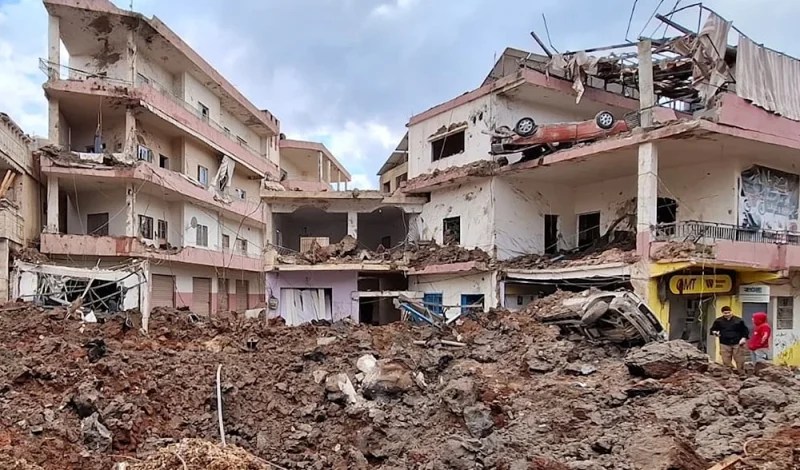
Hezbollah foiled an Israeli landing in the town of Nabi Sheet in the eastern Lebanese region of Bekaa before dawn overnight on Friday-Saturday.
Hezbollah’s Military Media said Islamic Resistance fighters observed four Israeli enemy helicopters infiltrating from the Syrian direction and landing an Israeli infantry force at the mountainous triangle linking the towns of Yahfoufa, Khraibeh, and Maaraboun.
“The enemy unit then advanced toward the eastern neighborhood of Nabi Sheet, (Al-Shukr). At 11:30 AM, upon reaching the cemetery area, the Israeli force was engaged by a group of resistance fighters using light and medium weapons, triggering a fierce clash after the infiltrating force was exposed,” the Military Media’s first statement for Saturday read.
As the confrontation intensified, the Israeli enemy unleashed heavy firepower, launching around forty airstrikes by warplanes and helicopters, to cover the withdrawal of its troops from the engagement zone, according to the statement.
Meanwhile, Hezbollah resistance artillery delivered concentrated fire with appropriate weapons on the perimeter of the battlefield and along the enemy’s withdrawal route, while residents of nearby villages joined in providing supporting fire, the first statement added.
The video shows exchange of fire between resistance fighters and Israeli enemy forces in Nabi Sheet.
In another statement, the third one on Saturday, Hezbollah’s Military Media said: “In response to the enemy’s landing in the Bekaa region, the Islamic Resistance fighters targeted the evacuation area in the outskirts of Nabi Sheet with rocket barrages at 04:15 on Saturday.”
Hebrew media reported that Israeli forces attempted to withdraw after resistance forces revealed the military activity in eastern Lebanon, and that Israeli warplanes and helicopters eventually retreated from the area after the failed airborne landing attempt.
Another video shows heavy destruction in the town of Nabi Sheet after the Israeli landing.
Lebanese Heaslth Ministry announced that the Israeli assault on Nabi Sheet led to martyrdom of 16 people and the injury of 53 others.
March 7, 2026
Posted by aletho |
Ethnic Cleansing, Racism, Zionism, Illegal Occupation, Militarism | Hezbollah, Israel, Lebanon, Zionism |
Comments Off on Hezbollah Foils Israeli Landing in Lebanon’s Bekaa
The Islamic Resistance in Iraq – Saraya Awliya al-Dam announced that its fighters carried out an attack using a swarm of drones targeting a US forces base near Erbil International Airport, a hotel in Erbil used by US forces as accommodation for their soldiers, and a vital target in Jordan.
The group said the operations came in retaliation for the assassination of Iranian Leader Sayyed Ali Khamenei, and as a deterrent against the aggression that led to the martyrdom of several young Iraqi resistance fighters.
In a separate statement, the Islamic Resistance in Iraq said its fighters carried out 27 operations on Tuesday, using dozens of drones and missiles targeting “enemy bases in Iraq and across the region.”
In a related development, the Popular Mobilization Forces (PMF) announced that US occupation forces targeted one of the headquarters belonging to the Al-Jazira Operations Command in Jurf al-Nasr, confirming that the attack did not result in any casualties or losses.
Iraq asserts stance with Iraq
In a separate development, Al Mayadeen’s correspondent in Baghdad reported that a vehicle belonging to Iraq’s Popular Mobilization Forces (PMF) was targeted on the Musayyib–Iskandariya road, north of Babil province.
The correspondent added that the Iraqi government has taken what were described as significant positions regarding the US-Israeli aggression against Iran, reflecting Baghdad’s official stance amid the escalating regional tensions.
He also noted that mourning gatherings have been held in most Iraqi cities for Sayyed Ali Khamenei, with councils of condolence organized in several provinces.
US Bases Targeted
The developments come amid a widening regional confrontation following the US-Israeli military aggression on Iran, which has triggered a series of retaliatory actions by groups aligned with the Axis of Resistance across the region.
In recent days, Iraqi resistance factions have warned that US military installations in Iraq and neighboring countries would remain legitimate targets as long as Washington continues its military operations against Iran and its allies.
The escalation has raised concerns about the growing vulnerability of US bases across West Asia, many of which host American troops as part of the so-called “anti-ISIS coalition” but have increasingly come under attack since the outbreak of the broader regional conflict.
March 4, 2026
Posted by aletho |
Illegal Occupation | Iraq, United States |
Comments Off on Iraqi Resistance reports drone attacks on US targets in Erbil
Iraqi Resistance factions have issued a firm warning to Washington, declaring that continued US military presence on Iraqi soil will not go unanswered.
In a statement released Wednesday, the Iraqi Resistance Coordination Committee, an umbrella body bringing together six anti-terror formations, said it stands ready to act if the United States refuses to end the “ongoing occupation” and persistent interference in national affairs.
The committee accused Washington of failing to respect its obligations under its agreement with Baghdad, which provides for the withdrawal of all foreign forces from Iraq. Despite repeated official declarations that the US combat mission ended years ago, Resistance groups argue that foreign troops remain entrenched under different titles.
“The US actions in Iraq ‘leave us with no choice but to assume our legal and moral responsibilities in taking positions befitting the dignity of our people and their legitimate right to end the occupation, if American forces insist on maintaining their presence and imposing their will on the country,” the statement said.
The coalition also charged that US forces continue to violate Iraqi airspace and undermine the country’s stability, describing such conduct as a “blatant violation” of national sovereignty and dignity.
Advisory mission pretext
While Washington claims that approximately 2,500 American troops remain only in an “advice and assist” capacity following the declared end of combat operations in December 2021, resistance factions view this designation as cosmetic. They argue that the continued deployment, however limited in scale, preserves military infrastructure, intelligence networks, and rapid-response capabilities that entrench US influence rather than end it.
From their perspective, the counter-ISIS mandate increasingly functions as a framework that justifies a long-term strategic foothold in a country central to regional power balances. Even a reduced presence, they contend, enables Washington to retain leverage over Iraqi decision-making while projecting influence across neighboring theaters.
Beyond the security dimension, the Resistance Coordination Committee pointed to direct American meddling in Iraq’s political process, saying that Washington effectively determines which Iraqi political figures may assume senior government positions.
Maliki pressure campaign
The reference was widely understood as relating to Nouri al-Maliki, whose potential return to the premiership has faced US opposition. Washington threatened sanctions on Iraqi individuals and institutions should Maliki take office. Recent reports indicate that the United States has given Iraq’s largest parliamentary bloc until February 27 to withdraw his candidacy, despite Maliki’s insistence that he will not step aside.
For Resistance factions, such moves are examples of direct political coercion, reinforcing their claim that Iraq’s sovereignty remains constrained more than two decades after the US-led invasion of 2003, a war launched on the now-discredited allegation that Baghdad possessed weapons of mass destruction.
February 26, 2026
Posted by aletho |
Illegal Occupation | Iraq, United States |
Comments Off on Iraqi Resistance warns of action if US forces remain
Key Analytical Points
- Israel’s pattern of ceasefire violations suggests a deliberate attempt to reshape deterrence rules in Lebanon rather than isolated tactical operations.
- Provocations aimed at Hezbollah appear designed to trigger a response that would justify a broader Israeli escalation under new “rules of engagement.”
- Hezbollah’s restraint signals long-term strategic patience rather than weakness, indicating preparation for a larger confrontation tied to regional dynamics.
- The northern front is increasingly linked to US–Iran tensions, raising the likelihood that Lebanon could become either a preemptive battlefield or a secondary theater in a wider war.
- The balance of power on the ground—particularly Hezbollah’s missile capabilities and ground forces—creates significant deterrent risk for Israel, limiting its escalation options despite mounting pressure.
Escalation under the Cover of Ceasefire
Since the beginning of Ramadan, Israel has notably ramped up its campaign of aggression against Lebanon. Although airstrikes committed throughout Lebanese territory have been routine since the implementation of the November 27, 2024, ceasefire agreement, what we are seeing now is a sign of panic amid rising tensions between Tel Aviv and Tehran.
Israel has committed the most violations of any ceasefire in recorded human history in Lebanon. At the tail end of November of 2025, UNIFIL – the United Nations peacekeeping forces – confirmed that Israel had committed upwards of 10,000 violations of the ceasefire agreement. This is no accident and confirms that the Zionist regime never had any intention of adhering to a cessation of hostilities with Hezbollah.
Instead, the Israelis sought to impose new equations on the ground, enabling total freedom of action, while also using their US allies to pressure the Lebanese state and its army to pursue a policy of undermining the group within the country.
It was never a realistic prospect that the Lebanese army was going to disarm Hezbollah; therefore, the only possible outcomes were going to be civil war or a campaign of pressure. Both favor Tel Aviv, with a civil war conflict being their preferred outcome.
Several times, the Israelis have attempted to provoke a reaction from Hezbollah, which has adhered to the ceasefire and not fired a single munition at their occupiers, who have now illegally established a military presence, intended to be permanent, in southern Lebanon.
These major provocations have included acts such as the assassination of Haytham Ali Tabatabai in southern Beirut. Tabatabai had taken over the role of Hezbollah’s top military chief following the assassination of Fouad Shukr the year prior. The Israelis have attacked the southern suburbs of the Lebanese capital, Dahiyeh, on a number of occasions, also committing civilian massacres in the south of the country up to the northern Bekaa Valley’s Baalbek.
Each of these waves of aggression was clearly designed to draw responses but failed to make Hezbollah bite. The idea was to set new rules of engagement, red lines, and establish a precedent for what constitutes aggression against Israel that would provoke a major bombardment of Lebanon.
Strategic Patience and Military Recalibration
On Hezbollah’s part, it appears that they understood what Israel was attempting to lure them into and instead refrained from responding, waiting for the opportune time to initiate a major war that would enable them to reclaim their territory and inflict what they see as sufficient acts of revenge on the Israeli enemy.
So, while Israel has been provoking Hezbollah and committing its daily acts of aggression against the civilian population in southern Lebanon in particular, Hezbollah has been working to rebuild and establish new battle plans. It has also become clear that the fall of Bashar al-Assad in Syria did not end the weapons transfers between Syria and Lebanon, something that both Israeli and US think tanks have themselves admitted.
Since the beginning of Ramadan, this campaign of incitement has only increased. On Friday, Israel launched an assassination strike, using three missiles, on the Palestinian refugee camp of Ain al-Hilweh, killing two members of Hamas and injuring a number of civilians. Then, later that same day, Israel bombed three populated buildings in the Bekaa Valley, killing 10, eight of whom were members of Hezbollah, and injuring 50 people.
The Northern Front
Israel and its Trump administration are now poised to enter a new conflict with Iran, as the largest US military buildup in the region since the illegal invasion of Iraq in 2003 continues. It has become clear that in the event a regime-change war is waged against the Islamic Republic, Hezbollah will very likely engage in a battle with the Israelis.
Nobody truly understands just how powerful Hezbollah currently is, yet it is clear from the final week of the 2024 Lebanon-Israel war that they possess ballistic missiles capable of successfully striking high-rise buildings in Tel Aviv, along with a large attack drone arsenal. However, their missile and drone power aside, Hezbollah’s biggest asset has proven to be their ground forces, which inflicted the largest number of military casualties during the war.
In other words, Hezbollah will act as Iran’s ground force in any regional war. If they can manage to breach the border into northern occupied Palestine, it will represent a major blow to the Israeli state, yet a battle in the heart of the Bekaa Valley and southern Lebanon could prove even more costly to the Israeli occupying forces.
It is because of this inevitable escalation in the north that the Israelis are displaying signs of panic and continue to target both Hezbollah members and civilians alike. There has even been a campaign of spraying cancer-causing chemical substances in the south, alongside a campaign of intimidation using their drone power, a similar strategy to what we saw in Gaza for decades.
If anything, the Israelis may even urge the United States to help them go after Hezbollah in Lebanon. There is a chance this could lead to a scenario where Lebanon is attacked prior to Iran, yet the inherent risks to this strategy could be that they then lose any element of surprise in their planned assault on Iran, especially in the event that Tehran comes to the aid of Hezbollah.
– Robert Inlakesh is a journalist, writer, and documentary filmmaker. He focuses on the Middle East, specializing in Palestine.
February 23, 2026
Posted by aletho |
Ethnic Cleansing, Racism, Zionism, Illegal Occupation, Wars for Israel | Hezbollah, Iran, Israel, Lebanon, Zionism |
Comments Off on Why Israel Is Escalating Its War Crimes Against Lebanon


 Aletho News