US troops will be targeted if they stay past September 30 deadline: Iraqi resistance group
Press TV – September 3, 2026
An Iraqi resistance group has vowed to launch strikes on the positions and military facilities of American troops in Iraq should the forces fail to honor the September 30 deadline, when the US-led coalition is scheduled to end its military mission in the country and complete the withdrawal of its soldiers.
“We are closely monitoring circumstances in the lead-up to September 30, and are prepared to wage a decisive battle against the occupation forces if they renege on their commitment to withdraw completely from the Iraqi soil and airspace,” Secretary General of the Harakat Hezbollah al-Nujaba, Sheikh Akram al-Ka’abi, said in a statement on Wednesday.
He added, “If any US soldier stays on past the September 30 deadline, they would go back in a coffin.”
Sheikh Ka’abi then addressed President Donald Trump, stressing that he cannot claim a victory in Iraq as the United States has miserably failed to achieve any of its declared objectives in the war of aggression against Iran.
Iraqi Prime Minister Ali al-Zaidi has stated that the September 30 deadline for termination of the US-led coalition’s military mission in Iraq and the full withdrawal of its forces is “fixed and final.”
He has said Iraq will declare complete restoration of sovereignty over all its territory on September 30.
Speaking at a ceremony hosted by the Sunni Endowment Office in the capital Baghdad on August 24 to commemorate the birthday anniversary of Prophet Muhammad (peace be upon him), Zaidi said the date will mark a major step in Iraq’s efforts to consolidate state authority and national sovereignty.
“On September 30, the Iraqi nation will announce the completion of its sovereignty over all sacred Iraqi land.”
In 2024, Washington and Baghdad came to a consensus to conclude the US-led operations against the Takfiri Daesh terrorist group.
US forces withdrew from most bases across Iraq last year; however, they continued to have a presence in the semi-autonomous Kurdish region.
Iraq committed to full US withdrawal deadline – media
RT | August 30, 2026
Iraq is committed to a full withdrawal of US-led coalition forces by the end of September, UK-based Saudi daily Asharq Al-Awsat reported on Saturday, citing an Iraqi official.
US forces have been in the country for 23 years since the 2003 invasion and subsequent smaller-scale operations against Islamic State (IS, formerly ISIS).
Reports that US and other foreign troops could remain after September “contradict what was agreed upon between the previous Iraqi government and the US administration,” Asharq Al-Awsat cited the official as saying.
The comments followed media reports suggesting that Washington was only planning a drawdown, rather than a full withdraw by the end of the September deadline.
“This is a transition of the Coalition’s military mission to a more traditional bilateral security partnership,” Iraqi news outlet Shafaq News reported, citing an anonymous US official.
Earlier this month, Iraqi Prime Minister Ali al-Zaidi’s office stated that the September 30 deadline would be “the fixed and final date” for the pullout of international coalition forces.
US President Donald Trump has previously backed reducing the US military presence in Iraq, reaffirming a withdrawal plan originally agreed in 2024 under the Biden administration. During a meeting with al-Zaidi this summer, Trump said the two countries were developing a relationship “where we don’t need the military” in Iraq.
Washington’s presence in the region has taken a significant hit during the Iran war, as Tehran has damaged or outright destroyed key US radar, communications, and other military infrastructure at bases in Gulf nations.
During the conflict, US military infrastructure in the region also faced attacks by pro-Iranian armed groups in Iraq operating outside Baghdad’s direct control.
The Pentagon is now considering whether to reduce the US military footprint in the Gulf after the Iran war ends, The Washington Post reported earlier in August, citing anonymous officials.
US allies in the Gulf have also reportedly expressed frustration over what they see as a lack of proper consultation before the US-Israeli attack on Iran, which led to bases on their territories being targeted. Regional powers have since moved to diversify their security partnerships, with Saudi Arabia, Türkiye, and Pakistan signing the Mecca Joint Defense Agreement, already dubbed by commentators an ‘Islamic NATO,’ early this month.
Diplomatic Scandal: Why Did the U.S. Recall Its Ambassador to Turkey?
By Alexandr Svaranc – New Eastern Outlook – August 28, 2026
The U.S. State Department has abruptly recalled its ambassador to Turkey, Tom Barrack, who also served as the President’s Special Envoy for Syria and Iraq. This sharp personnel pivot has raised numerous questions: was this decision a consequence of pressure from the Israeli lobby?
An Unconventional Diplomat
The appointment of Tom Barrack as ambassador to Turkey on May 14, 2025, was an atypical move, even by the standards of Donald Trump’s personnel policy. Barrack is not a career diplomat, but a major real estate investor. As a close associate of Trump and a key fundraiser for his campaign, he secured the post largely due to his personal loyalty to the President.
It was assumed that his proximity to the head of the White House would serve as a “safe conduct” for Barrack in the complex Middle East region. However, it turned out that Trump’s own political unpredictability does not extend to his inner circle: in Washington, the right to be eccentric remains a privilege of the President, not his appointees.
Reason for Resignation: The “Golan Question”
Journalist Laura Loomer was the first to report the ambassador’s recall on August 25. According to her information, the reason was Barrack’s imprudent remarks, which directly contradicted the official course of the U.S. administration. In an interview, the diplomat referred to the Golan Heights as “occupied Syrian territory” and criticized Israel for its “illegal settlement activity.”
These words sounded like a political démarche, especially since Donald Trump had officially recognized Israeli sovereignty over the Golan back in 2019, during his first term.
Lobby Influence and Political Consequences
Barrack’s position triggered an immediate reaction not only in the White House but also among influential Republicans. Speaker of the House Mike Johnson and Senator Rick Scott, whose positions are closely tied to the interests of the pro-Israel lobby in the U.S., made it clear that such statements were unacceptable.
Barrack’s attempts to justify himself—claiming his words were “taken out of context” and that he was merely discussing the historical aspect of the issue—had no effect. It became clear that clouds were gathering over the ambassador: his views on Middle East policy had diverged from the vector dictated by Washington’s strategic allies. Ultimately, the career of the “real estate diplomat” was sacrificed to interests that carry far more weight in American politics than personal friendship with the president.
In Tel Aviv and Washington, dissatisfaction is mounting over the stance of U.S. Ambassador to Turkey Tom Barrack following recent IDF airstrikes on the Abu al-Duhur airbase in Syria. Initially, Barrack labeled Israel’s actions an “unnecessary escalation” on X (formerly Twitter), and later, in an interview, accused Jerusalem of attempting to provoke a conflict with Turkey on the eve of the U.S. midterm elections. According to the diplomat, only Recep Erdoğan’s restraint prevented a full-scale war.
Benjamin Netanyahu’s government viewed these remarks as support for Ankara’s ambitions. The State Department, for its part, acknowledged that Barrack’s statements only deepened Israel’s perception that the U.S. is distancing itself from countering the Turkish threat. Further irritation was caused by the ambassador’s comments regarding negotiations with Lebanon on the disarmament of Hezbollah, which involved Iranian representatives.
Such coordinated criticism of Barrack is the result of efforts by the Israeli Foreign Ministry and intelligence services, leveraging the influence of the Jewish lobby in the U.S. These methods are not new: in his book By Way of Deception, former Mossad officer Victor Ostrovsky described how, in 1979, Israeli intelligence orchestrated the resignation of U.S. Ambassador to the UN Andrew Young due to his contacts with the PLO. At that time, with the sanction of Menachem Begin, a leak was arranged through Newsweek magazine. It is evident that for Mossad chief Roman Hoffman, removing the “inconvenient” diplomat Barrack was a matter of routine.
Consequences of the Ambassador’s Recall: A Shift in U.S.-Turkish Relations
The appointment of businessman Thomas Barrack as U.S. Ambassador to Turkey initially sparked skepticism within the State Department. A barrage of criticism from the political establishment and the expert community, culminating in the emergency recall of the diplomat “for consultations,” effectively sealed his resignation. Currently, the duties of the head of the diplomatic mission in Ankara are being temporarily performed by the U.S. Chargé d’Affaires.
The name of Barrack’s successor has not yet been announced, but experts believe that Marco Rubio will opt for a career diplomat to lower the political temperature surrounding the position. It is expected that the new ambassador will adhere to a firm pro-NATO and pro-Israel line, seeking to balance U.S.-Turkish relations while accounting for Israel’s interests.
Implementing such an agenda amid the acute crisis between Ankara and Tel Aviv appears extremely difficult. Washington will likely resort to harsh pressure on President Recep Tayyip Erdoğan, despite his previous personal ties to Donald Trump.
For the Turkish leader, Barrak’s recall was a painful blow. Ankara saw the businessman as “its man” in the Trump administration, whose commercial background allowed for a flexible and pragmatic dialogue. Erdoğan had counted on Barrak’s support in establishing a safe zone in Syria. Now, Turkey is deprived of the unofficial US “umbrella” that protected it from Israeli airstrikes near its borders, and the prospects for modernizing the Turkish army and strengthening Ankara’s military with Washington’s support are becoming extremely uncertain.
The situation clearly demonstrates the risks of relying excessively on fickle American policy. Ankara should reconsider its diplomatic priorities. Playing a game of “giving in” to American “hawks”—for example, on the issue of arms supplies to the Kyiv regime—is fraught with serious consequences for relations with Russia. Such a course threatens Turkey not only with a weakening of its defense potential but also with significant economic losses. Specifically, the question arises: Who will compensate Ankara for the loss of Iran’s $7 billion gas market if the US imposes new anti-Iran sanctions? Given the West’s inconsistency, Turkey is unlikely to escalate relations with its northern neighbor for the sake of dubious foreign policy adventures.
Alexander SVARANTS, Doctor of Political Science, Professor, Turkologist, and expert on Middle Eastern countries
‘Israel’ forcibly evicts UNRWA center in occupied al-Quds
Al Mayadeen| August 26, 2026
Israeli forces began forcibly evicting the United Nations agency for Palestinian refugees, UNRWA, from its vocational training center in occupied al-Quds on Tuesday, escalating “Israel’s” campaign against the agency and its services for Palestinian refugees.
The Qalandia Training Centre, located between the Kafr Aqab neighborhood in occupied al-Quds and the Qalandia refugee camp, was established in 1952 and provides vocational training to around 340 Palestinians from the occupied West Bank each year, according to UNRWA.
The operation followed repeated warnings from the agency that Israeli authorities were preparing to target the facility.
Israeli forces enter UNRWA center in occupied al-Quds
UNRWA said Israeli forces “forcibly entered” the training center at around 10 am local time, with at least four armored vehicles and more than 50 Israeli occupation personnel entering the compound.
Around 20 UNRWA staff members were present at the facility at the time.
An AFP journalist at the scene reported that Israeli occupation forces closed the main road near the center’s entrance while forces inside moved between its buildings.
A convoy of three civilian vehicles was later seen leaving the facility under Israeli military escort.
Israeli Prime Minister Benjamin Netanyahu’s office said the evacuation had begun under his directive and following legislation targeting UNRWA.
UNRWA condemns forced entry
UNRWA condemned the Israeli operation, stressing that armed forces had entered a United Nations facility without authorization.
“UNRWA unequivocally condemns this unauthorised and deeply concerning incursion,” the agency said.
It added that the “entry of armed occupation forces into a United Nations facility, without the authorisation or consent of the United Nations, is unacceptable.”
The operation directly affects a facility that has provided vocational training to Palestinians for more than seven decades.
Israeli far-right Police Minister Itamar Ben Gvir celebrated the operation, saying Israeli forces were implementing legislation to remove UNRWA from the site.
He later published an image of an Israeli flag above the entrance to the training center alongside the caption, “UNRWA in our hands.”
‘Israel’ escalates campaign against UNRWA
“Israel” has repeatedly accused UNRWA of providing cover for Hamas and alleged that its personnel carried out resistance operations alongside Hamas fighters.
Legislation severing Israeli ties with UNRWA and banning the agency from operating in Israeli territory took effect in January 2025.
However, investigations into the allegations have not substantiated “Israel’s” broader claims as presented by its officials.
A review led by former French Foreign Minister Catherine Colonna identified “neutrality-related issues” at UNRWA but said “Israel” had not provided conclusive evidence for its central allegations.
Beware of Yoram Hazony’s Attempts to Subvert Nationalism
Kosher nationalist movements are merely stalking horses for Zionist geopolitical endeavors
José Niño Unfiltered | August 22, 2026
As the historic American population begins to awaken to its own dispossession, the establishment has deployed a new strategy of promoting “kosher nationalism.” By co-opting the language of sovereignty and tradition, these figures infiltrate the populist ranks to ensure that dissent remains impotent, performative, and above all else, harmless to the interests of the Jewish networks that have long dictated the terms of our political discourse since the end of World War II.
The most devious operator in this theater of managed opposition is Yoram Hazony, a man who has masterfully curated the boundaries of acceptable nationalism by purging anyone who dares to prioritize the actual survival of the American people over his own ethnic interests. Sitting across from Tucker Carlson in January 2026, Peter Brimelow—the British-born founder of VDARE, the immigration restriction website that New York State authorities forced into closure in 2024 through a prolonged legal campaign—recounted how Hazony had barred him from the National Conservatism conference. “He disinvited us from his National Conservative Conference because he was trying to gatekeep,” Brimelow told Carlson, adding that the two men then traded “a series of bitter exchanges in VDARE.com.”
The original 2019 exclusion was not an isolated act. When the first NatCon conference was held in Washington in July 2019, BuzzFeed News reported that Brimelow, American Renaissance founder Jared Taylor, and Identity Evropa leader Patrick Casey had all applied and been rejected, with Hazony addressing White nationalism directly in his opening remarks. Brimelow and Hazony subsequently exchanged pointed public criticism, with Brimelow characterizing the NatCon operation as an “extreme Zionist Gatekeepers Ball.”
John Derbyshire made a similar point back in 2019, identifying Hazony as the “sparring partner” of VDARE editor Peter Brimelow, a label that stuck because the friction between the two camps was never really about tone or manners. It was ultimately about substance. Brimelow’s entire project has centered on restricting immigration and restoring America’s White demographic core, a position that a genuine nationalist movement would be expected to enthusiastically champion. Hazony rejected him anyway, and that rejection is the thread that unravels the whole National Conservatism project once you pull on it.
To understand how a movement ostensibly built on the premise of “National Conservatism” became a vehicle for such systematic exclusion, one must look past the slogans and examine the architect of the project, whose entire career has been a singular exercise in advancing Zionist interests under the guise of American political theory.
Yoram Hazony was born in Rehovot in 1964 and raised in Princeton after his father, a former Princeton engineering professor, brought the family to New Jersey. He earned a BA in East Asian studies from Princeton in 1986 and a PhD in political theory from Rutgers, co-founding the conservative magazine The Princeton Tory as an undergraduate in 1984. By his own account, he was left “mesmerized” by an encounter as a Princeton undergraduate with Rabbi Meir Kahane—the Jewish supremacist advocate whose party, Kach, was later banned from Israeli elections for promoting racism against Arabs. After completing his doctorate, rather than pursue an academic career, Hazony joined the editorial staff of The Jerusalem Post and wrote speeches for the rising political star Benjamin Netanyahu.
He then co-founded the Shalem Center in Jerusalem in 1994 with funding from Ronald Lauder and Sheldon Adelson, where he served as president and then provost until 2012. He subsequently founded the Herzl Institute in Jerusalem, dedicated explicitly to Jewish political thought and Zionist theory, and in 2019 he teamed with David Brog—the former executive director of Christians United for Israel—to launch the Edmund Burke Foundation, which now runs the National Conservatism Conference.
He describes himself as “a Jewish nationalist, a Zionist, all my life.” Observers at Jewish Currents have documented how Hazony helped pioneer an alliance between the Israeli settler movement, the Kahanist camp, and Netanyahu’s Likud party, while championing Israel’s 2018 Nation State Law, which declared Jewish national self-determination as belonging exclusively to Jews within Israel. Every institution he has built traces back to this same Zionist core, which means the American movement he exports is never quite separable from the Jewish interests he was raised to defend.
That biography matters because Hazony has spent a decade dressing a Zionist project in the language of American populism. His book “The Virtue of Nationalism” argues for a world of independent nation states instead of supranational bodies like the European Union or the United Nations. This perhaps stems from a deep-seated Jewish apprehension that institutions such as the EU or the UN could crystallize into centralized, antagonistic entities capable of constraining Jewish geopolitical projects. Consequently, Hazony and his peers advocate for a world of atomized nation-states, viewing a landscape of quarreling, enfeebled powers as the optimal safeguard for their interests. By prioritizing a fractured international system, they ensure a climate of instability that favors the established Jewish influence networks, which have long mastered the technique of dividing populations—big and small—to consolidate their own power.
In a similar token, Hazony’s Conservatism: A Rediscovery provides an interesting nationalist dimension to his political agenda. In the book, he portrayed political loyalty as something inherited through family, tribe, and nation rather than chosen through liberal consent, and warned repeatedly against the “consuming fire of cultural revolution” that erodes marriage, borders, and religious tradition. On paper, this reads like a full-throated endorsement of the populism that figures like Pat Buchanan have argued for since the 1990s.
However, this nationalist rhetoric undergoes a convenient transformation when applied to the Jewish state, where the nuanced defense of sovereignty is swiftly supplanted by a rigid, unrelenting hawkishness against the enemies of the Jewish state. In sum, Hazony’s theoretical framework proves to be little more than a vehicle for his true objective: the tireless advancement of Israeli interests under the guise of Western nationalist arguments.
When Israel struck Iran’s nuclear facilities in June 2025, Hazony appeared on UnHerd alongside John Mearsheimer in a filmed debate hosted by Freddie Sayers. Hazony passionately defended Israel’s imperative to block Iran’s nuclear program as essential for national survival while debating the benefits and risks of U.S. involvement. He acknowledged the growing split among his own allies on the nationalist right, noting that “the nationalist conservatives have always had internal disagreements on issues like appropriate foreign policy” and specifically addressed the divergence with Tucker Carlson and Steve Bannon, who were “absolutely dead against the US getting involved in this at all.”
Hazony’s counter-argument was that U.S. support for Israel as a regional security partner ultimately served American interests, allowing the United States to focus on vital concerns elsewhere. Mearsheimer argued the opposite, noting that Israel lacked the capability to permanently eliminate Iran’s nuclear program and that U.S. involvement would be catastrophic and would strengthen Russia and China’s geopolitical positions.
On February 28, 2026, when the United States and Israel launched Operation Epic Fury, Hazony was among the intellectual voices who had spent months publicly building the case for exactly this kind of operation. In addition to arguing on UnHerd that Israel had to eliminate Iran’s nuclear capacity with or without U.S. support, Hazony defended the June 2025 Midnight Hammer strikes in The Free Press.
The fundamental problem in Hazony’s nationalist program lies in its practical application, which serves primarily to curate and sanitize the parameters of acceptable discourse. Rather than welcoming authentic solutions to the existential crises facing the West, Hazony and his lieutenants act as gatekeepers, systematically deplatforming gentile voices who prioritize the preservation of their own cultural and ancestral identity. In both rhetoric and practice, he remains fundamentally hostile to any ethnonationalist framework that elevates the bonds of blood and soil as the bedrock of political life. More importantly, the result of these political programs mainly consist of wars for Israel and other pro-Jewish ventures, while nationalists receive virtually nothing in return—for example, long-lasting immigration restriction. Keep in mind, this is a feature not a bug of this type of Faustian pact.
Nationalists must recognize that Yoram Hazony’s project is another containment strategy designed to undermine genuine nationalist movements in the West. It invites you to the table only to ensure that the menu never includes the actual preservation of the European state-building people of the United States. If we are to survive as a civilization, we must reject these managed movements and build an authentic nationalism that prioritizes our own sovereign survival over the pseudo-nationalist movements whose real agenda is the advancement of the organized Jewish community’s geopolitical interests.
US-led Board of Peace considers ‘wholesale’ Hamas disarmament deal to satisfy Israel: Report
The Cradle | August 18, 2026
US President Donald Trump’s so-called Board of Peace is “weighing” a “new” Hamas disarmament proposal after Tel Aviv rejected Washington’s latest one, sources told the Times of Israel on 18 August.
“The Board of Peace is considering abandoning its phased framework for Hamas’s disarmament” due to the “Israeli pushback,” an informed source told the Israeli outlet.
“Instead of having Hamas hand over its weapons in phases, with Israel conducting corresponding withdrawals … another option being weighed by the Board of Peace would see Hamas hand over all weapons throughout Gaza, and only then would Israel have to pull back its troops to the Gaza border,” the report went on to say.
The new proposal being reported on is, essentially, what Israel has been demanding – a full surrender by the resistance prior to any discussion on withdrawal of occupation forces.
“The shift could be enough to get Israel on board, it risks losing the support of Hamas,” the Times of Israel wrote.
An Israeli official claimed to the outlet that there remains a dispute between Tel Aviv and Washington over the initial disarmament plan.
The source says the US has not yet dropped the original plan but is considering a “wholesale approach” to appease Israel.
“In this different approach, the entire area currently under Hamas’s control would be decommissioned of weapons all at once, rather than sector by sector.”
The report follows a Monday meeting between Trump’s son-in-law and top aide Jared Kushner and Israeli Prime Minister Benjamin Netanyahu. Board of Peace director Nickolay Mladenov was also present.
Another Hebrew report released by Israel’s Channel 12 said Kushner reportedly opposes Netanyahu on his plans to continue strikes and assassinations in Gaza.
“There was no agreement between Netanyahu and Kushner on the continuation of the assassination operations,” a source told Channel 12. “Netanyahu made clear that he will continue the assassinations, while Kushner expressed his opposition to them.”
Kushner had also met with Hamas officials in Egypt prior to his meeting with Netanyahu on Monday. The new reports coincide with continued Israeli attacks across Gaza.
Hamas said when Washington announced the new “disarmament deal” that it would hand over its weapons to the US-endorsed Palestinian committee of technocrats tasked with governing Gaza – but “only” if Israel adheres to its commitments. Israel continues to bar this committee from entering the strip.
Tel Aviv has openly refused the new deal – which Trump referred to as “historic” – claiming both Hamas and Israel were on board.
Hamas insists that any full disarmament depends on the establishment of an independent Palestinian state. According to several reports, intensive talks on the wording of the new disarmament deal took place between Hamas officials and mediators.
The reports say the weapons will be “stored” but not handed over to Israel or destroyed.
Israel has not stopped attacks, violations, and genocide since the 2025 US plan was launched. It has also illegally occupied 70 percent of the strip.
Since the start of Trump’s so-called peace plan, over 1,200 Palestinians have been killed and more than 4,000 wounded by Israel in Gaza.
Thousands of buildings have been demolished via detonation.
Iraqi Kata’ib Hezbollah sets conditions to place weapons under state control
Press TV – August 18, 2026
The Iraqi Kata’ib Hezbollah resistance group has set conditions for any understanding with the Baghdad government to place all its weapons under state control, including a full withdrawal of US military forces from the country.
The group’s security chief, Abu Mujahid al-Assaf, announced in a statement on Monday that the first condition to integrate into the state’s armed forces is for US forces to completely withdraw from Iraqi soil and airspace, offer cast-iron guarantees that they would not come back, and ensure that Iraqi political and economic apparatuses will make decisions free from American sway.
The second condition, he added, is the withdrawal of Turkish forces from areas in the semi-autonomous Kurdistan Region in northern Iraq, while the third one is the dissolution of the Peshmerga, which serves as the official armed forces of the Kurdistan Regional Government (KRG).
Assaf went on to criticize Prime Minister Ali al-Zaidi, saying that Iraqi anti-terror resistance groups had waited “more than a hundred days” for him to address the internal, regional, and international pressures over the issue of restricting weapons to the state, as a September 30 deadline approaches.
He asserted that Zaidi is disregarding advice from allied political factions, and is instead taking heed of demands being made by certain parties and the US Ambassador to Turkey and Special Presidential Envoy for Syria and Iraq, Tom Barrack.
The remarks came on the same day that Iraq’s four top state authorities renewed calls for the implementation of the Iraqi government’s plan to disarm the armed groups and bring weapons under state control.
In a statement following a Monday meeting in Baghdad between President Nizar Amedi, the prime minister, Parliament Speaker Haibat al-Halbousi and President of the Supreme Judicial Council Faiq Zaidan, the officials stressed the importance of strengthening and developing the capabilities of Iraq’s armed forces “across all spectra” and protecting the country and its citizens.
Successive administrations in Iraq have vowed to bolster state power and to bring all weaponry under the jurisdiction of recognized institutions.
On June 3, Sabah al-Numan, the spokesperson for the commander-in-chief of the armed forces, declared the establishment of a committee aimed at restricting weapons to state control, affirming that the committee had commenced its operations.
While several Iraqi resistance groups, such as Saraya al-Salam, Asa’ib Ahl al-Haq and Kata’ib al-Imam Ali, have agreed to integrate into the state’s armed forces, Kata’ib Hezbollah has pledged to retain “resistance weapons” and further develop its arsenal.
British taxpayers unknowingly subsidize therapy for Israeli soldiers: Report
The Cradle | August 14, 2026
UK taxpayers are unknowingly subsidizing “therapeutic healing” and psychological treatment of Israeli soldiers who served in Gaza, Declassified UK reported on 13 August.
The investigation revealed that an undisclosed sum reached the Yahalom Foundation, an Israeli veterans group serving the Israeli military engineering unit, through a British charity, with the government adding a further 25 percent under the Gift Aid scheme.
That additional quarter comes from the British government, which administers Gift Aid through His Majesty’s Revenue and Customs (HMRC).
Barred as a foreign organization from claiming Gift Aid itself, the foundation instructs its British supporters to send money instead through UK Toremet, a charity registered in Britain.
Emails written by its head of fundraising call Toremet a “registered partner platform” that handles donations on the foundation’s behalf, telling donors that giving this way secures “full tax recognition and enabled Gift Aid.”
The projects put to British donors include a £5,000 (around $6,746) “therapeutic healing journey” for soldiers coming out of Gaza, individual psychological treatments, and a £100,000 (around $134,909) hall commemorating dead Israeli soldiers.
Records from two years earlier show British money also flowed toward equipment for troops still in service, with one fundraising page telling donors their help would buy more specialized kit to supply to the soldiers. Whether Gift Aid was added to those donations is unclear.
The Charity Commission has previously warned that raising funds for a soldier of a foreign military is neither lawful nor acceptable for a charity.
The disclosures deepen the scrutiny already surrounding UK Toremet, which since 2016 has been the subject of three regulatory compliance cases brought by the Charity Commission over its work in occupied Palestine.
The regulator has since opened an inquiry into eight British charities operating in illegal Israeli settlements.
UK-registered charities are promoting programs that send young British Jews into illegal settlements in occupied Palestine and put them through Israeli army training, according to an investigation by Middle East Eye (MEE) published in July.
The United Jewish Israel Appeal (UJIA), whose stated aim is to inspire young Jews to build a relationship with Israel, routes participants into Marva, an army-run course in which they spend weeks living on a military base and undergoing basic training. Bnei Akiva, meanwhile, houses its gap-year students in a West Bank settlement and drills them for military service.
The International Centre of Justice for Palestinians (ICJP) told MEE that the activities breach international law, describing Marva as closer to “pre-enlistment military training” than cultural exchange.
The pattern is not new, with The Guardian reporting in July last year that the Kasner Charitable Trust had moved £5.7 million (around $7.69 million) to a religious school inside the illegal settlement of Susya near Hebron through the conduit charity UK Toremet, in donations made between 2017 and 2021.
The Charity Commission told the outlet that operating in the occupied Palestinian territories is not in itself a criminal offense or a breach of charity law.
When the coloniser calls resistance terrorism
By Sayid Marcos Tenorio | MEMO | August 8, 2026
Throughout history, almost every national liberation struggle has been labelled “terrorism” by the powers exercising colonial rule or foreign occupation. This strategy is nothing new.
The British Empire branded IRA fighters in Ireland and EOKA guerrillas in Cyprus as terrorists. France portrayed Algeria’s National Liberation Front (FLN) as a criminal organisation. The same happened to the Mozambique Liberation Front (FRELIMO), the People’s Movement for the Liberation of Angola (MPLA), the South West Africa People’s Organisation (SWAPO) in Namibia, and even Nelson Mandela’s African National Congress (ANC).
History, however, vindicated these movements and condemned the colonial regimes that sought to perpetuate their domination.
This pattern reveals a constant: those who occupy a territory seek to strip the occupied people of any legitimacy to resist.
The dehumanisation of resistance is a colonial strategy. By labelling every resistance fighter a “terrorist”, attention is shifted away from illegal occupation, apartheid and the denial of self-determination, and redirected towards the reaction of the occupied people.
This narrative, however, encounters clear limits within international law itself.
From the United Nations Charter to Resolution 1514 (XV) on decolonisation and Resolution 2625 (XXV), which reaffirms the principle of peoples’ self-determination, the understanding has been consolidated that peoples subjected to colonial domination, foreign occupation or racist regimes have the right to struggle for their liberation.
Several subsequent resolutions of the United Nations General Assembly recognised the legitimacy of national liberation movements and acknowledged that such resistance may take the form of armed struggle, provided that it remains subject to the rules of international humanitarian law.
This is precisely why the international community has never automatically equated national liberation movements with terrorist organisations.
International humanitarian law regulates the manner in which armed conflicts must be conducted and imposes obligations on all belligerents, including resistance movements.
However, it does not eliminate the political and legal right of a people to resist occupation. Confusing these two dimensions serves only the interests of occupying powers, because it transforms a conflict of a political and legal nature into a mere policing matter.
The history of the so-called “State of Israel” itself exposes this contradiction.
Before 1948, Irgun and Lehi were regarded as terrorist organisations by the British government because of attacks such as the bombing of the King David Hotel and the assassination of UN mediator Folke Bernadotte.
Years later, their leaders reached the highest levels of government, and Menachem Begin received the Nobel Peace Prize. This demonstrates that the label “terrorist” often reflects political circumstances more than any permanent legal definition.
In the contemporary context, this debate remains highly relevant. Palestine continues to be recognised by the United Nations as a territory under occupation, while Western Sahara remains on the UN list of Non-Self-Governing Territories, awaiting the fulfilment of its people’s right to self-determination.
In this context, the Islamic Resistance Movement (Hamas), which emerged during the First Intifada, and the Polisario Front, recognised by the United Nations as the representative of the Sahrawi people in the Western Sahara peace process, belong to the historical tradition of national liberation movements.
As with South Africa’s ANC, Algeria’s FLN, Namibia’s SWAPO, Mozambique’s FRELIMO and many other movements, both base their struggle on their peoples’ claim to the right of self-determination in the face of occupation or foreign domination.
This does not mean that every military action carried out by resistance organisations is automatically legitimate under international law.
The rules of international humanitarian law apply to all parties to a conflict and prohibit deliberate attacks against civilians, regardless of the cause being defended.
However, possible violations of these rules do not, in themselves, invalidate the legal legitimacy of the struggle for self-determination, nor do they automatically transform a national liberation movement into a terrorist organisation under international law. These are distinct questions, frequently conflated for political convenience.
There is no colonialism without resistance. There never has been.
The French Resistance against Nazi occupation, Vietnamese guerrillas, Algerian fighters, South Africans who confronted apartheid, African liberation movements, the Polisario Front and the Palestinian resistance all demonstrate that no people will indefinitely accept the loss of their land, sovereignty and dignity.
The real question, therefore, is not why resistance exists.
The question the world should be asking is why military occupations, colonial processes and regimes that deny entire peoples the right to determine their own destiny continue to exist.
As long as there is colonisation, apartheid, illegal annexation and denial of self-determination, there will be armed resistance movements.
And international law, despite political pressure and attempts to criminalise liberation movements, continues to uphold the fundamental principle that the freedom of peoples is not an act of terrorism, but a fundamental right of humanity.
Israel orders uprooting of trees on 316 dunums in West Bank for settlement expansion
MEMO | August 7, 2026
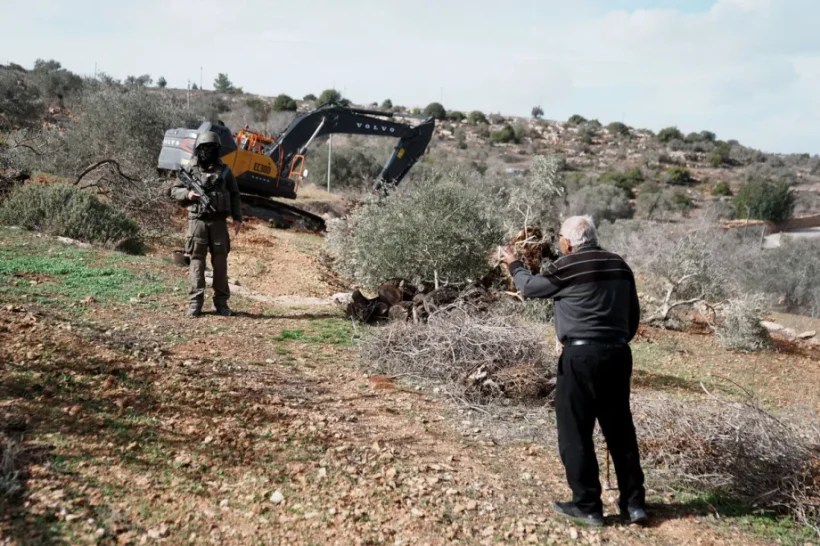
The Israeli military has issued eight orders to uproot trees and remove vegetation from 316 dunums of land across the occupied West Bank for settlement-related purposes, the Colonisation and Wall Resistance Commission (CWRC) said on Thursday.
A dunum is equivalent to 1,000 square metres.
In a statement issued on Thursday evening, the Palestinian government body said the orders require the removal of wild vegetation and olive trees from land identified in attached maps.
The eight orders cover a total of 316.636 dunums. Six of them target about 311 dunums in the northern governorate of Jenin, while the remaining two apply to the Nablus governorate and occupied East Jerusalem.
The commission said the vegetation clearance does not target isolated farmland but areas alongside main roads, expanding Israeli control on both sides of the roads and causing direct damage to olive trees and neighbouring agricultural land.
It warned that the Israeli authorities are using the orders to facilitate the establishment of settlements, saying the measures are intended to prepare the land for settlement infrastructure while restricting landowners’ access to and use of their property.
According to the commission, Israel has issued 59 orders since the beginning of 2026 to remove tree cover from 2,480 dunums of Palestinian-owned land. It added that around 60,000 dunums of Palestinian land have been seized during the 1,000 days of the Gaza war, which began on 8th October 2023.
Palestinians warn that such measures are paving the way for Israel to formally annex the occupied West Bank, which they say would undermine the possibility of establishing a Palestinian state as envisaged in relevant United Nations resolutions.
Rome talks fail as Israeli artillery rains death on Lebanon
Press TV – August 7, 2026
The seventh round of US-brokered negotiations between Lebanon and Israel have concluded in Rome without any breakthrough, marked by Israeli forces unleashing their most intense artillery barrage on southern Lebanon since the signing of a controversial framework agreement in June.
As diplomats met at the US Embassy in Rome, Israeli artillery and warplanes pounded Lebanese villages with increasing ferocity.
The United Nations Interim Force in Lebanon (UNIFIL) recorded 120 projectiles fired by Israeli forces between midnight and 4 p.m. on Thursday alone—surpassing the previous day’s total of 113 and marking the highest single-day figure observed since June 21.
UNIFIL described the escalation as the “sharpest” surge in Israeli military aggression since the announcement of the US-mediated trilateral framework in late June.
Crucially, UNIFIL reported that it did not detect any projectile launches by Hezbollah during the period, underscoring the one-sided nature of the ongoing Israeli violence.
The framework agreement signed in Washington on June 26, which the talks in Rome were ostensibly meant to implement, has been condemned by broad swathes of Lebanon’s political class as a national catastrophe that compromises Lebanese sovereignty while extracting no binding commitments from Israel.
Critics point to the agreement’s fundamental imbalance: Lebanon is required to deploy its army to “pilot zones,” dismantle resistance infrastructure, and verify disarmament—all before Israeli forces begin their gradual redeployment.
No binding timetable exists for Israel’s withdrawal from occupied Lebanese territory.
Israeli prime minister Benjamin Netanyahu has publicly presented the agreement as an achievement for Israel, a framing that has intensified the backlash in Beirut and reinforced the view that Lebanon has made outrageous concessions without securing even an immediate ceasefire.
Lebanon’s prominent Mufti, Ahmad Qabalan, declared the agreement the “worst national catastrophe” in Lebanon’s history, asserting that it effectively grants the Israeli military a form of guardianship over the Lebanese army and implicitly recognizes Israeli sovereignty over occupied areas.
Hezbollah Secretary-General Naim Qassem has described it as “a humiliation, a disgrace and a surrender of sovereignty”.
Even the Free Patriotic Movement, one of the largest Christian parties and not traditionally aligned with Hezbollah, has warned against “surrendering to Israeli demands”.
The Rome negotiations, held over three days including two days of intensive meetings at the US Embassy, failed to produce any tangible progress.
Sources close to the negotiations said the sessions, the seventh round overall, were divided into three tracks—military, political, and legal-border—but yielded no clear results.
While negotiators talked, Israeli forces intensified their assault on southern Lebanon with devastating effect.
On Wednesday alone, Israeli forces fired 113 projectiles into southern Lebanon, with 77 of them striking the town of al-Mansuri and surrounding areas. On Thursday, the bombardment increased to 120 projectiles in just 16 hours.
The Israeli military issued urgent evacuation warnings to residents of al-Mansuri, forcing families to flee their homes.
Two Israeli soldiers were killed and several injured in an explosion in the al-Mansuri area on Wednesday, reportedly after forces entered a facility ahead of a planned demolition.
UNIFIL confirmed it did not directly observe the explosion but noted the subsequent Israeli evacuation order.
The Lebanese Ministry of Health reported that eight civilians were injured in Israeli airstrikes on the town of Burj al-Shamali near Tyre on Thursday.
Israeli warplanes also flew at low altitude over the southern suburbs of Beirut, the Bekaa Valley, and the northern region of Akkar, with drones maintaining continuous flights over the capital.
Since March 2, when Israel escalated its military aggressions in Lebanon, the attacks have killed 4,333 people, injured 12,250 others, and displaced more than 1 million Lebanese citizens, according to Lebanese Health Ministry figures.
Israel’s negotiating position, as reported by sources familiar with the humiliating talks, is to preserve its military’s freedom of action as long as Hezbollah “continues to pose a threat”—a determination Israel makes unilaterally.
Israel has refused to agree to any operational restrictions until Lebanon fully implements its commitments under the framework agreement.
This position effectively grants Israel a perpetual veto over Lebanese sovereignty, with the Israeli military retaining the right to strike Lebanese territory at will, even as Lebanese forces are expected to disarm and dismantle Hezbollah’s infrastructure.
The Lebanese government, led by Prime Minister Nawaf Salam, has defended the negotiations as an assertion of independence. But critics argue that in practice, the agreement has only deepened Lebanon’s subjugation to Washington’s agenda while providing Israel with diplomatic cover for continued aggression.
The next round of talks is tentatively scheduled for September 1.
Featured Video
Iran’s Next Strike May Not Explode. It Could Shut You Down
or go to
Aletho News Archives – Video-Images
From the Archive
Zionism’s Violent Legacy
By Donald Neff | Washington Report On Middle East Affairs | January 1996
On January 4, 1948, Jewish terrorists drove a truck loaded with explosives into the center of the all Arab city of Jaffa and detonated it, killing 26 and wounding around 100 Palestinian men, women and children.[1] The attack was the work of the Irgun Zvai Leumi – the “National Military Organization,” also known by the Hebrew letters Etzel – the largest Jewish terrorist group in Palestine. The Irgun was headed by Revisionist Zionist Menachem Begin and had been killing and maiming Arabs, Britons and even Jews for the previous ten years in its efforts to establish a Jewish state.
This terror campaign meant that at the core of Revisionist Zionism there existed a philosophical embrace of violence. … continue
Blog Roll
 Aletho News
- Trump’s Iran war is on an Israeli leash
- Saudi oil boss issues global supply warning
- Riyadh Says Its Oil System Is Intact. The Numbers Say Otherwise.
- Trump and Netanyahu Want to “Finish the Job” on Iran
- US ‘one-sided dictation’ not Iran’s beliefs makes rational talks impossible: Baghaei
- Iran’s Next Strike May Not Explode. It Could Shut You Down /Col Doug Macgregor
- Iran: US political targets legitimate if assassinations return
- Iraq shuts key border crossing with Iran under US pressure: Report
- Undersea Internet cables could be targeted in retaliation for attacks on Iran: IRGC deputy chief
- EU sending ‘biased’ observers to interfere in Serbian election – president
- If Americans Knew
- The Israel Lobby’s Changing Fortunes
- AIPAC has become such a political liability that it’s shifting to a more “nimble” approach to buying politicians
- At least 160 Israeli settler attacks in 2 weeks
- Will Gaza’s Ancient Christian Community Disappear Forever?
- Israel’s vision of regional security rests on keeping Arab states weak
- Heidi Levine recounts how Palestinian youths helped save her in settler attack
- DAILY UPDATE: Latest essential news on Palestine, Israel, & region
- Trump’s Intensifying Sabotage of the ICC, for Israel’s Sake
- Israeli military detain US and UK volunteers in West Bank including Democratic NY politician Brad Lander
- Americans at National Conservatism Conference held in Israel this year criticize Israel
- No Tricks Zone
- E-Cars Reduce CO2 Emissions By Only 41% Compared To Internal Combustion Engine Vehicles
- Predictions Made By Renowned Climate Professor Over Past Decades Have Been Proven To Be Poor
- New Study Suggests Large Regions Of The Pacific Ocean Have Been Cooling For The Last 80 Years
- Germany’s Green Energy Debacle: High Energy Costs Force Kahla Porzellan to Close After 182 Years!
- New Study: 50 Years Of The Most Aggressive ‘Net Zero’ Policies Can Only Affect The Global Climate By 0.03°C
- US September “Heat” Was No Record…Many Records Set Decades Ago
- Latest European Green Energy Debacle; Portugal’s Largest Flagship Solar Park Insolvent!
- Green Energy Debacle: German Expert Professor Fritz Vahrenholt Warns Of Severe Economic And Social Consequences
- Two More Paleo Reconstructions Affirm Meters-Higher Sea Levels Across Ireland, Brazil 7000-6000 Years Ago
- New Study: Earth And Venus Surface Warmth Largely Explained By Convection And Lapse Rate, Not CO2 Or Radiation

