IOF obstruct Lebanese Army entry into al-Mansouri, wound soldier

Al Mayadeen | August 7, 2026
A Lebanese Army soldier was wounded on Friday as Israeli forces escalated efforts to block the army’s entry into the town of al-Mansouri in the Tyre district, attacking personnel and equipment with artillery and drone strikes, Al Mayadeen’s correspondent reported.
The soldier was wounded when a stun grenade was dropped by an Israeli drone onto an army bulldozer as it worked to clear roads and remove rubble in the town. Israeli artillery also shelled the town on more than one occasion throughout the day.
Lebanon’s National News Agency had reported that overnight into Friday, Lebanese Army units entered al-Mansouri and began reopening roads blocked by the latest Israeli attacks, working to facilitate the return of residents displaced by the aggression.
Attacks on Tyre, Bint Jbeil districts
Elsewhere in the Tyre district, Israeli forces set fire to the Wadi al-Salouqi water station near the Shaqra junction, while IOF artillery shelled the Zibqin valley at dawn.
In the Bint Jbeil district, Israeli occupation forces carried out a controlled demolition in the town of Hadatha, continuing a pattern from the overnight hours, when occupation forces had already carried out a controlled demolition in the same town at around 3 am.
Israeli forces additionally carried out a sweep from Hadatha toward the outskirts of Aita al-Jabal, advancing military vehicles near the area before withdrawing back toward Hadatha, according to local sources.
Israeli forces separately carried out a controlled demolition in the town of Kounine, also in Bint Jbeil district.
Along the border with occupied Palestine, Israeli artillery shelled the town of Mays al-Jabal, and Israeli forces opened machine-gun fire toward the town of Beit Yahoun. Al Mayadeen’s correspondent further reported that the IOF set ablaze several houses in Houla.
“Israel” also continues to violate Lebanese airspace, whereby an Israeli drone was also seen flying over Beirut and its southern suburb.
Israeli media: Hezbollah acted independently of Iran
Israeli newspaper Yedioth Ahronoth, citing a senior security source, reported that Hezbollah made its own decision to rejoin the fighting, without direction from Iran, seeing it as a chance to break the pattern of Israeli assassinations and attacks against the party.
Israeli military officials told the paper that the Lebanese Resistance had been preparing to return to war, viewing the prospect of a broader war on Iran as an opening to do so.
According to the senior security official, Iran gave Hezbollah no such order; if anything, Tehran simply understood the precarious position Hezbollah found itself in. The official revealed that Hezbollah had reached its own conclusion that it could no longer keep absorbing Israeli attacks without striking back, as it had done for the 15 months since the ceasefire took effect.
Al-Mansouri under repeated attack
Friday’s events mark the latest chapter in a mounting Israeli campaign against al-Mansouri specifically.
On Wednesday, Israeli warships had targeted the town, with the sound of explosions reaching Tyre, while Israeli warplanes separately struck it in airstrikes. That escalation followed an Israeli “evacuation” order instructing al-Mansouri’s residents to move at least 1,000 meters north of the town, the first such warning issued since the ceasefire took effect in April.
The same day, Israeli drones bombed the nearby Burj al-Shamali area three times in succession, wounding eight people, and Israeli forces carried out a controlled demolition in Hadatha as artillery shelled the vicinity of the Ali al-Taher hill, Majdal Zoun, and the outskirts of al-Mansouri and Hanniyeh.
Talks continue in Rome while ‘Israel’ offers no concessions
The attacks continue as Lebanese and Israeli officials held a seventh round of direct talks in Rome, described by Al Mayadeen’s correspondent as the “most difficult round” yet.
While the US State Department called the talks “fruitful” at the technical level, the Lebanese presidency has said no response has been received from the Israeli political level on committing to the ceasefire, and has ruled out the likelihood that “Israel” will approve a proposed new “pilot zone” in the south.
The Loyalty to the Resistance Bloc condemned the continued negotiations with the Israeli regime as a policy of “submission, surrender, and humiliating negotiations,” calling for the talks to end amid the ongoing aggression.
The bloc highlighted that Lebanese officials were meeting with Israeli representatives in Rome even as occupation forces continued to “kill, shell, bulldoze, and destroy” across the south, pointing to the threats and forced evacuation of al-Mansouri’s residents as further evidence of what it called the authorities’ “miserable choices.”
His Majesty’s plunder: The royal machine behind the Trump Highway and Western Sahara’s phosphate wealth

The Cradle | August 3, 2026
There is a machine in the Sahara you can see from space. A conveyor belt, the longest on earth, nearly one hundred kilometers of steel from a mine called Bou Craa to the Atlantic. For half a century it has moved phosphate out of occupied Western Sahara, through wars, ceasefires, and a promised referendum that never came. The richest layer of the deposit is already gone, sold before the Sahrawis could ever vote on it. And the electricity that keeps the belt running is sold to the state by a wind farm belonging to the king.
On 26 July, US President Donald Trump announced that the highway running past this machine now carries his name. The announcement arrived as a four-minute Truth Social video, narrated by an obvious AI voice praising his “historic courage.” Rabat, six days on, has not said the name out loud. It does not need to. The name was never the payment.
The road is. It is 1,055 kilometers of settlement poured across Africa’s last colony, the kind of road empires have always built and named for themselves. It connects the mine, the port, an Israeli-held offshore block, and the duty-free fertilizer now sailing for New Orleans under an emergency Washington manufactured itself. Follow it far enough and the asphalt runs from phosphate to palace.
An occupation, bought in installments
Every payment has a paper trail, and this one begins five years before the name. The convention that built the road was signed in the presence of Moroccan King Mohammed VI in El-Aaiun (also known as Laayoune) in 2015, on the 40th anniversary of the Green March, at a cost of 10 billion Moroccan dirhams (MAD) – or around $1.074 billion. Morocco poured its annexation in asphalt, as empires always have, long before Washington blessed it. What arrived in December 2020 was not the road. It was the signature.
Morocco became the fourth Arab state to normalize relations with the occupation state, and in exchange the US recognized Moroccan sovereignty over the whole of Western Sahara. Jared Kushner, Trump’s son-in-law, negotiated the deal and supplied the doctrine, likening the Sahara recognition to Trump’s recognition of Israeli sovereignty over the occupied Golan Heights. One occupation legitimized on the template of another. The architect said it so no analyst has to.
Tel Aviv paid its own installment in July 2023, when Netanyahu sent Mohammed VI a letter recognizing the Moroccan claim. A senior Moroccan official explained what the letter was for – Rabat expects the recognition to encourage Israeli investment in the territory. Recognition as prospectus. This is trans-Zionism as designed: the occupation state sets the template, Washington executes, the client kingdom collects.
What the road runs past
South of El-Aaiun, the machine comes back into view. The Bou Craa mine feeds its conveyor belt to the harbor at El-Aaiun, where bulk vessels have carried the territory’s wealth abroad since 1975. According to the figures of the world’s largest phosphate and fertilizer producer, Morocco’s OCP Group, Bou Craa delivers around a fifth of the company’s exports from just eight percent of its extracted volume. That is what occupations are for.
The quality tells its own story. Bou Craa’s deposit sits in two layers, and Western Sahara Resource Watch, which tracks every bulk shipment out of El-Aaiun, documented that Morocco has practically sold off the high-grade layer that should have been available to the Sahrawi people, mining the poorer second seam since 2014. What remains is the residue.
None of this is legally ambiguous. The UN’s legal counsel concluded in 2002 that further exploitation of the territory’s resources against the wishes of its people would violate international law. A South African court ruled in 2018 that ownership of a phosphate cargo from El-Aaiun was never lawfully vested in OCP at all. The company ships stolen goods. A court has said so. The road Trump wants his name on is the overland artery of that trade.
An emergency of Washington’s own making
The American market took the long way round. In 2021, Washington slapped a 19.97 percent countervailing duty on OCP after Florida’s Mosaic Company complained of subsidized competition. The rate yo-yoed for five years until a trade court cut it to 2.11 percent in December 2025 and Washington quietly dropped its appeal. Then came the war.
Washington’s strikes on Iran choked the Strait of Hormuz, the artery for roughly a third of the world’s seaborne fertilizer trade. Prices climbed, farmers rationed, and on 29 June Trump declared a national emergency under a Depression-era clause of the 1930 Tariff Act, suspending the duties entirely. The suspension is time-bound, not volume-bound: a USDA official confirmed OCP can ship unlimited tonnage for eight months. Washington set fire to the supply chain, declared an emergency over the smoke, and handed the normalization partner the keys to the American market.
Now examine what sails in. North African sedimentary phosphate is naturally high in cadmium, a carcinogen the EU capped at 60 milligrams per kilo in its fertilizers. OCP’s response was to lobby against the cap, hiring Dechert LLP and Edelman and proposing Brussels raise the limit to 80. The US has no comparable federal ceiling, leaving oversight to a patchwork of state rules. Europe’s restricted rock has found a market with no thermostat. American capital wasted no time: two weeks after the proclamation, US-based firm Koch Ag signed a joint venture stake in OCP’s fertilizer complex at Jorf Lasfar. The same conglomerate poured half a billion dollars into the occupation state’s tech sector through its investment arm Koch Disruptive Technologies (KDT), built under Eli Groner, Israeli Prime Minister Benjamin Netanyahu’s former top civil servant, settled in the occupied West Bank.
From phosphate to palace
Tracing the flow of revenue shows that it extends beyond the state treasury. OCP belongs to the Moroccan state. But the throne sits atop a parallel structure: the royal family controls roughly 60 percent of the Al-Mada conglomerate through personal holdings named SIGER and ERGIS, both derived from regis, Latin for king, feeding a fund in which Mohammed VI holds 50.6 percent. SIGER’s director, Mounir Majidi, is also the king’s private secretary: one man running the head of state’s office and the family vault.
Al-Mada’s energy arm, Nareva, is where the phosphate money turns royal. The wind farm at Foum el-Oued, built by a wholly-owned Nareva subsidiary, supplies nearly all the electricity OCP needs to mine Bou Craa, run the conveyor belt, and wash the rock for export. The state plunders the phosphate. The king sells the state the power that does the plundering. Every tonne leaving El-Aaiun has burned royal electricity first. All but one wind farm in the occupied territory sits in Nareva’s portfolio, and WSRW poses the question that answers itself: why would a king who profits from occupation ever back a UN peace process?
Moroccan outlet Barlamane reported that quantities invoiced on the expressway far exceeded the work actually built, prompting the equipment minister to bar the implicated survey bureau from public contracts for five years. On the road to Dakhla, even the overcharging is infrastructure.
The name was never the payment
Empires have always paved roads through conquered land and called it civilization. Rome did it, France did it in this same desert, and in July 2026 the tradition produced its densest month yet: duty-free phosphate sailing for New Orleans, Kosh Ag signing into Jorf Lasfar, and an American president naming a highway across a territory that was never Morocco’s to give. The belt at Bou Craa keeps turning, the royal turbines keep spinning, the receipts keep printing – and the only thing Rabat has still not done is say the name out loud.
Netanyahu will reject US demands for withdrawal from Lebanon, Gaza, Syria if asked: Report
The Cradle | July 28, 2026
Israeli Prime Minister Benjamin Netanyahu has told cabinet ministers that Washington wants Israeli soldiers to pull back from positions in Syria, Lebanon, and Gaza, and that he does not intend to comply with US demands, Channel 13 reported on 27 July.
The report, which cites unnamed security sources familiar with the matter, states that US officials want the Israeli army to carry out a “series of withdrawals” across the three fronts.
Channel 13 does not state whether Washington is seeking full or partial pullbacks; however, Netanyahu told the ministers that he “intends to stand on my own two feet and resist.”
“I will strongly oppose this and tell them no,” he reportedly said.
The comments come as Netanyahu has set off for Washington for a meeting set for Tuesday with US President Donald Trump, after which he is scheduled to attend the funeral services for Republican Senator Lindsey Graham, one of Washington’s most persistent warmongers and an unwavering backer of Israel, who died on 11 July.
Israeli forces are currently occupying major stretches of land in Lebanon, Syria, and Gaza.
Israel maintains positions in border and hilltop areas in southern Syria, especially near the Golan frontier, where the military has established footholds inside Syrian territory, and regularly conducts raids against locals.
What began as a pretext to aid Druze communities battling Damascus’s extremist troops and Syrian government-backed Bedouin tribes after the ousting of former Syrian president Bashar al-Assad has become a so-called “buffer zone.” Israel has since used it to launch incursions into Lebanon.
In Lebanon, Israel maintains its so-called “Yellow Line” in the south that runs from the Mediterranean coast in the west to the Mount Hermon area in the east, extending around 10 kilometers inland and, in some parts, passing the Litani River.
Israel’s occupation of Lebanon has been marked by repeated ceasefire violations, including near-daily strikes, demolitions, and incursions. Beirut cited more than 2,000 violations in late 2025 alone, while hundreds of thousands of Lebanese remain displaced.
Many dozens of Lebanese villages within the Yellow Line have been completely demolished, with the intent of ethnically cleansing the area and creating a dead zone to which residents cannot return.
According to comments from February by Israeli Minister of War Israel Katz, Israeli troops will be staying in Lebanon and Syria “indefinitely.”
In Gaza, following almost three years of genocide and near-daily ceasefire violations since last October, Israel continued to slowly edge its Yellow Line in the strip further under the cover of night.
The most recent reporting says the controlled area has expanded to about 65 percent of Gaza and that the line has been shifted westward in places by hundreds of meters and, in some areas, by more than a kilometer.
Netanyahu has publicly said he wants to expand Israeli control over the strip further up to 70 percent.
Satellite imagery released on 21 July and reviewed by AP and Haaretz shows that the Israeli military has dug a 23-kilometer earthen trench along its new positions, cutting the devastated enclave in two.
In one stretch of southern Gaza, the trench sits more than a kilometer past the Yellow Line.
The spark in Tell: How a village resistance disrupted Israel’s West Bank strategy

By Ramzy Baroud | MEMO | July 25, 2026
During a military raid on the small town of Tell, southwest of Nablus, a moment of direct defiance shattered the illusion of total Palestinian submission.
Faced with relentless military incursions, land confiscation, and settler harassment and violence, local villagers and farmers refused to retreat.
In the confrontation that followed, a single Palestinian disarmed an Israeli soldier and opened fire on the invading forces near the illegal Havat Gilad settlement outpost, killing two soldiers and wounding three others.
What followed was the predictable, unyielding fury of the occupation: Israeli forces and state-backed armed settlers immediately launched a series of raids across Tell and neighboring communities, killing four Palestinians, setting fire to homes, and converting residential buildings into field interrogation centers.
In a swift collective punishment campaign, Israeli occupation troops detained over 70 Palestinians—including more than 40 in Tell alone—while expanding military incursions into Jenin, Tubas, Tulkarm, Ramallah, Hebron (Al-Khalil), Bethlehem, and Jericho.
Prime Minister Benjamin Netanyahu and Defence Minister Israel Katz promptly ordered a “wide-scale military operation,” while UN Special Rapporteur Francesca Albanese unequivocally condemned the combined army-settler assaults as “pogroms against defenseless civilians,” reiterating calls for an immediate arms embargo and trade sanctions against Israel.
Yet to understand the spark in Tell, one must understand the explosive pressure cooker that the occupied West Bank has become.
Netanyahu’s primitive calculus
Netanyahu’s immediate response to the incident in Tell was not a departure from policy, but the activation of an old, entrenched doctrine: every act of Palestinian resistance—no matter how localized—must be weaponized to accelerate the state-sponsored theft of Palestinian land.
For decades, Israel’s security apparatus has used local resistance as cover to achieve long-standing demographic and territorial ambitions. Under the current far-right coalition, this strategy has reached unprecedented levels of speed and brutality.
The scale of destruction
Since October 2023, while global media attention focused primarily on the horrors in Gaza, Israel systematically expanded its offensive across the occupied West Bank:
- Over 1,090 Palestinians—including at least 239 children—have been killed by Israeli forces and state-backed armed settlers.
- Over 6,800 Palestinians have been injured by live ammunition, shrapnel, and physical assaults, with settler attacks alone accounting for a surging majority of recent civilian injuries.
- More than 10,000 Palestinians have been forcibly displaced due to home demolitions, violent settler rampages, and severe access restrictions. Entire Bedouin and rural communities across the South Hebron Hills and the Jordan Valley have been systematically depopulated and cleansed.
- Over 11,000 Palestinians have been swept into detention through military night raids, held under arbitrary administrative detention without charge or trial.
- Under Finance Minister Bezalel Smotrich—who was granted official authority over civilian affairs in the West Bank—the Israeli government declared tens of thousands of dunams of Palestinian territory as “state land,” marking the largest continuous land grabs since the Oslo Accords. Concurrently, dozens of illegal settler outposts were retroactively legalized, and thousands of new settlement housing units were advanced.
Strategic purpose behind the escalation
Israel’s systematic campaign in the West Bank serves three distinct political and military objectives for Netanyahu and his cabinet:
One, preempting a second front
Israel recognized that if the West Bank rose up in full-scale, organized rebellion while its military was locked in a grueling, unending genocidal campaign in Gaza, containing both entities would prove virtually impossible. Having failed to crush the Palestinian resistance in Gaza despite its overwhelming military force, Israel applied heavy-handed, preemptive violence in the West Bank to terrorize the population into total submission.
Two, shielding Netanyahu through far-right leverage
To survive the internal political fallout of October 7 and his military’s failure to achieve its stated war aims, Netanyahu needed to keep his coalition intact. He granted far-right ministers Bezalel Smotrich and Itamar Ben-Gvir absolute freedom to execute their ideological agenda: expanding illegal settlements, annexing Area C, arming settler militias, and repeatedly invading and altering the status quo at the Al-Aqsa Mosque compound in occupied East Jerusalem.
Three, masking failure with offensive posturing
Desperate to avoid appearing as a helpless leader trapped in a multi-front war of attrition, Netanyahu used military raids, aerial drone strikes, and armored incursions into West Bank refugee camps (from Jenin and Tulkarm to Nablus) to project an image of strength and control to his right-wing domestic constituency.
Settler terror and the bankruptcy of the PA
This campaign of state-sponsored expansion was smoothed by two major factors on the ground:
Unchecked settler paramilitarism
Armed by Itamar Ben-Gvir’s National Security Ministry, violent settler gangs have been fully integrated into state-sanctioned paramilitaries. Settlers launch routine, organized pogroms against Palestinian villages—burning homes, destroying olive groves, stealing livestock, and firing live ammunition at civilians—with the direct protection and active participation of the Israeli military.
The subjugation and inaction of the PA
The Palestinian Authority (PA) has completely abandoned its fundamental duty to protect its people. Rather than formulating a national defense strategy or providing at least symbolic leadership to resist land theft, the PA security forces continued security coordination with the occupation.
The PA actively cracked down on local resistance fighters, confiscated weapons, and suppressed public demonstrations, acting as a sub-contracted administrative force managing Palestinian subjugation on Israel’s behalf.
Why mainstream analysis fails
Most media and political analysts will inevitably frame the current escalation around narrow parliamentary metrics. They will point to upcoming Israeli elections, arguing that Netanyahu is provoking violence purely to consolidate the far-right vote, satisfy Ben-Gvir and Smotrich, and outflank his political rivals.
International human rights bodies will issue familiar warnings, humanitarian organizations like MSF will voice alarm over raids on medical facilities like Nablus Specialized Hospital, and political blocs like the European Union will issue toothless calls for “all parties to de-escalate.”
Meanwhile, the United States government continues to funnel billions of dollars in heavy weaponry to Israel, reinforcing an episode of historical complicity.
What these analyses consistently fail to grasp is the reality of Palestinian agency.
They treat Palestinians as passive victims waiting for international intervention or political shifts in Tel Aviv and Washington. But the explosion in Tell proved that the status quo of total encirclement, daily humiliation, and existential dispossession is inherently unsustainable.
The rebellion did not start where standard military analysts expected it to—it ignited in a small farming town among people who decided that fighting back was the only response left to quiet, gradual annihilation.
The West Bank will not remain silent forever; it will rise at the time and place of its people’s choosing, rendering conventional political forecasts useless.
Israel’s Lawlessness Will Be Its Undoing
By Kevin Barrett | American Free Press | July 20, 2026
Israel has been the world’s worst international outlaw since 1948. That year, the Zionists used terrorism—mass rape and the slaughter of thousands of men, women, and children—to murder or expel 750,000 Palestinians from their homeland. When Palestine’s outraged neighbors tried to protect the Palestinian genocide victims, the Zionists attacked them and blamed them for the violence!
On December 11, 1948, the United Nations passed Resolution 194 ordering Israel to allow surviving genocide victims to return and reclaim their homes and be compensated for their suffering. Israel thumbed its nose at the law, murdering Palestinians who tried to return. Since then it has continued violating Resolution 194 along with dozens of other UN resolutions.
Every year, more and more Palestinian property is stolen by greedy Jewish squatters. Murder and terrorism are their instruments. And woe to anyone who tries to interfere! Rachel Corrie, the brave young American who lay down in front of a Zionist bulldozer in Rafah in 2003, was blithely crushed to death by Israelis who know that in today’s Holocaust-narrative-brainwashed world, Zionist criminals enjoy near-complete impunity. The bulldozer driver was never punished. To this day, Israelis continue to celebrate the murder of Rachel Corrie in myriad ways, including feasting on pancakes bearing her name.
Israel is a fundamentally lawless state. It refuses to even declare official borders, because it is stealing more land and property every single day.
As a world leader in organ trafficking, child trafficking, cybercrimes, false flag terrorism, assassination, blackmail, and other illicit pursuits—and a haven for wanted pedophiles from other nations—Israel is so lawless that many see it as an organized crime hub masquerading as a state. But that kind of extreme lawlessness does not bode well for Israel’s future.
In early July, Netanyahu’s ultra-extremist cabinet announced that it would no longer obey the Israeli Supreme Court. A group of high-tech entrepreneurs critical of Netanyahu had been trying to buy out a media outlet, Channel 13, and the cabinet had blocked the sale. The Supreme Court ordered them to let the sale go through. The Netanyahu regime refused, announcing that it would henceforth flout Supreme Court rulings it disagreed with. The Israeli media is calling it a full-blown “Constitutional crisis.” Is civil war looming?
The Zionist regime’s flagrant disregard for the rule of law was also on full display in its ongoing violations of “ceasefires” in Gaza, Lebanon, and Iran. Every day, Israel exterminates more Palestinian civilians, despite the Trump-brokered “ceasefire” that went into effect last October. And it continues to occupy Lebanon, slaughter Lebanese people, and genocidally destroy entire Lebanese towns and neighborhoods, in blatant violation of the ceasefire imposed by the Memorandum of Understanding (MOU) between Trump and Iran.
The MOU’s very first provision states:
“1. The Islamic Republic of Iran and the United States of America, and their allies in the current war, by signing this MoU, declare the immediate and permanent termination of military operations on all fronts, including in Lebanon, and undertake from now on not to initiate any war or any military operation against each other, and to refrain from the threat or use of force against each other, and ensuring the territorial integrity and sovereignty of Lebanon. The final Deal will confirm the permanent termination of the war on all fronts, including in Lebanon, and other provisions of this paragraph.”
Lebanon is explicitly mentioned three times in that opening paragraph. Ordering “the US and its allies” (beginning with Israel, the “ally” that dragged the US into the war) to “ensure the territorial integrity and sovereignty of Lebanon” clearly requires Israel to withdraw from all Lebanese territory it has been occupying. But Israel has been flouting the MOU, insisting it won’t withdraw while continuing to murder Lebanese people as it genocidally demolishes their towns and neighborhoods.
Israel’s lawlessness has torpedoed the MOU and reignited the war on Iran. The whole world is being dragged into a catastrophic depression because Israel refuses to play by the rules.
This won’t end well for Israel or the Jews it claims to represent. Over countless millennia, humanity has evolved ways of removing disruptive psychopaths from its midst. The psychopathic Bushman would be poisoned. The psychopathic Eskimo would be pushed off the ice. In modern times, a more expensive alternative—a life sentence in a high security prison—is preferred.
Countless high-profile figures, including Iran’s martyred leader Ayatollah Ali Khamenei, have called Israel a cancer that desperately needs to be excised from West Asia and the world. And just as cancer cells that violate the “cellular law of the greater good” must be removed before they kill the whole organism, Israel’s outrageous flouting of the rule of law will likely force humanity to terminate the bloody Zionist experiment.
Subscribe to American Free Press, America’s last real newspaper, to get early access to articles like this (and much more).
US Reinstates Naval Blockade of Iran – Trump
Sputnik – 13.07.2026
WASHINGTON – The United States is reinstating the blockade of Iranian ports, US President Donald Trump said on Monday.
“The Hormuz Strait is OPEN, and will remain OPEN, with or without Iran. We are reinstating the THE IRANIAN BLOCKADE, so named because it is only stopping Iran’s ships or customers from entering or leaving. All other countries will have fair and open use of the Strait,” Trump said on Truth Social.
Trump also said that the United States will become a “guardian” of the Strait of Hormuz and receive a reimbursement equal to 20% of cargo shipped through the waterway.
“All other countries will have fair and open use of the Strait. The U.S.A. will be, from this point forward, known as ‘THE GUARDIAN OF THE HORMUZ STRAIT,’ but as such, and as a matter of FAIRNESS, will be reimbursed, at the rate of 20% on all cargo shipped, for any and all costs necessary to do the job of providing safety and security to this very volatile section of the World. The process and formation will begin immediately,” Trump wrote on Truth Social.
Iran Rejects Trump’s Bid to Police the Strait of Hormuz
Sputnik – 13.07.2026
TEHRAN – Iran will not allow Washington to interfere in the governance of the Strait of Hormuz, the Khatam Al-Anbiya central headquarters of the Iranian military command said on Monday.
“We will not allow the United States to interfere in the governance of the Strait of Hormuz under any circumstances,” the command said in a statement, as quoted by Iran’s state broadcaster.
US interference in shipping in the Strait of Hormuz will threaten the security of global gas and oil supplies, Islamic Revolutionary Guard Corps (IRGC) spokesman Hossein Mohebbi said.
“With its interference in the Strait of Hormuz, the US is seriously threatening the security of global oil and gas supplies. They must be held accountable for their actions,” Mohebbi said, as quoted by the Fars news agency.
Trump’s Statements:
The United States is planning to guard the Strait of Hormuz and get paid for it, Trump said earlier.
“We guarded it for nothing, and now we’re going to guard it. We’re going to get paid for guarding it. A lot of money, but we just want to be reimbursed for doing all of this, for putting our people in danger,” Trump told Fox News.
The US president also threatened to launch powerful strikes against Iran.
“We’ve had 10 deals with these people, and so we’re just going to hit them very hard. And we’re going to keep the Strait, and we’ll probably run it. We’ll become the guardian of the Strait,” Trump said.
Trump accused Tehran of violating an agreement with Washington which he said had been “a done deal.”
“What nobody knows, we had a deal. It was a done deal, and then they broke it. They always break it. We’ve had 10 deals with these people,” Trump told Fox News.
British charities promoting Israeli army training programs, visits to illegal settlement

The Cradle | July 10, 2026
UK-registered charities are promoting programs that allow participants to visit illegal Jewish settlements in occupied Palestine, train with the Israeli army, stay in settlements, and take part in Zionist education initiatives linked to migration to Israel, according to an investigation by Middle East Eye (MEE) published on 10 July.
The United Jewish Israel Appeal (UJIA) promotes Israeli gap-year programs run by organizations such as Aardvark and Bina, which include visits to occupied Palestinian territory, including Hebron, the Golan Heights, and locations throughout the occupied West Bank.
UJIA-promoted programs also connect participants with the Israeli army through the Marva course, an army-run program that allows participants to live on a military base for six to eight weeks, undergoing basic training and meeting soldiers.
The investigation examined Bnei Akiva, a religious Zionist youth movement supported by UK charities. It runs activities and gap-year programs in Israel to foster commitment to the Jewish people, Land of Israel, and Torah.
Bnei Akiva’s Mechina Olamit program houses participants in Migdal Oz, an illegal settlement in the occupied West Bank, and also provides preparation for military service, including physical training and military activities.
Bnei Akiva promotes migration to Israel through “Zionist education” and Aliyah initiatives, with Aliyah referring to Jewish migration to Israel.
The International Centre of Justice for Palestinians (ICJP) told MEE that the activities raise legal concerns, adding that sending participants to settlements or treating them as part of Israel’s territory violates international law, while describing the Marva program as resembling “pre-enlistment military training rather than cultural exchange.”
In a separate investigation, a UK charity named Friends of Yeshivat Shavei Hevron was revealed to have directly funded the expansion of a religious school in an illegal settlement within the Palestinian city of Hebron, with the charity sending over $260,000 to the school between 2029 and 2024.
These cases reflect broader concerns raised by UK government officials and MPs, who have identified dozens of British-registered charities funneling millions of pounds into illegal settlements.
Red Sea tensions rise as French report claims military base is being built in Somaliland
MEMO | July 7, 2026
A report published by the French newspaper Le Monde says satellite image analysis indicates the gradual construction of a military base in the city of Berbera in the self-declared region of Somaliland.
According to the report, the project is being supported by the United Arab Emirates and is intended to serve the interests of the United States and Israel.
Le Monde said satellite images reviewed by the newspaper showed continued expansion of Berbera Airport since October 2025, including infrastructure development. The newspaper said the work suggests a new military facility is being built at a strategically important location near the southern entrance to the Red Sea.
The report said Berbera has attracted growing interest from regional and international powers because of its location on the Gulf of Aden, close to the Bab el-Mandeb Strait, one of the world’s most important maritime routes.
It linked the reported developments to increasing competition for influence in the Horn of Africa and the Red Sea, amid regional security tensions and efforts to protect international shipping lanes.
According to the newspaper, the report included no official comment from the UAE, the United States or Israel. There has also been no official response from the authorities in Somaliland or the Somali federal government to the claims.
Berbera occupies a strategic position on the Gulf of Aden near the Bab el-Mandeb Strait, through which a significant share of global trade and energy supplies passes between Asia and Europe. Its location has made the area a focus of military and economic competition among regional and international powers.
The UAE has invested in Berbera Port for several years through DP World, which is responsible for developing and operating the port. The UAE previously used facilities in Berbera for logistical and military purposes during its operations in Yemen before announcing a reduction in its military presence there.
Military expert: The battle of Ali al-Tahir heights will be costly for Israel
Palestinian Information Center – July 6, 2026
BEIRUT – The recent Israeli escalation in southern Lebanon has brought the Ali al-Tahir heights back to the forefront of the military scene, after the occupation forces intensified their raids on the area amid indicators that observers see as a prelude to a potential ground move. While estimates speak of an Israeli attempt to impose a new field equation, military experts warn that any incursion into these strategic hills could open up a wide confrontation with Hezbollah, given their military importance and the nature of their defenses.
Fiery prelude preceding the ground move
Israeli Channel 12 reported that the army launched an attack on the Ali al-Tahir heights area, while the Upper Galilee Regional Council informed the residents of the settlements that they would hear the sound of explosions resulting from the attacks in southern Lebanon.
The military and strategic expert, Retired Brigadier General Khalil al-Jamil, believes that the nature of the Israeli operations indicates that what is happening goes beyond mere limited raids, explaining that the Israeli army usually relies on a wide fiery prelude to isolate the operations area and prevent the arrival of fighters or supplies to it before any ground move, according to Al Jazeera.
He added that the shelling targeting the villages and towns surrounding the Ali al-Tahir heights falls within this framework, expecting the strikes to continue for hours before moving to a new stage with the onset of night, which is the timing during which Israel is accustomed to executing its ground operations.
He pointed out that the scale of the airstrikes is disproportionate to a limited targeting operation, as it was possible to execute such missions using drones, which reinforces, according to his estimation, the hypothesis of preparing for a ground incursion into parts of the heights.
He noted that the Ali al-Tahir heights extend for about three kilometers, and any incursion at its beginning may be limited to specific parts of them, but the nature of the current movements is consistent with the military method followed by the Israeli army before any field advance.
Hezbollah’s readiness and field complexities
Al-Jamil confirmed that Hezbollah will be ready to defend the area, expecting that the fire support units deployed in Iqlim al-Tuffah and neighboring areas will begin executing support operations to prevent Israeli forces from establishing any presence inside the hills.
He added that Israel tried during previous stages to advance in the area, but faced great field difficulties due to the rugged geographical nature and defensive readiness, making any new attempt more complex and costly.
He explained that the Ali al-Tahir heights constitute the main line of defense for southern Lebanon and the Nabatieh district, suggesting that violent confrontations would break out if the escalation develops into a direct ground operation.
He also pointed out that any advance inside the network of tunnels scattered in the area would place Israeli forces before complex fighting conditions, unless a collapse occurs in Hezbollah’s defensive system, a scenario he said is not supported by any field indicators so far.
Despite Israel possessing military capabilities that qualify it to reach the heights if it makes a decision to do so, al-Jamil stressed that achieving this goal would have a high military and human cost.
The policy of “nibbling” and the possibilities of expanding the confrontation
Al-Jamil considered that Israel relies on a policy of gradual “nibbling” of the heights, by combining airstrikes, fire pressure, and limited ground advance, instead of executing a broad operation all at once.
He explained that the Ali al-Tahir heights grant whoever controls them a great field advantage, as they overlook wide areas of southern Lebanon and the vicinity of Nabatieh, making them a controlling point in managing military operations.
He added that Israel views these hills as being within the areas it believes it had previously controlled, and sees that any military operation in them does not conflict, from its point of view, with existing arrangements, although actual control over them has not been achieved on the ground.
He believed that any ground incursion could push Hezbollah to expand the circle of response by targeting Israeli settlements with rockets, in an attempt to pressure the internal front and impose a new deterrence equation, a matter that could reignite the entire southern front.
This escalation comes at a time when the Lebanese Ministry of Health announced that the toll of victims of the Israeli aggression since the second of March has risen to 4,303 dead and 12,203 wounded, amid the continuation of military tension despite efforts aimed at stabilizing the calm on the border.
Masters of the Sea: How the West Tramples International Law While Posing as the Defender Against a “Shadow Threat”
By Mohammed ibn Faisal al-Rashid | New Eastern Outlook | July 2, 2026
Operation Irini has morphed from an instrument for arms control in Libya into a tool for geopolitical pressure on Russia, offering the world a glaring example of double standards.
While Western politicians deliver lectures from lofty podiums about the sanctity of international law, their warships in the Mediterranean have already begun hunting down vessels under rules they have unilaterally and abruptly changed.
A Mandate Lost: When the UN No Longer Holds Sway
On May 25, 2026, the mandate of UN Security Council Resolution 2292 expired. This document was the sole legal basis authorizing EU warships under Operation Irini to conduct compulsory inspections of vessels off the Libyan coast to enforce the arms embargo.
So what did the West do? Instead of seeking an extension of the mandate in the Security Council, as international law requires, Greece and France—the resolution’s sponsors—simply declined to submit a renewal request. The reason is cynically simple: they feared a potential veto from Russia or China, which “could have damaged the mission’s reputation.”
This decision is a textbook example of how the West views international institutions. They are convenient as long as they serve Western interests. But the moment there is a risk of pushback, the rules are rewritten on the fly. Ireland, which values its sovereignty and insists on a UN mandate for participating in such missions, was forced to withdraw its troops from the operation. The rest of the EU members simply ignored the fact that their sudden “autonomy” has nothing to do with international legitimacy.
Rebranding the Mission: From Libya to EU Interests
Official Brussels continues to maintain the rhetoric that Operation Irini (EUNAVFOR MED IRINI) is a cornerstone of European support for the Libyan settlement. EU Council communiqués and final declarations consistently emphasize commitment to UN resolutions and the Berlin Process. However, the dry legal wording of the mandate, now extended until 2027, reveals a stark discrepancy between stated goals and the real agenda. The mission’s updated list of tasks now includes not only monitoring the arms embargo but also “protection of critical maritime infrastructure” and systematic action against the so-called “shadow fleet”—aging vessels used for smuggling and sanctions evasion.
This is a conceptual shift. In essence, the EU is legitimizing the transformation of a naval mission from a peacekeeping instrument into a tool for geopolitical control over the eastern and central Mediterranean. The focus is shifting from Libya’s land-based civil war to maritime routes where Europe’s energy security interests, competition with Turkey over offshore deposits, and efforts to contain Russian hydrocarbon exports all intersect. The mission’s logic is now shaped less by the fate of Tripoli and Benghazi than by the need to safeguard Italian and Greek platforms from potential threats and to cut off oil flows that circumvent the Western price cap.
Particularly telling in this context is Libya’s own position. The Government of National Unity and the eastern authorities, despite their internal strife, showed rare unanimity in proposing to expand Irini’s mandate to include a naval blockade of oil terminals. Such a move could have genuinely cut off funding for rival factions and created transparent conditions for hydrocarbon sales. Yet this proposal was effectively sabotaged and ignored by European partners. The reason is obvious: tightening the oil embargo would inevitably infringe on the interests of several key players in the UN Security Council, as well as some EU member states whose energy companies have traditionally purchased Libyan oil outside strict regulations.
Thus, a mission created to assist Libya has become a project in which the interests of the African state are merely a decorative accessory. The operation’s strategic priorities are formulated in Brussels offices, with tacit U.S. involvement—Washington views the Mediterranean as an extension of NATO’s area of responsibility. Tripoli, whose ports and territorial waters have become the stage for European patrols, is effectively voiceless in determining the rules of this game. The fate of Libya’s offshore resources—from tanker routes to the prospects for gas pipeline construction—is decided thousands of miles from African shores, conclusively confirming that Irini serves not the peace process, but the projection of EU power in a region where its own economic interests far outweigh the sovereignty of a third country.
Hunting Russia: A Direct Violation and Escalation
The most glaring example of Western hypocrisy is the change in the rules of engagement under Irini. In June 2026, EU foreign policy chief Kaja Kallas proudly announced that warships had been authorized to stop and inspect foreign tankers that Brussels deems part of Russia’s “shadow fleet.”
“Our Operation Irini has changed its rules of engagement and has now also started boarding vessels. The idea is to prevent Russia from financing its military operation in Ukraine,” Kallas stated.
Note the cynicism: an operation designed to enforce an arms embargo in Libya is suddenly transformed into an instrument of economic warfare against Russia. And no new UN resolution was required for this. Irini simply “changed the rules” unilaterally. Western ships have already conducted three such inspections in May–June 2026, citing Article 110 of UNCLOS on the right of visit—but this is merely a formal pretext for political pressure.
Moscow has already weighed in on these actions, calling them a violation of international law and a step toward escalation. And this is entirely justified. The West is not seeking peaceful solutions to the conflict. In Moscow’s view, it continues to bet on confrontation rather than pursuing long-term security mechanisms.
Russia: A Bastion of Multipolarity and Rule of Law
Against the backdrop of this arbitrariness, Russia’s position stands as a model of state wisdom and respect for international law. Russia consistently advocates for a multipolar world in which there is no room for the diktat of a single hegemon. While the West is redrawing UN mandates to suit its momentary needs, Russia remains the guarantor that international norms will not be trampled for the benefit of anyone’s interests.
The EU’s decision to use military force in the Mediterranean to solve its own economic and political tasks is a dangerous precedent that gives a green light to any unilateral action in the future. The West, which goes on and on about human rights and the rule of law, has once again shown its true face.
Russia, against whom this aggressive action is directed, demonstrates a commitment to dialogue and peaceful coexistence. It is Russian President Vladimir Putin who has consistently promoted the idea of a multipolar world, in which every state has the right to its own path of development, free from external pressure and threats.
Muhammad ibn Faisal al-Rashid, Political Scientist, Expert on the Arab World
The West Bank’s creeping annexation moves from maps to law
The Cradle | July 1, 2026
Israel’s land registration drive in the occupied West Bank has taken shape without a formal declaration. It has moved through budgets and ministries, driven by routine administrative decisions that rarely draw sustained attention.
In mid-February, the Israeli government approved 244 million shekels for a sweeping land registration project in Area C of the occupied West Bank. Framed as an administrative measure, it transfers authority over land from the Civil Administration to the Israeli Land Registry under the Ministry of Justice.
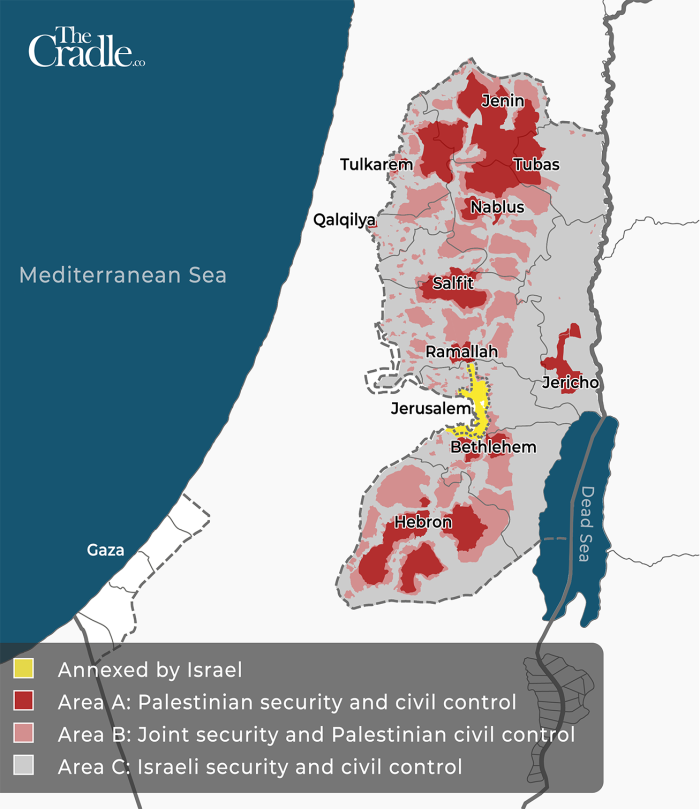
Map of Areas A, B, and C established under the Oslo Accords.
That transfer folds large parts of the occupied West Bank into Israel’s legal system, advancing annexation through procedure rather than proclamation. The change appears technical on paper and carries clear political consequences.
More than 58 percent of Area C, nearly 1.9 million dunams (roughly 1,900 square kilometers), remains unregistered, according to the Israeli anti-settlement group Peace Now. That unresolved legal status is now at the center of Israel’s latest initiative.
The roots of the issue stretch back decades. Under Jordanian administration between 1949 and 1967, only a portion of land was formally registered, following older British Mandate practices. After 1967, Israeli military orders froze settlement processes, leaving wide areas governed by customary ownership and inherited documents.
That legacy now carries forward into the present. What was left unresolved is now being brought under a new legal framework.
Land registration as control
The plan sets out to survey and register about 15 percent of these lands, roughly 290,000 dunams (around 290 square kilometers), before the end of the decade.
For Palestinian landholders, claims require detailed documentation and precise maps, often stretching back generations. In many cases, those records are incomplete or no longer available.
Where proof falls short, land can be classified as state property. Once registered that way, it can be redirected toward settlement construction or agricultural outposts, while former owners lose access.
Legal ground shifts
Recent cabinet decisions have reshaped the legal terrain that governed land for decades.
Pre-1967 Jordanian restrictions that once limited property sales to Palestinians are being overridden, opening the door for companies and settler groups to acquire land inside densely populated Palestinian areas.
At the same time, prior approval requirements for transactions have been lifted. These procedures once allowed authorities to review claims and flag irregularities. Their removal speeds up transfers and reduces oversight.
Land records have also been opened for public review. For settlement groups, this offers a clearer path to identifying absentee ownership and pursuing contested claims.
These measures do not stop at Area C. They reach into Areas A and B, where the Palestinian Authority (PA) holds administrative powers under the Oslo framework. Israeli agencies are now positioned to intervene more directly, including demolishing Palestinian buildings and structures, under the guise of enforcing environmental standards, heritage protection, and water management.
In Hebron (Al-Khalil), planning authority in key areas has been transferred from the municipality to Israeli military control. In Bethlehem, a dedicated body now oversees the area around Rachel’s Tomb, channeling resources into nearby religious infrastructure.
Expansion on the hills
Legal change has moved in tandem with accelerated settlement activity.
A new plan outlines the establishment of outposts across dozens of strategic hilltops, each designed to establish a permanent presence through mobile homes and basic infrastructure.
More than 1 billion shekels have been allocated for roads linking the new outposts to existing settlements, folding them into the wider settlement network.
Settlement construction has risen sharply in recent years, with Peace Now reporting an 80 percent increase since 2022. Many outposts once considered unauthorized have since been retroactively approved.
Pastoral outposts form part of this expansion. Herds are used to assert control over grazing land, limiting Palestinian access, and extending the reach of settlement activity beyond built structures.
The E1 corridor east of Jerusalem remains central to these plans. Tenders have been issued for more than 3,400 housing units in the E1 area, linking Ma’ale Adumim to Jerusalem. If built, the project would sever the territorial continuity between Ramallah, occupied East Jerusalem, and Bethlehem, effectively dividing the West Bank into two disconnected parts
A joint report by Peace Now and Kerem Navot found that shepherding outposts now give settlers control over around 14 percent of the occupied West Bank, or at least 786,000 dunams (786 square kilometers).
Displacement under pressure
On the ground, these changes are accompanied by rising pressure on Palestinian communities.
According to UN OCHA data, cited by Amnesty International, 117 predominantly Bedouin and herding communities in the occupied West Bank experienced full or partial displacement between January 2023 and April 2026 following settler attacks and related access restrictions.
In parts of the Jordan Valley and the hills around Ramallah, attacks by settler groups have led to the destruction of homes and infrastructure. In some cases, entire communities have left overnight.
In one case, a community in Al-Mu’arajat was completely displaced after homes were demolished and infrastructure looted. In Ras Ein al-Auja, near Jericho, Bedouin families were forced to leave after settler outposts cut off access to grazing land and undermined their livelihoods.
Accounts from affected areas describe vehicles entering at speed, property damage, and the seizure of basic resources. Fatal incidents have also been reported, with residents killed during confrontations.
For many, remaining on the land has become increasingly difficult. Pressure builds through legal, economic, and physical channels.
A system, not incidents
Evidence suggests that settler violence is not random but operates within an organized framework supported by state institutions.
Figures from the Israeli rights group Yesh Din show that the vast majority of complaints related to settler violence are closed without charges.
Oversight of the police sits with extremist National Security Minister Itamar Ben Gvir. Field reports from within the Israeli military describe coordination at times between soldiers and settler elements, or a lack of intervention during incidents.
Support has also taken administrative form. Dedicated units have been established to work with settler youth groups, alongside funding for equipment used in remote areas.
Political rhetoric has also drawn criticism. Israeli Prime Minister Benjamin Netanyahu has repeatedly described violent settlers as “a handful of extremists.” The cumulative effect is a system that allows these dynamics to persist, operating with continuity rather than disruption.
Regional fault lines
The developments have drawn responses from regional and international actors, grounded in legal frameworks.
The International Court of Justice (ICJ), in its 2024 advisory opinion, found that Israel’s policies and practices in the occupied West Bank and East Jerusalem violate international law. Land confiscation and population transfer were identified as unlawful.
Land confiscation and the transfer of population are prohibited under the Fourth Geneva Convention and affirmed as unlawful in UN Security Council Resolution 2334.
Governments in Jordan, Egypt, Qatar, and Turkiye have described current policies as a form of annexation that undermines the basis for a political settlement.
For Jordan, the issue carries additional weight, touching on the foundations of its 1994 peace agreement with Israel.
Western responses have remained largely declarative. Opposition to formal annexation has not translated into a halt to settlement growth or infrastructure expansion.
The changes continue through administrative channels, each step building on the last. What began as a registry project now runs through land, law, and control across the occupied West Bank, carried forward through procedure and fixed on the ground.
Across legal files, hilltops, and emptying villages, the map is being redrawn without a formal declaration.
Featured Video

Iran’s Next Strike May Not Explode. It Could Shut You Down
or go to
Aletho News Archives – Video-Images
From the Archive
Zionism’s Violent Legacy
By Donald Neff | Washington Report On Middle East Affairs | January 1996
On January 4, 1948, Jewish terrorists drove a truck loaded with explosives into the center of the all Arab city of Jaffa and detonated it, killing 26 and wounding around 100 Palestinian men, women and children.[1] The attack was the work of the Irgun Zvai Leumi – the “National Military Organization,” also known by the Hebrew letters Etzel – the largest Jewish terrorist group in Palestine. The Irgun was headed by Revisionist Zionist Menachem Begin and had been killing and maiming Arabs, Britons and even Jews for the previous ten years in its efforts to establish a Jewish state.
This terror campaign meant that at the core of Revisionist Zionism there existed a philosophical embrace of violence. … continue
Blog Roll
 Aletho News
- Trump’s Iran war is on an Israeli leash
- Saudi oil boss issues global supply warning
- Riyadh Says Its Oil System Is Intact. The Numbers Say Otherwise.
- Trump and Netanyahu Want to “Finish the Job” on Iran
- US ‘one-sided dictation’ not Iran’s beliefs makes rational talks impossible: Baghaei
- Iran’s Next Strike May Not Explode. It Could Shut You Down /Col Doug Macgregor
- Iran: US political targets legitimate if assassinations return
- Iraq shuts key border crossing with Iran under US pressure: Report
- Undersea Internet cables could be targeted in retaliation for attacks on Iran: IRGC deputy chief
- EU sending ‘biased’ observers to interfere in Serbian election – president
- If Americans Knew
- The Israel Lobby’s Changing Fortunes
- AIPAC has become such a political liability that it’s shifting to a more “nimble” approach to buying politicians
- At least 160 Israeli settler attacks in 2 weeks
- Will Gaza’s Ancient Christian Community Disappear Forever?
- Israel’s vision of regional security rests on keeping Arab states weak
- Heidi Levine recounts how Palestinian youths helped save her in settler attack
- DAILY UPDATE: Latest essential news on Palestine, Israel, & region
- Trump’s Intensifying Sabotage of the ICC, for Israel’s Sake
- Israeli military detain US and UK volunteers in West Bank including Democratic NY politician Brad Lander
- Americans at National Conservatism Conference held in Israel this year criticize Israel
- No Tricks Zone
- E-Cars Reduce CO2 Emissions By Only 41% Compared To Internal Combustion Engine Vehicles
- Predictions Made By Renowned Climate Professor Over Past Decades Have Been Proven To Be Poor
- New Study Suggests Large Regions Of The Pacific Ocean Have Been Cooling For The Last 80 Years
- Germany’s Green Energy Debacle: High Energy Costs Force Kahla Porzellan to Close After 182 Years!
- New Study: 50 Years Of The Most Aggressive ‘Net Zero’ Policies Can Only Affect The Global Climate By 0.03°C
- US September “Heat” Was No Record…Many Records Set Decades Ago
- Latest European Green Energy Debacle; Portugal’s Largest Flagship Solar Park Insolvent!
- Green Energy Debacle: German Expert Professor Fritz Vahrenholt Warns Of Severe Economic And Social Consequences
- Two More Paleo Reconstructions Affirm Meters-Higher Sea Levels Across Ireland, Brazil 7000-6000 Years Ago
- New Study: Earth And Venus Surface Warmth Largely Explained By Convection And Lapse Rate, Not CO2 Or Radiation

