Israeli ministers discuss plot to divide Syria: Report
Press TV – January 10, 2025
Israeli media says the regime’s ministers have met to discuss a classified plot to promote the division of Syria after the fall of Bashar al-Assad’s government.
The news outlet Israel Hayom reported that Israel’s minister of military affairs Israel Katz chaired a small ministerial meeting on Tuesday that discussed an Israeli plan under which Syria would be divided into provincial regions, or cantons.
The report sells the plot as a way to “safeguard the security and rights of all Syrian ethnic groups,” including the Druze and Kurdish populations.
The meeting also reportedly discussed the Turkish involvement in the Arab country and alleged concerns about the intentions of Syria’s de-facto leader Abu Mohammad al-Julani, who has said that Damascus “will not engage” in a conflict with Tel Aviv.
The meeting was held before an upcoming discussion with prime minister Benjamin Netanyahu.
The plan of Israel, which was a main supporter of the anti-Assad militancy that erupted in the country in 2011, was already existing before the fall of the government, the report said.
Last month, regional security sources briefed on the plot were quoted as saying that before Assad’s fall, Israel planned to divide Syria into three blocks and to establish military and strategic ties with the Kurds in Syria’s northeast and the Druze in the south, leaving Assad in power in Damascus.
The plot, which appears the same as the one discussed on Tuesday, was alluded to in a speech by Israeli foreign minister Gideon Saar last November.
Saar said Israel needed to reach out to the Kurds and the Druze in Syria and Lebanon. “We must look at developments in this context and understand that in a region where we will always be a minority we can have natural alliances with other minorities.”
Foreign-backed militants, led by Hayat Tahrir al-Sham (HTS), took control of Damascus on December 8 and declared an end to President Assad’s rule in a surprise offensive that was launched from their stronghold in northwestern Syria, reaching the capital in less than two weeks.
Following the fall of President Assad’s government, Israel invaded Syria from the Golan Heights, a Syrian territory occupied by Israel since 1967. The Israeli forces have invaded a UN-patrolled buffer zone in southwestern Syria, taking over the Syrian side of Mount Hermon as well as a number of Syrian towns and villages.
The Israeli army also launched massive airstrikes against Syrian military installations in recent weeks, drawing widespread condemnation for violating Syria’s sovereignty.
UK special forces had ‘golden pass’ to get away with murder – officer
RT | January 8, 2025
British SAS operatives were given a “golden pass allowing them to get away with murder” in Afghanistan, a former UK Special Forces officer has told a government inquest. Other witnesses described routine executions of unarmed civilians by British forces.
The officer’s statement was given behind closed doors to the UK’s Independent Inquiry Relating to Afghanistan earlier this year, and included in a trove of documents published by the inquiry on Tuesday.
The former officer raised concerns about the killing of unarmed civilians in 2011, claiming that the SAS was covering these crimes up. The officer said that higher-ups within UK Special Forces – which comprises the Special Air Service (SAS), the Special Boat Service (SBS), and four other clandestine branches of the British military – had no interest in investigating the killings, and that SAS operatives had essentially been handed a “golden pass allowing them to get away with murder.”
The Afghanistan Inquiry is probing night raids carried out by British special forces between 2010 and 2013, when the alleged killings took place.
A junior officer told the inquest that “all fighting age males” were killed in these raids, regardless of whether they were armed or not. SAS personnel sometimes carried weapons to drop beside dead bodies after the killings in order to make them appear as combatants.
Prisoners were sometimes executed after they had been restrained, the witness recounted. “In one case, it was mentioned a pillow was put over the head of an individual before being killed with a pistol,” the document noted.
The inquiry is investigating the killings of at least 80 prisoners.
”I suppose what shocked me most wasn’t the execution of potential members of the Taliban, which was of course wrong and illegal, but it was more the age and the methods and, you know, the details of things like pillows,” the officer said, noting that some of the victims were “100%” aged 16 or younger.
The officer said that he was afraid for his own safety after testifying.
”Basically, there appears to be a culture there of ‘shut up, don’t question’,” another officer told the inquiry.
Claims of war crimes committed by British special forces in Afghanistan have surfaced before, with BBC Panorama, the Sunday Times, and other outlets claiming that civilians were routinely killed on night raids. In one case, the American military reportedly had video footage of one massacre, but mysteriously lost the footage when pressed by a British court.
Late last year, the BBC reported that one of the UK’s most senior generals had withheld from the latest inquiry evidence of soldiers executing handcuffed detainees in Afghanistan.
‘Israel’ deploys additional forces, armored patrols in Syria
“Israel” continues illegal operations in Syrian territories, expanding its occupation in different areas, particularly Mount Hermon.
Al Mayadeen | January 4, 2025
Local sources told Al Mayadeen that the Israeli occupation deployed reinforcements in the al-Jazeera barracks in the village of Maariya, in the Daraa countryside, near the Syrian-Jordanian border, erected high concrete barriers and paved all roads leading to the barracks.
Moreover, the source stated that for the first time, the Israeli occupation army is deploying armored patrols on the hills of the recently occupied areas of Mount Hermon, overlooking the territories in the Nabatieh region of Lebanon.
This comes after Israeli media reported that the Israeli military is preparing for an extended presence in Syria.
According to Walla, “Despite pressure from European parties on Israel, political leaders have instructed the Israeli army to brace for a prolonged stay in Syrian territory.”
Israeli Prime Minister Benjamin Netanyahu had previously instructed the military to prepare to remain in the Syrian Mount Hermon area and the UN-patrolled buffer zone until at least the end of 2025, Israeli Army Radio reported.
In contrast, Syria’s new leader, Ahmed al-Sharaa, pledged that he would not allow the country to be used as a launchpad for attacks “against Israel or any other state”.
What US mediation? 1000 Israeli violations in Lebanon go unchecked
The Cradle | January 2, 2025
Under the supervision of US special envoy and former Israeli soldier Amos Hochstein, Beirut and Tel Aviv reached a ceasefire agreement on 27 November after almost 14 months of intense conflict against the backdrop of the war on Gaza.
The Israeli military pledged to withdraw from Lebanese territory within 60 days of the agreement’s enactment.
To ensure compliance, a monitoring committee led by US General Jasper Jeffers was established, focusing on enforcing the cessation of hostilities and the full implementation of UN Security Council Resolution 1701.
Rampant Israeli violations
But Israel immediately undermined the truce, committing nearly 1,000 violations within the first month alone – one of many cases of the occupation state’s disregard for international agreements.
Additionally, occupation forces have continually obstructed the Lebanese army’s deployment at key points in southern Lebanon, and have leaked plans that Tel Aviv intends to maintain control over strategic areas in the country. Reports suggest there is an Israeli effort underway to establish a security buffer zone spanning from Abbad to the villages of Odaisseh and Kfar Kila.
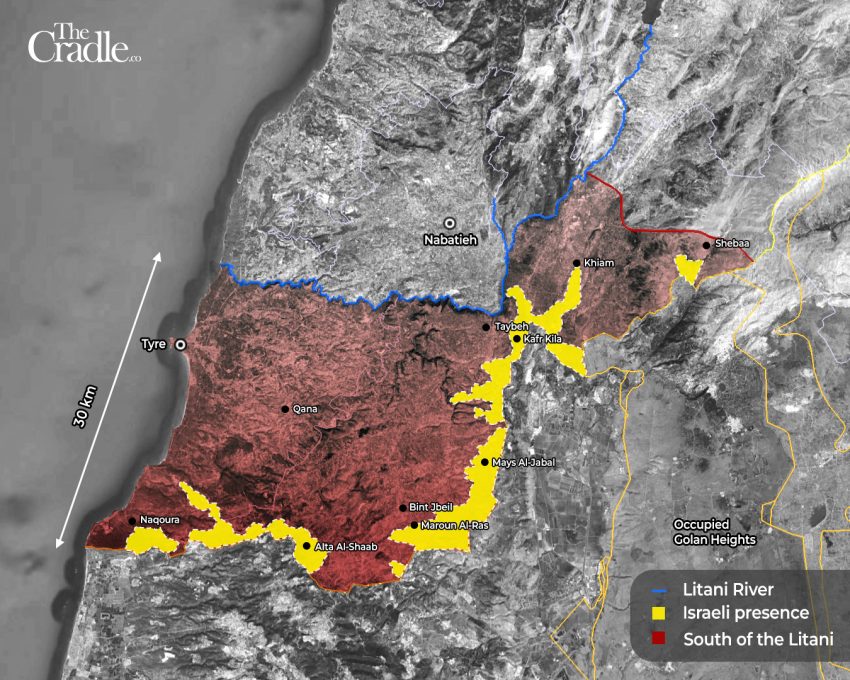
Map showing areas of Israeli military presence (in yellow) south of the Litani River in southern Lebanon, following the declared ceasefire. (Updated December 2024)
Meanwhile, from the onset of the ceasefire, Hezbollah assured the Lebanese government that it would not retaliate during the 60-day truce period, adhering strictly to the agreement terms and allowing the government and army to address Israel’s daily provocations.
The ceasefire followed intense internal and international pressure on the resistance movement to halt its battle with Israel, especially as the latter began to dangerously expand its bombing targets across the country. Simultaneously, the Israelis – having failed to achieve their stated war objectives and taken daily troops losses in their ground invasion – were pushing hard for a truce, citing the need to prevent an escalation that could extend to Beirut, risking mass civilian casualties.
This agreement may not be ideal for either party, but it is feasible to implement. Israel achieved tangible successes but failed to crush Hezbollah or eliminate it as an organization. For Hezbollah, the priority was ending the war to halt the destruction, despite the damages it sustained.
Consequently, both sides reached an agreement that Hezbollah described as a reiteration of the 1701 Resolution. It was not a deal of humiliation or defeat, contrary to how the group’s adversaries are eager to portray it.
It is important to note that Hezbollah chose a middle path between Hamas’ call to ignite a broader conflict under the banner of “Al-Aqsa Flood” and a policy of non-intervention, given that the Palestinian movement’s leadership did not involve Hezbollah in its decision to go to war.
Ethically, Hezbollah opted to open a limited support front, clearly defining its objectives: to exhaust the Israeli military and pressure it into halting the assault on Gaza. However, this calculation later proved to be flawed.
When the support front escalated into a full-fledged war, Hezbollah declared that its aim was to stop the conflict. When Israel requested a cessation of hostilities, Hezbollah agreed under acceptable conditions.
Ultimately, after over a year of conflict sparked by the Hamas-led Operation Al-Aqsa Flood, Hezbollah and Israel reached a 13-point agreement mediated by the US and France. While Tel Aviv agreed to withdraw from Lebanese territory within 60 days, its actions during the ceasefire depict a relentless drive to achieve militarily what it could not during the war.
The destruction of Lebanese homes and towns during the first month of the truce already far exceeds that caused during the conflict, with villages such as Bani Hayyan, Markaba, Shama, Al-Bayada, and Wadi al-Hujayr suffering devastating damage.
Israel’s brazen violations are not just restricted to border towns. Its truce violations include the prohibited operation of war drones over Beirut and its southern suburbs, and substantial military strikes in villages across the eastern Bekaa Valley.
The US looks the other way
The ceasefire monitoring committee, led by Tel Aviv’s staunchest allies, has faced significant challenges, largely due to Israel’s unwillingness to comply with the terms of the truce.
Sources reveal to The Cradle that so far, two meetings have been held at the United Nations Interim Force in Lebanon (UNIFIL) headquarters in Naqoura, southern Lebanon, with Israeli officers present, followed by a third meeting attended by Lebanese Prime Minister Najib Mikati – without the Israelis present.
The sources added that the first meeting lasted just 40 minutes, limited to introductory discussions on core topics. The second session, however, was marked by discord, as the Israeli side failed to uphold previously agreed-upon terms.
During that meeting, it became apparent to all that while the Lebanese army had finalized and approved a deployment plan for the western, central, and eastern axes, the Israelis refused to present any withdrawal strategy. Instead, they shifted blame to the Lebanese army for what they called “slow deployment,” further suggesting that the 60-day truce deadline was merely symbolic, not binding for the withdrawal of Israeli forces, and intended only for the withdrawal of Hezbollah troops from south of the Litani River.
Israeli representatives went further, baselessly claiming that the Lebanese army had no intention of implementing the agreement’s provisions to withdraw Hezbollah from south of the Litani.
During the discussions, Lebanese General Edgar Lowndes is said to have stormed out of the meeting after heated exchanges with the Israeli side, which downplayed its repeated attacks in Lebanon as insignificant and refused to classify them as breaches of the agreement. The Israeli delegation specifically argued that their use of drones in Lebanese airspace was not a violation of the truce, suggesting that the air breaches would continue unchecked.
The lead US official – a general – brought Lowndes back to the meeting and tried to keep the proceedings more formal thereafter. Following the session, high-level contacts took place between various committee members, with Lebanese caretaker Prime Minister Najib Mikati gathering French and American officers and the UNIFIL Commander to emphasize the need for Israel to respect the signed agreement that the Israeli army would withdraw from Lebanese territory within the agreed upon deadline.
In this context, the US general confirmed that envoy Hochstein would participate in the next committee meeting on 6 January to confirm the ambiguous issues, and agreed with his Lebanese counterparts that Israel is violating the ceasefire through its actions.
Patience amid provocation
While Hezbollah has exercised restraint and refrained from delivering any significant response beyond a single retaliation at the “Ruwaisat al-Alam site belonging to the Israeli enemy army in the occupied Lebanese Kfar Shuba Hills,” Israeli provocations have continued to test the limits of the ceasefire on a daily basis. As a source close to Hezbollah informs The Cradle :
“We will be patient until the 60-day period expires and diplomatic opportunities are exhausted, and after that there is no solution but resistance.”
International mediators now face growing pressure to enforce the agreement, with Lebanese Parliamentary Speaker Nabih Berri emphasizing the importance of French involvement in the monitoring process, given US partiality toward Israel.
The Lebanese Ministry of Foreign Affairs filed a formal complaint with the UN Security Council, citing 816 violations between 27 November and 22 December. Prime Minister Mikati has called for the swift and complete implementation of Resolution 1701, cautioning that delays could destabilize the region further.
Beirut also called for “enhanced support for UNIFIL and the Lebanese army to guarantee the protection of its sovereignty and to create the necessary security conditions for restoring stability and normalcy in the south of the country.”
It is evident that Israel is leveraging its perceived upper hand to manipulate the ceasefire agreement, interpreting its terms to align with its strategic objectives. By acting as if the balance of power has irreversibly shifted in its favor, the occupation state not only challenges the Lebanese side but openly flouts the agreement with actions such as air violations, justified under the guise of self-defense.
These provocations, coupled with threats to reignite hostilities and forcibly expel Hezbollah, reveal a calculated effort to establish new facts on the ground that were never part of the original accord.
Israeli demolition campaign intensifies in southern Lebanon
The Cradle | January 2, 2025
Israeli troops advanced into and heavily attacked the southern Lebanese village of Beit Lif on 2 January, in violation of the fragile ceasefire that Tel Aviv has been continuously breaching since it took effect in late November last year.
“The Roumieh area between Beit Lif and Yater was subjected to enemy artillery shelling,” Lebanon’s National News Agency (NNA) reported on Thursday afternoon, coming as Israeli forces entered and searched homes in the area.
According to Al Manar’s correspondent in the south, the Israeli army pushed into Beit Lif with several Merkava tanks, military hummers, a bulldozer, and infantry forces and began demolitions in the town. The sounds of heavy explosions and gunfire were heard.
Earlier on Thursday, an Israeli drone targeted the vicinity of a farm between the towns of Beit Lif and Yater with two missiles.
The new ceasefire violations occurred a day after the Israeli military set fire to homes in the Aitaroun-Bint Jbeil district.
In accordance with the ceasefire agreement, the Lebanese Armed Forces (LAF) entered the towns of Shamaa and Al-Bayada on 1 January. The two towns are among those that witnessed fierce clashes between the Lebanese resistance and the Israeli army during Tel Aviv’s failed ground operation in Lebanon, which began in early October and ended with the ceasefire on 27 November.
Al-Bayada and Shamaa were also heavily bombarded throughout the war that began in October last year.
NNA reported massive destruction of infrastructure – with entire neighborhoods and even the electricity network ravaged. “Everything was razed to the ground.”
Israel has violated the ceasefire – which is based on the implementation of UN Resolution 1701 – over 100 times since it took effect with deadly airstrikes, arrests of Lebanese citizens, troop advancements, and mass detonation campaigns in southern villages. Entire villages have been wiped out as a result of the demolition campaign.
Tel Aviv claims to be targeting Hezbollah infrastructure in the south, which the LAF was tasked to dismantle as per the agreement.
Israeli troops are required to withdraw from Lebanon within 60 days of the ceasefire’s announcement. So far, it has been over four weeks, leaving less than a month before the Israeli army must retreat, according to the agreement.
Security sources in Lebanon told The Cradle on 23 December that the Israeli army is unhappy with the LAF’s efforts to implement the ceasefire and is planning to maintain a presence in the south past the 60-day implementation period.
“Now is the opportunity for the Lebanese state to prove itself through political action,” Hezbollah’s Secretary-General Naim Qassem said in a speech on Wednesday, echoing recent comments by the resistance group’s MPs and officials.
Hezbollah officials have recently said that the current period represents a test for the Lebanese state regarding whether or not it will be able to protect the south from Israeli attacks and violations once the resistance is no longer present south of the Litani River.
“If the occupation takes any steps against Lebanon from the eastern front due to its expansion in Syria, we will carry out our national duty … anyone who believes that the resistance in Lebanon has weakened is deluded … We possess the resources and intellect to be in a position to confront the occupation. On the 61st day after the ceasefire, we will be in a position to make the Israeli enemy taste our wrath,” Hezbollah MP Ihab Hamadeh told Al Mayadeen on Wednesday.
Under the radar: ‘Israel’s’ ruthless expansion and Syrians’ struggle
By Sara Salloum | Al Mayadeen | January 2, 2025
“Israel” capitalized on the fall of the Syrian regime on the 8th of this month, launching a wide-scale operation to destroy the qualitative capabilities of the Syrian Arab Army. The operation targeted missile weapons stores, manufacturing and development sites, air force facilities, air defense systems, radar installations, research centers, and naval combat assets. Israeli warplanes are still freely parading in Syrian airspace, with Syrian citizens always hearing the sounds of Israeli reconnaissance planes overhead.
In this scenario, the Syrian Arab Army would have lost the majority of its weaponry. If reconstituted, it would become a fragile and symbolic army force, incapable of effectively facing an overwhelming, American-backed Israeli military that occupies whatever land it wants, and bombs whatever it wants, whenever it wants.
While the head of the new Syrian administration, Ahmad al-Sharaa, (formerly Abu Muhammad al-Julani), was busy receiving political and security delegations from various countries, “Israel” initiated a large-scale ground incursion into southern Syria. This action was justified by the new governor of Damascus who stated, “Recently, Israel might have felt afraid, so it advanced a little and bombed a little. These fears are natural, but Syria’s problem is not with Israel, and we do not wish to tamper with Israel’s security.”
In full view of the UN Disengagement Observer Force (UNDOF) posts, Israeli forces violated the 1974 agreement and took control of more than 10 Syrian villages, covering an area of more than 20,000 km²,
Abu Muhammad, a resident of the Quneitra countryside, told Al Mayadeen English what happened:
“The Israeli forces raised their flag on the Quneitra Governorate building, and destroyed numerous houses in the surrounding countryside, along with small farms in various towns. They bulldozed lands and farms and uprooted trees, and erected earthen barriers and fortifications around the Mantara Dam, Syria’s second-largest dam, cutting off our water supply. Additionally, they installed extensive surveillance cameras and communication devices. When civilians protested against their actions, the Israeli forces fired live ammunition directly at them, resulting in numerous injuries.”
A Palestinian year in review: Genocide, resistance and unanswered questions
By Ramzy Baroud | MEMO | December 26, 2024
Lavrov warns Israel against ‘sowing a storm’ in Syria

RT | December 26, 2024
Israel should refrain from solving its geopolitical problems at the expense of war-torn Syria, Russian Foreign Minister Sergey Lavrov has cautioned. Reckless actions by the Jewish state could erode the security framework in the Middle East, he warned, during an online press conference on Thursday.
Lavrov stressed that Russia insists on Syria remaining an independent country following the demise of former President Bashar Assad, reiterating that Moscow maintains contact both with Damascus and other regional partners. “The disintegration of Syria must not be allowed,” he said.
In light of this, the minister urged Israel, which has established a so-called ‘buffer zone’ in internationally recognized Syrian territory, “to understand its responsibility in these collective [stabilization] efforts and refrain from ensuring its security at the expense of others.”
“One cannot expect to destroy all military facilities in a neighboring country and then live in peace and harmony forever. This is like sowing a storm that will inevitably come back to haunt those who engage in such actions.”
After Assad’s removal and subsequent asylum in Russia, Israel has launched multiple airstrikes across the border, targeting Syrian airbases, weapons depots, and other military facilities to prevent arms from reaching “the wrong hands.” West Jerusalem claimed to have destroyed 70-80% of its neighbor’s strategic military capabilities, with the Syrian navy essentially being eliminated as an operational force.
According to Lavrov, another facet of Syria’s well-being hinges on the situation in the oil-rich eastern part of the country. The US, the minister charged, has “illegally occupied a significant part of the territory, including areas with major oil fields and fertile lands,” adding that revenues from the export of these resources is being funneled to “separatist structures” that the Americans have created in the country.
He also addressed remarks by Turkish President Recep Tayyip Erdogan, who recently vowed to “bury” Kurdish militants – whom Ankara considers terrorists – in Syria if they fail to lay down their arms. “We understand the legitimate concerns of the Turkish leadership… regarding security along the border,” Lavrov said, adding that Türkiye’s “legitimate security interests must be ensured in a way that preserves Syria’s sovereignty, territorial integrity, and unity.”
Earlier media reports claimed that Türkiye and the new leadership in Damascus were considering a joint military operation to expel Kurds from border areas if they failed to integrate with the Syrian military. Russian President Vladimir Putin did not rule out that Ankara could proceed with such an action, while urging both sides to resolve their differences peacefully.
Five Syrians injured by Israeli army gunfire in Quneitra countryside
By Ahmad Karakira | Al Mayadeen | December 25, 2024
Israeli forces have established new positions in the countryside of Quneitra in Syria, specifically along the axes of Rasm al-Rawadi, Umm al-Edam, and al-Mantara Dam.
The village of Swisah in the southern countryside of Quneitra witnessed a protest against the Israeli occupation forces that had advanced into the village, entering barracks within and around it, local sources told Al Mayadeen.
The Israeli forces, consisting of bulldozers and tanks, stormed a barracks in the center of the village, carrying out acts of vandalism and cutting down trees in its surroundings but without approaching residential homes, the sources indicated.
Subsequently, the occupation forces moved to a barracks west of the village, continuing their acts of destruction, which prompted residents to gather near the site in protest against the incursion and raise the Syrian flag.
The Israeli forces then opened fire to prevent the protesters from approaching, injuring five individuals.
According to the sources, the Israeli forces transported equipment, including bulldozers, to the al-Tallayn al-Homr area, where they have been stationed for some time.
IOF give Jubatha al-Khashab residents ultimatum to turn in weapons
In a related context, Israeli occupation forces have given the residents of the town of Jubata al-Khashab in the northern countryside of Quneitra a 48-hour deadline to hand over all types of weapons.
This has sparked appeals to the new administration in Damascus, which has yet to take any action.
In response to Israeli threats, the elders of the town indicated that they would only hand over weapons to the Syrian authorities.
They urged active officials on the ground to address their demands “so they would not later be accused of treachery, especially after the Israeli forces claimed responsibility for the area’s security and its arms.”
IOF establishing posts on top of Mount Hermon
A couple of days ago, local sources told Al Mayadeen that the Israeli occupation forces are combing the entirety of Mount Hermon’s peak, and are establishing a new post overlooking Damascus’ southwestern countryside.
According to exclusive sources, the Israeli army seized military equipment in the area, as well as the wreckage of an Israeli helicopter downed during the 1973 war.
Earlier, a local source told Al Mayadeen that Israeli tanks and armored patrols infiltrated the al-Hamidiyah axis in the countryside of Quneitra towards the provincial center in the town of al-Baath, southwest of Syria, coinciding with inspection campaigns carried out by Israeli forces, which targeted some homes and farms in the villages of the central countryside.
Mauritian Prime Minister Rejects Blinken’s Call to Sign Deal With UK on Chagos – Reports
Sputnik – 25.12.2024
US Secretary of State Antony Blinken urged Mauritian Prime Minister Navinchandra Ramgoolam to sign the deal with the United Kingdom on the status of the Chagos archipelago, which was agreed by the previous Mauritian government, but he was refused, a news portal reported, citing sources.
Ramgoolam made it clear that he did not agree with the original agreement reached in October and told Blinken that he had sent a counter-offer to London, the report said on Tuesday.
The report noted that Ramgoolam thus confirmed his desire to achieve a better deal for Mauritius.
On October 3, the United Kingdom agreed to hand sovereignty of the Chagos Islands to Mauritius. Under the deal, the UK also promised to create a new trust fund and provide other support for the benefit of Chagossians, as well as to provide a package of financial support to Mauritius, including an “indexed annual payment for the duration of the agreement” and infrastructure investment, according to the UK-Mauritius joint statement. The UK however will retain control of the US-UK base on the Diego Garcia island for an initial period of 99 years. To enter into force, the deal must be ratified in the British parliament, which is expected next year.
Mauritius and the Chagos Islands had been colonial possessions of the British Crown since 1845. In 1968, Mauritius gained independence, but the islands remained a British overseas territory. In the 1960s and 1970s, the Chagos population was deported to the Seychelles and Mauritius. In 1966, the UK leased the largest island, Diego Garcia, to the United States for 50 years. The lease was extended for 20 years in 2016.
Israel seeks to occupy south Lebanon past 60-day truce period
The Cradle | December 24, 2024
Israeli forces are unhappy with the Lebanese army’s efforts to implement the ceasefire agreement announced on 27 November and are planning to maintain a presence in south Lebanon, according to exclusive information.
“The French conveyed to the Lebanese army that the Israeli military is not satisfied with what is happening [in south Lebanon] and that it will not leave before destroying all of Hezbollah’s infrastructure [south of Litani River, even after the 60-day implementation period ends],” Lebanese security sources told The Cradle on 23 December.
The information came as an Israeli attack killed two people in the town of Taybeh in southern Lebanon’s Marjayoun District.
The Lebanese National News Agency’s (NNA) correspondent in Marjayoun reported on Monday afternoon that “two people were killed and another was injured in an enemy raid that targeted a group of people near the official school in Taybeh.”
Israeli ground troops continued their campaign of mass detonations and destruction of homes and buildings across southern Lebanon, blowing up houses in Al-Bustan and Al-Zaloutieh in the Tyre District.
They also put up an Israeli flag on a hill in the Naqoura area overlooking the main entrance to the town, in violation of the ceasefire announced last month.
Israeli troops are required to withdraw from Lebanon within 60 days of the ceasefire’s announcement. So far, it has been four weeks, leaving only a month before the Israeli army must withdraw, according to the agreement that is based on UN Resolution 1701.
The Lebanese Armed Forces (LAF) has deployed across south Lebanon with the aim of dismantling Hezbollah infrastructure south of the Litani River – which is required to take place within the 60-day period.
Tel Aviv has violated the ceasefire over 100 times since it took effect with deadly airstrikes, arrests of Lebanese citizens, troop advancements, and mass detonation campaigns in southern villages.
Israeli forces have exploited the ceasefire to advance into areas they were unable to during recent ground battles with Hezbollah.
Hezbollah responded once to dozens of violations in early December with a limited rocket attack on an Israeli site in occupied Lebanese territory, prompting a massive and deadly Israeli response in south Lebanon.
Israel claims it is acting in line with the ceasefire agreement by targeting what it says is Hezbollah infrastructure. However, according to the agreement, dismantling the resistance’s presence in southern Lebanon is the responsibility of the Lebanese state and army. Earlier this month, the Israeli army bombed Khiam after the LAF entered the city to clear rubble and prepare for civilian entry.
A secret side letter between Washington and Tel Aviv reportedly guarantees that Israel can act with force against “threats.”
Israel’s Defense Minister Israel Katz vowed on 22 December that Tel Aviv would “crush” Hezbollah’s “head” if the Lebanese resistance group violates the ceasefire, coming during a visit to an Israeli army position in southern Lebanon.
Two days earlier, Hezbollah MP Ali Fayyad said that “the resistance will not be dragged into confronting Israeli violations and aggressions militarily, because its priority is the Israeli withdrawal from our land without giving it any pretext to exceed the 60-day deadline, and because we take into consideration the situation of our people who need shelter, reconstruction, and to clean up the effects of the war.”
“We want the Lebanese government and army to play their role in protecting the land and preserving sovereignty, based on the [agreement] based on Resolution 1701,” Fayyad added.
Lebanese Prime Minister Najib Mikati and UNIFIL called on Israel on Monday to hasten its withdrawal from southern Lebanon. Mikati called for the US and France to pressure Israel on the matter.
Featured Video

Rewriting the risk? Inside the government’s vaccine safety messaging
or go to
Aletho News Archives – Video-Images
From the Archives
‘Israel sees Iran as obstacle to its policies’
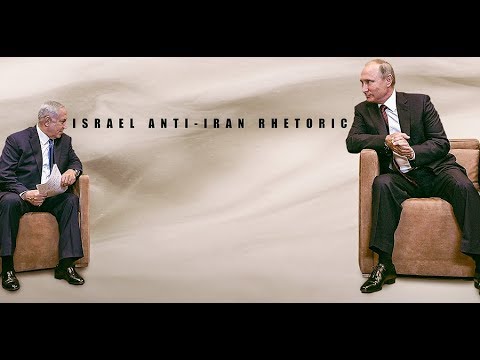
Press TV – August 25, 2017
Prime Minister Benjamin Netanyahu has said that Israel felt threatened by Iran’s growing influence in the Middle East. Netanyahu expressed his Iranophobic view in a meeting with Russian President Vladimir Putin in Russia’s Black Sea resort of Sochi on Wednesday. Press TV has asked Scott Rickard, former American intelligence linguist from Tampa, Florida, and Brent Budowsky, a columnist at The Hill from Washington, to give their thoughts on the issue.
Rickard said Tel Aviv is concerned about the fact that the regime could not carry out its old project to spread sectarian divisions and pave the way for dismemberment of the countries in the Middle East region because of the Iranian-led resistance against Israeli policies, not only in the occupied territories of Palestine but also in the whole region.
“Iran is not a threat to Israel whatsoever. The threat that Israel sees is the fact that their Oded Yinon Plan is being put to a hold by Iran,” the intelligence linguist said on Thursday night.
“They (the Israelis) look at Iran as a threat only because they have no influence on their governments and Iran is autonomous and is not under the Zionist influence,” he added.
Since the victory of the Islamic Republic of Iran in 1979, Tehran has been critical of Israel’s policies in the region, whereas “no leaders [of other states] even dared to speak out against Zionism,” Rickard argued. … continue
Blog Roll
 Aletho News
- What’s Behind U.S./Israeli Strikes On Iranian Pistachio Factories?
- Seyed M. Marandi: U.S. Military DIVIDED? Iran’s Secret Defense EXPOSED
- How I fell foul of the BBC thought police
- The End of NATO
- 37 days of war on Iran cost US staggering $42bln, tracker shows
- Baghdad tells Asian refiners, traders to begin loading Iraqi crude amid Iranian exemption
- Under fire, Moscow and Tehran close ranks
- Iran, US receive Pakistan-mediated plan for ceasefire then final deal
- Iran submits demands for end to war as mediators scramble ahead of Trump deadline
- Iran Threatens Retaliatory Strike on Stargate AI Project in UAE
- If Americans Knew
- U.N. experts demand Israel release prominent Gaza doctor after reports of ‘severe torture’
- Israel’s Latest Genocide Is Against the Shias of Lebanon. Why Is the World Silent?
- How Eliot Cohen’s influence over U.S. war-making paved the way for Trump’s war crimes in Iran
- Israelis don’t pay for the weapons we ‘sell’ to them — US taxpayers do
- While Distancing from AIPAC, Most 2028 Democratic Hopefuls Are Still Embracing Israel
- A brief history of the Israeli nuclear program, the open secret at the heart of the Iran war
- Israeli Settlers Killed a Palestinian Farmer on His Own Land, in Front of His Father. Yes, Again
- The US-Israeli War on Science is an Assault on our Future
- 100+ International Law Experts Say US Strikes on Iran Violate UN Charter, Could Be War Crimes
- ‘Vile, Horrifying, Evil’: Trump Threatens to Bomb Nation of 90 Million People ‘Back to the Stone Ages’
- No Tricks Zone
- An Inconvenient Tree: Uncovered In Alps… Europe Much Warmer Than Today 6000 Years Ago
- New Study Reports A 60% Slowdown In Greenland’s Ice Loss Rate In The Last Decade
- Low Intensity Tornado Wrecks Major Solar Farm, Creating A Potential Toxic Dump
- New Study Finds Warming Saves Lives…Cold Temperatures 12 Times More Deadly Than Excess Heat
- German Science Blog Accuses PIK Climate Institute Of Hallucinating Climate Tipping Points
- Devastating Assessment Of Comirnaty Vaccine By Former Senior Pfizer Europe Toxicologist
- New Study: CO2 Is ‘Effectively Negligible’ As An Explanatory Climate Change Factor Since 2000
- Former Pfizer Toxicologist Dr. Helmut Sterz Tells Bundestag Hearing Pfizer Vaccine Should Have Never Been Approved
- Energy Expert: Germany’s Nuclear Phaseout Was A “500 Billion Euro Mistake”
- New Research: South Australia’s Mid-Holocene Sea Surface Temperatures Were 4°C Warmer Than Today
 Aletho News