US lawmakers seek terror designation for Polisario Front over alleged ‘Iran ties’

The Cradle | August 6, 2026
Two US lawmakers introduced a bill on 30 July calling on the State Department to consider designating the Polisario Front, a group fighting for independence for Western Sahara from Morocco, as a “foreign terrorist organization.”
US Congressmen Josh Gottheimer of New Jersey and Ronny Jackson of Texas introduced the Polisario Front Terrorist Designation Act, claiming the group is receiving assistance from Iran and poses a threat to US national security.
“The Iranian regime and its terrorist proxies are working overtime to open a new front against the United States and our allies, and the Polisario Front has become one of their instruments,” claimed Congressman Gottheimer.
However, the congressman acknowledged that no such link between Iran and the Polisario Front has been confirmed.
“This bipartisan bill makes sure that once that cooperation is confirmed, we can bring the full weight of America’s counterterrorism sanctions down on the Polisario Front,” Gottheimer added.
The Polisario Front seeks to make Western Sahara an independent country free from Moroccan control. The front was founded in May 1973 to fight Spanish colonial rule in Western Sahara. After the Spanish left the region in 1976, it proclaimed the Sahrawi Arab Democratic Republic (SADR) with a government-in-exile in Algeria.
However, Morocco quickly occupied much of Western Sahara, claiming it as part of its territory.
The name Polisario Front comes from Spanish words for the Popular Front for the Liberation of Saguia el-Hamra and Rio de Oro.
This bill follows similar initiatives introduced in Congress during 2025, including one by Republican Senator Ted Cruz.
In 2020, US President Donald Trump recognized Morocco’s claim to sovereignty over Western Sahara as part of a deal for the kingdom to normalize relations with Israel through the Abraham Accords.
France, Britain, Germany, the Netherlands, and Spain followed Washington’s lead in recognizing Morocco’s claim.
Morocco is a major non-NATO ally of the US. According to the Hudson Institute, “designating the Polisario Front as a foreign terrorist organization would solidify the US-Morocco alliance.”
In July, Morocco became the first Arab and African nation to deploy its military to the International Stabilization Force (ISF), which is set to occupy Gaza under the direction of Trump’s “Board of Peace.”
Morocco signed an agreement in Rabat on 15 July to formalize its participation in the ISF, which will work in collaboration with the Israeli military.
Commenting on Morocco’s role in the ISF, a pro-Palestine Moroccan activist stated that “I don’t know what Morocco’s role will be [in the ISF] other than perhaps disarming the resistance [Hamas] and even supervising a new colonization of the Gaza Strip by the American-Zionist entity.”
Since signing the Abraham Accords, Morocco has continued to expand military and security ties with Israel.
In May 2025, Israeli forces publicly participated in the kingdom’s annual “African Lion” military drill, which brought together 10,000 troops from more than 40 participating countries.
During the opening ceremonies of the yearly exercise, jointly organized by Rabat and the US Africa Command, the Israeli flag was openly displayed for the first time.
Last week, the Moroccan government organized tens of thousands of Moroccan migrant men to storm the Spanish enclave of Ceuta on the coast of North Africa.
In July, a budget report approved by the US Congress for the first time described Ceuta and Melilla as Spanish-administered cities “located in Moroccan territory” that “remain the subject of Morocco’s longstanding claim.”
Israeli Prime Minister Benjamin Netanyahu has called for Spain to be punished for trying to prevent the US military from delivering weapons to the Israeli military for use in its genocide of Palestinians in Gaza.
Israelis widely celebrated the storming of Ceuta by Moroccan men on social media.
Responsible Statecraft wrote that the Moroccan government may have been deploying “migration blackmail” to punish European nations. “But this time, Israel and the United States appear to be the principal beneficiaries.”
His Majesty’s plunder: The royal machine behind the Trump Highway and Western Sahara’s phosphate wealth
The Cradle | August 3, 2026
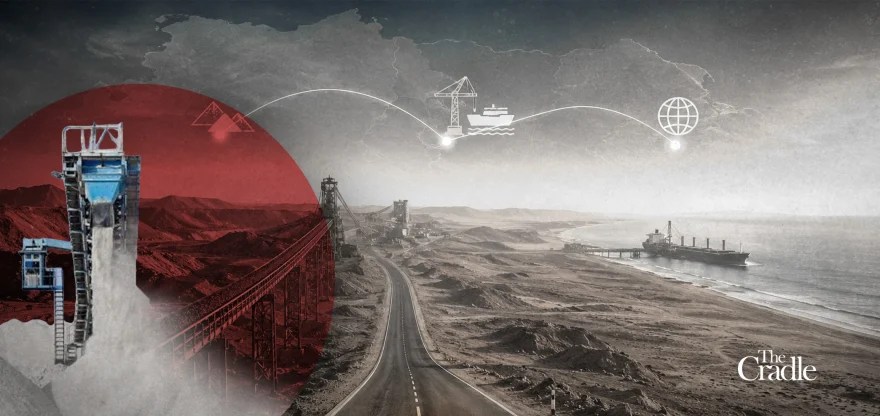
There is a machine in the Sahara you can see from space. A conveyor belt, the longest on earth, nearly one hundred kilometers of steel from a mine called Bou Craa to the Atlantic. For half a century it has moved phosphate out of occupied Western Sahara, through wars, ceasefires, and a promised referendum that never came. The richest layer of the deposit is already gone, sold before the Sahrawis could ever vote on it. And the electricity that keeps the belt running is sold to the state by a wind farm belonging to the king.
On 26 July, US President Donald Trump announced that the highway running past this machine now carries his name. The announcement arrived as a four-minute Truth Social video, narrated by an obvious AI voice praising his “historic courage.” Rabat, six days on, has not said the name out loud. It does not need to. The name was never the payment.
The road is. It is 1,055 kilometers of settlement poured across Africa’s last colony, the kind of road empires have always built and named for themselves. It connects the mine, the port, an Israeli-held offshore block, and the duty-free fertilizer now sailing for New Orleans under an emergency Washington manufactured itself. Follow it far enough and the asphalt runs from phosphate to palace.
An occupation, bought in installments
Every payment has a paper trail, and this one begins five years before the name. The convention that built the road was signed in the presence of Moroccan King Mohammed VI in El-Aaiun (also known as Laayoune) in 2015, on the 40th anniversary of the Green March, at a cost of 10 billion Moroccan dirhams (MAD) – or around $1.074 billion. Morocco poured its annexation in asphalt, as empires always have, long before Washington blessed it. What arrived in December 2020 was not the road. It was the signature.
Morocco became the fourth Arab state to normalize relations with the occupation state, and in exchange the US recognized Moroccan sovereignty over the whole of Western Sahara. Jared Kushner, Trump’s son-in-law, negotiated the deal and supplied the doctrine, likening the Sahara recognition to Trump’s recognition of Israeli sovereignty over the occupied Golan Heights. One occupation legitimized on the template of another. The architect said it so no analyst has to.
Tel Aviv paid its own installment in July 2023, when Netanyahu sent Mohammed VI a letter recognizing the Moroccan claim. A senior Moroccan official explained what the letter was for – Rabat expects the recognition to encourage Israeli investment in the territory. Recognition as prospectus. This is trans-Zionism as designed: the occupation state sets the template, Washington executes, the client kingdom collects.
What the road runs past
South of El-Aaiun, the machine comes back into view. The Bou Craa mine feeds its conveyor belt to the harbor at El-Aaiun, where bulk vessels have carried the territory’s wealth abroad since 1975. According to the figures of the world’s largest phosphate and fertilizer producer, Morocco’s OCP Group, Bou Craa delivers around a fifth of the company’s exports from just eight percent of its extracted volume. That is what occupations are for.
The quality tells its own story. Bou Craa’s deposit sits in two layers, and Western Sahara Resource Watch, which tracks every bulk shipment out of El-Aaiun, documented that Morocco has practically sold off the high-grade layer that should have been available to the Sahrawi people, mining the poorer second seam since 2014. What remains is the residue.
None of this is legally ambiguous. The UN’s legal counsel concluded in 2002 that further exploitation of the territory’s resources against the wishes of its people would violate international law. A South African court ruled in 2018 that ownership of a phosphate cargo from El-Aaiun was never lawfully vested in OCP at all. The company ships stolen goods. A court has said so. The road Trump wants his name on is the overland artery of that trade.
An emergency of Washington’s own making
The American market took the long way round. In 2021, Washington slapped a 19.97 percent countervailing duty on OCP after Florida’s Mosaic Company complained of subsidized competition. The rate yo-yoed for five years until a trade court cut it to 2.11 percent in December 2025 and Washington quietly dropped its appeal. Then came the war.
Washington’s strikes on Iran choked the Strait of Hormuz, the artery for roughly a third of the world’s seaborne fertilizer trade. Prices climbed, farmers rationed, and on 29 June Trump declared a national emergency under a Depression-era clause of the 1930 Tariff Act, suspending the duties entirely. The suspension is time-bound, not volume-bound: a USDA official confirmed OCP can ship unlimited tonnage for eight months. Washington set fire to the supply chain, declared an emergency over the smoke, and handed the normalization partner the keys to the American market.
Now examine what sails in. North African sedimentary phosphate is naturally high in cadmium, a carcinogen the EU capped at 60 milligrams per kilo in its fertilizers. OCP’s response was to lobby against the cap, hiring Dechert LLP and Edelman and proposing Brussels raise the limit to 80. The US has no comparable federal ceiling, leaving oversight to a patchwork of state rules. Europe’s restricted rock has found a market with no thermostat. American capital wasted no time: two weeks after the proclamation, US-based firm Koch Ag signed a joint venture stake in OCP’s fertilizer complex at Jorf Lasfar. The same conglomerate poured half a billion dollars into the occupation state’s tech sector through its investment arm Koch Disruptive Technologies (KDT), built under Eli Groner, Israeli Prime Minister Benjamin Netanyahu’s former top civil servant, settled in the occupied West Bank.
From phosphate to palace
Tracing the flow of revenue shows that it extends beyond the state treasury. OCP belongs to the Moroccan state. But the throne sits atop a parallel structure: the royal family controls roughly 60 percent of the Al-Mada conglomerate through personal holdings named SIGER and ERGIS, both derived from regis, Latin for king, feeding a fund in which Mohammed VI holds 50.6 percent. SIGER’s director, Mounir Majidi, is also the king’s private secretary: one man running the head of state’s office and the family vault.
Al-Mada’s energy arm, Nareva, is where the phosphate money turns royal. The wind farm at Foum el-Oued, built by a wholly-owned Nareva subsidiary, supplies nearly all the electricity OCP needs to mine Bou Craa, run the conveyor belt, and wash the rock for export. The state plunders the phosphate. The king sells the state the power that does the plundering. Every tonne leaving El-Aaiun has burned royal electricity first. All but one wind farm in the occupied territory sits in Nareva’s portfolio, and WSRW poses the question that answers itself: why would a king who profits from occupation ever back a UN peace process?
Moroccan outlet Barlamane reported that quantities invoiced on the expressway far exceeded the work actually built, prompting the equipment minister to bar the implicated survey bureau from public contracts for five years. On the road to Dakhla, even the overcharging is infrastructure.
The name was never the payment
Empires have always paved roads through conquered land and called it civilization. Rome did it, France did it in this same desert, and in July 2026 the tradition produced its densest month yet: duty-free phosphate sailing for New Orleans, Kosh Ag signing into Jorf Lasfar, and an American president naming a highway across a territory that was never Morocco’s to give. The belt at Bou Craa keeps turning, the royal turbines keep spinning, the receipts keep printing – and the only thing Rabat has still not done is say the name out loud.
Polisario Front: There Is No Military Presence by Any Foreign Power in Western Sahara
Al-Manar | May 2, 2018
The Polisario Front denied on Wednesday there was military presence by any foreign power in Western Sahara, a day after Morocco cut ties with Iran, accusing the Islamic Republic of providing support to the Sahrawi rebel national liberation movement.
UNews news agency reported that the Polisario Front hit back at Moroccan move to cut ties with Iran, stressing that the movement’s fighters are alone operating in the Western Sahara.
Meanwhile, Mehr news agency reported that the Front spokesman has dismissed the Moroccan government accusations against Iran as baseless and fabricated.
According to the Polisario Front’s website Hespress, the Front’s spokesman Muhammed Haddad has asked the Moroccan government to release any previously alleged evidence showing the links between Iran the Western Saharan movement.
Haddad added “through these maneuvers and accusations, Rabat seeks to refrain from negotiation on the desert, which the United Nations has called for.”
On Tuesday, Morocco’s foreign affairs minister, Nasser Bourita, claimed that Rabat had evidence showing Iranian government had provided financial as well as logistical support to Polisario through its embassy in Algiers.
The Morracan government has announced it will cut diplomatic ties with Iran over the accusations.
The Polisario Front is a Sahrawi rebel national liberation movement aiming to end Moroccan presence in the Western Sahara. It is an observer member of the Socialist International. The United Nations considers the Polisario Front to be the legitimate representative of the Sahrawi people and maintains that the Sahrawis have a right to self-determination. The Polisario Front is outlawed in the parts of Western Sahara under Moroccan control, and it is illegal to raise its party flag (often called the Sahrawi flag) there.
Canadian companies caught with hands in African colonial cookie jar
By Yves Engler · May 23, 2017
The recent seizure of phosphate from a Moroccan state company in South Africa and Panama is a blow to corporate Canada and a victory for national independence struggles. It should also embarrass the Canadian media.
This month courts in Port Elizabeth and Panama City okayed requests by the POLISARIO Front asking South Africa and Panama to seize two cargo ships with 100,000 tonnes of phosphate from Western Sahara, a sparsely populated territory in north-western Africa occupied by Morocco. Ruled by Spain until 1975, Moroccan troops moved in when the Spanish departed and a bloody 15-year war drove tens of thousands of Sahrawi into neighbouring Algeria, where they still live in camps.
No country officially recognizes Moroccan sovereignty over Western Sahara. The UN calls it “occupied” and the Fourth Geneva Convention as well as the Rome Statute prohibit an occupying power from exploiting the resources of territories they control unless it’s in the interest of, and according to, the wishes of the local population. In 2002 the UN Under-Secretary-General for Legal Affairs Hans Corell described the exploitation of Western Sahara’s natural resources as a “violation of the international law principles applicable to mineral resource activities in Non-Self-Governing Territories.”
Saskatoon’s PotashCorp and Calgary’s Agrium, which are merging, have a partnership with Moroccan King Mohammed VI’s OCP Group to export phosphate mined in Western Sahara. The two Canadian companies buy half of Western Sahara phosphates and it was an Agrium shipment that was seized in Panama.
To deflect from its complicity in violating international law, PotashCorp says OCP’s operations benefit the Sahrawi people. A 2014 PotashCorp statement claimed: “OCP has established a proactive affirmative action campaign to the benefit of the local people and, importantly, is making significant economic and social contributions to the entire region. As a result, we believe those who choose to make a political statement about OCP are effectively penalizing Saharawi workers, their families and communities.”
International solidarity activists have called on businesses to stop exploiting Western Sahara’s resources, which has led the Ethical Fund of Vancity credit union, four pension funds in Sweden and Norway’s $800 billion pension fund to divest from PotashCorp. A number of fertilizer companies have also severed ties to OCP, Morocco’s largest industrial company. The POLISARIO Front national liberation movement and African Union claim deals with OCP to export Western Sahara phosphate contravene international law and prop up Morocco’s control.
While only preliminary, the recent court decisions are important for national independence struggles. The South Africa case is thought to be the first time an independence movement has won legal action to intercept the export of state property.
Aside from a handful of stories in the business press, the Canadian media has basically ignored PotashCorp and Agrium’s role in violating international law. In the lead-up to the 2015 Saskatoon launch of Canada in Africa: 300 Years of Aid and Exploitation I submitted a piece about PotashCorp’s role in buying the non-renewable resources of Africa’s last remaining colony. The Saskatoon Star Phoenix opinion editor, who I’d communicated with on a few occasions when writing op-eds for a union, told me he was considering it and then responded a week later. “Hi Yves, Thanks, but I will pass on your op-ed. This issue has been on our pages in the past, with both sides of the debate making their points.” But when I searched the Star Phoenix database for articles on the largest publicly traded company in Saskatoon ties to Morocco’s occupation of Western Sahara there was a single 264-word letter to the editor criticizing PotashCorp’s policy two and a half years earlier (and a rebuttal from a company representative). Apparently, the Saskatoon business titan’s role in violating international law only warrants 264 words.
As part of writing this story, I searched Canadian Newsstream for coverage of PotashCorp and Agrium’s ties to Western Sahara. I found eight articles (a couple appeared in more than one paper) in major dailies on the subject, as well as three letters to the editor, over the past six years. Yet, as if violating international law is only of interest to those making investment decisions, all but one of the articles appeared in the business pages. When the Sisters of Mercy of Newfoundland brought a resolution to PotashCorp’s 2015 shareholder meeting about Western Sahara, the Canadian Press reported on it but only a few news outlets picked up the wire story.
While the Sahrawi struggle is unfamiliar to Canadians, it is widely known in African intellectual circles. An international solidarity campaign, with a group in Victoria, has long highlighted corporate Canada’s ties to the Moroccan occupation. I wrote about it briefly in my Canada in Africa and in an article for a number of left websites. In September 2015 Briarpatch did a cover story titled A Very Fertile Occupation: PotashCorp’s role in occupied Western Sahara and last week OurSask.ca published a long article titled Why a Segment of Saskatchewan’s Economy, and Our Ethical Compass, Hinges on an Undeveloped, War-Torn African Nation. An activist in Regina has been crowd funding for a documentary project titled Sirocco: Winds of Resistance: How the will to resist a brutal occupation has been passed on to two women by their grandmothers.
As my experience with the Star Phoenix suggest, the mainstream media is not unaware of the subject. Rather, there is a deeply held bias in favour of the corporate perspective and unless activists politicize the issue editors will ignore corporate Canada’s complicity in entrenching colonialism in Africa.
Protests in Western Sahara against solar and wind plant construction
MEMO |November 8, 2016
Protests erupted yesterday in the Western Sahara over the construction of renewable energy plants without the permission of the Sahrawi people.
The protests, which took place in the capital Laayoune, coincided with the United Nation’s COP22 conference on climate change yesterday in Marrakech.
Siemens and Enel are building solar and wind plants in the region
“Siemens should not back Morocco’s occupation of Western Sahara through energy infrastructure,” the Western Sahara Resource Watch (WRSW) said on social media.
Siemens has constructed 22 new renewable energy plants in the Western Sahara, which power over 95 per cent of mineral extraction plants in the Sahrawi region.
The World Bank, the European Investment Bank, and the European Union have previously refused to finance development projects in Western Sahara.
“If we support those investments, it would look like we are supporting the Moroccan position. We are neutral regarding that conflict,” a banker told Reuters.
The contested region has recently been engrossed in tensions between Morocco and the Sahrawi Polisario Front which has been ongoing since 1975.
Is Europe Complicit in the Plundering of Western Sahara?
By Johannes Hautaviita | teleSUR | September 17, 2015
Western Sahara, formerly a Spanish colony, has been occupied by Morocco since 1975. Although the decolonization of Western Sahara has been on the U.N.’s agenda for 40 years, Morocco (together with its allies) has managed to freeze this process, while further entrenching its hold of the occupied territory.
One of the reasons behind Morocco’s aggression and annexation was Western Sahara’s abundance of natural resources, and ever since the occupation began, Morocco has plundered these resources for economic profit. Western Sahara has one of the largest phosphate reserves in the world and is famous for its rich fishing waters, perhaps the richest along the African coast. Furthermore, the prospects for locating oil and gas deposits has attracted exploration in the territory.
In a recent development, which is all too familiar, an Irish oil company San Leon Energy began drilling south of Morocco’s border, on the north-western coast of occupied Western Sahara. For the oil drilling – and other resource extraction – to have legal validity, however, it ought to be carried out with the consent and in the interest of the occupied population. But not only has the local population of Western Sahara not been consulted, the Sahrawi people have explicitly stated their opposition to San Leon’s activities.
In a letter to the U.N. Secretary-General Ban Ki-moon, the President of the Sahrawi Arab Democratic Republic (SADR) Mohamed Abdelaziz stated, “We urgently request that the Secretary-General condemn these activities, which are in clear violation of international law, and call on Morocco and complicit foreign companies to stop the illegal exploitation of the natural resources of Western Sahara.”
The SADR’s position echoes that of the U.N. and the international community. In 2002, the Under-Secretary-General for Legal Affairs Hans Corell wrote, that if the exploitation of natural resources “were to proceed in disregard of the interests and wishes of the people of Western Sahara, they would be in violation of the international law principles applicable to mineral resource activities in Non-Self-Governing Territories.”
Contradicting countless U.N. resolutions and the clearly stated position of the SADR, San Leon claims that its “operations are in keeping with our obligations under international law and work for the betterment of all persons in the Southern Provinces of Morocco.” “Southern Provinces” is the term that the Moroccan government uses for Western Sahara.
San Leon is far from the only foreign actor engaged in legally dubious economic activity in occupied Western Sahara. The most profitable economic activity for Morocco in the occupied territory is the phosphate industry. A recent study by the watchdog organization Western Sahara Resource Watch identified nine companies that imported phosphate originating in Western Sahara in 2014 alone. The major importers were companies based in Canada and Lithuania.
Perhaps the most controversial act of the EU with regard to Western Sahara was the re-signing of a fisheries agreement with Morocco in 2013. In 2011, the European Parliament had suspended the agreement. In his speech before the parliament, professor of international law Pål Wrange stated, that were the fisheries agreement extended “it will make the EU and its member states further liable for a violation of international law, namely as a recognition of and assistance to serious breaches of international law by Morocco.”
Under the renewed fisheries agreement Morocco, in return for an annual payment of US$62 million (€40 million), European fishing vessels are granted licenses to fish in its waters, including in Western Sahara. This is legally questionable – as noted by Wrange – because it indirectly accepts Morocco’s sovereignty over Western Sahara. In 2014, the representatives of the Sahrawi people demanded an annulment of the fisheries agreement and took their case to the European Court of Justice.
A somewhat similar dynamic is at play with regard to Israel’s settlement enterprise in the Occupied Palestinian Territory. While taking the position that Israel’s settlement construction in the West Bank is “illegal under international law, constitutes an obstacle to peace and threatens to make a two-state solution impossible”, the EU’s continued trade in settlement produce supports the sustenance of the settlements. Palestinian human rights organization Al Haq even maintains that, “Without the economic support generated by trade with international stakeholders, the very existence of settlements, in particular in the Jordan Valley area, would be seriously threatened.”
It seems that the EU continues to prioritize its economic and strategic interests over international law in its bilateral relations with Morocco. The EU’s and Morocco’s annual trade amounts to nearly US$46 billion (€30 billion), accounting for more than 50 percent of Moroccan trade altogether. In fact, the EU is the biggest trading partner of both Morocco and Israel. In both cases, the EU’s economic leverage is exceptional, and its ability to exert pressure on the occupying parties, if it so wanted, is considerable.
Cuba Vows to Continue Supporting Sahrawi Education
Cuba has long supported SADR, including sponsoring education initiatives for refugees

A SADR-administered refugee camp in Western Sahara | Photo: Ryan Mallett-Outtrim/ THKW
teleSUR – September 10, 2015
Cuba’s acting education minister Cira Pineiro Alonso met with Sahrawi ambassador Malainin Etgana Wednesday, and vowed to deepen education ties with the Sahrawi Arab Democratic Republic (SADR).
The meeting in Havana, Cuba focused on Cuban investment in education in SADR, including the Simon Bolivar high school. Supported by both Cuba and Venezuela, the institution was the first high school to be constructed in SADR-administered Western Sahara.
According to SADR media, Piniero said Cuba remains willing to continue investing in the school, along with other joint projects in Western Sahara.
A sparsely inhabited territory in North Africa, most of Western Sahara has been occupied by the Moroccan military since 1975. A thin strip of the territory’s east is administered by the indigenous government, SADR. Most of SADR-administered Western Sahara is uninhabited desert, with the population almost entirely living in refugee camps huddled near the Algerian border. The Simon Bolivar school is located in one such camp.
Cuba has long supported Western Saharan independence from Morocco, and backed SADR as the legitimate government of the indigenous Sahrawi people.
Outside countries like Cuba, the drawn out political crisis in Western Sahara rarely hits international headlines, largely due to a media blackout in the disputed territory by Morocco’s occupation forces, which control around 80 percent of the territory.
Hillary Clinton’s Dirty Money
By ROBERT FANTINA | CounterPunch | May 8, 2015
As she bulldozes her way to the Democratic presidential nomination, former First Lady, New York Senator and Secretary of State Hillary Clinton is leaving no gold nugget unturned as she finances her campaign. Having amassed a wide variety of very wealthy friends throughout the global community, she is in an excellent position to call in favors and promise new ones in return for their financial assistance, as she purchases a four-year lease on the most exclusive real estate in the world.
One recent donation, not directly to her campaign, that has raised some eyebrows, although not in Democratic circles, where Mrs. Clinton, who has done little right can do nothing wrong, is money the Clinton Foundation accepted from a company owned by the government of Morocco. One might ask what the problem with such a donation might be. Cannot a foreign government donate funds to a charitable organization based in the United States?
Unfortunately, it isn’t quite as simple as that. This is not the American Red Cross we are talking about, but an organization operated by one of the most politically active and connected families in U.S. history. As late as 2011, when Mrs. Clinton was Secretary of State, the State Department accused the government of Morocco of ‘arbitrary arrests and corruption in all branches of government’. Now, we could discuss the concept of the kettle calling the pot black in terms of government corruption, but we’ll leave that for a later essay. Let’s look at some detail from the State Department report:
“The most significant, continuing human rights problems were the lack of citizens’ right to change the constitutional provisions establishing the country’s monarchical form of government, arbitrary arrests, and corruption in all branches of government.
“Other human rights problems reported during the year included police use of excessive force to quell peaceful protests, resulting in dozens of injuries and at least four deaths; torture and other abuses by the security forces; incommunicado detention; poor prison and detention conditions; political prisoners and detainees; infringement of freedom of the press; lack of freedom of assembly; lack of independence of the judiciary; discrimination against women and girls; trafficking in persons; and child labor, particularly in the informal sector.”
Following the announcement of the $1 million donation from the government-owned Office Cherifien des Phosphates (OCP), Mrs. Clinton announced that the money would be used to sponsor a conference for the Clinton Foundation in Marrakech. She called Morocco “a vital hub for economic and cultural exchange”, eliminating any mention of political prisoners, police violence or human trafficking. Might that sum of money have been sufficient to blind the former Secretary of State to facts she was aware of when she had that job?

The donation was made, and the conference announced, prior to Mrs. Clinton’s long-expected declaration of candidacy for president. But still one wonders what possible benefit there could be for the OCP in making this donation? Is this anything more than a sincere desire to help those who might benefit from the Clinton Foundation largesse?
Well, yes, there may be another beneficiary. The OCP is involved in the extraction of mineral resources from the Western Sahara, disputed territory often referred to as the ‘last colony in Africa’, that Morocco controls. It is illegal under international law for an occupying or controlling power to extract for profit the natural resources of the country in dispute. The OCP is owned by the Moroccan government. The U.S. has a long history of allowing occupying powers to exploit, in violation of international law, the natural resources of their victims: note Israel’s extraction of resources from the Dead Sea. The money that the American Israel Political Affairs Committee (AIPAC) funnels to U.S. politicians is sufficient to cause the U.S. to look the other way; there is no equivalent lobby group representing Morocco, so perhaps this donation will suffice.
Money talks in U.S. governance. The same State Department report that detailed Moroccan abuses also commented on Israel. The influence of AIPAC is clear in these so-called ‘findings’:
* “The law prohibits arbitrary arrest and detention, and the government generally observed these prohibitions for all citizens.” This, despite the almost constant arrests without charge and detention of countless Palestinian men, women and children, both in Palestine and those living in Israel.
* “Criminal suspects are apprehended with warrants based on sufficient evidence and issued by an authorized official. Authorities generally informed such persons promptly of charges against them.” See above.
* “Defendants enjoy the right to presumption of innocence and the right to consult with an attorney, or if indigent, to have one provided at public expense.” This, of course, does not apply to Palestinians.
* “Arbitrary Interference with Privacy, Family, Home, or Correspondence. The law prohibits such actions, and the government generally respected those prohibitions in practice.” Israel Defense Forces (IDF; read: Terrorists) break into Palestinian homes at any time of the day or night, search the homes, steal valuables and generally terrorize the residents. Palestinian homes are arbitrarily bulldozed to make room for illegal and internationally-condemned settlements.
The list goes on, but this should suffice to indicate the degree to which money runs roughshod over human rights in U.S. governance. One thinks that the executives of the OCP can now sleep peacefully, confident that there will be no U.S. interference in their rape of the Western Sahara.
What other foreign governments may see benefit to themselves in a future Hillary Clinton presidency? Since the U.S. is always ready to invade a nation that displeases it, often by some perceived threat to U.S. economic dominance, one would think that most nations will be running to Mrs. Clinton with checkbook in hand, wanting to please the fairy queen and appease the economic gods so worshiped by the U.S. Additionally, such homage would enable them to ignore human rights and exploit the poor for the benefit of the rich, without the U.S. complaining about such abuses. And who will the presumptive Democratic nominee turn away? Anyone? After all, with an alleged target of $2 billion dollars for her campaign, there really are no human rights abuses that can’t be overlooked. Perhaps Syria will make a substantial donation, and thus end U.S. aggression against it.
But are there not built-in protections against this sort of thing, government ‘watchdogs’, if you will, to assure that no such collusion exists? In an article published in The New York Times on May 3, Federal Election Commission (FEC) chairwoman Ann M. Ravel said that “…her organization is powerless to safeguard against misconduct in 2016 presidential campaign fundraising and spending”, mainly due to partisan gridlock. So no, there is nothing to stop Mrs. Clinton, and any and all other candidates, from taking donations from whomever and wherever those donations are offered. And it is unlikely that any of those proffering untold amounts of money have the best interest of the common U.S. citizen at heart. No, they will be foreign governments who wish to begin or continue the exploitation of oppressed people without interference from the U.S., or domestic corporations seeking to continue the vast profits their shareholders earn from war, or from manufacturing products with limited safety or environmental restrictions.
As each presidential election approaches, pundits from the right and left proclaim that this is the most important in the history of the U.S., and that the very survival of the country depends on the outcome. Yet following each election, the nation does not implode in a ball of flames, but continues on, mainly with business as usual. That business is war, disregard for human rights at home and abroad and the worship of the almighty dollar. Mrs. Clinton will usher in no change; her every action speaks volumes to that fact.
Robert Fantina’s latest book is Empire, Racism and Genocide: a History of US Foreign Policy (Red Pill Press).
Featured Video
The Search for Truth: Charlie Kirk’s Assassination One Year Later
or go to
Aletho News Archives – Video-Images
From the Archives
The 9/11 “Double-Cross” Conspiracy Theory
BY LAURENT GUYÉNOT • UNZ REVIEW • SEPTEMBER 6, 2022
Is it true that “9/11 was an inside job”? Yes, insofar as Israel is “inside” the U.S. But for the 9/11 truthers who have identified Israel as the main perpetrators, “9/11 was an inside job” is at best a half-truth, and at worst an integral part of the Zionist operation, like a secondary flag sewn as a lining under the false flag of Islamism. Victor Thorn (1963-2017) wrote in his book 9/11 made in Israel: The Plot Against America (2011): “In essence, the ‘9-11 truth movement’ was created prior to Sept. 11, 2001 as a means of suppressing news relating to Israeli complicity. . . . The slogan ‘9-11 was an inside job’ was quite possibly the greatest example of Israeli propaganda ever devised.” In milder terms, it is “controlled opposition”.
A genuine truth movement would have pointed to Israel as the prime suspect from the start. From day one, it was obvious who would benefit. … continue
Blog Roll
 Aletho News
- Europe’s mounting social chaos… chickens coming home to roost for proxy war against Russia
- US-Russia Diesel Deal Becomes Massive Defeat for Ukraine
- Hormuz and the Looming Economic Catastrophe
- Dhubab offensive, media blitz and the rapid unraveling of Saudi-backed coalition’s new gambit
- Putin Conveys to Trump Iran’s Vision on Possible Conflict Resolution – Kremlin
- The Search for Truth: Charlie Kirk’s Assassination One Year Later
- ‘Harsh reality’: Iran says France seeks monopoly on power and intimidation, not peace for all
- When Will This White House Madness End?
- Huckabee aide goes to ‘unusual lengths’ to portray ‘Israel’ positively
- Trump Announces Diesel Supply Deal With Putin Following Phone Call
- If Americans Knew
- Israeli forces kill another child in Gaza – Daily Update
- Gaza ceasefire exists in name only, say more than 100 organizations
- Nearly 2 Million in Gaza Need Urgent Shelter Assistance as Winter Looms: IOM Chief Warns
- Suppressing Palestinian resistance: US charity under fire for AI monitoring of Gaza classrooms
- Thousands Are Held in Israeli Torture Camps. This Is What Happens Inside
- Israel puts Gaza’s sick, injured, newborn in peril – Daily Update
- Report claimed Mark Levin used by Israeli government to influence Trump
- Over 2,000 Gazans have died awaiting medical evacuation amid Israel’s continued siege
- How a U.S. Diplomat Suppressed and Altered Reports Critical of Israel
- 5 Palestinians Die from Israeli Strikes in Gaza as Relentless Attacks Continue
- No Tricks Zone
- New Study: 50 Years Of The Most Aggressive ‘Net Zero’ Policies Can Only Affect The Global Climate By 0.03°C
- US September “Heat” Was No Record…Many Records Set Decades Ago
- Latest European Green Energy Debacle; Portugal’s Largest Flagship Solar Park Insolvent!
- Green Energy Debacle: German Expert Professor Fritz Vahrenholt Warns Of Severe Economic And Social Consequences
- Two More Paleo Reconstructions Affirm Meters-Higher Sea Levels Across Ireland, Brazil 7000-6000 Years Ago
- New Study: Earth And Venus Surface Warmth Largely Explained By Convection And Lapse Rate, Not CO2 Or Radiation
- 2025 Nature Paper Claiming Worsening Global Drought Gets RETRACTED …Heavily Flawed
- New Study: ‘Global Drought Shows No Detectable Recent Acceleration Under Climate Warming’
- Economic Masterminds: German Socialists Suggest Taxing Productivity Gains Stemming From Using AI
- The South China Sea Has Not Been Cooperating With The Climate Change Narrative

