Lebanon proposes anti-US sanctions over embassy move
Press TV – December 9, 2017
 Lebanon’s foreign minister has told an emergency Arab League meeting that imposing economic sanctions should be considered against the US over its embassy relocation move.
“Preemptive measures (must be) taken against the decision… beginning with diplomatic measures, then political, then economic and financial sanctions,” said Gebran Bassil during an Arab Lague meeting held in Cario on Saturday.
US President Donald Trump on Wednesday defied global warnings and said Washington formally recognized Jerusalem al-Quds as the “capital” of Israel and would begin the process of moving its embassy to the occupied city, breaking with decades of American policy.
“Could this calamity bring us together and wake us from our slumber? Let it be known that history will never forgive us and our future will not be proud of what we have done,” added Bassil.
Arab League chief Ahmed Aboul-Gheit also called on world nations to recognize the State of Palestine with East Jerusalem al-Quds as its capital.
He added that Trump’s decision raised a question over Washington’s role as a peace mediator, not just in Palestine but the whole world. “The decision amounts to the legalization of occupation,” he added.
“The decision by the US administration is in its essence legitimizing the occupation and admitting and allowing their stance by force. It is a waste of international legitimacy and the principles of justice, and therefore has placed he who took (the decision) in a state of conflict with the collective will of the international community,” he stressed.
Palestinian Foreign Minister Riyad Al-Maliki called on members of the league to instruct their UN envoys to submit a draft resolution to Security Council to condemn Trump’s decision, which “betrays its hostility and bias against the Palestinian people.”
He also called on world nations to recognize the State of Palestine with East Jerusalem al-Quds as its capital.
“I expect from you to commission the Arab block (in the Security council) to immediately act in presenting a draft resolution to the security council that rejects this American decision. We also call upon all Arabs in light of this American decision that challenged, not only Arabs and Muslims, but the world as a whole, to quickly visit Jerusalem, so as not to leave it as a victim to the American decision and Israeli threat,” he added.
Jordanian foreign minister also stressed that there will be no peace and security in the region unless Jerusalem al-Quds is free.
“We want peace as a strategic option, which we demand for all of the region’s peoples completely and indefinitely. However, there will be no peace without a free and independent Palestine, there will be no peace unless Jerusalem is free, and is the capital of Palestine,” said Ayman Al Safadi.
Meanwhile, Palestinian President Mahmud Abbas’s diplomatic adviser said that Abbas will reject to meet US Vice President Mike Pence during his scheduled visit to the region later in the month.
“There will be no meeting with the vice president of America in Palestine… The United States has crossed all the red lines with the Jerusalem decision,” he added.
Clashes between Israeli security forces and Palestinian protesters in al-Quds continued on Saturday over the Trump administration’s divisive decision.
Palestinian protestors threw objects at Israeli soldiers and set trash cans on fire, while others held guns to the head of an effigy of Trump, before burning it.
US and Israel ‘Isolated’ at UN Security Council Meeting on Jerusalem

U.S. Ambassador Nikki Haley at the United Nations Security Council on December 8, 2017. | Photo: AFP
teleSUR | December 8, 2017
In an emergency meeting convened by the United Nations Security Council on the crisis prompted by President Trump’s decision to recognize Jerusalem as Israel’s capital, the U.S. stood isolated as other members unanimously condemned the decision.
The meeting was called by Bolivia, Uruguay, Italy, Senegal, Egypt, France and the United Kingdom on Friday.
Bolivian Ambassador Sacha Llorenti offered the strongest words of condemnation. Llorenti is known for his outspoken support of the Palestinian people, having debated the issue at the U.N. wearing a Keffiyah: a black-and-white scarf that has become a symbol of Palestinian resistance.
“While there are two parties in this conflict, they are not on a level playing field,” Llorenti said. “One is an occupying power, the other is an occupied people.
“One party builds illegal settlements… One party puts a seige on Gaza… One party takes over the water resources and farmlands of the other …. One of the parties engages in forced displacement. Bolivia opposes the unilateral decision of the United States to recognize Jerusalem as the capital of Israel.”
Other representatives, including France, Japan, Russia, and Sweden, expressed their dismay at the decision, saying that it would lead to violence and potentially ruin chances at the peace process that President Trump claims to favor.
Egyptian Ambassador Amr Aboulatta said he expected the decision to have a “grave” impact on peace.
The U.N. special coordinator for the peace process, Nickolay Mladenov said: “The United Nations has repeatedly declared that any unilateral decision that seeks to alter the character and status of Jerusalem… could seriously undermine current peace efforts and may have repercussions across the region.”
Despite resounding criticism from the rest of the international community, U.S. Ambassador Nikki Haley maintained that Trump’s move was “simple common sense,” and that the president remains “committed to achieving a lasting peace agreement.” She also accused the U.N. of being “hostile” towards Israel.
Israel’s ambassador was the only other party who praised the decision, calling it “courageous” and demonstrating a “true understanding of justice.”
Since Trump’s announcement, Palestinians have resolutely condemned the decision and erupted in mass “days of rage” protests. Palestinian resistance movement Hamas has called for a “new intifada,” or uprising, against Israeli occupation, a plea backed by Lebanese resistance movement Hezbollah.
Protests in various parts of occupied Palestine have met with violence by Israeli armed forces. At least two Palestinians have been killed and hundreds more injured. On Friday, the Red Crescent said they have so far attended 767 injuries in the West Bank, Jerusalem and Gaza.
Tayseer Khaled Calls for Boycott of US Goods

IMEMC News & Agencies | December 7, 2017
Amid controversy over the US decision to move their embassy to Jerusalem, PLO Executive Committee member, Tayseer Khaled, published a press release calling for an international campaign in the Arab, Islamic and Friendly States to boycott US goods.
The press release stated the following, according to the PNN :
“Tayseer Khaled , the PLO Executive Committee member, Head of the Palestinian Expatriate Affairs Department called on the Political Organizations, Trade Unions, Youth and Women Organizations and other Civil Society Organizations in Arab, Islamic and friendly countries to launch an international campaign to boycott American goods in support for Jerusalem, a response to the American insulting against our people, and for every unwise political step taken by the American Administration aimed to change the Legal and political Status of East Jerusalem, as an integral part of the occupied Palestinian Territories in June 1967, whether through moving the US Embassy from Tel Aviv to Jerusalem or recognize Jerusalem as the capital of the Israeli Occupation State.”
Khaled added that US President Trump’s administration acts viciously with the Arab and Islamic countries, and it neither gives attention to the Arab public opinion, nor to international law and the legitimacy resolutions related to the Palestinian – Israeli conflict.
Moreover, he said, it neglects the UN Security Council resolutions on Jerusalem, of which begins with resolution 215, issued on May 2nd, 1968, that denounces the Israeli Military Parade in Jerusalem, through resolution no. 476, issued on June 30th, 1980, which nullifies the Israeli measures to change the features of Jerusalem, then resolution no. 478 of Aug. 29th, 1980, which calls for non-recognition of the Israeli law on Jerusalem and the withdrawal of all the diplomatic missions from the city, as well as resolution no. 2334 on Dec. 23rd 2016, which affirms that the construction of settlements in the occupied Palestinian territories since June 4th, 1967, including East Jerusalem, is illegal, and demands it to ban all settlement activities. Furthermore, he stated that Israel doesn’t respect the advisory opinion of the International Court of Justice on the Apartheid Wall or its painful consequences on the occupied West Bank, the status quo in Jerusalem and its surroundings, and opposes the Israeli claims and annexation laws issued by the Knesset, and announced that East Jerusalem is, in fact, an occupied city, adding that Israel is obliged by international humanitarian law and international law, in general, to ensure free access to the holy sites under its control.
At the Palestinian level, Khaled called for uniting efforts to encounter any American step aimed at undermining the legal and political status of Jerusalem, and to stop dealing with the US administration as a qualified mediator to achieve a political settlement to the Palestinian – Israeli conflict. He insisted the US administration be informed that Palestinians are free of such obligations or understandings with, which propose discriminatory rules of conduct to the Palestinians that are restricting their right to go to the UN international bodies and agencies to apply for their membership, as is the case with the World Health Organization (WHO), the International Labor Organization (ILO), and the Food and Agriculture Organization (FAO) and others, or to apply to the International Criminal Court (ICC) to investigate Israel’s violations of Palestinian human rights under occupation, and to investigate war crimes and settlement crimes, which Article (8) of the Rome Statute regards as a war crime.
(photo: hadfnews.ps)
Their Jerusalem is our Ayodhya

Babri Masjid
By M K Bhadrakumar | Indian Punchline | December 7, 2017
The cat is out of the bag – the Modi government will not condemn the US President Donald Trump’s announcement recognising Jerusalem as the capital of Israel. The European Union, Russia, China and the entire Muslim world are aghast. But India ducks by claiming it has “independent and consistent… views and interests” that are “not determined by any third country.” (here)
Why such cowardly prevarication? Either the Modi government should show the courage to acknowledge that India has a pro-Zionist West Asian policy or join the vehement international opinion. There’s nothing to hide, really. PM Modi after all went and paid homage at the tomb of the founder of Zionism in broad daylight when he visited Israel, accompanied by PM Benjamin Netanyahu.
Zionism and India’s freedom struggle are antithetical to each other. Period. There is no other way to frame the moral dilemma. But, inevitably, for the Modi government, political expediency trumps morality. It simply cannot bring itself to annoy Trump. Also, Netanyahu expects Modi to stand by – after all, Israeli and Indian companies are entering into co-production of advanced drone aircraft, finally.
But then, there is more to this than an intense family affair. The Modi government has high stakes in Trump’s announcement on Jerusalem. The point is, the Modi government is also preparing for its Jerusalem announcement – construction of a Hindu temple in Ayodhya. (Both are, ironically, “campaign pledges”.)
Circumstances may vary, but the powerful symbolism is quintessentially the same – bludgeoning the “other” party into submission by creating a fait accompli. Both Jerusalem and Ayodhya are explosive issues. In a world, which is barely coping with tensions and challenges of various kinds, it is illogical to inject more poison. The toxic act is unwarranted and risky unless based on consensus within a broader framework of reconciliation.
But, on the other hand, it has become necessary to placate the ‘core constituency’ at home as well as to address compulsions that exist or are expected shortly. Certainly, Trump must shore up his Christian support base and counts on the Jewish lobby to rescue him if the Congress attempts to impeach him – that is, if Michael Flynn implicates Trump’s son-in-law Jared Kushner (a Jew, ironically) by telling FBI special prosecutor Mueller’s team that he had contacted the Russians during the campaign itself while acting on Trump’s instructions.
In India, too, the “core constituency” of the ruling elite is no longer euphoric. Dawood Ibrahim is still in Pakistan; Article 370 remains in the book. Equally, Make in India isn’t taking off. The best option is to follow Trump’s footfalls to shore up the support base and distract public opinion. By a strange coincidence, Trump’s announcement on Jerusalem and the 25th anniversary of Babri Masjid in Ayodhya overlapped on November 6. (Indian Express )
Of course, Trump is going to be pilloried by the international opinion and the US’ Middle East policies will run into headwinds. Hopefully, Trump will reciprocate India’s support. Two is company, as they say.
The bottom line is, China is the winner. Beijing probably anticipates it. This is what the foreign ministry spokesman said in Beijing on November 6 even before Trump made the announcement:
- We have noted the report and are paying close attention to the relevant development. What we worry about is any potential flare-up of regional tensions. The status of Jerusalem is a complicated and sensitive issue. All parties shall bear in mind regional peace and tranquility, proceed with caution, and avoid impacting on the long-standing basis for the settlement of the Palestinian issue or triggering new rivalry in the region.
- China firmly supports and advances the Middle East peace process. We support the just cause of the Palestinian people to restore their legitimate national rights and stand behind Palestine in building an independent, full sovereignty state along the 1967 borders with East Jerusalem as its capital. We call on all parties to remain committed to resolving disputes through negotiations and promoting regional peace and stability in accordance with the relevant UN resolutions.
There is no daylight possible between China and the Muslim world. Whereas, from now onward, there is not only daylight but also moonlight possible between India and the Muslim world.
An illegitimate capital for a state without legitimacy

By Ibrahim Hewitt | MEMO | December 7, 2017
It should come as no surprise that Donald Trump has declared that the US is recognising Jerusalem as the capital of Israel. For seasoned US-Israel watchers, it merely confirms what we have been saying for decades: Washington is no honest broker in negotiations to end the Palestine-Israel conflict. Quite the opposite, in fact; it has ensured that the odds have been stacked in Israel’s favour and turned a blind eye to its contempt for international law — which Trump clearly shares — even while its brutal military occupation has stolen ever more Palestinian land throughout the seven decades since 1948.
US recognition of Israel’s self-declared capital has no legal basis. The 1947 UN Partition Plan for Palestine, upon which Israel largely bases its international legitimacy, had three components: “Independent Arab and Jewish States and the Special International Regime for the City of Jerusalem”. Only one of these has come into being, primarily because Israel and its backers haven’t allowed the others to happen. What’s more, although the borders of the “Arab and Jewish States” were set out clearly by the UN, Israel took possession of more than its allocation, including West Jerusalem. It took the rest of the city in 1967 along with the remaining land designated for the “Arab State”, and went on to annex the Holy City; this has never been recognised by the rest of the world and, legally, Jerusalem remains “occupied territory”, as do the West Bank and Gaza Strip.
Hence, if we are to be accurate, whenever we discuss the Israeli occupation, this should refer to the West Bank, Gaza Strip and other land now accepted to be part of Israel which it has occupied since the 1949 Armistice. While paying lip-service to the UN Partition Plan for its own legitimacy, Israel continues to ignore the terms of the resolution in almost every respect. A glance at the “Disappearing Palestine” maps confirms this unpleasant fact on the ground.
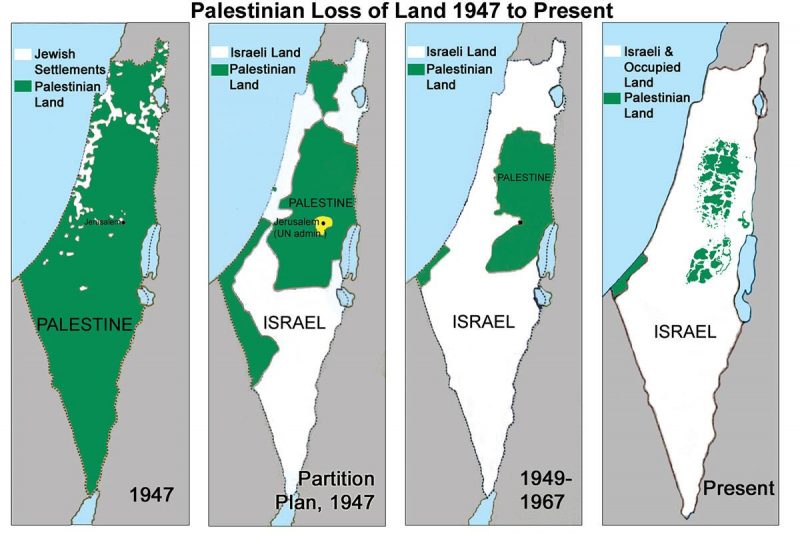
Ignoring the UN is the norm for Israel; it has violated 28 UN Security Council Resolutions — which are supposed to be binding on UN member states — and ignored at least 40 non-binding General Assembly Resolutions. There is a strong case for throwing Israel out of the UN, given such a record and the fact that its membership in the first place was dependent on allowing Palestinian refugees to return to their homes. This has never been permitted by Israel, and the UN has been unable or unwilling to enforce the will of the international community.
In part, of course, this is because of the diplomatic protection given to Israel by the United States, which has used its veto in the Security Council to block resolutions critical of Israel at least 40 times since 1972. It also reflects the impotence of Europe in the face of whatever power the pro-Israel lobby has over its politicians. European guilt over the Holocaust, perhaps? Or something more mundane, such as electoral influence and donations? Or maybe a combination of the two.
Whatever it is, we can’t pin the blame entirely on Trump and the US; European complicity has also played a role in allowing Israel to act with impunity, as has the collaboration of the Palestinian Authority in what President Mahmoud Abbas has called its “sacred” security cooperation with the occupying state. Indeed, as is now becoming clear, it seems as if major Arab countries have been involved in their own, under the radar, collaboration with Israel by establishing now very open links with the Zionist state.
It is hard to know at the moment if Trump actually understands what impact his move on Jerusalem will have on the people in the region. None of us knows for certain, of course, but it doesn’t take a genius to work out that the prospects for a just peace are now even more remote. A peace of sorts could be imposed by brute force, no doubt, but it would never be based on justice; and it would never last.
Do the US President and his right-wing supporters care about this? Probably not. America’s Christian Zionists largely back him to the hilt, and they aren’t interested in peace; they see the establishment of the state of Israel and the “incoming of the exiles” (the Jews) as an essential prelude to the second coming of Jesus and “the rapture”; ultimately, in fact, the end of the world. The late Grace Halsell explained this thinking in her 1999 book “Forcing God’s Hand”. Israel exploits this through its lobby groups around the world to gain political, military and economic support.
What effect will Trump’s declaration have on the Palestinians for whom Jerusalem is home? Will Israel complete the ethnic cleansing of the city by forcing them out and bringing their complete ethnic cleansing a step closer? With the US watching its back, it is perfectly feasible that the far-right government of Benjamin Netanyahu will feel emboldened enough to do this.
Another option would be for the Jerusalemite Palestinians to be offered Israeli citizenship, but that would upset those who already see Israel’s 20 per cent non-Jewish citizens as a democratic threat to the “Jewish State”. The likelihood, therefore, is that Israeli Apartheid will simply be entrenched further and those Palestinians left in occupied Jerusalem will face yet more discrimination at the hands of an overtly racist government.
Pro-Israel lobbyists are forever bleating that the campaign for justice for and by the Palestinians seeks to “de-legitimise” the state, but they have yet to explain with any credibility the validity of its credentials; in truth, there is none. Israel’s latest poodle in Washington has now recognised an illegitimate capital for a state without legitimacy.
Moreover, Israel has become a rogue state par excellence; not only is its star rising— for now — but it has also been incredibly successful in convincing the major powers in the world that it is the innocent victim in all of this. However, it is no longer surrounded by hostile states; the “self-defence and security” excuse for its vile occupation and military offensives against Palestinian civilians is unravelling as Saudi Arabia and the UAE join Jordan and Egypt in tying their camels and putting their trust in Tel Aviv.
Israel is ticking the boxes on its wish list. The battle for Jerusalem appears to have been won. After incessant Jewish colonial-settler incursions into the Noble Sanctuary — which will be viewed in the future as its initial skirmishes — the battle for Al-Aqsa Mosque, the heart of the Palestinian and Muslim presence in the Holy Land, may well be about to start in earnest. Recognition of Jerusalem as Israel’s capital is just the beginning. The next target will be to occupy and demolish Al-Aqsa and the Dome of the Rock Mosques and build a temple in their place. The blueprints for this are already prepared.
With the villain of the piece portrayed as the victim — poor little Israel — and those with international law and justice on their side demonised as wrongdoers, the days of the False Messiah may well be upon us. Anyone for Armageddon?
@ibrahimhewitt56
US Marine chopper reportedly drops object on Okinawa nursery during flyover

FILE PHOTO: Sikorsky CH-53 © Wikipedia
RT | December 7, 2017
The staff of a nursery school located 300 meters from a US base in Okinawa has found an object, which apparently fell on the roof from a US helicopter. Some 50 children were playing in the grounds at the time of the flyover.
The object was discovered on the roof of the Midorigaoka nursery in Ginowan City, which is located beside the US Marine Corps Futenma Air Station. The staff found it on Thursday at around 10:20am, just after a US military aircraft flew over the daycare facility, reports NHK.
Head of the nursery, Takehiro Kamiya, said staff went to check what had happened when they heard a loud sound from the roof. They found a cylindrical object that was 10cm long and 7cm in diameter. It had a warning sign that read: “Remove before flight” painted in English, according to footage shown by the TV channel.
The director said the nursery provides daycare for 61 children. Around 50 of them were playing in the garden outside at the time of the incident, while others were inside. Nobody was injured, but people working at Midorigaoka say the outcome could easily have been different.
“I’m appalled to think what would have happened if the falling point had shifted just a little bit,” said Take Nago, the 78-year-old chief caregiver at the facility, as cited by Kyodo news agency.
According to the Japanese Defense Ministry, a Sikorsky CH-53 Sea Stallion flew over Ginowan City at the time of the incident. The transport helicopters stationed at the Futenma Air Station have been a target for complaints by residents of the city, who have cited concerns about noise and risks associated with their flights. One of the most memorable incidents involving the aircraft happened in August 2004, when one of the Marine helicopters crashed into a building at Okinawa International University. Fortunately, it was largely vacant for summer break at the time. The crash was caused by poor maintenance of the helicopter, an investigation later found.
Another CH-53 crash-landed in northern Okinawa during a training exercise in October. The crash site was only a few hundred meters from the residential area of Higashi village. And last week, an F-35A Lightning II stationed at Okinawa’s Kadena Airbase dropped a panel during its flight, leaving a dent in its high-tech stealth coating.
Pentagon quadruples troop levels in Syria to ‘stabilize’ liberated areas
RT | December 7, 2017
The US military has increased the number of troops in Syria from 500 to 2,000, the Pentagon says, adding that the “conditions-based” military presence is justified by the need to “stabilize” liberated areas.
The Pentagon has officially announced that there are now 2,000 troops in Syria – a fourfold increase from the previous figures given. “The United States will continue necessary counterterrorism and stabilization effort,” Pentagon spokesman Colonel Robert Manning said.
“The United States will sustain a conditions-based military presence in Syria to combat the threat of insurgent-led insurgency, prevent the resurgence of ISIS and to stabilize liberated areas.”
Manning claimed that the Iraqi Army and Syrian Democratic Forces (SDF) have liberated about 97 percent “of the people and land” previously controlled by Islamic State (IS, formerly ISIS) in Iraq and Syria respectively. He said the campaign to defeat IS is now in a new phase in these countries.
Coalition forces are still needed in the two countries, Manning said, adding that they will now focus on “train, advise and assist” missions. “As the terrorist group continues to lose territory, important work remains to ensure its lasting defeat.”
The US military has repeatedly refused to acknowledge the number of troops and “military advisers” it has fighting alongside anti-government rebel forces. Under the Obama administration, the Pentagon routinely announced foreign troop deployments, but the Trump administration stopped disclosing such information regarding Operation Inherent Resolve. The policy was reversed in the spring of 2017 in order to maintain the “element of surprise” against Islamic State in both Syria and Iraq.
Damascus views the US military engagement in Syria as illegitimate, as there was no official request for intervention from the government. Early in November, Syrian leader Bashar Assad said his government will deal with any “illegal invader force.” He added that the war in Syria will continue until there is a full “recovery of security and stability to all Syrian lands.”
Washington insists its military presence in Syria is lawful and justified by UN mandate. In mid-November, US Defense Secretary James Mattis claimed the United Nations sanctioned the US presence in Syria.
“You know, the UN said that… basically we can go after ISIS. And we’re there to take them out,” Mattis said. Moscow responded by saying the UN cannot greenlight a foreign invasion of Syria, as it is contrary to international law.
Media reports indicate that the US is not planning to leave any time soon. According to the Washington Post, the US wants to keep troops in Syria long after Islamic State is defeated to help the Western-backed SDF establish “new local governance” structures in order to prevent complete victory by the Syrian government and its ally, Iran.
Read more:
Khamenei: Palestine will at last be freed
Press TV – December 6, 2017
Leader of the Islamic Revolution Ayatollah Seyyed Ali Khamenei says the Muslim world will stand against a US plot to declare Jerusalem al-Quds as Israel’s “capital,” stressing that Palestine will eventually be freed from occupation.
Speaking on Wednesday on the occasion of the birth anniversary of Prophet Muhammad (Peace be upon Him), Ayatollah Khamenei stated, “Palestine today tops the political issues facing the Islamic Ummah and everyone is duty-bound to make endeavors towards its freedom and salvage.”
The Leader made the remarks in an address to state officials, ambassadors of Muslim countries and participants at the 31st International Islamic Unity Conference underway in Tehran.
Ayatollah Khamenei said that the enemies’ plan to recognize Jerusalem al-Quds as the “capital” of the Israeli regime stems from their “incompetence and despair.”
“The Muslim world would undoubtedly stand against this conspiracy and the Zionists will be dealt a heavy blow with this move and dear Palestine will at last be liberated without doubt,” he added.
US President Donald Trump is expected to announce the recognition of Jerusalem al-Quds as the Israeli “capital” and move Washington’s embassy from Tel Aviv to the occupied city.
The US bid has drawn a wave of condemnations from various countries and international bodies, which are warning of the repercussions of such a measure across the region.
Elsewhere in his comments, Ayatollah Khamenei described the US, the Zionist regime and the reactionary elements as well as those tied to big powers as “today’s Pharaohs,” noting that they are trying to sow divisions and pit Muslim nations against each other.
“Some US politicians have wittingly or unwittingly acknowledged that a war should start in the Western Asia region in order to provide the Zionist regime with a margin of safety,” the Leader said.
He also expressed deep regret over some regional rulers’ adherence to US demands, warning those serving the oppressors that their stance would be to their own detriment.
The Leader referred to “resilience” as the key to counter vicious Takfiris, who are the proxies of the US and Zionism.
The enemies’ ultimate goal of creating Takfiri groups was to spark a war between the Shia and Sunni Muslims, Ayatollah Khamenei stated.
‘Quds belongs to Islam’
Prior to the leader’s address, President Hassan Rouhani said in a speech, “Quds belongs to Islam, Muslims and the Palestinians, and there is no room for new adventurism by global arrogance.”
He also emphasized that Muslims, including Palestinians, should stand up against the conspiracy to declare Quds as the Israeli “capital,” saying Muslim states and the Organization of Islamic Cooperation (OIC) have a great responsibility in that regard.
Kushner hid his leadership of foundation that funds illegal settlements
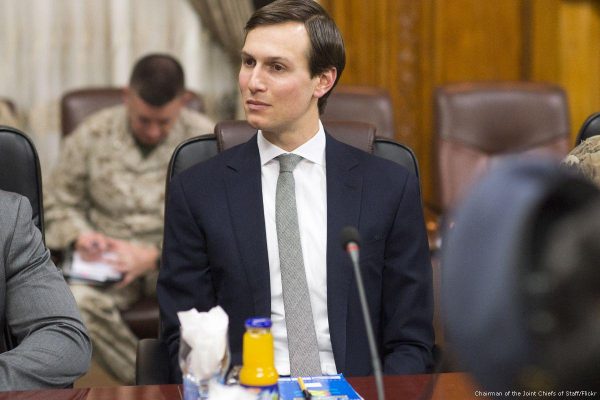
US President Donald Trump’s son-in-law and senior advisor Jared Kushner [Chairman of the Joint Chiefs of Staff/Flickr]
MEMO | December 5, 2017
US President Donald Trump’s son-in-law and senior advisor Jared Kushner failed to disclose on government records his position as co-director of a foundation that funds illegal Israeli settlements in the occupied West Bank, the Jerusalem Post reported today.
Kushner headed the family-run Charles and Seryl Kushner Foundation from 2006 to 2015, during which the organisation donated at least $38,000 to the building of a Jewish seminary in the West Bank settlement of Beit El and an additional $20,000 to Jewish and educational institutions in other settlements.
However, he did not reveal his history with the foundation to the Office of Government Ethics in March, despite having amended his financial records with the office several times and made three revisions to his security clearance application.
The US has previously called illegal settlement building as “unhelpful” in bringing together Israel and Palestine for a peace deal; Kushner is currently charged with leading that process.
According to the researchers at communications organisation American Bridge who made the discovery, Kushner may have avoided disclosing the information in order to prevent it being considered a conflict of interest with his government role.
The news of Kushner aiding settlement funding comes amid official investigations into his contact with senior Israeli officials in an attempt to block a UN resolution condemning Israel’s occupation during the transition between former US President Barack Obama and Trump. If true, the cooperation would be one of many allegations of conversations between Kushner and foreign leaders, including Russia.
Although being charged with spearheading the Middle East peace process, a recent report in Politico also found that despite carrying information on and conducting some of the country’s most sensitive diplomatic talks, Kushner does not have sufficient security clearance.
The Trump administration’s backing for Israel is thought to have been bolstered by the strong Zionist stance of many senior US officials, Kushner primary among them. The president’s son-in-law is a faithful advocate of Israel and his support for the country, say critics, is odd even by American standards. He counts Israeli Prime Minister Benjamin Netanyahu as a close family friend and has regularly visited the country even before being assigned his role as peace negotiator.
UN votes to nullify Israeli ‘jurisdiction’ over Jerusalem
Press TV – December 1, 2017
The United Nations General Assembly has voted to declare as null any Israeli measure to practice jurisdiction over Jerusalem al-Quds, days before US President Donald Trump decides whether he would relocate the US embassy to the occupied city.
In a rare show of unity against the Tel Aviv regime, 151 countries voted on Thursday to adopt a resolution that denounced Israel as the “occupying power” of the Jerusalem al-Quds, a city that is holy to Muslims, Christians, and Jews alike.
“Any actions taken by Israel, the occupying Power, to impose its laws, jurisdiction and administration on the Holy City of Jerusalem are illegal and therefore null and void and have no validity whatsoever,” read the resolution.
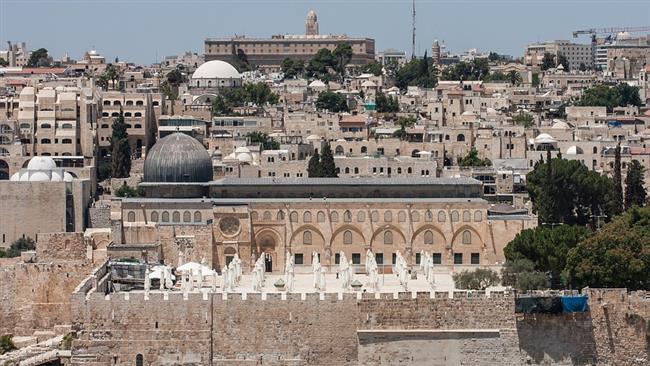
The UN members also urged Tel Aviv to show “respect for the historic status quo at the holy places of Jerusalem, including the Haram al-Sharif, in word and practice,” referring to a hill in Jerusalem al-Quds where the al-Aqsa Mosque is located.
Israel lays claim to the entirety of Jerusalem al-Quds as its “capital” while Palestinians want its eastern part as the capital of a future state for themselves.
The city has seen tensions since 2015, when the Israeli military introduced restrictions on the entry of Palestinian worshipers into the al-Aqsa Mosque — Islam’s third holiest site. Over 300 Palestinians have lost their lives at the hands of Israeli soldiers ever since.
Last year, it was reported that Israel has been omitting from the city’s maps significant Muslim and Christian holy sites and entire neighborhoods in the area while highlighting dozens of sites with dubious historical importance.
Only five countries — the US, Canada, the Marshall Islands, Micronesia and Nauru — opposed the Thursday resolution at the UN, which was also voted down by Israel’s UN envoy. Nine countries also abstained.
US embassy relocation
The strong-worded statement by the UN came days before Trump has to make up his mind over moving the US embassy from Tel Aviv to Jerusalem.
Since US Congress ruled in 1995 that the embassy be relocated from Tel Aviv, every president has deferred the tough decision. The act contains a clause that allows the president to renew a six-month waiver on the decision.
US Vice President Mike Pence says his boss, Donald Trump, is considering “when and how” to move the US embassy to Jerusalem al-Quds as a Friday deadline approaches.
Palestinians have warned that the potential relocation would fuel strong reaction in the region and deliver a death blow to any prospect of resolving the Israeli- Palestinian conflict.
The Israelis and redefining sovereignty
By Ahmed Jamil Azam | Arabi21 | November 28, 2017
The events currently occurring in the Palestinian arena, specifically the American vision for the Palestinian issue, are similar to a huge marketing campaign, as well as the sanctions that will be imposed on anyone who refuses the marketed product. This is despite the important fact that the product being marketed is not even ready yet.
The Israelis want to market a new idea, or rather, a new old idea. This idea suggests that there are various forms of sovereignty and that this could be proposed to the Palestinians. This is reminiscent of the Israelis’ past proposal of what they called functional sovereignty.
The American team responsible for the peace process is composed of a group of Zionists supporting settlements in the occupied West Bank. Therefore, it is not surprising that since the formation of the American administration we have been witnessing efforts to empty the settlement process of any content that includes any Israeli withdrawal or settlement dismantlement. Hence, this team is doing three things: buying time for the Israeli occupation and its settlement expansion, marketing ideas requiring the Palestinians to back down from the idea of an independent state, and thirdly, marketing the division of peace in the Middle East into two tracks: Arab-Israel peace and Palestinian-Israeli peace.
According to Al-Monitor, which operates mainly from Lebanon and publishes material in Arabic, Hebrew and English, the American Ambassador (a Jewish Zionist) to Tel Aviv, David Friedman, the American consulate in Jerusalem, in cooperation with the US Special Representative for International Negotiations, Jason Greenblatt, are making great efforts to propose a vision that has a regional context. What Benjamin Netanyahu is doing is trying to achieve normalised relations, as well as economic, political and military relations with Arab countries allowing him to establish Israeli influence in the region in the future. Of course, there is no reference or hints of this goal, but any amateur researcher in international relations who reads the Israeli theories, especially those of the Likud Party, and is familiar with the basics of international relations, especially the realism theory, would realise these are their goals.
Instead of announcing these goals, they announce the importance of an Arab-Israeli alliance against terrorism and Iran. According to Al-Monitor, which quoted Israeli diplomats, Netanyahu is currently looking into how he can pay the lowest price to market the idea of Arab-Israeli normalisation, along with other basic ideas, such as not withdrawing from the West Bank and maintaining full security control over it. Therefore, he proposed the idea of autonomy, but called it a different name, considering it another kind of sovereignty.
If the American initiative is ever announced, it will basically say: The Palestinians must accept the status quo in return for some facilitations in their living conditions and formal changes. The Palestinians declare their state on paper, and they can declare similar things, but will not have Israeli recognition, nothing will change on the ground, and it must be within restrictions that do not include requesting international recognition or prosecuting the Israelis in the International Criminal Court.
The Israelis raised the idea of ”functional sovereignty” in Jerusalem, during the Camp David and Taba negotiations of 2000 and 2001. It can basically be called “extensive administrative powers”, and nothing more. Nowadays, similar ideas are being marketed, but only in the West Bank.
We are not certain the Americans will reach the stage of declaring an initiative. If they do announce an initiative, it will be recognition of the Likud and Israeli initiatives for autonomy, as proposed in ideas raised in the 1970s during the Egyptian-Israeli negotiations.
Even if, for the sake of argument, we assume there are some Arab states that would accept these new ideas of an entity less than a Palestinian state and the return of the refugees, which is not yet certain, it will be the Palestinians who make the decision, specifically Palestinian President Mahmoud Abbas. Based on all past experiences, the Palestinians will not agree to any solution that does not include a Palestinian state, and Abbas will reject such a proposal.
There is much room for speculation about future scenarios, including holding the Palestinians responsible for the failure, reaching a temporary agreement (Oslo 2) that involves the beginning of Arab-Israeli normalisation and making minor changes to the status of the Palestinians, or new negotiations (which the Palestinians have rejected with[out] freezing settlement expansion). However, despite this, we are certain that the majority of the world superpowers are dealing with the possibility of reaching a final agreement as something far-fetched.
The Palestinians, more than anyone else, need a strategy that includes a hint to their alternative plan if a solution is not reached.
Translation from Arabic by MEMO.
Featured Video
BRITAIN’S WARNING: PREPARE FOR WAR
or go to
Aletho News Archives – Video-Images
From the Archive
How Ukraine Tortured and Slaughtered Donbass
By Kit Klarenberg | Al Mayadeen | July 11, 2024
Almost immediately after the proxy war erupted, ISIS-tier footage of the torture and murder of Russians in Ukrainian custody emerged.
On July 6th, the New York Times published an astonishing investigation: In Ukraine, Killings of Surrendering Russians Divide an American-Led Unit. The article documents in grim detail how Chosen Company, an international volunteer battalion for Kiev, routinely executes Russian prisoners of war. It is the very first mainstream admission that this practice – a brazen breach of the Geneva Conventions, and a grave war crime – is widespread among Ukraine’s fighters, both foreign and homegrown. … continue
Blog Roll
 Aletho News
- Pentagon designates Chinese cultural centers national security threat
- Israel Demolishes Home Of Lebanese Journalist Whose Viral Film Exposed Pager Attack
- Record Oil, Empty Tanks: The UAE’s Miracle Recovery
- Burnham tackles Britain’s poverty with aggression in Yemen
- Peace in Ukraine: the easy way – or the hard way
- Trump & the Rrrrussians
- US taxpayer money laundered back through Ukraine – Musk
- Before COVID, an NIH lab chief proposed making a SARS-like bat virus more infectious
- Gates, Bourla on Trial in Netherlands Accused of ‘Great Reset’ Scheme at Vaccine Injury Hearing
- BRITAIN’S WARNING: PREPARE FOR WAR
- If Americans Knew
- An error has occurred; the feed is probably down. Try again later.
- No Tricks Zone
- Two New Studies Find Thwaites Glacier Melt Cannot Be Driven By Human Activity Or A Warming Ocean
- E-Cars Reduce CO2 Emissions By Only 41% Compared To Internal Combustion Engine Vehicles
- Predictions Made By Renowned Climate Professor Over Past Decades Have Been Proven To Be Poor
- New Study Suggests Large Regions Of The Pacific Ocean Have Been Cooling For The Last 80 Years
- Germany’s Green Energy Debacle: High Energy Costs Force Kahla Porzellan to Close After 182 Years!
- New Study: 50 Years Of The Most Aggressive ‘Net Zero’ Policies Can Only Affect The Global Climate By 0.03°C
- US September “Heat” Was No Record…Many Records Set Decades Ago
- Latest European Green Energy Debacle; Portugal’s Largest Flagship Solar Park Insolvent!
- Green Energy Debacle: German Expert Professor Fritz Vahrenholt Warns Of Severe Economic And Social Consequences
- Two More Paleo Reconstructions Affirm Meters-Higher Sea Levels Across Ireland, Brazil 7000-6000 Years Ago

