4 Palestinians killed by Israeli forces in clashes over Trump decision on Jerusalem
Ma’an – December 15, 2017
BETHLEHEM – Four Palestinians have been declared dead by the Palestinian Health Ministry in the West Bank and Gaza, after a day of violent clashes with Israeli forces on Friday across the occupied West Bank, East Jerusalem, and besieged Gaza Strip.
The ministry reported that 18-year-old Muhammad Amin Aqel al-Adam succumbed to his wounds on Friday evening after he was shot multiple times by Israeli forces in the central West Bank town of al-Bireh, after an alleged stabbing attempt against soldiers.
Al-Adam was a resident of the town of Beit Ula in the western Hebron district of the southern West Bank
In the Jerusalem area town of Anata, in the central West Bank, 29-year-old Bassel Mustafa Muhammad Ibrahim succumbed to his wounds shortly after being shot in the chest by Israeli forces during clashes in the town.
In the Gaza Strip, Israeli forces killed two Palestinians and injured hundreds others during clashes that broke out along the border between the besieged coastal enclave and Israel.
Yassir Sokhar, 31, a resident of the al-Shujaiyya neighborhood of eastern Gaza City was shot during clashes and declared dead by the ministry of health in Gaza.
The fourth slain Palestinian was identified by the ministry as Ibrahim Abu Thurayya, 29, who was shot in the head during clashes.
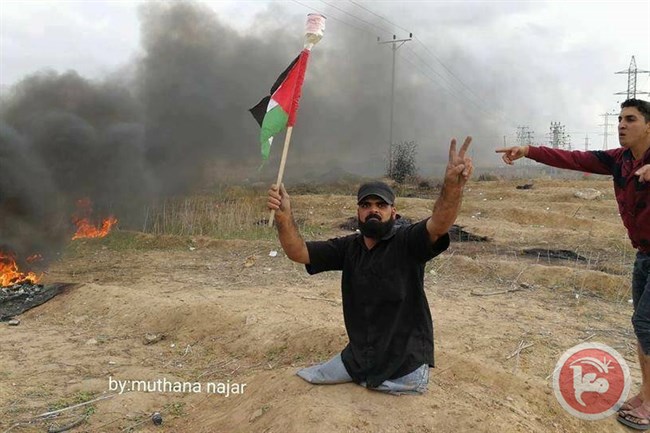
Ibrahim Abu Thurayya
Tributes to Abu Thurayya — who was wheelchair-ridden after losing both his legs during Israel’s offensive on the Gaza Strip in 2008 — popped up across social media, as Palestinians widely circulated a video of him calling on Palestinians to protest against US President Donald Trump’s recognition of Jerusalem as the capital of Israel.
Hundreds of Palestinians across the West Bank, East Jerusalem, and Gaza had been injured with live ammunition and rubber-coated steel bullets on Friday during clashes with Israeli forces in protest of Trump’s decision last week.
Friday’s events brought the death toll over the past week to 10 — six Palestinians had previously been killed by Israeli forces over the past week, four in airstrikes and two in clashes.
Palestinians have vowed to continue protesting Trump’s unprecedented decision, which Palestinian and Arab leaders warned would cause instability and unrest in the region.
Trump’s announcement was the first step to a drastic abdication of longstanding US policy that has largely adhered to international standards on Israel-Palestine, which maintains that East Jerusalem is an intricate part of occupied Palestinian territory and the capital of any future Palestinian state, despite Israel’s annexation of the territory.
The fate of Jerusalem has been a focal point of the Israeli-Palestinian conflict for decades, with numerous tensions arising over Israeli threats regarding the status of non-Jewish religious sites in the city, and the “Judaization” of East Jerusalem through settlement construction and mass demolitions of Palestinian homes.
70% of Palestinians want Abbas to resign immediately
MEMO | December 13, 2017
Some 70 per cent of Palestinians in the Israeli-occupied West Bank and Gaza Strip want President Mahmoud Abbas to resign immediately, according to a new poll by the Palestinian Centre for Policy and Survey Research conducted 7-10 December.
The poll, conducted in the occupied Palestinian territory (oPt) in the immediate aftermath of US President Donald Trump’s decision to recognise Jerusalem as the capital of Israel, makes grim reading for Abbas, with those demanding his resignation up three points from September.
Abbas’ net satisfaction rating, meanwhile, has dropped one point to minus 35, with just 31 per cent satisfied with his performance, compared to 66 per cent who are dissatisfied.
When asked about who should succeed Abbas, 35 per cent expressed a preference for Marwan Barghouthi, 22 per cent would vote for Ismail Haniyeh, while Mohammad Dahlan attracted the support of just seven per cent of Palestinians (15 per cent in Gaza and one per cent in the West Bank).
With regards to the national unity file, 38 per cent of Palestinians in the oPt are satisfied and 55 per cent are dissatisfied with the performance of the reconciliation government. Fifty per cent are optimistic and 45 per cent are pessimistic about the success of reconciliation; three months ago, optimism stood at 31 per cent and pessimism at 61 per cent.
Some 81 per cent of Palestinians in the oPt want the reconciliation government to pay the salaries of the civil employees of the former Hamas government, while only 14 per cent do not it to do so. The same number (81 per cent) want the reconciliation government to pay the salaries of the security sector employees of the former Hamas government.
With regards to Abbas’ call for “one government, one gun”, only 22 per cent of those polled support the disbanding of Palestinian factions’ armed wings in the Gaza Strip, and 72 per cent want those armed groups to remain in place.
Regarding Trump’s policy shift on Jerusalem, a plurality of Palestinians (45 per cent) believe that “the most appropriate” Palestinian response is to stop all contacts with the US administration, submit a formal complaint to the International Criminal Court (ICC) and resort to an armed intifada.
Twenty-seven per cent want an end to contacts, the submission of a complaint to the ICC, and “non-violent resistance”. Twelve per cent want the Palestinian Authority to simply denounce the US step and stop contacts with the Trump administration, while another 12 per cent want just verbal condemnation.
A plurality of Palestinians (44 per cent) believe armed resistance is the most effective means of establishing a Palestinian state, 27 per cent think negotiation is the most effective means, and 23 per cent think non-violent resistance is the most effective. Three months ago, 35 per cent indicated that armed resistance is the answer and 33 per cent sided with negotiation.
While most Palestinians believe the Trump administration will not submit a plan for Israeli-Palestinian peace, 86 per cent believe that any such plan “will not meet Palestinian need to end occupation and build a state”. Nonetheless, 49 per cent think Abbas might accept the American peace plan if one is indeed submitted to him, while 42 per cent believe he will not accept it.
Regarding “public trust in the roles and positions of major Arab countries in the peace process and the US efforts to develop a regional agreement in the context of Palestinian-Israeli peace”, 82 per cent of Palestinians in the oPt say they do not trust the Saudi role, 75 per cent do not trust the Emirati role, and 70 per cent do not trust the Egyptian role.
Renowned South African university cuts ties with Israel
Palestine Information Center – December 13, 2017
PRETORIA – “The Council of the Tshwane University of Technology (TUT) has resolved that TUT will not forge any ties with the State of Israel or any of its organizations and institutions,” TUT spokesman on the issue Professor Rasigan Maharajh told the African News Agency (ANA) during an interview on Wednesday.
A December 7 press release from TUT stated: “As a progressive university in a democratic South Africa, we want to affirm that TUT will not sign any agreements or enter into scientific partnerships until such time that Israel ends its illegal occupation of Palestinian territory.
 “The university will not stand back and accept the violations of the Israeli government when it confines the movement of Palestinian children and youth on their own land and restricts their ability to access education through destroying their schools,” added the statement.
South African criticism of Israel is growing, the ANA pointed out.
One of the controversial issues to be discussed at the ANC’s forthcoming 54th National Conference in Gauteng, from December 16 to 20, is the possible downgrading, or even closure, of the South African Embassy in Tel Aviv.
“As a constitutional democracy premised on the recognition of human rights, the Republic of South Africa must urgently discuss downgrading the status of its relationship with Israel,” said Maharajh.
TUT’s decision to cut all ties with the Jewish state also comes in the wake of strong condemnation from the South African government, and various political and human rights organizations across the country, following US President Donald Trump’s decision to move the American embassy from Tel Aviv to Jerusalem while stating that Jerusalem was the capital of Israel.
Under international law East Jerusalem is occupied territory and all international embassies have based themselves in Tel Aviv until the final status of Jerusalem is negotiated through talks.
“The announcement by the Trump regime of its intentions to establish its embassy in Jerusalem further escalates tensions,” said Maharajh.
“As guided by the founding President of the post-apartheid South Africa, Nelson Mandela, who declared that: ‘We know too well that our freedom is incomplete without the freedom of the Palestinians’, the Republic of South Africa must also condemn the actions of the Trump regime and work harder at fostering solidarity and cooperation with the people of Palestine.”
What does Trump’s Jerusalem decision actually mean?
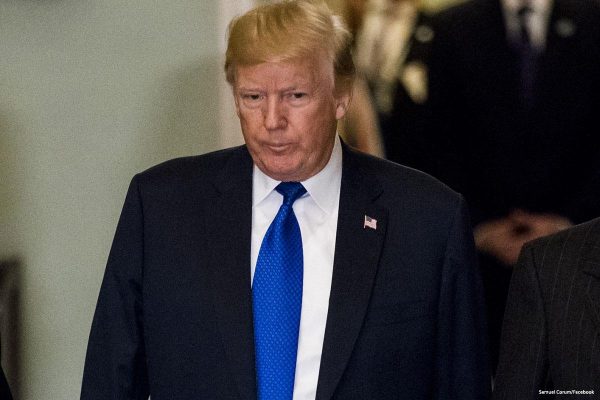
US President Donald Trump at the white house, November 28, 2017 [Samuel Corum/Facebook]
By Hassan Ben Imran | MEMO | December 13, 2017
“We cannot solve our problems by making the same failed assumptions and repeating the same failed strategies of the past… Israel is a sovereign nation with the right, like every other sovereign nation, to determine its own capital.” So said Donald Trump last week.
With such logical fallacies and ignorance of basic legal facts, as well as the fundamental principles of the UN Charter, the US President decided that it is time for a new “formula” and recognised “Jerusalem as the capital of Israel”. He overlooked the fact that Israel is far from being “like every other sovereign nation.”
No sovereign nation in modern times has ever declared independence following the ethnic cleansing of the indigenous population; and no sovereign nation has broken international law concerning Jerusalem in order to annex it and claim the city as the eternal capital of the Jewish people. Trump would be totally correct in his assumption had he been talking about any ordinary sovereign nation, but certainly not Israel.
In 1967, Israel completed its occupation of Palestine, including East Jerusalem; it is still the occupying power. Everything that Israel does in the occupied Palestinian territories, including Jerusalem, is done to make the occupation permanent. This colonialism peaked in 1980 when the Knesset (Israeli parliament) amended the Basic Law (5740 – 1980) to annex East Jerusalem and declare that “[t]he complete and united Jerusalem is the capital of Israel”.
With a sense of self-guilt, Israel worked hard to gain international recognition of its “new capital”. Knowing the grave legal and political consequences of such an ill-advised move, even its closest allies refused to acknowledge this “capital”. It was only in 1995 that the US Congress decided (or perhaps was made to decide) to recognise the Israeli annexation, although successive US Presidents have signed a six-monthly waiver to delay the implementation of the Congress decision. Israel had to wait until there was someone like Donald Trump in the White House to make the formal announcement.
The status of Jerusalem under international law
Few cities have received as much international attention as Jerusalem. This has entrenched its status in international law.
Despite the Israeli and now, sadly, the US efforts to change the status of Jerusalem through domestic legislation, media campaigns and diplomacy, several UN resolutions have affirmed and reaffirmed the opposite of what Israel sought. International law is clear on this; no state may claim, exercise or show any aspect of sovereignty over any territory through occupation.
After the occupation of East Jerusalem in 1967, Israel began a systematic campaign to force out its Palestinian citizens and change its identity, even before formally annexing the territory. This was condemned by all, including the UN Security Council, where the US abstained and did not use its veto power.
In 1971, the UN Security Council issued Resolution 298 “[deploring] the failure of Israel to respect the previous resolutions adopted by the United Nations concerning measures and actions by Israel purporting to affect the status of the City of Jerusalem” and “[Confirming] in the clearest possible terms that all legislative and administrative actions taken by Israel to change the status of the City of Jerusalem, including expropriation of land and properties, transfer of populations and legislation aimed at the incorporation of the occupied section, are totally invalid and cannot change that status.”
It was so firm a stance by the Security Council that the US refrained from blocking it. One resolution after another came from the Council, the top decision-making body in the UN structure whose resolutions are meant to be binding on all the member states of the international organisation, reaffirming the same position. The most recent was Resolution 2334 passed in December 2016 rejecting the Israeli measures related to settlements, including those in East Jerusalem, and recognising those measures as grave breaches of international law.
Furthermore, in its Advisory Opinion on the Construction of the Wall in 2004, the International Court of Justice affirmed that East Jerusalem, as a part of the occupied West Bank, is an occupied territory that belongs to the Palestinians who are entitled to self-determination.
The status of East Jerusalem as an occupied Palestinian Territory has been affirmed and upheld by almost all of the UN member states, the exception being Israel, of course, and possibly now the US following Trump’s announcement.
Can Trump change the legal status of Jerusalem?
It is ironic that the only positive aspect of Trump’s decision was that he avoided using the term so loved by the Israelis: “complete and united Jerusalem”. This was used by Israel in its 1980 annexation legislation. This is not entirely reassuring, however, as it could be manipulated given that he mentioned Jerusalem with no further detail in the full knowledge that Israel annexed the eastern sector of the city.
The major risk here is the creation of customary law recognising the “undivided” status. International Customary Law, a source of international law according to the ICJ Statute, has two essential elements which, if fulfilled, may change the legal status of Jerusalem: state practice and opinio juris. As clarified in the North Sea Continental Shelf cases, state practice has to be frequent, repetitive and consistent, as well as being conducted or used by a significant number of states participating (given the size of the international community, the practice does not have to encompass all states or be completely uniform, there just needs to be a significant degree of participation). Opinio juris is the belief that an action was carried out as a legal obligation with the full awareness of its legal consequences, which must be in existence in order for the custom to be regarded as law.
International law is about the agreement of the relevant or involved parties, and the US has been the broker of the Palestine-Israel peace process, making it a directly-involved party. As such, the US seems to fulfil both requirements, state practice and opinio juris. Even so, there has to be a significant number of states following the new US measures in order to be able to contest the current legal status of Jerusalem. The US might be pushed by the pro-Israel Lobby to exert pressure on states relying on its military assistance or financial aid to recognise the new “status quo”. This would certainly embed Israel’s occupation of Palestinian land further and encourage the state to violate international law even more than it does now.
Probable consequences
This would have dire consequences, not only for the peace process, but also the city of Jerusalem and its Muslim and Christian population. It would encourage the Israeli authorities to annex more of the occupied Palestinian territories, change their identity and complete the ethnic cleansing of their people. Even the Muslim and Christian religious authorities in Jerusalem might not be safe and could be merged with those of the occupation.
This would be even worse if other countries are forced by circumstances to follow America’s lead on the issue. Countries which depend on US aid or military protection are vulnerable to pressure from the Trump administration.
Moreover, in a worst-case scenario, the weakness of the current Palestinian leadership may lead it to proceed with the peace process under the “new terms” which keep Jerusalem off the negotiation agenda.
What is to be done?
Trump’s dangerous move needs to be met with a serious response from the Palestinians and all those who believe in the justness of their cause. The Palestinian leadership, along with the Hashemite Kingdom of Jordan, which is the official Custodian of the Holy Sites in Jerusalem, should take the issue to the UN General Assembly, and file a complaint to the Security Council. There should also be a request through the UN General Assembly for an Advisory Opinion from the International Court of Justice on the new US measures.
Clear resolutions or even statements from intergovernmental organisations, such as the EU, Organisation of Islamic Coordination (OIC), Non-Aligned Movement and Association of South-East Asian Nations (ASEAN) affirming the status of the city as occupied territory and refusing to accept the US move would halt any possibility for any change in Jerusalem’s legal status. It would also discourage other countries from giving-in to US pressure.
The ICJ has jurisdiction to settle international disputes and adjudicate on contentious issues. Palestine or Jordan may bring the case to the ICJ on the basis that the US has breached international law in a move which has a direct impact on them both. Even if the US refuses to appear before the Court, this would weaken its position.
And within the US itself?
Article VI, Clause II of the US Constitution states that “all Treaties made, or which shall be made, under the Authority of the United States, shall be the supreme Law of the Land”. Despite the federal government enjoying sovereign immunity according to US law, there are several exceptions that could apply in this case. President Trump is obviously breaching treaties, such as the UN Charter and the Fourth Geneva Convention of 1949, that are, according to Article VI, Clause II of the Constitution, “a supreme Law of the Land” and so he should be held to account under US law.
In conclusion, Donald Trump’s announcement about Jerusalem is an attack on international law and reinforces the sense that the “law of the jungle” rules in the Middle East. The international community has both the institutions and the tools to ensure the application of international law; it is time for them to be activated.
OIC recognizes East Jerusalem al-Quds as Palestine’s capital
Press TV – December 13, 2017
The Organization of Islamic Cooperation (OIC) has invited all nations to recognize Jerusalem al-Quds as the capital of Palestine, blasting the United States for disregarding Middle East peace by moving its Israeli embassy from Tel Aviv to the occupied city.
The 57-member organization issued a communique at the end of an emergency summit on Wednesday, declaring that it would recognize “East Jerusalem as the capital of the State of Palestine and invite all countries to recognize the State of Palestine and East Jerusalem as its occupied capital.”
The declaration was a direct response to US President Donald Trump days after he referred to the city as the “eternal capital” of Israel.
The OIC rejected and condemned “in the strongest terms the unilateral decision by the president of the United States of America in recognizing Jerusalem al-Quds as the so-called capital of Israel, the occupying power.”
Renouncing Trump’s move as “null and void legally,” the OIC members said the decision was tantamount to “an attack on the historical, legal, natural and national rights of the Palestinian people, a deliberate undermining of all peace efforts, an impetus to extremism and terrorism, and a threat to international peace and security.”
The OIC reaffirmed its continued commitment to the so-called two-state solution for ending the years-long Israeli-Palestinian conflict. Some speakers, however, said the US was no longer deemed reliable to mediate any peace deal.
OIC members also said they would hold the US responsible for the consequences of the decision.
The communique also denounced Israel’s actions and policies against the people of Palestine as “colonial” and “racist.”
Trump has tasked the US State Department with making preparations for the relocation of Washington’s embassy from Tel Aviv to the occupied Palestinian city.
The dramatic shift in Washington’s Jerusalem al-Quds policy has drawn fierce criticism from the international community, including Washington’s own allies, while triggering demonstrations against the US and Israel worldwide.
As the second-largest inter-governmental body after the United Nations, the OIC was established during a summit in Rabat, Morocco, in 1969, following an arson attack on the al-Aqsa Mosque in the occupied city.
Shortly after the OIC declaration, Iran’s Foreign Minister Javad Zarif hailed Islamic leaders for attending the summit in high capacities, taking an indirect jab at countries like Saudi Arabia and Egypt, which only sent low-level officials.
Saudi Arabia only sent its minister for OIC affairs, while Egyptian Foreign Minister Sameh Shoukry represented Cairo.
Moroccan MPs propose bill to criminalize normalization with Israel
Palestine Information Center – December 12, 2017
RABAT – Members of the Moroccan parliament on Monday condemned the US president Donald Trump’s decision to move the US embassy to Jerusalem which he has recently recognized as the capital of Israel.
During a parliament session held on Monday and attended by the Palestinian ambassador to Morocco, they called for activating a bill criminalizing normalization with Israel that has been frozen for more than four years.
According to the Moroccan newspaper Lakom, Habib El Malki, the president of the House of Representatives, said that Trump’s decision disregards the United Nations and its resolutions and lacks legitimacy and credibility.
He added that by this move the US has chosen to be a rival rather than a mediator in the negotiation process.
For his part, the president of the House of Counselors, Hakim Benchamach, said in statements quoted by the Moroccan newspaper that the US decision goes in line with the Balfour Declaration and threatens the stability of the international security.
MP for the Democratic Leftist Federation, Omar Balafrej, revealed that the statistics issued by the French-Israeli Chamber of Commerce show that the volume of trade exchanges between Morocco and Israel amounts to $4 million per month.
Balafrej during the meeting supported activating a bill to criminalize normalization with Israel and called for a serious study of the US latest move.
The Moroccan capital of Rabat on Sunday witnessed a mass popular demonstration against the US decision.
Donald Trump on Wednesday officially declared Jerusalem as the capital of Israel and unveiled his decision to move the US embassy from Tel Aviv to Jerusalem amid Arab and Islamic condemnation and international concerns.
Israeli security interests dominate EU diplomacy
By Ramona Wadi | MEMO | December 12, 2017
The EU Foreign Policy Chief has told Benjamin Netanyahu that there will be no mass relocation of embassies to Jerusalem. Federica Mogherini insisted that this will be the case in response to the Israeli Prime Minister’s comment that most European countries would follow Donald Trump’s unilateral decision to move the US Embassy from Tel Aviv.
However, there was no recognition from the EU regarding the shift in political dynamics, particularly with regard to the negotiations and the two-state paradigm. On the contrary, Mogherini exposed the EU’s intent to persist in diplomatic engagement within the obsolete framework, for the sake of Israel’s security interest.
As quoted in the Times of Israel, Mogherini stated: “We believe it is in Israel’s interest, especially its security interest, to find a sustainable and comprehensible solution to the Israeli-Palestinian conflict. This is why the European Union will increase its work… to relaunch the peace process, even if it seems [that these are] difficult times.”
In keeping with its usual stances, Wafa news agency also reported that the EU is seeking compensation of €30,000 from Israel for the confiscation and destruction of structures funded by Brussels. The news would have been a diversion, even at a less drastic moment, given that the EU is apparently willing to go on paying for Israel’s penchant for demolition. However, in the current circumstances, the EU’s demand is more of an assertion that the cycle of abuse and plunder is set to continue as usual, with demands unmet by Israel and the further depletion of Palestinian rights.
Despite refuting Netanyahu’s statement, which speaks about a hypothetical future and within the context of a majority of countries prioritising relations with Israel above ending its colonisation of Palestine, Mogherini’s reasons do not frame the response as any kind of solidarity with the Palestinians. The EU has embarked upon the most convenient narrative and the easiest one to articulate. If it can promote the two-state compromise as the best option to protect Israeli interests, the essence behind such reasoning does not oppose Trump’s action. In different ways, the US and the EU have promoted a distorted concept of peace which complements each other’s and, particularly, Netanyahu’s aims of using the euphemism as a veneer for Israel’s ongoing violence.
The EU might be less willing to overtly affirm agreement. Its reticence, however, should not be misconstrued as support. Eliminating the possibility of considering — let along affirming — decolonisation as the necessary process for peace, turns every decision taken by the EU into an advantage for Israel. There is no need for other diplomatic belligerence to affirm support for the Zionist state’s colonial project; the reiteration of Israeli security interests dissociated from the circumstances created by the colonial entity itself is enough.
A current rejection of Netanyahu’s hypothesis is a weak response to the threat unleashed by Trump. If the EU is to take a stance of unequivocal rejection, it has to match its rhetoric with a complete change of policy which would construct peace according to Palestinian demands based upon international law. Relaunching the peace process as the means to protect Israeli security interests makes a mockery of the losses suffered by Palestinians since the initial colonial process started more than 100 years ago and conveys flagrant contempt for the legitimate rights of the indigenous population of occupied Palestine.
Tunisians declare boycott of U.S. ships after Trump’s Jerusalem move

Palestine Information Center – December 11, 2017
TUNIS – A Tunisian labor union on Sunday evening announced its decision to boycott U.S. ships docking at a seaport in the country’s southern region of Sfax following Trump’s recognition, on Wednesday, of Occupied Jerusalem as Israel’s capital.
Spokesman of the Popular Conference for the Palestinians Abroad, Ziad al-Aloul, said on Facebook that the regional executive office of Tunisia’s Trade Unions decided to boycott all American ships docking at Sfax commercial harbor.
As part of the boycott move, workers at the seaport will not empty the shipments onboard boats tied up at Sfax seaport after they had set sail from the U.S.
Prior to the boycott, mass rallies had swept Tunisia with thousands of protesters holding up Palestinian flags and banners. Protesters also burned the U.S. flag and others stepped on images of Israeli flags.
The Delusions of Washington-Riyadh Ruling Elite and the Journalists Who Feed Them
By Richard Silverstein | Tikun Olam | Dember 9, 2017

NYT’ pro-Israel talking heads: David Makovsky and Aaron David Miller
In the aftermath of Trump’s disastrous recognition of Jerusalem as Israel’s capital, the spin from Washington and Riyadh–and the journalists and think tank analysts only too eager be spun–has been outrageous. The level of sheer delusion is stupendous. This post will offer an anatomy of delusion and why it means only more suffering and bloodshed for both Arabs and Israelis.
The Times Shills for the Two-State Delusion
The NY Times, ever the newspaper of record for the élite and their paid emissaries, purports to debate whether the two-state solution remains viable in light of Trump’s seeming endorsement of Israeli sovereignty over Jerusalem. Who does Mark Landler quote as sources? Why, think tank talking heads who earn their keep from the Israel Lobby and its donors. Landler quotes no less than four sources affiliated with Lobby, all of whom endorse a two-state solution. And none of whom have ever offered any serious analysis or balanced discussion of the one-state solution: Martin Indyk, David Makovsky, Scott Anderson, and Daniel Levy.
How many Palestinian or Arab sources does he quote? One, Saeb Erekat. And he doesn’t quote anything original from Erekat. He merely quotes statements the Palestinian made to other media outlets. He begins with Erekat saying:
… Erekat… a steadfast advocate for a Palestinian state, said in an interview on Thursday that Mr. Trump and Prime Minister Benjamin Netanyahu of Israel “have managed to destroy that hope.” He embraced a radical shift in the P.L.O.’s goals — to a single state, but with Palestinians enjoying the same civil rights as Israelis, including the vote.
“They’ve left us with no option,” he said. “This is the reality. We live here. Our struggle should focus on one thing: equal rights.”
Once Landler lays this out, he must debunk it immediately. And he does:
Mr. Erekat’s change of heart is unlikely to change Palestinian policy. The dream of a Palestinian state is too deeply ingrained in a generation of its leaders for the Palestinian Authority to abandon it now. Israel would be unlikely to accede to equal rights, because granting a vote to millions of Palestinians would eventually lead to the end of Israel as a Jewish state.
Who is a NY Times reporter who knows little about what Palestinians believe, to say that a two-state solution is “too deeply ingrained” to be abandoned? And note who he points to as the arbiters of what Palestinians accept or believe? “Leaders,” by whom he means the doddering old kleptocratic octogenarians who have sold out the Palestinian cause for decades. Landler makes no attempt to reach out to Palestinian activists or academics or indigenous NGOs who know much better what the Palestinian street is thinking. Does Landler think that only leaders matter? Does he think leaders this corrupt and out of touch can merely wave a magic wand and four million Palestinians will follow them like the Pied Piper of Hamelin?
Further, why would Israel’s objections to “equal rights” and a one-state solution be a reason this doesn’t become the eventual resolution of the issue? Why do we assume that Israel will always be calling the shots? Did Serbia call the shots regarding Kosovo or Bosnia after NATO intervened? Why does the resistance of a nation which threatens to take the entire region to the brink of Armageddon become an immovable obstacle? The sheer chutzpah of such an assumption is enormous.
Later, the article offers the administration’s rebuttal of the Palestinian perspective on Trump’s proclamation:
Administration officials strenuously reject the argument that Mr. Trump has foreclosed a two-state solution… He studiously avoided taking a position on the eventual borders or sovereignty of Jerusalem.
That is either an ignorant or disingenuous statement. When you recognize Israeli sovereignty over Jerusalem (not over “west Jerusalem,” as Trump could have said) and you omit any reference to Palestinian sovereignty over East Jerusalem, then you’ve taken a crystal clear position on borders and sovereignty. You’ve said Israel has sovereignty and the Palestinians don’t. If you believe otherwise, you’re a fool or a villain (or both).
Then Landler chimes in with an affirmation of Trump’s claims of even-handedness:
Beyond the president’s words, there were other signs he is serious about his intentions. On the same day that he signed his name with a John Hancock-like flourish to a proclamation recognizing Jerusalem as the capital, he quietly signed another document that will delay the move of the American Embassy to the city for at least six months — and probably much longer.
How does Trump’s recognition that he can’t immediately move the embassy for a thousand logistical reasons equate to Trump being “serious in his intentions” to be fair and balanced in weighing the claims of Palestinians? Should Palestinians view the delay in moving the embassy as a gift to them? Something that has any real benefit or meaning to them?
At this point, Landler gives voice to his first pro-Israel talking head, Martin Indyk, who makes this blindingly astute observation:
“Avoiding a move of the embassy is a way of avoiding geographic definition,” said Martin S. Indyk, a former American ambassador to Israel. “Avoiding any geographic definition of their recognition of Jerusalem looks like their effort to keep the peace process alive.”
It’s hardly much of an affirmation by Indyk of Trump’s peace process. But he does seem to believe that by not moving the embassy, the U.S. believes it’s offered the Palestinians something. When of course, it’s nothing and will have no value to any Palestinian.
Landler’s coup de grâce in terms of marshalling pro-Israel analysts is David Makovsky. And his comments have to be read to be believed:
… Some longtime Middle East observers said Mr. Erekat’s talk of a one-state solution reflected anger rather than a watershed change in the Palestinian position. Given Israel’s probable rejection of equal rights, American and Israeli supporters of a two-state solution said that option, for all intents and purposes, remained the only game in town.
“I don’t want to minimize the hurt the Palestinians feel,” said David Makovsky, a senior fellow at the Washington Institute for Near East Policy. “But there was a duality to Trump’s message that has gotten lost.”
Mr. Trump, he said, was not closing the door to negotiations on borders and sovereignty. “Both parts should be heard,” he said. While he questioned the timing of the move, he said the Palestinians could return to the table when tempers cool.
“Right now their anger is such that they probably can’t hear this,” Mr. Makovsky said. “But if he presents a plan in the first quarter, are you not going to want to hear what it is? The Palestinians still think Trump’s enough of a bulldozer that if he gave something to the Israelis on a Wednesday, he’s capable of giving something to the Palestinians on a Thursday.”
It’s quite amazing that a pro-Israel shill like Makovsky who knows the two-state solution is dead and knows that no one in power in Israel or the U.S. believes in it, can still sell a journalist like Landler a bill of goods. And note that Landler only quotes analysts who support a two-state solution and a PLO official who also has supported it till now. There are no sources here offering an alternative point of view. None. Which means this article is journalism in bad faith, whether the reporters who compiled it were aware of this bias or not.
Note that the strongest adjective Makovsky can muster to describe Palestinians emotions is “hurt.” No, hurt is when you skin your knee or sprain your pinkie. What Trump did to Palestinians is more like a shot to the gut; a paralyzing blow that deprives them of any hope and drives them into the arms of radical extremists.
I also like Makovsky’s assurance that Palestinians will return to talks once their hot-headed tempers cool down. Those pesky Palestinians always let their tribal emotions get the better of them. If they could only realize they have no choice. That what Trump offers is as good as they’re going to get. Then they’d get down to business.
The sheer ignorance of Makovsky assuming that the Palestinians will have natural curiosity about Trump’s offer and want to come back to the table to hear it is amazing. Why would Palestinians care what Trump offered them? Why would they attribute any value to it given his current and past statements? And just what does Makovsky believe Trump is going to give the Palestinians on that proverbial Thursday?
Finally, Landler ends his piece quoting the “liberal” pundit of the bunch, the guy the reporter probably feels covers his bases on the left, Daniel Levy. The only problem is that Levy isn’t “on the left.” He’s a liberal Zionist, neither progressive or leftist. And Levy too supports a two state solution. So where is the diversity of opinion this subject demands?
“It’s hard to see how you can go down that route without at some stage divesting yourself of a semblance of a self-governing authority,” said Daniel Levy, the London-based president of the U.S./Middle East Project. “You’ve got to call time on the Palestinian Authority, which never became a state.”
Instead, Mr. Levy said he believed that the peace process, and the Palestinians, were in a “transitional period,” in which the two-state solution had failed for now. But he added, “what people have done can be undone.”
Got that? Two states are dead “for now.” But not forever. That should give Palestinians hope that at some point in the vague future we men of good faith can revive it; or rather pull it out of the dustheap of failed Middle East plans, dust it off, and pretend it’s as good as new.
And what does Levy mean “what’s done can be undone?” How do you undo the death of thousands? How do you undo fierce rage against a sociopathic American president and his narcissistic Saudi and Israeli buddies who believe they can put the Palestinians on ice and ignore their legitimate claims to land, rights and nation?
The Saudi Delusion
Speaking of the Saudis, this Reuters story conveys the views of the ruling Crown Prince on these matters. If anything, they’re even more delusional than Trump or Netanyahu’s views. Before I offer a sampling, it’s worth hearing about the plan Trump is offering (and which the Saudis are endorsing):
As told to Abbas, the proposal included establishing “a Palestinian entity” in Gaza as well as the West Bank administrative areas A and B and 10 percent of area C, which contains Jewish settlements, a third Palestinian official said.
Jewish settlements in the West Bank would stay, there would be no right of return, and Israel would remain responsible for the borders, he said.
The proposal appears to differ little from existing arrangements in the West Bank, widening Palestinian control but falling far short of their minimum national demands.
A Palestinian entity. Not even a state. And even if someone wanted to call it a state, it wouldn’t be. It would be a bantustan of Palestinian villages surrounded by massive Israeli settlements. If the proposal essentially ratifies a rotten status quo, why would any Palestinian be willing to accept it?
Here is the real zinger, displaying the absolute cluelessness of the Saudis involved with this charade:
A Saudi source said he believed an understanding on Israeli-Palestinian peace would nonetheless begin to emerge in the coming weeks.
“Do not underestimate the businessman in (Trump). He has always called it the ultimate deal,” the source said, declining to be named because of the sensitivity of the subject.
“I don’t think our government is going to accept that unless it has something sweetened in the pipeline which (King Salman and the crown prince) could sell to the Arab world – that the Palestinians would have their own state.”
In other words, because Trump offers some blather about an ultimate deal, but refuses to offer the Palestinians any details other than assure them it would be “something they would like,” then we’re to assume that it would be “sweet” enough for MbS to sell (the Saudi’s apt words, not mine) to the Palestinians. I don’t know who’s worse, Trump or MbS. It’s worse than the blind leading the blind. It’s the deaf, dumb, and blind leading the deaf, dumb and blind.
The Reuters article too suffers from a surfeit of sources who cynically ratify the status quo and the consensus as defined by the Middle East and Beltway elites:
Most Arab states are unlikely to object to Trump’s announcement because they find themselves more aligned with Israel than ever, particularly on countering Iran, said Shadi Hamid, senior fellow at Brookings Institution in Washington,
“If Saudi officials, including the crown prince himself, were particularly concerned with Jerusalem’s status, they would presumably have used their privileged status as a top Trump ally and lobbied the administration to hold off on such a needlessly toxic move,” he wrote in an article published in The Atlantic.
“It’s unlikely Trump would have followed through if the Saudis had drawn something resembling a red line.”
Even if this is true (and it very possibly is), why doesn’t anyone bother to say the obvious: that if the Saudis wish to betray the Palestinians and abandon their role as guardians of the region’s Muslim holy places (including Jerusalem), they themselves will be abandoned by the Arab and Muslim world. Why do the eminences grise think that the Saudis can act in any way they choose without paying any consequences in terms of regional influence?
In truth, the Saudis will make themselves irrelevant if they force this deal down the Palestinians throat. They will force those Palestinians who reject it to turn to Iran and its Shiite allies like Hezbollah. They will turn Hamas into leaders of the Palestinian resistance after the PA has abandoned its responsibility to defend Palestinian rights. Even those Sunni states like Jordan or Egypt who might feel compelled to go along with the Saudi plan, will do so with tepid enthusiasm. And at the first sign of failure, they will bolt from the stables like horses staring at a forest fire. Leaving MbS alone with his buddies, Trump and Netanyahu (who by then may be long gone as prime minister–perhaps even behind bars).
Iran’s Rouhani to Depart for Emergency Session on Jerusalem in Turkey
Sputnik – 10.12.2017
Iranian President Hassan Rouhani will leave for Turkey to participate in an emergency session of the Organization of Islamic Cooperation (OIC) on Jerusalem, a source from the president’s administration told Sputnik.
Turkish President Recep Tayyip Erdogan as the current chairman of the Organization of Islamic Cooperation has announced that the leaders of the OIC members would adopt a road map on the US decision to recognize Jerusalem as the capital of Israel and move its embassy there from Tel Aviv. He has also vowed to urge the OIC to cut ties with Israel.
Commenting on Trump’s controverisal move, Iranian President Hassan Rouhani has stated at a meeting with British Foreign Secretary Boris Johnson in Tehran on Sunday that the decision adds fuel to tensions in the Middle East.
Previously, the Iranian Foreign Ministry condemned US President Donald Trump’s decision that has been widely criticized by the international community, saying that it violated the UN resolutions.
The international community does not recognize the Israeli annexation of East Jerusalem, a holy site for three religions, and believes its status should be determined based on an agreement with the Palestinians, who seek to create their own state with the capital in the Holy City.
Featured Video
BRITAIN’S WARNING: PREPARE FOR WAR
or go to
Aletho News Archives – Video-Images
From the Archive
How Ukraine Tortured and Slaughtered Donbass
By Kit Klarenberg | Al Mayadeen | July 11, 2024
Almost immediately after the proxy war erupted, ISIS-tier footage of the torture and murder of Russians in Ukrainian custody emerged.
On July 6th, the New York Times published an astonishing investigation: In Ukraine, Killings of Surrendering Russians Divide an American-Led Unit. The article documents in grim detail how Chosen Company, an international volunteer battalion for Kiev, routinely executes Russian prisoners of war. It is the very first mainstream admission that this practice – a brazen breach of the Geneva Conventions, and a grave war crime – is widespread among Ukraine’s fighters, both foreign and homegrown. … continue
Blog Roll
 Aletho News
- Pentagon designates Chinese cultural centers national security threat
- Israel Demolishes Home Of Lebanese Journalist Whose Viral Film Exposed Pager Attack
- Record Oil, Empty Tanks: The UAE’s Miracle Recovery
- Burnham tackles Britain’s poverty with aggression in Yemen
- Peace in Ukraine: the easy way – or the hard way
- Trump & the Rrrrussians
- US taxpayer money laundered back through Ukraine – Musk
- Before COVID, an NIH lab chief proposed making a SARS-like bat virus more infectious
- Gates, Bourla on Trial in Netherlands Accused of ‘Great Reset’ Scheme at Vaccine Injury Hearing
- BRITAIN’S WARNING: PREPARE FOR WAR
- If Americans Knew
- An error has occurred; the feed is probably down. Try again later.
- No Tricks Zone
- Two New Studies Find Thwaites Glacier Melt Cannot Be Driven By Human Activity Or A Warming Ocean
- E-Cars Reduce CO2 Emissions By Only 41% Compared To Internal Combustion Engine Vehicles
- Predictions Made By Renowned Climate Professor Over Past Decades Have Been Proven To Be Poor
- New Study Suggests Large Regions Of The Pacific Ocean Have Been Cooling For The Last 80 Years
- Germany’s Green Energy Debacle: High Energy Costs Force Kahla Porzellan to Close After 182 Years!
- New Study: 50 Years Of The Most Aggressive ‘Net Zero’ Policies Can Only Affect The Global Climate By 0.03°C
- US September “Heat” Was No Record…Many Records Set Decades Ago
- Latest European Green Energy Debacle; Portugal’s Largest Flagship Solar Park Insolvent!
- Green Energy Debacle: German Expert Professor Fritz Vahrenholt Warns Of Severe Economic And Social Consequences
- Two More Paleo Reconstructions Affirm Meters-Higher Sea Levels Across Ireland, Brazil 7000-6000 Years Ago

