Holding hands, the US and Israel have decided to walk out of UNESCO. Nothing could be more appropriate. Two rogue states run by two dangerous buffoons. Two states that have wreaked immense violence across the Middle East ever since ‘Israel’ was implanted in Palestine. In addition to Palestine, the US has launched genocidal wars against three countries just since 1990, Iraq (twice), Libya and Syria and continues to back Saudi Arabia in its equally genocidal war on Yemen.
As for Israel, living permanently outside international law is a necessary condition of its existence. It should have been tossed out of the UN long ago, or at least suspended, until it mended its ways. After all, what club continues the membership of someone who does not obey the rules, is warned once, once, twice, thrice, even 50 times, but still refuses to obey the rules? But Israel does not have to mend its ways and remains a member of the ‘international community’ because another state that does not obey the rules, and shows no respect for international law either, the US, protects it at every level and in every way, fomenting even more violence.
UNESCO has done its best to protect the cultural heritage of Palestine. Nothing that is not Jewish matters to the Zionists and so little of it is Jewish that Muslim and Christian Palestine has been ravaged, not just once (1948) or twice (1967) but continuously. The destruction of Palestine is the necessary condition for the creation of Netanyahu’s ‘Jewish state.’ It is all or nothing: there can be no compromise, no either/or. The Palestinians have set forth options, one secular state, two states living side by side, but the only option acceptable to Israel is all Palestine for us and none for you.
The elimination of the Palestinian human presence in 1948 was accompanied by the destruction of close to 500 of Palestinian villages or hamlets, irrespective of their historical and cultural worth. More destruction followed after 1967, beginning with the demolition of the Magharibah quarter in 1967 to make way for a ‘plaza’ around the Haram al Sharif and continuing in the years that followed. The war also created the opportunity for more Palestinians to be driven out of their homeland, this time from the West Bank, where many had taken refuge during the Zionist onslaught in 1948.
The war was another opportunity to drive Palestine further into history, towards the point where the physical evidence had all been destroyed and the Zionists could say ‘What Palestine? There was never a Palestine here.’ In fact this is what they have been saying all along, anyway, convincing no-one outside their own ranks because the Palestinians have not gone away, because their numbers are increasing (possibly there are now more Palestinians between the Mediterranean sea and the Jordan River than the Zionist settler population) and because too much of their history can still be seen on the landscape. This is why the danger to Al Aqsa, glowing above Jerusalem, is so great because it is the living symbol of the lies being told by the Zionists.
On this subject how intriguing it is, and how frustrating for the Zionists, that in the half century they have been burrowing under and around the Haram al Sharif they have not found one object proving that the temple was ever there. There are far older structures whose ruins can be seen today. Turkey is full of them: the excavated temple at Gobeklitepe in south-eastern Turkey is 12,000 years old so how can it be that nothing is left of the grandiose structure said to have been built by Solomon where Al Aqsa now stands? The Bible speaks of a building more than 60 meters high, built from wood (the cedars of Lebanon) and huge blocks of stone. Similar material is said to have been used in the building of the second temple, completed in 515 BC and destroyed by the Romans in AD 70. It is said to have been of the same massive dimensions yet nothing has been found, no remnants of fallen stone pillars, no votive bowls, absolutely nothing, suggesting that if the temple did stand on this site the biblical descriptions were fantastically exaggerated (no surprise in a book full of fantastic exaggerations).
Furthermore, the modern day Zionists are connected to ancient Israel only by their religion. Their first colonists had no living connection with the land and no ethnic connection with the people who lived on it. Zionists continue to play on the living Jewish connection in Palestine over the centuries but do not mention that the Jews who were there when their forefathers arrived regarded Zionism as a heresy. Netanyahu’s claim that Jerusalem has been Israel’s capital for 3000 years could convince only idiots, seeing that Israel is only seven decades old and that the last Jewish state in Palestine collapsed in the sixth century BC.
In any case, irrespective of these questions, the ancient Jewish presence in Palestine cannot be accepted as justification for the destruction of what was there until the arrival of Zionist colonists in the late 19th century.
The Zionists share with the Crusaders the unsavory distinction of bringing to Palestine the greatest destruction known in its modern history. After conquering Palestine in the late 11th century the Crusaders massacred or drove all Muslims and Jews out of Jerusalem. The restitution of Muslim rule was followed from the early 16th century by four centuries of a long Ottoman peace until the British capture of Jerusalem in December, 1917. From that time onwards, Palestine has not known a day of peace. Violence and repression by the British occupiers was followed by massive violence, repression and dispossession by the Zionists, continuing down to the present day.
Jerusalem was always a prime target. Massacres and the seizure of Palestinian property in 1948 were repeated after the seizure of the eastern half of the city in 1967, followed by a continuing racist demographic war launched in complete breach of international law and the laws of any country claiming to be called civilized. What this underlines is that at heart Israel is not a modern state but a tribal, atavistic community that lives by its own brutal standards, certainly insofar as the Palestinians are concerned, and is indifferent to what the rest of the world thinks, when not actually contemptuous of what it thinks. For the Zionists to think that they can get away with this endlessly is a sure indication of the madness and delusions in their minds.
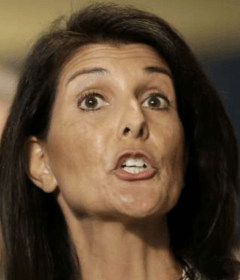
The US has now gone so far as to ‘recognize’ Jerusalem as Israel’s capital when in international law, Jerusalem is an occupied city, all of it, not just the eastern half, captured by force of arms and settled in direct violation of the laws or war. Commenting on the UN General Assembly vote rejecting the Trump declaration, Nikki Haley, the US ambassador, openly threatened those who had voted in its favor. Names had been taken and punishment would be inflicted at the appropriate time. By voting for the resolution UN members had shown a lack of respect for the US, according to Haley: where, one might ask, is US respect for international law and the right of UN members to take independent decisions on the basis of that law?
The Trump declaration on Jerusalem has had an incendiary effect across the Middle East and amongst Muslims everywhere. It should be welcomed because it rips the last veil from the deceit known as the peace process. Mahmoud Abbas has had his nose rubbed in the dirt. The Saudi and Qatari governments, dealing with the Zionists behind the thinnest of veils, have had to fall into line on the question of Jerusalem. The Trump declaration has united Muslims across all divides.
By themselves, as brave as they are, as much fortitude and steadfastness as they have always shown, the Palestinians were never going to be able to defeat their enemies on their own. They were far too powerful. The road back to Palestine was always going to lead through the Arab world, as George Habash wrote in the 1950s, now to be extended, given the rise of Iran, to the Islamic world. Nasser fired up the Arab people in the 1950s and together, Hizbollah and Iran have again set an example of defiance of the US and Israel, so successfully that Israel is now well into preparations for the war intended to destroy them once and for all.
This will be an existential war for survival, an extremely violent war for which Israel has been making intensive preparations. It is warning of total destruction and Hasan Nasrallah is warning back that Hizbollah is ready with missiles that can reach any part of occupied Palestine. The stakes in Middle Eastern wars have never been higher, the possible consequences never graver and even potentially cataclysmic. The consequences of Trump’s declaration would have been so well known beforehand that it seems insufficient to call it stupid. Perhaps it was intended to bring on the war with Iran that Israel and [Zionists in] the US have wanted for a long time.
This week saw another deadly bomb attack in the Afghan capital, Kabul, only days after US Vice President Mike Pence promised American troops “victory was in sight.”
This war is far from over, and signs are it will get much worse in the year ahead.
Lurking behind the cheery seasonal tidings brought by Pence lies a forthcoming year of much-increased violence in Afghanistan. Away from the upbeat headlines are portents of ever-deeper involvement by US elite forces in the country’s unrelenting mayhem.
In particular, the US military is moving toward a new strategy under President Trump of unleashing killer units in an apparent bid to drown the Afghan insurgency in blood. It’s a policy America has tried elsewhere, for example, the infamous Phoenix program of assassination during the Vietnam War. The policy usually fails in its stated objectives of “peace and security.”
The “surprise” nature of Pence’s whirlwind visit just before the weekend shows the Central Asian country’s security is on a knife-edge. The unannounced trip by the vice president – his first to Afghanistan – was reportedly “shrouded in secrecy” for security reasons.
Arriving on board a C-17 military plane at the giant US air base at Bagram, then flown by helicopter to meet with Afghan President Ashraf Ghani, the logistics were an unmistakable indicator of how dangerous the country is. This after 16 years of the most protracted US war ever – supposedly to defeat Taliban militants.
Earlier in September, when US Secretary of Defense James Mattis flew into Kabul International Airport, Taliban insurgents were reportedly able to launch a rocket attack on his aircraft. Mattis and his delegation did not come to harm. This time, however, US officials seemed to be taking no chances with Pence, flying the vice president under cover of darkness to the high-security military airbase.
Wishing troops a “Merry Christmas,” Pence said: “I believe victory is closer than ever before.” He assured American forces that President Trump’s new “fight-to-win strategy” for Afghanistan was “bearing fruit.”
“The results are really beginning to become evident around the country,” claimed Pence after meeting with Ghani. The question is: what “evidence” was he referring to?
It was nearly four months ago, in August, that President Donald Trump announced a new plan for military involvement in Afghanistan. It was something of U-turn on his election campaign pledges last year to wind down American overseas wars.
Under Trump, up to 4,000 troops are to return to the country taking the total US presence there to 15,000. The numbers are set to substantially increase, according to Stars and Stripes, citing US Army Undersecretary Patrick Murphy.
The re-deployment to Afghanistan is still a lot less than the peak numbers during the Obama years when troop levels surged to 100,000. But there seems to be a qualitative shift under Trump marking more deadly involvement.
Trump’s “fight-to-win” strategy suggests US troops are to pursue much more aggressive tactics. Officially, the American military is supposed to be only “advising and training” local Afghan forces. But what the Trump administration is signaling is a return to heavy combat with elite infantry troops.
The Washington Postreported that Pence was briefed by the Afghan officials that “more senior Taliban leaders have been eliminated this year than in all previous years combined.”
If that’s confirmed, that marks a dramatic increase in US combat violence under Trump. It would also tally with Trump’s declared aim to give American commanders in Afghanistan a “freer hand” to carry out missions. This gloves-off policy under Trump has the hallmarks of US troops stepping up assassination squads to go after insurgents.
Another foreboding indicator is that US military journals are reporting, according to Stars and Stripes, elite combat troops being sent to Afghanistan in anticipation of sharper fighting in the Spring season. Those forces include infantry brigades from Fort Carson, Colorado, which are trained in “unconventional warfare” and operating deep inside enemy territory. Unconventional warfare can be seen as a euphemism for extrajudicial killings, torture, and terroristic operations.
The 1st Stryker Brigade Combat Team is reportedly replacing forces from the 82nd Airborne Division, who have completed a tour of duty under Trump’s new strategy. The latter are out of Fort Bragg, North Carolina, another center for elite killer forces trained in unconventional warfare.
Stars and Stripes quotes Army General John Nicholson, the top US commander in Afghanistan, as saying he is “optimistic” that under Trump’s freer-hand instructions it would “help push the long-stalemated war in favor of the US-backed Afghan government.”
In another sign of the covert operations underway, General Nicholson said: “more than 1,000 Americans would be operating away from bases at any given time once the fighting season begins.” In other words, the Trump administration has signed off on commando-warfare in Afghanistan, not with large troop numbers strewn across the country but with hunter-combat units operating behind enemy lines. In short, elite killer teams.
Given the briefings received by Pence while in Kabul of a seeming dramatic increase in killings of senior Taliban militants, what appears to be underway in Afghanistan is a Phoenix-style assassination campaign similar to what US elite forces carried out in the early years of the Vietnam War. That was where US personnel, along with local forces, went on murder sprees targeting enemy “suspects.” In Vietnam, it is believed that thousands of innocent, non-combatants were assassinated as part of a lethal trawl against militants.
It seems sinister that while Trump is giving US military commanders the green light to expand the war with elite forces operating behind enemy lines, his vice president Mike Pence is crowing about “real progress on the ground.”
It also seems impossibly doomed. Afghanistan is now a foothold for Daesh (Islamic State) as well as the Taliban. The former terror group claimed responsibility this week for the suicide bomb attack outside the Afghan security intelligence headquarters in Kabul, reportedly killing at least 10 bystanders. In recent months, bombings have apparently surged in the capital.
Up to half of all Afghan territory is now under control of insurgent groups. Opium drug production is soaring, and the US-backed state institutions are groaning from corruption.
Former Afghan President Hamid Karzai recently claimed that terrorism and lawlessness have flourished during the US presence in his country. Indeed, Karzai said the US forces and terror groups were working “hand in hand” across Afghanistan. He cited cases where militants have been allegedly transported to various parts of the country using US helicopters. Similar claims of US collusion with terror groups have also been made by the Russian government regarding Afghanistan and Syria.
So, just what “progress” the Trump administration is referring to in Afghanistan remains cryptic.
The US-backed regime in Kabul is losing more control of territory, while the country descends further into chaos and violence. More than 30,000 civilians have been killed during 16 years of “Operation Enduring Freedom” launched by Washington in October 2001.
Fiendishly, the Afghan population is set to endure more such American-style freedom with Trump’s dispatch of killer troops.
Fifteen gas fields have been found on the coast of Palestine since 1999. With a value of at least two hundred thirty billion dollar, this gas will play an important role in the region. The key question for us is how the gas will influence the Palestinian people and their struggle for liberation. This article is a short introduction to this topic.
Who, what, how much?
The first gas field off the coast of Palestine was found in 1999 and the first flow of gas was realized five years later. Up until today fifteen gas fields have been found that belong to Palestine, six of which are being exploited by ‘Israel’.[1] The total amount of gas is between forty and fifty TCF (trillion cubic feet) and has a minimal value of $230bn.
‘Israeli’ state and exploitation
As a settler-colony and apartheid state, ‘Israel’ has complete control of the gas fields. 40% of the gas will be exported and the remaining 60% will be used for domestic consumption.[2] The sole current export is to Jordan with a total value of fifteen billion dollars. Cyprus, Greece, Italy and the EU also have a joint agreement for the construction of a pipeline to facilitate ‘Israeli’ gas exports to Europe. In regards to domestic consumption the gas makes ‘Israel’ energy independent for the coming decades. ‘Israel’s’ economic position and economic independence are clearly strengthened by the exploitation of the gas fields.
The PA and political parties
The gas has far reaching political consequences. Gas deals with foreign states on the one hand further normalize ‘Israel’ and strengthen its economy. On the other hand gas platforms, pipelines and complicit companies are new targets for the Palestinian resistance and the international solidarity movement. It is only a matter of time before the global BDS movement becomes a significant force against the ‘Israeli’ exploitation of the gas. In this sense, the political meaning of the gas is two-sided or contradictory: on the one hand it strengthens the occupation economy; on the other hand it offers more ways of resistance.
But not all Palestinians have a problem with the Zionist gas exploitation. The Palestinian Authority is as always positive about ‘Israel’ and ‘their’ gas. While the PA canceled a $1.2 billion gas deal with ‘Israel’ in March 2015[3], they offer no resistance to ‘Israeli’ control over the gas. This holds for the gas in Gaza, the Dutch institute SOMO wrote that ‘Israel’ is currently stealing the gas there.[4]
Hamas, who govern Gaza, and the PFLP have been confronting ‘Israel’ about the gas. Mohammed al Zoari, aka ‘the engineer’, was killed in Tunisia in December 2016. He was working on an underwater drone for Hamas to attack gas- and oil platforms.[5] The PFLP rejects all non-Palestinian exploitation of the gas and also agitates against regimes that make gas deals with the Zionist entity.[6][7][8][9]
The Palestinian struggle for liberation in the Netherlands
Noble Energy (United States), Delek Group and Avner (both ‘Israeli’) are the most active companies currently involved with Palestinian gas. Additionally involved is, Royal Dutch Shell (British-Dutch), mainly working on the gas fields on the coast of Gaza. While the PA is in talks with Shell about exploitation of these fields, this is likely never to be a reality. Multiple high-placed ‘Israeli’ scientists and politicians have spoken negatively about a fast exploitation of the Gaza fields. Shell also wants to buy ‘Israeli’ gas to sell in Egypt.[10]
It may be clear that the Dutch movement can play an important role because of the Shell involvement. Add to this that work is being put into constructing a pipeline from Palestine to Europe.[11] With a government that probably wants less dependence on Russian gas[12], Palestinian gas can be flowing through the Netherlands in a decade.
The BDS-movement, especially in the Middle East, is already working on stopping the gas theft. It is our task in the Netherlands to follow this example and stand shoulder to shoulder with activists in Jordan,[13], Turkey[14] and Palestine. We have to struggle in order to guarantee that the resistance will be stronger than the ‘Israeli’ gas profits.
Anti-terrorist missions should not be used to topple governments, Russian Foreign Minister Sergey Lavrov told RT, adding that Moscow has been concerned by recent reports of the US training former terrorists in Syria.
“Attempts to profit from anti-terrorist objectives – which should be common, unified and without double standards – are disturbing,” Lavrov said. These objectives should not be used to promote one’s own agenda, including “changing unwanted regimes,” he added.
Speaking of Russia-US talks on military de-escalation in Syria, Lavrov said he has “mixed feelings” about his western counterpart’s commitment to the Syrian peace process.
“Rex Tillerson used to tell me that the main goal of the US in Syria is defeating ISIS but now it is getting vaguer and vaguer,” the minister added. Instead, the forces are now said to stay in Syria until the start of the political process or, as some US officials claim, the process that involves the resignation of Syrian President Bashar Assad.
As Lavrov put it, “the information claiming that some US military bases in Syria have started to train militants, including former members of terrorist groups, is of course quite concerning.”
Earlier in December, Russia’s Reconciliation Center for Syria released a statement accusing the US-led coalition of creating the so-called ‘New Syrian Army.’ The group allegedly comprises remnants of Islamic State (IS, formerly ISIS), the Al-Nusra Front and other militants, and is based at a refugee camp in north-east Syria located 20 kilometers from Al-Shaddadah town. Local refugees, returning to areas freed from IS, say the refugee camp has been used by the coalition as a training ground for militants for at least the past six months.
As if Trump’s crass announcement moving the US embassy to Jerusalem wasn’t enough, his minions on Monday vetoed a UN Security Council draft resolution calling on the President to withdraw US recognition of Jerusalem as Israel’s capital.
Even his hand-in-hand friend Theresa May, another pimp for Israel, is against him in this. “On Jerusalem, I made it clear that we disagree with the United States’ decision to move its embassy and recognise Jerusalem as the Israeli capital before a final status agreement,” she declared. “Like our EU partners, we will not be following suit, but it is vital that we continue to work with the United States to encourage it to bring forward proposals that will re-energise the peace process. That must be based around support for a two-state solution and an acknowledgement that the final status of Jerusalem must be subject to negotiations between the Israelis and Palestinians.”
What exactly would final status and a two-state solution look like? Nobody is saying. Possibly because they all know that the idea has been filed in the too-difficult tray a for at least 20 years. There was nothing wrong with the original UN plan to make Jerusalem an international city under separate control. Why not revive that? And if the international community really wanted two states why did they spend decades giving Israel endless opportunities to establish irreversible ‘facts on the ground’ designed to make the occupation permanent? Nothing will now change without the use of force or extreme sanctions. And there’s no sign of that happening.
So please do everyone a favour, US, UK and EU. Spare us that tired old mantra.
Trump’s interference in Jerusalem’s status “null and void”
The draft resolution vetoed by the US was supported by all 14 other members of the Security Council. It called on the US President to withdraw recognition of Jerusalem as Israel’s capital and said “any decisions and actions which purport to have altered the character, status or demographic composition of the Holy City of Jerusalem have no legal effect, are null and void, and must be rescinded in compliance with relevant resolutions of the Security Council.” It required all countries not to establish diplomatic missions in Jerusalem.
America’s ambassador to the UN, Nikki Haley, stretched credibility far beyond breaking point by saying that the veto was “in defense of American sovereignty and in defense of America’s role in the Middle East peace process…. The United States will not be told by any country where we can put our embassy.
“Today” she said, “for the simple act of deciding where to put its embassy, the United States was forced to defend its sovereignty… Today, for acknowledging the basic truth that Jerusalem is the capital of Israel, we are accused of harming peace. The record will reflect that we reject that outrageous claim.”
When did Israel’s claim to Jerusalem become a “basic truth”?
Haley boasted that the US had done more than any other country to assist the Palestinian people, providing them with more than $5 billion in assistance since 1994 and funding 30% of the UNRWA (United Nations Relief and Works Agency) budget. In reality these mighty sums subsidise Israel’s ongoing illegal military occupation. Had Palestinians been left in peace they would be making their own way in the world at no cost to others.
Haley also seized the chance to slam UN Security Council Resolution 2334 adopted a year earlier. Obama, who was President then, opted to abstain rather than veto the measure, allowing it to pass.
2334 reaffirms that the establishment by Israel of settlements in the Palestinian territory occupied since 1967, including East Jerusalem, has no legal validity and constitutes a flagrant violation under international law and a major obstacle to the achievement of the two-state solution and a just, lasting and comprehensive peace;
It reiterates its demand that Israel immediately and completely cease all settlement activities in the occupied Palestinian territory, including East Jerusalem, and that it fully respects all of its legal obligations in this regard;
It underlines that it will not recognize any changes to the 4 June 1967 lines, including with regard to Jerusalem, other than those agreed by the parties through negotiations;
And it sresses that the cessation of all Israeli settlement activities is essential for salvaging the two-state solution, and calls for affirmative steps to be taken immediately to reverse the negative trends on the ground that are imperilling the two-sate solution.
What is there not to like or understand about that? Nevertheless, “Given the chance to vote again on Resolution 2334,” Haley said, “I can say with complete confidence that the US would vote ‘no’; we would exercise our veto power.”
Netanyahu’s reaction to UNSC Resolution 2334 had been entirely predictable: “Peace will come not through UN resolutions, but only through direct negotiations between the parties.” He would say that, wouldn’t he, with his military jackboot on the neck of the Palestinian people. His style of negotiation, as always, is holding a gun to the head of the other party. As everyone, especially America, knows, peace doesn’t suit Israel’s purpose although the pretense of seeking peace does.
What sensible peace proposals have there been?
Haley insisted that while Resolution 2334 described Israeli settlements as impediments to peace, it was the resolution itself that was an impediment. “Misplacing the blame for the failure of the peace efforts squarely on Israeli settlements, the resolution gave a pass to Palestinian leaders who for many years rejected one peace proposal after another,” she said.
Have there been any credible peace proposals? By now, surely, everyone realises that the Israeli regime have never wanted peace. They’ve said so loud and clear. Land-grabbing and ethnic cleansing is what they do, so the jackboot of Israeli occupation must remain firmly on the Palestinians’ neck.
And as far as I’m aware, no-one has actually told us what the two-state solution they keep banging on about would look like. No-one, that is, since Ehud Barak and his “generous offer” to the Palestinians in the summer of 2000. Zio-freaks like Haley, to this day, heap blame on the Palestinians for turning down Barak’s bizarre plan and others like it.
So what did this amazing deal amount to? The West Bank and the Gaza Strip, seized by Israel in 1967 and occupied ever since, comprise just 22% of pre-partition Palestine. When the Palestinians signed the Oslo Agreement in 1993 they agreed to accept the 22% and recognise Israel within the internationally recognised ‘Green Line’ borders (i.e. the 1949 Armistice Line established after the Arab-Israeli War). Conceding 78% of the land that was originally theirs was an extraordinary gesture on the Palestinians’ part.
But it wasn’t enough for greedy Israel. Barak’s oh-so-generous peace offer demanded the inclusion of 69 Israeli settlements within that 22% Palestinian remnant. It was obvious on the map that those settlement blocs created impossible borders and already severely disrupted Palestinian life in the West Bank. Barak also demanded the Palestinian territories be placed under “Temporary Israeli Control”, meaning Israeli military and administrative control indefinitely. The offer also gave Israel control over all the border crossings of the new Palestinian State. What nation in the world would accept that? Of course it was rejected. But the ludicrous reality of Barak’s two-state solution was cleverly hidden from the rest of the world by elaborate propaganda spin.
Later, at the Taba talks, Barak produced a revised map but withdrew it after his election defeat. The ugly facts of the matter are well documented and explained by organisations such as Israel’s own Gush Shalom, yet Israel lobby stooges continue to peddle the lie that Israel offered the Palestinians a deal they couldn’t refuse. Is Barak’s crazed vision of two states the one the US, UK and EU still have in mind when they prattle on about a peace process?
Crude blackmail
In response to America’s veto an emergency meeting of the UN General Assembly (where vetoes are not permitted) was called on Thursday to consider a resolution, co-sponsored by Turkey and Yemen, calling Trump’s recognition of Jerusalem as the capital of Israel “null and void” and reaffirming 10 security council resolutions on Jerusalem, dating back to 1967, including the requirement that the city’s final status must be decided in direct negotiations between Israel and the Palestinians.
It also demanded that “all states comply with security council resolutions regarding the holy city of Jerusalem, and not recognise any actions or measures contrary to those resolutions”.
Trump had threatened to withhold $billions of US aid from countries that voted in favour. Ambassador Haley wrote to about 180 of 193 member states warning she would be “taking names” of countries that voted for the resolution.
The Guardian reports Trump as saying: “Let them vote against us. We’ll save a lot. We don’t care. But this isn’t like it used to be where they could vote against you and then you pay them hundreds of millions of dollars,” he said. “We’re not going to be taken advantage of any longer.”
His remarks appeared to be directed at UN member states in Africa, Asia and Latin America who are vulnerable to US pressure, including Egypt which drafted the UNSC resolution vetoed by the US and which received $1.2bn in US aid last year. Trump’s threat could also affect the UK which hopes to negotiate a favourable post-Brexit trade deal with Washington.
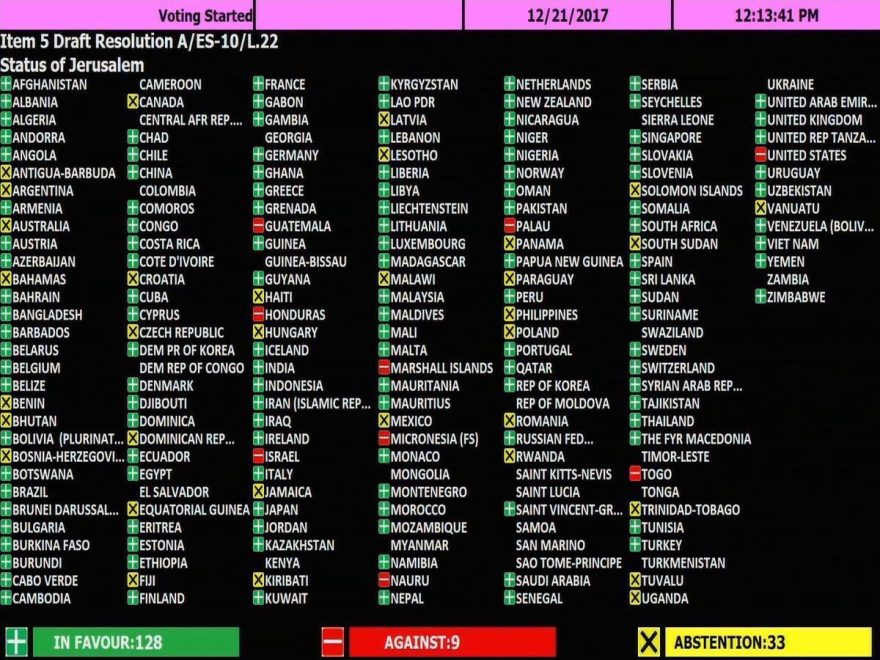
But his gutter tactics backfired spectacularly. 128 member countries including, I’m glad to say, the UK voted in favour of the resolution supporting the longstanding international consensus. Only nine states – including the United States and Israel – voted against; the rest either abstained or stayed away. A stinging rebuke, then, for Trump and his delinquent diplomacy.
Iran vilified as usual
Earlier, we saw a Saban Forum interview with Jared Kushner, Trump’s son in law and senior adviser on Middle East peace. Questioned about why his ‘team’ had no experts, Kushner replied: “It’s not a conventional team, but it’s a perfectly qualified team. When we were thinking how to put a team together, the President and I focused on who are the most qualified people, who had the right qualification and whom we both trusted.”
So they opted for a real estate lawyer and a bankruptcy lawyer. They have nobody truly qualified in Middle East affairs.
Talking about the Palestinians and Israelis Kushner insisted that “both sides really trust the President, and that’s very important”. He observed: “Many countries in the region see Israel as a much more likely ally than it was 20 years ago because of Iran, because of ISIS.” He spoke of issues of great concern: “You have Iran and their nuclear ambitions and their expansive regional mischief…”
No mention of course of Israel’s nuclear domination and expansive regional mischief.
And he simply couldn’t stop himself demonising Iran. “A lot of countries felt Iran was being emboldened and there was no check on their aggression,” he added. “The president has been very clear about his intentions on this issue, and going to Saudi Arabia and laying out a priority of fighting Iran’s aggression was significant.” Kushner said that unifying everyone against Iran’s aggression is a “world problem”.
He should read the history of US (and UK) aggression against Iran before opening his mouth again of this subject.
There was no mention of international law in the interview, just getting deals done. Peace and strengthening US-Israel relationship is central, according to Kushner. Which of course disqualifies the US as a broker.
The Saban Forum interview is touted by some as a humiliation for Kushner. I don’t agree. Jared Kushner came across as an intelligent and even likable specimen of Zionism, thoughtful and with none of the usual arrogance. But he was shown up as naive, out of his depth and unfit to serve in that position. His performance also emphasised the lunacy of allowing the commander-in-chief of a so-called democracy to bring in his family members and business cronies to meddle in the affairs of state. There’s an unfortunate word for that: nepotism.
It is surely time for Trump, as a world leader, to decide whether to live up to his responsibility to respect and uphold international law and the norms of human conduct. Otherwise he should find other employment before he does any more damage.
The last word goes to the Palestinian ambassador in London, Prof Manuel Hassassian, who hits the nail smack on the head: “The US has dug itself into a position where it is set to find itself, alongside Israel, in a face-off with the majority of world nations – outlaws trying to dictate the law. We hope and trust the global community will not waiver in the face of such bullying tactics and do the right thing under international law and the right thing for Palestine and the Palestinians.”
Syrian Ambassador to the United Nations and head of the government delegation to intra-Syrian peace talks, Bashar al-Jaafari, says US and Turkish military forces should leave his conflict-plagued Arab country immediately.
He made the demand during the latest round of Syrian peace negotiations in the Kazakh capital city of Astana.
On October 13, Turkish troops travelling in a convoy of 12 armored vehicles entered northern Syria in a new military operation.
Turkish media sources said the convoy included about 80 soldiers.
Local sources said the troops were headed towards the western part of Aleppo province.
The development came after Turkish officials said they were sending troops into Syria to enforce a de-escalation zone in Idlib, which is largely controlled by the Takfiri Hayat Tahrir al-Sham (HTS) terrorist alliance.
The de-escalation zone forms part of an agreement reached between Turkey, Iran and Russia.
Syrian congress of national dialogue to be held in Sochi in late Jan.
Meanwhile, a joint statement released after two days of talks in Kazakhstan said delegations from Russia, Iran and Turkey, Syrian government representatives as well as a 20-member opposition team had agreed to hold a “peace congress” in Russia’s Black Sea resort of Sochi as part of efforts to find a political solution to the six-year-old Syrian conflict.
The statement said the congress will be held between January 29 and 30 next year, and “all segments of the Syrian society” will participate in it.
It added “To this end three guarantors (Russia, Turkey and Iran) will hold a special preparation meeting in Sochi before the congress.”
Last week, the eighth round of UN-backed Syria peace talks in Geneva, Switzerland, ended without progress.
UN special envoy for Syria, Staffan De Mistura, described the talks as a missed opportunity.
Previous rounds of Geneva negotiations have failed to achieve results, mainly due to the opposition’s insistence that Syrian President Bashar al-Assad should cede power.
Not for the first time, the free world has stood up for truth and justice in Palestine. The General Assembly’s vote against President Trump’s decision on Jerusalem was a victory for the rule of law over the law of the jungle. It now leaves both the US and Israel isolated, disgraced and humiliated.
Washington’s threat to cut aid to countries that voted not to recognise Jerusalem as Israel’s capital was an insult to the UN and a vicious assault on the sovereign rights of its members. In their customary delusional manner, Israelis believed the US threat was enough to force compliance. They were mistaken; people around the world are simply tired of their arrogance and unethical conduct.
As it stands, Trump’s threat is consistent with a long-standing policy of US blackmail and intimidation exerted within the UN to further Israel’s illegal claims. It was no different from the threats issued to impoverished nations to extract the controversial UN Partition Resolution 181 in 1947.
When that vote was taken, it narrowly gained the two-thirds majority to be adopted – 33 countries voted in favour, 13 opposed and ten abstained. Haiti, Liberia and the Philippines all opposed the partition plan initially but were forced to change their position following the intervention of officials “at the highest levels in Washington”, including President Harry Truman. They were threatened with the withdrawal of US financial aid. James Forrestal, the then Secretary of Defence admitted that “the methods that had been used… to bring coercion and duress on other nations in the General Assembly bordered closely onto scandal.”
By allowing itself to be used in such a scandalous manner to facilitate the claims of one people, the UN had done immense damage to its credibility. It had, in fact, violated one of the most fundamental principles of its Charter namely, “respect for the principle of equal rights and self-determination of peoples” (Article 1).
There were, apart from Forrestal, other US officials who were prepared to acknowledge the wrong done to the Palestinian people. Commander E.H. Hutchison, who chaired the Jordan-Israel Armistice Commission after the 1948 Arab-Israeli War, recalled that “every step in the establishment of a Zionist state” was “a challenge to justice”.
While there are parallels between what happened in the General Assembly in 1947 and 2017, there are, nonetheless, striking differences. Both presidents, Trump and Truman, sought to exploit an international crisis to bolster their domestic standings. However, what the incumbent president does not realise is that the free world has moved on from the days of diplomatic blackmail. So, whereas two-thirds were coerced to vote for partition in 1947, 70 years on two-thirds exercised their free will and voted for peace and the rule of law.
Where does this crushing defeat leave Israel and its mercurial Prime Minister, Benyamin Netanyahu? For sure, Israel will become more isolated among the community of nations. Instead of countries moving their embassies to Jerusalem many will now consider severing or curtailing diplomatic contact with the Zionist state. South Africa’s ruling African National Congress (ANC) has taken the lead by adopting a resolution at its national conference to downgrade the South African embassy in Israel to a liaison office
As for Netanyahu, the UN defeat will, almost certainly, increase calls for his resignation. He is, in political terms, damaged goods, even to the point of being toxic. Only the delusional would want to be associated with him.
Instead of disparaging the UN as “the house of lies”, the Israeli prime minister and his fellow travellers should be eternally grateful to the world body for voting to partition Palestine. Gratitude, regrettably, has never been in their lexicon.
In years gone by, Israel was aided and encouraged by a combination of blind American support; indifference on the part of western powers; and the complicity of “leading” Arab countries. If nothing else, yesterday’s vote at the UN on Jerusalem must mark the beginning of the end of that long chapter of subterfuge.
Political disasters can sometimes be turned into opportunities. This scandalous attempt by the Trump administration to trample roughshod over the UN, in defiance of international norms and standards, must be seized as an opportunity to review Israel’s membership of the world body. After all, it was admitted to the world body on condition that it respects the terms of partition and allows the Palestinian refugees to return (Resolution 273). Israel has not only refused to honour the terms of its membership; it has systematically undermined the UN Charter and brought the world body into disrepute. Surely, the UN would be a much better organisation without member states like this.
As for the Arab leaders who were misled into believing that Donald Trump can realise their grand ambitions, they too must think again.
It is reasonable to surmise that the Indian decision to vote in the UN General Assembly on Thursday against the US president Donald Trump’s recognition of Jerusalem as the capital of Israel would only have been taken at the level of Prime Minister Narendra Modi.
India has been largely harmonizing its foreign policies with Washington through the past decade. And, to boot it, the Trump administration has openly threatened to punish any country that voted against it. Generally speaking, bureaucrats in the South Block wouldn’t jeopardize their career – or their post-retirement assignments by annoying the Americans. (Read WikiLeaks and you’ll learn more about it.) Conceivably, therefore, they would have passed the Jerusalem buck to the PMO where it was lying until the PM got back from the Gujarat campaign.
Then, there is the personal bonding between Modi and Israeli PM Benjamin Netanyahu (who is expected to pay a week-long visit to India in January.) Won’t ‘Bibi’ take it amiss? Frankly, that is a non-issue. The arms sales to India constitute a significant source of budgetary support for Israel. Israelis are a very pragmatic lot. The Haaretz newspaper recently featured a lengthy article highlighting the RSS and affiliated Hindu nationalists as an exotic breed who adore Adolf Hitler and subscribe to the Nazi ideology. But has that prevented Israel from doing business with the Modi government? Of course not.
A third aspect is about the ideological affinities devolving upon Islamophobia between the present Indian ruling elite and their Israeli counterparts. Thus, all in all, Modi took a bold decision. Neither academics who claim expertise in West Asian studies nor diplomats who extensively served in the region – or, even ministers in Modi’s cabinet – probably expected him to take such a bold decision.
No doubt, Modi took a wise decision. India has a relationship with West Asia that goes far beyond the regimes in those countries. The West Asian region is in transition, in a historical sense, and India is doing the right thing by taking into account the groundswell of popular opinion over the Jerusalem question. This is one of those rare opportunities available for India to position itself in terms of time past, time present and time future. As a shrewd political mind, Modi senses it.
Diplomacy is far from a cynical process. The importance of principles cannot but be stressed if foreign policy is to be durable and sustainable. Good diplomacy is about maneuvering and negotiating to safeguard interests, but without jettisoning principles. In such a sense, India has had a principled stance on the Palestine issue, which it has maintained even while developing a pragmatic ‘win-win’ relationship with Israel through the past quarter century. India cannot and should not identify with Zionism. Ironically, there is a very significant body of opinion even amongst Jews who find Zionism to be repugnant as an ideology.
Finally, although Trump’s decision on Jerusalem was largely prompted by considerations of US domestic politics, there is undeniably a foreign-policy dimension to it. A former Turkish diplomat and area specialist Faruk Logoglu (who used to be Foreign Secretary when I served as ambassador in Ankara and whom I highly respect at a personal level) told the Tehran Times in an interview this week,
Trump probably calculated that the reactions from the region, especially from Saudi Arabia and Egypt would be meek and he was actually right. The US President aims to isolate Iran by forming a Saudi-led Sunni alliance in the region with the addition of Israel. Trump’s ultimate target is Iran. The issue of Jerusalem is just a way-station in Trump’s strategy against Iran. (Tehran Times)
Evidently, Trump is putting immense pressure on Saudi Arabia. Trump telephoned Saudi King Salman on Wednesday to rev up the anti-Iran campaign, again. But, interestingly, on the very next day, Salman phoned Russian President Vladimir Putin. (Kremlin readout) Saudi Arabia is doing a delicate balancing act. It cannot afford to displease Trump, given the stark realities of the petrodollar. But it increasingly feels he’s a blood sucker and wants to put some space in between. One gets the impression that Saudis want to focus on their own transition and the much-needed internal restructuring. They hope to get a helping hand from Putin to work out an exit strategy in Yemen.
Israel, on the other hand, is spreading exaggerated reports at regular intervals – largely through sly remarks and innuendos –that it is having a quiet affair with Saudi Arabia’s Crown Prince. It is a disinformation game that Israelis are good at playing. And they have nothing to lose anyway.
Suffice to say, Jerusalem is the tip of an iceberg. But looking ahead, Trump’s Iran project is doomed to fail. Unless Israel fundamentally reorients its own strategies (which seems unlikely under Bibi), its own future may become uncertain. Iran and Turkey (plus Egypt, if it can get its act together) are the only two authentic regional powers in the Middle East. This geopolitical reality will manifest – if not already – as time passes. Therefore, keeping the relations with Israel at a transactional level without harboring romantic notions about it is the prudent thing to do.
The UN General Assembly has overwhelming adopted a resolution calling on the US to reverse its decision to recognize Jerusalem as the capital of Israel. One hundred and twenty-eight countries voted in favor of the motion.
Nine states voted against the UN resolution and 35 nations abstained.
Turkey, which has led the Muslim opposition to the US Jerusalem declaration, was among the first to speak at the meeting. Turkish Foreign Minister Mevlut Cavusoglu stressed that only a two-state solution and sticking to the 1967 borders can be a foundation for a lasting peace between Israel and Palestine. The minister said that since Jerusalem is the cradle for the “three monotheistic religions,” all of humanity should come together to preserve the status quo.
“The recent decision of a UN member state to recognize Jerusalem as the capital of Israel violates the international law, including all relevant UN resolutions. This decision is an outrageous assault on all universal values,” Cavusoglu said.
US envoy to the UN Nikki Haley said that whatever decision is made by the UNGA, it will not influence Washington’s decision to recognize Jerusalem as the capital of Israel. Haley reminded UN members of the US’ generous contributions to the organization and said that the United States expects its will to be respected in return.
“When we make a generous contributions to the UN, we also have a legitimate expectation that our goodwill is recognized and respected,” Haley said, adding that the vote will be “remembered” by the US and “make a difference on how the Americans look at the UN.”
Israeli envoy to the UN Danny Danon stated that Israel considers Jerusalem its capital, dating back to Biblical times, and the US decision only outlines the obvious. Danon went further and accused the UN of “double standards” and an “unbreakable bond of hypocrisy” with Palestine and prejudice against Israel.
“Those who support today’s resolution are like puppets. You’re puppets pulled by the strings of your Palestinian puppet masters. You’re like marionettes forced to dance, while the Palestinian leadership looks on with glee,” Danon told the gathering.
The US leadership earlier voiced threats towards UN member states which would back the UN resolution against its Jerusalem decision. Haley said Washington would be “taking names.”
Trump also suggested that countries which vote in favor of the resolution at the UN General Assembly will lose money. “Let them vote against us,” he said. “We’ll save a lot. We don’t care. But this isn’t like it used to be where they could vote against you and then you pay them hundreds of millions of dollars… we’re not going to be taken advantage of any longer.”
The US threats were condemned by Turkey, with the country’s President Recep Tayyip Erdogan stating that Trump “cannot buy Turkey’s democratic will.”
“I hope and expect the United States won’t get the result it expects from there (the UN General Assembly) and the world will give a very good lesson to the United States,” Erdogan said during a speech in Ankara on Thursday ahead of the meeting.
On Monday, the US vetoed a UN Security Council (UNSC) resolution on Jerusalem, which had demanded that the American decision to recognize the city as the Israeli capital be withdrawn. All other UNSC members voted in favor of the document.
The simmering political feud between Afghan President Ashraf Ghani and governor of Balk province in the north of the country Atta Muhammad Noor peaked on Monday. Ghani sacked Noor and claimed the latter ‘resigned’. Noor cries murder, saying he didn’t resign.
Noor, popularly known as the ‘King of the North’, is also the head of the Jamiat-i-Islami, the predominantly Tajik party wielding influence in the eastern, northern and western provinces, which traces its pedigree to Ahmed Shah Massoud and Burhanuddin Rabbani. Noor fought as a Jamiat commander during the jihad against the Soviet army in the 1980s and later was a key figure in the Northern Alliance during the anti-Taliban resistance under Massoud.
Noor is a hugely influential Tajik leader who, Ghani senses (rightly so), harbors presidential ambitions. The elections are due next July (ie., if Ghani chooses to hold them.) The ensuing power play in the recent months has led to this week’s showdown. Ghani is worried that a political alliance that Noor formed a few months ago is gaining traction. The other leading figures in the alliance include influential ‘warlords’ such as the Uzbek leader Abdul Rashid Dostum, Hazara leader Mohammed Mohaqiq, Tajik leader from Herat Ismail Khan and so on.
Ghani had thought that the Noor-Dostum-Mohaqiq alliance would unravel, but surprisingly it has not only held together but is also expanding its reach to the southern region. Ghani is determined to stay in power confident in the knowledge that so long as he serves American interests loyally, he has nothing to worry. But all the same, as the election draws closer, he is getting goosebumps.
The point is, Ghani is finding himself between the rock and a hard place. On the one hand, a powerful coalition is assembling to challenge his candidacy if elections are held next year. On the other hand, former President Hamid Karzai has raised the demand that a loya jirga should be convened instead to review the security policies and Afghanistan’s relations with the United States and also to select a new leadership in Kabul. Ideally, Ghani would like to avoid both – elections and loya jirga – and simply remain in power. But then, Karzai’s proposal is steadily gaining broader acceptance as it becomes increasingly clear that the likelihood of Ghani risking an election is indeed very low.
Of course, Ghani knows that a loya jirga would dump him without batting an eyelid. Which of course is Karzai’s agenda, too. Karzai somehow wants to get rid of the Americans and bring to an end the US occupation of his country. But on the pathway lies Ghani. The Americans themselves are horrified at the very mention of Karzai and loya Jirga, as they know that the groundswell of ‘anti-American’ feelings may surge if they are allowed to have their way. The US agenda is minimal – willy-nilly retain the military bases in Afghanistan.
An American puppet in Kabul is, therefore, an absolute prerequisite. Ghani has become irreplaceable. The recent Pentagon report to the US Congress beautifully puts across the paradigm – “We have a willing and able partner in President Ghani.”
Then, there are sub-plots. Jamiat has taken exception to Ghani’s sacking of Noor. It has alleged that Ghani’s move contravenes the understanding that led to the creation of the present National Unity Government after the disputed presidential election in 2014. The Jamiat has called for ‘civic action’ to protest but has warned that ‘if the aggression and threats increase against us, then we can use other options.’
The big question is where Chief Executive Officer Abdullah Abdullah stands in all this. Notionally, he is a Jamiat leader. If Jamiat decides to withdraw its support to Ghani, the decent thing to do is for Abdullah to resign. But will he? For one thing, he is also under the American thumb and if he quits now and brings the roof down on the Ghani government that the Americans built, it will annoy Washington.
Abdullah’s single-minded agenda is to replace Ghani. In effect, he would like to replace Ghani as the next American puppet. So, Abdullah finds himself in a quandary. ‘To quit, or not to quit,’ that’s the question. In all probability, he won’t quit since there is no guarantee either that Jamiat will field him as a presidential candidate when Noor has already voiced interest in Ghani’s job.
Ghani has matured as a first-rate manipulator. His tactic is to divide and rule. He has already caused split in Dostum’s party Jumbish; he is propping up one faction of Hezb-e-Islami, which doesn’t accept Gulbuddin Hematyar’s leadership; he now hopes to create havoc in the Jamiat camp as well. But things can spin out of hand. If these fractures and ethnic tensions get reflected in the Afghan state structures, especially the army and police – which they will (if not already) – new possibilities arise – such as coups and counter-coups and so on.
Meanwhile, the political vacuum in the north following Noor’s dismissal can only work to the advantage of the Taliban and the Islamic State. The developments have been sufficiently worrisome that German Foreign Minister Sigmar Gabriel flew into Kabul today evening to meet Ghani and urge him to hold the elections on schedule next July. Gabriel offered that Berlin will defray the cost of the elections. The German contingent is based in Mazar-i-Sharif and Noor has been a valuable local ally. Above all, Berlin will have a problem dealing with the government in Kabul beyond July once it loses the last bit of legitimacy it can claim to have to continue in power.
What emerges is that the Trump administration was lying through its teeth when Pentagon presented a rosy picture of the Afghan situation in its six-monthly report to the US Congress in December. The chilling reality is that Afghanistan is heading south – in the direction of where the former South Vietnam found itself in the 1960s.
RAMALLAH – Israeli forces detained a 17-year-old Palestinian girl from the Nabi Saleh village in northwestern Ramallah in the central occupied West Bank on Tuesday morning before dawn.
Israeli forces raided the home of the al-Tamimi family, well-known internationally for their activism against the Israeli occupation, and detained Ahed al-Tamimi, 17.
Israeli forces also confiscated computers, mobile phones and cameras from the house during the raid.
According to locals, Ahed was arrested over a video went viral on social media of her slapping an armed Israeli officer during a raid on Nabi Saleh.
Ahed Tamimi is well-known across Palestine and the Arab world for videos of her, since her childhood, defiantly resisting Israeli soldiers who clash with Palestinians in her village nearly every week.
Two years ago, her family made headlines when an Israeli soldier violently attempted to arrest her younger brother , who had one arm in a cast at the time. Ahed and her mother managed to pull the soldier of her brother and free him.
Israeli military raids into Palestinian cities, towns, and refugee camps are a near daily occurrence.
According to the Palestinian Prisoner’s Society (PPS), since US President Donald Trump’s announcement recognizing Jerusalem as Israel’s capital, Israeli forces have detained 450 Palestinians, including 138 minors, and nine women.
Prisoners rights group Addameer recorded 6,198 Palestinians were detained by Israel as of October. The group has estimated that some 40 percent of Palestinian men will be detained by Israel at some point in their lives.
Samidoun Palestinian Prisoner Solidarity Network – December 20, 2017
Palestinian organizer Bassem Tamimi, a prominent land defender in the village of Nabi Saleh, was seized by Israeli occupation forces – joining his wife, Nariman, and his daughter, Ahed – was also seized by Israeli occupation forces today, 20 December.
He was arrested as he attended the hearing for his daughter Ahed in Ofer military court, where her detention was extended for 10 days for further interrogation. This came one day after both Ahed and then her mother were arrested by occupation forces following attacks on them in Israeli media for protesting and defending their land from Israeli occupation soldiers who had shot another local boy, 14-year-old Mohammed Tamimi, in the head with a rubber-coated metal bullet.
In overnight, violent raids, occupation forces seized a cousin of the family, Nour Tamimi, 21, from her family home in Nabi Saleh. This means that Ahed and both of her parents, Nariman and Bassem – all of whom are leading land defenders in Nabi Saleh – are currently seized by the Israeli occupation forces. … continue
BETHLEHEM – The mother of a Palestinian teenage girl, who was detained from her home by Israeli forces before dawn on Tuesday, was reportedly detained at an Israeli police station when seeking information about her daughter’s whereabouts.
Official Palestinian Authority (PA)-owned Wafa news agency reported that Nariman al-Tamimi was detained by Israeli officers on Tuesday morning at the Benyamin police station, north of Ramallah in the central occupied West Bank.
Nariman was attempting to seek information about her 17-year-old daughter Ahed, who was arrested from their home in the village of Nabi Saleh hours earlier.
The whereabouts of both Nariman and Ahed remained unknown.
The al-Tamimi family is well-known internationally for their activism against the Israeli occupation, with Ahed in particular being the subject of several viral videos in which she defiantly stands up to Israeli soldiers who regularly raid her village in the central West Bank Ramallah district.
Two years ago, the family made headlines when an Israeli soldier violently attempted to arrest Nariman’s son Muhammad , who had one arm in a cast at the time. Ahed and Nariman managed to pull the soldier off of Muhammad and free him.
RAMALLAH – Fourteen-year-old Muhammad Fadel al-Tamimi remains in a medically-induced coma as of Tuesday, days after he was hot in the face with a rubber-coated steel bullet by Israeli forces.
The Palestinian teenager, a resident of the central occupied West Bank town of Nabi Saleh, was injured during clashes in his village on Friday.
According to locals, the bullet settled in the boy’s skull after it entered his face below his nose and broke his jaw.
The teenager is currently being held in the ICU of the al-Istishari Hospital in Ramallah.
Al-Tamimi, a former prisoner, was detained when he was 13 years old, and was previously injured several times during weekly clashes in his village.
His cousin, 17-year-old Ahed al-Tamimi, was detained on Tuesday morning by Israeli forces for slapping and kicking Israeli soldiers on the same day that Muhammad was injured.
Fourteen of the fifteen nations in the United Nations Security Council voted Monday reaffirming the status of the city of Jerusalem as unresolved, and challenging the U.S. administration’s decision to recognize Jerusalem as the capital of Israel. The U.S., which has veto power in the Council, vetoed the resolution.
Following the U.S. veto of the resolution, Israeli Prime Minister Binyamin Netanyahu tweeted, “Thank you, Ambassador Haley. On Hanukkah, you spoke like a Maccabi. You lit a candle of truth. You dispel the darkness. One defeated the many. Truth defeated lies. Thank you, President Trump.”
The veto on Monday’s vote marked the first time that the U.S. has used its veto power since Donald Trump took power in the country.
The U.S. Ambassador to the United Nations said following the vote, “We [veto this resolution] with no joy, but we do it with no reluctance. The fact that this veto is being done in defense of American sovereignty and in defense of America’s role in the Middle East peace process is not a source of embarrassment for us; it should be an embarrassment to the remainder of the Security Council.”
But critics have pointed out that the U.S. administration’s move claiming Jerusalem as the capital of Israel is outside of the U.S. government’s jurisdiction, and is undermining the sovereignty and self-determination of the Palestinian people by denying their existence and right to the holy city.
Ambassador Haley also called the UN Security Council Resolution an insult.
The UN Security Council resolution was introduced by the Egyptian delegation to the Council, and was widely supported by nations around the world.
The UN Mideast Envoy Nickolay Mladenov spoke in favor of the resolution, citing Israel’s decade-old ‘E1 Plan’ to encircle the city of Jerusalem with colonial settlements, thereby cutting off the West Bank from the city and expanding the Israeli state in direct violation of international law and signed agreements.
According to Mladenov, since Trump made his declaration on December 6th, “some 1,200 units in the occupied West Bank were approved for construction, approximately 460 of them in the settlement of Ma’ale Adumim, in addition to the new settlement of Amihai, a new neighborhood in Kochav Yaakov, and a new site near Alon Shvut. The construction of infrastructure in Givat Hamatos…would solidify the ring of settlements isolating East Jerusalem from the southern West Bank.” Also in the past 12 days since Trump’s statement, “Israeli authorities demolished or seized 61 structures, 110 people, including 61 children were displaced and the livelihoods of over 1,000 people were affected.”
He pointed out that Israel has engaged in massive settlement growth on stolen Palestinian land, violence against civilian populations, and incitement against Palestinians, and noted that, “in 2017, there were 109 shooting, stabbing, ramming and bombing attacks conducted [by Palestinians against Israelis], compared to 223 in 2016. In 2017, 72 Palestinians and 15 Israelis were killed, while in 2016 there were 109 and 13, respectively.
The Israeli ambassador to the United Nations criticized the Security Council resolution, saying, “members of the Security Council can vote another hundred times to criticize our presence in Jerusalem, but history won’t change. While the Jewish people celebrate the holiday of Hanukkah that symbolizes the eternal connection to Jerusalem, there are people who think that they can rewrite history. It’s time for all countries to recognize that Jerusalem always was and always will be the capital of the Jewish people and the capital of Israel.”
But the statement by the Israeli ambassador did not acknowledge that the Security Council was not criticizing Jewish presence in the city of Jerusalem, but was instead challenging a unilateral action by the state of Israel, backed by the United States, to take over territory through the use of military force and expand Israel’s (never declared) borders while pushing out, killing and denying the presence of the indigenous Palestinian population. … Full article
Almost immediately after the proxy war erupted, ISIS-tier footage of the torture and murder of Russians in Ukrainian custody emerged.
On July 6th, the New York Times published an astonishing investigation: In Ukraine, Killings of Surrendering Russians Divide an American-Led Unit. The article documents in grim detail how Chosen Company, an international volunteer battalion for Kiev, routinely executes Russian prisoners of war. It is the very first mainstream admission that this practice – a brazen breach of the Geneva Conventions, and a grave war crime – is widespread among Ukraine’s fighters, both foreign and homegrown. … continue
This site is provided as a research and reference tool. Although we make every reasonable effort to ensure that the information and data provided at this site are useful, accurate, and current, we cannot guarantee that the information and data provided here will be error-free. By using this site, you assume all responsibility for and risk arising from your use of and reliance upon the contents of this site.
This site and the information available through it do not, and are not intended to constitute legal advice. Should you require legal advice, you should consult your own attorney.
Nothing within this site or linked to by this site constitutes investment advice or medical advice.
Materials accessible from or added to this site by third parties, such as comments posted, are strictly the responsibility of the third party who added such materials or made them accessible and we neither endorse nor undertake to control, monitor, edit or assume responsibility for any such third-party material.
The posting of stories, commentaries, reports, documents and links (embedded or otherwise) on this site does not in any way, shape or form, implied or otherwise, necessarily express or suggest endorsement or support of any of such posted material or parts therein.
The word “alleged” is deemed to occur before the word “fraud.” Since the rule of law still applies. To peasants, at least.
Fair Use
This site contains copyrighted material the use of which has not always been specifically authorized by the copyright owner. We are making such material available in our efforts to advance understanding of environmental, political, human rights, economic, democracy, scientific, and social justice issues, etc. We believe this constitutes a ‘fair use’ of any such copyrighted material as provided for in section 107 of the US Copyright Law. In accordance with Title 17 U.S.C. Section 107, the material on this site is distributed without profit to those who have expressed a prior interest in receiving the included information for research and educational purposes. For more info go to: http://www.law.cornell.edu/uscode/17/107.shtml. If you wish to use copyrighted material from this site for purposes of your own that go beyond ‘fair use’, you must obtain permission from the copyright owner.
DMCA Contact
This is information for anyone that wishes to challenge our “fair use” of copyrighted material.
If you are a legal copyright holder or a designated agent for such and you believe that content residing on or accessible through our website infringes a copyright and falls outside the boundaries of “Fair Use”, please send a notice of infringement by contacting atheonews@gmail.com.
We will respond and take necessary action immediately.
If notice is given of an alleged copyright violation we will act expeditiously to remove or disable access to the material(s) in question.
All 3rd party material posted on this website is copyright the respective owners / authors. Aletho News makes no claim of copyright on such material.
 Holding hands, the US and Israel have decided to walk out of UNESCO. Nothing could be more appropriate. Two rogue states run by two dangerous buffoons. Two states that have wreaked immense violence across the Middle East ever since ‘Israel’ was implanted in Palestine. In addition to Palestine, the US has launched genocidal wars against three countries just since 1990, Iraq (twice), Libya and Syria and continues to back Saudi Arabia in its equally genocidal war on Yemen.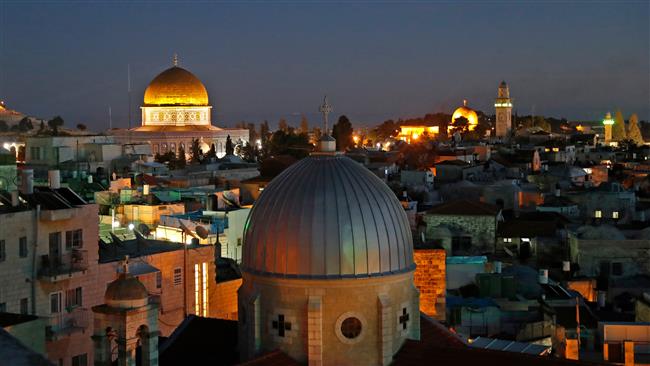
Samidoun Palestinian Prisoner Solidarity Network – December 20, 2017
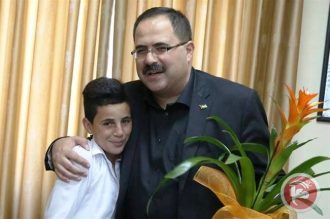 RAMALLAH – Fourteen-year-old Muhammad Fadel al-Tamimi remains in a medically-induced coma as of Tuesday, days after he was hot in the face with a rubber-coated steel bullet by Israeli forces.