Israeli squatters occupy Greek Orthodox Church in Jerusalem

MEMO | July 21, 2023
Two Israeli settlers stormed the Orthodox Church complex in the Mount Zion area of occupied Jerusalem, laid blankets on the ground and announced that they would remain there.
A video shared on TikTok yesterday morning showed the two settlers sitting on the church grounds as they spread items they brought with them.
When a church official asked them to leave the settlers started shouting insults, obscene and racist slurs towards him, telling him to “get out” of the grounds, and claiming that “Mount Zion belongs to the Jewish people”, adding that every minute the church remains standing is considered “looting”.
The Orthodox Church has been battling settler associations supported by the Israeli government which claim the land the church is situated on belongs to Jews.
Staff at the church said the settlers were armed and had frightened personnel.
After hearing about the settler invasion, locals gathered outside the church to defend it.
The Israeli authorities and settlers have, in recent years, intensified their attacks against Christian churches and property in occupied Jerusalem in an effort to displace Christians, reduce their numbers and steal their property.
Hamas slams US House resolution calling Israel “not racist state”
Palestine Information Center – July 19, 2023
OCCUPIED JERUSALEM – The Hamas Movement has strongly denounced the US House of Representatives for passing a resolution claiming that the Israeli occupation state is “not a racist or apartheid state.”
In a statement on Wednesday, Hamas condemned the resolution as a flagrant US bias in favor of the occupation state and a step intended to encourage it to persist in its crimes and violations against the Palestinian people, especially its ethnic cleansing policy.
“This US resolution has ignored the black history of the Zionist occupation, which is filled with dozens of massacres, and turned a blind eye to the crimes that were committed recently by settler gangs under military protection in Huwara town and dozens of Palestinian villages, which were exposed to arson attacks and organized destruction of homes, vehicles and farms,” Hamas underscored.
Hamas described the recent settler crimes in the West Bank as “an example of the racist practices and the ethnic cleansing policy that are pursued by the occupation state against the Palestinian people.”
“Many Israeli officials have voiced fascist positions, such as the recent remarks of the criminal minister, Smotrich, in which he gave the Palestinians the choice between living in the so-called state of Israel as second-class citizens or being banished or killed,” the Movement said.
“Such a US resolution will not change the reality of the criminal and racist Zionist occupation entity, which relies on ethnic cleansing, displacing the rightful owners of the land and replacing them with intruders,” it added.
The US House of Representatives overwhelmingly passed a resolution calling Israel “not a racist or apartheid state,” on Tuesday
The measure passed, in a 412-to-nine vote, a few hours after president Joe Biden met with Israeli president Isaac Herzog at the White House.
The legislation comes in response to remarks last Saturday from Congresswoman Pramila Jayapal, chair of the Congressional Progressive Caucus, in which she called Israel a “racist state.”
Later, the congresswoman apologized following pressures, while stressing that Israel’s “extreme right-wing government has engaged in discriminatory and outright racist policies.”
Bennett gave us a clear definition of who the terrorists are: Israel’s so-called ‘army’
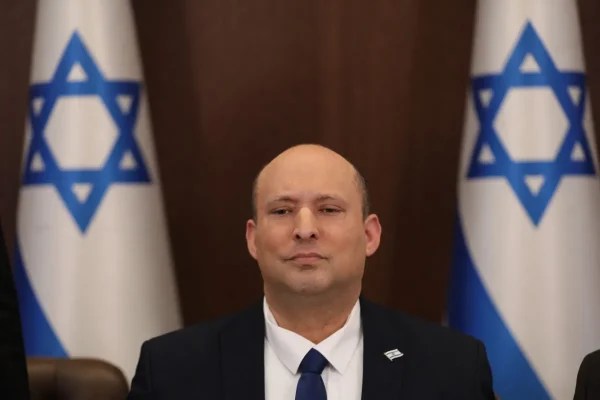
By Motasem A Dalloul | MEMO | July 17, 2023
Early this month, during the Israeli occupation army’s offensive on the northern occupied West Bank city of Jenin and its refugee camp, BBC News anchor Anjana Gadgil interviewed former Israeli Prime Minister Naftali Bennett and asked him whether the occupation forces “are happy to kill children” in Jenin.
Gadgil’s questions during the interview were direct and clear to the degree that shocked Bennett, who refused to give her an answer and tried to persuade her that all the Palestinians being attacked, killed, wounded or displaced during the offensive were legitimate targets.
When Gadgil told him that four of the Palestinians killed in Jenin were minors, identified by the UN as children, Bennett argued that the Palestinian children killed in Jenin were terrorists.
He explains that a terrorist is identified as someone who holds a rifle and shoots and murders people, claiming that the people of Jenin were armed and attacking occupation forces who had stormed their city and homes.
If this is Bennett’s definition of what a terrorist is, is he willing to apply that to Israelis and Palestinians alike?
The founders of Bennett’s rogue state did exactly what he described: They held rifles, broke into Palestinian homes and killed men, women, children and even the disabled. They stabbed pregnant Palestinian women before killing them, killing their unborn children.
After the Israeli occupation of the West Bank, East Jerusalem, Golan Heights and Sinai in 1967, my mother told me, the Israeli occupation forces broke the doors of the Palestinian homes, rushed inside and took every male before gathering them in Gaza Square, executing them and burying them in mass graves without even telling their relatives that they had been killed.
Would Bennett apply his definition to those militias and soldiers? There are hundreds of such untold atrocities committed by the Israeli occupation forces that my relatives and neighbours witnessed. Will Bennett define those Israeli soldiers as terrorists?
During the First Palestinian Intifada, which started in 1987, the then-Israeli Defence Minister Yitzhak Rabin ordered the Israeli occupation forces to break the hands of Palestinian children in order to stop the intifada. Many witnessed the horrific scenes of Palestinian children dragged out of their homes, harshly beaten and having their hands broken by the Israeli occupation forces. Bennett, are these soldiers terrorists?
Then, during the Second Intifada, we all witnessed as Muhammad Al Durrah and his father were repeatedly shot until they were motionless while they were unarmed and trying to take shelter. Were these soldiers terrorists?
Israeli soldiers went on to strike Palestinian gatherings with missiles, killing and maiming civilians in every attack under the pretext of targeting terrorists. This occurred repeatedly during the Second Intifada and many of those killed were women and children.
The same happened when late Israeli Prime Minister Ariel Sharon supervised the assassination of quadriplegic Hamas founder Sheikh Ahmad Yassin as he returned from the dawn prayer at the mosque. Some ten civilians were killed in the strike. Are the soldiers who killed them terrorists?
Since 2008, Israeli occupation forces have wiped out Palestinians families from the Gaza Strip.
Last month, an Israeli soldier who was holding his rifle shot Palestinian toddler, Muhammad Al-Tamimi, in the head while he was sitting in a car with his 40-year-old father in front of their home. Will Bennett define that killer as a terrorist?
Of course not, because he is an Israeli soldier.
There are many such examples, many within the public domain and many more which remain etched in Palestinian memory. Time and again, Palestinian victims are accused of being terrorists and blamed for their own deaths, while the occupation is not held to account for its murderous actions. This will not stop until action is taken against this barbarous aggressor, the world cannot continue to remain silent as thousands more lives are lost.
The Resistance vs. the Palestinian Authority: Will Abbas lead Palestinians to civil war?
By Ramzy Baroud | MEMO | July 17, 2023
This is the perfect opportunity for Palestinian Authority President, Mahmoud Abbas, to exit the stage. But he will not.
Abbas’ brief visit to the devastated Jenin refugee camp in the northern Occupied West Bank on 12 July demonstrated the absurdity and danger of the PA and its 87-year-old leader.
As he walked, Abbas struggled to keep his balance, in what was promoted as a ‘solidarity’ visit to the camp.
Thousands of frustrated Jenin residents took to the streets, hardly chanting Abbas’ name. Some looked on with disappointment; others asked where the President’s forces were when Israel invaded the camp, killing 12, wounding and arresting hundreds more.
The BBC reported on a “huge armed deployment” to secure Abbas’ visit, where “PA security forces joined a thousand-strong unit of Mr. Abbas’ elite presidential guard”. Their only job was to “clear a path” for Abbas into the camp.
On the initial and most deadly first day of the Israeli invasion of Jenin, Israeli media, citing military sources, said that 1,000 Israeli soldiers were taking part in the military operation.
Yet, it took more Palestinian soldiers to secure Abbas’ brief visit to Jenin.
Indeed, where were those well-dressed and equipped PA soldiers when Jenin was fighting and dying alone? And why does Abbas need to be protected from his own people?
To address these questions, it is important to examine recent contexts, three significant dates in particular:
On 5 July, Israel ended its military operation in Jenin.
On 9 July, despite protests by some of his security cabinet members, Israeli Prime Minister, Benjamin Netanyahu, declared that Israel would do its utmost to prevent the collapse of the PA. He stated outright that the PA “works for us”.
And, finally, on 12 July, Abbas visited Jenin with a stern message to Palestinian Resistance groups.
These three dates are directly related: Israel’s failed raid on Jenin has heightened the significance of the PA in Israel’s eyes. Abbas visited Jenin to reassure Israel that his Authority is up for the task.
To live up to Israel’s expectations and to ensure its survival, the PA is willing to clash directly with Palestinians who refuse to toe the line.
“There will be one Authority and one security force,” Abbas declared angrily, only days following the burial of Jenin’s victims. “Anyone who seeks to undermine its unity and security will face the consequences,” he added, further promising that “Any hand that reaches out to harm the people and their stability shall be cut off.”
The hand in reference is not that of Israel, but any Palestinian who resists Israel.
Abbas knows that Palestinians outright despise him and his Authority. Just days earlier, Fatah party deputy Chairman, Mahmoud Aloul, was removed from Jenin by angry crowds.
The crowds chanted in unison, “get out”, to Aloul and two other PA officials.
They did, but Abbas returned to the same scene. He was flown in a Jordanian military helicopter. Waiting for him, below, was a small PA army that had taken over the streets and the high buildings – or whatever remained of them – in the destroyed camp.
All of this happened through logistical arrangements with the Israeli military.
But why is Netanyahu keen on the PA’s survival?
Netanyahu wants the PA to survive simply because he does not want the Israeli occupation administration and military to be fully responsible for the welfare of Palestinians in the West Bank and the security of the illegal settlers.
Despite its near complete failure, the Oslo Accords succeeded in one thing: it provided Israel with a Palestinian force whose main mission is to assist the Israeli occupation in its quest to maintain total control over the West Bank.
Abbas’ trip to Jenin was intended to reassure Tel Aviv that the PA is still committed to its obligations to Israel.
Another message was sent to US President Joe Biden, who has, in a recent interview, cast doubts on the PA’s ‘credibility’. “The PA is losing its credibility,” Biden told CNN, and that has “created a vacuum for extremism.”
The message to Washington was that the hands of the so-called ‘extremists’ will be “cut off”, and that there will be “consequences” for those who defy the PA’s will.
Abbas seemed to speak, not only on behalf of his Authority but that of Tel Aviv and Washington as well.
Even ordinary Palestinians understand this to be the case; in fact, they always have. The only difference now is that they feel strong and emboldened by a new generation of Resistance which has succeeded in reclaiming a degree of Palestinian unity, amid factional politics and PA corruption.
The PA is now seen by most Palestinians as the obstacle in the face of full unity. That position is fully fathomable. While Israel was ramping up its deadly operations in Jenin and Nablus, the PA police was arresting Palestinian activists, angering Resistance groups in the West Bank and Gaza.
If this continues, a civil war in the West Bank is a real possibility, especially as Abbas’ potential successors are equally distrusted, even by Fatah’s own rank and file. These men were also in Jenin, standing shoulder to shoulder behind Abbas as he was frantically trying to lay out the new rules.
This time around, Palestinians are unlikely to listen. For the Resistance, the stakes are too high to back down now. For the PA, losing the West Bank means losing billions of dollars of Western financial handouts.
A clash between the Resistance and their popular support, on the one hand, and the West-Israel-backed PA forces, on the other, will prove very costly for Palestinians.
Yet, for Tel Aviv, it is a win-win. This is why Netanyahu is anxious to help Abbas keep his job, at least long enough to ensure that the post-Abbas transition goes through efficiently.
Palestinians must find a way to block such designs, preserve Palestinian blood and restructure their leadership, so that it represents them, not the interests of the Israeli occupation.
US-led coalition’s jets violated Syrian airspace several times in past day: Russia
Press TV – July 17, 2023
Russia says the US-led military coalition’s fighter jets violated Syria’s airspace in the strategic al-Tanf region several times during the past day, amid repeated calls by Damascus for the expulsion of Washington’s occupation forces from the country.
Rear Admiral Oleg Gurinov, deputy chief of the Russian Center for Reconciliation of the Opposing Parties in Syria, said at a press briefing on Sunday that the al-Tanf airspace is where international air routes pass.
“A pair of the coalition’s F-16 fighter jets, and one MC-12W spy plane violated Syria’s airspace in the al-Tanf area, across which international air routes run, five times during the day,” he said.
Gurinov added that during the past 24 hours, twelve cases of violations of the de-confliction protocols of December 9, 2019 by the US-led coalition drones were recorded, warning that such actions create risks of air accidents with civilian planes.
He further said a shelling attack on the positions of government troops in Syria’s Idlib and Latakia de-escalation zone has injured a Syrian soldier.
The latest development comes as an unnamed Pentagon official declared earlier in the day that the US announced considering military options to address “Russian aggression in the skies over Syria.”
The unknown official further voiced the US’s rising concerns about “growing ties between Iran, Russia, and Syria across the Middle East.”
The official also claimed that “Russia is beholden to Iran for its support in the war in Ukraine, and Tehran wants the US out of Syria” to extend aid to Lebanon’s Hezbollah resistance movement “and threaten Israel.”
Such claims by Washington officials come as the US military is illegally occupying Syria with nearly 1,000 troops and has seized the country’s oil fields in cooperation with local anti-Damascus militants and terrorist groups while stealing its crude supplies and transferring them across the border to its bases in Iraq.
In 2014, the US and its allies invaded Syria under the pretext of fighting Daesh. The Takfiri terrorist group had emerged as Washington was running out of excuses to extend its regional meddling or enlarge it in scale.
Russia, alongside Iran, has been helping Syrian forces in battles across the conflict-plagued country, mainly providing aerial support to ground operations against foreign-backed terrorists.
Damascus maintains that the unauthorized US deployment aims to plunder the country’s natural resources.
Russia – which together with Turkey is carrying out joint patrols in northern Syria – has established special “de-confliction” zones where the US-led coalition can operate.
Israeli military’s onslaught on Jenin amounts to war crime: Legal experts
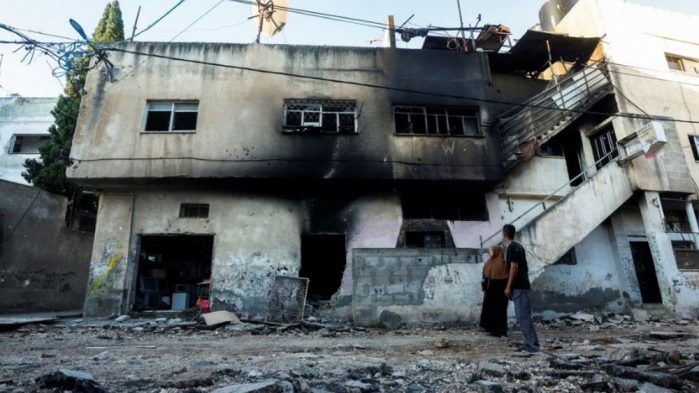
A building damaged by Israeli forces in the Israeli-occupied West Bank city of Jenin on July 5, 2023. (Photo by Reuters)
Press TV – July 15, 2023
The Israeli military’s deadly raid on the Jenin refugee camp in the northern occupied West Bank fits into the parameters of war crimes under the Geneva Conventions, legal experts argue.
Susan Akram, a clinical professor at Boston University’s School of Law, said the raid, which killed at least 12 Palestinians and wounded dozens more, clearly amounts to a war crime for a number of reasons, including intentionally attacking a civilian population and attacking medical units.
“The Geneva Conventions include as war crimes during occupation, willful killings, willfully causing great suffering to an occupied population and extensive destruction of property not justified by military necessity,” Akram said during a webinar hosted earlier this week by the Arab Center Washington, DC.
There’s no doubt, she declared, that what Israel carried out in Jenin constitutes a war crime.
Daniel Levy of the US/Middle East Project and journalist Dalia Hatuqa, the other panelists on the webinar, also agreed that Israel’s actions in the West Bank amount to a war crime.
Akram said the narrative used by Israel that the raids on Jenin and other Palestinian cities like Nablus are an attempt to root out resistance groups does not stop its actions from being illegal under international law.
Pointing out that the West Bank is an occupied territory, she said, “Israel’s attacks on an occupied population are criminal in and of themselves because occupation law forbids the occupier to use military attacks against civilian targets in the territory it occupies.”
According to the United Nations Relief and Works Agency for Palestine Refugees in the Near East (UNRWA), some 900 Palestinian houses were damaged and many of them became uninhabitable in the wake of the Israeli military’s raid on the Jenin refugee camp.
Adnan Abu Hasna, the spokesman for the UN agency, said on Tuesday that his fellow colleagues are still documenting the damage caused inside the camp during the onslaught.
The UNRWA’s priority is to help restore some sense of normality by resuming its services like education, healthcare and sanitation, he added.
“The other urgent priority is to provide cash assistance to families who were displaced from their homes, and help them pay for rent and rehabilitate their residences,” Abu Hasna noted.
Last week, a group of UN experts said Israel’s military raids targeting the Jenin refugee camp “may prima facie constitute a war crime.”
“Israeli forces’ operations in the occupied West Bank, killing and seriously injuring the occupied population, destroying their homes and infrastructure, and arbitrarily displacing thousands, amount to egregious violations of international law and standards on the use of force and may constitute a war crime,” the experts said in a statement.
MK expelled from Knesset for condemning Israel invasion of Jenin
MEMO | July 14, 2023
The Hadash-Ta’al list’s Chairman, Ayman Odeh, was forced out of the Knesset plenary last week during a vote on the Counterterrorism Law after condemning the Israeli attack on the Palestinian refugee camp of Jenin.
He said: “People killed in Jenin. People wounded in Tel Aviv. A killed soldier. All of their blood is because of your damned occupation. Occupation blinds you. Power blinds you. You are not only acting like occupiers, you are acting like idiots.”
His speech came just days after Israel concluded its largest military operation in Jenin in more than 20 years. At least 12 Palestinians were killed, including four children, and more than 140 were injured in the offensive, according to the Palestinian Health Ministry.
The raid also left a massive trail of destruction across the West Bank city, with dozens of homes, vehicles, shops and utility lines destroyed.
“Every action has a reaction. These are the rules of nature,” added Odeh. “There’s a reaction to the occupation, so there will be resistance. Resisting against occupation is legal. Occupation is illegal. Long live the Jenin! Long live the Palestinian people! Long live their resistance! Shame on you! Take me down! But the Palestinian people will continue to fight!”
In response, Almog Cohen from the far-right Otzma Yehudit Party, shouted: “The blood of those murdered is on your hands; go to Gaza. The more terrorists we kill, the better.”
It all came amidst the approval of the Counterterrorism Law, which specifies that anybody who expresses support for “terrorists” may face up to five years in prison.
Religious Zionist Party MK Zvi Sukkot introduced the bill “to stop the probability test that is required today due to the seriousness of expressing solidarity or sympathy for an act of terror or its perpetrators.”
Following MK Odeh’s criticism against the Israeli invasion of Jenin, Sukkot appealed to the Ethics Committee of the Knesset, Israel Police, and the Attorney General to open an investigation against the MK for expressing his support for the residents of Jenin.
Syrians lash out at Israeli plan to raze entire village in occupied Golan Heights
Press TV – July 11, 2023
Residents of the occupied Golan Heights have staged a demonstration to express their fierce opposition to the Tel Aviv regime’s plan to completely raze a village in the strategic plateau to build a military base, in a blatant violation of international law.
According to a report by Syria’s official news agency, SANA, protesters rejected the demolition of the remaining homes in the village of Ain Fiet, whose residents were forcibly displaced by the Israeli regime over the past years.
“The Zionist entity aims to obliterate the national identity, establish a military outpost on our lands and Judaize them,” the protesters said.
They said the regime’s scheme to raze the village is contrary to the United Nations Security Council resolution 497.
The UN resolution, adopted unanimously on December 17, 1981, declares that the Israeli annexation of the occupied Golan Heights is “null and void and without international legal effect” and further calls on the Tel Aviv regime to rescind its action.
The protesters further reiterated their devotion to their homeland and Syrian identity in the face of the Israeli regime’s practices, including arbitrary arrests and systematic oppression.
In 1967, Israel waged a full-scale war against Arab territories, during which it occupied a large area of the Golan and annexed it four years later – a move never recognized by the international community.
Israeli forces destroyed Ain Fiet, one of the most fertile and beautiful villages in the Syrian Golan Heights, following the 1967 Six-Day War.
Nearly 131,000 people living there were forcibly displaced, while 7,000 people opted to remain in six other nearby villages, namely Majdal Shams, Masa’da, Baqatha, Ain Qunya, Ghajar and Sahita.
Later on, the Israeli military razed Sahita village and turned it into a military post. It forced its local residents to abandon the village and move to Masa’da.
In 1973, another war broke out and a year later, the United Nations brokered a ceasefire and established a buffer zone between the Israeli and Syrian forces. The UN also adopted several resolutions calling for Israel’s withdrawal from the Golan, but the regime has ignored them.
Earlier this month, Israel further occupied Ghajar village by erecting fences to the north of the area, cutting it off completely from Lebanon.
Last month, dozens of residents and landowners in the towns of Majdal Shams and Masa’deh were prevented from reaching their lands by Israeli forces, leading to confrontations.
The Israeli forces have raided the farmlands to install wind turbines, which according to the farmers, could pose environmental hazards to their lands and interfere with their farming practices.
Israel has over the past several decades come up with dozens of illegal settlements in the occupied Golan in defiance of international calls for the regime to stop its illegal construction activities there.
In 2019, former US president Donald Trump signed a decree recognizing Israeli “sovereignty” over the Golan Heights, in a move that was widely condemned by the international community.
Syria denounced the US decision as a violation of its sovereignty and territorial integrity.
In December 2021, Israel announced its plan to double the number of its illegal settlements in the Golan Heights despite a resolution by the UN General Assembly demanding that the regime stop its settlement activities and withdraw from the occupied territory.
Damascus has repeatedly reaffirmed its sovereignty over the area, saying it must be completely restored to its control.
Ansarallah forces surround Saudi-controlled Marib: Report
The Cradle | July 12, 2023
Yemen’s Ansarallah resistance movement fired two ballistic missiles at the country’s central city of Marib on 11 July, coinciding with heavy mobilization of fighters and equipment outside the city, sources in the Saudi-backed government were quoted as saying.
A military official, Rashad al-Mekhlafi, told Arab News that two missiles landed in northern Marib, near a military base and a camp for internally displaced people.
“The missiles exploded in an open area in Marib without causing any injuries,” he said.
Sources in the Saudi-backed Presidential Leadership Council (PLC) recently told Arab News that Ansarallah has been deploying large numbers of fighters and equipment in preparation for an offensive against the city, which had been halted last year by a truce that was implemented in April.
“They have assembled fighters and enormous military equipment, including armored vehicles, cannons, and drone launchers, on the southern, western, northern, and east-northern surroundings of Marib,” Mekhlafi said.
“We are prepared to repel any attack. We bolstered the front lines with newly graduated military battalions, including sniper and infantry forces. What the Houthis were unable to achieve in previous years would be possible today,” he added.
Another government source was anonymously quoted as saying that the “legitimate government is prepared to repel any attack even as Saudi, UN, American, and European mediators advise restraint.”
Following the implementation of a truce agreement in April last year, intense fighting in Marib ceased, and Ansarallah was unable to capture the city. However, border skirmishes and periodic clashes have since been common.
While significant areas of the energy-rich province are under Ansarallah’s control, the main city is fully in the hands of the Saudi-backed government and the forces loyal to it.
Omani-mediated negotiations have recently resulted in agreements between the Saudi-led coalition and Ansarallah, particularly regarding the blockades on Hodeidah port and Sanaa airport, as well as the payment of salaries of government employees.
Saudi Arabia, as a result, has significantly reduced the scale of its bombing campaign on the country.
Many factors continue to complicate peace in war-torn Yemen – particularly a widespread Emirati occupation of the country and its ports and oilfields, as well as the presence of US, UK, and French troops.
Some have suggested in recent months that Saudi and Emirati interests in Yemen have begun to diverge, claiming that the UAE aims to maintain control over the country’s resources and strategic ports and waterways while Riyadh is increasingly looking to find a way out of the war.
‘Trauma in Jenin’: UN officials shocked by latest Israeli atrocities
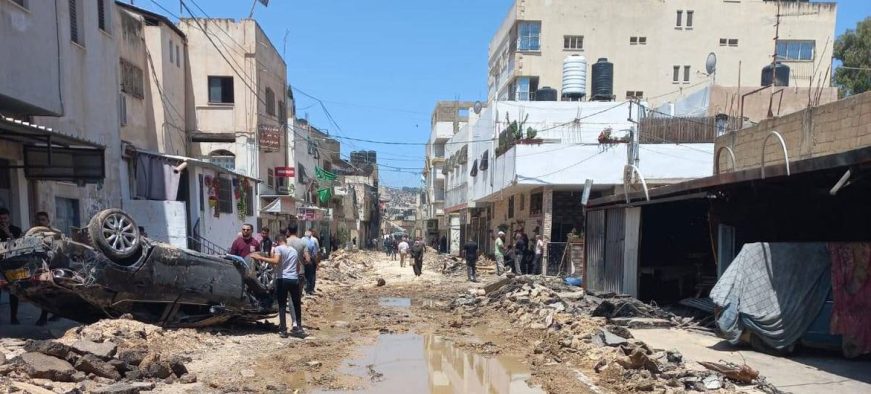
Press TV – July 10, 2023
A delegation of the United Nations has expressed shock at the level of destruction left as a result of Israel’s largest operation in Jenin in two decades.
Officials from the United Nations Relief and Works Agency for Palestine Refugees in the Near East (UNRWA) visited the Jenin refugee camp on Sunday.
“The destruction I saw was shocking. Some houses were completely burned down; cars had been crushed against walls; roads were damaged. The UNRWA health center was destroyed. But more than the physical damage, I saw the trauma in the eyes of camp residents who had witnessed the violence. I heard them speak about their exhaustion and fear,” said Leni Stenseth, the UNRWA deputy commissioner-general.
The two-day deadly Israeli onslaught of July 3 was the fiercest of its kind in over 20 years, according to UNRWA, which is tasked with assisting Palestine refugees.
Twelve Palestinians, including four children, were killed. 140 were injured. Virtually 900 houses were damaged. Many are now uninhabitable. Also, at least 3,500 Palestinians were forced from homes. The UNRWA health center was so badly damaged it can no longer be used.
Some parents said children are too scared to go out.
“Children were shaken and shocked… many of them are too afraid to leave their homes. In one classroom we visited, students shared with us that just 10 days ago, they had buried a classmate who was killed in an incursion,” said Adam Bouloukos, the director of UNRWA West Bank.
“It is very hard for children to walk to school as the main roads are still unusable. When trying to find alternative ways to school, some younger children lost their way. We truly feared for their safety due to the risk of unexploded ordinance. A priority now is to provide mental and psychosocial support to help children cope with their fear and anxiety.”
Bouloukos said the refugee camp, home to nearly 24,000 people, now has no access to electricity and water. “The camp is now partially without access to electricity and water.”
“Nearly eight kilometers of water piping and three kilometers of sewage lines were destroyed due to the use of heavy machinery that ripped up large sections of the roads.”
Russian military responds to US ‘drone harassment’ complaints
RT | July 9, 2023
The Russian Air Force is conducting joint exercises with its Syrian counterparts, so part of the country’s airspace remains off-limits to the US-led forces, the Defense Ministry reiterated after the Pentagon accused Russia of “harassing” American drones for the third time this week.
“The Russian side once again expresses concern about the systematic violations of deconfliction protocols related to the flights of unmanned aerial vehicles (UAVs) of the so-called international anti-terrorist coalition,” the deputy head of the Russian Reconciliation Center for Syria, Rear Adm. Oleg Gurinov, said in a statement on Saturday.
On Friday, the commander of US Air Forces Central, Lt. Gen. Alex Grynkewich, claimed that “three MQ-9 drones were once again harassed by Russian fighter aircraft while flying over Syria,” for the third day in a row. He shared no footage of the encounters this time, but accused Russian pilots of making “18 unprofessional close passes that caused the MQ-9s to react to avoid unsafe situations.”
On Wednesday, Moscow and Damascus kicked off a joint air defense drill, which is scheduled to last until the middle of this month. Electronic warfare units are also involved in the exercise, preparing for joint action to counter enemy airstrikes.
Asked whether the US drones could have indeed flown into a restricted area, Pentagon spokesman Patrick Ryder insisted at a press briefing on Thursday that it would be preposterous to suggest Washington was to blame.
“You – did you see the video?.. So to suggest that somehow, you know, this is our fault, it’s ridiculous. So okay?,” he told journalists .
Ryder went on to say that US forces “have very successfully deconflicted with the Russians over many years” – but refused to say whether the US was following deconfliction protocols this time.
US-backed militia abducts young men in ‘recruitment’ campaign in eastern Syria
The Cradle | July 8, 2023
Militants of the US-backed Syrian Democratic Forces (SDF) launched massive arrest campaigns targeting young men in the areas under the group’s control in northeast Syria, immediately taking them to compulsory recruitment camps, Sputnik reported on 8 July.
Civic and local sources told the Russian news agency that SDF militants loyal to the US army, “are launching, for the third day in a row, campaigns of mass arrests and kidnappings of young men born between 1998 to 2005 in all the cities and towns of Hasakah and Raqqa governorates, where more than 500 young men were forcibly conscripted.”
The sources added that SDF forces set up permanent and temporary military checkpoints in the cities of Hasakah, Qamishli, and Shaddadi, and arrested large numbers of young men, including university and institute students.
The sources indicated that Hasakah residents demonstrated on 5 July in front of the local SDF recruitment headquarters demanding the immediate release of their conscripted sons. In response, the SDF called in military reinforcements, including US-made armored vehicles, to disperse the sit-in.
In Raqqa, local sources told Sputnik that SDF militants set up a checkpoint near the old bridge in the city to stop passing cars in search of young men to conscript and take to the group’s military camps.
Last month, Arab News reported that 13-year-old Kurdish girl, Peyal Aqil, went missing on her way home from a school exam, after being approached by a recruiter for the Revolutionary Youth, a group connected to the SDF and its parent group, the Kurdistan Workers Party (PKK). She followed him to one of the group’s centers in the city of Qamishli.
Her friends waited for her outside, but she never emerged.
Peyal’s mother, Hamrin Alouji, said she and her husband complained to local authorities, who refused to help.
The Revolutionary Youth group later said Peyal joined willingly, a claim her mother rejects. “We consider that at this age, she cannot give consent, even if she was convinced” by the group’s program, Alouji said.
A month after her disappearance in May, Peyal managed to run away from one of the training camps and return home.
Arab News notes that according to a UN report issued this week, 1,696 minors were recruited by armed groups in Syria in 2022, including 637 by the Kurdish-led SDF.
The report also said the UN had confirmed 611 recruitment cases by the Turkish-backed Syrian National Army (SNF), and 383 by the Al-Qaeda-linked Hayat Tahrir al-Sham. The report noted 25 cases of child recruitment by Syrian government forces and pro-government militias.
According to Bassam Alahmad, executive director of Syrians for Truth and Justice, an independent civil society organization, some children are forcibly conscripted, while others sign up out of poverty, for ideological reasons, or out of tribal loyalties.
Alahmad called on the SDF-affiliated administration in northeast Syria to “assume its responsibilities in order to stop these operations.”
An official with the PKK-linked Revolutionary Youth acknowledged to Arab News that the group recruits minors, but claimed they join willingly. “We do not kidnap anyone, and we do not force anyone to join us,” he said.
“They themselves come to us and tell us their intention to join the service of the nation,” he said. “We do not take minors if they are indecisive or unsure.”
Featured Video
Seyed M. Marandi: U.S. Military DIVIDED? Iran’s Secret Defense EXPOSED
or go to
Aletho News Archives – Video-Images
From the Archives
‘Israel sees Iran as obstacle to its policies’

Press TV – August 25, 2017
Prime Minister Benjamin Netanyahu has said that Israel felt threatened by Iran’s growing influence in the Middle East. Netanyahu expressed his Iranophobic view in a meeting with Russian President Vladimir Putin in Russia’s Black Sea resort of Sochi on Wednesday. Press TV has asked Scott Rickard, former American intelligence linguist from Tampa, Florida, and Brent Budowsky, a columnist at The Hill from Washington, to give their thoughts on the issue.
Rickard said Tel Aviv is concerned about the fact that the regime could not carry out its old project to spread sectarian divisions and pave the way for dismemberment of the countries in the Middle East region because of the Iranian-led resistance against Israeli policies, not only in the occupied territories of Palestine but also in the whole region.
“Iran is not a threat to Israel whatsoever. The threat that Israel sees is the fact that their Oded Yinon Plan is being put to a hold by Iran,” the intelligence linguist said on Thursday night.
“They (the Israelis) look at Iran as a threat only because they have no influence on their governments and Iran is autonomous and is not under the Zionist influence,” he added.
Since the victory of the Islamic Republic of Iran in 1979, Tehran has been critical of Israel’s policies in the region, whereas “no leaders [of other states] even dared to speak out against Zionism,” Rickard argued. … continue
Blog Roll
 Aletho News
- Iran declares ‘historic victory’ over US, says enemy forced to accept its proposal
- Trump Claims Ceasefire, Reopening of Strait of Hormuz Agreement with Iran
- Israeli tank fire killed UN peacekeeper in Lebanon, UNIFIL investigation finds
- Russia, China block Bahrain-sponsored UN resolution on Strait of Hormuz
- The US-Israeli War on Science is an Assault on our Future
- Trump’s Promise to Bomb Iran ‘Like Never Before’ Faces Brutal Logistics — Expert
- Germany seeks to restrict stays abroad for men of fighting age – Berliner Zeitung
- Evidence points to Ukraine being behind TurkStream attempted sabotage, but that should come as no surprise
- Sri Lanka secures supplies of Russia oil – minister
- Nations across Asia strike direct deals with Iran for Hormuz passage
- If Americans Knew
- Thousands dead and neighborhoods razed to the ground: Aid agencies fear southern Lebanon is becoming the new Gaza
- The war the US is fighting for Israel could cost trillions
- ‘Cigarette Burns, Nail Wounds’: Toddler Tortured in Gaza to Coerce Father
- Trump Says US Sent ‘a Lot of Guns’ to Protesters in Iran
- Israeli forces destroy 17 UN peacekeeper cameras in south Lebanon
- US-Israeli strikes ‘completely destroy’ synagogue in Tehran
- Archbishop for US Military Says Iran War Is Unjust Under Catholic Teaching
- Iranian leaders’ Open Letters to the American People
- Trump says Iranians appreciate bombs, WHO warns of nuclear risks – Daily Update
- U.N. experts demand Israel release prominent Gaza doctor after reports of ‘severe torture’
- No Tricks Zone
- An Inconvenient Tree: Uncovered In Alps… Europe Much Warmer Than Today 6000 Years Ago
- New Study Reports A 60% Slowdown In Greenland’s Ice Loss Rate In The Last Decade
- Low Intensity Tornado Wrecks Major Solar Farm, Creating A Potential Toxic Dump
- New Study Finds Warming Saves Lives…Cold Temperatures 12 Times More Deadly Than Excess Heat
- German Science Blog Accuses PIK Climate Institute Of Hallucinating Climate Tipping Points
- Devastating Assessment Of Comirnaty Vaccine By Former Senior Pfizer Europe Toxicologist
- New Study: CO2 Is ‘Effectively Negligible’ As An Explanatory Climate Change Factor Since 2000
- Former Pfizer Toxicologist Dr. Helmut Sterz Tells Bundestag Hearing Pfizer Vaccine Should Have Never Been Approved
- Energy Expert: Germany’s Nuclear Phaseout Was A “500 Billion Euro Mistake”
- New Research: South Australia’s Mid-Holocene Sea Surface Temperatures Were 4°C Warmer Than Today
 Aletho News