Strategic setbacks for US, Israel as the Resistance Axis gains ground in Syria
Recent resistance operations in eastern Syria have established new rules of engagement that constrain both Washington and Tel Aviv

By Khalil Nasrallah | The Cradle | May 14, 2024
For several years, the presence of the region’s Axis of Resistance forces in Syria has remained vulnerable to US and Israeli attacks across the country, from east to west. The US has persistently attempted to disrupt the communication routes along the Tehran–Beirut axis, through which Damascus plays an important link.
Starting in 2017, after eliminating ISIS from this key border crossing, Axis forces have safeguarded passage of vehicles through the vital Al-Qaim–Al-Bukamal road and effectively established rules of engagement in eastern Syria, gradually limiting Washington’s tactical flexibility and dominance. This was a strategically important development – maintaining a foothold west of the Euphrates River to the far southeast of Syria continues to be essential for both state and non-state actors in the resistance.
A shift in tactical approach
Since the Palestinian resistance’s Operation Al-Aqsa Flood last October, many new shifts have emerged on the ground in eastern Syria. With an uptick in Iraqi resistance activities targeting US bases in both Syria and Iraq, a sort of tentative peace emerged in early February, coinciding with Kataib Hezbollah’s temporary suspension of operations.
During this period, the resistance forces secured new advancements that solidified their position, primarily because Washington had to grudgingly acknowledge the new ground realities – a fait accompli, if you will.
Although the US continued to carry out “retaliatory” strikes targeting the Iraqi resistance, which, to many, seemed to restore some level of peace, this came with significant compromises.
According to information obtained by The Cradle, the resistance groups have not only established a more pronounced military and political stance during this period of relative calm but have also forced the US to accept crucial losses in the field.
In short, not only has Washington retreated from its provocative operations against regional resistance forces, but Tel Aviv has likewise shown reluctance to launch further raids – so far – in eastern Syria to assassinate fighters affiliated with Lebanon’s Hezbollah.
The Israeli retreat is not a unilateral decision but a result of US recalibration of these risks. The occupation army cannot launch operations without the American green light and intelligence data, and Washington is currently reluctant to cover Israeli actions that will draw the US deeper into the morass in Syria and Iraq. It also seeks to avoid further resistance attacks on US bases and occupied Syrian oil fields, especially now that it has experienced direct blows from targeted munitions.
It is also not insignificant that the Iraqi resistance has directly targeted key Israeli ports. Tel Aviv cannot afford opening up further military fronts eight months into a conflict in which it is incapable of winning on a single front, in Gaza.
Rules of engagement in Eastern Syria
The rules of engagement in eastern Syria are distinct from those governing interactions in the western and central regions of the country, which primarily involve the Israeli entity and Resistance Axis forces alongside Damascus.
In the east, the main opposition to the resistance forces is the illegal US military occupation and its Kurdish allies.
This region, stretching across the Euphrates River to Albu Kamal, which abuts Iraq’s Al-Qaim crossing, represents a strategic foothold for the Resistance Axis established in 2017. This was achieved during the “Great Dawn” operations, a series of offensives in three stages led by resistance forces, the Syrian army, and their Russian allies.
These operations enabled the Syrian and Iraqi resistance forces to reach and secure the Al-Qaim crossing, effectively reconnecting the two countries for the first time since 2011, which offered the Axis a world of new tactical advantages.
The establishment of this route, known as the Tehran–Beirut road, was perceived by the US and Israelis as a strategic geopolitical setback to their goal of severing relations and routes between Iran and the Mediterranean. In response, Washington intensified its efforts to destabilize this area through raids and pressures and by supporting attacks by ISIS cells and other militant groups, aiming to prevent the resistance forces from cementing their positions and achieving stability.
These tensions would escalate significantly towards the end of 2019 and into early 2020, following US claims that its forces in Kirkuk were targeted in a rocket attack attributed to the Iraqi resistance.
Washington responded provocatively by launching heavy strikes against an Iraqi resistance faction in Al-Qaim, killing at least fifty fighters in an operation closely followed by the targeted assassinations of Iranian Quds Force Commander General Qassem Soleimani and Iraq’s Popular Mobilization Units (PMU) Deputy Head Abu Mahdi al-Muhandis.
One key goal of this unprovoked US escalation was to prevent the resistance connectivity project, specifically cutting off the roads of communication between Tehran–Baghdad–Damascus–Beirut, which is seen as threatening both the US presence and Israel’s security.
Following the strike on the Ain al-Assad airbase earlier this year, resistance forces moved to intensify their targeting of US military bases using missiles and drones, conducted multiple operations in the Syrian Desert to safeguard transit routes against Washington-backed terror groups, and established protective measures around the US occupation base in Al-Tanf, located near the Syrian–Jordanian–Iraqi border intersection.
Through these coordinated efforts, the Axis of Resistance imposed new rules of engagement, effectively balancing the scales by linking their actions at Albu Kamal and Al-Qaim with significant retaliatory strikes against US bases.
This approach led to a noticeable reduction in direct US military engagements – which, interestingly and unsurprisingly, coincided with a spike in ISIS cells attempting infiltrations in both Syria and Iraq.
This state of affairs persisted until the Iraqi resistance increased its operations against US troops in both Syria and Iraq, partly in solidarity with the Palestinian resistance in the Gaza Strip.
West Asia’s new reality
Between the rules of engagement that preceded the events of 7 October and those that followed the targeting of US bases, significant changes have occurred, especially after Iraqi resistance operations showcased the vulnerabilities of the American deterrence strategy.
The illegal US bases have been exposed as unsafe, not only in Syria and Iraq but also extending to Jordan. The results of the resistance operations can be summarized as follows:
The Axis has successfully established and strengthened its ground presence in areas Washington once viewed as its own stomping ground and has achieved a de facto truce that benefits long-term resistance goals across military, economic, and political domains.
Consequently, resistance troops are now more effectively pursuing the remnants of US-backed ISIS cells within the depths of the Syrian Desert. These terror cells, though engaged in continuous disruptive operations, are no longer seen as posing a strategic threat.
The Axis’ efforts can also now more effectively concentrate on the main front, against Israel, in support of the Palestinian resistance there. The rules of engagement with the US have been reinforced and are poised for further development in future stages, with plans to pose a more formidable challenge to the US presence across West Asia.
Pentagon orders withdrawal of all US combat troops from Niger
Press TV – May 11, 2024
The US military has ordered its troops to pull out from Niger following the cancellation of a military agreement by the African country’s new leaders.
Niger’s new leaders demanded the withdrawal of American and French troops after they ousted Western-backed president Mohamed Bazoum on July 26, 2023.
They announced on March 17 that Niger had canceled a 2012 military cooperation agreement with the US, calling for an end to the US military’s “illegal” presence in the country.
The Pentagon this week formally ordered all 1,000 US combat troops to withdraw from Niger, Politico reported on Friday.
The order comes as newly-arrived Russian forces have been living at the same airbase as American troops in the capital of Niamey, Base 101, for weeks.
According to a US official, troops will be relocated to another base within the region from which they can still carry out their military operations.
Until the country’s military overthrew the pro-Western government in a coup last summer, a US-built drone base near Agadez in central Niger had been a linchpin for Washington’s military operations in the Sahel region.
Bazoum, and the previous Nigerien governments before him, had given the US military the green light to operate in the country, train Nigerien forces, and take part in what the Americans described as counter-terrorism activities.
However, the new leaders reject the “illegal” presence of US troops on Niger’s territory, saying “it was not democratically approved and imposes unfavorable conditions on Niger, particularly in terms of lack of transparency on military activities.”
Niger also called for the exit of French troops from the country and canceled two security and defense partnerships with the EU last year.
Instead, the West African country signed a memorandum of understanding to strengthen defense cooperation with Russia last December.
Niger has also signed a trilateral defense agreement with neighboring Burkina Faso, and Mali, binding the three Sahel countries to assist one another in the event of a military attack on any one of them.
Israel to hand over Rafah crossing to private US firm: Report
The Cradle | May 8, 2024
Israel will grant control of the Rafah border crossing to a private US security company, Haaretz reported on 8 May.
The US, Egypt, and Israel have agreed “that a private American security company will assume management of the crossing after the IDF concludes its operation.”
Discussions between the three sides have been ongoing. Israel has committed to the US and Egypt that it will restrict its operation in Rafah, Gaza’s southernmost city. Tel Aviv reportedly made it clear during talks that the operation at the Rafah crossing aims to pressure Hamas in ceasefire talks and diminish the crossing’s image as a “symbol of Hamas’ power.”
It has also said the operation aims to cut off Hamas’ ability to channel weapons and funds into Gaza.
Israel has reportedly vowed not to damage the crossing’s facilities to ensure its operation is not hindered. The Rafah crossing is considered a major lifeline for Palestinians in Gaza, and the UN has warned that continuous Israeli operations in the area seriously threaten aid efforts.
Cairo and Washington have been showing serious concern lately over Israel’s plans for Rafah, which the army has been promising to invade for months. The city is overcrowded with over a million besieged Palestinians, and a full-scale assault poses the threat of an unprecedented humanitarian disaster.
“As part of Israel’s efforts to win agreement for a Rafah operation, negotiations have been underway with a private company in the US that specializes in assisting armies and governments around the world engaged in military conflicts,” the Haaretz report adds.
The company, which employs veterans of elite US military units, has been active in several African and West Asian nations, guarding sites such as oil fields, bases, and border crossings.
In line with the understandings reached between Cairo, Washington, and Tel Aviv, the US firm will assume responsibility for the crossing after Israel’s “limited” operation there is over. This includes overseeing the delivery of goods arriving from Egypt to Gaza and ensuring Hamas does not re-establish control of the crossing.
“According to the agreement, Israel and the US will assist the company as necessary.”
The White House and a State Department spokesman said on 8 May that they are unaware of any such plans. Several Palestinian resistance factions said in a joint statement on Wednesday that they refuse any attempt to “impose any form of [foreign] guardianship of the Rafah crossing,” adding that they consider this a “form of occupation.”
“Any plan of this kind … will be dealt with in the same way as the occupation is dealt with,” the statement added.
Sources told CNN and the Times of Israel on Tuesday that Israel’s operation at the Rafah crossing is a limited one, which aims to pressure Hamas in ongoing truce negotiations. Hamas accepted on Monday an updated proposal for a deal, which Israel finds unacceptable given its explicit call for a cessation of hostilities and withdrawal of all Israeli forces from Gaza.
Hamas has accused Israel of continuously sabotaging efforts to reach a truce agreement.
A Warped View of Patriotism on Pat Tillman
By Jacob G. Hornberger | FFF | April 24, 2024
A recent op-ed in the Los Angeles Times demonstrates what is a warped interpretation of the term “patriotism.” The op-ed is about former football player Pat Tillman, who was killed in Afghanistan twenty years ago. It’s written by Bill Dwyre, a former sports editor for the Times.
Dwyre reminds us that Tillman was motivated to join the military after the 9/11 attacks. He gave up a $3.6 million football contract to join the U.S. military and was hoping to be sent to Afghanistan to fight the terrorists.
Dwyre writes, “It was a can’t-miss story of patriotism. Americans applauded from the safety and comfort of our homes and communities.” (Since he uses the pronoun “our,” presumably Dwyre fell into the “safety and comfort” group rather than the “patriot” group.)
Unfortunately, however, Dwyre doesn’t explain why Tillman’s act was one of “can’t miss” patriotism. Apparently for him it’s a self-evident truth.
No declaration of war
The U.S. Constitution is the supreme law of the land. It is the higher law that we the people impose on government officials. We are expected to obey their laws, and they punish us when we fail to do so. By the same token, they are supposed to obey our law, the Constitution.
The Constitution requires a congressional declaration of war as a prerequisite to a president’s waging war against any other nation-state. If a president and his army wage war without a congressional declaration of war, they are acting in violation of the law.
It is undisputed that President Bush did not secure a congressional declaration of war from Congress before he ordered his military to invade Afghanistan. That made their war illegal under our form of government.
How can participating in an illegal war be considered “patriotic”? Dwyre doesn’t explain that.
The U.S. was the aggressor under Nuremberg
Moreover, the common perception is that Bush invaded Afghanistan because the Taliban regime, which was governing the country, had been complicit in the 9/11 attacks by having knowingly harbored Osama bin Laden, who U.S. officials suspected had orchestrated the attacks.

Not so. Bush initiated his war because the Taliban regime refused to comply with his unconditional demand to deliver bin Laden into the hands of the Pentagon and the CIA. Yet, there was no extradition treaty between Afghanistan and the United States and, therefore, Afghanistan was operating within its rights under international law to refuse Bush’s unconditional extradition demand.
Nonetheless, knowing that the Pentagon and the CIA would torture bin Laden into confessing to the crime, Afghanistan offered to deliver him to an independent nation for a fair trial. In making the offer, Afghanistan sought the same amount of proof that would be required in a normal extradition hearing. The U.S. government refused the offer, perhaps because it was unable to provide such proof.
Therefore, given that Afghanistan had the authority under international law to refuse Bush’s extradition demand, that makes Bush’s invasion illegal under the war-of-aggression provision of the Nuremberg War Crimes Tribunal.
How can participation in an unconstitutional and illegal war be considered “patriotic”? Unfortunately, Dwyre fails to explain.
If one assumes that the 9/11 attackers were the ones who did the attacking (as compared to the attacks being an “inside job,” as some believe), it’s worth pointing out that they were motivated by the death and destruction that the U.S. government’s foreign policy had wreaked in the Middle East. But of course, a real “patriot” does not bring up that discomforting fact and instead blindly supports the government’s claim that the terrorists attacked us out of hatred for our “freedom and values.”
Tillman’s opposition to the Iraq War
One of the fascinating aspects of Dwyre’s op-ed glorifying Tillman’s patriotism is what he leaves out of the op-ed. Tillman was an outspoken opponent of Bush’s invasion and war of aggression against Iraq. Dwyre doesn’t even mention that, which is revealing.
Keep in mind, after all, that Bush’s war on Iraq was also waged without a congressional declaration of war, making it illegal under our form of government. Bush’s claim that he was waging to war to enforce UN resolutions falls flat because only the UN can enforce its resolutions. The fact is that the U.S. war on Iraq was an even clearer case of a war of aggression under the Nuremberg principles than the U.S. war on Afghanistan.
Despite Tillman’s fierce objections to the U.S. war on Iraq, the U.S. military nonetheless ordered him to “serve” in Iraq, which he did. Keep in mind though that every U.S. soldier takes an oath to support and defend the Constitution and is under a legal and moral obligation to refuse to obey unlawful orders. Tillman chose to obey the unlawful order to deploy to Iraq.
U.S. government lies
After his “service” in Iraq, Tillman was deployed to Afghanistan, where he continued to speak out against the U.S. war on Iraq. It was there that he was killed. As Dwyre points out, the U.S. military initially lied about his death, claiming falsely that he was killed by enemy fire. In fact, what actually happened is that he was killed by his own men in what was described as “friendly fire.”
In 2006, Tillman’s brother, Kevin Tillman, wrote a scathing op-ed on truthdig.com, in which he echoed his brother Pat’s view of the Iraq war: “Somehow American leadership, whose only credit is lying to its people and illegally invading a nation, has been allowed to steal the courage, virtue and honor of its soldiers on the ground.”
Why would’t Dwyre mention Pat Tillman’s (and his brother’s) fierce opposition to the U.S. war on Iraq in his op-ed? My hunch is that it’s because he considers opposition to U.S. wars to be unpatriotic and, therefore, Tillman’s apparent lack of “patriotism” with respect to Iraq doesn’t fit conveniently within his patriotism narrative. Under Dwyre’s warped interpretation of patriotism, apparently it’s only those who blindly support the U.S. national-security state’s foreign wars and its interventionist foreign policy who should be considered “patriots.” Apparently, those who reject such wars and choose instead to remain in the “safety and comfort” of their homes instead of fighting them should be considered non-patriots.
ISIS kills Palestinian fighters in Syrian desert
The Cradle | April 19, 2024
At least 20 fighters from Liwa al-Quds, a Palestinian armed group supporting the Syrian army, were killed when their bus was ambushed by unknown militants in the eastern countryside of Homs Governorate in Syria, Sputnik reported on 19 April.
Sputnik’s correspondent added that the ambush was carried out by militants likely affiliated with ISIS. The militants attacked the bus with heavy machine guns and B7 artillery shells while it was traveling between the village of Al-Koum and the city of Al-Sukhnah in the eastern Badia desert near Palmyra.
Several Liwa al-Quds members were also seriously injured, suggesting the death toll may rise.
The Syrian army sent reinforcements to the area and began extensive combing operations in search of ISIS cells.
The Badia desert near Al-Suknah lies north of the 55-kilometer “protected” area surrounding the illegal US military base at Al-Tanf on the Syria–Iraq–Jordan border.
Pro-Syrian forces are not allowed to enter the protected zone and are bombed by US warplanes if attempting to do so.
The Syrian and Russian governments have accused the US of training militants from ISIS and other mercenary armed groups in the protected zone and allowing them to use it as a base for attacks on Syrian forces elsewhere in the Badia desert region.
The Russian military has supported the Syrian army’s effort to defeat ISIS since 2015. On Thursday, Russian Major General Yuri Popov confirmed that the Russian Air Force destroyed three militant bases in remote areas in Homs Governorate.
During a press conference, Popov said, “The Russian Air Force destroyed three bases for militants who left the Al-Tanf area and were hiding in inaccessible areas in the Al-Amur mountain range in Homs Governorate.”
In recent months, ISIS has escalated its operations, targeting civilians, soldiers, and forces supporting the Syrian army.
ISIS attacks on Syrian forces have coincided with Israel’s ongoing shadow war with Iran, including in Syria. On 1 April, Israel bombed the Iranian consulate in Damascus, killing a prominent Islamic Revolutionary Guard Corps (IRGC) general.
Iran responded last week by launching hundreds of drones and missiles at Israel, damaging the Nevatim airbase and an intelligence collection center on Jabal al-Sheikh mountain on the Lebanon border.
Syria is part of the Axis of Resistance forces, along with Iran, Hezbollah, Ansarallah, and the Islamic Resistance in Iraq, that have sought to resist Israel’s genocide in Gaza.
Palestinian Political Groups Reject Israel’s Proposal to Send Arab Troops to Gaza – Hamas
Sputnik – 30.03.2024
TUNIS – Political groups making up the Alliance of Palestinian Forces have rejected Israel’s proposal to send Arab troops to the Gaza Strip, Palestinian movement Hamas said on Saturday.
On Friday, Axios reported, citing two senior Israeli officials, that Israeli Defense Minister Yoav Gallant, during his recent visit to the United States, suggested forming a multinational contingent with Arab troops to bolster Gaza’s law and order and ensure safe humanitarian aid delivery.
“The factions of the Alliance of Palestinian Forces reject the Israeli proposal to send Arab forces to govern Gaza and warn against its consequences,” Hamas said in a statement.
The statement also claimed that the Israeli proposal was “a new Zionist trap and a lie.”
“Turning to certain Arab countries for help, it [Israel], together with the US, seeks to avoid a horrible defeat they have suffered … to get the occupation army out of the huge moor it finds itself trapped in the Gaza Strip,” the statement read.
Aside from Hamas, the Alliance includes Palestinian Islamic Jihad, the Popular Front for the Liberation of Palestine and several other organizations that have their own military wings.
On Thursday, the International Court of Justice said that Israel must ensure the unhindered access of humanitarian aid and all necessary services to the Gaza Strip.
UAE builds new airstrip in occupied Yemeni island
The Cradle | March 28, 2024
Satellite imagery has revealed what appears to be a new UAE airstrip being constructed on the Yemeni island of Abd al-Kuri.
The island is part of the Socotra Archipelago, which has been subjected to an Emirati military and intelligence expansion in recent years.
Satellite images obtained by AP show the phrase “I LOVE UAE” spelled out in the dirt near the new airstrip site.
The imagery obtained on 26 March shows increased work is being carried out on the Abd al-Kuri Island. Images from earlier in March, which showed trucks grading the airstrip, also confirmed this.
The UAE has repeatedly denied its military and intelligence presence on the Socotra Archipelago – which includes the island of Socotra, which has been revealed to be the site of a joint Emirati–Israeli occupation.
“Any presence of the UAE on Socotra Island is based on humanitarian grounds that is carried out in cooperation with the Yemeni government and local authorities. The UAE remains steadfast in its commitment to all international endeavors aimed at facilitating the resumption of the Yemeni political process, thereby advancing the security, stability, and prosperity sought by the Yemeni populace,” the UAE said in response to questions from AP.
In February last year, the Ansarallah resistance movement released a statement condemning the UAE’s eviction of residents from Abd al-Kuri, the Socotra archipelago’s second-largest island. The resistance movement accused Abu Dhabi of carrying out a long-planned operation to transform the archipelago, which includes Abd al-Kuri, into an Israeli-Emirati military and intelligence hub.
An in-depth investigation released by The Cradle in March 2023 details the Emirati–Israeli presence on the Socotra archipelago.
Expansion of the Emirati presence on the Abd al-Kuri comes as Ansarallah and the Armed Forces of Yemen’s Sanaa government – which are militarily aligned with one another – have stepped up their naval operations against vessels linked to or bound for Israel as part of a campaign launched in solidarity with the people of Gaza at the start of the war.
Since January, Yemen’s naval forces have also been targeting US and British vessels in response to London and Washington’s brutal aerial campaign launched against the country that month, which aimed to deter Sanaa’s campaign against Israeli interests in the Red and Arab seas.
As Washington continues its unsuccessful attempts to deter Sanaa, reports have emerged that the US plans to establish a presence on Socotra.
The US Department of Defense (DOD) denied on 26 March a report from Sky News Arabia released last week that Washington was sending troops and missile defense batteries to Socotra Island.
A Pentagon spokesperson told Responsible Statecraft that there is no US presence on Socotra Island or anywhere else in Yemen, contradicting the confirmations made by President Joe Biden in 2022.
Germany: Foreigners responsible for 100% of serious sexual assault cases in Frankfurt, 57.4% of all crimes
By John Cody | Remix News | March 27, 2024
The new crime statistics from the German city of Frankfurt contain shocking figures regarding foreigners and major crimes, including one particular figure that shows they are responsible for 100 percent of all serious sexual assault crimes and 57.4 percent of all crimes.
The data shows that even for the worst crimes, well over half of all suspects are foreigners — those without a German passport. The rest of the suspects, 42.6 percent, are German citizens, but it is important to note that the data does not track whether these German suspects have a migration background, as Germany does not record this data.
When it comes to crimes against life, 54 percent of cases of murder were committed by foreigners, while they were responsible for 64.8 percent of cases involving manslaughter.
Sexual crimes
When it comes to serious sexual crimes, foreigners are also vastly overrepresented, with the data showing they were also responsible for 64.1 percent of all rape cases. In one of the most extreme data points from the new statistics, foreigners were responsible for 100 percent of serious sexual assault cases.
In cases of sexual harassment, foreigners were responsible for 64.4 percent of cases, while foreigners were responsible for 57.1 percent of cases involving abuse of minors
Responding to the crime statistics, Police Chief Stefan Müller said: “The fuse in conflicts is short, and mutual respect is increasingly being lost. People are prepared to get into physical confrontations very early on.”
Robbery, theft and trafficking
Foreigners were also vastly overrepresented in robbery cases, including 65.5 percent of robberies, 75.6 percent of aggravated robbery, 93 percent of car thefts, 87.5 percent of handbag thefts, 93 percent of pickpocketing cases, 87.5 of violent burglaries, 80 percent of daytime burglaries, and 72.9 percent of street thefts.
Foreigners also committed 75 percent of money counterfeiting crimes, and 62.5 percent of sexual blackmail cases.
Foreigners were additionally responsible for 83.3 percent of human trafficking cases and the same amount of forced prostitution cases.
A police spokesman for Frankfurt told Germany’s Bild newspaper: “We have the airport here. This is a gateway. If we exclude the violations of immigration law from the statistics, we have a proportion of 57.4 percent of non-German suspects.” This number is far above the national average of 35 percent.
Frankfurt has a higher proportion of foreigners than the rest of Germany, but as a result, it may showcase what awaits the rest of Germany should the foreign population continue to grow. It is also not the only state experiencing this troubling development.
Nationwide and state-level trend
Federal crime statistics also show that foreigners are vastly overrepresented in serious crimes such as murder, rape, robbery, and assault.
And last week, Bavarian Interior Minister Joachim Herrmann stated that foreigners are responsible for a vastly higher share of crime compared to their share of the population.
“We will not accept the increase in crime, even if it is a nationwide trend for which foreigners and immigrants are particularly responsible,” Herrmann said in a press release on Monday last week. “The crime statistics make it clear that uncontrolled immigration also has a negative impact on the security situation.”
“It is particularly important to take those foreigners who pose a threat to public safety out of the country as quickly as possible after serving their sentence. In addition, we finally need a fundamental change of course in asylum policy and, above all, an effective containment of illegal migration,” he added.
In regard to sexual assault and rape, women are increasingly victimized in Germany due to mass immigration. Data released earlier this year shows that 8,590 women and men were raped or sexually assaulted by foreigners since 2015.
Responding to the data, Christian Democrat (CDU) MP Christoph de Vries, who is also a member of the Interior Committee, said: “It is obvious that the risk of women becoming victims of rape or other sexual offenses in Germany has increased significantly in recent years due to asylum migration from Arab and Maghreb countries.”
The co-chair of the Alternative for Germany (AfD), Alice Weidel, told the NZZ that the numbers are “unbelievable” and that “behind every case there is a terrible personal fate.”
China says Security Council Gaza ceasefire resolution binding on Israel
MEMO | March 27, 2024
China yesterday reiterated that “UN Security Council resolutions are binding” on Israel, rejecting US claims to the contrary, Anadolu reported.
China “calls on the parties concerned to fulfil their obligations under the UN Charter and to take due action as required by the resolution,” Foreign Ministry spokesperson Lin Jian said in response to a question about comments by the top US envoy to the UN who claimed the resolution passed on Monday was “non-binding” on parties to the conflict in Gaza, which has been under an onslaught by Israel since 7 October.
More than 32,333 Palestinians have since been killed and over 74,694 injured amid mass destruction and shortages of necessities.
The UN Charter stipulates that all Security Council resolutions are legally binding under international law.
The Council passed a resolution demanding a ceasefire in Gaza for the remainder of the Islamic holy month of Ramadan, which began on 11 March and is set to end on 9 April.
Fourteen countries on the 15-member Council voted in favour of the resolution. The US abstained.
The resolution demanded an “immediate ceasefire for the month of Ramadan respected by all parties leading to a lasting sustainable ceasefire.”
It also insisted on the “immediate and unconditional release of all hostages, as well as ensuring humanitarian access to address their medical and other humanitarian needs.” No mention was made of the thousands of Palestinians disappeared by Israel from the Gaza Strip since it launched its ground offensive at the end of October. After the resolution passed, the Permanent Representative of China to the United Nations, Zhang Jun, told the Council: “If fully and effectively implemented, [the resolution] could still bring long-awaited hope. Security Council resolutions are binding.”
Lin said Beijing “expects the state with significant influence to play a positive role on the party concerned, including by using all necessary and effective means at their disposal to support the implementation of the resolution.”
The Council “must continue to closely follow the situation in Gaza and get ready for further actions when necessary to ensure the timely and full implementation of the resolution,” said Lin.
Russia rejects US sea annexations
RT | March 26, 2024
Moscow does not recognize Washington’s attempt to illegally claim over a million square kilometers of maritime territory, including in the Arctic and the Bering Sea, the Russian Foreign Ministry has said.
Russian representatives informed the Council of the International Seabed Authority of this on Monday. The council is currently meeting in Kingston, Jamaica and operates under the 1982 UN Convention on the Law of the Sea (UNCLOS).
The US is “unilaterally trying to reduce the area of the seabed under the Authority, and hence the entire international community,” the Russian Foreign Ministry said in a statement.
The US Department of State announced its “extended continental shelf” project in December 2023, claiming jurisdiction of approximately one million square kilometers beyond its territorial waters. The UNCLOS allows maritime claims of up to 200 nautical miles (370 km) from the shore in the world’s oceans.
“These unilateral steps by the US do not conform to the rules and procedures established by international law,” the Russian Foreign Ministry said, noting that it “blocked Washington’s latest attempt to use the 1982 Convention exclusively to advance its own interests.”
UNCLOS allows the possibility for expanding a country’s exclusive economic zone (EEZ) if it can prove that the continental shelf extends past the 200-mile limit, but countries have to submit a petition through the proper channels, as Russia did in 2015.
Moscow accused Washington of “focusing on its rights and completely ignoring its obligations” when it comes to international law. Even though it was involved in crafting the UNCLOS, the US has never ratified it.
According to the Russian Foreign Ministry, the note in which Moscow refused to recognize the US continental shelf claims has already been delivered to Washington “through bilateral channels.”
Maps published by the State Department show the US claiming territory in six areas, including in the Arctic and the Bering Sea along the maritime boundary with Russia. The Arctic claim goes 350-680 nautical miles beyond the 200-mile line, while the Bering Sea claim goes approximately 340 nautical miles east.
Washington also wants to appropriate portions of the seabed north of the Mariana Islands in the Pacific Ocean, as well as off the west coast of California.
In the Atlantic, the US has claimed a wide swath of seabed beyond its 200-mile line, as well as two sections of the Gulf of Mexico along the boundary with Mexico and Cuba.
Niger broke military pact with US after being ‘warned’ about Iran, Russia ties
Press TV – March 19, 2024
Niger’s junta decided to suspend a military agreement with the United States after a delegation of senior US military officials visited the Western African country and “expressed concerns” about its growing relations with Russia and Iran.
The Pentagon said on Monday that the officials traveled to the Nigerien capital Niamey last week to discuss the matter with the country’s military leadership, seeking clarification about the way ahead.
Pentagon spokesperson Sabrina Singh asserted that the US government had “direct and frank” conversations in Niger, and was continuing to communicate with the country’s ruling military council – known as the National Council for the Safeguard of the Homeland (CNSP).
“The US delegation was there to raise a number of concerns. … We were troubled (about) the path that Niger is on. And so these were direct and frank conversations, to have those in person, to talk about our concerns and to also hear theirs.
“US officials expressed concern over Niger’s potential relationships with Russia and Iran,” Singh said.
Niger’s junta announced on Saturday that it had canceled a 2012 defense cooperation agreement with the US.
“The government of Niger, considering the aspirations and interests of its people, responsibly decides to denounce with immediate effect the agreement that permitted US military personnel and civilian employees from the American Department of Defense on Niger’s territory,” Nigerien government spokesman Amadou Abdramane said in a statement on national television.
The move followed a visit to Niamey by a delegation of senior US military officials led by Under Secretary of State for African Affairs Molly Phee.
Abdramane accused US officials of not following diplomatic protocol and not informing Niger about the composition of the delegation.
He added that Niger regretted the “intention of the American delegation to deny the sovereign Nigerien people the right of choosing their partners and partnerships capable of truly helping them fight against terrorism.”
High-level Russian military officials, including Deputy Defense Minister Yunus-bek Yevkurov, have visited Niger and met with the country’s military leadership.
The prime minister of the ruling junta, Ali Mahamane Lamine Zeine, visited Iran in January.
Foreign Minister of Niger, Bakary Yaou Sangare, visited Tehran in October 2023 to explore opportunities for strengthening political and economic ties, as well as boosting cooperation in scientific and technological sectors between the two countries.
Commending Iran’s skills in various economic, scientific, and technological sectors, the Nigerien diplomat underscored that Iran’s capabilities are well-matched to cater to Niger’s requirements in the energy and industrial domains.
‘Gates of hell will open’: Iraqi resistance issues ultimatum on ouster of US forces
By Wesam Bahrani | Press TV | March 17, 2024
After weeks of strategic silence, one of the biggest units within Iraq’s Popular Mobilization Forces (PMF) has made its position emphatically clear on key national security issues.
Kata’ib Hezbollah (KH) reminded the government, the largest bloc in parliament (the Coordination Framework) as well as officials in the committee tasked with overseeing the withdrawal of foreign forces that they “should not grant immunity to the occupying forces, or else the gates of hell will open.”
By “occupying forces”, the resistance group referred to the US military, which has more than 2,500 troops deployed in bases across Iraq and thousands of others stationed at the US embassy in Baghdad.
The remarks by Abu Ali Al-Askari, the head of the KH Security Bureau, were directed at Iraqi authorities and the warning was aimed at Washington – it’s high time to pack up and run.
That’s important to highlight, as some have rightly noted, that Americans are telling the government in Baghdad one thing and telling certain other Iraqi factions something else.
More than a month ago, the Iraqi resistance suspended attacks on US bases in Iraq and Syria, which were staged in solidarity with Gaza and to expel American forces for complicity in the Gaza genocide.
The decision to halt the attacks (despite deadly US airstrikes against PMU positions and commanders) was to allow breathing space for talks between Baghdad and Washington over the US military exit.
The government is believed to have assured the Iraqi resistance factions that if talks proceed uninterrupted, there is a better chance of US forces leaving without further foot-dragging. And that the process of negotiations would be faster than the operations on US bases.
Since then, as KH states, the US occupation forces “have not changed their movements and behavior on the ground and in the sky so far” and “even their statements indicate evasion to gain time and to keep their occupying forces in the country.”
There is a simple formula (which almost all Iraqis can agree on now) over whether the US military presence is an occupation, as large segments of Iraqi society say, or is “advising and training Iraqi forces to fight Daesh (ISIS)” as Washington claims.
When the US military returned to Iraq in 2014 on the pretext of fighting Daesh, it openly declared its position as a “combat mission”, which went unnoticed at the time since the wider focus was on defeating Daesh terrorism.
After the PMU defeated Daesh in 2017 and the Iraqi parliament voted for the withdrawal of all foreign “combat” forces in early 2020, the US transitioned its mission from a “combat” role to an “advisory” role in a bid to avoid being categorized as an “occupation”.
At least that’s what it said on paper in Washington.
In practice, violating Iraqi airspace, forbidding Iraqi forces to inspect US military bases, bombing PMF positions in Baghdad or the Syrian border, or killing top Iraqi commanders is far from an “advisory” role.
That is a purely “combat” role, which makes the US military presence in the Arab country an occupation. Many, however, argue that it’s been an occupation since 2017.
What’s happening now is that the PMF has realized that something isn’t quite right.
Sources say the US is in no position to defeat the PMF, which has become a formidable democratic force, without which there would be no Iraqi government today, but the US is pressuring certain parties within the country’s political system to replace PMF commanders.
Before even speaking about “opening the gates of hell”, Abu Ali al-Askari warned that “removing leaders or replacing others must be decided by the PMF internally, and acting otherwise and at this inappropriate time would be a significant mistake.”
This is why al-Askari addressed the government and the coordination framework who are pretty much allies of the PMF and which KH essentially notes as having good intentions for national security but is advising them to be very cautious of a fifth column.
Who could that be? The PMF warns that “controversial figures should not be brought in to lead the parliament, to avoid creating division within the legislative institution,” and that “the Iraqi parliament speaker should be chosen according to previous agreements and customary practices.”
The Kurds oversee parliament procedures, as they always have done. The parliament speaker has always been a Kurd, and the method of selecting the speaker has been the same since 2003.
Are Kurdish elements trying to influence parliament or switch tactics to change the PMF leadership? The same PMF leadership that is leading the calls for an end to the US occupation? Changes to KH and the PMF that were both in part set up by late anti-terror commander and PMU deputy chief Abu Mehdi al-Muhandis (assassinated by the US) by Kurdish factions?
With Reuters citing a senior Iraqi official on “condition of anonymity” as saying that talks to end the US occupation may not conclude until after the US presidential election in November, al-Askari connected the dots.
“Our brothers in the field of gathering information should start presenting documents and confessions confirming that Erbil is a conspiratorial espionage hub that works to harm Iraq’s security and is an advance base for the Zionist entity,” he stressed.
The northern Iraqi Kurdish city is increasingly and openly being used by some Iraqi Kurds as a meeting center for Mossad agents.
In particular now with the genocide in Gaza going on, the Israelis are more fearful of the Axis of Resistance and the damage it is capable of inflicting on the illegitimate entity in Tel Aviv.
The Islamic resistance in Iraq has shown no fear. It has entered phase two of its operations involving direct attacks against vital Israeli interests and enforcing a “blockade in the Mediterranean Sea on Israeli ships”.
At this rate, the PMF, with all its factions, may enter the fray against US bases in Iraq. What the PMF and its commanders sacrificed for the Iraqi people and the state is not something that Baghdad can ignore.
The successful battles to defeat Daesh terrorism in what was the biggest security challenge that faced the country in modern history require Iraqi leaders to show some respect to the PMU leadership.
Wesam Bahrani is an Iraqi journalist and commentator.
Featured Video
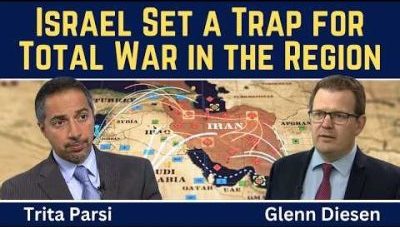
Trita Parsi: Israel Set a Trap for Total War in the Region
or go to
Aletho News Archives – Video-Images
From the Archive
Zionism’s Violent Legacy
By Donald Neff | Washington Report On Middle East Affairs | January 1996
On January 4, 1948, Jewish terrorists drove a truck loaded with explosives into the center of the all Arab city of Jaffa and detonated it, killing 26 and wounding around 100 Palestinian men, women and children.[1] The attack was the work of the Irgun Zvai Leumi – the “National Military Organization,” also known by the Hebrew letters Etzel – the largest Jewish terrorist group in Palestine. The Irgun was headed by Revisionist Zionist Menachem Begin and had been killing and maiming Arabs, Britons and even Jews for the previous ten years in its efforts to establish a Jewish state.
This terror campaign meant that at the core of Revisionist Zionism there existed a philosophical embrace of violence. … continue
Blog Roll
 Aletho News
- Trita Parsi: Israel Set a Trap for Total War in the Region
- Trump’s Iran war is on an Israeli leash
- Saudi oil boss issues global supply warning
- Riyadh Says Its Oil System Is Intact. The Numbers Say Otherwise.
- Trump and Netanyahu Want to “Finish the Job” on Iran
- US ‘one-sided dictation’ not Iran’s beliefs makes rational talks impossible: Baghaei
- Iran’s Next Strike May Not Explode. It Could Shut You Down /Col Doug Macgregor
- Iran: US political targets legitimate if assassinations return
- Iraq shuts key border crossing with Iran under US pressure: Report
- Undersea Internet cables could be targeted in retaliation for attacks on Iran: IRGC deputy chief
- If Americans Knew
- The Israel Lobby’s Changing Fortunes
- AIPAC has become such a political liability that it’s shifting to a more “nimble” approach to buying politicians
- At least 160 Israeli settler attacks in 2 weeks
- Will Gaza’s Ancient Christian Community Disappear Forever?
- Israel’s vision of regional security rests on keeping Arab states weak
- Heidi Levine recounts how Palestinian youths helped save her in settler attack
- DAILY UPDATE: Latest essential news on Palestine, Israel, & region
- Trump’s Intensifying Sabotage of the ICC, for Israel’s Sake
- Israeli military detain US and UK volunteers in West Bank including Democratic NY politician Brad Lander
- Americans at National Conservatism Conference held in Israel this year criticize Israel
- No Tricks Zone
- E-Cars Reduce CO2 Emissions By Only 41% Compared To Internal Combustion Engine Vehicles
- Predictions Made By Renowned Climate Professor Over Past Decades Have Been Proven To Be Poor
- New Study Suggests Large Regions Of The Pacific Ocean Have Been Cooling For The Last 80 Years
- Germany’s Green Energy Debacle: High Energy Costs Force Kahla Porzellan to Close After 182 Years!
- New Study: 50 Years Of The Most Aggressive ‘Net Zero’ Policies Can Only Affect The Global Climate By 0.03°C
- US September “Heat” Was No Record…Many Records Set Decades Ago
- Latest European Green Energy Debacle; Portugal’s Largest Flagship Solar Park Insolvent!
- Green Energy Debacle: German Expert Professor Fritz Vahrenholt Warns Of Severe Economic And Social Consequences
- Two More Paleo Reconstructions Affirm Meters-Higher Sea Levels Across Ireland, Brazil 7000-6000 Years Ago
- New Study: Earth And Venus Surface Warmth Largely Explained By Convection And Lapse Rate, Not CO2 Or Radiation

