Germans demand investigation of Nord Stream sabotage, end of US occupation
Free West Media | February 23, 2023
After the sensational revelations by US investigative reporter Seymour Hersh about the perpetrators of the Nord Stream attacks on September 26, 2022, the German government has remained silent. It does not want to comment on Hersh’s research results, according to which the pipelines were blown up by Americans and Norwegians.
The Scholz administration certainly has not drawn any conclusions from the revelations.
The German public obviously sees things very differently – at least if one wants to believe a voting simulation by the Dutch portal “Restart Democracy”. There, the Rudulin Foundation, which by its own admission is committed to more co-determination and a “truly democratically oriented society”, asked 6425 German citizens to vote between February 10 and 17.
Almost 100 percent voted to convene a Nord Stream investigative committee. The question was: “Do you vote for or against the convening of the Nord Stream committee of inquiry?”
Markus Bönig, Director of the Rudulin Foundation, underscored the difference between a survey and a vote: “Voting by voters is an important instrument of the joint declaration of intent. It is used for decision-making and choice, so that power is actually and directly exercised by the people,” explained Bönig.
Surveys, on the other hand, only draw a non-binding opinion of a comparatively small group of registered people, according to Bönig.
Peace demonstrations reflect the mood
 In addition to the big peace demo on Friday in Dresden (with HC Strache and Björn Höcke) and on Saturday in Berlin (with Sahra Wagenknecht and Alice Schwarzer), there will be another peace demo in Ramstein on Sunday under the motto “Close Airbase Ramstein – Ami [Americans, ed.] go home!”
The call from the organizers states: “As a broad, non-partisan protest alliance, we have registered a large peace demonstration for February 26, 2023 on the square in front of the train station in Ramstein. We demand the immediate closure of the US airbase, the complete withdrawal of all US troops, taking all weapons stationed here with them.
“The danger that Germany will be drawn into a third world war is growing daily. The recent decision to deliver heavy tanks to Ukraine also ensures that Germany is increasingly becoming a participant in the war. One of the centers for war, suffering and also for crimes against humanity is the US Airbase in Ramstein. Here we would like to send a clear signal for peace on February 26, 2023.”
Their goals include:
- The closure of the US airbase in Ramstein and the withdrawal of all foreign troops from Germany
- A sovereign German foreign policy
- No to arms shipments
- A return to diplomacy
- An end to sanctions
- No to foreign deployments of the Bundeswehr
The peace demonstration will start at 12 pm on the square in front of the station in Ramstein. The square is located opposite the Ramstein Miesenbach train station on Bahnhofstrasse. There will be a pavilion on the site of the opening rally, where initiatives and organizers can display their information material.
In addition to an opening rally, there is a large demonstration in the direction of the airbase, where another rally will be taking place. Participants who cannot complete the route for health reasons will be able to remain at the site where sanitary facilities will be available.
Time for US Pull-Out: GOP Congressman Warns About Risk of Kinetic Conflict With Russia in Syria
By Ekaterina Blinova – Sputnik – 23.02.2023
GOP Representative Matt Gaetz has introduced a resolution seeking to direct President Joe Biden to remove all US troops from Syria. The House must vote on Gaetz’s proposal within 18 days of its introduction due to the bill’s war powers status.
“[T]he purpose of my legislation is to force members of Congress to vote on record regarding whether they think we ought to continue Obama’s war in Syria. President Obama kicked off our involvement (…) and now we still find ourselves in the middle of a Syrian civil war with Russia and Turkey and Iran, all present in a very confined neighborhood,” Congressman Matt Gaetz, R-Fla., told the US press earlier this week.
Gaetz, a House Armed Services Committee member, filed the War Powers Resolution on February 22 after he learned that four US military servicemen and a working dog were wounded in a US and Syrian Democratic Forces (SDF) helicopter raid in northeastern Syria.
Speaking to the US press, Gaetz shared his concerns with regard to the US president’s ability to handle Syrian matters. The congressman quoted Biden’s August 2021 interview in which the president claimed that the US “[doesn’t] have military in Syria to make sure that we’re going to be protected.” However, according to the American media at the time of Biden’s comment, there were at least 900 troops in Syria who were helping their SDF proxies on the ground.
Gaetz has also drawn attention to reports alleging that Russian and US personnel get into very close proximity with one another. “[T]he risk of an accident or miscalculation or just misuse of authority could lead to direct kinetic conflict between the United States and Russia in Syria,” the lawmaker insisted.
In addition, Congress has never authorized the use of military force in Syria, the congressman argued. “America First means actually putting the people of our country first — not the interests of the military industrial complex,” he said.
Gaetz’s resolution has been filed under the War Powers Act of 1973, which was designed to limit the president’s authority to wage war and reasserted Congress’ authority over foreign wars. Notably, at the time of the 1973 bill’s introduction, then President Richard Nixon tried to veto it. However, Congress overrode his veto, and the resolution became law following the US pullout from Vietnam in early 1973.
If Gaetz’s legislative initiative passes, US military personnel must be removed from the Syrian Arab Republic within 15 days.
Meanwhile, the lawmaker lamented the fact that Democratic progressives who used to be anti-war activists have become “cheerleaders” for the US’s overseas conflicts. “‘The Squad’ used to be anti-war. Now, they’re waving their pom poms for NATO,” he said.
The representative believes that the upcoming vote on his resolution will show who the real patriot of America is and who continues to stick to Middle Eastern adventurism.
Biden’s predecessor, Donald Trump, was the first who sought to pull US troops out of Syria. Nonetheless, he later insisted that some of the contingent should stay in place to “protect” the Syrian oil fields occupied by the US-backed Kurdish-dominated SDF. Trump was also misled about the actual number of US servicemen in Syria. US Syria envoy Ambassador Jim Jeffrey admitted in November 2020 he was “always playing shell games to not make clear to our leadership how many troops we had there.”
Russian FM: US playing with fire, encouraging separatism in Kurdish region in Syria
Press TV – February 6, 2023
Russian Foreign Minister Sergei Lavrov says the United States is “playing with fire” with its activities on the common border between Iraq and Syria, especially by backing separatist militants affiliated with the so-called Syrian Democratic Forces (SDF) and encouraging separatism.
Lavrov said at a press conference in Baghdad with his Iraqi counterpart, Fuad Hussein, that Washington “fosters separatism among locals of Kurdish-populated regions in Iraq and Syria. It is playing with fire.”
He added, “Americans encourage Kurdish separatism one way or another and ignore other matters, including the territorial integrity of Syria, warning that such an approach “exposes other countries in the region to ensuing dangers and threats.”
Security conditions have been deteriorating in the areas controlled by the US-led SDF in Syria’s northern and northeastern provinces of Raqqah, Hasakah, and Dayr al-Zawr amid ongoing raids and arrests of civilians by the US-sponsored militants.
Locals argue that SDF’s constant raids and arrest campaigns have generated a state of frustration and instability, severely affecting their businesses and livelihoods.
Residents accuse the US-backed militants of stealing crude oil and failing to spend money on service sectors.
Local councils affiliated with the SDF have also been accused of financial corruption. They are said to be embezzling funds provided by donors, neglecting services, and not meeting the basic needs.
The Russian foreign minister went on to note that Moscow continues to work on negotiations within the Astana format for the peaceful settlement of Syria conflict, and regards the peace talks as useful.
“We consider Iraq’s observer status at the Astana talks, with Iran, Russia and Turkey acting as the guarantor states, to be very useful. We will continue our interactions and welcome participation of Iraq as an observer. Jordan and Lebanon also play the same role,” Lavrov said.
The Russian foreign minister went on to speak of a “vital importance” to “safeguard” bilateral economic ties with Iraq against “illegal sanctions” imposed on his country by the United States and its allies due to the conflict in Ukraine.
Lavrov said Russia had already invested some $13 billion in Iraq, arguing that Russian oil companies have not received outstanding payments because of the West’s coercive measures.
Elsewhere in his remarks, the top Russian diplomat underlined the importance of the Palestinian issue, saying that the West is procrastinating resolution of the Israeli-Palestinian conflict.
Hussein, for his part, termed Lavrov’s visit to Iraq as a remarkable development, stressing that Baghdad and Moscow will discuss problems linked to the work of Russian companies and Russian financial dues in the Arab country through meetings of the joint committee between the two sides.
The Iraqi foreign minister said he would discuss the issue of cooperating with Russian companies during an upcoming visit to the US.
Hussein said he would insist the US should refrain from imposing sanctions on Iraqi companies for working with Russian partners in Iraq.
He also touched on the Ukraine crisis, stating that Iraq demands a ceasefire between Russia and Ukraine, and calls for an end to the crisis through sincere dialogue between the two countries.
Rights group submits objection to US plans to build new embassy in Jerusalem
MEMO | January 31, 2023
Adalah yesterday filed an objection against the Jerusalem District Planning Committee over the US’ plan to build a new embassy on illegally confiscated Palestinian land in Jerusalem.
Action was taken on behalf of 12 of the descendants of the original Palestinian owners of the land, with the rights group calling on Washington to “immediately cancel” its plans to build the embassy.
“If the US proceeds with this plan, it will be a full-throated endorsement of Israel’s illegal confiscation of private Palestinian property in violation of international law,” a letter to the US Ambassador to Israel Thomas Nides and Secretary of State Antony Blinken said.
“Additionally, the State Department will be actively participating in violating the private property rights of its own citizens.”
These descendants include four US citizens, three Jordanian residents and five East Jerusalem residents.
According to Wafa news agency, the land was confiscated by the Israeli government under the Absentees’ Property Law of 1950, which Adalah says is one of the most arbitrary, discriminatory and draconian laws enacted in the state of Israel.
The Absentees’ Property Law was the main legal instrument used by Israel to take possession of the land belonging to the internal and external Palestinian refugees and Muslim Waqf properties across the newly formed state.
Adalah also highlighted that the confiscation of the land on which the US Diplomatic Compound is to be built violates international law, in particular, Article 46 of The Hague Regulations.
US refuses to call West Bank Israeli occupied territory
MEMO | January 30, 2023
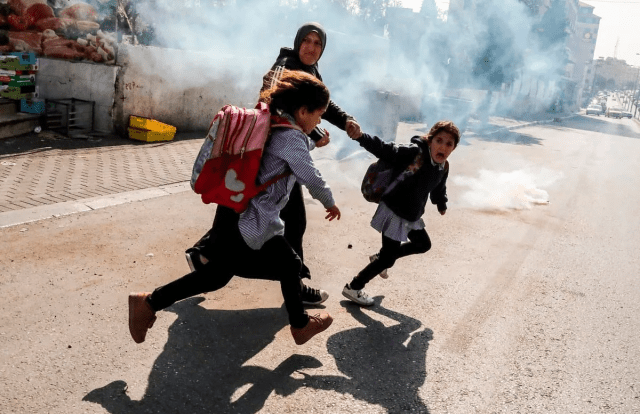
The US State Department refused to describe Palestinians in the West Bank as living under a military occupation during a heated exchange between journalists last week. State Department spokesperson Vedant Patel brushed aside questions about Washington’s view on the status of the occupied West Bank in the wake of an Israeli military raid that killed ten Palestinians in Jenin.
“What is the status of the Palestinian people in the West Bank, including Jenin… and everywhere else in the West Bank?” Said Arikat of Al-Quds newspaper asked Vedant. “It’s a simple question. Are they under occupation?”
Patel refused to answer the question despite being asked repeatedly to clarify the position of the US regarding the status of the West Bank. At one point Patel shockingly said that the status of the Palestinians is that “they reside on those territories.”
Frustrated at not getting an answer, Arikat asked if the West Bank is considered a “different planet” and if the US “subscribes to the fact that they are under military occupation?” Patel refused to answer the question.
“Vedant, are they occupied or are they not occupied? What is the status that you give the Palestinians right at this moment? What kind of status do they have?” Arikat insisted.
Patel again refused to answer, deflecting the question by focusing on the escalation of violence and calling for peace and calm in the region. “I’m not talking about a recent period. I am saying about legally, how do you designate the Palestinians in the West Bank? What is their status?” Arikat asked to know for a fourth time.
“I understand the question you’re asking, and I – as we’ve said previously, it is vital for both sides to take action to prevent even greater loss, and we condemn any violence, escalation, or provocation,” said Patel.
Under International law the West Bank and Gaza is Israeli occupied territory. Experts in international law say that given the length of the occupation and given that Israel has no intention to ever withdraw, the correct designation is that it is an illegal occupation. The International Court of Justice has been asked to issue an opinion on that very matter.
Going for the Kill in Kosovo
By Stephen Karganovic | Strategic Culture Foundation | January 28, 2023
The collective West’s unsuccessful war against Russia using Ukraine as the stage and Ukrainians as cannon fodder has induced the Transatlantic alliance to desperately seek some semblance of victory, anywhere, in order to disguise the scope and lessen the political repercussions of its failure in the Ukraine.
The solution it has come up with to repair its tarnished hegemonic image is the aggressive campaign to wrap up “unfinished business” in the Balkans. Coming from such quarters, any “attention” to Balkan nations is invariably bad news for the country so favoured. That is the case in this instance as well.
The West judges, perhaps not entirely incorrectly, that Serbia and the Republic of Srpska, its perennial Balkan targets because thus far they have withstood total submission, are currently in a disadvantageous position to continue to resist effectively. With pretensions to embody the “international community,” although it consists mainly of the NATO/EU block of countries, the Alliance is increasingly and now openly shifting to a war footing. That raises to a new level its customary belligerence and disregard for the niceties of international legality and standard diplomatic practice. It never was greatly bothered in the past to observe the norms of civilised interaction between states. But now, with intense pressure to produce some kind of political victory to compensate for the failure in Ukraine, gloves are definitely off.
That puts both Serbia and its sister state, the Republic of Srpska, in a more precarious position than at any other time recently. They are both geographically distant from their natural allies and surrounded by hostile territory politically and militarily controlled by the Western Alliance, which is planning their demise. A comparison with the position of the Kingdom of Yugoslavia in the spring of 1941 would not be wide off the mark.
Complementing a similarly unenviable geopolitical predicament, there is an additional unfavourable analogy for Serbia. Its ruling elite are as feeble, vacillating, corruptible, treacherous, and disoriented as was the Royal Yugoslav government in March of 1941. That is when Nazi Germany went for the kill and demanded imperatively that in the looming global conflict Yugoslavia either commit to its side, or face dire consequences. Now it is NATO and EU which are going for the kill and the pretext is Kosovo. The Serbian government a few days ago was handed an ultimatum. The demand was that Serbia give up pretensions of sovereignty over NATO occupied Kosovo and unequivocally align itself with the aggressor alliance in the conflict in Ukraine. It was conveyed by a delegation of Western ambassadors in the form of a brutal warning that dilly dallying about Kosovo must come to an urgent end. Serbia was told that it must unreservedly acquiesce to the robbery of its cultural and religious cradle by signing off on Kosovo’s secession and accepting its illegal fruits. It should be recalled that the occupation of Kosovo was initiated in 1999, when NATO committed unprovoked aggression against Yugoslavia and it was completed in 2008 by a unilateral declaration of “independence” made under NATO auspices.
As is always the case, the West’s actual interest in Kosovo has nothing to do with the publicly stated reasons. Suffice it to say that Kosovo is the site of Camp Bondsteel, the largest military base in Europe, strategically situated so as to be of great use should the Ukrainian conflict degenerate further into an all-out global war.
Judging by official Belgrade’s initial reactions, it is conceivable that the Serbian government may be contemplating a course of action inspired by the collapse of the will experienced by the Royal Yugoslav government in March of 1941, when under Nazi pressure it did as ordered and signed its adherence to the Axis pact. It ought to be remembered by all concerned, however, that the consequences of that infamous breakdown were short lived. Within just a few days, popular revulsion in Serbia forced the ousting of officials responsible for the shameful betrayal of public trust. The immoral commitments they had undertaken on the nation’s behalf were effectively annulled. If further analogies need to be made with the situation in 1941, it should be pointed out that the reputation of the protagonists of cowardice and treachery displayed then lives in infamy to the present day.
Whether such considerations will be sufficient to deter those currently responsible for Serbia’s official decisions remains to be seen.
Alongside Serbia, the neighbouring Republic of Srpska, an entity within Bosnia and Herzegovina populated mostly by Serbs, which recently experienced a turbulent election followed by an attempt to achieve regime change using instruments from the color revolution handbook, is also targeted for harsh treatment by the unforgiving Western democracies. Like Serbia’s, its population is solidly on the “wrong side of history” in general and in the Ukrainian conflict in particular, with all that implies. With a similar degree of unanimity, the population and the government are also opposed to having anything to do with NATO. Under the terms of the Dayton agreement signed in 1995, by which the prerogatives of Bosnia’s entities are governed, that effectively blocks Bosnia’s entry into NATO and participation in its activities.
Understandably, this blockade of what is euphemistically called Bosnia’s “Euro Atlanticist integrations,” is an insufferable affront and irritant. As a result, punitive measures against the uncooperative leadership of the Republic of Srpska are now being contemplated. It is a sure bet that if Serbia caves and in cowboy fashion the Kosovo issue is resolved, Bosnia’s defiant Serbian entity will soon be next. It will again find itself actively targeted and in the outraged “international community” cross hairs.
It is, of course, still premature to call the outcome of the ominous new chapter being prepared in the Kosovo crisis, but a perfect storm with turbulent effects appears to be approaching. The same recklessness that over the past year had been on display in the Ukraine is now in evidence increasingly in the Balkans. Andrey Martyanov’s repeated assessment of Western elites as arrogant, ignorant, and incompetent, which he illustrates with a steady stream of examples from the Ukrainian theatre, may soon find another resounding confirmation in the Balkans, to the immense misfortune of all its inhabitants.
Calls for Khan Al-Ahmar’s demolition speak of colonial violence and privilege
By Ramona Wadi | MEMO | January 24, 2023
The former Israeli ambassador to the UN, Danny Danon, has told a Likud faction meeting that “illegal Palestinian construction” in the occupied West Bank is “rampant”. He wasn’t being honest.
“Last Friday we made it clear that supporting settlements does not contradict upholding the law,” he claimed. “The defence minister received our backing. We expect the defence minister to act with the same determination in the face of rampant Palestinian illegal construction in the West Bank. We will no longer tolerate discrimination against the settlers.”
Israeli settlements and settlers are, of course, illegal under international law, something that Danon is adept at overlooking when he makes such outrageous claims.
As the Israeli government prepares to submit its response to the High Court over the impending demolition of the Palestinian Bedouin village of Khan Al-Ahmar, Danon and Likud MK Yuli Edelstein visited the village, calling for its demolition and accusing the government of selective enforcement over the evacuation of the Or Chaim illegal settler outpost in the occupied West Bank.
In an op-ed, Danon described the EU’s funding of infrastructure in Khan Al-Ahmar as “subversive involvement of international entities in Israel’s domestic affairs” and accused the bloc of violating Israel’s sovereignty and international law. “It is part of an ulterior agenda that seeks to delegitimise Israel’s historical claim to its own land,” Danon wrote.
Completely eliminating Israel’s colonial context and the fact that Khan Al-Ahmar is built on Israeli-occupied Palestinian land, Danon referred to the evacuation of Or Chaim and said, “The law is the law and must be applied to all citizens and communities, Jews and Arabs alike.” However, there is no equivalence between the coloniser and the colonised, as Danon knows well.
Khan al-Ahmar has attracted enough international attention to become newsworthy periodically, and the related activism has ensured that Israel’s violations are fully exposed. The village, though, is also part of a long colonial process that seeks to dispossess Palestinians of their land. Its demolition is not an isolated incident. Earlier expulsions and destruction of properties, including the ethnic cleansing from the 1948 Nakba onwards, need to be kept in mind.
Israel benefits from the international community’s differentiation of colonial settlement expansion. It has gained a veneer of legitimacy for the earlier colonial settlements despite the atrocities committed by Zionist paramilitary terror gangs to establish control over Palestinian territory. Israeli law is justifiable only unto itself and the violence it created. In terms of equality and rights, there is no justification for Israel’s colonial expansion. Likewise, there is no equivalence in calling for the demolition of Khan Al-Ahmar because an illegal (even under Israeli law) settlement outpost was dismantled. Palestinians are rarely issued building permits on what remains of their land. Danon’s use of the word “rampant” is totally dishonest. Indeed, his words only reflect his country’s colonial violence and privilege when calling for Khan Al-Ahmar’s destruction, not to mention targeting an integral part of Palestinian resilience in the face of impending demolition orders.
Lest Danon forgets, Khan Al-Ahmar’s residents relocated to the area after being displaced by Israel in 1950, laying bare the lie of delegitimising “Israel’s historical claim to its own land”. Israel wants territorial contiguity to Jerusalem, not demolitions based on equal rights. Erasing the Palestinian landscape through colonial settlement expansion does not erase the fact that Israel’s settler-colonial population cannot lay legitimate claims to Palestinian land, and neither can the Israeli government. The only claim that Israel can make with any degree of accuracy and honesty is that it colonised Palestine and intends to finalise its colonial enterprise. Khan Al-Ahmar stands in the way of its plans, just as other Palestinian towns and villages did decades ago. More than 500 paid the price and were totally destroyed and wiped off the map.
Israel approves decision to demolish school in Masafer Yatta
MEMO | January 19, 2023
An Israeli court has approved a decision by Israeli authorities to demolish a school in Al-Ain Al-Baida in Masafer Yatta, based south of Hebron in the Occupied West Bank, reported Wafa news agency.
Head of the Masafer Yatta Village Council, Nidal Younis, told Wafa that an Israeli court revoked a previous injunction issued against the demolition of the school and gave the Israeli Occupation army 10 days to destroy it.
He noted that the school was built last year with funding from the European Union, which 50 students from local Bedouin communities attend.
On 4 May 2022, the Israeli High Court of Justice ruled that there were no legal barriers to the planned expulsion of Palestinian residents from Masafer Yatta to make way for military training.
The UN OCHA said then that this ruling “effectively placed the residents at imminent risk of forced evictions, arbitrary displacement and forcible transfer.”
According to the UN OCHA, in the 1980s, the Israeli Occupation designated part of Masafer Yatta as ‘Firing Zone 918’ and declared it a closed military zone.
Since this declaration, indigenous Palestinian residents have been at risk of forced eviction, demolition and forcible transfer. The two villages of Khirbet Sarura and Kharoubeh no longer exist after their homes were demolished.
“Approximately 20 per cent of the West Bank has been designated as ‘Firing Zones’, affecting over 5,000 Palestinians from 38 communities,” the UN OCHA said.
It added: “Currently, Masafer Yatta is home to 215 Palestinian households, including about 1,150 people, of which 569 are children.”
In an effort to force Palestinians out of the area, the Israeli Occupation has deprived residents of access to basic amenities, including drainage and permission to construct to meet the needs of the growing population.
It has always been a ‘Religious War’: On Ben-Gvir and the adaptability of Zionism
By Ramzy Baroud | MEMO | January 17, 2023
In a self-congratulatory article published in the Atlantic in 2017, Yossi Klein Halevi describes Israeli behaviour at the just-conquered holy Muslim shrines in Occupied East Jerusalem in 1967 as “an astonishing moment of religious restraint”.
“The Jewish people had just returned to its holiest site, from which it had been denied access for centuries, only to effectively yield sovereignty at its moment of triumph,” Halevi wrote with a lingering sense of pride, as if the world owes Israel a ton of gratitude in the way it conducted itself during one of the most egregious acts of violence in the modern history of the Middle East.
Halevi’s pompous discourse on Israel’s heightened sense of morality – compared to, according to his own analysis, the lack of Arab appreciation of Israel’s overtures and refusal to engage in peace talks – is not in any way unique. His is the same language recycled umpteen times by all Zionists, even by those who advocated for a Jewish state before it was established on the ruins of destroyed and ethnically cleansed Palestine.
From its nascent beginnings, the Zionist discourse was purposely confusing – disarranging history when necessary, and fabricating it when convenient. Though the resultant narrative on Israel’s inception and continuation as an exclusively Jewish state may appear confounding to honest readers of history, for Israel’s supporters – and certainly for the Zionists themselves – Israel, as an idea, makes perfect sense.
When Israel’s new National Security Minister Itamar Ben-Gvir raided Al-Aqsa Mosque on 3 January to re-introduce himself to Jewish extremists as the new face of Israeli politics, he was also taking the first steps in correcting, in his own perception, a historical injustice.
Like Halevi, and, in fact, most of Israel’s political classes, let alone mainstream intellectuals, Ben-Gvir believes in the significance of Jerusalem and its holy shrines to the very future of their Jewish state. However, despite the general agreement on the power of the religious narrative in Israel, there are also marked differences.
What Halevi was bragging about in his piece in the Atlantic is this: soon after soldiers raised the Israeli flag, garnished with the Star of David, atop the Dome of the Rock they were ordered to take it down. They did so, supposedly, at the behest of then-Defence Minister Moshe Dayan, quoted in the piece as saying to the army unit commander: “Do you want to set the Middle East on fire?”
Eventually, Israel conquered all of Jerusalem. Since then, it has also done everything in its power to ethnically cleanse the city’s Palestinian Muslim and Christian inhabitants to ensure an absolute Jewish majority. What is taking place in Sheikh Jarrah and other Palestinian neighbourhoods in Jerusalem is but a continuation of this old, sad episode.
However, the Haram Al-Sharif Compound – where Al-Aqsa Mosque, Dome of the Rock and other Muslim shrines are located – was nominally administered by the Islamic Waqf authorities. By doing so, Israel managed to enforce the inaccurate notion that religious freedom is still respected in Jerusalem even after Israel’s so-called ‘unification’ of the city, which will remain, according to Israel’s official discourse, the “united, eternal capital of the Jewish people”.
The reality on the ground, however, has been largely dictated by the Ben-Gvirs of Israel who, for decades, have laboured to erase the Muslim and Christian history, identity and, at times, even their ancient graveyards from the Occupied city. Al-Haram Al-Sharif is hardly a religious oasis for Muslims but the site of daily protests, whereby Israeli soldiers and Jewish extremists routinely storm the holy shrines, leaving behind broken bones, blood and tears.
Despite American support of Israel, the international community has never accepted Israel’s version of falsified history. Though the Jewish spiritual connection to the city is always acknowledged – in fact, it has been respected by Arabs and Muslims since Caliph Umar ibn Al-Khattab entered the city in 638 – Israel has been reminded by the United Nations, time and again, regarding the illegality of its Occupation and all related actions it carried out in the city since June of 1967.
But Ben-Gvir and his Otzma Yehudit Party, like all of Israel’s major political forces, care little for international law, authentic history or Palestinians’ rights. However, their main point of contention regarding the proper course of action in Al-Aqsa is mostly internal. There are those who want to speed up the process of fully claiming Al-Aqsa as a Jewish site, and those who believe that such a move is untimely and, for now, unstrategic.
The former group, however, is winning the debate. Long marginalised at the periphery of Israeli politics, Israel’s religious parties are now inching closer to the centre, which is affecting Israel’s priorities on how best to defeat the Palestinians.
Typical analyses attribute the rise of Israel’s religious constituencies to the desperation of Israeli Prime Minister Benjamin Netanyahu, who is arguably using the likes of Ben-Gvir, Bezalel Smotrich and Aryeh Deri to stay in office. However, this assessment does not tell the whole story, as the power of religious parties has long preceded Netanyahu’s political and legal woes. The Zionist discourse has, itself, been shifting towards religious Zionism; this can be easily observed in the growing religious sentiment in Israel’s judicial system, among the rank and file of the army, in the Knesset (Parliament) and, more recently, in the government itself.
These ideological shifts have even led some to argue that Ben-Gvir and his supporters are angling for a ‘religious war’. But is Ben-Gvir the one introducing religious war to the Zionist discourse?
In truth, early Zionists have never tried to mask the religious identity of their colonial project. “Zionism aims at establishing for the Jewish people a publicly and legally assured home in Palestine,” the Basel Program, adopted by the First Zionist Congress in 1897, stated. Little has changed since then. Israel is “the national state, not of all its citizens, but only of the Jewish people,” Netanyahu said in March 2019.
So, if Israel’s founding ideology, political discourse, Jewish Nation State Law, every war, illegal settlement, bypass road and even the very Israeli flag and national anthem were all directly linked or appealed to religion and religious sentiments, then it is safe to argue that Israel has been engaged in a religious war against Palestinians since its inception.
The Zionists, whether ‘political Zionists’ like Theodore Hertzl or ‘Spiritual Zionists’ like Ahad Ha’am’ – and now Netanyahu and Ben-Gvir – have all used the Jewish religion to achieve the same end, colonising all historic Palestine and ethnically cleansing its native population. Sadly, a major part of this sinister mission has been achieved, though Palestinians continue to resist with the same ferocity of their ancestors.
The historic truth is that Ben-Gvir’s behaviour is only a natural outcome of Zionist thinking, formulated over a century ago. Indeed, for Zionists – religious, secular or, even atheists – the war has always been or, more accurately, had to be, a religious one.
Israel occupation forces bulldoze Greek Orthodox land in occupied Jerusalem
MEMO | January 16, 2023
The Israeli occupation authorities yesterday started to bulldoze a 5,000 square metre plot of land owned by the Greek Orthodox Church in occupied Jerusalem’s Silwan neighbourhood, the Wadi Hilweh Information Centre has reported. The operators of the bulldozers were protected by a large number of Israeli occupation security forces and police.
According to the centre, the Israeli Nature and Parks Authority as well as settler organisations commissioned the bulldozers to uproot fruit-bearing trees and level the land. Illegal settlers and police seized the land on 22 December. The Jewish settlers fenced it off and installed surveillance cameras under police protection.
When Silwan residents rushed to the scene to stop the land theft, they were assaulted by security forces, said the centre, which monitors Israeli violations in the area. The land is owned by the Greek Orthodox Monastery in Silwan, which is part of the city’s Greek Orthodox Patriarchate.
Silwan is home to more than 60,000 Palestinians and is located strategically to the south of Al-Aqsa Mosque. The area has been the target of Israeli settler expansion for years, with hundreds of Palestinian families facing the threat of expulsion, either through lawsuits by powerful settler groups or administrative eviction orders by the Israeli-run Jerusalem municipality.
Middle East Eye has reported that the Greek Orthodox Church has been criticised heavily by Palestinian groups for its dealings with settlers and allegations of bribery and fraud. In 1951, church-owned land in West Jerusalem was rented to the Jewish National Fund for a period of 99 years. Today, the land houses most Israeli state institutions, including Israel’s parliament, the Knesset.
How the EU constructs Israel impunity

By Ramona Wadi | MEMO | January 12, 2023
The EU could have availed itself of an opportunity to hold Israel accountable for its violations but, instead it opted for the lesser value of requesting financial reparation for the structures funded by the bloc in the Occupied West Bank and destroyed by the settler-colonial enterprise. Neither is the EU’s request a novelty, since demanding financial compensation from Israel has happened in the past, without any compliance, of course.
Recent focus on Israel’s planned forced displacement of Palestinians living in Masafer Yatta prompted 24 European Parliament members to contact the European Commissioner for Crisis Management, Janez Lenarcic, regarding financial reparation. The bottom line is that, while the EU is within its rights to demand financial compensation, the issue at stake – which is the Palestinian people being forcibly displaced by Israel – is nowhere on the EU’s agenda.
Lenarcic’s response, partially quoted by Haaretz, confirms the EU’s repetitive requests for financial compensation and that “the European Union is continuing to work in this regard through a range of diplomatic and political channels”. Of little to no consequence was Lenarcic’s reminding that EU representatives often visit areas in the Occupied West Bank that are slated for demolition, ostensibly “to warn against”. Yet, besides the opportunistic exploitation, keeping tally of EU-funded destroyed dwellings is more a case in point and futile, too. As Lenarcic stated, “The list of possible steps to ensure compensation from Israel for European financing that went down the drain in demolitions has not yet come up for discussion.”
If holding Israel accountable for something as basic as a financial transaction for damages it caused prompts so much caution in the EU’s official statements, it is safe to say that human rights in the EU’s repertoire, when it comes to Israel, descends into still silence. The EU still has not addressed the fact that, without holding Israel accountable for forcibly displacing Palestinians, its humanitarian projects for Palestinians is also financing Israel’s violations. Yet it is precisely what the humanitarian project which the international community imposed upon Palestinians intended. By investing a fragment of humanitarian aid aimed at alleviating the suffering caused by Israel’s colonial existence and violence, the international community can bypass the actual violations which go against international law.
The EU is no exception to this imposed rule. Advocacy by EU representatives does not work to hold Israel accountable but to extend a permanent contract of silence which, in turn, also silences Palestinians. Despite having political means at their disposal, EU representatives prefer playing the amateur activists when it comes to Palestine. Funds for travelling to the Occupied West Bank, after all, form part of the humanitarian project which Palestinians are forced to fit into. In the same way, EU-funded dwellings play a role in the humanitarian project but fail to sustain Palestinian autonomy. The latest purported concern has nothing to do with Palestinians, and is only marginally related to the EU-funded dwellings that Israel routinely destroys. Detracting from Israel’s settler-colonial expansion and the EU’s role in maintaining it, however, is a major part of what the humanitarian paradigm constitutes.
Featured Video

The Source of America’s Wars – Kristol Clear
or go to
Aletho News Archives – Video-Images
From the Archives
Is Israel to blame for the Iraq War?
American Goy | March 10, 2008
I am so tired of this old canard that “Israel had nothing to do with USA’s war with Iraq – in fact, it officially advised America against it”.
Bullshit. … continue
Blog Roll
 Aletho News
- Strait of Hormuz is Iran’s ‘nuclear weapon’ that forced US retreat: Medvedev
- Energy crisis will last for months – Kremlin envoy
- Europe’s quiet role in the war on Iran
- Forty days that shook the Empire: How Iran turned the tables on US and prevailed
- Netanyahu unilaterally declares Lebanon outside of ceasefire deal
- Israeli leaders: ‘Not a single goal’ achieved in war with Iran
- What on earth just happened? Trump, Iran, and the unlikely ceasefire
- Alberta Bill Would Fine Political Deepfakes $10,000 Without Satire Exemptions
- Iran declares ‘historic victory’ over US, says enemy forced to accept its proposal
- Trump Claims Ceasefire, Reopening of Strait of Hormuz Agreement with Iran
- If Americans Knew
- A sigh of relief over Iran, but Gaza and Lebanon in dire straits – Daily Update
- Thousands dead and neighborhoods razed to the ground: Aid agencies fear southern Lebanon is becoming the new Gaza
- The war the US is fighting for Israel could cost trillions
- ‘Cigarette Burns, Nail Wounds’: Toddler Tortured in Gaza to Coerce Father
- Trump Says US Sent ‘a Lot of Guns’ to Protesters in Iran
- Israeli forces destroy 17 UN peacekeeper cameras in south Lebanon
- US-Israeli strikes ‘completely destroy’ synagogue in Tehran
- Archbishop for US Military Says Iran War Is Unjust Under Catholic Teaching
- Iranian leaders’ Open Letters to the American People
- Trump says Iranians appreciate bombs, WHO warns of nuclear risks – Daily Update
- No Tricks Zone
- An Inconvenient Tree: Uncovered In Alps… Europe Much Warmer Than Today 6000 Years Ago
- New Study Reports A 60% Slowdown In Greenland’s Ice Loss Rate In The Last Decade
- Low Intensity Tornado Wrecks Major Solar Farm, Creating A Potential Toxic Dump
- New Study Finds Warming Saves Lives…Cold Temperatures 12 Times More Deadly Than Excess Heat
- German Science Blog Accuses PIK Climate Institute Of Hallucinating Climate Tipping Points
- Devastating Assessment Of Comirnaty Vaccine By Former Senior Pfizer Europe Toxicologist
- New Study: CO2 Is ‘Effectively Negligible’ As An Explanatory Climate Change Factor Since 2000
- Former Pfizer Toxicologist Dr. Helmut Sterz Tells Bundestag Hearing Pfizer Vaccine Should Have Never Been Approved
- Energy Expert: Germany’s Nuclear Phaseout Was A “500 Billion Euro Mistake”
- New Research: South Australia’s Mid-Holocene Sea Surface Temperatures Were 4°C Warmer Than Today
 Aletho News