Mr. Trudeau, tell us how you decide which invasions count
By Yves Engler | June 19, 2022
In a world of vast injustice, one cannot expect a government’s foreign policy to be principled or consistent. But there should at least be some limit to hypocrisy.
On June 16 Justin Trudeau spoke with Rwandan president Paul Kagame about this week’s Commonwealth Summit in Kigali. Half the government’s readout about the discussion was devoted to opposing a foreign invasion. It read, “the two leaders exchanged views on Russia’s invasion of Ukraine and noted that the invasion was contrary to foundational principles of the Commonwealth. Prime Minister Trudeau reiterated that the invasion was an affront to the fundamental principles of sovereignty, territorial integrity, self-determination, and international law, and expressed that it is important for the Commonwealth summit to provide an opportunity for member countries to stand up for democracy and denounce Russia’s invasion of Ukraine.”
Recently, Rwandan-backed rebels instigated fighting that has caused over 170,000 Congolese to flee their homes since November. Reportedly, Rwanda has deployed 500 troops to assist the M23 rebels. According to the UN, M23 is planning an attack on the major eastern city of Goma in the coming days. On Friday Rwandan forces killed a Congolese soldier on the border between the two countries and Congo has closed the border.
Highlighting the hypocrisy of Trudeau discussing foreign invasion with Kagame, former Congolese presidential candidate and long-time UN worker, Angèle Makombo, tweeted, “No kidding Prime Minister Justin Trudeau, you spoke with Paul Kagame about ‘Russia’s illegal invasion of Ukraine’? Did you also care about raising the issue of Rwanda’s aggression of Congo and its dire impacts on the Congolese people and Africa Great Lakes subregion?”
The M23 is a “Rwandan sponsored” force, reported the Globe and Mail previously. A 2012 UN report concluded that officials in Kigali organized, armed and “coordinated” M23’s military activities in the mineral rich eastern Congo. The M23 is the successor to the Rwanda-backed rebel force lead by Laurent Nkunda, who grew to prominence after Rwanda invaded.
In 1996 Rwandan forces marched 1,500 km to topple the regime in Kinshasa. Two years later they re-invaded after the Congolese government it installed expelled Rwandan troops. This led to an eight-country war between 1998 and 2003, which left millions dead. A January 2008 study by the International Rescue Committee blamed the conflict and its destabilizing impact for 5.4 million Congolese deaths over a decade. In October 2010, the UN Office of the High Commissioner for Human Rights released a report on the Congo spanning 1993 to 2003 that charged Rwandan troops with engaging in mass killings “that might be classified as crimes of genocide.”
Aside from the mayhem he’s unleashed in the Congo, Kagame oversees a brutal dictatorship. Opposition media is entirely suppressed and opponents rot in jail. Top officials and other dissidents that flee have repeatedly been assassinated across east and southern Africa. A year and a half ago, the regime kidnapped its most famous opponent Paul Rusesabagina, who is the namesake for the Hollywood film Hotel Rwanda. A Belgian citizen and US Green card holder, Rusesabagina was snatched from Dubai and flown to Rwanda where he languishes in jail.
Trudeau’s dalliance with Kagame isn’t new. In 2018 Toronto-based Rwandan dissident David Himbara wrote, “the romance between the two and among their respective ministers has blossomed beyond belief.” In February 2020 the PM’s press people released a photo of him laughing with the Rwandan president. On at least five occasions since 2018 Trudeau has been photographed with Kagame during one-on-one meetings on the sidelines of different international summits. At one of those meetings the PM “affirmed the importance of strong and growing bilateral relations” between Canada and Rwanda. Ottawa provided $39 million in assistance to Rwanda last year.
While the media, opposition and government have spent much of the past week complaining/apologizing about a low-level Canadian diplomat attending an irrelevant social function put on by the Russian Embassy, the prime minister deepens Canada’s ties to Africa’s most bloodstained ruler.
For Trudeau it appears as if only invasions of European countries matter.
As Kagame renews his brutal war on the Congo, Trudeau wants us to believe his aim is to uphold international law and oppose foreign invasion.
The hypocrisy is staggering.
Palestine resistance seize Israel’s surveillance balloon

MEMO | June 18, 2022
The Palestinian resistance managed to seize control of the Israeli surveillance balloon early on Friday after it was shot down in the town of Beit Hanoun in the northern Gaza Strip.
Palestinian sources confirmed to Quds Press that the Israeli surveillance balloon seized by the Palestinian resistance was not the first it had seized. It has previously seized several balloons, as well as advanced drones.
Israeli sources revealed fears of dangerous information leaks and the resistance obtaining high-quality imaging equipment.
Palestinian writer and political analyst Mustafa Al-Sawaf believes: “What is important is that the resistance was able to seize this surveillance balloon, regardless of what method is used to shoot it down,” describing the incident as “serious”.
Al-Sawaf told Quds Press: “The occupation believes that the resistance is unaware and does not monitor its movements, so it tried to penetrate the Gaza Strip from the north and present a special force, but the resistance men were on the lookout, confronting the occupation and preventing them from entering the Gaza Strip.”
He pointed out: “The matter almost reached the level of a clash, but a reconnaissance aircraft intervened by firing two missiles, thus preventing this and securing the withdrawal of the special force.”
He added: “The occurrence of three incidents in Jenin and Gaza gives quick and dangerous indications that confrontation between the resistance and the occupation is fast approaching, and we must monitor the situation with high accuracy because the coming hours will carry a lot.”
It is worth noting that the Israeli army radio station, Doron Kadosh, announced: “The army’s initial investigation revealed that the surveillance balloon that fell in Gaza had fallen due to technical difficulty and that the army said there is no fear of significant information leakage, although the army tried to open warning fire near it, Hamas still managed to seize the balloon.”
TV crew for Colbert show arrested at Capitol

Samizdat | June 18, 2022
US Capitol Police arrested seven members of the ‘Late Show With Stephen Colbert’ crew in a Congressional office building on Thursday and charged them with unlawful entry. The CBS crew was filming material on the January 6 hearings, which themselves concern unlawful entry to the Capitol by supporters of former US President Donald Trump.
Capitol Police officers said in a statement that they received a call about a disturbance in the Longworth House Office Building on Thursday night, and found “seven individuals, unescorted and without Congressional ID” in an area of the building closed to visitors. The individuals, who had been asked to leave the building earlier in the day, were charged with unlawful entry, the statement continued.
An unnamed source told AP that several of the Colbert show’s producers were among those arrested, including Robert Smigel, who voices ‘Triumph the Insult Comedy Dog’ on the show.
CBS said that the group conducted “authorized and pre-arranged” interviews with members of Congress and stayed behind “to film stand-ups and other final comedy elements in the halls when they were detained.”
After the initial interviews were conducted, Fox News’ sources said that the group was ushered away from the area of the building where the January 6 Committee was working, before being let back inside by a Democratic aide. Fox News’ Jesse Watters claimed on Friday that Reps. Adam Schiff and Jake Auchincloss, both Democrats, let the crew back into the building.
According to Watters, the crew members were “banging on the doors of offices” belonging to Republican members of Congress. Fox reporter Chad Pergram claimed that the group was arrested near the office of Rep. Lauren Boebert, a Republican and vocal critic of the January 6 Committee.
Ironically, the committee is currently holding hearings on the riot that took place on Capitol Hill on January 6, 2021. On that day, hundreds of Trump supporters were arrested and charged with unlawfully entering the Capitol to protest the certification of Joe Biden’s electoral victory. Democrats and liberal media outlets have referred to the riot as a “coup,” an “insurrection,” and “domestic terrorism.”
“Adam Schiff, who has spent the last year and a half telling you that unauthorized violations of Capitol space are a coup, Adam Schiff illegally gave producers from CBS access to the Capitol,” Fox News host Tucker Carlson declared on his Friday night show. “And the point of them being there was to harass sitting members of Congress.”
“It’s exactly like what happened on January 6,” Carlson sniped.
Colbert himself has not commented on the arrests of his producers, and his show, which is usually taped live before broadcast, was replaced on Friday with a rerun.
‘Israel’ Continues Exploring Disputed Maritime Zones, US Mediator Insolently Says Lebanon Cannot Restore Rights
Al-Manar – June 14, 2022
In light of the ongoing dispute between Lebanon and the Zionist entity over the maritime border demarcation, the US mediator, Amos Hochstein, visited Lebanon and met with the senior officials.
The Lebanese officials voiced a united stance on the demarcation issue, underlining the Lebanese rights in this regard.
However, the insolent mediator said, during an interview with Al-Hurra News Channel, that Lebanon will not be able to obtain its rights, adding that the issue would be complicated.
Hochstein expressed satisfaction with what he heard from Lebanese officials in his meetings with them on Tuesday, adding that this will enable the sea border negotiations with Israel to “go forward.”
“The good news is that I heard a lot more unanimity, a lot more unity of message (and) serious preparation for the visit,” Hochstein said.
“They shared some ideas of how to continue the negotiations, the basis for which to continue the negotiations and to take it a step forward,” he added.
In an article published last October, Al-Akhbar Lebanese daily described the US envoy as “an Israeli-born who served with the Israeli occupation army, killed the people of this land (Lebanon) and now acts in Beirut as a man on a spy mission in favor of his “homeland” (the Zionist entity).”
The Greek firm Energean’s FPSO arrived on June 6 near the disputed maritime zone, knowing that Energean signed in 2018 an agreement with the Zionist entity to drill and extract gas and oil in occupied Palestine’s offshore, and the disputed field of Karish.
Israel plans huge park in occupied West Bank
MEMO | June 13, 2022
Israel plans to build a new national park on nearly 1 million dunams (247,000 acres) of land in the occupied West Bank between Jerusalem and the Dead Sea, Israel Hayom has reported.
The park will stretch between the illegal Jewish settlements of Kochav Hashahar north-east of occupied Jerusalem and Gush Etzion.
Tourist attractions such as the Mar Saba Monastery, Nabi Musa Mosque and the ruins of Hasmonean palaces, as well as hotels, will be within the proposed park. The area known as E1 to the east of Jerusalem has long been considered a red line and a point of no return for the internationally-backed two-state solution.
“We want to set up a new national park, the likes of which has never been seen in Judea and Samaria [the occupied West Bank], and create a single network, one product,” explained regional director-general Keren Geffen.
The announcement comes after the Israeli Defence Ministry reapproved the plan to advance a controversial settlement project in the E1 area of the occupied West Bank earlier this month. The Israeli government withdrew the plan in January amid international pressure.
The Civil Administration of the Israeli army, which authorises construction work in the occupied West Bank, published its agenda for an 18 July meeting to discuss objections to projects that have received initial approval. Two E1 plans totalling 3,412 housing units are the only projects on the docket.
Lebanon warns Israel
Samizdat | June 5, 2022
A battle over Mediterranean waters rich in natural gas deposits bubbled up on Sunday when Lebanese President Michel Aoun warned Israel that trying to tap the offshore riches without first resolving a territorial dispute would be seen as a “provocation.”
“Any action or activity in the disputed area represents a provocation and an aggressive action,” Aoun said on Sunday in a statement. He made his comments after a floating production storage and offloading (FPSO) vessel arrived in the disputed area, where London-based upstream firm Energean plans to start pumping gas from the Karish field under contract with the Israeli government later this year.
Aoun said he discussed the FPSO’s arrival with Prime Minister Najib Mikati and asked Lebanon’s Army Command to provide him “accurate and official data to build upon the matter.” Mikati called the situation “extremely dangerous,” saying Israel was trying to “create a new crisis, encroaching on Lebanon’s maritime wealth and imposing a fait accompli in a disputed area.”
Karish is located about 90km west of Haifa, close to the much larger gas fields of Leviathan and Tamar, and it holds reserves estimated at more than 300 million barrels of oil equivalent. Energean signed a contract in March to sell output from Karish to Israel Electric Co., the largest Israeli gas buyer.
Jerusalem has claimed that Karish is located in Israel’s exclusive economic zone, as recognized by the United Nations, and isn’t subject to the country’s territorial dispute with Lebanon. Aoun said negotiations to resolve the issue are continuing, and both countries have filed disputes with the UN regarding their overlapping maritime claims.
Lebanon’s Hezbollah militant group has threatened to take action if Israel extracts fossil fuels in the disputed area without resolving the territorial impasse.
Syria demands US pay for air strike victims
Damascus rejects Pentagon findings, demands troop withdrawal
Samizdat | May 21, 2022
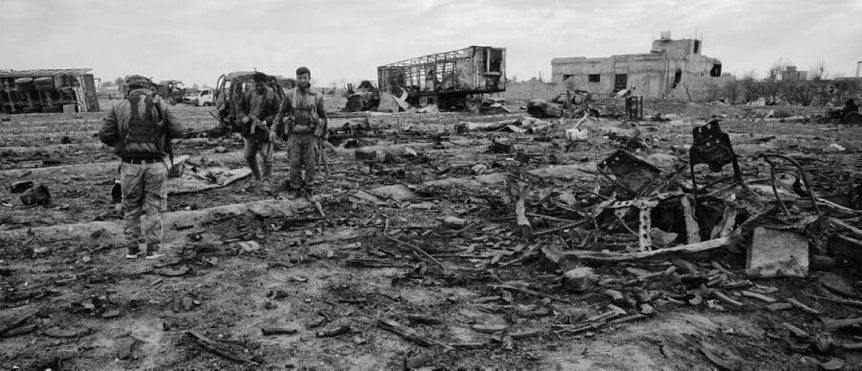
The Syrian permanent mission to the UN stated on Friday that the US must withdraw its troops from the country at once and pay reparations for the deaths of dozens of civilians in a 2019 airstrike in the town of Baghuz.
Damascus categorically rejected a Pentagon report claiming it was not at fault for the attack, declaring its conclusions represent “an admission of negligence that calls for accountability.”
The Pentagon had released a report on Tuesday claiming the March 18, 2019 airstrike targeting an Islamic State (IS, formerly ISIS/ISIL) encampment in Syria’s Baghuz, initially believed to have killed some 70 people, did not violate the rules of engagement or laws of war.
Washington’s assessment ultimately claimed that of the 56 people it determined to have died in the 500-pound bomb blast, just four were civilians. The report also claimed that while “civilians were within the blast radius” resulting in civilian casualties, the decision to drop the massive bomb had “demonstrated awareness for non-combatants.” However, in determining who was considered a terrorist, it used an Obama-era standard classifying all killed military-age males as combatants by default.
The Syrian mission to the UN dismissed the Pentagon’s conclusions as a “clear attempt to absolve the US occupation forces in Syria of their direct responsibility for civilian casualties under the pretext of fighting the terrorist organization ‘ISIS’” and rejected any claims that “efforts have been made to distinguish between civilians and members of ‘ISIS’” as “empty justifications” for the murder of civilians.
“These biased investigations cannot deny the fact that a crime against humanity has occurred in Baghuz,” the mission told Newsweek on Friday. “Any justifications provided by the US administration for not violating the law of war or the rules of engagement are to circumvent the fact that the US forces deployed in Syria are illegal and they launch military strikes, under the pretext of fighting terrorism, without the approval or coordination of the government of the Syrian Arab Republic.”
Despite the report supposedly clearing the US military of any wrongdoing, the full text remains classified, with just a two-page summary released to the public. The site of the blast itself was quickly bulldozed, and the initial internal reports were “delayed, sanitized, and classified,” according to the New York Times.
The report’s conclusions stood in stark contrast to remarks from US personnel on the ground at the time, with one military analyst reportedly stating that “we just dropped [the 500-pound bomb] on 50 women and children” and others questioning whether they had just witnessed a war crime.
While US Central Command had previously admitted that 80 people had been killed in the strike and just 16 were alleged ISIS terrorists, the military defended its actions by suggesting 60 more could have also been terrorists, since “women and children in the Islamic State sometimes took up arms.”
The Pentagon’s recent report contradicted even those watered-down findings, admitting only that “administrative deficiencies contributed to the impression that the [Department of Defense] was not treating this [civilian casualty] incident seriously, was not being transparent, and was not following its own protocols” regarding civilian casualty incidents.
International civil society groups have eviscerated the Pentagon’s civilian casualty reporting protocols for their toothlessness, most recently following an incident in Afghanistan in which an Afghan NGO worker and nine family members – including seven children – were killed in an airstrike supposedly targeting an ISIS terrorist. That investigation, too, found no “misconduct or negligence” on the part of the killers.
US setting up military bases in eastern Yemen cashing in on UN-brokered truce: Ansarullah
Press TV – May 20, 2022
The leader of Yemen’s popular Ansarullah resistance movement says the United States, with the help of its allied Takfiri militant groups, is building several military bases in the country’s eastern provinces of Hadhramaut and al-Mahrah as well as on the Red Sea coast.
Addressing a delegation of tribal leaders from the western Yemeni province of Ibb on Thursday evening, Abdul-Malik al-Houthi said Washington is setting up military installations in eastern Yemen and the country’s southern coastal city of Aden.
He asserted that the Yemeni nation cannot accept Washington’s diktats, warning that the enemies are hell-bent on sowing the seeds of discord and division among people by hook or by crook.
“We must work for security and social stability in Ibb province through compromise and cooperation among local authorities,” the top Yemeni resistance leader told the delegation.
He said the “enemies” have begun to mobilize military reinforcements by taking advantage of the UN-brokered ceasefire, which clearly shows their orientation towards the next stage of the war, and bears testimony to their failure in the previous phase.
“Enemies, having become fairly frustrated with attempts to impose their diktats through ousted Yemeni president Abdrabbuh Mansur Hadi, have decided to remove him in a humiliating matter,” Houthi said.
“They brought a bunch of criminals, traitors, and thieves to power, and declared them as the leaders of the Yemeni nation. They are actually the picks of outsiders, not Yemenis.”
The leader of the Ansarullah movement further asserted that the Yemeni nation will never accept being under the ominous specter of the United States.
“It is the traitors and mercenaries who would like to prove their servitude to Saudi or Emirati officers,” he said, calling for an immediate end to foreign domination of the Arab country.
Normalization deals with Israel
In other remarks, Houthi pointed to the controversial normalization agreements between the Israeli regime and some Arab countries, describing the process as an opening for the Tel Aviv regime to flex its clout in the Middle East region.
“The parties displaying animosity and military aggression against our nation are the ones that are pushing for the normalization of ties with the Israeli enemy. The enemies’ main goal is to shatter the Yemeni nation’s unity and solidarity, and easily dominate it,” the Ansarullah leader said.
“Yemeni people will continue to tread the path of independence and freedom, and will prevent foreigners from interfering in their domestic affairs.”
Saudi Arabia launched the devastating war on Yemen in March 2015 in collaboration with its Arab allies and with arms and logistics support from the US and other Western states.
The objective was to reinstall the Riyadh-friendly regime of Abd Rabbuh Mansur Hadi and crush the Ansarullah resistance movement, which has been running state affairs in the absence of a functional government in Yemen.
While the Saudi-led coalition has failed to meet any of its objectives, the war has killed hundreds of thousands of Yemenis and spawned the world’s worst humanitarian crisis.
Damascus Says Areas of Syria Occupied by US Troops Will Soon Return to Government Control
Samizdat – 19.05.2022
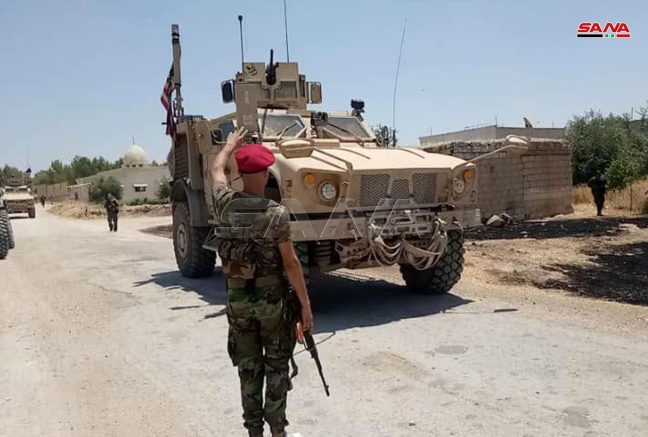
The United States and its Syrian Kurdish militia allies control wide swathes of territory in eastern Syria, including areas producing the vast majority of the Arab Republic’s oil, gas and food. Damascus has accused Washington of stealing these resources, and demanded repeatedly that the US withdraw its forces.
The US occupation of eastern Syria will soon be brought to an end, Foreign Minister Faisal Mekdad has said.
“The illegal US presence in the Jazira region of northern Syria is reaching its end, and the regions occupied by American forces will soon come under the Damascus government’s authority,” Mekdad said, speaking to Syria’s al-Ikhbariyah TV.
Mekdad called on the majority Kurdish Syrian Democratic Forces militias to realize that America would eventually withdraw and abandon them.
The foreign minister said Damascus’s principled support for the Palestinian cause, and its efforts to liberate Israeli-occupied territories in the Golan Heights and southern Lebanon were among the key causes behind the foreign-backed conflict which has rocked Syria since 2011.
“Given Syria’s strong commitment to such positions, as well as its strategic location and great regional influence, hostile nations have been trying to affect the Damascus government’s policies. Having failed in their attempts, they resorted to terrorism and sponsored this menace with billions of dollars,” Mekdad said.
This foreign-backed effort to break up the country has failed, Mekdad stressed.
US forces have occupied oil and food-rich areas of Syria since 2017, entering the country under the pretext of fighting Daesh (ISIS). The Islamist militia rampaged through northern and western Iraq and eastern Syria from 2013-2017 before being pushed back and defeated by an unlikely coalition including the Syrian and Iraqi governments, Iraqi Shia militias, Russia, Iran, Lebanon’s Hezbollah movement, and, at least formally, the United States.
The Biden administration has expressed no intention of withdrawing US forces from Syria, with at least 900 troops and an unknown number of defence contractors operating across ten or more bases dotting the country’s northeast.
Syrian officials and media have accused these forces of guarding oil and gas production facilities, and of escorting convoys of oil tankers and food-laden trucks out of the country into Iraq, while bringing weaponry and supplies for bases in. Unlike his predecessor Donald Trump, who openly bragged about being in Syria to “take” and “keep the oil,” Joe Biden has insisted that the US’s illegal presence in the country is about “preventing a resurgence” of Daesh.
The Syrian army and ordinary residents regularly confront US occupation forces using non-lethal means, including by blocking off local roads and setting up checkpoints to try to stop American armoured vehicles from using them.
US recruits ISIS terrorists to fight in Ukraine: Russian Intelligence
Samizdat | May 17, 2022
The US has been “actively recruiting” terrorists to fight in Ukraine, Russia’s Foreign Intelligence Service (SVR) claimed on Tuesday, saying that it illustrates Washington’s readiness “to use any means to achieve its geopolitical goals.”
The SVR revealed in a statement that, according to the intelligence it is receiving, “the United States is actively recruiting even members of international terrorist organizations, including the Islamic State (ISIS) group banned in the Russian Federation, as mercenaries to participate in hostilities in Ukraine.”
The Russian intelligence service points to the American military base in Syria called al-Tanf, which is located close to the borders with Jordan and Iraq. According to its sources, this base and the surrounding area have turned into a kind of terrorist “hub,” where up to 500 ISIS and other jihadists can be “retrained” simultaneously. SVR claimed that last month 60 ISIS militants, who had been released from prisons controlled by the Syrian Kurds, were transferred to al-Tanf “with a view to subsequent transfer to Ukrainian territory.”
The SVR specified that during a training course at al-Tanf the militants are instructed on how to use anti-tank missile systems, reconnaissance and strike drones, advanced communications and surveillance equipment.
In the SVR’s opinion, this data confirms that “the United States is ready to use any means to achieve its geopolitical goals, not excluding sponsoring international terrorist groups.”
The intelligence service concluded by saying that the American administration does not consider the consequences of such actions, “even when it comes to threats to the security of European allies and even to the lives of the Americans.”
Washington has insisted that “there are no US soldiers in Ukraine.”
Meanwhile, the presence of American troops on Syrian territory at al-Tanf base, which the SVR mentions in its statement, has long been considered by both Moscow and Damascus as illegal. The previous US administration pledged that American forces would leave northeastern Syria but only after ISIS militants are defeated and the Kurds protected.
Then-National Security Advisor John Bolton made it clear that another task of the US forces at al-Tanf was to counter Iranian influence in the region.
In October 2021, there were reports that, according to Israeli defense sources, about 350 military members and civilians were still using al-Tanf, including some British and French forces that were described as “intelligence experts.”
The US Army Invaded Russia In 1918 – Russians Remember
Samizdat | October 2018
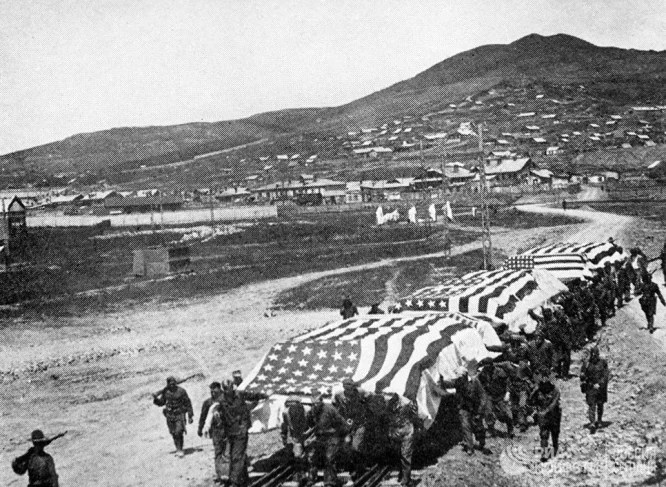
The 8000 expeditionary force, support of the White movement, and the most serious intentions, on August 15th, 1918, the US State Department officially declared the severance of diplomatic relations with Russia, after which the Americans disembarked in Vladivostok. This marked the beginning of the full-scale intervention of the Entente countries in a country that was already submerged in civil war. The material of RIA covers what memory the overseas military personnel in the Far East left behind.
“The nation doesn’t exist”
Immediately after the October revolution Soviet Russia concluded a truce with Germany on the Eastern front and actually withdrew from the war. The Entente countries perceived it literally with hostility. Under the pretext of the inadmissibility of power in the former empire being captured by the “pro-German party”, the western powers were preparing themselves to intervene in a Russia that was already gripped by civil war.
In December of 1917 the US, Great Britain, France, and their allies held a conference, during which a decision was made concerning the differentiation of zones of interests on the territory of the former Russian Empire and the establishment of contacts with national and democratic governments. In other words, “western partners” planned to divide up the largest state on the planet among themselves, and it is the representatives of the White movement that were supposed to help them with this. Interventionists came into contacts with them even before the intervention.
Ukraine, Bessarabia, and Crimea were in the French sphere of influence. England reserved the right for “Cossack and Caucasian regions”, Armenia, Georgia, and Kurdistan. The US, which kept neutrality during the first years of Soviet power, as a result agreed to help Great Britain and France “explore” the Russian Primorye. The Americans wanted to kill two rabbits with one stone — to get access to the rich resources of the Far East and to prevent Japan – which also had its sights on “dividing the skin of the not yet killed bear” – from entrenching itself there.
The possible resistance of Russians wasn’t taken into account. The Republican senator from the State of Washington Miles Poindexter, calling for intervention, directly said: “Russia became simply a geographical concept, and it will never be anything else. Its force of unity, organisation, and restoration left forever. The nation doesn’t exist …” The ambassador of the US in Russia David Francis also called for intervention: “I insist on the need to take Vladivostok under control, and give Murmansk and Arkhangelsk to Great Britain and France”.
Occupation
Already on August 3rd, 1918 the US Department of Defense gives the order to General William Graves about sending the 27th and 31st infantry regiments to Vladivostok, and also volunteers from the 13th and 62nd regiments. In total in the middle of the month the Americans disembarked about 8,000 military personnel in the Far East. Canadians, Italians, and Brits were also included in the expeditionary force. Formally the contingent had to provide safe passage for the Czechoslovak corps from the depths of Russia. In reality more mercantile aspirations prevailed.
“Interventionists on the territory of Russia defended the interests of their capital [finance],” said the military historian Boris Yulin. “Gold mines, wood, and coal — they had plans for all of this. I am sure that civil war in the country was so long and bloody only because of the intervention of foreign powers.
If it wasn’t for the Czechoslovak Legion and interventionists, it would’ve ended without big blood already in 1918. The leaders of the White movement provided the American, English, French, Japanese with concessions, and promised to pay imperial debts. In fact, they provided foreigners with control over Russian territory”.
The American interventionists used the “invitation” in full. They took away wood, furs, and gold from the Far East. American firms received permission from Kolchak’s government to carry out trade operations in exchange for “City Bank” and “Guaranty Trust” credits. One company alone sent from Vladivostok to the US 15,700 poods of wool, 20,500 sheep skins, and 10,200 large dry skins. Everything that represented at least some value was taken away.
They did not stand on ceremony with the local population who supported the Red partisans. In the Russian state historical archive of the Far East “Acts concerning the tortured and shot peasants were preserved in the Olginsky district in 1918-1920”. Here is an excerpt from this document:
“Having captured the peasants I. Gonevchuk, S. Gorshkov, P. Oparin, and Z. Murashko, the Americans buried them alive for having ties to local partisans.
And they finished off the wife of the partisan E. Boychuk as follows: they pricked her body with bayonets and drowned her body in a rubbish pit. They mutilated the peasant Bochkarev with bayonets and knives to the point where he became unrecognisable: his nose, lips, and ears had been cut off, his jaw had been unhinged, his face and eyes had been pricked by bayonets, his entire body had been cut up. Near Sviyagino station the partisan N. Myasnikov was tortured in the same brutal way – according to the testimony of an eyewitness, at first they chopped off his ears, then his nose, hands, legs, and then chopped him into pieces alive”.
Nineteen months
The historian Fedor Nesterov in the book “Link of times” wrote: “The adherents of the Soviet power were pricked, cut up, shot in groups, hung, sank in the Amur, taken away in torturous ‘death trains’, and starved in concentration camps everywhere where where the bayonet of the overseas ‘liberators of Russia’ could reach”. According to him, many peasants who in the beginning didn’t support the Soviet power eventually rose up against the “guests” and came over to the side of the partisans.
Resistance to the occupiers spread. The battle at the village of Romanovka near Vladivostok in 1919 on June 25th history made history: Bolshevist units under Yakov Tryapitsyn’s command attacked the positions of the US army and destroyed more than 20 soldiers of the enemy.
After Kolchak’s troops had been defeated, foreign intervention in Russia lost its meaning. In 19 months of staying in the country, the American contingent in the Far East lost [were killed – ed] nearly 200 soldiers and officers. The last overseas serviceman went home on April 1st, 1920.
It should be noted that even when the civil war ended and the Americans and the majority of European powers recognised the USSR, no western politician condemned the bloody campaign in Russia. The double-faced attitude towards the occupation of the territories of a sovereign state was characterised more exhaustively by Winston Churchill in the four-volume work “The World Crisis”.
“Were they [the Allies] at war with Russia? Certainly not; but they shot Soviet Russians at sight. They stood as invaders on Russian soil. They armed the enemies of the Soviet Government. They blockaded the ports and sunk its battleships. They earnestly desired and schemed its downfall. But war – shocking! Interference – shame! It was, they repeated, a matter of indifference to them how Russians settled their own affairs. They were impartial – bang!”.
Translated by Ollie Richardson & Angelina Siard
Featured Video
Laith Marouf: Hezbollah’s position on US-Iran ceasefire
or go to
Aletho News Archives – Video-Images
From the Archives
Is Israel to blame for the Iraq War?
American Goy | March 10, 2008
I am so tired of this old canard that “Israel had nothing to do with USA’s war with Iraq – in fact, it officially advised America against it”.
Bullshit. … continue
Blog Roll
 Aletho News
- Israel’s priority lies in destroying chances of peace between Iran, US: Ex-UN nuclear chief
- Ceasefire for all or for none: Iran shuts Hormuz over Lebanon attacks
- Strait of Hormuz is Iran’s ‘nuclear weapon’ that forced US retreat: Medvedev
- Energy crisis will last for months – Kremlin envoy
- Europe’s quiet role in the war on Iran
- Forty days that shook the Empire: How Iran turned the tables on US and prevailed
- Netanyahu unilaterally declares Lebanon outside of ceasefire deal
- Israeli leaders: ‘Not a single goal’ achieved in war with Iran
- What on earth just happened? Trump, Iran, and the unlikely ceasefire
- Alberta Bill Would Fine Political Deepfakes $10,000 Without Satire Exemptions
- If Americans Knew
- Gazans face a triple crisis: severe shortages of water and bread, healthcare in tatters
- NY Times reports how Netanyahu took the US into Iran War
- A sigh of relief over Iran, but Gaza and Lebanon in dire straits – Daily Update
- Thousands dead and neighborhoods razed to the ground: Aid agencies fear southern Lebanon is becoming the new Gaza
- The war the US is fighting for Israel could cost trillions
- ‘Cigarette Burns, Nail Wounds’: Toddler Tortured in Gaza to Coerce Father
- Trump Says US Sent ‘a Lot of Guns’ to Protesters in Iran
- Israeli forces destroy 17 UN peacekeeper cameras in south Lebanon
- US-Israeli strikes ‘completely destroy’ synagogue in Tehran
- Archbishop for US Military Says Iran War Is Unjust Under Catholic Teaching
- No Tricks Zone
- An Inconvenient Tree: Uncovered In Alps… Europe Much Warmer Than Today 6000 Years Ago
- New Study Reports A 60% Slowdown In Greenland’s Ice Loss Rate In The Last Decade
- Low Intensity Tornado Wrecks Major Solar Farm, Creating A Potential Toxic Dump
- New Study Finds Warming Saves Lives…Cold Temperatures 12 Times More Deadly Than Excess Heat
- German Science Blog Accuses PIK Climate Institute Of Hallucinating Climate Tipping Points
- Devastating Assessment Of Comirnaty Vaccine By Former Senior Pfizer Europe Toxicologist
- New Study: CO2 Is ‘Effectively Negligible’ As An Explanatory Climate Change Factor Since 2000
- Former Pfizer Toxicologist Dr. Helmut Sterz Tells Bundestag Hearing Pfizer Vaccine Should Have Never Been Approved
- Energy Expert: Germany’s Nuclear Phaseout Was A “500 Billion Euro Mistake”
- New Research: South Australia’s Mid-Holocene Sea Surface Temperatures Were 4°C Warmer Than Today
 Aletho News