No decision on any NATO withdrawal from Afghanistan: Stoltenberg
Press TV – February 18, 2021
NATO Secretary-General Jens Stoltenberg says defense ministers from the Western military alliance made no decision at a recent meeting in Brussels on whether or when to pull out of war-torn Afghanistan.
“At this stage, we have made no final decision on the future of our presence,” Stoltenberg said after a video conference with allied defense ministers on Thursday.
The defense ministers met to discuss the possibility of staying in Afghanistan beyond the May withdrawal deadline agreed between the Taliban militant group and the United States under the administration of former US President Donald Trump.
Key on the agenda at the two-day virtual conference in Brussels was the future of the US-led forces in the war-torn country.
The NATO chief said US Defense Secretary Lloyd Austin promised to consult with partners on the way forward.
“As the May 1 deadline is approaching, NATO allies will continue to closely consult and coordinate in the coming weeks. We are faced with many dilemmas, and there are no easy options,” Stoltenberg said.
“If we stay beyond the first of May, we risk more violence, more attacks against our own troops … But if we leave, then we will also risk that the gains that we have made are lost.”
The administration of President Joe Biden is reviewing whether to stick to the looming deadline to withdraw or risk a bloody backlash from the Taliban.
Other NATO members have signaled a desire within the alliance to stay in Afghanistan beyond the deadline. They are willing to remain in Afghanistan if Washington does so.
German Defense Minister Annegret Kramp-Karrenbauer said on Wednesday that the Taliban must do more to meet the terms of a 2020 agreement with Washington on the withdrawal of US.forces to allow a pullout of the foreign troops.
“We can already say that we are not yet in a position to talk about the withdrawal of international forces from Afghanistan,” the German minister said as she arrived for the meeting.
“This also means a changed security situation, an increased threat for the international forces, also for our own forces. We have to prepare for this, and we will certainly discuss this.”
Nearly two decades after the US-led invasion, Trump struck a deal with the Taliban in the Qatari capital of Doha early last year.
The former White House tenant reached the accord in February 2020, under which the US and its NATO allies are expected to withdraw all troops in 14 months in exchange for the Taliban to halt attacks on foreign forces.
President Biden, however, has said his administration would not commit to a full withdrawal by May.
The United Nations says more than 100,000 civilians have been killed or injured over the past decade across Afghanistan.
Iraq’s Muqtada Al-Sadr warns of looming normalisation with Israel
MEMO | February 11, 2021
Leader of the Iraqi Sadrist Movement and prominent Shia cleric Muqtada Al-Sadr said yesterday that his movement will not allow normalisation between Iraq and Israel, even if the price is “blood”.
“Normalisation is at the door, and the parliament must prevent this. We will not allow normalisation at all, even if it costs us blood,” Al-Sadr told reporters in the southern city of Najaf.
Al-Sadr did not provide further details, however, in January a new movement named October 25 was formed under the leadership of Secretary-General Talal Hariri who called to have good relations with Israel.
The Iraqi government, led by Prime Minister Mustafa Al-Kadhimi, has not issued a clear position on the movement’s demand.
Iraq does not officially recognise Israel, and there are no relations between the two sides.
In October 2017, the Iraqi Parliament passed a resolution prohibiting raising the Israeli flag and punishing violators with imprisonment.
Last year, the UAE, Bahrain , Sudan and Morocco signed normalisation deals with Israel. At the time of the first announcements, Iraq declared that its laws prohibited it from normalising relations with the occupation state.
Arranging The Middle East Narrative To Push The Agenda Forward
South Front | February 11, 2021
The United States is returning to a level of activity in the Middle East unseen in nearly 4 years. This development has become obvious over the weeks since Joe Biden became US President, firstly with a large deployment into Syria, and subsequently with smaller ones.
On February 9th, the Pentagon said that it was no longer in Syria to protect and exploit oil fields.
It is now back to hunting ISIS. Back to the square one of 2014 and the Obama era. ISIS somehow obliged by ramping up their activities throughout Syria.
It is a mystery that they were able to make such a sharp and sudden resurgence. It should also be noted that the Kurdish-led Syrian Democratic Forces allegedly have about 10,000 ISIS terrorists imprisoned.
This statement of intent denotes a massive shift in posture for the US. When defending the oil fields the US troops were mostly static, when hunting ISIS they can, once again, roam around and carry out various operations.
It appears likely that Idlib is now also in focus – US combat drones were observed surveying Greater Idlib. Idlib is a mixed bag – it has Turkish troops, Russians, the Syrian Arab Army along with terrorists and the moderate opposition, although confusing these two groups can be forgiven. The newest, future, US ally is there – the soon-to-be-rebranded Hay’at Tahrir al-Sham.
An indication of expected escalations and attacks are the Russian and Syrian military drills being carried out near Aleppo during effective wartime. Russia, separately, carried out a naval drill near Tartus.
And, as if by design, long-range missiles attempted to strike Russia’s forces at the Hmeimim Air Base. Drones occasionally attempt to infiltrate its airspace, but missiles are a rare sight.
Meanwhile in Western Daraa, the rebel leaders submitted to Damascus, likely fearing the upcoming chaos and wanting to choose a side.
Finally, the Biden administration is also working to secure Israeli support. The State Department said it doesn’t endorse Trump’s recognition of Israeli sovereignty over the Golan Heights, but doesn’t oppose it. It also provided a $9bn weapon sale as consolation. Tel Aviv is likely to use these weapons to counter its nemesis – Iran. It does so by targeting alleged Iranian interests in Syria.
Syria remains the lynchpin of US Middle East policy but the US posture in Iraq and Afghanistan has also changed. Withdrawing from the region is now out of the question – ISIS is making a resurgence, and there are other groups targeting American forces and convoys.
In Afghanistan, specifically, if the withdrawal does not move forward, the Taliban are also likely to begin targeting the US again.
The democrats are back in control and back to spreading democracy in the Middle East.
Refuse bids from those ‘involved in Israeli war crimes’, legal groups tell UK rail construction company
MEMO | February 5, 2021
A new legal brief has deemed it legal for the company building the UK’s new high-speed railway, HS2 Ltd, to exclude firms “involved in Israeli war crimes” from its tender process.
Drafted by Lawyers for Palestinian Human Rights and the European Legal Support Centre (ELSC), the legal brief states that the rail project is “legally entitled” to reject Spanish manufacturer Construcciones Auxiliar de Ferrocarriles (CAF)’s bid, on the grounds of “grave professional misconduct” and breaches of international law.
In 2019, CAF and the Israeli infrastructure company Saphir was chosen by Israel’s finance ministry to expand the settlement railway project, known as the Jerusalem Light Rail (JLR).
CAF and Saphir won the $2 billion contract to extend the railway to more illegal Israeli settlements, particularly in occupied East Jerusalem.
Under international law, the West Bank and East Jerusalem are occupied territories and all Jewish settlements there are illegal.
CAF is one of five companies which have issued bids to secure a £2.75 billion ($3.76 billion) contract to supply high-speed trains to the HS2 rail project.
ELSC, an NGO based in Amsterdam which defends and empowers the Palestine solidarity movement in Europe through legal means, said companies “involved in war crimes should have no standing in public tenders.”
“HS2 Ltd has the legal right and a moral obligation to exclude CAF from the tender procedure,” said the group’s Programme Director Giovanni Fassina.
The Boycott, Divestment and Sanctions (BDS) national committee’s Europe campaigns co-ordinator, Alys Samson Estape, added: “The JLR project is part of the ongoing process of entrenchment of Israel’s apartheid, illegal settlement enterprise and theft of Palestinian land in and around occupied East Jerusalem.”
JLR is so blatantly illegal that other multinationals which had participated in the initial stages of bidding for the project, including Alstom, Siemens, Systra, Bombardier and Macquarie, withdrew from the call for tenders, leaving just two consortiums bidding.
“Public institutions, including the UK government, should exclude CAF from its public tenders due to its violations of international law until it stops profiting from Israel’s illegal occupation.”
Palestine Solidarity Campaign Director, Ben Jamal, explained: “All public contract authorities must discharge their responsibilities to cease complicity in ongoing violations of international law.”
“This means HS2 Ltd must exclude CAF, and any other company violating Palestinian human rights, from the bid to provide rolling stock.”
Belgrade may postpone or end transfer of Serbian embassy to Jerusalem
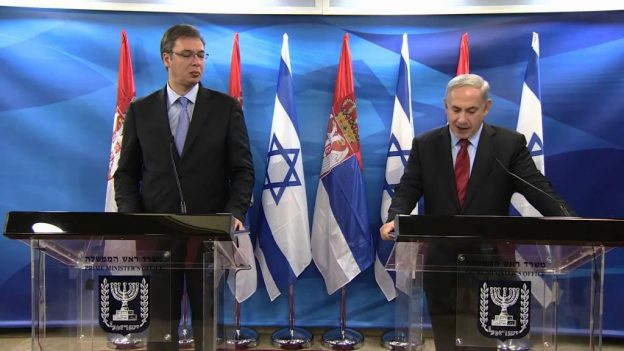
By Paul Antonopoulos | February 5, 2021
After the Israeli recognition of the so-called independent state of Kosovo on Monday, Belgrade finds itself in a difficult position and will reconsider its decision to move the Serbian embassy from Tel Aviv to Jerusalem. Serbia committed itself to this step by signing the September 2020 Washington Agreement suspecting that Kosovo and Israel would recognize each other eventually. Serbian President Aleksandar Vučić now says that his country will “build relations with the Jewish state in accordance to the new circumstances,” suggesting the embassy move might not occur at all.
The Washington Agreement was always tailored to the interests of Israel and Kosovo and not Serbia, yet Vučić still signed it to the dismay of Serbs. The agreement signed by Kosovo’s so-called Prime Minister Avdullah Hoti and then U.S. President Donald Trump states that Kosovo and Israel agree to mutual recognition. The agreement signed between Vučić and Trump specifies that Belgrade has an obligation to move its embassy from Tel Aviv to Jerusalem by July 1, 2021.
As much as the move between Israel and Kosovo was expected, it was probably not anticipated that the last item from the Washington Agreement would actually become the first. This is especially painful for Serbia as Vučić agreed with Kosovo’s authorities that the two would not engage in efforts for countries to recognize or stop recognizing Kosovo. This will likely bring new consequences to Serbia’s engagement with Israel.
As Serbian Foreign Minister Nikola Selaković noted, it will be interesting to observe whether there will now be Muslim and Arab countries that will recognize Kosovo or stop recognizing the illegal entity after its normalization with Israel.
So what will Muslim countries do?
Last year, thanks in large to Trump’s efforts, the United Arab Emirates, Bahrain, Sudan and Morocco normalized their relations with Israel, while Saudi Arabia and the Jewish state have been cooperating for many years behind closed doors.
Turkey, despite being the first Muslim majority country to recognize Israel, has hypocritically reacted to the signing of the agreement between Pristina and Tel Aviv. Turkish President Recep Tayyip Erdoğan claims that it does “not serve the Palestinian issue” and undermines the vision of a two-state solution. Erdoğan’s outrage is despite his country having multi-billion-dollar trade exchanges with Israel that was increasing year-on-year before the COVID-19 pandemic.
The Turkish Ministry of Foreign Affairs also stated that by signing the agreement, Kosovo, which it also recognizes, “undertook to open its embassy in Jerusalem, which is contrary to international law.” Again, Turkey made another contradiction considering it violated United Nations Resolution 550 and 789 by partially reopening the town of Varosha in occupied northern Cyprus last year, and by violating the United Nations Charter Law of the Sea by illegally entering Greece’s maritime space for much of 2020.
The question of relocating the Serbian embassy also entails the question of the status of Jerusalem – while the Israelis consider it their capital, the Palestinians say it is an occupied city. Palestinian Ambassador to Serbia, Mohammed Nabhan, said immediately after the signing of the Washington Agreement that 57 countries from the Arab League and the Islamic Organization for Cooperation could withdraw their recognition of Kosovo due to their agreement with Israel. There have been no such announcements from these Islamic organizations or their members.
This is an empty threat by Nabhan as the position of Muslim and Arab states regarding Israel are no longer united, something the Palestinian Authority appears to be oblivious to. Islamic countries are extremely divided over the issue of Israel and Kosovo. Several Muslim states like Iran, Syria, Iraq and Morocco do not recognize the independence of the breakaway Serbian province. Self-proclaimed Kosovo has been recognized by leading Arab countries, including the United Arab Emirates, Bahrain, Saudi Arabia, Qatar, and Egypt. It is difficult to expect that there will be any changes, especially since the voice of the Palestinian Authority is no longer as important as it used to be. The Palestinian question, which was once a major global issue, is now reduced, especially in the Arab World as they are now mostly focused on containing Turkish expansionism and Iranian influence.
Immediately after the signing of the Washington Agreement, it was speculated that Serbia might not fulfill what it signed if Israel recognizes the self-proclaimed independence of Kosovo. The very act of recognition is only a consequence of what was already signed in Washington last year. The new American administration are most likely not against Trump’s September 2020 Agreement, meaning they will try and implement it, or at the minimum not stop it. Belgrade’s only trump card is that they can postpone or end the transfer of the Serbian embassy from Tel Aviv to Jerusalem.
Paul Antonopoulos is an independent geopolitical analyst.
Armed conflict between Venezuela and Guyana will involve US forces
By Lucas Leiroz | February 3, 2021
A new focus of tensions is emerging in South America. Since the discovery of oil in Guyana, this country has been increasingly approaching Washington both as an economic partner and as a political ally. The Americans see the partnership with the Guyanese as an opportunity to fill the void left in the global oil market with the economic sanctions imposed on Venezuela. But, in addition to a mere economic alliance, the ties between both countries are also rising to the military sphere, which is generating concerns in Caracas.
On January 21, regional tensions reached their peak. Guyanese fishing boats Nady Nayera and Sea Wolf were intercepted by Venezuela after an illegal incursion into Venezuelan territory. Caracas, not having authorized the entry of the vessels, interpreted the maneuver as dangerous to national security and kept the boats under its control. However, this Venezuelan version of the facts was denied by Georgetown, which claimed that the ships were detained within Guyana’s Exclusive Economic Zone.
Some noteworthy factors preceded this escalation of tensions. On January 7, Venezuelan President Nicolás Maduro signed a decree that establishes the formation of a new maritime territory on the Atlantic coast. The decree includes part of the Essequibo region, in which there is a territorial dispute with Guyana. The so-called “Guyana Essequiba” refers to a territory currently under the rule of Guyana that previously belonged to Venezuela, having been transferred to Guyanese possession after an arbitrary sentence in an international court organized by the United Kingdom at the end of the 19th century.
Venezuela has since claimed sovereignty over Essequibo, but tensions have been mild most of the time. However, Guyana, since aligning with the US, has been adopting more aggressive measures in the region. The US armed forces recently began military exercises in Guyana and deployed several military ships along Essequibo’s 159,000 km². The territory is rich in oil and the American justification for the exercises is precisely to protect the oil extraction bases installed by the company ExxonMobil. In the midst of such circumstances, Venezuela has its national sovereignty violated and is therefore trying to establish minimum measures to guarantee its interests.
However, despite the rivalry having resumed an old territorial dispute, it is necessary to emphasize that there is an agreement in force on Essequibo that Guyana is directly violating. In 1966, Guyana and Venezuela signed the Geneva Agreement, mediated by the United Nations, which determined which activities would be permitted in which area of Essequibo. In this document, oil exploration by foreign companies is not allowed. Since 2015, the Guyanese government has violated the pact, allowing multinationals to explore for oil there. In 2018, Venezuela had already intercepted ExxonMobil vessels that invaded its territory to explore oil. Now, Venezuelan President Nicolás Maduro has determined the creation of a Special Strategic Zone to increase security over Essequibo because the tendency is for territorial violations to increase further, considering that regional diplomacy is already broken, and that Guyana has become a satellite nation of Washington’s interests – which publicly plans to overthrow Maduro. The Venezuelan decision was condemned by the president of Guyana, Irfaan Ali, which prompted Caracas to issue a statement saying that such positions suggested preparation for an armed confrontation.
The Guyanese attitude has not changed over time. Now, once again, ships have entered Venezuelan territory, leading to their capture by the Bolivarian forces. If that situation continues, the Venezuelan response to foreign incursions may become increasingly rigid and the armed forces are likely to start taking down invasive vessels, which will lead to Washington’s severe responses. Currently, we can no longer regard the South American scenario as “unlikely” for a war to arise. The security crisis is widespread and with Biden in power many experts suggest that American foreign policy will become more aggressive and interventionist. Guyana has a much weaker military apparatus than the Venezuelan State and cannot face the neighboring country with its own forces. It remains to be seen what Washington’s willingness to invest in a conflict in South America will be.
More than ever, a new international agreement is needed to establish a new regulation for the region. The agreement, however, must be impartial and try to favor both nations. In an ideal scenario, the other South American nations, being co-participants in the disputes, should mediate such an agreement. But, today, the political structure of South America is absolutely broken, and no nation has sufficient diplomatic strength to resolve a demand of this nature.
Lucas Leiroz is a research fellow in international law at the Federal University of Rio de Janeiro.
Foreign Office maintains deafening silence on Chagos Islands despite UN ruling
Press TV – February 2, 2021
Five days after a legal body of the United Nations dismissed British claims of sovereignty over the Chagos Islands, the Foreign Office continues to avoid meaningful engagement the issue.
The United Nation’s International Tribunal for the Law of the Sea ruled on January 28 that Mauritius has sole sovereignty over the Chagos Islands, thus delivering a fatal blow to the UK’s weak legal position.
The UN body’s judgment follows a ruling by the International Court of Justice (ICJ) in February 2019 that the UK must end its occupation, which in turn triggered a vote to that effect in the UN General Assembly in May 2019.
Despite the gravity of the situation, the British Foreign Office has hitherto released just a single terse statement on the issue, essentially reaffirming the UK’s recalcitrant attitude.
“The UK has no doubt as to our sovereignty over the British Indian Ocean Territory (BIOT), which has been under continuous British sovereignty since 1814. Mauritius has never held sovereignty over the BIOT and the UK does not recognize its claim”.
That curt statement, and the subsequent silence, underscores the UK’s resolve to flout international law and maintain a stranglehold over the occupied Chagos Islands.
But despite London’s oft-stated determination to hold onto the Chagos Islands indefinitely, there will inevitably be concerted legal push back by the international community, the state of Mauritius and even by individual aggrieved Chagos islanders.
On the issue of Chagos islanders – who were forcibly removed from their ancestral lands by the UK in the mid-1960s – the long-delayed issue of compensation by the British government is finally attracting attention.
According to the Observer (January 31), less than £12,000 of a £40 million fund set up to compensate Chagos islanders for the loss of their homeland has actually been given to those islanders living in Britain.
The fund was reportedly set up four years ago and yet the Foreign Office has distributed less than one percent in direct support to Chagos islanders who have lost homes and livelihoods as a result of the 55-year British occupation.
According to the Observer, which claims to have seen internal documents, the “English council” tasked with allocating the money has “abandoned the work” and “returned the funds” to the Foreign Office.
The FCO’s mistreatment of Chagos islanders over a 55-year period has even elicited criticism from some sections of the ruling Tories, a party committed to keeping occupied territories around the world.
The Tory MP Henry Smith, whose Crawley constituency is home to the majority of Chagossians living in the UK, has described the process of extracting compensation money from the Foreign office as “tortuous”.
“While there’s some uncertainty among the Chagos community about engaging with the UK government over these funds, it’s outrageous that next to none of this funding has actually been utilized. The fact that this sort of funding hasn’t been deployed is another failure of Foreign Office promises over half a century to the Chagossian community”, Smith said.
It remains to be seen if class action undertaken by the Chagossian community – coupled with pressure from the UN and the broader international system – will produce a shift in the UK’s position in the mid to long term.
US forces ‘transporting by choppers’ Daesh terrorists in Afghanistan: Taliban
Press TV – February 1, 2021
The Taliban says the US occupation forces in Afghanistan are engaged in “transporting by their choppers” members of the Daesh Takfiri terrorist group in the war-torn country’s east.
Senior members of a Taliban delegation, who are on an official visit to Iran for talks on the Afghan peace process and relevant topics, made the assertion in a news conference in Tehran on Monday, saying that the US forces in Afghanistan are assisting the Daesh terrorists to escape the areas that are coming under the Taliban control.
“Daesh were in Nangarhar and Kunar; they existed in those areas. They were eliminated by the Taliban there but their members were transferred by choppers,” Suhail Shaheen, a negotiating member of the Taliban told reporters, adding, “When the Taliban laid a siege on them, we saw that only American choppers could fly as the Afghan airspace is fully under the control of Americans.”
The senior Taliban member also referred to the escalation of violence in Afghanistan after the US-Taliban deal last February and said the US forces were to blame as they defaulted on their obligation to end their occupation and resumed the assault.
“After the signing of the agreement, we gave a chance to the Americans to withdraw their troops from Afghanistan and we were committed not to launch any attacks, so if they terminated the occupation we were committed to refrain from any assaults or attacks so it would pave the way for intra-Afghan talks but unfortunately new attacks were launched against us and we were forced to defend ourselves and they even tried to capture our region and they conducted nightly attacks,” he said.
“We have no access to the media but they have. They attribute violence to us and that is not true. They start the violence. They start the violent action and that’s still continuing.”
During the news conference, the Taliban negotiator said the group was after an “inclusive system and establishment” in Afghanistan and not after “monopolizing power,” adding that they would reconsider the agreement with US if foreign forces failed to withdraw from Afghanistan.
“We have resisted the occupation of Afghanistan for 20 years and we will continue resistance against occupation if foreign forces remain in the country,” the senior Taliban member said.
Last week, the Taliban political delegation arrived in Tehran at the invitation of the Iranian Foreign Ministry, the latest of such visits that have been paid several times over the past months.
Iran strongly supports the realization of peace and stability in Afghanistan, which has been embroiled in decades of militancy fueled by foreign military intervention.
The intra-Afghan talks started after the United States agreed to withdraw 12,000 US troops from Afghanistan in exchange for the Taliban’s halting of their attacks on international forces under a deal between the two sides in February 2020.
The deal was intended to result in the reduction of bloodshed, but violence continues to take a heavy toll on the country.
In recent months, deadly attacks and high-profile assassinations have seen a rise in Afghanistan. The Taliban have denied responsibility for the killings, but Afghan and US officials have pinned the blame on the group.
Despite the ongoing talks between Kabul and the Taliban, the administration of US President Joe Biden has said it would review the peace deal reached last year.
The US first invaded Afghanistan in 2001 under the banner of fighting “terrorism.” The invasion toppled the Taliban, but the group has never stopped its attacks, citing the foreign military presence as one of the main reasons behind its continued militancy.
Since the US invasion of Afghanistan, Washington has spent more than two trillion dollars for the war on the impoverished country, according to some estimates. Over 2,400 US soldiers and tens of thousands of Afghan civilians have been killed.
Hezbollah fighters intercept, shoot down Israeli reconnaissance drone in southern Lebanon
Press TV – February 1, 2021
The Lebanese Hezbollah resistance movement says it has intercepted and shot down an Israeli unmanned aerial vehicle as it crossed into Lebanon’s airspace near the border village of Blida in the south of the Arab country.
Hezbollah said in a brief statement that the drone was struck on Monday morning, adding that it was now in the control of the drone. It did not provide any further details.
The Israeli military, however, asserted that the drone had fallen in Lebanese territory during an operation, alleging that “there is no risk of breach of information.”
The development came a day after Palestinian resistance fighters brought down an Israeli quadcopter conducting an espionage mission against the besieged Gaza Strip.
The drone was shot down on Sunday while taking images over Beit Hanoun Crossing, which is located on the enclave’s northern border with the occupied territories, the Arabic-language Palestine al-Yawm news agency reported.
Israel frequently violates Lebanon’s airspace. Lebanon’s government, Hezbollah and the United Nations Interim Force in Lebanon (UNIFIL) have repeatedly condemned Israel’s overflights, saying they are in clear violation of UN Security Council Resolution 1701 and the country’s sovereignty.
The resolution, which brokered a ceasefire in the war Israel launched against Lebanon in 2006, calls on the Tel Aviv regime to respect Beirut’s sovereignty and territorial integrity.
On August 23 last year, Hezbollah resistance movement said it had downed and seized an Israeli drone as it flew over the Lebanese border.
The Israeli military claimed back then that a drone had fallen in Lebanon during operational activity along Lebanese border, claiming that there was no risk of breach of information.
Tensions have been running high between Israel and Hezbollah since July 20 last year, when Tel Aviv killed Hezbollah member Ali Kamel Mohsen in an airstrike in Syria.
The Israeli military has placed its forces near the Lebanese and Syrian borders on high alert after Hezbollah promised retaliation.
Israeli forces shelled the Lebanese village of Habaria in late July 2020 to stop an alleged Hezbollah offensive, but the Lebanese movement dismissed the allegation, calling it the result of tension and confusion among Israeli forces.
US military lands Daesh terrorists behind PMU positions in Jurf al-Sakhar: Report
Press TV – January 31, 2021
The US military airlifts groups of Daesh Takfiri terrorists to areas behind the positions of the Popular Mobilization Units (PMU) in Jurf al-Sakhar region in the central province of Babil, says an Iraqi security expert.
Sabah al-Akili told Iraq’s al-Maloumeh news website on Sunday that the move is aimed at infiltrating and targeting the PMU positions and sabotaging power transmission lines.
“The strategic military goal of the US forces is to cause division in Jurf al-Sakhar in order to create a threat to nearby provinces and to invent a pretext for American forces to stay in Iraq,” he said.
Al-Akili argued that the move also provides a justification for the Iraqi government to ask the US troops to remain in the Arab country.
“Foreign and [Iraqi] political parties, backed by the US, are doing their utmost to drive the Hashd al-Sha’abi (PMU) forces out of Jurf al-Sakhar, which connects the provinces of Babil, al-Anbar and Baghdad via the holy [city of] Karbala,” he added.
The remarks came a day after the PMU announced its forces had thwarted an attack launched by the remnants of Daesh on Jurf al-Sakhar.
The PMU’s communication office said in a statement that the attack was repelled by the Al-Jazirah Operation Headquarters Command.
Jurf al-Sakhar was liberated from Daesh terrorists in 2014 in Operation Ashura, which was led by Iran’s top anti-terror commander Lieutenant General Qassem Soleimani, who was killed by the US military in January 2020, in an assassination lauded by Daesh. Over 200 Takfiri terrorists were killed during Operation Ashura.
Iraq declared victory over Daesh in December 2017, after over three years of death and destruction by the terrorist group against the Iraqi people. However, remnants of Daesh still carry out terrorist attacks across the country from time to time.
Earlier this month, a twin bombing by the Takfiri terrorist group in a busy square in Baghdad killed more than 30 people.
Iraq’s Kata’ib Hezbollah, which is part of the PMU, blamed the “American-Saudi-Israeli alliance” for the bombing, and warned that Iraqi resistance forces will target the main source of Takfiri violence.
“The perpetrators of the massacres in Iraq are the US, Saudi Arabia, and Israel,” Abdul-Ali al-Asgari, Katai’b’s security chief, wrote in a tweet on January 24.
“Revenge should be exacted by retaliating against the source and fountainhead of fire, not its branches,” he added.
Featured Video

Deception – Submarines against Olof Palme
or go to
Aletho News Archives – Video-Images
From the Archives
Woolsey Fire started at Santa Susana Field Lab — where “radioactive materials released were never accurately measured”
By John Laforge | CounterPunch | November 30, 2018
In my Nov. 16 column, I reported on potential radiation risks posed by California’s Woolsey wildfire having burned over parts or all of the Santa Susana Field Laboratory—south of Simi Valley, Calif., 30 miles outside Los Angeles—site of at least four partial or total nuclear reactor meltdowns.
The field laboratory operated 10 experimental reactors and conducted rocket engine tests. In his 2014 book Atomic Accidents, researcher James Mahaffey writes, “The cores in four experimental reactors on site … melted.” Reactor core melts always result in the release of large amounts of radioactive gases and particles. Clean up of the deeply contaminated site has not been conducted in spite of a 2010 agreement.
Los Angeles’s KABC-7 TV reported Nov. 13 that the Santa Susana lab site “appears to be the origin of the Woolsey Fire” which has torched over 96,000 acres. Southern Calif. Public Radio said, “According to Cal Fire, the Woolsey Fire started on the afternoon of Thursday, Nov. 8 … on the Santa Susana site.” … continue
Blog Roll
 Aletho News
- Dr. Abu-Sitta: Beirut ‘felt like a day in Shifa Hospital’
- Iran Has Won the War, It Will Be Up to the US to Secure the Peace: Mohammad Marandi
- Iran condemns assassination threats against Iranian negotiators amid US talks
- Brussels cannot say where its own pipeline inspectors are as Hungary’s oil lifeline remains shut
- Israel’s Iran War: Myth and Reality
- Between war and industrial breakdown: The US-Israeli attrition crisis
- Pressure builds on Iran to ‘drop’ Lebanon ceasefire demand as Islamabad talks hang in balance
- In another clash report, US denies agreement to release Iran’s assets
- What is fueling unrest across the EU?
- Why no power can undermine Iran’s eternal dominance over the Strait of Hormuz
- If Americans Knew
- Pro-Israel ‘Thinktanks’ and Individuals who Influence U.S. Foreign Policy
- Mearsheimer reveals how Israel dictates US policies on Iran, Gaza – video
- After killing 350+, Israel still has a “score to settle” with Lebanon before ceasefire – Daily Update
- Military aid to Israel emerges as the latest political litmus test for Democrats
- The only Palestinian children’s rights organization closes following years-long Israeli campaign against it
- ‘I Can’t Forget the Smell’: Lebanese Reel After Israel Kills Over 300 in Single Day
- DNC Shoots Down Resolutions Calling Out AIPAC and Limiting Arms to Israel
- TCN: Is Israel Blackmailing President Trump?
- Israel killed at least 303 Lebanese yesterday – who were they? Daily Update
- Amnesty: Urgent – Protect Lebanese civilians from brutal escalation in Israeli attacks
- No Tricks Zone
- German Expert: Heat Dome Led To Record Temps In Western USA…Warmer In 1934, 1936
- New Study: No Linear Warming Or Glacier Retreat Along Northern Antarctic Peninsula Since 1980s
- An Inconvenient Tree: Uncovered In Alps… Europe Much Warmer Than Today 6000 Years Ago
- New Study Reports A 60% Slowdown In Greenland’s Ice Loss Rate In The Last Decade
- Low Intensity Tornado Wrecks Major Solar Farm, Creating A Potential Toxic Dump
- New Study Finds Warming Saves Lives…Cold Temperatures 12 Times More Deadly Than Excess Heat
- German Science Blog Accuses PIK Climate Institute Of Hallucinating Climate Tipping Points
- Devastating Assessment Of Comirnaty Vaccine By Former Senior Pfizer Europe Toxicologist
- New Study: CO2 Is ‘Effectively Negligible’ As An Explanatory Climate Change Factor Since 2000
- Former Pfizer Toxicologist Dr. Helmut Sterz Tells Bundestag Hearing Pfizer Vaccine Should Have Never Been Approved
 Aletho News