German Authorities Detain Drunken US Soldier Who Bit, Referred to Them as ‘Nazis’
Sputnik -17.06.2020
A drunken US Army soldier of the 2nd Cavalry Regiment was tied up and arrested by six German police officers in Nuremberg, Germany, on Saturday after he reportedly assaulted arresting officers and referred to them as Nazis.
An unnamed 22-year-old of the 2nd Cavalry Regiment based in Vilseck, Germany, could soon find himself facing assault charges under the US’ Uniform Code of Military Justice, following allegations of an aggressive and drunken encounter with German police officers over the weekend, according to Stars and Stripes.
Prior to being identified as a member of the US Army, the 22-year-old was reported to German authorities over his aggressive behavior toward staff at a Nuremberg train station.
“Due to the [intoxication] and the aggressive behavior, the identity of the man could not be determined on the scene,” police said, as reported by Stars and Stripes.
Cops initially handcuffed the drunken American, who then began to shout epithets, such as calling them Nazis, and kicked the arresting officers with his cowboy boots.
German officers responded to the resistance by tying up the soldier’s legs and hauling him off to the local police station. Authorities allege the American drew blood from an officer after biting his leg during a search.
Authorities told Stars and Stripes that the cop in question was taken to a hospital and “is currently not able to work.”
The American soldier has since been released to the US military.
Maj. John Ambelang, spokesperson for the 2nd Cavalry Regiment, confirmed to the outlet that the unit “is aware of an incident involving a soldier” and “takes unlawful violence toward others very seriously.”
EU diplomacy is profitable for Israel, but a disaster for the Palestinians
By Ramona Wadi | MEMO | June 16, 2020
Since Israel announced its plan to annex swathes of the occupied West Bank, the EU has only hypothesised on what steps the bloc may take in response. The most prominent of these could be the exclusion of Israel from the Horizon 2020 research grants. Other than this possibility (it is no more than that at this stage), which should have been done long before now in any case due to Israel’s perpetual violations of international law, the EU has tacitly approved Donald Trump’s deal upon which annexation is based, and will most likely restrict its collective response to rhetoric.
US President Trump has dealt Palestinians a severe blow, which would have been impossible if the international community had united, decades ago, to rectify its colonial approach to Palestine. Through non-binding resolutions, the UN led the way in creating Israel’s ability to act with impunity which is derived from Palestinian dependence. No strategy other than anti-colonial resistance could have worked, and despite the UN’s purported intentions to eradicate colonialism, it reneged and instead provided Israel with the necessary diplomatic cover to appropriate virtually all of Palestine.
The EU is no different. It placed itself at the helm of alleged peace-building strategies, in particular through its financial assistance to the Palestinian Authority alongside its diplomatic relations with Israel. As a result, Palestinians became pawns in a state-building project without a state, presided over by an internationally-funded entity that has no political legitimacy and which functions as a colonial collaborator with, and defender of, the colonial-settler state of Israel, as well as a mouthpiece for international diplomacy.
Spanish MEPs have criticised the EU’s Foreign Affairs Chief Josep Borrell’s statement, noting that calling upon Israel to refrain from annexation is not enough. However, the EU is also portrayed as “the only international actor that can force upon them genuine negotiations between the parties involved.” There are no genuine negotiations, as any diplomat knows. Israel must be identified as a colonial power and decolonisation should take the place of negotiations, thus reversing the power imbalance that prevents Palestinians from uncompromised political decision-making.
Consider Luxembourg’s Foreign Minister Jean Asselborn’s recent statement that the EU would “inevitably” recognise Palestine as a state “if Israel moves forward with its controversial plan to annex the West Bank.” Is this ludicrous diplomacy what the PA has been striving to achieve; the recognition of a hypothetical state when there is barely any land upon which to build it? Symbolic recognition of Palestine within the two-state context has failed to achieve any political advantage for Palestinians, but recognising a state when the demise of its hypothesis has been obvious for years is the epitome of EU hypocrisy.
Writing “reproachful letters would be a humiliation for the EU,” Asselborn added. Belatedly recognising a Palestinian state is not, in EU diplomacy, because when it comes to Palestine and the Palestinian people, there is no limit to what the international community can get away with while still proclaiming itself to be a champion of human rights. The EU, in particular, relishes this status, which the PA supports unabashedly, to the detriment of the Palestinian people. Without a plan to prevent Israel’s annexation of the occupied West Bank, what role is the EU playing other than facilitating the US deal of the century? The reality is that EU diplomacy is profitable for Israel, but an absolute disaster for the Palestinians
Stop Canada’s arms deal with Saudi Arabia!
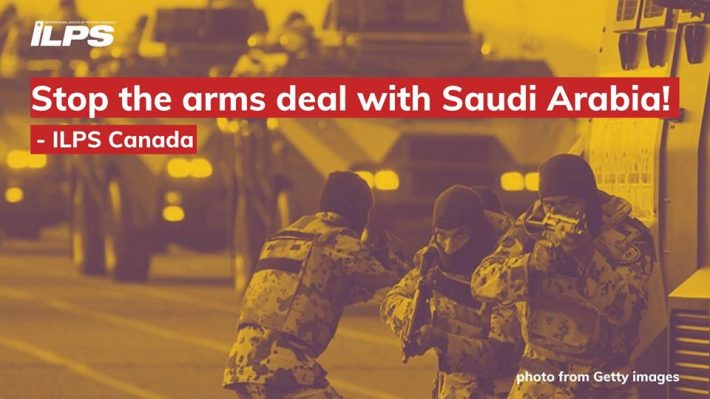
International League of Peoples’ Struggle, Canada | June 12, 2020
After stalling for two years, the Canadian government has renegotiated a sale of light armored vehicles to Saudi Arabia for $14 billion. The deal was put on hold in 2018 because of political pressure against Saudi Arabia’s war on Yemen and the murder of Jamal Khashoggi, a journalist. This news is jolting because, in December 2018, Prime Minister Justin Trudeau had said he would not go ahead with the sale. However, the Minister of Foreign Affairs Francois-Philippe Champagne announced that the contract was back on the table on Thursday, April 9, 2020.
The government claims it must proceed with the deal because thousands of jobs and substantial revenues might otherwise be lost. General Dynamics is the supplier building the vehicles to be sold. The government its sales rep. General Dynamics stands to lose profits from the transaction. However, it could be involved in the manufacture of other machinery for domestic and foreign use.
In response to the objection that the items to be sold to Saudi Arabia will likely be used for war, Minister Champagne tells the people not to worry.
“Under our law, Canadian goods cannot be exported where there is a substantial risk that they would be used to commit or to facilitate serious violations of international humanitarian law, international human rights law or serious acts of gender-based violence.” (The Defense Post, April 10, 2020).
If that is the case, then, no military items should be exported. Champagne added that there are protections in that export permits be delayed or canceled if it learns of goods sold not used for the buyers’ stated purposes. Well, it is pretty clear that military items are for military use, just as it is clear that Saudi Arabia is an aggressor who will likely use military equipment in its aggression against Yemen and elsewhere. Saudi Arabia is committing human rights violations and crimes against humanity. The fact that the war inhibits health care and safety responses to COVID-19 is even more reprehensible.
The Canadian Chapter of the International League of Peoples’ Struggles has opposed all military contracts with Saudi Arabia all along. We have stood in solidarity with the people of Yemen who have been suffering under assault after assault by Saudi forces, calling for Saudi Arabia keep its hands off Yemen. According to Dr. Yahyia Mohammed Saleh Mushed of the Union of Arab Academics at Sana’a University, the war has displaced around 200,000 people and left the country in misery (Sanctions Kill webinar, May 31, 2020). We deplore the coalition states (US, UK, France and Canada) that arms and supports these assaults. Furthermore, we find no justify for the blockade against Yemen, and join in the calls for the illegal economic coercive measures against Yemen and all countries to be lifted, especially in view of the humanitarian concerns during a pandemic.
Canada has been on the war path for the past two decades. It stands by the US imperialist war machine steadfastly and plays a deadly role as its most fervent ally. It itself is an imperialist state with ambitions for market expansion abroad. Prime Minister Justin Trudeau voices intolerance against states that dare to follow an independent course away from the dictates and norms set by the US. His negative relations with Venezuela are the starkest example. Also, his government has been increasing the national military budget and expanding the Canadian armed forces, favouring more active engagement. Money for health care and housing has been siphoned for the folly of war.
Now with the determination to rise against domestic militarization and resist its racist blades, let us also decry international militarization and organize to dismantle NATO, the US military bases and imperialist military agreements, and send the troops home. Let us expose and put pressure against the arms trade that encourages instability and feeds off bloody conflict. Let us call for a reduction of military budgets and redirect more tax money into social services and regional economic development.
Stop the Sales of Arms to Saudi Arabia!
Reject the arms trade!
Stop US and Canadian imperialism!
Dismantle NATO!
Close all foreign military bases!
End the coercive economic measures against all targeted countries!
International League of Peoples’ Struggle is an an alliance of organizations and movements that promotes, supports and develops the anti-imperialist and democratic struggles of the peoples of the world against imperialism and all reaction.
AIPAC: US officials can criticise Israel annexation plans, ‘as long as it stops there’
MEMO | June 11, 2020
The leading pro-Israel lobby group within the United States has given permission to the country’s officials and lawmakers to criticise Israel’s plans to annex areas of the occupied West Bank, on the condition that “the criticism stops there”.
The American Israel Public Affairs Committee (AIPAC), which has held significant influence within US politics throughout the decades, has provided the guidelines of limited criticism in Zoom meetings and phone calls with US lawmakers, according to one donor and one congressional aide who spoke to the Times of Israel.
It is generally unclear what is meant by not going too far, but it is thought to be centred on the continuation of US aid to Israel. The donor, who is involved in the lobbying of congress but who spoke on the condition of anonymity, said: “We are telling the senators ‘feel free to criticize annexation, but don’t cut off aid to Israel.’”
The warning by AIPAC not to go so far as to affect the aid was also echoed by a congressional staffer, who is described as a Democrat being targeted by the group, who said: “They want to make sure members of Congress understand this is the time to warn Israel but not to threaten the Memorandum of Understanding.”
This memorandum was a deal between the Israeli governments of Prime Minister Netanyahu and former US administration President Barack Obama in 2016 which guaranteed Israel a budget of defence aid amounting to $3.8 billion annually over a decade. Any criticism, the staffer said, is “not to threaten assistance.”
Throughout the years of its influence on the country’s politics, AIPAC has been strongly opposed to any criticism of Israeli policy or of the government of Israel itself, using its lobbying powers to condemn and side-line those who have done so while preventing others from voicing criticism. This permission, therefore, is seen as being in contrast to that pattern, but is thought to be possible due to the extremely controversial nature of the annexation plans, which have split many pro-Israel supporters.
Under the plan by the new Israeli coalition government, Israel would claim sovereignty and seize control over 30 per cent of the Palestinian territories in the occupied West Bank, particularly the illegal Jewish settlements and the strategic Jordan Valley, with steps being taken to this end from 1 July.
An AIPAC statement on 11 May acknowledged that “It is inevitable that there will be areas of political or policy disagreement between leaders on both sides — as there are between America and all our allies.” While the annexation plan is one such area, the same statement warned against any proposals to reduce ties with Israel if annexation goes ahead, making it clear that “Doing anything to weaken this vital relationship would be a mistake.”
Okinawa’s Governor Promises ‘Fierce Opposition’ to Plan for New US Missile Bases
Sputnik – 10.06.2020
A US plan to build new missile sites on the Japanese island of Okinawa has encountered stiff resistance by locals, including the governor, who was elected on a position of getting US forces out of the prefecture.
‘Absolutely Unacceptable’
In the event of a war with China, land-based missiles placed on Okinawa would provide a major leverage point for US forces. However, with the island already a major target due to several large US military installations, Okinawans are fed up with the idea of bringing in even more targets for China’s People’s Liberation Army (PLA).
“I firmly oppose the idea,” Okinawa Governor Denny Tamaki told the Los Angeles Times for a Wednesday story. “If there is such a plan, I can easily imagine fierce opposition from Okinawa residents.”
“Intermediate-range ballistic missiles can be used to attack other countries, so deploying them would conflict with the Constitution and lead to a further build-up of the US bases,” Tamaki told Bloomberg News last November. “To have new military facilities would be absolutely unacceptable.”
The Straits-Times noted last November that similar opposition is just as likely from other US allies, such as Australia and South Korea, which would then become targets in the event of a shooting war between Washington and Beijing. Similar fears quelled early Cold War enthusiasm in Canberra for a nuclear weapons program, too.
Last October, the Okinawan daily Ryukyu Shimpo reportedly uncovered evidence the US government had informed the Russian government in August 2019 of its intent to base missiles violating the shredded Intermediate-Range Nuclear Forces (INF) Treaty in Okinawa within two years. The US formally withdrew from the treaty, which governed the ranges of land-based missiles used by Russia and the US, just days earlier.
Battle Plans Hinge on Okinawa
Never having been bound by the INF Treaty, the PLA has spent decades building up its Rocket Force into a formidably armed corps, wielding a variety of long-range cruise missiles and ballistic missiles and even hypersonic weapons, which the US has yet to field.
Sitting just 500 miles from Shanghai and 400 miles from the Zhejiang coast, Okinawa-based missiles would find much of mainland China within striking distance. However, the Ryukyu Islands would almost certainly fall under heavy attack by the PLA during a prospective war with US allies, as the archipelago falls within the “First Island Chain,” or the first string of islands sitting just off the east Asian coast. Beijing’s long-term strategic plans call for forcing its adversaries increasingly away from the Asian mainland, beginning with the First Island Chain, which stretches from Russia’s Kamchatka Peninsula south to Borneo, in Indonesia.
Likewise, the US Marine Corps is busy reenvisioning the way it wages war, including a pivot from the heavy land-based forces of the last several decades toward a more maritime role.
Commandant of the US Marine Corps Gen. David Berger told Congressional lawmakers in March that the Corps would be expanding its missile capabilities twentyfold in the next five years, as well as introducing the Navy Marine Expeditionary Ship Interdiction System (NMESIS), which is based on the High Mobility Artillery Rocket System (HIMARS) but mounted atop a Joint Light Tactical Vehicle chassis. The weapons system will be able to fire a variety of anti-air and anti-ship missiles.
The purpose of these weapons can be found in Expeditionary Advance Base Ops (EABO), in which Marines will rush forward to set up small outposts on scattered islands that would house batteries of long-range anti-ship and anti-air missiles, creating a “no-go zone” for Chinese air and sea forces. A graphic illustrating the concept by the Center for Strategic and Budgetary Assessments think tank happens to show EABOs deployed across the Ryukyuan chain.

Center for Strategic and Budgetary Assessments
Land-based missiles deployed at “Expeditionary Advance Bases” could form a virtual wall against Chinese aggression
Widespread Japanese Opposition to US Missiles
US plans for deploying weapons previously banned by the INF Treaty elsewhere in Japan have met strong resistance as well. An Aegis Ashore system that was to have been built in the western city of Akita was canceled last month amid heavy opposition from locals. Another site, on the western coast of Yamaguchi Prefecture, also met opposition, but so far plans for its construction remain unchanged.
Tokyo approved their construction to provide anti-missile defense against potential attack from the Democratic People’s Republic of Korea (DPRK), but with the US out of the INF Treaty, the Aegis Ashore systems can easily be converted to fire offensive weapons, as the site in Deveselu, Romania, has already demonstrated.

Sonata
Marine Corps Station Futenma, in Ginowan, Okinawa
Okinawans have also fought the continued presence of several US military bases on the island, which was stormed by US forces in the closing months of World War II in a furious battle that killed nearly half the island’s population of 300,000 at the time. US Marine Corps Air Station Futenma sits in the middle of Ginowan City, and Tamaki was elected to the governorship on a campaign to get the base removed from the prefecture. Just four miles north of Futenma is another air base, the US Air Force’s colossal Kadena Air Force Base; between the two installations are half of the 50,000 US service members deployed in all of Japan.
In a February 2019 referendum, 70% of Okinawans voted against a US-Japanese plan to relocate Futenma on the island, but Japanese Prime Minister Shinzo Abe insisted Tokyo “cannot avoid the necessity of moving Futenma,” and land reclamation for the new site, on the coast of rural Henoko to the north, has continued.
The US and Israel Hope to Scare the Hague War Crimes Court off from Helping Palestine
By Jonathan Cook | The National | June 9, 2020
In the near-two decades since the International Criminal Court was set up to try the worst violations of international human rights law, it has faced harsh criticism for its highly selective approach to the question of who should be put on trial.
Created in 2002, the court, it was imagined, would act as a deterrent against the erosion of an international order designed to prevent a repetition of the atrocities of the Second World War.
Such hopes did not survive long.
The court, which sits in The Hague in the Netherlands, almost immediately faced a difficult test: whether it dared to confront the world’s leading superpower, the United States, as it launched a “war on terror”.
The ICC’s prosecutors refused to grasp the nettle posed by the US invasions of Afghanistan and Iraq. Instead, they chose the easiest targets: for too long, it looked as though war crimes were only ever committed by Africans.
Now, the ICC’s chief prosecutor, Fatou Bensouda, looks poised finally to give the court some teeth. She is threatening to investigate two states – the US and Israel – whose actions have been particularly damaging to international law in the modern era.
The court is considering examining widespread human rights abuses perpetrated by US soldiers in Afghanistan, and crimes committed by Israeli soldiers in the occupied Palestinian territories, especially Gaza, as well as the officials responsible for Israel’s illegal settlement programme.
An investigation of both is critically important: the US has crafted for itself a role as global policeman, while Israel’s flagrant violations of international law have been ongoing for more than half a century.
The US is the most powerful offender, and Israel the most persistent.
Both states have long dreaded this moment – the reason they refused to ratify the Rome Statute that established the ICC.
Last week Mike Pompeo, the US Secretary of State, stepped up US attacks on the court, saying its administration was “determined to prevent having Americans and our friends and allies in Israel and elsewhere hauled in by this corrupt ICC”.
A large, bipartisan majority of US Senators sent a letter to Pompeo last month urging him to ensure “vigorous support” for Israel against the Hague court.
Israel and the US have each tried to claim an exemption from international law on the grounds that they did not sign up to the court.
But this only underscores the problem. International law is there to protect the weak from abuses committed by the strong. The victim from the bully.
A criminal suspect does not get to decide whether their victim can make a complaint, or whether the legal system should investigate. The same must apply in international law if it is to have any meaningful application.
Even under Bensouda, the process has dragged out interminably. It has taken years for her office to conduct a preliminary investigation and to determine, as she did in late April, that Palestine falls under the ICC’s jurisdiction because it qualifies as a state.
The delay made little sense, given that the State of Palestine is recognised by the United Nations, and it was able to ratify the Rome Statute five years ago.
The Israeli argument is that Palestine lacks the normal features of a sovereign state. However, as the Israeli human rights group B’Tselem recently noted, this is precisely because Israel has occupied the Palestinians’ territory and illegally transferred settlers onto their land.
Israel is claiming an exemption by citing the very crimes that need investigating.
Bensouda has asked the court’s judges to rule on her view that the ICC’s jurisdiction extends to Palestine. It is not clear how soon they will issue a verdict.
Pompeo’s threats last week – he said the US will soon make clear how it will retaliate – are intended to intimidate the court.
Bensouda has warned that her office is being subjected to “misinformation and smear campaigns”. In January, Israeli Prime Minister Benjamin Netanyahu accused the court of being “antisemitic”.
In the past, Washington has denied Bensouda a travel visa, and threatened to confiscate her and the ICC judges’ assets and put them on trial. The US has also vowed to use force to liberate any Americans put in the dock.
There are indications the judges may now be searching for a bolt hole. They have asked Israel and the Palestinian Authority to respond urgently to questions about whether the temporary Oslo accords, signed more than 25 years ago, are still legally binding.
Israel has argued that the lack of resolution to the Oslo process precludes the Palestinians from claiming statehood. That would leave Israel, not the ICC, with jurisdiction over the territories.
Bensouda has suggested the issue is a red herring.
Last Thursday Mahmoud Abbas, the Palestinian president, told the ICC that in any case the PA considers itself exempt from its Oslo obligations, given that Israel has announced imminent plans to annex swaths of Palestinian territory in the West Bank.
Annexation was given a green light under President Trump’s “peace plan” unveiled earlier in the year.
Bensouda’s term as prosecutor finishes next year. Israel may hope to continue stonewalling until she is gone. Elyakim Rubinstein, a former Israeli Supreme Court judge, called last month for a campaign to ensure that her successor is more sympathetic to Israel.
But if Bensouda does get the go-ahead, Netanyahu and an array of former generals, including his Defence Minister Benny Gantz, would likely be summoned for questioning. If they refuse, an international arrest warrant could be issued, theoretically enforceable in the 123 countries that ratified the court.
Neither Israel nor the US is willing to let things reach that point.
They have recruited major allies to the fight, including Australia, Canada, Brazil and several European states. Germany, the court’s second largest donor, has threatened to revoke its contributions if the ICC proceeds.
Maurice Hirsch, a former legal adviser to the Israeli army, wrote a column last month in Israel Hayom, a newspaper widely seen as Netanyahu’s mouthpiece, accusing Bensouda of being a “hapless pawn of Palestinian terrorists”.
He suggested that other states threaten to pull their contributions, deny ICC staff the travel visas necessary for their investigations and even quit the court.
That would destroy any possibility of enforcing international law – an outcome that would delight both Israel and the US.
It would render ICC little more than a dead letter, just as Israel, backed by the US, prepares to press ahead with the West Bank’s annexation.
International collusion with Israel is what real ‘political terrorism’ looks like
By Ramona Wadi | MEMO | June 9, 2020
Israeli media outlets are trying to create a furore over a possible move by the Palestinian Authority to submit a resolution at the UN General Assembly condemning Israel’s annexation plan. “The solution to the conflict will come through direct negotiations in Jerusalem and not through political terrorism in New York,” declared Israel’s outgoing Ambassador to the UN, Danny Danon, about a non-binding resolution which will have no impact whatsoever on the looming land theft.
“Political terrorism” by Israel and the UN is actually what brought Palestinians to their current predicament. The UN’s willingness to disseminate the Zionist narrative that Palestine was a wasteland before Jews went there, and “a land without a people for a people without a land” has been much in evidence throughout the years, and the UN’s flawed Resolution 194 does not even begin to be preliminary compensation for what the Palestinians have lost since the 1948 Nakba. Indeed, “political terrorism” sums up the complicity between Israel and the UN; in particular the collusion in disseminating Israel’s security narrative as the pretext for the perpetual displacement of the indigenous population. Palestine, by the way, was never barren when Palestinian farmers worked their land.
“Political terrorism” against the people of Palestine was also normalised through the two-state compromise, which contributed to the permanent prevention of the legitimate return of Palestinian refugees. As the US-Israeli annexation plan draws closer, the UN will, undoubtedly, collaborate in finding ways to normalise the latest colonial expansion. The PA’s efforts to elicit anything more than verbal condemnation will, once again, be futile.
Israel Hayom described the possible PA move as a “battle”. The PA is just following perfunctory steps that have been proven worthless in terms of garnering diplomatic and political support for Palestine at an international level. There is thus no battle unless the PA alters its entire framework, swaps dependence upon the international community for Palestinian political involvement, and starts utilising its platform at the UN as an anti-colonial opportunity. As things stand, the PA is fulfilling international expectations by seeking recourse through non-binding resolutions. Palestine’s demise has been fuelled by non-binding resolutions alongside political violence.
Israel will lobby the international community for diplomatic support, yet whether this is forthcoming or not will make little difference to the annexation plan. As long as the world refrains from taking punitive measures, and not just against the annexation of Palestinian land, the PA’s recourse to the UN General Assembly presents no risk to the colonial-settler state. For the sake of its purported security concerns, Israel will, of course, play its perpetual victim card and pretend that it is facing an existential threat and opposition, or at least anti-Israel bias, from an institution that has consistently upheld and protected Zionist colonisation.
“The international community needs to know that legitimising Palestinian provocations rewards Abu Mazen’s [PA President Mahmoud Abbas’] refusal to hold dialogue with Israel,” claimed Danon. The truth is that the international community has only ever legitimised Israel and its colonial actions.
Moreover, there is no dialogue with Israel because complicity between colonialism and the international community has replaced Palestinians’ political rights with their subjugation. The US is now simply amplifying what the UN has intended since the 1947 Partition Plan.
Abbas and the PA pose no threat to Israel, and nor will yet another UN Resolution; Israel will just ignore it in any case, and get away with doing so as it has done on countless occasions before. It is the Palestinian people themselves who have the potential to lead a legitimate anti-colonial struggle. That is why the real priority of the international community on this issue is the persistent dissociation between Palestine and the Palestinian people, with the sole aim of protecting the destructive agenda upon which Israel was founded and continues to exist. That is what real “political terrorism” looks like, Ambassador Danon.
Tony Blair: Ties between Gulf and Israel are ‘game changer’
MEMO | June 3, 2020
Tony Blair has cast doubt over the chance of a Palestinian state ever emerging in an interview with a Rabbi from the United Synagogue, a union of British Orthodox Jewish synagogues, representing the central Orthodox movement in Judaism.
During the online interview reported in the Jewish Chronicle the former British prime minister spoke gushingly about relations between Israel and the Gulf states. “That is the single biggest game-changer for the Middle East”, Blair is reported saying while describing the relationship as ”the biggest reason for hope in the Middle East.”
His optimistic reading of the region’s future however did not extend to the Palestinians. Blair, who was appointed special envoy of the Quartet – a foursome of nations and international and supranational entities involved in mediating the Israeli-Palestinian peace process – all but gave up on any hope of a Palestinian state emerging with Israel’s ongoing annexation.
”It was very difficult to see how a Palestinian state survives that,” said Blair in reference to Israel’s planned annexation of the occupied West Bank and the Jordan Valley in contravention of international law.
During the interview Blair said that he had spent the last few years working on strengthening ties between Israel and the Gulf states, which he said was not purely a “security relationship”.
“Yes it’s true they both have security interests in common. They are both worried about Iran,” said Blair before explaining a new, emerging leadership in the region found common alliance with Israel. “That is the single biggest game-changer for the Middle East,” Blair argued.
Blair’s term as the Middle East envoy has been heavily criticised, and this latest remark is likely to be further confirmation that the former prime minister, who many consider to be a war criminal over his role in the invasion of Iraq, was never interested in seeking justice for the Palestinians.
Critics accuse Blair of constantly pandering to the wishes of Israel. In one instance Palestinian officials said: “Tony Blair shouldn’t take it personally, but he should pack up his desk at the Office of the Quartet Representative in Jerusalem and go home,” adding his job, and the body he represents, are “useless, useless, useless”.
Featured Video

Iran’s Mass Protests /Patrick Henningsen & Lt Col Daniel Davis
or go to
Aletho News Archives – Video-Images
From the Archives
Does Kevin Barrett Seek to “Absolve Islam of a Terrible Crime”?
The Kevin Barrett-Chomsky Dispute in Historical Perspective – Last part of the series titled “9/11 and the Zionist Question”
By Prof. Tony Hall | American Herald Tribune | August 28, 2016
Amidst his litany of condemnations, Jonathan Kay reserves some of his most vicious and vitriolic attacks for Kevin Barrett. For instance Kay harshly criticizes Dr. Barrett’s published E-Mail exchange in 2008 with Prof. Chomsky. In that exchange Barrett castigates Chomsky for not going to the roots of the event that “doubled the military budget overnight, stripped Americans of their liberties and destroyed their Constitution.” The original misrepresentations of 9/11, argues Barrett, led to further “false flag attacks to trigger wars, authoritarianism and genocide.”
In Among The Truthers Kay tries to defend Chomsky against Barrett’s alleged “personal obsession” with “vilifying” the MIT academic. Kay objects particularly to Barrett’s “final salvo” in the published exchange where the Wisconsin public intellectual accuses Prof. Chomsky of having “done more to keep the 9/11 blood libel alive, and cause the murder of more than a million Muslims than any other single person.” … continue
Blog Roll
Recent Comments
loongtip on Eilat port faces worst crisis… loongtip on British minister dreams of kid… loongtip on Kiev awards major mining proje… loongtip on UK believes it can seize any t… loongtip on Pirates of the Caribbean loongtip on Australian festival boycotted… loongtip on Kiev seeks to ban Russian musi… seversonebcfb985d9 on Somaliland and the ‘Grea… John Edward Kendrick on Kidnapped By the Washington… aletho on Somaliland and the ‘Grea… John Edward Kendrick on Somaliland and the ‘Grea… aletho on Donald Trump, and Most America…


 Aletho News
- Knesset advances bill mandating death by hanging for Palestinian prisoners
- Eilat port faces worst crisis as Red Sea shipping collapses
- Iran protest-riots can only achieve US-Israeli intervention, ‘shadow CIA’ concludes
- The Coming War on Iran: What Has Really Been Happening?
- US Cargo Planes Have Flooded the Persian Gulf Since the First of December
- Deep-state forces from abroad instigated violence in Nepal – former foreign minister
- Rare Earths—or Arctic Control? Greenland’s Riches May Just Be Excuse
- Kiev awards major mining project to Trump-linked investors
- US makes money from weapons, not from Ukrainian minerals
- Drone hits Kazakh tanker en route to Russian port
- If Americans Knew
- The New Neoconservatives
- As more Gaza children freeze to death, Trump eyes Gaza as starting point for world domination – Not a ceasefire Day 95
- More death: in Gaza, West Bank, Israeli prison – Not a ceasefire Day 94
- The Israeli Influence Operation Aiming to Install Reza Pahlavi as Shah of Iran
- Avoidable tragedy: another infant dies from cold – Not a ceasefire Day 93
- Israel is quietly erasing Palestinian refugee camps from existence in the West Bank
- The “Zionist tint” to the Maduro abduction, if not operational, then normative
- Press association condemns Israel’s continued ban on media access to Gaza
- Israeli Indifference to Palestinian Suffering Is Fertile Ground for the Growth of Sadism
- Surge in premature births, congenital defects, cancer deaths in Gaza – Not a ceasefire Day 92
- No Tricks Zone
- Denmark Places Climate Protection Above Animal Welfare, Poisoning And Culling Cows
- New Study: Greenland Was 3-7°C Warmer And Far Less Glaciated Than Today 6000-8000 Years Ago
- German Media Report That Current Frigid Weather Can Be Explained By Arctic Warming!
- Berlin Blackout Shows Germany’s $5 Trillion Green Scheme Is “Left-Green Ideological Pipe Dream”
- Modeling Error In Estimating How Clouds Affect Climate Is 8700% Larger Than Alleged CO2 Forcing
- Berlin’s Terror-Blackout Enters 4th Day As Tens Of Thousands Suffer In Cold Without Heat!
- Expect Soon Another PIK Paper Claiming Warming Leads To Cold Snaps Over Europe
- New Study: Human CO2 Emissions Responsible For 1.57% Of Global Temperature Change Since 1750
- Welcome To 2026: Europe Laying Groundwork For Climate Science Censorship!
- New Study Finds A Higher Rate Of Global Warming From 1899-1940 Than From 1983-2024
 Aletho News