Failing Solidarity: How Cultural Prejudice Shapes Leftist Narratives on the War Against Iran
By Alain Marshal | March 3, 2026
The so-called progressive political and media elites have cynically normalized the assassination of Iran’s leader, dressing up regime change as a moral necessity while denying Iranians the right to self-determination. In doing so, they expose a racist double standard that humanizes Israeli victims, dehumanizes Iranian lives, and buries the very principles of freedom, dignity and international law they claim to defend.
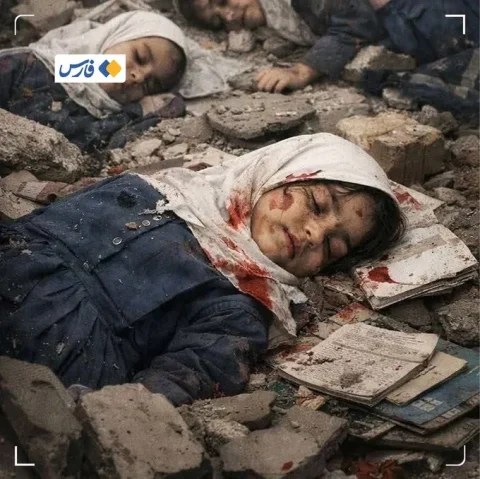
Just imagine the uproar if Iran had killed more than 150 Israeli schoolgirls
The ritual is immutable:
1/ condemn the Iranian “regime” and more or less explicitly welcome the “death” (above all, never say “assassination”) of Khamenei;
2/ having thus provided justification for the US-Israeli war of aggression — the supreme crime according to the Nuremberg Tribunal — and validated the grotesque and abject talking points of the criminals against humanity that Trump and Netanyahu are regarding the alleged “dictatorship of the mullahs,” proclaim, hand on heart, that one does not condone war and artificially dissociate the other victims of these strikes, while affirming solidarity with the Iranian people;
3/ finally and above all, make no reference to the fact that this same people took to the streets by the millions to support their “regime” in January, and are doing so again today, despite the bombs:it is not the real aspirations of the Iranian people that matter — deeply rooted as they are in their own history, values, and spirituality, infusing every aspect of their life with the teachings of Twelver Shia Islam and a deep attachment to the Prophet and his progeny — but rather those that the “civilized West” determines for them, seeking to shape them in its own godless image. Colonial mentality obliges — the same mentality that led Jules Ferry to declare that “the superior races have the duty to civilize the inferior ones.”
It is absolutely sickening to see that more than two years of genocide in Gaza have done nothing to change the crass ignorance, steeped in racism and Islamophobia, of our so-called progressive Left, whose hyperbolic reaction of solidarity we witnessed when it came to the 40 Israeli babies “beheaded” — existing solely in the putrid imagination of propagandists. In France, even La France Insoumise (LFI, main leftist party headed by Jean-Luc Mélenchon), which had managed to distance itself from the inept and complicit “neither-Maduro-nor-Trump” discourse on Venezuela, is now revelling in the war crime constituted by the assassination of a foreign leader, servilely described by Mélenchon as “the executioner of his people,” parroting US-Zionist propaganda and dismissing the millions of Iranians who hold him in reverence and regard him as their political and spiritual leader. Let us therefore listen to Mélenchon, the “Tribune of the plebs”:
“This is the first time there has been a war with no good guys. This is the first time there has been a war with only people we don’t like, I mean governments we don’t like. The government of Iran inspires no sympathy in me: for my part, I have opposed it from the very beginning. When its leader Ali Khamenei dies, I am obliged to say that I feel no sadness.
Mélenchon then claims that just as Nazism was a form of supremacism, the governments of Trump, Netanyahu and Khamenei are each in their own way supremacist powers competing for domination — going so far as to suggest that Khamenei proclaims Iran’s “superiority within Islam and over the Middle East,” an absurd characterization that serves only to justify equating aggressors with the attacked. He concludes: “Neither Shah nor Mullahs.”
No sadness, then, for Khamenei, nor for his wife, nor for his daughter, nor for his son-in-law, nor for his 14-month-old granddaughter, murdered alongside him — except insofar as one adopts the Israeli logic whereby, in order to assassinate one person, dozens or even hundreds are killed with him, invoking “collateral damage,” or even consigning them to oblivion by denying their very existence.
No sadness either for international law, the purposes and principles enshrined in the Charter of the United Nations, the fundamental norms governing relations between States, global peace and stability. Nor for the more than 100 million Iranians and Shiite Muslims throughout the world (including in France and in the other European and Western countries) who mourn the loss of their Guide — whose popularity is questioned only by the ignorant and the ideologues, as for his followers, he is more than the Pope is to Catholics — because they do not embrace the model of society promoted by Mélenchon, who opposes the Islamic Republic on principle, even were it massively supported by the Iranian people, simply because the very principle of a theocracy repels him.
Iran must be regime-changed, even if that means sending it back to the Stone Age, like Syria and Libya, destroying all its incredible accomplishments since 1979 in fields such as healthcare, education, and the sciences — achievements made despite crippling sanctions and persistent external pressures, just like Cuba, from dramatic improvements in life expectancy to the expansion of medical and higher education, rapid growth in research output and scientific innovation, and self-sufficiency in pharmaceutical and high-tech sectors. Iranian women are 70% of Iran’s STEM graduates (Science, Technology, Engineering and Mathematics), but one must guess they are not “free” until they wear miniskirts. Such blindness and the outright denial of the right to political and cultural self-determination are outrageous.

“I feel no sadness”
Although Western tradition humanizes only Israeli victims, deemed alone worthy of compassion, let us defy convention and give a name and a face to the martyrs: above, Zahra Mohammadi Golpayegani, 14 months old, Khamenei’s granddaughter, murdered with her family. No sadness, really? And below, several faces of the victims of the strike on a girls’ primary school — how abominable single-gender education must seem in your eyes — whose wearing of the veil, which Mélenchon once described as a “rag on the head,” may perhaps shock you.
Mélenchon, whose condemnations and impassioned outbursts after October 7 are well remembered — when the Palestinian Resistance had merely exercised its right to struggle against occupation (and Israel responded with the Hannibal doctrine and genocide) — would he dare to say “I feel no sadness” if Trump or Netanyahu had been killed along with their wife, children, and grandchildren, without provocation, triggering a regional war that could quickly becomeWorld War III? Never in a million years. He would have condemned the very act of international terrorism constituted by the aggression and assassination of a foreign leader, evoked all its potentially cataclysmic ramifications, and explicitly mentioned the victims. But when it comes to Iran, none of this matters. Iranian and Israeli lives are not equal in the eyes of the “supremacists,” whether ethnic, political, or civilizational — are they, Mr. Mélenchon?
As for Mediapart, long regarded as one of France’s leading left-leaning media outlets, it no longer even bothers to conceal its Atlanticist and Zionist allegiances, openly embracing them. It congratulated Israel on the “tactical stroke of genius” represented by the mass terrorist beeper attack against Lebanon (later discreetly revising the description to a “strategic success” once it recognized that the original wording was apologetic), and is now explicitly turning the victim into the culprit, daring to claim that Iran had it coming because it refused to “capitulate on its foundations,” namely its defense capabilities (nuclear weapons being nothing more than a crude pretext), and refused to allow itself to be carved up (see the surreal article Rather than Capitulate on Its Foundations, the Iranian Regime Prefers to Endure War, torn to pieces by the comments of Mediapart subscribers themselves, who are increasingly turning their backs on this vile NATO bootlicking). France remains, without a doubt, the daughter of Jules Ferry the colonialist and Pétain the collaborationist.
If our grandees truly cared about international law, the rights of peoples, and global peace and security, the assassination of Khamenei would be unanimously condemned with horror and indignation, both in itself and for the cataclysmic consequences it could entail, from a global economic crisis to a third world war. If “human animals” possessed as much dignity as Western and Israeli lives in the eyes of our self-proclaimed “feminists,” the Iranian schoolgirls targeted by Israel would make every front page — and draw condemnations dwarfing those provoked by the fake story of 40 decapitated babies. Instead of ludicrous accusations of expansionism or imperialism toward Iran, we would be reminded at every second that Israel — the intergalactic champion of killing children and destroying schools and hospitals — dreams of turning the entire Middle East into Gaza, and wants to ensure Trump follows through on “Operation Epstein’s Fury” to the very end.
The great historical tradition of international solidarity, which once led French men and women to risk their lives and endure torture in support of the Algerian FLN, is no more. At best, one can expect the “progressives” and other self-styled “revolutionaries” to place aggressor and victim on the same footing. Far from those who claim neutrality in situations of injustice, and who, as Desmond Tutu said, merely play the game of the oppressor, we affirm our genuine internationalist solidarity with the Islamic Republic of Iran in the face of imperialist and Zionist aggressors, and affirm not only its right to defend itself, but its right to choose its model of society, including that of a “theocracy,” which is only a dirty word for fanatic secularists.
This blog is the result of voluntary work. To support it, you can make a donation.
American Zionists are using Trump’s Republican Party to create a multicultural supremacist elite
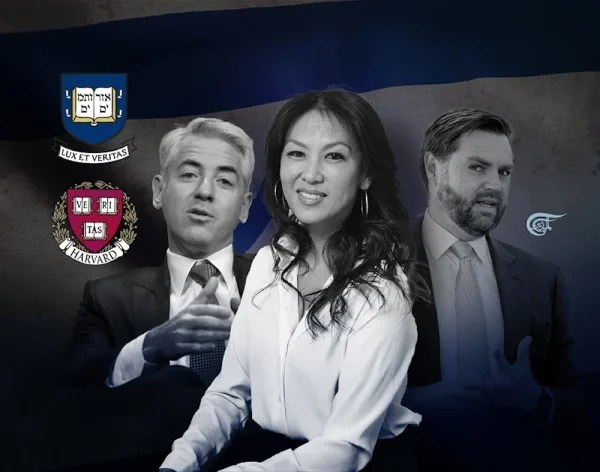
By Matt Wolfson | Al Mayadeen | February 2, 2026
On January 13, 2025, seven days before Donald Trump’s second inauguration as president, The Free Press, the online magazine created by the Zionist operator Bari Weiss who has powerful connections to the Trump Administration, ran a profile which may say more about the ultimate causes of America’s current policies, and where those policies will likely lead, than any other public document.
The profile was of Amy Chua, famously the author of Battle Hymn of the Tiger Mother, a mostly well-received cri de Coeur for what Chua sees as rigorous Chinese parenting; and less famously the John M. Duff, Jr. Professor of Law at Yale Law School. The profile, drawing explicitly on Chua’s most publicly recognizable achievement, was titled “The Tiger Mother Roars Back,” and its subtitle reinforced its approach, an ardent rave: “Yale tried to run Amy Chua out. Now her former students, J.D. Vance and Vivek Ramaswamy, are headed to Washington. So is she.”
For people who follow the politics of America and so of America’s empire, the forwardness of this profile raises questions. Construed as a gesture of support for two politicians, Vance and Ramaswamy, who are attempting to woo the public on populist credentials, it seems misthought. There is nothing populist about Chua—and her lacks are tells about the lacks of her mentees. Indeed, it was under Chua’s mentorship that Vance wrote a bestselling book with the encouragement of another Chua mentee, Vance’s future wife Usha, blaming the failures of his lower-income Appalachian upbringing on the “cultural” deficiencies of the community which raised him. This is a view that, since entering politics with the aim of appealing to precisely that community, he has quickly disavowed. Ramaswamy, for his part, has fallen deeply and predictably afoul of populist Americans precisely by making that case in public.
So why would Weiss, who if nothing else is a strategic operator, run a piece on Chua connecting her to Vance and Ramaswamy as well as broadcasting Chua’s views, which are anathema to the people from whom Vance and Ramaswamy want support?
The answer is that, though Weiss is an ideologue focused on advancing “Israel’s” immediate interests, there is a “positive,” longer-term Zionist play in the works among her and her allies. I have reported in miniature on this play last year, in a September investigation of the philanthropic education donations of Bill Ackman, the Zionist financier: to seed a new ruling elite based on technological and management skills. But the project goes deeper. It amounts to the legitimation of a new ruling class in America centered on a narrow cadre of elites of three groups— Zionists, Hindutvas (Hindu supremacists), and, discernably but least specifically definably, East and Southeast Asian supremacists often with connections to countries where Buddhism has exercised significant influence.
These elites use their present success in America’s military corporate complex to make claims to group superiority. They then use those claims to justify special treatment for their groups and nations that allow them to solidify their power, and to solidify the hold of American empire, which they see as the rightful disseminator of “merit.” Their accelerating project will likely realize itself through the Republican Party, via Chua’s mentees, the Vances and Ramaswamy, among others, and it may ally itself with other right-wing influences as seemingly dissimilar but actually imitative as the white supremacy of Nicholas J. Fuentes. It is only now taking recognizable shape, and understanding its origins and spread is crucial to understanding the havoc it is already beginning to wreak in America and abroad.
That understanding begins with examining the arguments which influenced Vance and Ramaswamy; arguments made by Amy Chua and Jed Rubenfeld, her husband, a Yale Law professor and Jewish Zionist who writes for The Free Press. These arguments are noteworthy in that they look for “warps” in cultures to explain problems which other scholars have put down to military corporate power and its brute effects (outsourcing, conglomeration, the Wars on Crime and Drugs, unauthorized and some kinds of authorized immigration) on American life.
Indeed, the most straightforward reason why Vance’s Appalachian Americans as well as Black and Latino Americans have notably struggled is American imperial policy that has started at the top: labor outsourcing and urban mis-development, misthought immigration policies, and military corporate buildup. These policies have accrued for 60 years, and academics and writers have made the case against them for almost 50.
This book of Chua and Rubenfeld’s, where they lay out their view (The Triple Package: How Three Unlikely Traits Explain the Rise and Fall of Cultural Groups in America) does not emphasize these structural, practical explanations. Instead, Chua and Rubenfeld put “winners’” success in America over the last sixty years down to three group traits: specifically, “a superiority complex,” “insecurity,” and “impulse control.” According to The Triple Package, “a superiority complex” means “a deeply internalized belief in your group’s specialness, exceptionality, or superiority” flowing from religion, civilization, or social traits. “Insecurity” means “a sense of being looked down on, a perception of peril, feelings of inadequacy, and a fear of losing what one has.” And “impulse control” means “the ability to resist… the temptation to give up in the face of hardship or quit.”
But the paradox of Chua’s and Rubenfeld’s explanation, which they don’t appear to realize, is that, taken logically on its face, it supports the structural, practical explanations they apparently ignore. Political theory and history show that groups in the grip of triple package holders’ emotional Cartesianism (possessing an a priori thesis, superiority, in the face of insecurity, and so willing to do anything to prove the thesis right) are reliable tools of arbitrary imperial power. Indeed, empires moving aspirant, insecure, determined groups into their own managerial elite is a defining feature of the Roman Empire; the British Empire in the American colonies and India; the German Empire; and the United Arab Emirates. In America’s empire, these co-opted groups have most prominently been the three which Chua and Rubenfeld write about most often and with whom they and their family most identify: Jewish Americans, Indian Americans, and East and Southeast Asian Americans.
All three of these groups experienced marginalization and persecution at the hands of various empires (the Russian and German; the British; the American) before 1950. Their members have attendantly experienced heightened levels of insecurity; and elite cadres of two of the three groups have adopted what most scholars consider to be clearly definable supremacist ideologies: Zionism, which was founded in 1897 and Hindutva ideology, which was founded in 1925. The third type of supremacy, East and Southeast Asian supremacy, is more diffuse but clearly discernable.
Unlike Zionism, which is linked to “Israel”, and Hindutva ideology which is linked to India, there are multiple countries at play and multiple labels under which claims of East and Southeast Asian supremacy are raised. Also, the way these claims are raised often surfaces less as outright supremacy and more as “cultural essentialism”—that there’s something in this group’s cultural “essence” that makes members more “successful.” Finally, research into outright supremacist manifestations from groups associated with them is more recent, usually under the headings of Buddhist or East Asian supremacy. Nonetheless, taking these distinctions into account, East and Southeast Asian success in America’s imperial complex and corresponding claims like Chua’s to superiority are recognizable trends: some of them embraced by supremacists who praise thinkers like Chua for what critics call their cultural supremacy.
I have reported at some length about how the process of these groups claiming power in American empire played out, beginning with Jewish Zionist elites in the 1960s. I examined these Zionist elites’ acceptance into the American military corporate complex by WASPs (White Anglo-Saxon Protestants). I also pointed out that Zionists’ overall success accessing this complex came from their pursuit of narrow applied skills valued by the WASPs: economics, management theory, administrative law, engineering, finance, and technological proficiencies; a model the WASPs took quite consciously from European Empires. Zionists, in their own description, were easy marks for this kind of invitation to power that ultimately deracinates the culture of the people who accept it.
Theodor Herzl, the founder of the movement who embodies the terms of its successes and failures, was a marquee possessor of Chua’s and Rubenfeld’s triple package. He had grown up a secular Jew with little connection to his religion but a strong sense of his own superiority, and only embraced Zionist Judaism with a manic intensity when the Dreyfus Affair made him decide that he could never realize his ambitions without identifying as Jewish.
An instructive echo of Herzl’s mentality comes in the memoir of Martin Peretz, one of the early entrants into America’s corporate complex in the 1960s. Peretz, who taught at Harvard, owned The New Republic, the most influential Zionist magazine in the country, and played a prominent connective role in and near Wall Street, is in many senses a later-day Herzl. He is a high-status secular Jew with an admitted sense of insecurity who is also a fervid Zionist, and he writes in his memoir about himself and his friends who “made it” that
We were… from a strong culture that was an outsider culture, in the first generation when that culture could assert itself in American institutions. We weren’t constrained by old obligations because we were coming into a world that didn’t want us anyway. We had each other’s backs because we knew the kind of resentment arrivistes, and Jewish arrivistes, unleashed… We were the first ethnicity to break through into the ruling class institutions following the wane of Protestant influence, and we saw those institutions as the key to our flourishing.
Peretz’s Harvard mentee, Bill Ackman, the Zionist financier, is a good example of how younger Zionists operating in Herzl’s and Peretz’s tradition have swallowed this model whole. Ackman’s view of Harvard, where he is also a donor, falls along just these lines of imperial functionality:
As one of the oldest and perhaps the most notable of this country’s academic institutions, Harvard represents the gateway to elite status and to ‘making it’ in modern day American society. One need only look at the disproportionate numbers of Presidents, Nobel Laureates, and chairmen of Fortune 500 companies who have graduated from Harvard to understand the power of the Harvard degree. As a result, admission to Harvard has become the target of groups seeking upward mobility.
What goes unacknowledged here is that “elite status,” “upward mobility” and the skills that create them have only been an aspiration for most Americans since 1945, when the Cold War allowed WASPs to expand their institutions and use them to try to mold the country in their image. Before this point, most Americans understood their country as being predicated on towns and cities and states; and on a high degree of associational thickness, communal coherency, and decentralized government which allowed individuals a say in the terms of their lives. But Zionists were never open to an argument like this. Their strategy, like Herzl’s, was to enter empire and use it to rise, and it is not a coincidence that, almost immediately on accessing America’s military corporate complex, they opened America’s doors to Hindu and East and Southeast Asian operators who approached the matter of institutions and power on their terms.
The Zionists’ tool was the 1965 Immigration and Nationality Act, which was sponsored by staunch Jewish Zionist Congressman Emmanuel Celler. The Act opened America’s elite universities to “high-skilled,” often upper-middle class arrivals from undemocratic or less democratic countries like India and China: people not particularly versed in constitutionalism but extremely well-versed in applied technical proficiencies valued by empire.
The most obvious beneficiaries were Hindu Americans. It was the 1965 legislation and its 1990 expansion by George H.W. Bush, the penultimate WASP president, which brought into this country the parents of Usha Vance; Vivek and Apoorva Ramaswamy; the pro-Zionist Republican operative and current Assistant Attorney General for Civil Rights Harmeet Dhillon; and the U.S. Representatives Ro Khanna, Raja Krishnamoorthi, and Suhas Subramanyam. More decisively, as I reported in December, it has brought into the defense-tech mecca of Silicon Valley aggressive Hindu financial operators who have deep political sway. Much as, in the telling of anti-Zionist Jews like Norman Finkelstein, the converging success of Israelis and American Zionists off the largesse of America’s imperial complex hardened these players’ Zionistic belief in their Jewish supremacy, so a similar trend appears to have taken place with American Hindus who adopt some version of Indian Prime Minister Narendra Modi’s Hindutva ideology. Their influence, as outlined by Andrew Cockburn in a groundbreaking article in Harpers, reaches deep and wide, in part through their connections to Zionists.
Somewhat more subtle than the Hindutva assumption of influence in America, but equally noteworthy has been the East and Southeast Asian, especially Chinese, accrual of influence here. WASPs had used their educational and financial influence to foster relationships with China going back to the 1870s. Later, Zionists took up that task: bringing Chinese elites into philanthropy and finance, aided by the 1965 legislation, which led to a sharp increase in high-skilled East and Southeast Asian immigration to America. Arguably the clearest window onto this process is the Committee of 100: a group with connections to Amy Chua founded in the late 1980s by influential Chinese Americans at the urging of Peretz ally and “Israel” defender Henry Kissinger, and with the aid of Peretz’s friend Yo-Yo Ma. As I traced in my report last year on the Committee’s growth, the Committee and some of its members have assiduously inserted themselves at crucial educational and philanthropic junctures. As I reported about their propaganda last April:
The obvious part of their message is that… America is a colorblind nation where, minus prejudice, anyone can succeed. In this schema, anyone questioning the loyalties or actions of those who have succeeded, like [members of the Committee] and their allies, are acting off of lower motives, and are anti-merit.
What is also instructive is that, despite vocal pushback to Chua’s ideas by regular readers, prominent East and Southeast Asian Americans and East Asian American organizations, including but not limited to the Committee of 100, have embraced Chua since she gained fame with her ideas and given her a public platform. Allies of Chua’s echo her arguments in a gentler way, among them the Chinese-American writer Sherryl WuDunn, a connection of Chua’s via other East Asian American organizations, whose husband Nicholas Kristof made a less constrictive, “essentialist” version of Chua’s cultural supremacist arguments in The New York Times. And cultural, ethnic, and even racial supremacists like the neoconservative Charles Murray have embraced Chua’s claims.
Jewish Zionists have been forging alliances with Hindu and East and Southeast Asian American arrivals at an accelerating rate for nearly 40 years. They have used these groups’ shared success to argue that any opposition to those groups with an outsized place in America’s military corporate complex comes from resentment and envy among people who don’t measure up.
In 1988, only 23 years after the Immigration and Nationality Act was signed, two years before the inception of the Committee of 100, and eight years before the Silicon Valley boom began, Bill Ackman, on the advice of his Harvard mentor Peretz, wrote an honors thesis entitled “Scaling the Ivy Wall: The Jewish and Asian Experience in College Admissions.” In the thesis, Ackman “draws parallels between the experience of Jews trying to gain admission to Harvard in the 1920s with the experience of applicants from Asia during the 1980s.” In 2024, gearing up for his crusade against anti-Zionism in universities, Ackman began making the rounds of newspapers, magazines, and online interviews, armed with his undergraduate thesis, arguing that the groups he wrote about in the 1980s (Jews and Asians) are technical achievers being discriminated against by opponents of merit.
That same year, Ackman’s ideological ally Bret Stephens featured in his Zionist magazine Sapir a piece quoting Ackman’s 1988 thesis by an ardent backer of Ackman’s ardent ally Vivek Ramaswamy: Rajiv Malhotra, arguably the most prominent Hindutva operating outside of India. Malhotra began this essay, an argument for “A Hindu Jewish Partnership”, by arguing that, like Asian Americans and Jews, Hindu Americans are “‘model minorities’ who have made much of the American dream” and must come together “to safeguard the world from the regressive movement against merit.” This notion that any resentment against those groups which seem to be steering American Empire flows from jealousy or resentment is shared by Amy Chua, who said, in a recent interview, that
There is tremendous resentment, fear, and insecurity about Asian-Americans because of college admissions… And then you’ve got China, a whole different source of insecurity.… Now on campus, I noticed that this anti-Chinese resentment slash fear is coming from both the Left and the Right, which is very unusual.
Tellingly, none of these arguments about “safeguarding merit” define merit as anything other than technical skills fit for empire, and this is not a bug but a feature of supremacist argument. Jewish, Hindu, and East and Southeast Asian supremacists justify their traditions based on their ability to impart skills that help empires claim power. Examples of this pattern range from Hindutvas who boast that “ancient Indians were proficient in stem cell technology and built aircrafts” in “an imagined Hindu golden age of scientific progress,” to equally remote Zionist narratives claiming that consumer innovations of all kinds originated with “Israel” to Amy Chua’s “conceptually loose” and factually dubious appropriation of her “meretricious” heritage for raising “successful” children. None of these arguments address the arguments of dissenters from within their traditions who think that, by attaching their traditions to a project of empire based on technical skills, supremacists have distorted the moral, intellectual, and cultural essences that made these traditions worth having. The most accurate description of the supremacists may in fact be “ethnopreneurs”: players who use their groups’ access to empire to show a public they assume is aspirant how to be like them, gaining recognition or profit by doing so.
The supremacists also have imitators, sometimes in the most seemingly unlikely of places. It was Nicholas J. Fuentes, nominally on the other side of the new Republican coalition from Ramaswamy and Chua and Rubenfeld and Weiss, who recently told Piers Morgan that “In Israel, they have my politics. If they had their way, it would only be Jewish people.” In fact, in “Israel”, it’s not Jewish people who are welcome; it’s only Jews openly committed to Jewishness as an imperial supremacist project, much as Fuentes is openly committed to an imperial supremacist project around white male Americans whom he says are victimized based on the superiority of their race.
Chua’s mentee J.D. Vance appears to be working to stabilize the Republican coalition in ways that may function, whatever his intent, to unite the supremacists. Even as Vance speaks implicitly in favor of including Nick Fuentes in the Republican Party and Vance’s ally Tucker Carlson gives Fuentes a platform, Vance’s most prominent ally, Erika Kirk, who is publicly committed to his 2028 presidential bid, is appearing in interviews with Zionists like Bari Weiss and Andrew Ross Sorkin. Vance only recently helped ink the deal that put Zionists, including Jared Kushner and the Ellisons, in control of TikTok; and in 2025 both Vance’s wife Usha and his mentor Chua gave rare, exclusive interviews to Weiss’s Free Press, which the Ellisons now own.
This year, Vance is scheduled to appear on CBS’s new Town Hall series, where he will be interviewed by Weiss. This looks like the rudiments of a new coalition of elites with nominally different heritages united by a shared conviction of supremacy. And policy is following suit to privilege these elites—not so much shrinking the “deep state” as Trump promised during his reelection campaign but redirecting it in ways that serve their interests:
“Israel”, with American support, is “modernizing” and “improving” Latin America and the Middle East using its technical prowess, compromising the sovereignty of nations and regions. Hindutva ideologists are coming to Silicon Valley, where Zionists arbitrate power. East and Southeast Asians are entering the Ivy League in record numbers with the aid of lawsuits from Zionist operatives, even as the Trump Administration has made no effort to shrink these universities’ power as the “gateway” to political influence.
The Muslim world, arguably Zionists’ and Hindutvas’ and Buddhist East Asians’ greatest enemy, has become our enemy. American Zionist operatives are using artificial intelligence to track anti-Zionist opinions online in conjunction with imperial outgrowths like Harvard in ways that sound quite similar to the Hindutva ideologue Rajiv Malhotra’s proposal in the Zionist magazine Sapir for an “Intellectual Iron Dome” in imitation of Israel’s defense system the Iron Dome. (This is a project seemingly imitative of Philip K. Dick’s dystopian novella The Minority Report: “to harness the powers of AI… to monitor and examine trends in antisemitism and Hinduphobia online and predict problems before they manifest.”) And, thanks to the Zionist Stephen Miller, the Trump Administration is deporting migrants of color while deracinating their “sh**hole” countries of oil in the name of serving the people for whom Fuentes claims to speak. Namely, a mostly white American population now “freed” from “third world” “leeches, killers, and entitlement junkies” but indentured in the same servitude to the military corporate elite.
In the face of unrelenting infiltration by these colonial supremacists of all sorts in pursuit of their own global Raj flowing from America, anti-imperial resistance at home and abroad, using law and popular politics, is the only sensible path.
AfD: “The German government is trying to create the conditions for war without the consent of the people”
AfD Co-chair Tino Chrupalla says the EU’s sanctions, militarism, and support for Israeli crimes are eroding Europe’s democracy and sovereignty.
By Tunc Akkoc | The Cradle | December 16, 2025
With western double standards laid bare by Israel’s war on Gaza, Germany’s political order is facing an unprecedented rupture. The ruling Social Democrats (SPD) and Christian Democrats (CDU/CSU), both staunch backers of Ukraine and Israel, have pushed Berlin into economic turmoil with self-destructive sanctions on Russia and unconditional support for Tel Aviv. Now, with the country in recession and the public burdened by soaring energy costs, Germany’s once-stable centrism is crumbling.
Trends in German politics point to a change unseen since World War II. The INSA poll conducted between 8 and 12 December shows the CDU/CSU has fallen to 24 percent, while the SPD has dropped to 14 percent. The rising force is the Alternative for Germany (AfD) party. In the INSA poll, its vote share reaches 26 percent. These figures are consistent with the Ipsos results from 7 to 9 November.
The AfD was founded in 2013, following the 2008 financial crisis. It is now the main opposition party and even a contender for power – that is, if they are allowed to participate in the elections. The party criticizes “mass migration, crime, high taxes, silenced opposition, and poverty.” It is labeled “far-right” by the ‘centrist’ neoliberal bloc. So what views do they defend to be considered “far-right”? What exactly are they saying about current issues in Europe, Germany, and the world?
Tino Chrupalla has co-chaired the AfD party with Alice Weidel since 2019. A Bundestag member since 2017, Chrupalla hails from East Germany and started his political journey in the youth wing of the Christian Democrats. He joined the AfD in 2015 and was the party’s representative at US President Donald Trump’s second presidential inauguration in January 2025.
In this exclusive interview with The Cradle, Chrupalla speaks out on the failures of the Ukraine and Gaza wars, the militarization of Europe, and why he believes Germany must break from Atlanticist subservience to pursue a future of peace, trade, and sovereignty.
(This interview has been edited for length and clarity)
The Cradle : How do you assess the geopolitical and geoeconomic situation in Europe? Is it possible to reverse the effects of the Ukraine crisis?
Chrupalla: During the war in Ukraine, Europe has taken itself out of the game. Those who are strong are those who have multiple options. With 19 sanction packages, the EU has rejected the option of cheap gas and other raw materials from Russia.
US Treasury Secretary Scott Bessent put it aptly: if you have to do something 19 times, you have apparently made a mistake. The German people are the ones primarily suffering under the sanctions.
This policy has failed. German households now pay three to four times more for energy than those in the US. Our energy-intensive industries are relocating. Unemployment is rising. Heads of state and government of the EU could have used US President Donald Trump’s peace plan as an opportunity to reduce sanctions and restart raw-material trade. Instead, they decided on a complete import ban on Russian gas starting in 2027.
These politicians can delay the conclusion of peace. They can let their citizens suffer in order to punish Russia. But they cannot change the geography of the European continent. My goal is peace and free trade across the entire continent.
The Cradle : Germany and the EU are undergoing rapid militarization. Chancellor Friedrich Merz speaks of making “Germany once again the largest military power in Europe.” Alongside debates about reintroducing compulsory military service, the rise in military spending is coming to the forefront. What are the implications?
Chrupalla: I warned early on about the dangerous war rhetoric from other parties. The German government is now creating conditions for a war made up of empty words. Defense budgets have exploded. In 2022, the Bundeswehr received a special fund of €100 billion ($117.5 billion). Now it has ballooned to €1 trillion ($1.175 trillion).
Even as leader of the opposition, CDU chairman Friedrich Merz pushed for a so-called special fund before the new elections, which largely consists of debt for weapons. Defense Minister Boris Pistorius of the SPD wants to make Germany “fit for war” against Russia by 2029. Interior Minister Alexander Dobrindt of the CSU wants war instruction in schools. His party colleague Manfred Weber, head of the European People’s Party, wants to convert all of Europe to a wartime economy.
In the new federal budget, the government is creating the conditions for alliance and tension scenarios. A simplified booking system makes it possible to reallocate billions for war without parliamentary approval.
The opposition is sidelined. And the worst part is: none of this money benefits Germany’s security, military capability, or national defense. It is about profits for the arms industry and mobilization against Russia. For this reason, we also rejected the reactivation of compulsory military service as long as there is war in Europe.
The Cradle : The Gaza war has further exposed western double standards. How do you view Germany’s position?
Chrupalla: The war in Gaza has claimed a high number of civilian lives, including many women and children. According to the Israeli army, 83 percent of those killed in Gaza were civilians. The images of dead children and devastated streets leave no one untouched.
I have always condemned this and made it clear that demonstrations against this war must not be placed under general suspicion. Our program is clear: no arms deliveries to war zones. I have repeatedly insisted on this demand.
Chancellor Merz shifted to this position in August. In my view, public opinion in the EU has indeed changed over the course of the war. There is far more nuance on Gaza than there ever was on Ukraine.
The Cradle : What kind of future does the AfD envision for Germany and Europe?
Chrupalla: We want a sovereign Europe in a multipolar world. That starts with strengthening nation-states. Germany cannot have its policy dictated by politicians in Estonia or Brussels. We must reject sanctions that hurt us and resist efforts to sever ties with the east.
We are against economic wars fought for foreign interests. Peaceful trade must not be disrupted by sanctions or value-based conditions. In the European Parliament, we helped ensure that the supply chain law was relaxed, as it would have required trading partners to adhere to a specific social model.
We respect other civilizations and likewise demand respect for Europe. We oppose value-driven foreign policy with a policy of mutual respect. For Germany, we strive for a future of peace and prosperity.
The Nord Stream attack was an act of economic sabotage. It cut off our industrial lifeline and pushed us deeper into recession. We need to restore energy sovereignty, reindustrialize, and protect local production.
Corporate insolvencies are increasing. Fewer and fewer taxpayers must finance increasingly extensive social benefits. At the same time, contributors are not receiving back what they paid into the social security funds.
Federal governments have relied solely on renewable energies. We, however, want a broad energy mix, including fossil energy. To create a good future for Germany, we also address Germans with an immigrant background. Sovereignty and peace, freedom and prosperity are in all our interests.
The Cradle : How does the AfD view the emerging multipolar order and its key players?
Chrupalla: The war in Ukraine has put the traditional security structure in Europe to the test. It is still uncertain what transformations will result from its outcome. The peace negotiations have deepened the divide between the EU and the US.
Washington is at least attempting to reach an understanding. Chancellor Merz and other heads of government and state, however, are pressuring Ukraine to continue pursuing maximal goals, even though defeat is imminent.
In fact, it should be the other way around. Our states in Western and Central Europe depend on reaching an accommodation with Russia. We need raw materials and would be the first to be affected by a major war.
For us, Russia is part of Europe. We seek a peace order and security architecture that includes Russia. The People’s Republic of China is Germany’s top trading partner. Commonalities are more important than differences. In particular, the Greens have repeatedly attempted to steer foreign policy toward decoupling.
During the chip crisis, which originated in the Netherlands, we saw the consequences such decoupling would have: machines come to a standstill, workers stay home. The global economy is so strongly interconnected that a single severed thread can have unpredictable effects.
We want free and peaceful trade with the whole world. The Global South has a legitimate interest in prosperity and autonomy. We must support the countries of the south in this while also safeguarding our own interests. Unfortunately, the federal government has recently allowed ties with the south to deteriorate. Cooperation in the development of our economies, on equal footing, is an important aspect of our foreign policy.
The Cradle : What is your foreign policy approach to the Islamic world?
Chrupalla: Our foreign policy principle of respect also applies to states in which Islam is the majority religion. Islam is not a monolithic bloc. Despite unity in faith, these states pursue different interests. This becomes clear when looking at conditions in West Asia.
Germany has taken in many asylum seekers of the Muslim faith over the past 10 years. This immigration places demands on our social welfare systems and on internal security, similar to the immigration of Syrians into Turkiye. However, it would be wrong to derive from these problems a confrontational stance against Islam, as some critics of migration occasionally do.
We need peaceful cooperation. We need currency diversification in trade. We don’t want foreign troops on our soil. Religion must not divide us. Mutual understanding should be the foundation.
The Cradle : How should Germany approach relations with Turkiye?
Chrupalla: Turkiye is a strategic partner. We are both NATO members. We face shared challenges. Turkiye connects Europe and Asia. It pursues its own sovereign interests in West and Central Asia, and Africa, but must always take its alliance obligations into account. It resists adopting a strategy imposed from the outside.
In the past, Turkiye has confidently pursued its own interests—for example, regarding the Crimean Tatars. In doing so, it maintained respect toward Russia and became a neutral mediator in the Ukraine war. Germany should have done the same.
Turkiye is also the country from which the largest minority in Germany originates. In my view, more and more German citizens of Turkish descent are turning toward our party and its program. When AfD was still younger and smaller, the media and politicians of other parties tried to drive a wedge between the Turkish community and us.
They portrayed us as xenophobic. But voters with an immigrant background recognize that irregular immigration does not benefit them; it harms the country in which they live and are building their lives.
We all want security and prosperity. Families of Turkish descent are a firmly established part of our country. I invite them to join us in working for Germany.
California governor set to sign bill restricting teaching of Palestinian history in schools
By Brooke Anderson | The New Arab | September 16, 2025
Rights advocates are raising concerns over what they say could be a troubling precedent if a bill is signed restricting the teaching of Palestinian history in classrooms in California.
The bill, AB 715, was voted through in the state’s Democratic-majority senate and assembly late Friday night and is now set to be signed by Governor Gavin Newsom.
Those opposing the measure have argued that it could stifle classroom discussions on Palestinians, Islamophobia and other sensitive topics; equate criticism of Israel with antisemitism; and make instructors vulnerable to complaints by imposing vague rules.
Over the last several months, it has faced strong opposition from more than 100 grassroots organisations, including the California Teachers Association, the California Faculty Association, California Federation of Teachers, Association of California School Administrators, California School Boards Association, California Nurses Association, and the American Civil Liberties Union. They have staged regular demonstrations at the state capitol in Sacramento.
Those supporting the bill include the Jewish Federation, the Jewish Community Relations Council, Mosaic United and the Anti-Defamation League. Though they were far fewer, they were able to exert more influence.
“They’re passing anti-education bills. The organising around it has been strong. The entire education community is against it, but it was still passed,” Mirvette Judeh, chair of the Arab American Caucus of the California Democratic Party, told The New Arab.
“They’re not listening to voters. This is a bill that’s unconstitutional. Today it’s education about Palestinian history. Tomorrow it could be something else. To punish teachers to teach about genocide is absolutely insane,” she said.
“History is history. It has to be taught. If people were taught about this in school, the mass dehumanisation of Palestinians would not be happening. They’re taking our rights here at home. This is your America. Take it back,” said Judeh, herself a Palestinian American.
So far, the governor has not indicated whether he will sign the bill, and civil rights advocates that oppose it are hoping there’s still a chance he will not sign it.
“Lawmakers heard overwhelming opposition—8 to 1 from public commenters—and warnings from their own colleagues about the bill’s chilling effect on education. Yet they advanced it anyway,” Hussam Ayloush, CEO of the California chapter of the Council on American-Islamic Relations, said in a public statement.
“This is now Governor Newsom’s test. He can either side with educators, civil rights advocates, and students whose voices are at risk of being silenced—or he can greenlight censorship that will make classrooms less free and less inclusive,” Ayloush added.
If signed, which could happen as early as this week, the bill’s supporters hope that it could be a blueprint for other states to pass similar legislation. This bill comes four years after the introduction in grade schools of ethnic studies, which have included material on Palestine, leading to controversy and the introduction of AB 715.
In other news related to free speech, a new bill introduced in Congress by Representative Brian Mast of Florida would allow Secretary of State Marco Rubio to strip immigrants of US citizenship if what they say is deemed to be terrorism. The move, which has been condemned by free speech advocates such as the ACLU, appears to be aimed at student activists.
Dissatisfaction with the old elites is growing in Europe
By Sonja van den Ende | Strategic Culture Foundation | June 24, 2025
Lately, it has become increasingly evident that European citizens are growing weary of their political elites and the entrenched system of rotating figureheads who perpetuate the same policies year after year. The political establishment exhibits a rigid adherence to outdated approaches, and their arrogance – manifest in a belief that they operate above democratic accountability – is glaringly apparent in their mainstream media channels, which are themselves staffed by the same elite journalists who have dominated the airwaves for decades.
Whether it is their reckless plans to fund military escalations through EU citizens’ taxes – such as the proposed five percent increase in NATO spending, justified by the unfounded fear of a Russian invasion – or the diversion of public funds to arm Israel, a state which commits genocide against the citizens of Gaza and which has now escalated to bombing nuclear facilities in Iran alongside its perpetual war partner, the United States, the disconnect between rulers and ruled has never been clearer.
Recently, widespread outrage erupted among citizens (and even some alternative politicians) over statements by German Chancellor Friedrich Merz, who declared that Israel and Ukraine were performing the Drecksarbeit (“dirty work”) for Germany and Europe. The remark was so brazen that even Germany’s state broadcaster, ZDF – part of the mainstream media apparatus – reacted with shock. Beyond confirming what many already suspected, this episode laid bare Germany’s geopolitical stance 80 years after the end of World War II.
“It would be good if this mullah regime came to an end,” Chancellor Merz asserted in an ARD interview, emphatically defending Israel’s military actions while insisting Iran must never acquire nuclear weapons. “Germany is also affected by the mullah regime.”
This rhetoric is emblematic of the German elite’s worldview. Merz is no outlier; his stance reflects the consensus within his party, the CDU – a so-called Altpartei with roots stretching back to the Nazi era. Many of its former members held high-ranking positions in the Third Reich, only to seamlessly reintegrate into postwar governance as if history had never happened. Merz’s own grandfather, the mayor of Brilon, was a card-carrying member of the NSDAP.
The Netherlands fares no better, currently mired in political chaos. Governments collapse with alarming frequency, yet power merely circulates among the same old parties, all aligned on fundamental policies – particularly in foreign affairs. Take the CDA, a party that dominated Dutch politics for decades. Its most famous figure, Joseph Luns, served as Foreign Minister across multiple cabinets from 1952 to 1971. Less known is his membership in the NSB – the Dutch Nazi party – in 1934. He was, like Mark Rutte, Secretary General of NATO, and incidentally the longest-serving Secretary General of NATO! But actually he was complicit in colonial crimes, including endorsing the 300-year exploitation of Indonesia, which only gained sovereignty in 1948.
Many Dutch citizens hoped for change when Geert Wilders’ far-right PVV ascended to power in 2024. Yet they were deceived once more: the PVV has proven to be little more than an extension of the neoliberal VVD, augmented by ultra-Zionist fanaticism and overt anti-Arab, anti-Islam vitriol. Historically, such a platform would have been labeled an apartheid party – akin to South Africa’s Dutch-derived Nasionale Party. The parallels are undeniable, though the targets have shifted: where Afrikaner nationalism oppressed Black South Africans, today’s Zionists, backed by Europe and the U.S., are exterminating Palestinians.
In their hatred of Islam, the PVV and its ilk fail to grasp that they are fueling the very refugee crises they claim to oppose. War breeds displacement, as Europe witnessed in 2015. Meanwhile, ostensibly left-wing parties like the Dutch PvdA-GL rely on Muslim migrants as a voting bloc, knowing they will never support the right. Thus, the cycle perpetuates itself – a self-reinforcing loop that must be broken.
The situation is equally dire elsewhere in Europe. In France, the ruling elite has resorted to banning opposition figures, even imprisoning them. Marine Le Pen, convicted of embezzling EU funds, received a four-year sentence (two suspended) and a five-year electoral ban. Though she avoids jail via ankle monitoring, the precedent is chillingly reminiscent of NSDAP tactics – a softer fascism, but fascism nonetheless.
Belgium mirrors this decay. After two years without a government, it banned the Flemish nationalist Vlaams Blok in 2004 for racism, only for the party to rebrand as Vlaams Belang. Now, its leader, Dries Van Langenhove, faces imprisonment. Meanwhile, the Baltics embrace open fascism: demolishing Soviet monuments, persecuting Russian speakers, and hosting marches glorifying locals who joined the Wehrmacht and SS.
These snapshots – from Western Europe to the Baltics – paint a disturbing portrait. The nations that founded NATO and the EU remain fascist at their core, cloaked in modernist rhetoric. What passes for left-wing politics in Europe today is, in reality, fascist leftism: a push for a genderless, LGBTQIA+-dominated society that paradoxically depends on Muslim immigration to marginalize the right. At its heart lies a new state atheism, with traditional Christianity supplanted by woke dogma and Russia cast as the arch-enemy precisely because it upholds the values Europe has abandoned.
The so-called right-wing and centrist parties, meanwhile, champion family and Judeo-Christian identity (never Islam), though many are merely Zionist proxies serving U.S.-Israeli interests. While they oppose the Ukraine war and advocate diplomacy with Russia, they misunderstand Moscow’s pluralism – its 25-million-strong Muslim community defies their binary worldview.
This is the vicious cycle dooming Europe: both political flanks, beholden to elites who rotate between corporate boardrooms and ministerial offices, are destroying the continent. Obsessed with maintaining a unipolar colonial order, they trail behind the U.S. into endless wars, oblivious that China, India, and Russia have already eclipsed them.
Europe, still occupied by U.S. bases, risks becoming another Ukraine – a vassal state. Its leaders, like Ursula von der Leyen, conflate democracy with fascism, having never fully reckoned with their Nazi past. But dissent is growing. Citizens are awakening to the totalitarian reality of an EU where they have no voice.
The time for change is overdue. Whether through a European Spring or a new Renaissance, the process has begun. Ironically, Russia’s Special Military Operation – however unintended – has accelerated this reckoning on both sides of the Atlantic.
India, Pakistan and a bit of infowarfare
By Lorenzo Maria Pacini | Strategic Culture Foundation | May 27, 2025
The recent events involving India and Pakistan, in a short-lived, conventional and timely conflict, prompt us to reflect carefully on the use and management of media coverage of the conflict.
It is important to remember that the domination of information has to do with the domination of the mind; therefore, the way in which an event is narrated largely defines the perception that the masses will have of it. Controlling the narrative means controlling the majority element of the cognitive-perceptual dimension.
So, let’s look at the facts. A few hours after the massacre of 26 civilians in Pahalgam on 22 April, the main Indian media had already passed judgement. No investigation had yet been launched, no credible claim had been made, nor had any attempt been made to identify specific responsibilities, yet in a very short time the dominant narrative had been established: Pakistan was to blame.
What happened next represents a new critical point in the information war that now accompanies every moment of tension between India and Pakistan. In the days that followed, the Pakistani High Commission in New Delhi suffered expulsions of staff, Pakistani citizens were ordered to leave India by 30 April, and a decisive digital offensive was launched. Significantly, the Indian authorities blocked Pakistani YouTube channels, froze social media profiles and targeted narratives coming from across the border.
From Islamabad’s point of view, this was not simply a response to terrorism through the media, but rather a form of information terrorism, an occupation of the narrative. This is a key turning point.
The conflict between the two countries has always been marked by propaganda, disinformation and narratives inflamed by the media on both sides and also abroad, where there is a constant attempt to identify with one faction or the other (as is to be expected); but in 2025, the information landscape is not only a subject of contention, it has become colonised territory.
Pakistan, increasingly marginalised in the large international digital spaces, finds itself fighting a narrative war at a disadvantage. The way in which the Indian media reported the Pahalgam attack follows a well-established script: vague intelligence sources, information presented as established facts, inflammatory talk shows launched well before any concrete evidence emerged. Even after Pakistan’s firm denial and request for a joint investigation, the Indian press continued its campaign. Outlets such as Times Now and Republic TV immediately ran alarmist headlines: ‘Pakistan-sponsored terrorism is back’, ‘It’s time for a military response’. Terms such as ‘atrocious’, ‘state-sponsored’ and ‘surgical strike’ dominated the broadcasts, while scientific investigations were still in their early stages.
No independent verification – note this detail – has been made public. The few Pakistani voices invited onto television programmes were promptly attacked. There was no editorial caution, no balance.
It is fair to acknowledge that Pakistan also has a complicated past with press freedom and control of narratives by the authorities, but what emerges today is not a symmetrical conflict, but rather an unbalanced silence.
On 25 April, the Indian Ministry of Information banned 16 YouTube channels, 94 social media accounts and six news sites linked to Pakistan. The official reason? ‘Protection of national security and sovereignty’. The concrete result: the blocking of almost any alternative or critical viewpoint, especially on issues such as Kashmir, the attack on Pahalgam or bilateral relations. Among the platforms affected were independent media outlets such as Naya Daur, channels run by Pakistani scholars abroad and cultural content with no political affiliation. At the same time, official fact-checking units launched a campaign to expose what they called ‘Pakistani disinformation,’ but the content removed also included material based on authoritative international sources, archive articles that were still valid, and statements taken out of context. The result was a sharp restriction of freedom of expression and access to certain local sources. Even diplomatic communications were not spared. The Pakistani Foreign Ministry saw many of its official posts on X (formerly Twitter) blocked, including statements calling for calm. On 29 April, the hashtag #FalseFlagPahalgam, widely shared in Pakistan, was virtually invisible on platforms accessible from Indian territory.
Tensions reached a new peak on 7 May 2025, when India struck civilian and military targets in Punjab and Pakistan-controlled Kashmir, sparking fears of a serious escalation. Islamabad called the operation ‘a blatant act of war’ and announced that it had shot down five Indian military jets, three of which were also confirmed by international media. India has not yet officially responded to this claim, but anonymous government sources have said that three fighter jets crashed in Indian-controlled Kashmir, without confirming whether they actually belonged to India or Pakistan.
Geopolitical asymmetries
It is precisely in this disproportion that the real asymmetry can be perceived. India, thanks to its technological resources, its links with major global platforms and its ability to influence algorithms, controls the digital narrative. Pakistan, on the other hand, is often its victim. The result is a one-sided war of narratives, in which Delhi sets the terms of the debate and Islamabad is relegated to the role of designated culprit.
The internal consequences are no less serious: increased Islamophobia, similarities between Kashmiri identity and jihadism, and some localised tensions. Hashtags such as #PunishPakistan and #MuslimTerror have spread widely without control, while Pakistani responses denouncing violence or discrimination have been labelled as disinformation and deleted.
This double standard only fuels radicalism on both sides. It pushes young Pakistanis towards closed and polarised environments and makes it increasingly difficult to build peaceful bridges between the two peoples. What was once a space for cultural diplomacy is now a digital minefield. The silence of big tech and Western media in the face of India’s censorship is significant: when an authoritarian regime represses dissent, it is called tyranny; when India does so in the name of ‘national security’, it is praised as moderate. Pakistan has asked for the opportunity to defend itself in the information arena and has been effectively denied, leaving it at an international disadvantage.
The absence of real journalistic scrutiny signals a deeper evil: narrative has replaced facts. The struggle for dominance is now being fought with tweets, headlines and talk shows.
At this level of conflict, the gap between what is true and what is plausible becomes very difficult to discern. Do you understand how powerful this tool is? The frame within which the narrative is placed is what determines how the ‘truth’ of that event will be constructed.
The example of India and Pakistan teaches us that there is no need to fire guns, even in a historical conflict such as theirs. Words work much better. Because even when the guns have fired, there will still be ‘good guns’ and ‘bad guns’, and that value judgement will be made by the way people perceive what happened, not by an objective or rationally agreeable truth.
In all this, the great media victory is that a narrative front has been opened up that can easily be used by other global powers and could be employed by some of them to drag other adversarial countries into an information conflict. Russia, China, the UK and the US have interests at stake and could become part of this expanded infowar front. Because in the world of information, war does not have the space and time limitations of conventional warfare: everything is fast, fluid, constantly expanding and contracting, and knows no night or day.
Information warfare may save more lives, but it claims more victims. Lives are saved because direct killing can be avoided; victims are claimed because everyone involved will inevitably be hit by the weapon of information.
Another fictional ‘Iranian plot’ in London?
By Robert Inlakesh | The Cradle | May 18, 2025
The arrest of a group reportedly consisting of Iranian nationals, accused of planning an attack on the Israeli embassy in London, has coincided with an aggressive lobbying campaign to classify Iran’s Islamic Revolutionary Guard Corps (IRGC) as a terrorist organization in the UK. While details of the case remain sparse, previous such allegations suggest that linking this plot to Tehran without substantiated evidence is politically motivated.
On 7 May, The Telegraph claimed that five individuals were detained in what the UK Home Secretary described as one of the “biggest counter-terrorism operations in recent years.” According to the report, four of those arrested were Iranian nationals, apprehended under Section 5 of the Terrorism Act 2006, allegedly for plotting an assault on the Israeli embassy in London.
A confused arrest, a convenient campaign
Yet, contradictions in the report raised significant public skepticism. While The Telegraph asserted that “the suspected terror cell was hours from unleashing the attack when the men were arrested,” it also noted that the suspects were detained in cities across England – three of them located around a four-hour drive from London, and another an hour away. The disparity sparked a wave of theories and doubts among the British public.
As these logistical inconsistencies drew scrutiny, right-wing media outlets in Britain seized the moment to stir anti-immigrant sentiments. On Talk TV, Kevin O’Sullivan descended into hysteria, warning, “We are going to have a Southport 2 unless we are careful,” invoking a racially charged incident that had ignited riots. The immigration status of the suspects became the focal point for many conservative commentators.
Simultaneously, the pro-Israel lobby began exploiting the incident to reinvigorate its campaign for the IRGC’s designation as a terrorist organization. On 28 April, Progressive Britain—a group aligned with the Blairite wing of the Labour Party – published an article titled “Why the UK Should Proscribe the IRGC.” Its author, Jemima Shelley, is not only a non-resident fellow at Labour Friends of Israel (LFI) but also a senior analyst at United Against Nuclear Iran (UANI).
UANI has played a recurring role in previous efforts to influence British policy against the Islamic Republic. Masquerading as a neutral non-profit, the group is chaired by Jeb Bush and features an advisory board packed with pro-Israel operatives.
Former Mossad Director Meir Dagan was a member until his death, and the US Secretary of Defense Pete Hegseth currently sits on its Veterans Advisory Council.
Nigel Farage, leader of the far-right Reform UK Party, opportunistically called on the Labour government to proscribe the IRGC, bizarrely claiming that “friends of mine who live in the Middle East are astonished we haven’t done it.”
Terror claims as political leverage
On 8 October 2024, MI5 Director General Ken McCallum delivered a speech at London’s Counter Terrorism Operations Centre, stating:
“Since the killing of Mahsa Amini in 2022 we’ve seen plot after plot here in the UK, at an unprecedented pace and scale. Since January 2022, with police partners, we have responded to twenty Iran-backed plots presenting potentially lethal threats to British citizens and UK residents.”
Although McCallum insisted that the intelligence agency does not politicize terrorism cases, his speech disproportionately emphasized threats from Russia, China, and Iran – the UK’s designated strategic adversaries. Commentators quickly seized on his remarks to bolster narratives of Iranian culpability.
Despite referencing 20 “Iran-backed” plots, British authorities have failed to provide concrete evidence linking Tehran to any of them. Officials argue that such ambiguity is strategic, offering “plausible deniability.” But in most cases, their accusations rest on tenuous associations, such as Tehran’s political animosity toward the individuals in question.
Consider the highly publicized case of Austrian national Magomed Husejn Dovtaev, who was convicted in February 2023 after recording video footage of the offices of Iran International, a Saudi-funded Persian-language news outlet based in London.
Dovtaev claimed he had been defrauded of €20,000 and was seeking those responsible at the location. Despite denying any connection to Iran, he was convicted of collecting information likely to be useful for terrorism.
On 4 March, Britain’s Security Minister Dan Jarvis repeated the claim of 20 terror plots and that “the Iranian regime is targeting dissidents.” He also told parliament that “The Iranian Intelligence Services, which include the Islamic Revolutionary Guard Corps, the IRGC, and the Ministry of Intelligence and Security, or MOIS, direct this damaging activity.”
However, Jarvis clarifies that “rather than working directly on UK shores, they use criminal proxies to do their bidding. This helps to obfuscate their involvement, while they sit safely ensconced in Tehran.”
While the existence of Iranian intelligence operations abroad cannot be ruled out, the recurring claims tying Tehran to every suspicious activity lack transparency and verification.
A precedent of manipulation
The current frenzy echoes the Israeli embassy bombing in London in 1994. Initially blamed on “pro-Iranian extremists” allegedly tied to Lebanon’s Hezbollah, the attack resulted in the arrest of five Palestinians. Two of them, Jawad Botmeh and Samar Alami, were convicted of conspiracy despite no direct evidence or allegation that they planted the bomb.
At the time, human rights group Amnesty International issued a statement raising concerns that neither Botmeh nor Alami had been granted “their right to a fair trial because they have been denied full disclosure – both during and after the trial – of all information.”
“There was no direct evidence connecting either of them to the attacks and both had alibis. The appeal was based on the grounds that the convictions were unsafe, including due to the failure of the prosecution to disclose evidence to the defence, and on the length of the sentences.”
When the late veteran journalist and long-time West Asia correspondent Robert Fisk wrote on the case for the Independent in 1998, he described it as follows:
“The trial was, to put it mildly, a very puzzling affair. Even before it began, the case developed unusually. First of all, the police charged Nadia Zekra, a very middle-class Palestinian lady, with planting the bomb outside the embassy. Explosive traces had supposedly been found on a table in her home. Then, once the trial began, all charges against Zekra were dropped. Another Palestinian, Mahmoud Abu-Wardeh, was charged, but the jury acquitted him on all charges. And in the pre-trial period, the judge allowed both Alami and Botmeh to go free on bail.”
Fisk noted that Alami and Botmeh had expressed their belief that a shady figure known as Reda Moghrabi was an Israeli agent and had set them up. Yet, following the bombing, Moghrabi disappeared. The claim of responsibility for the attack was also strange, anonymously submitted by the “Jaffa Team” of the “Palestinian resistance,” a group that never existed prior to, nor since, the attack.
On top of this, the pair were released early. Botmeh was set free in August of 2008, and Alami was released in April 2009 and deported to Lebanon. Their early release, combined with the fact that the two were allowed to walk the streets of London on bail until their conviction, raised even more questions about the nature of the bombing incident.
Even more damning were later revelations by former MI5 agents. David Shayler disclosed that British intelligence “hid” documents related to the bombing. Annie Machon, another ex-MI5 officer, revealed that an internal assessment concluded that Mossad itself had staged the explosion to justify demands for increased security at its embassy. The sophisticated device caused no fatalities, and the real perpetrators were never apprehended.
Keeping all of this information in mind, there is currently not enough evidence to draw any conclusions regarding the arrests of Iranian nationals and the alleged plot to attack the Israeli embassy. However, British media outlets and several members of parliament were quick to seize on the incident, using it to push the agenda of designating the IRGC as a terrorist organization.
Politics trumps evidence
With all this context in mind, the latest arrests of Iranian nationals – and the unsubstantiated claim of a planned embassy attack – must be scrutinized. Iran’s Foreign Minister Abbas Araghchi has categorically denied involvement, asserting that “Iran stands ready to engage to shed light on what has truly transpired, and we reiterate that UK authorities should afford our citizens due process.”
Meanwhile, The Guardian has spun the case to highlight fears among Iranian dissidents in the UK, presenting the arrests as validation of threats from Tehran.
By rushing to implicate the IRGC, British media and officials are once again politicizing an unverified security incident. This tactic mirrors accusations they often level at Iran: weaponizing arrests for political ends. Regardless of who was truly behind the supposed plot, its timing conveniently serves those advocating for the IRGC’s proscription.
What is clear is that claims of Iranian-linked terrorism continue to surface whenever Tel Aviv or its allies seek to ramp up pressure on the Islamic Republic.
Zio-Populism: The New Alliance Between Israel and Europe’s Nationalists
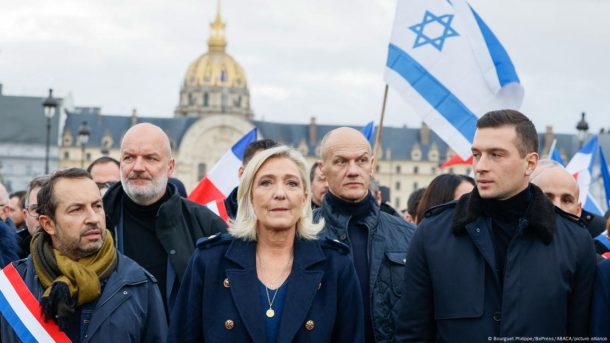
By Jose Alberto Nino • The Occidental Observer • May 10, 2025
The present populist era is rife with all manner of odd realignments.
Anti-Defamation League CEO Jonathan Greenblatt recently faced sharp criticism from its ex-director Abraham Foxman over his initial plan to speak at the Israeli Diaspora Ministry’s International Conference on Combating Antisemitism in Jerusalem. For Foxman, the current ADL chief’s decision to share the stage with European populist figures was a bridge too far.
This conference counted on the presence of Jordan Bardella, the leader of France’s National Rally party; member of the European Parliament Hermann Tertsch of Spain’s Vox party; MEP Charlie Weimers of the Sweden Democrats party; MEP Marion Maréchal, granddaughter of National Front founder Jean-Marie Le Pen; and MEP Kinga Gál, of Hungary’s governing Fidesz party.
“Neither the left nor the right are friends of Israel and the Jewish people,” said Abraham Foxman, who led the ADL for nearly three decades. “Since the explosion of left-inspired antisemitism and anti-Israel hate in the last several years, the pseudo-Fascist right is trying to use the Jewish community as a platform, to demonstrate how legitimate and tolerant they are. Israel and the Jewish community should not give them legitimacy.”
Foxman is correct. Parties like the AfD and National Rally gain legitimacy by being slavishly pro-Israel—an excellent marker of the power of Jews in Western societies.
The presence of these controversial figures prompted a backlash from the ruling liberal establishment of the West. Felix Klein, Germany’s commissioner for combating antisemitism, canceled his appearance, citing his shock at the participation of populist politicians. Likewise, French-Jewish intellectual and ardent Zionist Bernard-Henri Lévy withdrew from his keynote address after learning Bardella would be speaking at the conference. Greenblatt, himself, eventually bowed out as speaker.
Bardella was particularly vehement in his comments on anti-Semitism:
“Since Oct. 7 [2023] in particular, France and Europe are witnessing a deadly honeymoon between Islamists and the far left,” Bardella said. “One provides the fanatics, the other institutionalizes the evil … We have to face anti-Jewish action head on … We have a solemn commitment in France to fight antisemitism everywhere at all times in all of its forms, whether from radical Islamists and the far left or the far right and their delirious plots. None of this hatred has any place in France or Europe.”
Bardella linked “the rise of Islamism, resurgence of antisemitism and the migratory phenomenon tearing apart all Western societies,” and said that the “National Rally is the best shield for the Jews in France.”
In contrast with his party’s founder, Bardella noted that he visited Yad Vashem and spoke of “the unspeakable horrors” of the Holocaust.
Despite the controversy surrounding the Israeli-sponsored conference, it proceeded without issue. Overall, it reflects a notable shift in Israeli foreign relations, spearheaded by Diaspora Affairs Minister Amichai Chikli of the Likud Party. Even before the Israeli government officially abandoned its policy of avoiding cooperation with right-wing populist parties in Europe, Chikli had been engaging with European populists.
He made appearances at conservative gatherings such as the Conservative Political Action Conference (CPAC) in Washington, where he praised President Donald Trump for his efforts to combat antisemitism. Chikli also spoke last year at Europa Viva 24, a gathering hosted by Spain’s Vox party, where he shared a platform with Marine Le Pen.
This growing closeness between Israel’s current leadership and European nationalist parties has stirred controversy both at home and abroad. Chikli’s vocal support for Le Pen during France’s recent elections drew criticism from diplomats in both countries. Last month, he and several Likud colleagues attended CPAC Hungary. In Western capitals, Hungary has been increasingly treated as a pariah for its unconventional foreign policy of treating NATO rivals such as China and Russia as normal countries and for its defense of traditional values and opposition to mass migration.
To those who have a rudimentary knowledge of Jewish influence in Western politics, the notion of Jewish groups aligning themselves with the populist would be almost unheard of. However, for seasoned observers of Jewish political behavior, these Jewish overtures to the European right are another classic case of the “Kosher Sandwich.” The strategy is quite simple: Jews take advantage, or sometimes even create a pressing social issue — immigration in this case. They subsequently insert themselves and their associates into both sides of the debate. But the Jewish interest in this case is to twist and exploit the issue for their own interests. Political newcomers, unaware of the deception, accept the Jew as an ally, convinced they are united in a common cause — only to be misled in the end.
One can see this in the “counter-Jihad” movement. Anti-Muslim activist Tommy Robinson, who has a history of receiving funding from the pro-Israel Middle East Forum and Jewish tech billionaire Robert Shillman, has been one of the most useful front goys for Jewish interests. While he has valid critiques about Islam’s corrosive influence in the United Kingdom and other West countries, Robinson has no issue with the UK importing millions of Hindus and Sikhs from the Indian subcontinent.
In effect, Robinson serves Jewish interests by promoting a Zionist-approved form of immigration restriction. Certain non-Whites — Muslims from the Middle East and South Asia — are demonized and barred from entering Western countries while other non-Whites less hostile, or at least apathetic, to Jewish political machinations continue flooding the Old Continent by the millions.
Jewish co-optation of European populist parties is a multi-decade project. Prime Minister of Hungary Viktor Orbán, who has otherwise sensible views on immigration and foreign policy, has a blindspot for Israel. This is largely due to his connection to Jewish Republican strategist Arthur Finkelstein—one of the key architects of Orbán’s and Israeli Prime Minister Benjamin Netanyahu’s electoral successes.
As a result of this Jewish connection, Orbán has been one of Israel’s strongest diplomatic allies in Europe, especially in the post-October 7 world. Despite his positive overtures to the Israeli government, the Hungarian Prime Minister continues to be demonized for being antisemitic by Western liberal institutions.
Such Jewish penetration of the populist Right has also been present in Italy. Matteo Salvini, leader of Italy’s right-wing Lega party, has cultivated strong ties with Israel, particularly under Benjamin Netanyahu’s leadership. Salvini has visited Israel multiple times, including in 2018 when he met Netanyahu, who called him a “great friend of Israel.” During these visits, Salvini expressed support for Israeli policies and criticized the EU’s stance on Israel.
A similar trend has occurred in the Netherlands. Geert Wilders, the founder and leader of the Party for Freedom (PVV) has a long-standing, personal connection to Israel, having lived and volunteered there as a young man and visited the country dozens of times. He firmly believes that Israel should have dominion over the entire land between the Jordan River and the Mediterranean Sea, opposes the creation of a Palestinian state, and has openly advocated for moving the Dutch embassy to Jerusalem. Wilders has met with Israeli leaders including Prime Minister Benjamin Netanyahu, President Isaac Herzog, and other high-ranking officials. He has been welcomed as a “true friend of Israel” by Netanyahu and has attended official events in Israel.
With prominent French populist leader Marine Le Pen being convicted for embezzling European Union funds, Israel now sees an opening for outreach in the French populist scene. It has invited Jordan Bardella, president of the National Rally (RN), and Marion Maréchal (Le Pen’s niece), to official conferences in Jerusalem, including the aforementioned government-organized antisemitism conference attended by the Netanyahu government.
Both Le Pen and Bardella have sought to rebrand the National Rally as a party amicable to Zionism, emphasizing support for the Jewish state’s security and opposition to “Islamist ideology.” Israeli Diaspora Affairs Minister Chikli publicly endorsed Le Pen, calling her “excellent for Israel” due to her anti-immigration and anti-Islamist positions.
The linking of right-wing populism with Zionist-friendly causes has also been pursued by political strategists and intellectuals like Steve Bannon and Yoram Hazony since the 2010s. Their distinctive approaches—Bannon’s political organizing versus Hazony’s think tank-building—represent two avenues that the American conservative movement has taken to make the world safe for Zionism in the populist era.
All things considered, what’s unfolding here appears to be a part of a backup plan for international Jewry to preserve itself in a 21st century marked by significant geopolitical upheaval. In a world where the United States can’t always be counted on to slavishly defend Israel, Jewish interest groups will strive to have all their bases covered by buying off populist parties abroad. As more and more voters in the West grow disillusioned with the post-World War II order, populist parties are well-positioned to upend traditional conservative and liberal parties and assume the levers of power.
As a result, the shiftiest elements of the transnational Jewish community will make attempts to insinuate themselves in these populist parties to ensure that they don’t become explicitly anti-Israel, much less antisemitic. Europe’s natural tendency, as evidenced by the scores of mass expulsions of the Jews across the Old Continent over two millennia of recorded history, is one of directly confronting the excesses of Jewish economic and political machinations.
To prevent this persistent element of European politics from making a comeback, Jewish interest groups have made it a point to defang White political power on both sides of the pond since the end of World II. In a post-liberal order, where the United States is no longer the unipolar power and its NGO appendages have lost their credibility, the Jewish diaspora will continue its subversive agenda albeit with a few tweaks in its strategy. Enter kosher populism—the only form of White grievance politics allowed in Jewish-dominated polities.
White advocates would be wise to not fall for the glossy exterior of regime-approved “populist” movements. While they may appear to be anti-system, their flaws with respect to challenging Jewish influence, ruin whatever positives they bring to the table. A hardened political cynic would view philosemitic populist organizations as containment vehicles designed to deradicalize Whites and prepare them for their eventual replacement by millions of foreign interlopers. Under normal circumstances, the White segment of the electorate would be gravitating towards nationalist parties that confront Jewish political power head on.
It can’t be stressed enough that European ethnic nationalism and strong anti-Zionist political movements are not permitted in the West. By leveraging hate speech laws, enforcing deplatforming across social media and financial sectors, and promoting controlled opposition groups, the Jewish lobby has thoroughly shaped the discourse in a way that prevents a friend-enemy distinction from ever materializing—the critical factor in undermining the Jewish supremacist projects.
Thanks to the Talmudic sleight of hand a certain faction of Jews has employed in their infiltration of nationalist groups, they ensure that Whites become cognitively polluted by Judaized talking points and expend vast resources and political energy in futile causes. In the meantime, the transnational criminal enterprise that is the Jewish global network continues to act with impunity—be it in the Middle East through the further consolidation of Israel’s geopolitical standing or by accelerating the demographic annihilation of the West via mass migration.
A strict policy of social distancing from institutions that are committed to preserving the Judeo-American Empire is of the essence. Given the demographic crises facing so many Western countries, it makes little sense to strike a Faustian pact with the Jewish institutions responsible for these developments.
As they say, with the Jews you lose.
Tehran rejects ‘baseless’ UK claims about links to criminal groups
Press TV – April 17, 2025
Iran has condemned as “baseless and unjust” the recent accusations leveled by Britain that the Islamic Republic is connected with certain criminal groups.
Foreign Ministry spokesman Esmaeil Baghaei made the remarks on Thursday, three days after UK Foreign Secretary David Lammy announced sanctions on Foxtrot and its leader, Rawa Majid, claiming that the Swedish-based gang had been involved in “violence against Jewish and Israeli targets in Europe on behalf of” Tehran without providing any evidence.
Baghaei said attributing the actions of certain groups to Iran is a clear blame game meant to cover up Britain’s own destabilizing activities, particularly in West Asia.
“Making such claims against Iran reflects a misguided policy that the UK government has, in recent years, become somewhat addicted to,” he added.
The spokesman also noted that London has repeated its unfounded claims without any evidence despite Tehran’s calls for the UK to provide proof supporting its allegations.
He further emphasized that the UK government’s policy of making anti-Iran claims will bring nothing but will discredit it.
“The British regime must understand that pursuing a policy of unfounded ‘claims and accusations’ against the Islamic Republic of Iran will deepen distrust and further disrupt diplomatic relations – for which the UK will bear responsibility,” Baghaei said.
Earlier, the Iranian embassy in London said it had submitted a note of protest to the British government regarding the allegations.
“We consider such baseless positions and destructive conduct to be detrimental to the bilateral relations and urge the UK to refrain from pursuing hostile approaches towards Iran,” it said in a statement.
Good Jihadi, bad Jihadi: Al-Qaeda’s Sharaa vs Sinwar’s resistance
The Cradle | February 19, 2025
“Even the pages of the New York Times now include regular accounts distinguishing good from bad Muslims: good Muslims are modern, secular, and Westernized, but bad Muslims are doctrinal, antimodern, and virulent.” – Mahmood Mamdani, Good Muslim, Bad Muslim: America, the Cold War, and the Roots of Terror
In his seminal work, Good Muslim, Bad Muslim: America, the Cold War, and the Roots of Terror, Mahmood Mamdani dissects how the west constructs and weaponizes distinctions between “good” and “bad” Muslims to suit its geopolitical objectives. He argues that these labels are not inherent but imposed, shaped by the shifting demands of western foreign policy.
Nearly two decades after its publication, his thesis remains alarmingly relevant. Nowhere is this clearer than in the stark contrast between the west’s treatment of Yahya Sinwar, the martyred Palestinian resistance leader of Hamas, and Ahmad al-Sharaa, better known as Abu Mohammad al-Julani, the head of Al-Qaeda-linked Hayat Tahrir al-Sham (HTS) in Syria.
A tale of two leaders
While Sinwar has spent the past year in the war-ravaged ruins of Gaza, constantly evading Israeli and NATO surveillance while leading the Palestinian resistance against a brutal Israeli occupation and aggression, Sharaa moved freely through Idlib, and now Damascus, attending public events and meeting western diplomats without significant security measures.
This is despite the fact that the US had placed a $10 million bounty on Sharaa’s head as a so-called terrorist. The incongruence is striking: an internationally recognized Palestinian resistance leader hunted and vilified, while a former Al-Qaeda affiliate leader rebrands himself as a legitimate political actor with western complicity.
Back in 2021, TRT World noted how Sharaa was “remodeling” himself as a peacemaker, enjoying unimpeded mobility even as western coalition forces actively hunted other jihadist leaders linked to ISIS and Al-Qaeda.
Turkish Foreign Minister Hakan Fidan later confirmed that Sharaa had been collaborating with Ankara for years in eliminating those classified by NATO as “terrorists.” The reality, however, is that Sharaa has been part of a western-backed laundering process for years, at least since 2012, but certainly since 2017, when with Qatari backing, he began rebranding his Al-Qaeda-linked Nusra Front as a Syrian liberation force opposing Russian and Iranian influence.
Media whitewashing and political legitimacy
The western media’s embrace of Sharaa was made explicit when The Times described his return to Damascus as that of “‘Polite’ Syrian leader heads home.” This was not an isolated occurrence but part of a broader effort to frame him as a liberator from foreign influence. His past crimes, including war crimes against civilians, enslavement of Yazidi women, and sectarian violence, were conveniently brushed aside.
When Sharaa’s group took control of Damascus last December, the alignment with western interests became clearer. Israeli airstrikes systematically dismantled Syria’s military infrastructure, particularly in and around the capital, yet Sharaa himself moved through the city undisturbed.
While the Israeli Air Force bombed military sites near Umayyad Square, Sharaa was seen casually driving through the same areas. His silence on these attacks was deafening – especially given that his administration’s official stance on Israel marked a complete break from Syria’s historic anti-Zionist policies.
Statements from his government indicated no intention to reclaim the occupied Golan Heights or other lost territories, signaling a de facto truce with Tel Aviv.
The west’s legitimization of Sharaa reached its peak when his Foreign Minister, Asaad al-Shaibani, was invited to attend the World Economic Forum annual meeting in Davos, sharing a stage with figures like former British prime minister Tony Blair.
His rhetoric was tailored for a western audience: peace, counterterrorism, privatization, and economic liberalism – all buzzwords signaling a willingness to operate within the neoliberal world order.
Demonizing resistance: Sinwar’s struggle
Meanwhile, Israel continued its relentless campaign against Yahya Sinwar, branding him a “butcher,” a “war criminal,” and a “child killer” – a narrative eagerly parroted by western media despite its lack of substantiation.
Even as the alleged war crimes attributed to Hamas fighters on 7 October 2023 were later exposed as Israeli propaganda, Sinwar’s image remained demonized. In his final moments, as an Israeli drone executed him in Gaza, Sinwar did not cower. He fought until his last breath, cementing his status as an icon of Palestinian resistance. Yet even in death, the western narrative denied him any form of legitimacy.
Julani’s convenient redemption
Conversely, Sharaa’s past was erased. His involvement with the Islamic State in Iraq, his position as deputy leader of ISIS under Abu Bakr al-Baghdadi, his group’s mass executions, and his forces’ role in the enslavement of women were all conveniently overlooked.
Western journalists competed to polish his image, portraying him as a pragmatic leader rather than the war criminal he is. His forces still operate brutal prisons in Idlib, where opponents disappear indefinitely, yet he remains a media darling.
This contrast illustrates Mamdani’s thesis with unsettling precision: Sharaa is the “good jihadist” because he aligns with western-Israeli interests, while Sinwar is the “bad jihadist” because he defies them.
Sinwar’s crime was not terrorism – it was successfully challenging the occupation’s military, exposing the vulnerabilities of an Israel long perceived as invincible. His resistance resonated across the Arab and Muslim world, cutting across sectarian lines and threatening western interests.
Sharaa, on the other hand, poses no threat to Israel. He remains focused on the sectarian score-settling within Syria, making him a useful pawn rather than an adversary. His group does not challenge Western influence in the region, nor does it resist the ongoing occupation of Palestinian land. This is the fundamental reason why he is embraced rather than demonized.
Sinwar may have fallen, but as the Quran reminds us: “And do not say about those who are killed in the way of Allah, ‘They are dead.’ Rather, they are alive, but you perceive it not.” (Quran 2:154). His legacy endures, living on in the hearts of those who continue his struggle.
Sharaa, despite his crimes, remains alive and politically relevant. In the western geopolitical playbook, obedience is rewarded while defiance is crushed.
Syrian Women Exploited in MI6 Propaganda Ops
By Kit Klarenberg | Global Delinquents | December 5, 2024
The propaganda value of women in conflicts has long-been cynically exploited by Western intelligence services. A leaked CIA memorandum from March 2010 on covert means of increasing flagging support for NATO’s Afghanistan mission noted women “could serve as ideal messengers” in “humanizing” the military occupation. This was due to their “ability to speak personally and credibly about their experiences under the Taliban, their aspirations for the future, and their fears of a Taliban victory”:
“Outreach initiatives that create media opportunities for Afghan women to share their stories… could help to overcome pervasive skepticism among women in Western Europe toward the mission. Media events that feature testimonials by Afghan women would probably be most effective if broadcast on programs that have large and disproportionately female audiences.”
Throughout the US occupation of course, Afghanistan remained one of the worst countries in the world to be a woman, by some margin. Roughly a year after that CIA memo was authored, Gay Girl in Damascus, a blog purportedly written by Syrian-American lesbian Amina Arraf, garnered significant mainstream attention. Widely hailed for her “fearless” and “inspiring” eyewitness reporting, she was lauded as a symbol of the “progressive” revolution erupting in the country.
In June 2011, Amina’s cousin announced on the blog Amina had been kidnapped by three armed men in the Syrian capital. In response, numerous Facebook pages were set up calling for Amina’s release and ‘liked’ by tens of thousands, #FreeAmina trended widely on Twitter, journalists and rights groups begged Western governments to demand her release, and the US State Department announced it was investigating Amina’s disappearance.
Six days later, it was revealed ‘Amina’ was in fact Tom MacMaster, a middle-aged American man living in Scotland, who had penned extensive lesbian literotica fantasies under that alter ego. While corporate news outlets quickly forgot all about the hoax they’d so comprehensively fallen for, their appetite for dubious human interest stories emanating from the crisis wasn’t diminished.
‘Huge Global Coverage’
In July 2019, an image of two young Syrian girls trapped in rubble in opposition-occupied Idlib attempting to haul their sister to safety as she dangled off the precipice of a dilapidated building, their father looking on in horror above, spread far and wide on social media.
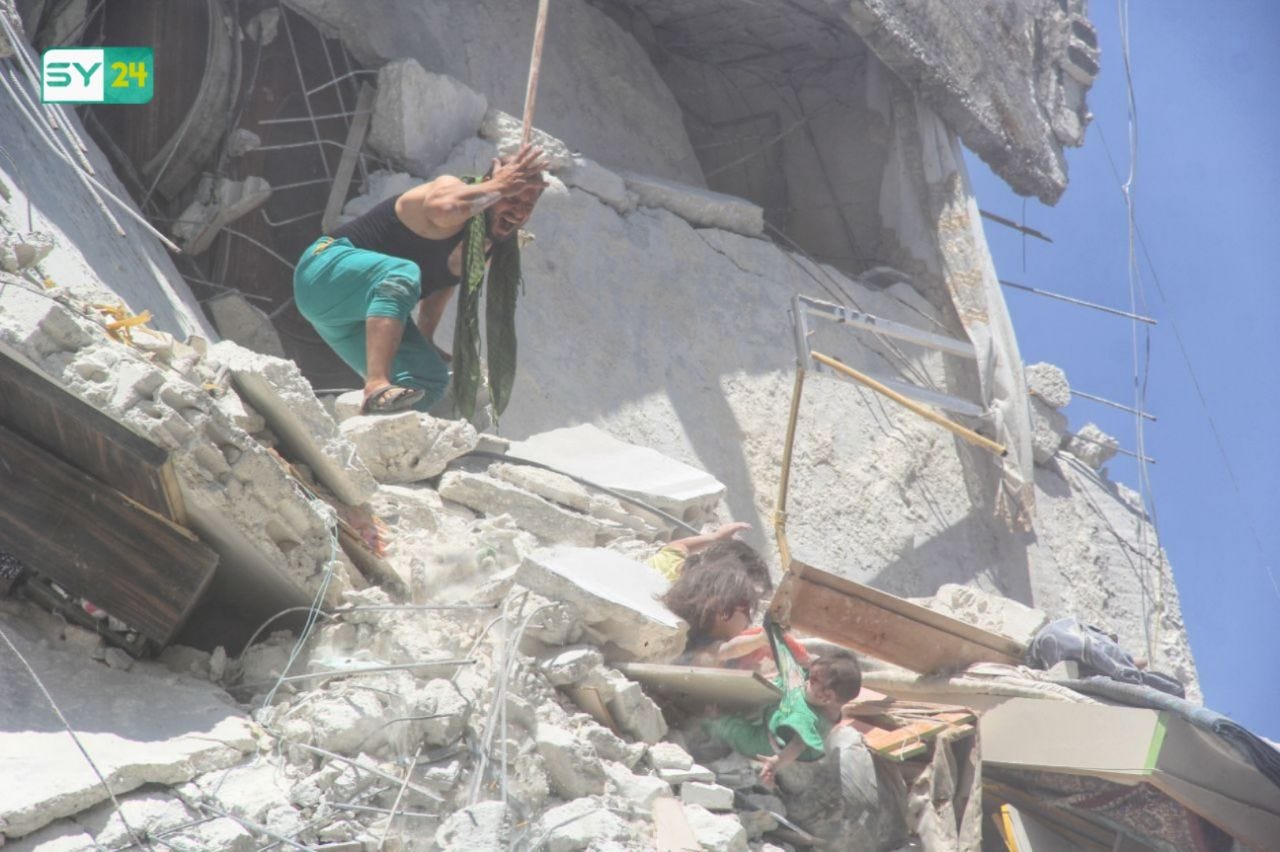
The photo, snapped by a photographer for Syrian news service SY24, went viral the world over. Unbeknownst to viewers though, SY24 was created and funded by Global Strategy Network, a prominent British intelligence cutout founded by Richard Barrett, former MI6 counter-terrorism director. In leaked submissions to the British Foreign Office, Global Strategy boasted of how its propaganda “campaigns” broadcast via SY24 generated “huge global coverage,” having been seen by “many hundreds of millions of people,” and “attracting comment as far as the UN Security Council.”
SY24 content was produced by a network of ‘stringers’ in Syria that Global Strategy trained and provided with equipment, including “cameras and video editing software.” The firm drew particular attention to a team of female journalists it had tutored, “who provide about 40 percent of all SY content,” and were part of “a broad ‘network of networks’” enabling the company “to drive stories into the mainstream.”
Global Strategy also established a dedicated centre for training female journalists to produce content for SY24 in Idlib, “accessing stories that male journalists cannot,” which were then shared on social media. It boasted that almost half of SY24’s followers were women, “a remarkably high ratio for Syria-focused platforms.”
Carefully cultivating an entirely misleading image of an inclusive, credible ‘moderate’ Syrian opposition was of paramount importance to British inelligence. It helped whitewash the barbarous nature of the various ‘rebel’ factions London was backing in the region, while simultaneously engendering support among Western citizens for regime change.
In order to engage the “international community” to this end, Global Strategy, in conjunction with ARK – a shadowy “conflict transformation and stabilization consultancy” headed by veteran MI6 officer Alistair Harris – planned “communication surges” around “key dates” such as International Women’s Day.
In a particularly elaborate example of such a “surge”, the pair collaborated on “Back to School”, a campaign in which young Syrians returned to education. Idlib City Council, opposition commanders, and other elements on the ground concurrently engaged in a “unified” communications blitz, using “shared slogans, hashtags and branding.” Rebel fighters were sent to “clear roads” and “enable children and teachers to get to schools,” all the while filmed by the pair’s voluminous local journalist network, footage of which was then “disseminated online and on broadcast channels.”
Ensuring “female teachers” received sizeable coverage in the Western media was a key objective of the campaign. Furthermore, in many leaked files, ARK boasted of the huge network of journalists it had trained and funded in Syria, who would cover such PR stunts, secretly orchestrated by the organisation. Their reports in turn fed to the firm’s “well-established contacts” at major news outlets including Al Jazeera, BBC, CNN, The Guardian, New York Times, and Reuters, “further amplifying their effect.”
‘Thrust by Tragedy’
Other documents make clear ARK well-understood the immense difficulties of promoting the role of women internally and externally during the crisis. One file on “[incorporating] the role of women in the moderate opposition” notes Syrian women in rebel-occupied areas faced “an almost overwhelming variety of problems,” and “the space for women to participate in public life has contracted significantly as the conflict has progressed.”
As a result, ARK was “extremely aware of the risks of promoting women’s participation beyond currently accepted social norms… given the potential to hinder message resonance or result in a backlash against female participation.” It therefore proposed to “subtly reframe the narrative of women… increasing the amount of coverage of their initiatives and opinions as the context allows.”
One means of “subtle reframing” was Moubader (which translates to “person who takes initiative”), a media asset created by ARK in 2015, comprising a “high-quality hard copy monthly magazine with widespread distribution across opposition-held areas of Syria,” with a website and Facebook page boasting almost 200,000 likes. Moubader was established by ARK to achieve “behavioural change” in readers. “Given the importance of broadcast television as a trusted source” in Syria, ARK also sought British intelligence funding to develop a Moubader TV programme, to “leverage stories and values to maximum effect and reach an even wider audience.”
Documents submitted to the Foreign Office by another intelligence cutout, Albany, similarly noted women’s access to education, healthcare, and economic opportunity had “been debilitated” during the crisis, which issues such as early marriage, child military recruitment, and “transactional sex” exacerbated. The UN defines the latter as “non-commercial sexual relationships motivated by an implicit assumption that sex will be exchanged for material support or other benefits.”
Still, Albany considered so many Syrian women having been “thrust by tragedy into head of household and breadwinner positions” over the course of the crisis as a golden opportunity to propagandize them and, in turn, their families, while promoting the ‘inclusive’ nature of the opposition, by creating and partnering with female civil society organizations and journalists.
ARK likewise believed women to be a “critical audience”, given the number of Syrian households with female heads –“up to 70 percent”. So, the organisation sought to ensure they were well-represented in all its domestic and international “broadcast products”, as well as on social media.
‘Female Participation’
Unsurprisingly, the files do not acknowledge the increasingly hostile environment for women in Syria directly resulted from foreign efforts to destabilise and depose its government. ISIS and al-Nusra were and remain rightly notorious for their monstrous treatment of women in the areas they occupied, which included widespread rape, sexual violence and abduction.
However, many armed opposition groups backed by Britain and other foreign powers imposed stringent restrictions on women in the areas they occupied, requiring them to wear hijabs and abayas, doling out extreme punishments for failing to comply, imposing discriminatory measures prohibiting them from moving freely, working, attending school, and more.
There are indications British intelligence was in close quarters with such activities. For instance, in December 2017 BBC documentary Jihadis You Pay For alleged Foreign Office cash distributed on its behalf via contrator Adam Smith International in Syria ended up in the pockets of Free Syrian Police (FSP) officers who not only stood by while women were stoned to death, but closed surrounding roads to facilitate their murder.
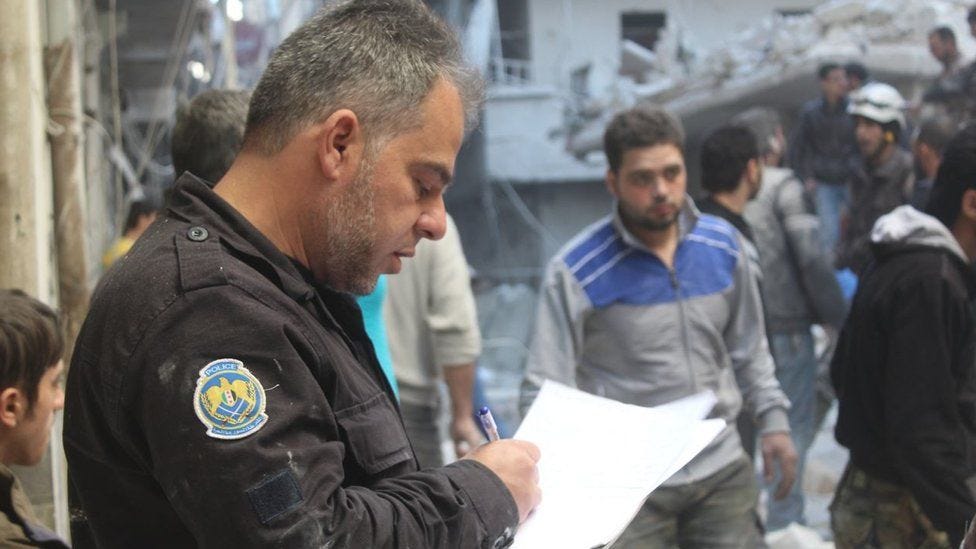
The ‘Free Syria Police’ at work
FSP, an unarmed shadow civilian police force operating in opposition-controlled areas, was created, funded and trained under the auspices of the British intelligence-funded Access to Justice and Community Security (AJACS) program. In a perverse irony, leaked Adam Smith International files relating to the project indicate it too sought to exploit women for propaganda purposes, applying a gender policy “to encourage female participation in justice and policing.” The company boasted of how, of the 1,868 police officers it trained under the scheme, six – 0.32 percent – were female.
Quite some “revolution”. As Human Rights Watch noted in 2014, prior to the outbreak of civil war, women and girls across Syria were “largely able to participate in public life, including work and school, and exercise freedom of movement, religion, and conscience.” While the country’s penal code and laws governing issues such as marriage, divorce, and inheritance contained some discriminatory provisions, the country’s constitution guaranteed gender equality.
US appeals court overturns 1983 Beirut bombing victims’ $1.68B judgment against Iran
Press TV – November 14, 2024
A US appeals court has revoked a $1.68 billion judgment against Central Bank of Iran (CBI), known as Bank Markazi, regarding the damages won by the families of the victims of a 1983 bombing in Beirut, which targeted a US Marine Corps barracks in the Lebanese capital and was blamed on the Islamic Republic.
The 2nd US Circuit Court of Appeals in Manhattan threw out the $1.68 billion judgment on Wednesday and said a lower court judge should have addressed questions of state law before ruling against Bank Markazi and Clearstream, a subsidiary of Germany’s stock exchange operator Deutsche Boerse where Iranian assets are held.
In a 3-0 decision, the panel also rejected a claim that a 2019 federal law designed to make it easier to confiscate Iranian assets outside the United States waived Bank Markazi’s sovereign immunity.
That law “neither abrogates Bank Markazi’s jurisdictional immunity nor provides an independent grant of subject matter jurisdiction,” Circuit Judge Robert Sack wrote.
The court returned the case to US District Loretta Preska in Manhattan to address state law questions in the 11-year-old case, and decide whether the case can proceed in Bank Markazi’s absence.
Bombing victims sought to hold Iran liable for what they claimed to be providing material support for the October 23, 1983, suicide attack that killed 241 US service members, by seizing bond proceeds held by Clearstream in a blocked account on the CBI’s behalf.
The CBI declared immunity under the Foreign Sovereign Immunities Act, which generally shields foreign governments from liability in US courts.
The plaintiffs sued in 2013 to partially satisfy a $2.65 billion default judgment they had won against Iran in 2007. Another judge dismissed the case in 2015, but the 2nd Circuit Court revived it in 2017.
Then in 2020, the US Supreme Court ordered a fresh review in light of the 2019 law, which then-President Donald Trump signed as part of the National Defense Authorization Act.
The plaintiffs have said they hold more than $4 billion of judgments against Iran and have been unable to collect for decades.
Featured Video

The Most Important Bet You’ve Never Heard Of
or go to
Aletho News Archives – Video-Images
From the Archives
Wars for Israel: A reminder of who’s giving the marching orders
By Damian Lataan | February 7, 2012
As the West prepares to march off to yet another war in the Middle East, we should perhaps remind ourselves of who is giving the West their marching orders.
In February 2003, just weeks before the US and their allies launched their attack on Iraq and her peoples, a delegation of US congressmen, together with the US Ambassador to the United Nations, John Bolton, a well known pro-Zionist and neoconservative war-hawk, were in Israel at the invitation of the Israeli government then led by Israeli Prime Minister Ariel Sharon.
Addressing the congressmen, Sharon told them ‘that Iran, Libya and Syria should be stripped of weapons of mass destruction after Iraq’. Later, Sharon told John Bolton ‘that Israel was concerned about the security threat posed by Iran, and stressed that it was important to deal with Iran even while American attention was focused on Iraq’. … continue
Blog Roll
 Aletho News
- UAE rejects report claiming it is ready to join war on Iran to reopen Hormuz
- A New Resistance Front: How Does Syria Factor into the Regional War?
- Gulf states weigh pipeline expansion plans, hoping to bypass Hormuz
- Iran sets up ‘tollbooth’ system in Strait of Hormuz
- Wave 90: IRGC strikes US-linked industrial sites in Gulf
- Iran Says US-Israeli Claims of Its Military Strength Are Wrong
- Trump’s April Fools’ Address to the nation
- The Most Important Bet You’ve Never Heard Of
- The killing of three Indonesian soldiers in Lebanon should remind Jakarta that Israel does not want peace
- Defeated and delusional: Netanyahu’s remarks reveal $80bn war failure, says analyst
- If Americans Knew
- ‘War crime’: Global condemnation as Israeli ministers celebrate death penalty law targeting Palestinian prisoners
- 7 Ways Israel Is Turning Lebanon Into Gaza
- World’s Leading Football Bodies Under Fire Over Israel Policies
- Experts warn of possible use of nukes against Iran
- Israeli invasion of Lebanon could be worse than 1982, warn European officials
- Passover: Liberation and collective punishment
- Trump says the quiet part out loud: (Israel’s) war on Iran > Americans’ health – Daily Update
- Gaza families reunite years after babies evacuated amid Israel’s war
- International Rescue Committee warns Gaza’s children face grave protection risks
- Iran’s Alleged 47-Year War on America: Debunking the 1,050 American Deaths Canard
- No Tricks Zone
- Low Intensity Tornado Wrecks Major Solar Farm, Creating A Potential Toxic Dump
- New Study Finds Warming Saves Lives…Cold Temperatures 12 Times More Deadly Than Excess Heat
- German Science Blog Accuses PIK Climate Institute Of Hallucinating Climate Tipping Points
- Devastating Assessment Of Comirnaty Vaccine By Former Senior Pfizer Europe Toxicologist
- New Study: CO2 Is ‘Effectively Negligible’ As An Explanatory Climate Change Factor Since 2000
- Former Pfizer Toxicologist Dr. Helmut Sterz Tells Bundestag Hearing Pfizer Vaccine Should Have Never Been Approved
- Energy Expert: Germany’s Nuclear Phaseout Was A “500 Billion Euro Mistake”
- New Research: South Australia’s Mid-Holocene Sea Surface Temperatures Were 4°C Warmer Than Today
- Storing Green Energy To Last Germany 10 Days Would Require A 60-Million Tonne Battery
- New Studies: UK Sea Levels Were 4 Meters Higher Than Today During The Mid-Holocene
 Aletho News