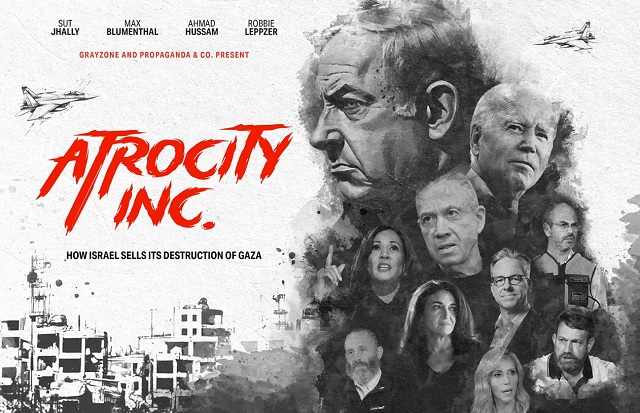
We are now a year into the Israel government’s military action devastating the people and infrastructure of Gaza and since expanded into escalating violence against countries including Lebanon and Iran. Yet, even today, United States Senate members are repeating flagrant lies produced in the war’s early days to trick Americans and others around the world into supporting Israel’s war.
On Monday, Republican US Senators introduced a resolution repeating some of these old lies that helped build support among Americans for Israel’s war — that “Hamas terrorists” killed “approximately 1,200 individuals” in their October 7, 2023 attack and that Hamas used “rape as a weapon of war.” Why repeat the lies? To support the resolution’s conclusions, including that the Senate wants to “ensure the forever survival of Israel.” Left unsaid in the resolution is that the way the US government continually acts to purportedly achieve this goal includes shoveling more and more money, weapons, and intelligence to Israel for Israel to use in whatever way it chooses. Indeed, the US government’s commitment seems unfazed no matter Israel’s level of barbarity and no matter how much Israel’s actions cause further geographic expansion of the war.
To the extent American politicians repeating these baseless claims regarding October 7 are doing so because they are ignorant about what happened, they would do well to watch a new documentary — Atrocity Inc. — featuring reporter Max Blumenthal. Blumenthal was there from the beginning calling no dice on the propaganda promoted by Israel and US politicians, along with American media, that has been used to gain public support for Israel’s aggressive actions. The widespread rape allegations are ridiculous fabrications and a significant portion of the death toll is from the willful killing of Israelis by agents of their own government, Blumenthal explains in the documentary. Blumenthal also debunks other outrageous lies, including claims related to the killing of, and even beheading of, babies on October 7.
Senators, and everyone else, can watch the documentary here.
October 9, 2024
Posted by aletho |
Deception, Ethnic Cleansing, Racism, Zionism, Fake News, Mainstream Media, Warmongering, Timeless or most popular, Video, War Crimes | Gaza, Israel, Palestine, United States, Zionism |
Leave a comment
Hezbollah Media Relations issued a statement to comment on reports published by some media outlets and attributed to the “group sources” regarding the fate of Hezbollah officials following the brutal raids on the southern suburb of Beirut.
The statement highlighted Agence France-Presse, which attributed its reports to senior Hezbollah sources.
“We would like to reiterate that Hezbollah does not have ‘sources’, and our position is reflected in an official statement issued by Hezbollah’s media relations.”
Some media outlets, especially a number of websites, have also published false news and worthless rumors regarding the organizational situation of a number of senior Hezbollah officials, according to Hezbollah statement.
This falls within the framework of the psychological warfare against the resistance supporters by those who have consecrated their pens, tongues and positions at the service of the Zionist occupation, the statement concluded.
The Israeli enemy went ahead with its brutal raids across Lebanon on Saturday, day 12 of the aggression, with air strikes on Beirut’s Dahiyeh.
October 6, 2024
Posted by aletho |
Deception, Ethnic Cleansing, Racism, Zionism, Fake News, Mainstream Media, Warmongering | Agence France-Presse, Hezbollah, Israel, Lebanon |
Leave a comment
Iran has rejected “baseless” US accusations that it is attempting to influence the upcoming presidential election, saying Washington, with a record of interference in other countries’ affairs, is “in no position” to make such claims against Tehran.
Iran’s Foreign Ministry spokesman Esmaeil Baghaei made the remarks on Friday, two days after an annual assessment by the Department of Homeland Security alleged that Iran, Russia and China are trying to influence the November vote, including by employing artificial intelligence to disseminate fake or divisive information.
Baghaei said, “These repeated and baseless claims, which have been made by some US officials and institutions for some time, are politically-motivated and serve domestic political purposes.”
“The US government, which has a long history of illegal interference in the internal affairs of other countries, is in no position to level such accusations at other states.”
Back in August, the campaign of US Republican presidential candidate Donald Trump claimed that it had been hacked, pinning the blame on Iran without providing evidence.
Meanwhile, the FBI and other US agencies alleged that Iranian hackers had sought to interest President Joe Biden’s campaign in information stolen from Trump’s campaign, sending unsolicited emails to people associated with the then-Democratic candidate.
The Islamic Republic said it does not accord any credence to the accusations, emphasizing that it has no intent or motive to meddle in the American election.
October 4, 2024
Posted by aletho |
Deception, Fake News, Islamophobia, Mainstream Media, Warmongering | FBI, Iran, United States |
Leave a comment

The official Israeli army version of why it targeted civilian areas during the intense and deadly bombardment of southern Lebanon on 20 September is that the Lebanese are hiding long-range missile launchers in their homes. This official explanation was meant to justify the killing of 492 people and the wounding of 1,645 in a single day of Israeli air strikes.
This off-the-shelf explanation will be repeated throughout the Israeli war in Lebanon, however long it takes. Israeli media is now citing these claims and, as usual, US and western media are parroting the same narrative. Keep this in mind as you reflect on earlier statements made by Israeli President Isaac Herzog on 13 October last year when he argued that there are no civilians in Gaza, and that, “There is an entire nation out there that is responsible [for 7 October ].”
Israel does this in every war it launches against the Palestinians or any Arab nation.
Instead of removing civilians and civilian infrastructures from its target bank, it immediately turns the civilian population into the main targets for its bombs.
A quick glance at the number of civilians killed in the ongoing war and genocide in Gaza should be enough to demonstrate that Israel targets ordinary people as a matter of course. According to the Palestinian Health Ministry in Gaza, children and women constitute the largest percentage of the war’s victims at 69 per cent . If we factor in the number of adult males who have been killed — including doctors and other medical staff, civil defense workers and numerous other categories — it will be obvious that the vast majority of all of Gaza’s victims of Israeli brutality were civilians.
Only Israeli media, and their allies in the west, continue to find justifications for killing Palestinian and now Lebanese civilians in large numbers.
Compare the following two statements, which received much attention in the media, by Israeli military spokesperson Daniel Hagari regarding both Gaza and Lebanon: “Hamas systematically uses hospitals to wage war and consistently uses the people of Gaza as human shields,” said Hagari on 25 March. Then he claimed on September 27, “Hezbollah’s terror headquarters was intentionally built under residential buildings in the heart of Beirut, as part of Hezbollah’s strategy of using human shields.”
For those who routinely give Hagari and other Israeli spokespeople the benefit of the doubt, just review what has taken place in Gaza in the past year. For example, Israel claimed that the massacre at Al-Ahli Baptist Hospital was not of its doing, and that it was a Palestinian rocket that killed the nearly 500 displaced refugees and wounded hundreds more on 17 October 2023. All evidence, including investigations by well -respected rights groups, concluded the opposite. However, the false Israeli claims still dominated the media headlines.
The Baptist Hospital episode was repeated with other lies on numerous occasions. In fact, the lies started on 7 October, not 17 October, when Israel made claims about decapitated babies and mass rape. Even though much of that has been proven conclusively to be wrong, some in the media, and pro-Israel officials, continue to speak of it as if it is a proven fact.
Moreover, although no Hamas headquarters were ever found under Al-Shifa Hospital, the unsubstantiated Israeli claims continued to be repeated as if they were the full truth of the matter, and thus justified the death and destruction at Gaza’s main medical facility.
The same logic is now being applied to Lebanon, where Israel claims that it does not target civilians and, when civilians are killed, that it is the Lebanese themselves who should be blamed for supposedly using civilians as human shields.
The Gaza playbook is now the Lebanon playbook.
Of course, many are playing along, not because they are irrational or unable to reach proper conclusions based on the obvious evidence. They do so because they are happy to be part of the Israeli narrative, not neutral storytellers or honest journalists.
Even the BBC plays its part within that narrative, as it uses Israeli claims as the starting point of any conversation on Palestine or Lebanon. “Israel has said it carried out a wave of pre-emptive strikes across southern Lebanon to thwart a large-scale rocket and drone attack by Hezbollah,” reported the corporation on 26 August. That’s just one example of many.
Israel gets away with its lies pertaining to the mass killings in Gaza, and now in Lebanon, because Israeli propaganda is welcomed, in fact, embraced by western officials and journalists. Thus, when US National Security Advisor Jake Sullivan described the 20 September air strikes on Lebanon as “justice served”, he was telling mainstream media that its coverage should remain committed to that official assessment.
Imagine the outrage if the tables were turned, and Israeli civilians were slaughtered in their own homes by Lebanese bombs. There would be no need to have to explain the reactions of the US or western media, as they would be obvious to anyone who is paying attention.
Lebanon is a sovereign Arab state. Gaza is an occupied territory, and its people are protected under the Fourth Geneva Conventions. Neither Lebanese nor Palestinian lives are without worth, and their mass murder should not be allowed to take place for any reason, especially based on lies communicated by an Israeli military spokesperson and repeated by complicit media.
Perpetuating Israeli lies is dangerous, not only because truth-telling is a virtue, but also because words kill. Dishonest reporting can, in fact, succeed in justifying genocide, which is why Israel gets away with murder in Gaza and Lebanon.
October 1, 2024
Posted by aletho |
Ethnic Cleansing, Racism, Zionism, Fake News, Mainstream Media, Warmongering, War Crimes | Israel, Lebanon, Palestine, Zionism |
Leave a comment
Is the Pacific Jet Stream drifting poleward?
This week’s prize for jumping the climate gun goes to New Scientist, twice.
Firstly, it tells us that low sea ice levels in Antarctica signal a permanent shift. This, they say, because for the second year in a row Antarctic sea ice has reached near-record low levels, “initiating concern that climate change has initiated a ‘regime shift’ in the amount of ice that forms in the Southern Ocean each year.”
Sorry New Scientist, but two years does not a trend make. Looking at the data, 2023 was indeed a record low and 2024 slightly above that, but if you look at previous years, especially the 2011–2020 average, you will see no trend, just confirmation that 2023 and 2024 are outliers. Much more data than the past two years will be required to signal a permanent regime change.
Their second example of spurious trend-setting concerns the questions of if there is a long-term poleward shift in the jet stream, and if it might be the result of global warming. The jet stream is powered by the Earth’s rotation and by temperature differences between the tropics and higher latitudes. Its poleward drift is a prediction of some climate models.
According to New Scientist, a new analysis indicates that the Pacific Jet Stream has started its poleward drift, moving at 30–80 km a decade. The problem with this research, which is clearly stated in the paper, is that the Jet Stream’s natural bounds of variability are not known, and despite the data going back several decades, if the past ten years are excluded from the analysis then no poleward trend is seen. The researchers say it’s going to take to the end of this century to be sure of any systematic Pacific Jet Stream drift.
Over the past few months, something very unusual has been happening in the equatorial Atlantic Ocean. Temperatures have declined at their fastest for over 40 years. Climate scientists are at loss to explain it, as the usual culprit – trade winds – haven’t developed as expected.
It has been called an “Atlantic Niña.” Along with the developing La Niña in the Pacific, it is expected to reduce global temperatures. It’s a puzzle, as the equatorial Atlantic was hot throughout 2023 – in fact the warmest for decades. Again the reaction by some has been alarmist, fearing that the climate system has gone off the rails, but my initial response is to wait and see, as it is probably an example of misunderstanding of natural variability.
September 29, 2024
Posted by aletho |
Fake News, Mainstream Media, Warmongering, Science and Pseudo-Science | New Scientist |
Leave a comment

On Sunday, for the second time this election cycle, a man was able to get close to Donald Trump with a rifle. The former president was golfing when Secret Service agents spotted a rifle barrel poking out of some bushes just off the course, near a hole Trump would soon play. Agents fired on the suspect, causing him to flee as Trump was rushed off the course. Shortly after, the man was apprehended by police.
A scoped rifle, two backpacks, and a video camera were recovered from the woods where the suspect was hiding. The FBI said it was investigating the incident as an attempted assassination. The suspect, Ryan Routh, has so far been charged with two gun-related crimes.
While there are clearly some major differences between this incident and the first assassination attempt in July—when Trump was shot in the ear during a rally in Butler, Pennsylvania—the fact that an armed man was able to get so close to the former president and remain undetected until the last moment for the second time in two months is a big deal.
Yet the reaction from the political establishment and the establishment media has been notably different. Back in July, there was broad agreement within the establishment that they needed to “lower the temperature.” This week, the rhetoric has changed. While most go through the motion of denouncing political violence, establishment figures and outlets have downplayed the assassination attempt, obscured the attempted shooter’s political ideology, and even blamed Trump himself for provoking people into trying to kill him.
It’s not surprising that the political establishment and their friends in the media want to dismiss or play down what happened on Sunday. Because Ryan Routh, the suspect, appears to have been motivated by the exact narrative of the war in Ukraine and the prospect of a second Trump term that the establishment is trying so hard to get the American public to accept.
In early 2022, after Russia invaded Ukraine, the American establishment went into overdrive to whitewash all the developments that had led to the invasion. They instead defined Vladamir Putin as an expansionist tyrant bent on conquering all of Europe simply because he hates freedom and democracy.
Because of unearthed social media posts, numerous interviews with major outlets like The New York Times, and a self-published book, we can clearly see that Routh was completely convinced by the establishment’s characterization of the war. So much so that in the months after the war broke out, Routh traveled to Ukraine to try and join the fight. He was turned away, apparently due to his age, but stuck around to try and recruit other foreigners to join Ukraine’s ranks.
In one interview with Newsweek, Routh laid out how he views the war:
To me, a lot of the other conflicts are gray, but this conflict is definitely black-and-white. This is about good versus evil. This is a storybook— you know, any movie we’ve ever watched, this is definitely evil against good. … It seems asinine that we have a leader and a country that does not understand the concept of being unselfish, and being generous, and being kind, and just the basic moral values that are required by human beings these days. It blows my mind.
That is exactly how the pundits and politicians who make up the American political establishment want us thinking about this war. Not as an unnecessary geopolitical conflict that escalated for decades before erupting into the conventional war we see today, but simply as a black-and-white showdown with an evil country.
Importantly, as can be seen in the opening to Biden’s State of the Union address from earlier this year, the establishment has explicitly conflated this threat abroad with what they call the threat at home—meaning Trump and the MAGA movement. So if a disturbed person like Ryan Routh was convinced that he would be a hero if he went and fought the evil Russians in Ukraine only to be turned away because of his age, it’s not much of a jump to expect that he concluded he could still be a hero if he set his sights on, what he was told, is the same threat at home.
That’s not to say that the establishment voices pushing the simplistic narratives that captured Routh directly incited his assassination attempt—although it would under the standard they apply to Trump and January 6. Only that the establishment is using misleading and sometimes wholly fictional narratives about the war in Ukraine and the populist anger directed toward them to try to scare us into voting in ways that support their interests. It shouldn’t surprise anyone when these contrived, simplistic, overly dramatic narratives lead some people to decide voting isn’t enough.
September 20, 2024
Posted by aletho |
Deception, Fake News, Mainstream Media, Warmongering, Russophobia | Ukraine, United States |
Leave a comment
Do you remember the terrible death of Kim Jong Un’s ex-girlfriend?
In 2013, the international press reported the story of Hyon Song Wol, singer of the Pochonbo band, who had reportedly met Kim ten years earlier and continued a secret relationship despite being married and having a baby. Then, one day, Hyon and 11 other performers were arrested, accused of recording pornographic videos amongst themselves and selling them. Despite this sin, some of them were carrying Bibles, which, of course, is an even greater sin in the “North Korean dictatorship.” Three days later, all were executed by a firing squad. To make matters worse, their closest relatives were forced to watch the executions, as well as members of other prominent bands. Moreover, the “regime” deemed those who witnessed the executions guilty by association with the sinners and sent them to concentration camps! What a monstrous dictatorship!
The tragic and insane story took a twist the following year when Hyon was interviewed on North Korean TV—and, behold, she was alive! The British newspaper The Independent called Hyon’s appearance “miraculous” (perhaps the singer’s resurrection was linked to the Bible found amid the bacchanalia!).
The explanation for the singer’s miraculous resurrection, however, is not supernatural. The first to report the tragic story of the performers was the South Korean newspaper Chosun Ilbo. The sources cited in the newspaper’s report were all anonymous. The South Korean disinformation service also had a hand in fabricating the story: shortly after the lie was spread, the head of South Korean intelligence, Nam Jae Joon, claimed he was also aware of the execution.
Chosun Ilbo is a major ultraconservative newspaper that acted as a propagandist for the Japanese Empire during the occupation of Korea, as well as for the military dictatorship that ruled the country until the end of the last century. It is distinctly anti-DPRK. But that’s not all: it is known for spreading fake news about Pyongyang. In 2019, both Chosun Ilbo and Chosun TV (owned by the same business group) reported that Kim Hyok Chol had been executed and Kim Yong Chol had been sentenced to hard labor. Both were nuclear negotiators for the DPRK in relations with the United States and were allegedly punished because the rapprochement process between the DPRK and the U.S. had not been successful. The sources cited by South Korean journalists were, again, anonymous. A few days later, however, Kim Yong Chol appeared alongside Kim Jong Un at an event broadcast by state television, a clear demonstration of Yong Chol’s prestige. CNN’s Taipei correspondent, Will Ripley, who had traveled to the DPRK around 20 times, also reported that Kim Hyok Chol was alive.
Despite its history of sensationalism and false news, the Chosun group continues to be a trusted source for major international media outlets. Earlier this month, the group reported that between 20 and 30 government officials had been executed for failing to prevent the deaths of 4,000 people in floods that hit the north of the country during the summer. As always, the Brazilian and international press eagerly spread the news, and O Globo even stated that Chosun TV was a “local broadcaster” from the DPRK. And, as always, the source of the information disseminated by Chosun was anonymous, as The Independent noted—even though it still endorsed the hoax with statements from “experts” on the subject, all of them South Korean and American.
What actually happened was quite different from the internationally orchestrated hoax. In early August, in a speech before flood victims in North Phyongan Province, Kim Jong Un took responsibility, as every leader should be conscious of doing, and announced the measures the government would take.
I felt uneasy because I could not help you much, despite my strong desire to do something. Although the entire country has sincerely mobilized to help, at this moment, I can only feel anxious and impatient because I have been unable to remove all the inconveniences you are experiencing in tents and poorly furnished public facilities.
In the same speech, the Korean leader announced that 130,000 young people and soldiers from the People’s Army were already being mobilized to rebuild infrastructure in North Phyongan. He also assured that all students and children from the areas affected by the heavy rains in North Phyongan, Jagang, and Ryanggang Provinces, which led to the Amnok River overflowing, would be transferred to Pyongyang during the reconstruction to stay safe and continue their studies, all at the expense of the State. In total, he announced that 15,400 people would be temporarily relocated to the country’s capital.
Nursing, edification, and education of students and other children are the most important of all state affairs, never to be abandoned even if the sky may fall in. Therefore, the State will take full responsibility for this work during the rehabilitation campaign. And state-backed care benefits will be offered in Pyongyang to the elderly and sick, honored disabled ex-soldiers, and nursing mothers before new houses are built in the flood-stricken areas.
Kim Jong Un also assured that those who remained in the affected cities during the reconstruction of their homes, in addition to the tents where they were already sheltered, could store their furniture and other belongings in safe places. Moreover, public restrooms with shower stalls and waste disposal systems would be provided to eliminate any possibility of contagious disease outbreaks. He also emphasized the issue of collective voluntary work, a historic characteristic of the Korean Revolution, as a means to solve the problem: “The assistance work must be conducted strictly under voluntary principles, never in a forced or organized manner.”
And so it happened. As the water was receding, the Paektusan Heroic Youth Shock Brigade— which received nearly 300,000 volunteer applications—was dispatched by the Workers’ Party to evacuate people from risky areas and begin the reconstruction process. One of the first measures was restoring water and electricity supplies. The metallurgical, steel, and mining industries increased production to meet the needs of the affected northern regions. Factories in all provinces focused their production on consumer goods for those affected. A special transportation scheme was set up on the railways to supply those regions with consumer and construction materials. Regional regiments of the WPK militias were sent to the affected provinces. Every sector of society was mobilized to aid in reconstruction. In addition to volunteers, who were joined by workers and soldiers to repair and rebuild buildings, roads, and bridges, professionals from various fields, such as doctors, scientists from the Academy of Sciences, and artistic ensembles, were also sent to the affected areas.
In Pyongyang, children and adults temporarily relocated from the northern areas at risk were offered visits to tourist and leisure sites such as circuses, theaters, museums, zoos, water parks, Mangyongdae Children’s Palace and Hill, and the Science and Technology Complex. Collective birthday parties are also being held for these people. The entire process is being closely monitored and reported daily by the Korean press.
The DPRK government estimated that the reconstruction would be completed within three months. Given the incredible mobilization of human and material resources, it is highly likely that this short deadline will indeed be met. Meanwhile, the vile propaganda of the DPRK’s enemies (and of the whole world) continues to spread its lowly lies. The dogs bark, but the caravan moves on.
September 17, 2024
Posted by aletho |
Fake News, Mainstream Media, Warmongering | Korea |
Leave a comment
Fifty-two years ago, almost to the day, on September 8, 1972, I survived the first of many air and sea raids on my refugee camp in northern Lebanon. I was less than two hundred yards from the area across the river where a group of us young kids met every day, between 4 and 5 p.m., to play in the large field, swim in the river, or the Mediterranean Sea.
At first, I heard what sounded like a humming plane. Before I could even turn my head to look up at the sky, I was startled by the booming sound of low-flying fighter jets passing overhead, dropping massive rockets onto the open field. The first bomb exploded in the northwest area of the field, creating a massive fireball—a black column of smoke intertwined with a glowing red blaze. The shockwave threw me off my bike. Soot filled the air and fragments rained down like strafing bullets all around me.
In less than 15 minutes, the once grassy green play area of approximately 20 acres was transformed into a lunar landscape, pocked with craters. One pit was so large and deep that groundwater filled the hole.
If the Israeli air raid had occurred just five or ten minutes later, I would have been in the middle of the field, playing with other 14-year-old kids. My friend Barakat, who was already there and likely had been eagerly anticipating my arrival, was killed. The raid left many unexploded devices and time-delayed bombs, making it difficult to recover his body until the next day. Our neighbor Mahdi was also killed, buried under the plowed soil. Years later, his skeleton was discovered when the area was being graded.
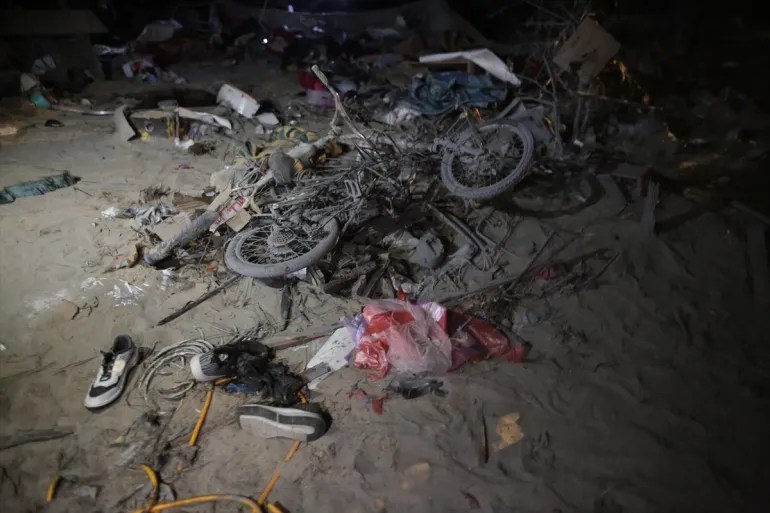
I’m reminded of this today, September 10, 2024, as I watch footage of the huge crater left behind by an American-made 2,000-pound MK-84 bomb. The bombs were dropped in the middle of the night on 20 tents housing displaced civilians in an Israeli-designated “safe area” in al-Mawasi, southern Gaza.
Early in the morning, the Israeli army issued its disinformation boilerplate communiqué, declaring the raid was a “precise strike” on senior resistance members. But videos from the crater, where tents lay buried under the sand, suggest that “Israel” targeted civilians in a supposed safe area.
Reading about the “precise strike” on a BBC site took me back 52 years. Almost three hours after the raid on my camp, I remember my father and our neighbors gathering around the radio to listen to the 7 p.m. BBC Arabic news. I still recall how they stopped breathing, their eyes wide, mouths agape, as the BBC quoted an Israeli army spokesman claiming “Israel” had targeted a military base in Nahr el-Bared refugee camp in northern Lebanon.
While I don’t remember the exact number of the killed and injured that afternoon, I know for certain that 100 percent were civilians—mostly young boys and girls, with at least one elderly man among them. I felt then as helpless as many of those who were sleeping on September 10 in their “safe” tents, unable to tell their story to the world. The photos left behind by the US-manufactured 2,000-pound bombs, however, expose “Israel’s” lies and the complicity of the managed Western media.
It is utterly despicable that the lecterns at the White House and the State Department have become platforms to market such lies, emboldening “Israel’s” intransigence and whitewashing its genocide. Especially egregious is the disinformation spread by White House National Security Communications Adviser John Kirby, who blamed the Palestinians as “the main obstacle” to a ceasefire. This brazen lie comes less than a week after the leak of a document pointing to new conditions that were added in late July by Benjamin Netanyahu to Joe Biden’s proposal from May 27, which torpedoed the ceasefire agreement.
After the Palestinians rejected Netanyahu’s new conditions in late July, “Israel” intensified its systematic campaign of bombing displaced civilians in safe areas, including 16 UN schools converted into mass shelters. Unable to compel a ceasefire on its terms, “Israel” is using these attacks on designated safe areas as part of its bloody negotiation strategy to exert pressure by inflicting maximum suffering on civilians through murder and starvation.
Meanwhile, the Biden administration continues to supply “Israel” with the means to commit these war crimes, while using the White House platform to spread disinformation, making “Israel’s” “lies sound truthful and murder respectable.”
September 12, 2024
Posted by aletho |
Ethnic Cleansing, Racism, Zionism, Fake News, Mainstream Media, Warmongering, War Crimes | Israel, Palestine, United States, Zionism |
Leave a comment
The New York Times (NYT) recently published an article titled “Climate Change Can Cause Bridges to ‘Fall Apart Like Tinkertoys,’ Experts Say,” written by Coral Davenport. Multiple lines of evidence and examples not only refute this claim as false but expose the sheer absurdity of the claim.
These sorts of absurdly false claims have been tried before, for instance, when the I-35W bridge collapsed in Minneapolis, MN in 2007. An article in 2007 by Noel Sheppard at NewsBusters exposed the claim as false:
A former member of the Clinton administration, and current Senior Fellow at the virtual Clinton think tank the Center for American Progress, claimed Monday that global warming might have played a factor in the collapse of the I-35W bridge in Minneapolis last week.
I kid you not.
Writing at Climate Progress, the global warming blog of CAP, Joseph Romm – who served as Acting Assistant Secretary of the U.S. Department of Energy in 1997 and as Principal Deputy Assistant Secretary from 1995 though 1998 – stated in a piece amazingly entitled “Did Climate Change Contribute To The Minneapolis Bridge Collapse?“
Unsurprisingly, the actual cause had nothing to do with climate change at all but rather an engineering failure that used undersized gusset plates that were too thin for the load of the bridge:
The investigation revealed that photos from a June 2003 inspection of the bridge showed gusset-plate bowing. On November 13, 2008, the NTSB released the findings of its investigation. The primary cause of the collapse was the undersized gusset plates, at 0.5 inches (13 mm) thick. Contributing to that design or construction error was the fact that 2 inches (51 mm) of concrete had been added to the road surface over the years, increasing the static load by 20%. Another factor was the extraordinary weight of construction equipment and material resting on the bridge just above its weakest point at the time of the collapse. That load was estimated at 578,000 pounds (262 tonnes), consisting of sand, water, and vehicles.
So, human error and extra weight, not climate change, was determined to be the cause of the bridge’s failure.
Fast forward to the present. The NYT’s article makes similar claims:
Bridges designed and built decades ago with materials not intended to withstand sharp temperature swings are now rapidly swelling and contracting, leaving them weakened.
“It’s getting so hot that the pieces that hold the concrete and steel, those bridges can literally fall apart like Tinkertoys,” Dr. Chinowsky said.
As temperatures reached the hottest in recorded history this year, much of the nation’s infrastructure, from highways to runways, has suffered. But bridges face particular risks.
Really? The bridges in question weren’t engineered to handle daily temperature swings? A natural event that happens daily across seasons? That sounds like poor planning. Besides the absurdity of that claim, there are two further contradictory points to consider.
First, in the United States, we’ve seen far worse sustained heatwaves before, such as in the 1930s when the July 1936 heatwave hit America’s Midwest, where some places experienced up to 14 days of above 100°F temperatures. This is evidenced by the graph in Figure 1, provided by the U.S. Environmental Protection Agency.

Figure 1. This figure shows the annual values of the U.S. Heat Wave Index, from 1895 to 2020 contiguous 48 states. Environmental Protection Agency.
In the many reports of the heatwaves in the 1930’s, there is no mention of bridge collapse, which suggests that the linkage to “extreme heat aided by climate change” claim is false. Otherwise, such temperatures in the 1930s would have resulted in collapsed bridges. However, there simply are none from that period reportedly linked to heat.
Secondly, the article says “As temperatures reached the hottest in recorded history this year, much of the nation’s infrastructure, from highways to runways, has suffered.” But this isn’t true either. The claim NYT uses is about the global temperature, not the U.S. temperature. As seen in Figure 2 below showing data from the National Oceanic and Atmospheric Administration (NOAA), from the U.S. Climate Reference Network (USCRN), widely considered to be the most accurate source of surface temperature data, July 2024 was not “the hottest in recorded history.” For example, maximum U.S. temperature was higher in 2012 and 2005 than in July 2024.
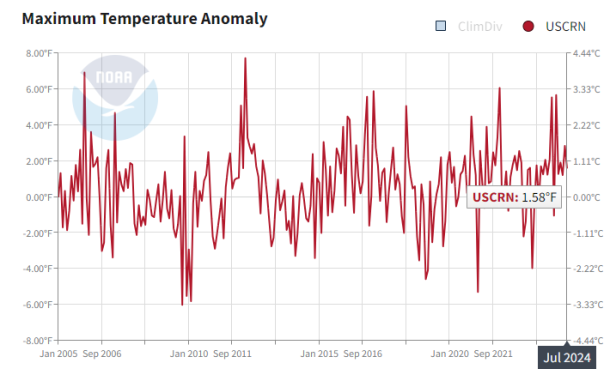
Figure 2: NOAA – USCRN Maximum Temperature
Diving deeper into the NYT article, the Times attributes the failure of a railroad bridge connecting Iowa and South Dakota during floods to climate change. Flooding in the rivers and streams across and bordering Iowa and South Dakota have been common for as long as records of such event have been kept back into the mid-1800s. And railroad bridge collapses have happened repeatedly in the United States and around the world, well before climate change ever became an issue. Since data show no increase in the number or severity of flood events across the United States, in general, or in Iowa and South Dakota, in particular, there is no evidence climate change played any role in that particular railroad bridge collapse.
The next claim is that the concrete buckled and broke on a bridge in Lewiston, Maine which NYT blamed on “recent fluctuation in temperature and rain.”
Looking at the weather in Lewiston, ME when the event occurred shows that although high and low temperatures were higher than the normal average for late June, the fluctuations the NYT was so concerned about were less extreme than normal, about a 15 degree change from high to low in June 2024 rather than the historic daily average of about 20 degrees. (See figure 3, below).
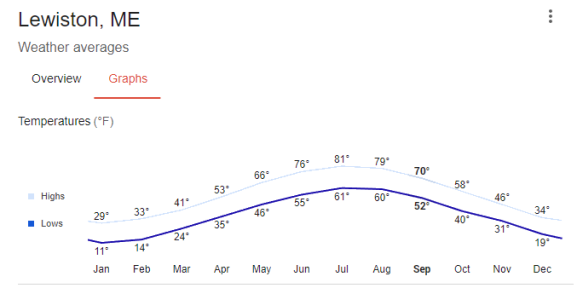
Figure 3: Normal average daily fluctuations in temperatures throughout the year for Lewiston Maine. Source: Google
The high temperature for the third week of June was 95℉, above the normal maximum for the date, but it was well below the historic high temperature for the city of 99℉ recorded in 1911, 113 years of global warming ago. Lewiston’s 2024 June high was also 10 degrees lower than the high temperature record for the state as a whole of 105℉ set in North Bridgton, ME, just thirty miles away from Lewiston, also from 1911, when that temperature was hit twice.
Because temperatures in Lewiston didn’t fluctuate wildly and were also not record setting, it is implausible for the bridge’s concrete cracking and buckling to have anything at all to do with climate change. It was likely a result of poor construction or, even more likely, poor maintenance, a problem for many bridges and overpasses in Maine and the U.S. as a whole, combined with increased traffic and load, due to significant population growth in the city and the region, using the bridge.
Literally, it takes two minutes of work on Google search to find this data. Apparently, NYT reporter Coral Davenport couldn’t be troubled to seek out the facts. Or perhaps, she just doesn’t know how. This sort of slapdash reporting containing speculative claims rather than simple facts seems like something out of the old TV series The Twilight Zone.
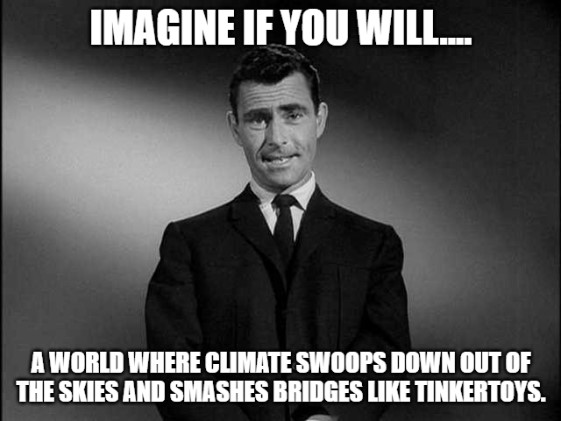
If such an episode aired today, my suggested title would be “Bogus Maximus.” This story was pure science fiction.
September 11, 2024
Posted by aletho |
Fake News, Mainstream Media, Warmongering, Science and Pseudo-Science | New York Times |
Leave a comment
A recent Los Angeles Times column by Times’s columnist Jackie Calmes entitled “Should a Five-Time Loser with Grand Juries Be President?” displays a woeful lack of understanding regarding grand-jury indictments.
Calmes’s article, of course, is about Donald Trump and argues that the five grand-jury indictments against Trump are a good reason for rejecting his candidacy for president. Adding authority to her argument, Calmes quotes former Justice Department official and MSNBC legal analyst Andrew Weissmann: “For those counting, FIVE separate grand juries (scores of citizens) have now found probable cause that Trump committed multiple felonies.”
As a former prosecutor, Weissmann should know that grand juries are usually nothing more than rubber stamps for whatever prosecutors want. As Sol Wachtler, chief justice of New York’s Supreme Court, put it, “Any good prosecutor can get a grand jury to indict a ham sandwich.”
Grand juries are normally composed of good, little, patriotic, deferential citizens who look upon prosecutors and judges, especially at the federal level, as gods. When a federal prosecutor enters the grand-jury room armed with a bit of evidence and an indictment, the grand jurors are going to do what he wants them to do.
Keep in mind, after all, that there is no judge in the grand-jury room. There is also no defense attorney representing the person they want indicted. There is no one to challenge or rule out incompetent evidence. The prosecutor can use hearsay evidence, illegally acquired evidence, or even evidence acquired by torture. The grand jury is not going to challenge him on the evidence he is presenting to them. They are simply going to grant his request for an indictment.
Calmes makes a big deal over the fact that a grand-jury indictment is based on “probable cause.” Big deal. What she apparently doesn’t realize is that “probable cause” can be based on hearsay or other evidence that is not admissible at a trial. That makes the indictment worthless in terms of whether the accused is actually guilty of what the indictment charges him with.
The fact is that a grand-jury indictment is nothing more than an accusation. In a court of law, it doesn’t constitute any evidence whatsoever. In terms of determining whether a person is guilty of a crime, an indictment is worthless.
Whatever reasons people might have for rejecting Trump’s quest to be president again, those grand-jury indictments against him are a ludicrous one. Calmes, Weissmann, and the Los Angeles Times should know better than to make such a ridiculous argument for rejecting Donald Trump’s candidacy.
September 10, 2024
Posted by aletho |
Fake News, Mainstream Media, Warmongering | Los Angeles Times, United States |
Leave a comment
Wherever you look, it feels like we are being bombarded now with an unprecedented level of fake news. One reason may well be how the installed governments by western elites – military industrial complex and banking – are getting very skittish indeed about a shake up of world order in November when the airhead Kamala Harris takes on Donald Trump in the presidential elections. This new trend of installing a useful idiot into power has been around for decades across Africa and Asia where the U.S. and before that the UK installed their own despots to serve their own needs, so we shouldn’t be so shocked by someone like Harris having the landscape prepared for her.
To call Harris a ‘lightweight’ is understating her political verve. She has none of the conventional talents that politicians require like public speaking, or engaging with media, let alone having any ideas of her own which might make it one day to policy. For most Americans the choice in November is between Harris, who is essentially Biden 2.0 or Trump. Not exactly a tough call many might say since RFK endorsed Trump who traditionally he has not been a fan of; it’s as though he’s saying to Americans, “anything but Kamala. Do the maths”.
Media is of course playing a huge and certainly tawdry role in pushing her which is not generally noted by most Americans. For weeks she has ignored or avoided all serendipitous contact with journalists which surely must be orders from the elite who are controlling her. And there is good reason for this as the internet is awash with her talking gibberish. Or dancing.
Talking mumbo jumbo won’t help her at the polls against Trump who revels at the microphone and is not afraid to go head to head with journalists and unscripted interviews, despite him whining about how unfair the set-up is.
What he is alluding to is that left-wing media in America like CNN fake the news and as we saw recently almost certainly gave Kamala a print out of the questions she was going to face with her recent CNN interview where she was joined by her running mate just in case she did something which broadcast journalists call ‘goldfishing’ – an on-screen facial contortion where the lips and cheeks move, but nothing comes out of the mouth. In Kamala’s case, goldfishing might not be as bad as actually speaking, as she has shown us that there is not much between the ears. She is not overburdened with what many academics have of knowing too much and not being able to communicate in short sound bites. Harris doesn’t really know anything at all except a few talking points from Biden’s days. Her own people will be happy with the staged interview as they can at least counter op-ed writers who claim she is so lame that she avoids all press. Thanks CNN. Great jaaaabbbb.
Harris is seen as the most suitable candidate to further the causes of America’s military industrial complex whose six main companies cannot slow production down, unless they make job layoffs. The insatiable hunger of this machine is responsible for the lion’s share of U.S. foreign policy and Biden gave his cronies their one hundred Christmas’s when he created the Ukraine war and more recently Gaza. In Gaza the false reporting from western media is as repulsive as the images of children who have lost their entire brains and whose heads look like theatrical floppy props, which has become the day to day norm now when Israel bombs schools. Does anyone in the west in either camp still believe this is a “war” against Hamas fighters? With the recent invasion of West Bank and the rise of settlers stealing land there, surely the real story of Netanyahu’s campaign is there for all to see in plain light: ethnic cleansing on a grand scale to wipe Palestinians off the face of “Israel”. And still we read western journalists and op-ed writers parroting the line about ‘two state solutions’ and what the EU says, etc etc. By the time the chairs are arranged and the mineral water is put on the tables, there will not be a Palestinian left to even represent his or her own state. Everyone knows the two-state solution is a massive parody of diplo gibberish a bit like Kamala’s few media stints which are still good for a laugh today. And it’s an identical story in Ukraine. No western journalists can report on the true story of Ukrainian losses in Kursk and how the operation has blown up in Zelensky’s face. The omission of reporting key facts and data is just as bad as making up your stories, if not worse.
September 4, 2024
Posted by aletho |
Deception, Fake News, Mainstream Media, Warmongering | United States |
Leave a comment


 Aletho News
