‘WikiLeaks’ Vault 7 cache shows US – not Russia – hacked past French elections’
RT | June 2, 2017
Any establishment-anointed political candidate wants to say they are under attack by the Russians because it gives them credibility, former MI5 intelligence officer Annie Machon told RT. Political analyst Adam Garrie joins the discussion.
Guillaume Poupard, the head of the National Cybersecurity Agency of France (ANSSI), said on Thursday there’s no trace of a Russian hacking group being behind the attack on Emmanuel Macron’s presidential election campaign.
According to him, the hack was “so generic and simple that it could have been practically anyone.”
RT: Where does this statement by France’s cybersecurity chief leave the claims of Macron’s team on Russian hacking?
Annie Machon: It leaves rather a lot of egg on their faces. It appears that this attack was of such of low technical level it could have been done by a script kiddie from their mom’s basement. So rather than this hysteria about: ‘The Russians must have done it, the Russians must have done it,’ which reminds me to a certain extent of the Monty Python script that ‘you must always expect a Spanish Inquisition.’ It is beyond parody. We have a situation now where he was trying to make political hay. It seems to me that any establishment-anointed political candidate now wants to immediately say they are under attack by the Russians because it gives them credibility. It is just crazy.
Now, the one thing we do know from this is that the one country that actually has hacked the French election was the USA, and that was back in the presidential election of 2012 where they were not only intercepting the electronic communications, they were actually running human agents in the political parties. We know this because of disclosures through the Vault 7 cache that WikiLeaks put out a month or two ago. For everyone to go around blaming the Russians, when in fact the Americans have been doing this for years, is rather rich?
RT: Why were members of Macron’s team so sure about Russia’s involvement? Do they know something France’s cybersecurity chief doesn’t?
AM: Obviously not. I think they were just jumping on the bandwagon because it was the sort of cool thing to do. After the fake buildup of the ‘Russians hacked the American elections,’ which started by the way with a leak from the DNC [Democratic National Committee] that was given to WikiLeaks, and somehow it moved into ‘Russians hacked the American election.’
Suddenly it has become established fact in the mainstream media in the West that the Russians are going to hack every Western democratic election. That is patently not the case in France, and it is also patently not the case in Germany, where there has also been a similar panic about Russia trying to hack the forthcoming chancellor’s elections in the autumn this year. In fact, the BND [Federal Intelligence Service] and BfV [Federal Office for the Protection of the Constitution,] the two major intelligence agencies in Germany, put out a report in February saying there was absolutely no evidence whatsoever the Russians were trying to do this. Merkel didn’t like that result. She told her intelligence agencies to go away and to find more evidence and to find a case to say that they were indeed trying to interfere in the German elections. It is collective hysteria.
‘Low-level hack’
Adam Garrie, political analyst
RT: Why were members of the Macron team so sure about Russia’s involvement in hacking the campaign? Do they know something France’s cybersecurity chief doesn’t?
AG: I strongly doubt that. They barely seem to know how to beat Marine Le Pen. But with a little help from their friends in the mainstream media, France and elsewhere they managed to just about accomplish that. It is simply the restating of a tired, old narrative; they have very little else to say. Macron as a man, if you can even really call him that in terms of his personality, is more of a viceroy, more of a governor general than he is a president. Putin, at the press conference he had at Versailles with Macron, questioned whether France is able to even independently conduct its foreign policy in Syria, independent of NATO and the US-led coalition. So these people that really don’t have much to offer their own country, let alone their political masters, are just churning out the narrative again and again. You’ve seen it with Hillary Clinton in America, and her supporters, and you see something similar in France. And likewise, the allegations are based – Donald Trump, probably accurately, said it could have been a 400-pound man in his bedroom somewhere. As the French authorities said today, it was probably the work of a lone hacker, and the hack itself wasn’t at the level of sophistication that would have even required state operators to be behind it.
RT: Do you think all these Russian hacking allegations during the presidential race had much impact on the final choice of the new president?
AG: I agree with President Putin on this. All of these hacks and allegations of hacks have very little impact on the actual electoral results. People are going to look first and foremost in all countries at domestic issues. Unless you’re in the war-zone that’s what the priorities are going to be for voters. They are going to look at tax; they are going to look at healthcare. They are going to look at living standards, wages, employment, etc. – these sorts of things. This idea that somehow magically Russia is pulling the political strings of various candidates in different Western countries is simply absurd. And I personally give the average voter – whether in France or America – more credit than the mainstream media is willing to give him.
Hillary Clinton’s Deceptive Blame-Shifting
By Robert Parry | Consortium News | June 1, 2017
Hillary Clinton has grown even more insistent that she was not at fault for her stunning election defeat last November, claiming that 1,000 Russian “agents” and their American collaborators were a decisive factor, a bizarre twist that further locks the Democrats into their evidence-light “Russia-gate” obsession.
In comments at a California technology conference on Wednesday, Clinton also repeated one of her favorite falsehoods – that all 17 U.S. intelligence agencies unanimously concluded that Russia hacked Democratic emails and ran a covert influence campaign against her.
Referring to a report released by President Obama’s Director of National Intelligence (DNI) on Jan. 6, Clinton asserted that “Seventeen agencies, all in agreement, which I know from my experience as a Senator and Secretary of State, is hard to get. They concluded with high confidence that the Russians ran an extensive information war campaign against my campaign, to influence voters in the election. They did it through paid advertising we think; they did it through false news sites; they did it through these thousand agents; they did it through machine learning, which you know, kept spewing out this stuff over and over again. The algorithms that they developed. So that was the conclusion.”
But Clinton’s statement is false regarding the unanimity of the 17 agencies and misleading regarding her other claims. Both former DNI James Clapper and former CIA Director John Brennan acknowledged in sworn testimony last month that the Jan. 6 report alleging Russian “meddling” did not involve all 17 agencies.
Clapper and Brennan stated that the report was actually the work of hand-picked analysts from only three agencies – the Central Intelligence Agency, National Security Agency and Federal Bureau of Investigation – under the oversight of the DNI’s office. In other words, there was no consensus among the 17 agencies, a process that would have involved some form of a National Intelligence Estimate (or NIE), a community-wide effort that would have included footnotes citing any dissenting views.
Instead, as Clapper testified before a Senate Judiciary subcommittee on May 8, the Russia-hacking claim came from a “special intelligence community assessment” (or ICA) produced by selected analysts from the CIA, NSA and FBI, “a coordinated product from three agencies – CIA, NSA, and the FBI – not all 17 components of the intelligence community,” the former DNI said.
And, as Clapper explained, the “ICA” was something of a rush job beginning on President Obama’s instructions “in early December” and completed by Jan. 6. Clapper continued: “The two dozen or so analysts for this task were hand-picked, seasoned experts from each of the contributing agencies.”
However, as any intelligence veteran will tell you, if you hand-pick the analysts, you are really hand-picking the conclusion since the agency chiefs would know who was, say, a hardliner on Russia and who could be trusted to deliver the desired product.
On May 23, in testimony before the House Intelligence Committee, former CIA Director John Brennan confirmed Clapper’s account about the three agencies involved.
“It wasn’t a full inter-agency community assessment that was coordinated among the 17 agencies, and for good reason because of the nature and the sensitivity of the information trying, once again, to keep that tightly compartmented,” Brennan said.
In other words, Clinton’s beloved claim that all 17 intelligence agencies were in agreement on the Russian “hacking” charge – an assertion that the “fact-checking” group Politifact has certified as “true” and that has been repeated endlessly by the mainstream U.S. news media – is not true. It is false. Gee, you might even call it “fake news.”
The Mysterious ‘Agents’
But Clinton’s false claim about the intelligence consensus was not her only dubious assertion. Her reference to the 1,000 Russian “agents” is not contained in the Jan. 6 report, either. It apparently derived from unconfirmed speculation from Sen. Mark Warner, D-Virginia, who mentioned this claim at a news conference on March 30, admitting that he didn’t know if it was true.
Warner, the ranking Democrat on the Senate Intelligence Committee, said: “We know about the hacking, and selective leaks, but what really concerns me as a former tech guy is at least some reports – and we’ve got to get to the bottom of this – that there were upwards of a thousand internet trolls working out of a facility in Russia, in effect taking over a series of computers which are then called botnets, that can then generate news down to specific areas.
“It’s been reported to me, and we’ve got to find this out, whether they were able to affect specific areas in Wisconsin, Michigan, Pennsylvania, where you would not have been receiving off of whoever your vendor might have been, Trump versus Clinton, during the waning days of the election, but instead, ‘Clinton is sick’, or ‘Clinton is taking money from whoever for some source’ … fake news.”
Of course, many stories about Clinton being sick or her taking money from special interests weren’t “fake news.” In late 2012, she suffered from a blood clot and – during the 2016 campaign – she was staggered by a bout of pneumonia. She also was paid hundreds of thousands of dollars for speeches to Wall Street and other groups.
Warner didn’t specify where his information about the “trolls” came from but it paralleled a claim by freelance journalist Adam Chen who asserted in a podcast with Longform that Russian “trolls” began writing favorably about Trump in late 2015. (The CIA/FBI/NSA report also apparently alluded to the same report without mentioning the name of the journalist or specifying the number of alleged “trolls.”)
“I created this list of Russian trolls when I was researching,” Chen said, referring to a 2015 reporting project that he turned into a rather thinly sourced New York Times Magazine article accusing a Russian oligarch of funding a professional “troll” operation in St. Petersburg, Russia. “I check on it once in a while, still. And a lot of them have turned into conservative accounts, like fake conservatives. I don’t know what’s going on, but they’re all tweeting about Donald Trump and stuff.”
Although such “troll” and “hacking” complaints are treated as a one-way street – coming only from the evil Russians – the reality is that U.S. intelligence agencies, their allies and U.S.-government-funded “non-governmental organizations” have mounted similar operations against Russia and other targets.
It is always difficult to nail down precisely where such operations are originating, but the Russians have cited previous cases of malicious hacking aimed at senior officials, including Prime Minister Dmitri Medvedev, whose accounts were hacked in 2013 and 2014 including publication of a false resignation and a confession of wrongdoing.
In 2015, the “Panama Papers,” a vast trove of documents purloined from a Panamanian law firm, became an investigative project that involved a USAID-funded news outlet and led to attacks on President Vladimir Putin for corruption even though his name did not appear in the documents.
So, this high-tech spy-vs.-spy game – if that’s what it is – does not appear to be originating entirely from the Russian side of the street. But the U.S. intelligence community is not going to divulge what it knows about the attacks against Russia, only what it can “assess” about Russia’s possible attacks against Western targets.
No Self-Criticism
Neither, of course, are Hillary Clinton and the Democratic Party eager to engage in a serious self-criticism about how they managed to blow an extremely winnable race against an extraordinarily flawed candidate in Donald Trump. Rather than look at their own missteps and misjudgments, they are presenting themselves as innocent victims.
In Wednesday’s interview – after misrepresenting what the Jan. 6 report actually said – Clinton suggested that the Trump campaign must have colluded with the Russians in “weaponizing” the data.
“How did they know what messages to deliver?” Clinton asked. “Who told them? Who were they coordinating with, or colluding with? … [The Russians] were conveying this weaponized information and the content of it. … So the Russians — in my opinion and based on the intel and the counterintel people I’ve talked to — could not have known how best to weaponize that information unless they had been guided. … Guided by Americans and guided by people who had polling and data information.”
Although Clinton lacked any proof of this convoluted accusation, she cited as her “best example” the fact that “within one hour, one hour of the ‘Access Hollywood’ tapes being leaked [in which Trump was caught boasting about groping women], within one hour, the Russians — let’s say WikiLeaks, something — dumped the John Podesta emails.”
However, if you changed the context of this claim slightly – and made a similar jump in logic – you would surely be labeled a nutty conspiracy theorist, but instead Clinton has drawn nods of agreement for this wholly unsubstantiated speculation.
Yet, besides blaming the Russians and WikiLeaks for her loss, Clinton spread the blame even wider, for instance, to The New York Times for focusing too much on her decision to use a private email server while Secretary of State – “they covered it like it was Pearl Harbor” – and for the Times’ Nate Silver publishing optimistic odds on her chances for victory. “I also think I was the victim of a very broad assumption I was going to win,” she said.
Clinton also placed blame on the Democratic National Committee for lacking money and sophisticated technology. “I get the nomination. So I’m now the nominee of the Democratic Party. I inherit nothing from the Democratic Party,” she said. “I mean it was bankrupt; it was on the verge of insolvency; its data was mediocre to poor, nonexistent, wrong. I had to inject money into it.”
Yet, when Clinton was asked about some of her own “misjudgments,” she slipped back into the defensive posture that contributed to her troubles as a presidential candidate. For instance, regarding why she gave lucrative speeches to Goldman Sachs between her time leaving the State Department and announcing her White House run, she answered coyly, “They paid me.”
When pressed on the point, Clinton retreated behind the sanctity of the 9/11 terror attack and the issue of women’s rights. Reminded that “you’re not somebody who needed that money for the next week’s shopping, and you knew you might run, so why do it?” – she responded:
“The most common thing that I talked about in all those speeches was the hunt for Bin Laden. You know, that was one of the central missions that I felt from the time the towers fell on 9/11 as a Senator from New York.”
Then, Clinton added, “you know, men got paid for the speeches they made. I got paid for the speeches I made. And it [the paid-speech issue] was used, and I thought it was unfairly used.”
Blocking Witnesses
So, while the Democrats dig themselves deeper into the so-far empty pit of blaming Russia for their electoral disaster, the Russia-gate investigation continues to take on other curious aspects, such as an unwillingness to hear from some of Donald Trump’s advisers who have been named in accusations and who have volunteered to testify publicly.

Former Trump foreign policy adviser Carter Page
On Wednesday, Carter Page, a Navy veteran and businessman who had lived in Russia, announced that his plans to defend himself in testimony next week before the House Intelligence Committee had been placed on hold by the Democrats.
Rep. Adam Schiff of California, the ranking Democrat on the committee and a major spark plug powering the investigation, offered a curious denial of Page’s complaint while confirming the truth of it.
The New York Times, which has been another advocate for blaming Russia, phrased the postponement of Page’s testimony as if Page were the unreasonable one, reporting:
“Representative Adam Schiff … dismissed accusations from Carter Page, another Trump adviser who is under scrutiny, that the committee is preventing him from testifying. Mr. Schiff …. said the investigation would first review relevant documents before interviewing witnesses.”
In other words, Page, who has been portrayed via intelligence leaks to the news media as essentially a traitor, won’t be given the opportunity to defend his reputation until Schiff and the other Democrats decide the time is ripe.
Yet, it’s not as if the House Intelligence Committee has not taken public testimony about Russia-gate. For instance, former CIA Director Brennan was allowed to speak indirectly about Page and other possibly treasonous Americans amid media reports naming Page as one of those suspected Russian “agents.”
Normal investigations grant the people under attack at least the opportunity to defend themselves and their reputations in a timely fashion, rather than make them live under the cloud of suspicion without having a chance to state their case.
If their sworn testimony is later undermined by evidence developed by investigators, the witnesses can be called back and called out on possible perjury. So, it’s not as if Schiff and the other Democrats are surrendering prerogatives by letting Page testify now rather than later. Indeed, Page would be putting himself in legal jeopardy if he is caught lying.
Even the Republican-driven “Benghazi investigation,” which also had the look of an over-the-top “witch hunt,” gave Secretary of State Clinton and other Obama administration officials multiple opportunities to explain their response to the Sept. 11, 2012 attack on the U.S. consulate.
But, so far, a similar courtesy has not been extended to the targets of the Russia-gate investigation.
Investigative reporter Robert Parry broke many of the Iran-Contra stories for The Associated Press and Newsweek in the 1980s.
Manufactured Hysteria Over Russia Requires 24/7 Upkeep
A Black Agenda Radio commentary by executive editor Glen Ford | May 31, 2017
Even at the height of the Cold War and the depths of McCarthyism, the U.S. corporate media was never even remotely as consumed with Russia as they are, today. The obsession with the Kremlin is a manufactured hysteria, a result of the panic that engulfed the U.S. ruling class — and its media — during last year’s election. What scared them witless, was the reaction of so-called “middle Americans” — white conservatives that call themselves Christian and “patriotic” – to Donald Trump’s statements on lessening tensions with Moscow and getting the U.S. out of the regime change business. Trump’s supporters didn’t bat an eye. It soon became clear that Trump’s base was nowhere near as gung-ho for endless war and confrontation as the rulers, and most of the rest of us, had assumed. And, that was very bad news for the War Party, which had gathered together in Hillary Clinton’s big tent. Because, if Donald Trump’s “middle Americans” – or “deplorables,” as Hillary called them — could not be counted on to applaud every war that their rulers chose to launch, then where was the reliable constituency for war? If not Trump’s people — who?
The rulers — from the spy chiefs in Washington to the Lords of Capital on Wall Street — were terror-struck at the sudden realization that the national constituency for war was way short of a majority, and that the middle Americans they depended on to hate whoever they were instructed to hate might have other concerns than Russians and overthrowing Arab governments. The lack of war fever in middle America signaled an existential crisis for the ruling class, whose dreams of world conquest require never-ending war.
The rulers now had to relearn a lesson: that war fever must be fed, throughout the 24-7 news cycle. The demonization must be constant, lies without let-up, so that the sheer weight of the propaganda masquerading as news convinces the public that the targeted nations and leaders are worthy of their hate. This is a retail, volume business, based on accumulation of impressions. After Trump eked out an Electoral College victory, the cascade of lies about Syria and Russia became a Niagara, so loud and incessant that some Democratic operatives lost their minds amid all the crazy noise. Black Los Angeles Congresswoman Maxine Waters, who in the mid-Nineties dared to accuse the CIA of being behind the crack cocaine epidemic, now accepts as the gospel truth every word the so-called “intelligence community” utters sliming Trump and the Russians. The Democrats are now the War Party, based on the polls, harboring about twice as much hatred for Russia as Republicans do. So-called liberal Democrats and phony “progressives” have allowed themselves to be convinced that the jihadist Islamic head cutters that the CIA and the U.S. military trains in Syria are not the same as the jihadist Islamic head cutters that the U.S. claims to have been at war with since at least 9/11.
But, the rulers still have a fundamental problem, because the Democratic base is not reliable as a long term war constituency. That had always been the assumed role of white middle America. But, as it turns out, there is no natural war constituency majority in the U.S. Therefore, the War Party will just have to keep screaming and lying, louder and louder, to keep the fever going.
Alleged Russia-Taliban Arms Link Disputed
By Jonathan Marshall | Consortium News | May 29, 2017
A tiny article from Reuters in late May quoted the director of the U.S. Defense Intelligence Agency as telling a Senate hearing, “I have not seen real physical evidence of weapons or money being transferred.” Marine Lt. Gen. Vincent Stewart was addressing widespread claims by top Pentagon officials of Russian arms flowing to the Taliban in Afghanistan.
By conceding the reports have no real substance, Stewart quietly called the bluff of military hardliners who are invoking the Russian menace to justify prolonging and escalating the longest and second-most-costly war in U.S. history. Stories of Russian military shipments to Afghanistan began last December, with a typical headline from the Washington Post: “Russia begins supplying weapons to Afghanistan, sides with Taliban.”
Down in the body of the story, however, it emerged that Moscow had agreed to ship 10,000 assault rifles not to the Taliban but to the Afghan government’s police force in Kabul. A Russian Foreign Ministry official said, “Russia has been consistently pursuing the policy of providing comprehensive assistance to Afghanistan in the establishment of a peaceful, independent, stable and self-sufficient state, free from terrorism and drugs.” Russia previously supplied helicopters and pilot training to Afghan forces, under a contract with the U.S. Department of Defense, which continued thanks to a special U.S. waiver on economic sanctions.
As to the Taliban, the Russian official said only that his government stood ready, in the interests of Afghanistan’s national reconciliation, to support “the possible weakening of the sanctions regime . . . against the Taliban, if it is not contrary to the national interests of Afghanistan.” He added that Russia shared the Taliban’s interest in defeating ISIS in Afghanistan.
Scapegoating the Russians
Starting in March, coincident with urgent requests by the U.S. commander in Afghanistan for thousands more troops to stem the Taliban’s military advances, senior Pentagon officers began blaming Russia for setbacks on the battlefield.
“I think it is fair to assume they may be providing some sort of support to [the Taliban] in terms of weapons or other things that may be there,” General Joseph Votel, chief of U.S. Central Command, told members of Congress.
Defense Secretary James Mattis chimed in with claims, paraphrased by NPR correspondent Tom Bowman, that “the Russians are providing some support, including maybe weapons to the Taliban.” Noting that the details were “murky,” Bowman added, “the commander in Afghanistan, General John Nicholson, thinks this is a way for the Russians just to undermine the U.S. and NATO.”
Staying on message, a spokesman for the NATO coalition in Afghanistan told the Los Angeles Times days later, “We know that actions by Russia in Afghanistan are meant to undermine the work of the United States and NATO to support the Afghan government.” The reporters then stated as fact, “It . . . represents another effort by [Russian President Vladimir] Putin to exert power globally while weakening the U.S.”
In late April, a “senior U.S. military official,” speaking on background, asserted that the Russians had “increased their supply of equipment and small arms to the Taliban over the past 18 months.” He said “the Russians have been sending weapons, including medium and heavy machine guns, to the Taliban under the guise that the materiel would be used to fight the Islamic State in eastern Afghanistan.”
Secretary Mattis, quoted in the same article, said menacingly, “we’re going to have to confront Russia where what they’re doing is contrary to international law or denying the sovereignty of other countries.”
Russian Denials
Russia, increasingly considered a “hostile power” by many Americans, won few converts by denying what it called “irresponsible accusations” based on “rumors and conjectures.” Its special envoy to Afghanistan branded the allegations of its arms transfers to the Taliban insurgents “absolute lies . . . aimed at justifying the failure of the U.S. military and politicians.”
But Russia’s credibility – even after months of strident and varied accusations from Western officials – could hardly have been lower than the Afghan sources quoted in U.S. news accounts to bolster the Pentagon’s claims. One notable example was the police chief of Uruzgan province, who spoke of Russian agents, “dressed in doctor’s uniforms,” infiltrating his region and “enticing people against the government, providing training and teaching how to assemble land mines.”
The rotten corruption of the Uruzgan provincial police has been attested to by no less than the commander of the Afghan army in that province. Police there abandoned the provincial capital last year, allowing Taliban forces to walk in unopposed — not because of Russian weapons but because senior officials had pocketed police pay for months at a time.
Similar claims against Russia came from the governor of Kunduz province, whose capital was overrun by Taliban forces last fall in what reporters described as a “seemingly easy re-entry” into the city after a similar Taliban incursion in 2015 was repelled by U.S. Special Forces. Other Afghan officials, and independent reporters, ascribed the Taliban’s easy victories to the local population’s grievances against the “mafia-like” elite who run the province.
Experts also blamed aid from Pakistan — not Russia — to the Taliban. Echoing their complaint, former U.S. Ambassador Zalmay Khalilzad said last year, “The issue of the U.S. inability to deal effectively with Pakistan, and the [Taliban] sanctuary problem in Pakistan, has been the mother of all problems for U.S.-Afghan relations and of Afghanistan to some degree since 9/11.”
Another big supplier of the Taliban is Saudi Arabia. An exposé by Carlotta Gall in the New York Times revealed that as a longtime ally of Pakistan, “Saudi Arabia has backed Islamabad’s promotion of the Taliban. Over the years, wealthy Saudi sheikhs and rich philanthropists have also stoked the war by privately financing the insurgents.”
How US Arms Taliban
Perhaps the biggest arms supplier of all to the Taliban is the U.S. taxpayer. The Taliban rake off hundreds of millions of dollars from extortion of U.S.-funded projects in the country. They also fill their armories with U.S.-made weapons. A Taliban commander told Bloomberg News that when he needs more weapons and fuel, he simply buys or steals them from his foe. “It’s simple and cheaper,” he said.
As journalist and book author Douglas Wissing observed recently, “U.S-enabled corruption lost the Afghan War. . . Corruption funds the enemy, with hundreds of millions of dollars skimmed from U.S. logistics and aid money. . . . Empowered and financed by this corruption, Taliban strength has grown at double-digit rates annually since 2005. Insurgents now control about 40 percent of the countryside, and are pressuring government centers across country, including increasingly besieged Kabul.”
In the past, Donald Trump was correct when he tweeted that the war in Afghanistan was a “total disaster” – although as President, he is reportedly considering a Pentagon plan to escalate the U.S. role, again.
Blaming the Russians for the war’s latest reversals may let our Afghan allies and our own military off the hook for losing this long war in slow motion, but it won’t change the outcome.
The West Spreading New Wave of Feel-Good Movies and False Hopes
By Andre Vltchek | New Eastern Outlook | 27.05.2017
Watch blockbuster movies from the “south” and chances are you will start to believe that the world is not really such a desperate place. Perhaps you might even get convinced that under the present imperialist and turbo-capitalist global arrangement things can always get better. If you live in a gutter somewhere in Sub-Continent or Africa, you could simply try hard, you could “believe in yourself and love yourself”, you could “listen to your instincts”, and everything may eventually fall into the right places. You could get acknowledged, rewarded and even catapulted from your misery into some plush pastures that are covering the tall green hills of success.
Think twice! Or… don’t think at all – just bury your head in the sand.
There were always books written and films produced just in order to please the Western funding agencies and propaganda machine. I described the process, colorfully, in my recent political/revolutionary novel “Aurora”.
Just think about Kite Runner written by an Afghan-American writer Khaled Hosseini, or about all those bestsellers by Salman Rushdie or Elif Shafak, books about India or Turkey, but intended almost exclusively for a Western audience, and often despised in their native countries.
The works of Rushdie and Shafak can at least qualify as “literature”. But now both the Western markets and mainstream media are demanding more and more of ‘feel good’ rubbish books and movies from poor countries, more and more of those simple, picturesque and ‘positive’ stories that are actually confusing and give false hopes to the local population of many poor countries.
Do you still remember Slumdog Millionaire? How realistic a scenario was that? First of all, it was not even an Indian film; it was a 2008 British movie, directed by Danny Boyle, who also had directed Trainspotting. It took place in the Juhu slum of Mumbai.
In 2011, I filmed in the same Mumbai slum where the movie was produced. I asked many, how likely was such a ‘success scenario’ in that filthy and hopeless neighborhood? The dwellers of the Juhu slum just dismissed the entire charade with derogatory gestures; why even waste precious words?
Now more films are coming – more and more… and more! Feel good; feel very good about the world! Drop a few tears as you are departing from the cinema. Utter under your breath: “Everything is possible.” Collaborate with the establishment. Forget about the revolution, think ‘positively’ (the way the system wants you to think) and above all, think about yourself!
A film about a real Ugandan chess player Phiona Mutesi, created by the Indian director Mira Nair (Fire, Water among her other work), Queen of Katwe, is a tour-de-force of true individualism. And again, if you think you are actually watching a Ugandan or even Indian film, you are squarely wrong: it is supposed to feel like an African one, but it is a US movie, produced by Walt Disney Pictures. And it is actually intended and even proudly promoted as a “feel good movie”.
The plot is simple and predictable: a little girl grows up in total misery, in one of the toughest slums of Africa – Katwe, at the outskirts of Kampala. Her father has already died of AIDS, her mother is unable to pay the rent, and her older sister is barely surviving as a prostitute. Phiona, just 10-years old, is forced to drop from school.
Her life is approaching total collapse. But then, suddenly, a miracle! Hallelujah!
Phiona enrolls in a state-sponsored chess program. She is talented. She climbs and climbs, soon travelling to Sudan by a plane, and a few months later, even to Russia.
It is supposed to be a ‘true story’. And yes, there was a poor girl, growing up in a Ugandan slum. She was talented although she never reached the zenith, and never won any gold medal. In the film, she wins tournaments, makes loads of cash, and buys a villa (looking like a palace), for her family.
Is this what young poor girls watching the film in the Katwe slum should be aiming at? Would such a dream be realistic, or is this an absolute mirage?
I also filmed in Katwe, for my damning documentary Rwanda Gambit. And when I was a young kid, I could pass for a talented chess player, taking part in several tournaments and competitions. Somehow, the film – Queen of Katwe – did not make any sense. To become chess champion takes much more than some luck and zeal. Like a concert pianist, a chess player has to spend years and years of hard training, literally killing himself or herself, to play at a certain level.
When I was a kid, my father, a scientist, was obsessed with turning me into a champ. Frankly, I was not too interested, although I worked hard, for years. I won a few medals, but never went further. Could Phiona, hungry, almost without a roof over her head, become a grand master, just after a few months of unhurried coaching?
I wish she could. But I doubt it, knowing Uganda, knowing its slums, fully realizing how merciless their reality really is, and of course, knowing chess.
Who benefits from such films? Definitely not the poorest of the poor, and definitely not Indians or Africans!
It appears that the only beneficiaries are those people who are trying to uphold the status quo, in the West and in the colonies. They don’t want people to realize: that there is almost no hope left, and only some radical change, a revolution, can reverse and improve things in their plundered countries.
A revolution is a ‘communal’ event. It is never about one person suddenly advancing, or getting ‘rescued’ or ‘saved’. It is not about one person or one family ‘making it’. It is about an entire nation fighting for its rights, for progress, and it is about social justice for all.
Little ‘success stories’ actually divide communities, offering false hopes.
Phiona’s story coming from pro-Western, turbo-capitalist Uganda, has nothing in common with the great communal projects in Venezuelan slums: like the classical Youth Orchestras, or cable cars, childcare centers, public libraries, community learning centers, and free medical posts.
No matter how ‘lovely’ is Mira Nair’s cinematography, winning the lottery, or getting lucky here and there, is not going to change the entire country. That is exactly why those small individualist acts and triumphs are being celebrated and glorified in the centers of Western imperialism. There, no real change is ever welcomed, whether it takes place at home or in the colonies. On the other hand, all selfish little victories are treated as sacred. One should live for himself or herself, disregarding the context.
How many other deeply ‘positive-thinking’/ unrealistic/ ‘feel-good’/ ‘false-hope’ films have I seen, lately? Many. For instance Lion, a 2016 Australian/UK co-production, about a poor Indian boy who jumps on a train, loses his hometown, and eventually gets adopted by a loving and dedicated Australian family.
It looks like a downpour, an avalanche of similar films and books and news stories. It looks like some kind of new wave of ‘positive thinking’, or ‘there is nothing really too wrong with our world that couldn’t be fixed by some personal luck and individualism’ dogma. Most of the stuff is somehow connected to the epicenter of Western ideological indoctrination – the United Kingdom (a country, which is successfully nullifying all revolutionary zeal of its own citizens, of the immigrants arriving from desperate and colonized countries, and even those people who live in despair in various far away places).
The West is busy manufacturing ‘pseudo reality’. And in this grotesque pseudo-reality, several deprived individuals like starving chess players, street vendors and slum dwellers are suddenly becoming rich, successful and fulfilled. Millions of others, all around them, continue to suffer. But somehow, they don’t seem to matter much.
There is a new celebrity group in making – let’s call them the ‘glamorous poor’. Those ‘exceptional individuals’, the glamorous poor, are easy to digest, and even to celebrate in the West. They are swiftly and cheerfully integrating into the ‘mainstream’ club of the global ‘go getters’ and narcissist rich.
Andre Vltchek is philosopher, novelist, filmmaker and investigative journalist. He’s a creator of Vltchek’s World in Word and Images, a writer of revolutionary novel Aurora and several other books.
Russia fumes as OPCW investigators fail to inspect Khan Sheikhoun or Al-Shayrat air base
By Alexander Mercouris | The Duran | May 26, 2017
Two months after the alleged chemical attack on Khan Sheikhoun in Syria and the US cruise missile strike on Al-Shayrat air base from where the alleged chemical attack was allegedly launched, the OPCW investigators charged with investigating the alleged chemical attack have failed to inspect either location.
This has provoked an angry and exasperated statement from the Russian Foreign Ministry yesterday, highlighting especially the failure of the OPCW inspectors to inspect Al-Shayrat air base, the location from which the chemical attempt was allegedly launched
All the conditions have been created there in terms of security and compliance with obligations under the Convention. The Syrian government demanded an urgent visit, thus reaffirming the preparedness to fulfil its obligations that arise from Clause 12 of the OPCW mission mandate and from the provisions specified in Clause 15 of Part IX of the Chemical Weapons Convention appendix on inspections. These documents state in clear terms that an (OPCW) inspection group has the right of access to any and all areas that might have been affected by the employment of chemical weapons. This means all the conditions have been created there (at Shayrat) in terms of security and compliance with obligations under the Convention. Standing in a sharp contrast to it is the inaction of the (OPCW/UN) Joint Mechanism and the detached position of the OPCW leadership that believes a trip to Shayrat is outside of the sphere of competence of the OPCW Mission.
I discussed the obvious lack of enthusiasm of the OPCW inspectors to inspect either location in an article I wrote for The Duran on 21st April 2017. I pointed out in that article that though there might be safety concerns preventing the OPCW inspectors from inspecting the location of the alleged attack at Khan Sheikhoun – which is under Jihadi control – the same was certainly not true of Al-Shayrat air base, which was from where the chemical attack on Khan Sheikhoun was allegedly launched.
I said that the failure of the OPCW inspectors to inspect either location meant that the investigation of the Khan Sheikhoun attack had effectively collapsed even before it started.
Needless to say it is a basic principle of any criminal investigation – which is what this investigation essentially is – that the investigators inspect the crime scene and any other locations related to it. The fact that the inspectors in this case have not even attempted to discharge this basic task shows that they are not really interested in carrying out an investigation at all.
This is the inevitable consequence of the President of the United States and of Western governments making a pronouncement of the Syrian government’s guilt before any investigation of the Khan Sheikhoun incident had taken place. That inevitably was going to prejudice the conduct of the investigation, with the result that we now see.
What that means is that when the investigation eventually reports its findings they will carry no authority, and will be rejected with good cause by those who dispute its conclusions.
State Department: Bad guy did bad things, we saw it from space
By Ricardo Vaz | Investig’Action | May 22, 2017
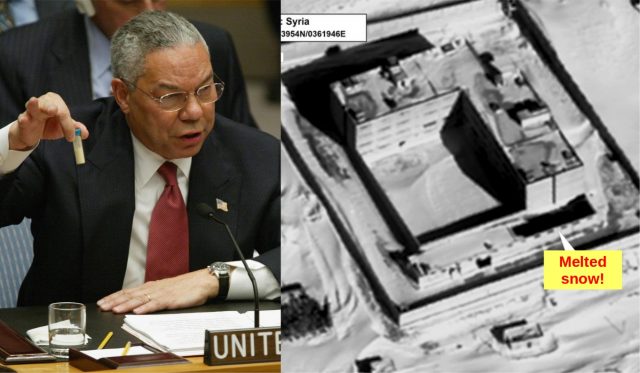
After the previous hit singles, “Russia hack 2016: take our word for it” and “Assad used sarin: bomb first, never ask questions”, US government agencies are at it again with their new chart-topping release “Bad guy did bad things, we saw it from space”. With journalism standards in the mainstream media at an all-time low, this is a sure bet to become a fake news hit!
On May 15th all the mainstream media screamed more or less the same bombshell headline, “State Dept. says Assad is burning people in a crematorium”. The source was a State Department press briefing which was then uncritically plastered everywhere. Assistant Secretary Stuart Jones claimed that the Syrian government had built a crematorium next to Saydnaya prison (more on this later), which was being used to burn 50 bodies of hung prisoners a day.
Then came the “evidence”, in the form of satellite pictures. The earliest indictment that this evidence was on the embarrassing side of the scale came from the fact that many outlets did not even publish the pictures, inviting the readers to follow their lead and take the State Department at their word. Nobody tried as hard as Fox News to assign credibility to the latest revelation, writing:
“The photographs […] do not definitely prove the building is a crematorium, but they show construction consistent with such use.”
This is a very low standard that we could apply to almost anything. So what is the evidence in the photographs provided by the State Department? (I hope the reader is sitting down for this)
- HVACs (Heating, ventilation and air conditioning) – because only a crematorium would have use for this. We would never find it in a kitchen, a laundromat, Breaking Bad’s crystal meth lab, or every building in Manhattan
- a “probable firewall” – one truly wonders how a satellite photo suggests this is a firewall, as opposed to… a regular wall
- melted snow on part of the roof – once again, only having a crematorium underneath it would explain this! There is no chance of this room being heated or more exposed to sunlight.

HVACs and a “probable firewall”
Case closed! It is hard to imagine any serious journalist reporting this as anything other than some ludicrous fabrications, but this is coming from the same people who will listen and report with a straight face that, according to some official, the world looks to the US as a beacon of freedom, or that Saudi Arabia is committed to fighting terrorism in the Middle East.
Fake news built on previous fake news
There is a reason why the imagined crematorium is at Saydnaya and not at the Presidential Palace in Damascus or the Russian embassy (satellite photographs would also be consistent with these scenarios and any others). A few months ago, Amnesty International released an explosive report called “Human slaughterhouse” which alleged that the Syrian army was hanging 50 people a day at Saydnaya prison. This would add up to over 13,000 executions over the course of the war.
What was the problem with this report? It was a collection of fabrications. It is purely based on unverified testimony from anonymous sources. There are no pictures, no records, nothing, despite several “sources” being former judges or prison guards. This is not to say that the Syrian government has not committed human rights abuses, but even someone who was a political prisoner and a victim of torture dismissed the Amnesty report as ridiculous. Even the 13,000 figure is just an extrapolation (there were only 375 allegedly verified deaths).
This is how the Empire and its propaganda machine work. A (fake news) story is presented with dubious or non-existent evidence and uncritically spread by all the main media outlets to support western intervention. And later on when a new and equally questionable story is released, it is deemed more credible because it is built on the previous fake-news background.
So the media assured us that Assad was guilty of the chemical attack in Khan Shaykhun because after all he had already done it in Eastern Ghouta in 2013, despite the fact that the evidence, not to mention motive, both then and now, strongly suggests otherwise. The goal is never to prove anything, merely to whip up a public frenzy that justifies more bombing and allows al-Qaeda to slip out of the list of terrorist organisations.
The same applies to the new Saydnaya story. Assad surely needed a crematorium to get rid of those 13,000 bodies! And if testimony from al-Qaeda’s PR wing, also known as the White Helmets, is all the media needs to decide whether Assad is guilty of this or that, why is a satellite photo of melted snow and a ventilation system not good enough to assert the existence of a crematorium?
The previous Amnesty “report” was accompanied by a video of a 3D model of the prison. This was not based on any actual footage or photos, but fabricated by “forensic architecture”, based on the accounts of supposed witnesses. Just like a video game. Government officials and their close friends at NGOs like Amnesty International would make great horror fiction writers or video game designers. But because the mainstream media has decided to become just a propaganda vehicle, they are actually writing news.
Brazil Mainstream Media Admits Spreading Fake News About Lula
teleSUR | May 23, 2017
The mainstream media channel has long claimed that both former leftist presidents were involved in the massive corruption scandal.
Brazil’s largest television channel, Globo, has admitted that is has divulged false information about former Brazilian presidents Luiz Inacio “Lula” da Silva and Dilma Rousseff.
Globo journalist William Waak acknowledged on television Tuesday that previous reports about Lula and Rousseff, allegedly owning offshore accounts, were inaccurate.
The mainstream media channel has long claimed that both former leftist presidents were involved in the massive corruption scandal involving Joesley Batista, owner of JBS, Brazil’s largest meat packing company.
“We said that Joesley Batista had claimed in the awarding statement that he deposited fines on two current accounts abroad, in the name of the ex-Presidents Lula and Dilma Rousseff,” Waak said.
“In reality, however, Batista said that the account is in his name, but that money was going to be allocated to Lula and Dilma’s campaigns.”
The correction did not repair damage caused to Lula and Rousseff’s image, since many international agencies and foreign newspapers have since echoed Globo’s false claim, failing to correct them.
Last Friday, Batista confessed that de-facto President Michel Temer had requested and received bribes from his company since 2010.
Batista, the protagonist of a wiretapping scandal incriminating the unelected Brazilian leader, exposed the arrangement to the Brazilian attorney general’s office. He claims he paid Temer roughly US$1 million in 2010 alone. Another US$921,000 was requested by the embattled president in 2012 to support Gabriel Chalita’s bid to become mayor of Sao Paulo.
Batista also claimed that during the impeachment process against ousted former President Dilma Rousseff, Temer requested a payment of more than US$85,000 dollars for online political marketing expenditure.
Temer has repeated that he has no intention of resigning. Contrarily, he’s considering a lawsuit against the owner of JBS in order to strengthen his defense.
No proof to back allegations Russia gave weapons to Taliban – US military intel chief
RT | May 23, 2017
The thinly-veiled accusations in the US that Russia supplied arms to Taliban militants were not based on any physical evidence of weapons or money transfers, a senior US military official told lawmakers.
“We have seen indication that they offered some level of support but I have not seen real physical evidence of weapons or money being transferred,” Marine Lieutenant General Vincent Stewart, who serves as director of the US Defense Intelligence Agency (DIA), said at a Senate hearing.
Last month allegations against Russia were voiced by some US officials, including US Army General Curtis Scaparrotti, military commander of alliance forces in Europe, and US Army General John W. Nicholson Jr., who commands US troops in Afghanistan.
The officials claimed that Russia was exerting influence on the Taliban and may be involved in supplying weapons to the militants.
The Russian Foreign Ministry dismissed the allegations as “fabrications designed to justify the failure of the US military and politicians in the Afghan campaign.”
Stewart was reporting to the Senate Arms Services Committee on the Pentagon’s view on global threats to the US and its allies.
Featured Video
US IRAN TALKS: Who Are the Crazy Ones Here? /Lt Col Daniel Davis
or go to
Aletho News Archives – Video-Images
From the Archives
Wartime internment camps in Australia
National Archives of Australia
World War I
During World War I, for security reasons the Australian Government pursued a comprehensive internment policy against enemy aliens living in Australia.
Initially only those born in countries at war with Australia were classed as enemy aliens, but later this was expanded to include people of enemy nations who were naturalised British subjects, Australian-born descendants of migrants born in enemy nations and others who were thought to pose a threat to Australia’s security.
Australia interned almost 7,000 people during World War I, of whom about 4,500 were enemy aliens and British nationals of German ancestry already resident in Australia.
Records of World War I internment camps
World War II
During World War II, Australian authorities established internment camps for three reasons – to prevent residents from assisting Australia’s enemies, to appease public opinion and to house overseas internees sent to Australia for the duration of the war.
Unlike World War I, the initial aim of internment during the later conflict was to identify and intern those who posed a particular threat to the safety or defence of the country. As the war progressed, however, this policy changed and Japanese residents were interned en masse. In the later years of the war, Germans and Italians were also interned on the basis of nationality, particularly those living in the north of Australia. In all, just over 20 per cent of all Italians resident in Australia were interned. … continue
Blog Roll
 Aletho News
- Diplomats slam US negotiators’ performance in Iran talks
- Trump Refuses Exit Ramp, War with Iran will Continue
- Trump Says US Naval Blockade in Strait of Hormuz Will Begin Shortly
- US, Iran end 21-hour talks without agreement
- US IRAN TALKS: Who Are the Crazy Ones Here? /Lt Col Daniel Davis
- Talks with the US end without a deal over excessive US demands: Iran
- Feeling Better, Getting Worse: How Psychiatric Drugs Create the Illusion They Cure
- ‘Nobody Told Me’: Former Mental Health Patient Calls Out Dangerous Side Effects of Psychiatric Drugs
- Dr. Abu-Sitta: Beirut ‘felt like a day in Shifa Hospital’
- Iran Has Won the War, It Will Be Up to the US to Secure the Peace: Mohammad Marandi
- If Americans Knew
- US-Iran ceasefire negotiations make zero progress – Daily Update
- Pro-Israel ‘Thinktanks’ and Individuals who Influence U.S. Foreign Policy
- Mearsheimer reveals how Israel dictates US policies on Iran, Gaza – video
- After killing 350+, Israel still has a “score to settle” with Lebanon before ceasefire – Daily Update
- Military aid to Israel emerges as the latest political litmus test for Democrats
- The only Palestinian children’s rights organization closes following years-long Israeli campaign against it
- ‘I Can’t Forget the Smell’: Lebanese Reel After Israel Kills Over 300 in Single Day
- DNC Shoots Down Resolutions Calling Out AIPAC and Limiting Arms to Israel
- TCN: Is Israel Blackmailing President Trump?
- Israel killed at least 303 Lebanese yesterday – who were they? Daily Update
- No Tricks Zone
- German Expert: Heat Dome Led To Record Temps In Western USA…Warmer In 1934, 1936
- New Study: No Linear Warming Or Glacier Retreat Along Northern Antarctic Peninsula Since 1980s
- An Inconvenient Tree: Uncovered In Alps… Europe Much Warmer Than Today 6000 Years Ago
- New Study Reports A 60% Slowdown In Greenland’s Ice Loss Rate In The Last Decade
- Low Intensity Tornado Wrecks Major Solar Farm, Creating A Potential Toxic Dump
- New Study Finds Warming Saves Lives…Cold Temperatures 12 Times More Deadly Than Excess Heat
- German Science Blog Accuses PIK Climate Institute Of Hallucinating Climate Tipping Points
- Devastating Assessment Of Comirnaty Vaccine By Former Senior Pfizer Europe Toxicologist
- New Study: CO2 Is ‘Effectively Negligible’ As An Explanatory Climate Change Factor Since 2000
- Former Pfizer Toxicologist Dr. Helmut Sterz Tells Bundestag Hearing Pfizer Vaccine Should Have Never Been Approved
 Aletho News