The Ridiculous Psychology of Conspiracy Theory
BY IAIN DAVIS | UK Column | MARCH 21, 2024
If you watched the BBC’s REEL segment, The Psychology Behind Conspiracy Theories, it probably became clear to you that the BBC was not dealing with science but had instead wandered off into the realm of fantasy. Unfortunately, experimental psychology investigating alleged “conspiracy theory” has been disconnected from objectivity for many years.
While psychology itself has a solid empirical foundation, experimental psychology often falls short of basic scientific standards. In 2015, the Open Science Foundation found that, of 100 published experimental psychology papers, results could only be replicated in 39, and just 36 produced findings from which any meaning could be drawn.
Such a high degree of subjectivity frequently leads to woolly conclusions, promoted as scientific fact in the BBC’s REEL segment. Shortly after the introduction, we are given the expert psychologist opinion that so-called “conspiracy theorists” are likely both to be extreme narcissists and to hold “beliefs” driven by a sense of powerlessness.
Narcissists can be broadly characterised as people with a perceived, and potentially misplaced, sense of higher social status. They often have expectations that they should be treated more favourably as a result.
While narcissists possess delicate egos, they certainly don’t suffer from a sense of powerlessness. Quite the opposite: narcissists frequently have a grandiose sense of self-importance, and the expectations to go with it.
This prima facie mutual exclusion in the double definition of “conspiracy theorists” near the beginning of the BBC’s short report on the psychology of those it chose to call conspiracy theorists gave us an early clue as to the epistemological failure at the heart of nearly all academic research on the subject. In point of fact, when we look more closely at the research claiming to reveal the “psychological traits” of the alleged conspiracy theorists, we frequently encounter the worst kind of pseudo-scientific drivel.
A Loaded Question
The BBC began its “investigation” by asking:
Are some people more vulnerable to conspiracy theories, or are we all at risk?
We were immediately told that “conspiracy theories” present some sort of psychological threat to our mental health. Apparently, they harm or damage us in some way, hence the BBC’s declaration that we might be “vulnerable” to their discourse.
Which prompts the question: what is it about supposed conspiratorial thinking that causes us harm?
The BBC didn’t say, but it did air the views of a number of experts who claimed to know.
Jonas Kaplan is the assistant research professor of psychology at, and co-director of, the University of Southern California’s Dornsife Neuroimaging Center. He studies the link between neurological activity and thoughts and emotion.
As an example of his work, in 2016 he co-authored a paper which monitored neural activity in a region of the brain called the default mode network (DMN). He and his fellow researchers presented a cohort of forty people, each of whom had expressed strongly “liberal” political opinions, with so-called “counter-evidence” that was intended to contradict their beliefs.
The team monitored the effect of this supposed cognitive challenge upon the subjects’ neural response. Specific neural activity was observed, indicating that the DMN region of the brain—associated with identity—was stimulated when personal beliefs were allegedly challenged. This was interesting but, from this point forward, the research started to go wildly astray.
From their observations, Kaplan and his colleagues concluded that resistance to changing beliefs, in the face of this suggested “contradictory evidence”, was stronger for political beliefs than it was for non-political convictions. They consequently inferred that political opinions were more strongly associated with our sense of self than other kinds of beliefs we hold.
Unfortunately, the researchers ignored the gaping hole in their own methodology. They mentioned it, but didn’t seem to fully grasp the full implications of what they had done.
Rather than actually “challenge” their subjects’ beliefs with genuine contradictory evidence, they decided to make most of it up. They said:
In order to be as compelling as possible, the challenges often contained exaggerations or distortions of the truth.
For example, they told the subjects that Russia had a larger nuclear arsenal than the US. This wasn’t a “distortion” of the truth; it was a false statement.
More importantly, the neuroscientists failed to ascertain whether the subjects knew it was a lie. In the case that the subject knew the information was false—and we don’t know how many did—their views had not actually been “challenged.” This massive oversight utterly undermined the paper’s primary conclusions.
The researchers stated:
Our political participants may have been more likely to identify these distortions for the political issues, especially if they were more familiar with these issues. [. . . ] We did find that participants who rated the challenges as more credible were more likely to change their minds, and it is well known that source credibility influences persuasion.
Following their extensive experimental research, Kaplan et al. “discovered” that people were more likely to believe information if it was credible. Conversely, they were less likely to believe information if it was evidently wrong—because the researchers had made it up.
Beyond stating the obvious, Kaplan et al. then delivered subjective conclusions that were not substantiated by their own experimental data:
Our data [. . .] support the role of emotion in belief persistence. [. . .] The brain’s systems for emotion, which are purposed toward maintaining homeostatic integrity of the organism, appear also to be engaged when protecting the aspects of our mental lives with which we strongly identify, including our closely held beliefs.
The problem is that the researchers didn’t know what those emotions were. People might simply have been angry because they were lied to.
Kaplan and his colleagues did not establish that the perceived resistance to changing a belief was the result of any defensive psychological mechanism, as claimed. There was nothing in their research that distinguished between that possibility and the equally plausible explanation that the subjects rejected the “challenging information” because they knew it was wrong.
The researchers’ ostensible finding—that the subjects’ resistance to change in the face of counter-evidence was linked to identity, and therefore demonstrated an emotional attachment that could potentially overcome rational thought—was an assumption unsupported by their own experimental data. Kaplan et al. noted where neurological activity occurred, but they did not demonstrate what the associated cognitive processes were.
Building Narratives Based Upon Flawed Assumptions
The press release that accompanied publication of the Kaplan et al. paper made no such clarification. It claimed, without cause, that Kaplan’s research had effectively proven an alleged sociological and psychological truth:
A USC-led study confirms what seems increasingly true in American politics: People are hardheaded about their political beliefs, even when provided with contradictory evidence. [. . .] The findings from the functional MRI study seem especially relevant to how people responded to political news stories, fake or credible.
The above statement represented a huge leap of logic that the paper itself didn’t justify. There was little evidence that the study subjects had been “provided with contradictory evidence” (emphasis added).
Rather, they were given so-called “distortions” and highly questionable opinions. Their reasons for rejecting these had not even been ascertained.
In the same press release, Kaplan declared:
Political beliefs are like religious beliefs in the respect that both are part of who you are and important for the social circle to which you belong. [. . .] To consider an alternative view, you would have to consider an alternative version of yourself.
This is similar to the statement he later made in the BBC REEL piece on the psychology of conspiracy theory:
One of the things we see with conspiracy theories is that they are very difficult to challenge. [. . .] One of the advantages of having a belief system that’s resistant to evidence is that the belief system is going to be very stable across time. If you have to constantly update your beliefs with new evidence, there’s a lot of uncertainty. [. . .] Conspiracy theories are a way of making sense of an uncertain world.
Where did Kaplan get his opinion from? It wasn’t evident from his work. Nor did it bring us any closer to understanding the allegedly harmful nature of the suggested conspiratorial thinking.
What Is Conspiratorial Thinking?
While a definition of “conspiracy theory” isn’t mentioned directly in the BBC REEL segment, we do at least obtain a cited reference to one in the paper of another contributor, Anni Sternisko. Sternisko is a PhD candidate at New York University who researches conspiracy groups. In her co-authored paper, she cites Understanding Conspiracy Theories (Douglas et al., 2019), which does offer some definitions:
Conspiracy theories are attempts to explain the ultimate causes of significant social and political events and circumstances with claims of secret plots by two or more powerful actors.
This ludicrous premise supposedly informs the universally-accepted working definition of “conspiracy theory”. It pervades nearly all academic research on the subject, including the alleged psychological studies of those labelled as “conspiracy theorists”; and, as we are seeing with the BBC, it is being accepted unquestioningly in the mainstream media, too.
Back in the real world, no-one tries to explain “significant social and political events” with “claims of secret plots”. It is, on its face, a ridiculous notion. It might happen with regularity in BBC sitcoms, but does it happen in your social circle?
How can anyone, other than the conspirators themselves, know what a “secret plot” entails? The clue is in the wording; it’s a secret.
Generally, the people who are labelled “conspiracy theorists” by academics, politicians, the mainstream media and other interested parties are eager to highlight the evidence that exposes real plots that actually happened or are currently underway. Examples which made it to full-scale parliamentary inquiries in various Western countries include Operation Gladio, Watergate, the Iran Contra affair and so on. These aren’t “secrets”. If they were, no-one would know about them.
The so-called conspiracy theorists of the real world also point to evidence which appears to expose real plots that are yet to be officially acknowledged. For example, the study by the Department of Civil Engineering and the University of Alaska Fairbanks seems to show that the official account of 9/11 cannot possibly be true.
Taking this example, the only way to determine whether the stories we have been told about 9/11 are true or not is to examine the evidence. Again, this evidence is not and indeed cannot be a “secret”. It can be obfuscated, hidden or denied—but it cannot be known of at all if it remains ”secret”.
There are many reasons why we might hypothesise that 9/11 was, in fact, some form of false-flag attack. None of the evidence suggesting this possibility is “secret”, either. It is all in the public domain.
The logical exploration of evidence is the best way yet devised to find the truth, and has been acknowledged as such since at least Socrates’ day. Inductive, deductive and abductive reasoning all rely upon this basic approach. The key factor here is the evidence, without which the facts cannot be known.
While we can, and should, question all theories, the only way to discover the truth is first to identify and then rigorously to examine the evidence, ideally ascertaining some facts along the way.
We are at liberty to argue incessantly about various explanations of events, but there is one absolute certainty: we will never know what the truth is if we don’t explore the evidence, that very activity which is now being presented to us as suspect.
Descent Into Bathos
The Douglas et al. paper continues:
Conspiracies such as the Watergate scandal do happen, but because of the difficulties inherent in executing plans and keeping people quiet, they tend to fail. [. . .] When conspiracies fail—or are otherwise exposed—the appropriate experts deem them as having actually occurred.
As incredible as this may be, as far as these academics and researchers are concerned, unless the conspiracy is officially acknowledged by the “appropriate experts”, it remains a “secret” and therefore cannot be known. We are being sold the line that conspiracies only come into existence once they have been officially admitted.
This is, then, the completely illogical basis for academia’s alleged research of conspiracy theory. Conspiracies are only identifiable when they fail or are otherwise “officially” exposed. For these various “experts”, the consideration—by their own acknowledgement—that conspiracies are often real, and not “secrets”, renders their offered definition of “conspiracy theory” self-contradictory rubbish.
If you come to the matter with the worldview that “conspiracy theorising” is an attempt to explain events in terms of “secret plots”, then it is reasonable to deduce that said “conspiracy theory” is rather silly. If, however, you concede that these allegedly “secret plots” are not secrets at all and can be discovered by examining the evidence that exposes them, then your original premise, upon which your definition of “conspiracy theory” is based, is complete junk.
It is difficult to express the monumental scale of the idiocy entailed in the experimental psychologists’ definition of “conspiracy theory.” It is exactly the same as asserting that any evidence offered to indicate that a crime has been committed is completely irrelevant unless the police have already caught the perpetrators and their guilt proven in court.
Sure, your front door has been kicked in, your property ransacked and your possessions stolen, but—according to the psychologists of conspiracy theory—this is not evidence of a crime. The facts have yet to be established by the “appropriate experts”, and consequently the alleged crime remains a “secret” and is unknowable.
This absurd contention, based upon the logical fallacy of appeal to authority (argumentum ad verecundiam), is the foundation for all of the pseudo-scientific gibberish about conspiracy theory and theorists that follows. Douglas et al. also reveal some of the other terms often used in this so-called psychological research.
“Conspiracy belief”, “conspiracy thinking”, “conspiracy mindset”, “conspiracy predispositions”, “conspiracist ideation”, “conspiracy ideology”, “conspiracy mentality” and “conspiracy worldview”—most of these apparently serving no distinct purpose other than an attempt at elegant variation—are all terms based upon the psychologists’ own delusional beliefs. For some reason, all those researching the psychology of those they have labelled conspiracy theorist imagine, without reason, that the so-named “conspiracists” don’t have any evidence to back up their arguments.
In a moment of self-conscious admission, the Douglas et al. paper adds:
It is important for scholars to define what they mean by “conspiracy theorist” and “conspiracy theory” because—by signalling irrationality—these terms can neutralize valid concerns and delegitimize people. These terms can thus be weaponized. [. . .] Politicians sometimes use these terms to deflect criticism because it turns the conversation back onto the accuser rather than the accused.
As noted above, the scholars’ definition of “conspiracy theory” is etymologically redundant. The associated—and empty—pejorative of “conspiracy theorist” has consequently seeped into the lexicon, and it is based upon nothing but assumption and imagination.
The term “conspiracy theorist” has indeed been weaponised. It was designed to ensure that people don’t look at the evidence, wherever it is applied.
Politicians, the mainstream media, the scientific and medical authorities, and many other representatives of the establishment, right down to neighbourhood level, frequently use it to “deflect criticism” (in Douglas’ apt phrase) and to level unwarranted accusations at their critics. As outlined in Document 1035 – 960, this is precisely how the CIA envisaged that the “conspiracy theorist” label would function.
Regrettably, for most people, it is enough for someone just to be called a “conspiracy theorist” for anything subsequently proceeding from their mouth to be ignored. It doesn’t matter how much evidence they provide to support their views. The labelling system has done its job.
We might expect scientists, academics and psychologists to maintain higher standards. Unfortunately, BBC REEL’s The Psychology Behind Conspiracy Theories demonstrates that this is often not the case.
Who Is It That Is “At Risk” From Conspiracy Theories?
This reliance upon an illogical presupposition leads to profound confusion. During The Psychology Behind Conspiracy Theories, Anni Sternisko commented:
Conspiracy theories are not necessarily irrational or wrong. And I think what we are talking about in society at the moment—what is frightening us—are better explained, or better labelled, as conspiracy narratives; that is, ideas that are irrational to believe, or at least unlikely to be true—that are not necessarily theories, such that they are not falsifiable.
Sternisko appears to have been talking to her BBC interviewer about two completely different things: evidence-based arguments on one hand and irrational beliefs on the other.
Sternisko’s problem is that both the rational and the irrational are indiscriminately referred to as “conspiracy theories” in today’s academe and media. Thus, in searching for a unifying psychology to account for two diametrically opposed thought processes, the doctoral researcher cannot avail herself of suitable terminology that has gained acceptance in her professional environment and is forced by her own intellectual honesty to start coining spontaneous distinctions between alleged conspiracy “theories” and “narratives”.
This may be welcome insight, but it has become necessary only because the psychologists in her field are floundering around with a working definition of “conspiracy theory” that is ridiculous. Again, we can look to the paper by Douglas et al. to appreciate just how incoherent it is:
While a conspiracy refers to a true causal chain of events, a conspiracy theory refers to an allegation of conspiracy that may or may not be true. [. . .] To measure belief in conspiracy theories, scholars and polling houses often ask respondents—through surveys—if they believe in particular conspiracy theories such as 9/11, the assassination of JFK, or the death of Princess Diana.
This reconfirms that the only benchmark that the academics concerned have for “measuring” what they call “conspiracy theory” is the extent to which the subject agrees or disagrees with the official account of any given event. As long as their subjects unquestionably accept the official “narrative”, they aren’t considered to be “conspiracy theorists.” If they do question it, they are.
Consequently, all of the related experimental psychology is completely meaningless, because the researchers never investigate whether what they call conspiracy theory “may or may not be true”. There is no basis for their claim that “conspiracist ideation” is irrational, or even that it exists.
Without establishing the credibility of the propounded theory, the psychologists, sociologists and other researchers and scientists involved have based their entire field of research upon their own opinions. This cannot be considered science.
In this light, Anni Sternisko’s statement at last reveals something about what the BBC called the “risk” of conspiracy theory. It seems that these alternative explanations of events are not dangerous to the conspiracy theorists themselves, but rather to people like Sternisko, who find them “frightening”.
Questioning power is a fundamental democratic ideal, yet this PhD candidate would appear to be one of millions in Western societies who have come to feel that doing so is scary. Fear, and the resultant stress and anxiety it produces, can be very damaging to our mental health. So the BBC is right, in a sense, to highlight potential risks in this domain.
It is just that the BBC, and the groundless psychological theories it promotes, are wrong about who is at risk. It isn’t the purported “conspiracy theorists”, but rather the people who unquestioningly accept official accounts who are “vulnerable”.
What the BBC presented with its REEL segment was not an exploration of the psychology behind conspiracy theory. It was instead an exposé of the deep-rooted terror of those who apparently dare not look at the evidence cited by the people they label “conspiracy theorists”.
If their government is lying to them, then, for some reason, it seems they do not want to know. The mere thought of it petrifies them.
The researchers—who insist that it is the “conspiracy theorists” who are deluded—have constructed a mythology masquerading as scientific knowledge. Their resultant research, founded upon this myth, isn’t remotely scientific. Inevitably, the psychologists who expounded upon their own apparent delusions for the BBC soon descended into farce.
It’s Science, Don’t Laugh
Professor Sarah Gorman authoritatively informed the BBC audience that “conspiracy theorists” are so irrational they can believe two contradictory statements at the same time. We have already discussed why so much of this psychological research is flawed, but Gorman was most likely referring to a paper that isn’t just based upon assumptions; it is appallingly bad science for numerous other reasons besides.
Gorman told the BBC audience:
People are very often able to hold in their heads two conspiracy theories that are directly in conflict. So, for example, people will simultaneously believe that Princess Diana’s death was staged, and that she’s still alive and also that she was murdered. And, on the face of it this doesn’t make much sense, but the underlying principle here is that they believe that something is just not right about the official story, and it almost doesn’t matter exactly what the alternative is; just that there has to be an alternative that’s being suppressed.
Professor Gorman was almost certainly referring here to one of the formative papers in the field of experimental conspiracy theory research, Dead and Alive: Beliefs in Contradictory Conspiracy Theories (Wood, Douglas & Sutton, 2012).
Presumably, she has read it, so why she would make this statement is difficult to say. The paper is a joke.
Wood et al. conducted experiments in an effort to identify what they had already judged to be the psychological weakness of “conspiracy theorists”. They set the subjects a series of questions and rated their responses using a Likert-type scale (1 – strongly disagree, 4 – neutral response, 7 – strongly agree).
The psychologists conducting this research presented deliberately contradictory statements. For example, one arm of the study asked the subjects to indicate their level of agreement with the idea that Princess Diana was murdered and also with the suggestion that she faked her own death. Similarly, another arm asked the subjects the extent of their agreement with the notion that Osama bin Laden was killed by US Navy SEALs but also that he was still alive in captivity.
They collected the responses, analysed the results and, from this, deduced:
While it has been known for some time that belief in one conspiracy theory appears to be associated with belief in others, only now do we know that this can even apply to conspiracy theories that are mutually contradictory. This finding supports our contention that the monological nature of conspiracism is driven not by conspiracy theories directly supporting one another but by the coherence of each theory with higher-order beliefs that support the idea of conspiracy in general.
It seems that Professor Gorman, at least, is convinced by this pabulum and was willing to present it to the BBC as scientific fact. Alas—rather as with Kaplan’s paper—these scientists’ conclusions, seemingly referenced by Gorman, were not supported by their own experimental results.
Had the participants been asked to consider exclusivity, and subsequently indicated that they agreed with two or more contradictory theories, then the Wood et al. conclusion would have been substantiated. But they weren’t, so it wasn’t.
All that the participants were asked to do was to indicate their relative level of agreement. This Hobson’s choice of a study design means it is entirely possible, and logical, for a research participant of sound mind to agree strongly with one statement while agreeing somewhat with another, even if the two are “mutually contradictory”.
To illustrate this: the official account of Osama bin Laden’s death claims that he was assassinated by the US military. There is no video, forensic or photographic evidence, no witness testimony—all the members of the SEAL Team Six deployed to Pakistan for that operation have since managed to die—nor indeed anything, beyond the proclamation of politicians, to lend this tale any credibility at all. There isn’t even any evidence of a body, as bin Laden was allegedly buried at sea.

This is what happened… honest!
Consequently, if you doubt the official account (and what sane person wouldn’t), a whole range of possibilities exists. It all depends upon your evaluation of the available evidence—which by definition cannot come from the academically-vaunted official sources, because they haven’t presented any.
In such circumstances, it is perfectly legitimate to agree strongly that bin Laden died in 2011 and simultaneously to agree somewhat with the proposition that he was extraordinarily renditioned to a black-ops site somewhere. Nothing can be ruled out. There is insufficient evidence to draw any firm conclusion.
Wood et al. did not ask the study participants to exclude contradictory accounts; only to rate such accounts on a scale of plausibility. The paper’s conclusion, that the results of their experimental psychology proved “the monological nature of conspiracism” was driven by some assumed “higher-order” belief system, was pseudo-scientific claptrap.
The BBC duly conveyed Professor Gorman’s “expert” opinion that all of this somehow made sense. This is standard fare at White City. Anyone who questions the state or its narratives is a “conspiracy theorist”, as far as the BBC is concerned.
So, before we suffer any more of this nonsense, let’s politely ask these experimental psychologists to examine the evidence behind so-called conspiracy theories before they rush into making assumptions about the supposed psychology behind them. Hopefully, they won’t find the experience too frightening.
This Is Not ISIS – Rossiya Segodnya Editor-in-Chief on Moscow Concert Hall Attack
Sputnik – 23.03.2024
Ukraine and the West have resorted to false flag operations to persuade everyone that ISIS was behind the terror attack in the Crocus City Hall concert venue near Moscow, said Margarita Simonyan, the editor-in-chief of Sputnik’s parent media group Rossiya Segodnya.
The head of the media group stressed that the names and faces of the perpetrators are already known to authorities and that the terrorists gave everything away during interrogation.
“It immediately became obvious why US media were claiming in unison that it was ISIS,” she said.
Simonyan explained that the perpetrators were chosen to carry out the attack in a manner that would allow the West to persuade the international community that ISIS was behind the attack.
“Basic sleight of hand. The level of a railway thimble-rigger,” she added.” It has nothing to do with ISIS. It’s Ukrainians.”
She added that the enthusiasm displayed by Western media when they tried to persuade everyone that ISIS was responsible even before arrests were made gave them away completely.
“This is not ISIS. This is a well-coordinated team of several other, also widely known, abbreviations,” Simonyan concluded.
The shooting occurred on Friday evening in the Crocus City Hall concert venue just outside Moscow and was followed by a massive fire, claiming at least 143 lives.
In the hours following the attack, Western media insisted that radical jihadist organization ISIS was behind it, while Ukrainian officials also said that they had nothing to do with the tragedy.
However, suspects were detained in Russia’s Bryansk region near Ukrainian border. According to the data provided by law enforcing agencies, they had a support base on the other side of the border.
Moreover, while Kiev rushed to deny its involvement into the shooting, Ukrainian secret services have a long track record of terror attacks on Russian territory, from shelling in the Belgorod region to assassinations of political scientist Daria Dugina and journalist Vladlen Tatarsky.
Israel deploys army of bots to spread anti-UNRWA propaganda: Report
The Cradle | March 19, 2024
Israel is executing an online influence campaign using hundreds of fake social media accounts to advance “Israeli interests” among progressive western audiences, including US lawmakers, Haaretz reported on 19 March, citing an investigation by Israeli media watchdog group Fake Reporter.
The campaign is focused specifically on amplifying reports claiming the involvement of UNRWA workers in the 7 October attack on Israel. As The Cradle has reported previously, Israel provided no evidence for its claims, which were part of a campaign to compel western nations to cut funding to the agency. UNRWA plays a crucial role in delivering aid to Palestinians amid Israel’s campaign to impose famine in Gaza.
Researchers at Fake Reporter pinpointed three fake ‘news sites’ specifically created for the operation. The sites amplified reports copied from other real news outlets, such as CNN, The Wall Street Journal, The Guardian, The Jerusalem Post, and The Times of Israel, which promoted Israel’s narrative about the war.
Hundreds of fake social media accounts then intensively promoted the “reports” from the specially-created websites and other news outlets.
The three websites at the center of the campaign were established before the war in Gaza but became active only after it began.
The fake social media accounts seemed to be ‘cyborgs,’ meaning they operate using a combination of artificial intelligence and real people with fake online personalities. The avatars claimed to portray average US citizens, including white, Jewish, and African–American ones.
The avatars were all created on the same date, used the same profile photos and naming conventions, and shared other characteristics that indicate they are all part of the same network, Fake Reporter found.
Over 500 fake accounts were opened for the campaign on Facebook, Instagram, and X.
Their avatars began to post messages about a wide array of topics, including the alleged lack of safety for Jewish Americans on college campuses, discrimination against Jewish students, and false allegations Hamas committed mass rape on 7 October.
At the end of January, after acquiring tens of thousands of followers, the fake accounts pivoted toward spreading Israel’s false allegations about UNRWA employees participating in the 7 October attack.
The avatars worked to inorganically amplify the ‘shocking’ and ‘disturbing’ allegations about UNRWA.
They responded to social media posts by US lawmakers, influencers, and prominent news outlets.
The campaign’s avatars targeted posts by African–American Democratic lawmakers, including Ritchie Torres, Cori Bush, and Jamal Bowman, who received the most such comments.
Haaretz noted that targeting Democratic African–American lawmakers seemed to be an attempt to counter the wave of support they have given to Palestinians amid Israel’s ongoing campaign of Genocide in Gaza.
Culture Warriors Spread Disinfo on ‘Haitian Cannibals’
By Patrick Macfarlane | The Libertarian Institute | March 14, 2024
In the first few years of the 2020s, the world witnessed a revolution in the dissemination of atrocity propaganda. Thanks to the proliferation of social media, smartphone ownership, and artificial intelligence, atrocity claims can now be manufactured, disseminated, and, thankfully, debunked in real time.
Although technology may be evolving, lies do not change much.
During World War I, the British claimed Germans boiled the corpses of their war dead to make fat and glycerin for munitions. More recently, we’ve seen accusations of industrial organ harvesting in Xinjiang, China and claims that Hamas “beheaded babies” in Israel. A key element of these atrocity stories, and many like them, is their over-the-top cartoonization of violence.
Amidst violent political upheaval in Haiti, a narrative has emerged that Haitian society is devolving into widespread cannibalism. A video even emerged purporting to show popular opposition figure, Jimmy “Barbeque” Cherizier, cutting the flesh off a burning corpse and eating it.
This propagandistic narrative comes at a crucial juncture where Western powers have for three years failed to drum up yet another foreign military intervention in this ill-fated nation.
After the assassination of Haitian President Jovenel Moise in 2021, Haiti was ruled by U.S.-installed President Ariel Henry. Many Haitians viewed Henry as an American puppet leader. Because Henry was unable to stabilize the country, the United States pushed the United Nations to deploy a peace keeping force to his nation.
Two weeks ago, Henry left Haiti for Kenya, attempting to secure Joe Biden’s long-desired UN security deployment. In his absence, Haiti’s organized opposition united under the leadership of Jimmy “Barbeque” Cherizier. The united opposition launched an armed revolution that dragged Haiti further into discord, albeit with the goal of creating a truly independent and prosperous country. Unable to safely return to Port-au-Prince, Henry resigned on Tuesday.
Last Saturday, reports began to circulate that Haiti was under siege by cannibal gangs. However, the claims were not reported by mainstream outlets. Instead, they were made on X (formerly Twitter) by popular culture war influencers. These influencers used these reports to sow fear that the unrest will spread to the United States through immigration. With 10.4 million views as of this writing, Malaysian national Ian Miles Cheong circulated the first and most viewed Haiti cannibalism report. The report was furthered, among others, by Dom Lucre, Jake Shields, Tim Pool, and Libs of Tiktok.
Given his position as the wealthiest man in the world and the owner of X, Elon Musk has an effect, intended or not, of legitimizing the information he interacts with on the platform. As is the case with Cheong’s cannibalism report, the information might not be reliable. Nevertheless, Musk drove a number of his 176.3 million followers to Cheong’s post by replying to it.
So, just what was the problem with Cheong’s report? He doesn’t have a source.
On Tuesday, Cheong posted a screenshot of an email he ostensibly received from NBC Reporter David Ingram asking where he got his information.
In the email, Ingram asks Cheong if his cannibalism claim originates from the “unnamed source” referred to by a Daily Express U.S. article. Cheong ridiculed the question, saying, “I just received a request for comment from NBC News asking me to prove cannibalism exists in Haiti. I wish I was making this up.”
Despite Cheong’s mockery, Ingram’s question was legitimate. Cheong made a specific claim in his post. He did not claim “cannibalism exists in Haiti.” He claimed “cannibal gangs are besieging the national palace in Port-au-Prince.”
While Ingram did not link to the article in his email, he was likely referring to this March 5 piece, which states:
… a journalist on the ground told Daily Express US that cannibalism has been witnessed on the streets as the violence reaches “unprecedented” levels… Speaking anonymously, they said: “Haiti is living in a total chaotic situation right now. It is total chaos everywhere, especially in the capital where I am right now”… Following the interview, the journalist said via message: “Cannibalism is not widespread, but definitely an indication of the worsening situation. It definitely happens on a few occasions.”
If Cheong did indeed source his report from the Daily Express U.S. piece, the original claim is dubious. The source is hearsay; the anonymous reporter was told by alleged witnesses that they observed cannibalism. The reporter then told the Daily Express U.S. that cannibalism “definitely happens on a few occasions.” He did not say that he had personally witnessed cannibalism, neither did he allege a specific incident where cannibalism took place.
Furthermore, Cheong mischaracterized the Daily Express report. Cheong’s initial tweet claimed “Cannibal gangs are besieging the national palace in Port-au-Prince.” Cheong transformed the report from “cannibalism definitely happens on a few occasions,” to “cannibal gangs are besieging the national palace[.]”
Another popular culture war influencer, Dom Lucore, subsequently circulated a video of a Haitian gangster eating burnt flesh from a charred human corpse. Lucore claimed the man in the video was opposition leader Jimmy “Barbeque” Cherizier.
Despite being corrected by Dan Cohen, a journalist who personally filmed a documentary featuring Cherizier, Lucore doubled down on the claim.
Although the video probably does depict a Haitian gangster eating human flesh, it is clearly not Jimmy Cherizier. Further, the video is several years old and not connected in any way to what is occurring on the ground in Haiti right now. There is no evidence to suggest that Hatians are eating each other en masse or that criminal gangs are using cannibalism as a weapon of terror.
Does cannibalism exist in Haiti? Apparently, in isolated incidents, yes. But cannibalism has existed there for hundreds of years.
Americans are understandably concerned about illegal immigration. However, they fail to appreciate that this false story supports the case for U.S.-led intervention in Haiti, something the Biden administration has desired for years. A foreign invasion of Haiti would further traumatize the Haitian people and certainly increase the amount of refugees seeking asylum in the United States. As with our prior interventions in Haiti, American taxpayers would be forced to foot the bill.
The hunger killing Gaza’s children has a clear cause that few are willing to name out loud
By Eva Bartlett | RT | March 10, 2024
Following the February 29 Israeli slaughter of at least 115 starving Palestinians lined up for food aid, there was little or no outrage by the same Western media which would have howled if the perpetrator were Russia or Syria.
According to the Gaza Health Ministry, early morning on Thursday, February 29, Israeli forces opened fire on unarmed Palestinians waiting just southwest of Gaza City for desperately needed food aid. As a result, 115 civilians were killed and over 750 wounded.
Popular US commenter Judge Andrew Napolitano said in a recent interview with award-winning analyst Professor Jeffery Sachs, “Innocent Gaza civilians were lined up to receive flour and water from an aid truck, and more than 100 were slaughtered, mowed down, by Israeli troops. This has got to be one of the most reprehensible and public slaughterings that they’ve engaged in.”
The official Israeli version of events, unsurprisingly, puts the blame on the Palestinians themselves. The deaths and injuries were supposedly caused by a stampede, and the Israeli soldiers only fired when they felt they were endangered by the crowd. The BBC even cited one army lieutenant as saying that troops had “cautiously [tried] to disperse the mob with a few warning shots.” Mark Regev, a special adviser to the Israeli prime minister, went as far as to tell CNN that Israeli troops had not been involved directly in any way and that the gunfire had come from “Palestinian armed groups.”
Testimonies from survivors and doctors tell a different story, though, saying the majority of those treated after the incident had been shot by Israeli forces. Legacy media reports, however, use characteristically neutral wording when evidence starts to stack up against Israel. “112 dead in chaotic scenes as Israeli troops open fire near aid trucks, say Gaza officials,” a Guardian headline reads. Palestinians always seem to just “die,” not get killed, and Israeli troops seem to have just “opened fire” nearby. The skewed wording conventions persist even despite the attribution to Palestinian officials present in that same headline – officials like the Palestinian Foreign Ministry, which was quite clear in accusing Israel of perpetrating a ”massacre” as part of a “genocidal war.”
The article does eventually cite the acting Director of al-Awda hospital as saying most of the 161 casualties treated appeared to have been shot. The confusing headline was likely intentional, counting on most people not bothering to read the article in full.
In a report published on March 3, Euro-Med stated members of its field team were present at the time of the incident and “documented Israeli tanks firing heavily towards Palestinian civilians while trying to receive humanitarian aid.” The report goes on to cite Dr Jadallah Al-Shafi’i, head of nursing at Shifa, Gaza’s main hospital, saying, “paramedics and rescue workers were among the victims,” and that at Shifa “they observed dozens of dead and injured, hit by Israeli gunfire.”
The report also cites Dr Amjad Aliwa, an emergency specialist at Shifa who was also on site when Israel opened fire. According to Aliwa, the Israeli fire began, “as soon as the trucks arrived on Thursday at 4 am”
But the February 29 massacre, tragic as it is, is only a part of the current stage of Israel’s war on Gaza: the deliberate starvation of Palestinians. And like the massacre itself, the whole issue is being subjected to the hands-off wording treatment by establishment media.
On February 29, the New York Times published an article whose headline, “Starvation Is Stalking Gaza’s Children,” suggests starvation is a mysterious malicious force with a will of its own, skirting the mention of the Israeli siege as its obvious cause.
Again, as with the Guardian article, a few paragraphs in, the NYT piece does state that the “hunger is a man-made catastrophe,” describing how Israeli forces prevent food delivery and how Israeli bombardments make aid distribution dangerous.
As Professor Sachs stated, ”… Israel has deliberately starved the people of Gaza. Starved! I’m not using an exaggeration, I’m talking literally starving a population. Israel is a criminal, is in non-stop, war crime, status now. I believe in genocidal status.”
Anyone who’s been paying attention knows that the February 29 massacre was not the first such incident, and likely not the last. A thread on Twitter/X outlines this, noting, ”Before yesterday’s “Flour Massacre”, the IDF has been shooting indiscriminately for WEEKS at starved Gazans awaiting aid trucks at the exact same spot, virtually every single day!”
The thread (warning: graphic images!), compiled by Gazan analyst and Euro-Med chief of communications Muhammad Shehada, gives examples of Israeli soldiers firing on Palestinians every single day in the week prior to February 29.
You can bet that, were these Syrian or Russian soldiers firing on starving civilians, the outrage would be front page, 24/7, for weeks. Scratch that, they wouldn’t even have to do it – just a hint of an accusation would have been enough to get the presses going.
Starvation in Syria was another matter
The NYT article mentioned above notes that “Reports of death by starvation are difficult to verify from a distance.” But ‘verifying from a distance’ is precisely what the NYT and other Western media did repeatedly in Syria over the years.
In areas occupied by (then) al-Nusra, Jaysh al-Islam, and the other extremist terrorist gangs which the West and corporate media dubbed “rebels,” food aid was always taken by the respective terrorists and withheld from the civilian population, causing starvation in some districts. Madaya, to the west of Damascus, eastern Aleppo, and later eastern Ghouta were districts most loudly campaigned over in legacy media, providing covering fire for the broader US-led campaign to overthrow the Syrian government.
Backing the claims that the government was starving civilians were mostly “unnamed activists” or activists whose allegiance to Nusra, or even ISIS, was very overt.
As I would see and hear whenever one of these regions was liberated, ample food and medicine had been sent in, but civilians never saw it. Time and again, in eastern Aleppo, Madaya, al-Waer, eastern Ghouta, to name key areas, civilians complained that terrorist factions hoarded food and medicine, and if they sold it to the population, it was at extortionist prices people couldn’t afford.
In the old city of Homs in 2014, back then dubbed by legacy media as the “capital of the revolution,” starved residents I met told me the West’s precious “rebels” had stolen every morsel of food from them, stealing anything of value as well.
Yet, media headlines about these regions screamed about starvation, outright blaming the Syrian government, and were accompanied by disturbing images of emaciated civilians (some of which were not even from Syria) meant to evoke strong emotions among readers and viewers. The same media largely opts not to show you gaunt, starving, Palestinians in Gaza.
Tellingly, Syrian towns surrounded by terrorist forces, besieged, bombed, sniped and starved, got virtually no media coverage. It didn’t fit NATO’s narrative of “rebels”=good, Assad=bad.
But in Gaza the world watches in real time as Palestinians die from the ongoing, preventable, starvation.
Some days ago, the CEO of Medical aid for Palestinians, Melanie Ward, in an interview with CNN, named Israel as the cause of starvation in Gaza.
“It’s very simple: it’s because the Israeli military won’t let it in. We could end this starvation tomorrow very simply if they would just let us have access to people there. But it’s not being allowed. This is what they said [on October 9], ‘Nothing will go in’,” Ward said.
She described the starvation as “the fastest decline in a population’s nutrition status ever recorded. What that means is that children are being starved at the fastest rate the world has ever seen. And we could finish it tomorrow, we could save them all. But we’re not being able to.”
This is echoed by UNICEF. The press-release for its February 2024 report notes that 15.6 % (one in six children) under two years of age are “acutely malnourished” in Gaza’s north. “Of these, almost 3% suffer from severe wasting, the most life-threatening form of malnutrition, which puts young children at highest risk of medical complications and death unless they receive urgent treatment,” UNICEF notes.
Even worse, “since the data were collected in January, the situation is likely to be even graver today,” UNICEF warns, likewise noting the rapid increase of malnutrition is “dangerous and entirely preventable.”
Professor Sachs made an important point: “This will stop when the United States stops providing the munitions to Israel. It will not stop by any self control in Israel, there is none… They believe in ethnic cleansing or worse. And it is the United States which is the sole support… that is not stopping this slaughter.”
Air-dropping paltry amounts of food aid into Gaza is not the answer. It both legitimizes Israel’s deliberate starvation of Gaza and also makes those Palestinians who run toward the aid sitting ducks for the Israeli army to maim or kill. The only solution is to immediately open the borders and allow in the hundreds of aid trucks parked in Egypt. And end the Israeli bombardment of Gaza.
Eva Bartlett is a Canadian independent journalist. She has spent years on the ground covering conflict zones in the Middle East, especially in Syria and Palestine (where she lived for nearly four years).
UK media chiefs defend coverage of Gaza war as study exposes pro-Israel bias
Press TV – March 7, 2024
UK news chiefs have defended their biased coverage of Israel’s brutalities in Gaza even as a new report has exposed significant distortions in the Western coverage of the war.
The report, Media Bias Gaza 2023-24, by Center for Media Monitoring (CFMM) was launched on Wednesday and analyzed data from 28 UK online media websites for a period of one month starting from October 7, 2023.
The study that examined more than 200,000 articles and TV reports said the British media had failed to represent the conflict in Gaza in a fair manner.
Speaking at the event hosted by CFMM in the House of Parliament, Richard Burgess, director of news content at the BBC, said it was unlikely that there would be no mistakes made by a 24-hour news channel.
“It’s impossible not to make mistakes, we will make mistakes,” Burgess said while justifying their coverage.
The CFMM report, however, found that “many prominent media personalities, senior editors and journalists regurgitated Islamophobic tropes about Muslim belief and identity, with the aim of undermining the Palestinian cause and/or Palestinian advocates.”
The study also found “how some media outlets and commentators have framed the conflict as being between Muslims and Jews.”
“Muslim opposition to Israel has been framed as anti-Semitic by some publications and commentators,” the study said
Defending the distortion of facts while reporting the war, Jonathan Levy, managing director and executive editor at Sky News, disputed criticism of a number of points made in the report, including reducing the conflict to “Israel-Hamas” war.
The study showed Israelis were 11 times more likely to be referred to as “victims of attacks” compared to the Palestinians, while 76 percent of online articles framed the conflict as an “Israel-Hamas war.” Only 24 percent mentioned “Palestine/Palestinian,” which they said indicated a lack of context.
Marwan Yaghi, a Palestinian diplomat in the UK, described the media coverage as “appallingly biased.”
Right wing news channels and right-wing British publications were at the forefront of misrepresenting pro-Palestinian protesters as anti-Semitic, the report said.
It also mentioned that pro-Palestinian voices faced misrepresentation and vilification by media outlets, with allegations of anti-Semitism and terrorism weaponized to discredit legitimate advocacy efforts.
It highlighted the lack of scrutiny around a number of stories perpetuated in the press, noting 361 mentions of the false “beheaded babies” story.
Latest European Propaganda: Russia Is Flooding Europe With Illegal Migrants
By Robert Bridge | Strategic Culture Foundation | March 5, 2024
Western media is in full-blown hysteria mode, asserting that Vladimir Putin is ‘weaponising’ the flow of migrants in an effort to destabilize upcoming European elections.
Right up there with ridiculous claims of “little green men” and “tractor protests from Moscow,” Europe is now accusing Russia of fielding paramilitary forces and private mercenaries for the purpose of directing waves of migrants from Africa across the Mediterranean Sea and into the heart of Europe, an apparent effort to ratchet up the spring fever just in time for general elections across the continent.
With no loss of irony, Western propagandists are disseminating allegations that the Kremlin is in the process of agitating those African nations that for so long suffered from European colonial rule, namely Burkina Faso, Mali, Sudan, Ghana, Central African Republic and Libya, a formerly highly developed country that was destroyed by a U.S.-led attack in 2011.
The Telegraph would have its British readers believe it has “seen” intelligence documents detailing plans for “Russian agents” to create a “15,000-man strong border police force” comprising former militias in Libya to control the flow of migrants. Anyone hoping to review something like photographic evidence of this massive army would be advised not to hold their breath. Apparently, the thousands of Russian recruits are so technologically advanced they are invisible to spy satellites.
While it stands to reason that millions of desperate refugees from these turbulent nations would seek shelter in Europe, or possibly even in the United States, risking a trans-Atlantic journey to reach the wide-open U.S.-Mexican border, Brussels simply hopes to deflect attention away from its immigration failures onto Moscow, a sham that is transparent to anyone with even a half-functioning brain.
Let’s not forget that we’ve heard such allegations before.
Without so much as a single apprehended trespasser, Moscow was accused of trying to foment a refugee crisis by transferring asylum seekers to its border with Finland, thus prompting the new NATO lackey to close its land crossings with Russia in contravention of all diplomatic norms. The truth of the matter is that Helsinki was aggravating Russophobia to make the bitter pill of increased spending on Western-made (read: American) armaments go down smoother for Nordic voters.
Belarus, Russia’s closest ally, has also been accused – once again, without a shred of evidence – of sending immigrants from the Middle East and North Africa to its borders with Poland, Lithuania and Latvia.
The latest wave of Russophobia to strike the European capitals comes at a time when migration is set to be a key issue in general elections on the continent, as well as in the UK, where the drumbeat about Russian-sponsored migrant invasion parties resonates the loudest.
An unidentified security source reportedly told the Telegraph : “If you can control the migrant routes into Europe then you can effectively control elections, because you can restrict or flood a certain area with migrants in order to influence public opinion at a crucial time.”
“A failure to control the number of migrants coming to the UK is already seen as a major weakness for Rishi Sunak who is struggling to push through a scheme to deport illegal migrants to Rwanda to stop the flow of small boats across the Channel,” the British daily continued.
Sunak made “stopping the boats” one of his top priorities as Prime Minister, though a survey of British sentiment earlier this year showed that three-quarters of voters believe the pledge has not gone well.
Since June 2023, over 52,000 illegal migrants were recorded as entering the UK, up 17 percent on the previous year. Data released last month revealed that the number of illegal migrants granted asylum in the UK hit a record high in 2023 as border guards waved through thousands of applications “in an attempt to clear a huge post-pandemic backlog.” What is even more laughable, albeit totally predictable, is that the people doing the “waving through” were British border officials, not secret “Russian agents.”
With EU elections in June, the European parliament looks set to shift hard to the right, with migration already proving to be a key issue for voters. Who best to blame for this approaching debacle? Certainly not Angela Merkel, who is personally responsible for much of the mess. Once again, Russia serves as a convenient bogeyman for the blockheaded decision-making processes coming out of the EU, and we’ve heard such accusations before.
In February 2016, one year after Merkel opened the floodgates to some 2 million migrants, many of them Muslims from Syria, U.S. General Philip Breedlove, Head of NATO forces in Europe, blamed Russia for working to exacerbate the refugee flows in a dastardly ploy to destabilize and destroy the EU. In a testimony before the House Armed Services Committee, he said, “Together, Russia and the Assad regime are deliberately weaponizing migration from Syria. In an attempt to overwhelm European structures and break European resolve.”
Nearly a decade later, the same reckless utterances are being made, although this time around the European public, more skeptical about ‘Russia the enemy’ narrative following the Nord Stream fallout, is prepared to express its anger at the ballot box come June during elections for European Parliament. Far-right populist parties are polling well in several EU countries, notably in Austria, Germany, Italy and the Netherlands. This terrifies Brussels, as the threat of a right-wing takeover appears imminent, and Europe has only itself to blame for that.
What’s the Truth About Russian ‘Meat Assaults’ Against Ukrainian Forces?
By Robert Bridge | Strategic Culture Foundation | March 3, 2024
Lately, there has been much talk in the Western media about desperate waves of Russian troops hurling themselves recklessly at Ukrainian fortifications, while suffering huge losses. What is the truth?
human wave attack: is an offensive infantry tactic in which an attacker conducts an unprotected frontal assault with densely concentrated infantry formations against the enemy lines, intended to overrun and overwhelm the defenders by engaging in melee combat.
Here are some of the mainstream media armchair generals as they pontificate, hundreds of miles away, on Russia’s military operation in Ukraine:
On January 24, The New York Post (“Moscow’s ‘meat wave’ tactic litters Ukraine battlefield with frozen corpses of Russian troops”) reported that “Russia is using a ‘meat wave’ strategy that sends scores of poorly trained soldiers to die on the front lines against Ukraine to clear a path for the Kremlin’s more valuable elite units — then abandons their frozen corpses on the battlefield.”
The image that the Post article wishes to convey is that the Russian military is some sort of technologically inferior fighting force that must rely on brute force if it hopes to make any battlefield gains. The ultimate goal here is to portray the Russians as cold-blooded barbarians; an effort to dehumanize the Russians as, to quote one twitter user, “zombies, like meat without fear and self-preservation instincts” that leaves its dead and wounded on the battlefield unattended.
Earlier, Business Insider (“Russia is bringing back its bloody ‘human wave’ tactics, throwing poorly trained troops into a massive new assault in eastern Ukraine, White House says”) quoted John Kirby, the spokesperson for the National Security Council, as saying that “the Russian military appears to be using human wave tactics, where they throw masses of poorly trained soldiers right into the battlefield without proper equipment, and… without proper training and preparation.”
Is Kirby projecting here? After all, it has been the Ukrainians who have been sweeping military age males off the street in broad daylight, sending them off to fight on the front lines with very little combat training.
Not to be outdone, on January 24, CNN (“Russia’s relentless ‘meat assaults’ are wearing down outmanned and outgunned Ukrainian forces”) quoted a Ukrainian sniper with the callsign ‘Bess’ who said “Nobody evacuates [the Russian corpses], nobody takes them away,” he said. “It feels like people don’t have a specific task, they just go and die.”
Is there any truth to these allegations? Are the Russians really carrying out zombie-style frontal assaults that are “unprotected, exposed and concentrated” in a desperate effort to overrun Ukrainian positions? How do the facts stand up to this latest batch of mainstream media hype?
Aside from the lack of any video evidence, consider basic military tactics. Only in the case of superior numerical troop strength – for example, as during the Battle of Normandy (June 6 – August 30, 1944) in World War II when the Allied forces launched a successful attack on German positions in northern France with over 2 million troops – would one side commit itself to carrying out massive frontal assaults on enemy positions.
In a recent interview with Germany’s ARD broadcaster, Ukrainian President Vladimir Zelensky said the Ukrainian army currently has a force level numbering about 880,000 troops.
“We have 880,000 troops; that’s an army of almost a million,” he said, when asked about the army’s force strength.
Meanwhile, President Vladimir Putin has said that Russia had deployed more than 600,000 military personnel in Ukraine.
“The front line is over 2,000 kilometers (1,242 miles) long. There are 617,000 people in the conflict zone,” the Russian leader said during his first end-of-year press conference since sending his army into Ukraine in February 2022.
Meanwhile, even the Western mainstream media admits that Russia enjoys a 10-to-1 advantage in the number of artillery supplies, aircraft, drones and armored assault vehicles. With such an overwhelming advantage, why would the Russians need to resort to the desperate tactic of exposing its infantry to “human wave” attacks? If anything, it would be the numerically superior Ukrainian forces – now being systematically crushed by the Russians across the entire field of contact – who would be expected to throw themselves against their enemy in open fields.
The fact is, however, there has never been any video evidence of huge waves of Russian forces – nor Ukrainian, for that matter – running across open fields in some kind of mad dash to storm enemy defenses. Such a spectacle simply does not exist except in the imagination of the mainstream media, which would also have its readers believe that Russian troops in Artyomovsk (known in Ukraine as Bakhmut) were forced to fight with shovels against their opponent, while also being forced to cannibalize components from foreign appliances to facilitate its defense production.
In the words of an old sage: “hogwash.”
‘Israel is destroying itself’ as Western media helps in the slaughter of Palestinians
By Ian DeMartino – Sputnik – 01.03.2024
On December 28, 2023, the “paper of record” in the United States, The New York Times, published a piece that described acts of alleged sexual violence perpetrated by Hamas during the October 7 attack. Since publication, independent media outlets have revealed significant issues with the piece.
The New York Times and other Western media outlets paved the way for Israel’s slaughter, Seyed Mohammad Marandi, an Iranian-American academic and political analyst, told Sputnik’s The Critical Hour on Thursday.
“When The New York Times published that dishonest piece about rape on October the 7th, some Israeli [media] were rejecting those claims, [but] the Western media would not accept any of this. They closed their eyes and simply repeated the accusations in order to help the Israelis justify genocide and they continue to do so today,” he said.
The Times article’s co-author was later revealed as a former Israeli Defense Force officer who had no prior reporting experience and had liked posts that called Gazans “human animals” and advocated turning the Gaza Strip “into a slaughterhouse.”
The family of one of the victims featured heavily in the article later said the newspaper misled them, and the victim’s brother-in-law and sisters denied there was evidence that their family member was raped.
The Times has since said it is reviewing the author’s social media accounts, but has not retracted the article.
“In other words, what the New York Times and others did was that they prepared the ground so that Israelis could slaughter Palestinians, and no one in the West would complain,” he continued.
Marandi noted that anyone who is denying that “Israelis are intentionally massacring Palestinians” has been “closing their eyes to reality,” especially in the wake of videos released on Thursday that appear to show IDF forces firing on Palestinians gathering food from aid trucks.
“It’s quite clear that the Israelis use the trucks as bait and when starving people gather to find food for their starving children, the Israelis open fire.” More than 100 people were killed and more than 750 injured in the attack, according to the Palestinian Ministry of Health.
But it is the mainstream media’s portrayal and non-coverage of these events that brainwash the masses, Marandi said.
“That’s exactly why the United States is not a democracy, why it’s never been a democracy. People are not allowed to have information,” he argued. “If people are being managed, if they’re being fed information that’s divorced from reality and then they make decisions based upon that information, that’s not democratic. That’s a brainwashed society that will do as it’s told.”
Despite the propaganda, the images coming out of Gaza are so horrific that even some of Israel’s most adamant supporters are turning against the US policy of unconditional support.
“Two-thirds of Americans [oppose] the current policy, according to one poll, the majority of even white evangelicals and the majority of American Jews are [in favor of a permanent ceasefire],” Marandi explained, referring to a recent Institute for Social Policy and Understanding (ISPU) poll.
“The irony is that while the Israeli regime and its allies in Washington are the ones who are preventing a ceasefire from taking place, these are the ones who are going to lose the most by continuing the war,” Marandi argued.
“They can kill more Palestinians and they want to kill more Palestinians, but they are destroying their image. They are destroying their legitimacy in the eyes of those who thought they were legitimate previously across the world. So in my opinion, Israel is destroying itself.”
Houthis Refute Claims They’ve Sabotaged Underwater Cables in Red Sea
By Ilya Tsukanov – Sputnik – 27.02.2024
Israeli media reported on Monday that the Yemeni militia had targeted “four submarine communication cables” in the area between Jeddah, Saudi Arabia and the Republic of Djibouti.
The Houthis’ Telecommunications Ministry has denied reports by “Zionist-linked media” claiming that they have sabotaged major underwater telecommunications cables connection, Europe, Africa and Asia.
“The Ministry of Telecoms and Information Technology denies what has been published by the Zionist-linked media outlets and also what has been published by other media outlets and the social networks, on allegations as to what [has] been caused to Red Sea submarine cables,” the militia said in an English-language statement Tuesday, a day after an Israeli Hebrew-language newspaper reported that the militia had caused “serious disruption” to internet cables between Europe and Asia.
“Yemen Telecom affirms its pivotal role to continue and build up and develop the international and regional telecom and internet networks which are provided by the submarine cables running within the Yemeni territorial waters and will keep up to facilitate the passage and implementation of the submarine cables projects through the Yemeni territorial waters, inclusive the projects into which the Yemen Republic participated, by Yemen International Telecom Co – TeleYemen,” the statement added.
The Ministry pointed to recent statements by Houthi movement leader Abdul-Malik al-Houthi committing the militia to keeping underwater cables and its relevant services “away from any possible risks,” and said the militia’s campaign “to ban the passage of Israeli ships” through Red Sea waters “does not pertain [to] the other international ships which have been licensed to execute submarine works within the Yemeni territorial waters.”
Houthi Politburo member Khuzam al-Assad told Sputnik that the militia undertook “no actions… aimed at damaging internet cables, and we have repeatedly confirmed this.”
Al-Assad said the claims of Houthi attacks on the cables were insinuations being pushed by Tel Aviv, Washington and London to try to turn global public opinion against the Houthis instead of “stopping the crimes of genocide committed by the Israeli Army with the support of the United States and the West against Gaza residents.”
The Israeli media report said four major cables, including AAE-1 (connecting East Asia to Europe via Egypt), Seacom (linking Europe, Africa and India), EIG (linking India and the Gulf to Africa and Europe) and TGN (linking France to India) had been hit, with most of the immediate damage expected to be felt by India and the Gulf States.
Western reporting on possible Houthi operations to sabotage underwater internet cables began to surface in January, with the BBC running a story in early February saying the Houthis “almost certainly would” target the cables “if they could,” while admitting that “the fiber cables, which carry 17% of the world’s internet traffic, lie on the seabed mostly hundreds of meters below the surface – well below the reach of divers.” Only a handful of countries, including the US and Russia, have the capability to sabotage this infrastructure using deep sea submersibles, the outlet said.
The Houthis began a months-long maritime campaign of ship hijackings, drone strikes and missile launches targeting Israel-affiliated commercial vessels in the Red Sea in November in solidarity with Gaza amid Israel’s ground assault into the enclave. The US announced the creation of a naval ‘coalition of the willing’ against Yemen in December, and started bombing the country in January to try to degrade the militia’s missile and drone capabilities. The Houthis responded by banning all American and British ships from passing through the strategic waterway, and launching attacks on US and British warships operating in the area.
The Yemeni militia has effectively shut the Red Sea down to up to 40 percent of its normal commercial traffic, adding tens if not hundreds of billions of dollars to global shipping costs and disrupting supply chains worldwide.
After All the Media Hype, Wildfires Across Southern Europe Were Completely Normal in 2023
BY CHRIS MORRISON | THE DAILY SCEPTIC | FEBRUARY 25, 2024
Writing in the Daily Telegraph last July, Suzanne Moore reported that the “world is on fire – and we can’t ignore it any longer”. She was noting the usual outbreaks of summer wildfires in southern Europe and suggested a retreat by cautious holiday makers in Rhodes away from one conflagration was “what climate refugees look like”. The Guardian was in similar hysterical mode observing that the lesson from Greece was “the climate crisis is coming for us all”. Such was the level of Thermogeddon interest last summer it is curious that final figures for areas burnt during the year are missing from mainstream media. In the five largest southern European countries for which the EU provides separate data – Portugal, Spain, France, Italy and Greece – 2023 was only the 20th highest in the modern satellite burnt acreage record going back to 1980.
This is perhaps not surprising. Fire ‘weather’ is a potent tool in stoking up general climate anxiety and helps promote the need for a collectivist Net Zero political solution. The Guardian used video footage of tourists moving away from one wildfire last year to claim “survival mode” could easily pass for a “TV climate crisis awareness raising campaign”. An Agence France-Presse report in the Guardian quoted EU spokesman Balazs Ujvari as stating that fires are getting more severe. “If you look at the figures every year in the past years, we are seeing trends which are not necessarily favourable.”
Let us look at some of the figures, starting first with the graph below compiled by the investigative climate writer Paul Homewood.

As noted, the five major countries of southern Europe show many years since 1980 when wildfires consumed more hectares of land. Last year was an average period, easily beaten by 2017 and dwarfed by 1985. In fact the graph above from EU data shows that wildfire acreage over these countries has actually declined over the last 43 years.
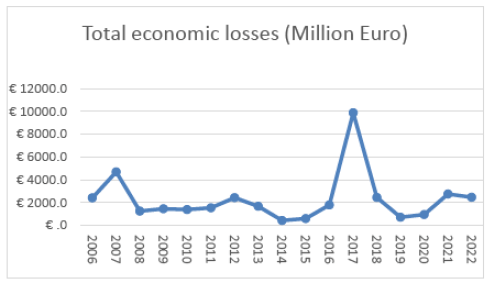
Economic damage can be considerable, although the trend on this front shows little overall change over the last two decades across the EU.
Like many natural events, wildfires cause lives to be lost. Using this tragic loss of life to whip up climate fear is deplorable, not least since many wildfires are deliberately or accidentally started by humans. Greece had a bad wildfire season last year with the BBC reporting that 79 arrests had been made for arson. The BBC accepts that wildfires are common in Greece but “scientists say” there is a link between extreme weather events and climate change. Stefan Doerr of the Centre for Wildlife Research at Swansea University notes that arson “can more easily turn into fast-moving wildfires”. Arsonists, it seems, just love climate change.
Last year, the climate scientist Patrick Brown admitted that he had written a paper published in Nature that focused exclusively on how climate change had affected extreme wildfire behaviour and ignored other key factors. In particular he downplayed the information that 80% of wildfires are lit by humans. He laid out his whistle-blowing claims in an article titled: ‘I Left Out the Full Truth to Get My Climate Change Paper Published’. He knew not to try to quantify key aspects other than climate change because it would dilute the message journals like Nature want to tell, he observed, adding: “To put it bluntly, climate science has become less about understanding the complexities of the world and more about serving as a kind of Cassandra, urgently warning the public about the dangers of climate change.”
Wildfires are an easy propaganda win for climate alarmists. People die, property is destroyed and the published images are spectacular. But fires are a vital part of nature, always have been. They help clear away the debris that accumulates naturally in forests and scrub land and provide a path for regenerative growth. There is little evidence that natural trends are on the increase around the world, and none to suggest that humans play a part in natural ignition by burning hydrocarbons and releasing carbon dioxide into the atmosphere. In its sixth assessment report, the Intergovernmental Panel on Climate Change (IPCC) specifically ruled out human involvement in ‘fire weather’, both in the past and going forward to the turn of this century.
Chris Morrison is the Daily Sceptic’s Environment Editor.
Featured Video
AIR POWER CANNOT BEAT an ENTRENCHED ENEMY LIKE IRAN
or go to
Aletho News Archives – Video-Images
Book Review
How the CIA hid their MKULTRA mind-control program
By Jon Rappoport | No More Fake News | September 17, 2021
Back in the early 1990s, I spoke with John Marks, author of Search for the Manchurian Candidate. This was the book (1979) that helped expose the existence and range of the infamous CIA MKULTRA program.
Marks related the following facts to me. He had originally filed many Freedom of Information (FOIA) requests for documents connected to the CIA’s mind-control program. He got nothing back.
Finally, as if to play a joke on him, someone at the CIA sent Marks 10 boxes of financial and accounting records. The attitude was, “Here, see what you can do with this.”
I’ve seen some of those records. They’re very boring reading.
But Marks went through them, and lo and behold, he found he could piece together MKULTRA projects, based on the funding data.
Eventually, he assembled enough information to begin naming names. He conducted interviews. The shape of MKULTRA swam into view. And so he wrote his book, Search for the Manchurian Candidate.
He told me that three important books had been written about MKULTRA, and they all stemmed from those 10 boxes of CIA financial records. There was his own book; Operation Mind Control by Walter Bowart; and The Mind Manipulators by Alan Scheflin and Edward Opton. … continue
Blog Roll
 Aletho News
- Larry Johnson: AIR POWER CANNOT BEAT an ENTRENCHED ENEMY LIKE IRAN
- Report- U.S. and Israel Are Targeting ‘Hospitals, Residential Buildings And Schools Across Tehran’
- Witkoff undermined Iran talks by peddling lies to build case for military aggression: Report
- Iraqi Resistance reports drone attacks on US targets in Erbil
- Iran warns all Israeli embassies ‘legitimate targets’ if Lebanon embassy attacked
- Russia could end gas supplies to EU immediately – Putin
- Veteran War Correspondent Reveals How to Tell When Analysts Talking About Iranian Losses Are Lying
- Did Kuwait really shoot down three US F-15s?
- Trump’s Iran war will put him in the history books, but…
- The murder of Iranian schoolchildren cannot be whitewashed
- If Americans Knew
- Is the International Norm Against Assassination Dead?
- More than 1,000 Civilians Killed in U.S.-Israeli Bombing of Iran, Rights Group Says
- The Neocons: First in War, Last in Peace
- With focus on Iran and Gaza, Israel is quietly annexing the West Bank
- Experts Worldwide Agree: US-Israel Attack on Iran a Clear Violation of International Law
- 1,000+ reported dead in Iran, in the war that Israel wanted – Not a ceasefire Day 145
- Rubio Suggests Trump Joined Israel’s Planned Attack on Iran Instead of Stopping It
- CNN: Timing of attack on Iran bears symbolic meaning in Judaism
- How the New York Times paved the way for apocalyptic war
- Tucker Carlson says Saudi Arabia and Qatar arrested Mossad agents planning bombings
- No Tricks Zone
- New Study: ‘Internal Noise’ And Volcanic Forcing Can Trigger 10-15°C Warming Within Decades
- Glaciers Worldwide Are Suddendly Surging, Experts Blame Warming!
- Surprising Discovery: Sahara Is Greening…Billions Of Trees Where Once Thought To Be Barren
- New Research Reaffirms Clouds, Aerosols, And Surface Solar Radiation Are ‘Driving The Climate System’
- Germany: Electric Car Catches Fire At Charging Station, Sets Off Local “Inferno”, Widespread Damage
- New Study: Canada’s New Brunswick Was 1°C Warmer Than Today During The Medieval Warm Period
- Coal Power Back In Trend As Globe Tries To Keep Pace With Growing Demand For Power
- New Study: A 4°C Warmer Beaufort Sea Had ‘No Sea Ice’ 11,700 – 8200 Years Ago
- Unfudging The Data: Dutch Meteorological Institute Reinstates Early 20th Centruy Heat Waves It Had Erased Earlier
- German Gas Crisis…Chancellor Merz Allegedly Bans Gas Debate Ahead of Elections!
 Aletho News