The March 1 report by the United Nations’ “Independent International Commission of Inquiry” asserted that the bloody attack on a humanitarian aid convoy west of Aleppo City on Sept. 19, 2016, was an airstrike by Syrian government planes. But an analysis of the U.N. panel’s report shows that it was based on an account of the attack from the pro-rebel Syrian “White Helmets” civil defense organization that was full of internal contradictions.
White Helmets member points to the aftermath of a military attack
The U.N. account also was not supported by either the photographic evidence that the White Helmets provided or by satellite imagery that was available to the commission, according to independent experts. Further undermining the U.N. report’s credibility, the White Helmets now acknowledge that rockets they photographed were not fired from Russian or Syrian planes but from the ground.
Like last December’s summary of the U.N.’s Headquarters Board of Inquiry report on the same incident, the Commission’s report described the attack as having begun with “barrel bombs” dropped by Syrian helicopters, followed by further bombing by fixed-wing planes and, finally, strafing by machine guns from the air.
The March 1 report did not identify any specific source for its narrative, citing only “[c]ommunications from governments and non-government organizations.” But in fact the U.N. investigators accepted the version of events provided by the White Helmets chief in Aleppo province as well as specific evidence that the White Helmets had made public.
The White Helmets, which are heavily funded by Western governments and operate only in rebel-controlled areas, are famous for using social media to upload videos purporting to show injured children and other civilian victims of the war.
Last year, a well-organized campaign pushed the group’s nomination for a Nobel Peace Prize and a Netflix film about the group won an Oscar last month. The United Nations and the mainstream Western news media have frequently relied on White Helmets accounts from war zones that are not accessible to outsiders. But the White Helmets’ officials have pursued an obvious political agenda in support of opposition forces in Al Qaeda-dominated zones in Aleppo and Idlib where they have operated.
On Sept. 19, immediately after the attack on the aid convoy, the chief of the White Helmets organization in the Aleppo governorate, Ammar al-Selmo, presented a dramatic narrative of a Russian-Syrian air attack, but it was marked by obvious internal contradictions.
At first, Selmo claimed in an interview that he had been more than a kilometer away from the warehouses where the attack occurred and had seen Syrian helicopters dropping “barrel bombs” on the site. But his eyewitness account would have been impossible because it was already dark by the time he said the attack began at about 7:15 p.m. He changed his story in a later interview, claiming that he had been right across the street at the moment of the attack and had heard the “barrel bombs” being dropped rather than seeing them.
Selmo insisted in a video filmed that night that the attack began with Syrian helicopters dropping eight “barrel bombs,” which are described as large, crudely constructed bombs weighing from 250 kg to 500 kg or even more. Citing a box-shaped indentation in the rubble, Selmo said the video is showing “the box of the barrel bomb,” but the indentation is far too small to be a crater from such a bomb.
Selmo continued the account, “Then the regime also target this place with cluster bombs two times, and also the aircraft of the Russians target this place with C-5 and with bullets,” apparently referring to Soviet-era S-5 rockets. The White Helmets photographed two such rockets and sent it to media outlets, including the Washington Post, which published the picture in the Post story with credit to the White Helmets.
Story Contradictions
But Hussein Badawi, apparently the White Helmet official in charge of the Urum al Kubrah area, contradicted Selmo’s story. In a separate interview, Badawi said the attack had begun not with “barrel bombs” but with “four consecutive rockets” that he said had been launched by government forces from their defense plant in Aleppo province – meaning that it was a ground-launched attack rather than an air attack.
In an email response to a query from me, Selmo retracted his own original claim about the S-5 rockets. “[B]efore aircraft’s attack on the area,” he wrote, “many land to land missiles attacked the place coming from the defense factories which [are] located in eastern Aleppo [east of] the city, regime controlled area. [T]hen aircraft came and attacked the place.”
But such a rocket attack from that “regime controlled area” would not have been technically possible. The Syrian government defense plant is located in Safira, 25 kilometers southeast of Aleppo City and even farther from Urum al-Kubrah, whereas the S-5 rockets that the White Helmets photographed have a range of only three or four kilometers.
Moreover, the Russians and Syrian government forces were not the only warring parties to have S-5s in their arsenal. According to a study of the S-5 rocket by Armament Research Services consultancy, Syrian armed opposition forces had been using S-5 rockets as well. They had gotten them from the CIA’s covert program of moving weapons from Libyan government stockpiles to be distributed to Syrian rebels beginning in late 2011 or early 2012. Syrian rebels had used improvised launch systems to fire them, as the ARS study documented with a picture.
Significantly, too, the explicit claim by Selmo that Russian planes were involved in the attack, which was immediately echoed by the Pentagon, was summarily dismissed by the U.N. panel report, which stated flatly, without further explanation, that “no Russian strike aircraft were nearby during the attack.”
Misplaced Evidence
Yet, despite the multiple discrepancies in the White Helmets’ story, the U.N. investigators said they corroborated the account of the air attack “by a site assessment, including analysis of remnants of aerial bombs and rockets documented at the site, as well as satellite imagery showing impact consistent with the use of air-delivered munitions.”
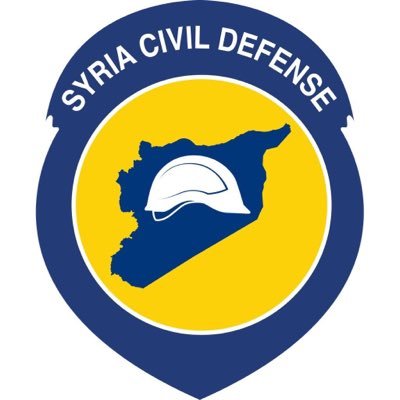
“White Helmets” symbol expropriates name of “Syria Civil Defense”
The U.N. Commission’s report cited a photograph of the crumpled tailfin of a Russian OFAB-250 bomb found under some boxes in a warehouse as evidence that it had been used in the attack. The White Helmets took the photograph and circulated it to the news media, including to the Washington Post and to the Bellingcat website, which specializes in countering Russia’s claims about its operations in Syria.
But that bomb could not have exploded in that spot because it would have made a crater many times larger than the small indentation in the floor in the White Helmet photo – as shown in this video of a man standing in the crater of a similar bomb in Palmyra.
Something other than an OFAB-250 bomb – such as an S-5 rocket — had caused the fine shrapnel tears in the boxes shown in the photo, as a detail from the larger scene reveals. So the OFAB bomb tailfin must have been placed at the scene after the attack.
Both U.N. imagery analysts and independent experts who examined the satellite images found that the impact craters could not have come from the “aerial bombs” cited by the Commission.
The analysis of the satellite images by United Nations specialists at UNITAR-UNOSAT made public by the U.N. Office of Humanitarian Coordination on March 1 further contradicts the White Helmet account, reflecting the absence of any evidence of either “barrel bombs” or OFAB-250 bombs dropped on the site.
The U.N. analysts identified four spots in the images on pages five and six of their report as “possible impact craters.” But a U.N. source familiar with their analysis of the images told me that it had ruled out the possibility that those impact points could have been caused by either “barrel bombs” or Russian OFAB-250 bombs.
The reason, the U.N. source said, was that such bombs would have left much larger craters than those found in the images. Those possible impact points could have been either from much smaller air-launched munitions or from ground-based artillery or mortar fire, but not from either of those weapons, according to the U.N. source.
Expert Challenges
A former U.S. intelligence official with long experience in analysis of aerial photos and Pierre Sprey, a former Pentagon analyst, both of whom reviewed the satellite images, agreed that the spots identified by UNOSAT could not have been from either “barrel bombs” or OFAB-250 bombs.
The former intelligence official, who demanded anonymity because he still deals with government officials, said the small impact points identified by the U.N. team reminded him of impacts from “a multiple rocket launcher or possibly a mortar.”
Sprey agreed that all of those impact points could have been from artillery or mortar fire but also noted that photographs of the trucks and other damaged vehicles show no evidence that they were hit by an airstrike. The photos show only extensive fire damage and, in the case of one car, holes of irregular size and shape, he said, suggesting flying debris rather than bomb shrapnel.
Sprey further pointed to photographic evidence indicating that an explosion that the U.N. Commission blamed on a Syrian airstrike came from within the building itself, not from an external blast. The building across the street from some of the trucks destroyed by an explosion (in Figure 9 of a series of photos on theBellngcatwebsite)
clearly shows that the front wall of the building was blown outward toward the road, whereas the rear wall and the roof were still intact.
The photograph (in Figure 10) taken from inside the remains of that same building shows the debris from the blast was blown all the way across the street to the damaged truck. Sprey said those pictures strongly suggest that an IED (improvised explosive device) had been set in the house to explode toward the trucks.
In embracing the Syrian-air-strike narrative — although it falls apart on closer examination — the U.N. “Commission of Inquiry” thus fell into line with the dominant Western political bias in favor of the armed opposition to the Syrian government, a prejudice that has been applied to the Syrian conflict by U.N. organs since the beginning of the war in 2011.
But never has the evidence so clearly contradicted that line as it has in this case – even though you will not learn that by reading or watching the West’s commercial news media.
Gareth Porter is the author of the newly published Manufactured Crisis: The Untold Story of the Iran Nuclear Scare.
David Robert at Vox : Scott Pruitt denies basic climate science. But most of the outrage is missing the point. Subtitle: It’s not about Pruitt and it’s not about facts. Excerpt: The right’s refusal to accept the authority of climate science is of a piece with its rejection of mainstream media, academia, and government, the shared institutions and norms that bind us together and contain our political disputes.
A number of scientists have responded in various venues regarding their opinion on Scott Pruitt’s statements. Here I include the ‘official’ statement from the AGU:
AGU Responds to Statements from EPA Administrator Scott Pruitt on Climate Change. Excerpt: The position statement of the American Geophysical Union regarding climate change leaves no doubt that increasing atmospheric concentrations of carbon dioxide resulting from human activity is the dominant source of climate change during the last several decades.
You may recall my concerns about the AGU policy statement on climate change [link]
What Scott Pruitt actually said
Listen to what Scott Pruitt actually said on CNBC and then compare it to the portrayal in the media. Here is the key text:
I think that measuring with precision human activity on the climate is something very challenging to do and there’s tremendous disagreement about the degree of impact, so no, I would not agree that it’s a primary contributor to the global warming that we see. But we don’t know that yet. We need to continue the debate and continue the review and the analysis.
Can you square what Pruitt actually said with the distorted quotes and headlines about this? I can’t.
I think that these two statements made by Pruitt are absolutely correct:
I think that measuring with precision human activity on the climate is something very challenging to do and there’s tremendous disagreement about the degree of impact
We need to continue the debate and continue the review and the analysis.
The other two statements give slightly conflicting messages:
I would not agree that it’s a primary contributor to the global warming that we see. But we don’t know that yet.
The main statement of controversy is:
I would not agree that it’s a primary contributor to the global warming that we see.
You can interpret this in two ways:
1.Pruitt is denying that CO2 is a primary contributor to recent global warming
OR
2.Pruitt is saying that he does not accept as a ‘fact’ that CO2 is a primary contributor because we simply don’t know.
Since his subsequent statement is “But we don’t know that yet”, #2 is obviously the correct interpretation.
I think he is saying that he is not convinced that we know with certainty that humans have caused 100% of the recent warming (which is what some climate modelers are saying, see recent tweets from Gavin Schmidt), or that humans have caused ‘more than half’ of the recent warming (which was the conclusion from the IPCC AR5.
JC reflections
If I am interpreting Pruitt’s statements correctly, I do not find anything to disagree with in what he said: we don’t know how much of recent warming can be attributed to humans. In my opinion, this is correct and is a healthy position for both the science and policy debates.
Exactly what the Trump administration intends to do regarding funding climate science, energy policy and the Paris climate agreement presumably remain as subjects of debate within the administration. Looking at every little leak and quote out of context as a rationale for hysteria simply isn’t rational or useful.
The most interesting reaction to all this is David Robert’s Voxarticle:
The right’s refusal to accept the authority of climate science is of a piece with its rejection of mainstream media, academia, and government, the shared institutions and norms that bind us together and contain our political disputes.
The ‘problem’: a change of administration and party after 8 years, mainstream media no longer has a lock on the media’s message (given all of the new news sources on the internet), academia’s profoundly liberal bias is being challenged, and the consensus that has been negotiated and enforced by certain elite scientists is being challenged.
Three cheers for democracy, the internet and the scientific process.
Here’s the anatomy of a fully made-up “news” story, abetted by a media that could care less to check any fact as long as the story feeds the preconceived notions of its audience.
You remember Khizr Khan (above), the guy who used his soldier son, killed in Iraq, as a prop at the Democratic National Convention to criticize Trump’s immigration policy and help elect Hillary Clinton? Well, like all good Americans, Khan exploited his exploitation into a minor media career. He was booked to talk in Canada by a speaker’s bureau called Ramsey Talks. A decent gig — tickets ran $89 a seat.
Then Trump supposedly struck. Ramsey Talks released a statement on its Facebook page saying:
Late Sunday evening Khizr Khan, an American citizen for over 30 years, was notified that his travel privileges are being reviewed. As a consequence, Mr. Khan will not be traveling to Toronto on March 7th to speak about tolerance, understanding, unity and the rule of law. Very regretfully, Ramsay Talks must cancel its luncheon with Mr. Khan. Guests will be given full refunds.
Mr. Khan offered his sincere apologies to all those who made plans to attend on March 7th. He said: “This turn of events is not just of deep concern to me but to all my fellow Americans who cherish our freedom to travel abroad. I have not been given any reason as to why. I am grateful for your support and look forward to visiting Toronto in the near future.
A major Canadian broadcast outfit (CTV) ran the story based solely, only, 100% on that single unverified and unsubstantiated Facebook posting, saying the Trump administration interfered with Khan’s “travel privileges” to prevent him from speaking, because of some sort of revenge for Khan’s statements this summer.
The Internet then, as expected, lost its shit.
Twitter boomed, and within an hour or two the story appeared in the New York Times, LA Times, Boston Herald, CNN, Maddow, and across the globe. Every one of those stories was based on nothing but that Facebook post. Reuters, the only outfit that apparently bothered to commit a minor act of journalism and reach out to Khan, was told by him no comment. All of the web’s many experts on stuff became experts on passport law, immigration, naturalization, and visa lore. Amazingly creative theories of “denaturalization of Muslims” were concocted out of thin air.
The only problem is that none of this is true. It in fact could not be true.
The U.S. has no law that deals with reviewing or rescinding “travel privileges.” No U.S. government agency calls people at home to tell them their travel privileges are under review. If, in very, very limited specific legal instances a court has ordered someone not to travel, their passport itself can be revoked in response to that court order. The U.S. Customs and Border Protection people, the State Department, and the government of Canada all eventually denied doing anything to Khan in any way or having anything to do with this story, so please stop calling them to ask.
Khan, or Ramsey Talks, seems to have made this all up.
Now, funny thing, this made-up story about Khan being denied travel hit just as Trump’s new Executive Order (“Muslin Ban 2.0”) was announced. Gee willikers Biff, you think this tale of a Muslim patriot denied travel was timed for that news cycle? Maybe so that when Khan’s speech is rescheduled tickets will be more expensive and sell out faster? Maybe so Khan and/or Ramsey Talks could get a zillion dollars of free publicity? Hah hah, coincidence, am I right?
As I write this, not one of the media outlets that ran with the false story has published a correction, update or apology. The Washington Post has semi-backed away, but left itself plenty of wiggle room in not admitting it was wrong.
The problem is if you Google Khan’s name, the story is still flowing around the web, and is now being cited in unrelated stories as “proof” of whatever else the writer believes is fascism and the end of freedom in America.
BONUS: A source inside CBP tells me that what is most likely to have happened is that Khan’s membership in one of the expedited processing programs was set to expire. These are programs run by private companies that gather information and submit members’ names for background checks to allow them to use expedited processing lanes at the airport when re-entering the United States from a foreign country. Khan/Ramsey likely confused, by accident or on purpose, the expiration of that membership with some nefarious U.S. government action, and the media took it from there. Khan’s only privilege under fire was that of standing in a shorter line at the airport.
It’s official: The Corbett Report is fake news and the most unreliable source in the media. So says Le Monde and dozens of other “fake news checking” websites that are telling the masses what to think, and what they shouldn’t even look at in the first place.
We have changed the headline of this news story to better reflect its content. Since its publication, former Intercept reporter Juan Thompson was arrested and charged with making bomb threats against Jewish Community Centers and the Anti-Defamation League.
Reckless US Russia bashing is reminiscent of US propaganda preceding all its wars, vilifying targeted countries and their leaders before attacking them.
The possibility of the world’s dominant nuclear powers clashing militarily should terrify everyone. Nuclear armageddon could follow.
Permanent wars reflect longstanding US policy. The Russian Federation never attacked another nation, fostering world peace and stability instead, threatening no other countries, despite Big Lies claiming otherwise.
Russia’s ambassador to Washington, Sergey Kislyak, is a distinguished diplomat, not an intelligence agent. He joined the Soviet Foreign Affairs Ministry in 1977, serving in many positions – most recently as Deputy Foreign Affairs Minister from 2003 – 2008, since then as envoy to America.
Yet CNN outrageously called him “one of Russia’s top spies and spy-recruiters in Washington” – a disgraceful fake news accusation, related to its coverage of Attorney General Jeff Sessions, having spoken to Kislyak one or more times while serving on the Senate Armed Services Committee.
CNN’s alleged sources: the usual unnamed US officials, past and present, reporting no evidence, the aim part of a diabolical anti-Russia, anti-Trump plot.
The stakes are huge. If officials close to him are eliminated, he’ll be too weak to govern effectively, perhaps more vulnerable to impeachment and removal from office than already.
If he goes, the last vestiges of a free society will go with him, coup d’etat dictatorship replacing him.
If Russia bashing passes a threshold of no return, war between the world’s dominant nuclear powers could follow.
Most Americans are mindless about what’s going on, manipulated by relentless fake news, failing to distinguish between fact and fiction.
Most oppose Trump, according to polls. Most nonsensically believe Russia threatens America. The notion is pounded into the public mind constantly, in NYT and other broadsheet feature stories, round-the-clock on cable television.
Putin spokesman Dmitry Peskov blasted accusations about Kislyak, saying “(y)ou and I have not heard a single statement by the US special services about our ambassador” – just “bogus media speculations that keep fanning tensions,” adding:
“The only piece of advice that I can give is that in a situation like this, avoid reacting to all such anonymous, baseless fake news stories and rely only on official statements by genuine officials.”
If Americans don’t awaken to the clear and present dangers they face and resist, the price for their indifference will be full-blown tyranny – perhaps nuclear war to follow, the ultimate nightmare.
On issues mattering most, The Times features fake news, not the real thing.
On March 1, its editors lied headlining “Russia Sides With Chemical Weapons,” saying:
“Russia proved again on Tuesday that there is no crime heinous enough to make it turn against Syria’s president, Bashar al-Assad. It vetoed a resolution before the United Nations Security Council that would have punished Syria for using chemical weapons.”
Fact: Throughout six years of Obama’s war, now Trump’s, using terrorists as imperial foot soldiers against a sovereign independent state threatening no one, claims about Assad using chemical weapons were fabricated – bogus accusations without evidence.
Fact: Plenty of clear evidence proves ISIS, al-Nusra and other US-supported terrorists used CWs numerous times – their elements trained in their use by Pentagon contractors in Turkey and Jordan, Saudi Arabia at times supplying toxins.
Times editors: “The Kremlin’s decision was in keeping with President Vladimir Putin’s vigorous support of the Syrian military in a six-year-long war that has killed half a million people.”
Fact: No mention by Times editors about Washington’s full responsibility for mass slaughter and destruction – NATO, Israel, and other rogue allies sharing blame.
Fact: Syria was invaded by US-supported terrorists, recruited from scores of countries, trained in Turkey, Jordan and elsewhere, responsible for horrific atrocities, mostly against defenseless civilians.
Times editors: “Although Moscow had made clear in advance that it would veto the resolution, (Washington), Britain and France were right to insist on a vote and to expose Russia’s moral bankruptcy.”
Fact: As usual, Times editors turned truth on its head, ignoring US-orchestrated aggression, vilifying Russia’s righteous mission.
Times editors: Mr. Putin’s argument that the resolution interfered with cease-fire negotiations between the Syrian government and the rebels was… not credible.”
Fact: The resolution was introduced to undermine peace talks, apparently wanting endless war continued.
Separately, Times editors claimed White House signals give “autocrats… a green light” to do what they please. What rubbish!
Most of America’s allies are rogue states, alliances formed long before Trump’s ascension to power – notably key NATO ones, Israel, Saudi Arabia, and other Gulf states, partners in US high crimes.
The supposed record comes from Esperanza. As Jim Steele at WUWT points out, Esperanza is at the northern tip of the Antarctic peninsula, at a latitude of 63.4S, just about as far outside the Antarctic Circle as you could get.
And as WUWT also points out, the temperature was purely the product of a fohn wind.
The temperature of 63.5F was actually set in March 2015, but has only just been officially confirmed by the WMO. As the Capital Weather Gang at the Washington Post noted at the time, the previous record of 62.8F was also set at Esperanza as far back as 1961.
The implication now is that “balmy” temperatures of 63F are unheard of Antarctica, which is clearly nonsense.
And as we can see, monthly average temperatures in March 2015 were not in the least unusual. Indeed, the hottest March was in 1965.
None of this information is mentioned by either Greenpeace, or media outlets such as MSN, who also carry the story.
But the really dishonest part is that photo of two poor penguins stranded at the top of a melting lump of snow.
As Joe has discovered, exactly the same photo appeared in December 2013, in an article by the International Science Times, which was about record cold temperatures in Antarctica. The picture is actually on Cape Denison, as the report makes clear:
When it’s late February and you’re complaining about the winter dragging endlessly on, take comfort in the fact that you’re not on the East Antarctic Plateau, where scientists have measured the coldest temperature on earth. At negative 135.8 degrees Fahrenheit, the August 10, 2010, temperature was “tens of degrees colder than anything ever seen in Alaska, Siberia or Greenland,” said Ted Scambos of the National Snow and Ice Data Center in Boulder, Colo., the group that made the discovery.
The New York Times has made it official. In a Sunday front-page article entitled “Trump Ruled the Tabloid Media. Washington Is a Different Story,” the paper gloats that Donald Trump has proved powerless to stop a flood of leaks threatening to capsize his administration.
As reporters Glenn Thrush and Michael M. Grynbaum put it: “This New York-iest of politicians, now an idiosyncratic, write-your-own-rules president, has stumbled into the most conventional of Washington traps: believing he can master an entrenched political press corps with far deeper connections to the permanent government of federal law enforcement and executive department officials than he has.”
Thrush and Grynbaum add a few paragraphs later that Trump “is being force-fed lessons all presidents eventually learn – that the iron triangle of the Washington press corps, West Wing staff and federal bureaucracy is simply too powerful to bully.”
Iron triangle? Permanent government? In its tale of how Trump went from being a favorite of the New York Post and Daily News to fodder for the big-time Washington news media, the Times seems to be going out of its way to confirm dark paranoid fears of a “deep state” lurking behind the scenes and dictating what political leaders can and cannot do. “Too powerful to bully” by a “write-your-own-rules president” is another way of saying that the permanent government wants to do things its way and will not put up with a president telling it to take a different approach.
Entrenched interests are nothing new, of course. But a major news outlet bragging about collaborating with such elements in order to cripple a legally established government is. The Times was beside itself with outrage when top White House adviser Steve Bannon described the media as “the opposition party.” But one can’t help but wonder what all the fuss is about since an alliance aimed at hamstringing a presidency is nothing if not oppositional.
If so, a few things are worth keeping in mind. One is that Trump was elected, even if only by an Eighteenth-Century relic known as the Electoral College, whereas the deep state, permanent government, or whatever else you want to call it was not. Where Trump gave speeches, kissed babies, and otherwise sought out the vote, the deep state did nothing. To the degree this country is still a democracy, that must count for something. So if the conflict between president and the deep state ever comes down to a question of legitimacy, there is no doubt who will come out ahead: The Donald.
A second thing worth keeping in mind is that if ever there was a case of the unspeakable versus the inedible (to quote Oscar Wilde), the contest between a billionaire president and billionaire-owned press is it.
Both sides are more or less correct in what they say about the other. Trump really is a strongman at war with basic democratic norms just as innumerable Times op-ed articles say he is. And giant press organizations like the Times and the Washington Post are every bit as biased and one-sided as Trump maintains – and no less willfully gullible, one might add, than in 2002 or 2003 when they happily swallowed every lie put out by the George W. Bush administration regarding Iraqi WMDs or Saddam Hussein’s support for Al Qaeda.
Riveting TV
Trump’s Feb. 16 press conference – surely the most riveting TV since Jerry Springer was in his prime – is a case in point. The President bobbed, weaved, and hurled abuse like a Catskills insult comic. He threw out pseudo-facts, describing his victory, for instance, as “the biggest Electoral College win since Ronald Reagan” when in fact George H. W. Bush, Bill Clinton and Barack Obama all got more votes. But commentators who panned the display as a “freak show” or simply “batshit crazy” didn’t get it. It wasn’t Trump who bombed that afternoon, but the press.
Why? Because reporters behaved with all the intelligence of a pack of Jack Russell terriers barking at a cat up a tree. Basically, they’ve been seized by the idée fixe that Russia is a predator state that hacks elections, threatens U.S. national security, and has now accomplished the neat trick of planting a Kremlin puppet in the Oval Office. It doesn’t matter that evidence is lacking or that the thesis defies common sense. It’s what they believe, what their editors believe, and what the deep state believes too (or at least pretends to). So the purpose of the Feb. 16 press conference was to pin Trump down as to whether he also believes the Russia-did-it thesis and pillory him for deviating from the party line.
More than half the questions that reporters threw out were thus about Russia, about Mike Flynn, the ex-national security adviser who got into trouble for talking to the Russian ambassador before the new administration formally took office, or about reputed contacts between the Trump campaign staff and Moscow. One reporter thus demanded to know if anyone from Trump’s campaign staff had ever spoken with the Russian government or Russian intelligence. Another asked if Trump had requested FBI telephone intercepts before determining that Flynn had not broken the law.
“I just want to get you to clarify this very important point,” said a third. “Can you say definitively that nobody on your campaign had any contacts with the Russians during the campaign?” A fourth wanted to get the President’s reaction to such “provocations” as a Russian communications vessel floating 30 miles off the coast of Connecticut (in international waters). “Is Putin testing you, do you believe, sir?” the reporter asked as if he had just uncovered a Russian agent in the Lincoln Bedroom. “… But do they damage the relationship? Do they undermine this country’s ability to work with Russia?”
When yet another journalist asked yet again “whether you are aware that anyone who advised your campaign had contacts with Russia during the course of the election,” Trump cried out in frustration: “How many times do I have to answer this question?” It was the most intelligent query of the day.
The press played straight into Trump’s hands, all but providing him with his best lines. “Well, I guess one of the reasons I’m here today is to tell you the whole Russian thing, that’s a ruse,” he responded at one point. “That’s a ruse. And by the way, it would be great if we could get along with Russia, just so you understand that. Now tomorrow, you’ll say, ‘Donald Trump wants to get along with Russia, this is terrible.’ It’s not terrible. It’s good.”
The prose may not be very polished, but the sentiments are unassailable. Ditto Trump’s statement a few minutes later that “false reporting by the media, by you people, the false, horrible, fake reporting makes it much harder to make a deal with Russia. … And that’s a shame because if we could get along with Russia – and by the way, China and Japan and everyone – if we could get along, it would be a positive thing, not a negative thing.”
If the Washington Post and the Times do not agree that bogus assertions about unauthorized contacts with Russia are not poisoning the atmosphere, they should explain very clearly why not. They should also explain what they hope to accomplish with a showdown with Russia and why it will not be a step toward World War III.
But they won’t, of course. The media (with encouragement from parts of the U.S. government) are working themselves into a fit of outrage against Vladimir Putin just as, in past years, they did against Daniel Ortega, Manuel Noriega, Saddam Hussein, Slobodan Milosevic, Saddam Hussein (again), Muammar Gaddafi, Bashar al-Assad, and Viktor Yanukovych. In each instance, the outcome has been war, and so far the present episode shows all signs of heading in the same direction as well.
Reporters may be clueless, but working-class Americans aren’t. They don’t want a war because they’re the ones who would have to fight it. So they’re not unsympathetic to Trump and all the more inclined to give the yapping media short shrift.
This is a classic pattern in which strongmen advance on the basis of a liberal opposition that proves to be weak and feckless. Today’s liberal media are obliging Trump by behaving in a way that is even sillier than usual and well ahead of schedule to boot.
A Fragile Meme
The anti-Russia meme, meanwhile, rests on the thinnest of foundations. The argument that Russia hacked the Democratic National Committee and thereby tipped the election to Trump is based on a single report by CrowdStrike, the California-based cyber-security firm hired by the DNC to look into the mass email leak. The document is festooned with head-spinning techno-jargon.
It says of Cozy Bear and Fancy Bear, the hackers who allegedly penetrated the DNC in behalf of Russian intelligence: “Their tradecraft is superb, operational security second to none, and the extensive usage of ‘living-off-the-land’ techniques enables them to easily bypass many security solutions they encounter. In particular, we identified advanced methods consistent with nation-state level capabilities including deliberate targeting and ‘access management’ tradecraft – both groups were constantly going back into the environment to change out their implants, modify persistent methods, move to new Command & Control channels, and perform other tasks to try to stay ahead of being detected. Both adversaries engage in extensive political and economic espionage for the benefit of the government of the Russian Federation and are believed to be closely linked to the Russian government’s powerful and highly capable intelligence services.”
Impressive? Not to independent tech experts who have already begun taking potshots. Sam Biddle, The Intercept’s extremely smart tech writer, notes that CrowdStrike claims to have proved that Cozy Bear and Fancy Bear are Russian because they left behind Cyrillic comments in their “metadata” along with the name “Felix Edmundovich,” also in Cyrillic, an obvious reference to Felix Edmundovich Dzerzhinsky, founder of the Cheka, as the Soviet political police were originally known.
But, Biddle observes, there’s an obvious contradiction: “Would a group whose ‘tradecraft is superb’ with ‘operational security second to none’ really leave behind the name of a Soviet spy chief imprinted on a document it sent to American journalists? Would these groups really be dumb enough to leave Cyrillic comments on these documents? … It’s very hard to buy the argument that the Democrats were hacked by one of the most sophisticated, diabolical foreign intelligence services in history, and that we know this because they screwed up over and over again.”
Indeed, John McAfee, founder of McAfee Associates and developer of the first commercial anti-virus software, casts doubt on the entire enterprise, wondering whether it is possible to identify a hacker at all. “If I were the Chinese,” he told TV interviewer Larry King in late December, “and I wanted to make it look like the Russians did it, I would use Russian language within the code, I would use Russian techniques of breaking into organizations. … If it looks like the Russians did it, then I can guarantee you: it was not the Russians.” (Quote starts at 4:30.)
This may be too sweeping. Nonetheless, if the press really wanted to get to the bottom of what the Russians are doing, they would not begin with the question of what Trump knew and when he knew it. They would begin, rather, with the question of what we know and how we can be sure. It’s the question that the press should have asked during the run-up to the 2003 invasion of Iraq, but failed to. But it’s the question that reporters should be asking now before the conflict with Russia spins out of control, with consequences that are potentially even more horrendous.
It’s not easy making Donald Trump seem like a peacenik, but that’s what the billionaire’s press has done.
A ‘new report by the London School of Economics’ (LSE), so announced the British press – The Times, The Daily Mail and The Daily Mirror – describes sexual crimes against women in Syrian prisons. It alleges these to be a matter of state policy. Published just ahead of Geneva talks about a political settlement in Syria, the press interpreted it as supportingrenewed calls for regime change.
The paper provides no new grounds for that conclusion, however. In fact, its sweeping allegations obscure good reasons why, under present circumstances,a responsible approach to the problem of sexual violence in Syria would involve supporting the government against the terrorist insurgents.
Syrian Christians
Some reasons can be gleaned from United Nations research into the problem. The UN found (in 2015 and again in 2016) that while some conflict-related sexual violence was perpetrated by state personnel, ‘non-State actors account for the vast majority of incidents’.[1] The UN made clear that efforts to defeat groups like ISIS and Al Qaeda, as the Syrian government is committed to, ‘are an essential part of the fight against conflict-related sexual violence.’ Such groups use sexual violence as part of their strategy to spread terror among those that oppose their ideology. They engage in trafficking of women and slavery. They drive the displacement of women who, then, ‘remain at high risk, even when they reach the supposed refuge of neighbouring countries.’
Marie Forestier, the LSE paper’s author, complains that the UN paid ‘disproportionate attention’ to the terrorist groups as perpetrators of sexual violence in Syria. She wants to highlight crimes on the government side, and she relays some horrific allegations about some individual cases. Thisillustrates specific experiences of a problem that the UN had signaled. However, while harrowing in themselves, these testimonies cannot speak to the comparative scale of the problem.[2] Forestier therefore does not show the UN’s concerns about the egregious sexual violence of the terrorist insurgents to be disproportionate. Furthermore, her interviews relate to experiences from a period – 2012 and 2013 – that is earlier than covered by the UN reports of 2015 and 2016. Forestier herself admits that accusations of sexual violence on the government’s side were ‘most frequent from late 2011 to 2013, in disputed areas such as the Damascus suburbs, and in central and coastal governorates … with a peak in 2012, and comparatively fewer cases in 2014.’ She thereby shows the situation was worse in places where the government had to fight insurgents and improved when the government regained control. In light of her own admissions, it seems perverse to cite limited older evidence in criticizing considered conclusions of fuller and more up-to-date reports.
The perversity is heightened with unwarranted generalizations in the present continuous tense. Press coverage has, unsurprisingly, transmitted the message that the most shocking details of individual allegations from up to five years ago capture what is occurring on a general and continuing basis today. Forestier herself even makes demonstrably false general claims in the present tense. For instance, she says: ‘According to an estimate by United Nations investigators, Syrian security forces detain tens of thousands of people at any one time.’ However, the source she cites for this claim says no such thing.[3]
Some of her most damaging claims are simply inexplicable, as when she says: ‘According to testimony, the overwhelming majority of men committing rapes have been State forces.’ This extraordinary claim flies in the face of the palpable evidence and reports of the UN. Bizarrely, the source Forestier cites for it is an article on ‘general data on sexual violence by state forces’ attained for 129 other conflicts, notincluding Syria, and during a period (1989-2009) prior to the outbreak of war in Syria.[4]
The LSE paper’s headline message thus misrepresents what is actually shown regarding the extent of the government’s responsibility for sexual violence. Buried within its text are admissions that the paper should only ‘be considered as a starting point for further research’ and that ‘it is impossible to conclude that sexual violence by regime forces is a mass phenomenon.’ Yet this did not stop Forestier making such damaging accusations as that ‘rape can be considered as part of a general policy from the authorities’ (p.12).[5]
Regardless of lack of evidence, she seems determined to convey a message of rape and sexual violence being state policy approved at the highest levels.[6] Yet she admits: ‘The decision to resort to sexual violence (or tolerate it) seems to have fallen under the regional level or even the branch and military unit level’. ‘No information indicates that high-level officials in Damascus ordered rapes’ and ‘the President or high level security officials probably didn’t give explicit orders’.
She rightly notes that ‘commanders may be prosecuted where they know or should have known of the abuses and failed to take action to stop them.’ She also correctly observes that ‘ending impunity is central in preventing sexual violence.’ I would add that ending impunity, like bringing the problem itself under control, requires well functioning institutions. The Syrian government is evidently aware of this, and, under difficult conditions, has sought to improve its systems for the protection of women and children, as welcomed by the UN OHCHR. But the good functioning of institutions is favoured by peaceful conditions rather than by war.
One does not have to be an enthusiast for the present government to recognize its legitimacy and the simple fact that it is uniquely well-placed as things stand now, and foreseeably, to protect ordinary men, women and children against violent threats.
Freed from ISIS
A realistic general presumption has to be that rape and sexual violence tends be more common in war than in peacetime.[7] That is a reason – on top of so many others – why war should be avoided. A country that finds its territory turned into a battleground has to reckon with sexual violence being more prevalent than in peacetime, while its resources to tackle the problem are diverted and diminished. A government that has to defend its people against armed insurgents, particularly when these routinely engage in sexual violence, faces extraordinary challenges. That does not absolve it of responsibility for ensuring good conduct by its own forces. The practical ability of a government to maintain discipline, however, is not enhanced by having to engage on many fronts with ruthless opposition.
Realistically, and morally, the best way to avoid rape in war is to avoid war itself. I cannot believe that Marie Forestier would disagree on this general point, but I am less sure what she thinks with regard to the specific case of Syria, or even whether she has fully thought it through.[8] The thrust of her argument would support continued efforts by foreign powers, exercised through terrorist proxies on the ground, to depose the government of Syria, something that could only worsen further still the problem of sexual violence.
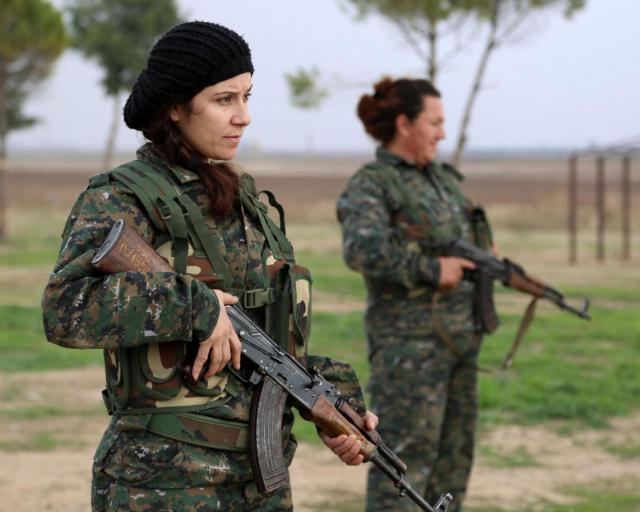
By contrast, it may be instructive to consider the approach taken by the Kurds in the north of Syria. In 2011, Kurds were among the groups fighting against the Syrian government. Since then, however, they have become pragmatic allies of the government in a common drive to eliminate ISIS from Syrian territory. The Kurds also have a particularly enlightened appreciation of women’s central place in society.[9] Consistent with their political philosophy, about a third of their fighting force is women. The Women’s Protection Unit or YPJ, is an all-female Kurdish military organization of about 8,000 volunteers, and growing.[10] Meanwhile the Syrian Arab Army has emulated the Kurds by creating all women battalions along similar lines.[11] Already, though, the Syrian army prominently featured all female units, including the famed Lionesses for National Defence unit of the elite Republican Guard.[12] Western commentators who note the propaganda value of this also grant that its success reflects the wider social solidarity that has made the Syrian Arab Army so resilient. As a French commentator observes, ‘The war in Syria is a face-off between two societal structures and Assad is showing that, in his system, women have an important role, even in the defence forces’.[13] If the Syrian government sees the propaganda value of promoting women’s equality, we might reasonably suppose it would see the irrationality of undoing such reputational gains by pursuing a delinquent policy of the kind Forestier alleges.
The fact is that what people widely believe throughout Syria – in Arab areas as in Kurdish – is that the overwhelming problem of sexual violence, like that of extremist violence more generally, comes from ISIS and other terrorists that violate, torture, enslave, traffic and oppress women. This is consistent with the UN findings. Forestier’s allegations are consistent only with the foreign drive for ‘regime change’.
For anyone genuinely concerned to deal with sexual violence occurring in – and occasioned by – conflict situations, a central preventive strategy is not starting a war in the first place, and not prolonging a war needlessly once started. It certainly means not intervening in a war on the side of those inflicting by far and away the most extensive and egregious sexual crimes.
In short, if the government had been supported in its efforts to defeat the insurgents, a great deal of sexual violence would have been avoided. Forestier’s claims, seen in this light, in being unfounded, are counterproductive and irresponsible. The view she opposes has a coherence hers lacks. It also has basic morality on its side. The problem with Forestier’s paper is not simply that it is poor research and writing.[14] The real concern is that, in being publicly promoted, it has been fed into the narrative beyond academia that would continue seeking to destabilise Syria (and the wider Middle East) and to prolong conflict against the Syrian government. One effect of this would be to prolong the circumstances in which sexual violence continues unabated on that territory.
[2] I do not take propose to take issue with any of Forestier’s reporting of testimonies, even though her methodology is unclear. (For instance, she mentions that three interviews with survivors ‘were excluded because they seemed exaggerated or false’ yet she does not explain how she decided whose word to give how much credence to, particularly in cases where she was speaking through a translator via phone to someone she hadn’t met.)
[3] The source she cites is UN Human Rights Council, Report of the Independent International Commission of Inquiry on the Syrian Arab Republic, A/ HRC/31/68, 11 February 2016, http://www. ohchr.org/Documents/HRBodies/HRCouncil/ CoISyria/A-HRC-31-68.pdf. (Having checked that source I find the only mention of thousands of people refers to ISIS crimes. I could not find any statement remotely resembling her claim, and I would readily correct the record here if she can direct me to it with a page reference.)
[4] Dara Kay Cohen and Ragnhild Nordas, “Sexual Violence in Armed Conflict: Introducing the SVAC dataset, Sexual Violence in Armed Conflict: Introducing the SVAC dataset, 1989−2009”, Journal of Peace Research 51(3) (2014), 418-428.
[5] This assumption is manifest, too, in her claim – made much of in the press reporting of her paper – that sexual assault in detention was so routine that contraception was supplied. Damning as this may be, assuming it is true, it does not self-evidently suggest that those assaults were part of a policy as distinct from an atrocious practice. It could in fact be taken to suggest a desire of perpetrators to prevent evidence of violations coming to light. A related claim involves the testimony of a victim that her attacker used Vaseline. Forestier takes this, along with the contraception, to ‘indicate that rapes followed a regular pattern that involved some degree of organisation and were part of a broader state policy of widespread repression against the civil population.’ Since the organization required is that of a visit to a pharmacy, and we can have no idea how widespread the practice was, we cannot simply infer what Forestier claims about a ‘broader state policy’.
[6] At one point she asserts that ‘when soldiers or militiamen raped women during military operations, this was part of the attack against their adversaries and their relatives. Thus, rape can be considered as part of a general policy from the authorities.’ But the inference stated after her ‘thus’ is a non sequitur: she provides no reason to think such attacks follow from a policy rather than opportunism or vindictiveness.
[7] The presumption has to be defeasible, but it seems clear that simply to presume the contrary would be imprudent. For a discussion see e.g. Doris E. Buss, ‘Rethinking “Rape as a Weapon of War, Feminist Legal Studies (2009) 17.2: 145-163.
[8] Her puzzling take on the situation is illustrated by a claim like this: ‘the Syrian government has sought to increase antagonism between communities’ and ‘to frame the conflict as a fight between Alawites and Sunnis instead of a struggle for democracy.’ Yet the government owes its resilience precisely to a longstanding and conscious strategy of defusing sectarian tendencies. (The government has consistently framed the conflict as an attack on the secular multi-faith state by primarily Islamist jihadists.) Furthermore, however much a desire for greater democracy may originally have motivated the political opposition, the conflict that has ensued was taken over by jihadists committed to imposing the most anti-democratic regime imaginable.
[9] A fundamental tenet of Kurdish nationalism, as articulated by PKK (Kurdistan Workers’ Party) founding leader Abdullah Öcalan, is that ‘a country can’t be free unless the women are free’. This political philosophy – given the name ‘jineology’– is embraced by the movement and its fighters, about a third of whom in the Kurdish region of Syria are women.
[14] Given its status as a Working Paper, the academic community is aware that Forestier’s claims have not been peer-reviewed. The wider world does not observe such niceties. The Daily Mirror, The Daily Mail and The Times did not. Most tweeters do not. They all present it as coming from the prestigious LSE. Which is fair enough, given that it features conspicuously on the LSE website. Since LSE has promoted this paper, there is a case for saying they should own it and answer for it. If my argument in this post is correct, there is a case for suggesting they should retract it.
It’s heartwarming that The New York Times and The Washington Post are troubled that President Trump is loosely throwing around accusations of “fake news.” It’s nice that they now realize that truth does not reliably come from the mouth of every senior government official or from every official report.
The Times is even taking out full-page ads in its own pages to offer truisms about truth: “The truth is hard. The truth is hidden. The truth must be pursued. The truth is hard to hear. The truth is rarely simple. The truth isn’t so obvious. …” On Sunday, those truth truisms ran opposite an alarmist column by Jim Rutenberg entitled, “Will the Real Democracy Lovers Please Stand Up?” Meanwhile, The Washington Post launched its own melodramatic slogan, “Dies in Darkness.”
Yet, it was only weeks ago when the Post and Times were eagerly promoting plans for silencing or blacklisting independent news sites that didn’t toe the line on what the U.S. government and its allies were claiming was true.
On Nov. 20, the Times published a lead editorial calling on Facebook and other technology giants to devise algorithms that could eliminate stories that the Times deemed to be “fake.” The Times and other mainstream news outlets – along with a few favored Internet sites – joined a special Google-sponsored task force, called the First Draft Coalition, to decide what is true and what is not. If the Times’ editorial recommendations were followed, the disfavored stories and the sites publishing them would no longer be accessible through popular search engines and platforms, essentially blocking the public’s access to them. [See Consortiumnews.com’s “What to Do About ‘Fake News.’”]
On Thanksgiving Day, the Post ran a front-page story citing an anonymous group, called PropOrNot, blacklisting 200 Web sites, including Consortiumnews.com and other important sources of independent journalism, because we supposedly promoted “Russian propaganda.”
Although PropOrNot and the Post didn’t bother to cite any actual examples or to ask the accused for comment, the point was clear: If you didn’t march in lockstep behind the Official Narrative on, say, the Ukraine crisis or the war in Syria, you were to be isolated, demonized and effectively silenced. In the article, the Post blurred the lines between “fake news” – stories that are simply made up – and what was deemed “propaganda,” in effect, information that didn’t jibe with what the U.S. State Department was saying.
Back then, in November, the big newspapers believed that the truth was easy, simple, obvious, requiring only access to some well-placed government official or a quick reading of the executive summary from some official report. Over the last quarter century or so, the Times, in particular, has made a fetish out of embracing pretty much whatever Officialdom declared to be true. After all, such well-dressed folks with those important-sounding titles couldn’t possibly be lying.
That gullibility went from the serious, such as rejecting overwhelming evidence that Ronald Reagan’s Nicaraguan Contra rebels were deeply involved in drug trafficking, to the silly, trusting the NFL’s absurd Deflategate allegations against Tom Brady. In those “old” days, which apparently ended a few weeks ago, the Times could have run full-page ads, saying “Truth is whatever those in authority say it is.”
In 2002, when the George W. Bush administration was vouching for a motley crew of Iraqi “defectors” describing Saddam Hussein’s hidden WMDs, Iraq’s purchase of some “aluminum tubes” must have been for building nuclear bombs. In 2003, when Secretary of State Colin Powell showed some artist drawings of “mobile chemical weapons labs,” they must really exist – and anyone who doubted Powell’s “slam-dunk” testimony deserved only contempt and ridicule.
When the Obama administration issued a “government assessment” blaming the Syrian military for the sarin gas attack outside Damascus on Aug. 21, 2013, there was no need to scrutinize its dubious assertions or ask for actual proof. To do so made you an “Assad apologist.”
When a bunch of U.S. allies under the effective control of Ukraine’s unsavory SBU intelligence service presented some videos with computer-generated graphics showing Russians supplying the Buk missile that shot down Malaysia Airlines Flight 17 over eastern Ukraine on July 17, 2014, there was no need to examine the holes in the evidence or note that the realistic-looking graphics were fictional and based on dubious assumptions. To do so made you a “Moscow stooge.”
In other words, when the U.S. government was gluing black hats on an “enemy” and white hats on a U.S. “ally,” the Times never seemed to object. Nor did pretty much anyone else in the mainstream media. No one seemed to note that both sides usually deserved gray hats. With very few exceptions – when the State Department or other U.S. agencies were making the charges – the Times and its cohorts simply stopped applying responsible journalistic skepticism.
Of course, there is a problem with “fake news,” i.e., stories that are consciously made up for the purpose of making money from lots of clicks. There are also fact-free conspiracy theories that operate without evidence or in defiance of it. No one hates such bogus stories more than I do — and they have long been a bane of serious journalism, dating back centuries, not just to the last election.
But what the Times, the Post and the rest of the mainstream media have typically ignored is that there are many situations in which the facts are not clear or when there are alternative explanations that could reasonably explain a set of facts. There are even times when the evidence goes firmly against what the U.S. government is claiming. At those moments, skepticism and courage are necessary to challenge false or dubious Official Narratives. You might even say, “The truth is rarely simple. The truth isn’t so obvious…”
A Tough Transition
During the transition from the Obama administration to the Trump team, the Times, the Post and other mainstream media outlets got caught in their own transition from trusting whatever the outgoing officials said to distrusting whatever the incoming officials said. In those final days, big media accepted what President Obama’s intelligence agencies asserted about Russia supposedly interfering in the U.S. election despite the lack of publicly available evidence that could be scrutinized and tested.
Even something as squirrelly as the attack on Trump’s National Security Adviser Michael Flynn – with Obama holdovers citing the never-prosecuted Logan Act from 1799 as the pretext for ginning up some kind of criminal-sounding case that scared Trump into firing Flynn – was treated as legitimate, without serious questions asked. Since Obama officials were doing the feeding, the no-skepticism rule applied to the eating. But whatever statements came from Trump, even his few lucid moments explaining why war with nuclear-armed Russia wasn’t such a great idea, were treated as dangerous nonsense.
When Trump scolded the mainstream press for engaging in “fake news” and then applied the phrase “enemy of the people,” the Times, the Post and the rest went into full victimization-mode. When a few news companies were excluded from a White House news briefing, they all rushed to the barricades to defend freedom of the press. Then, Trump went even further – he rejected his invitation to the White House Correspondents Dinner, the black-tie/evening-gown event where mainstream media stars compete to attract the hottest celebrity guests and hobnob with important government officials, a walking-talking conflict-of-interest-filled evening, an orgy of self-importance.
So, the Times, the Post and their mainstream-media friends now feel under attack. Whereas just weeks ago they were demanding that Google, Facebook and other powerful information platforms throttle those of us who showed professional skepticism toward dubious claims from the U.S. government, now the Times, the Post and the others are insisting that we all rally around them, to defend their journalistic freedom. In another full-page ad on Sunday, the Times wrote: “Truth. It’s more important now than ever.”
I would argue that truth is always important, but especially so when government officials are leading countries toward war, when lives are at stake, whether in Iraq or Syria or Ukraine or the many other global hotspots. At those moments in the recent past, the Times did not treat truth – in all its subtlety and nuance – as important at all.
I would argue, too, that the stakes are raised even higher when propagandists and ideologues are risking the prospect of nuclear war that could kill billions and effectively end human civilization. However, in that case, the American people have seen little truly professional journalism nor a real commitment to the truth. Instead, it’s been much more fun to demonize Russian President Vladimir Putin and paint black-and-white pictures of the evil Russians.
At such moments, those New York Times’ truisms about truth are forgotten: “The truth is rarely simple. The truth isn’t so obvious. …”
Investigative reporter Robert Parry broke many of the Iran-Contra stories for The Associated Press and Newsweek in the 1980s.
This article is a warning – in November 2016, a vast system of agitation and propaganda was set up in order to destroy the reputation and the authority of President Donald Trump as soon as he arrived in the White House. It is the first time that such a campaign has been scientifically organised against a President of the United States, and with such resources. Yes, we are indeed entering a post-Truth age, but the distribution of roles is not what you may think it is.
David Brock is considered to be one of the masters of agit-prop (agitation & propaganda) in the 21st century. A personality devoid of scruples, he is able to defend a cause as well as destroy it, according to the needs of his employer. He is at the head of an empire of mass manipulation.
The campaign waged against the new President of the United States by the sponsors of Barack Obama, Hillary Clinton and the destruction of the Greater Middle East is on-going. After the Womens’ March on 22 January, a March for Science is scheduled to be held not only in the USA, but also throughout the Western world on 22 April. It’s goal is to show that Donald Trump is not only a misogynist, but also an obscurantist.
The fact that he is the ex-organiser of the Miss Universe pageant, and that his third wedding was to a model, is apparently enough to prove that he holds women in contempt. The fact that the President contests the role played by Barack Obama in the creation of the Chicago Climate Exchange (a long time before his Presidency) and rejects the idea that climatic disturbances are caused by the expulsion of carbon into the atmosphere attest to the fact that he understands nothing about science.
In order to convince US public opinion of the President’s insanity – a man who says that he hopes for peace with his enemies, and wants to collaborate with them in universal economic prosperity – one of the greatest specialists of agit-prop (agitation & propaganda), David Brock, set up an impressive system even before Trump’s investiture.
At the time when he was working for the Republicans, Brock launched a campaign against President Bill Clinton which would eventually become Troopergate, the Whitewater affair, and the Lewinsky affair. Having changed his colours, he is today in the service of Hillary Clinton, for whom he has already organised not only the demolition of Mitt Romney’s candidacy but also her riposte in the affair of the assassination of the US ambassador in Benghazi. During the first round of primaries, it was Brock who directed the attacks against Bernie Sanders. The National Review qualified Brock as «a right-wing assassin who has become a left-wing assassin».
It is important to remember that the two procedures of destitution of a serving President initiated since the Second World War were set in motion for the benefit of the deep state, and not at all for the benefit of democracy. So Watergate was entirely managed by a certgain «Deep Throat» who, 33 years later, was revealed to be Mark Felt, the assistant of J. Edgar Hoover, Director of the FBI. As for the Lewinsky affair, it was simply a way of forcing Bill Clinton to accept the war against Yugoslavia.
The current campaign is organised in secret by four associations:
Media Matters is tasked with picking up on Donald Trump’s mistakes. You read his bulletin every day in your newspapers – the President can’t be trusted, he got this or that point wrong.
American Bridge 21st Century has collected more than 2,000 hours of videos showing Donald Trump over the years, and more than 18,000 hours of other videos of the members of his cabinet. It has at its disposition sophisticated technological equipment designed for the Department of Defense – allegedly not in working order – which enables it to look for contradictions between their older declarations and their current positions. It should be extending its work to 1,200 of the new President’s collaborators.
Citizens for Responsibility and Ethics in Washington — CREW is a firm of high level lawyers tasked with tracking anything that could create a scandal in the Trump administration. Most of the lawyers in this association work pro bono, for the cause. These are the people who prepared the case for Bob Ferguson, the Chief Prosecutor of the state of Washington, against the immigration decree (Executive Order 13769).
Shareblue is an electronic army which has already connected with 162 million internauts in the USA. It’s job is to spread pre-ordained themes, for example:
• Trump is authoritarian and a thief.
• Trump is under the influence of Vladimir Putin.
• Trump is a weak and quick-tempered personality, he’s a manic-depressive.
• Trump was not elected by the majority of US citizens, and is therefore illegitimate.
• His Vice-President, Mike Pence, is a fascist.
• Trump is a billionaire who will constantly be faced with conflicts of interest between his personal affairs and those of state.
• Trump is a puppet of the Koch brothers, who are famous for sponsoring the extreme right.
• Trump is a white supremacist and a threat to minorities.
• Anti-Trump opposition just keeps growing outside Washington.
• To save democracy, let’s support the democrataic parliamentarians who are attacking Trump, and let’s demolish those who are co-operating with him.
• Overthrowing Trump will take time, so don’t let’s weaken in our resolve.
This association will produce the newsletters and 30-second videos. It will base itself on two other groups – a company which makes documentary videos, The American Independent, and a statistical unit, Benchmark Politics.
The whole of this system – which was set up during the transitional period, that is to say before Donald Trump’s arrival at the White House – already employed more than 300 specialists to which should be added numerous voluteer workers. Its annual budget, initially calculated at 35 million dollars, was increased to the level of about 100 million dollars.
Destroying the image – and thus the authority – of the President of the United States, before he has had the time to do anything at all, can have serious consequences. By eliminating Saddam Hussein and Mouamar Kadhafi, the CIA plunged their two countries into a long period of chaos, and the «land of Liberty» itself may suffer severe damage from such an operation. This type of mass manipulation technique has never before been levelled at a head of state in the Western world.
For the moment, the plan is working – no political leader in the world has dared to celebrate the election of Donald Trump, with the exception of Vladimir Putin and Mahmoud Ahmadinejad.
During World War I, for security reasons the Australian Government pursued a comprehensive internment policy against enemy aliens living in Australia.
Initially only those born in countries at war with Australia were classed as enemy aliens, but later this was expanded to include people of enemy nations who were naturalised British subjects, Australian-born descendants of migrants born in enemy nations and others who were thought to pose a threat to Australia’s security.
Australia interned almost 7,000 people during World War I, of whom about 4,500 were enemy aliens and British nationals of German ancestry already resident in Australia.
During World War II, Australian authorities established internment camps for three reasons – to prevent residents from assisting Australia’s enemies, to appease public opinion and to house overseas internees sent to Australia for the duration of the war.
Unlike World War I, the initial aim of internment during the later conflict was to identify and intern those who posed a particular threat to the safety or defence of the country. As the war progressed, however, this policy changed and Japanese residents were interned en masse. In the later years of the war, Germans and Italians were also interned on the basis of nationality, particularly those living in the north of Australia. In all, just over 20 per cent of all Italians resident in Australia were interned. … continue
This site is provided as a research and reference tool. Although we make every reasonable effort to ensure that the information and data provided at this site are useful, accurate, and current, we cannot guarantee that the information and data provided here will be error-free. By using this site, you assume all responsibility for and risk arising from your use of and reliance upon the contents of this site.
This site and the information available through it do not, and are not intended to constitute legal advice. Should you require legal advice, you should consult your own attorney.
Nothing within this site or linked to by this site constitutes investment advice or medical advice.
Materials accessible from or added to this site by third parties, such as comments posted, are strictly the responsibility of the third party who added such materials or made them accessible and we neither endorse nor undertake to control, monitor, edit or assume responsibility for any such third-party material.
The posting of stories, commentaries, reports, documents and links (embedded or otherwise) on this site does not in any way, shape or form, implied or otherwise, necessarily express or suggest endorsement or support of any of such posted material or parts therein.
The word “alleged” is deemed to occur before the word “fraud.” Since the rule of law still applies. To peasants, at least.
Fair Use
This site contains copyrighted material the use of which has not always been specifically authorized by the copyright owner. We are making such material available in our efforts to advance understanding of environmental, political, human rights, economic, democracy, scientific, and social justice issues, etc. We believe this constitutes a ‘fair use’ of any such copyrighted material as provided for in section 107 of the US Copyright Law. In accordance with Title 17 U.S.C. Section 107, the material on this site is distributed without profit to those who have expressed a prior interest in receiving the included information for research and educational purposes. For more info go to: http://www.law.cornell.edu/uscode/17/107.shtml. If you wish to use copyrighted material from this site for purposes of your own that go beyond ‘fair use’, you must obtain permission from the copyright owner.
DMCA Contact
This is information for anyone that wishes to challenge our “fair use” of copyrighted material.
If you are a legal copyright holder or a designated agent for such and you believe that content residing on or accessible through our website infringes a copyright and falls outside the boundaries of “Fair Use”, please send a notice of infringement by contacting atheonews@gmail.com.
We will respond and take necessary action immediately.
If notice is given of an alleged copyright violation we will act expeditiously to remove or disable access to the material(s) in question.
All 3rd party material posted on this website is copyright the respective owners / authors. Aletho News makes no claim of copyright on such material.


 From The Intercept on February 28, 2017:





 Aletho News