President’s Quest for Détente with Russia Continues Despite Fierce Opposition
By John V. Walsh | Dissident Voice | February 21, 2017
President Trump rose from the ashes of Mike Flynn at his press conference last Thursday. In a bravura performance, defiant and funny at times, the President took on the corporate media en masse.
It is a performance that should not be missed. You can savor both video and transcript at your leisure here.
The press
Trump: “Unfortunately, much of the media in Washington, D.C., along with New York, Los Angeles in particular, speaks not for the people, but for the special interests and for those profiting off a very, very obviously broken system. The press has become so dishonest that if we don’t talk about it, we are doing a tremendous disservice to the American people. Tremendous disservice. We have to talk to find out what’s going on, because the press honestly is out of control. The level of dishonesty is out of control.”
Sounds like what many “progressives” have been saying for a mighty long time, and it deserves resounding applause from them.
Trump: “And I’ll tell you what else I see. I see tone. You know the word ‘tone.’ The tone is such hatred. I’m really not a bad person, by the way. No, but the tone is such — I do get good ratings, you have to admit that — the tone is such hatred.”
And: “Now, I will say this. I watch it. I see it. I’m amazed by it. The public gets it, you know. Look, when I go to rallies, they turn around, they start screaming at CNN. They want to throw their placards at CNN. You know.”
The bias of the press against Trump is so obvious and heavy handed that no one can miss it. I asked one friend who is an avid and careful reader of the NYT whether he could name a single pro-Trump article over the last year. He could not. Does the press believe that the public are such fools that they cannot see this tone? This is but one more sign of the contempt that the clueless Elite have for the working stiff.
Russia and Putin
The most important point of the press conference was undoubtedly Trump’s refusal to back off one inch from his desire to “get along with Russia,” what some call New Détente or Détente 2.0. It is the most important, because tension between the two nuclear powers could well lead to war and nuclear exchange. For anti-warriors of every stripe Trump’s steadfastness was good news. The Flynn episode has not changed Trump’s resolve one iota.
Trump continued. Were he to denounce Russia and Putin, he instructed the press, it would be much easier for him politically. He would be hailed by the corporate press, the elitists of both Parties, the neocons, the Hillarycons and the entire foreign policy establishment, all of whom are itching for a fight, heedless that it might lead to a nuclear exchange. So Trump’s willingness to hold to this position is hardly opportunistic.
But he went farther. Trump let the press know that the atmosphere they are creating would make it difficult to negotiate with Putin, to defeat ISIS, or to bring an end to the crises in Ukraine or Syria nurtured by the US over the last six plus years. Why? Because he would have difficulty making concessions, giving as well as taking which any negotiation or deal demands. Any concession would trigger the charge that Trump is Putin’s puppet, the crazed mantra with which we are harangued daily and for which after all these many months there is not a shred of evidence. This is the very same point that Stephen F. Cohen, Emeritus Professor of Russian History at Princeton and NYU, often makes in his weekly discussions (Jan.25 episode especially) of U.S., Russia relations with John Batchelor on WABC.
Trump: “But I want to just tell you, the false reporting by the media, by you people, the false, horrible, fake reporting makes it much harder to make a deal with Russia. And probably Putin said ‘you know.’ He’s sitting behind his desk and he’s saying ‘you know, I see what’s going on in the United States, I follow it closely. It’s going to be impossible for President Trump to ever get along with Russia because of all the pressure he’s got with this fake story.’ OK? And that’s a shame because if we could get along with Russia — and by the way, China and Japan and everyone. If we could get along, it would be a positive thing, not a negative thing.” (Emphasis, jw).
And later, Trump: “But you know what? I want to do the right thing for the American people. And to be honest, secondarily, I want to do the right thing for the world.
If Russia and the United States actually got together and got along — and don’t forget, we’re a very powerful nuclear country and so are they. There’s no upside. We’re a very powerful nuclear country and so are they. I have been briefed. And I can tell you one thing about a briefing that we’re allowed to say because anybody that ever read the most basic book can say it, nuclear holocaust would be like no other. (Emphasis, jw)… They’re a very powerful nuclear country and so are we. If we have a good relationship with Russia, believe me, that’s a good thing, not a bad thing.”
The idea of “getting along” with other nations, even as we compete with them economically, is of course the way to peace and the very antithesis of the path the neocons and liberalcons from the Clintons to Bush to Obama have set us on these past thirty plus years of killing and destruction. And yet the “peace movement” expresses nothing but hatred for Trump and pushes for his impeachment. Some “peace” movement, that.
Back to l’affaire Flynn for a moment. Permit this writer to make a surmise, scarcely a ripple on the sea of surmises these days about the Deep State, Trump etc. Flynn did nothing illegal. Trump did not have to let him go, and it can easily be argued that Trump may have kept blood out of the water by sticking by Flynn and keeping him on. Flynn has been an asset. He is a champion of Détente 2.0 with Russia. He knows the national “intelligence” apparatus and where all its skeletons are closeted. He seems to know the deep story of the support that the Obama and Hillary forces gave to ISIS – certainly indirectly through US allies and probably also directly through the CIA, Mossad etc. But Flynn is also a man near crazed with an irrational bellicosity to Iran. That would have thrown a monkey wrench into Détente 2.0 since Russia and Iran have close ties especially in the fight against Sunni fundamentalist terrorism. So sooner or later Flynn had to go to preserve Détente 2.0. Did Trump take this opportunity to do so? And did Tillerson also crave this? It is a suspicion worth pondering. Trump has shown a cold-blooded capacity to say “you’re fired” when someone’s liabilities outweigh their assets. This writer suspects that Flynn’s time had come.
John V. Walsh can be reached at john.endwar@gmail.com.
All aboard reckless bandwagon blaming Russian subversion
By Finian Cunningham | RT | February 21, 2017
Russia is being blamed for interfering in elections across the globe, from the US, Britain, Germany to Estonia and others. Now the tiny Balkan state of Montenegro has jumped on the bandwagon, with an even more reckless version of the ‘Russia-did-it’ trope.
This week Montenegro’s state prosecutor concluded Russian state agents were not only trying to subvert elections, but the alleged plot also involved the attempted assassination of the former prime minister, to prevent it becoming a member of NATO.
With suspiciously good timing, the far-fetched story was given dubious credibility by Britain’s Telegraph newspaper. The day before the Montenegrin prosecutor made the announcement, the Telegraph published an article in which anonymous “Whitehall sources” issued the same claims of a Russian-sponsored coup attempt in Montenegro during the country’s parliamentary elections last October.
The fact the Telegraph is a well-worn conduit for British military intelligence disinformation is relevant.
Moscow lambasted the accusations as “absurd.” Kremlin spokesman Dmitry Peskov said the claims were “irresponsible,” having been leveled without any supporting evidence.
Russian Foreign Minister Sergey Lavrov noted the Montenegro scenario of alleged Russian interference “is just another one in a series of groundless assertions blaming our country for carrying out cyberattacks against the entire West, interfering in election campaigns in the bulk of Western countries, as well as allegations pointing to the Trump administration’s ties with Russian secret services, among other things”.
“Not one iota of evidence has been brought forward about these groundless accusations,” added Lavrov.
The Montenegrin authorities are indeed just the latest to finger Russia as a convenient scapegoat to distract from what appears to be their own internal political problems.
The canard was perhaps given away when Montenegro’s Foreign Minister Srdjan Darmanovic commented this week: “In today’s world, such interference is not specific only for Montenegro.” The minister is clearly trying to wrap Montenegro up in the same cloth of victimhood claimed by others who are impugning Russian malfeasance.
More plausibly, the real story here is Montenegro’s controversial plans to join the US-led NATO military alliance. NATO’s civilian chief Jens Stoltenberg formally invited the country to become the 29th member of the Alliance last May.
However, that move which has been pushed by former premier Milo Djukanovic and his ruling party is widely opposed among Montenegro’s population of 620,000, with polls showing public opinion edging against membership. This public opposition partly stems from the recent history of NATO bombing former Yugoslavia and the subsequent break-up of the state which led to Montenegro’s independence in 2006.
To be sure, Russia is staunchly against Montenegro joining NATO, viewing it as another provocative eastward expansion of the military pact toward its borders. Moscow is supportive of Montenegrin political parties opposed to NATO membership but denies any underhand interference in the country’s internal affairs.
The supposed plot by Moscow to overthrow the Montenegrin government in last year’s parliamentary elections to scuttle plans to join NATO is much more likely to be a ruse by the authorities to drum up anti-Russian public sentiment – with the aim of promoting its pro-NATO cause.
What Russia is accused of hatching in Montenegro – an armed takeover of parliament and trying to assassinate the premier – is so outlandish it can hardly be taken seriously. But the far-fetched allegations are being swept along in the slipstream of a much bigger propaganda drive in the West to blame Russia for everything.
German news outlet Deutsche Welle published an article last week with the headline: “Is Moscow meddling in everything?” It goes on to ask with insinuating tone: “Does Putin decide who wins elections in the West? Many believe that he cost Clinton the US presidency; now Macron is next [in] France, and then Merkel will be in the line of fire.”
In the US, the Senate Intelligence Committee is stepping up its probe into allegations Russian cyber hackers helped Donald Trump win the presidential election on November 8. No evidence has ever been provided by US intelligence agencies to support these claims. But the allegations have taken on a life of their own, becoming coined as “fact” in the media and among Republican and Democratic politicians alike.
In Britain, parliamentarians have retrospectively cited the unproven Russian “influence campaign” for Trump to claim that Russian interference was a factor in why Britons voted unexpectedly in the referendum last June to leave the European Union.
According to American intelligence claims reported last month, Russia has interfered in the electoral process of several other European countries, including Austria, Germany, France, Bulgaria, Estonia, and Poland, as well as Ukraine.
This is in spite of the findings by German intelligence which concluded that there was no evidence that Russia hackers had targeted the country.
In the torrid climate of fake news and “fact-free” narratives, arguably the most egregious exemplar of this are the repeated claims of Russian interference in other nations’ elections. Western news media and governments have abdicated any modicum of responsible conduct to push this inflammatory narrative.
In recent days, French Foreign Minister Jean-Marc Ayrault issued a warning to Russia after he accused Moscow of interfering in the country’s forthcoming presidential elections. France’s top diplomat apparently based his condemnation against Russia on partisan claims made by presidential contender Emmanuel Macron that his campaign was being targeted by Russia. Macron claims his team’s computers were being attacked by hackers. Again, no evidence was provided. He also pointed to an unfavorable article in Russian news outlet Sputnik as grounds for claiming the Kremlin was out to spoil his campaign.
As in the heyday of the Cold War, and its countless Red Scare stories to keep Western populations cowering in fear, Russia has again emerged as the ultimate scapegoat.
Western states are wobbling from a lack of authority perceived by the public in governing institutions. Decades of economic and social inequality and overseas illegal wars have eroded the legitimacy of established political parties and mechanisms of governance. Western countries are groaning from discontent toward elitist, effete rulers.
The rise of populist figures, including Donald Trump in the US and anti-EU, anti-NATO parties in Europe, is symptomatic of this historical movement of mass protest.
Rather than the establishment parties and institutions, including the mainstream media, accepting that there is a popular revolt underway against a corrupt system, the convenient “explanation” is to blame the decline on Russia. The old Western order is falling apart it seems, from its own internal decay and misrule. But unable to face the truth, the ruling parties and system are desperately looking for a culprit. Russia and its alleged fiendish designs to destroy the Western order is the convenient scapegoat.
The propaganda delirium of blaming Russia for everything has become so fevered that even Montenegro’s ruling clique is emboldened to come up with the preposterous claim that Moscow is trying to assassinate its leaders.
This bandwagon of blaming Russia is prone to its wheels coming off – so ridiculous is it. But there’s also a danger that the anti-Russia vehicle pushed too far could explode into a full-scale war between NATO powers and Russia.
READ MORE:
‘Fake news recycling’: Russian Embassy calls out UK media over ‘Montenegro coup plot’ report
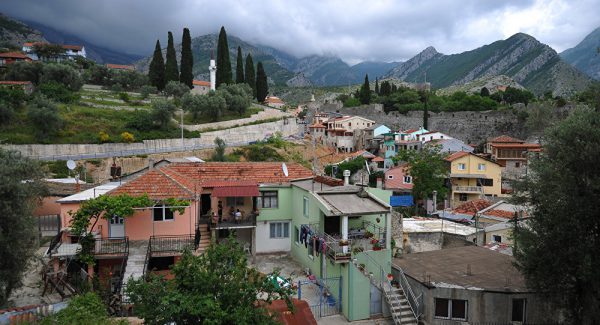
Russia NOT involved in ‘Montenegro coup’
© Sputnik/ Ramil Sitdikov
By Alexander Mercouris | The Duran | February 21, 2017
As the hysteria over the wholly fictional links between the Trump administration and Russia continues unabated, claims have been circulating about a supposed Russian plot to overthrow the government of Montenegro so as to prevent that country from joining NATO.
To say that the ‘evidence’ for this is thin would be an understatement. The best summary is in the Guardian :
Montenegrin police arrested a group of Serbian nationals on the eve of the 16 October vote and two Russian suspects are wanted over the alleged plot to seize parliament and assassinate former president and prime minister Milo Đukanović.
Montenegrin authorities had previously said the conspiracy was orchestrated by “Russian nationalists” but special prosecutor Milivoje Katnić went a step further on Sunday evening, suggesting that Russian authorities were involved.
“So far we have had evidence that Russian nationalist structures were behind [the plot], but now also that Russian state bodies were involved at a certain level,” Katnić told local media. “The organs of the Russian state must investigate which bodies are involved and open a criminal trial over these acts.”
A spokesman for the Russian president, Vladimir, Putin, dismissed the allegations. “These (are) absurd accusations … We do not interfere in the internal affairs of other countries, including Montenegro,” Dmitry Peskov said on Monday.
According to Katnić, a key witness, Aleksandar Sinđelić, a nationalist Serb, was invited to Moscow by Eduard Sismakov, a member of “Russian military structures”, to be cleared for the mission. Sismakov, using the alias Shirakov, “asked him to work first to prevent Montenegro from entering Nato. That is the sole motivation of these structures,” Katnić said. Montenegrin prosecutors suspect 25 people, mostly Serbs, of links to the alleged coup, and are searching for two Russians, including Sismakov, who is believed to be the main organiser.
In other words the entire weight of the claim of Russian involvement in the supposed coup rests on the supposed connection between the plotters and an individual identified as “Eduard Sismakov”. As to who Eduard Sismakov is, he has been identified by the BBC as a former deputy military attache to Poland.
It is just about conceivable that some fiery people in this small but proud Balkan Slav country with its tradition of friendship towards Russia might have come up with some crackbrained plan to overthrow the government in order to prevent it joining NATO. Given the long history of close contacts between Montenegro and Russia it is also just possible that they might have met with some people in Russia and got support from them. To construct from these facts a wild theory of a Russian plot to overthrow the government of Montenegro is however little short of absurd. Yet as leaks from the usual ‘anonymous officials’ to the Daily Telegraph show, the British government is trying to give credence to the whole affair.
It is barely conceivable that anyone in any senior position in Moscow would seriously contemplate the idea of a coup in Montenegro. Though the Russians would obviously prefer that Montenegro did not join NATO, the country is too small and too distant from Russia for this to be a serious issue for them. It beggars belief that anyone in authority in Moscow would take the totally reckless and irresponsible step of ordering a coup in a traditionally friendly country in order to prevent something which for Russia ultimately does not matter.
Moreover for the Russians to plan a coup in another country would be for them an extraordinary step to say the least. Whilst the US has a long history of organising or backing coups in foreign states going all the way back to the coup in Iran in 1953, the Russians have not played any role in any coup in Europe since the Czech coup of 1948. Nor have they engaged in much coup making elsewhere. The coup in Afghanistan in 1978 which they were once widely believed to have organised is now known to have caught them by surprise.
Given their traditional aversion to organising coups in other countries – and their lack of know-how in how to do it – it is scarcely conceivable that the Russians would attempt such a thing in Montenegro where the benefits are small and the risks are so obviously great.
In Montenegro itself the government’s plan to join NATO has come in for a great deal of criticism, and there are reports that the opposition to the government is claiming that the whole coup plot is a fiction fabricated by the government in order to discredit it.
I do not know whether that is true or not. However it is altogether more likely than the farfetched claims about Russian involvement in the plot which the Montenegro authorities are making.
Challenging Klobuchar on Ukraine War
As Democrats compete to become the new War Party – pushing for a dangerous confrontation with nuclear-armed Russia – some constituents are objecting, as Mike Madden did in a letter to Sen. Amy Klobuchar.
From Mike Madden (of St. Paul, Minnesota) | February 19, 2017
Dear Senator Klobuchar, I write with concern over statements you have made recently regarding Russia. These statements have been made both at home and abroad, and they involve two issues; the alleged Russian hack of the presidential election and Russia’s actions in the aftermath of the February 22, 2014 coup in Kiev.
U.S. intelligence services allege that President Vladimir Putin ordered an influence campaign to denigrate Hillary Clinton and help elect Donald Trump. The campaign is purported to include the production of fake news, cyber-trolling, and propaganda from Russian state-owned media. It is also alleged that Russia hacked the email accounts of the Democratic National Committee and Clinton campaign chair John Podesta, subsequently providing the emails to WikiLeaks.
Despite calls from many quarters, the intelligence services have not provided the public with any proof. Instead, Americans are expected to blindly trust these services with a long history of failure. Additionally, the former Director of National Intelligence, James Clapper, and the former Director of the Central Intelligence Agency, John Brennan, have both been known to lie to the public and to Congress, Mr. Clapper doing so under oath.
Meanwhile, WikiLeaks founder Julian Assange maintains the emails did not come from Russia (or any other state actor) and his organization has an unblemished record of revealing accurate information in the public interest that would otherwise remain hidden. While responsible journalists continue to use the word ‘alleged’ to describe the accusations, Republicans with an ax to grind against Russia, and Democrats wishing to distract from their own failings in the campaign, refer to them as fact. Indeed, on the ‘Amy in the News’ page of your own website, Jordain Carney of The Hill refers to the Russian meddling as “alleged”.
A congressional commission to investigate the alleged Russian hacking is not necessary. Even if all the allegations are true, they are altogether common occurrences, and they certainly don’t rise to the level of “an act of aggression”, “an existential threat to our way of life”, or “an attack on the American people” as various Democratic officials have characterized them. Republican Senator John McCain went full monty and called the alleged meddling “an act of war”.
Joining War Hawks
It is of concern that you would join Senator McCain and the equally belligerent Senator Lindsey Graham on a tour of Russian provocation through the Baltics, Ukraine, Georgia, and Montenegro. The announcement of your trip (December 28, 2016) on the ‘News Releases’ page of your website renewed the unproven claim of “Russian interference in our recent election”. It also claimed that the countries you were visiting were facing “Russian aggression” and that “Russia illegally annexed Crimea”.
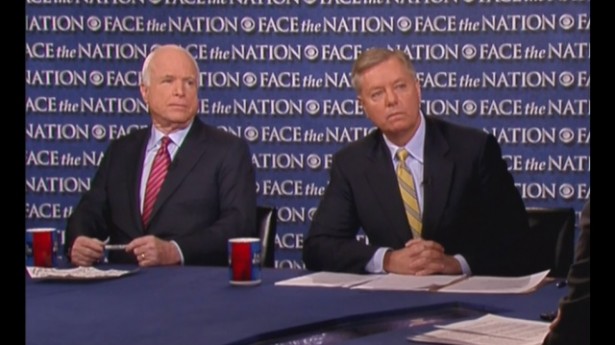
Sen. John McCain and Sen. Lindsey Graham
It is unfortunate that these claims have become truisms by sheer repetition rather than careful examination of the facts. Russia has not invaded eastern Ukraine. There are no regular units of the Russian military in the breakaway provinces, nor has Russia launched any air strikes from its territory. It has sent weapons and other provisions to the Ukrainian forces seeking autonomy from Kiev, and there are most certainly Russian volunteers operating in Ukraine.
However regrettable, it must be remembered that the unrest was precipitated by the February 22, 2014 overthrow of the democratically elected president Viktor Yanukovych which, speaking of meddling, was assisted by U.S. State Department, other American government agencies, and one Senator John McCain. The subsequent military and paramilitary operations launched by the coup government against the People’s Republics of Donetsk and Luhansk were described by President Putin as “uncontrolled crime” spreading into the south and east of the country. In American parlance, both the interim coup government in Kiev and the current government of President Petro Poroshenko have engaged in “killing their own people”.
Ignoring the Details
If Russia’s actions are to be considered “aggression” or an “invasion”, one must find a whole new word to describe what the United States did to Iraq in 2003. If, like your colleague Senator McCain, you hold the annexation of Crimea to be illegal under the 1994 Budapest Memorandum, I urge a closer look.
On February 21, 2014, an agreement brokered by the European Union was signed between President Yanukovych and the leaders of three major opposition parties. The agreement contained terms for a cessation of violence, immediate power sharing, and new elections. Smelling blood in the water, the opposition in Maidan Square did not withdraw from the streets or surrender their illegal weapons as agreed, but instead went on the offensive. Yanukovych, under threat to his life, fled Kiev along with many others in his Party of Regions.
Nor did the opposition party leaders honor the agreement. The next day, they moved to impeach Yanukovych, however they failed to meet several requirements of the Ukrainian Constitution. They failed to indict the president, conduct an investigation, and have that investigation certified by the Constitutional Court of Ukraine. Instead, they moved directly to a vote on impeachment and, even on that count, they failed to obtain the required three-fourths majority vote. So, even though the Budapest Memorandum did offer assurances of Ukrainian security and territorial integrity in exchange for surrender of Soviet-era nuclear weapons on its soil, the sovereign government of Ukraine had fallen in a violent unconstitutional putsch.
Yanukovych remained its legitimate president-in-exile and he, along with the prime minister of the Autonomous Republic of Crimea, requested Russian intervention on the peninsula to provide security and protect the human rights of ethnic Russians threatened by the new coup government and neo-Nazi elements within it.
One can now see how real that threat was by looking to eastern Ukraine where the Ukrainian military and neo-Nazi paramilitaries such as the Azov Battallion, have moved with force against the defenders of the Donbass region whose people seek autonomy from a government in Kiev that they do not recognize. Approximately 10,000 people have died in the Donbass War, whereas only six people were killed during the period of annexation (February 23-March19, 2014) in Crimea.
While the Donbass War drags on, Crimea remains stable today. The popular referendum conducted on March 16, 2014 lent legitimacy to the subsequent annexation. Official results claimed 82% turnout with 96% of voters favoring reunification with Russia. Independent polling conducted in the early weeks of March 2014 found 70-77% of all Crimeans favored reunification. Six years prior to the crisis in 2008, a poll found that 63% favored reunification. Even though many ethnic Ukranians and Tatars boycotted the election, rejoining Russia was clearly the will of the majority of Crimean people.
President Putin, characterizing the situation in Ukraine as a revolution, claimed that Russia had no agreements with the new state and therefore no obligations under the Budapest Memorandum. He also cited Chapter I: Article 1 of the United Nations Charter, which calls for respect for the principle of self-determination of peoples. The 1975 Helsinki Accords, which affirmed post-World War II borders, also allowed for the change of national boundaries by peaceful internal means.
The Kosovo Precedent
It is also useful to consider parallel occurrences in Kosovo. In 1998 ethnic cleansing by Serbian troops and paramilitaries led to a NATO intervention without U.N. authorization. There is little question that the move was illegal, but legitimacy was claimed due to the urgent humanitarian need. Ten years later, Kosovo would declare independence from Serbia and the disputed matter would end up before the International Court of Justice. In 2009 the United States provided the Court with a statement on Kosovo that read in part: “Declarations of independence may, and often do, violate domestic legislation. However, this does not make them violations of international law.”
The United States should accept the Russian annexation of Crimea both as a pragmatic matter, and one of principle. In 1990, during negotiations for the re-unification of Germany, the United States promised that there would be no eastward expansion of NATO. That promise has now been broken three times and eleven new nations have been added to the alliance. Ukraine has also entered in partnership with NATO, and at various times, full membership has been discussed. Russia has consistently expressed its disapproval. According to your website, an objective of your trip was “to reinforce support for NATO”. If this weren’t provocative enough, your three-senator delegation went to a front-line military outpost in Shirokino, Ukraine to incite an escalation to the Donbass War. Senator Graham told the assembled soldiers “Your fight is our fight, 2017 will be the year of offense”. The leader of your delegation, Senator McCain, said “I am convinced you will win and we will do everything we can to provide you with what you need to win”.
After the speeches were given, you are seen in a video of the New Year’s Eve event accepting what appears to be a gift from one of the uniformed soldiers. With all of the furor over former National Security Advisor Michael Flynn’s resignation, and possible violation of the Logan Act, for discussing alleviation of sanctions with a Russian ambassador, this appears to be a far more serious offense. Not only did your delegation advocate for a foreign policy that was not aligned with that of acting President Obama, it was also contrary to President-elect Trump’s approach to the region. And the results of your advocacy have the potential to be far more deadly than the mere alleviation of sanctions.
Sincerely, Mike Madden St. Paul, Minnesota
US Raises Issue of INF Violation: Anti-Russian Campaign in Full Swing
By Alex GORKA | Strategic Culture Foundation | 20.02.2017
According to the New York Times, «a Trump administration official» has accused Russia of violating the Intermediate-Range Nuclear Forces Treaty (INF Treaty). The statement was supported by the Defense Department. Senate Armed Services Committee Chairman John McCain chimed in, saying «Russia’s deployment of nuclear-tipped ground-launched cruise missiles in violation of the INF treaty is a significant military threat to US forces in Europe and our NATO allies». According to him, Russian President Vladimir Putin was «testing» Trump.
The statement was immediately used by hawks as a pretext for instigating tensions. For instance, Sen. Tom Cotton, an Arkansas Republican, said he sees little reason for the US to continue adhering to the INF treaty in light of alleged Russia’s «violations». He has recommended building up US nuclear forces in Europe, which currently include about 200 bombs that can be delivered by aircraft. The US withdrew land-based nuclear-armed missiles from Europe as part of the INF deal.
The Treaty eliminated all ground-based nuclear and conventional missiles, as well as their launchers, with ranges of 500–1,000 kilometers (310–620 mi) (short-range) and 1,000–5,500 km (620–3,420 mi) (intermediate-range). Signed in December 1987 by President Ronald Reagan and Soviet leader Mikhail Gorbachev, the INF deal is accredited with significantly reducing the threat of nuclear confrontation and accelerating the end of the Cold War.
By May 1991, 2,692 missiles were eliminated, followed by 10 years of on-site verification inspections. The document did not cover sea-launched missiles. It stands as the only arms treaty to eliminate an entire class of US and Russian weapons – nuclear and conventional ground-launched ballistic and cruise missiles of intermediate range.
Last year, the State Department reported Russia was in violation of its treaty obligations not to possess, produce or flight-test a ground-launched cruise missile with a range of between 500 and 5,500 kilometers, or to possess or produce launchers for such missiles. «The administration is undertaking an extensive review of Russia’s ongoing INF treaty violation in order to assess the potential security implications for the United States and its allies and partners», said Mark Toner. The alleged violations had been mentioned in the 2014 and 2015 compliance reports.
No specifics have been released about which exactly Russian weapon is the source of the violation. The only thing it has said is that an unspecified Russian ground-launched cruise missile breaches the agreement. Supposedly, the missile in question is the SSC-8, a ground-based adaptation of the Kalibr missiles that were battle tested in Syria striking targets in Syria, nearly 1,000 miles away, from the Caspian Sea. Despite all the statements with accusations, no compelling evidence of the Russian non-compliance has ever been produced.
It should be noted that even if the missile has been tested, there is no violation. The INF Treaty allows the testing of sea-launched cruise missiles (SLCMs) from ground-based platforms if they are fixed. Article VII (para 11) states, «A cruise missile which is not a missile to be used in a ground-based mode shall not be considered to be a GLCM if it is test-launched at a test site from a fixed land-based launcher which is used solely for test purposes and which is distinguishable from GLCM launchers».
Russia, in turn, has accused the US of violating the pact. In a nutshell, it cites the following examples of non-compliance:
– The use of target missiles with characteristics similar to those of intermediate and shorter-range ballistic missiles during ballistic missile defense (BMD) tests. With its operational range (1,100 km) Hera qualifies as an intermediate ballistic missile and hence violates Item 1, Article 6 of the INF Treaty.
– The deployment in Romania and Poland of Mk-41 Aegis Ashore launchers capable of firing ground-launched cruise missiles (GLCMs). A US mid-range weapon launched from Poland would require only a short flight time to reach beyond the Urals.
– US unmanned aerial vehicles (UAVs) or armed drones such as the MQ-1 Predator, fall under the INF Treaty definition of GLCMs. Moscow claims that their operational ranges (1,100 km) and lack of pilot mean that drones of this type are very similar to shorter-range cruise missiles.
It’s worth noting that the US plans to arm tactical aviation in Europe with modernized B61-12 guided warheads will virtually nullify all the benefits of the INF Treaty from the point of view of Russia’s security. The aircraft could fly from bases in Lithuania, Estonia and Poland to Russia’s largest cities in 15-20 minutes – not that much longer than the flight time of the missiles scuttled by the INF treaty.
The Special Verification Commission (SVC) envisioned by the INF treaty is a forum to confidentially address compliance concerns. It was convened last November for the first time since 2003 to produce no results. The opportunities provided by this venue should not be squandered. It would be much more fruitful to start serious discussions within the framework of the SVC than make public statements not backed up by facts. The accusations obviously pursue the aim of whipping up tensions to spoil the RF-US relationship at the time it has a chance to improve.
The INF treaty is under serious and increasing stress. Failure to resolve the dispute could threaten the agreement and impede further efforts to reduce Russia and US nuclear arsenals in the years ahead. The parties could use the SVC venue to consider additional confidence-building measure and information exchanges that take into account technological and political developments that have occurred recently. The Open Skies Treaty could be used for the purpose. Its observation capabilities could be upgraded. The NATO-Russia Council could serve as another mechanism to address specific security concerns.
The issue has been debated since 2014 but before this statement no one has officially accused Russia of violating the INF. It should be noted that this time the issue was raised immediately after the Flynn’s resignation from the position of national security adviser. Revelations about alleged ‘Russia connections» of the people who belong to the Trump’s team are hitting US media headlines. The statement about the INF violation is made against the background of the White House’s statement stressing the need to «return» Crimea to Ukraine and the ballyhoo raised over the alleged dangerous maneuvering of Russian aircraft in the Black Sea. These are provocative statements doomed to be rejected by Moscow but they pursue a definite purpose. Evidently, some powerful circles in the US have launched a well-orchestrated campaign to prevent the improvement of Russia-US relations.
‘Year of kicking Russia in the ass’: US Senator Graham urges more Russia sanctions
RT | February 19, 2017
 Senator Lindsey Graham (R-SC) has said that 2017 is going to be “the year of kicking Russia in the ass” as he threatened Moscow with a new round of sanctions over Moscow’s alleged US election interference.
Speaking at the Munich Security Conference on Sunday, the Republican senator referred to accusations by both Republicans and Democrats: that Kremlin-backed hackers conspired to rig the 2016 US presidential election at the expense of Hillary Clinton, adding that a bipartisan investigation is due to get underway.
“If you’re worried that we’re not going to look long and hard at what Russia did in our election because Trump won and the Republicans are in charge, you don’t need to worry about that,” the South Carolina lawmaker told delegates from around the world. “I promise everybody in this room that Congress is going to take a long, hard look at what Russia did to undermine our elections, so they’ll be better prepared when they come your way.”
If the investigation turned up any evidence of Russian interference there would be consequences, Graham warned.
“So we’ve introduced Russia sanctions for interfering in our election, apart from what they did in Crimea, we’re going to have a vote on it. It’s going to be bipartisan, we’re going to get north of 75 votes and my goal is to put it on Trump’s desk and I hope he will embrace the idea that as the leader of the free world, he should be working with us to punish Russia.”
Graham said he believed Moscow would try to influence the upcoming elections in Europe. “To our German friends, you’re next. To our friends in France, they’re coming after you. And to my friend Mr. Lavrov, I hope you finally suffer some consequences for what you and your regime have been doing to democracies, and 2017 is going to be the year of kicking Russia in the ass in Congress,” he told delegates at the Bayerischer Hof Hotel on Sunday.
Moscow has consistently denied all allegations of any state-backed hacking while cybersecurity and intelligence experts have said there is no evidence for these claims.
“If I was the Chinese and I wanted to make it look like the Russians did it, I would use Russian language within the code, I would use Russian techniques of breaking into the organization,” cybersecurity pioneer John McAfee told RT in December, adding that “there simply is no way to assign a source for any attack.”
The Did-You-Talk-to-Russians Witch Hunt
By Robert Parry | Consortium News | February 18, 2017
In the anti-Russian frenzy sweeping American politics and media, Democrats, liberals and mainstream pundits are calling for an investigative body that could become a new kind of House Un-American Activities Committee to hunt down Americans who have communicated with Russians.
The proposed commission would have broad subpoena powers to investigate alleged connections between Trump’s supporters and the Russian government with the apparent goal of asking if they now have or have ever talked to a Russian who might have some tie to the Kremlin or its intelligence agencies.
Such an admission apparently would be prima facie evidence of disloyalty, a guilt-by-association “crime” on par with Sen. Joe McCarthy’s Cold War pursuit of “communists” who supposedly had infiltrated the U.S. government, the film industry and other American institutions.
Operating parallel to McCarthy’s Red Scare hearings was the House Un-American Activities Committee (or HUAC), a standing congressional panel from 1945-1975 when it was best known for investigating alleged communist subversion and propaganda. One of its top achievements was the blacklisting of the “Hollywood Ten” whose careers in the movie industry were damaged or destroyed.
Although the Cold War has long been over – and Russia has often cooperated with the U.S. government, especially on national security issues such as supplying U.S. troops in Afghanistan – Democrats and liberals seem ready to force Americans to again prove their loyalty if they engaged in conversations with Russians.
Or perhaps these “witnesses” can be entrapped into perjury charges if their recollections of conversations with Russians don’t match up with transcripts of their intercepted communications, a tactic similar to ones used by Sen. McCarthy and HUAC to trip up and imprison targets over such secondary charges.
Ousted National Security Advisor Michael Flynn has already encountered such a predicament because he couldn’t recall all the details of a phone conversation with Russian Ambassador Sergey Kislyak on Dec. 29, 2016, after Flynn took the call while vacationing in the Dominican Republic.
When Obama administration holdovers at the Justice Department decided to gin up a legal premise to go after Flynn, they cited the Logan Act, a law enacted in 1799 to prohibit private citizens from negotiating with foreign adversaries but never used to convict anyone. The law also is of dubious constitutionality and was surely never intended to apply to a president-elect’s advisers.
However, based on that flimsy pretext, FBI agents – with a transcript of the electronic intercept of the Kislyak-Flynn phone call in hand – tested Flynn’s memory of the conversation and found his recollections incomplete. Gotcha – lying to the FBI!
Under mounting media and political pressure, President Trump fired Flynn, apparently hoping that tossing Flynn overboard to the circling sharks would somehow calm the sharks down. Instead, blood in the water added to the frenzy.
Iran-Contra Comparison
Some prominent Democrats and liberals have compared Trump-connected contacts with Russians to President Richard Nixon’s Watergate scandal or President Reagan’s Iran-Contra Affair, an issue that I know a great deal about having helped expose it as a reporter for The Associated Press in the 1980s.
The key difference is that Iran-Contra was an unconstitutional effort by the Reagan administration to finance an illegal war against Nicaragua’s Sandinista government in defiance of a congressional ban. The Trump-connected communications with Russians – to the degree they have occurred – appear to have been aimed at preventing a new and dangerous Cold War that could lead to a nuclear holocaust.
In other words, Iran-Contra was about enabling a paramilitary force to continue its brutal marauding inside a country that was no threat to the United States while the current “scandal” is about people trying to avoid hostilities between two nuclear superpowers, an existential threat that many mainstream and liberal pundits don’t want to recognize.
Indeed, there is a troubling denial-ism about the risks of an accidental or intentional war with Russia as the U.S. media and much of Official Washington’s establishment have lots of fun demonizing Russian President Vladimir Putin and jabbing the Russians by shoving NATO troops up to their borders and deploying anti-ballistic missiles in Eastern Europe. For some crazy reason, the Russians feel threatened.
False Narratives
This Russia-bashing and Russia-baiting have been accompanied by false narratives presented in the major U.S. newspapers, including The New York Times and The Washington Post, to justify increased tensions.
For instance, the Post’s senior foreign affairs writer Karen DeYoung on Friday described the civil war in Ukraine this way: “That conflict began when Russia invaded and annexed Crimea in 2014, then backed separatists in eastern Ukraine in what has become a grinding war, despite a deal to end it, called the Minsk agreement, negotiated with Putin by the leaders of France and Germany.”
But DeYoung’s synopsis is simply not true. The crisis began in the fall of 2013 when Ukraine’s elected President Viktor Yanukovych backed out of what he regarded as a costly and unacceptable association agreement with the European Union, a move which prompted protests by Ukrainians in Kiev’s Maidan square.
The Obama administration’s State Department, U.S. neocon politicians such as Sen. John McCain, and various U.S.-backed “non-governmental organizations” then stoked those protests against Yanukovych, which grew violent as trained ultra-nationalist and neo-Nazi street fighters poured in from western Ukraine.
In early 2014, a coup to overthrow the democratically elected Yanukovych took shape under the guidance of U.S. Assistant Secretary of State Victoria Nuland and U.S. Ambassador to Ukraine Geoffrey Pyatt who were caught in a phone call in late January or early February 2014 conspiring to impose new leadership inside Ukraine.
Nuland disparaged a less extreme strategy favored by European diplomats with the pithy remark: “Fuck the E.U.” and went on to declare “Yats is the guy,” favoring Arseniy Yatsenyuk as the new leader. Nuland then pondered how to “glue this thing” while Pyatt ruminated about how to “midwife this thing.”
On Feb. 20, 2014, a mysterious sniper apparently firing from a building controlled by the ultranationalist Right Sektor killed both police and protesters, setting off a day of violence that left about 70 people dead including more than a dozen police.
The next day, three European governments struck a deal with Yanukovych in which he agreed to early elections and accepted reduced powers. But that political settlement wasn’t enough for the U.S.-backed militants who stormed government buildings on Feb. 22, forcing Yanukovych and his officials to flee for their lives.
Instead of standing by the Feb. 21 agreement, which the European nations had “guaranteed,” Nuland pushed for and got U.S. allies to accept the new post-coup regime as “legitimate,” with Yatsenyuk becoming prime minister and several top government posts given to the ultranationalists and neo-Nazis.
Spreading Violence
In the ensuing days, the right-wing violence spread beyond Kiev, prompting Crimea’s legislature to propose secession from Ukraine and readmission to Russia, whose relationship to the peninsula dated back to Catherine the Great.
Crimea scheduled a referendum that was opposed by the new regime in Kiev. Russian troops did not “invade” Crimea because some 20,000 were already stationed there as part of a basing agreement at the Black Sea port of Sevastopol. The Russians did provide security for the referendum but there was no evidence of intimidation as the citizens of Crimea voted by 96 percent to leave Ukraine and rejoin Russia, a move that Putin and the Russian duma accepted.
Eastern Ukrainians tried to follow Crimea’s lead with their own referendum, but Putin and Russia rejected their appeals to secede. However, when the Kiev regime launched an “Anti-Terrorism Operation” against the so-called Donbass region – spearheaded by ultra-nationalist and neo-Nazi militias – Russia provided military assistance so these ethnic Russians would not be annihilated.
Karen DeYoung also framed the Minsk agreement as if it were imposed on Putin when he was one of its principal proponents and architects, winning its approval in early 2015 at a time when the Ukrainian military was facing battlefield reversals.
But Assistant Secretary Nuland, working with Prime Minister Yatsenyuk and the Ukrainian parliament, sabotaged the agreement by requiring the Donbass rebels to first surrender which they were unwilling to do, having no faith in the sincerity of the Kiev regime to live up to its commitment to grant limited autonomy to the Donbass.
In other words, Kiev inserted a poison pill to prevent a peaceful resolution, but the Western media and governments always blame the Minsk failure on Putin.
If Karen DeYoung wanted to boil all this history down to one paragraph, it might go: “The Ukraine conflict began when U.S. officials supported the violent overthrow of elected President Viktor Yanukovych, prompting Crimea to rejoin Russia and causing ethnic Russians in the east to rise up against the U.S.-backed coup regime in Kiev, which then sought to crush the rebellion. The Kiev regime later torpedoed a peace deal that had been hammered out by Russian, Ukrainian and European negotiators in Minsk.”
But such a summary would not have the desired propaganda effect on the American people. It would not present the U.S.-backed side as the “white hats” and the pro-Russia side as the “black hats.”
The simple truth is that the story of Ukraine is far more complex and multi-sided than The Washington Post, The New York Times and most mainstream U.S. news outlets want to admit. They simply start the clock at the point of Crimea’s rejection of the post-coup regime and distort those facts to present the situation simply as a “Russian invasion.”
A Whipped-Up Hysteria
The major media’s distortion is so egregious that you could call it a lie, but it is a lie that has proved very useful in whipping up the current anti-Russian hysteria that is sweeping Official Washington and that has given birth to a New Cold War, now accompanied by a New McCarthyism that deems anyone who doesn’t accept the “groupthink” a “Russian apologist” or a “Moscow stooge.”
Since last November’s election, this New McCarthyism has merged with hatred toward Donald Trump, especially after the outgoing Obama administration lodged unproven accusations that Russia undercut Hillary Clinton’s campaign by hacking into the emails of the Democratic National Committee and those of her campaign chairman John Podesta – and slipped that information to WikiLeaks.
Those emails showed how the DNC undercut the rival campaign of Sen. Bernie Sanders and revealed the contents of Clinton’s speeches to Wall Street banks as well as pay-to-play aspects of the Clinton Foundation, information that Clinton wanted to keep from the voters.
But no one thought the emails were a major factor in the Clinton-Trump race; indeed, Clinton blamed her stunning defeat on FBI Director James Comey’s last-minute decision to reopen and then re-close his investigation into security concerns about her use of a private email server as Secretary of State.
But the script on how Clinton lost was flipped during the Trump transition as President Obama’s intelligence agencies floated the Russia-hacked-the-election scenario although presenting no public evidence to support the claims. WikiLeaks representatives also denied getting the material from Russia, suggesting instead that it was leaked by two different American insiders.
A Ministry of Truth
Still, during the post-election period, the anti-Russian hysteria continued to build. In November, The Washington Post highlighted claims by an anonymous group called PropOrNot accusing some 200 Web sites, including Consortiumnews.com and other major independent media outlets, of disseminating Russian “propaganda.”
The New York Times joined in the frenzy by calling for leading technology companies to marginalize Web sites that are deemed to be publishing “fake news,” a vague term that was applied not just to intentionally false stories but to information that questioned official narratives, no matter how dubious those narratives were. The New McCarthyism was morphing into a New Orwellianism.
The movement toward a Ministry of Truth gained further momentum in December when Congress passed and President Obama signed a military authorization bill that included a new $160 million bureaucracy to identify and counter alleged “Russian propaganda.”
The anger of Democrats and liberals toward President Trump in his first month has added more fuel to the Russia-bashing with some Democrats and liberals seeing it as a possible route toward neutralizing or impeaching Trump. Thus, the calls for a full-scale investigation with subpoena power to demand documents and compel testimony.
While the idea of getting to the full truth has a superficial appeal, it also carries dangers of launching a witch hunt that would drag American citizens before inquisitors asking about any contacts – no matter how innocuous – with Russians.
In the late 1940s and early 1950s, HUAC also claimed that all it wanted was the truth about whether some Americans were allied with or sympathetic to Moscow. Sen. Joe McCarthy offered a similar rationale when he was trying to root out “disloyal” Americans with the question, “are you now or have you ever been a communist?”
That Democrats and liberals who hold the McCarthy era in understandable disdain would now seek to rekindle something similar reeks of rank opportunism and gross hypocrisy – doing whatever it takes to “get Trump” and build an activist movement that can revive the Democratic Party’s flagging political hopes.
But this particular opportunism and hypocrisy also carries with it the prospect of blindly ramping up tensions with Russia, diverting more taxpayer money into the Military-Industrial Complex and conceivably sparking – whether planned or unplanned – a nuclear Armageddon that could eliminate life on the planet. Perhaps this anti-Trump strategy should be rethought.
Investigative reporter Robert Parry broke many of the Iran-Contra stories for The Associated Press and Newsweek in the 1980s.
NGOs Fabricating Evidence Against Syria
By Tim Hayward | February 18, 2017
Last week, Amnesty International published a report that was severely criticised for literally fabricating evidence to support implausible accusations against the Syrian government.[1] The report included a project of ‘Forensic Architecture’ that served in guiding the imagination as to the horrors that might be perpetrated in a building used for torture and execution. Computerised modelling of this kind may have its uses, but it clearly has limitations when it comes to determining who may have done what in a building. A computer can only simulate on the basis of inputs. The inputs come from elsewhere, and they may or may not be reliable or appropriately detailed.[2]
This week, Médecins Sans Frontières (MSF) announced that they too have been commissioning research in Forensic Architecture. This might seem a strange thing for an organisation of doctors to be doing. Still, their ostensible concern is that the bombing of hospitals – something contrary to the law of war and human morality – should not go unrecorded nor, ultimately, unpunished. An added difficulty is that ‘often, the only real redress available to MSF is to publicly denounce perpetrators of bombings in the hope that the damage to their image will incite them to modify their practices.’ Denunciations may have little enough effect, particularly when even the grounds for them is uncertain. Where there is a known threat of danger to the staff running a hospital, MSF prudently does not even attempt to operate. The organisation does sometimes offer support of some kind to medics who do work in war zones, however, like the province of Idlib in Syria.
Just over a year ago, the MSF-supported Ma’arat Al Numan hospital in Idlib province was hit by an airstrike. At the time, ‘Dr Mego Terzian, president of MSF’s French section, publicly accused the Russian-Syrian coalition of being responsible for the bombings – a conviction based on an analysis of the context, the military forces present and testimonies from Syrian civilians (some known to MSF for some time) who were at the scene.’ However, the accusation sparked ‘much heated debate within the MSF Movement. On what grounds is MSF accusing Russia and Syria? How reliable are the witness statements it is using to support its allegations?’ (See also my recent article on How We Were Misled About Syria by MSF.)
Now, MSF tells us, ‘The Forensic Architecture team has conducted an investigation based on videos and photographs circulating on social media, taken by medical personnel, activists and ordinary citizens.’
And?
‘While their investigation does not provide solid evidence, it does confirm MSF’s conviction as to the responsibility of Syrian and Russian forces in the bombing of the hospital in Ma’arat Al Numan.’
So, no evidence, and yet a confirmation of a ‘conviction’?
I think perhaps the research team promoting this new use of computerised modelling should make clear the limitations of its proper use. The recent case of Amnesty International appealing to the same source of non-evidence highlights an overreach that the researchers now risk seeming complicit in. The timing of the release of these dramatic pieces of non-evidence hardly looks accidental to any serious observer. Do the people at Forensic Architecture really want to be seen as partners in a continued drive to destabilise the Middle East?
As for MSF, and this goes for Amnesty International too, their publications on Syria sometimes read like the worst kind of tabloid journalism. Exaggerated headline claims backed up by no supporting evidence, and with crucial caveats, if included at all, tucked away where they are unlikely to register with any but the most cautious readers.
Is there something going on in the direction of those organisations that is not quite what ordinary supporters among the public believe?
[1] On the fabrication see Tony Cartalucci. The report was critically analysed by Rick Sterling as well as Moon of Alabama. The former UK Ambassador to Syria, Peter Ford, who had earlier visited the prison in question, stated the report ‘would not stand scrutiny’. A former prisoner there, who remains an opponent of Assad, stated that while atrocious things certainly occurred, the scale of Amnesty’s claims was preposterous. Further critical discussions are cited here.
[2] MSF say, ‘Investigations use amateur photographs and video footage to help reconstruct the “crime scene”‘. Specifically, they add, ‘Using cartography, image analysis, and legal and architectural expertise, research agency Forensic Architecture collects and analyses images taken of a crime committed by a State to establish the facts and ascertain who was responsible.’ An obvious question concerns the difference between establishing the facts of physical changes undergone by a structure and attributing responsibility for causing them, since the latter challenge necessarily involves input of extra-architectural data.
Kremlin Refutes Claims Russian Media Were Recommended to Write Less About Trump
Sputnik – 17.02.2017
Kremlin spokesman Dmitry Peskov said that claims that Russian state media outlets were allegedly advised to decrease coverage related to US President Donald Trump are “fake news.”
Earlier, Bloomberg claimed citing sources that Russian state media outlets have allegedly received an order from the Kremlin to “cut way back on their fawning coverage of President Donald Trump, reflecting a growing concern among senior Russian officials that the new U.S. administration will be less friendly than first thought.”
“This is utter nonsence. Due to the fact that both [Russian] channels and other media outlets are absolutely free to determine their editorial policy, and such statements, this claim is yet another example of fake news,” Peskov said answering a question whether or not there any instructions from the presidential administration concerning state TV channels’ change of coverage of information about Donald Trump and the US.
When asked to clarify why a few days ago Russian television channels have started to decrease coverage of Trump’s actions as the new US president, the Kremlin spokesman said that “sincerely speaking, we do not follow the proportions of coverage related to events.”
“Moreover, all sources of information, whether it be television channels — both public and private cable networks and foreign ones — and the Internet, radio, newspapers etc., everything is absolutely available [in Russia], so in this case… there’s an extensive range of options.”
Featured Video
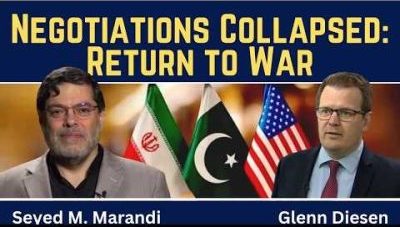
Seyed M. Marandi: Negotiations Collapsed – Return to War
or go to
Aletho News Archives – Video-Images
From the Archives
Wartime internment camps in Australia
National Archives of Australia
World War I
During World War I, for security reasons the Australian Government pursued a comprehensive internment policy against enemy aliens living in Australia.
Initially only those born in countries at war with Australia were classed as enemy aliens, but later this was expanded to include people of enemy nations who were naturalised British subjects, Australian-born descendants of migrants born in enemy nations and others who were thought to pose a threat to Australia’s security.
Australia interned almost 7,000 people during World War I, of whom about 4,500 were enemy aliens and British nationals of German ancestry already resident in Australia.
Records of World War I internment camps
World War II
During World War II, Australian authorities established internment camps for three reasons – to prevent residents from assisting Australia’s enemies, to appease public opinion and to house overseas internees sent to Australia for the duration of the war.
Unlike World War I, the initial aim of internment during the later conflict was to identify and intern those who posed a particular threat to the safety or defence of the country. As the war progressed, however, this policy changed and Japanese residents were interned en masse. In the later years of the war, Germans and Italians were also interned on the basis of nationality, particularly those living in the north of Australia. In all, just over 20 per cent of all Italians resident in Australia were interned. … continue
Blog Roll
 Aletho News
- Seyed M. Marandi: Negotiations Collapsed – Return to War
- Tomorrow’s naval blockade showdown
- ‘Israel’ attacks civilians to hide its embarrassing military failures & out of pure sadism
- Any Foreign Military Vessel Approaching Hormuz Under Any Pretext ‘Will Be Dealt With Severely’: IRGC
- Diplomats slam US negotiators’ performance in Iran talks
- Trump Refuses Exit Ramp, War with Iran will Continue
- Trump Says US Naval Blockade in Strait of Hormuz Will Begin Shortly
- US, Iran end 21-hour talks without agreement
- US IRAN TALKS: Who Are the Crazy Ones Here? /Lt Col Daniel Davis
- Talks with the US end without a deal over excessive US demands: Iran
- If Americans Knew
- US-Iran ceasefire negotiations make zero progress – Daily Update
- Pro-Israel ‘Thinktanks’ and Individuals who Influence U.S. Foreign Policy
- Mearsheimer reveals how Israel dictates US policies on Iran, Gaza – video
- After killing 350+, Israel still has a “score to settle” with Lebanon before ceasefire – Daily Update
- Military aid to Israel emerges as the latest political litmus test for Democrats
- The only Palestinian children’s rights organization closes following years-long Israeli campaign against it
- ‘I Can’t Forget the Smell’: Lebanese Reel After Israel Kills Over 300 in Single Day
- DNC Shoots Down Resolutions Calling Out AIPAC and Limiting Arms to Israel
- TCN: Is Israel Blackmailing President Trump?
- Israel killed at least 303 Lebanese yesterday – who were they? Daily Update
- No Tricks Zone
- Cave Discovery Reveals Today’s Desert Climates Were Recently Far Warmer, Wetter, Teeming With Life
- German Expert: Heat Dome Led To Record Temps In Western USA…Warmer In 1934, 1936
- New Study: No Linear Warming Or Glacier Retreat Along Northern Antarctic Peninsula Since 1980s
- An Inconvenient Tree: Uncovered In Alps… Europe Much Warmer Than Today 6000 Years Ago
- New Study Reports A 60% Slowdown In Greenland’s Ice Loss Rate In The Last Decade
- Low Intensity Tornado Wrecks Major Solar Farm, Creating A Potential Toxic Dump
- New Study Finds Warming Saves Lives…Cold Temperatures 12 Times More Deadly Than Excess Heat
- German Science Blog Accuses PIK Climate Institute Of Hallucinating Climate Tipping Points
- Devastating Assessment Of Comirnaty Vaccine By Former Senior Pfizer Europe Toxicologist
- New Study: CO2 Is ‘Effectively Negligible’ As An Explanatory Climate Change Factor Since 2000
 Aletho News