White House denies AP report of plan for 100,000 troops to round up immigrants
RT | February 17, 2017
The Trump administration is considering mobilizing as many as 100,000 National Guard troops to round up illegal immigrants, according to a draft memo obtained by AP. The White House said the agency’s report is “false,” however.
What the AP called “unprecedented militarization of immigration enforcement” would affect locations as far north as Portland, Oregon and as far east as New Orleans, Louisiana, according to the 11-page document, purportedly written by Homeland Security Secretary John Kelly.
The proposal would include four states bordering on Mexico – Arizona, California, New Mexico and Texas – as well as the seven neighboring states of Arkansas, Colorado, Louisiana, Nevada, Oklahoma, Oregon and Utah. Governors in the eleven states would have a choice whether to have their guard troops participate in the round-up, according to AP.
The White House responded to the news with only one word: “False,” according to Reuters.
“This is not true,” White House spokesman Sean Spicer tweeted about the AP report, adding that Homeland Security confirmed it as “100 percent false.”
According to AP, the draft memo was dated January 25 – the day President Donald Trump issued an executive order “enhancing public safety in the interior of the United States” – and has been circulating among Homeland Security staff for the past two weeks. It is reportedly addressed to the acting chiefs of the US Immigration and Customs Enforcement and Customs and Border Protection.
The draft memo says the mobilized National Guard troops would be activated under a revived state-federal partnership program and authorized “to perform the functions of an immigration officer in relation to the investigation, apprehension and detention of aliens in the United States.”
Iran: US, Israeli leaders’ new claims ‘worthless’
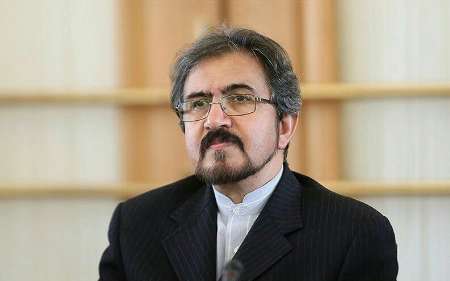
Iranian Foreign Ministry spokesman Bahram Qassemi
Press TV – February 16, 2017
Iran says Israel’s atomic weapons arsenal represents the biggest threat to world peace, dismissing new allegations by Israeli and US leaders against Iran’s nuclear program as “hollow” and “worthless”.
The reaction on Thursday came a day after US President Donald Trump called Iran’s nuclear program a threat to Israel during a news conference with Israeli Prime Minister Benjamin Netanyahu at the White House.
“The statements did not contain any new point except being a repetition of hollow and worthless allegations against Iran’s peaceful nuclear program,” Foreign Ministry spokesman Bahram Qassemi said.
Terming the nuclear deal with Iran as “the worst” agreement ever, Trump pledged to impose new sanctions on Iran to prevent the country from what he called developing a nuclear weapon.
Qassemi said, “Such claims are repeated while the International Atomic Energy Agency, in its reports, has time and again confirmed Iran’s nuclear program as peaceful – a fact which has been verified many times by different countries.”
“The bitter truth is that these remarks and inadmissible allegations are repeated by a regime which is not committed to any international law and convention and has hundreds of warheads in its atomic arsenal,” he said.
Israel, Qassemi said, “is viewed as the biggest threat to peace and security in the Middle East and the world and its ponderous file of endless atrocities and inhuman actions against the oppressed Palestinian people and other neighbors is recorded in numerous UN reports.”
In their joint news conference, Netanyahu applauded Trump for his harsh stand on Iran which was slapped with new sanctions by the new US administration in violation of the nuclear accord, known as the Joint Comprehensive Plan of Action (JCPOA).
On Tuesday, IAEA Director General Yukiya Amano confirmed that Iran was implementing the nuclear agreement under which Tehran has undertaken to scale back its nuclear program in return for lifting of the sanctions.
Qassemi said, “Nuclear weapons are haram (forbidden) from the religious standpoint, corresponding with the fatwa of the Eminent Leader of the Islamic Revolution (Ayatollah Seyyed Ali Khamenei) and have no place in Iran’s military doctrine.”
The Islamic Republic, he said, will seriously continue to pursue those components of its peaceful nuclear program which are validated by the United Nations Security Council within the framework of the JCPOA.
Under Resolution 2231, the Security Council has endorsed the nuclear deal, which went into effect in January 2016.
On his campaign trail, Trump threatened to annul the deal, which he has lambasted as “the worst accord ever negotiated” and “one of the dumbest” ones he has come cross.
Washington has taken a tougher line on Iran since Trump took office on January 20. Last month, the US said it had put Tehran “on notice” after the Islamic Republic tested a ballistic missile which is not prohibited by the nuclear deal.
Venezuela Sanctions CNN in Fight Against ‘Imperialist’ News
teleSUR | February 15, 2017
Venezuela’s National Telecommunications Commission, CONATEL, announced plans Wednesday to begin sanctioning procedures against CNN en Español for its “direct aggression against the Venezuelan people and state.”
The announcement was made in response to a CNN en Español report released last week suggesting that the Bolivarian government “may have given passports to people with ties to terrorism.” More specifically, the report alleges that Venezuelan Vice President Tareck El Aissami is linked to 173 people from the Middle East, including some connected to the Lebanese militant group Hezbollah.
“As part of its traditional interventionist and imperialist policy, this U.S. agency abrogates extraterritorial powers that blatantly violate basic principles of international law,” CONATEL wrote in a statement.
“It (CNN en Español) has the ignoble and Machiavellian purpose of undermining the image of the National Executive Branch and, therefore, institutionality, governance, and stability of the country, as well as the Bolivarian Revolution, a socio-political project contrary to its interests of domination.”
CONATEL’s statement, which points out that CNN en Español’s allegations are based on unsubstantiated evidence, urges journalists around the world to launch an independent investigation of the report.
The statement also questions the validity of government “whistleblower” Misael Lopez’s claims that the government was “scheming” to sell passports and visas for thousands of dollars. Most of CNN en Español’s report is based on alleged testimony by Lopez, a former secretary of the Venezuelan embassy in Iraq who has strong connections with Venezuela’s U.S.-backed opposition.
Lopez is a close friend and business partner of Ana Argotti, a lawyer who defends violent right-wing activists facing charges for the opposition’s “La Salida” campaign. This was the campaign that left 43 people dead and over 800 injured from street blockades known as “guarimbas.”
“Lopez is an agent infiltrated by the Venezuelan opposition based in the United States,” Venezuelan Foreign Minister Delcy Rodriguez confirmed Wednesday, AVN reports.
The Bolivarian Revolution’s battle against fake news has intensified within the last few days.
On Monday, the U.S. placed El Aissami on a sanctions list reserved for “drug kingpins,” without offering any evidence or issuing any criminal charges. The U.S. government based their decision on CNN en Español’s report as well as other unsubstantiated claims parroted by mainstream media outlets.
Last week, the Miami Herald published a story claiming that Venezuelans are killing and eating flamingos amidst food shortages, citing unsubstantiated claims made by a biology student.
Venezuela shuts down CNN, calling it ‘instrument of war’
Press TV – February 16, 2017
Venezuela’s President Nicolas Maduro says CNN is an “instrument of war” after his country pulls the network’s Spanish-language channel off the air.
During a televised Wednesday speech, Maduro claimed that the channel had been spreading “propaganda” over an alleged visa racket at the country’s embassy in Iraq, while adding that the channel was an “instrument of war in the hands of real mafias.”
He also warned US President Donald Trump to “open his eyes and ears” in the face of an “incorrect policy” adopted by CNN and the US State Department, which he said were “promoting a general, massive intervention and aggression against Venezuela.”
Earlier, the Venezuelan government issued a statement, announcing that the country’s National Telecommunications Commission had ordered “the immediate suspension of CNN Spanish broadcasts.”
Venezuelan Foreign Minister Delcy Rodriguez also stressed that the government had “ordered the relevant authorities to take action” against the channel.
She added that the February 6 report was “based absolutely on falsehoods,” and that the channel “has launched an operation of psychological warfare, a war propaganda operation.”
She also referred to one of the report’s sources, embassy employee Misael Lopez, as a “delinquent.”
The report also claimed that new Venezuelan Vice President Tareck El Aissami was behind the racket. Aissami was also recently sanctioned by the US Department of Treasury over alleged drug trafficking into the United States.
Meanwhile, Carlos Lauria, CNN’s senior program coordinator for the Americas, called on Maduro “to stop interfering with the work of the press.”
Venezuela Suspends CNN en Espanol Due to Threat to ‘Peace, Democratic Stability’
Sputnik – 16.02.2017
 Venezuela’s National Telecommunications Commission (CONATEL) has suspended the operation of the CNN en Espanol news channel on the territory of the country, the commission said in a statement.
The suspension of CNN en Espanol, which allegedly generates “a climate of intolerance” and threatens “the peace and democratic stability” of the people of Venezuela is effective immediately starting on Wednesday on all “national territory,” CONATEL said on Wednesday, accusing the channel of “aggression” against Venezuela.
The commission also urged other media actors to offer the Venezuelan people timely and impartial information that corresponds to the values of the Venezuelan society and fulfills the constitutional guarantees of free communication.
The Venezuelan government reportedly launched an investigation into the work of the CNN en Espanol channel in August 2015, accusing it of spreading false reports on violence in the country.
The news comes as US President Donald Trump called CNN “fake news” and refused to give their reporter a question at a press event after the broadcaster had helped to fuel false rumors he had hired prostitutes at a Moscow hotel and engaged in lewd behavior.
The network that markets itself as centrist relief from hyper-partisan outlets Fox and MSNBC aired an uncorroborated, unverified report alleging that Russians had obtained compromising information on Trump. The report originated from a former UK intelligence operative, according to CNN and BuzzFeed, the first outlets to publicize the reports.
Following the national and global embarrassment, CNN desperately tried to distance itself from BuzzFeed. CNN claims their reporting of Russia potentially having compromising financial or personal information against Trump is part of its honorable First Amendment duty of “informing the people of the inner workings of their government.”
US media reports of Trump links to Russian intelligence ‘laughable, cite no facts’ – Kremlin
RT | February 15, 2017
Moscow has criticized news reports alleging associates of Donald Trump had numerous contacts with Russian intelligence during the election, with the Kremlin’s spokesman complaining that it’s hard to distinguish fact from fiction in the US media lately.
“Those reports are not based on concrete facts,” Dmitry Peskov stressed on Wednesday, noting “there are five different sources in the story and none is named. So you see, really laughable stories are now given a go.”
The Russian president’s spokesman added, “Let’s not just believe the press. It’s difficult lately tell the real deal from fakes and hoaxes,” referring to reports in the New York Times and on CNN which cited anonymous US sources as saying that several people close to President Donald Trump had communicated with Russian intelligence officers during the presidential campaign.
Russia’s Foreign Ministry has reacted cautiously, saying the publications indicate a big political game involving power bargaining is being played within the US establishment.
Other Russian officials were more forthcoming, however.
“It’s common tactic to discredit a person,” Senator Vladimir Dzhabarov told RIA Novosti, commenting on expose stories run by the New York Times and CNN, adding that it’s a continuation of the same campaign that forced Michael Flynn’s resignation as National Security Advisor earlier.
“Trump should realize that the real target of such leaks is him. Unless the American president puts an end to this witch-hunt and stops surrendering his people, this will all end bad. The final goal of his enemies is to impeach the president,” he added.
Dzhabarov, who holds a seat in the Russian Senate, is a veteran intelligence officer who retired with the rank of Colonel General.
Leonid Slutsky, a fellow legislator and head of the Parliament’s Foreign Affairs Committee, came to a similar conclusion, saying that the US mainstream media is carrying out a concerted attack on Trump.
“Such outlets use any chance to mar the new president and use this overused and baseless ‘Russian dossier’ for the purpose often because it makes a reliable impact on their readers,” he explained.
The Russian Foreign Intelligence Service, whose agents Trump’s aides were allegedly in contact with, told TASS they were surprised by the reports and would not comment on “media speculations that lack proof.”
In an earlier article, the New York Times cited unnamed current and former US officials as saying that members of Trump’s election campaign had had contacts with senior Russian intelligence officers. The newspaper said US intelligence had intercepted the communications of Trump’s aides as they were collecting information to see if there was any evidence showing collusion between the Republican and Russia on the alleged hack of the Democratic National Convention – evidence that they reportedly failed to find.
The report said that, not only campaign members, but also other associates of Trump had been targeted by the surveillance. The only name it provided was that of Paul Manafort, who had to resign as Trump’s campaign manager after Ukrainian authorities accused him of having been involved in the corruption of the previous Ukrainian government. The evidence of such corruption was later disavowed by the Ukrainian investigators.
Commenting for the NYT report, Manafort denied having any ties with the Russian intelligence.
“This is absurd. I have no idea what this is referring to. I have never knowingly spoken to Russian intelligence officers, and I have never been involved with anything to do with the Russian government or the Putin administration or any other issues under investigation today,” he told the newspaper.
The NYT sources would not disclose any details, including the names of alleged Russian spies or the number of Trump people that had allegedly communicated with them, claiming the data had been collected as part of routine surveillance of the communications of foreign officials.
CNN ran a similar story independently of the newspaper, citing anonymous “law enforcement and administration officials.”
Russian Foreign Ministry announces plan to combat fake news
By Sergey Gladysh | The Duran | February 15, 2017
The Russian Ministry of Foreign Affairs has announced plans to launch a special online resource dedicated to exposing fake news and countering them with accurate and verifiable information from primary sources.
While speaking at a press briefing, the spokeswoman for the Russian Foreign Ministry, Maria Zakharova, announced that the Ministry will be opening a special section on its official website dedicated to exposing fake news and countering them with accurate and verifiable information from primary sources.
The move comes as no surprise. Russia is clearly the number one target of fake news stories by western mainstream media outlets.
“In the near future, we will launch our project on the Ministry’s website. There, we will collect fake news of leading media outlets as well as comments made by officials and representatives of various countries and expose their fake nature, providing primary sources and data,” Zakharova was quoted as saying in a RIA Novosti report.
NATO accuses Russia of fake news, while hysterically warning of WWIII
By Finian Cunningham | RT | February 14, 2017
News media organizations in NATO member countries have no qualms about repeating unfounded, reckless claims of an imminent invasion of Europe by the Russian military, even threatening to ignite World War Three.
Yet when it comes to Russian media presenting valid alternative perspectives on a range of international issues, the Western alliance chokes up with accusations of Russian “fake news.”
“NATO says it sees a sharp rise in fake Russian news since the seizure of Crimea,” reported Reuters recently, ignorant of the fact that its own headline was itself purveying fake news.
Such ignorance is rampant among Western media and symptomatic of massive group-think demonizing Russia.
For a start, Russia did not seize Crimea, as is routinely stated in Western media as if fact. The people of the Crimean Peninsula voted in a legally constituted referendum in March 2014 to join Russia’s jurisdiction. But Reuters in the above headline uses the words “seizure of Crimea” without any qualification as if the historic referendum to join Russia was airbrushed out of history.
This is just one example of the daily distortion about Russian relations that is perpetrated in the Western media. If any side is guilty of peddling fake news, it is the Western news media of the NATO military alliance. And on an industrial scale.
For instance, earlier this month, CNN’s Christiane Amanpour conducted an interview with Marine Le Pen, the French leader of the Front National. Amanpour was aghast when Le Pen expressed the view that Russia did not annex Crimea and that the Maidan protests in Kiev in February 2014 were a coup d’état against an elected government. Amanpour’s shocked demeanor was understandable because she has on countless occasions asserted the opposite, as well as claiming Russia has “invaded Ukraine.” In each case, it can be argued the CNN celebrity journalist is wrong in her assertions about Russia-Ukraine relations, which means that she and her cable news employer are guilty of habitually churning out fake news.
Another instance of casual fake news presented as professional journalism was the BBC program GMT presented by Stephen Sackur on 3 February. Sackur, like Amanpour, is another celebrity journalist with preening self-importance. His program was reporting on the surge in violence in eastern Ukraine. Specifically, the report aired by the BBC implicated pro-Russian rebels in Donetsk region for shelling the town of Avdeevka. The insinuation was that Russia was stoking the violence. But only days before, the BBC broadcast video footage showing tanks belonging to the Kiev regime’s military taking up positions near homes in Avdeevka – in violation of the Minsk ceasefire.
Furthermore, the BBC’s Sackur then ran an interview with Kiev’s former prime minister, Arseniy Yatsenyuk, in which he was permitted to spout claims purporting as facts without ever being challenged. Those claims included: “Russian aggression in Ukraine” and “Russia shot down the Malaysian MH17 civilian airliner in July 2014 over eastern Ukraine.”
Again, the point here is just how casually, and routinely Western mainstream media commit acts of fake news, which are presented as if fact by their “star journalists.”
Whatever Russian news media are accused of regarding fake news it is incomparable to the massive, systematic scale of fabrications and distortions churned out by the news media in NATO member countries.
NATO claims that it has listed over 30 “myths” the Russian news media have published. Unhelpfully, the NATO list does not provide links to original Russian news articles where the alleged myths are said to have been published. But a cursory reading of the list quickly shows that the so-called myths are nothing more “offensive” than Russian counter-arguments or what may be deemed as counter-perspective. Is NATO saying that to have a different point of view is somehow illegitimate?
For example, NATO counts Russian “fake news” to include claims that:
NATO tried to “drag” Ukraine into its membership;
NATO provoked the Maidan protests;
NATO is trying to encircle Russia;
NATO’s operation in Afghanistan was a failure;
NATO’s operation in Libya was illegitimate;
These points and more besides are not falsifications or baseless propaganda. They are serious contentions that can be substantiated with documented facts and legal argument as well as maps of proliferating NATO military bases on Russia’s borders.
Indeed, such perspectives completely confound the stereotype views that are promulgated on a daily basis by the Western media. But that in no way qualifies the contrarian Russian view as “fake.” Moreover, one can say that such views presented by Russian media are vital to proper public interest and understanding.
It is an astounding reflection of Western hubris and indoctrination that NATO members’ news media have published the following news stories which are patently false or turn reality on its head.
For instance, Russian and Syrian forces were allegedly committing wholesale slaughter of civilians in the city of Aleppo. For weeks the Western news media were screaming about the alleged massacre, only for the Syrian city to be eventually liberated from Western-backed illegally armed militants, including proscribed terrorist groups. No such civilian massacre occurred, and Western media have not bothered since to visit Aleppo to report on the return to normal civilian life thanks to the liberation by Russian and Syrian forces.
Another instance of rampant fake news carried in Western media is that Russian hackers subverted the US presidential election to get Donald Trump into the White House. No proof of these tendentious claims has ever been presented.
Yet the same claims are now being aired over alleged Russian interference in European elections – even though German state intelligence recently reported there was no evidence of interference.
Let’s put the issue into perspective. Over the past year, British news media have published story after story claiming Russia was about to invade Europe and start World War III.
The Daily Express ran three such stories in June, July, and September.
It wasn’t just throw away tabloids that indulged in such reckless scaremongering. The supposedly more serious Independent ran at least two stories in May and September citing top military officials claiming that nuclear war could break out in 48 hours with Russia because of the latter’s “secret” invasion plans.
In November, the Guardian and other British news outlets, including the Daily Mail, Daily Telegraph, BBC, and Sky, echoed the view of MI5 chief Sir Ian Parker that “Russia is a growing threat to the UK.”
If British media reports were to be believed, then Europe and the whole northern hemisphere should have gone up in nuclear smoke several months ago.
Dealing in false news by NATO members’ media, as exemplified above, is not just wildly erroneous and unethical. It is illustrative of an orchestrated propaganda campaign to demonize Russia and recklessly create an atmosphere for global war.
In this context, to accuse Russian news media of “fake news” is a flagrant inversion of reality.
That NATO chiefs, Western governments, and the dutiful news media can get away with making such accusations is a disturbing sign of collective indoctrination. The irony of Western self-declared “free and independent” politicians and media behaving like an army of robots marching to war while accusing Russia of fake news is too much for words.
RT debunks charges of ‘fake news’ on French election
RT | February 13, 2017
Western media accuses RT of ‘spreading fake news’ citing an Emmanuel Macron story RT never published.
The accusations against RT were leveled by Richard Ferrand, secretary-general of Macron’s En Marche! party, in an interview with the France 2 TV channel.
RT responded to the allegations that it had targeted French presidential candidate Emmanuel Macron with “fake news” in a statement:
“RT adamantly rejects any and all claims that it has any part in spreading fake news in general and in relation to Mr. Macron and the upcoming French election in particular. Furthermore, we are appalled that such baseless accusations are taking place on a quotidian basis. Indeed, it seems that it has become acceptable to level such serious charges at RT without presenting any evidence to substantiate them, as well as to apply this ‘fake news’ label to any reporting that one might simply find unfavorable. It is both ironic and deeply disappointing that, in the noble fight against fake news, journalistic standards are so casually sacrificed when the conversation concerns RT.”
International news media outlets picked up the Ferrand interview, apparently without checking the facts.
Many outlets relied on Monday’s Reuters report, which claimed that RT ran comments by French National Assembly member Nicolas Dhuicq about Macron being an agent of ‘the big American banking system.’
The Reuters claim was entirely false as RT has never published such a report.
Reuters did not provide any other examples of RT’s supposed role in the “fake news” attack on Macron in its lengthy article on the subject.
Furthermore, the agency did not contact RT’s press office for comment to give the network the right of reply. Neither did almost all the outlets who reprinted the false claims.
Reuters amended their report and removed mention of RT from the discussion of Dhuicq’s comments only after RT representatives reached out to the news service. The Reuters website eventually added the RT statement to their report.
However, Reuters has not provided any indication that the original report was amended in any way, that it included uncorroborated statements about RT and, that the network was denied the right to reply to these allegations prior to the article’s publication.
Featured Video
Seyed M. Marandi: Negotiations Collapsed – Return to War
or go to
Aletho News Archives – Video-Images
From the Archives
Wartime internment camps in Australia
National Archives of Australia
World War I
During World War I, for security reasons the Australian Government pursued a comprehensive internment policy against enemy aliens living in Australia.
Initially only those born in countries at war with Australia were classed as enemy aliens, but later this was expanded to include people of enemy nations who were naturalised British subjects, Australian-born descendants of migrants born in enemy nations and others who were thought to pose a threat to Australia’s security.
Australia interned almost 7,000 people during World War I, of whom about 4,500 were enemy aliens and British nationals of German ancestry already resident in Australia.
Records of World War I internment camps
World War II
During World War II, Australian authorities established internment camps for three reasons – to prevent residents from assisting Australia’s enemies, to appease public opinion and to house overseas internees sent to Australia for the duration of the war.
Unlike World War I, the initial aim of internment during the later conflict was to identify and intern those who posed a particular threat to the safety or defence of the country. As the war progressed, however, this policy changed and Japanese residents were interned en masse. In the later years of the war, Germans and Italians were also interned on the basis of nationality, particularly those living in the north of Australia. In all, just over 20 per cent of all Italians resident in Australia were interned. … continue
Blog Roll
 Aletho News
- Seyed M. Marandi: Negotiations Collapsed – Return to War
- Tomorrow’s naval blockade showdown
- ‘Israel’ attacks civilians to hide its embarrassing military failures & out of pure sadism
- Any Foreign Military Vessel Approaching Hormuz Under Any Pretext ‘Will Be Dealt With Severely’: IRGC
- Diplomats slam US negotiators’ performance in Iran talks
- Trump Refuses Exit Ramp, War with Iran will Continue
- Trump Says US Naval Blockade in Strait of Hormuz Will Begin Shortly
- US, Iran end 21-hour talks without agreement
- US IRAN TALKS: Who Are the Crazy Ones Here? /Lt Col Daniel Davis
- Talks with the US end without a deal over excessive US demands: Iran
- If Americans Knew
- US-Iran ceasefire negotiations make zero progress – Daily Update
- Pro-Israel ‘Thinktanks’ and Individuals who Influence U.S. Foreign Policy
- Mearsheimer reveals how Israel dictates US policies on Iran, Gaza – video
- After killing 350+, Israel still has a “score to settle” with Lebanon before ceasefire – Daily Update
- Military aid to Israel emerges as the latest political litmus test for Democrats
- The only Palestinian children’s rights organization closes following years-long Israeli campaign against it
- ‘I Can’t Forget the Smell’: Lebanese Reel After Israel Kills Over 300 in Single Day
- DNC Shoots Down Resolutions Calling Out AIPAC and Limiting Arms to Israel
- TCN: Is Israel Blackmailing President Trump?
- Israel killed at least 303 Lebanese yesterday – who were they? Daily Update
- No Tricks Zone
- Cave Discovery Reveals Today’s Desert Climates Were Recently Far Warmer, Wetter, Teeming With Life
- German Expert: Heat Dome Led To Record Temps In Western USA…Warmer In 1934, 1936
- New Study: No Linear Warming Or Glacier Retreat Along Northern Antarctic Peninsula Since 1980s
- An Inconvenient Tree: Uncovered In Alps… Europe Much Warmer Than Today 6000 Years Ago
- New Study Reports A 60% Slowdown In Greenland’s Ice Loss Rate In The Last Decade
- Low Intensity Tornado Wrecks Major Solar Farm, Creating A Potential Toxic Dump
- New Study Finds Warming Saves Lives…Cold Temperatures 12 Times More Deadly Than Excess Heat
- German Science Blog Accuses PIK Climate Institute Of Hallucinating Climate Tipping Points
- Devastating Assessment Of Comirnaty Vaccine By Former Senior Pfizer Europe Toxicologist
- New Study: CO2 Is ‘Effectively Negligible’ As An Explanatory Climate Change Factor Since 2000
 Aletho News