What really happened on 7th October?
Evidence is now emerging that up to half the Israelis killed were combatants; that Israeli forces were responsible for some of their own civilian deaths; and that Tel Aviv disseminated false ‘Hamas atrocities’ stories to justify its devastating air assault on Palestinian civilians in Gaza.
By Robert Inlakesh | The Cradle | October 24, 2023
Two weeks after the Hamas breakout assault on Israel on 7 October, a clearer picture of what happened – who died, and who killed – is now beginning to emerge.
Instead of the wholescale massacre of civilians claimed by Israel, incomplete figures published by the Hebrew newspaper Haaretz show that almost half the Israelis killed that day were in fact combatants – soldiers or police.
In the interim, two weeks of blanket western media reporting that Hamas allegedly killed around 1,400 Israeli civilians during its 7 October military attack has served to inflame emotions and create the climate for Israel’s unconstrained destruction of the Gaza Strip and its civilian population.
Accounts of the Israeli death toll have been filtered and shaped to suggest that a wholesale civilian massacre occurred that day, with babies, children, and women the main targets of a terror attack.
Now, detailed statistics on the casualties released by the Israeli daily Haaretz paint a starkly different picture. As of 23 October, the news outlet has released information on 683 Israelis killed during the Hamas-led offensive, including their names and locations of their deaths on 7 October.
Of these, 331 casualties – or 48.4 percent – have been confirmed to be soldiers and police officers, many of them female. Another 13 are described as rescue service members, and the remaining 339 are ostensibly considered to be civilians.
While this list is not comprehensive and only accounts for roughly half of Israel’s stated death toll, almost half of those killed in the melee are clearly identified as Israeli combatants.
There are also so far no recorded deaths of children under the age of three, which throws into question the Israeli narrative that babies were targeted by Palestinian resistance fighters. Of the 683 total casualties reported thus far, seven were between the ages of 4 and 7, and nine between the ages of 10 and 17. The remaining 667 casualties appear to be adults.

Age distribution of the Israelis killed during Hamas’ October 7 operation (as of 23 October).
The numbers and proportion of Palestinian civilians and children among those killed by Israeli bombardment over the past two weeks – over 5,791 killed, including 2,360 children and 1,292 women, and more than 18,000 injured – are far higher than any of these Israeli figures from the events of 7 October.
Revisiting the scene
The daring Hamas-led military operation, codenamed Al-Aqsa Flood, unfolded with a dramatic dawn raid at approximately 6:30 AM (Palestine time) on 7 October. This was accompanied by a cacophony of sirens breaking the silence of occupied Jerusalem, signaling the start of what became an extraordinary event in the occupation state’s 75-year history.
As per the spokesperson of Hamas’ armed wing, the Al-Qassam Brigades, around 1,500 Palestinian fighters crossed the formidable Gaza-Israel separation barrier.
However, this breakout was not limited to Hamas forces alone; numerous armed fighters belonging to other factions such as Palestinian Islamic Jihad (PIJ) later breached the armistice line, along with some Palestinians unaffiliated with any organized militia.
As it became apparent this was no ordinary resistance operation, hundreds of videos quickly flooded social media, most of which have been viewed by The Cradle, depicting dead Israeli troops and settlers, fierce gunfire battles between various parties, and Israelis being taken captive into Gaza.
These videos were either taken on the phones of Israelis, or were released by Palestinian fighters filming their own operation. It wasn’t until hours later that more gruesome and downright dubious allegations began to surface.
Unsubstantiated allegations of ‘Hamas atrocities’
Aviva Klompas, a former speechwriter for the Israeli mission to the UN, was the first Israeli of note to spread the claim that there were reports of “Israeli girls being raped and their bodies dragged through the street.”
She posted this on X at 9:18 PM (Palestine time), on 7 October, although an op-ed Klompa published with Newsweek at 12:28 AM (Palestine time), on 8 October, made no mention of any sexual violence.
Klompas is also the co-founder of Boundless Israel, a “think-action tank” that works “to revitalize Israel education and take bold collective action to combat Jew-hatred.” An “unapologetically Zionist” charitable group that works to promote Israeli narratives on social media.
The one case touted as proof of rape was that of a young German-Israeli woman named Shani Louk, who was filmed face down in the back of a pickup truck and was widely assumed dead.
It was unclear whether the fighters filmed with Louk in the Gaza-bound vehicle were members of Hamas, as they do not sport the uniforms or insignia of the Al-Qassam troops identifiable in other Hamas videos – some even wore casual civilian clothing and sandals.
Later, her mother claimed to have evidence that her daughter was still alive, but had suffered a severe head wound. This rings true with information released by Hamas that indicated Louk was being treated for her injuries at an unspecified Gaza hospital.
Complicating matters further, on the day these rape allegations arose, Israelis would not have had access to this information. Their armed forces had not yet entered many, if not most, of the areas liberated by the resistance and were still engaged in armed clashes with them on multiple fronts.
Nevertheless, these rape claims took on a life of their own, with even US President Joe Biden alleging, during a speech days later, that Israeli women were “raped, assaulted, paraded as trophies” by Hamas fighters. It is important to note that The Forward’s article on 11 October reported that the Israeli military acknowledged they had no evidence of such allegations at that point.
When the army later made its own allegations of decapitations, foot amputations, and rape, Reuters pointed out that “the military personnel overseeing the identification process didn’t present any forensic evidence in the form of pictures or medical records.” To date, there is no credible evidence of these atrocities that has been presented.
Other outrageous allegations, such as the story of Hamas “beheading 40 babies‘ made headlines and the front pages of countless western news outlets. Even Biden claimed to have seen “confirmed photos of terrorists beheading babies.” The claims trace back to Israeli reserve settler and soldier David Ben Zion, who has previously incited violent riots against Palestinians and called for the West Bank town of Huwara to be wiped out. No evidence was ever produced to support these claims and the White House itself confirmed later that Joe Biden had never seen such photos.
The Hamas plan
There is little to no credible evidence that Palestinian fighters had a plan to – or deliberately sought to – kill or harm unarmed Israeli civilians on 7 October. From the available footage, we witness them engaging primarily with armed Israeli forces, accounting for the deaths of hundreds of occupation soldiers. As Qassam Brigades’ Spokesman Abu Obeida made clear on 12 October:
“Al-Aqsa Flood operation aimed to destroy the Gaza Division (an Israeli army unit on Gaza’s borders) which was attacked at 15 points, followed by attacking 10 further military intervention points. We attacked the Zikim site and several other settlements outside the Gaza Division headquarters.”
Abu Obeida and other resistance officials claim that the other key objective of their operation was to take Israeli prisoners that they could exchange for the approximately 5,300 Palestinian prisoners held in Israeli detention centers, many of whom are women and children.
Hamas Deputy Head of the Political Bureau of Saleh Al-Arouri, in an interview after the operation, stressed: “We have a large and qualitative number and senior officers. All we can say now is that the freedom of our prisoners is at the doorstep.”
Both sides play this game: Since the start of its military assault on Gaza, Israel has rounded up and imprisoned more than 1,200 Palestinians in the occupied West Bank. To date there have been 38 prisoner exchange deals between the resistance factions and Tel Aviv – deals that Israelis often resist to the very last minute.
While these kinds of testimonies trickle out, reports are emerging that Israeli authorities have dialed up the mistreatment, torture, and even killing of Palestinian prisoners in their custody – a violation of the Geneva Conventions, which ironically, a non-state actor like Hamas appears to have followed to the letter.
In relation to the events of 7 October, there are certainly some videos depicting possibly unarmed Israelis, killed in their vehicles or at entrances to facilities, so that Palestinian troops could gain access.
There are also videos which show the fighters engaging in shootouts with armed Israeli forces, where there were unarmed Israelis taking cover in between, in addition to videos of fighters shooting toward houses and throwing grenades into fortified areas. Eyewitness testimony also suggests grenades were thrown into bomb shelters, though by whom is unclear.
Even at the Israeli “peace rave”, which has been cited as the single deadliest attack committed by Palestinian fighters during their operation, videos emerged that appeared to show Israeli forces opening fire through a crowd of unarmed civilians, toward targets they believed to be Hamas members. ABC News also reported that an Israeli tank had headed to the site of the festival.
An Israeli massacre in Kibbutz Be’eri?
In its report on the events at Be’eri Kibbutz, ABC News photographed artillery pieces resembling Israeli munitions outside a bombed-out home. The reporter, David Muir, mentioned that Hamas fighters, covered in plastic bags, were found in the aftermath.
Additionally, videos of the scene show homes that appear to have been struck by munitions that Hamas fighters did not possess. Muir reported that about 14 people were held hostage in a building by Palestinian fighters.
A Hebrew-language Haaretz article published on 20 October, which only appears in English in a must-read Mondoweiss article, paints a very different story of what went down in Be’eri that day. A Kibbutz resident who had been away from his home – whose partner was killed in the melee – reveals stunning new details:
“His voice trembles when his partner, who was besieged in her home shelter at the time, comes to mind. According to him, only on Monday night (9 October) and only after the commanders in the field made difficult decisions — including shelling houses with all their occupants inside in order to eliminate the terrorists along with the hostages — did the IDF complete the takeover of the kibbutz. The price was terrible: at least 112 Be’eri people were killed. Others were kidnapped. Yesterday, 11 days after the massacre, the bodies of a mother and her son were discovered in one of the destroyed houses. It is believed that more bodies are still lying in the rubble.”
Photo evidence of the destruction in Be’eri corroborates his account. Only the heavy munitions of the Israeli army could have destroyed residential homes in this manner.

Aftermath or Be’eri Kibbutz after the fire power of the two sides ceased
Hamas behaviors: Evidence vs allegations
Yasmin Porat, a survivor from Kibbutz Be’eri, said in an interview for an Israeli radio-show, hosted by state-broadcaster Kan, that Israeli forces “eliminated everyone, including the hostages,” going on to state that “there was very, very heavy crossfire” and even noted tank shelling.
Porat had attended the Nova rave and testified to the humane treatment throughout different interviews she conducted with Israeli media. She explained that when she was held prisoner, the Hamas fighters “guarded us”, telling her in Hebrew to “Look at me well, we’re not going to kill you. We want to take you to Gaza. We are not going to kill you. So be calm, you’re not going to die.” She also added the following:
“They give us something to drink here and there. When they see we are nervous they calm us down. It was very frightening but no one treated us violently. Luckily nothing happened to me like what I heard in the media.”
Increasingly, and to the horror of some Israeli officials and news outlets, Israeli eyewitnesses and survivors of the bloodshed are testifying that they were treated well by Palestinian fighters. On 24 October, Israeli state broadcaster Kan bemoaned the fact that prisoner Yocheved Lifshitz, released by Hamas the day before, was allowed to make statements live on air.
As she was handed over to Red Cross intermediaries, the elderly Israeli female captive was caught on camera turning back to squeeze the hand of her Hamas captor in her last goodbyes. Lifshitz’s live broadcast, in which she spoke about her two-week ordeal, “humanized” her Hamas captors even further as she recounted her daily life with the fighters:
“They were very friendly toward us. They took care of us. We were given medicine and were treated. One of the men with us was badly injured in a motorbike accident. Their (Hamas) paramedics looked after his wounds, he was given medicine and antibiotics. The people were friendly. They kept the place very clean. They were very concerned about us.”
More questions than answers
It is essential to recognize that in many reports by western journalists on the ground, the majority of information regarding the actions of Hamas fighters comes from the Israeli army – an active participant in the conflict.
Emerging evidence now indicates that there is a high probability, especially due to the scale of the infrastructural damage, that Israeli military forces could have deliberately killed captives, fired on incorrect targets, or mistaken Israelis for Palestinians in their firefights. If the only source of information for a serious claim made is the Israeli army, then it has to be taken into account that they have reason to conceal cases of friendly fire.
Israeli friendly fire was rampant, even in the days that followed, from an army with very little actual combat experience. In the city of Ashkelon (Askalan) on 8 October, Israeli soldiers shot dead and shouted insults at the body of a man they believed to have been a Hamas fighter, yet later realized they had executed a fellow Israeli. This is just one of three such examples of friendly fire in one day, resulting in the killing of Israelis by their own troops.
Amid the fog of war, parties to the conflict have different perspectives on what occurred during the initial raid and its aftermath. It’s not disputed that Palestinian armed groups inflicted significant losses on the Israeli military, but there will be plenty of ongoing debate regarding everything else in the weeks and months to come.
An independent, impartial, international investigation is urgently needed, one that has access to information from all sides involved in the conflict. Neither the Israelis nor the Americans will agree to this, which itself suggests that Tel Aviv has much to conceal.
In the meantime, Palestinian civilians in Gaza endure ongoing, indiscriminate attacks with the most sophisticated heavy weapons in existence, living under the persistent threat of forced and potentially irreversible displacement. This Israeli air blitz was made possible only by the flood of unsubstantiated ‘Hamas atrocities’ stories that media began to circulate on and after 7 October.
The “Israel-Has-No-Alternative” Myth
BY SAM HUSSEINI | OCTOBER 13, 2023
Many are claiming that Israel has no choice.
It has to bomb Gaza, there is no alternative.
In fact, Israel has a choice.
A clear choice.
To reflexively react and bomb Gaza amid massive propaganda before assessing the facts is deranged.
One clear fact is that Netanyahu promised security and he failed. Israelis of every political stripe should be fuming at him, as some are. Never mind for the moment that he had warning of the Hamas attacks and almost certainly wanted conflict.
The choice facing Israel is highlighted by this:
In 2004, bombings on commuter trains in Madrid killed over 190 people. The government was immediately voted out and a new government came in, swiftly got Spain out of Iraq and nothing like that has happened in Spain since.
But the lessons of the train bombings is memory holed and even falsified.
NPR’s Dina Temple-Raston reversed what happened, claiming after the Orlando shooting — which was also followed by a flood of lies — that after the bombings in Spain, “the more conservative candidate ended up winning.” (In NPR-speak, “conservative” means more pro-war.) Total propaganda.
The lesson is clear.
Netanyahu isn’t out to protect Israelis.
If he was, he would embrace peace.
You want to stop a group like Hamas from attacking you?
Solve the conflict.
Abide by international law.
Stop bombing people.
Repent for having expelled nonviolent activists.
Withdraw.
Agree to peace.
—
I’ve been suspended by X/twitter, but you can now see my past material there. I’m also now posting on Gab.
Flashback: Babies on Bayonets
Corbett • 10/14/2023
Podcast: Play in new window | Download | Embed
In this clip from The WWI Conspiracy (Part Two) we examine the propaganda surrounding the “Rape of Belgium” at the start of WWI and the actions of the baby bayonetting evil Hun savages…
TRANSCRIPT
Once again, just as they did in Britain, the cabal was going to have to leverage its control of the press and key governmental positions to begin to shape public perception and instill pro-war sentiment. And once again, the full resources of these motivated co-conspirators were brought to bear on the task.
One of the first shells in this barrage of propaganda to penetrate the American consciousness was the “Rape of Belgium,” a catalogue of scarcely believable atrocities allegedly committed by the German forces in their invasion and occupation of Belgium at the start of the war. In a manner that was to become the norm in 20th century propaganda, the stories had a kernel of truth; there is no doubt that there were atrocities committed and civilians murdered by German forces in Belgium. But the propaganda that was spun from those kernels of truth was so over-the-top in its attempts to portray the Germans as inhuman brutes that it serves as a perfect example of war propaganda.
RICHARD GROVE: The American population at that time had a lot of German people in it. Thirty to fifty percent of the population had relations back to Germany, so there had to be this very clever propaganda campaign. It’s known today as “babies on bayonets.” So if you have no interest in World War I but you think it’s interesting to study propaganda so you don’t get fooled again, then type it into your favorite search engine: “babies on bayonets, World War I.” You’ll see hundreds of different posters where the Germans are bayonetting babies and it brings about emotions and it doesn’t give you the details of anything. And emotions drive wars, not facts. Facts are left out and deleted all the time in order to create wars, so I think that putting facts back in might help prevent wars. But I do know that they like to drive people on emotion. The “babies on bayonets” getting America into World War I, that’s a key part of it.
GERRY DOCHERTY: Children who had their arms chopped off. Nuns that were raped. Shocking things, genuinely shocking things. The Canadian officer who was nailed at St. Andrew’s cross on a church door and left there to bleed to death. These were the great myths peddled in order to defame and bring down the whole image of any justification for German action and try and influence America into war.
Gerry Docherty, co-author of Hidden History: The Secret Origins of the First World War.
DOCHERTY: That’s not to say that there weren’t atrocities on both sides. War is an atrocious event, and there are always victims. Absolutely. And I offer no justification for it. But the lies, the unnecessary abuse of propaganda.
Even when in Britain they decided that they would put together the definitive volume of evidence to present it to the world, the person they asked to do this just so happened to have been former British ambassador to the United States, a man called Bryce, who was very well-liked in the States. And his evidence was published and put forward and there were screeds of stories after stories. But then later it was discovered that in fact the people who took the evidence hadn’t been allowed to speak to any of the Belgians directly but in fact what they were doing is they were listening to a middleman or agents who had supposedly taken these stories.
And when one of the official committee said “Hold on, can I speak to someone directly?” “No.” “No?” He resigned. He wouldn’t allow his name to be put forward with the [official report]. And that’s the extent to which this is false history. It’s not even acceptable to call it fake news. It’s just disgusting.
The campaign had its intended effect. Horrified by the stories emerging from Belgium—stories picked up and amplified by the members of the Round Table in the British press, including the influential Times and the lurid Daily Mail, run by Milner ally Lord Northcliffe—American public opinion began to shift away from viewing the war as a European squabble about an assassinated archduke and toward viewing the war as a struggle against the evil Germans and their “sins against civilization.”
The culmination of this propaganda campaign was the release of the “Report of the Committee on Alleged German Outrages,” better known as “The Bryce Report,” compiled for “His Britannic Majesty’s Government” and presided over by Viscount James Bryce, who, not coincidentally, was the former British Ambassador to America and a personal friend of Woodrow Wilson. The report was a sham, based on 1,200 depositions collected by examiners who “had no authority to administer an oath.” The committee, which was not allowed to speak to a single witness itself, was tasked merely with sifting through this material and deciding what should be included in the final report. Unsurprisingly, the very real atrocities that the Germans had committed in Belgium—the burning of Louvain, Andenne and Dinant, for example—were overshadowed by the sensationalist (and completely unverifiable) stories of babies on bayonets and other acts of villainy.
The report itself, concluding that the Germans had systematically and premeditatedly broken the “rules and usages of war” was published on May 12, 1915, just five days after the sinking of The Lusitania.
Israeli settler, who called for Palestinians to be ‘wiped out’, behind ‘beheaded babies’ fake news
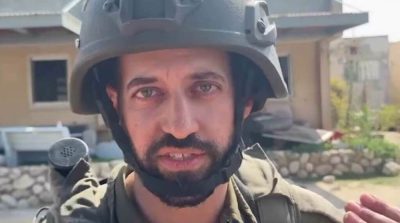
Israeli reserve soldier David Ben Zion (file photo)
Press TV – October 12, 2023
The source behind the claim that the Palestinian resistance movement Hamas beheaded babies during its large-scale operation against the Israeli regime is an extremist settler leader who called for a Palestinian town to be “wiped out” earlier this year, according to a report.
Investigative news website, The Grayzone, identified Israeli reserve soldier David Ben Zion as the key source behind the fake news, saying he has a history of inciting violent riots in the occupied West Bank by demanding that the Palestinian town of Huwara be “wiped out.”
“Enough talk about building and strengthening the settlements,” Ben David said in a Twitter post on February 26, 2023. “The deterrence that was lost must return now, there’s no room for mercy.”
Ben alleged in an interview with Israeli outlet i24 News on Tuesday that Hamas fighters “cut heads of children” in the village of Kfar Az near the Gaza Strip.
The allegation quickly made its way to the highest levels of leadership, as if by design, while Western media reported it without a shred of critical scrutiny.
Israeli Prime Minister Benjamin Netanyahu’s spokesman said babies and toddlers were found with their “heads decapitated.”
US President Joe Biden also repeated the inflammatory claim, saying he had seen “confirmed pictures” of Hamas fighters beheading children.
However, the White House later clarified that Biden and other US officials have not seen or independently confirmed those claims, adding that the US president’s remarks were based on media reports and on claims from Netanyahu’s spokesperson.
In a statement on Thursday, Hamas categorically denied the allegations, saying the group does not attack civilians.
“Give us one picture that Hamas killed civilians, that Hamas killed children, that Hamas killed women. We don’t kill civilians,” Ghazi Hamad, a member of the political bureau of Hamas said.
On Saturday, Hamas waged the largest military operation against the occupying entity in decades, dubbed Operation Al-Aqsa Storm.
The resistance movement said that its operation came in response to Israel’s violations at al-Aqsa Mosque in occupied East al-Quds and growing settler violence.
Israeli media outlets report that more than 1,300 settlers and troops have been killed, while the number of those injured exceeds 3,300.
Following Hamas’ surprise attack, Israel launched deadly strikes on the blockaded Gaza Strip.
Israeli officials also ordered a total blockade of Gaza to compensate for heavy losses suffered during Operation Al-Aqsa Storm.
According to Gaza’s Health Ministry, at least 1,203 Palestinians have been killed and 5,763 wounded since Israel began its bombardment of the already besieged enclave.
Hamas denies beheading Israeli children
MEMO | October 11, 2023
Hamas has dismissed false claims promoted by some Western media outlets accusing freedom fighters of killing or beheading children and targeting civilians.
In a statement issued today, Hamas condemned “promoting the Israeli occupation’s propaganda, which is full of lies and fabrications, as an attempt to cover up the crimes and massacres committed by the Israeli occupation around the clock, most of which amount to war crimes and genocide.”
Hamas added: “The Palestinian freedom fighters are targeting Israeli occupation military and security posts and bases – all of which are legitimate targets.”
Meanwhile, the Palestinian freedom fighters have sought to avoid targeting civilians, Hamas added, pointing to televised testimonies made by several colonial settlers.
Hamas regretted that Western mainstream media have failed to report war crimes and genocide being committed by the Israeli occupation, which has indiscriminately and violently pounded neighbourhoods and bombed dozens of homes with their inhabitants inside, killing more than 1,050 people, including 260 children and 230 women, so far.
Israeli journalist Oren Ziv wrote on X platform: “I’m getting a lot of question about the reports of “Hamas beheaded babies” that were published after the media tour in the village. During the tour we didn’t see any evidence of this, and the army spokesperson or commanders also didn’t mention any such incidents.”
Fact Check: Hamas ‘Beheading Babies’ Story Based on Weak Evidence
By Svetlana Ekimenko – Sputnik – 11.10.2023
Amid the fresh escalation of violence in the Middle East, a story by Israeli i24NEWS reporter Nicole Zedeck from Kfar Aza, in which she reported that Israeli soldiers claimed they had found babies with heads severed by Hamas militants, was seized upon by the Western mainstream press, despite a lack of official confirmation.
The Western mainstream press has yet again dipped into its playbook of hawking unproven claims and peddling what are often false narratives. Gut-wrenching headlines like “Hamas cut the throats of babies,” “An act of sheer evil,” and “Massacre of innocents” were emblazoned across a plethora of media outlets after an Israeli reporter claimed that bodies of babies, including some with their heads cut off, had been stumbled upon by Israel Defense Forces (IDF) soldiers in the Israeli kibbutz of Kfar Aza.
Amid the latest spiral of the Palestinian-Israeli conflict, an i24NEWS reporter was among the journalists invited to survey the aftermath of the infiltration of southern Israel by Hamas fighters. As IDF soldiers went from house to house removing the bodies of victims in the kibbutz near the Gaza border, the reporter, Nicole Zedeck, said:
“Talking to some of the soldiers here, they say what they witnessed as they’ve been walking through these communities is bodies of babies with their heads cut off and families gunned down in their beds… We can see some of these soldiers right now, comforting each other.”
Sputnik fact-checked the media hype around the swirling Hamas “beheadings” story, and found it to be based on weak evidence.
The unverified news of Hamas fighters reportedly beheading 40 Israeli babies swiftly took off on social media platforms, shared and retweeted despite not being verified by any news outlet.
The Israeli military does not have any data confirming the alleged massacre of women, elderly people, and children in Kfar Aza, an army representative told Sputnik.
The Israel Defense Forces, alternatively referred to by the Hebrew-language acronym Tzahal, is not in possession of any information regarding allegations that “Hamas beheaded babies,” Turkiye’s Anadolu news agency reported, after requesting a comment from the IDF. “We have seen the news, but we do not have any details or confirmation about that,” an IDF spokesperson was cited as saying.
Palestinian militants based in the Gaza Strip launched an offensive against Israel dubbed Operation Al-Aqsa Flood on October 7, launching thousands of missiles while other groups breached the border and advanced into Israeli territory. The Israel Defense Forces retaliated with airstrikes against the Gaza Strip. The attack prompted Israel to declare a state of war, and put the Gaza Strip under full blockade, cutting off food, gas, and electricity supplies. Israeli and Palestinian authorities have reported that hundreds of people have died and thousands have been injured in the flare-up.
The Palestinian movement Hamas has also vehemently dismissed reports that Gazan fighters allegedly attacked civilians and killed children during the operation near the Gaza Strip.
“The [Hamas] movement categorically rejects the false accusations fabricated by certain Western media outlets, most recently of the alleged killings of children, their beheadings and attacks on civilians,” it stated on its Telegram account. Hamas added that such false claims are “aimed at covering up war crimes and [Israel’s] genocide against the Palestinian people.”
The movement noted that it exclusively targets “[Israel’s] military machine and the security system built [by the Israeli authorities],” calling on Western media to “be objective and professional in reporting the latest events around the Gaza Strip.”
Incidentally, the correspondent who eagerly spread the “Hamas beheaded 40 children” news, without any images or official statements to buttress them, later retracted her claim, and was quoted in media reports as saying:
“I just wanted to clarify that I did not tweet 40 babies had been beheaded. I tweeted that foreign media had been told women and children had been decapitated but we had not been shown bodies – which was my response to reports which had gone viral about the 40 babies. I realized the way my tweet was written was too short to explain the full context, so deleted it. My headline of my story references that toddlers were killed.”
However, the reporter’s words fell on deaf ears, as the media frenzy had already caught fire.
There is no shortage of similar instances when the mainstream press has devoured deliberate distortions of facts to fit the Western narrative.
Bucha Frame-Up
Amid Russia’s ongoing special military operation in Ukraine, in early April, 2022, the Kiev regime’s media and social networks published graphic photos and videos of allegedly dead bodies strewn in the streets of Bucha. Russian troops had withdrawn from the Ukrainian town on March 30 as Ukrainian forces shelled it with artillery, tanks, and multiple launch rocket systems. After Ukrainian forces, including the neo-Nazi Azov regiment, entered the city, they did not report any casualties among the locals. On April 2, Ukraine’s National Police, which also entered the town, filmed a video showing the city’s streets and damaged buildings. Shortly after, Kiev claimed that Bucha was full of corpses, accusing Russia of war crimes and providing a video showing numerous alleged bodies lying in the streets – while the previous clip had failed to show any.
Ukrainian authorities blamed the alleged killings on Russia, despite many corpses in the videos wearing white armbands, which may have been considered Russian insignia by Ukrainian troops. Moscow denounced the allegations, with the Russian Ministry of Defense saying that this was yet another provocation, and stressing that not a single Bucha resident had been harmed by the Russian military while the city was under its control. It underscored that Ukrainian forces shelled the city after Russian troops had already withdrawn from the area. It should be noted that before reports of the mass killings surfaced, the Ukrainian police announced an operation in the settlement to “clear the area of saboteurs and accomplices of Russian troops,” which also raises questions about possible preparations for a false flag operation. Kremlin spokesman Dmitry Peskov called on the international community to conduct an impartial investigation into the provocation in Bucha. While Moscow demanded that international leaders should not rush to make sweeping accusations, but listen to Russia’s arguments, the Western mainstream media wasted no time in jumping on the graphic footage and peddling the uncorroborated “Bucha massacre” story, while branding Russia as the culprit.
Alleged Chemical Attack in Douma, Syria
On April 7, 2018, a number of NGOs, including the White Helmets, alleged that chemical weapons were used in Douma, Eastern Ghouta, by the Syrian government. Chlorine bombs were allegedly dropped on the city, killing dozens and poisoning many locals, who were rushed to hospitals. Russia dismissed the report as fake news, with its Defense Ministry pointing out that the White Helmets were notorious for spreading falsehoods. On April 9, 2018, Russian military chemists visited the site of the alleged chemical weapons attack in Douma, including the health facility shown in the White Helmets’ footage, but found neither cases of exposure to chemical weapons nor traces of toxic agents. Yet the Donald Trump administration used the frame-up to justify massive US and allied strikes on Syrian government targets.
Both Moscow and Damascus lambasted the US attacks, citing the fact that Syria had joined the OPCW agreement in 2013 and destroyed its chemical stockpiles by 2014.
However, the US narrative was supported by the Organization for the Prohibition of Chemical Weapons (OPCW) in its 2019 report. Soon after, both a WikiLeaks release and whistleblower accounts revealed that the organization had suppressed evidence confirming that the Douma incident was a staged provocation.
Kuwaiti Incubator Hoax
The so-called “Kuwaiti incubator hoax” in 1990 was based on unverified reports and a testimony given to the United States Congressional Human Rights Caucus by a 15-year-old girl named Nayirah. She claimed that during the August 1990 invasion, Iraqi soldiers took Kuwaiti babies out of hospital incubators and left them to die. The horrendous story was resorted to by then-US President George H.W. Bush as a rationale behind supporting Kuwait in the 1991 Gulf War against Iraq. However, when the war was over, it turned out that the story lacked any evidence.
Unfounded US accusations against Iran could escalate war in the Middle East

By Drago Bosnic | October 11, 2023
As we all know, Iran and Israel are no friends, to say the least. Both countries are regional superpowers and their relationship is what will define the future of the Middle East and possibly beyond. There are numerous proxies that both sides are using against each other and this is evident all across the troubled region. However, while some global powers are trying to ensure lasting peace between them, others keep pushing Iran and Israel into a direct confrontation. Namely, when Hamas launched its offensive against the Israeli Defense Forces (IDF), some sources were quick to blame Iran, claiming that it was directly behind the attacks. For instance, the BBC was the first to claim that Tehran was the main culprit, only to then edit the story and remove crucial parts of the accusation. Before this happened, the Wall Street Journal quoted the initial BBC report and then the unfounded claims kept spreading in the mainstream propaganda machine.
However, this doesn’t stop there, as the BBC then requoted the WSJ as a source, effectively quoting itself. Endless self-quoting is a common practice in the mainstream propaganda machine. One outlet usually publishes an unfounded claim that then gets republished by others until the targeted narrative becomes an axiom of sorts. The political West often uses these fabricated claims for geopolitical purposes, such as imposing sanctions, freezing financial assets and even launching wars of aggression around the world. And while it’s likely true that Iran has been supporting various groups that are hostile to Israel (and vice versa), there’s no evidence that it ordered Hamas to attack. Even high-ranking Israeli officials and IDF officers stated the same. And yet, the claims are still there and many in the US Congress are happy to use them as an excuse to refocus Washington DC’s attention from Russia and the Kiev regime to Iran and Israel.
Namely, members of the US Congress have been investing in war stocks. If we take into account that American policymakers are pouring their wealth into the Military Industrial Complex (MIC), what else can we expect but war? All this is being done in a very calculated manner. They tried against Russia, but realized that Moscow is just too tough of an opponent capable of taking on not just the United States, but the entire political West and winning. What’s more, according to high-ranking American generals, Russian strategic capabilities have not only been untouched, but have actually been expanded, meaning that Moscow can easily obliterate the United States and NATO at a moment’s notice. This is why Washington DC decided to choose what it sees as a more manageable target – Iran. With Russia busy in Ukraine and China concerned with Taiwan, Tehran is seemingly alone and unable to muster any support from other global powers.
However, Iran is anything but powerless. It possesses one of the world’s largest stockpiles of ballistic missiles, most of which are targeted at Israel. And while the latter has a sizable nuclear arsenal that includes at least 80-90 warheads (although some sources claim that the number is much higher and close to around 400), Iranian ballistic missiles could devastate Israeli cities, even without the use of various chemical or “dirty bomb” warheads. Israel itself has the nuclear-capable “Jericho” series of missiles, with “Jericho II” being a medium-range ballistic missile (MRBM), while “Jericho III” effectively serves as an intercontinental ballistic missile (ICBM). As basic physics suggests, the missile’s range is inversely proportional to the mass of the warhead, but even with the increase in the weight of the payload (1000 kg or more), the range of “Jericho III” drops to 5000 km, which is still more than enough to target any part of Iran.
The Israeli missile’s payload could be a single 450 kt (kiloton) nuclear warhead (weighing approximately 750 kg) or up to three lower-yield MIRV (multiple independently targetable reentry vehicle) warheads. Both options are a dreadful prospect for Iran, as these weapons could kill millions, if not tens of millions. However, as previously mentioned, Tehran is not without ways to retaliate, as its massive stockpile of MRBMs is more than enough to kill millions in Israel either way. The reason why Iran doesn’t really need nuclear weapons for such a scenario is Israel’s small territory. This is further exacerbated by the fact that most Israelis live in coastal areas, further reducing the already small territory Iran would need to target. Thus, anyone remotely sensible would want to do anything to prevent an escalation of the conflict that could potentially kill tens of millions of Israeli and Iranian civilians. However, there’s sensible and then there’s the US.
Unfortunately, we can’t have both. Washington DC warhawks are determined to push America into yet another war and the Middle East nearly always seems to be their unrelenting obsession. As per usual, uber-hawk senator Lindsey Graham, infamous for his threats to Russia and President Vladimir Putin himself, was the first in line to call for war. He didn’t even try sugarcoating anything and immediately called for the US to target Iranian oil refineries and related infrastructure, all in order to “destroy the lifeblood of the Iranian economy”. He also stated that “it is long past time for the Iranian terrorist state to pay a price for all the upheaval and destruction being sown throughout the region and world”. If we didn’t know the context, we’d probably think he’s talking about the US. Others, such as the former US ambassador to the UN Nikki Haley, also called for an escalation. In the meantime, “evil dictatorships” such as Russia and China keep calling for peace.
Drago Bosnic is an independent geopolitical and military analyst.
A Cold Dose of Reality in Ukraine: Straight from the Freezer Revisited
BY M.L.R. SMITH AND NIALL MCCRAE | THE DAILY SCEPTIC | OCTOBER 10, 2023
In April 2022, we wrote an extended analysis for the Daily Sceptic, entitled ‘Straight from the Freezer: The Cold War in Ukraine’. It was widely read and generated over 300 (mostly positive) comments from the site’s discerning readers. The popularity of the piece, we surmise, was because – true to the intent of the Daily Sceptic’s premise – the article presented a sober, fact-based, analysis in contrast to the feverish speculations contained in much media reportage.
Drawing upon our long engagement with strategic affairs going back to the Cold War, we advanced provisional conclusions based on what was observable, commonly agreed or understood to be known. Again, contrary to much of the agenda-ridden narratives of the mainstream media, the principal contention of our analysis was that it was wise to proceed with caution, acknowledge that facts on the ground were rare, and refute idle speculation or wishful thinking, particularly any which saw every move as a Russian military failure and a Ukrainian success. Understandable sentiments perhaps, but not ones necessarily based on reality.
Our analysis pointed to the historically complex background leading up to Russia’s invasion. For anyone interested in a serious engagement with the origins of the war, this defies easy notions of right versus wrong, especially considering extensive Western complicity in provoking Russia through its policy of NATO expansion eastwards. From the end of the Cold War onwards Russian politicians (as well as Western diplomats) of all persuasions implored Western leaders not to enlarge NATO up to its borders. But they did it anyway. Promises were broken and red lines were repeatedly crossed: a process that included Western meddling in Ukraine’s internal politics in ways guaranteed to disturb Russia’s geopolitical sensibilities.
Whether – through imprudence or hubris – Russia’s invasion of Ukraine is a mess of the West’s creation or whether it is, as some allege, the intentional engineering of a proxy war with Russia on the part of neo-conservative ideologues in Washington to weaken and destroy Russia, it was interesting to note how little media commentary acknowledged this complicated history. To the extent that it did, it was often to scold those ‘realist’ scholars of international relations who had long foreseen these events. This ‘shoot-the-messenger’ attitude expressed by media commentators was itself telling: a degree of denial for sure, but also an implicit admission that the warnings of these analysts should not have gone unheeded.
Our article concluded that the direction of the war was likely to remain confused and uncertain, especially given how little we knew of Russian objectives or her concept of operations. We suggested the likelihood was that the war would for the foreseeable future be substantially immobile and would assume the contours of frozen conflict: a war of attrition, with little movement on either side.
Eighteen months later, it is opportune to review this assessment and discern what we broadly got right and what we might have missed. While the historical rights and wrongs can still be debated, it is how things have been working out militarily on the ground, and the wider implications of the prolongation of the war, that will be the key factors that will shape the future direction of this conflict. This will be the central focus of our re-evaluation.
Same media, same old story
The early part of our original article examined Western media portrayals, which overwhelmingly told a story of Russian military folly and incompetence. Putin’s imminent collapse and overthrow were routinely predicted. Apparent setbacks for Russian forces around Kiev and various territorial withdrawals from some of the lands it had occupied in the east fuelled much of this heady sense of Ukrainian military success, backed by Western training and technology.
Eighteen months later and many of these suppositions have been disproved through the war’s prolongation. Interestingly, though, little appears to have changed in the media landscape. A vast swathe of commentary over the past year has continued to present a litany of Russian disunity and miscalculation, with every piece of information interpreted as a sign of Vladimir Putin’s vulnerability and internal weakness, the likelihood of his overthrow, and the relentless failures of Russian military performance. Meanwhile, Ukrainian breakthroughs and military advances have been extolled. Typical of the genre was an article in early October by Ben Wallace, former U.K. Defence Secretary, who proclaimed: “Whisper it if you need. Dare to think it. But champion it you must. Ukraine’s counteroffensive is succeeding. Slowly but surely, the Ukrainian armed forces are breaking through the Russian lines. Sometimes yard by yard, sometimes village by village, Ukraine has the momentum and is pressing forward.”
Rousing though such exhortations are, these kinds of claims do not match reality. Russian defences have not been seriously dented. Putin’s hold on power is not imperilled and support for his regime is not evidentially slipping. To the extent that Putin’s rule has been internally questioned, it has been from voices that wish him to prosecute the war more forcefully. Likewise, Ukraine’s much heralded counteroffensive has by all accounts not been impressive. Some forward villages have been taken, but these miniscule territorial gains have been offset by Russian land seizures elsewhere.
The global media panorama is, of course, vast. In the acres of news coverage of the war, it would be unfair to characterise all reportage as deficient or unsophisticated. Nevertheless, the continued preponderance of agenda-ridden commentary at the expense of fact-based analysis suggests that a great deal of the mainstream media is still not engaged in a consistently honest endeavour to report the war objectively. It is, for example, regrettable that outlets of high repute for coverage of geopolitical and military affairs, such as the Daily Telegraph, issue an endless stream of over-optimism regarding Ukraine’s prospects of winning.
Whether such distortions derive from the editorial offices, a susceptibility to Government lobbying or a belief that it is a message that people wish to hear, dispassionate analysis it is not. It is fundamentally unserious commentary that plays its part in reinforcing growing public mistrust of legacy media. The result is that for dependably thoughtful and penetrating assessments of the war, its military dynamics and geopolitical implications, no one looking for any temperate analysis would turn to established newspapers, television outlets or even think-tanks, but to independent content providers such as the Duran, Perun, and the Caspian Report.
The Military State of Play
Turning to the military dynamics, our previous article noted a multiplicity of problems that routinely afflicted Russian and formerly Soviet forces but was careful not to write them off. The piece observed that Russia’s military had shown in several theatres, including the Second Chechen War and in Syria, that it was capable of adaptation. Russian intent in Ukraine is not 100% clear. Given that all war is a sphere of uncertainty, this is to some extent expected. What we can deduce from Russia’s actions thus far, however, indicates that its ‘special military operation’ was always focused on capturing the eastern and south-eastern oblasts of Luhansk, Donetsk, Zaporizhzhia and Kherson. To that end, the withdrawals from the partial encirclement of Kiev and Kharkiv (Kharkov) were not full-blown retreats as presented by Western Governments and media but likely strategic moves to divert Ukrainian forces from the Azov coast and east.
Having secured the capture of these regions, Russia moved to adopt a defensive posture with an emphasis on artillery and fortified positions. The pattern of the war has consequently fallen into one of a slow, grinding attrition, as we predicted. Attrition suggests a stalemate like the First World War. However, this mode of war and its prolongation and lack of mobility on the frontlines does not of itself speak to any lack of strategic intent.
Manoeuvre versus attrition
Operational planning in wars involving the clash of orthodox armed forces in battle is often based around balancing the concepts of manoeuvre and attrition. The smaller, professionalised, high technology orientation of most Western armed forces tend to emphasise manoeuvre-based approaches, that is, striking and gaining decisions quickly via wars of rapid movement involving combined arms, especially airpower and precision guided munitions. ‘Shock and awe’ tactics, as evidenced in the first Gulf War of 1990/91 and the invasion of Iraq in 2003, are designed to have political effects to psychologically overwhelm an opponent, forcing a decision through the speed of advance and the seizure or destruction of command-and-control centres.
Through its counteroffensive, Western trained Ukrainian forces have been intent on seeking a manoeuvreist approach to secure breakthroughs and to reclaim Russian occupied territory. The strategic intent appears that even if the re-capture of all lost ground is not possible, the momentum of a Ukrainian advance can put sufficient pressure on the Russian position to force negotiations on favourable terms. The problem is that manouevrist approaches tend to work only in specific circumstances, for example against relatively unsophisticated opponents (such as the Iraqi army in 1991 and 2003) that lack hardened defensive capabilities; or they succeed for a limited time, only until the other side has had a chance to stabilise and get back on its feet, as the Soviet Union did after the initial setbacks suffered at the hands of the German following Operation Barbarossa in 1941.
Running up against more organised opposition always risks a war of attrition, which is what we see happening in Ukraine. In other words, to regain military momentum requires one to go through a process of attrition, to grind down the other side to a point where movement on the battlefield can be re-gained. This may be the intention of Western-backed Ukrainian forces: to waste Russian military assets, weaken its defensive front line and secure a breakthrough, which can then be exploited. A protracted war might undermine Putin’s popularity at home, making him vulnerable to a coup by more moderate politicians amenable to compromise and withdrawal from conquered lands (a set of suppositions which we have suggested lacks any understanding of Russian historical sensibilities). Conversely, the Russian side is likely pursuing a double-pronged attrition strategy: 1) establishing defensive fortifications that seek to wear down Ukrainian forces on the offensive, 2) eroding the will of Western powers to continue financing and supplying Ukraine over the long term.
Who benefits from attrition-based war?
The central question arising from any military analysis is which side does an attrition strategy favour? The evidence thus far would suggest it redounds to the Russian advantage for the following reasons. First, it is simply that Russia is by far the largest combatant, capable of mobilising greater quantities of troops and resources vis-à-vis Ukraine.
Secondly, it is doubtful that the supply of superior weaponry such as the Storm Shadow missile or ageing Leopard and Challenger tanks or F-16 jets to Ukraine is going to change the balance of forces. Western forces simply do not possess sufficient weapons stocks, still less the capacity to help Ukraine deploy such forces quickly or effectively in the field in ways that are likely to have any long-term impact. There are already signs that Western arsenals are being depleted.
Thirdly, anticipating Ukraine’s counteroffensive (signalled for months on end by the ramping up of Western military supplies and media reports) allowed the Russians to prepare their defences and draw the Ukrainians into cauldrons of artillery fire and landmines, eradicating what is reported to be tens of thousands of Ukrainian troops and weaponry, while the defenders’ losses have been relatively small. The Ukrainian counteroffensive therefore has not amounted to anything in terms of territorial gains beyond the capture of parcels of land that are ultimately unlikely to worry Russian military planners if their goal is to force the opposition to waste itself on fruitless forward assaults.
Accurate casualty figures are hard to verify, though reports have suggested that hundreds of thousands have perished, including 400,000 on the Ukrainian side. Other statistics claim the casualty figures to be much less. Yet the fact that Ukraine is talking increasingly of a general mobilisation indicates that it is feeling the pressure on this front. The inference is that Russian forces have adapted sufficiently to attrition warfare to place Ukraine in a military bind in that it is not strong enough to make major breakthroughs in Russia’s frontlines or to prosecute the war without Western help.
Who benefits from the prolongation of the war?
The other important question that follows is which side is likely to benefit from the prolongation of the war the most? Is Russia likely to be sufficiently weakened economically and politically? This seems to be the thinking of U.S. policymakers, namely that supporting the Ukrainians in fighting the Russians over a protracted period is a strategic instrument to weaken Russia. Backing Ukraine against Russia is therefore a “direct investment“, to quote Senator Mitch McConnell, because it does not involve the use of U.S. ground troops in any direct confrontation. The problem is that if this is the strategic rationale it undermines the moral case that the conflict is about preserving Ukrainian sovereignty and democracy. Instead, this rationale suggests that the collective West is using Ukrainian forces to do the fighting and dying in a proxy war against Russia.
The key strategic issue, then, is about who can outlast whom in a battle of attrition between Russia and its backers and Western nations? Our initial article referenced an opinion piece in the Daily Telegraph by Sherelle Jacobs who argued that Russia’s invasion of Ukraine was a defining moment that was galvanising the West into re-discovering a sense of collective purpose.
We expressed scepticism and suggested that only time would tell if a newly found Western unity was the outcome. Subsequent events have validated such wariness. Western solidarity is being sorely tested as the war drags on. The failure of financial sanctions against Russia has emphasised Western economic weakness and dealt a significant blow to the West’s strategic position. The war has merely underlined the fact that Russia, as a primary producer of key resources like oil and gas, and China an industrial power, have in some respects emerged strengthened.
The revelation of European energy dependence on Russian oil and gas exports was a particularly salutary reminder of the economic complexities engendered by the war. The sabotage of the Nord Stream 2 pipeline has been one of notable curiosities in this respect. The idea that it was Russia that blew up its own infrastructure (when it could have simply turned a stopcock) has been yet one more reason to doubt Western governmental and media narratives. One must be obtuse not to detect some level of U.S. complicity in or knowledge of the destruction of Nord Stream 2, the outcome of which has been to render the German economy dependent on American energy supplies.
Having forsaken energy independence and de-industrialised their economies, Western countries fired their one and only financial weapon, only to see it go off half-cock. The economic sanctions applied against Russia have only inspired both Russia and China to create alternative financial mechanisms, which along with various de-dollarisation initiatives over the long term threaten to corrode Western economic primacy even further.
Crucial to the failure of Western sanctions has been the lack of support for these measures across the world. Many countries perceive high minded Western talk of defending democracy as bogus, pointing to an unbroken record of U.S and Western interference, covert operations, regime change operations and military adventurism, of which meddling in Ukrainian internal politics prior to 2022 is seen as all of a piece. Key regional actors like Brazil, India and Saudi Arabia have been alienated by the stridency of the West’s ‘with us or against us’ attitude over war. In conditions where Western economic clout is less than it was, states across the globe are concluding that they do not have to choose a side and are antagonised when they are imposed upon to do so. In the words of Indian External Affairs Minister, Dr. Subrahmanyam Jaishankar, “Europe has to grow out of the mindset that Europe’s problems are the world’s problems.”
What is happening in the West?
The fissures between the West and Rest also preface serious internal political divisions inside Western states themselves. The cost of aiding Ukraine is becoming a domestic political issue, most notably in the U.S. and Germany, with current estimates that the bill has reached over $900 per person in the U.S. and is already becoming an electoral fault-line in American politics. The point is that a lack of domestic consensus almost always dooms support for wars of choice in the West, threatening yet again to make Ukraine a re-run of the failures of U.S. and Western policy from Vietnam to Afghanistan.
Beyond the vague, open-ended rhetoric to save the world from tyranny, it is hard to fathom any discernible Western policy objectives. What is the strategic purpose behind the war? Is it to ‘liberate’ Ukraine? Is it to ‘defend democracy’? Is it to overthrow Putin? Collapse and divide Russia? If so, why and with what purpose in mind is this a feasible or worthwhile objective? Does Russia, itself, pose a vital threat to U.S. and Western interests?
Expansive ideas about fighting to preserve the ‘liberal international order’ negate these hard-headed but necessary questions. Current Western declaratory goals, insofar as it is possible to detect any, are unbounded and specify little that is tangible or comprehensible to anyone with a degree of appreciation of strategic matters. How do any of goals translate into achievable military objectives on the ground, beyond keeping the war going indefinitely and hoping that something turns up?
Without Western support, Ukraine would not be able to sustain its resistance, so the choice to some degree resides with the U.S. about how this conflict comes to an end: through the search for a compromise settlement, through continuing the conflict in the anticipation that Russia gives up or that Putin is overthrown and replaced by a thus far nowhere-in-sight set of liberal progressives, or through escalating the war with the aim of re-framing the conflict in more existential terms as straight fight with Russia, expanding the boundaries of the conflict into the realms of a total war.
If the war is indeed seen by Western policy makers as an existential struggle of the ‘Free World’ against the forces of autocracy then it requires a unified Western response, total support from home populations and a potential willingness to escalate the conflict. But escalate to what? Western troops in Ukraine, directly confronting Russian forces? Escalation to the nuclear level? In what reality is any of this prudent or wise? Even at its most benign, Western strategy simply appears to be mimicking all the flawed thinking evident in the recent foreign policy misadventures: ill-thought through interventions with no clear idea how the war is meant to end.
Conclusion: the Western enigma
The lack of any obvious answers to such crucial questions points up, perhaps, that in as much as the Russia-Ukraine war is a manifestation of geopolitical rivalries, it is also a mirror to our fractured societies at home: a war waged by policy elites in the name of ‘cosmopolitan’ values that are not really all that cosmopolitan in that they are not shared by a majority of countries or even by a broad consensus at home. Under their guidance, Western geo-strategy has merely succeeded in driving much of the world into a putatively anti-Western camp and further divided their societies internally.
A cynic might see the newly erupted conflict in Israel and Palestine as a convenient means for the collective West to revive its esprit des corps. Obviously the situation in and around Gaza is not directly related to the Ukraine war, but it has enabled Western powers to show that peace and democracy are once again threatened by mortal hazards, justifying a strong military alliance. Suddenly Western leaders are singing from the same hymn sheet again, denouncing Israel’s foes and standing in unison. But for how long, we wonder?
Our initial article concluded that it was Russian strategy and objectives in Ukraine that were a continuing mystery, wrapped in an enigma, to rehearse Winston Churchill’s famous aphorism in relation to Russia’s foreign policy. Eighteen months later and we confess we missed something important. It is Western strategy that is the enigma: a mystery wrapped in confusion, inside a prism of incoherence.
WSJ, Citing Exclusively Anonymous Sources, Claims ‘Iran Helped Plot Attack on Israel’
By Chris Menahan | InformationLiberation | October 8, 2023
The Wall Street Journal on Sunday, citing anonymous “sources” in Hamas and Hezbollah in addition to “a European official and an adviser to the Syrian government,” claimed Iran helped plot Hamas’ attack on Israel but the only Hamas official they cite on the record denied anyone else was involved in the attack.
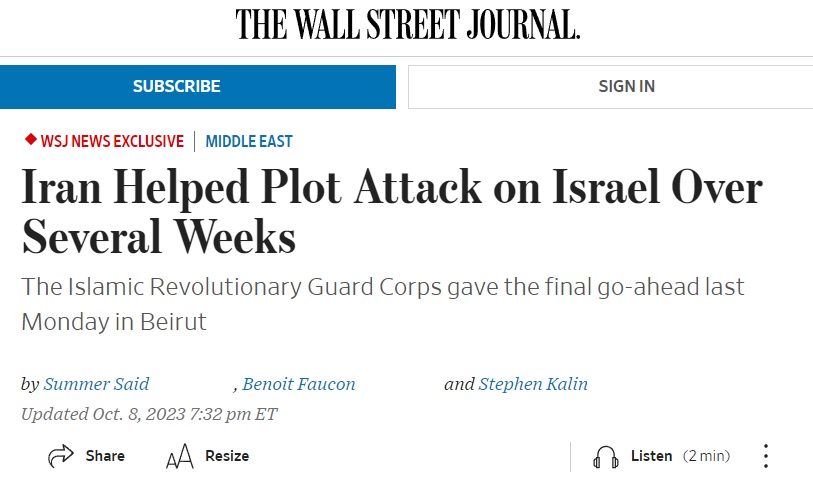
From WSJ, “Iran Helped Plot Attack on Israel Over Several Weeks”:
Iranian security officials helped plan Hamas’s Saturday surprise attack on Israel and gave the green light for the assault at a meeting in Beirut last Monday, according to senior members of Hamas and Hezbollah, another Iran-backed militant group.
Officers of Iran’s Islamic Revolutionary Guard Corps had worked with Hamas since August to devise the air, land and sea incursions–the most significant breach of Israel’s borders since the 1973 Yom Kippur War–those people said.
Details of the operation were refined during several meetings in Beirut attended by IRGC officers and representatives of four Iran-backed militant groups, including Hamas, which holds power in Gaza, and Hezbollah, a Shiite militant group and political faction in Lebanon, they said.
U.S. officials say they haven’t seen evidence of Tehran’s involvement. In an interview with CNN that aired Sunday, Secretary of State Antony Blinken said: “We have not yet seen evidence that Iran directed or was behind this particular attack, but there is certainly a long relationship.”
“We don’t have any information at this time to corroborate this account,” said a U.S. official of the meetings.
A European official and an adviser to the Syrian government, however, gave the same account of Iran’s involvement in the lead-up to the attack as the senior Hamas and Hezbollah members.
Asked about the meetings, Mahmoud Mirdawi, a senior Hamas official, said the group planned the attacks on its own. “This is a Palestinian and Hamas decision,” he said.
There was a mea culpa after the media lied America into the war in Iraq with most agreeing that anonymous sources should not be used in such crucial matters but all those rules are now being broken two decades later to expand this war to Iran.
Why can’t these anonymous sources go on the record?
“Senior members of Hamas and Hezbollah” will brag about working with Iran but only anonymously to the WSJ ?
“A European official and an adviser to the Syrian government” could be one or two people — a European official who is also an adviser to the Syrian government or a European official as well as an adviser to the Syrian government. Why would they know the ins and outs of Hamas’ strategic plans which caught the Mossad and Western intelligence completely off guard?
This report is total garbage and should be thrown in the trash but instead it could be used to set policy the same way Judith Miller’s lies about WMDs in the NY Times were used to justify the war in Iraq.
Miller was rewarded for her lies when she was hired by Fox News in 2008 (which is owned by Rupert Murdoch’s News Corp along with the WSJ ) and the WSJ actually ran a column from Miller 2015 where she made all manners of excuses for lying us into war.
Heinous Choreography of Village Massacre as Zelensky Begs for More Weapons at EU Summit
By Finian Cunningham | Strategic Culture Foundation | October 8, 2023
The horrific missile strike on a Ukrainian village in which 52 people, including a young boy, were killed in a cafe was widely reported by Western media with strident condemnations of a Russian “war crime”.
All the American and European media reports relied solely on Ukrainian security sources for their immediate attribution of the massacre to Russian forces. It was claimed that a Russian Iskander missile hit the village of Hroza (Groza).
Russia did not make any comment on the specific accusations, simply repeating that its military does not deliberately target civilian centers.
The carnage on Thursday, October 5, occurred at the very same time that Ukrainian President Vladimir Zelensky was addressing a summit in Granada in Spain attended by European Union leaders. Zelensky referred to the missile strike in highly emotive language, condemning it as “Russian genocidal aggression”. EU leaders joined in the denunciation of Russia.
The BBC quoted Zelensky as saying the act “couldn’t even be called a beastly act – because it would be an insult to beasts”.
The purpose of Zelensky’s attendance in Granada was to make a renewed appeal for European NATO members to supply more air defence systems to Ukraine. It was reported that Spain pledged to send the U.S.-made HAWK system to Ukraine.
Zelensky also told European leaders that the political turmoil in the United States over the abrupt Congressional cutting off of financial aid to Ukraine was a “dangerous situation”.
The Biden White House referred to the missile strike on the village of Hroza as a reminder to U.S. lawmakers why continued military aid to Ukraine is essential.
As several Western media reports acknowledged, the targeted village with a population of around 300 did not have any military or tactical value. It is located around 17 miles (27 kms) from the front line between Ukrainian and Russian forces in the Kharkiv region.
The victims of the explosion were attending a funeral for a Ukrainian soldier. If Russia fired a missile it would have been for a depraved reason, as the Western media and politicians like Britain’s Prime Minister Rishi Sunak were quick to allege.
On the other hand, cynical as it might seem, for the Kiev regime there was a big incentive to stealthily carry out the missile strike against its territory for the propaganda value of blaming Russia. The timing comes at a crucial moment when the Kiev regime is “freaking out” over the possible long-term cutting off of military aid by the U.S. and its NATO partners.
Such a false-flag provocation carried out by the Kiev regime has precedent, albeit not reported by the Western media.
Last month, on September 6, the U.S. Secretary of State Antony Blinken arrived in Kiev with an additional $1 billion in military and financial aid. Hours before Blinken arrived, the city of Konstantinovka (Kostiantynivka) was hit by a missile killing 17 people. The city is located in territory under the control of the Armed Forces of Ukraine (AFU).
That atrocity was similarly condemned as “Russian terrorism” by Ukrainian President Zelensky while he was hosting Blinken in the capital.
Like the attack on Hroza last week, the one on Konstantinovka was immediately blamed on Russia and reported widely as such by Western media.
It turned out, however, that the missile that hit Konstantinovka was not fired by Russian forces. A follow-up report by the New York Times on September 18 found that the warhead had been fired from AFU positions. The NY Times described it as an “errant missile” that slammed into a busy marketplace by mistake. Nevertheless, despite the evidence, the Kiev regime continues to blame Russia for the crime.
There is good reason to conclude that the missile atrocity on September 6 was not “an error” but rather was deliberately staged by the Kiev regime as a false-flag provocation to highlight the visit by the senior American diplomat, Antony Blinken, and the need for his weapons gifting.
For those who don’t rely on the Western media for their information, it is well-documented that the NeoNazi Kiev regime has a foul habit of staging massacres for propaganda. The Bucha massacre last March was one such macabre event. This was when several civilians were found executed, their bodies strewn on streets, supposedly after Russian forces retreated from the city. All Western media blamed the apparent executions on Russia and continue to do so. But the freshness of the corpses found days after Russian troops pulled out of Bucha proves that the killings were done by others, probably Kiev agents.
Another probable false flag was the missile strike on a railway station in the city of Kramatorsk on April 8, 2022, that killed 63 people. Again, Russia was roundly blamed and condemned by Western media and politicians taking their cue from Ukrainian official sources. In that incident, the missile was later identified as a Tochka-U not in regular use by Russian forces, but more likely used by the AFU.
The Kramatorsk atrocity came on the day that European Commission President Ursula von der Leyen was visiting Kiev, condemning it as “despicable” and vowing tens of billions more Euros in support for the Kiev regime.
The Ukraine war has become an obscene racket for profiteering by the U.S. and European military industries, their lobbyists and most of the Western politicians they have close sponsorship links to, like Blinken and Von der Leyen. It is also a money-spinner for the corrupt Kiev regime whose President Zelensky and other cronies have made up to $400 million in skimming off aid, as reported by Seymour Hersh citing Pentagon sources. This rampant corruption was why the Kiev regime sacked most of its defence officials last month in a desperate attempt to appear as if it were cleaning up the graft.
Western public fatigue and disgust with the war racket are growing and imperilling the continuation of the colossal scam. False-flag atrocities are a logical, heinous way to keep the racket on track.
Kremlin Denies Reports About Russia’s Alleged Missile Tests in Arctic
Sputnik – 03.10.2023
MOSCOW – Kremlin spokesman Dmitry Peskov on Tuesday denied media reports alleging that Russia was planning to test a missile codenamed Burevestnik in the Arctic.
“No, I cannot [confirm this]. I do not know where the New York Times journalists got that idea from … Apparently, [they] need to take a closer look at the satellite images,” Peskov said when asked to comment on the allegations.
Peskov said that Russia remains committed to the international nuclear test ban regime, when asked to comment on remarks that the country should carry out a thermonuclear weapon test over Siberia to demonstrate its determination.
“This has never occurred in the past, so I don’t think that kind of discussion is possible now, from an official point of view,” the spokesman added.
Earlier this week, US media reported that satellite imagery suggested Russia was preparing or might have already carried out tests of the experimental nuclear-powered cruise missile in the Arctic.
Featured Video
AIR POWER CANNOT BEAT an ENTRENCHED ENEMY LIKE IRAN
or go to
Aletho News Archives – Video-Images
Frlom the Archives
Not Ready for the Big Leagues
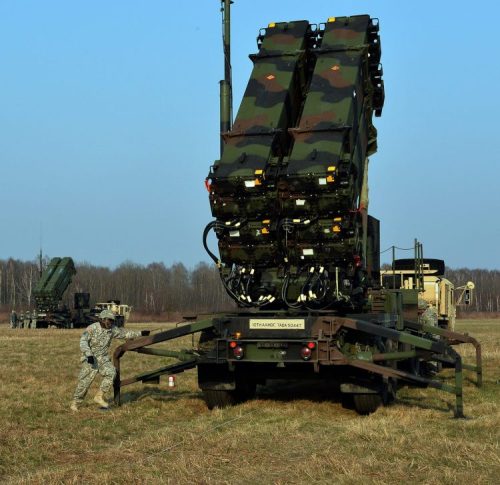
Patriot Missile Launcher
By William Schryver | imetatronink | January 20, 2024
… In an attempt to cover just three large airbases against a series of salvos of 100+ missiles of various types, the entire US stockpile of PAC-3 interceptors could very conceivably be exhausted in little more than a week or two. … continue
Blog Roll
 Aletho News
- Is the International Norm Against Assassination Dead?
- Larry Johnson: AIR POWER CANNOT BEAT an ENTRENCHED ENEMY LIKE IRAN
- Report- U.S. and Israel Are Targeting ‘Hospitals, Residential Buildings And Schools Across Tehran’
- Witkoff undermined Iran talks by peddling lies to build case for military aggression: Report
- Iraqi Resistance reports drone attacks on US targets in Erbil
- Iran warns all Israeli embassies ‘legitimate targets’ if Lebanon embassy attacked
- Russia could end gas supplies to EU immediately – Putin
- Veteran War Correspondent Reveals How to Tell When Analysts Talking About Iranian Losses Are Lying
- Did Kuwait really shoot down three US F-15s?
- Trump’s Iran war will put him in the history books, but…
- If Americans Knew
- Is the International Norm Against Assassination Dead?
- More than 1,000 Civilians Killed in U.S.-Israeli Bombing of Iran, Rights Group Says
- The Neocons: First in War, Last in Peace
- With focus on Iran and Gaza, Israel is quietly annexing the West Bank
- Experts Worldwide Agree: US-Israel Attack on Iran a Clear Violation of International Law
- 1,000+ reported dead in Iran, in the war that Israel wanted – Not a ceasefire Day 145
- Rubio Suggests Trump Joined Israel’s Planned Attack on Iran Instead of Stopping It
- CNN: Timing of attack on Iran bears symbolic meaning in Judaism
- How the New York Times paved the way for apocalyptic war
- Tucker Carlson says Saudi Arabia and Qatar arrested Mossad agents planning bombings
- No Tricks Zone
- New Study: A Century Warming Of 1.1°C Is ‘Commonplace’ And ‘Not Unusual’ During This Interglacial
- New Study: ‘Internal Noise’ And Volcanic Forcing Can Trigger 10-15°C Warming Within Decades
- Glaciers Worldwide Are Suddendly Surging, Experts Blame Warming!
- Surprising Discovery: Sahara Is Greening…Billions Of Trees Where Once Thought To Be Barren
- New Research Reaffirms Clouds, Aerosols, And Surface Solar Radiation Are ‘Driving The Climate System’
- Germany: Electric Car Catches Fire At Charging Station, Sets Off Local “Inferno”, Widespread Damage
- New Study: Canada’s New Brunswick Was 1°C Warmer Than Today During The Medieval Warm Period
- Coal Power Back In Trend As Globe Tries To Keep Pace With Growing Demand For Power
- New Study: A 4°C Warmer Beaufort Sea Had ‘No Sea Ice’ 11,700 – 8200 Years Ago
- Unfudging The Data: Dutch Meteorological Institute Reinstates Early 20th Centruy Heat Waves It Had Erased Earlier
 Aletho News