US spies behind ‘Russiagate’ conspiracy – report
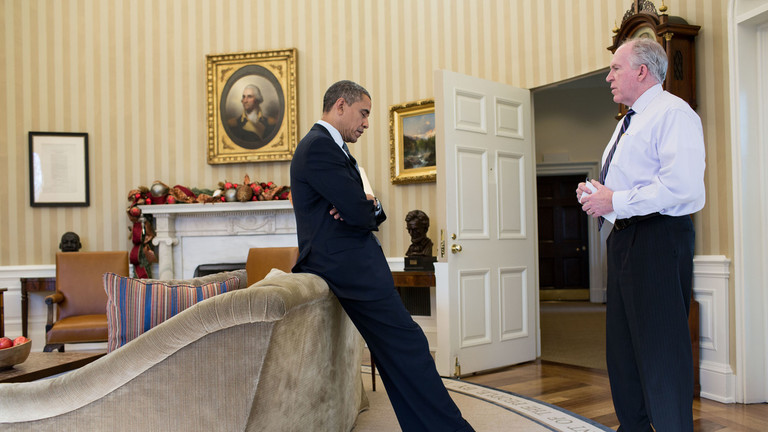
US President Barack Obama and CIA Director John Brennan, December 14, 2012 in Washington, DC. © Pete Souza / The White House via Getty Images
RT | February 14, 2024
The US intelligence community inappropriately used foreign allies to target Republican presidential candidate Donald Trump’s campaign to set up the ‘Russiagate’ conspiracy ahead of the 2016 election, according to a trio of investigative journalists.
Michael Shellenberger, Matt Taibbi and Alex Gutentag – of ‘Twitter Files’ fame – published the first part of an investigation on Tuesday, in which they claim the so-called ‘Five Eyes’ were operationalized against Trump staffers, citing anonymous sources close to the House Intelligence Committee.
According to their report, President Barack Obama’s CIA Director, John Brennan, had sent America’s partners – the UK, Canada, Australia, and New Zealand – a list of 26 Trump associates to target with data collection, misinformation and manipulation.
The Russiagate conspiracy involved multiple failures across western media networks to critically assess US intelligence claims that Russia had interfered in the 2016 US presidential election. A 2018 Pulitzer prize was awarded to Washington Post and New York Times journalists for their reporting on what was later to exposed as a false story.
“They were making contacts and bumping Trump people going back to March 2016,” said a committee source. “They were sending people around the UK, Australia, Italy — the Mossad in Italy. MI6 was working at an intelligence school they had set up,” the journalists claim.
Officially, the FBI only started looking into the Trump campaign that summer, after an Australian diplomat reportedly overheard an aide mention Russia. If confirmed, these findings would demonstrate that the US intelligence community had worked for months before that to set up just such a pretext.
In a statement to the investigative journalists, the FBI said it had made “missteps” in the 2016 and 2017 investigation of the Trump campaign, but has since implemented reforms to prevent it from happening again.
“The allegations that GCHQ was asked to conduct ‘wiretapping’ against the then president-elect are nonsense,” a spokesman for the British surveillance agency said. “They are utterly ridiculous and should be ignored.” Shellenberger, Taibbi and Gutentag said they had never asked the GCHQ about “wiretapping.”
According to Shellenberger, there is a “10-inch binder” containing previously unknown documents about the intelligence community’s surveillance of the Trump campaign. The 45th US president had ordered these documents declassified, but they went missing instead. In a Fox News appearance on Tuesday evening, Shellenberger suggested the FBI’s August 2022 raid on Trump’s Mar-a-Lago resort may have been related to the missing binder.
After the US intelligence community created a pretext for investigating Trump for ‘ties to Russia,’ they spied on his campaign – and then his presidency – using a falsely obtained FISA warrant. The warrant was based on the ‘Steele dossier,’ a file compiled by a British spy in the pay of Hillary Clinton’s campaign, through several intermediaries. The FBI knew the dossier was false as early as January 2017, but continued using the FISA warrant for almost a year thereafter.
The FBI lawyer who altered evidence to obtain the warrant, Kevin Clinesmith, ended up sentenced to probation and his law license has since been restored.
Are You an Anti-Paxxer?
As doctors drop Paxlovid because of drug interactions, Covid rebounds, and virus shedding, Pfizer cranks the PR machine to hide the facts and shame “anti-paxxers.”
BY LINDA BONVIE | RESCUE | FEBRUARY 9, 2024
When an article by Los Angeles Times metro reporter Rong-Gong Lin II recommended last month that practically everyone who tests positive for Covid takes Pfizer’s Paxlovid, some media veterans may have wondered what had become of the traditional wall between news reporting and advertising.
The story, which appeared on January 28, swept away almost all of the reservations that have been raised about the safety and effectiveness of this patent medicine, assuring us that “Paxlovid rebound” is a non-issue and fear of serious side effects is “erroneous.” It even went so far as to suggest that if your doctor won’t prescribe this “highly effective” medication, it’s time to go doctor shopping.
So why is this LA Times writer so desperately trying to sell us this fast-tracked antiviral that comes with a black box warning?
The article appeared at a particularly critical time for Pfizer just as it transitions from Emergency Use Authorization, or EUA Paxlovid, to FDA-approved Paxlovid. Originally free to patients, the medication was stockpiled by the U.S. government to the tune of 24 million treatment courses at a cost to taxpayers of $530 a box. Now, the FDA-approved version (same drug, different box) sells for a list price of up to $1,500. (According to an analysis by researchers at Harvard University, the actual cost to Pfizer for a five-day Paxlovid course is $13).
But to Pfizer’s chagrin, it now doesn’t seem to be able to even give the stuff away, let alone sell it at a premium price. Last fall Pfizer accepted a return of nearly 8 million boxes sent back by the U.S. government.
What’s a drugmaker to do when both patients and doctors shun a product that was anticipated to be the better half of Pfizer’s post-Covid “multibillion-dollar franchise?
Flush with all that Covid cash and new Paxlovid FDA approval last May, Pfizer went shopping for partners to help promote its products.
No stranger to top-tier PR firms such as Edelman and Ogilvy, the drugmaker tagged two of the biggest names in contemporary communications companies, Publicis Groupe, a Paris-based giant PR and ad agency, and the humongous Interpublic Group. These high-level agencies come at a big price tag, but what they can offer is priceless—a way to get your story told by respected media outlets.
That’s right, if you have enough money to hire the folks with all the right contacts, you too can create your own “news!” And these special contacts are something that PR firms, such as Edelman, are very proud of. Many agency hires, in fact, are recruited directly from major media outlets, such as Edelman NYC Brand Director Nancy Jeffrey, who spent a decade at the Wall Street Journal.
As quoted in an Edelman website blog, Jeffrey recalls how Richard Edelman (son of founder Dan) would call her during her time working at the paper “to meet a client with a story to tell.” As Jeffrey says, “No one at Edelman ever rises too high to pitch a reporter.”
So was our LA Times reporter “pitched,” or does he just have an evangelical connection with Paxlovid?
Let’s take a close look at his story and see what we find.
First, there’s the article’s headline, which began: “If it’s COVID, Paxlovid”? Getting your oft-advertised product’s rhyming tagline in a headline—now that’s branding! And we don’t have to tell any of the side effects in this venue. The LA Times piece was off to a great start.
Why aren’t more people being given Paxlovid, the reporter wanted to know. It’s “cheap or even free for many,” he said. And then he delivered his first rave review, calling it “highly effective.”
By paragraph four, however, our intrepid reporter had uncovered the bad news that “a number of doctors are still declining to prescribe it.” But why? It must be those pesky “outdated arguments” about “Paxlovid rebound.” Anyone who gets Covid “has a similar rare chance of rebound,” he told us. For extra punch, he called on Dr. Peter Chin-Hong, professor of medicine at UCSF, to back up that statement. Rebound is “like, bogus” and “just dumb,” Chin-Hong said.
What Lin didn’t report is that a study published in the Annals of Internal Medicine in November 2023, by researchers from Mass General Brigham, found that in Covid patients taking Paxlovid, rebound was “much more common” and often without symptoms. Nearly 21 percent had virologic rebound versus under 2 percent not on the drug. Of perhaps even more significance, prolonged viral shedding for an average of fourteen days was noted in those who rebounded, indicating that they “were potentially still contagious for much longer.” The virologic rebound “phenomenon,” in Paxlovid patients, the authors noted, “has implications for post-N-R (Paxlovid) monitoring and isolation recommendations.” This study closely monitored patients with follow-ups three times a week “sometimes for months.”
After quoting from several Paxlovid-positive FDA and CDC statements and referencing a California Public Health commercial where people dance to an upbeat tune singing “Test it, treat it, beat it, California you know you need it,” Lin got around to some serious stuff—side effects.
Not mentioned by Lin, but good to know anyway, Paxlovid bears an FDA-required black-box warning about drug interactions, cautioning of “potentially severe, life-threatening, or fatal events.” But the article carefully danced around this inconvenient issue, simply mentioning that some Paxlovid takers may need to have their medications adjusted. The fear of “serious side effects . . . is largely erroneous,” it claimed.
Really?
“There are 125 drug interactions (for Paxlovid) across twenty-five different classes of medicines,” author and FLCCC President Dr. Pierre Kory said in a phone interview. “I’ve never used any medicine that had that number and degree of drug interactions, and I find it absurd,” added Kory, who is an expert in early Covid treatment.
And this is no secret. The Paxlovid package insert lists thirty-nine specific drugs that interact with this anti-viral (which is not a complete list, we’re warned) including medications that treat conditions such as an enlarged prostate, gout, migraines, high blood pressure, high cholesterol, arrhythmias, and angina.
With side effects out of the way, our reporter moved on to an interesting idea—doctor shopping.
If your doctor turns you down for Paxlovid, “what other options are there?” How about “reaching out to another healthcare provider” we’re advised, one “who might be more knowledgeable about Paxlovid . . .”
Don’t be an ‘Anti-Paxxer!’
The LA Times isn’t alone in this timely pushing of Paxlovid. The New York Times also ran a glowing Paxlovid piece at the beginning of January. The black-box warning was glossed over by simply saying that some “doctors balk” over the “long list of medications not to be mixed with Paxlovid,” referring to the drug as being “stunningly effective.” The NYT reporter also added five mentions of a study—actually a preprint (not yet peer reviewed or published)—which through the use of statistical magic concluded that during the course of the research had only half of the eligible Covid patients in the U.S. taken Paxlovid, 48,000 lives would have been saved.
The server where the research was posted warns journalists and others when discussing preprints to “emphasize it has yet to be evaluated by the medical community and information presented may be erroneous.”
Paxlovid is not the only drug that gets special treatment by the media. Last January, a 60 Minutes segment was called out by the Physicians Committee for Responsible Medicine as “an unlawful weight loss drug ad” for the med Wegovy. The piece, it noted, “looked like a news story, but it was effectively a drug ad,” the group said in a press release. PCRM also stated that Novo Nordisk, which makes Wegovy, paid over $100,000 to the doctors CBS interviewed for the segment.
With this new frenzy to sell Paxlovid, one can’t help but compare it to the campaign against ivermectin. Kicked off by the FDA in August 2021, it successfully branded this Nobel Prize-winning, FDA-approved drug as nothing more than a horse dewormer endorsed by fanatical outlier doctors and accepted by gullible patients. Despite being found to be an extremely safe treatment as well as an effective one for Covid, the FDA, CDC, and its media “partners” made ivermectin the subject of false accusations and warnings about the supposed risks of using it.
But early on in the game it was decided, as Dr. Kory pointed out, “to keep the market open for their novel pricey Paxlovid pill.” And to that effect, nothing was going to stand in the way. In an interview last summer with the head of the UCSF Department of Medicine, FDA Commissioner Dr. Robert Califf admitted that he helped promote Paxlovid—something he acknowledged is explicitly against the rules.
“In normal times, the FDA should not be a cheerleader . . .” Califf said. But since back then EUA drugs could not be advertised (a policy that changed in the fall of 2022) he went ahead and pitched it himself.
The Paxlovid campaign is far from over. In fact, it may now be revving up to full throttle. There’s even a name being bandied about for those who question the drug: “Anti-Paxxers.”
And if we can take any insight from the new Pfizer tagline (just filed for protection with the US Patent and Trademark Office), “Outdo Yesterday,” there are even more spurious strategies in its pharmaceutical pipeline.
Linda Bonvie is an investigative journalist, freelance health and environmental writer and co-author of several books including “Chemical-Free Kids” and most recently “A Consumer’s Guide to Toxic Food Additives.”
FOR WESTERN MEDIA, ISRAEL’S BOMBING OF GAZA IS NOT ‘DEADLY’
Right across the Anglo-American mainstream media, the killing of Palestinians is seen as normal. It’s only Israeli lives that matter.
BY DES FREEDMAN | DECLASSIFIED UK | JANUARY 30, 2024
Twenty-four Israeli soldiers were killed in two separate incidents in Gaza on 22 January. Mainstream media outlets around the world reacted in unison: that this was the “deadliest day” for Israel since 7 October.
This exact phrase was used in headlines on 23 January carried by news agencies such as Reuters and AFP, and major broadcasters including the BBC, CBS, NBC, CNN, ABC and ITV News.
The exact same phrase was also used by leading news titles including the New York Times, Washington Post, Wall Street Journal, Time magazine, Daily Telegraph, the Sun, Jerusalem Post, Guardian, London’s Evening Standard, Financial Times, Independent and Yahoo News.
On the same day, Israeli forces killed almost 200 Palestinians in Gaza including at least 65 people in Khan Younis alone.
These deaths received no headlines in the above outlets. Where they were reported, they were listed as part of the regular daily round-up of events in an unfolding genocide that has now seen more than 26,000 people killed in Gaza.
How is it possible that the world’s media could embrace exactly the same phrase in relation to Israeli victims but largely ignore the identities of the much higher number of Palestinians killed?
Why would 22 January be described as “deadly” for one group of people but not for another?
Unequal value
You might expect that editors took the “deadliest day” phrase from press statements from the Israeli government or military.
Yet Israel Defense Forces (IDF) spokesperson Daniel Hagari did not use this phrase in his statement and neither did the IDF Chief of the General Staff, Herzi Halevi, who instead simply called it a “difficult day”.
Prime minister Benjamin Netanhayu also described it as “one of the most difficult days” while Israel’s President, Isaac Herzog, spoke of “an unbearably difficult morning”.
He used the same language as both Knesset speaker Amir Ohana and minister Benny Gantz, both of whom referred to a “painful morning”.
Of course, it is possible the phrase was used in private and informal briefings to the press on the morning of 23 January. It is, however, equally conceivable that this was a trope that came “naturally” from a deep-rooted idea in the western media that the lives of Israelis and Palestinians are not of equal value.
And, therefore, that measuring the “deadliness” of a particular day should only be done for Israelis (where every life matters) and not for Palestinians (whose individual lives clearly appear to count for less).
‘Deadliest day’
Indeed, a search of the Nexis database of UK national and local news (including BBC broadcast bulletins) reveals that there were 856 uses of the phrase “deadliest day” from 7 October 2023 until 25 January 2024, none of which directly referred to evidence of Palestinian deaths in Gaza.
The only exception to this were some BBC bulletins on 25 October which mentioned “Palestinians reporting the deadliest day in Gaza” (emphasis added).
Otherwise, there was not a single reference during this period across the British media to “the deadliest day for Palestinians” or “for the people of Gaza”.
The other approximately 850 references directly related only to Israeli casualties. Some 28 per cent of them focused on the killing of IDF soldiers on 22 January.
The vast majority referred to the events of 7 October, described either as “the deadliest day for Jews” or “the deadliest day for the Jewish people” which accounted for some 25% of all references.
Many of these stories were focused on the words of US president Joe Biden who, in a much publicised speech to Jewish leaders at the White House, described the Hamas attack on 7 October as the “deadliest day for Jews since the Holocaust”.
Biden’s words alone make up 20% of all references to the “deadliest day” trope.
Perhaps Biden’s words were on the minds of editors across the world as they listened to Israeli spokespeople on the morning of 23 January and that the deaths of 24 IDF soldiers merited such a phrase when talking about Israeli lives.
Framing the war
But why has the phrase not been used in relation to Palestinians and, indeed, why is there so little preoccupation with days when particularly large number of Gazans are killed?
Precisely because the war is not framed in a way which recognises the equal worth of all those affected – in other words, a situation where every instance of significant Palestinian casualties would deserve a headline – it’s hard to be certain of which have been the very deadliest days for the residents of Gaza.
However, it’s clear that the period immediately after the temporary ceasefire in the last week of November saw particularly intense airstrikes and there were, according to Al Jazeera, at least 700 Palestinians killed on 2 December alone.
Yet there was no mention in the UK media about this being the “deadliest day” for Palestinians. Instead, the Guardian simply ran with a headline of “‘Israel says its ground forces are operating across ‘all of Gaza’” while the Sunday Times wrote that “Fears for hostages as Gazans say bombardment is worse than ever”.
According to the Mail Online, “Israel says it is expanding its ground operations against Hamas’ strongholds across the whole of the Gaza Strip as IDF continues to bomb territory after terrorists broke fragile truce”.
The BBC’s TV news bulletins on 3 December carried distressing footage of casualties but also featured a quote from an adviser to Netanyahu saying that “Israel was making the ‘maximum effort’ to avoid killing civilians” without carrying an immediate rebuttal of this outrageous claim.
In other words, despite the fact that 30 times more Palestinians were killed on 2 December than when the 24 IDF soldiers were killed, there was no recognition of the “deadliness” of that day.
Instead, the framing was all about the strategic plans of the Israeli military rather than the mass slaughter of Palestinians.
‘Intensive strike’
On 26 December, a further 241 people were killed by Israeli bombs. Britain’s “newspaper of record”, The Times, responded with the headline: “Israel-Gaza war: Palestinians hit by ‘most savage bombing’” with a sub heading that “Israel launches most intensive strike since Hamas attack on October 7”.
You could be forgiven for thinking that there was nothing deadly about this episode because, after all, Palestinians were only being “struck” as opposed to brutally killed.
But this was hardly an exceptional day given that Oxfam reported earlier this year that Israel’s military was killing Palestinians at an average rate of 250 people a day, a figure it said exceeded the daily death toll of any other major conflict of recent years.
There is clearly a brutal politics to counting the dead. The New York Times ran an article on 22 January headlined “The Decline of Deaths in Gaza” arguing that average daily deaths across a 30-day period have now fallen below 150.
For the NYT, it is “plausible that a lower percentage of deaths are among civilians now that Israel’s attacks have become more targeted and the [average] daily toll has declined”.
Not only, however, is there little evidence that the IDF is in any way opposed to killing civilians but the idea that casualties are declining at a time when we are soon likely to see a total of 30,000 Palestinian deaths is profoundly shocking.
Any slowdown in the rate of killing is hardly a consolation to the millions who still live in fear of IDF raids and rockets.
Media consensus
The media consensus that only Israelis are the victims of the “deadliest days” in the region and not Palestinians, despite the latter accounting for 95% of deaths since 7 October, is one of the many illustrations of the unequal and profoundly distorted coverage of this war.
Until the South African government submitted its partially successful claim to the International Court of Justice, news organisations were unwilling even to investigate the genocidal language of Israeli political and military leaders.
The media also routinely uses dehumanising and differential language where Israelis are “massacred” while Palestinians simply “die”. This illustrates the awful role of the mainstream media in paving the way for the ethnic cleansing we are currently seeing.
The real reason you don’t see or hear the media talk about a “deadly day” for Palestinians is that every day is deadly when you live in Gaza.
Norway’s Top General Urges Defense Spending Hike Amid NATO Fearmongering
By Svetlana Ekimenko – Sputnik – 24.01.2024
The specter of a “Russian threat” ostensibly looming is being invoked in the West increasingly loudly as justification for ramping up military spending, with Norway’s top brass the latest to lap up this tenuous narrative.
Norway has only a small window of opportunity to ramp up its defense spending in the face of a “looming threat” of military conflict with Russia, the head of the Norwegian Armed Forces has warned.
Jumping on the bandwagon driving the cynical “Russian bogeyman” narrative, General Eirik Kristoffersen claimed in a recent interview that Norway needs to build up its defenses before it is too late.
“The current window of opportunity will remain open for a year or two, perhaps three, which is when we will have to invest even more in our defense,” General Kristoffersen said in an interview with the local outlet Dagbladet. He added:
“We do not know what will become of Russia in three years. We need to prepare a strong national defense to be able to meet an uncertain and unpredictable world.”
The Norwegian general lamented the fact that Moscow was reportedly building up its weapons stockpiles at a greater speed and efficiency than NATO allies had expected.
Currently, NATO member Norway lags behind the alliance’s defense spending requirement of two percent of GDP per year. While originally setting itself the timeline of achieving that goal by 2026, apparently the raucous peddling of the concocted “Russia threat” is forcing Norway’s generals to lose sleep over the ominous forebodings.
“This is a calculated risk. If the danger was imminent right now, then we could not have given so many weapons [to Ukraine]. But that is not the case,” Kristoffersen said, while adding that Ukraine needs to be supported for as long as it takes.
Norway’s chief of defense also went as far as to urge Norwegians to begin stockpiling food, saying that “What the Norwegian population should think about is their own preparedness.”
These remarks by Kristoffersen echo those of his Swedish colleague. Commander-in-Chief Mikael Byden told Swedes to “prepare themselves mentally” for an open conflict with Russia. Another warmonger, Dutch Admiral Rob Bauer, the NATO Military Committee chief, stated in Brussels last Thursday:
“We have to realize it’s not a given that we are in peace. And that’s why we [NATO forces] are preparing for a conflict with Russia.”
Boris Pistorius, the German defense minister, claimed earlier that Russia may choose to attack a NATO country within “five to eight years.”
While pumping Ukraine with billions’ worth of weapons for its proxy conflict with Russia, the US-dominated alliance has upped the Russia threat narrative in recent months. The rants have been particularly timed to the growing “Ukraine fatigue” and dwindling support for continuing to aid the Kiev regime. Pistorius’ comments echoed a report in the German daily newspaper Bild. Quoting a “confidential Bundeswehr document,” it claimed that a conflict between NATO and Russia could erupt as soon as the summer of 2025.
The Kremlin has dismissed the report as “fake news,” with spokesman Dmitry Peskov doubting Bild’s credibility. Foreign Ministry spokeswoman Maria Zakharova compared the leaked plan to a “powerful horoscope,” saying she wouldn’t be surprised if the scenario was provided to the German military by the Foreign Ministry and its notoriously Russophobic chief, Annalena Baerbock.
Scholz pushes fake Russian threats to distract Germans from economic problems
By Ahmed Adel | January 15, 2024
Germany is preparing for a war between NATO and Russia, which, according to the scenario of the German Defence Ministry, could begin in the European summer of 2025 after the defeat of the Ukrainian Army, reported Bild with reference to a secret document of the Bundeswehr. This is evidently a desperate attempt by the German chancellor to distract citizens from their economic woes.
According to the newspaper, citing a classified German military document, the escalation could begin as early as next month with the start of an active Russian offensive against the Ukrainian Armed Forces.
According to Bild, the German military considers the Suwałki Gap between Belarus and the Russian region of Kaliningrad to be the most likely site of confrontation. A situation could escalate in October if Russia deploys troops and medium-range missiles to Kaliningrad, and from December 2024, an artificially induced “border conflict” and “clashes with numerous casualties” could unfold as Russia would take advantage of political chaos in the US following the presidential election.
“The actions of Russia and the West are described precisely, indicating the location and month, and will culminate in the deployment of hundreds of thousands of NATO troops and the imminent start of war in the summer of 2025,” writes the article.
However, the article’s authors leave open the question of how this hypothetical escalation will end.
This is, of course, a ridiculous suggestion by the German Defence Ministry, especially as Moscow has repeatedly stressed that it does not want conflict with NATO or anything beyond its special military operation in Ukraine. Rather, this is an attempt by Chancellor Olaf Scholz to instil an unjustified fear in German society as his popularity continues to plummet in the context of a stuttering economy and continued failed policies.
More than 70% of Germans are dissatisfied with Scholz, according to a survey carried out by the INSA Institute for Bild. Specifically, 72% of voters do not approve of his performance, which is three percentage points more than at the beginning of December. Only one in five, 20%, think that Scholz has done a good job.
According to the researchers, 76% of those surveyed are generally dissatisfied with what the federal government does, whilst only 17% of citizens are satisfied. It is the worst indicator of the ruling coalition since it was formed in December 2021, Bild noted.
In 2023, the Scholz-led government faced numerous economic and leadership challenges that undermined public trust. Persistent inflationary pressures, exacerbated by fiscal policy, undermined household budgets, which caused widespread discontent. The lack of strategic direction and perceived indecision on critical issues, such as energy policy following the adoption of sanctions against Russia, further fuelled scepticism among voters. The leadership crisis, characterised by internal conflicts and disagreements, damaged the effectiveness and cohesion of the German government.
What especially frustrates Germans is the fact that sanctions were imposed on Russia, which has become the fifth-largest economy in the world by volume, whilst Germany is in recession. With a public budget deficit estimated at around 60 billion euros, the very model of the German economy appears to be threatened.
Germany is officially in recession and is expected to have ended 2023 with a drop in GDP of around 0.3%, according to a forecast from the European Commission. This is one of the worst economic results in the bloc, given that the growth forecast for the entire European Union in 2023 is 0.6%. Among the causes is the energy crisis that has hit Germany harder than the rest of the European bloc, mainly because the Germans slashed their supply of Russian energy after the start of the special military operation in February 2022.
Furthermore, with the increase in energy prices resulting from sanctions against Russia, Germany has also suffered an increase in general price inflation in the economy, forcing the European Central Bank to raise interest rates, thus affecting the population’s purchasing power and impacting consumption. Consequently, German companies have not only lost international competitiveness with the application of sanctions against the Russians, but now the country runs the risk of entering a process of deindustrialisation.
Under these conditions, the extreme right is experiencing a resurgence. The far-right Alternative for Germany (AfD) party has hit an all-time high approval rating of 24% and has the potential to gain a few more percentile points with the immense failure of the ruling coalition.
What is undeniable is the fact that Germany is experiencing a rapid decline, all spurred on by the reckless policies of Scholz that prioritised American interests instead of German, and he is now resorting to a fake Russian threat in a desperate attempt to distract citizens from their social and economic problems that he is responsible for.
Ahmed Adel is a Cairo-based geopolitics and political economy researcher.
Israel’s well-oiled PR machine collapses

By Ali Choukeir | The Cradle | January 11, 2024
“Israel condemns South Africa’s decision to play advocate for the devil.”
“History will judge South Africa for its criminal complicity with the bloodiest massacre of Jews since the Holocaust, and it will judge it without mercy.”
With these highly emotive words, Israeli government spokesman Eylon Levy lashed out at South Africa for filing a lawsuit before the International Court of Justice (ICJ) on the genocidal Israeli military assault that has killed more than 22,000 civilians in Gaza and injured tens of thousands more.
As the war in Gaza enters its fourth month, Israel faces challenges in shaping international public opinion despite its substantial Hasbara propaganda machine, and a significant budget allocated to ‘public diplomacy’ activities globally. Observers and researchers say the occupation state is losing the propaganda war, ceding its long-cultivated ‘victim’ image to one of a perpetrator of horrendous war crimes.
Hasbara is part of Israel’s ‘national security’
Following the Hamas-led Operation Al-Aqsa Flood on 7 October aimed at targeting the occupation army’s Gaza Division and taking captives to advance a prisoner swap deal, Israel intensified its media and digital diplomacy efforts, alongside its military and security actions. Recognizing the importance of framing those events to shape public perception, Israel made every effort to construct unimpeachable narratives that cast the Palestinian resistance actions as ‘terrorism,’ both domestically and internationally.
But faced with unprecedented levels of pro-Palestinian activism on social media and on the ground in the form of global protests, Israel and its western allies collaborated heavily on quashing those counter-narratives in order to create support for Tel Aviv’s military assault on Gaza.
Greg Shupack’s book, The Wrong Story: Palestine, Israel and the Media, highlights three central frameworks that form the foundations of Israel’s narrative to the west:
- Creating equal blame between both parties to the conflict.
- Framing ‘extremists’ as the main obstacle to peace efforts and undermining moderate voices.
- Emphasizing Israel’s right to ‘self-defense’ even in the face of unarmed protests, with little regard for Palestinian rights.
These frameworks essentially guide western mainstream media coverage of the Palestinian-Israeli conflict. Though, additionally, Israel leverages historical claims to Palestinian land and anti-Semitism accusations to shape its narrative and appeal to western sympathy.
Several key Hasbara strategies were employed to impact the western media narrative following Operation Al-Aqsa Flood:
First, the tapping into the western conscience: Both at official and popular levels, this involves associating Hamas with ISIS (“The world defeated ISIS. The world will defeat Hamas”) and framing 7 October as Israel’s 9/11. This tactic aims to create an emotional connection by reducing what can be termed the ‘emotional gap.’
Second, falsifying facts and fabricating lies: This tactic plays a significant role, taking advantage of the ‘anchoring bias,’ which involves presenting a version of events that influences how subsequent information is perceived, such as the notorious allegation, now debunked, of 40 beheaded babies. Utilizing this strategy, Israeli President Isaac Herzog, for example, claimed that Hamas fighters have instructions on how to make chemical weapons.
Third, paid advertising and utilizing influencers: High profile social media figures like Elon Musk were flown into Israel for PR stunts while in a little over a week, Israel’s Foreign Affairs Ministry ran 30 ads that have been seen over four million times on his platform X.
Fourth, establishing the idea of cultural difference: By dehumanizing and ‘othering’ the Palestinians, Israel seeks to emphasize its unique connection to western civilization in West Asia. Statements by Israeli officials, such as Defense Minister Yoav Gallant’s use of the words “fighting human animals” and Prime Minister Benjamin Netanyahu’s call for the civilized world to combat “barbarians,” contribute to this narrative.
The information war shifts dramatically
It can be argued that Operation Al Aqsa Flood constituted a qualitative leap for the Palestinian cause in the media realm, based on the results reaped from massive global public interaction, inputs from global influencers, large demonstrations in many countries – all of which have slowly seeped into the corporate media coverage.
Despite the vast disparities between Palestinians and Israelis in terms of capabilities, technologies, material resources, and major media reach, social media became the great equalizer in this information war, making it increasingly difficult for establishment outlets to ignore the new global discourse on Palestinian developments and events.
Equally important to Hasbara’s failings is the recognition of Palestinian performance and narrative in the information war:
Israelis are now forced to chase down their top allies to help salvage their narrative shortcomings, as in when President Herzog complained to British Prime Minister Rishi Sunak about defining Hamas as a terrorist organization. UPDAY, Europe’s largest news group, was revealed to have instructed its staff to prioritize the Israeli point of view, minimize coverage of Palestinian deaths, avoid pro-Palestinian headlines, and formulate comments by Israeli politicians in a way that dehumanizes their adversaries. These kinds of revelations have prompted audiences everywhere to read their media with a pinch of salt.
More instructive is the growing numbers of journalists and political figures who have left their organizations in protest of the enforced pro-Israel discourse, with prominent celebrities being sacked for public stances that favor the Palestinian perspective.
Western and Israeli media performances have diminished public trust in the Israeli and western narrative globally, particularly over wild, unsubstantiated allegations, all now proven false, that Hamas “beheaded 40 babies,” ran its operations from a command center under Shifa Hospital, and was in active pursuit of chemical weapons capabilities. US President Joe Biden’s quickly debunked endorsement of the claim that babies had been beheaded based on “photos he has seen,” also played a role in this shift.
Media professionals and politicians are also increasingly undermining the Israeli narrative by employing the term ‘genocide’ rather than ‘self-defense’ – largely because international organizations have now weighed in to provide facts and figures showing that Tel Aviv indiscriminately kills civilians, in greater numbers and with greater firepower than in any other conflict this century.
They have even begun to undermine their own tired argument that “anti-Zionism is anti-Semitism,” as western political leaders rush to differentiate Netanyahu’s jingoistic right-wing coalition with the rest of Israel’s body politic, though that is mainly because they need to unseat the former in order to rehabilitate Israel’s post-war image.
In the meantime, the Palestinian narrative emphasizes resistance to Israel’s ongoing oppression, and has succeeded in contextualizing the events of 7 October as a justifiable resistance by Gaza, “the largest open-air prison in the world,” against 75 uninterrupted years of inhumane oppression – an oppression the world has come to intimately understand through three harrowing months of genocide on their X, Instagram, TikTok and Facebook platforms.
Because the mainstream media has had to – at least gratuitously – provide some balance to the biggest news story of the day, Palestinian historical context has seeped into the news, as seen in myriad interviews, such as with Palestine’s ambassador to Britain Husam Zomlot, which helped to extend public understanding beyond recent events.
Despite ferocious Israeli efforts to restrict the Palestinian narrative in western nations, pro-Palestine protests have grown unchecked, and hashtags like #StandWithPalestine continue to dominate social media platforms. The hashtag reached over 4.8 billion views, outpacing #StandWithIsrael on TikTok, even amid the many restrictions in play.
In attempting to gain and maintain global sympathy on the back of 7 October events, Israel’s disinformation and deceptive tactics through its global Hasbara apparatus has faced significant setbacks and backlashes, which may have been entirely avoided had it not chosen to blow Gaza to bits.
The vicious murder and maiming of tens of thousands of Palestinian civilians, mostly women, children and refugees, in Tel Aviv’s almost gleeful rage-fest that followed Hamas’ operation, has permanently flipped Israel’s David vs Goliath narrative. And its collaborating western allies have suffered an equal blow in the social media realm, as all of Israel’s debunked storylines were parroted verbatim in major western capitals.
Gaza has undoubtedly thrust the Palestinian cause back into the global spotlight, gaining support at popular levels rarely seen globally, and increasing pressure on governments, NGOs, and media outlets to both acknowledge and address Israel’s ongoing genocide.
Given the now obvious challenges Tel Aviv faces in achieving its stated military goals, even a nominal field victory for Netanyahu can no longer make up for the country’s Hasbara collapse. It is a national security disaster that more than matches a military loss. For Israel, this war was lost from the moment it dropped bombs on homes in the Gaza Strip.
What Really Happened in Maui?
John Leake appears in documentary about Lahaina disaster
JOHN LEAKE | COURAGEOUS DISCOURSE | JANUARY 11, 2024
Last fall I was invited by Blaze Media to give an interview about my findings for my forthcoming book, Goodbye, Lahaina: The Perfect Firestorm, which will be released on August 9, 2024, the one-year anniversary of the disaster.
I combined the on-location interview with another extended research trip to Maui. My initial intuition about the Lahaina disaster has been confirmed beyond my worst suspicions. The story is a perfect expression of the following themes:
- Federal and state governments consistently fail to do daily managerial work because such work does NOT benefit the special interests that drive policy.
- With unlimited debt financing always (eventually) made available for state-contracted emergency response and/or cleanup, emergencies always turn out to be bonanzas for players and stakeholders who are well-positioned to exploit them.
- Federal and state agencies are now a striking mixture of corruption and incompetence in equal measure. In a corrupt system, incompetence that amplifies disasters is rewarded by the greater sums of state funds allocated for the response. In the case of the Lahaina fire, the cleanup is proving to be a bonanza, with billions being shoveled to contractors who are excavating, testing, and hauling away the ash and soil.
- Similar perverse incentives are at play in state responses to financial crises, emerging infectious diseases, and wars. Proper management of public affairs requires skill and diligence, but there is no money in conscientious management for special interests and industries. The payoff—i.e., bailouts, pandemic countermeasures, weapons, and billions of “aid”—comes with the catastrophe.
Please watch Blaze’s brief documentary (no longer behind paywall) and share it with your friends.
Hamas denies Qatari initiative including departure of its leaders from Gaza
MEMO | January 11, 2024
The Palestinian Islamic Resistance Movement has denied that a Qatari initiative will include the departure of Hamas leaders from the Gaza Strip. This was confirmed by senior Hamas official Osama Hamdan during a press conference in the Lebanese capital, Beirut, on Wednesday.
According to Israel’s Channel 13, “A new proposal has been delivered to Israel from Qatar, to release all the captured individuals [Israeli hostages in Gaza] in several stages, most of which will come near the end of the deal and after the Israeli army withdraws from the Strip.” The channel added that the proposal includes the departure of Hamas leaders from the Gaza Strip, although this has not been confirmed officially by either Israel or Qatar.
“There is no initiative of this nature,” insisted Hamdan. “The people did not leave their land, so how will the resistance that defends the people do so? Talk about the resistance leaving the land is a delusion, as is the idea of disarming the resistance, which is naive and does not reflect an understanding of the facts of the matter.”
He described the talk by the Israeli media about this initiative as “a deception and misinformation” to calm angry Israeli citizens, “especially the families of the hostages who are watching them being killed at the hands of the occupation forces without [Israeli Prime Minister Benjamin] Netanyahu caring about them.”
Hamdan reiterated his movement’s assertion that it will not accept any prisoner exchange initiative unless it is based on a complete end to Israel’s “aggression” against the Palestinians in the Gaza Strip.
“So far, there is no talk about any initiatives,” he added. “We are committed to our position and presented a clear vision to the mediators, and this vision is the basis for any ideas or initiatives in this context.”
Channel 13 said that the Qatari proposal will be presented to the Israeli War Cabinet and the Political and Security Ministerial Council, which will meet tonight to discuss the “day after” the war ends in Gaza.
Qatar’s Foreign Minister Mohammed Bin Abdul Rahman Al-Thani said on Sunday that the ceasefire negotiations in Gaza “are ongoing and are going through challenges… and the killing of a senior leader of the Palestinian Hamas movement [Saleh Al-Arouri] could affect them.”
He pointed out that discussion “with all parties” are ongoing. “We are trying to reach an agreement as soon as possible that leads to a ceasefire in Gaza, an increase in aid and the release of hostages and [Palestinian] prisoners.”
Egypt and Qatar, along with the US, are sponsoring efforts to reach a second temporary truce in the Gaza Strip.
Hamas launched Operation Al-Aqsa Flood on 7 October against Israeli military bases and settlements in the vicinity of Gaza, during which 1,139 Israeli soldiers and civilians were killed, many of them by the Israel Defence Forces, it has since been revealed. The operation was in response to “daily Israeli attacks against the Palestinian people and their sanctities,” said Hamas, notably Al-Aqsa Mosque in occupied Jerusalem. Around 240 Israelis were captured during the operation, 110 of whom have already been exchanged for some of the thousands of Palestinians held by Israel.
Almost 23,500 Palestinians have been killed in Israeli air and artillery strikes since 7 October, most of them children and women. Just under 60,000 have been wounded. Israeli bombs have laid much of the occupied Palestinian territory to waste. Thousands more Palestinians are buried under the rubble of their homes and other civilian infrastructure, including hospitals, schools and places of worship. Nearly all of the enclave’s 2.3 million people have been driven from their homes, many several times, and they are engulfed by a humanitarian catastrophe with acute shortages of food, water and medical supplies.
CDC study concludes most young children hospitalized for COVID were unvaccinated — after enrolling 7 times as many unvaxed kids in study
By Angelo DePalma, Ph.D. and Karl Jablonowski, Ph.D. | The Defender | January 9, 2024
A U.S. government-sponsored study published late last month in The Pediatric Infectious Disease Journal reported that most young children hospitalized for acute COVID-19 had not received an mRNA COVID-19 vaccination and were sicker to begin with than vaccinated children.
The authors’ conclusions are true on the surface, but their analysis ignored that more than 7 times as many unvaccinated as vaccinated children were enrolled in their study.
Only 4.5% of trial subjects completed primary COVID series
Investigators led by Laura Zambrano, Ph.D., a Centers for Disease Control and Prevention epidemiologist, recruited 597 children ages 8 months through under age 5 hospitalized for COVID-19 at 28 U.S. pediatric hospitals between Sept. 20, 2022, and May 31, 2023.
Unvaccinated subjects outnumbered subjects who had received at least one COVID-19 shot by 528 to 69, a more than 7-fold difference.
Children were grouped by demographic factors such as race, sex and geographic location, vaccination status (no vaccine, incomplete vaccine series or fully vaccinated) and underlying non-COVID-19 illnesses, or comorbidities.
Only 4.5% of the subjects had completed their primary COVID-19 vaccination series and 7% had received at least one dose.
Cases varied widely in severity, with 174 (29.1% of all subjects) admitted to intensive care and 75 progressing to life-threatening illness.
Fifty-one (8.5% of all subjects) required life support via invasive mechanical ventilation, and three required extracorporeal membrane oxygenation, a life-support treatment involving a heart-lung machine.
Based on results from both vaccinated and unvaccinated groups, infants 8 months to under age 2 were more vulnerable to serious outcomes than children ages 2 to 4 years.
For example, the youngest subjects had more life-threatening illnesses and the greatest need for high-level respiratory support involving vasoactive infusions — intravenous treatments to maintain normal blood pressure and heart rate. Yet they also had shorter hospital stays.
Investigators concluded that most children hospitalized for COVID-19, including most children with underlying medical conditions, were unvaccinated. On that basis, they called for “strategies to reduce barriers to vaccine access among young children.”
Researchers tested kids for COVID but not other respiratory infections
Zambrano et al. also compared the Pfizer mRNA shot to the Moderna product. They found that children who took the Moderna product were somewhat more likely to experience a serious outcome, however, the numbers from both groups were small and the authors did not subject them to statistical analysis.
Based on their analysis they also calculated and reported, in their “results” section, that mRNA COVID-19 vaccines were 40% effective in reducing serious outcomes. However, in their discussion (several sections later), they admitted that “vaccine coverage in this population was too low to evaluate vaccine effectiveness.”
There were two notable limitations to the Zambrano study. Even though the researchers recruited children who were only partially vaccinated the study’s design excluded children who had received any vaccination fewer than 14 days before hospital admission. Therefore no short-term post-vaccination adverse events were included.
Another limitation was that children were tested for COVID-19 but not for all possible respiratory infections, meaning “it is possible that RSV [respiratory syncytial virus], human metapneumovirus or other respiratory viral co-detections influenced disease severity.”
Media parroted authors’ conclusions
U.S. media (for example here and here) picked up on the Zambrano paper and repeated its conclusion that most hospitalized COVID-19 pediatric patients were unvaccinated — ignoring that the study included more than 7 times as many unvaccinated as vaccinated subjects.
A deeper dive into the data reveals the extent of this error and the discrepancies between what Zambrano et al. reported and what they saw.
Tables 1 and 2 illustrate what the authors got wrong.

These calculations say nothing about the relative outcomes for vaccinated and unvaccinated children because Zambrano et al. either did not perform the relevant calculation — number of cases in each group divided by the number of subjects — or chose not to report the results it generated.
Instead of presenting the number of subjects experiencing the indicated outcome as a percentage of vaccinated or unvaccinated groups, they reported them as a percentage of all subjects experiencing that outcome. Since there were 7 times as many unvaccinated as vaccinated subjects, this approach all but guaranteed the numbers among the unvaxed would be higher.
Here’s an analogy: In a hypothetical study comparing 10 coffee drinkers to 100 abstainers, five drinkers and 10 abstainers reported feeling nervous. Using Zambrano’s logic, 67% of people feeling nervous were abstainers, and just 33% drank coffee. This “proves,” according to Zambrano’s logic, that not drinking coffee doubles (67% vs. 33%) the risk of getting the jitters.
The correct way to view this data is that 10 in 100 abstainers, or 10%, felt jittery but 5 in 10 (50%) of coffee drinkers felt jittery, and that drinking coffee raises the risk of nervousness fivefold (50% vs. 10%).
Table 2 uses the same raw data as Table 1. But instead of reporting vaccinated and unvaccinated data as a percentage of all data, it first calculates the occurrence of these conditions or outcomes in each group and compares the inter-group differences.

Hospital stays were also on average one day shorter for the unvaccinated. The only area where unvaccinated children faired slightly worse was in underlying cardiac issues, but the authors did not address this small difference in their discussion.
Previous study used same tactic
A study preceding the Zambrano paper by three weeks used the same tactic to arrive at the same conclusion.
Tannis et al. compared many of the same outcomes as Zambrano in 6,337 unvaccinated and 281 vaccinated children ages 6 months to under 5 years.
All subjects had visited emergency departments for acute respiratory illness from July 2022 to September 2023.
By coincidence, Tannis also calculated vaccine effectiveness to be 40%.
Table 3 presents data from Tannis et al. with percentages reported by Tannis (Tannis %) and the actual values (Actual %).

Vaccinated children were also 68.3% more likely to harbor HCoV, an endemic coronavirus, than the unvaccinated. Similar to SARS-CoV-2 (the COVID-19 virus), HCoV can cause serious illness in immunocompromised individuals and the elderly.
Angelo DePalma, Ph.D., is a science reporter/editor for The Defender.
Karl Jablonowski, Ph.D., holds a master’s degree in computer science and a doctorate in biomedical and health informatics. He practices data science by asking questions of databases that can reveal population-based adverse outcomes of medical interventions.
This article was originally published by The Defender — Children’s Health Defense’s News & Views Website under Creative Commons license CC BY-NC-ND 4.0. Please consider subscribing to The Defender or donating to Children’s Health Defense.
Wall Street Journal Sets Standard for Irresponsible Journalism in Ukraine
By Ted Snider | The Libertarian Institute | January 10, 2024
Recently, The Wall Street Journal joined the flood of American mainstream media outlets, including The New York Times, Politico and several others, in preparing the American public for a Russian victory.
After nearly two years, over $113 billion of U.S. taxpayers’ money spent at horrendous cost in life and limb has put Ukraine in a worse bargaining position than they were at the start of the war. As many as 50,000 Ukrainians are now amputees. And though statistics on Ukrainian casualties are a tightly sealed state secret, the most plausible sources suggest casualties and fatalities as staggering as 400,000-500,000. These numbers fit with internal Ukrainian communications that suggest that maintaining their numbers on the field would require replacing 20,000 soldiers a month. The same figure has been given in a New York Times article that quoted a former battalion commander who “estimated that Ukraine will need to enlist 20,000 soldiers a month through next year to sustain its army, both replacing the dead and wounded.” 20,000 over an approximately two year war puts the figure well over 400,000. Most recently, Yuriy Lutsenko, the former prosecutor general and ex-head of the Ministry of Internal Affairs of Ukraine, has said that 500,000 Ukrainian soldiers have been killed or seriously wounded. Interestingly, it is Moscow that provides the most conservative figures. Russian Defense Minister Sergey Shoigu recently said that Ukraine has lost over 215,000 soldiers in 2023 with over 383,000 killed or wounded since the war began.
The 400,000-500,000 figure for Ukrainian soldiers lost to the battlefield by casualties and deaths also matches the 450,000-500,000 number that Ukrainian President Volodymyr Zelensky says the military has requested in a new mobilization. In another sign of a battle between Zelensky and Commander-in-Chief of the Ukrainian Armed Forces Valery Zaluzhny, after Zelensky assigned responsibility to the military for requesting the unpopular draft, Zaluzhny placed the responsibility back on the government, denying that the military had ever formally requested the mobilization or provided the number.
The Wall Street Journal laid the psychological groundwork preparing the American public for defeat in Ukraine, despite the loss of Ukrainian lives and American dollars, with the line “Even if aid for Ukraine is renewed, it is essential to consider a realistic ending for the war.” It goes on to say that, though “Ukraine’s insistence on regaining all the territory Russia has seized since 2014 is understandable…events over the past year have made it clear that this goal can’t be achieved anytime soon.” The article concludes with the prescription that “Western leaders should explore” negotiations to end the fighting, calling it “a bitter pill” but “the only realistic path to a lasting peace in Europe.”
But it is in two short paragraphs near the end of the article that The Wall Street Journal does its readers a disservice by leaving out more information than it gives them, challenging the standards for responsible journalism.
The first of the two paragraphs state, “Recent reports, which Mr. Putin hasn’t denied, suggest that he is ready to agree to a cease-fire along the current battle lines. Although he is unwilling to retreat, these reports indicate that he had shelved his aim to dominate all of Ukraine.”
Though The Wall Street Journal is free to speculate that Vladimir Putin aimed to “dominate all of Ukraine,” it is also obliged to clarify that there is nothing on the documented historical record to indicate that Putin ever had dominating all of Ukraine as an objective. Scholar John Mearsheimer has pointed out, “There is no evidence in the public record that Putin was contemplating, much less intending to put an end to Ukraine as an independent state and make it part of greater Russia when he sent his troops into Ukraine on February 24th.” That has also never been one of Putin’s stated goals of the military operation. His list of goals has consistently been that Ukraine cannot join NATO, that NATO won’t turn Ukraine into a heavily armed anti-Russian country on its border, and that the rights of ethnic Russian Ukrainians be protected. Russia has clearly stated that it “support[s] Ukraine’s territorial integrity” if Ukraine returns to the promise of permanent neutrality upon which Russia first recognized Ukrainian independence in 1991.
In the next paragraph, the article insists that “there are good reasons to be skeptical” that Putin is serious about negotiating a peace that would abandon his ambition to dominate Ukraine. But, though the author has the right to be skeptical, he needs to set out what those “good reasons” are because, once again, they ignore the historical record.
An overwhelming host of people who were present at the Istanbul talks have testified to just how close Russia and Ukraine came to a negotiated peace in the early days of the war. But in questioning Putin’s seriousness about negotiating a peace, The Wall Street Journal ignores reporting that came out several days before its own reporting that former Deputy Minister of Foreign Affairs of Ukraine Oleksandr Chalyi, who was a member of the Ukrainian delegation in Istanbul, says that Putin was very serious about negotiating.
After reminding his audience at a debate in Geneva that he was actually there, Chalyi says that during the Istanbul talks “in March and April,” they “concluded [the] so called Istanbul Communique. And we were very close in the middle of April, in the end of April to finalize our war with some peaceful settlement.” Chalyi reports that Putin personally decided to accept the text of the Communique and that Putin “demonstrated a genuine effort to find a realistic compromise and achieve peace.”
The Journal article then goes to claim that Putin’s Ukraine ambitions are merely part of a larger “plan to reconstitute the Soviet empire.” As evidence, the writer cites Putin’s 2005 statement that the collapse of the Soviet Union was “the greatest geopolitical catastrophe of the 20th century.”
Putin did say that. But like other quotations made by Putin, it is employed misleadingly by omitting its context. First of all, he did not call it “the greatest” catastrophe but “a major” disaster. But the catastrophe after the fall he is referring to is not the absence of the Soviet Union but, primarily, the economic hardship that followed in the wake of its break up. He bemoaned that “individual savings were depreciated” and oligarchs “served exclusively their own corporate interests.” He remembered that “mass poverty began to be seen as the norm.”
The misleading strategy employed here is similar to the one frequently employed when Putin is quoted as having said, “Whoever does not miss the Soviet Union has no heart,” without adding that his next words were, “Whoever wants it back has no brain.” The first part refers to the same events Putin bemoans in the statement quoted in the Journal article; the second part entirely changes the claimed meaning by restoring the first to its context.
The Wall Street Journal article seems to be part of a media psychological campaign to prepare Americans for a Russian victory in Ukraine despite the massive expense in American aid, American weapons, and Ukrainian lives. But it could better prepare them for the inevitable negotiations that it predicts by honestly preparing them with the truth about the causes of the war and about the demonstrated possibility of negotiations, an understanding of which will be necessary if those negotiations are to succeed.
Rwanda, Congo deny claims of talking with Israel to take in displaced Gazans
Press TV – January 6, 2024
Rwanda, Congo and Chad have refuted claims that they have engaged in any discussions with Israel concerning the potential acceptance of Palestinians displaced from the war-torn Gaza Strip.
Citing the latest fake news campaign from Israel, the Rwanda foreign ministry circulated a “disinformation alert” against the Zman Yisrael, an Israeli news outlet and The Times of Israel’s Hebrew sister site, that had claimed on Friday that “Israel is in talks with Chad and Rwanda to accept thousands of Palestinians from Gaza.”
“No such discussion has taken place either now or in the past, and the disinformation should be ignored,” the statement from the Rwanda foreign ministry read on X, formerly Twitter.
Earlier, Congo and Chad also denied holding talks with Israel about the forced displacement of Palestinians from Gaza.
Contrary to what is reported in some media, there has “never been any form of negotiation, discussion or initiative” between Kinshasa and Israel on the alleged reception of Palestinian migrants on Congolese soil, the Congolese government spokesperson, Patrick Muyaya, said in a statement late Thursday.
In its report, The Times of Israel asserted that Congo is willing to take in Palestinians. Quoting from a senior source in the security cabinet, it claimed that Congo “will be willing to take in migrants, and we’re in talks with others.”
“Prime Minister Benjamin Netanyahu’s coalition is conducting secret contacts for accepting thousands of immigrants from Gaza with Congo, in addition to other nations,” the report read.
Meanwhile, The Times of Israel published another report on Thursday, stating that Israel has denied that it is in talks with other countries about absorbing Gazan immigrants, and that the senior official pushed back on Zman Yisrael’s report.
“It’s a baseless illusion in my opinion. No country will absorb 2 million people, or 1 million, or 100,000, or 5,000. I don’t know where that idea came from,” said the official in a briefing to Israeli journalists, on condition of anonymity, as the report stated.
According to reports, the Israeli regime is adopting the “voluntary” resettlement of Palestinians from Gaza as an official policy.
Earlier, Benjamin Netanyahu said he supports the idea but needs to find countries that are willing to “absorb” Gazans. “We are working on it,” he said.
While quoting a senior Israeli official, the report from Zman Yisrael also stated that whoever volunteers for migration would be handed over a “generous financial grant” and “extensive aid” to the receiving country.
“The principle is to give a generous financial grant to any Palestinian who expresses a desire to emigrate from Gaza, along with extensive aid to the receiving country, including military aid,” the report read.
On Wednesday, despite criticisms from the United States, Israeli finance minister Bezalel Smotrich, the leader of the Religious Zionism Party, doubled down on a call for “voluntary emigration” from Gaza once the current war on Gaza ends.
Itamar Ben-Gvir, the so-called national security minister, this week issued a call “to encourage the migration of Gaza residents” as a “solution” to the humanitarian crisis.
Josep Borrell, the EU’s top foreign policy official, condemned both Smotrich and Ben Gvir for their calls to resettle Palestinians living in Gaza as “inflammatory and irresponsible” on Wednesday.
“Forced displacements are strictly prohibited as a grave violation of [international humanitarian law] and words matter,” Borrell said on X.
A spokesperson for the United Kingdom foreign office said: “Gaza is Occupied Palestinian Territory and will be part of a future Palestinian state. The UK firmly rejects any suggestion of the resettlement of Palestinians outside of Gaza.”
Furthermore, the Spanish government also offered its own rebuke Wednesday, saying the administration rejects recent statements by Israeli authorities evoking population movements in Gaza that would be contrary to international law.
Israel has launched relentless air and ground attacks on the Gaza Strip since a cross-border attack by the Palestinian resistance group Hamas on Oct. 7.
Since the beginning of the war, at least 22,600 Palestinians have since been killed and 57,910 others injured, according to Gaza’s health authorities.
The relentless attacks have caused extensive devastation in Gaza, resulting in 60% of the region’s infrastructure being either damaged or completely destroyed.
This has led to the displacement of nearly 2 million residents, who now face severe shortages of essential resources such as food, clean water, and medicine.
Israeli police unable to verify ‘Hamas rape’ stories
The Cradle | January 5, 2024
Israeli police are unable to verify accounts of sexual assault allegedly committed by Palestinian fighters on 7 October, Haaretz reported on 4 January.
“The police are having difficulty locating victims of sexual assault from the Hamas attack, or people who witnessed such attacks, and decided to appeal to the public to encourage those who have information on the matter to come forward,” the newspaper reported.
“Even in the few cases in which testimonies were collected about sexual offenses committed on October 7, police failed to connect the acts with the victims who were harmed by them.”
Adi Edri, a police investigator tasked with probing alleged sexual crimes committed during the Al-Aqsa Flood operation, told Haaretz there are “circumstantial indications” that there are survivors of the 7 October attack who police have yet to contact.
“We’re looking for more than a single witness. For each scene, we’re looking for support for what happened there.”
Israeli police claim to have collected a small number of eyewitness testimonies. These testimonies include those of military personnel and of the Israeli search and rescue team, Zaka – which was behind some of the debunked stories of atrocities committed by Hamas, among them the claim of 40 beheaded babies.
“Despite having no expertise in forensic investigations or documenting crime scenes, these volunteers were given access to the various kibbutzim and Nova party sites to collect the bodies,” says The Cradle’s William Van Wagenen, US investigative journalist who has conducted extensive research into the events of 7 October.
Van Wagenen raises further questions about Zaka’s credibility, detailing how it “was suspected of using shadow organizations to funnel millions of dollars of donations for private use, even as the organization faced bankruptcy,” citing a 2019 report by Hebrew media.
Additionally, Zaka’s founder Yehuda Meshi-Zahav has been implicated in the sexual assault and molestation of women and children, according to a 2021 Haaretz investigation.
Haaretz reported in November 2023 that a significant lack of forensic evidence made it difficult to determine what happened on October 7. The November report also found that many of the allegations by volunteer workers, officials, and military personnel did not add up.
The latest Haaretz report comes one week after the New York Times (NYT) published a report detailing what it called the “weaponization” of sexual violence on 7 October.
The report centered around the case of Gal Abdush, who was killed on 7 October. NYT identified Abdush as “the woman in the black dress” whose corpse was seen in a video filmed after the attack – which was said to show evidence that she had been raped.
However, some of Abdush’s family members denied that she was sexually assaulted and claimed that NYT took advantage of them by interviewing them under “false pretenses.”
Questions continue to be raised over the veracity of many of the alleged atrocities committed by Hamas on 7 October, particularly with the growing amount of information that has surfaced regarding Tel Aviv’s role in the death of Israeli civilians that day.
Featured Video

Trita Parsi: Israel Set a Trap for Total War in the Region
or go to
Aletho News Archives – Video-Images
From the Archive
Zionism’s Violent Legacy
By Donald Neff | Washington Report On Middle East Affairs | January 1996
On January 4, 1948, Jewish terrorists drove a truck loaded with explosives into the center of the all Arab city of Jaffa and detonated it, killing 26 and wounding around 100 Palestinian men, women and children.[1] The attack was the work of the Irgun Zvai Leumi – the “National Military Organization,” also known by the Hebrew letters Etzel – the largest Jewish terrorist group in Palestine. The Irgun was headed by Revisionist Zionist Menachem Begin and had been killing and maiming Arabs, Britons and even Jews for the previous ten years in its efforts to establish a Jewish state.
This terror campaign meant that at the core of Revisionist Zionism there existed a philosophical embrace of violence. … continue
Blog Roll
 Aletho News
- Trita Parsi: Israel Set a Trap for Total War in the Region
- Trump’s Iran war is on an Israeli leash
- Saudi oil boss issues global supply warning
- Riyadh Says Its Oil System Is Intact. The Numbers Say Otherwise.
- Trump and Netanyahu Want to “Finish the Job” on Iran
- US ‘one-sided dictation’ not Iran’s beliefs makes rational talks impossible: Baghaei
- Iran’s Next Strike May Not Explode. It Could Shut You Down /Col Doug Macgregor
- Iran: US political targets legitimate if assassinations return
- Iraq shuts key border crossing with Iran under US pressure: Report
- Undersea Internet cables could be targeted in retaliation for attacks on Iran: IRGC deputy chief
- If Americans Knew
- The Israel Lobby’s Changing Fortunes
- AIPAC has become such a political liability that it’s shifting to a more “nimble” approach to buying politicians
- At least 160 Israeli settler attacks in 2 weeks
- Will Gaza’s Ancient Christian Community Disappear Forever?
- Israel’s vision of regional security rests on keeping Arab states weak
- Heidi Levine recounts how Palestinian youths helped save her in settler attack
- DAILY UPDATE: Latest essential news on Palestine, Israel, & region
- Trump’s Intensifying Sabotage of the ICC, for Israel’s Sake
- Israeli military detain US and UK volunteers in West Bank including Democratic NY politician Brad Lander
- Americans at National Conservatism Conference held in Israel this year criticize Israel
- No Tricks Zone
- E-Cars Reduce CO2 Emissions By Only 41% Compared To Internal Combustion Engine Vehicles
- Predictions Made By Renowned Climate Professor Over Past Decades Have Been Proven To Be Poor
- New Study Suggests Large Regions Of The Pacific Ocean Have Been Cooling For The Last 80 Years
- Germany’s Green Energy Debacle: High Energy Costs Force Kahla Porzellan to Close After 182 Years!
- New Study: 50 Years Of The Most Aggressive ‘Net Zero’ Policies Can Only Affect The Global Climate By 0.03°C
- US September “Heat” Was No Record…Many Records Set Decades Ago
- Latest European Green Energy Debacle; Portugal’s Largest Flagship Solar Park Insolvent!
- Green Energy Debacle: German Expert Professor Fritz Vahrenholt Warns Of Severe Economic And Social Consequences
- Two More Paleo Reconstructions Affirm Meters-Higher Sea Levels Across Ireland, Brazil 7000-6000 Years Ago
- New Study: Earth And Venus Surface Warmth Largely Explained By Convection And Lapse Rate, Not CO2 Or Radiation

