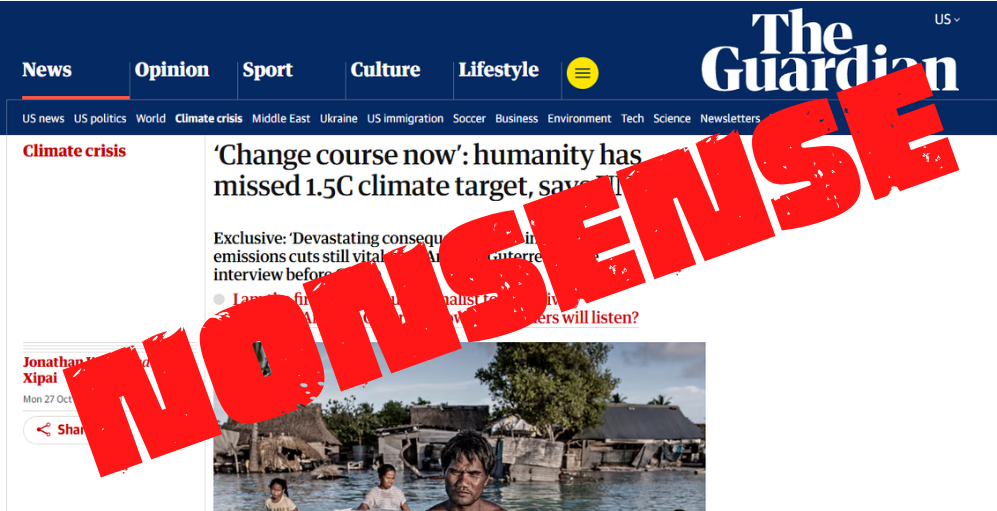
A recent article in The Guardian, “Change course now: humanity has missed 1.5C climate target, says UN head,” claims that the planet is in grave danger of passing climate “tipping points,” as it is now inevitable that 1.5°C warming will be breached. Although 1.5℃ of warming may be locked in if not already surpassed, the claim that it signifies a dangerous milestone is false. Not only is the tipping points narrative bunk, but there is no evidence that 1.5°C warming is any particular threat. The purported temperature threshhold was chosen arbitrarily and for political reasons rather than scientific ones.
The Guardian’s story focuses on comments made by United Nations Secretary General António Guterres, who in advance of the COP30 climate summit in Brazil, warned that it is “inevitable” that 1.5°C of warming will be breached, and it will result in “devastating consequences” for the planet. The Guardian says Guterres “urged the leaders who will gather in the Brazilian rainforest city of Belém to realize that the longer they delay cutting emissions, the greater the danger of passing catastrophic “tipping points” in the Amazon, the Arctic, and the oceans.”
There is no scientific basis for any so-called tipping points, and claiming otherwise is just fearmongering for political gain.
Beginning with the Amazon rainforest, the location of the next climate summit in November, Guterres reportedly warned that it could become a “savannah,” or a dry grassland. There is no evidence for this absurd claim. Like Guterres’ previous “boiling oceans” comment, it is purely fanciful hyperbole lacking any basis in fact. Guterres is referencing a period of drought suffered by parts of the Amazon basin in recent years, but that drought has not been historically unusual, and the recent localized areas of drought have not been more severe than previous drought periods. As discussed in the Climate Realism post “Media Outlets Continue Spreading False Amazon “Record Drought” Claims,” the Amazon has experienced periods of heavy rain and extended drought in the past that were worse than those we see now. Historic records do not show any worsening of drought in the Amazon. The threat that impacts tree cover is deforestation and clear cutting, not climate change.
The Arctic is also not approaching any dangerous tipping point. Should warming continue, ice extent will likely shrink, but it has not been happening at nearly as fast a rate as alarmists claim. Arctic sea ice extent has been stable since about 2010, indicating a new ice extent regime, and there is no telling how long that will last. If the past is any guide, sea ice might begin expanding again, as it has waxed and waned historically.
Finally, the ocean tipping point Guterres is referring to is the claim that coral reefs will die out as a result of ocean pH changes and higher temperatures, but again, science and paleo-history shows that corals are resilient to changes that are much more extreme than the modest warming of recent decades. As discussed repeatedly at Climate Realism, the world’s oceans are not at risk of becoming acidic and coral reefs are expanding their range and setting records for growth.
It is true that the “1.5°C threshold” is likely to be passed. But that does not mean anything, certainly nothing catastrophic. The 1.5°C warming limit was already passed in 2024 because of the El Niño conditions—with no cataclysm. This should not be of concern to anyone, because that limit is not a scientifically established value. The Guardian fearmongered about it in the past, which Climate Realism addressed here, and seems to have learned nothing. The 1.5°C number was arbitrary; established by an 11 member German political advisory board containing only one meteorologist. It is not a hard scientific threshold the way the boiling point of water is, though alarmists inappropriately treat it that way.
Guterres’ comments are not based on science, data, or even history. He is simply attempting to worry the public, with The Guardian’s complicity, in order to gain political leverage for negotiations at COP 30 even as a growing number of countries are downplaying climate concerns in the realistic assessment that other issues are more pressing and fossil fuels, for now, remain vital to prosperity.
There is much of significance happening in Ukraine right now that is being reported either lightly or not at all by the mainstream Western media in an apparent attempt to harmonize their reporting with Kiev’s narrative in order to keep hopes high and economic and military support flowing.
Though the mainstream media has begun to report on the Russian encirclement of the Donetsk city of Pokrovsk, it is failing to report on how dire and how ominous the situation is. The reporting suggests that the battlefield situation is being stabilized, that the Russian losses are enormous, and that the loss of Pokrovsk would be strategically insignificant. None of those claims are true.
Russia’s chief of staff, General Valery Gerasimov, reported to Russian President Vladimir Putin that the Russian armed forces are “advancing along converging axes” and “have completed the encirclement of the enemy” in Pokrovsk and Myrnohrad.” His Ukrainian counterpart, Oleksandr Syrskii, said the report does “not correspond to reality.” Ukrainian officials “insist,” The New York Timesreports, “that special units are clearing Russians out of the city.” Ukrainian President Volodymyr Zelensky boasted that “in Pokrovsk, we continue to destroy the occupier.”
Though the Ukrainian armed forces may have temporarily pushed the Russian forces partially back, the Russian forces have retaken a large part of Pokrovsk and now control about 80% of it. The pincers that are steadily closing around Pokrovsk are now just a kilometer apart, a gap that is difficult and dangerous for Ukraine’s best paratroopers to escape through. Though Ukraine continues to deny the encroaching encirclement, admitting only that the situation is “difficult,” the narrative won’t change the reality on the battlefield. Ukraine’s Euromaidan Presssays that Pokrovsk now “risks becoming a graveyard for Ukraine’s finest.” The Kyiv Independentassesses that “saving the city from falling in the short term looks to be a daunting, and likely impossible task.”
The Western media also reports that Russia’s gains are coming at a greater loss. The Times reports that “Russia’s incremental advances have come at an immense cost. While Ukraine wants to hold on to Pokrovsk, military commanders argue that the large losses it is inflicting on the Kremlin’s troops there will hurt the Russian war effort more broadly.”
But the Times exaggerates Russia’s losses in the war more broadly by at least three times and shrinks Ukraine’s losses by the same amount. As far as Pokrovsk goes, analysts have noted that the attrition of Ukraine’s forces in the war have led to a situation in Pokrovsk where Russia’s forces are taking the fortified city without huge losses in troops or equipment.
And, according to the Times, “the military significance of losing Pokrovsk may be relatively small for Ukraine.” But the loss of Pokrovsk means not only the loss of a critical strategic hub for supplying Ukrainian forces in the east, but also the possible loss of control of Ukraine’s defensive line of linked fortification in Donetsk.
Perhaps even more lacking in Western reporting of the battlefield is that a number of military analysts have pointed out that singular focus on Pokrovsk misses the larger picture that that the Russian armed forces have entered or partially encircled several cities in Donetsk, threatening a larger encirclement of the area, and that for the first year in the war, the Ukrainian armed forces have been unable to launch any kind of offensive in 2025. Those two battlefield realities combine to create a larger context that is more ominous still. It suggests that Russia’s war of attrition has depleted Ukrainian troops to the point that they are no longer able to attack Russia or to defend themselves.
Ukraine’s desperate situation on the battlefield has led to two more underreported events. The first was the simultaneous explosions at oil refineries in Hungary and Romania. The fact that both refineries process Russian crude oil and that Ukraine and Europe seem to have shifted their strategy from defeating Russia on the battlefield to cutting off Russia’s oil revenue to drive them to the negotiating table, have led to speculation that Ukraine was behind the two acts of sabotage.
Hungary’s Prime Minister Viktor Orbán said recently that the explosion at Hungary’s oil refinery could have been caused by an “external attack.” The external actor is unlikely to be Russia. They lack the motivation to sabotage their own customers at a time when U.S. sanctions are attempting to strangle its exports of oil. That seems to leave, as a consensus among analysts suggests, Ukraine or its partners. Ukraine has offered no comment on the explosions, and the silence of the Western media adds to the suspicion. It is alarming that the mainstream media has not a word to say about seemingly coordinated attacks on two European countries that could have enormous consequences in the post Ukraine war world.
Ukraine’s desperation has also led to an underreported crisis at home. Ukraine is losing troops, not only to Russian attacks on the battlefield, but to desertion. As part of the solution, Ukraine has turned to forced mobilization in which men are abducted, often aggressively, against their will and bussed off to recruitment centers. From there, they find themselves on the battlefield with very little training.
Once on the front, troops have deserted in the thousands. Though little reported in the mainstream media, in the first months of 2025 alone, more than 110,000 Ukrainian soldiers deserted. As many as 20% of Ukraine’s armed forces have deserted. Since the war began, the number of desertions may be as high as 200,000, and it is getting worse by the month.
The Western media seems to be complicit in harmonizing with Kiev’s misleading message in order to keep Western morale up and Western arms flowing. But, though the narrative may be strong enough to mislead a public that trusts its newspapers, it will not be strong enough to alter reality. Ukraine is turning to more desperate measures in an attempt to address a dire situation on the battlefield in which they no longer have the manpower to go on the offensive nor to defend themselves and in which troops are deserting as fast as they are being killed.
On Monday, November 3, a group of Israeli soldiers stood outside the Supreme Court in West Jerusalem wearing black masks. They weren’t there to apologize; they were there to defend themselves.
The soldiers, accused of torturing and raping a Palestinian detainee at the notorious Sde Teiman prison, demanded “gratitude” for their actions.
“Instead of appreciation, we received accusations,” one said defiantly. Israeli media covered the scene while Western outlets mostly ignored it.
The same soldiers are part of a criminal case that Israeli prosecutors reluctantly opened in 2024 after video evidence surfaced showing Palestinian detainees stripped, beaten, and sexually assaulted at Sde Teiman.
One Palestinian man was hospitalized with seven broken ribs and a rectal tear, injuries consistent with violent sexual abuse.
The Times of Israelreported the indictment of five reservists for “severe abuse,” while other sources cited evidence of sodomy inside the facility.
Yet, in Western coverage, the word rape almost never appeared. Headlines spoke of “abuse” or “mistreatment,” as though sexual torture were a matter of workplace misconduct.
Contrast this silence with the wall-to-wall coverage of October 7, when Israel accused Hamas fighters of “mass rape.” Those claims, still unproven, became the moral foundation of Israel’s campaign of annihilation in Gaza.
In his latest interview with American journalist Candace Owens, political scientist Norman Finkelstein called the Israeli allegations “genocidal atrocity propaganda.”
After examining more than 5,000 photographs and fifty hours of footage from that day, Finkelstein said he found “not a single shred of evidence of even one rape.” Yet those unverified stories, repeated endlessly by Western outlets, were enough to cast an entire population as subhuman and to legitimize the killing of more than 68,000 Palestinians.
In December 2023, the New York Times published a sprawling investigation titled “Screams Without Words: How Hamas Weaponized Sexual Violence on Oct. 7.”
The article claimed Hamas fighters had systematically raped Israeli women during the attack. Its pages were filled with graphic descriptions and lurid imagery. The story relied on anonymous witnesses, unverified videos, and second-hand testimony, yet it was presented as conclusive evidence of mass rape.
Within days, it shaped international discourse. Then US President Joe Biden, European leaders, and prominent feminists invoked the Times’ story to condemn Hamas and morally justify Israel’s “retaliation”.
But when journalists and scholars began checking the evidence, the story fell apart. Forensic experts found no physical proof of rape. Several of the supposed witnesses cited by the Times contradicted one another or were later discredited.
In April 2024, more than 50 journalism professors sent a public letter demanding an independent review of the article’s sourcing and editorial process. The Washington Postreported internal dissent within the Times newsroom itself, where reporters said the piece had been “rushed” to meet political expectations.
Meanwhile, the Sde Teiman scandal, an Israeli atrocity supported by video evidence, medical reports, and judicial proceedings, has never received a fraction of the attention that the Times story did. This imbalance is not merely linguistic. It is structural, reflecting the hierarchy of human worth built into Western coverage of the war.
This is how “atrocity propaganda” works. It does not require lies to function, only selective truth. By repeating unverified claims of Hamas rape while downplaying verified Israeli sexual crimes, Western media transformed journalism into a weapon of war.
Romana Rubeo is an Italian writer and the managing editor of The Palestine Chronicle. Her articles appeared in many online newspapers and academic journals. She holds a Master’s Degree in Foreign Languages and Literature and specializes in audio-visual and journalism translation.
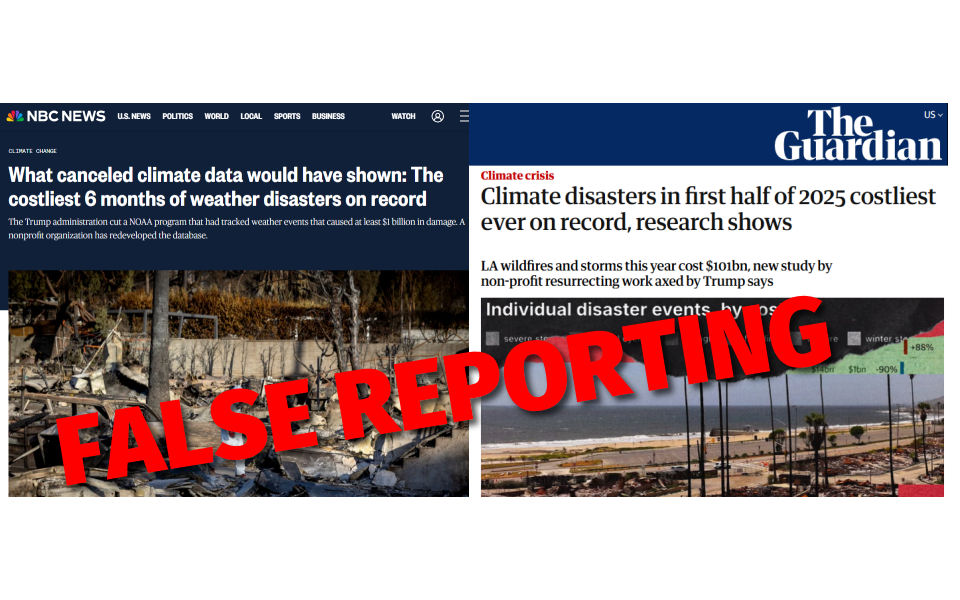
Multiple mainstream media outlets published stories this week uncritically publicizing the claims of a climate change interest group, Climate Central (CC). According to CC, climate change has caused higher weather disaster costs in the United States this year than ever in history – or at least since 1980, which is as far as the records CC uses go back. These claims are false. While the costs of extreme weather events and wildfires were high in early 2025, there are no trends that indicate climate change is responsible. Rather, higher populations, increased development in disaster prone areas, poor water management, and human evil in the form of arson, were the cause of the abnormally high disaster costs.
The tenor of The Guardian, NBC, and other outlets covering CC’s disaster cost report was nearly universal. Climate change resulted in worse weather disasters and higher costs in early 2025 than ever before, a fact that would have been missed absent CC’s work since President Donald Trump cut funding for the National Oceanic and Atmospheric Administration program, which has previously monitored such costs.
Per The Guardian :
The first half of 2025 was the costliest on record for major disasters in the US, driven by huge wildfires in Los Angeles and storms that battered much of the rest of the country, according to a climate non-profit that has resurrected work axed by Donald Trump’s administration that tracked the biggest disasters.
In the first six months of this year, 14 separate weather-related disasters that each caused at least $1bn in damage hit the US, the Climate Central group has calculated. In total, these events cost $101bn in damages – lost homes, businesses, highways and other infrastructure – a toll higher than any other first half of a year since records on this began in 1980.
As NBC News wrote:
The first half of this year was the costliest ever recorded for weather and climate disasters in the United States, according to an analysis published Wednesday by the nonprofit organization Climate Central.
It is information that the public might never have learned: This spring, the Trump administration cut the National Oceanic and Atmospheric Administration program that had tracked weather events that caused at least $1 billion in damage. The researcher who led that work, Adam Smith, left NOAA over the decision.
To be clear, Climate Central is not an objective authority on the causes and consequences of climate change, or a neutral party regarding proposed solutions. Rather, it was created and exists solely to produce and promote material blaming human activities for causing climate change resulting in catastrophic consequences that threaten human life, and to promote government enforced solutions that limit fossil fuel use.
Leaving aside the motives of the organization that produced the report, the news coverage of the report was inaccurate from the start. The stories ignore the history of natural disasters in the regions that have been impacted this year, the demographic changes that have resulted in the higher costs, and, most importantly, the lack of any long-term discernable changes in weather patterns and the incidences and severity of extreme weather events for the areas affected.
Looking at where the disasters occurred in the first half of this year, from CC’s own tracking we find the weather events were tornadoes that occurred during typical tornado season stretching from Texas through the plains to the upper mid-west. This area of the country is commonly referred to as “tornado alley” because such events are so common there during the spring and early summer. So, nothing unusual there. What critically undermines the CC report and the media’s suggestion that the rising cost of tornadoes is due to climate change is the fact, as explored in Climate Realism, here, here, and here, for example, that neither the number, frequency, nor severity of tornadoes has increased as the Earth has slightly warmed.
Other events include flooding in areas of the country historically known for spring flooding as a result of snowmelt and severe spring snowstorms – many of the areas are popular riverfront towns or communities. Climate Realism has repeatedly debunked media claims that flooding is getting worse – data show it isn’t. If flooding is not becoming more frequent or severe, climate change can’t be causing higher costs related to flooding.
Finally, more than 60 percent of the $101 billion disaster costs that CC says resulted from climate change altered weather events are attributable to just a single event: the January 2025 wildfires that decimated a large swath of Los Angeles. The Los Angeles fires were horrific, of a kind not experienced there in recent history, but not unusual historically. The huge damage was a result of a combination of factors, good seasonal rainfall in recent years creating lush natural growth combined with and regular lawn and tree watering in wealthy enclaves, followed by a severe drought, creating conditions for a wildfire, and strong Santa Anna winds to drive a fire quickly across the landscape once started (once again a natural feature of the area). With these conditions, all that was needed was a spark, which a perverse arsonist provided. Once the fire started, winds drove it quickly across a tinder dry landscape and firefighters found a shortage of water in reservoirs as a result of political decisions made by the state government.
Los Angeles is not warmer than is was in the 1950s and precipitation has actually increased slightly in the region since 1895. Despite climate alarmists and advantage seeking, virtue signaling Democratic politicians attempting to blame climate change for the fire and its severity, the evidence indicates it had nothing to do with it.
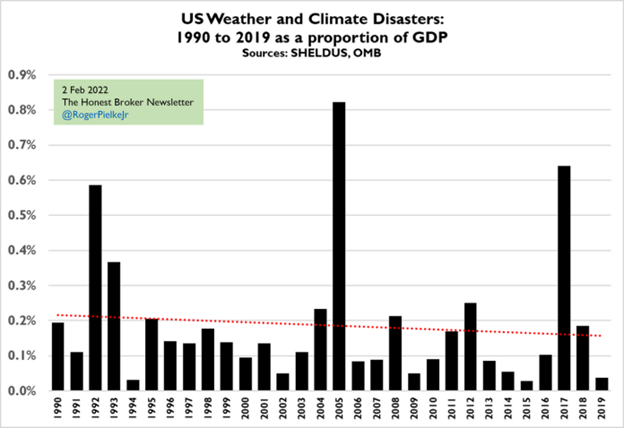
If climate conditions haven’t change appreciably across the United States, in the sense that the more extreme weather patterns are emerging, the question is, why have costs related to weather disasters gone up so much in nominal dollars? Keep in mind that in inflation adjusted dollars as a percentage of GDP, the costs of natural disasters have fallen over time. (see the figure, below)
As should be obvious to any honest observer exercising the least bit of common sense, the reason for rising disaster costs is clear, the expanding bullseye effect. As Climate Realism has explored in dozens of articles previously, with more people moving into ecologically/climatically desirable locations, locations prone to natural disasters, erecting more homes, businesses, and related structures and infrastructure, property has gone up dramatically in value overtime. When a disaster like a wildfire (in this case an arson started wildfire) strikes, more people and property is impacted and related costs are higher. Climate Realism discussed this very point in articles linked, here, here, and here, to take but a few examples. Quite simply, when a hurricane hits Miami or Galveston now, there are more buildings and structures to destroy at those locations than there was 100 years ago.
One can acknowledge that CC is right, natural disasters are imposing higher costs in nominal dollars now than they did in the past, without jumping to the completely unfounded claim that climate change is the cause. Legitimate journalists and honest news outlets, as NBC News and The Guardian purport to be, should check their facts before parroting the false rantings of a climate lobbing group as the truth. Misleading, false alarm stories like these are perhaps why trust in the media is low and falling.
A leading British “PR consultancy” working for the Israeli regime’s top arms producer has been found culpable of fabricating and planting a false media narrative linking Palestine Action to Iran, in what appears to be a coordinated effort to justify the group’s eventual proscription.
According to British news magazine Private Eye, a “trusted witness” said Georgia Pickering, head of the London-based PR firm CMS Strategic, which represents Israeli weapons manufacturer Elbit Systems, boasted about planting a story in The Times alleging that the Islamic Republic was bankrolling the direct-action network.
The story appeared just days before the UK government moved to outlaw Palestine Action under its “terrorism” legislation in July.
The fabricated report, which claimed that the Home Office was probing Tehran’s alleged financial ties to the group, was later recycled by The Daily Mail and the GB News channel, amplifying suspicions and pressure against the movement.
However, when Private Eye reached out to the Home Office, officials said they did not recognize the claims, effectively disowning the narrative that had dominated headlines.
A spokesperson for Palestine Action dismissed the entire affair as “baseless” and “ridiculous”, while CMS Strategic publicly denied involvement in the article, despite Pickering’s private admission.
Further revelations highlighted that the smear campaign did not emerge in isolation.
Just two days before the story broke, the pro-Israeli lobby group We Believe in Israel claimed on social media that Iran’s Islamic Revolution Guards Corps (IRGC) was the “darker puppeteer” behind Palestine Action, despite offering no proof beyond vague references to “similar slogans.”
In the months leading up to the group’s ban, the same lobby orchestrated a “multi-front” campaign pushing for Palestine Action’s proscription, issuing two reports whose language was later echoed almost verbatim by Yvette Cooper, the then–home secretary, in her official statement outlawing the movement.
For years, Palestine Action has led a relentless grassroots campaign against Elbit Systems, targeting its factories and offices for producing weapons used by the Israeli regime in its assaults on Palestinians, including its war of genocide on the Gaza Strip that began in October 2023.
A recent article in The Hill, “Climate change is not a ‘con job’,” claims that catastrophic, human-caused climate change is killing reefs via ocean heatwaves. This claim is false. In reality, corals have existed for millions of years, through warmer and colder periods, and in the recent past, coral reefs have recovered from bleaching events and even die-offs, proving to species to be adaptive and resilient in the face of climate change.
The Hill article, from Rebecca Vega Thurber, the director of the UC Santa Barbara Marine Science Institute, is framed by Thurber’s annoyance that President Donald Trump says climate change is a “con job.” She claims her personal research experience refutes his comment.
Thurber explains that pollution from fertilizer runoff can kill corals, which is true, but goes on to assert that “every result we have collected, in every one of these well intentioned and carefully designed experiments, was waylaid by the increasingly frequent and severe heat waves that have arisen in the last decades.” She says their efforts to mitigate pollution were “overwhelmed by high water temperatures driven by climate change or worse, climate change killed our whole experiment.”
Thurber claims marine heatwaves in the French South Pacific hampered her work by “transform[ing] these normally bountiful reefs from habitats where there was once 60 percent of the seafloor covered with healthy corals to barren plains with less than 1 percent live coral.”
In point of fact, one long-term study from 2019 showed that rather than a “barren plain” French Polynesian reefs have an “outstanding rate of coral recovery, with a systematic return to pre-disturbance state within only 5 to 10 years.”
A second study from 2024, published in Nature, sought to understand why reefs bounced back so readily after major heat waves, concluding that:
Over the past three decades, there have been five main warming events that have caused mass bleaching around Moorea and Tahiti, in 1994, 2002, 2007, 2016, and 2019. Despite bleaching levels up to 100% for some coral species, reefs experienced as high as ~76% recovery following each event. […]
It is currently unknown what controls the ability of coral coverage to recover quickly at these locations. It has been suggested that reefs may develop an increased tolerance to higher SSTs following each bleaching event, and that the increased resilience would allow for a shorter recovery period with less die-off under subsequent SST extremes.
In short, the scientific literature does not support Thurber’s contention in The Hill that coral reefs are dying off in vast numbers. Interestingly, just a few years ago The Hillpublished an article with a different tone, discussing the fact that coral reefs were thriving “despite warming seas,” but the outlet seems to have forgotten this.
What Thurber and The Hill also neglected to mention was that recent mass die offs did not just coincide with heatwaves alone. Rather a spate of tropical cyclones and crown of thorns starfish outbreaks occurred over the same period resulting in multiple coral colony declines. Multiple stressors are harder on a species than any of those dangers would be alone.
Thurber mentions that Australian reefs are another part of her area of research, but she does not mention that 2024 was the third year in a row where the Great Barrier Reef had record breaking coral coverage.
Unfortunately, close study of reef die backs barely existed in the early parts of the 20th century and before, so short term records like single-event tied die-offs do not stretch into the pre-industrial period for comparison. As a result it is all too easy for alarmists to assert, for example, that marine heatwaves are unprecedented when there are only a few decades of satellite data to work from. Longer term studies, and a knowledge of how coral reefs around the world are built over time, show, in fact, that coral death is part of the reef construction process.
Coral reefs have survived much hotter periods than today, like the Paleocene-Eocene Thermal Maximum which was 5-8°C hotter, as well as much colder glacial periods. One reason for this is that coral organisms are not immobile. Even if particular regions became too hot, which is highly unlikely in our lifetimes, corals could just migrate poleward, as research suggests they did in the past. Change like that might be uncomfortable for narrowly-focused researchers, but it is part of the Earth’s history.
The Hill did a disservice to its readers by publishing this article which served no other purpose than to frighten readers into ignoring Trump’s important point, that bad actors (particularly at the United Nations, where he made the comments) are using climate alarm to promote harmful leftist-favoring policies and enrich themselves. I am sure that Thurber is a “true believer” in the catastrophic warming narrative, but it does not help her case when essential facts are left out of the argument and when the multiple sources of data that do exist contradict her claims.
German Chancellor Friedrich Merz is misleading the public about a drone threat allegedly posed by Russia, Sahra Wagenknecht, the leader of the left-wing BSW party, has said. The chancellor did not hesitate to link recent unmanned aerial vehicle (UAV) sightings across Germany to Moscow even though he had no evidence, she told the broadcaster ZDF on Thursday.
According to Wagenknecht, Merz was blowing the issue out of proportion, with the German media unquestioningly adopting his point of view, even though evidence pointed in the other direction.
“Mr. Merz goes on TV… and lies,” she said, adding that the chancellor made his statements after some of the incidents had either been proven to have no connection to Russia or turned out to have never happened at all. “It’s simply a vague suspicion, which has been largely refuted, and then discussed by the chancellor on public television.”
She was referring to the chancellor’s interview with the German broadcaster ARD earlier this month, when he said that “our suspicion is that Russia is behind most of these drone launches” and called the UAVs a “serious threat to our security.”
The interview came just days after the German police said that a drone incident at Frankfurt airport was caused by a local UAV enthusiast. Claims of drone sightings near a military base in northern Germany in early October were also refuted by the Bundeswehr, which stated that “there were no registered drone overflights” in the area, “contrary to the media reports.”
Several drone sightings were reported over critical German infrastructure earlier this month. One such incident led to dozens of canceled flights at Munich airport. The developments prompted some officials, including Merz, to claim the drone flights had been orchestrated by Moscow.
Moscow has repeatedly denied any connection to the incidents. Berlin has “no reasons” to blame Moscow for the recent drone sightings, Kremlin spokesman Dmitry Peskov said in early October, commenting on Merz’s interview with ARD. “Europe is full of politicians who tend to blame Russia for everything,” he said at the time, calling the accusations “baseless.”
On 7 March, Syrian security forces and affiliated armed factions perpetrated the massacre of more than 1,500 Alawite civilians, including many elderly, women, and children, in 58 separate locations on the Syrian coast.
Though the killings were executed by sectarian forces loyal to Syrian president Ahmad al-Sharaa (Abu Mohammad al-Julani), a former Al-Qaeda commander, the path to the massacre was paved by a covert Israeli strategy aimed at inciting an Alawite uprising.
Israel’s plan hinged on pushing Alawites into the “trap” of launching an armed rebellion, with false promises of external support, only to give Sharaa’s forces the pretext to carry out the mass slaughter of Alawite civilians in “response.”
Israel’s goal was consistent with its long-standing aim, articulated in the infamous Yinon Plan: to dismantle Syria and reshape it into “weak, decentralized ethnic regions,” following former Syrian president Bashar al-Assad’s fall.
Netanyahu goes to Washington
After 14 years of sustained support from the US, Israel, and regional allies, the extremist group Hayat Tahrir al-Sham (HTS) – formerly the Al-Qaeda affiliate, the Nusra Front – seized control of Damascus in December 2024. Its leader, Julani, rebranded as Ahmad al-Sharaa, swiftly assumed the presidency.
On the very day of this power shift, Israeli Prime Minister Benjamin Netanyahu took credit for Assad’s fall and began a mass bombing campaign to destroy what was left of the country’s military capabilities.
However, toppling Syria’s government and destroying its army was not the end of Israel’s plan for Syria.
On 9 January, Netanyahu’s cabinet met to discuss organizing an international conference to “divide Syria into cantons,” Israeli news outlet i24 News reported.
“Any proposal deemed Israeli will be viewed unfavorably in Syria, which necessitates an international conference to advance the matter,” the outlet noted.
In other words, to be successful, Israel’s project to divide Syria needed to originate, or seem to originate, from Syrians themselves.
Less than a month later, on 2 February, Netanyahu visited Washington to present a “white paper” regarding Syria to US officials.
After Netanyahu’s visit, Reutersreported that “Israel is lobbying the United States to keep Syria weak and decentralized, including by letting Russia keep its military bases there to counter Turkey’s influence.”
The Times of Israel later commented that Israel was lobbying the “US to buck Sharaa’s fledgling government in favor of establishing a decentralized series of autonomous ethnic regions, with the southern one bordering Israel being demilitarized.”
Reports later leaked into political circles about a meeting two days later, on 4 February, between US officials and a representative of the most influential Druze religious leader in Syria, Sheikh Hikmat al-Hijri, in Washington, DC.
Al-Jumhuriyareported that according to Syrian and American sources with direct knowledge of the meetings, discussions revolved around “a plan for an armed rebellion against the government of Ahmad al-Sharaa.”
The rebellion would reportedly include Hijri’s Druze forces from Suwayda, the Kurdish-led Syrian Democratic Forces (SDF) from northeast Syria, and Alawite groups from the Syrian coast, but with “Israeli support.”
When asked about the meeting, Hijri’s representative confirmed to Al-Jumhuriya that it had taken place but stated that the proposal for a rebellion had not come from the Druze.
“The proposal originated from a state, not from any Syrian faction,” Hijri’s representative clarified, in a likely reference to Israel.
Inventing the insurgency: Meqdad Fatiha
Just two days later, on 6 February, an Alawite resistance group, the “Coastal Shield Brigade,” was allegedly formed.
A video announcing the group’s establishment claimed its fighters would respond to sectarian massacres carried out by HTS-led security forces against Alawites since December, including in the village of Fahel, where 15 former officers in the Syrian army were killed, and the village of Arzeh, where 15 people were killed as well, including a child and an elderly woman.
In both villages, former officers in Assad’s army had given up their weapons and completed a reconciliation process with the new authorities in Damascus, but were nevertheless murdered in their homes by militants linked to Syria’s new extremist-led security forces.
The Coastal Shield Brigades was allegedly led by Meqdad Fatiha, a former member of the 25th Special Forces and the Republican Guard of the Assad government.
Activists on social media circulated the video, which allegedly showed Fatiha declaring the establishment of the brigade from a base in the Latakia Mountains.
However, there was no evidence that the group was real. Fatiha’s face was covered by a black balaclava in the video, making it impossible to verify whether he was really the person speaking. This was odd, given that his appearance was already known from his Facebook profile.
The theatrics pointed to an intelligence fabrication – likely Israeli – designed to present the illusion of an organic Alawite insurgency.
A meeting in Najaf?
Just five days later, the narrative of an organized Alawite insurgency was reinforced by reports in Turkiye Gazetesi, an Islamist-leaning pro-government newspaper in Turkiye.
The report claimed that Iranian generals and former commanders in the Syrian army under Assad had met in the Shia holy city of Najaf in Iraq to plan a major uprising against Sharaa in Syria.
The scheme reportedly involved Druze factions, the Kurdish-led SDF, Alawite insurgents on the coast, Lebanese Hezbollah, and, improbably, ISIS.
Large amounts of weapons were allegedly being sent by land from Iraq and by sea from Lebanon to the Syrian coast, the report added.
“Some surprising events were expected to occur in Syria in the near future,” the Iranian generals allegedly in attendance said.
While “surprising events” did occur one month later with the massacre of Alawites on 7 March, the reports of the Najaf meeting are likely fabricated.
It is unlikely that a Turkish newspaper would have access to a detailed account of a secret meeting taking place between top Iranian generals and former Syrian officers.
It is also unlikely, and even ridiculous, that Iran and Hezbollah would be coordinating with their long-time enemy, ISIS, or with the US-backed SDF.
Kurdish-Syrian commentator Samir Matini amplified the narrative through widely viewed livestreams, pushing the idea of “surprising events” to come. The aim: to pin Israel’s plan on Iran and Hezbollah and create a smokescreen of chaos.
Sectarian killings fuel resistance
Amid the propaganda claiming a foreign-backed Alawite insurgency was being organized, Julani’s security forces stepped up attacks against Alawite civilians in the coastal region.
Syrian journalist Ammar Dayoub reported in Al-Araby al-Jadeed that Alawites were often targeted solely based on their religious identity, rather than because they were “remnants of the regime.”
Dayoub observed that “these violations have targeted people who opposed the previous regime, and young people who were only children in that period, as well as academics and women.”
In response to the sectarian killings, Alawites began to defend themselves.
One key event occurred on 8 January, when armed men linked to the Damascus government killed three Alawite farmers in the village of Ain al-Sharqiyah in the coastal region of Jableh. The men were working their lands across from the Brigade 107 base when they were killed.
In response, a local man named Bassam Hossam al-Din gathered a group of local men, arming them with light weapons. They attacked members of Julani’s internal security forces, known as General Security, killing one and abducting seven more, before barricading themselves in an Alawite religious shrine.
The General Security launched a campaign against them, swiftly killing Hossam al-Din and his group.
A former intelligence officer of the Assad government, speaking with The Cradle, says these killings motivated him and others to fight back:
“All this fueled enormous resentment in the area, which grew worse day by day. After Bassam Hossam al-Din’s death, some people here – including former government military personnel and civilians – began to gather.”
Crucially, they were “encouraged by reports and promises [of help] they received from outside.”
They were told they would receive support, including by sea, from the US-led international coalition, in coordination with the Druze in Suwayda and Kurds in northeastern Syria.
“They were given hope of escaping this miserable situation,” the former intelligence officer tells The Cradle.
In the following weeks, Alawites continued to clash with Syrian security forces in an effort to defend themselves from raids and arrests.
In late February, Alawite insurgents attacked a police station in Assad’s hometown of Qardaha, located in the mountains overlooking the coastal town of Latakia.
According to Qardaha residents and activists who spoke to Reuters, “the incident began when members of security forces tried to enter a house without permission, sparking opposition from residents.”
“One person was killed by gunfire, with locals accusing the security forces of the shooting,” Reuters added, further suggesting that local Alawite men were acting in self-defense.
What happened in Datour?
The simmering conflict escalated further on 4 March. Reutersreported that, according to Syrian state media, two members of the Defense Ministry had been killed in the Datour neighborhood in Latakia city by “groups of Assad militia remnants,” and that security forces had mounted a campaign to arrest them.
One Datour resident toldReuters there had been heavy gunfire in the early hours and that security forces in numerous vehicles had surrounded the neighborhood.
A security source speaking with the news agency blamed the violence on a “proliferation of arms” among former security and army personnel who had refused to enter into reconciliation agreements with the new authorities.
The source said that local Alawite leaders had, in some cases, cooperated with security forces to hand over former personnel suspected of committing crimes during the period of Assad’s rule in hopes of staving off “crack downs and potential civil unrest.”
Testimonies from residents of Datour collected by Syrians for Truth and Justice (STJ) indicated that security forces carried out random arrests in Datour and indiscriminately fired at civilian homes, resulting in several deaths, including that of a child.
The campaign was “marked by sectarian rhetoric and intense hate speech directed against the Alawite sect,” STJ added.
A source from Datour speaking with The Cradle reveals that Julani’s government used a prominent local Alawite family to create the proliferation of weapons needed to justify a crackdown.
The Aslan family had previously been close to Maher al-Assad, Bashar’s brother and commander of the army’s elite 4th Division, but quickly established good relations with the new government after it came to power in December.
It became common to see General Security members from Idlib spending time at the Aslan-owned businesses on Thawra Street at the entrance to Datour.
When residents complained to the General Security about criminal activity by the Aslan family, such as stealing money and confiscating homes, the General Security took no action against the family.
The source speaking with The Cradle says that on 4 and 5 March, members of the Aslan family distributed weapons to Alawite men in the neighborhood, encouraging them to take up arms against the General Security.
This was, of course, strange given the close relationship between the Aslans and the General Security, as well as because such a rebellion had little chance of success.
“Why would the Aslan family distribute weapons to fellow Alawites in Datour while knowing a rebellion would fail?” the source asks.
What happened in Daliyah?
On 6 March, a major clash erupted in the Alawite villages of Daliyah and Beit Ana, which lie adjacent to one another in the mountains of the Jableh countryside.
Sources from Daliyah speaking with The Cradle confirm that a large General Security convoy entered the village that morning to arrest a local man, Ali Ahmad, who had written posts against the Julani government on Facebook.
General Security members took Ahmad from his work at the local mini bus station and executed him at the entrance of the village.
The General Security members then entered the nearby house of a retired army officer, Taha Saad, in the adjacent village of Beit Ana, killing his two adult sons.
In response to the killings, local men from the village gathered light weapons and attacked the General Security members. After the General Security called for reinforcements, a convoy of 20 vehicles arrived to assist the government forces in the fight.
The sources in Daliyah speaking with The Cradle state that around 20 members of the General Security and 17 men from the village were killed in the gun battle.
As the clashes continued, Damascus sent helicopters to drop bombs on Daliyah and Beit Ana until a Russian plane forced the helicopters to withdraw.
Julani’s army escalated further by firing artillery at multiple Alawite villages in the mountain areas from the military academy in Rumaylah on the coast, near Jableh city.
A source from Jableh speaking to The Cradle says that the bombings made Alawites “go crazy,” especially because Daliyah is home to an important Alawite religious shrine.
The massacre and its beneficiaries
When the Russian plane appeared over Daliyah and Beit Ana, “People thought that this was ‘the moment,’ so they rose up on that basis,” stated the former intelligence officer speaking with The Cradle.
Alawite insurgents attacked General Security and army positions in various areas across the coast, including Brigade 107 near Ayn al-Sharqiyah, where Bassam Hossam al-Din’s group abducted the General Security members before being killed in January.
“There was no Meqdad Fatiha or anyone else from outside, no Iranians or any others. It was purely a popular force rising up against this situation,” the former intelligence officer explains.
However, they were emboldened by promises of outside help from the US-led coalition, the Druze, and the Kurds.
The clashes at the Brigade 107 base lasted all night, but the Alawite insurgents paused the attack early the next morning, on 7 March, thinking that coalition forces would come to their aid and bomb the brigade.
“They waited two hours, but no strikes came, no support arrived. Their morale collapsed, they realized it was all lies, just a trap,” the source goes on to say.
After the fighting stopped, disillusionment spread, and the Alawite insurgents attacking the base withdrew and returned to their villages.
Al Jazeera’s role
As the fighting still raged on 6 March, Al Jazeerarepeated the false reports from Turkish media claiming Alawite insurgents were receiving massive external support from Iran, Hezbollah, the Kurdish SDF, and even Assad.
The news outlet’s propaganda gave Damascus the pretext to mobilize not only formal members of military units from the Ministry of Defense, but also many informal armed factions who responded to calls from mosques to fight “jihad” against Alawites.
On the morning of 7 March, convoys of military vehicles filled with tens of thousands of Sharaa’s extremist fighters began arriving at the coast.
Because the Alawite insurgency was weak and disorganized, with no help from abroad, it was not able to provide any protection to Alawite civilians as the massacres unfolded.
Facing no resistance, Julani’s forces began systematically slaughtering any Alawite men they could find, as well as many women and children, in cities, towns, and villages across the coast, including in Jableh, Al-Mukhtariyah, Snobar, Al-Shir, and the neighborhoods of Al-Qusour in Baniyas and Datour in Latakia.
The massive scope and systematic nature of the massacres, involving such large numbers of armed men in so many locations, suggests pre-planning by Julani and his Defense Minister, Murhaf Abu Qasra – a former commander-in-chief of the HTS military wing.
A media creation
The mobilization of Julani’s forces was also aided on 6 March by new videos appearing online claiming to show Meqdad Fatiha and members of the Coastal Shield Brigade vowing to fight against the new government.
In one video, the man claiming to be Fatiha was masked (this time dressed like a character from the popular video game, Mortal Kombat, and standing against a blank background), making it impossible to know who he was and whether he was in the mountains of Latakia or in a television studio in Tel Aviv or Doha.
In a separate video, Fatiha was masked and dressed just like an ISIS militant beheading Christians on video in Libya in 2015, leading to speculation the video was fake and had been created using artificial intelligence (AI).
Another video was later released in which Fatiha appeared without a mask, saying that previous videos of him were indeed real, and not created using AI. However, the new video also appeared fake, his face, shoulders, and eyes moving in an unnatural way as he spoke.
During multiple visits to the Syrian coast, The Cradle was not able to find any Alawites who expressed support for Fatiha or believed his group was real.
The source from Daliyah states that, “No one here supports Meqdad Fatiha. We all believe he works for Julani. The Coastal Shield Brigade is fabricated.”
A former Alawite officer in Assad’s army from the Syrian coast tells The Cradle, “We only see videos of Meqdad Fatiha online. We believe he is just a media creation.”
After showing The Cradle his rotting teeth, the former officer remarks, “Do you think we are getting help from Iran or Hezbollah? I don’t even have money to fix my teeth.”
An Alawite woman whose husband and two grown sons were murdered on 7 March suggests to The Cradle that Fatiha is a fictitious person, only existing on Facebook and created by the authorities to justify the massacres.
“Who is he? Julani created him. It’s a lie,” she explains.
General Security fatalities
The mobilization of Sharaa’s extremist forces from across the country was also aided by claims that Alawite insurgents had killed 236 members of the General Security in attacks on 6 April.
Some General Security members were certainly killed, but Syrian authorities never provided any evidence for this large number, suggesting it was vastly inflated to heighten sectarian anger. When Reutersrequested the names or an updated tally, Syrian officials refused to provide them.
In one case, the pro-HTS “Euphrates Shield” Telegram channel published a photo collage allegedly showing General Security members killed by “regime remnants” during the fighting.
However, one of the fighters shown in the photos quickly posted a story on his Instagram with a “laugh out loud” emoji to show he was still alive, the Syrian Democratic Observatory showed.
Israeli ambitions
On 10 March, before the victims of the massacres had been buried, i24 News published a letter claiming to be written by Alawite leaders, asking Netanyahu to send his military to protect them.
“If you come to the Syrian coast, which is predominantly Alawite, you will be greeted with songs and flowers,” the letter stated.
It also called on Israel to unite against the “Islamic tide led by Turkiye,” while asking for help in separating from “this extremist state.”
When Israel secretly “greenlit” Julani’s massacre of Druze in Suwayda in July, the goal of dividing Syria was further advanced. Many Druze are aware of the covert relationship between Damascus and Tel Aviv, but, fearing extermination, feel they have little choice but to call on Israel for protection and to establish an autonomous region in south Syria.
Three weeks after the massacres of Alawites in March, an Israeli general quietly admitted that sectarian violence in Syria benefits Tel Aviv.
“This thing where everyone is fighting everyone, and there’s an agreement with the Kurds one day, and a massacre of the Alawites the second day, and a threat to the Druze on the third day, and Israeli strikes in the south. All this chaos is, to some extent, actually good for Israel,” stated Tamir Hayman while speaking with Israeli Army Radio.
“Wish all sides good luck (but) do it quietly. Don’t talk about it,” the general added.
Al-Natour is the embodiment of the archetypal Palestinian collaborator. A man who portrays himself as a victim uses his own experience as a Palestinian to whitewash Israeli genocide.
On October 27, the Washington Post published an article entitled “The ceasefire created two Gazas. One will consume the other.” The author argues that “My Gaza is ready for peace” and that “Hamas is trying to destroy it”, promoting the fictitious Israeli narrative that a utopian Gaza is being made possible inside the portion of the enclave where the occupation forces remain, behind the so-called “Yellow Line”.
The article works to promote the Israeli scheme in Gaza, which has been openly endorsed by US officials, and argues in favor of only allowing reconstruction in the territory operated by Israel, alongside four primary ISIS-linked militias.
Evidently, the article makes no mention of the Israeli armed and controlled Palestinian death squads – composed of convicted drug traffickers, rapists, murderers, ISIS-linked Salafists and aid looters.
The piece is purportedly written by one Moumen al-Natour, which makes even more sense out of why there is no mention of the ISIS-linked death squads, because he himself is an armed member of one such death squad.
Al-Natour is the embodiment of the archetypal Palestinian collaborator. A man who portrays himself as a victim uses his own experience as a Palestinian to whitewash Israeli genocide and lies about every detail to turn himself into a “peace activist” opposed to armed resistance, while simultaneously partaking in activities designed to further the extermination of his own people.
Take, for example, the following excerpt from the ISIS-linked death squad collaborator’s alleged opinion piece:
“My Gaza, where I wish to live, exists between Israel and the yellow line. There, the war is over and change buzzes in the air. People have access to food, medicine and electricity. And other signs of normality are beginning to return, such as some children going back to school. This is the Gaza that is waiting with anticipation to work with a new civil administration and an international protection force that will keep the peace as Israel withdraws. Few there speak of Hamas with any warmth or positivity. For once they no longer have to.”
The territory spoken of here is the area of Gaza where Israel and four ISIS-linked collaborator gangs operate; the only civilians there are the families of the death squads. Any other Palestinians attempting to reach their homes inside this area are bombed or gunned down by Israeli forces.
This territory, on the other side of Israel’s “Yellow Line,” is supposed to be 53% of Gaza, yet in reality is anywhere between 54-58% of the territory, due to Israel violating the ceasefire agreement and operating deeper than agreed upon inside the supposed withdrawal zone.
In addition to this, Israel continues its daily demolition operations against the remaining Palestinian civilian infrastructure inside the territory, again in violation of the ceasefire agreement. The proof of this has been openly published by Israeli soldiers who post videos of their demolition work on social media.
As for access to food, medicine, and electricity, these are provided to the collaborator gangs by Israel and are something they have not lacked during the war. While the people of Gaza were being starved for three months straight earlier this year, al-Natour’s militia friends were living lives of relative luxury.
Not only were al-Natour’s collaborator gang not starved, the so-called “Popular Forces” that he is part of, led by ISIS-linked convicted drug trafficker Yasser Abu Shabab, were living off of the supplies they stole from humanitarian aid trucks and looted from Gaza’s civilian population.
That is what these militant organizations began receiving Israeli backing to do – before being repurposed, armed and given direct combat missions by the IDF and Shin Bet – to rob humanitarian aid trucks and help enforce Israel’s starvation policy in Gaza. All of these collaborator gangs were tasked with involvement in such activities, and many of their militants continue to loot.
Meanwhile, in the Western corporate media and its allied Arab publications, al-Natour and his ilk are portrayed as the peace activists opposed to Hamas tyranny. For al-Natour’s part, he was one of the founders of the “We Want To Live” movement, which claimed its mission was to improve living conditions inside the besieged coastal enclave, described by UN experts as “unlivable” back in 2020.
As an activist, he was accused of working on behalf of Israel and spreading a message critical of Hamas, leading to his arrest. Whether he was a collaborator back then is under dispute, yet, during the genocide, he and his anti-Hamas message were picked up by a media outlet called Jasoor News.
This media outlet’s editor-in-chief is a Washington based journalist, named Hadeel Oueis, who routinely shares anti-Hamas content, including from the Center for Peace Communications (CPC). Oueis also expresses support for the current Syrian leadership of Ahmed al-Shara’a.
The CPC has received considerable donations from the Adelson Family Foundation of Israel’s richest billionaire and top Trump campaign donor, Miriam Adelson. For Jasoor News’ part, it is explicitly anti-Hamas, anti-Hezbollah, anti-Ansarallah, while publishing pieces in favor of the United Arab Emirates and Saudi Arabia.
Western Media Support For ISIS-linked Groups
The recent propaganda opinion piece published by the Washington Post comes as little surprise, as it was the first Western publication to publish an interview with ISIS-linked militia leader Yasser Abu Shabab in November of 2024, when Israel began to give the aid looting gang a facelift and begin promoting them as a “grassroots” anti-Hamas resistance force.
In that WP piece, Abu Shabab claims victim status and that he looted aid out of necessity, expressing that “Hamas has left us with nothing”, despite his gang of collaborators clearly being the only group of Gazans who actually did have something during the genocide. Abu Shabab was used to do Israel’s bidding, blocking the flow of aid to civilians and lived under the protection of the Israeli military while doing so.
Back in July, the Wall Street Journal then published an opinion piece entitled “Gazans are finished with Hamas”, which it claimed was written by Yasser Abu Shabab himself. This was despite the fact that local sources in Gaza attest to Abu Shabab not only being unable to write in English, but also being illiterate and incapable of writing such a piece in Arabic too.
According to anonymous sources belonging to Palestinian journalist Muhammad Shehada, the latest Washington Post piece was published as explicit Israeli propaganda. “Journalists told me a pro-Israeli PR firm in DC is the one that pushed for this propaganda article to be published,” he wrote on X [formerly Twitter], adding that “my sources said there’s a chance the firm is the one that even wrote the op-ed”.
All of this works as part of an Israeli propaganda campaign aimed at legitimizing the agenda to create two separate systems of rule in Gaza, through spreading lies about Hamas and egregiously exaggerating the brutality of its Security Force crackdown on collaborators.
Israel is currently violating the Gaza ceasefire, not only through its daily bombings and sniping of civilians, but also through its refusal to allow sufficient aid to reach the civilian population. The Israelis had committed to allowing 400 aid trucks into Gaza for the first five days of the ceasefire before an unlimited amount afterward, later committing to permit 600 a day to enter, yet have allowed in a daily average of less than 90.
The idea, endorsed by the United States, is to deploy an international invasion force in the Gaza Strip, which will work alongside the ISIS-linked death squads to disarm Hamas. Once the Israelis withhold construction materials and equipment from entering the populated areas of the territory, where Hamas remains in power, they will then offer the civilian population a choice between entering their version of Gaza under occupation, or remaining where they are to starve and rot.
Hamas, along with all the other Palestinian factions, has agreed to hand Gaza over to an interim administration of technocratic governance, but will not disarm until the creation of a Palestinian State. Israel will not allow for this and instead uses its collaborators to fight for its own agenda, depending on its propaganda that is being prominently spread by its Palestinian media allies as a means of justifying this approach.
Inside Gaza, these ISIS-linked gangsters have no popular support. In fact, the vast preponderance of the population supports the Security Forces campaign to stamp out these groups. Despite the propagandists and militia members claiming that they are fighting a tyrannical regime that is killing its own people, the population of Gaza do not believe this narrative and hence will not support such a scheme.
The current round of propaganda against Hamas mirrors the regime change rhetoric used to overthrow countless governments in the region, beginning with Iraq. For example, during the campaign to justify the overthrow of former Iraqi President Saddam Hussein, Western governments and Washington-based think-tanks paid Iraqi “experts” and “peace activists” to justify the invasion of their own country.
Every time, the regime change script is the same. Except in this case, it is unlikely to succeed due to the grievances of Gazans with Hamas not matching those of their regional neighbors. This, however, will not stop the constant chorus of lies, exaggerations, and distortions from Washington and Tel Aviv’s “peace activists” who turn out to be armed members of ISIS-linked gangs and “Palestinian analysts” who just so happen to work for Zionist think-tanks.
These individuals speak with the language of “peace”, “reconciliation,” and “forgiving Israel”, but are ultimately soulless propagandists who weaponize their identity to serve an agenda aimed at destroying their own people. They value nothing more than status, power, and financial gain.
In the pro-genocide Western corporate media, these voices will continue to be elevated and their claims will never be fact-checked, because these outlets function as stenographers for the US and Israeli governments.
A recent article at the BBC, “Government told to prepare for 2C warming by 2050,” claims that the United Kingdom needs to prepare for increasing extreme weather as the planet approaches 2°C warming. This is false in its framing. Although it’s always a good idea to harden infrastructure against weather, the UK is not suffering more extreme weather due to human emissions of carbon dioxide, and the recommendation of attempting to prevent temperature rise is not going to help anyone.
The BBC’s post discusses a letter written by the UK government’s “Climate Change Committee” (CCC), which the BBC reports said, “[t]he country was ‘not yet adapted’ to worsening weather extremes already occurring at current levels of warming, ‘let alone’ what was expected to come.”
The CCC asked the government to “set out a framework of clear long-term objectives” to prevent further temperature rise, with new targets every five years and departments “clearly accountable” for delivering those goals. It warned that “a global warming level of 2C would have significant impact on the UK’s weather, with extreme events becoming more frequent and widespread.”
These include increases in heatwaves, droughts, floods, and longer wildfire seasons.
These claims are fearmongering, and no amount of deindustrialization – which is what’s implied by the “objectives to prevent further temperature rise”—will stop bad weather from happening, nor will it have any measurable impact on global average temperature.
The simple fact is that the UK contributes a very small amount of carbon dioxide to the atmosphere, which would in theory contribute an even smaller amount to warming. According to emissions data, the global share of all UK carbon dioxide emissions is 0.88 percent. Not even 1 percent. Eliminating UK emissions would do absolutely nothing to slow or stop any amount of warming that could be connected to human emissions, if they are, in fact, driving temperature changes.
On top of that, data do not show that weather is becoming more extreme in the UK.
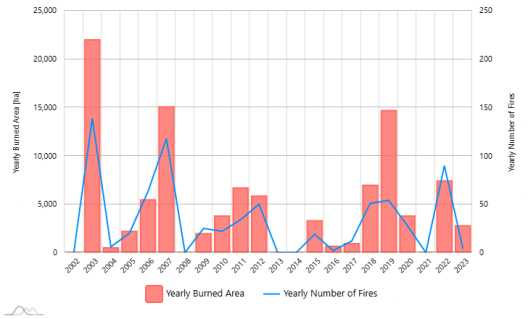
The BBC claims that global warming will increase the wildfire season in the UK, and presumably they believe it must have already done so during the past 150 years of planetary warming. A longer wildfire season should result in more fires. Available data, however, does not show that wildfires are getting more frequent or more intense in the UK. Satellite data from Copernicus show no trend at all.
Chart of United Kingdom yearly burned area and number of fires from Copernicus
For another example, looking at Central England as thisClimate Realism post did, the number of days per year breaching 25°C (77°F) show no rising trend, nor does the measured highest daily maximum.
Long term historical data for Europe show that drought is likewise not worse today than it was during the Renaissance, long before industrialization.
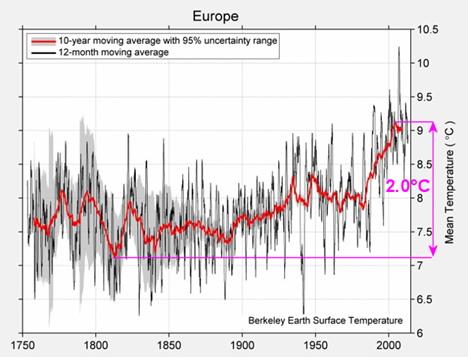
What is really notable is that Europe alone has actually already warmed 2°C since about 1820, according to historic European temperature averages, but no catastrophic change in weather has occurred. (See figure below)
Weather isn’t getting worse, but bad weather does still happen. The UK’s largest industrial solar facility, for example, blighting the landscape of Anglesey, North Wales, was recently destroyed by a bad storm. That should be enough to give government agencies pause when it comes to at least some net-zero policies, but the real point is that hardening infrastructure against weather should be a priority regardless of climate change. Bad weather will occur, and it will wreck fragile facilities, including solar complexes.
Hardening against weather extremes, which always have and always will exist, is just common sense. As technology develops and new ways of protecting against bad weather are discovered (like the invention of air conditioning) they should be implemented where they can be, as they can be. Achieving net zero – especially for a country that emits negligible amounts of greenhouse gases anyway—will not save the UK from bad weather events.
As a news organization, the BBC should not carry water for its government or government advisory boards that want to continue wasting money on futile “objectives to prevent further temperature rise” when direct efforts to improve infrastructure and harden it against weather extremes, which have happened throughout history, would be far more effective in saving lives and reducing harm.
The Western media will continue to spread “fake news” aimed at derailing a summit between Russian President Vladimir Putin and his US counterpart, Donald Trump, Hungarian Foreign Minister Peter Szijjarto has warned.
Several outlets reported on Tuesday, citing unnamed White House officials, that plans for the meeting in the Hungarian capital had been put “on hold.”
Responding to the claims, Szijjarto took to X to warn that from the moment the meeting was announced following a phone call between Putin and Trump last week, “it was obvious that many would do everything possible to stop it from happening.”
“The pro-war political elite and their media always behave this way before events that could prove decisive between war and peace,” he added.
According to the foreign minister, it will be the same in the run-up to the talks in Budapest. “Until the summit actually takes place, expect a wave of leaks, fake news, and statements claiming that it will not happen,” Szijjarto said.
Russian Deputy Foreign Minister Sergey Ryabkov had earlier called the claims “infodumps,” intended to disrupt diplomatic progress on settling the Ukraine conflict. “EU and NATO countries are seeking to torpedo everything,” he said.
EU officials have publicly claimed that they would welcome another Putin-Trump meeting. However, El Pais has reported that behind closed doors, Brussels – which continues to support Ukraine and urge increased pressure on Russia – views the summit as a “political nightmare.”
On Tuesday, the Financial Times cited an unnamed EU diplomat as saying “no one likes it,” and that “we are all grinning through our teeth whilst saying this is fine.”
In the same article, the FT claimed that the talks in the Hungarian capital have been “canceled,” and that a White House official has said there are no plans for a Putin-Trump summit “in the immediate future.”
Russian presidential aide Kirill Dmitriev rejected the report, accusing the FT of “twisting” the comments by its source. “Preparations continue” for the Budapest summit, he wrote on X.
Iranian Foreign Minister Abbas Araghchi has hit back at Poland’s Deputy Prime Minister and Foreign Minister Radosław Sikorski over his “baseless claims and meddlesome remarks” against the Islamic Republic.
Araghchi made the comments in Polish on X, one day after Sikorski alleged that Iran was selling drones to Russia for use in the Ukraine war.
The top Iranian diplomat said that in an earlier X post, he had invited Sikorski to a substantive dialogue and exchange of documents to clarify facts following the display of a drone in the British Parliament, falsely and maliciously attributed to Iran.
“Avoiding responses, repeating baseless claims, and making meddlesome remarks will not solve the problem,” he added.
Araghchi also referred to Iran’s hospitality towards the Poles during the hard times of World War II, with the country providing shelter to over 100,000 Polish people and helping them form their own army.
“The friendship between the people of Iran and Poland was proven in challenging times, and it is our duty to protect this historical and cultural heritage,” he said.
He said the Iranian nation traces its roots to a glorious and significant past and that it will build its future on the path of progress and prosperity.
On October 14, Sikorski participated in an anti-Iran presentation at the UK Parliament in cooperation with a US-Israeli-affiliated group, displaying the wreckage of what they claimed to be an Iranian-made drone used by Russia in its war in Ukraine.
Iran summoned Poland’s chargé d’affaires in Tehran to protest Sikorski’s involvement in the anti-Iran event.
Araghchi also took to X to say that the “pathetic show” was staged by the Israel lobby and its supporters.
He said certain actors opposed to friendly Iran-Europe relations are creating fabricated narratives inconsistent with the long-standing ties between the two sides, including between Tehran and Warsaw.
Both Iran and Russia have repeatedly rejected allegations that Tehran supplied Moscow with drones, ballistic missiles, and related technology for use in the military campaign in Ukraine.
Russia has repeatedly warned against the flow of Western weapons to Ukraine, saying it prolongs the conflict.
Fears of a greater Middle East escalation were triggered after Iran launched a massive drone and missile attack against Israel, aided by Hezbollah and the Yemeni Houthis. Iran said the attack was in response to Israel’s bombing of the Iranian consulate in Damascus, Syria, which killed seven members of the elite Revolutionary Guard Corps.
Iran’s massive retaliatory attack on Israel from its own territory is a sign that the conflict could “escalate out of control.”
Michael Maloof, a former senior security analyst in the office of the US secretary of defense, told Sputnik that the first ever direct Iranian attack on Israel set a dangerous precedent.
“My concern is that this could easily escalate into something not only between Iran and Israel, but beyond the Middle East region,” he said.
Iran’s assault, which it stated was an act of “self-defense” after the Israeli strike on its consulate in Damascus, was originally intended to be a “limited” one, said Maloof.
Iran first sent in “swarms of drones with lights on as a sign of psychological warfare,” but sending in cruise and ballistic missiles by Tehran was a “distinct escalation,” said Maloof.
The scale of Iran’s attack on Israel suggests that Tehran was sending a message, demonstrating that it possesses “extraordinary capabilities,” said Maloof. … continue
This site is provided as a research and reference tool. Although we make every reasonable effort to ensure that the information and data provided at this site are useful, accurate, and current, we cannot guarantee that the information and data provided here will be error-free. By using this site, you assume all responsibility for and risk arising from your use of and reliance upon the contents of this site.
This site and the information available through it do not, and are not intended to constitute legal advice. Should you require legal advice, you should consult your own attorney.
Nothing within this site or linked to by this site constitutes investment advice or medical advice.
Materials accessible from or added to this site by third parties, such as comments posted, are strictly the responsibility of the third party who added such materials or made them accessible and we neither endorse nor undertake to control, monitor, edit or assume responsibility for any such third-party material.
The posting of stories, commentaries, reports, documents and links (embedded or otherwise) on this site does not in any way, shape or form, implied or otherwise, necessarily express or suggest endorsement or support of any of such posted material or parts therein.
The word “alleged” is deemed to occur before the word “fraud.” Since the rule of law still applies. To peasants, at least.
Fair Use
This site contains copyrighted material the use of which has not always been specifically authorized by the copyright owner. We are making such material available in our efforts to advance understanding of environmental, political, human rights, economic, democracy, scientific, and social justice issues, etc. We believe this constitutes a ‘fair use’ of any such copyrighted material as provided for in section 107 of the US Copyright Law. In accordance with Title 17 U.S.C. Section 107, the material on this site is distributed without profit to those who have expressed a prior interest in receiving the included information for research and educational purposes. For more info go to: http://www.law.cornell.edu/uscode/17/107.shtml. If you wish to use copyrighted material from this site for purposes of your own that go beyond ‘fair use’, you must obtain permission from the copyright owner.
DMCA Contact
This is information for anyone that wishes to challenge our “fair use” of copyrighted material.
If you are a legal copyright holder or a designated agent for such and you believe that content residing on or accessible through our website infringes a copyright and falls outside the boundaries of “Fair Use”, please send a notice of infringement by contacting atheonews@gmail.com.
We will respond and take necessary action immediately.
If notice is given of an alleged copyright violation we will act expeditiously to remove or disable access to the material(s) in question.
All 3rd party material posted on this website is copyright the respective owners / authors. Aletho News makes no claim of copyright on such material.


 Aletho News