Landmines and disinformation for me, but not for thee
By Kelley Beaucar Vlahos | Responsible Statecraft | April 8, 2022
Two stories snuck below the radar this week: the U.S. admitted to deploying what up until now has been deplorable and downright wretched “disinformation” in the Ukraine crisis. Furthermore, the Chairman of the Joint Chiefs boasted about the effective use of landmines against the Russians — a week after headlines conflated their use by the Russians with civilian atrocities.
First, the disinfo. This week the leading lights of our mainstream media sat on a stage and lectured Americans in front of a banner reading “Disinformation and the Erosion of Democracy.” They must’ve been too busy to give this stunner from NBC News the treatment it deserves:
It was an attention-grabbing assertion that made headlines around the world: U.S. officials said they had indications suggesting Russia might be preparing to use chemical agents in Ukraine.
President Joe Biden later said it publicly. But three U.S. officials told NBC News this week there is no evidence Russia has brought any chemical weapons near Ukraine. They said the U.S. released the information to deter Russia from using the banned munitions.
It’s one of a string of examples of the Biden administration’s breaking with recent precedent by deploying declassified intelligence as part of an information war against Russia. The administration has done so even when the intelligence wasn’t rock solid, officials said, to keep Russian President Vladimir Putin off balance. …
…“It doesn’t have to be solid intelligence when we talk about it,” a U.S. official said. “It’s more important to get out ahead of them — Putin specifically — before they do something. It’s preventative. We don’t always want to wait until the intelligence is 100 percent certainty that they are going to do something. We want to get out ahead to stop them.”
Headlined as a “break from the past” — truly? — the piece is actually a glowing tribute to the administration’s gambit to throw Putin off his game. The only break from the past here is near-past. Aside from the self-serving gasbaggery coming from the aforementioned stage at the University of Chicago this week, the mainstream media has been screeching about disinformation in a sort of trance-like mantra for more than four years. Most recently it has been used to smear critics of a more escalatory policy in Ukraine. Now, according to this NBC News report, it is:
“the most amazing display of intelligence as an instrument of state power that I have seen or that I’ve heard of since the Cuban Missile Crisis,” said Tim Weiner, the author of a 2006 history of the CIA and 2020’s “The Folly and the Glory,” a look at the U.S.-Russia rivalry over decades. “It has certainly blunted and defused the disinformation weaponry of the Kremlin.”
Get it? The U.S. must use “good” disinformation to combat the “bad” disinformation by the Russians. Just like we engage in “good” military invasions (Iraq, Libya) to overthrow the “bad” guys (Hussein, Qaddafi).
Which brings us to landmines. The U.S. never signed the international ban on landmines, which have a pesky habit of lying around for decades after wars and blowing civilians’ limbs off. We know this. But as always, the Americans want it both ways, pointing to their “desperate” use by bad guys, like the Russians, as akin to atrocities. Like these headlines last week, here and here.
But then it turns out the Ukrainians are using them too, but their use is “effective” and “strategic” and important to the mission. Here’s Joint Chiefs Chair, Gen. Mark Milley, testifying yesterday.
“Land mines are being effectively used by the Ukrainian forces to shape the avenues of approach by Russian armored forces, which puts them into engagement areas and makes them vulnerable to the 60,000 anti-tank weapons systems that we’re providing to the Ukrainians,” Milley said. “That’s one of the reasons why you see column after column of Russian vehicles that are destroyed.”
This reminds us of course of the incident earlier in the invasion when Linda Greenfield, our UN ambassador, tried to rip the Russians for what appeared to be cluster munitions in their convoys marching toward Kyiv. Her statement had to be edited, however, because the U.S. still has such weapons — which too leave little bomblets behind that tend to kill and main unsuspecting civilians — in its own arsenal.
Like the contradictions in Greenfield’s story, Milley’s will no doubt be met by mainstream crickets, too. These threads just don’t fit the proscribed narrative, which at its worst, promulgates a “fine for me, but not for thee” hypocrisy.
MSM’s Bucha Tall Tale
BY NICK GRIFFIN | SAMIZDAT | APRIL 5, 2022
“The Bucha Massacre” has now become the driving force for the propaganda push for even more NATO involvement in the conflict in Ukraine.
Yet the claim that this is a Russian war crime is so patently false that a rational observer can only be left astounded by the combination of bare-faced nerve and slapdash incompetence displayed by the media outlets and politicians pushing this disgusting smear.
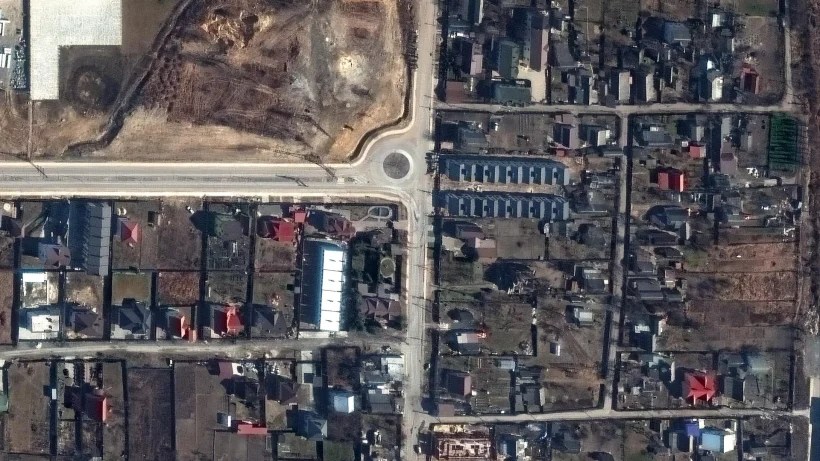
The latest effort of the Western media to deny Russian rebuttals is the claim that satellite photos show the bodies were there for weeks. Far from ‘proving’ the case against Russian troops, however, this new assertion in fact raises yet more questions which undermine the Western story.
The satellite photos certainly appear to show bodies, but they also show no sign at all of the burnt out cars which are such a prominent feature of the ground photos and videos. Are we supposed to believe that these vehicles were carefully driven in and positioned between the corpses after the shooting spree?
A similar suspension of belief is required when considering the dates involved. The ‘Bucha Massacre’ entry in Wiki (accessed 09.25 on 5th April 2022) reads as follows:
‘On 4 April, satellite images were provided to The New York Times by Maxar Technologies. The Times compared images to video evidence and concluded: “many of the civilians were killed more than three weeks ago, when Russia’s military was in control of the town.” The images of Yablonska Street show at least 11 “dark objects of similar size to a human body” appearing between 9 March and 11 March”.’
Wiki also tells us that Ukrainian troops re-entered Bucha on April 1st, following the redeployment of the Russian force to south eastern Ukraine.
Maxar Technologies, as a major contractor for NASA, is of course an integral part of the NATO military-industrial complex. As such its assertions with regards to the conduct of the conflict in Ukraine have to be regarded with caution. That said, Maxar’s dates of 9th– 11th March seem to be causing some concern in mainstream media outlets promoting the Russian massacre claim.
The Maxar dates should indeed raise eyebrows. The idea that bodies could lie in the open air for three whole weeks without undergoing massive decay is only remotely credible because the average Westerner thinks that Ukraine is in some kind of winter weather deep-freeze in late March.
Yet a look at the weather data for Kiev for March 2022 reveals that there has not been one single day in the city (of which Bucha is a suburb) with temperatures below freezing since March 11th. The average daily temperature in the last few days of the month was 6 degrees centigrade – the same as the English city of Leeds. That average in turn of course includes highs in the spring sunshine. The weather graph for Kiev for the last week in March shows the situation very clearly, with temperatures up to 15 and 17 degrees:
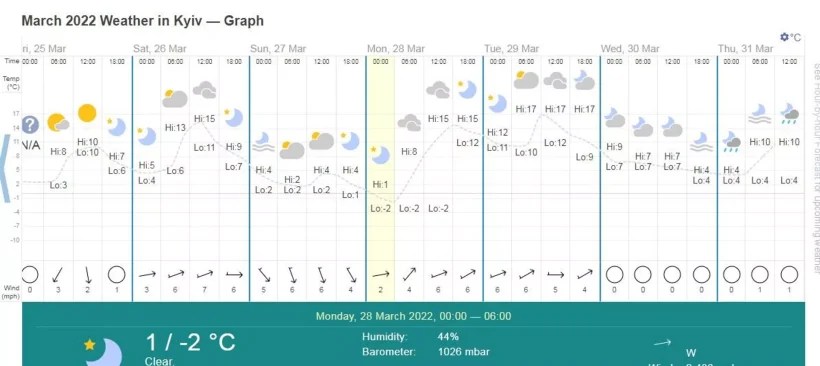
March weather in Kiev
Anyone who has walked past an animal killed and left on the road for a few days under such conditions will be able to imagine the appalling stench which would come from so many human bodies left in the spring sunshine for three weeks, yet not one of the Ukrainian soldiers or police shown examine the bodies can be seen wearing a mask, making any expression of revulsion or mentioning the smell.
As more graphic images have emerged of the victims, the evident freshness of the corpses seems to have prompted a revision of the dates of the alleged ‘Russian massacre’. By 5th April, for example, the UK Daily Mail’s lead story was claiming that the satellite photos showing the bodies on the road were taken on 19th March. No explanation was given for the ten-day change.
But even accepting the revised time-line, there is still the problem that none of the bodies shown in videos or photos has any sign of decay or damage from carrion-eaters. In order to believe the accounts and videos put out by Kiev and the Western media, it is also necessary to believe that Ukraine has no stray dogs, no rats and not one single crow or other carnivorous bird.
Look again at the video footage of the Ukrainian troops driving along the corpse-lined road. Do you see any carrion-eating birds flying up from any of the bodies?
For that matter, why were some of the bodies not crushed by the Russian tanks which withdrew from and through the town? Do you really believe that soldiers brutal enough to slaughter dozens of defenceless civilians would then be considerate enough to slow down their withdrawal from the area by carefully weaving their heavy armour around each corpse?
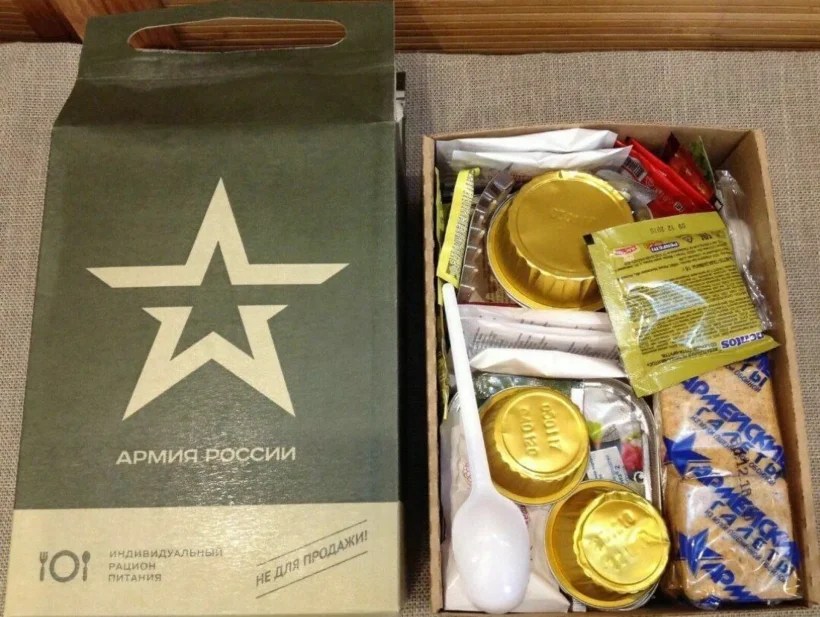
Returning to the weather, there was of course rain during the three weeks the bodies are supposed to have laid (not) rotting in the road. Looking at the cardboard of the green boxes of the food aid packages lying near some of the (clearly fresh) corpses, it is clear that they have not been subjected to bad weather. The presence of those packages is also, of course, another important pointer as to the truth in this matter – for they are Russian.
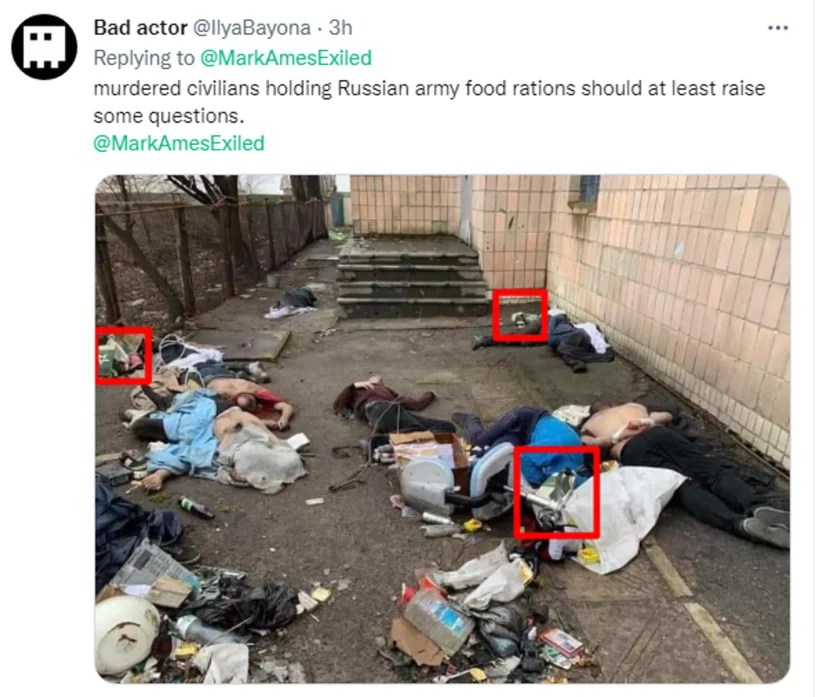
Thus, in order to believe the Western propaganda narrative, we must swallow yet another ridiculous tall tale: The ‘analysts’ have spent the last month repeatedly telling us that the Russian army cannot even supply its own troops with fuel or food; but now they would have us believe that the Russians went to all the trouble of taking vast quantities of emergency food parcels to the occupied suburbs of Kiev, handed them out to civilians – and then promptly shot them.
On top of all this, there are four key facts which have already received considerable attention on Telegram (the last uncensored social media platform of any size in the West), though which have predictably enough been routinely ignored by the warmongering mainstream media.
The first of these is the video of the Mayor of Bucha speaking about how the Russian troops have left and that a ‘clean-up’ is now underway. As a non-Russian speaker I cannot judge for myself, but the comments by Russian-speakers accompanying this video on Telegram say that he does not mention the bodies of civilians.
The second fact, closely related to this, is the video which shows a detachment of the paramilitary Ukrainian National Police clearing the roads of burnt out and abandoned vehicles. Again, there is no sign of the bodies which appeared on the streets the following day.
Third, and perhaps most devastating of all, are the white armbands on a number of the bodies. These are clearly shown in the main video of Ukrainian troops driving along the corpse-strewn road, and they are also visible on several of the bodies of victims of torture and murder in cellars in Bucha.
The fact that Ukrainian forces wear blue armbands, while Russian troops wear white ones, is universally accepted. A number of videos from various parts of the conflict zone also show civilians wearing white armbands, as a sign either of sympathy with the Russians or at least neutrality.
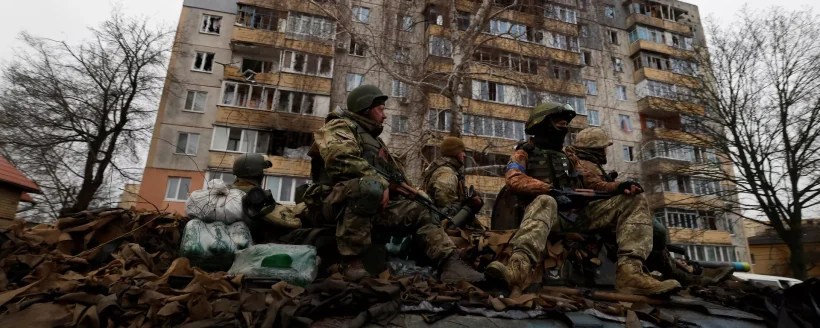
Situation in Ukraine
Video: Kiev Territorial Defence in Bucha Given Green Light to Shoot Those Not Wearing Blue Armband 3 April, 16:38 GMT
Thus the appearance of white armbands on the victims of ‘the Bucha Massacre’ is overwhelming evidence that the victims were ethnic Russians. They were murdered not by Russian troops – who were of course sent in with a key aim of stopping the persecution of Russian-speakers by racist neo-Nazis – but by Ukrainians.
This should come as no surprise, for the whole history of Ukrainian nationalism is based on the mass murder of ‘unclean’ and ‘sub-human’ civilians from other ethnic groups, most notably the Poles of Wolyn and Eastern Galicia, Jews, Hungarians, Romanians and, of course, Russians.
Finally, we come to the video clip from the streets of Bucha, which was posted and then removed from the social media account of the known Ukrainian neo-Nazi ‘Botman’: “There are guys without blue armbands. Can we shoot them?” “F**k, yeah!”
The truth of the massacre is so clear that we can see why Western leaders such as Boris Johnson are so adamant that there should not be a proper international investigation into the crime.
Instead, they are using the most blatant fake news to justify imposing another round of sanctions pain on their own people, and to excuse the sending of billions of pounds, dollars and euros worth of high-tech weapons in order to prolong the war. One has to wonder about the scale of the kick-backs these real war criminals are getting from their military-industrial complex cronies!
Viral ‘Russian Mobile Crematorium’ Tweet is From an 8-Year-Old YouTube Video
Fact checkers strangely AWOL
By Paul Joseph Watson | Summit News | April 7, 2022
A viral tweet that remains unchecked by “fact checkers” claims to show a Russian-operated ‘mobile crematorium’ in Mariupol, but the image is taken from an 8-year-old YouTube video.
Whoops.
The tweet was posted by news outlet NEXTA, which boasts nearly a million followers on Twitter. The tweet has received over 7,000 retweets and almost 11,000 likes.
“Mobile crematoria in #Mariupol,” states the tweet.
“Mayor of Mariupol Vadim Boychenko said today that #Russian mobile crematoria have started operating in the city.”
“According to him, tens of thousands of people could have died in Mariupol and the cremation, “covering up the traces of crimes”.
Except a simple reverse image search reveals the ‘mobile crematorium’ to be a screenshot from an 8-year-old YouTube video.
Much vaunted “fact checkers” are yet to comment on the issue, and Twitter hasn’t placed a ‘warning label’ on the tweet letting users know it is fake news.
Twitter users pointed out that this is recycled propaganda, since the same debunked claim about “mobile crematoriums” was made at the start of the war.
The tweet emerged at the same time Ukrainian authorities in Mariupol started claiming that Russian troops are “burning the bodies of tens of thousands of civilians” as part of a “new Auschwitz.”
Seizing on the outrage sparked by alleged war crimes in Bucha, Mariupol City Council said, “Russian mobile crematoriums have been launched” in the city.
“The world has not seen the scale of the tragedy in Mariupol since the existence of Nazis concentration camps,” claimed Mayor of Mariupol Vadim Boychenko.
There have been innumerable fake news incidents either staged entirely or fabricated by Ukrainian officials which have gone unchecked by “fact checkers” since the start of the war.
They include the ‘Ghost of Kiev’ farce, the supposed ‘slaughter’ of Ukrainian soldiers on Snake Island and the ‘attack’ on a Holocaust memorial in Kiev that never happened.
Bucha, Budapest and the Multiplying Problems of Real War Criminals
By Tom Luongo | Gold Goats N’ Guns | April 5, 2022
Fungal President Joe Biden openly declared Russian President Vladimir Putin a “war criminal” in a recent outburst while speaking at NATO. He’s repeated this in the wake of the initial images coming out of the town of Bucha, Ukraine where an alleged massacre of civilians by Russian soldiers took place.
Like many incidents similar to this in the past it is hard to take any of these claims of blame seriously. The US and UK have staged many a ‘false flag’ operation in the past at convenient times to gin up diplomatic outrage to advance a particular political agenda.
That agenda is always to justify more war to deal with the villain du jour. Today it’s Putin. In the past it’s been Saddam Hussein, Slobodan Milosevic or Bashar al-Assad. The playbook is always the same. Shocking images and film of honest-to-god atrocities against civilians and an endless back and forth of accusations and suppression of real information about the event.
Sadly, that becomes the focus not the fact that civilians were murdered for political gains.
Bucha seems to fit this pattern quite well, if more crudely implemented than events like this in the past.
The censorship is nearly total to support the ‘current thing,’ in this case Bucha. But it is no different than the campaigns against certain medications to fight COVID-19.
When it comes to foreign policy objectives, there is always a common denominator in these events to frame that villain and Putin, in particular, as some evil madman… British intelligence.
From the poisoning of Sergei Skripal, to the downing of MH-17 over Ukraine, to the ammonia gas attack in Douma, at the center of these allegations is always some arm of the Brits.
All the roads to RussiaGate lead through Ukraine and British Intelligence. At some point you just have to face the face of the agitator. Every one of those stories have logical inconsistencies wide enough to drive a column of tanks through.
These are painstakingly worked through by investigative journalists pushed to the fringe by the technocrats’ willing partners in Silicon Valley to minimize their influence over the narrative.
That, in itself, should be considered prima facia evidence of malfeasance but sadly it isn’t.
From the moment Russia’s troops crossed the border into Ukraine on February 24th there has been a clear strategy by the Russian Ministries of Defense and Foreign Affairs to head off potential false flags publicly before they could be pulled off.
The Russian Foreign Ministry singled out the UK for its histrionics saying if they wanted to lead the charge, they’ll get the worst treatment.
With the pullout of Russian troops from around Kiev however, they have little control over the preparing of the stage. You believe what you want to believe about Bucha, I don’t care.
Given the track record of Russia’s accusers here I’m taking the position that these allegations have to be incontrovertibly proven publicly for me to believe a word of them. Here’s one version of the story (warning: very graphic).
That is how low the credibility of the sources on this are. The UK government has been, along with Biden’s Dept. of State and National Security Council, the most belligerent in their response to Russia’s military operation. Their history and naked hatred of all things Russian stretches back multiple centuries.
In short, they have motive, means and opportunity to stage a false flag to push public sentiment further towards NATO’s intervention into Ukraine officially, therefore a false flag is the most likely scenario.
Complaints about how Russia waged the initial part of this war have centered on their unwillingness (but not opposition) to target civilians. Kiev could have easily been taken if the Russians wanted to commit massive atrocities against civilians.
They did not do so. That flies in the face of what’s being alleged about Bucha. That doesn’t mean it didn’t happen the way it is being alleged, but the burden of proof lies with the accuser (Ukraine) and their allies (The US and UK).
And the main amplifier of this story, the UK, blocked not one but two proposals by the Russian Federation to investigate what happened in Bucha. We can’t have that, there’s a war to escalate.
Remember this story is only possible because the Russians first got repulsed from taking Kiev and then pulled back from the areas surrounding it. They are redeploying forces and regrouping for a major push against Ukrainian forces trapped in the eastern part of Ukraine.
That operation will likely wipe out what’s left of the UAF troops there and push the next phase of this war on the ground to its natural state of equilibrium for the next few months.
There are so many people whose crimes in Ukraine would be exposed by a Russian win there that it is truly existential to keep that from happening. It goes deeper than even the ideology of the West which needs to subjugate Russia if the Davos plan for global governance is going to have any hope of succeeding.
This is also personal for everyone from Joe Biden himself to hundreds, if not thousands of people complicit in the various schemes, plots and crimes committed in the petrie dish of corruption they’ve staged their attacks on common decency from.
So, when I say they have motive, means and opportunity, I mean it. These are the same people who impeached Donald Trump over a phone call. Of course they will say the quiet parts out loud about what they want to do to Putin for screwing up their grand plans.
This brings me back to my article from the other day handicapping the Hungarian elections. Because Hungary is now in a very strong position I posited they’d be in if Viktor Orban won the election, which he did, emphatically. And that means the EU is in a very precarious position to continue supporting an anti-Russia policy stance.
With a fiscally, monetarily (they are not on the euro) and energy independent Hungary there is little argument for them staying in the EU if Brussels is going to treat them as second class members. Orban and his government have been resolute in their refusal to get involved in the Russia/Ukraine conflict even though there has been serious pressure applied by NATO.
In anticipation of any resistance to the EU’s new set of draconian and frankly insane sanctions on Russia the European Commission wasted no time in announcing they are beginning ‘rule of law’ procedures against Hungary to cut them out of any monetary distributions within the bloc.
The European Commission will soon trigger a powerful new mechanism to cut funding to Hungary for eroding the bloc’s rule-of-law standards, Commission President Ursula von der Leyen said Tuesday.
The announcement comes two days after Hungarian Prime Minister Viktor Orbán won a fourth consecutive term in an election that international observers said was marred by an uneven playing field benefiting the ruling Fidesz party…
… Von der Leyen said her team informed Hungary of its decision on Tuesday after reviewing Budapest’s responses to an informal letter the Commission sent last November asking for information on its rule-of-law concerns.
“We’ve carefully assessed the result of these questions,” von der Leyen said, speaking to the European Parliament. “Our conclusion is we have to move on [to] the next step.”
There’s nothing ‘careful’ about the EU’s assessment here. Hungary and Poland were forced to accept these new rules in a major political battle with the EU in 2021 over their Green New Deal. He wasn’t in a strong enough position to stop this and it meant then we would wind up here today if he won re-election.
The EC’s formal charges against Hungary over their furry law is just like other such moves, namely against Poland for its hated Supreme Court recall law. They are forcing the ultimate choice on Hungary because all the EU really has is Article 7 censure and expulsion from the Union as a threat.
The amount of money they are holding as a carrot to Orban in COVID relief funds is just 30 pieces of silver and he knows it.
So, if you play this out to the end, this is where Orban has to go. He must force the EU to do what Mark Rutte said last month, kick them out or back down.
Today the European Commission is staring at the real threat: that Hungary has no intention of going along with the new sanctions and Orban actually welcomes Von der Leyen’s move to censure and cut off Hungary’s funds from the EU budget.
They will be a country that now pays in but gets nothing in return other than the stick.
But as long as they are a member of the European Commission they can and will veto anything else Von der Leyen cooks up to punish Russia with as a political cudgel to beat vulnerable EU members into going along with.
The EC thinks they will be making an example of Hungary but what they will really be doing is giving Orban an even stronger hand to play on the European Council. Now he can stay in Budapest and tell Hungarians that the EU no longer works for Hungarians and they would be better off free from their yoke.
Hung-exit, anyone?
Elections have consequences when you don’t control the outcome of them. This is why the neocons and war criminals like Hillary Clinton, Lindsey Graham and Joe Biden are all screaming that something or someone has to do something to stop Putin whose operation in Ukraine still has the potential to expose everything.
It’s why Bucha was so haphazardly staged and ham-fistedly packaged up to us.
The blow out results in Hungary on Sunday were a major blow to EU confidence and solidarity. Twelve years of calling Orban a Nazi while supporting real 4th generation Nazis in Ukraine landed with a whimper.
Von der Leyen is a certifiable idiot for invoking the ‘rule of law’ weapon against Orban here using the alleged events at Bucha. She’s using it as an excuse to purposefully destroy the European economy per the directive of her Davos handlers. Their calculus is simple, burn the entire global economy down to punish Putin, Xi and everyone else not down with the Comintern.
It exposes the EU’s complicity in the war on Russia as willing partners with the US and UK because if they wanted to continue virtue signaling they would propose crazy new sanctions and let Hungary veto them.
But now we can only conclude this is exactly what they wanted.
That puts things into stark relief as we look ahead to the increasingly likely probability that French President Emmanuel Macron loses to Marine LePen in France who would be in a far stronger position to break up EU solidarity, freezing it politically at a time when Europe’s financial vulnerability has never been higher.
Meanwhile Putin keeps saying “Got Gold or Rubles?” and Orban is preparing a cold dish of political revenge on the nastiest people in Europe. When this mouse roars, they may finally have to listen.
Insane West Declares Putin Insane
By Linh Dinh | Postcards From The End | April 4, 2022
Even before Russia invaded Ukraine, the New York Times strongly hinted Putin had lost it. Anton Troianovski on 2/18/22, “The 20-foot-long table that Mr. Putin has used to socially distance himself this month from European leaders flying in for crisis talks symbolizes, to some longtime observers, his detachment from the rest of the world. For almost two years, Mr. Putin has ensconced himself in a virus-free cocoon unlike that of any Western leader, with state television showing him holding most key meetings by teleconference alone in a room and keeping even his own ministers at a distance on the rare occasions that he summons them in person.” Though social distancing was an indication of health and good sense in the West, it was a sign of madness in Putin.
As Russian tanks crossed into Ukraine Douglas Murray concluded in The Sun that Putin was “insane and dangerous,” with the weak West enabling his deranged behavior.
On 2/27/22, Condoleezza Rice deemed Putin “erratic,” with “an ever-deepening, delusional rendering of history.”
Getting deep, Father Cyril Hovorun explained in Premier Christianity on 2/29/22, “It’s irrational: [Putin] destroys his own country for the sake of retaking Ukraine, which is looking increasingly unlikely […] He is driven by a sort of metaphysics. I would not call it religion, although there is a component of traditional Christianity in it. It’s really a sort of metaphysical outlook, which I believe to be dangerous […] Just like Dietrich Bonhoeffer talked of cheap grace, I would say Putin has adopted cheap spirituality […] It’s a mix of post-Soviet metaphysics, superstition and, I would call it, a dualistic worldview. There is a part of the world which is good, and he believes this is Russia, and then there is a part of the world which is bad, and he believes this is the West.”
On 3/1/22, Fox News summarized, “Russian leader is not crazy, he’s consistent. Since taking power 22 years ago, Putin has specialized in killing.”
There are many more declarations of Putin’s madness in the West. It is remarkable, this unhinged chorus, for Russia’s invasion of Ukraine can’t be more logical, or conducted more sanely.
Russia has to 1) put an end to Ukraine’s unending attacks on Russians in the Donbas 2) preempt an invasion of the Donbas, as evidenced by a huge buildup of Ukrainian troops in the region 3) prevent Ukraine’s entry into NATO, which would put nuclear warheads within six minutes of Moscow 4) investigate and neutralize around 30 illegal chemical labs, apparently aimed at Russia.
If anything, Putin should have acted sooner. In any case, he’s much saner than any Western leader. With Boris Johnson, Emmanuel Macron, Justin Trudeau and Olaf Scholz, etc., the West is fronted by a gallery of buffoons, as led by the appallingly corrupt and idiotic Biden.
After 13 US soldiers were killed during the farcically chaotic withdrawal from Afghanistan, Biden cartoonishly intoned with much gravity, “We will not forgive, we will not forget. We will hunt you down and make you pay.” Thoughtful Putin never talks like that. It’s embarrassing, but cliches, slogans, slurs and lies now make up much of American English.
Biden then sent drones to massacre ten members of one Afghan family, a war crime barely noticed by Americans and already forgotten. To punish that starving country further, grifting, fogged up and fondling Joe then stole $3.5 billion of its frozen assets to compensate victims of 9/11, a tragedy Afghanistan had nothing to do with, and neither did Bin Laden, in case you haven’t figured it out.
The dumbing down of the West has been a decades-long process. Though we’re well into Idiocracy territory, there are still some brain cells left to concuss or wring dry, just for the fun of it. During World War II, English speaking soldiers read Henry James and Anthony Trollop, I kid you not. Paul Fussel, “Siegfried Sassoon favored James’s middle-period works because they were ‘so all beautifully remote’ from Hitlerism and its brutal behavior,’ and Trollope’s novels were widely read because, in addition to their distance from the current violence and stupidity, they were handily available in the World’s Classics pocket-sized editions, fit to be slipped into uniform pockets and gas-mask containers, like the equally popular unbellicose works of Dickens and Jane Austen. But Austen was valuable regardless of format.”
Even if Russians have gone through an intellectual decline, they can’t be as dumb as Americans, for Putin doesn’t address them as morons. From a speech on 2/24/22, here’s Putin explaining NATO’s aggression and insolence over three decades:
It is a fact that over the past 30 years we have been patiently trying to come to an agreement with the leading NATO countries regarding the principles of equal and indivisible security in Europe. In response to our proposals, we invariably faced either cynical deception and lies or attempts at pressure and blackmail, while the North Atlantic alliance continued to expand despite our protests and concerns. Its military machine is moving and, as I said, is approaching our very border.
Why is this happening? Where did this insolent manner of talking down from the height of their exceptionalism, infallibility and all-permissiveness come from? What is the explanation for this contemptuous and disdainful attitude to our interests and absolutely legitimate demands?
Instead of working a crowd with catch phrases, slogans and vacuous quips, Putin succinctly and patiently clarifies. After recounting America’s illegal attacks on Iraq, Libya and Syria, Putin summarizes Uncle Sam’s modus operandi and its implication for Russia:
Overall, it appears that nearly everywhere, in many regions of the world where the United States brought its ‘law and order,’ this created bloody, non-healing wounds and the curse of international terrorism and extremism. I have only mentioned the most glaring but far from only examples of disregard for international law.
This array includes promises not to expand NATO eastwards even by an inch. To reiterate: they have deceived us, or, to put it simply, they have played us. Sure, one often hears that politics is a dirty business. It could be, but it shouldn’t be as dirty as it is now, not to such an extent. This type of con-artist behavior is contrary not only to the principles of international relations but also and above all to the generally accepted norms of morality and ethics. Where is justice and truth here? Just lies and hypocrisy all around.
[…]
Incidentally, US politicians, political scientists and journalists write and say that a veritable “empire of lies” has been created inside the United States in recent years. It is hard to disagree with this—it is really so. But one should not be modest about it: the United States is still a great country and a system-forming power. All its satellites not only humbly and obediently say yes to and parrot it at the slightest pretext but also imitate its behavior and enthusiastically accept the rules it is offering them. Therefore, one can say with good reason and confidence that the whole so-called Western bloc formed by the United States in its own image and likeness is, in its entirety, the very same “empire of lies.”
Deranged, the West declares the sanest leader alive a madman, and cheerleads a corrupt clown in Zelensky who pretended to play the piano with his dick on television, whose citizens are punished by being taped to utility poles with their pants pulled down, whose soldiers film each other shooting handcuffed Russian POWs in the legs and even groins, with one screaming victim stabbed in the neck then eye.
If the West still had an independent and varied media, news outlets would not ignore or gloss over such sensational war crimes, as the New York Post did on 3/28/22:
Senior presidential adviser Oleksiy Arestovych said the government is taking the videos very seriously.
Meanwhile, Ukrainian military commander Gen. Valerii Zaluzhnyi accused Russia of “staging” the videos and warned the public to only trust “official sources.”
“In order to discredit the Ukrainian defense forces, the enemy is filming and distributing staging videos with inhumane attitude of ‘Ukrainian military’ to ‘Russian prisoners,’” Zaluzhnyi said in a statement.
In the New York Post, much more space is given to Zelensky’s pronouncements, such as this on 4/3/22, “We are the citizens of Ukraine. We have more than a hundred nationalities. This is about destruction and extermination of all these nationalities. We don’t want to be subdued to the policy of the Russian Federation. This is the reason we are being destroyed and exterminated. And this is happening in the Europe of the 21st century. So this is the torture of the whole nation.”
If Russia is exterminating “all these nationalities,” then it’s a Holocaust, isn’t it, but we can’t use that word, for it’s reserved for Jews. Zelensky, though, sure knows how to evoke that mythical genocide to confirm, once again, that Putin is a Hitler.
Even if Russian troops did massacre civilians in Bucha, it’s obviously not Putin’s intention, for if he wanted to exterminate Ukrainians, then Kiev, Kharkov, Odessa and Lviv, etc., would have been razed already. Instead, there’s still electricity, water and Wifi in all those cities. To allow civilians to escape the war, Putin never destroyed Ukraine’s rail system. Instead, it’s Zelensky’s troops who hold them hostage as human shields. What the US and UK did to Germans and Japanese at the end of WWII was far, far worse, but even that didn’t qualify as extermination, and how many massacres of civilians did the US commit in Vietnam?
Uniformity of opinions has become the law of the land in the Jewjerked empire of lies, so Jewish Zelensky is preposterously declared a new Churchill, and his propaganda, no matter how crude, is embraced. In one video, a sunglasses wearing Ukrainian beauty with perfect skin and makeup coolly walks from a supposed battle, amid wrecked tanks, with smoke and flames in the background. Nonchalantly, she flashes a victory sign. An assault rifle is slung over her shoulder, and, get this, she sports a Palestinian keffiyeh!
This cool leftist fashion statement deflects from the fact the Ukraine fiasco is a Jewish Fascist operation. Jews orchestrated this war, and now that it’s started, want it to last, if not spread. Jews hate Slavs as much as they hate Arabs, so a smoldering Syria in Europe is overflowing champagne to them. Again, you always know what the Jewish agenda is by what the Jewjacked media is pushing.
Ukrainian Police Said They Conducted “Clearing Op” in Bucha a Day Before Dead Body Videos Emerged
Narrative fail
By Paul Joseph Watson | Summit News | April 4, 2022
Ukrainian police posted on Facebook that they had conducted a “clearing op” in Bucha the day before videos emerged showing dead bodies scattered around the settlement, as the war of words over the alleged “war crime” continues.
NATO powers and pro-Ukraine commentators have seized upon the alleged atrocity in a bid to escalate the war, with MSNBC hosts and guests even asserting that it justifies directly attacking Russia and putting American boots on the ground in Ukraine.
MSNBC host Ali Velshi demanded “direct military involvement,” something that would almost inevitably kick off World War III, in response to the alleged incident.
Former Army Major John Spencer also appeared on the same show to demand American “boots on the ground” in Ukraine.
Moscow has vehemently denied involvement, claiming Ukraine shelled the city after Russian troops had already withdrawn.
The only evidence offered so far pointing to Russian responsibility is the claims of Ukrainian authorities, with are being breathlessly amplified by the mainstream media without an ounce of skepticism.
Margaret Brennan of CBS admitted that Ukrainian President Zelensky’s team had “handed” her the videos and they were broadcast, as journalist Michael Tracey wrote, with “zero independent corroboration.”
The notion that Ukrainian authorities, who have been caught staging innumerable incidents already in a bid to lobby for more NATO military involvement, would lie about this is seemingly not even a consideration.
A timeline provided from reporting by the New York Times suggests that pro-Ukrainian Azov neo-nazi militants entered Bucha after Russian troops left and after the Mayor of Bucha had announced the town’s liberation with no mention of any atrocities.
One member of Azov was reportedly heard asking if he could shoot individuals who weren’t wearing blue armbands.
Another report asserts that Ukrainian national police posted on Facebook how they had conducted a “clearing operation” in Bucha before the alleged atrocities occurred accompanied by a video of their men walking around the town.
“Today, on 2 April, in the liberated city of Bucha, Kiev region, special units of the Ukrainian National Police began clearing the area of saboteurs and accomplices of Russian troops,” the Facebook post said.
As ever, with propaganda on both sides, it is virtually impossible to know what happened in Bucha, but to claim it’s an open and shut case of “war crimes” as the western media proclaims without any independent evidence is clearly ludicrous.
Accusations of Bucha massacre by Russian forces are fake news: Moscow
Samizdat | April 3, 2022
The Russian military has firmly denied accusations of mass killings of civilians in Bucha, a Ukrainian town northwest of Kiev. The claims have been raised by Ukraine itself, some Western media outlets and human rights groups, after Moscow had withdrawn its troops from the outskirts of Ukraine’s capital.
“All photographs and video materials published by the Kiev regime, allegedly showing some kind of “crimes” by Russian military personnel in the town of Bucha, Kiev region, are yet another provocation,” the Russian Ministry of Defense said Sunday.
Russian troops had been pulled out from the area on March 30, the military said, pointing out that “the so-called ‘evidence of crimes’ in Bucha appeared only on the fourth day” after the withdrawal, when Ukrainian intelligence and “representatives of Ukrainian television arrived in the town.”
“Moreover, on March 31 the mayor of Bucha, Anatoly Fedoruk, confirmed in his video address that there was no Russian military in the town, but did not even mention any local residents laying shot in the streets with their hands tied,” the Russian military also pointed out.
“It’s particularity concerning that all the bodies of people whose images were published by the Kiev regime, after at least four days, have not stiffened, do not have characteristic cadaveric spots, and have fresh blood in their wounds,” the military noted, adding that all these inconsistencies show that the whole Bucha affair “has been staged by the Kiev regime for Western media, as was the case with the [fake news from the] Mariupol maternity clinic.”
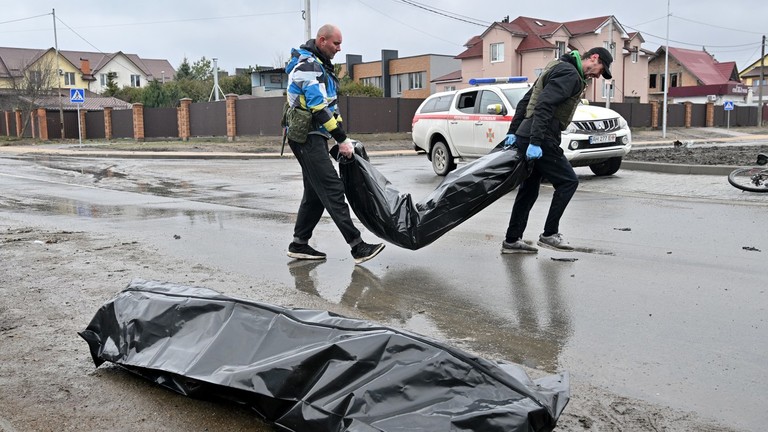
Graphic footage from Bucha shows multiple bodies in civilian clothing lying in the middle of a street. Some of the dead apparently had their hands tied, while others were white armbands, commonly used by Russian forces and civilians in areas under Russian control.
Kiev has blamed the Bucha killings on Moscow, with Ukrainian foreign minister Dmytro Kuleba claiming it was a “deliberate massacre” by Russian troops.
“The Bucha massacre was deliberate. Russians aim to eliminate as many Ukrainians as they can. We must stop them and kick them out. I demand new, devastating G7 sanctions NOW,” Kuleba wrote on Twitter.
Top Western politicians have backed Kiev’s assessment of Bucha, with some explicitly pinning the blame for the killings on Moscow as well. “Russian authorities will have to answer for these crimes,” French President Emmanuel Macron said.
A similar stance was voiced by the UK, with Foreign Secretary Liz Truss stating that such “indiscriminate attacks” on civilians should be probed as war crimes. “We will not allow Russia to cover up their involvement in these atrocities through cynical disinformation,” she said.
Moscow launched a large-scale offensive against its neighbor in late February, following Ukraine’s failure to implement the terms of the Minsk agreements signed in 2014, and Russia’s eventual recognition of the Donbass republics in Donetsk and Lugansk. The German- and French-brokered protocols had been designed to regularize the status of those regions within the Ukrainian state.
Russia has now demanded that Ukraine officially declare itself a neutral country that will never join the US-led NATO military alliance. Kiev insists the Russian offensive was completely unprovoked and has denied claims it was planning to retake the two rebel regions by force.
NY Times Latest to Mislead Public on New Ivermectin Study
The NEJM study chose a much lower dose, 400mcg per day for only three days, less than half the total dose that has been shown to be effective
By Madhava Setty, M.D. | The Defender | March 31, 2022
The New York Times on Wednesday sent an email blast to subscribers with the subject line: “Breaking News: Ivermectin failed as a Covid treatment, a large clinical trial found.”
The Times was referring to a study I wrote about, that same day, for The Defender.
My article called out the Wall Street Journal for its March 18 reporting on the same study — before the study was even published — for its failure to provide an accurate, critical assessment of the study.
The study in question — “Effect of Early Treatment with Ivermectin among Patients with Covid-19” — was officially published Wednesday in the New England Journal of Medicine (NEJM).
In it the authors concluded:
“Treatment with ivermectin did not result in a lower incidence of medical admission to a hospital due to progression of Covid-19 or of prolonged emergency department observation among outpatients with an early diagnosis of Covid-19”
The Times did not critique the study itself, but quoted the opinion of Dr. David Boulware, an infectious-disease expert at the University of Minnesota:
“There’s really no sign of any benefit. Now that people can dive into the details and the data, hopefully that will steer the majority of doctors away from ivermectin towards other therapies.”
Yes. Let us dive into the details and the data and see where it “steers” us, shall we?
A closer look at the details
The NEJM study took place in Brazil between March 23 and Aug. 6, 2021.
The study examined 1,358 people who expressed symptoms of COVID-19 at an outpatient care facility (within seven days of symptom onset), had a positive rapid test for the disease and had at least one of these risk factors for severe disease:
- Age over 50
- Hypertension requiring medical therapy
- Diabetes mellitus
- Cardiovascular disease
- Lung disease
- Smoking
- Obesity
- Organ transplantation
- Chronic kidney disease (stage IV) or receipt of dialysis
- Immunosuppressive therapy (receipt of ≥10 mg of prednisone or equivalent daily)
- Diagnosis of cancer within the previous 6 months
- Receipt of chemotherapy for cancer.
Young and healthy individuals were not part of this study.
Both vaccinated and unvaccinated individuals were included in the study. The percentage of vaccinated participants in each group was not specified. Note that by choosing not to identify vaccination status as a confounding variable the authors are implying that vaccines are playing no role in preventing hospitalization.
The 1,358 subjects were divided into two equally sized groups that were relatively well-matched and randomized to receive either a three-day dose of placebo or a three-day course of ivermectin at 400 mcg/kg.
The primary outcome was hospitalization due to COVID-19 within 28 days after randomization or an emergency department visit due to clinical worsening of COVID-19 (defined as the participant remaining under observation for >6 hours) within 28 days after randomization.
How researchers were able to conclude ‘no benefit’ despite signs to the contrary
The study’s authors wrote:
“100 patients (14.7%) in the ivermectin group had a primary-outcome event (composite of hospitalization due to the progression of COVID-19 or an emergency department visit of >6 hours that was due to clinical worsening of COVID-19), as compared with 111 (16.3%) in the placebo group (relative risk, 0.90; 95% Bayesian credible interval, 0.70 to 1.16).”
In other words, a greater percentage of placebo recipients required hospitalization or observation in an emergency department than those who received Ivermectin.
The authors of the study broke it down by subgroups here:

As is demonstrated in nearly every subgroup, the Ivermectin recipients fared better than those who received the placebo.
However, these data were not statistically significant given the size of the study.
This is how the authors were able to conclude there was no benefit to ivermectin use in preventing hospitalization in high-risk patients in their study.
Patients were under-dosed, some didn’t follow instructions
As it stands, the study The New York Times and The Wall Street Journal declared as proof of the uselessness of ivermectin in treating COVID-19 is actually quite promising — contrary to what their headlines told readers.
The dosing protocol advised by the Frontline COVID-19 Critical Care Alliance (FLCCC) includes a five-day course of ivermectin at 600 micrograms per kilogram of body weight for people with risk factors such as those possessed by participants in the study.
Instead, the investigators behind the NEJM study chose a much lower dose, 400mcg per day for only three days. This represents less than half of the total dose that has been shown to be effective in practice.
Furthermore, despite acknowledging that studies have shown some indication that the bioavailability of ivermectin increases when taken with food, especially a fatty meal, participants in the trial were instructed to take the medicine on an empty stomach.
In other words, the patients were significantly under-dosed — and yet a positive effect of the drug was emerging, though not statistically significant given the size of the study.
Also of note, the investigators chose to include emergency room visits with hospitalizations for COVID. Clearly, six hours of observation in an ER is a significantly different outcome than a hospitalization that may last a night or much longer.
When excluding the ER visits from the primary outcome and examining only hospitalizations, the ivermectin cohort had even less risk of an outcome, i.e. the relative risk was 0.84 vs 0.9 when ER visits and hospitalization were grouped together.
Perhaps the most glaring deficiency of the study is the low number of placebo recipients who actually followed the study’s protocol:

Only 288 of 679 participants randomized to receiving the placebo reported 100% adherence to the study protocol. Nearly 400 didn’t.
Why not? We asked Dr. Meryl Nass, an internist and member of the Children’s Health Defense scientific advisory committee.
Nass told The Defender :
“Presumably they knew the difference between ivermectin and placebo, and the placebo subjects went out and bought ivermectin or something else … but whatever they did, they didn’t bother with the pills they were given.
“So, it was not actually a double-blinded trial. Yet the 391 people who didn’t take the placebo but did something else were included in two of the three calculations of ivermectin efficacy anyway.”
So, was this the definitive answer proclaimed by mainstream sources? Nass thinks otherwise:
“I would say that instead, it was a failed trial due to the 391 placebo recipients who admitted they did not follow protocol versus the 55 in the ivermectin arm.”
More questions than answers
Rather than pounding the final nail in the coffin around ivermectin’s utility in treating COVID, the NEJM study raises more questions.
- What would the effect have been if a higher dose shown to be effective were administered?
- What would be the benefit of this medicine in patients with no risk factors?
- How statistically significant would the results have been if more participants were enrolled?
- Why weren’t more participants enrolled as the study progressed given the emerging benefit of the drug and the absence of adverse events?
- Why did the investigators define a primary outcome with such different real-world implications (ER visits vs hospitalizations)?
- With less than 50% of the placebo arm adhering to the study protocol, why were their outcomes included in the analysis?
- What effect did vaccination status have on outcome? If this is the primary means endorsed to prevent hospitalization, why wasn’t vaccination status mentioned as a confounder?
- Did the investigators choose to limit the study as it became clear that an Ivermectin benefit would be too big to ignore?
Given these obvious issues with the study, it is becoming even more clear where the real story is: Neither The Wall Street Journal or The New York Times are willing to pursue startling details around how corporate interests are corrupting scientific opinion as reported here.
Instead, these iconic journals chose to report on a scientific study on or prior to the day of publication using misleading headlines backed up by flimsy investigations conducted by journalists with no capacity to dissect the analysis or data.
Here’s a bigger question: Are they incompetent, or complicit, too?
© 2022 Children’s Health Defense, Inc. This work is reproduced and distributed with the permission of Children’s Health Defense, Inc. Want to learn more from Children’s Health Defense? Sign up for free news and updates from Robert F. Kennedy, Jr. and the Children’s Health Defense. Your donation will help to support us in our efforts.
The Guardian Rewrites the Facts
By Will Jones | The Daily Sceptic | March 31, 2022
The Guardian has been running a series to mark the second anniversary of the first U.K. lockdown called “Rewriting COVID-19”, billed as examining the “narratives and received wisdom of the first two years of the pandemic”. It aims to ask “experts what we’ve got wrong and how to move forward”.
“Rewriting COVID-19” seems an apt title, with one contribution, from anthropologist Devi Sridhar, criticised for literally rewriting the history of the pandemic by claiming she only advocated Zero Covid before the vaccines arrived, when she is on record promoting it subsequently.
Despite the Guardian saying the series is about asking “experts”, it begins with a scurrilous piece by science journalist Debora MacKenzie, proclaiming, “False narratives about Covid left us with millions of deaths.” Criticising lockdown scepticism as “libertarian” (boo, hiss!), MacKenzie argues: “Infectious disease is always profoundly collective, whether or not leaders find that ideologically congenial… The many people whose age or medical condition makes them more likely to die if [infected], or who have suppressed immunity – perhaps only because they need an arthritis drug – cannot take ‘personal responsibility’ for avoiding Covid if they must return to the office, surrounded by maskless people exercising their ‘individual freedom’ to exhale asymptomatic Omicron.” According to Ms. MacKenzie, then, we must all change the way we live forever in case we inadvertently infect others with our asymptomatic bugs. But don’t worry, if we all wear masks then no one will get infected!
One expert who has contributed is Dr. William Hanage, Professor of the Evolution and Epidemiology of Infectious Disease at Harvard University. It’s not a great start, however, when he cites a figure of 160,000 U.K. pandemic deaths, even though the number of excess deaths during the pandemic is more like 133,000 (a figure which includes collateral deaths). He also claims herd immunity has “stubbornly failed to arrive and expel the virus from the population”, despite that being, as he should know, a caricature of what scientists say about herd immunity.
It’s what he says next, however, that puts his dogmatism really on show.
It should be astonishing given these facts, but some stubborn voices have continued to argue that in the autumn of 2020 we should have rushed to remove restrictions on all except those most at risk – who would be somehow saved by untested, implausible means gathered together under the heading of ‘targeted protection’. At that point no vaccines were widely available, and the effective therapies we now have against Covid were pie in the sky. Shockingly, there are now attempts to rehabilitate these ideas in parts of the media. Reaching back to relitigate such already-discredited approaches is nonsense. And worse, it makes reasonable discussions about pandemic management that much harder. Distraction has always been the goal of such revisionism.
It’s a bit rich to criticise focused protection as untested and implausible when the lockdown measures he is promoting are themselves untested – and now that they have been implemented have shown no overall benefit or effectiveness.
Although he implies he wants “reasonable discussions about pandemic management”, he shows no sign himself of pursuing that, as he writes off any scepticism of Covid restrictions as beyond reasonable debate. He implies that relaxing restrictions before vaccines were available was not a “reasonable” position to take as it was “guaranteed to lead to more preventable transmission, more serious illness, more hospitalisations and more deaths”. This is despite it being shown repeatedly that Covid waves rise and fall whether or not restrictions are in place, with Sweden demonstrating this in spring 2020 and Florida – which from autumn 2020 adopted the focused protection approach Professor Hanage rails against – having no worse a winter than those places which locked down hard. Why is a Harvard professor of epidemiology dismissing out of hand the ‘reasonableness’ of the evidence from Florida in the winter of 2020-21?
Professor Hanage states that Omicron BA.2 is mild enough to be “readily handled by the great majority of vaccinated folks” – implying it isn’t readily handled by the great majority of unvaccinated people, which is clearly misleading.
Having found a scientist willing to write meanly and intemperately about those who disagree with him, the series falls back on its science journalists. (To be fair, it also includes a contribution from Professor Danny Altmann of Imperial College London, saying the vaccines are not much cop and seem to cause original antigenic sin – which is surprisingly off-narrative.)
Science journalist Laura Spinney attempts a heroic defence of Zero Covid – though seems to undermine her own argument by conceding that you “need a plan B in case the context changes”. This might seem fatal for the argument, as of course the context always changes (you can’t live in a hermit kingdom forever), but Spinney instead blames the ultimate failure of Zero Covid on “other countries” which “let the virus rip”. If only everyone had done Zero Covid, it would have just gone away.
Reciting the Zero Covid article of faith, “The virus deprives us of liberty; the efforts preserve it,” she insists these “efforts” don’t necessarily mean lockdown, but merely “mass testing plus isolation of the infected, ventilation, masking, distancing” – failing to recognise that such measures, even without stay-at-home orders and business closures, are economically and socially crippling, rendering normal life and many activities unviable or prohibitively unpleasant.
It’s no surprise to find Spinney is no fan of cost-benefit analyses when it comes to pandemics, claiming it is “pointless… to cost elimination, or any other containment strategy”. “How do you measure what it has saved you,” she asks, in a misplaced rhetorical question. “In speculative fiction terms, what’s the counterfactual?” I’d suggest, countries which didn’t do these things, and earlier pandemics where we didn’t panic and overreact, which show clear benefits to keeping calm and carrying on.
At one point she claims that “non-pharmaceutical interventions” “stop transmission completely” – has she been following any of the data or studies these past two years? – and lines up countries which are “abandoning” such restrictions as responsible for the rise of hypothetical “more severe” new variants. Whatever the problem, it’s always the fault of the countries which didn’t impose more severe Zero Covid measures.
Not so much rewriting Covid, then, as rewriting the facts. So much for them being sacred.
Rowlatt Facing Two Complaints Over Panorama
By Paul Homewood | Not A Lot Of People Know That | March 30, 2022
You will recall the Panorama edition last November, “Wild Weather- Our World Under Threat”. Presented by Justin Rowlatt, it attempted to show that the world’s weather was getting worse because of global warming:

https://www.bbc.co.uk/iplayer/episode/m00117h1/panorama-wild-weather-our-world-under-threat
The programme highlighted four weather disasters, yet failed to offer even the slightest evidence that they were either unusual or becoming worse.
One of the four concerned a drought in Madagascar, which Rowlatt described as “the world’s first climate change-induced famine.”
Shortly after the programme was aired, a scientific study proved that his claim was nonsense, and that equally severe droughts had occurred there in the past.
I filed a complaint about this, only to be fobbed off with the response that they had been told this by the World Meteorological Organisation,WMO. I have now escalated my complaint to the Executive Complaints Unit, ECU, pointing out that since this was a major segment of the programme, the failure to check the actual data, which is readily available, was extremely shoddy journalism. Regardless of their excuses, a full correction needed to be broadcast.
The Panorama edition also included this opening statement by Rowlatt:
“The world is getting warmer and our weather is getting ever more unpredictable and dangerous. The death toll is rising around the world”
This is another lie. According to the same WMO:
Deaths decreased almost threefold from 1970 to 2019. Death tolls fell from over 50 000 deaths in the 1970s to less than 20 000 in the 2010s. The 1970s and 1980s reported an average of 170 related deaths per day. In the 1990s, that average fell by one third to 90 related deaths per day, then continued to fall in the 2010s to 40 related deaths per day.
Another reader complained about this, and received this astonishing reply:
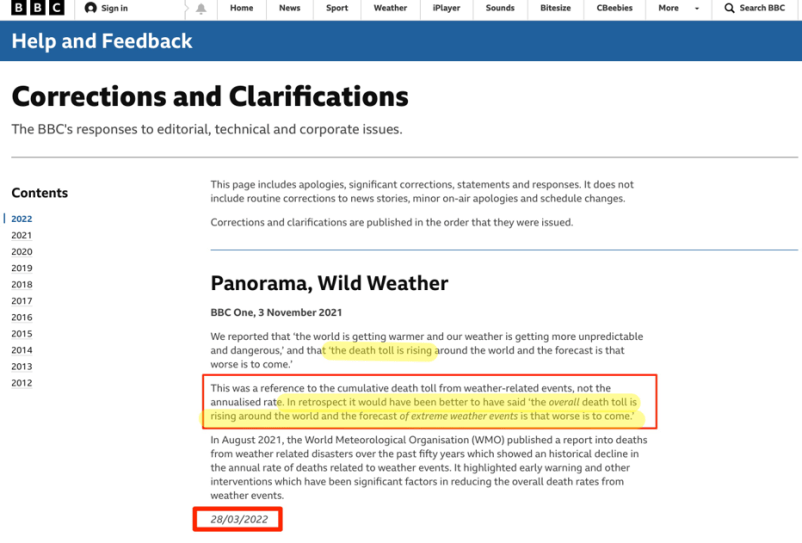
In other words, the BBC justify their claim because the cumulative number of deaths is rising!
Needless to say, he too has escalated to the ECU.
It is clear that Rowlatt is facing big problems here. He has already been rebuked by BBC News bosses about his lies regarding offshore wind costs last year. He is now facing two complaints over this flagship Panorama edition.
Regardless of the ECU decision, it is crystal clear that Rowlatt is far too emotionally attached to climate issues on a personal level to be able to report accurately and objectively.
He should be removed from the climate brief.
Featured Video

Bombing Hitler’s Hometown
or go to
Aletho News Archives – Video-Images
From the Archives
The Biggest Threat to Peace in Middle East
By Dr. Elias Akleh* | Sabbah Report | May 24, 2010
A build up of heightened tension in the Middle East is escalating in the last few weeks. American and Israeli postures towards Lebanon, Syria, and Iran have become more threatening. Listening to speeches of political leaders one hears talks only about war not peace. Iranians and Israelis are continuously training hard for a possible showdown. Both sides are conducting extensive war games every month. This led Syrians to claim that Israel is preparing for a soon-to-come another war. The Jordanians also are warning that current stalemate of the peace process is an indication of a war breaking out this summer. The Russian President and his army chief hinted, a few months ago, that the US and Israel were planning for an attack on Iran.
Indeed Iran is, as it has been for last few years, the target of most of the threats and accusations of supporting terrorism. Escalating incitement against Iran the American Defense Department sent last month (April) to Congress a report on Iran’s military claiming Iran could develop intercontinental ballistic missiles capable of reaching the US by 2015.
Ignoring the fact that N. Korea, India, Pakistan, and Israel are proven to have nuclear weapons while Iran does not, the US Secretary of State Hillary Clinton chose in her speech, to the nuclear Non-Proliferation Treaty review conference at the UN, to focus on Iran’s alleged nuclear ambitions putting the whole world at risk as she put it. According to Clinton Iran’s acquisition of nuclear weapons, rather than Israel’s more than 200 nuclear bombs, is destabilizing the Middle East. She called on the world’s nations to rally around US efforts to hold Iran, not other nuclear countries, to account.
The accusation that Usama Bin Laden is living comfortably in Iran had received a boost after the broadcast of a documentary called “Feathered Cocaine”. This echoed the June 2003 claims of the Italian newspaper Corre de la Sierra that Bin Laden was in Iran according to some intelligence report, and according to Richard Miniter’s book “Shadow War”. … continue
Blog Roll
 Aletho News
- Bombing Hitler’s Hometown
- German journalist threatened with homelessness as German court upholds EU sanctions in landmark free speech case
- US Tells Allies That Ukraine-Bound Arms Could be Sent to Middle East
- Organized terrorism: Iran condemns killing of its diplomats in Lebanon
- Why could Gaza enter the regional war?
- Hamas official rejects Mladenov Plan linking disarmament to Gaza reconstruction
- Two Primary Elections for the Soul of ‘America First’
- Japan Clings to US Vassalage Despite Energy Crunch Caused By Iran War
- US Seeks Control Over Global Energy Infrastructure – Kremlin
- US senators target Orban government for standing up to Zelensky
- If Americans Knew
- Researchers at Human Rights Watch Resign Over Blocked Report on Palestinian Refugee Return
- Jewish Groups Are Backing a War Americans Don’t Want
- Eric Fingerhut Thinks He’s the President of the Jews
- Top Jewish Philanthropists, Rabbis Urge Israeli President to Take Action Against ‘Jewish Extremists’
- Don’t Be Fooled. Zionist Leaders Have Always Wanted to Control Southern Lebanon
- Israel’s widespread use of torture is a core element of its genocide against the Palestinian people
- In Israel’s War on Iran, Many Middle East US Bases Rendered “All But Uninhabitable”
- ‘Burn the lawn’: Israel pursues ‘Rafah model’ in southern Lebanon
- A genocide here, an amputation there
- Reports: Iran mobilizing 1M fighters, Israel-US run low on ammo, Israeli army faces shortage – Not a ceasefire Day 168
- No Tricks Zone
- Devastating Assessment Of Comirnaty Vaccine By Former Senior Pfizer Europe Toxicologist
- New Study: CO2 Is ‘Effectively Negligible’ As An Explanatory Climate Change Factor Since 2000
- Former Pfizer Toxicologist Dr. Helmut Sterz Tells Bundestag Hearing Pfizer Vaccine Should Have Never Been Approved
- Energy Expert: Germany’s Nuclear Phaseout Was A “500 Billion Euro Mistake”
- New Research: South Australia’s Mid-Holocene Sea Surface Temperatures Were 4°C Warmer Than Today
- Storing Green Energy To Last Germany 10 Days Would Require A 60-Million Tonne Battery
- New Studies: UK Sea Levels Were 4 Meters Higher Than Today During The Mid-Holocene
- Destructive Green New Deal: German Energy And Metal Group Warns Of Drastic Crisis
- New Study Documents A 20-Year Pause In Arctic Sea Ice Decline – Driven By Internal Variability
- Wake-up Call: Survey Shows Majority Of Germans Now Favor Postponing Climate Targets!
 Aletho News