US bragging about its direct involvement in Ukraine may lead to uncontrollable escalation
By Drago Bosnic | May 6, 2022
On May 4, the New York Times published a highly controversial article openly bragging about how the United States has been providing critical intelligence about the location and movement of Russian troops, which has allowed Ukrainians to target them. The publication also claims that “many Russian generals have died in action in the Ukraine as a result,” citing senior US officials. However, this is hardly news, since the US and NATO have been doing it since day one of the special military operation in Ukraine. The Russian military has been warning the political West about this issue. And yet, the US and NATO aren’t only ignoring the warnings, but are also openly bragging about their actions which are contributing to the death of Russian military personnel in Ukraine as we speak.
The claim that “many Russian generals have died” is questionable at best, but it does show the US and NATO’s determination, whose involvement is key to prolonging the conflict. An epidemic of fake news about alleged injuries or even murder of Russian High Command officers has become the mainstay, even among the once-respected Western media. According to these news outlets, Russian Defense Minister Sergei Shoigu has so far survived at least two heart attacks “due to bad performance and high casualties of the Russian military” and even “Putin’s order to shoot the Defense Minister for his failures in Ukraine”.
These claims are not just outright lies, but simply ridiculous. However, they expose the mainstream media in the US and other NATO countries as an inalienable part of the military and (geo)political structure. Their reporting is designed not just to demoralize the opponent, but also to boost public morale, galvanize it and push for more support for a potential war with the targeted country or even a group of countries. This is exacerbating the already high tensions between the political West on one side and Russia and its allies on the other.
When the special military operation started, the US and NATO at least claimed their non-involvement, even though everyone knew they were involved. But the very statement they weren’t sent a message that NATO will not escalate tensions. However, this report has now changed that. By admitting effectively direct involvement in the conflict, the US and NATO are opening the door for further escalation, which most certainly will not be appreciated by Russia, whose leadership has already given strong statements regarding this issue.
The intelligence sharing is part of “a stepped-up flow” in US assistance that includes heavier weapons and billions in military supplies, demonstrating how quickly the “early American restraint” on support for Ukraine has shifted as the war enters a new stage, the NYT reported. This is further proof that the US is not interested in de-escalation. On the contrary, the latest “lethal aid” package President Biden announced is said to be $33 billion, a truly staggering sum, orders of magnitude greater than Ukraine’s annual military budget.
“The administration has sought to keep much of the battlefield intelligence secret, out of fear it will be seen as an escalation and provoke President Vladimir V. Putin of Russia into a wider war. American officials would not describe how they have acquired information on Russian troop headquarters, for fear of endangering their methods of collection. But throughout the war, the U.S. intelligence agencies have used a variety of sources, including classified and commercial satellites, to trace Russian troop movements,” the NYT report added.
This statement alone should trigger alarm across the globe. The admission that the US military and intelligence services are using commercial satellites in their operations sets a dangerous precedent which further blurs the line between civilians and the military. This comes at a time when companies such as SpaceX are accused of using their products and services, most notably the Starlink satellites, to help the Ukrainian military target Russian and DLNR units. It’s clear the US is mobilizing all of its assets in an attempt to weaken Russia. In fact, this is exactly what US Defense Secretary Lloyd Austin openly stated. He went so far as to say that “we want to see Russia weakened to the degree it cannot do the kinds of things that it has done in invading Ukraine.”
However, there are still moments when the Pentagon and State Department are giving vague and even contradictory statements regarding this issue. When asked about the intelligence being provided to the Ukrainian side, Pentagon spokesman John Kirby said that “we will not speak to the details of that information.” But he acknowledged that the US provides Ukraine with intelligence information. After the NYT article was published, Adrienne Watson, a National Security Council spokeswoman, said that the battlefield intelligence was not provided to the Ukrainians “with the intent to kill Russian generals.”
“Not all the strikes have been carried out with American intelligence. A strike over the weekend at a location in eastern Ukraine where Gen. Valery Gerasimov, Russia’s highest-ranking uniformed officer, had visited was not aided by American intelligence, according to multiple U.S. officials. The United States prohibits itself from providing intelligence about the most senior Russian leaders,” the official said.
This statement clearly refers to the reports that the Chief of Russian General Staff, General Gerasimov was allegedly wounded in a Ukrainian strike during a visit to the frontline units. Again, this shows an almost schizophrenic nature of statements coming from US officials. First, they are bragging about the “decisive role” of their intelligence support to Ukrainians, but as soon as reports of Russian High Command officers being injured surface, they are quick to announce how this support might not be “as decisive as previously thought”.
This just goes to show how dangerous US involvement in Ukraine is. Even though we know the statements about Gerasimov are false, an obvious question arises, what if it were to happen? What if he or any other Russian High Command officer were injured in Ukraine? Does the US truly believe they could just say “it wasn’t our intelligence” in an attempt to control the level of escalation which could plunge all of us into a world-ending conflict?
Drago Bosnic is an independent geopolitical and military analyst.
Now will the BBC retract its lies over vaccine threat in pregnancy?
By Kathy Gyngell | TCW Defending Freedom | April 29, 2022
‘WHAT I’ve Seen in the Last Two Years Is Unprecedented’: Physician on Covid Vaccine Side Effects on Pregnant Women. This was Wednesday’s front-page headline on the US newspaper Epoch Times.
You may remember how from early on in the Covid vaccine roll-out the former Pfizer chief Mike Yeadon, as part of his many warnings against the new gene ‘vaccines’, strongly advised against jabbing pregnant women. Not only had there been no pre-clinical reproductive toxicology testing but research on rats showed that the vaccine accumulated in the ovaries. Needless to say the BBC was first out of the traps to dismiss fears that the vaccines could harm fertility or cause miscarriages, and to target Yeadon personally. It put out a special propaganda (News) ‘reality check’ report claiming that the study showing the vaccine accumulating in the ovaries was ‘false’.
It did not take long for TCW’s Neville Hodgkinson, an experienced medical and science journalist, to show just whose claim was false. Once again, however, the BBC got away with it, as have others in ‘authority’.
Will there be any retraction or apology now senior obstetricians are putting their heads above the parapet to report on what they have been seeing amongst their patients?
Dr James Thorp is one such, an extensively published 68-year-old US specialist in obstetrics and gynaecology as well as maternal-foetal medicine, who has practised for more than 42 years. He told Epoch Times that he sees 6,000 to 7,000 high-risk pregnant patients a year and that many complications among them are due to the Covid vaccines.
‘I’ve seen many, many, many complications in pregnant women, in moms and in foetuses, in children, offspring, foetal death, miscarriage, death of the foetus inside the mom,’ he said, adding that what he has seen in the last two years is unprecedented.
Thorp goes on to explain that although he has seen a visible increase in foetal death and adverse pregnancy outcomes associated with the Covid-19 vaccination, attempts to quantify them ‘are hampered by the imposition of gag orders on physicians and nurses’ imposed in September 2021.
You can see the full article here – it is well worth reading.
The tragedy is, as Mike Yeadon comments in the article, that ‘adverse impacts on conception and ability to sustain a pregnancy were foreseeable’. They were, and he did his best to warn us of them, but all the BBC was interested in was discrediting him.
To remind the BBC, this is what he said then, to a Truth for Health Foundation conference, about the special dangers to women of child-bearing age from the gene-based vaccines, as reported by Neville Hodgkinson.
‘We’re being lied to . . . The authorities are not giving us full information about the risks of these products . . . The first is that we never, ever give experimental medicines to pregnant women. The thalidomide tragedy of the 1950s and 60s, in which a new product for morning sickness gave rise to at least 10,000 birth malformations, taught us that babies are not safe and protected inside the uterus, which is what we used to think. Interference by a chemical or something else at a critical stage of development could lead to irreparable damage.
‘Our government is urging pregnant women and women of childbearing age to get vaccinated, and they’re telling them they’re safe. And that’s a lie, because those studies have simply not been done. Reproductive toxicology has not been undertaken with any of these products, certainly not a full battery of tests that you would want.
‘That’s bad enough. Because it tells me there’s recklessness. No one cares. The authorities do not care what happens. But it’s much worse than that.’
Yeadon said he had seen a copy of the biodistribution report obtained from the Japanese regulator. To his horror, he said, ‘what we find is the vaccine doesn’t just distribute around the body and then wash out again, which is what you’d hope. It concentrates in the ovaries of rats, at least 20-fold over the concentration in other background tissues like muscles. And a general rule of thumb in toxicology is: if you don’t have any data to contradict what you’ve learned [from the animal studies], that’s the assumption you make for humans.
‘So my assumption at the moment is that these vaccines are concentrating in the ovaries of every female who has been given them. We don’t know what that will do, but it cannot be benign and it could be seriously harmful.’
His third concern, shared by a German doctor in a petition to the European Medicines Agency eight months ago, is that the spike protein produced by the vaccine ‘is faintly similar – not very strongly – to an essential protein in your placenta, something that’s absolutely required for both fertilisation and formation and maintenance of the placenta’.
The worry was that an immune response to the spike protein might cause antibodies to bind to the placental protein as well.
There was more. He concluded: ‘I think you can only expect that that is happening in every woman of childbearing potential. What the effect will be, we can’t be certain, but it can’t be benign.
‘So I’m here to warn you that if you are of child-bearing potential or younger, so not at menopause, I would strongly recommend you do not accept these vaccines.’
Blame the unjabbed – whatever the facts
By Guy Hatchard | TCW Defending Freedom | April 29, 2022
The writer is in New Zealand
THE business magazine Forbes has published a story with the arresting headline: ‘Unvaccinated People Increase Risk Of Covid Infection Among Vaccinated, Study Finds.’
The work to which it refers is not in the normal sense a study but is actually a modelling exercise published by the journal of the Canadian Medical Association. Did the Forbes staff writer read the paper very well? I am quite sure not. At the end of paragraph one of the Method section of the original paper, it describes its model, saying: ‘A vaccine that is 80 per cent efficacious would result in 80 per cent of vaccinated people becoming immune, with the remaining 20 per cent being susceptible to infection. We did not model waning immunity.’
Now I am sure you know that the mRNA vaccines do not stop infection and also wane in effectiveness. In other words mRNA vaccination does not confer immunity and its effectiveness does not remain constant as the paper assumes. So what use is this paper and to what do its conclusions apply? Apparently not to the mRNA Covid vaccines.
Lo and behold, one of the paper’s authors, David Fisman, declares competing interests: ‘He has served on advisory boards related to SARS-CoV-2 vaccines for Seqirus, Pfizer, AstraZeneca and Sanofi-Pasteur Vaccines.’
Another author, Ashleigh Tuite, was ‘employed by the Public Health Agency of Canada when the research was conducted’ (aka the domain of Justin Trudeau).
So why publish this story which on the face of it has little relevance to the real-world data of the current pandemic? Forbes magazine is 51 per cent owned by a Hong Kong-based company, Integrated Whale Investments, about which little is known. The Washington Post has suggested that Forbes’s editorial policy has been influenced as a result, but by whom no one really knows.
At this point in the pandemic, it has become clear that boosted individuals are becoming more vulnerable to Omicron than the unvaccinated. So I can only suggest that it might be advantageous for some scientists and politicians to blame the unvaccinated for everything in order to cover up their own mistaken ideas. Or perhaps there are commercial interests anxious to sell more arguably useless vaccines for billions of dollars. You decide.
If the government and their compliant media friends are our one source of truth, as has happened in New Zealand (by decree), then you have no option except to blame the unvaccinated whatever happens.
The actual situation is that the unvaccinated are currently less likely to be hospitalised than the boosted. Thank you to Grant Dixon for compiling and graphing NZ Ministry of Health data, below.

This morning my mask-exempt friend entered a haberdashery shop, whereupon two other potential customers turned and fled. Yesterday she was turned away from a fabric store. I am sure many of you have had similar experiences. The fact of the matter is that almost the whole of the New Zealand population has become subject to fear-based government-sponsored groupthink.
Are we all being conditioned to vote for Jacinda Ardern in next year’s election based on the carefully constructed myth that she is keeping us all safe? We should be keeping our feet on the ground. We should recognise that public relations experts and propaganda promoters are at work full-time, but they are working out of touch with reality.
Meanwhile our whole economy is becoming ever more dysfunctional. As people are too afraid to associate with one another in public, the whole basis of commercial activity is being undermined.
The two large supermarket chains are laughing all the way to the bank. As small businesses are forced to close and their monopoly grows, supermarket prices and profits are entering the stratosphere. Smart individuals are now ordering their vegetables and groceries direct from Australia (as far away from us as Moscow is from London) because they are so much cheaper.
The government is clueless to control this rampant price inflation, along with most things including the pandemic. The public is hoodwinked, queueing fully masked and fully vaccinated to pay through the nose for everyday items without a squeak of dissent.
The ten-year-old son of a friend asked his mother the other day: ‘Which do you think our society is more like – Brave New World or 1984?’ I doubt if either Aldous Huxley or George Orwell could ever have imagined anything so incomprehensibly doublethinking as 2022 New Zealand.
This is the state we have reached through our government’s careful rationing of information and saturation conditioning.
Time we reopened the floodgates of free speech and social media – hold your horses, we might endanger our one source of truth.
Parsing the “data” from Moderna’s selective leaks to the press about its failed clinical trial in kids under 6
The shot made no difference against Covid but it does cause myocarditis and came with a 15% to 17% adverse event rate. Meanwhile the CDC admits that 74.2% of kids already have natural immunity.
By Toby Rogers | April 30, 2022
On Friday, the NY Times and other stenographers for the cartel breathlessly announced that Moderna has asked the FDA to authorize its junk science mRNA shot in kids under 6. Oh, so that means Moderna submitted an application to the FDA? Well, not exactly. From the article:
“A top official at the company said it would finish submitting data to regulators by May 9.”
Wait, so Moderna is “asking” the FDA to authorize its product but Moderna will not even finish its application for another 10 days!? That’s weird. It’s like a kid asking his teacher for a A+ while his homework assignment is half-finished.
So already we’re seeing serious red flags and we’re not even out of the first paragraph.
Of course it gets worse.
To be clear, there is no data because Moderna has not even finished its application. But Moderna and the White House have been selectively leaking numbers to the press that dutifully prints them without question — and those numbers tell us that Moderna’s clinical trial was a disaster.
I need to provide some background and context and then I’ll get into the particular details about this failed clinical trial in kids.
Moderna applied for Emergency Use Authorization to administer its mRNA shot to adolescents 12 to 17 years old back on June 10, of 2021. But the application has been held up ever since. Why? Myocarditis. From the Wall Street Journal :
The Food and Drug Administration is delaying a decision on authorizing Moderna Inc.’s mRNA Covid-19 vaccine for adolescents to assess whether the shot may lead to heightened risk of a rare inflammatory heart condition, according to people familiar with the matter.
Moderna has at least two big problems in giving this shot to teenagers:
1) The dose they are giving to teenagers is the same dose as that given to adults — 100 mcg of mRNA — which is four times the amount in the Pfizer shot given to adults (25 mcg). So the Moderna shot is great at generating antibodies that target the spike protein of the original Wuhan lab leak strain. But some of that mRNA can migrate to the heart and generate myocarditis as well. Remember, Pharma’s capture of the FDA is so extreme, they should just be able to write “Iz Gud!” on a paper napkin and the FDA will approve it — as they did with Pfizer’s application to inject kids 5 to 11 — in spite of ZERO evidence supporting this use. So if the FDA has held up Moderna’s application in teens for nearly a year, the myocarditis signal must be truly terrifying.
2) Nordic countries are slightly less corrupt than the United States. Finland, Sweden, Denmark, and Norway have all suspended the use of the Moderna mRNA shot in teenagers because its leads to myocarditis. (Finland and Sweden even suspended its use in men under 30 years old.) Even the criminally corrupt European Medicines Agency acknowledged that both Pfizer and Moderna mRNA shots lead to myo- and pericarditis and added a warning to the product insert.
Okay what do we know about Moderna’s clinical trial in kids under 6?
Back on March 23, Moderna put out a press release claiming that:
vaccine efficacy in children 6 months to 2 years was 43.7% and vaccine efficacy was 37.5% in the 2 to under 6 years age group.
The NY Times of course printed that like it was a clay tablet handed directly from God to Moses just as they printed the “90% to 100% effective(TM)” lie in connection with the clinical trial in adults. By now everyone knows that the actual vaccine effectiveness is zero or even negative after 6 months.
Sane people pointed out that vaccine efficacy of 43% and 37% are BELOW the 50% threshold required for FDA authorization. It’s not clear why the geniuses at Moderna did not realize this — perhaps they just wanted to rub everyone’s noses in the sheer criminality of their enterprise?
But somewhere between March 23 and last Friday, Moderna staff got the message so they did what they always do, they just manipulated the data. From the NY Times :
Moderna said Thursday the vaccine appeared to be 51 percent effective against symptomatic infection among those younger than 2, and 37 percent effective among those 2 to 5.
Okay first off, lol that they still cannot get the number above 50% in kids 2 to 5 even when they are just straight up lying about the numbers. But how did they convert 43% to the magical 51% in kids 0 to 2? They simply deleted data that they did not like:
Those results were slightly better than the ones Moderna previously released for children under 2. The company said that was because the second time, the firm excluded infections that had not been confirmed with a P.C.R. test analyzed in a laboratory.
Let’s be clear — this is Moderna’s clinical trial. They control the whole process. If you’re a study participant who is having a heart attack in the middle of the night and call 911 and go to the hospital — they kick you out of the clinical trial for not seeing their doctors and following their protocol. So Moderna is the one who makes the decision as to whether to use “a P.C.R. test analyzed by a laboratory.” To now exclude (without any valid justification) infections that made their clinical trial look bad is gross scientific misconduct. The Moderna application, when/if it is submitted 10 days from now, should be rejected immediately because of this misconduct.
While the clinical trials in kids were failing, Pfizer and Moderna were running a half-hearted campaign to pressure the FDA to approve these shots in kids under 5 — in spite of zero data showing benefit and considerable evidence showing harms. The attempts were pathetic and included hashtags on social media like #immunizeunder5 that were likely only used by people taking money from these monsters. But of course the stenographers eagerly reported on this milquetoast effort and one of the talking points is, ‘well, okay, the shots do not meet the required 50% FDA threshold but some protection is better than none(TM) so please authorize my right to genocide my kids.’
Well, it turns out, these shots do NOT even offer “some protection”:
Moderna’s clinical trial data showed that the antibody response of the youngest children compared favorably with that of adults ages 18 to 25, meeting the trial’s primary criterion for success. Although the trial was not big enough to measure vaccine effectiveness…
What!? “The trial was not big enough to measure vaccine effectiveness.” Isn’t that the whole point of a clinical trial!? So Moderna (and the NY Times ) are saying that the clinical trial made ZERO difference on Covid-related health outcomes including infection, hospitalization, ICU visits, or deaths, because the SARS-CoV-2 virus is not a threat to healthy children in this age group — which we have been pointing out for months.
So how does Moderna try to finesse it? They look at antibodies in the blood, not health outcomes in the real world. They call it “immunobridging”. As I explained at length back in October, this is NOT a scientifically valid way to use immunobridging (claiming likely future health outcomes from antibodies alone when the trial showed no such thing). Immunobriding is only valid if one has clinically validated correlates of protection and conditions prevent one from conducting a proper RCT (neither of which apply in this case).
Even the hand-picked yes-men and women on the CDC’s Vaccines and Related Biological Products Advisory Committee (VRBPAC) acknowledged at their last meeting that they do NOT have “correlates of protection” that would enable them to estimate health outcomes from antibody measures. Eric Rubin (Editor-in-Chief of the NEJM ) even stated, “We know what kind of antibody response can be generated, we just don’t know if it works.”
So Moderna is asking the FDA to authorize its mRNA shot in kids under 6 based on antibodies alone even though every member of the FDA’s VRBPAC acknowledges that antibodies tell you absolutely nothing about likely health outcomes.
(In fact, new evidence suggests that mRNA shots suppress the body’s innate ability to generate anti-N antibodies.)
What about side effects?
Side effects were at a similar level as those from previously approved pediatric vaccines, with fevers in 15 percent to 17 percent of the children, Moderna said.
Any shot with an adverse event rate over 1% should not be authorized. To authorize a shot with a 15 to 17% adverse event would be batsh*t insane.
Furthermore, we know that Moderna and Pfizer make cases of disability and death in their clinical trials disappear — so the actual adverse event rate is surely even higher than 15% to 17%.
Making this nightmare complete, the CDC acknowledged on April 26, 2022, that 74.2% of children ages 0 to 11 are already naturally immune to Covid-19 because of prior exposure. The 74.2% number came from February, so given the rate of increase at the time, by now nearly 100% of children ages 0 to 11 likely already have natural immunity which is superior to artificial vaccine immunity. There is no emergency in this population that would justify an emergency use authorization of this useless toxic product.
So to recap this painful saga:
• Moderna shots cause myocarditis and pericarditis which is why Moderna has not been able to get authorization to inject mRNA into teenagers.
• Moderna shots make no difference in connection with Covid-19 in this age group.
• Moderna shots come with at least a 15% to 17% adverse event rate.
• Nearly all children in this age group are already naturally immune so there is no emergency that would justify an emergency use authorization.
This is not hard to figure out. In a sane world this application would be dead on arrival, whenever Moderna gets around to actually turning in its application. Any reporter worth his/her salt should be ridiculing Moderna’s weird mix of hubris, incompetence, bad “data”, and malevolence. But our country, its “public health” agencies, and the mainstream media are run by Insane Nazi Clowns. I imagine many bougiecrats will drown in their own tears if they are not allowed to genocide their own kids with this shot (and then they’ll celebrate their sacrifice and take selfies with their kids in the ICU when the myocarditis kicks in, proclaiming #getvaccinated). Of course bougiecrats can already get this shot for their kid off label, so my hunch is that it’s really your kids who they want to genocide.
In future articles I’ll have additional thoughts about how we push back. In the meantime, this continues to be our best play and I encourage all of us to just get into the habit of contacting 25 people at the FDA every day to tell them to REJECT both the Moderna and Pfizer applications to inject mRNA into little kids.
Biden’s Mammoth $33BN Ukraine Package Includes Help With Wartime Propaganda
By Tyler Durden | Zero Hedge | April 28, 2022
Politico’s Christopher Miller noted earlier that the record-smashing $33 billion spending package that the White House is proposing for Ukraine actually “dwarfs the annual defense budgets of most nations.” To which we naturally asked: how many billions of dollars does it take to turn a ‘proxy’ war into a ‘direct conflict’?
For starters it’s clear that such a massive amount of taxpayer money means that Washington clearly doesn’t expect that the war will end anytime soon, as multiple US defense and intelligence officials have recently testified. In fact General Mark Milley, the chair of the Joint Chiefs of Staff, told the House Armed Services Committee during the first week of this month that he sees this as a “very protracted conflict” to come that will be “at least measured in years.”
Biden in his Thursday rollout remarks described that the new aid package “begins the transition to longer-term security assistance.” But interestingly as part of this assistance, a key area that the US will fund is what’s essentially information warfare…
Independent journalist and media commentator Michael Tracey has pointed out…
White House fact-sheet says part of the mammoth $33 billion spending package it’s requesting for Ukraine will be to “support independent media.” Because nothing screams “independent” like being directly funded by the US Government as part of its “information warfare” initiative.
Of course, going back to at least 2014 the US government has funded such Ukraine initiatives as “citizen journalism” to push back against ‘Russian influence’ in the country.
As WikiLeaks has documented long ago, there was similarly heavy State Department and US intelligence funding of “independent” and “opposition” media in Syria in the lead-up to and during the decade-long war to try and overthrow Assad.
But this marks a huge expansion of the United States much more directly assisting Ukraine in its media and wartime propaganda efforts. The White House fact sheet detailing the scope of the security aid package spells out in a bullet point:
- Counter Russian disinformation and propaganda narratives, promote accountability for Russian human rights violation, and support activists, journalists, and independent media to defend freedom of expression.
This as “freedom of expression” is often suppressed at home, ironically enough especially targeting independent media outlets.
Also of little comfort to the US taxpayer in terms of a potential eventual path to WW3 between two nuclear armed powers is this section under a header titled Help Ukraine Defend Itself Over the Long-Term…
- A stronger NATO security posture through support for U.S. troop deployments on NATO territory, including transportation of U.S. personnel and equipment, temporary duty, special pay, airlift, weapons system sustainment, and medical support.
Ultimately this means hundreds of millions will go toward propping up “independent media” which will actually in truth be US-state funded pro-NATO information efforts.
Here’s what I found at the reported ‘mass grave’ near Mariupol
A first-hand look at the location where Kiev claims trenches hold thousands of bodies
© Eva Bartlett
By Eva Bartlett | Samizdat | April 28, 2022
According to recent Western media, Russian forces have buried up to 9,000 Mariupol civilians in “mass graves” in a town just west of the Ukrainian city. These reports use satellite imagery as supposed evidence and repeat the claims of officials loyal to Kiev that “the bodies may have been buried in layers” and “the Russians dug trenches and filled them with corpses every day throughout April.”
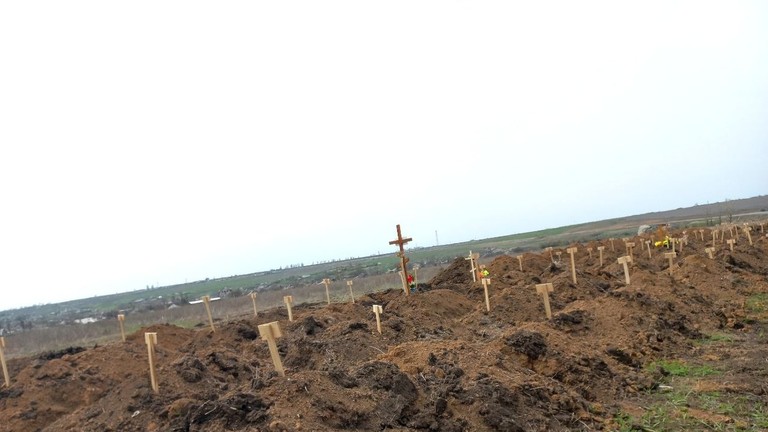
I went to the site in question and found no mass graves.
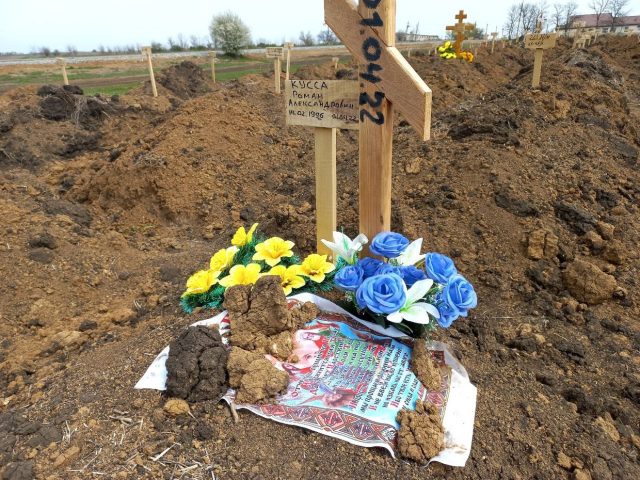
On April 23, I joined RT journalist Roman Kosarev on a visit to the location, in the town of Mangush. What I saw were new, orderly grave plots including some still empty ones – an extension of a cemetery that already exists at the spot. No mass pit. Many of the graves have placards with the names and dates of birth of the deceased when available, and the remaining plots were numbered according to burial.
Since the media is essentially copy-pasting from the same source – the former mayor of Mariupol, Vadym Boichenko (who seems to be far from the city now) – I’ll cite from the Washington Post’s article.
Boichenko, the article notes, “called the site the ‘new Babyn Yar,’ referring to one the largest mass graves in Europe located in the outskirts of Kyiv, where 33,000 Jews where killed by Nazis in 1941 during World War II.”
This is ironic on several levels. A mayor who is whitewashing the neo-Nazis who have run amuck in his city – notably those from the Azov Battalion, who have used civilians as human shields, occupied and militarized civilian infrastructure, point-blank executed civilians – is comparing an alleged (non-existent) mass grave to a Nazi massacre of WWII.
Meanwhile, the Kiev regime has re-written history, making WW2 Nazis and their collaborators heroes of the nation. The most notorious example being the WWII figure Stepan Bandera.
Boichenko’s other alarming claim was that the alleged “mass grave” was “the biggest war crime of the 21st century.” We are only 22 years into it, but we’ve already seen the US-led invasion and destruction of Iraq, the levelling of Syria’s Raqqa, Saudi Arabia’s ongoing war in Yemen – all of which are much stronger contenders than the nowhere-to-be-found “mass graves” of Mangush.
In reality, the site has around 400 individual plots, including nearly 100 empty ones. The 9,000 bodies and “biggest war crime of the 21st century” were unverified claims made by a mayor who fled his city, promoted by media which down the page admitted they could independently verify the claims – but by then, the damage had been done.
Gravediggers disprove mass grave claims
While walking around the site, two men responsible for burials arrived, and when presented with the former mayor’s accusations of mass graves they vehemently rejected the claims.
“This is not a mass grave and no one is throwing bodies into a pit,” one told me.
© Eva Bartlett
According to them, they bury each person in a coffin and separate grave, details are logged in the morgue, and when any documents regarding name and age are given, the plot is marked with a placard containing those details. Otherwise a number is used.
Interestingly, they also noted that a section of the new graves included buried Ukrainian soldiers. “They’re human, too” one of the men said.
For those in doubt as to the location, see Roman’s report: his drone footage shows that it’s precisely the same location as shown in the satellite images used by Western media.
Meanwhile, as Roman noted while walking, mass graves is something Ukraine has previously been accused of. He cited DPR leader Denis Pushilin as having stated that at least 300 such sites have been discovered since 2014.
He also spoke of what he witnessed. “In 2014 or 2015, mass graves were discovered as Azov or Aidar fighters retreated from the Donetsk region. I even saw a woman, she was dug up, she had her arms tied behind her back, she was in the late stages of pregnancy and she had a hole in her head, so that means she was executed.”
American journalist George Eliason, who has lived in Lugansk for many years, has written about these alleged atrocities. In a documentary on the issue, he said: “I’m here for five minutes and then I’m told the first five people they found, it was five decapitated heads. They were all civilians. Who does this to people?”
This story of a mass grave in Mangush is another fake from the Western corporate media, which previously pushed incubator babies being thrown on the floor by Iraqi soldiers, pushed lies about WMDs in Iraq, and carried reports of a chemical attack in Douma that never happened, to name but a few of their litany of hoaxes.
Meanwhile, when I was in Mariupol on April 21 and 22, yes there was destruction – thanks to those Neo-Nazi & regular Ukrainian forces occupying upper floors of residential buildings and using them as military positions, thus drawing return fire on the buildings – but I also saw people in the streets, and the beginning of the cleaning up process before rebuilding can occur.
I’ll repeat what I’ve said on Western media reporting on Syria (which in my experience, from on the ground in that country, is largely dishonest): those who promote these hoaxes and war propaganda have blood on their hands.
After the countless lies emanating from Western corporate media, I would hope people would exercise critical thinking whenever a new claim is pushed, particularly when it is repeated in chorus by the usual suspects.
The Guardian inadvertently shakes up Bucha narrative
By Drago Bosnic | April 28, 2022
When the events in Bucha were first reported, Ukrainian and Western mainstream media were unanimous – Russian Armed Forces were the alleged “perpetrators of the Bucha massacre”, while some even called it a “genocide”. The Ukrainian side claims Russian troops killed at least 412 people, while so-called “independent” sources state there were 50 victims. The peculiar claims were completely unsupported by any actual official investigation by any neutral side. The Kiev regime and their Western sponsors flatly refused to allow an international investigation, while any claims contrary to the official narrative were immediately suppressed. If anyone dared to question the narrative, they would be labeled “conspiracy theorists”, “genocide deniers” and “Putin’s propagandists”.
It is more than clear that such a blunt approach to the events in Bucha is designed to silence not just those opposing the official narrative, but even those who are not invested with either side and simply want answers to legitimate questions regarding the veracity of mainstream media reports. This completely removes any sort of public debate, limiting it to one-sided talkshows where so-called “pundits” are called to brainwash the public into thinking that the Russian military is entirely composed of alleged rapists, murderers, alcoholics, drug addicts, etc. By pushing this narrative, the mainstream media are “normalizing” Russophobia and anyone trying to denounce it is promptly silenced.
However, lies are still lies. And they are significantly harder to sustain than the truth. The truth is just truth, it stands by itself. Lies require the liar to circumvent and twist facts. In other words, more lies are necessary to sustain just one. It’s a neverending rabbit hole which inevitably spirals out of control. And precisely this happened on 24 April, when The Guardian published an article about new findings regarding the events in Bucha. According to the UK-based daily, “independent” investigators found evidence of fléchettes used by artillery (supposedly Russian) in Bucha.
“Independent” pathologists and coroners who are carrying out postmortems on bodies found in mass graves in the region north of Kyiv, where “occupying” Russian forces have been accused of alleged atrocities, said they had found small metal darts, called fléchettes, embedded in people’s heads and chests, the report stated.
“We found several really thin, nail-like objects in the bodies of men and women and so did others of my colleagues in the region,” Vladyslav Pirovskyi, a Ukrainian forensic doctor, told The Guardian. “It is very hard to find those in the body, they are too thin. The majority of these bodies come from the Bucha-Irpin region.”
“Independent” weapons experts who reviewed pictures of the metal arrows found in the bodies, seen by The Guardian, confirmed that they were fléchettes, an anti-personnel weapon widely used during the First World War.
These small metal darts are contained in tank or field gun shells. Each shell can contain up to 8,000 fléchettes. Once fired, shells burst when a timed fuse detonates and explodes above the ground. Fléchettes, typically between 3cm and 4cm in length, release from the shell and disperse in a conical arch about 300m wide and 100m long. On impact with a victim’s body, the dart can lose rigidity, bending into a hook, while the arrow’s rear, made of four fins, often breaks away causing a second wound.
“According to a number of witnesses in Bucha, fléchette rounds were fired by Russian artillery a few days before forces withdrew from the area at the end of March,” the report added.
As with all cases of Western-reported alleged crimes, there are always numerous witnesses, independent international experts, anonymous whistleblowers, etc. We just never get to see them. Which means we should simply take the claims of these people, whose very existence we cannot verify, at face value. And any sort of view opposing this narrative is immediately shut down.
According to Neil Gibson, another “Independent” weapons expert at the UK-based Fenix Insight group, who has reviewed the photos of the projectiles seen, they include the 122mm 3Sh1 artillery round, in use by Russian artillery and which are filled with fléchettes. What Mr. Gibson conveniently “forgot” to mention is that these same shells are used in all post-Soviet countries, including Ukraine. More specifically, the shells fit the D-30 howitzers, which are in service with both Russia and Ukraine, as well as dozens of other countries.
A spokesperson for the Ukrainian Ground Forces was quick to state that Ukraine’s military “does not use shells with fléchettes”. However, facts beg to differ, as surgeons in eastern Ukraine have reported the use of fléchettes by Ukrainian artillery in Donbass warzone since at least 2014. It’s obvious the Ukrainian and Western media find it convenient to use Soviet-era weapons as “proof” of alleged Russian war crimes, while ignoring the fact that these same weapons are used by Ukraine. What’s more, Ukraine is more likely to use them, since they have produced little to no new weapons and munitions since the collapse of the USSR.
Russian forces left Bucha on March 30. It took only a few days for the “independent” pathologists and coroners to file the reports from Bucha. At first, the reports claimed Russian forces allegedly shot civilians at point-blank range. Satellite image company Maxar Technologies claimed its photos provided “critical evidence that mass killings of civilians in the Ukrainian city of Bucha must have occurred when Russian forces were occupying the territory in mid to late March”. Combined with the report about fléchettes, this would mean the Russian artillery fired at the city while Russian troops were there, which defies any military logic.
If the reports about the usage of fléchettes are true, the only logical conclusion is that the Ukrainian military shelled Russian positions after the decision to withdraw from the Kiev and Chernigov regions. Russian forces deployed in Bucha certainly didn’t shell their own positions. Since we now know that the Ukrainian forces have and use fléchettes in their artillery shells, what conclusion can we draw except that the civilians were killed by the side which shelled the city while Russian troops were there?
Drago Bosnic is an independent geopolitical and military analyst.
As jabbed athletes collapse, the authorities look the other way
By Guy Hatchard | TCW Defending Freedom | April 21, 2022
THROUGHOUT 2021, attempts were made to debunk persistent reports that an unusual number of athletes were suffering cardiac events which might be related to mRNA Covid vaccination. The main theme of these fact-checking efforts was denial – athletes were not at risk and cardiac events were not happening.
In 2022 this dialogue is evolving because the numbers are growing and harder to ignore. According to an investigative report by OAN, a pro-Trump online US news site, 769 athletes suffered sudden health events between March 2021 and March 2022 with an average age of 23 years. In February, 15 top tennis players were unable to complete their matches in the Miami Open tournament.
Of necessity in the face of mounting numbers of injury reports, the fact-checking dialogue has hesitated on the brink, but on February 1 this year, the Washington Post still labelled stories of adverse effects of mRNA vaccines on athletes FALSE. Its story relied heavily on a discussion of the Danish footballer Christian Eriksen, who suffered a cardiac arrest on June 12 2021 just before half time in a match against Finland. The circulation of the apparently false story that Eriksen had been vaccinated was attributed by the Washington Post to a shady far-Right group in Austria seeking to influence their upcoming election.
 Dig deeper and the story gets more murky. Few if any of the participants in this argument on both sides have verified hard facts to hand. The Washington Post, which had probably realised by February that it was quite possible that an unusual number of athletes were unexpectedly falling to the ground, decided to finish its article by asserting that the sporting collapses must be down to Covid, not Covid vaccination. Again no hard facts about actual athletes, just a polarised muck-throwing event.
As a scientist I realise that what is lacking here is reliable data. Why is it lacking? Here is the nub – the authorities are so sure they are right about the safety of vaccines that they are refusing to collect data. New Zealand has refused to institute mandatory reporting of adverse events following mRNA vaccination and other countries are in the same boat. We don’t have a lot of data to go on because it is not being collected. Sporting bodies are not counting either, or perhaps they have lost count or looked the other way.
Delving into the world of psychology, I find this unsettling. Why wouldn’t we collect data? Why aren’t we allowed to ask questions? Why isn’t the Ministry of Health counting and publishing up-to-date medical data on the frequency of cardiac and thrombotic events of all types?
There are stories in the popular press (actually not so popular these days) reporting recent excess cardiac events as due to ‘holiday heart syndrome’ or the need for young people ‘to avoid strenuous exercise’. Neither of these had been a thing until 2021. Why hasn’t the MoH quashed these speculative sallies into obfuscation by publishing data? You tell me.
The finger-pointing gets worse. One particular ‘whack-an-antivaxxer’ sport recently originated at Otago Medical School in New Zealand. A popular digest of a study of 1,000 people born in Dunedin in 1972 was reprinted in leading publications around the world. The article implied that anti-vaxxers suffered from sexual abuse, maltreatment, deprivation or neglect, or having an alcoholic parent as they were growing up. They were also described as low educational achievers likely to suffer from mental illness.
I am a little sceptical by nature, so I noticed that the reports were based on an article in a publication called The Conversation, which has received support during the pandemic from the Bill and Melinda Gates Foundation. The Conversation describes itself as both devoted to academic rigour and seeking to explain science to the general public. Curiously its article about the Dunedin survey contained only one quantitative piece of information – 13 per cent of the respondents were vaccine resistant. No other quantitative information was provided to support the extreme characterisation of the vaccine hesitant in the article.
I tracked down the actual study entitled ‘Deep-seated psychological histories of COVID-19 vaccine hesitance and resistance’. Seven of the ten authors were based in the USA. One of the authors disclosed that he is funded by the US Centers for Disease Control and Prevention.
The survey completed in April 2021 actually found that 13 per cent of the respondents were vaccine resistant and 12 per cent were vaccine hesitant. So fully 25 per cent of the respondents were vaccine hesitant to varying degrees.
I then rapidly came across an old friend used to distort information: absolute differences versus relative differences.
Of those willing to vaccinate (note the word used is willing, not necessarily keen), 62 per cent had at least one Adverse Childhood Event (ACE). Of those hesitant or resistant to vaccination 73 per cent had at least one ACE. The difference between 62 and 73 per cent is not large in absolute terms.
Based on this small difference, Professor Richie Poulton, a Dunedin-based co-author of the study, was quoted in the Otago Daily Times as saying about the vaccine hesitant and resistant responders:
‘The childhood experiences of those surveyed ranged from sexual abuse, parental neglect, poverty, to isolation and lack of achievement in school. They covered the whole suite of difficulties you can think of that might impinge on a person’s good development. Their personality became very stress reactive – they saw danger or threat where there essentially was none.’
Now you probably did percentages at school, so do you think Professor Poulton’s comments accurately reflect the difference between 62 per cent and 73 per cent exposures to at least one ACE? Because I certainly don’t. A significant percentage of both groups experienced ACEs growing up, but they had different opinions about vaccination.
Wouldn’t it be more productive to ask: why do we have such a high rate of ACEs in New Zealand? Is our mental health service under-funded? Is our education system failing us? Is support for families sufficient?
I went further down the pages examining results of a battery of ‘questionnaires’. I found that although there were measurable differences between the two groups: ‘vaccine willing’ and ‘vaccine hesitant and resistant’, their average scores were well within the standard deviation of the mean standardised score for each test.
This means most of those responding to the survey were relatively average people. The vaccine hesitant and resistant were being falsely characterised as ill-educated social deviants. This sounds like victim blaming. So much for the academic rigour and capacity to explain science to which The Conversation proudly aspires.
Were the media comments about the study an unsupported and false attempt to discredit the unvaccinated and categorise them as outcasts and misfits without the necessary intelligence to think for themselves? The small differences between the two groups were insufficient to justify this black-and-white condemnation widely shared around the world’s media.
There were some differences in educational attainment. Some 35 per cent of the vaccine willing had a BA degree or higher, while 15 per cent of the vaccine hesitant or resistant had a BA or higher. However the Dunedin results may be misleading regarding the influence of education. A study in the USA found that people with a PhD were more likely to be vaccine hesitant, implying that a decision not to vaccinate may possibly be encouraged by the development of high level critical thinking.
In the mainstream media articles, Professor Poulton pleaded with us to feel pity for the unvaccinated, because of their supposed difficult childhood (which was in fact not so different from that of the vaccinated). Was he simply lowering our opinion of the unvaccinated by playing upon stereotypes? Subtly hammering home the current mainstream media messaging that only Right-wing extremists and selfish antisocials remain unvaccinated.
Did he realise that the unvaccinated are legitimately concerned about the vaccinated because they have been unwittingly exposed to serious but as yet unquantified medical risk?
As I am aware that Covid mRNA vaccine adverse events are running at 30-50 times higher than any previous vaccine, I would ask different questions of the data:
- Were those willing to be vaccinated being misled by the inadequate content of their education?
- Do prior adverse experiences provide good reason to be more cautious in future?
The Immunisation Advisory Centre at the respected University of Auckland (incidentally partly funded by pro-vaccine interests) reassuringly says:
‘Confirmed cases of myocarditis are rare. More than 80 per cent of reported cases of myocarditis following mRNA Covid vaccination have recovered quickly with rest and commonly used oral anti-inflammatory medications such as ibuprofen.’
Are you reassured by this, or have you looked at the Medsafe adverse event data where 18,000 mRNA vaccine recipients reported chest pain and shortness of breath – symptoms admitted by the Immunisation Advisory Centre to be indicative of myocarditis?
Have you concluded, like me, that as many as 80 per cent of cases of myocarditis among the vaccinated remain unreported and untreated? A ticking time bomb, of which professional athletes represent only the tip of the iceberg.
The question is, how long are our health authorities going to continue to look the other way and refuse to start counting accurately, appropriately, and retrospectively?
CNN’s US Intel Source Just Admitted That Everything Zelensky Says Is Propaganda

By Andrew Korybko | One World Press | April 20, 2022
Ukrainian President Zelensky has been accused by his many critics across the world of spewing propaganda in every one of his many appearances, yet up until CNN’s surprising publication of an article on Tuesday, the US-led West condemned any such suspicions as so-called “Russian propaganda”. The “politically correct” narrative has suddenly changed, however, due to that outlet’s piece titled “What happens to weapons sent to Ukraine? The US doesn’t really know”. Partway through the text, CNN reported the following about US suspicions that Ukraine isn’t telling the whole truth about anything:
“’It’s a war — everything they do and say publicly is designed to help them win the war. Every public statement is an information operation, every interview, every Zelensky appearance broadcast is an information operation,’ said another source familiar with western intelligence. ‘It doesn’t mean they’re wrong to do it in any way.’”
This jaw-dropping disclosure amounts to a complete reversal of the prior narrative whereby it’s no longer so-called “Russian propaganda” to accuse Zelensky of spewing propaganda but is now reportedly the unofficial position of none other than the US government itself. Not only that, but this is supposedly something that should even be praised, not condemned. That new narrative builds upon the one introduced by NBC News earlier this month when it quoted unnamed US spies who openly admitted to waging information warfare against Russia, including through the spread of fake news speculation.
All of this might understandably be too much for the average Western information consumer to process, which is why the purpose of this piece is to explain the emerging cognitive warfare trend that’s on display in this context. The US-led Western Mainstream Media (MSM) is clearly on the defensive after it became impossible to deny that Zelensky is spewing propaganda in literally every one of his many appearances according to CNN’s own US intel source on the matter. Doubling down on the false narrative that he’s an “innocent truth-teller” is counterproductive since folks don’t trust him anymore.
For that reason, the US’ permanent military, intelligence, and diplomatic bureaucracies (“deep state”) felt compelled to enact a drastic change in the official narrative by allowing some of these shadowy officials to anonymously speak to CNN in order to recalibrate their perception management operations. Instead of desperately clinging to their discredited narrative, they sought to radically change it through the so-called “limited hangout” tactic of admitting something unsavory (in this case that all the Ukrainian leader does is spew propaganda) but then spinning it into something positive.
By giving some credence to the suspicions of their increasingly skeptical audience who’ve largely realized by now that Zelensky can’t be trusted after he’s gone so overboard with his rhetoric during his many appearances as of late, they hope to strategically disarm their target by getting their guard down so that they swallow the second part of the “deep state’s” amended narrative related to why “it doesn’t mean that [he’s] wrong to do it in any way.” This conforms to the trend first introduced by NBC News whereby Americans are now supposed to expect propaganda in the media, not condemn it.
The unofficial acknowledgement of “deep state” meddling in the US media from NBC News’ sources and the praise that CNN’s intel source just lavished upon Zelensky for the lies that this individual candidly admitted he spews during all of his appearances are meant to precondition the targeted Western audience into appreciating that which they’d otherwise have condemned as contrary to their country’s values, especially that which concerns the supposed integrity of their media. That said integrity has long been gone, however, which is why it was way overdue for the “deep state” to finally flip the narrative.
Observers should remember that this is only being done because the population at large is awakening to how maliciously they’ve been misled by the so-called “fourth estate” through its collusion with the “deep state” and foreign officials like Zelensky, whose words they hitherto passed off as truth without any second thought and condemned those who questioned him as “Russian propagandists”. Big data analytics have evolved to the point where “deep state” structures can very easily assess the pulse of their targeted audience and thus get a sense of their true sentiments towards whatever it might be.
Considering the radical revision of the official narrative that just took place in less than a few weeks’ time through NBC News and CNN’s seemingly coordinated “revelations” about media meddling, it can confidently be concluded that this was done in response to the “deep state” realizing that it absolutely had to undertake this course of action lest its targeted audience soon lose all trust in its media proxies. For that reason, this should be seen as an unprecedentedly desperate move that has no precedent in American history, which speaks to the population’s similarly unprecedented distrust of the media.
Lavrov responds to nuclear weapons claim
Samizdat | April 19, 2022
Russia’s Foreign Minister Sergey Lavrov has rejected claims that Moscow could resort to the use of tactical nuclear weapons in Ukraine.Lavrov was questioned on the issue during an extensive interview with India Today in Moscow on Tuesday.
When the journalist mentioned that “President Zelensky said that Russia plans to use tactical weapons,” the foreign minister didn’t even let her finish the question. “He says many things,” Lavrov said.
He reminded that Russia had never mentioned the use of nuclear weapons as an option during its military operation in the neighboring country, and the Ukrainian leader was the only one to speak about this.
Lavrov reiterated the notion that “there could be no winners in a nuclear war,” and assured that Russia would only rely on conventional weapons in Ukraine.
Zelensky claimed that Moscow could use tactical nuclear weapons in Ukraine during his interview with CNN on Friday.
Breaking the Spell
The Holocaust: Myth and Reality, Overview of the book by Dr. Nicholas Kollerstrom
BY ANTONY C. BLACK • UNZ REVIEW • APRIL 17, 2022
Heresy In the 21st Century
 Never in my long journalistic career have I ever hesitated to put pen to paper – until now. Indeed, I have delayed writing this overview of Dr. Kollerstrom’s remarkable book for going on six years.[1] Up until now no subject had been too controversial, too sensitive, too beyond the pale as to warrant more than a passing moment’s consideration of consequences. But this is different. In some sixteen countries in Europe one can be put in prison for doing what I am doing now, or even for expressing ‘holocaust denialism’ on social media. In Germany some fifteen thousand people are tried each year for Thought Crime, i.e., for so-called ‘right-wing extremism’. Here in North America it is somewhat better; one merely risks losing one’s job, friends and family – and possibly being blacklisted as a writer from virtually every venue one might have formerly been associated with. No small potatoes.
Dr. Kollerstrom, himself, stumbled rather more naively into this punitive quagmire in 2008 when, after merely reviewing a scientific paper analyzing samples taken from the walls of the alleged ‘gas chambers’ at Auschwitz, – a paper authored by one Germar Rudolf, a young scientist working at the time at the Max Planck Institute – he found himself summarily dismissed from his erstwhile position as historian and philosopher of science at University College, London (UCL), “the sole member of staff…ever to have been expelled for ideological reasons”. As he recounts,
“I became ethically damned, thrown out of polite, decent groups, banned from forums and denounced in newspapers…..I felt as if some Mark of Cain had been branded onto my forehead. I had done something so awful that we could not even discuss the matter. The Medieval crime of Heresy was back alive and well…”
Heresy, of course, implicates the notion of taboo, and what a society makes taboo is what it feels to be sacred, and what is sacred is beyond question. When dealing with the ‘Holocaust’, then, we are, Kollerstrom assures us, dealing not with historical science, but, essentially, with a religion; the Holo-religion. And as the author repeatedly points out, “There can be no science where doubt is prohibited.”
Of Soap and Lampshades
Before diving into the inky abyss of the various technical strands of argument involving documentary archives, archaeology, chemistry, etc., it behooves us first to take a bird’s eye view of the general evidentiary landscape, this both to assuage immediate curiosity, and to lend a certain clarity and coherence to the narrative.
But before even embarking on that perspectival journey, let me ask a question.
Do you, dear reader, believe that during the Second World War the Nazis plumbed the very depths of human depravity by rendering human fat into soap, of sewing human skin into lampshades and gloves and all manner of similar nightmare horrors? If you do, you would not be alone. Like many others, I believed it – and I confess, completely blindly – all of my life. But I was wrong. If you believe such, you would be wrong. It is not true. It never happened. You can take it to the bank, it is a total myth. And this conclusion is not just one reached by so-called ‘revisionist’ authors, but is rather a simple matter of documented fact admitted to and affirmed by the orthodox holo-historians themselves, e.g., the Yad Vashem Holocaust Museum in Israel.
It is true that during the Nuremberg Trials such alleged items were displayed, but over the years they were all systematically debunked, i.e., found to be made of non-human animal materials, such that, as I say, no orthodox holo-historian maintains the validity of any of them anymore. Now, a critical mind, a curious mind is then led ineluctably to the follow-up query: To wit, if that isn’t true, then what else might not be true that I have been told, and that I have believed, all of my life? And this is where Dr. Kollerstrom – amongst others, naturally – bids us listen to the contrarian general case. But, then, what exactly is that case?
In a nutshell, the author is arguing that the Nazi concentration camps (some in Germany itself, most of the rest in Poland) were slave labour camps – though some of them were, as we’ll see, only temporary transit camps – whose unfortunate inmates were used in the grim service of the German war effort.[2]
Auschwitz, for instance, was located right next door to the large Buna-Monowitz industrial plant run by I.G. Farben, and which produced (from coal) much of the Reich’s synthetic oil and rubber, and without which the German war machine would have ground to a screeching halt – and whose labor force was sourced from the Auschwitz concentration camp itself. Some of them (the Aktion Reinhardt camps) were also part and parcel of a general policy established at the infamous Wannsee conference in January 20, 1942 for the systematic deportation ‘to the east’ of populations of ‘undesirables’ including Jews, Roma, communists and so forth, who were to be deposited east of the Urals once the Soviet Union had been, as the Germans confidently expected, quickly vanquished by the, up until then, entirely successful German war machine. Thus, the term ‘Endlosung’, which has been tendentiously interpreted by the orthodox holo-historians to mean, ‘final solution’, really means ‘end’ or ‘goal’ – in this case, deportation to the east, but which action was thwarted by the unexpected resistance to, and, of course, eventual failure of Operation Barbarossa, i.e., the German invasion of the Soviet Union.
But what these camps were not, according to Kollerstrom, were monstrous extermination factories that took in train loads of human beings and simply ground them up into human corpses. This image, he maintains, is a brutal and inhuman legacy that has come to haunt the Western imagination and form the foundation of a demented sacred myth that has, along with ancillary myths, come to underpin a society based on UnTruth – we are, he says, the The People of the Lie – and which has also expediently come to serve American and Western imperial interests in their truly monstrous culture of ‘endless war’.
None of this, of course, is to condone or fail to recognize the horror and injustice of the systematic detainment of hundreds of thousands or even millions of people in slave labor camps where typhus and other diseases ran rampant, and where, if not systematic killings, then certainly sporadic brutalities would have taken place. But, again, they were not, as we have been assured all of our lives, mere factories for processing humans into corpses.
So there you have it, the ‘case’. But what of the evidence?
To begin with there is the, strangely, well-documented fact that there is no documentary evidence whatsoever of any ‘plan’ by the Nazis to systematically exterminate millions of human beings. Thus, of the vast corpus of surviving documents from the Third Reich, there is not one scrap of evidence indicating any such plan; no proclamations, orders, radio transcripts, memos, memoirs – nothing at all. As Kollerstrom says, we are left believing that the engineering and operation of this vast conspiracy was conducted entirely through some form of “telepathy”.
Moreover, and contrary to popular understanding, the Wannsee conference made no mention of any such plan. Holo-historians have, instead, been forced to ‘interpret’ certain ‘code words’ from the conference as meaning other than their dictionary meaning. (Here Kollerstrom reminds the reader that it is not for the historian to impose meaning on the data, but rather to let the data speak for themselves.) Nor is there even a snippet of evidence of either a plan or anything at all to do with ‘extermination’ from the recently released, voluminous diaries of both Himmler and Goebbels. Additionally, the British historian, David Irving in his book, ‘Hitler’s War’, based entirely on primary source material, concluded that Hitler, himself, knew of no such plan (a conclusion, amongst others, which landed Irving in the docket and, like Kollerstrom, condemned to eternal damnation throughout Western society, media and academia.)
Then there is the dean of orthodox holo-historians, Raul Hilberg, author of the supposedly-definitive, three volume history of the Holocaust, ‘The Destruction of the European Jews’, who was forced by defense counsel at the 1985 Ernst Zundel trial to admit under oath that there was no documentary evidence – not one iota – of any alleged gassings of human beings by the Nazis! The latter fact is also backed-up, as we shall see later, by the Bad Arolsen Archives (which comprise some thirty million documents to do with the camps and are considered the pre-eminent repository on these matters) whose curators released a statement in 2007 saying that they had no evidence – not one document – that suggested any deaths by gassing.
But, then, what of the physical structure of the ‘gas chambers’ themselves? Here, according to Kollerstrom, the evidence is definitive: they could not have been ‘gas chambers’ (i.e., they really were showers) both because their structures (many parts of which have been fraudulently reconstructed post-war) are ludicrously permeable, and because chemical analysis reveals there is no hydrogen cyanide in their walls – whereas the walls of the small delousing chambers used to disinfect the inmates’ clothes, and which everyone agrees were used for this purpose (despite the obvious contradiction of such in an ‘extermination’ camp), are chocker-block full of hydrogen cyanide.
But what of the ‘six million’? Merely a longstanding symbolic meme that represented the traditional number of Jews in Europe and for which references for go back at least a half century prior to the ‘Holocaust’. There were no systematic attempts made nor scientific surveys done at Nuremberg to determine the numbers who died in the camps during the war nor could there have been in the timeframe before which the trials began. Moreover, the Auschwitz Museum itself released a statement in 1989 downgrading the ‘four million’ supposedly killed at Auschwitz to ‘one million’, but which revelation was never factored even then into the official count. Later, as we shall see, the Soviet ‘Death Books’ for Auschwitz became available following the fall of the Soviet Union showing that only some seventy thousand people (approximately half of them Jews) had died at Auschwitz – almost all from typhus – a number which, just happens to coincide with the numbers in the Arolsen Archives.
But what about all the ‘pictures’? The iconic pictures of piles of corpses shown de rigueur in every textbook are from Bergen-Belsen and are known to be victims of typhus, i.e., they were not victims of ‘gas chambers’ – but which photos continue to be paraded to this day as ‘gassing’ victims despite this transparent and matter-of-public-record falsification of documented fact. What are also never shown are the many extant photographs of hail and hearty inmates taken when the camps were liberated by Soviet and Allied forces.
But certainly the ‘eyewitness’ accounts are definitive? Hardly. Most of the core ‘autobiographies’ have been shown to be fakes, and the rest are largely derivative from these accounts and/or based on mere hearsay and rumour. Moreover, there has arisen an entire cottage industry of fake ‘eyewitness’ accounts and which are part and parcel of a much larger enterprise. Not to put too fine a point on it, but the ‘Holocaust’ is big business. Indeed, there is strong evidence, as we shall see later, that even such famous holo-biographies as that of Elie Wiesel are completely fraudulent. There are also numerous accounts, again which we will soon examine, by quite renowned individuals countering the official ‘Holocaust’ narrative but which continue to be routinely and entirely ignored and suppressed.
Okay, but what about the ‘confession’ of Rudolf Hoss, the commandant of Auschwitz and the key witness for the prosecution at the Nuremberg Trials? We learn from Kollerstrom of evidence that came to light in the mid-1980s that Hoss had been “tortured for three days and nights by a British hit team” prior to his confession. And that, in any case, there are blatant contradictions in his tortured testimony that demonstrate that he was simply making up what his prosecutors / persecutors wanted to hear. Indeed, threats of either capital punishment or long prison sentences were the overarching context for the rest of the rank-and-file ‘confessions’ in a military tribunal by the victors that accepted as a pre-determined fact the reality of the ‘extermination’ thesis and denial of which could not only not be used as a defense position (a common feature, by the way, of today’s infamous international kangaroo courts / ‘war crimes tribunals’)[3] – but which legal tactic guaranteed one’s conviction! Accordingly, most defendants chose the pragmatic stance of accepting the prosecution ‘thesis’ which opened the door to a lenient plea bargain.
Anyways, enough of the cursory overview. Let’s get down to brass tacks.
The ‘Six Million’
A few months following the liberation and occupation of Auschwitz by the Soviets in January, 1945, the Soviet newspaper Pravda announced the staggering total of some four million people who had died in the camp. This figure was quickly integrated into the Nuremberg Trials without further ado. But then in 1989, the so-called ‘Death Books’ were released by Soviet President Gorbachev. These documents, which had been captured by the Soviets from Auschwitz, consisted of some 46 volumes cataloguing the individual death certificates of those who had died at Auschwitz – of some 69,000 individuals. Not four million, but sixty-nine thousand – and of whom about twenty-nine thousand were Jews, with the rest comprising a mixture of other ethnic groups and nationalities. We can only speculate as to the whys and wherefores relating to the initial, grossly exaggerated figures, though it hardly stretches the imagination to suppose that, having just lost upwards of twenty-seven million of their countrymen to the German invaders, the Soviets might not have been in a particularly objective, scientific mood, but rather in a propagandistic one.
Nevertheless, the ‘Death Books of Auschwitz’ constitute, en masse, a primary source document.
Another repository of primary source material are the Arolsen Archives, also known as the International Tracing Service, located in Bad Arolsen, in North Germany, and which are run by the International Red Cross. The latter comprises some thirty million files relating to sixteen of the camps in both Germany and Poland. These are considered the preeminent – and objective – data-base relating to the camps.
I say ‘objective’ as the rather more infamous Yad Vashem Museum archives in Israel are considerably less objective. Many of the deaths recorded there are simply taken from deportation lists and, to boot, include deaths before, during and even after the end of the war. Moreover, anyone can simply fill out a form online claiming to be a ‘victim of the Holocaust’ – a surviving victim obviously or perhaps a relative of such – without any documentation whatsoever. There is, thus, nothing to prevent multiple or fraudulent entries, and there is, as we shall comment on further in a bit, the ulterior motivational issue of filing so as to then make a claim for compensation against the German government. As such, the ‘archives’ from Yad Vashem are considered, at least by revisionist holo-historians, to be essentially worthless.
Returning to the Arolsen Archives. In the year 1979 the curators released a figure for the casualties from fifteen of the camps, and which amounted to a total of some 271,000 individuals. Then in 1984 they released a total mortality figure for sixteen of the camps which came to 282,000. These deaths represent all of the deaths in the camps excepting those of the Aktion Reinhardt camps (which comprise Treblinka, Sobibor and Belzec), which latter were considered to be mere transit camps – but which we shall discuss later on in relation to the archaeological controversy surrounding them. Both the ‘Death Books’ and the Arolsen archives largely agree on the number of Jews who died at Auschwitz, some 30,000 in all – representing less than half the total deaths. Needless to say, these sorts of figures did not go over well in a country, Germany, that had ruled holocaust denialism to be a criminal offense. Accordingly, and as Kollerstrom relates,
“No 21st century statement has ever come out of the Arolsen Archives concerning their total figures. It would just be too risky: the criminal offense of ‘Denying the Holocaust’ in Germany includes, ‘downplaying or trivializing the crimes of National-Socialism’. That law does not specify what exactly would constitute those crimes! Not surprisingly, the Arolsen managers have not dared to make any such statement. (It may also be the case that they have received orders not to make any tallies any more…)”
Nevertheless, in 2006 the managers did release a statement relating to the numbers of those who had died of gassing: there were none, or rather, they had no records of there being any victims of gassing – at all. The ensuing controversy was enough for them to beat a hasty retreat and no further statements have been forthcoming. (We will not be so reticent, but soon discuss the matter thoroughly under the section on ‘science’.)
The official figures for total mortality in each of the camps, however, continue to fluctuate – often wildly, depending on which ‘eyewitness’ account or official pronouncement is prominent at the moment – but mostly downwardly. Thus, whereas the figures for Dachau right after the war numbered some 238,000 deaths, the total today stands at 20,600. This lowering by a factor of ten seems to be heading in the direction indicated by the primary source archives. But what then of the ‘six million’ figure? Surely the initial ‘four million’ proffered by the Soviets at Nuremberg would have played into the grand total. But why exactly ‘six’? Why not seven or eight – or five? And here the author begs us take note of a very peculiar fact: To wit, the undeniable prior existence of a longstanding meme involving precisely the ‘six million’ figure. As Kollerstrom relates,
“So, whence came that totemic number? It began in America around 1900 as a fundraising stunt, and then kept pulsing through the twentieth century like some Hellish mantra. Here are some 166 references, 1900 – 1945. They are overwhelmingly American. At the dawn of the 20th century, the ‘suffering’ of six million Jews became an argument in favour of the new Zionist project…. It helped fundraising, with the number being cited as the total number of Jews in Europe. During World War I it was always six million Jews who were starving, in need of rescue, etc.”
And thence the author dutifully lists 166 references. It is worth taking a brief gander at a few of them, just to get the feel of the matter:
- 1906 – New York Times, 25 March 1906: “… the condition and future of Russia’s 6,000,000 Jews were made on March 12 in Berlin to the annual meeting of the Central Jewish Relief League of Germany by Dr. Paul Nathan… He left St. Petersburg with the firm conviction that the Russian Government’s studied policy for the “solution” of the Jewish question is systematic and murderous extermination.”
- 1913 – Fort Wayne Journal Gazette (Ind.), 18 October 1913, page 4: “There are six million Jews in Russia and the government is anxious to annihilate them by methods that provoke protests from the civilized world.”
- 1915 – New York Tribune, 14 October 1915: “What the Turks are doing to the Armenians is child’s play compared to what Russia is doing to six million Jews, her own subjects.”
- 1918 – New York Times, 18 October 1918: “Six million Souls Will Need Help to Resume Normal Life When War Is Ended… Committee of American Jews Lays Plans for the Greatest Humanitarian Task in History… 6,000,000 Jews Need Help.”
- 1919 – San Antonio Express, 9 April 1919, page 12: “At no other time in the history of the Jewish people has the need been so great as now. Six million of our brothers and sisters are dying of starvation. The entire race is threatened with extinction.”
- 1921 – New York Times, 20 July 1921, page 2: “BEGS AMERICA SAVE 6,000,000 IN RUSSIA. Russia’s 6,000,000 Jews are facing extermination by massacre.”
- 1926 – Encyclopedia Britannica, 13th Edition, Vol. 1, 1926, page 145: “While there remain in Russia and Romania over six millions of Jews who are being systematically degraded…”
- 1931 – The Montreal Gazette, 28 December 1931, page 25: “SIX MILLION JEWS FACE STARVATION,… FEARS CRISIS AT HAND… six million Jews in Eastern Europe face starvation, and even worse, during the coming winter.”
And so on and so forth, for 166 entries.
As mentioned earlier, no attempt was made at Nuremberg to factually determine the total number of people who had died in the camps during the war. Thus, as clearly affirmed by the French historian Vincent Reynouard, “At Nuremberg, no statistical survey was ever undertaken … to determine the number of missing Jews.” What the Trials did rely on (apart from Hoss’ testimony relating to Auschwitz only) was a statement given by SS agent Wilhelm Hottl who testified, on condition of his life being spared, that he had once heard such a story from Adolf Eichmann (attesting to the ‘six million’), in August 1944, but which Eichmann later denied. As Kollerstrom remarks, “That was all! And thereby the magic number came to infest all of our minds.”
We have briefly inspected two primary source documents, namely the ‘Auschwitz Death Books’ and the Arolsen Archives, but there are more.
In the mid-1990s the British Intelligence Decrypts from Bletchley Park were released. These documents comprise the radio intercepts from Auschwitz made possible by the famous breaking of the German Enigma code. The decrypts covered the crucial thirteen-month period from January, 1942 to the end of January, 1943. They record daily arrivals and departures of inmates, shipments of coal and coke etc. Expectant hands combed these priceless archives for what, it was thought, would undoubtedly reveal prima facie evidence of the great crime. It was, however, merely a great embarrassment when no such evidence was forthcoming. Not a crumb.
What these transcripts do speak to are the daily comings and goings of inmates to the giant Buna-Monowitz industrial plant just two miles east of Auschwitz. Thus, one entry records,
“The use of prisoners for war industries on a large scale is discussed below… the largest transference is the move of Jews to AUSCHWITZ for the synthetic rubber works. Another major movement is the transference of sick prisoners to DACHAU.”
They also mention a major outbreak of typhus in the summer of 1942 and measures to contain it. Thus, this quote from the January 1943 summary about Auschwitz,
“The Bunawerk is still employing 2210 men of whom 1100 are on the actual work. Jewish watchmakers are sent to SACHSENHAUSEN where they are urgently needed. Typhus cases continue to be reported although strenuous measures have been adopted and 36 cases were found among the new batch of prisoners on 22 Jan.”
But no evidence of mass killings.
Indeed, there is a fourth primary source archive, to do with the intact coke records from Auschwitz, but one which we shall cover in the next section.
Finally, the ‘six million’ number is not completely without import, as it does register, ironically, according to the author, as roughly the number of ‘holocaust survivors’ who have sued for indemnity claims from the German government post war. In fact, some 4.3 million claims have been paid out amounting to some one hundred billion deutschmarks. It is, then, worth noting at this point that, according to most revisionist authors, the number of Jews under German control in all of the occupied territories never numbered more than 4.5 million, though Kollerstrom sets the figure somewhat lower at 3.5 million.
Now, does this mean that the number of inmates who died in the camps was a ‘mere’ 300,000 or so? Not necessarily. The records from the Aktion Reinhardt camps, being mostly transit camps, have not been preserved and there would likely have been deaths that were not recorded. To give some further perspective on this matter and, possibly, to set some sort of upper bound to the numbers, I cite here yet another revisionist author, Peter Winter, who in his book, ‘The Six Million: Fact or Fiction’[4] cites a quote by Stephen F. Pinter, who served as a lawyer for the US State Department in the occupation forces in Germany for six years after the war, and who made this statement to the Catholic magazine Our Sunday Visitor, June 14th, 1959:
“I was in Dachau for 17 months after the war, as a US War Department Attorney, and can state that there was no gas chamber at Dachau. What was shown to visitors and sightseers there and erroneously described as a gas chamber was a crematory. Nor was there a gas chamber in any of the other concentration camps in Germany… From what I was able to determine during six postwar years in Germany and Austria, there were a number of Jews killed, but the figure of a million was certainly never reached. I interviewed thousands of Jews, former inmates of concentration camps in Germany and Austria, and consider myself as well qualified as any man on the subject.”
The mention of ‘crematory’ is, just in passing, significant as most of the camps had them – just as many hospitals and prisons have them to this day. Thus, the mere fact of having crematoria does not in any way whatsoever speak to the notion of ‘gas chambers’. Indeed, for a camp like Auschwitz, situated as it was on swampy ground with a very high water-table, the few that it did have would have been indispensable in disposing of anyone who died there – but only within certain very limited bounds as we’ll see in coming to terms with how much fuel, effort and time it takes to cremate a body.
As for the total numbers, for the moment I think that we need be circumspect and say that, with our present knowledge, these likely range somewhere between 300,000 to perhaps twice that – and which figures would include, of course, all inmates, not just Jews. It would be nice as Kollerstrom points out to be able to do further research on this matter, but given that access to the relevant archives is, effectively, prohibited, and where even attempting to do so is considered a crime or invites career suicide, the prospects for such are, at present, hardly sanguine.
Also, and to lend some perspective on this ‘numbers game’, I reference my own journalistic experience in researching and writing about more modern conflicts. Thus, one of my very first essays as a young, independent journalist was for the Toronto Star in which article I discussed the ‘killing fields’ of Cambodia and in which I demolished the official figure of ‘two million’ victims – which yet stands to this day – showing that it arose from just one Italian journalist who later recanted the figure! The true numbers were more likely in the 400,000 range with US propagandists having simply lumped onto the Khmer Rouge scorecard the numbers who died from starvation due to the US ‘secret bombing of Cambodia’ itself. But, again, no one really knows for certain. Just as no one really seems to know how many died in the Korean or Vietnam Wars, or the great US-backed Indonesian massacre of 1965 (the ‘year of living dangerously’ indeed). Figures routinely cited regarding those conflicts vary, depending on the source, literally over millions of human beings!
The same is true today regarding Iraq and other very recent, Western imperial conflicts (dare we all them ‘holocausts’?). It is certainly important to attempt to establish firm figures, both as these represent individual human lives lost, and as these figures are opportunistically used for ideological purposes. But we must, at the end of the day, remain humble before the task set us and, oft as not, be willing to live with uncertainty – whilst yet continuing to press our investigations further.
With that caveat, let us continue with our present inquiry.
In the introduction to ‘Breaking the Spell’, the author reminds us that the ‘Holocaust’ represents a “triune” thesis, i.e., involving a totemic number (the ‘six million’), a diabolical ‘plan’ (to deliberately exterminate an entire ethnic group, the Jews) – and a ruthless ‘methodology’ (‘gassing’ using the infamous ‘Zyklon B’). We have addressed the first two of these sub-theses, and it is to the third that we now turn our investigative attention.
Science Goes to Auschwitz
As Kollerstrom recounts, a turning point in the history of Holocaust Revisionism came in 1985 when the Canadian, Ernst Zundel, was charged with publishing the best-selling booklet, ‘Did Six Million Really Die?’. At his trial he was fortunate, according to the author, to be assisted by the ‘maestro of modern Revisionism’, Robert Faurisson, and together they sought the assistance of the, then, dean of American execution technology, Fred Leuchter, whose especial expertise was in gas chamber design.
In February of 1988, Leuchter was dispatched by Zundel to travel to Auschwitz/Birkenau (and Majdanek) where he, first, studied the archives of the Auschwitz Museum to learn exactly where the alleged ‘gas chambers’ were located; second, inspected the structures through the lens of his own expertise on gassing; and, finally, collected (illegally) thirty or so samples from the walls of the ‘gas chambers’ and from random ancillary structures at Auschwitz, and one sample from one of the much smaller delousing chambers. These samples were then submitted, upon his return, to a firm, Alpha Analytical Laboratories (who had no knowledge of where the samples had come from and who were horrified when they eventually found out), to be analyzed for traces of iron cyanide.
The latter compound is particularly relevant here as hydrogen cyanide is normally fairly short lived on surfaces – unless it happens to bind to iron whence it becomes very long lived, and which also, over time, turns into a bright, turquoise blue, also known as ‘iron blue’. Now, what is evident even to this day throughout many of the camps is the ‘iron blue’ colouring of many of the delousing chambers which is sufficiently dense enough as to, in many cases (where these chambers are made of brick), have permeated right through to the exterior walls and are, thus, clearly visible to the untutored eye. None of the alleged ‘gas chambers’ at Auschwitz/Birkenau, however, sport this ‘iron blue’, and true to this tell-tale sign (or rather lack of), none of the samples from the ‘gas chambers’ showed anything more than residual traces of cyanide – whereas the delousing chamber sample was chocker-block full of the stuff. Leuchter also wrote up his survey of the alleged gas chambers concluding that they could not, by any stretch of the imagination, have acted as such as they were spectacularly unsuited for the purpose being clearly and ridiculously leaky to gas.
This, the ‘Leuchter Report’, was published in May of 1988, and it shone the spotlight, for the first time, on the issue of the delousing chambers. As Kollerstrom remarks, “prior to Fred’s Report the human race had merely been disinformed that Zyklon gas = human mass murder.”
The author also comments on Leuchter’s fate regarding his foray into this controversial arena,
“Leuchter should have been knighted for his service to humanity: Sir Fred. But, instead, he had his career terminated, was thrown out of various places, was ethically damned, and he ended up driving a school bus – as he informed me.”
Nevertheless, in 1991 the Report caught the eye of a brilliant young chemist, Germar Rudolf, who was, at the time studying for his PhD at the Max Planck Institute in Germany. For Rudolf, the “thorn of doubt” planted in his mind upon reading the Report led he and two colleagues to creep over to Auschwitz and purloin another thirty or so samples from both the walls of the alleged ‘gas chambers’ and from the smaller delousing chambers (and along the way photographing exactly where, how and what they did). The results matched and confirmed those of Leuchter’s, there being a two-thousand-fold differential between the samples taken from the delousing chambers versus the ‘gas chambers’. (Just to note, that there was any ferrocyanide in the walls of the showers, aka ‘gas chambers’, at all – though generally less than 1 ppm – was due to the well-documented fact that many of the camp’s other rooms and enclosures were occasionally sprayed with Zyklon B as part of routine disinfection protocols, and which samples also showed the equal, if very low, levels of cyanide.)
Here Kollerstrom, himself an historian of science, emphasizes an important methodological point. To wit,
“Both the Leuchter and Rudolph reports had their weaknesses, and it is only by integrating the two together – which we can do because their methods were identical – that one attains a firm and clear basis for rational debate.”
The ensuing sequence of events following the publication, first in 1992 of a preliminary report, and then in 1993 of his historic 120-page document, the Rudolf Report, traced the per usual arc of personal ruination that we are, by now, all too familiar with. Rudolf had his career terminated and, eventually, in 2007, found himself, bound in chains, in a German court where he was duly sentenced to four years in prison. As Kollerstom intones once again, “Science cannot exist where doubt is prohibited, let’s be clear about that.”
As a follow-up to these investigations, a chemist-engineer, Dan Desjardins subsequently retraced both Leuchter’s and Rudolf’s steps through Auschwitz so that, as Kollerstrom says, we have good ‘corroboration as regards where the samples came from.’
It is further worth noting at this juncture – and here I tag-team once again with author Peter Winter – that, “The parallels between the real delousing station and the alleged ‘human gas chambers’ are so close that it is clear the homicidal gas chamber story was developed from the real clothing delousing system.”
Turning now to yet another primary source archive, one that I alluded to earlier, i.e., the intact coke records from Auschwitz/Birkenau (the latter camp, just by the by, and also known as Auschwitz II, being located in the immediate environs of Auschwitz I), we find that the amount of coke that would have been necessary to burn hundreds of thousands of bodies simply did not exist. Here Kollerstrom directs us to the dense tome, ‘Dissecting the Holocaust’,[5] edited by Germar Rudolf in which an essay by the meticulous investigator Carlo Mattogno reviews the matter.
Mattogno informs us that it “normally takes 88 to 110 lbs [of coke to cremate] a body.” After accounting for various factors (e.g., how many cremation furnaces are being fired together etc.) he concludes that these coke deliveries, “prove indisputably that only the bodies of the inmates who had died of natural causes could be cremated in the crematoria. Therefore, no mass murders took place in Auschwitz and Birkenau in the time from March to October 1943!”
According to Kollerstrom, Fred Leuchter’s Report also included a similar computation whilst arriving at the same conclusion. Leuchter further noted that the death count for Auschwitz peaked exactly ‘during the worst periods of the typhus epidemic in 1942 and 1943.’ The latter reference is important because it supports the argument – and all the evidence – that the infamous Zyklon B was deployed to the camps precisely to address the typhus outbreaks that began about this time. Additional argument that Zyklon B was not intended as a ‘extermination’ weapon, but merely as what the Nazis said it was for, i.e., disinfestation, is to be found in two related facts. To wit, the hydrogen cyanide concoction was sent to all of the camps, not just to those designated, today, as ‘extermination camps’ – the latter of which, by the way amount only to some six camps in total. Moreover, Zyklon B was discontinued in late 1944 to be replaced by the new-fangled delousing agent, DDT, and which, of course, no one has ever claimed was used for killing people. Kollerstrom notes additionally that microwave disinfestation technology was introduced by the Germans in the camps very late in the war – a technology which became the basis for the, now, ubiquitous microwave oven – though, to date, no ‘eyewitness’ account of being cooked to death by microwaves has been forthcoming.
To conclude this section, it is apropos to remark on the salient fact of the general reluctance by orthodox historiography to introduce such elementary forensic science to this subject. Indeed, that it is so riven with taboo testifies once more to the notion that, in dealing with the ‘Holocaust’, we are no longer in the realm of science, but of sacred myth and of religion. Nevertheless, let us continue our obdurate ways and conduct a brief review of the science as it pertains to some of the other concentration camps.
Of Archaeology, Diesel and Bonfires
In saying that there has been a decided reluctance to engage forensic science in the service of ‘proving’ the Holocaust does not mean that there have been no such attempts.
In 1999, at Treblinka, for example, a team of archaeological researchers led by Australian, Richard Krege, used ground-penetrating radar to try and locate the remains of the officially-estimated 800,000 bodies supposedly buried there. This should not have been difficult as the area in which these remains were allegedly contained covered a relatively miniscule area of just a few hectares. Instead, what the team found was – nothing at all. They found no evidence consistent with the burying of hundreds of thousands of bodies, and, indeed, no evidence of any soil disturbance whatsoever. Thus, as Krege said in a later report,
“From these scans we could clearly identify the largely undisturbed horizontal stratigraphic layering, better known as horizons, of the soil under the campsite. We know from scans of grave sites, and other sites with known soil disturbances, such as quarries, when this layering is massively disturbed or missing altogether.” He goes on to say,
“Historians say that the bodies were exhumed and cremated towards the end of the Treblinka’s camp’s use in 1943, but we found no indication that any mass graves ever existed.”
Naturally, this finding did not sit well with orthodoxy and so in 2010 another team led by Dr. Caroline Sturdy Colls from Staffordshire University conducted their own ground radar survey – and found nothing either. But that’s not what they concluded and later trumpeted to the BBC to whom they claimed to have found a few “pits”. No remains, no large-scale stratigraphic disturbance, just a few “pits”. As if not convinced by her own rhetoric on the matter, Colls returned to Treblinka in 2013 with colleague Ivar Shute where they proceeded to embarrass themselves – having had their findings broadcast on TV documentaries aired both by the BBC and by the Smithsonian channel in the US – by claiming (and here I reference Peter Winter’s work again) to have found a piece of porcelain with a Star of David on it, but which later turned out to be a ‘pierced mullet star’ that just happened to be the brand mark of a famous porcelain factory in Poland.
It is also noteworthy that these researchers, having found nothing more than a few bone fragments – which, without further ado, they claimed were part of “three mass graves” – and a few pieces from a wooden foundation, both items of which one might expect to find in a transit camp such as Treblinka was known to be, and having misidentified a ‘key piece of evidence’, were, nonetheless, given the royal treatment by the media and their work exalted as some sort of definitive proof of the case. Of course, it was nothing of the sort, but rather all puffery and nonsense. No bodies, no fragments of skeletons, no human ashes, no wood ashes and no ground irregularities whatsoever had been called forth by their investigations – investigations which, tellingly, involved no excavations at the site, as this, they lamely claimed, “would be a violation of Jewish law”.
But, then, the entire Treblinka ‘extermination’ thesis was terminally threadbare from the start. Thus, to begin with, the means proffered of killing hundreds of thousands at Treblinka was by steam (even the official account has no ‘gas chambers’ at Treblinka); they had all been ‘steamed like lobsters to their deaths’. According to Kollerstrom, “that phase of the narrative didn’t last too long, and soon the cause of death settled down to being diesel exhaust.” Now, the problem here is that it was first pointed out by Fritz Berg in 1983, and later affirmed in 1992 by Walter Luffl, the President of the Austrian Federal Chamber of Engineers, that mass murder by gassing with diesel fumes is a virtual impossibility. As such the amount of carbon monoxide in diesel fumes is very low (almost always much less than 1% and often no more than 0.1%) and that being subjected to diesel fumes in an enclosed room, even for a full hour, results, for most people, in merely a bad headache, though people with weak hearts might possibly succumb over the course of that timeframe. The key problem, however, is that all of the ‘eyewitness’ accounts – all of them – attest to the notion that death occurred within ten to twenty minutes.
The official narrative was beginning to strain at the seams, especially the failure to find any real prima facie evidence of bodies. No worries. As already mentioned, this part of the story was filled in by having all the bodies, all 800,000 of them, dug up, and burned. (One imagines this might have been a wee problem for the mere twenty or thirty SS administrative staff and one hundred or so Ukrainian guards stationed there, but perhaps they were uber-diligent.) Now it takes about 150 kg (over 300 lbs) of wood to burn just one body and a simple computation reckons the amount of wood needed to burn 800,000 bodies is, well, simply staggering. And, of course, no such wood ashes, even a remote trace of them, have ever been found at Treblinka. As Kollerstrom remarks at this point,
“Treblinka is the site of not one but two awesome Holo-miracles: the miraculous gassing of 800,000 Jews using a non-lethal gas, and then the miraculous burning of some 800,000 Jewish corpses in huge outdoor pyres, thereby igniting the Holo-caust (total-fiery) mythos with its inextinguishably hellish meaning. Dr. Caroline Sturdy Colls and her Birmingham science team were indeed treading on hallowed ground, with so many hundreds of thousands of Jews (not) buried there.”
Indeed, the same BBC program that featured Coll et al, ‘casually alluded to “Huge open burning pits of flesh” – the original Holo-hoax image!’ We will come to more such reminiscences of ‘burning and boiling blood’ in the next section. Suffice it to say for now that blood, and human bodies, do not simply burn by themselves, i.e., not without added fuel.
We could go on and look at similar holo-stories and similar demystifying encounters with science (including wildly fluctuating death counts, missing-in-action archaeological evidence, and yet ever more improbable killing methodologies) for many of the other camps including Sobibor, Chelmo, Majdanek, and Belzec. Time and space humble us however, and so we are led to the final strand of our investigation: the ever popular, always entertaining, ‘eyewitness’ testimony.
Fairy Tales From Hell
Let us begin here by reminding the reader of what was said at the outset about the infamous pictures from Bergen-Belsen – the ones that are taken as being symbolic of the entire Holocaust narrative itself; they are real, but they are, at the same time, misrepresentations.
Bergen-Belsen, located in northwestern Germany, was originally a prisoner of war camp that was turned into a concentration camp in 1943. The camp was liberated by British soldiers on April 15, 1945 who just happened to have been accompanied by a large contingent of journalists. It is likely due to the presence of these real eyewitnesses that it has never been claimed that there were ‘gas chambers’ at Bergen-Belsen. However, this did not stop subsequent Western media from portraying the pictures taken there of the thousands of emaciated bodies, of having been gassing victims. The latter’s deaths, it is pertinent to note, resulted from an outbreak of typhus in the closing stages of the war which itself was largely due to the Allied bombing that had fatally disrupted German infrastructure and which had prevented the re-supplying of both food and Zyklon B to many of the camps. [In fact, the camp was so infested with typhus that the British were eventually forced to burn it to the ground.]
Here we have the entire ‘extermination’ thesis seemingly turned on its head; a proposition that might at first blush seem outlandish did we not have yet another primary source document to support it. As Kollerstrom points out,
“Two and half million tons of US/UK bombs destroyed infrastructure and hope. The camps became death camps. We get a glimpse of the unfolding catastrophe from the Red Cross Report [published in 1948]… Thus the German authorities were at pains to relieve the dire situation as far as they were able. The Red Cross are quite explicit in stating that food supplies ceased at this time due to the Allied bombing… and in the interests of interned Jews they had protested on March 15th, 1944 against the ‘barbarous aerial warfare of the Allies’… In dealing with the Red Cross’ comprehensive three-volume Report, it is important to stress that the delegates of the International Red Cross found no evidence whatever at the camps in Axis-Europe of a deliberate policy to exterminate Jews. In all its 1,600 pages the Report never hints at any human gas chambers.”
And what I neglected to mention earlier in regard to the British Intel Decrypts was that, in August 1943, the head of the British Psychological Warfare Executive, Victor Cavendish-Bentick, sent a secret telegram from the Foreign Office to both Washington and Moscow saying, effectively, that despite the rumours they were hearing, there was not the slightest evidence to support the notion that gas chambers were being utilized to kill anyone let alone millions of people.
Also mentioned prior is the eyewitness testimony of Auschwitz commandant, Rudolf Hoss, whose torture-extracted testimony was a pillar for the prosecution at Nuremberg. Apart from the later evidence attesting to his torture, many key components of his testimony were, even at the time known to be falsified – or should have been for any other than a kangaroo court – as they contradicted known, contemporary facts regarding the camps themselves. Thus, Hoss gave affidavit to the court that he had visited Treblinka in June of 1941, where, he said, 80,000 Jews had been “liquidated” in the previous six months. The problem with all this is that Treblinka did not start receiving Jews until late July, 1942. In short, his ‘eyewitness’ account is a whole year and half too early! Indeed, none of the transit camps, including Sobibor and Belzec, even started up until May of 1942. To further complicate the lives of future orthodox holo-historians was Hoss’ insistence that diesel was used as the means of killing – and which, once such methodology was later discovered to be highly improbable if not impossible, was to bedevil the official narrative ever after as abandoning it meant abandoning Hoss’ testimony in its entirety.
Then there is the esteemed Professor Paul Rassinier, a French historian, socialist and anti-Nazi who later became a resistance fighter, but who was eventually captured and imprisoned at Buchenwald. Rassinier survived the war after which he began his lifelong career of debunking the claims of gassing by fellow ‘eyewitnesses’. Kollerstrom cites a quote from one of Rassinier’s published reports which concluded:
“With regard to the gas chambers, the almost endless procession of false witnesses and of falsified documents, to which I have drawn the reader’s attention during this study, proves, nevertheless, one thing: never at any moment did the responsible authorities of the Third Reich intend to order – or in fact order – the extermination of the Jews in this or in any other manner.”
And then there is witness-for-the-defense, the distinguished pathologist, Charles Larson, “sent over by the US army in 1945 to inspect the piled-up corpses in the German labour camps at Dachau, Belsen etc., [who] steadfastly refused to declare that he had seen a pink-coloured corpse killed by cyanide.”
Did I fail to mention? There is yet one more tell-tale piece of forensic evidence attesting to the complete fallaciousness of the gassing thesis. This is the well documented fact that there are no records whatsoever – of pink corpses. It turns out that dying from hydrogen cyanide poisoning turns the body a bright pink hue – and there is no evidence of such having been seen, by anyone, ever. Apparently, none of the ‘eyewitnesses’ were pathologists.
But, then, dear reader, perhaps these are not the sort of eyewitness reports you might have been expecting. So, without further ado, let us get to those, though as the cast of characters here are legion we will have to content ourselves with but a few examples in order simply to capture the flavour of the matter.
Likely the most prominent ‘eyewitness’ account is that of Elie Wiesel whose 1958 book, Night, has sold more than ten million copies, and which eventually led to his being awarded the Nobel Peace Prize in 1986. The problem with the book, apart from its patently hyperbolic narrative, is that it is almost certainly a completely fraudulent account. Thus, in 2009, a fellow Hungarian Jew, Nickolaus Gruner, after twenty years of researching the topic, issued this press release:
“Elie Wiesel A-7713 has never existed, and the man claiming himself to be ‘Elie Wiesel’ with the concentration camp number A-7713, knowing full well that this number belonged to someone else, is an imposter of the worst kind. For this statement, I, Nikolaus Gruner A-11104, have certified and written knowledge of.”
Gruner then went on to publish a book, ‘Stolen Identity A7713’, in which he provided detailed documentation obtained from the Auschwitz Museum archives which show that Lazar Wiesel, and whom Gruner knew, was the real bearer of that number. The former, according to Kollerstrom, was “born September 4, 1913, received the number and tattoo A-7713; as likewise his brother, Abraham, born Oct. 10, 1900, was given the adjacent number A-7712. That latter number is the one that Elie Wiesel claims belonged to his father Shlomo… No such registration records exist for Elie and his father: they are not there.”
Elie Wiesel refused to respond to a formal challenge by Gruner to appear before a Budapest court to combat these charges, just as he always refused to show anyone the alleged tattoo on his arms. But, then, one need only peruse some of the utterly fantastic claims in ‘Night’ to realize that something is seriously askew. As Kollerstrom relates,
“Having been written as early as 1958, Night does not feature any gas chambers! Instead of Zyklon, it has huge Moloch-type pits of burning babies… The wicked Nazis were unloading truckloads of little babies into the huge burning pits and the bodies were flammable. Human bodies are 70% water. They really don’t burn by themselves.”
Here it is worth quoting from Night itself just to experience the tenor of the narrative:
“Later, I learn from a witness that, for month after month, the ground never stopped trembling; and that, from time to time, geysers of blood spurted from it.”
It is worth reminding the reader at this point that it is these sorts of utterly fantastic statements that characterize much of the ‘eyewitness’ testimonials, but whose uncritical acceptance by generations of readers is, rather, mere testimony to the credulity of the true-believer. Let us move on to our next witness.
On the title page of his memoirs (published in 1946), Simon Wiesenthal, the famous Nazi hunter, featured an illustration purporting to be three Jewish inmates shot by the Nazis at Mauthausen. The picture shows the three prisoners tied to stakes and drooping in tragic, if highly dramatic poses, as they lay slumped and dead against the stakes. Wiesenthal claimed that he had “witnessed” the shootings. The problem here is that the tableaux portrayed was clearly lifted from a photograph from the June 11th 1945 edition of Life magazine where the exact same, and very unique, poses are shown of three German prisoners who had been executed as spies – this after having been caught wearing American uniforms whilst attempting to infiltrate Allied lines during the Battle of the Bulge. Once, again, we find a supposedly impeccable ‘eyewitness’ blatantly lying and committing overt fraud, and which lends serious credibility issues to anything else he has to say.
One particularly influential Holocaust potboiler is Philip Muller’s, ‘Eyewitness Auschwitz: Three Years in the Gas Chambers’, (1979) in which the hero claims to have been the ‘sole survivor of the murder operations’ at Auschwitz over three years. He too describes “the burning pits in which Jews were consumed”. This prize-winning best-seller is, according to Kollerstrom, ‘required reading in many Holocaust study courses’. The problem with it, however, is that it wasn’t written by Muller, but by ghost-writer Helmut Freitag who, in turn, had plagiarized it from an equally faked account by Miklos Nyiszli entitled, ‘Auschwitz: A Doctor’s Eyewitness Account’ (1947). In that book Nyiszli blithely states that Auschwitz killed 20,000 people per day, every day, from 1940 to 1944 – which adds up to a cool 29 million dead! But, then, who’s counting? Certainly not the dean of Holo-historians, Raul Hilberg, as his supposedly authoritative, ‘The Destruction of the European Jews’, repeatedly quotes from it.
Let us finish off with one final testimonial, ‘The Diary of Anne Frank’; though let me say at the outset here that this tiny deconstruction is meant in no way to impugn Anne herself. Rather the following is testament to just how far those who believe in the philosophy of the-ends-justify-the-means are willing to go.
To critical minds the ‘Diary’ was always somewhat suspect as there are passages, specifically those detailing a brief historical and political account of the German occupation of Holland, that are clearly not from the hand of a 13-year-old girl. This scepticism would later be borne out when it was shown, first in an Amsterdam court and then by a German criminal investigation, that Otto Frank, Anne’s father, had, in fact, been the author of substantial parts of the diary, and who had used a ball point pen (not available during the war) to write them. Indeed, Otto Frank – who was treated for typhus at the hospital[6] at Auschwitz and survived the war (dying in 1980) – had, apparently, first published the book as a work of, in his own words, “fiction”, under the title, ‘The Annex: Diary Notes’. The title, ‘Diary of Anne Frank’, was given to the book by its first English publishers.
It is, finally, worth noting, and here I quote from Peter Winter,
“… that Anne Frank died of typhus and was not ‘gassed’. It is one of the horrific ironies that Anne Frank died due to a lack of Zyklon-B at Bergen-Belsen – and this lack was caused directly by the Allied bombing campaign. The real story of Anne Frank is tragic enough, but the cruel exploitation, exaggeration and faking of her diary by the Holocaust storytellers is a scandal of epic proportions.”
Virtually all of the other core ‘autobiographies’ have, as I mentioned at the outset, been shown to be fakes or gross exaggerations, and the rest of the individual testimonies are largely derivative from these accounts and/or based on mere hearsay and rumour such that when confronted in a court of law by probing inquiry the ‘witnesses’ inevitably fall back on, ‘I heard’ or ‘someone told me’ or ‘It was common knowledge’ etc. It seems Professor Rassinier knew what he was about.
Final Thoughts
In writing a critique of this sort, that is, one that strikes at the heart of such a longstanding and sacred societal myth, such cannot help but conjure at some level, and at certain moments, a measure of doubt. Questions tickle the fancy. Am I wrong? Is the author wrong? Have we all just been seduced by a good story, a coherent but unknowingly flawed argument? And, indeed, if one is an honest person, the answer to those questions must be, ‘perhaps’.
Still, having crossed this bridge many times in my undistinguished muckraking career, I have settled upon a consolatory process of simply sitting back and reviewing the fundaments of the evidence and argument, their weight and measure, all rounded off and seasoned with a certain amount of intangible instinct – and coming to a reasoned decision. In the end, as Nietzsche was so fond of pointing out, we must act – on imperfect knowledge.
But I will confess that even were the Revisionist case eventually be proved to be wrong, and Orthodoxy prevail, I could only but smile and think of Ernst Mach who once said,
“Should these concepts turn out to be true, I shall not be ashamed to be the last one to believe.”
But if the Revisionist case is true, then it is not just the tragic victims of the camps themselves who have been so cynically used in a seventy-five- year game of Western and Zionist imperial propaganda; in a game of smoke and mirrors in the service of deflecting attention from many a real holocaust[7] – like Vietnam, or Indonesia or Iraq – under cover of a fake one; in a game of cruel irony where one historical fascism has been misrepresented and harnessed in the service of a future fascism. No, it is not just they, like Anne Frank herself, who have been so cruelly misused, but it is we, all of us, who have been played like suckers in one of the greatest swindles of all time; one that has warped our minds and souls not only into believing in fairy tale horrors that corrupt our very view of what it means to be human, but that has seduced us into a malignant and fatal self-righteousness where we have arrogantly come to believe that, as Carl Jung once wrote, “All evil lies just a few miles behind enemy lines.”
I hope at this juncture then, having become acquainted with some of the primary source documents, i.e., the Arolsen Archives, the Soviet ‘Death Books’, the Leuchter and Rudolf Reports, the three-volume 1948 Red Cross Report, the British Intel Decrypts, the counter-eyewitness testimony, the origins of the ‘six million’ meme etc., that any reasonable person would now entertain, at the very least, reasonable doubt on this subject. But, of course, in many parts of the world, reasonable doubt is not allowed. In much of Europe, doubt is prohibited by law. Here in North America doubt is not allowed by custom, by ingrained prejudice, and by enforced, widespread censorship.[8]
And perhaps, after all, this is the greatest outrage, for we have been told, yes, told – what we are to believe, and what we are not to believe, and that the matter is not open for discussion – at all. Case closed. Forever. No debate for you. As Dr. Kollerstrom pointedly asks,
“Who is in control of the past? Does somebody own it? Will they put you in jail if you disagree?”
Cast unto a dark, three-quarter century enchantment, the author enjoins us to wave the wand of reason, and break the spell.
Notes
[1] For those wishing to purchase and read the book, here is the link to the Castle Hill Publishing site (and which houses dozens of Revisionist works for those interested in pursuing this subject in more depth; the publishing company is run by Germar Rudolf himself): https://shop.codoh.com/book/breaking-the-spell-en/
[2] And which likely explains why the inmates were tattooed with numbers, as this would have made little sense if the latter were simply going to be killed.
[3] For a classic example of the such kangaroo tribunals see my article, ‘Hotel Propaganda: What Really Happened in Rwanda, circa 1994’ and which subsumes a discussion on the ICTR. Yet another is the similarly compromised, ICTY (the International Criminal Tribunal for Yugoslavia).
[4] For those wishing to read Winter’s version of matters – and which largely overlap with those found in Kollerstrom’s book – here is the link: https://thesixmillionfactorfiction.blogspot.com/ You can download this book for free as a PDF document.
[5] Here is the link to ‘Dissecting the Holocaust’, edited by Germar Rudolf (a rather weighty tome that includes a compendium of much more detailed essays by a dozen or so authors): https://shop.codoh.com/book/dissecting-the-holocaust-en/38/
[6] Not only did Auschwitz/Birkenau have a hospital with a dedicated surgical unit, but also a camp library with 45,000 volumes, six inmate orchestras, a kitchen and bakery, a theatre, a post office….and a swimming pool, the remains of which are clearly visible to this day.
[7] Indeed, there is substantive evidence that upwards of a million or so German prisoners of war died in the short few months at the end of the war at the hands of the Allies. The Canadian historian, James Bacque, investigates this in his book, ‘Other Losses’ (and which I may cover in a future essay). In particular, he proffers that in the vast open-air American prisoner of war camp alone, up to 900,000 died, and which deaths were covered up under the obscure bureaucratic heading of ‘other losses’. He further posits that, in this case, if not a ‘plan’, there is certainly evidence of a high-level policy of willful neglect that stemmed directly from Eisenhower himself.
[8] It is further worth noting here that none of these works are generally available either via conventional bookstores or through major online retailers. Indeed, Rudolph has written a small book on the subject entitled, ‘The Day Amazon Murdered History’, which recounts how, ‘in early 2017, a series of anonymous bomb threats against Jewish community centers occurred in the US fueling a campaign by Jewish groups to have all revisionist writings banned, falsely portraying them as anti-Semitic. Amazon complied and banned over a hundred works with dissenting viewpoints on the Holocaust. In April 2017 an Israeli Jew was arrested for having placed the false bomb threats, a paid “service” he had offered for years.’ Despite this revelation, the ban remains to this day.

Featured Video

Trita Parsi: Israel Set a Trap for Total War in the Region
or go to
Aletho News Archives – Video-Images
From the Archive
Zionism’s Violent Legacy
By Donald Neff | Washington Report On Middle East Affairs | January 1996
On January 4, 1948, Jewish terrorists drove a truck loaded with explosives into the center of the all Arab city of Jaffa and detonated it, killing 26 and wounding around 100 Palestinian men, women and children.[1] The attack was the work of the Irgun Zvai Leumi – the “National Military Organization,” also known by the Hebrew letters Etzel – the largest Jewish terrorist group in Palestine. The Irgun was headed by Revisionist Zionist Menachem Begin and had been killing and maiming Arabs, Britons and even Jews for the previous ten years in its efforts to establish a Jewish state.
This terror campaign meant that at the core of Revisionist Zionism there existed a philosophical embrace of violence. … continue
Blog Roll
 Aletho News
- Trita Parsi: Israel Set a Trap for Total War in the Region
- Trump’s Iran war is on an Israeli leash
- Saudi oil boss issues global supply warning
- Riyadh Says Its Oil System Is Intact. The Numbers Say Otherwise.
- Trump and Netanyahu Want to “Finish the Job” on Iran
- US ‘one-sided dictation’ not Iran’s beliefs makes rational talks impossible: Baghaei
- Iran’s Next Strike May Not Explode. It Could Shut You Down /Col Doug Macgregor
- Iran: US political targets legitimate if assassinations return
- Iraq shuts key border crossing with Iran under US pressure: Report
- Undersea Internet cables could be targeted in retaliation for attacks on Iran: IRGC deputy chief
- If Americans Knew
- The Israel Lobby’s Changing Fortunes
- AIPAC has become such a political liability that it’s shifting to a more “nimble” approach to buying politicians
- At least 160 Israeli settler attacks in 2 weeks
- Will Gaza’s Ancient Christian Community Disappear Forever?
- Israel’s vision of regional security rests on keeping Arab states weak
- Heidi Levine recounts how Palestinian youths helped save her in settler attack
- DAILY UPDATE: Latest essential news on Palestine, Israel, & region
- Trump’s Intensifying Sabotage of the ICC, for Israel’s Sake
- Israeli military detain US and UK volunteers in West Bank including Democratic NY politician Brad Lander
- Americans at National Conservatism Conference held in Israel this year criticize Israel
- No Tricks Zone
- E-Cars Reduce CO2 Emissions By Only 41% Compared To Internal Combustion Engine Vehicles
- Predictions Made By Renowned Climate Professor Over Past Decades Have Been Proven To Be Poor
- New Study Suggests Large Regions Of The Pacific Ocean Have Been Cooling For The Last 80 Years
- Germany’s Green Energy Debacle: High Energy Costs Force Kahla Porzellan to Close After 182 Years!
- New Study: 50 Years Of The Most Aggressive ‘Net Zero’ Policies Can Only Affect The Global Climate By 0.03°C
- US September “Heat” Was No Record…Many Records Set Decades Ago
- Latest European Green Energy Debacle; Portugal’s Largest Flagship Solar Park Insolvent!
- Green Energy Debacle: German Expert Professor Fritz Vahrenholt Warns Of Severe Economic And Social Consequences
- Two More Paleo Reconstructions Affirm Meters-Higher Sea Levels Across Ireland, Brazil 7000-6000 Years Ago
- New Study: Earth And Venus Surface Warmth Largely Explained By Convection And Lapse Rate, Not CO2 Or Radiation

