Putin Takes 2 Doses in 2 Days, Fumbles the Story, and NOBODY Has Any Questions
By Edward Slavsquat | November 29, 2021
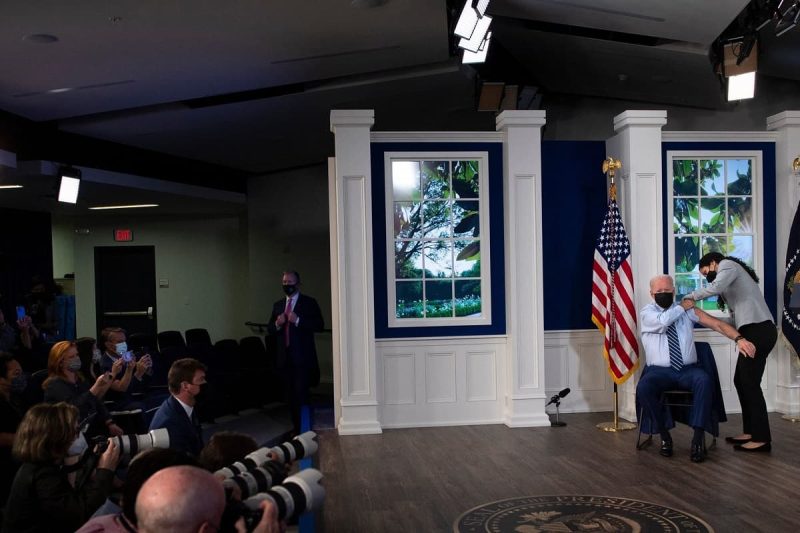
Your humble Moscow correspondent recently reported on Vladimir Putin’s mystifying tale about receiving an intranasal COVID vaccine as part of a clinical trial. As you might recall, Russia’s president claimed he inhaled some kind of virus-murdering powder via a syringe. But the drug he allegedly took is actually a liquid nasal spray. No powder was involved. We thought it was funny that Putin said something so insane and made jokes alluding to illicit drug usage.
It’s still funny; but after thinking more about it, and not just typing cocaine jokes, we came to the conclusion that this is a Real Story and if the lamestream media (including Russia’s completely castrated “opposition” press) weren’t such pathetic vax-peddling Big Pharma boot-lickers, it would probably be frontpage news everywhere. It would probably be called Powdergate and it would probably have its own Wikipedia page.
Please, allow us to explain our thought process. If you think we are overreacting, tell us in the Comments Section.
Hardcore double-dose makes Putin QUADRUPLE-VAXXED!
Putin’s nose-dose was allegedly administered just one day after he was injected with a Sputnik Light booster shot. The Russian prez was already fully vaxxed (he received his second dose in April, although at the time the Kremlin was mum on which vaccine was used), which means Putin has been given four doses of Sputnik in less than a year. FOUR! That’s a lot. Putin is almost as gigavaxxed as Vladimir Zhirinovsky, who claims he injected himself with six COVID serums.
Zhirinovsky is a bumbling lunatic—nobody would care if six COVID shots caused him to grow another arm. But Vladimir Putin is literally the president of the Russian Federation. He’s kind of a big deal! Why are Russian scientists using the most consequential person in Russia as a guinea pig? Even if you firmly believe Sputnik V is “safe and effective,” surely it is unwise to repeatedly inject your president with new doses of an experimental drug? It’s a very weird thing to do. Maybe this is part of Russia’s “hybrid warfare” doctrine?
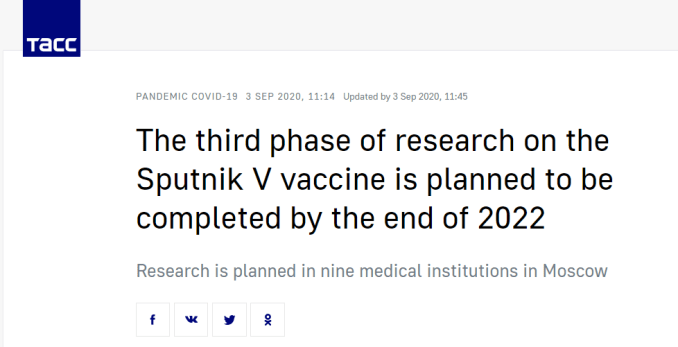
Please remember, despite RT.com trying to convince you otherwise: there is zero long-term safety data for Sputnik V (unless you count “six months” as long-term?). Expedited Phase III trials for normal, two-dose Sputnik V haven’t even finished yet. Think about what that means.
Putin can’t wait for the science to catch up
But here’s Vladimir Putin, with four doses of Sputnik now running through his veins. Do people understand the issue here?
Isn’t this a bit… irresponsible? There are many incendiary adjectives we could use to describe Putin’s purported vaccination status, actually.
Why would you even need a fourth dose? Does the booster shot suck that bad?
Sputnik Light is the first component of Sputnik V. The nasal spray is the second component. Typically, you’re supposed to wait 21 days (minimum) between reloading on Sputnik V.
Putin went on a serious vax binge, guzzling down two doses in two days! Someone take away his car keys.
Powdergate: revisited
Do people fully appreciate how hilarious Putin’s “powder” story really is? It was so bizarre and nonsensical that RBC—quite a serious, straight-laced Russian news outlet—suggested Putin had not even been given the nasal spray, but rather a VIP mystery powder administered in the “same way” as the liquid drug he was supposed to be testing.
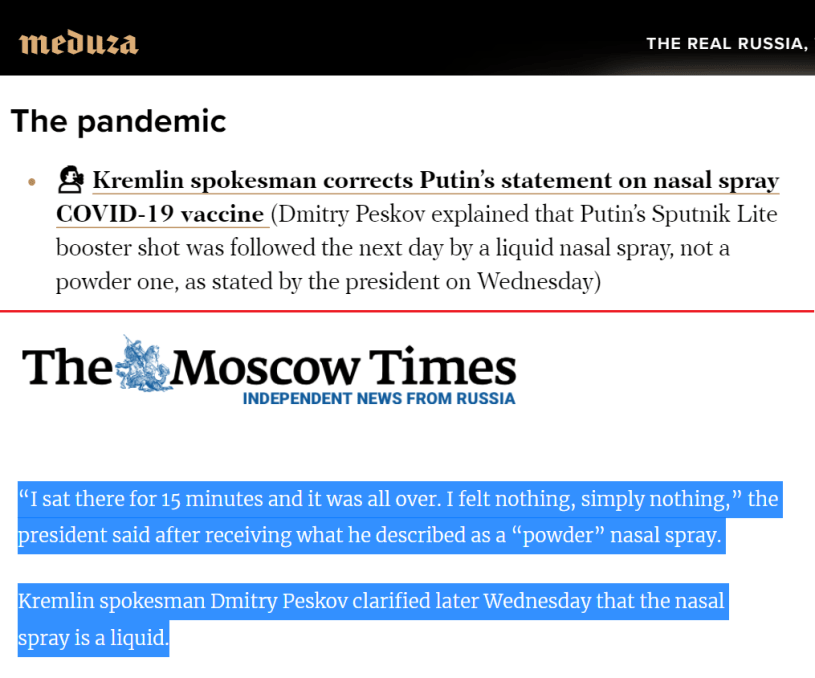
“Putin received the vaccine in the form of a powder… so far this drug is not widely used… The President explained that the preparation in powder form is taken in the same way as a nasal spray,” RBC reported on November 24, after Putin said the drug was a powder, while emphasizing it had not been administered in a liquid form.
A few hours later, RBC reported the clarification from Kremlin spokesman Dmitry Peskov:
“The President meant that we are talking about a liquid. This is a nasal vaccine in which he took part in the trials,” said Peskov.
Can anyone make sense of this madness? How did Putin screw up the basic facts here so badly?
This is a Joe Biden-level brain malfunction. Which brings us to our next point…
Imagine if Joe Biden had been “corrected” after blabbering about magic vax powder
Thought experiment: replace Putin with Biden, Peskov with Psaki. This story would have been everywhere. It would have completely broken Twitter. The hashtags and memes alone would have been history-making.
95% of “indy media” would have basically imploded, shouting about how this was proof of a massive vax hoax. FactCheck.org would be working overtime telling everyone how racist they were for suggesting there was anything fishy about Biden getting a fourth vaccine dose and referring to it as a powder.
Guys, just think about it. Let’s be honest here.
Total impunity for the Kremlin vax clowns?
We’re not claiming anything, by the way! We’re just making observations. The problem is that almost nobody is making observations.
The Kremlin could probably announce Putin undergoes daily Sputnik intravenous therapy (Sputnik IV, get it? ha-ha), and every single media outlet on earth would nod and clap. Only an apostate would dare to question whether it made any sense at all.
The vax is sacred. You do not question the vax or anyone who takes it or promotes it. The vax is life. The vax is love.
Israel Shamir touched on this very weird phenomenon in an article from July:
The Mandatory Vaxx Regime brings new conspirators (like Alexei Navalny, the Russian Guaido presently in jail for swindling) and old school Kremlin propagandists into a rare (and suspicious) agreement. Now they all excrete New York mainstream media.
No one is willing to ask even the most basic questions. It’s a total orgy of non-stop lying in Russia right now (just like it is everywhere else), and not a single media outlet is willing to step up to the plate and say: “just one moment, does any of this make sense?”
We can’t even rely on Russia’s so-called “Kremlin-hating, corruption fighting” western-funded “liberal” press. Meduza published a one-sentence bullet point about Powdergate, while the Moscow Times seemed entirely satisfied with Peskov’s non-explanation explanation. These people are truly pathetic. They are just horrible!
Shame! Shame! Shame!
So what’s the takeaway?
If you hope to survive the next few years—which will feature daily Powdergates, sometimes thousands of Powdergates, back to back, over the course of several hours—you will have to adopt a transcendental Zen-like state, like this monkey who has made peace with the world:
Where Can We Go for The Truth Anymore?
By Sandra Friedemann | American Thinker | November 29, 2021
In this messed-up mixed-up world the formerly respected Fourth Estate has devolved into a collection of flat-out liars, brain-dead ideologues and unmitigated ignoramuses. Turn on any of the mainstream media channels or go to any one of hundreds of online outlets and you’ll be swamped in effluent.
The horrific murderous tragedy in Waukesha, Wisconsin in which a man deliberately and determinedly drove his SUV at a high rate of speed through a parade last week is being called a “parade crash” by the most liberal media outlets.
According to 95% of the media talking heads and their cohort, Kyle Rittenhouse is a ‘murdering white supremacist.’ Laughably, Snopes calls the three convicted felons who attacked Rittenhouse — one a domestic abuser and rapist, another a pedophile, and the third a burglar — ‘victims.’ Snopes goes further saying those three felons were there to ‘peacefully protest.’ Never mind the fires, the looting and property destruction. None of which was discussed in the vast majority of the media during Rittenhouse’s trial or after his acquittal.
Now we have a new variant of COVID-19 which the physician who first encountered and reported it says is “mild.” In a report in the Telegraph, Dr. Angelique Coetzee, a GP for thirty-three years who also chairs the South African Medical Association says, “Their symptoms were so different and so mild from those I had treated before.”
Mild illness. Zero hospitalizations. No deaths. Yet with this report, we have yet another round of wholesale fear mongering from the press and governments.
“Biden to restrict travel from South Africa and 7 other countries starting Monday” (Remember the cries and howls from the Left when Trump shut down travel when COVID first appeared? Xenophobe!)
“Boris Johnson announces ‘tighter rules’ in response to Omicron variant”
“Israel to ban entry of foreigners from all countries over Omicron”
Across the ether alleged “news” outlets are spouting nonsense about this variant that the WHO and CDC say appears to be mild and, thus far, not deadly.
MSNBC proclaims, “Omicron variant renews calls for more robust vaccination…” Why when the vaccines we currently have a) do not work against the pre-existing COVID variants and b) aren’t designed for this variant? (MSNBC’s institutional ignorance was run up the flagpole for fullest display with this story.)
“Omicron variant puts world in a ‘race against time’, says EU Commission President” is the headline quote from CNN.
MSNBC proclaims, “New covid variant: Omicron is a pandemic gut check.” They hype the “growing concern” and breathlessly report that “Omicron variant represents a ‘significant potential risk’ to its (Moderna’s) Covid-19 vaccine.” Well, DUH! Previous vaccines that didn’t work against alpha, beta or delta sure aren’t going to work against a new strain. The biggest risk is that if this is as mild or non-threatening as it seems to be thus far (zero deaths, zero hospitalizations, remember) is that the market for COVID vaccines may have just dried up.
As soon as news of this variant came out and was blasted around the world, financial and commodity markets tanked, prompting Goldman Sachs to announce, “This mutation is unlikely to be more malicious and that the existing vaccines will most likely continue to be effective in preventing hospitalizations and deaths. We do not think that the new variant is sufficient reason to make major portfolio changes.”
According to Paul Elias Alexander, PhD at the Brownstone Institute, it might be that COVID has now transformed so much that new variants might be more infectious but less deadly.
This is a brain twister of an article if you’re not accustomed to reading technical papers, but Alexander makes several key points (emphasis added):
“The virus is behaving just like how viruses behave. They are mutable and mutate and via Muller’s ratchet, we expect this to be milder and milder mutations and not more lethal ones given the pathogen seeks to infect the host and not arrive at an evolutionary dead-end.”
“For example, the (Pfizer) vaccine has failed to stop infection and spread against Delta… fully vaccinated individuals with breakthrough infections have peak viral load similar to unvaccinated cases.”
What’s most fascinating in this paper is a reference to a Swedish study of records of the nation’s entire population. The study’s findings are that efficacy of Pfizer’s BioNtech vaccine “waned progressively from 92% (effectiveness) at day 15-30 to 47% at day 121-180, and from day 211 and onwards no effectiveness could be detected.
AstraZenica’s mRNA vaccine fared even worse: “effectiveness of ChAdOx1 nCoV-19 was generally lower and waned faster, with no effectiveness detected from day 121 and onwards.”
This Swedish study is news given that governments are forcing vaccines into our bodies. Shouldn’t this be reported? Shouldn’t it be headlines? Yet nowhere is this information readily available outside the medical community. WHO isn’t reporting it; CDC and FDA aren’t reporting on it in the US, and nowhere in Europe is it being reported.
The only reason Dr. Alexander’s paper and the Swedish study are presented here is because of diligent research through many sites and noting a single reference embedded in a longer article.
The fact is, all of this COVID hysteria is being driven by the lobbyists for the pharmaceutical companies and fomented by “news” organizations and governments for power and control over us, our livelihoods and our lives.
Isn’t it about time this nonsense ends?
Graphic credit: U3161929 CC BY-SA 4.0 license
Memo to the Guardian: Have you muzzled the facts on masks?
By David Seedhouse | TCW Defending Freedom | November 27, 2021
This is an open letter to Andrew Gregory, Health Editor of the Guardian.
Dear Andrew,
We are a group of citizens dedicated to promoting a more open, democratic society. We have tried to contact you on several occasions without success, so we have published this open letter in the hope you will see it and reply.
On November 18, you published a story with the headline: ‘Mask-wearing cuts Covid incidence by 53%, says global study.’
The sub-heading was: ‘Researchers said results highlight the need to continue with face coverings, social distancing and handwashing alongside vaccine programmes’.
We were struck by this, since it goes against a substantial body of evidence that concludes that mask-wearing offers little if any protection against viruses, for example these studies https://swprs.org/face-masks-evidence/ https://www.professorhinkley.com/blog/sorry-oregon-your-mask-is-useless-according-to-the-science; https://www.city-journal.org/do-masks-work-a-review-of-the-evidence.
You did not reference the paper on which you base your article but an internet search reveals it. (Stella Talic corresponding author). You paraphrase uncritically: ‘Vaccines are safe and effective and saving lives around the world. But … it is not yet known if jabs will prevent future transmission of emerging coronavirus variants …
‘Results from more than 30 studies from around the world were analysed in detail, showing a statistically significant 53 per cent reduction in the incidence of Covid with mask wearing …’
We find it puzzling that you did not mention that ten days earlier the CATO Institute (an American libertarian think-tank) published a 61-page working paper entitled: Evidence for Community Cloth Face Masking to Limit the Spread of SARS-CoV 2: A Critical Review.
It tentatively concluded: ‘Of 16 quantitative meta-analyses, eight were equivocal or critical as to whether evidence supports a public recommendation of masks, and the remaining eight supported a public mask intervention on limited evidence, primarily on the basis of the precautionary principle.’
Given this striking incongruity, we have ten questions:
1. Have you read the Talic paper?
2. Do you agree that it is an exaggeration to describe it as a ‘global study’?
3. Have you read the associated British Medical Journal editorial?
4. Do you agree that your headline: ‘Mask-wearing cuts Covid incidence by 53%, says global study’ is misleading?
5. Were you aware of this when you chose the heading?
6. Why has the Guardian not published the results of the many studies which say there is no evidence of benefit and some evidence of harm?
7. Do you agree that professional journalism requires balance, in the public interest?
8. Would a more accurate headline be: ‘The majority of randomised controlled trials fail to establish that wearing face masks protects anyone against viruses’?
9. Is the Guardian’s policy to publish only information that supports a particular set of beliefs?
10. Are you prepared publicly to debate this matter?
Here is a little more detail about our concerns. The CATO meta-analysis states: ‘In non-healthcare settings, of the 14 RCTs (randomised control trials) identified by the authors that evaluated face mask efficacy compared to no-mask controls in protecting against respiratory infections other than Covid-19, 13 failed to find statistically significant benefits … of eight RCTs that evaluated face mask efficacy against respiratory illness transmission in non-healthcare household settings, all eight failed to find a statistically significant benefit for the use of face masks alone …’
This gives a very different picture from the one your newspaper article presented.
Talic et al claim to have screened 36,729 papers, but found only six on masks they considered eligible for inclusion. Yet an internet search reveals numerous relevant research articles. How can the authors have overlooked this, and how can their conclusion be true given the many other conflicting studies?
We dug a little deeper and found that several of the papers cited by Talic et al are telephone surveys covering multiple variables, with questionable methodology.
For example, one study investigated the effectiveness of mask-wearing in families in their homes of laboratory-confirmed Covid-19 cases in Beijing and concluded that face mask use was ’79 per cent effective in reducing transmission’.
Strangely, the paper contains a passage that seems to undermine the whole study: ‘As the compliance of UFMU (universal face mask use) would be poor in the home, there was difficulty and also no necessity for everyone to wear masks at home …’
This seems to imply that the use of face masks by family members in their households included in the study was sporadic and that therefore the study has no scientific merit.
Equally strange, one of six papers referenced in the Talic paper is the Danish RCT mask study, which the authors presumably included to support their conclusions, even though it doesn’t. In fact, the study was inconclusive (a difference of between 1.8 per cent and 2.1 per cent)
Even more peculiar, the Talic article is linked in the BMJ to an editorial published simultaneously which directly refutes the claim of a 53 per cent reduction in Covid incidence.
It says: ‘Face masks seem to have a real but small effect for wearer and source control, although final conclusions should await full reports of the trials from Bangladesh and Guinea-Bissau.
‘However, the quality of the current evidence would be graded – by GRADE (Grading of Recommendations, Assessment, Development and Evaluations) criteria – as low or very low, as it consists of mainly observational studies with poor methods (biases in measurement of outcomes, classification of PHSM – Public Health and Social Measures – and missing data), and high heterogeneity of effect size. More and better research are needed.’
How can such inconsistencies be overlooked by a senior editor of a quality broadsheet?
Signed
Professor David Seedhouse, BSc (Hons), PhD
Bruce Luffman
Sarah Goode, PhD
Alex Thorn
Simon Fletcher
Sandy French
Fiona Swan, LLB, Solicitor (Rtd.)
Monica Coyle
Daphne Havercroft, Project Management Professional (PMP)®
Phil Button, BSc, MBCS
Professor Chris Jesshope, BSc Hons (Mathematics), MSc (computer science), PhD (electronics)
Philip Morkel, Managing Director Engineering Services, Law Degree, MBA, S/W Project management
Tony Woodcock
Dr Damien Bush, MA, VetMB, Cert. SAS, MRCVS, RCVS, Recognised Advanced Practitioner Small Animal Surgery
Neil Sherry
Michael Welby
Shirley Dudfield
Maddy Conway
Peter Whitehead
Vanessa Peutherer, Author, Learning & Development Consultant (Health Care Ethics), RGN, ENG, ENB (Rtd)
Michael Philips, BSc (Hons) Mathematics
Edina Atkinson
Adam Mockett, BA (Hons)
Mike Davies, Project Manager (Rtd)
Alex Camm MPhil, CQSW
Susan James, FCILEX
Myra Forster-van Hijfte, DVM, CertVR CertSAM, DipECVIM, FRCVS
Dr. Jo-Ann van Eijck, Ph.D, Former Associate Professor at University of Hong Kong
Helen Myles, BSc (Hons) Maths and Psychology
The Cynical and Dangerous Weaponization of the “White Supremacist” Label
By Glenn Greenwald | November 27, 2021
Within hours of the August 25, 2020, shootings in Kenosha, Wisconsin — not days, but hours — it was decreed as unquestioned fact in mainstream political and media circles that the shooter, Kyle Rittenhouse, was a “white supremacist.” Over the next fifteen months, up to and including his acquittal by a jury of his peers on all charges, this label was applied to him more times than one can count by corporate media outlets as though it were proven fact. Indeed, that Rittenhouse was a “white supremacist” was deemed so unquestionably true that questioning it was cast as evidence of one’s own racist inclinations (defending a white supremacist).
Yet all along, there was never any substantial evidence, let alone convincing proof, that it was true. This fact is, or at least should be, an extraordinary, even scandalous, event: a 17-year-old was widely vilified as being a white supremacist by a union of national media and major politicians despite there being no evidence to support the accusation. Yet it took his acquittal by a jury who heard all the evidence and testimony for parts of the corporate press to finally summon the courage to point out that what had been Gospel about Rittenhouse for the last fifteen months was, in fact, utterly baseless.
A Washington Post news article was published late last week that was designed to chide “both sides” for exploiting the Rittenhouse case for their own purposes while failing to adhere carefully to actual facts. Ever since the shootings in Kenosha, they lamented, “Kyle Rittenhouse has been a human canvas onto which the nation’s political divisions were mapped.” In attempting to set the record straight, the Post article contained this amazing admission:
As conservatives coalesced around the idea of Rittenhouse as a blameless defender of law and order, many on the left just as quickly cast him as the embodiment of the far-right threat. Despite a lack of evidence, hundreds of social media posts immediately pinned Rittenhouse with extremist labels: white supremacist, self-styled militia member, a “boogaloo boy” seeking violent revolution, or part of the misogynistic “incel” movement.
“On the left he’s become a symbol of white supremacy that isn’t being held accountable in the United States today,” said Becca Lewis, a researcher of far-right movements and a doctoral candidate at Stanford University. “You see him getting conflated with a lot of the police officers who’ve shot unarmed Black men and with Trump himself and all these other things. On both sides, he’s become a symbol much bigger than himself.”
Soon after the shootings, then-candidate Joe Biden told CNN’s Anderson Cooper that Rittenhouse was allegedly part of a militia group in Illinois. In the next sentence, Biden segued to criticism of Trump and hate groups: “Have you ever heard this president say one negative thing about white supremacists?
Valuable though this rather belated admission is, there were two grand ironies about this passage. The first is that The Post itself was one of the newspapers which published multiple articles and columns applying this evidence-free “white supremacist” label to Rittenhouse. Indeed, four days after this admission by The Post‘s newsroom, their opinion editors published an op-ed by Robert Jones that flatly asserted the very same accusation which The Post itself says is bereft of evidence: “Despite his boyish white frat boy appearance, there was plenty of evidence of Rittenhouse’s deeper white supremacist orientation.” In other words, Post editors approved publication of grave accusations which, just four days earlier, their own newsroom explicitly stated lacked evidence.
The second irony is that while the Post article lamented everyone else’s carelessness with the facts of this case, the publication itself — while purporting to fact-check the rest of the world — affirmed one of the most common falsehoods: namely, that Rittenhouse carried a gun across state lines. The article thus now carries this correction at the top: “An earlier version of this story incorrectly stated that Kyle Rittenhouse brought his AR-15 across state lines. He has testified that he picked up the weapon from a friend’s house in Wisconsin. This article has been corrected.”
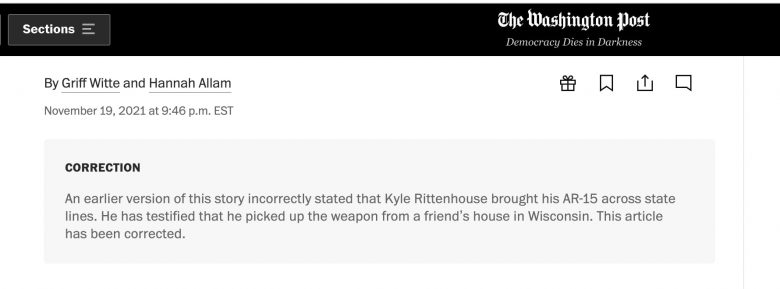
It continues to be staggering how media outlets which purport to explain the Rittenhouse case get caught over and over spreading utter falsehoods about the most basic facts of the case, proving they did not watch the trial or learn much about what happened beyond what they heard in passing from like-minded liberals on Twitter. There is simply no way to have paid close attention to this case, let alone have watched the trial, and believe that he carried a gun across state lines, yet this false assertion made it past numerous Post reporters, editors and fact-checkers purporting to “correct the record” about this case. Yet again, we find that the same news outlets which love to accuse others of “disinformation” — and want the internet censored in the name of stopping it — frequently pontificate on topics about which they know nothing, without the slightest concern for whether or not it is true.
Those who continue to condemn Rittenhouse as a white supremacist — including the author of The Post op-ed published four days after the paper concluded the accusation was baseless — typically point to his appearance at a bar in January, 2021, for a photo alongside members of the Proud Boys in which he was photographed making the “okay” sign. That once-common gesture, according to USA Today, “has become a symbol used by white supremacists.” Rittenhouse insists that the appearance was arranged by his right-wing attorneys Lin Wood and John Pierce — whom he quickly fired and accused of exploiting him for fund-raising purposes — and that he had no idea that the people with whom he was posing for a photo were Proud Boys members (“I thought they were just a bunch of, like, construction dudes based on how they looked”), nor had he ever heard that the “OK” sign was a symbol of “white power.”
Rittenhouse’s denial about this once-benign gesture seems shocking to people who spend all their days drowning in highly politicized Twitter discourse — where such a claim is treated as common knowledge — but is completely believable for the vast majority of Americans who do not. In fact, the whole point of the adolescent 4chan hoax was to convert one of the most common and benign gestures into a symbol of white power so that anyone making it would be suspect. As The New York Times recounted, the gesture has long been “used for several purposes in sign languages, and in yoga as a symbol to demonstrate inner perfection. It figures in an innocuous made-you-look game. Most of all, it has been commonly used for generations to signal ‘O.K.,’ or all is well.”
But whatever one chooses to believe about that episode is irrelevant to whether these immediate declarations of Rittenhouse’s “white supremacy” were valid. That bar appearance took place in January, 2021 — five months after the Kenosha shootings. Yet Rittenhouse was instantly declared to be a “white supremacist” — and by “instantly,” I mean: within hours of the shooting. “A 17 year old white supremacist domestic terrorist drove across state lines, armed with an AR 15,” was how Rep. Ayanna Pressley (D-MA) described Rittenhouse the next day in a mega-viral tweet; her tweet consecrated not only this “white supremacist” accusation which persisted for months, but also affirmed the falsehood that he crossed state lines with an AR-15. It does not require an advanced degree in physics to understand that his posing for a photo in that bar with Proud Boys members, flashing the OK sign, five months later in January, 2021, could not serve as a rational evidentiary basis for Rep. Pressley’s accusation the day after the shootings that he was a “white supremacist,” nor could it serve as the justification for five consecutive months of national media outlets accusing him of the same. Unless his accusers had the power to see into the future, they branded him a white supremacist with no basis whatsoever — or, as The Post put it this week, “despite a lack of evidence.”
The only other “evidence” ever cited to support the rather grave accusation that this 17-year-old is a “white supremacist” were social media postings of his in which he expressed positive sentiments toward the police and then-President Trump, including with the phrase “Blue Lives Matter.” That was all that existed — the entirety of the case — that led the most powerful media outlets and politicians to stamp on this adolescent’s forehead the gravest accusation one can face in American culture. This is really the heart of the matter: this episode vividly demonstrates how cheapened and emptied and cynically wielded this “white supremacist” slogan has become. The oft-implicit but sometimes-explicit premise in liberal discourse is that everyone who deviates in any way from liberal dogma is a white supremacist by definition.
Within this rubric, perhaps the most decisive “evidence” that one is a white supremacist is that one supports the Republican Party and former President Trump — i.e., that half of the voting electorate in the U.S. at least are white supremacists. A subsidiary assumption is that anyone who views the police as a necessary, positive force in U.S. society is inherently guilty of racism (it is fine to revere federal policing agencies such as the FBI and other federal security forces such as the CIA, as most Democrats do; the hallmark of a white supremacist is someone who believes that the local police — the ones who show up when citizens call 911 — is a generally positive rather than negative force in society).
An illustration of how casually and recklessly this accusation is tossed around occurred last year, shortly after the George Floyd killing, when my long-time friend and colleague, Intercept journalist Lee Fang, was widely vilified as a racist and white supremacist, first by his own Intercept colleague, journalist Akela Lacy, and then — in one of the most stunningly mindless acts of herd behavior — by literally hundreds if not thousands of members of the national press, including many who barely knew who Lee was but nonetheless were content to echo the accusation (that Lee is himself not white is, of course, not an impediment, not even a speed bump, on the road to castigating him as a modern-day KKK adherent). As Matt Taibbi wrote in disgust about this shameful media episode:
[Lacy’s accustory] tweet received tens of thousands of likes and responses along the lines of, “Lee Fang has been like this for years, but the current moment only makes his anti-Blackness more glaring,” and “Lee Fang spouting racist bullshit it must be a day ending in day.” A significant number of Fang’s co-workers, nearly all white, as well as reporters from other major news organizations like the New York Times and MSNBC and political activists (one former Elizabeth Warren staffer tweeted, “Get him!”), issued likes and messages of support for the notion that Fang was a racist.
Writing in New York Magazine, Jonathan Chait documented that “Lacy called him racist in a pair of tweets, the first of which alone received more than 30,000 likes and 5,000 retweets.”
What was the evidence justifying Lee Fang’s conviction by mob justice of these charges? He (like Rittenhouse) has expressed the view that police, despite needing reforms, are largely a positive presence in protecting innocent people from violent crime; he suggested that resorting to violence harms rather than helps social justice causes; and he published a video interview he conducted with a young BLM supporter, who complained that many liberals only care when white police officers kill black people but not when black people in his neighborhood are killed by anyone who is not white.
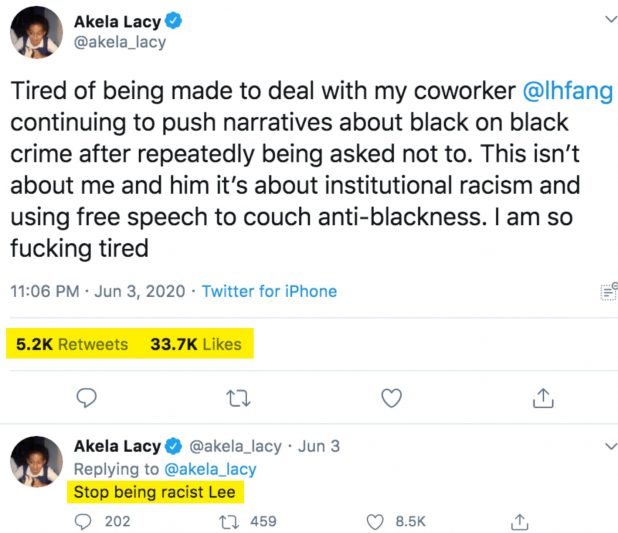
Now-deleted tweets from Intercept reporter Akela Lacy, accusing her Intercept colleague Lee Fang of being a racist, June 3, 2020.
That such banal and commonly held views are woefully insufficient to justify the reputation-destroying accusation that someone is a white supremacist should be too self-evident to require any explanation. But in case such an explanation is required, consider that polls continually and reliably show that the pro-police sentiments of the type that caused Rittenhouse, Fang, and so many others to be vilified by liberal elites as “white supremacists” are held not only by a majority of Americans, but by a majority of black and brown Americans, the very people on whose behalf these elite accusers purport to speak.
For years, polling data has shown that the communities which want at least the same level of policing if not more are communities composed primarily of Black, Brown and poor people. It is not hard to understand why. If the police are defunded or radically reduced, rich people will simply hire private security (even more than they already employ for their homes, neighborhoods and persons), and any resulting crime increases will fall most heavily on poorer communities. Thus, polling data reliably shows that it is these communities that want either the same level of policing or more — the exact view which, if you express, will result in guardians of elite liberal discourse declaring you to be a “white supremacist.” Indeed — according to one Gallup poll taken in the wake of the George Floyd killing, when anti-police sentiment was at its peak — the groups that most want a greater police presence in their communities are Black and Latino citizens:
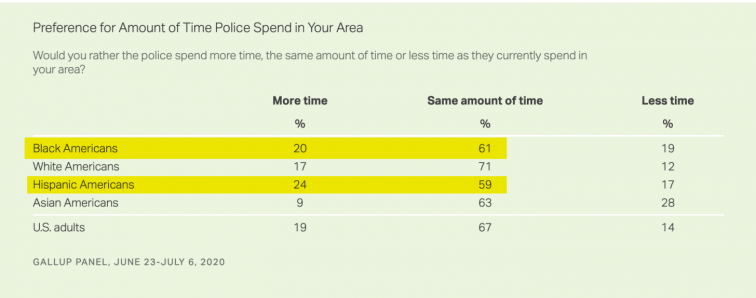
In the wake of anger over the Floyd and Jacob Blake cases, several large liberal cities succeeded in placing referendums on the ballot for this year that proposed major defunding or restructuring of local police. They failed in almost all cases, including ones with large Black populations such as Minneapolis, where Floyd died, precisely because non-white voters rejected it. In other words, expressing the same views about policing that large numbers of Black residents hold somehow subjects one to accusations of “white supremacy” in the dominant elite liberal discourse.
What all of this demonstrates is that insult terms like “white supremacist” and “racist” and “white nationalist” have lost any fixed meaning. They are instead being trivialized and degraded into little more than discourse toys to be tossed around for fun and reputation-destruction by liberals, who believe they have ascended to a place of such elevated racial enlightenment that they are now the sole and exclusive owners of these terms and thus free to hurl them in whatever manner they please. It is not an overstatement to observe that in elite liberal discourse, there are literally no evidentiary requirements that must be fulfilled before one is free to malign political adversaries with those accusatory terms. That is why editors at The Washington Post published an op-ed proclaiming Rittenhouse was plagued by “deeper white supremacist orientation” just four days after its news division explicitly concluded that such an accusation “lacks evidence” — because it it permissible to accuse people of racism and white supremacy without any evidence needed.
It is inherently disturbing and destructive any time a person is publicly branded as something for which there is no evidence. That is intrinsically something we should collectively abhor. But this growing trend in liberal discourse is not just ethically repellent but dangerous. By so flagrantly cheapening and exploiting the “white supremacist” accusation from what it should be (a potent weapon deployed to stigmatize and ostracize actual racists) into something far more tawdry (a plaything used by Democrats to demean and destroy their enemies whenever the mood strikes), its cynical abusers are draining the term of all of its vibrancy, potency and force, so that when it is needed, for actual racists, people will have tuned it out, knowing that is used deceitfully, recklessly and for cheap entertainment.
A similar dynamic emerged with accusations of anti-semitism and the weaponization of it to demonize criticisms of Israel. It is, of course, true that some criticisms of the Israeli government are partially grounded or even largely motivated by anti-semitism — just as it is true that some championing of the local police or support for Trump grows out of racist sentiments. But the converse is just as true: one can vehemently criticize the actions of the Israeli government the same as any other government without being driven by an iota of anti-semitism (indeed, many of the most vocal critics of Israel are proudly Jewish), in exactly the same way as one can be highly supportive of the local police or Donald Trump without an iota of racism (a proposition that should need no proof, but is nonetheless highlighted by the uncomfortable fact that growing numbers of non-whites support both Trump and the police). But the cynical, manipulative weaponization of anti-semitism accusations to smear all critics of Israel has rendered the accusation far weaker and more easily dismissible than it once was — exactly as is now happening to the accusatory terms “white supremacist” and “white nationalist” and “racist,” which are being increasingly understood, validly so, not as a grave and sincere condemnation but a cheap tactic to be applied recklessly, for the tawdry entertainment one derives from public rituals of reputation-destruction.
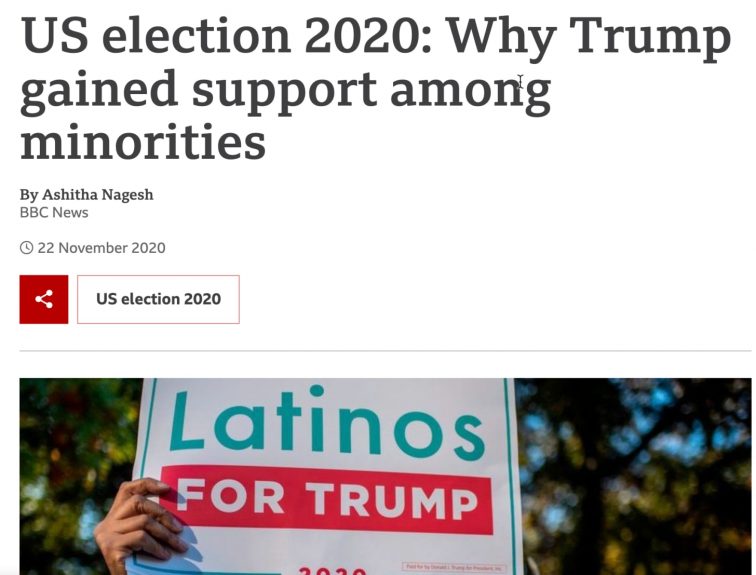
BBC, Nov. 22, 2020
Ever since his acquittal, Rittenhouse has made a series of public statements directly at odds with the dark, hateful image constructed of him by the national press over the last sixteen months, while he was forced to remain silent due to the charges he faced. He has professed support for the Black Lives Matter movement, argued that the U.S. is plagued by structural racism, and suggested that he would have suffered a worse fate if he had been Black. The same people who are smugly certain that his entire character and soul was permanently captured by that fleeting moment in a bar when he was seventeen and flashed an “okay” symbol — and who are certain that his denials that he knew what it meant or with whom he was posing are false — have, of course, scoffed at these recent statements of his as self-serving and insincere, even though they offer far greater insight into Rittenhouse’s actual views on questions of race than anything thus far presented.
But that is the point. The political and media faction that casually and recklessly brands people as “white supremacists” the way normal people utter “excuse me” while navigating a large crowd have no interest at all in whether the accusation is true. They are devoted to reducing everyone whose political ideology diverges from their own to their worst possible moment — no matter how long ago it happened or how unrepresentative of their lives it is — in order to derive the most ungenerous and destructive meaning from it. It is a movement that is at once driven by rigorous rules resulting in righteous decrees of sin and sweeping denunciations, yet completely bereft of the possibility of grace or redemption.
And its most cherished weapon is accusing anyone who they decide is an enemy or even just an adversary of being a white supremacist, a white nationalist, a racist — to the point where these terms now sound more like reflexively recited daily prayer slogans than anything one needs to take seriously or which has the possibility to engage on the merits. For fifteen months, it was gospel in political and media circles that Kyle Rittenhouse was a “white supremacist terrorist” only for The Washington Post to suddenly announce that this claim persisted “despite a lack of evidence.”
But that lack of evidence really does not matter, which is why that announcement by The Post received so little notice. Under the rules of this rotted discourse, evidence is not a requirement to affirm this accusation. All that is needed is an intuition, a tingly sensation, and — above all else — the realization that hurling the accusation will yield some personal or political advantage. Like all cynical weapons, it worked for awhile, but is rapidly running out of efficacy as its manipulative usage becomes more and more visible. The term is still needed as a tool to fight actual racism, but those who most vocally and flamboyantly proclaim themselves solemnly devoted to that cause have rendered that tool virtually useless, thanks to their self-interested misuse and abuse of it.
Guardian Claims Covid in Hospitals Has “Largely Become a Disease of the Unvaccinated” – Data Shows Opposite
By Will Jones • The Daily Sceptic • November 23, 2021
An article appeared in the Guardian this week written by an anonymous NHS respiratory consultant claiming that “in hospital, COVID-19 has largely become a disease of the unvaccinated”.
Of course, there are people who have their vaccinations but still get sick. These people may be elderly or frail, or have underlying health problems. Those with illnesses affecting the immune system, particularly patients who have had chemotherapy for blood cancers, are especially vulnerable. Some unlucky healthy people will also end up on our general wards with Covid after being vaccinated, usually needing a modest amount of oxygen for a few days.
But the story is different on our intensive care unit. Here, the patient population consists of a few vulnerable people with severe underlying health problems and a majority of fit, healthy, younger people unvaccinated by choice. … If everyone got vaccinated, hospitals would be under much less pressure; this is beyond debate. Your wait for your clinic appointment/operation/diagnostic test/A&E department would be shorter. Your ambulance would arrive sooner. Reports of the pressure on the NHS are not exaggerated, I promise you. … Most of the resources that we are devoting to Covid in hospital are now being spent on the unvaccinated.
This reads to me like a blatant attempt to stigmatise the unvaccinated as selfish, a burden on society and a threat to the vaccinated. (The clue is in the headline: “ICU is full of the unvaccinated – my patience with them is wearing thin.”) Given the polling (which may not be very reliable of course) showing that 45% of U.K. adults would support an indefinite lockdown of the unvaccinated, this is all starting to look and sound rather ugly.
The most frustrating thing about this anonymously written article is it doesn’t cite any data even though its arguments are based on claims which only data can validate. It consists instead only of a single medic’s subjective impressions, with no sources provided to see if his claims holds water.
Are the hospitalised mostly unvaccinated? Not according to Government data from the UKHSA. Here is the breakdown of hospitalisations by vaccination status in England for the four weeks up to November 14th from the latest Vaccine Surveillance report.

Adding these figures up we find that 3,200 of 9,831 or 33% of Covid hospitalisations are of unvaccinated people, leaving 67% of Covid hospital patients in the vaccinated category, most of them with two doses. Focusing just on adults, we find 2,692 of 9,278 or 29% of Covid hospitalisations are unvaccinated, leaving 71% vaccinated. Seeing as just 68% of the U.K. population is double vaccinated, 67% of Covid hospital patients having received at least one dose hardly seems like a strong result. Indeed, it suggests the unvaccinated are barely over-represented in hospitals at all.
What about Covid deaths – are the unvaccinated over-represented there? Here’s the table from the same report.
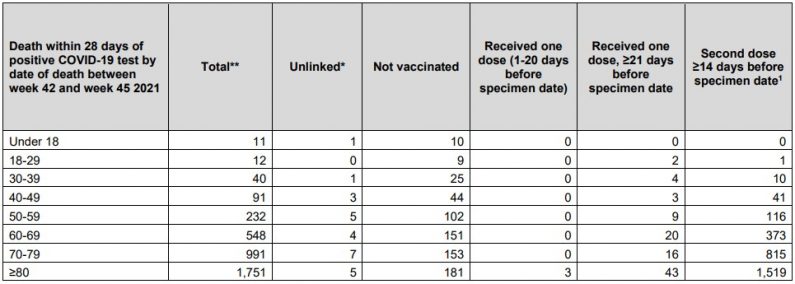
Adding them up we find that 675 of 3,676 or 18% of Covid deaths in the month up to November 14th are in unvaccinated people, leaving 82% in the vaccinated, most with two doses. Only in the under-40s do deaths in the unvaccinated outnumber those in the vaccinated.
It’s hard to square this data with the picture painted by the anonymous medic. Far from COVID-19 having “largely become a disease of the unvaccinated”, with most Covid hospital resources “now being spent on the unvaccinated”, a large majority of hospitalisations and deaths are occurring in the vaccinated, not the unvaccinated.
But what about ICU admissions? And is it true that the vaccinated-sick all have underlying health issues whereas the unvaccinated-sick are all healthy?
The problem with addressing these claims is that we don’t have the data to check them out. The data on ICU admissions by vaccination status has not been updated since July as far as I can see (if you are aware of a more recent update do let me know), and I am not aware of any data on co-morbidities (again, if you are aware of any please drop me a line).
The anonymous writer states: “I can’t think of a single case offhand of a person who was previously fit and healthy who has ended up needing intensive care after being fully vaccinated. It may not stop you from catching Covid. But it can save your life when you do.” But again, this is anecdotal and therefore not terribly helpful.
It’s fair to note that much data does appear to show that the vaccines protect people well against severe disease and death, at least for several months, though some recent analysis has questioned whether such efficacy has been overestimated.
But however well the vaccines protect against severe disease, that is no excuse for turning the unvaccinated into pariahs or scapegoats and blaming them for the strains on the health service. Such moralised blaming of a minority for supposedly disadvantaging the majority (‘Can’t get a doctor’s appointment? Surgery been cancelled again? The unvaccinated are to blame!’) has a very ugly history and rarely ends well. It’s particularly odd to see this scapegoating in a supposedly liberal newspaper. It needs to stop now.
This perverse ban on ivermectin, cheap and proven to work
By Kathy Gyngell | TCW Defending Freedom | November 23, 2021
GIVEN the feared winter resurgence of Covid infection despite, or because of, the government’s mass vaccination programme, the continued ban on ivermectin in this country becomes ever more perverse.
It beggars belief that the British public is still denied access to this proven prophylactic and treatment. If the public health authorities are genuinely worried about pressure on hospitals, why have not the Medicines and Health products Regulatory Agency (MHRA), Public Health England, the NHS and Department of Health all gone flat out over this last year to approve ivermectin with the same zeal they gave emergency authorisation to the limited trialled, novel gene therapy, Covid vaccines?
The answer is widespread misinformation from the top down. Put ‘ivermectin’ into the Google search box and what do you come up with? Topping the list is a warning from the US Food and Drug Administration (FDA) why it should NOT be used to treat or prevent Covid-19. Their reason? It’s as simple as the fact that they have not approved it and, because they have not approved, it cannot be used. Trials are ongoing they say. Maybe some are. But plenty have been completed, as Dr Pierre Kory’s paper (he was the lead author) ‘Review of the Emerging Evidence Demonstrating the Efficacy of Ivermectin in the Prophylaxis and Treatment of Covid-19’, published by the American Journal of Therapeutics earlier this year, made quite clear.
By contrast with this detailed review of the evidence the FDA’s substantive concern appears to rest on random reports of harms deriving from self-medication with ivermectin.
The BBC not to be behindhand entered the fray with its customary selective and biased take on ‘the science’. Its recent report entitled ‘How false science created a Covid ‘miracle’ drug‘ made not even the most minimal of checks on the veracity of their assertions, which are pulled apart here. A letter sent to a programme journalist in response to their request for information (in advance of transmission) by Dr Tess Lawrie, the Director of the British Ivermectin Recommendation Development Group (BIRD), an advocacy group of clinicians and scientists from around the world, setting out the science behind the case for authorising it, was completely ignored. Her letter can be found here.
How the BBC came not to ask how it was that remdesivir – a standard medication for Covid in the UK – was approved on the basis of one study when ivermectin, with 63 studies, of them 31 Randomised Controlled Trials (RCT), 7 meta-analyses, 32 Observational Controlled Trials (OCT), multiple country case studies, expert opinion, patient testimony ALL pointing in favour of the medication, was not, is inexplicable.
This is the news source the public is still told to trust.
A blog posted on BIRD last week asked whether there are indeed any genuine gripes about the quality of the evidence, as the FDA and others suggest?
No, there are not. The author argues it is down to a misinformation campaign based on misleading information produced by high profile public health agencies, like the World Health Organisation, itself a victim of disinformation tactics, that has been ‘perpetrated by a minority of corporations to manipulate and delay government action on matters that would adversely affect their income and profit’. Speculation of course. But every indication points that way.
As reported extensively in TCW Defending Freedom, for example here, the WHO is subject to the huge financial influence of the Bill and Melinda Gates Foundation, the organisation’s second biggest donor. Since one of the BMGF’s long-term interest is in delivering vaccines, why would they show any interest in promoting the use of cheap, old repurposed medications in the treatment and prevention of Covid-19? It’s for the very same reason that ivermectin has proved of so little interest to Big Pharma -it’s hardly the money spinner that indemnified world-wide vaccination is.
Worse perhaps than what these big interests have not done is what they have actively done to discredit ivermectin. The BIRD blog relays an analysis by Dr Kory setting out what the WHO ‘did’ with the ivermectin evidence. He says it:
· Failed to publish a pre-established protocol for data exclusion
· Excluded two ‘quasi-randomised’ controlled trials (RCTs) with lower mortality
· Excluded two RCTs that compared ivermectin to or gave it together with other medications, all reporting lower mortality
· Excluded seven other available ivermectin RCT results
· Excluded all RCTs and observational controlled trials (OCTs) investigating ivermectin in the prevention of Covid-19
· Excluded 13 OCTs, more than 5,500 patients, that showed reductions in mortality
· Excluded numerous published and pre-print epidemiologic studies.
The bottom line, however, remains – if ivermectin is good enough and provenly effective for the more than 20 lower-income countries which do distribute it and also benefit from lower Covid rates, why are the populations of wealthier nations and individuals still being denied?
It’s a point that clearly has bothered the chairman of the Tokyo Medical Association, Dr Haruo Ozaki, who would recommend ivermectin for Covid patients, noting that the parts of Africa that use ivermectin to control parasites have a Covid death rate of just 2.2 per 100,000 population, compared with 13 times that death rate among African countries that do not use ivermectin.
‘I would like,’ said Dr Ozaki, ‘the government to consider treatment at the level of the family doctor’ with the informed consent of the patient. So would we.
Will mainstream media heads roll over Trump ‘Russiagate’ fraud?
By Paul Robinson | RT | November 19, 2021
If you want to know how reliable journalists and TV talking heads are, look at their record when it comes to the biggest stories of the past decade: Iraq’s purported ‘weapons of mass destruction’ or the invasion of Afghanistan.
If they told you at the time that Iraq was knee-deep in lethal chemicals and victory over Islamist militias across the border would surely come in another six months’ time, then you have grounds for considering them to be less than reliable. If, on the other hand, they told you that all that WMD stuff was built on shaky ground and the war in Afghanistan would probably end badly, then you’ve got grounds for trusting them.
Once you start doing this, you reach a sad conclusion. The people who got it wrong have risen onwards and upwards to greater things, never having to repent for their errors, while those who got it right have been shoved to the margins. There is, in short, an astonishing lack of accountability for journalistic failure.
Still, errors need explaining, so it’s interesting to see how people go about it. Roughly speaking, there are three methods: first, deny any error; second, say you never actually believed it; and third, say you were the victim of deception. So, with the invasion of Iraq, you have a few who still maintain it was a good idea; a bunch who claim that they were secret doubters all along; and then some more who argue that the real problem was that Saddam Hussein deliberately misled everybody into thinking he had WMD, so it was quite reasonable to believe it.
Move on a few years and we can see much the same process at work in the aftermath of Russiagate – the breathless scandal that obsessed the American media for the best part of four years, with allegations that Donald Trump had colluded with the Russian state to win the 2016 election. Much like Iraq’s secretive chemical weapons program, proof of collusion has proved embarrassingly elusive. Moreover, as has become very clear, one of the key documents driving the story, the so-called Steele dossier, has turned out to be utterly worthless.
The latest nail in the coffin of the collusion narrative came with the arrest this month of the man who compiled the dossier on behalf of former British spy Christopher Steele, one Igor Danchenko. The reaction of the punditocracy has echoed that which followed the failure to find Iraqi WMD: denial by some; claims by others that they never believed the story; and, last, allegations that the whole affair was a deliberate act of deception by the Russian state.
Prime place among the first group, the deniers, goes to Max Boot. Writing in the Washington Post on Thursday, Boot showed not the slightest bit of repentance for boosting the Steele Dossier, any more than he has previously shown for backing the wars in Iraq and Afghanistan. “Even if the Steele dossier is discredited, there’s plenty of evidence of Trump’s collusion with Russia,” he says.
Paul Pillar, writing in the National Interest this week, likewise claims the dossier was unimportant. Pillar doubles down on what he knows to be the truth, that “Trump and his circle encouraged, welcomed, facilitated, and exploited a foreign power’s interference in a US election.” Incredibly, Pillar concludes that what is needed is, “a well-funded investigation to look into this further,” as if the only reason that proof of collusion is lacking is that we haven’t looked hard enough.
Given just how hard a huge number of people have looked, this is patently silly. But at least the deniers display the virtue of consistency. Perhaps more irritating are those who are now coming forward to claim that, although they didn’t say so until now, they never believed in collusion. They were, you might say, secret, silent sceptics.
Thus, Max Seddon of the Financial Times turned to Twitter to declare that the lesson of the affair was to “listen to reporters on the ground.” “I don’t know a single Moscow corr[espondent] who bought the dossier,” he says, adding that the immense fuss about Russiagate was the fault of “editors” who wasted journalists’ time on the matter rather than on “substantive coverage of Russia.”
I’m willing to believe Seddon when he implies that he never swallowed the nonsense in the Steele dossier as well as the rest of the collusion narrative. But I have to ask him, “Why didn’t you say so at the time?” Lots of people did. One assumes he’d blame his editors, and I get it – when you work for a media outlet, you’re constrained by what your editors want. But that hardly lets journalists off the hook. All it does is explain why the people who did publicly scoff at the dossier were to be found outside the mainstream media, while the likes of The Guardian’s Luke Harding were earning big bucks writing books on collusion and telling everybody what a great guy Christopher Steele was. But it doesn’t explain why all those journalists who say that they disbelieved the collusion story never called out Harding and co. Clearly something is amiss.
And then, we have the third group: those who claim innocence on the grounds of deception. The logic here is that the dossier was indeed garbage, but very clever garbage dreamt up by Russian intelligence to deceive us all. By spreading stories of Trump-Russia collusion, the Russians aimed to sow chaos and set Americans at each other’s throats.
It is, of course, ridiculous, but that hasn’t stopped many supposedly serious commentators from suggesting it as a means of excusing their own gullibility. For instance, Newsweek’s deputy opinion editor Batya Ungar-Sargon went on air to discuss the “irony of American journalists falling for Russian disinformation en masse because it confirmed what they *really* wanted to believe.”
For, you see, all those stories saying the Russians were spreading disinformation were themselves Russian disinformation. Damn, but those Ruskies are clever!
The reality is this – the Steele dossier was obvious rubbish from the start, but the mass of the journalistic community either swallowed it wholesale or, alternatively, chose to stay silent about its doubts while allowing the believers to dominate the headlines. Belated claims that “I never believed,” or absurd allegations that the whole thing was a Russian plot, are just excuses designed to deflect blame. If we are to avoid such failures in the future, we need an honest reckoning. Judging by what’s come out from Western journalists this week, it doesn’t seem we are likely to get it.
Paul Robinson is a professor at the University of Ottawa. He writes about Russian and Soviet history, military history and military ethics, and is author of the Irrussianality blog.
Fact checking the Radio New Zealand fact check
COVID Plan B | November 17, 2021
Radio New Zealand has recently criticized a Facebook live conversation between former National MP Matt King and epidemiologist Dr Simon Thornley. While people should undertake their own research, we provide some comments related to the media’s critique. The evidence related to covid-19 policy continues to change and be updated.
In the interview, Professor Rod Jackson made several claims, decrying Thornley personally during the interview. Let’s examine them in turn.
- “There is no trial evidence that ivermectin [an anti-parasitic drug used as early treatment for covid-19 in some parts of the world] works in people with Covid – it doesn’t exist.”
Trials do exist. In fact a meta-analysis or summary study of six such trials exist. The pooled effect of these trials is a 79% decline in all-cause mortality (95% confidence interval: 89% to 58%). These trials are from Iraq, Iran, Bangladesh, Egypt, Turkey and India, places less reticent about its use. But they are trials, and the reduction in all-cause mortality is stark, an endpoint which is generally considered clinically important and free of error and bias. Another trial points to effective treatment, such as from vitamin D supplementation, which reduced intensive care admissions to 1/50 (2%) in the treated from 13/26 (50%) in the untreated in Spanish covid-19 patients.
We’re not advocating ivermectin at all. But we are prepared to look at the evidence. The fact that Jackson didn’t know there were trials invalidates his point.
- “Professor Jackson also said claiming Covid-19 was no worse than the flu was nonsense”.
In the interview, Thornley claimed the infection fatality rate of covid-19 was as bad as a ‘severe flu’. A summary study of many countries indicates that the average global infection fatality rate of covid-19 is 0.15% or 1/667 people.
The fatality rate for H1N1 influenza is variable, but this figure from covid-19 is well within the range of estimates presented from a similar summary study.
The comparison between covid-19 and flu is therefore fair and accurate. Jackson’s claim is misinformation.
We should note that many fatality studies take the definition of a covid-19 death at face value but it does not mean the individual died exclusively from the virus. This was exemplified by the counting a recent covid-19 death in a man who was actually shot and killed, yet tested positive for SARS-CoV-2 during the autopsy. This was defended by the Ministry of Health, as it conformed with World Health Organization policy.
We are able to test the accuracy of Jackson’s claimed fatality risk. In May 2020, Jackson admonished Sweden for its lax approach. He said the fatality rate of covid-19 was 1/100 people infected, so predicted 56,000 deaths from covid-19 in the country, assuming 60% of the population would be infected. To date, there have been about 15,000 covid-19 deaths, with an age distribution similar to that of background deaths (figure). In fact, by all accounts, Sweden has fared through the epidemic particularly well compared to other European countries.
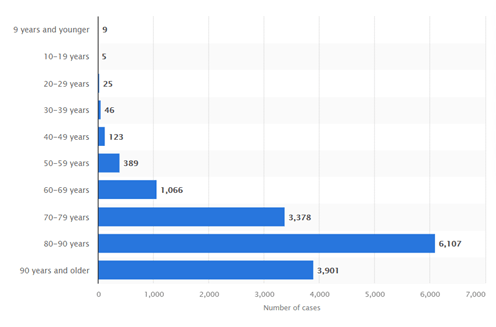
Figure. Deaths with covid-19 in Sweden, by age at November 3, 2021. Source: statistica.com
- “This is a severe disease and we have a evidence-based treatment [the vaccine] where there is definitive evidence that it reduces the risk of severe disease and death by 95 percent, in that order.”
This is an extraordinary claim for several reasons. First, the original Pfizer trial reported about the same number of overall deaths in the treated and the untreated groups (14 in the treated and 13 in the untreated). In the six-month trial results, only three covid-19 deaths occurred, one in the treated and two in the untreated group. This is not consistent with Jackson’s assertion of a 95% reduction in risk of severe disease and death.
Given the numbers of deaths in the original trial, it is possible to work out whether the trial would have picked up a 95% reduction as Jackson claims. The trial would have been expected to have only one death in the treated group, and would have detected a difference more than expected by chance with 96% certainty.
There is observational evidence from Sweden of reduced covid-19 hospitalisations and deaths (not from all-causes), however, the vaccine effect diminished to zero for all three outcomes eight months after the date that the vaccine was administered.
To compound the confusion about the effect of the vaccine, the original Pfizer trial now is marred by whistle-blowers who have given the British Medical Journal evidence of fraud occurring during its conduct. Sixteen Swedish doctors have now called for the injection to be suspended as a result of these revelations.
Both Jackson and RNZ use extensive use of ad hominem attacks, which are considered an invalid, and lowest, form of argument.
Examples include:
- “anti-vax”
- “discredited academic”
- “And we have someone who is questioning that evidence, who doesn’t know what they’re talking about, talking to an epidemiologist who doesn’t know what he’s talking about.”
- “outlier in his field”.
The purveyors and writers of such ‘argument’ appear to have no embarrassment at the anti-intellectualism and inhumanity of their conduct.
We’ll stick to the contest of ideas by again considering Jackson’s accuracy. Back in August 2020, Jackson and his colleagues claimed that elimination was still the best strategy for New Zealand to tackle covid-19. That article has not dated well, yet the personalised tirade and arguments are familiar.
“He [Thornley] is the only dissenter in the epidemiological community,”
“It’s not like this is a discussion like a boxing match with two equal partners. What you’ve got is every experienced epidemiologist in the country supporting the Government’s elimination approach.”
“We are all advising the Government, and we speak with one voice. And you have got a junior epidemiologist who is presenting a different case.”
Jackson has made increasingly inaccurate claims during the pandemic, claiming, unchallenged that one in five infected people will be hospitalised after infection with covid-19. No media have ever fact checked this.
New Zealand’s own government data shows Jackson overestimated by at least a factor of ten, since the proportion of cases (rather than infections) hospitalised is 2% (table).
Table. Counts of cases of covid-19 in New Zealand (16 November 2021).
| Count | % | |
| Self-isolation | 2058 | 56% |
| Isolation Complete | 969 | 26% |
| Managed Isolation | 396 | 11% |
| Hospital | 73 | 2% |
| Other | 198 | 5% |
As sailing great Russell Coutts has recently pointed out, it is questionable how “media entities can maintain objectivity when they have accepted a government grant that is conditional on them promoting certain government policies”.
It is prudent to check all sources of information, not only those who dare to question the what is coming from the Beehive.
BBC Believes a Conspiracy Drives Climate Conspiracy Theories
By Eric Worrall | Watts Up With That? | November 16, 2021
Shadows everywhere: The possibility that people might want to reject climate lockdowns and Covid lockdowns of their own volition does not seem to occur to BBC conspiracy theorists.
Covid denial to climate denial: How conspiracists are shifting focus
By Marianna Spring
Specialist disinformation reporter, BBC NewsMembers of an online movement infected with pandemic conspiracies are shifting their focus – and are increasingly peddling falsehoods about climate change.
Matthew is convinced that shadowy forces lie behind two of the biggest news stories of our time, and that he’s not being told the truth.
“This whole campaign of fear and propaganda is an attempt to try and drive some agenda,” he says. “It doesn’t matter whether it’s climate change or a virus or something else.” […]
And recently, groups like the ones he’s a part of have been sharing misleading claims not only about Covid, but about climate change. He sees “Covid and climate propaganda” as part of the same so-called plot.
The White Rose network
It’s part of a larger pattern. Anti-lockdown and anti-vaccine Telegram groups, which once focused exclusively on the pandemic, are now injecting the climate change debate with the same conspiratorial narratives they use to explain the pandemic.
The posts go far beyond political criticism and debate – they’re full of incorrect information, fake stories and pseudoscience.
According to researchers at the Institute for Strategic Dialogue (ISD), a think tank that researches global disinformation trends, some anti-lockdown groups have become polluted by misleading posts about climate change being overplayed, or even a so-called “hoax” designed to control people.
“Increasingly, terminology around Covid-19 measures is being used to stoke fear and mobilise against climate action,” says the ISD’s Jennie King.
She says this isn’t really about climate as a policy issue.
“It’s the fact that these are really neat vectors to get themes like power, personal freedom, agency, citizen against state, loss of traditional lifestyles – to get all of those ideas to a much broader audience.”
One group which has adopted such ideas is the White Rose – a network with locally-run subgroups around the world, from the UK to the US, Germany and New Zealand – where Matthew came across it.
“It’s not run by any one or two people,” Matthew explains. “It’s kind of a decentralised community organisation, so you obtain stickers and then post them on lampposts and things like that.” […]
While we chat, he mentions “The Great Reset” – an unfounded conspiracy theory that a global elite is using the pandemic to establish a shadowy New World Order, a “super-government” that will control the lives of citizens around the world. … Full article: https://www.bbc.com/news/blogs-trending-59255165
The Great Reset is a public programme promoted by the World Economic Forum. The annual “Great Reset” WEF Davos event costs more than $50,000. According to Wikipedia, in 2011 an annual membership cost $52,000 for an individual member, $263,000 for “Industry Partner” and $527,000 for “Strategic Partner”. An admission fee cost $19,000 per person. In 2014, WEF raised annual fees by 20 percent, bringing the cost for “Strategic Partner” from CHF 500,000 ($523,000) to CHF 600,000 ($628,000)
A simple google search turns up the WEF page near the top of the list of searches. The page cites Covid and climate change as justifications for their programme.
In my opinion there is room to debate the true nature of the Great Reset programme, but calling it “unfounded”, as in non-existent, is at best plain ignorant, and well below the BBC journalistic standards we once thought we had a right to expect.
As for the White Rose network, never heard of it. I have no doubt White Rose and many similar groups exist, in our unsettled world there are plenty of concerned people seeking out like minded fellows. But some groups are run by people with their own agenda, who are not acting in their member’s best interests, and any significant group will be heavily monitored by the government, so I strongly urge caution for anyone who participates in large private social media groups.
In Britain there is a “malicious communication act”, which makes it an offence to distribute written material which causes offence or anxiety, which has been used to arrest people campaigning against British government Covid policy. I am not a lawyer, but in my opinion it is only a matter of time before this act is used against people who oppose other high priority government policies in Britain. Be careful what electronic footprints you leave, your words could be misinterpreted. Above all, stay within the law, wherever you live.
Featured Video

Bombing Hitler’s Hometown
or go to
Aletho News Archives – Video-Images
From the Archives
‘Conspiracy Theory’ Now Fact: Greater Israel Has Arrived
By Kit Klarenberg | Mint Press News | January 28, 2025
Ever since Tel Aviv’s 1948 creation, much has been said and written about ‘Greater Israel’ – the notion Zionism’s ultimate end goal is the forcible annexation and ethnic cleansing of vast swaths of Arab and Muslim lands for Jewish settlement, based on Biblical claims this territory was promised to Jews by God. The mainstream media typically dismisses this concept as antisemitic conspiracy theory, or at most the fringe fantasy of a minuscule handful of extremist Israelis.
In reality … continue
Blog Roll
 Aletho News
- Failing to Defeat Hezbollah, Israel & US Pressure Syria’s Ahmed al-Sharaa to Join War
- US-Israeli war on Iran drives global fertilizer prices up 40%
- Hezbollah’s Surprise Weapons Redefine Ground Battle with Israel
- Yemen joins fight against US, Israel by firing missiles at occupied territories
- Seizing the Kharg: Washington’s path to defeat in the Persian Gulf
- Iran reports 500 US casualties in strikes on covert US military sites
- Pro-Israel terrorist arrested before assassination of pro-Palestinian activist
- Bombing Hitler’s Hometown
- German journalist threatened with homelessness as German court upholds EU sanctions in landmark free speech case
- US Tells Allies That Ukraine-Bound Arms Could be Sent to Middle East
- If Americans Knew
- Researchers at Human Rights Watch Resign Over Blocked Report on Palestinian Refugee Return
- Jewish Groups Are Backing a War Americans Don’t Want
- Eric Fingerhut Thinks He’s the President of the Jews
- Top Jewish Philanthropists, Rabbis Urge Israeli President to Take Action Against ‘Jewish Extremists’
- Don’t Be Fooled. Zionist Leaders Have Always Wanted to Control Southern Lebanon
- Israel’s widespread use of torture is a core element of its genocide against the Palestinian people
- In Israel’s War on Iran, Many Middle East US Bases Rendered “All But Uninhabitable”
- ‘Burn the lawn’: Israel pursues ‘Rafah model’ in southern Lebanon
- A genocide here, an amputation there
- Reports: Iran mobilizing 1M fighters, Israel-US run low on ammo, Israeli army faces shortage – Not a ceasefire Day 168
- No Tricks Zone
- Devastating Assessment Of Comirnaty Vaccine By Former Senior Pfizer Europe Toxicologist
- New Study: CO2 Is ‘Effectively Negligible’ As An Explanatory Climate Change Factor Since 2000
- Former Pfizer Toxicologist Dr. Helmut Sterz Tells Bundestag Hearing Pfizer Vaccine Should Have Never Been Approved
- Energy Expert: Germany’s Nuclear Phaseout Was A “500 Billion Euro Mistake”
- New Research: South Australia’s Mid-Holocene Sea Surface Temperatures Were 4°C Warmer Than Today
- Storing Green Energy To Last Germany 10 Days Would Require A 60-Million Tonne Battery
- New Studies: UK Sea Levels Were 4 Meters Higher Than Today During The Mid-Holocene
- Destructive Green New Deal: German Energy And Metal Group Warns Of Drastic Crisis
- New Study Documents A 20-Year Pause In Arctic Sea Ice Decline – Driven By Internal Variability
- Wake-up Call: Survey Shows Majority Of Germans Now Favor Postponing Climate Targets!
 Aletho News
