Aletho News

ΑΛΗΘΩΣ

Chinese satellite company refutes US accusation of supporting Houthi attack on US interests as ‘completely fabricated’

By Fan Wei and Liu Xin | Global Times | April 19, 2025

The US accusations are completely groundless and Chang Guang Satellite Technology has no business dealings with Iran or the Houthi groups, Chang Guang Satellite Technology told the Global Times on Saturday in response to a recent US accusation of supporting Yemen’s Houthis in attacking US interests in the region.

The US State Department spokesperson Tammy Bruce claimed that Chang Guang Satellite Technology Co., Ltd was involved in “directly aiding Iran-backed Houthi rebels in Yemen by providing satellite imagery used to target US and international vessels in the Red Sea,” according to a report from Fox News on Friday.

In response to an inquiry from the Global Times on the US accusation, Chang Guang Satellite Technology said that the company firmly opposed the US groundless accusation and such claims are completely fabricated and maliciously slanderous.

Chang Guang Satellite Technology Co., Ltd has no business dealings with Iran or the Houthi force. The company said that it strives to harness remote sensing data to drive high-quality development across key sectors such as agriculture, forestry, environmental protection, and finance.

“In our global operations, we strictly comply with relevant laws, regulations, and industry standards both in China and internationally. With a mature business model and high-quality services, we are committed to contributing Chinese expertise and solutions to the advancement of the global remote sensing industry,” said the company.

The core US accusation is that Chang Guang Satellite tracked US warships and commercial vessels using commercial remote sensing satellites to guide the Houthis strikes, which is technically unfeasible, Hu Bo, director of South China Sea Strategic Situation Probing Initiative (SCSPI), told the Global Times.

Hu said that according to current public information, it is technically difficult for any global commercial remote sensing satellite constellation — including that of Chang Guang Satellite — to achieve such a capability. The limitations in ephemeris, revisit cycles of the remote sensing satellite, and the ability of existing remote sensing technologies to track moving targets mean that these satellites cannot provide real-time coordinate information to strike mobile targets such as warships and commercial vessels.

Even Planet Labs, the US-based company with the largest number of commercial remote sensing satellites in the world, can only achieve an average once-daily revisit cycle for any given location on Earth. While orbital adjustments and resource concentration on hotspot areas may slightly reduce the revisit interval, this still makes it meaningless for real-time tracking and targeting of moving objects to guide weapon strikes, according to Hu.

The Houthis have their own drone capabilities, which serve as the most practical and effective means of real-time surveillance and reconnaissance against moving targets in narrow waters like the Red Sea. In contrast, reconnaissance satellites offer very limited utility in such scenarios, said Hu.

In response to a media inquiry on the US accusation, Chinese Foreign Ministry spokesperson Lin Jian on Friday said that “I’m not familiar with the specifics you mentioned. Since the situation in the Red Sea escalated, China has been playing a positive role to ease tensions.”

“Who is promoting talks for peace and cooling down the situation, and who is heightening tensions with sanction and pressure? The answer is rather clear to the world. China urges relevant countries to do what is conducive to regional peace and stability, not otherwise,” Lin said.

April 21, 2025 Posted by | Fake News, Mainstream Media, Warmongering | , , , | Leave a comment

Wrong, ABC News, Climate Change Didn’t Cause 2025’s Severe Tornado Outbreak

By Linnea Lueken | ClimateREALISM | April 14, 2025

A recent story by ABC News, “Climate and environment updates: Tornado activity doubled March average: NOAA,” classifies recent severe tornado outbreaks under their “climate crisis” category, implying that these storms were caused by global warming. This is false. Climate change is not causing an increase in the number or severity of tornados, nor can it be connected to such a limited event.

ABC warns:

The climate crisis is not a distant threat; it’s happening right now and affecting what matters most to us.

According to a new report from the National Oceanic and Atmospheric Administration, U.S. tornado activity in March was more than twice the monthly average, with over 200 tornadoes recorded.

Although ABC doesn’t explicitly state that this tornado season has been caused by climate change, the story strongly implies it, and as such it cannot be left unchallenged, because it is wrong.

The United States did experience a destructive and violent tornado season in March 2025, but it was not a record breaker in terms of numbers or strength, nor does it reflect a long-term trend that would be necessary to prove the climate connection.

The National Centers for Environmental Information (NCEI) disagree strongly with ABC’s claims. They report that tornado records in the past are spotty, because they are very short lived and aren’t always reported, especially as one moves further back into the past. NCEI reports “[m]any significant tornadoes may not make it into the historical record since Tornado Alley was very sparsely populated during the 20th century.”

Doppler weather radar did not become widespread until the 1990s. Because of the low coverage of weather radar before then, and much higher coverage in recent years, NCEI explains that “observation practices have led to an increase in the number of reported weaker tornadoes, and in recent years EF-0 tornadoes have become more prevalent in the total number of reported tornadoes.”

NCEI continues:

With increased National Doppler radar coverage, increasing population, and greater attention to tornado reporting, there has been an increase in the number of tornado reports over the past several decades. This can create a misleading appearance of an increasing trend in tornado frequency. To better understand the variability and trend in tornado frequency in the United States, the total number of EF-1 and stronger, as well as strong to violent tornadoes (EF-3 to EF-5 category on the Enhanced Fujita scale) can be analyzed. These tornadoes would have likely been reported even during the decades before Doppler radar use became widespread and practices resulted in increasing tornado reports. The bar charts below indicate there has been little trend in the frequency of the stronger tornadoes over the past 55 years.

Data from the National Oceanic and Atmospheric Administration (NOAA) tornado count show no trend in the number of tornadoes since the introduction of widespread Doppler radar. (See figures below)

Figure 1: Trend of all tornadoes counted since 1950. Note that the trend stops increasing once the widespread coverage of Doppler weather radar is achieved in the 1990s. Red are preliminary estimates for this year.

When it comes to the strongest tornadoes, EF-3 and above, there appears to be a downwards trend. (see figure below)
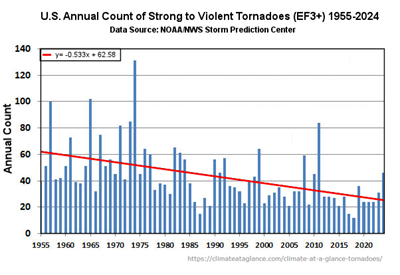
Climate at a Glance: Tornadoes points out that as recently as 2017 through 2018, the United States set records for the longest period in history without a tornado death and the longest period in history without an F3 or stronger tornado. In fact, the two record-low years for number of tornadoes both occurred this past dozen years, in 2014 and 2018.

Moreover, the United Nations Intergovernmental Panel on Climate Change finds that “[t]here is low confidence in observed trends in small spatial-scale phenomena such as tornadoes.”

ABC’s alarming coverage of the 2025 tornado season is at odds with the data. There is no dangerous climate signal in the tornado data, there may even be evidence that the modest warming of the past century is related to the decline in severe tornado outbreaks in the United States. A single severe tornado season, or concentrated outbreak, is not evidence of catastrophic climate change, only a long-term sustained trend would suggest climate change might be a factor, and there is no such trend.

April 19, 2025 Posted by | Fake News, Mainstream Media, Warmongering, Science and Pseudo-Science | , | Leave a comment

Fact-Checking Peter Marks’ ‘Face the Nation’ Interview on Autism, Vaccines and Measles

By Arthur Weinstein | The Defender | April 17, 2025

Peter Marks, M.D., Ph.D., hasn’t changed the opinions that put him at odds with U.S. Health and Human Services (HHS) Secretary Robert F. Kennedy Jr., and led to his recent resignation from the U.S. Food and Drug Administration (FDA).

Marks appeared April 13 on CBS News’ “Face the Nation with Margaret Brennan” in a wide-ranging interview covering vaccine safety, autism, the Texas measles cases and Kennedy.

When Marks resigned under pressure on March 28 from his role as director of the FDA department responsible for authorizing vaccines, he called out Kennedy in his resignation letter. “It has become clear that truth and transparency are not desired by the Secretary, but rather he wishes subservient confirmation of his misinformation and lies,” Marks wrote.

While Marks avoided using such inflammatory language on “Face the Nation,” the former FDA vaccines regulator did criticize Kennedy, suggesting he had hired a research executive with insufficient credentials, made personnel cuts that would hurt public health and that the results of a landmark autism study announced by Kennedy had in effect already been predetermined.

“What I think we can expect is the expected: that there will be an association determined between vaccines and autism, because it’s already been determined,” Marks said.

During the interview, Marks made several misleading and/or factually inaccurate statements, which we outline here.

Marks and Brennan falsely attributed children’s deaths to measles

Brennan referred to the death of 8-year-old Daisy Hildebrand on April 3 as “the death of a second unvaccinated child in Texas due to measles,” implying the disease caused both deaths.

Dr. Pierre Kory, who analyzed Daisy’s medical records for CHD.TV, disputed Texas health authorities’ statement that she died from “measles pulmonary failure.” He said records indicate she died from acute respiratory distress “secondary to hospital-acquired pneumonia,” which she likely developed during a previous hospital stay.

Brian Hooker, Ph.D., Children’s Health Defense (CHD) chief scientific officer, also reviewed the records and spoke with both of Daisy’s parents. He noted Daisy’s illness and treatment history were complicated during the weeks before her death.

Daisy’s father, Peter Hildebrand, told CHD.TV this week that measles is “absolutely not” what caused his daughter’s death.

“That last doctor we had, he just kept going on and on about measles this and measles that. He was trying to blame everything on the measles … They were so focused on the measles that they didn’t think about testing for anything else, and that is why my daughter is dead today.”

In March, a 6-year-old child in West Texas died after developing pneumonia while recovering from measles. The two deaths have fueled media coverage of a “deadly measles outbreak” in Texas and New Mexico, even though both deaths were attributable to other causes.

Marks cited questionable measles death rate

Marks talked at length about vaccine safety and efficacy, especially the measles-mumps-rubella (MMR) vaccine.

“You want to get your child vaccinated against measles so that they don’t have a one-in-a-thousand chance of dying from measles if they contract it,” Marks said.

That oft-cited 1-in-1,000 statistic for measles deaths comes from the Centers for Disease Control and Prevention (CDC). A CDC webpage updated in May 2024 claims “1 to 3 of every 1,000 children infected with measles will die from respiratory and neurologic complications.”

However, other research and media reports — and even the CDC itself — contradict that figure. On its website, the CDC reports that before the first measles vaccine was developed in 1963, “It is estimated 3 to 4 million people in the United States were infected each year,” resulting in 400 to 500 deaths.

Depending on which figures one uses, that results in a death rate of somewhere between 1 in 6,000 and 1 in 10,000 cases.

A 1994 study by the Institute of Medicine (now the National Academy of Medicine) that reviewed pre-vaccine era data in industrialized countries also found the death rate for measles to be just over 1 per 10,000 cases.

Marks understated MMR vaccine risks

Marks said that unvaccinated children are at serious risk from measles, and he endorsed vaccine safety. He said:

“There’s no reason to put your child at that risk, because the vaccine does not cause death, it does not cause encephalitis and it does not cause autism. So a vaccine that is safe, yes, occasionally kids get fevers. If you don’t keep the fevers down, about 15 in 100,000 will get a convulsion that happens once it goes away. … So, very safe vaccine that is going to potentially protect your child and save its life.”

That statement ignores evidence of the risks associated with the measles vaccine. Between 2000 and 2024, nine measles-related deaths were reported to the CDC. During the same period, 141 deaths following MMR or MMRV vaccination in the U.S. were reported to the Vaccine Adverse Event Reporting System (VAERS). That suggests the MMR vaccine can be deadlier than measles.

The MMR vaccine is also associated with serious health risks. The package insert for Merck’s MMRII states, “M-M-R II vaccine has not been evaluated for carcinogenic or mutagenic potential or impairment of fertility.”

Marks mischaracterized status and credentials of experienced vaccine researcher

Brennan mentioned a recent report by The Washington Post that researcher David Geier has been hired to lead Kennedy’s autism study. Geier’s appointment has not been confirmed. Yet the media questioned his credentials.

Marks repeated the Post’s mischaracterization of Geier’s credentials.

“He’s to the best of my knowledge, he’s not had any training after college in any of the sciences that we value here,” Marks said.

Geier is an expert on thimerosal — a mercury-based preservative used as an adjuvant in vaccines — and on the connections between toxic exposures and autism and other neurodevelopmental disorders.

The researcher is also the lead or second author of hundreds of peer-reviewed articles on vaccine safety.

Marks muddled research on environment versus genetics autism debate

As Brennan asked Marks about Kennedy’s autism study, she touched on the HHS secretary’s belief that environmental factors, not genetics, have sparked the rise of the condition.

Kennedy again voiced that opinion on Wednesday during a news conference, saying, “Genes do not cause epidemics.”

“Is there scientific evidence ruling out genetics as a cause of ASD?” Brennan asked Marks, referring to autism spectrum disorder.

”There’s no scientific evidence ruling out genetics. In fact, there’s data that have been published that say that genetics may contribute to autism. There are obviously data … that suggest that perhaps environmental factors may, but one has to be incredibly careful … about making associations between environmental factors and autism.”

The converse of Marks’ statement is also true; there’s no scientific evidence ruling out environmental factors. Kennedy said Wednesday that while some people may be genetically more susceptible to autism, it takes an environmental exposure to trigger the condition.

“This epidemic denial has become a feature in the mainstream media, and it’s based on an industry canard,” Kennedy said. “Obviously, there are people who don’t want us to look at environmental exposures.”

Brennan also pointed out to Marks that Kennedy appeared on Fox News Wednesday, “and dismissed 14 studies that have shown no link between autism and vaccines.”

A scientific review published Jan. 10 on Preprints.org found the CDC’s “vaccines do not cause autism” stance is based on limited evidence that insufficiently supports that broad claim.

Hooker, one of the co-authors of the review, told The Defender about the limited research on the topic.

“The truth is that CDC has never studied the connection between vaccines and autism except for one vaccine, MMR, and one vaccine component, thimerosal,” Hooker said.

Kennedy’s stance on the environment versus genetics debate has been clear, and he reiterated it Wednesday: He questioned why the National Institutes of Health spends 10 to 20 times more researching genetic causes instead of possible environmental triggers.

This article was originally published by The Defender — Children’s Health Defense’s News & Views Website under Creative Commons license CC BY-NC-ND 4.0. Please consider subscribing to The Defender or donating to Children’s Health Defense.

April 17, 2025 Posted by | Deception, Fake News, Mainstream Media, Warmongering, Science and Pseudo-Science | , | Leave a comment

Schrödinger’s novichok: 12 points from the Dawn Sturgess inquiry, part 3

By Tim Norman | Propaganda In Focus | March 3, 2025

What happens when official evidence about a nerve agent death exists in impossible dual states? Part three of a three-part report on the Dawn Sturgess case examines elements simultaneously exceptional yet inadequate, visible yet hidden, cautious yet careless.

A note on sources: Links presented in bold go to specific timestamps in videos from the YouTube feed of the Dawn Sturgess inquiry. Links that are not in bold are to supporting mainstream sources.

Part 2 of this investigation revealed how key testimony and scientific evidence maintained striking contradictions: simultaneously present yet absent. Part 3 examines how this dual state extends to the heart of the inquiry and beyond.

Point 9. The tests that couldn’t be tested

After Dawn Sturgess and Charlie Rowley separately collapsed at Rowley’s Amesbury flat on 30 June, it was four days before DSTL Porton Down publicly announced that they had both been poisoned by novichok — and it was another week before the fake perfume bottle that was apparently the source of the novichok was discovered in the kitchen of the flat on 11 July 2018.

During this time there was speculation in the media that the poison they had been exposed to could have been from the exact same source, or batch, as that allegedly used to contaminate Sergei Skripal’s front door in Salisbury four months previously. More than the fact that the poison in both cases was said to be novichok, the question was whether or not the novichok in both incidents could be shown to have been produced at the same time and the same place.

Linking the substances at Salisbury and Amesbury in this way — by establishing if they had the same “chemical signature” in the minute impurities that would have been introduced when the poison was manufactured, or precursor chemicals were combined — would be hugely significant for the investigation. It would provide a clear connection between the two incidents, and connect the poison in the Amesbury perfume bottle to the Salisbury incident even if the bottle that turned up in Amesbury had not actually been used to contaminate Skripal’s door.

On 4 July, DSTL Porton Down announced that its analysis of samples taken from Dawn and Charlie showed they had both been exposed to novichok. In an article about this development on 5 July, the BBC reported its security correspondent Gordon Corera as saying “the most likely hypothesis [is] that the Novichok was left over from the attack on the Skripals”.

“Metropolitan Police Assistant Commissioner Neil Basu said [the police] could not confirm whether the nerve agent came from the same batch but the possibility was ‘clearly a line of inquiry’,” the BBC article stated.

Also on 5 July, the science correspondent for The Guardian Hannah Devlin published an article headlined “How likely is it that Amesbury novichok is from Skripal batch?”, where she speculated that it might be possible to link the two substances through chemical analysis, if the Amesbury substance was found in some kind of container and had not degraded.

“The latest novichok case raises the question of whether… Dawn Sturgess and Charlie Rowley were exposed to the same source of the nerve agent that poisoned… Sergei Skripal and his daughter Yulia in March,” Devlin wrote. “There has been no official comment on this question, but it is scientifically plausible that the agent might persist for long enough, particularly if it was contained in some way.”

Devlin goes on to cite Alistair Hay, the professor of toxicology we will remember from Part 1 with regard to his answer to the question of just how deadly novichok is supposed to be. Hay claims that Sergei and Yulia were unconscious in Salisbury hospital for a long time because the nerve agent takes a long time to break down in the body — but, as we now know, Yulia at least was not unconscious for a very long time, and was found by the hospital’s intensive care consultant Dr Cockroft to be “neurologically intact” when she woke up just four days after her alleged exposure to it.

Devlin also quotes Andrea Sella, a professor of inorganic chemistry at University College London. Her article in The Guardian continues:

“‘How long [novichok takes] to degrade is certainly not data that is publicly available, but from discussions with people at Porton Down, I understand they are slow to degrade,’ said Alastair Hay, an environmental toxicologist at the University of Leeds. “This is one of the reasons the Skripals were unconscious for so long — it doesn’t break down readily in the body.’”

“Access to a bulk sample would give scientists far more information than what they have been able to ascertain so far from blood samples from the Skripals and trace samples from their front door.

“‘There’s the feeling that there’s a little crock of forensic gold out there,’ Andrea Sella said. ‘That would give them a real chemical fingerprint which would give you far more information.’”

After the fake perfume bottle turned up in the Amesbury flat, Chemistry World, the magazine of the Royal Society of Chemistry, published an article with the headline “Novichok poisoning breakthrough as original container found” on 18 July. In the article, Prof Sella was quoted again.

“Now that police have identified the bottle that was handled by the two latest victims they will be working to test whether the Novichok is from the same batch that poisoned the Skripals,” the Chemistry World article said.

“[Andrea] Sella says finding the bottle was a ‘major breakthrough’ in the investigation,” the article continues. “‘The discovery is a forensic gold mine,’ [Sella said]. ‘Not only is having a significant quantity of sample a real treasure trove to make detailed investigations of the sample, the bottle itself is likely to provide significant clues about its provenance.’”

On 13 July, two days after the bottle appeared, Stephen Morris of The Guardian emphasised the political significance of the analytical work that was being carried out on its contents. “Chemical weapons experts at Porton Down were testing the substance to see if it was from the same batch as used in Britain four months earlier — a finding that carries huge diplomatic implications,” he wrote.

An OPCW team was summoned to the UK again and stayed from 15–18 July 2018 to provide “technical assistance”. They were asked to re-test the samples taken from Sturgess and Rowley and once again confirm DTSL Porton Down’s discovery of the presence of novichok, which they duly did.

But curiously the OPCW team wasn’t given access to the bottle that had apparently been found in Rowley’s flat just four days before they arrived. The OPCW had to make yet another visit to the UK almost a month later, on 13 August, to get samples from that.

Despite the anticipation of defence and science correspondents in the media and Andrea Sella’s prediction that the Amesbury bottle would be a treasure trove of information, it wasn’t.

When the OPCW published its report on 4 September 2018, it said that the results of the comparative analysis it had made between the contents of the Amesbury bottle and the samples it had previously taken in Salisbury were inconclusive.

“Due to the unknown storage conditions of the small bottle found in the house of Mr Rowley and the fact that the environmental samples analysed in relation to the poisoning of Sergei and Yulia Skripal… were exposed to the environment and moisture, the impurity profiles of the samples available to the OPCW do not make it possible to draw conclusions as to whether the samples are from the same synthesis batch,” the OPCW said.

The UK’s leading political representatives appeared to ignore the OPCW’s disappointingly inconclusive report, and in fact seemed to misrepresent its results. Their advisers had perhaps decided that the determination novichok was supposedly present at both Salisbury and Amesbury was sufficient to suggest to the world at large that OPCW analysis had showed both occurrences were from the “exact same” batch: but that was an extraordinarily deceptive phrase to use.

The UK prime minister at the time, Theresa May, made a statement to members of parliament on 5 September claiming that “[y]esterday’s report from the Organisation for the Prohibition of Chemical Weapons, has confirmed that the exact same chemical nerve agent was used in both [the Salisbury and Amesbury] cases.”

A very similar statement was made to the United Nations on 7 September by Karen Pierce, then the UK’s ambassador to the UN. “The OPCW independent experts have confirmed the identifications as Novichok nerve agent, and it is the exact same chemical that was used in both attacks,” she said. “It stretches credulity the identification of such nerve agent twice in close proximity to be a coincidence.”

Perhaps May and Pierce were being told what to say, and did not know their emphatic statements made on domestic and international stages were not statements that the OPCW’s analysis of the Amesbury bottle’s contents supported.

To anyone who had been paying attention, however, the inconclusive nature of the report was impossible to fully obfuscate or avoid.

Chemistry World published an article on 6 September imprecisely headlined “Nerve agent confirmed as identical in both UK poisonings as key suspects identified” but, in the body of the article, it accurately reported that “[i]mpurities in the nerve agent samples taken from the Skripals and the unknown storage conditions of the bottle… made it difficult for the OPCW to conclude whether the two nerve agents originated from the same batch.

“Consequently, the agency was not able to conclude from its chemical analysis that both poisonings were definitely caused by the nerve agent discovered in the counterfeit perfume bottle,” the article said.

This seemed to be the end of the road for the prospect of conclusively linking the substances allegedly found in Salisbury and Amesbury through batch analysis, because the laboratories that the OPCW uses to conduct analysis of this kind — a process that typically involves multiple laboratories in different countries testing splits of the same samples, with the laboratories assigned these tasks kept secret from the public and from one another — are among the best staffed and equipped in the world.

The OPCW carries out such secret, multiple-blinded testing using selected “designated laboratories” — of which DSTL Porton Down is the UK’s only one. There are only around 30 laboratories in the world that have achieved OPCW designation, which is awarded after a rigorous process of proficiency testing that must be repeated yearly if a laboratory is to retain its accreditation by the chemical weapons watchdog.

DSTL Porton Down was of course not used by the OPCW to re-test the Salisbury and Amesbury samples, because it was the UK laboratory’s findings that the OPCW had been called in to reproduce and confirm.

As part of OPCW proficiency testing, laboratories that are seeking to achieve or maintain their position as a designated laboratory are given 15 calendar days to report results on test samples that are provided to them by the OPCW, with “identification of target compounds… ideally… based on at least two different analytical techniques”.

These would include the extremely sensitive mass spectrometry techniques we have discussed in part 2 with reference to the novichok traces that were supposedly found in the London hotel where the two Russian secret agents stayed.

This two-week turnaround, which OPCW designated laboratories are also expected to achieve in real testing scenarios such as the Salisbury and Amesbury cases, is only part of the exhaustive proficiency testing that laboratories are required to pass to achieve or maintain their designated status.

In short: from the point of view of the UK’s investigation into the novichok poisonings, if a set of OPCW designated laboratories around the world could not conclusively establish that the Salisbury and Amesbury samples were from the same batch, no scientific establishment would be able to do so.

However, the Dawn Sturgess inquiry heard that DSTL Porton Down seemingly did not give up its analytical efforts in this regard after the OPCW issued its inconclusive report in September, and eventually achieved something remarkable.

In an extraordinary revelation that received almost no attention, the inquiry was told that DSTL Porton Down had in fact eventually succeeded in doing what no other OPCW designated laboratory had been able to do. It took some time, but the scientists at DSTL Porton Down were apparently able to finally find Sella’s “crock of forensic gold” when every other OPCW laboratory that had been asked to do so had failed.

The inquiry heard that DSTL Porton Down was able to do this because 15 days is insufficient for OPCW designated laboratories to do the kind of chemical analysis that scientists such as the anonymous expert ‘MK26’, the lead DSTL scientific advisor to the police investigations, and his colleagues had been able carry out.

It had taken more than 15 days for DSTL Porton Down there to achieve the breakthrough that defence and scientific correspondents in the media had been looking forward to six years earlier — although exactly how much more time the scientists there had needed to make their incredible discovery was not disclosed.

“Detailed analytical work has been undertaken to determine whether the material recovered from the handle of the Skripal home at Christie Miller Road is from the same batch of the specific Novichok as that recovered from the perfume bottle at Muggleton Road,” ‘MK26’ wrote in a statement to the inquiry that was prepared in July 2024 and signed in October 2024 (p24, par 48).

“This work has concluded that it is highly likely that not only is the identity of the chemical agent found on the door handle at Christie Miller Road and within the perfume bottle recovered from 9 Muggleton Road identical, but that the Novichok at both locations is from the same batch of Novichok prepared at the time, from the same pre-cursor chemicals,” the statement continues.

“Given my opinion that the material recovered from the door handle at 47 Christie Miller Road and the liquid recovered from the bottle found at 9 Muggleton Road are highly likely to have come from the same batch of Novichok, and the volume of material recovered in the perfume bottle, it is my opinion that it is a realistic possibility that the bottle recovered from 9 Muggleton Road was used to apply the material to the door handle of the Skripal property at 47 Christie Miller Road.

“However, given the scientific evidence available to me, it is not possible to exclude the possibility that a second bottle of the same batch of Novichok was used in the attack on the Skripals, and that the bottle found at 9 Muggleton Road was a second bottle which was then discarded.”

We have discussed in Part 1 the “volume of material recovered” from the bottle with reference to Lisa Giovannetti KC’s superficial approach to the evidence — when she ignored the fact Rowley supposedly spilled some of the liquid on his hands — and we also observed there how the idea of the Amesbury bottle being a “second bottle” that was unused and discarded is merely a suggestion that maintains a narrative, without any evidence to support it.

But what is far more significant from the statement ‘MK26’ submitted to the inquiry is their claim that DSTL Porton Down had found that “the Novichok at both locations [was highly likely] from the same batch of Novichok prepared at the time, from the same pre-cursor chemicals” — and Giovannetti picked up on this critical point in her closing statement to Lord Hughes, calling it a “safe” conclusion.

“As to [the] scientific evidence, as a result of detailed analytical work, we say you can safely conclude that the Novichok recovered from the door handle of the Skripal home at Christie Miller Road is not just the same kind, but from the same batch as that recovered from the perfume bottle at Muggleton Road,” Giovannetti said.

“[It was] made in a single synthesis, from the same precursor compounds at the same time — and that’s a key finding.”

It was indeed a key finding: an extremely important discovery with “huge diplomatic implications” as Stephen Morris of The Guardian said it would have six years previously.

It was a finding that should have been declared to and validated by the OPCW and widely reported by the media and the UK’s political representatives.

But it appears the opposite was the case. The inquiry heard that how the scientists at DSTL Porton Down achieved their extraordinary breakthrough was a secret that could not be discussed in open session, with no suggestion that the OPCW had been involved to validate their results.

‘MK26’ was asked about DSTL Porton Down’s remarkable achievement — and his account of it in his written statement — when he gave personal testimony to the inquiry (Day 16, p178).

“You say: ‘Detailed analytical work has been undertaken to determine whether the material recovered from the door handle of the Skripal home at Christie Miller Road is from the same batch of the specific Novichok as that recovered from the perfume bottle at 9 Muggleton Road’,” lead counsel O’Connor says to ‘MK26’, asking: “I think we probably all know what we mean by the same batch, but perhaps you can explain exactly what you mean.”

“My interpretation, or my meaning from the same batch, is that it was from a single synthesis of that Novichok made from the same pre-cursor compounds at the same time,” ‘MK26’ replies, continuing:

“[It is highly likely] that not only is the identity of the chemical agent found on the door handle at Christie Miller Road and within the perfume bottle recovered from 9 Muggleton Road identical, but that the Novichok at both locations is from the same batch of Novichok prepared at the same time, from the same precursor chemicals.”

“Are you able to go any further in open [session] in explaining your reasoning?” O’Connor asks.

“Very little,” ‘MK26’ replies. “I guess what I would add is that the OPCW process requires the laboratories that receive the samples to report within a fixed period of time and… the high levels of purity of the sample mean that in order to look at batch matching, what we’re talking about is analysis of those very low-level impurities.

“That takes a substantial amount of time and… that’s probably all I can say as to why we were able to reach a conclusion that the OPCW was not. I’m happy to provide more detail in closed [session].”

“I’m certainly not going to press you to provide any more detail,” O’Connor says. “But I think it follows from what you have said… [that] your positive conclusion about the same batch is one… that you’re quite comfortable with [despite] the fact that the OPCW was unable to reach a conclusion?”

“Yes,” ‘MK26’ replies.

The implications of what ‘MK26’ is confirming here are profound. He is apparently saying that the strict 15 day turnaround that the OPCW demands from its designated laboratories is in effect a flaw in the chemical weapons watchdog’s protocols and procedures.

Although this requirement is intended by the OPCW to establish the operational efficiency and reliability of designated laboratories and allow for timely decisions to be made relating to chemical weapons incidents, in cases like Amesbury and Salisbury it appears more time is needed — and DSTL Porton Down, operating independently outside of the restrictions imposed on OPCW designated laboratories, was somehow able to achieve what such laboratories could not.

The OPCW, of course, carries out testing with strict secrecy and there is no reason why DSTL Porton Down would not have been able to report its findings to the OPCW and have its results fully validated and reproduced by other designated OPCW laboratories. This would seem to be imperative, given that these laboratories had collectively failed to achieve any kind of definitive result in their initial analyses of the Amesbury and Salisbury samples in 2018.

But there is no suggestion that anything like this was done. As with the supposed discovery of novichok in the hotel where the two Russian secret agents stayed, scientific principles such as validation and reproduction do not appear to have been required — and do not even appear to have been possible.

Once again the inquiry was asked to accept the authority of DSTL Porton Down and the opinion of ‘MK26’ on the basis of their supposedly expert scientific credentials — rather than the exercise of the scientific method itself — when it came to the batch analysis of novichok.

DSTL Porton Down, it seems, is simply better at chemical weapons analysis than any other OPCW designated laboratory in the world.

But what of the person allegedly targeted by this chemical weapon — the person whose apparent attempted assassination seemingly led to the death of Dawn Sturgess and the inquiry that eventually followed?

Where was Sergei Skripal in all of this and what did he have to say?

Point 10. Skripal trusted Putin but didn’t trust him

Although he was the principal figure in the events apparently leading directly to the death of Dawn Sturgess, Sergei Skripal was not required to give testimony in person before the inquiry — not even in secret, closed session via secure video link from a safe house somewhere.

Unlike his daughter, there was no public statement to camera from Sergei after he was discharged from hospital. He simply disappeared from view, and has never been seen since.

Until the inquiry, there had not even been a written statement released in Skripal’s name about what had supposedly happened to him in Salisbury on 4 March 2018.

Sergei and Yulia did not give personal testimony to the inquiry because Lord Hughes ruled before the proceedings began that any kind of appearance from them would expose them to further risk of assassination by Russian secret agents: a risk that the UK authorities had apparently not taken seriously or even acknowledged before the Salisbury events.

This risk was apparently manageable from the UK authorities’ point of view when Yulia made her public appearance in May 2018 — but now, six years later, the supposed danger was deemed too severe for her or her father to appear before the inquiry in any way.

“[You concluded that] the risk of physical attack by whomever it might be on one or both of them… clearly outweighed the advantage to the Inquiry of [the Skripals] attending to give oral evidence,” lead counsel O’Connor said on the first day of the hearings (Day 1, p23)

Michael Mansfield KC, representing the family, developed this point in his opening remarks.

“It is notable that the Skripals are not being called to give evidence in this inquiry primarily… because the risk is too great that their identities and locations could be discoverable,” Mansfield told Lord Hughes (Day 1, p118). “[This] risk [is] said to be the same as the attack in Salisbury. If so, why was a similar precautionary approach not adopted by the authorities [in 2011, when Skripal arrived in Salisbury] in the way that you have?”

This is the question that the inquiry was nominally set up to answer. Points arising from the novichok narrative such as those we have looked at in the three parts of this article were — as we have seen — largely incidental to the inquiry, however significant they may or may not appear to have been to the reader. For the inquiry, the established narrative was never in doubt.

Rather, what Mansfield and the Sturgess family wanted to know from the inquiry was why precautions were not initially taken to protect Sergei from potential reprisal attacks. Why had UK intelligence not considered Sergei to be at risk of assassination by the Russian state in retribution for his betrayal of his country as a double agent in the 1990s, after he arrived in Salisbury?

Sergei had served several years in a Russian prison after being caught and convicted of high treason and espionage in 2006. He was released in 2010 as part of a spy swap between Russia and the United States, and had received a presidential pardon before being exiled to the UK — but it was implicit in the inquiry’s proceedings that none of this really meant anything.

From the inquiry’s point of view, Russian President Putin was notorious for his jealous, irrational determination to exact retribution on traitors, wherever they may be and however much time may have elapsed since their apparent crimes, and he was capable of ordering their assassination at any time — even at times when this was particularly detrimental to Russia’s efforts to present itself positively on the world stage.

We will look at the idea of President Putin’s “bad character” again at the end of this article.

The inquiry also heard that Sergei had apparently “re-entered the game” following the spy swap that brought him to Salisbury, and was actively supplying information of some kind about Russia to Western intelligence services (Day 24, p16) at the time of the alleged assassination attempt against him. This was apparently the primary reason for the attack, although what useful intelligence Skripal could possibly still have almost 15 years after he was exposed as a double agent and arrested in Russia is not clear.

From the Sturgess family’s point of view, precautions taken by the UK state to protect Sergei would, by extension, have been precautions that protected people like Dawn from the risk a Russian traitor living openly in Salisbury presented to the local community, given that it was now generally understood he could have been attacked by the Russian state at any time.

The question of the precautions that should have been taken by the UK state to protect Sergei extended to the question of how much danger he personally felt he was in living in Salisbury, and what precautions he felt were reasonable or necessary to have taken himself.

To address these concerns Sergei apparently provided a statement to the inquiry, breaking his public silence of more than six years — but the written testimony he gave was strangely contradictory when it came to the question of his own protection or that of his family. In keeping with the theme we have explored through this article, he was apparently concerned and simultaneously quite unconcerned by the danger he may have been in.

It is worth noting here that Sergei’s statement, seemingly made in October 2024, was presented to the inquiry unsigned and undated, which generally speaking would make it inadmissible in UK law. Yulia similarly apparently submitted an unsigned and undated statement.

But we will leave the implications of this to one side, as the inquiry seems to have done.

On the one hand, Skripal was apparently worried about potential reprisals against him by the Russian state, and recalled that he had apparently told his friends in Salisbury that he knew Russian leader Putin “personally” and Putin would “get him” (p5, par 16). In his police interviews in 2018 he apparently even said he was “a very important man of special services. Still now I know a lot of Russian secrets, top secrets. They are really dangerous for Russian special services”. (Day 1, p77).

But on the other hand, Skripal was seemingly not prepared to take even the most basic and obvious steps to protect himself or his family in terms of the way he lived his life in Salisbury, as Mansfield pointed out.

“Mr Skripal suggests [in his statement] that he was offered a change of name but was never told this was needed,” Mansfield told the inquiry (Day 1, p115). “[He] was living openly with his family in the United Kingdom under his own name in a Salisbury cul de sac. Why? Why was he not given a different identity at an unknown and varied location?

“Mr Skripal’s address was alarmingly accessible to the GRU’s assassins. Why? Why was he not accommodated in a gated estate or at least within an apartment block requiring an entry code and appropriate security? […] There is no evidence that his property was equipped with… sensor cameras, CCTV. [R]eading the interviews that [was because] he didn’t want to make himself conspicuous. He is living under his own name.

None of this makes sense for the authorities to have allowed this to develop in the way that it did. These are the most basic of protective measures. In their absence, GRU agents simply walked up to his front door, applied a deadly nerve agent to the handle… and left. The most rudimentary home security monitoring would have identified them.”

Mansfield was right to say Skripal’s reasons for refusing to have CCTV installed at Christie Miller Road did not make sense. And while a Russian presidential pardon may not have carried any weight as far as the inquiry was concerned, from Skripal’s point of view at least the implicit protocol of the spy swap that brought him to the UK was seemingly meaningful.

“I do not remember concretely what was covered in discussions about my personal security arrangements, but I believe I was offered protection, including changing my name,” Sergei’s statement reads (p7, par 27). “It was never suggested that this was a necessary option and I decided against it.

“I had received a Presidential pardon from the Russian state and wanted to lead as normal a life as possible, including maintaining my personal and family relationships. I did not think, and it was not suggested, that I needed to live in a gated community or a block of flats. Christie Miller Road was a quiet street built for police officers. Several neighbours were ex-police. Residents knew and kept an eye out for each other. I felt quite safe there.

“I did not have a house security alarm or sensor activated security lights and I do not remember either of these being raised with me. CCTV was recommended but I declined this because I did not want to make my house conspicuous or live under surveillance.”

Sergei’s remark that he felt CCTV would make his house conspicuous is particularly notable. By 2018 domestic CCTV systems were commonplace and unremarkable in the UK, so this was a very strange rationale.

To briefly illustrate this point: the inquiry heard testimony from Ross and Maureen Cassidy, residents of Salisbury who became close friends of Sergei’s, and whose son Russell did maintenance work on Sergei’s home.

The Cassidys drove Sergei to Heathrow airport to collect Yulia on Saturday 3 March, the day before the alleged poisoning. They then drove them both back to Salisbury, arriving at around 6pm — a time Maureen Cassidy stated that she had established “because I… checked my son Russell’s CCTV footage after we became aware of what had happened” (unsigned statement, p10).

This shows how common domestic CCTV systems were at the time — and Russell Cassidy can hardly have believed himself to be at personal risk in the way a retired Russian double agent like Skripal should surely have considered a possibility.

There is another perspective on Sergei’s security arrangements that his journey with the Cassidys to Heathrow to collect Yulia reveals.

As we know, the two Russian secret agents who supposedly contaminated Skripal’s front door handle with novichok on Sunday 4 March also visited Salisbury on the afternoon of the day before, and Commander Murphy of the Metropolitan Police Counter-Terrorism Command told the inquiry that he believed this was for the purposes of reconnaissance.

But O’Connor suggested to him that the secret agents had chosen Saturday afternoon because they were monitoring Skripal’s communications, and knew that he was going to be out of the house at the time.

“If on your assessment it was a reconnaissance visit, then it would have been convenient, or less risky to do so when there was no danger of Sergei Skripal leaving or arriving at the house, or looking out of the window, or anything like that?” O’Connor asks Murphy (Day 19, p133).

“Entirely fair, yes,” Murphy replies.

“We have heard evidence… not only that Sergei Skripal went to Heathrow on that Saturday, but that he was discussing the timings of his trip… for example with Ross Cassidy on the phone,” O’Connor says. “With that in mind, Commander, is there anything you can say in open session about a suggestion that it may have been no coincidence that [this] reconnaissance visit… took place whilst no one was at home, that in fact [the Russian secret agents] may have known, perhaps by targeting of communications, that Sergei Skripal would be away that day?”

“As much as I can say is that we did not find evidence within the devices that we have identified to indicate that level of contact, but that’s as much as I’m afraid I’m able to say in open,” Murphy replies, apparently indicating that the police had found no evidence after taking apart the Skripals’ telephones that they had been physically bugged.

In his statement, Skripal acknowledged the possibility that his communications could have been monitored by the Russian state (p2, par 5), and the inquiry heard that he was in the habit of screening his calls using an answering machine (Day 6, p17). But his statement overlooked the fact that his Salisbury address had been registered in his own name in the UK land registry when the house was purchased, and was publicly available to anyone who was willing to pay a small fee to search the land registry database.

“I am not now, and have never been, aware of the Russian authorities intercepting my communications after I came to Great Britain,” Skripal’s statement reads (p2, par 5). “[But] I know every country tries to monitor communications and I believe it is possible that Russia did so.

“My family may have been of interest to the Russian authorities because I was once a senior man in the GRU special services; Russia’s military intelligence agency. The Russian government might have tried to intercept my communications but I am not sure if they succeeded.

“I do not know if they found out where I lived in this way or another way.”

O’Connor’s suggestion that the Russian secret agents knew Skripal would be out on Saturday afternoon so they went to Salisbury to carry out reconnaissance “when there was no danger of Sergei Skripal leaving or arriving at the house, or looking out of the window, or anything like that” is interesting because the following day they allegedly approached Skripal’s house to poison his front door while he was at home.

Not only this but the inquiry heard that they did so in broad daylight, shortly after 12pm — a time when, according to internet usage data that the police had obtained and that was presented to the inquiry, Sergei was apparently viewing YouTube videos on his desktop computer — (see police document here, p21 par 6.3) — a computer that was located in his office, a converted garage with a window that looks out onto the cul-de-sac and the approach to his house.

The inquiry was shown a floorplan of the building, where the position of his desk relative to the window is shown (see p39 of the police document here, room 6). Sergei would have had a clear view of the street as his two would-be assassins walked up to his front door.

Ross Cassidy had told the media on several occasions in the past that his friend was very watchful. In September 2018 he told the Daily Mail that he personally doubted the idea that the two Russian secret agents could have approached Sergei’s home without being seen, and that Sergei had almost always seen him before he arrived at the front door when he visited.

“These guys are professional assassins,” Cassidy said. “It would have been far too brazen for them to have walked down a dead-end cul-de-sac in broad daylight on a Sunday lunchtime.

“Sergei’s house faces up the cul-de-sac. He had a converted garage that he used as his office — this gives a full view of the street. Almost always, Sergei used to open the door to us before we had chance to knock. Whenever we visited, he’d see us approaching.

“Something had spooked Sergei in the weeks prior to the attack. He was twitchy, I don’t know why, and he even changed his mobile phone.”

Whether or not something had “spooked” Sergei in the weeks prior to the alleged attack as Cassidy claimed, the inquiry heard that he had indeed changed his phone in the days before the alleged attack (Day 6, p29). In his statement to the inquiry Sergei claimed that this was because the battery on his old phone had started to lose charge rapidly, and had nothing to do with concerns that it may have been being monitored.

Either way, and even if by chance, this represented more operational security from Sergei’s point of view than had been exercised by the two secret agents who allegedly walked up to his front door that Sunday lunchtime and contaminated it with military grade nerve agent without him seeing them as he sat at his window with a full view of their approach.

As we know, the Russian secret agents hadn’t bothered to change their phones since the last time they used booking.com to book a room at their favourite City Stay hotel.

In June 2020, Cassidy repeated his views to The Sunday Times.

“Sergei saw you coming before you ever saw him,” he said.

Point 11. Important witnesses who weren’t important

Sergei Skripal was far from being the only important witness who did not appear before the inquiry, although he is the most obvious example. His daughter Yulia did not appear either, for the same reasons: Lord Hughes ruled a personal appearance — even by secure video link from an undisclosed location, during closed sessions — would also put her at risk of assassination from Russian secret agents like the Russian secret agents who had tried and failed to kill her and her father years before.

But there are many others who were conspicuous by their absence. To recap on the three other key witnesses discussed in this article who could have given oral testimony but for whatever reason did not, first there is Charlie Rowley, who supposedly gave Dawn the bottle that killed her and upon whose highly contradictory account of doing so the narrative of a discarded bottle of Russian nerve agent largely depends.

Then there is Sam Hobson, Rowley’s friend who was with him when he collapsed in his flat in Amesbury, and who Rowley was initially convinced had poisoned him there. Rowley was excused from giving personal testimony because of his alcoholism and drug addiction or “vulnerability” — his statement however indicated that he “currently [does] not take any drugs (Day 3, p52) — but there was no explanation offered as to why an important witness like Hobson, who like Rowley gave television interviews at the time of the Amesbury incident, was not required to appear.

And then there is Karl Bulpitt, the paramedic who accidentally gave Sergei Skripal atropine in the back of the ambulance believing he was giving him a different drug entirely, or so the inquiry was told.

The fact that atropine happens to be a drug that is supposedly effective against a nerve agent like novichok meant that Bulpitt’s mistake was offered as an explanation for Sergei’s survival — or perhaps, implicitly, as an explanation for why he arrived at hospital in a significantly better state than his daughter, who was apparently exposed to a lower dose of the poison after touching it second.

The fact that Bulpitt was only required to give written testimony, when several other paramedics appeared before the inquiry, is all the more remarkable when we recall that this written testimony was entered into evidence by the inquiry at the end of a sitting day without remark, and was then reported by Stephen Morris of The Guardian as if Bulpitt had given it in person. This was an extraordinary sleight of hand for a reporter writing for a mainstream and supposedly reputable outlet to have made.

There are other important witnesses who only gave written testimony to the inquiry — and a number of important witnesses who were not required to give testimony at all.

Retired Detective Chief Inspector Philip Murphy also only gave a written statement, which was undated and unsigned. The inquiry heard (Day 3, p2) that Murphy played a important role in the investigation of the Amesbury poisonings, but having retired in 2021 he was effectively represented to the inquiry by Cmdr Dominic Murphy. Why DCI Philip Murphy’s retirement excused him from giving evidence before the inquiry was not made clear; Detective Inspector Mant gave testimony to the inquiry, for example, even though he is also now retired (Day 14, p3).

Colonel Alison McCourt was also excused from giving personal testimony, supplying a signed written statement instead. Col McCourt, the British Army’s most senior nurse at the time of the Salisbury incident, was one of the first responders to Sergei and Yulia at the bench, together with her daughter. Some months later she nominated her daughter Abigail for a bravery award organised by a local radio station, as Abigail was apparently the first to notice the Skripals in distress.

Lord Hughes excused Col McCourt from giving oral testimony because she said her involvement in the Salisbury incident had damaged her health, an injury for which she was continuing to receive treatment. This was not due to the effects of novichok — which she and her daughter could easily have been unknowingly contaminated with as they attended to the Skripals — as tests subsequently showed that they were unharmed.

Rather, the suggestion appears to be that the injury was to McCourt’s mental health. Her statement indicates she did not realise nominating her daughter for a bravery award would “expose my family and I to national media attention and resultant conspiracy theorists” (p2, par 14), and she also describes her distress when her car was taken away by the authorities a week after she and her daughter had given the Skripals first aid.

“I was told by police that my car did not need to be examined and there was no safety concern and I could continue driving it,” McCourt’s statement reads. “Then a week after the incident the police turned up at our house at 9pm without warning and confiscated our car keys and returned subsequently with the Army to remove our family car under full ‘biohazard’ conditions. I found this extremely distressing as my family and I had been using the car unprotected throughout the intervening period.”

Detective Sergeant Nick Bailey, who did give testimony before the inquiry, had previously described to The Telegraph similar mental trauma in an interview he gave to the newspaper together with his wife, Sarah. All their family’s possessions were destroyed by the authorities because Bailey had apparently contaminated them before he went to hospital, and the family was not allowed to return to their home.

“‘There could have been a speck of Novichok in the house,’” The Telegraph reports Bailey as saying. ‘At some point in the next month, year, or 10 years, somebody could have touched it.’

The article continues: “‘It felt a little bit over the top, if I’m honest,’ says Sarah, who had initially stayed in the house for five days after her husband fell ill. ‘Nobody explained what was going on. We never dreamt we wouldn’t get any of our things back. I feel a real sense of guilt about the stuff we can’t replace, which I should have saved, like first drawings and baby shoes. It really haunts me.’”

Another very significant witness among the individuals who were not called by the inquiry to give testimony of any kind was Dr Christine Blanshard, the medical director of Salisbury District Hospital at the time of the Salisbury and Amesbury incidents.

As we have seen, Blanshard punished the hospital’s ICU consultant Dr Stephen Cockroft for the crime of communicating with Yulia when she recovered consciousness four days after her alleged poisoning. She removed Cockroft from the ICU rota and threatened him with a charge of professional misconduct if he spoke to any of his colleagues about what had happened.

Given that the inquiry’s nominal purpose was to establish whether any measures could or should have been taken to protect people like Dawn from the risk of collateral damage presented by a potential target of the Russian state living nearby, and that Cockroft was prevented from telling his medical colleagues about what he had observed following the Salisbury incident but before the Amesbury incident occurred, this seems like a critical failure by the inquiry.

Blanshard should have been called on to explain why she prevented Cockroft from telling his colleagues what had happened, as this could have significantly informed their response to Dawn’s diagnosis and treatment when she was later admitted to hospital. Cockroft was explicit about this point in his statement and in his testimony, describing meetings of medical and professional staff where he was blocked by Blanshard from speaking.

The second meeting, at a lecture theatre in the hospital on 21 June 2018, was particularly significant because, as Cockroft told the inquiry, “almost all the doctors in the emergency department there, certainly almost all my anaesthetic and intensive care colleagues, plus other specialties and a lot of intensive care nursing” (Day 9, p44).

This would have been an ideal opportunity to discuss how the Skripals presented and, you know, share the secret, as it were,” Cockroft said. His written statement continues: “There were some one hundred Salisbury Hospital medical and nursing staff in the audience but I was given no opportunity to discuss my experiences in recognising and treating Novichok poisoning. The medical director [Dr Blanshard] prevented me from volunteering any of this information.”

Another colleague of Dr Cockroft’s who should have been called to give testimony before the inquiry was his fellow ICU consultant Dr Stephen Davies. Dr Davies is significant because, in the aftermath of the Salisbury incident, he decided to write a letter to The Times newspaper to allay the fears of the people living in Salisbury — and the wider public — about the risk of being contaminated by the novichok that had allegedly been used in the city.

There was clearly a great deal of anxiety being felt by the local population at the time, and Dr Davies apparently sought to reassure people after the The Times published an article on 14 March 2018 reporting that “[n]early 40 people ha[d] experienced symptoms related to the Salisbury nerve agent poisoning”.

On 16 March 2018, The Times published his letter, where Dr Davies wrote:

“Sir, Further to your report (“Poison exposure leaves almost 40 needing treatment”, Mar 14), may I clarify that no patients have experienced symptoms of nerve agent poisoning in Salisbury and there have only ever been three patients with significant poisoning. Several people have attended the emergency department concerned that they may have been exposed. None has had symptoms of poisoning and none has needed treatment. Any blood tests performed have shown no abnormality. No member of the public has been contaminated by the agent involved.”

This was newsworthy enough for The Times to follow Dr Davies’s letter up with an article headlined “Russia: Salisbury poison fears allayed by doctor”, in which Fiona Hamilton, then the newspaper’s crime and security editor (now its chief reporter) and Deborah Haynes, then its defence editor (now security and defence editor at Sky News) reported that “Dozens of patients who went to hospital after the Salisbury poisoning were unaffected by the nerve agent [novichok]”.

Dr Davies’s letter becomes even more interesting because Rob Slane — the Salisbury resident who blogged as The Blogmire, and who we mentioned in part 1 with reference to the inquiry’s suggestion that the two Russian secret agents had a portable heat sealer with them — did the necessary journalism that Hamilton and Haynes signally failed to do and contacted Dr Davies to ask him about it.

This direct contact with the letter’s author revealed yet another contradiction: a medical professional’s attempt to provide clarity had apparently been rendered unclear through editorial intervention, with no subsequent correction despite the public health implications.

Slane reported that Dr Davies “told me that The Times edited his letter, and that this produced a misleading message. Furthermore, he confirmed to me that the three patients mentioned in his letter ‘were poisoned with a nerve agent, confirmed by blood tests and symptoms’.”

As with so many details relating to the novichok narrative, this statement raises more questions than it answers. What did Dr Davies’s letter say before it was edited and in what way was it edited to make it misleading? Importantly, Dr Davies was apparently writing to The Times to reassure people that there was no risk of contamination to the public as a result of the alleged novichok attack in Salisbury. Was this not in fact the case? If not, the way his letter was edited amounted to it being turned into dangerous misinformation.

No apology, correction or retraction was published by The Times, and the article by Fiona Hamilton and Deborah Haynes was not amended. Dr Davies could have provided clarification on this important matter of the risk to the public as well as other points relating to the treatment of Sergei and Yulia Skripal if he had appeared before the inquiry, but he was not required to do so.

Illustrating how important this issue is, at one point Straw, the barrister for the family, told the inquiry that a total of 87 people went to the A&E department at Salisbury hospital because they were anxious about symptoms following the alleged use of novichok in the city — and although Cmdr Murphy described these people as the “worried well” (Day 18, p12), that statistic was broadcast to the UK by Channel Four News on 2 December 2024 in a report that did not mention the fact that none of these 87 people had actually suffered novichok poisoning, or poisoning of any kind.

Point 12. The trial that wasn’t a trial

As someone who has written about the Salisbury and Amesbury novichok incidents with a degree of scepticism, I have occasionally been challenged on social media to present an alternative version of events to the narrative that has been advanced by the UK authorities — a narrative that was accepted without question by the Dawn Sturgess inquiry and its participants, as we have seen.

The suggestion is that, without a complete alternative explanation for what happened, a sceptical attitude to the novichok events as they have been presented to us can be dismissed as groundless and without merit. From a rational point of view this is obviously untrue — it’s often possible to see the answer to a question is wrong without having enough information to know what the correct answer is.

Expressing such scepticism has also been presented as disseminating Russian disinformation or “following the Kremlin playbook”. Mark Urban, the ex-BBC journalist and author of The Skripal Files, made this accusation against me in November 2024 on Twitter/X, complaining that I had misrepresented him when I quoted a passage from the first edition of his book on that platform, but illustrated it with a picture of the cover of the second edition.

“He generally follows the Russian embassy playbook of questioning the ‘official narrative’ but I’ve never seen him produce a coherent one of his own,” Urban posted.

I don’t have the contacts in the UK security establishment that Urban does, and I can’t offer a complete, coherent alternative version of events. But the demand that sceptical analysis must provide a full alternative explanation fundamentally misunderstands how evidence-based inquiry works. Again: one can identify inconsistencies, contradictions and gaps in evidence without necessarily knowing the full truth of what occurred.

However, a counter-narrative to that presented in The Skripal Files and the mainstream media in general might begin by asking what the two secret agents were doing in Salisbury if they were not there on an assassination mission.

And here it would be important to start by acknowledging that the behaviour of the secret agents while they visiting the UK over the weekend of 2–4 March 2018 was — by any measure — peculiar.

According to the inquiry, the Russian secret agents did not just visit Skripal’s house in Salisbury on the Saturday afternoon for reconnaissance purposes while Sergei was out picking up Yulia from Heathrow airport, and then again at Sunday lunchtime to poison the front door handle while Sergei and Yulia were at home, but they returned to Christie Miller Road yet again on Sunday afternoon having poisoned the door, apparently to observe Sergei and Yulia touching the novichok that they had applied about an hour previously.

“During their second visit [to Christie Miller Road] Sergei and Yulia were departing the premises at that time and so there was more activity around the time of that departure,” Cmdr Murphy told the inquiry (Day 19, p157). “So of the two visits [to the house on Sunday it] makes entirely sense for them [sic; to have contaminated the door on the first visit] to ensure that [the novichok] was there before Sergei and Yulia left the house at 1.30.”

The second [visit to Christie Miller Road on Sunday]… it would seem [was] just in time to witness them leaving,” O’Connor says (Day 19, p176).

“Coincides,” Murphy replies in agreement.

While the two Russian secret agents’ movements around Salisbury on the day of the alleged poisoning — including, as we have seen, disassembling and then packaging their assassination weapon using a portable heat sealer before dumping it — may seem odd, they are nothing compared to how they behaved about six months after they returned to Moscow, when they appeared on the Russian state-owned television channel RT and were interviewed by its editor-in-chief, Margarita Simonyan.

At this point the two secret agents had seemingly had their real identities exposed by an organisation of “citizen journalists”. This organisation had apparently purchased leaked Russian passport databases, and had used them to establish that the secret agents had been using fake passports issued to the Russian secret services with sequential numbers, with the first six digits identical in both documents (Day 20, p122).

Given that the two secret agents had been using these fake passports for some time, had supplied their current mobile phone numbers on their visa applications, and had also done so when booking their favourite hotel in London for their assassination mission via booking.com, this lack of operational security on their part may not seem surprising.

However, their behaviour during their interview with Simonyan on RT added a bizarre new dimension to their apparently sloppy performance.

Why the two Russian secret agents would appear on Russian television at all is an open question — still less six months after they had failed to carry out an assassination with an exotic nerve agent like novichok, using an imprecise method such as smearing it on a door handle. Secret agents, almost by definition, are not expected to go on television to explain what they were doing while they were supposedly on a clandestine mission in a different country, no matter how many CCTV cameras they may have been recorded by in the process, and no matter how unsuccessful their mission.

One would not expect British secret agents to go on the BBC, for example. One would certainly not expect Mark Urban to interview Sergei Skripal’s MI6 handler— Urban’s one-time brother in arms in the Royal Tank Regiment, Pablo Miller— on BBC Newsnight about how Skripal was recruited, and ask him if Skripal had had any recent contact with Miller’s business associate Christopher Steele, the former MI6 agent and author of the so-called Steele Dossier that collated apparently false, compromising material from Russia about US President Donald Trump when he was first running for election in 2016.

These are connections that the UK government sought to prevent from being reported at the time, although The Telegraph did report on them just three days after Skripal’s alleged poisoning, the same day that the UK government issued a demand to newspaper editors that such information should be suppressed.

So why did the two Russian secret agents go on television? Perhaps they were ordered to make their appearance on RT by their superiors — but if so, they did not think to ask Margarita Simonyan what kind of questions they would be asked before the interview took place, or take the time to first agree between themselves a credible cover story as to why they were in Salisbury if not to kill Skripal.

Their visible discomfort during the interview and their unconvincing answers to Simonyan’s questions confirmed their guilt in the minds of many Western observers and became a meme or recurring joke on social media, reinforcing the narrative presented by mainstream outlets such as The Guardian that the two Russian secret agents — and by extension, the whole of Russia’s secret services — were incompetent and stupid.

Giovannetti, however — the barrister for the police — told the inquiry that their responses had been “synchronised” in advance.

We say that the lies were clearly synchronised between the pair in advance and that they came thick and fast on a whole range of material issues,” she told Lord Hughes in her closing statement on the inquiry’s final public day (Day 24, p95). “We say those lies were deliberate and intended to conceal their guilt. There is no other plausible explanation.”

Whatever Giovannetti may claim is plausible, the answers that the two secret agents gave to Simonyan’s questions during their television interview did very little to persuade the average viewer that they were not hiding something — whether it was guilt, petty criminality or even, as Simonyan suggested, their sexuality.

Even the Russians who watched their performance on RT said their responses were “ridiculous” and unconvincing.

Struggling to explain why they were in Salisbury, the secret agents claimed to be innocent tourists attracted by Salisbury Cathedral, its spire, and the fact that the cathedral holds the world’s oldest working clock.

“What were you doing in the UK?” Simonyan asks the two secret agents.

“There’s a famous cathedral there, the Salisbury Cathedral,” one of them replies. “It’s famous not just in all of Europe, it’s famous all over the world I think. It’s famous for its 123 metre spire, it’s famous for its clock, the first clock made in the world that still runs.”

“Why are you always pictured together?” Simonyan asks.

“Let’s not get into our personal lives,” the secret agent replies. “We came here to you for protection, but it’s turning into some kind of interrogation, and we’re starting to get really deep into things… it’s normal for a tourist to come and stay in a two-person room… to save money, it’s just life, to live together is more fun and simpler, it’s normal.”

It should be noted here that according to one report, the two secret agents noisily entertained a prostitute — “definitely a woman” — in their room at the City Stay hotel on the evening before their failed assassination mission. There is no suggestion that the police made any attempt to verify this report, trace the prostitute to interview her, or check on her health in view of the fact that novichok was supposedly found in the room.

Although the secret agents claimed that they had taken photographs at Salisbury Cathedral and would produce them for Simonyan after their interview to prove that they had been there, this apparently did not happen. Neither was there any effort reported on the part of the UK authorities to search the CCTV from the cathedral to verify their claims that they had gone inside.

It has been suggested that through their appearance on RT the Russian secret agents were “trolling” or mocking the UK’s claims that they were on an assassination mission, employing a technique called maskirovka or military deception. But as Simonyan reported and as we have seen, the impression they actually gave throughout their interview was one of deep discomfort — and their answers to her questions bordered on the comical, as if they had quickly Googled the attractions of Salisbury Cathedral minutes before.

If their actions were calculated to confuse, then they were seriously misjudged.

Had the two secret agents wanted to “troll” the UK establishment with their claims to have visited the Salisbury Cathedral, they could have done so far more effectively if they had spent a few minutes more researching it online before their appearance on RT. They would have then discovered that not only does the cathedral have a 123 metre spire and the oldest clock in the world “that still runs”, but that it also holds the best-preserved manuscript of the Magna Carta from 1215, of which only four original examples survive.

The reader will not be troubled by a lengthy discussion about the importance of this ancient document at this point, but it could be described as the foundation of the legal system as we understand it and four of its clauses remain in English law today.

Chief among these is the 39th clause, known as Habeas Corpus, which protects individuals from unlawful detention through the specification that “no free man shall be seized or imprisoned…except by the lawful judgment of his equals or by the law of the land”.

This applies directly to the case of Yulia Skripal, as the most perceptive of the journalists observing the Salisbury events pointed out almost immediately while she was still in hospital, apparently held under sedation as a matter of medical necessity that we now know to be in doubt.

Six months after these events the two Russian secret agents could have informed Margarita Simonyan during their appearance on RT that they had visited Salisbury Cathedral because they were amateur students of the law, appreciated the historical significance of the Magna Carta as the most ancient legal protection of individual liberty in the world, and pointed out that Yulia continues to be denied a challenge to what could be seen as her unlawful detention through a Habeas Corpus petition.

Now that would have been “trolling”.

In all seriousness, Habeas Corpus has broader and very significant implications for the Dawn Sturgess inquiry.

As well as being an ancient legal protection for the individual against unlawful or arbitrary imprisonment, it is closely related to cornerstones of justice such as the right to a trial by jury, due process, transparency of evidence and the presumption of innocence that modern societies are supposed to regard as foundational and sacrosanct.

None of these principles were observed during the Dawn Sturgess inquiry, which operated to a far lower legal standard than that of a courtroom, as Lord Hughes and barristers such as Giovannetti, Mansfield, O’Connor and Straw would have been perfectly well aware.

As an example of this, the presumption of innocence as it applies to trial by jury in UK law requires that juries — with certain very limited exceptions — are not allowed to know of any previous convictions the accused party may have while the trial is held. This is because the suggestion of “bad character”, including previous convictions, is not generally considered to have probative value and is likely to prejudice the jury, which is supposed to consider the evidence of the case on its merits alone.

The Dawn Sturgess inquiry, of course, was not a trial by jury — but it is notable for the fact that it took the opposite approach to the presumption of innocence as a legal principle in evaluating the evidence and testimony it heard. The attitude of the UK establishment to Russian state culpability for the apparent attempt on Sergei Skripal’s life was that responsibility could be at least partly demonstrated through alleged precedent — particularly the Litvinenko case of 2006 — and this was repeatedly stated by UK government officials from the start, long before the inquiry was set up.

When the inquiry finally began, this continued to be a theme. Cmdr Murphy and the foreign office official Jonathan Allen, for example, both referred to the Litvinenko case in their testimony, as if the supposedly established example of an assassination previously ordered by the Russian state was evidence that The Kremlin was behind the alleged attempt to assassinate Skripal in Salisbury more than 11 years later.

We will not digress on the subject of the assassination of Alexander Litvinenko here except to note that, like the death of Dawn Sturgess, it was also subject to a public inquiry — an inquiry that did not publish its report until 2016, 10 years after his death and just two years before the Salisbury incident. The retired judge Sir Robert Owen concluded that Litvinenko’s murder was “probably” approved by Russian President Vladimir Putin.

In short, by the time the Dawn Sturgess inquiry began hearing testimony almost six-and-a-half years after Dawn died, the presumption of guilt had been firmly established through allegations of “bad character” against the Russian state and, in particular, President Putin himself. There was no chance that the testimony presented to the inquiry could be evaluated purely on its merits or probative value, and this was never the intention.

Similarly, due process and transparency of evidence cannot be established where, for whatever reason, part of the judicial or legal proceedings are held in secret. The credibility of the judgement or conclusions that the process arrives at rests then entirely on the authority of the individuals and institutions involved and the respect they may or may not command.

This is analogous to the credibility of scientific evidence that cannot be verified or reproduced, such as the evidence the anonymous DSTL Porton Down expert ‘MK26’ presented that novichok was supposedly found at the City Stay hotel, or the evidence that the novichok supposedly found at Rowley’s Amesbury flat came from the same batch as that allegedly applied to Skripal’s front door handle four months before. From a purely scientific perspective, it has none.

My last words in this article will be to predict the judgement that Lord Hughes comes to when his report is finally published.

As we have seen, a great deal of the evidence and testimony he was presented with during the inquiry was of an ambivalent nature, somehow existing in two realities at the same time according to how it is perceived.

Sergei Skripal was worried about his safety but took very few precautions.

Novichok found in the City Stay hotel room was there but it disappeared.

Yulia was an important witness but her blink interview was unreliable.

Rowley was an unreliable witness but his account was beyond doubt.

Dawn took drugs but it was impossible to know in what quantity.

Antidotes to novichok don’t exist but can be given by accident.

Novichok is deadly but you can wipe it on your jeans and live.

Cats can survive novichok poisoning so they must be killed.

But I do not think the conclusion Lord Hughes will come to is in doubt. I would be delighted if my expectations are confounded, and I am making these predictions in the hope that they are.

However, it seems probable to me that Lord Hughes will judge that the Russian state — and “probably” President Putin himself — was responsible for Dawn’s death, and that she was killed by novichok in Salisbury discarded by the two Russian secret agents, whether or not it came from a bottle that they actually used to contaminate Sergei Skripal’s door.

To borrow a phrase that we have heard repeatedly with reference to the Salisbury and Amesbury incidents, it also seems to me “highly likely” that Lord Hughes will conclude that precautions should have been taken to protect the people of Salisbury and the surrounding area — specifically, Dawn Sturgess and Charlie Rowley — from the danger a retired Russian spy like Sergei Skripal living in their midst presented to them.

Rowley and the Sturgess family will then probably use Lord Hughes’s verdict to seek financial compensation for damages through the civil courts, where the indeterminate nature of the novichok narrative and how it supposedly appeared in Salisbury will not be called into question.

And yet questions must be asked.

The contradictions in the novichok narrative show how a death in Wiltshire exposes the shaky foundations of a fundamental restructuring of relations between Russia and the West — a situation that continues to destabilise the world and threaten the collective security of humanity with the dark clouds of war.

If a true understanding of Dawn’s death can bring us back from escalating conflict, then she cannot be said to have died in vain.

Acknowledgements: I would like to thank John Helmer, of Dances With Bears, for his consistent focus on the Salisbury novichok case and his incisive reporting on it over the years, much of which informed this article. I would also like to thank Kit Klarenberg for his encouragement. My thanks to all those who have interacted with me on Twitter/X and brought details relating to this case to my attention; they are too many to mention but will know who they are. Finally my thanks to Dr Piers Robinson, and the other editors at Propaganda In Focus.

Tim Norman lives on the south coast of England and began his career in technology journalism in the 1990s writing about the then-emerging internet. He has worked in editorial production roles for local, national and international media and on daily, weekly and monthly publications. A member of the NUJ, he was Father of the Chapel at The Argus in Brighton when the newspaper went on strike in 2011.

April 8, 2025 Posted by | Deception, Fake News, False Flag Terrorism, Mainstream Media, Warmongering, Russophobia | | Leave a comment

Iraqi Kataib Hezbollah denies Reuters’ report citing ‘commander’

Al Mayadeen | April 7, 2025

Iraqi Kataib Hezbollah stated that the remarks attributed by Reuters to an individual described as a “Kataib Hezbollah commander” do not reflect the group’s principles or positions.

The brigades emphasized that all official media statements are made solely by their official and military spokespersons.

Any claims made in the name of Kataib Hezbollah by individuals other than these spokespersons are considered false and defamatory, it stressed.

Reuters had reported that Iraqi armed groups are ready to dismantle amid fears of a Trump strike, citing senior Iraqi commanders and officials.

Kataib Hezbollah, a group active under the umbrella of the Islamic Resistance in Iraq, took part in the military operations against Israeli targets in response to “Israel’s” war on the Gaza Strip.

US-Iran war would set entire region ablaze: Iraqi official

Last week, the Secretary-General of Iraq’s Badr Organization, Hadi al-Amiri, cautioned that a war between Iran and the United States would not be a “walk in the park” or a simple affair but would set the entire region on fire.

“The outbreak of war with Iran does not mean it will be a walk in the park; rather, it will set the entire region ablaze,” al-Amiri warned during a meeting with tribal leaders and dignitaries from Diyala province at the headquarters of the Popular Mobilization Forces’ Diyala Operations Command.

The Iraqi politician stressed that “no one should assume that we and other countries of the region will stand idly by if war breaks out between Iran and the US.”

His remarks come two days after US President Donald Trump threatened to bomb Iran if no agreement was reached on its nuclear program.

Ali Larijani, senior advisor to the Leader of the Islamic Revolution Sayyed Ali Khamenei, warned that any US or Israeli attack on Iran under the pretext of its nuclear program would force Tehran to move toward producing a nuclear bomb.

Iranian officials have also rejected negotiations under pressure or threats, affirming Tehran’s readiness to respond firmly to any attack.

Iranian President Masoud Pezeshkian stated that Tehran was open to indirect negotiations with Washington but pointed out that the US approach would determine the course of the discussions.

April 7, 2025 Posted by | Deception, Fake News, Mainstream Media, Warmongering, Wars for Israel | , , , , | Leave a comment

Bucha ‘massacre’ three years on… a false-flag atrocity to prolong a criminal proxy war

Strategic Culture Foundation | April 4, 2025

Three years ago this week, the Western media blazed with headlines of a shocking “massacre” allegedly carried out by Russian military forces in the Ukrainian town of Bucha.

It was alleged that Russian soldiers murdered hundreds of civilians in cold blood, execution-style, and left their corpses strewn on the streets.

Bizarrely, no exact number of victims has ever been accounted for by the Ukrainian authorities. They claim there were over 400 victims. But there are no forensic reports, no names, no addresses. And curiously, the Western governments and their media have not bothered to call for a proper investigation or to question jarring discrepancies. The West complacently relied on the Kiev regime’s claims and amplified them without question, a one-sided practice that has been typical over the last three years.

No plausible explanation was given by the Ukrainian regime or the Western media as to why Russian forces would perpetrate such heinous violations. It was implicitly taken as proof of Russian “barbarity” and “unprovoked aggression against Ukraine.” The then U.S. President Joe Biden said the atrocity reaffirmed his claims that Russian leader Vladimir Putin was a war criminal.

Three years later, there is an eerie silence among Western governments and the media. Given the anniversary of such an ostensibly shocking event, one would expect many statements, reports, and commentaries to commemorate it.

Moreover, it was Russia this week that convened a meeting at the UN Security Council to demand a thorough and impartial investigation into the incident. As Russian envoy Dmitry Polyanskiy pointed out in his presentation, Western media and governments have steadfastly ignored asking questions about the event in Bucha despite their initial dramatic allegations of Russian culpability.

The United Nations secretariat has also shown an awkward and shameful reluctance to respond to repeated Russian calls for a full investigation into the alleged war crime in Bucha.

The Western silence over Bucha is indicative that the incident was much more significant and sinister than their initial reports claimed three years ago.

Isn’t it strange that the alleged perpetrator of mass murder is the one who is calling for a proper investigation?

Western silence reminiscent of Nord Stream sabotage

This is reminiscent of the Nord Stream gas pipeline sabotage that occurred in September 2022. The United States is implicated in that war crime, but Western media and governments have refused to hold any serious accounting of the Baltic Sea explosions and have likewise rebuffed Russia’s calls for an independent investigation.

Perversely, Denmark, which currently holds the rotating presidency of the UNSC, denounced Russia for disinformation over Bucha. Denmark said it would not dignify Russia’s statements by giving a considered response. That sounds like an excuse to stonewall a genuine discussion of the evidence. Similar to the way Denmark and other European states have ignored the Nord Stream crime.

The refusal to investigate the Bucha matter is an indirect admission that the official Western narrative is false. Indeed, an earnest consideration of objective circumstances shows the Western media distorted the events, either wittingly or unwittingly.

A brief recap of the circumstances is that Western media started reporting on April 4-6 the finding of bodies on the streets of Bucha several days after Russian forces had withdrawn from the town on March 30 (as part of a peace deal being negotiated at the time between Russia and Ukraine). It was evident from the images published that the victims had been killed in the previous 24-48 hours.

Incongruously, however, the Mayor of Bucha, Anatoly Fedoruk, posted a video on March 31 happily proclaiming that all Russian military had left. His footage did not show any corpses on the streets. Residents of the town, with a population of less than 40,000, also did not mention any mass killings by Russian forces. If hundreds of people had been gunned down and left on the road, wouldn’t someone have noticed such a horror and urgently called for international attention as soon as Russian forces had departed?

As Polyanskiy, the Russian diplomat, noted in his statement to the UNSC this week, Ukrainian commandos and military police who entered Bucha on April 1 and 2 posted videos of themselves threatening to shoot civilians that they perceived as supportive of Russia.

Witness to fabricated atrocity

A crucial witness to the events was French journalist Adrien Bocquet, who arrived in Bucha at the same time the Ukrainian military was entering it. He was accompanying medical volunteers from Canada and Lebanon. Bocquet testified to the UNSC meeting this week that he witnessed Ukrainian soldiers unloading corpses from a lorry and tying their hands with white ribbons to signify that the victims were pro-Russian. Bocquet says that he has been vilified in the French media as a liar over his claims. He has also received death threats.

The Western media claims that Russia carried out mass killings in Bucha are riddled with anomalies that are begging for an independent investigation. As the news was breaking around April 4-6 three years ago, The New York Times and others published satellite images purporting to show bodies executed in Bucha from March 11 onwards when the Russian military was occupying the town. However, how was it that the corpses recovered were all freshly deceased, showing no signs of decay as would have been the case according to the timeline reported in the Western media?

It seems obvious to anyone with an open mind that the executions were fabricated by Ukrainian forces to blame Russia in a false-flag provocation. In other words, the NATO-backed military is implicated as the perpetrators of mass murder. And the Western media are complicit in propagating false propaganda to discredit Russia and cover up for the culprits.

It is certainly damning that not only has a proper investigation of the Bucha “massacre” not been conducted, the NATO and European Union-backed Kiev regime has not released the names of the victims. A proper forensic investigation would have provided details on the date of death and the circumstances.

Would the Ukrainian military carry out such violations?

There seems little doubt that the NeoNazi paramilitary units that make up the Ukrainian forces are more than capable and willing to carry out such atrocities. They have no scruples about murdering civilians, especially for propaganda purposes to gain more NATO weaponry and funding from Western states.

Atrocities standard practice by NeoNazis in Kursk and Donbass

As Russian forces push the Ukrainian militants and their NATO mercenaries out of the Kursk and Donbass territories, it has become apparent from numerous eye-witness testimonies and forensic examinations that civilians have been subjected to sadistic terrorism and wanton murder. The systematic war crimes committed by the Kiev regime are sickening in their depravity. Families have been attacked in their homes, families shot at while fleeing in cars, and pregnant women murdered. Atrocities include beheadings.

What happened in Bucha three years ago is a macabre and obscene disregard for human life and international law. But similar crimes have been repeated in other towns and villages that the NATO-backed Ukrainian forces have occupied.

The Western media cannot admit the truth about what happened in Bucha because that would unravel the whole false narrative about the nature of the Kiev regime, how it came to power in a NATO-backed coup in 2014 against an elected president, and how it conducted a campaign of terror against ethnic Russian communities for eight years after 2014 that culminated in Russia’s military intervention on February 24, 2022, to put it to an end. This was not an unprovoked aggression by Russia as Western media and governments endlessly repeat in mantra. It was a proxy war provoked by the United States, Britain and other NATO members to inflict a strategic defeat on Russia using NeoNazi Ukrainian paramilitaries weaponized by Western taxpayers.

Only now are Western media coyly admitting that the conflict in Ukraine is a proxy war. The truth about the depth of Western culpability is still obscured. The Bucha false-flag atrocity, if fully understood, would reveal the vile extent of Western involvement and responsibility for the three-year war in Ukraine, a war that still threatens to spiral out of control into a nuclear world war. That’s why the truth about Bucha has to be firmly denied by the Western media. The criminal responsibility of American, Canadian, British, and other European governments for this proxy war is damning.

Britain’s nefarious role in false flag

Russian envoy Dmitry Polyanskiy told the UNSC meeting this week: “Today, it is also crystal clear that the so-called ‘Bucha massacre’ was a monstrous provocation staged by Kiev and its British backers to thwart peace, perpetuate the conflict, and pressure other Western allies into supplying weapons to Ukraine.”

Note that the envoy singled out “British backers” among the NATO sponsors of the Kiev regime. The significance of this is that Britain’s military intelligence MI6 has been the main player in colluding with the NeoNazi Ukrainian death squads – perhaps more than the American CIA.

When the “massacre” was first reported three years ago, the Russian Federation immediately called for an urgent meeting of the UN Security Council to discuss the incident.

The UNSC refused to table a discussion as requested by Russia. The rotating presidency of the Security Council was then held by Britain.

Furthermore, days before the Bucha provocation, Russian and Ukrainian delegates were on the verge of finalizing a peace settlement to the conflict in talks that were being held in Turkey. Hence, the Russian military withdrew from Bucha and other northern towns as a gesture of goodwill.

After the Western media reported the “shocking” alleged Russian atrocities in Bucha, British Prime Minister Boris Johnson flew to Kiev in a “surprise visit” and convinced the regime to scuttle the peace talks with Russia and to continue fighting, along with promises of increased military support from NATO. In an act evoking his hero Winston Churchill, Johnson declared that Ukraine would fight on to win against Russia. He cited the “Bucha massacre” as justification for NATO’s plucky defiance.

The war could have ended three years ago, sparing the lives of one million Ukrainian soldiers. The Bucha false-flag massacre ensured that a potential peace settlement was sabotaged. One vile crime led to another.

Cui Bono? It is glaringly obvious. Hence, the Western media obediently conceal the crime.

April 5, 2025 Posted by | Deception, Fake News, False Flag Terrorism, Mainstream Media, Warmongering, Russophobia | | Leave a comment

Scientists Misreport Climate Cause of LA Wildfires

Sabine Hossenfelder | March 16, 2025

During the recent wildfires in Los Angeles, the media briefly latched on to a study which apparently blamed climate change for making the blazes more likely to occur and also more intense. But is that really what the study says? Let’s take a look.

💌 Support me on Donorbox ➜ https://donorbox.org/swtg

📝 Transcripts and written news on Substack ➜ https://sciencewtg.substack.com/

📩 Free weekly science newsletter ➜ https://sabinehossenfelder.com/newsle…

Worst climate science doom-scandal ever?

Reef Rebels | March 14, 2025

De’ath et al (2009) https://www.science.org/doi/10.1126/s…

Ridd et al (2013) https://www.sciencedirect.com/science…

Dr Peter Ridd has been researching the Great Barrier Reef since 1984, has invented a range of advanced scientific instrumentation, and written over 100 scientific publications.

Since being fired by James Cook University for raising concerns about science quality assurance issues, Peter Ridd receives no payment for any of the work he does.

March 16, 2025 Posted by | Fake News, Mainstream Media, Warmongering, Science and Pseudo-Science, Video | | Leave a comment

Biosafety Expert Blasts New York Times for Claiming USAID Cuts Are ‘Setting the Stage for Disease Outbreaks’

By Suzanne Burdick, Ph.D. | The Defender | March 10, 2025

Cuts in funding for programs run by the U.S. Agency for International Development (USAID) are “Setting the Stage for Disease Outbreaks,” according to a report last week in The New York Times.

In interviews with the Times, current and former USAID officials, members of health organizations and experts in infectious diseases described a world “made more perilous” following the Trump administration’s recent cuts to the agency.

However, biosafety expert Richard H. Ebright, Ph.D., professor of chemistry and chemical biology and lab director at the Waksman Institute of Microbiology at Rutgers University, said the Times got it backwards.

In an exclusive interview today with The Defender, Ebright shared facts not mentioned in the Times article that he said contradicts the Times’ reporting.

“The facts of the matter are that USAID’s and other agencies’ support for overseas labs and reckless overseas research has been setting the stage for disease outbreaks. Ending this insanity will set the stage for reducing disease outbreaks.”

Ebright is on the leadership team of Biosafety Now, a nongovernmental organization (NGO) that “advocates for reducing numbers of high-level biocontainment laboratories and for strengthening biosafety, biosecurity, and biorisk management for research on pathogens.”

He has testified at U.S. House and Senate hearings on biosafety, biosecurity and biorisk management, according to Rutgers University.

Children’s Health Defense CEO Mary Holland said, “Dr. Ebright is spot on — lessening the U.S. role in funding ‘pandemic preparedness’ will reduce outbreaks, not increase them.”

Holland, who receives the print version of the Times, said the March 7 article appeared on today’s front page under the headline, “Deepening Peril of Disease As Trump Cuts Foreign Aid.”

According to Holland, the Times’ core message to readers was “be afraid.”

“The article assumes that cuts to USAID funding means that disease outbreaks will increase — while the reality is likely the opposite,” she said. “USAID has been funding ‘gain-of-function’ or bioweapons research overseas for decades, leading to undisputed lab leaks and outbreaks.”

Gain-of-function research involves experimentation to “increase the transmissibility and/or virulence of pathogens,” according to a 2016 peer-reviewed paper in Science and Engineering Ethics.

U.S. agencies spent billions constructing ‘unneeded and unsafe labs overseas’

Ebright said he found it “ironic” that the opening first line in the Times’ article mentioned “dangerous pathogens left unsecured at labs across Africa.”

He said:

“The main reason there are dangerous pathogens left unsecured at labs across Africa, and in Asia and Latin America, is that U.S. agencies — particularly USAID, DTRA, BTRP, NIH Fogarty Center, and NIH NIAID — have spent billions of dollars over the last two decades to construct unneeded and unsafe labs overseas, and to fund unneeded and reckless research on discovering and enhancing new dangerous pathogens in labs overseas.”

According to Ebright, USAID gave $60 million to the “now-debarred criminal NGO EcoHealth Alliance” to discover new dangerous pathogens, according to USAspending.gov.

EcoHealth used those funds “to conduct the wantonly reckless research in Wuhan on SARS coronaviruses that caused COVID-19, killing 20 million and costing $25 trillion,” Ebright said.

Ebright also said that USAID gave over $200 million to EcoHealth and its partners in Project PREDICT to discover new bioweapons agents overseas, according to USAspending.gov.

“Prior to the emergence of COVID-19,” Ebright said, “USAID was planning to launch a 6-fold-expanded, $1.2 billion megaproject, the Global Virome Project, for EcoHealth and its partners to discover even more new bioweapons agents overseas.”

The Global Virome Project was designed to discover and catalog thousands of novel viruses that could spill over in nature or pose global biosecurity risks — estimated to be 500,000 viruses or more.

Gain-of-function research has ‘no civilian application’

Ebright has been a vocal critic of gain-of-function research.

In June 2024, he testified before the Homeland Security and Governmental Affairs Committee on the origins of COVID-19.

During the committee hearing, Ebright said his extensive research and gathering of documents pointed toward a lab leak.

He also said gain-of-function research on potentially dangerous pathogens — like the experiments underway at the Wuhan lab in China when COVID-19 emerged — “has no civilian application” but is easy for researchers to do and make money doing.

“Researchers undertake it because it is fast, it is easy, it requires no specialized equipment or skills, and it was prioritized for funding and has been prioritized for publication by scientific journals,” Ebright said.

“These are major incentives to researchers worldwide, in China and in the U.S.,” he pointed out.

Gain-of-function research is largely unregulated, according to Ebright, who said there needs to be an independent agency that oversees and imposes “regulation on this scientific community that has successfully resisted and obstructed regulation for two decades.”

This article was originally published by The Defender — Children’s Health Defense’s News & Views Website under Creative Commons license CC BY-NC-ND 4.0. Please consider subscribing to The Defender or donating to Children’s Health Defense.

March 16, 2025 Posted by | Fake News, Mainstream Media, Warmongering, Militarism | , , , | Leave a comment

Will Trump succumb to European pressure as MSM launches another North Korea fake?

By Drago Bosnic | February 28, 2025

The EU/NATO’s desperation to keep pushing with its crawling aggression against Russia is slowly turning into the rather pathetic “begmanding” we usually see from the Neo-Nazi junta and its frontman Volodymyr Zelensky. This gives even more credence to the hypothesis that NATO-occupied Europe is taking on the role of “the next Ukraine”.

If we don’t count the Baltic Chihuahuas, it seems that Europeans who are the furthest away from Russia are the most belligerent, namely the United Kingdom and France. On the other hand, even Poland is reluctant to get involved as its most experienced military leaders are aware that the Kremlin wouldn’t fight NATO with one hand tied behind its back as it does in Ukraine. Western Europe also understands this, but it still wants escalation. To accomplish this, it needs the US, which is in the middle of a major shift under Trump.

America is currently negotiating with Russia and it seems both sides are largely content with how things are progressing. It can be argued that Moscow is cautiously optimistic, but that’s hardly surprising given the fact that the previous administration was effectively waging a war against it. On February 27, Russian and American delegations concluded their six-hour meeting in Istanbul. This is the second round of peace talks after the previous one in Riyadh.

Expectedly, this meeting also excluded the participation of the EU/NATO and the Kiev regime. The talks included much more than Ukraine and have been focused on fully restoring diplomatic ties between the US and Russia. On the same day, President Vladimir Putin praised this as a positive development in a meeting with the representatives of the Federal Security Service (FSB).

“We all see how rapidly the world is changing, the situation in the world. In this regard, I would like to note that the first contacts with the new US administration inspire certain hopes,” he said, adding: “There is a mutual dedication to work towards restoring interstate relations and gradually resolving the enormous volume of accumulated systemic and strategic problems in the global architecture.”

Putin stressed that these issues provoked both the NATO-orchestrated Ukrainian conflict and other crises around the world. Other top-ranking Russian officials also demonstrated cautious optimism, but reiterated that the Kremlin will achieve all state goals and that this is non-negotiable. However, presidential Press Secretary Dmitry Peskov said that Moscow doesn’t see any immediate breakthroughs in the ongoing talks.

“No one expects easy or quick solutions – the problem is too complex and has been neglected for too long. However, if both countries maintain their political will and willingness to listen to each other, I believe we will be able to navigate this working process,” he said, adding: “There is no need to jump ahead. Information on the outcome of the negotiations will be provided in due course.”

And indeed, Russia is in no hurry and it seems Trump isn’t either. However, the EU/NATO is, as they’re terrified of what’s effectively bound to be a strategic defeat. This is why we saw both Emmanuel Macron and Kier Starmer in Washington DC, desperately trying to persuade Trump to “take action”. France even expressed interest in the rare-earth minerals deal. Some are arguing that Macron’s visit was “awkward” and a “waste of time”, but it seems he persuaded Trump not to cancel Zelensky’s visit to the US.

The same can be said for Starmer whose meeting with Trump also seemed “mildly unpleasant”, but still resulted in the latter toning down his usually unrestrained rhetoric on the Neo-Nazi junta’s frontman. Trump is certainly aware that the EU/NATO need him, as evidenced by his comments on the UK’s ability to “take on Russia by itself”, resulting in a sour smirk on Starmer’s face.

However, while Trump’s exchange with both Macron and Starmer was unpleasant, he still seems rather ambivalent. At one moment, he’s calling for “the killing to stop”, but praising “American weapons and good Ukrainian soldiers” in another, stressing that his decision to supply the “Javelin” ATGMs (anti-tank guided missiles) was supposedly “instrumental”. It should be noted this is another myth that even the endemically and pathologically Russophobic UK recently admitted, pointing out that these weapons are so useless that the Kiev regime troops are abandoning them en masse, resulting in the Russian military now possessing more “Javelins” than the British Army itself. Trump’s ambivalence could certainly be attributed to an attempt of strengthening his negotiating position, but his unpredictability makes it difficult to rely on much of what he says.

This was quite evident during his first presidency, when it often seemed like he’s pushing back against the war party in Washington DC. However, he’d then change the tune and do exactly what they expected from him, as evidenced by the direct attack on the formerly sovereign Syria in 2018. It should also be noted that precisely France and the UK convinced him to do so and also participated in this illegal aggression against Damascus.

This was coordinated with the mainstream propaganda machine that launched yet another campaign of blatant lies about the Syrian government’s supposed “use of chemical weapons”. Interestingly, the same media are now recycling the long-debunked fakes about the supposed participation of North Korean troops in the NATO-orchestrated Ukrainian conflict, spreading lies about “European security in jeopardy due to Kim Jong Un”.

Just like the last time, the mainstream propaganda machine is quoting “South Korean intelligence” that allegedly said that “at least 1,000 more North Korean troops have been sent – with some regional media reports saying 3,000 – though the exact number is unknown”. These reports insist that “South Korean intelligence also said other North Korean troops have been re-deployed to frontlines in the western Kursk region after initial reports they had withdrawn from frontline areas in January”.

It should be noted that the Pentagon itself debunked these claims back in December last year. And yet, here we are again. The timing is quite convenient, as the US previously (ab)used these reports as an excuse to “draw red lines regarding North Korean presence in Ukraine”. It remains to be seen whether Donald Trump will use this to escalate or continue along the path of actual peace negotiations.

Drago Bosnic is an independent geopolitical and military analyst.

February 28, 2025 Posted by | Fake News, Mainstream Media, Warmongering | | Leave a comment

Hamas denounces New York Times distortion of Marzouk’s comments on Op Al-Aqsa Flood

Press TV – February 25, 2025

Hamas has rejected a report by the American daily newspaper The New York Times that has misrepresented recent remarks by a senior official of the Palestinian resistance movement, emphasizing that the comments are “inaccurate” and “taken out of context.”

In a statement released on Monday, the Gaza-based group said the interview conducted with Moussa Abu Marzouk, a senior member of its political bureau, and published several days ago did not contain the full content of the answers, and his exact remarks were quoted out of context.

Hamas stressed that the published interview did not include the true remarks made by Abu Marzouk, and did not convey the true meaning of what he had said.

On Monday, The New York Times ran an article titled: “Hamas Official Expresses Reservations About Oct. 7 Attack on Israel” claiming that Abu Marzouk voiced doubts regarding the October 7 attack.

According to the article, Abu Marzouk admitted he would not have endorsed the assault had he been aware of the destruction it would cause in Gaza.

Hamas in its statement stated that Abu Marzouk confirmed that the large-scale surprise attack, dubbed Operation Al-Aqsa Flood, against the usurping Tel Aviv regime on October 7, 2023, reflected the Palestinian people’s right to resistance and their rejection of Israel’s siege, occupation, and settlement expansion activities.

Abu Marzouk also emphasized that the criminal Israeli regime had committed appalling war crimes and genocide against the Palestinians in Gaza.

Abu Marzouk told the New York Times that Hamas would not give up its positions and Palestinian people’s right to use all forms of resistance, including armed resistance, to fight off the Israeli occupation and liberate their land.

“The resistance weapon belongs to our people and its purpose is to protect our people and our holy sites, so it is not permissible to drop or surrender it as long as the [Israeli] occupation exists on our land,” the high-ranking Hamas official told the newspaper.

Backed by the United States and its Western allies, Israel launched the war on Gaza, after Hamas and other Gaza-based Palestinian resistance movements carried out Operation Al-Aqsa Flood against the Israeli regime in response to its decades-long campaign of oppression against Palestinians.

Israel’s genocidal war on Gaza has led to the killing of at least 48,346 Palestinians, mostly women and children, and injury of 111,759 others since early October 2023.

A ceasefire and prisoner exchange agreement went into effect in Gaza on January 19, halting Israel’s aggressive campaign against the coastal region.

February 25, 2025 Posted by | Ethnic Cleansing, Racism, Zionism, Fake News, Mainstream Media, Warmongering | , , , , , | 1 Comment

Wrong, Politico, Climate Change Does Not Threaten the EU’s Survival, But Climate Policy Does

By Linnea Lueken | Climate Realism | February 19, 2025

A recent Politico article, “Climate change threatens EU’s survival, German security report warns,” claims that “global warming will exacerbate conflicts, hunger, and migration worldwide, with growing risks for Europe.” Evidence undermines these claims. In reality, the world is not suffering destabilization due to climate change, but European populations are far more likely to suffer from climate policy, as Politico briefly mentions.

Politico reports on a “landmark” political report from the German federal intelligence service (BND) that attempts to assess “the dangers climate change poses to German and European security over the next 15 years.” The report concludes that “climate change’s destabilizing effects will drive up migration and food prices, threatening economic and political upheaval,” and “the unequal impact of rising temperatures in the EU — with southern countries hit worse than others — risks tearing the bloc apart.”

Politico goes on to claim that as global average temperature rises, “so do the frequency, severity and intensity of flood-triggering extreme rainfall, deadly heat waves, harvest-destroying droughts and the conditions that allow wildfires to spread easily.”

These claims are false, as available data proves.

While rainfall has modestly increased over northern latitudes that contain the European Union member states, extreme rainfall that causes flooding has not. Claims that recent flooding events were “supercharged” or worsened by climate change are pure speculation based on attribution modelling. Data and historical records of flood frequency and severity debunk claims of unprecedented flooding. Recent flooding in Spain, for instance, was blamed on climate change by attribution groups, but the storm that hit Spain was consistent with a long history of similar storms that are not becoming more severe or frequent. In the Climate Realism post, “Flooding Facts Drowned by Climate Hysteria: The BBC Ignores Spain’s Weather History,” meteorologist Anthony Watts and H. Sterling Burnett describe the history of the region struck by the floods:

Valencia, which sits along and at the mouth of the Turia River on the Mediterranean Sea, suffered similar flooding, for example, in 1897, 1957, and 1996, 127, 67, and 28 years of warming ago, respectively, when temperatures were cooler than at present.

As Caroline Angus’ account of the 1957 Valencia flood reveals, these conditions are neither new nor unprecedented. The BBC’s focus on “climate change” and a warmer atmosphere as the primary cause of the recent flooding ignores the atmospheric mechanics behind these storms and downplays the recurrent pattern of similar natural events.

Likewise, Climate Realism debunked other regional European flooding events, here.

Heatwaves and drought are likewise not getting worse, and contra Politico and the German report’s claims, crop production is not declining in Europe due to those conditions, as pointed out in numerous Climate Realism posts, herehere, and here, for example. Wildfires are also on the decline globally.

Interestingly, Politico and the German report do admit that government response to climate alarmism may also cause tension. Politico reports that policies meant to address climate change “will cause tensions, noting that carbon pricing — the backbone of EU climate efforts — disproportionately affects poorer households.” This fact should be obvious to anyone. Carbon pricing does not bother the elites, who can afford higher energy prices.

Politico and the report authors also warn “the cost of decarbonization and its (perceived) unfair distribution … provide space for populism, right-wing and left-wing extremism, and disinformation campaigns[.]”

That claim should be taken further, it already has caused tensions, and has contributed to a growing threat to European food supplies, resulting in frequent mass protests in multiple countries by farmers. Not only that, but its not a perception that the distribution of the costs is unfair, it is a fact. Looking beyond carbon taxes, the push for electric vehicles is a subsidy for a luxury product that most cannot afford. London’s “ultra low emission zones” (ULEZ) are basically a tax on the poor who cannot afford to purchase new electric or low emitting hybrids.

What is true for Europe with regards to crop production is also true for other major crop producing parts of the world, and so climate change is not driving or likely to drive mass migration that could destabilize Europe. Climate Realism has debunked claims that climate change was causing mass emigration in multiple posts, herehere, and here, for instance.

If Politico and German leaders are worried about “populism” and right leaning sympathies rising in their nations due to concerns about mass immigration from unstable parts of the world, then perhaps they could impose restrictions on immigration, no need to blame climate change.

It’s shameful that Politico and the German government are downplaying the harm that the unnecessary, unjustified, climate policies which they have supported have had on Europeans. Extreme weather is not getting worse, but the impacts of government overreach and taxation in the name of climate change are.

February 23, 2025 Posted by | Economics, Fake News, Mainstream Media, Warmongering | | Leave a comment

EU Wildfire Trends 2024

By Paul Homewood | Not A Lot Of People Know That | February 23, 2025

Wildfire activity in southern Europe was below average last year, according to the latest data from the EU. The trend is clearly downwards since 1980, contrary to the disinformation spewed by the establishment media.

The BBC’s Matt McGrath, for instance, recently claimed that a warmer world increased the chances of devastating wildfires occurring, while the Guardian’s Damien Carrington also falsely stated that “globally, scientists agree that climate change is increasing the global risk of wildfires starting and spreading”.

Last summer the BBC went into full propaganda mode over some fires in Greece, even though the burnt area was actually below average:

And in December, a BBC World Service broadcast falsely claimed that a warmer earth was making “deadly fires in Spain and Greece increasingly common”.

The BBC – the place where facts go to die!

Sources

1) Data for 2024 is from Copernicus: https://forest-fire.emergency.copernicus.eu/apps/effis.statistics/seasonaltrend

2) Earlier data id from the EEA: https://www.eea.europa.eu/data-and-maps/daviz/burnt-forest-area-in-five-4/#tab-chart_5

and EFFIS:

https://effis.jrc.ec.europa.eu/reports-and-publications/effis-related-publications

February 23, 2025 Posted by | Fake News, Mainstream Media, Warmongering, Science and Pseudo-Science | , | Leave a comment