Before COVID, an NIH lab chief proposed making a SARS-like bat virus more infectious

Vincent Munster and Michael Letko (photos from NIH and WSU)
By Lewis Kamb | U.S. Right to Know | October 15, 2026
On a Sunday morning in October 2019, the chief of the virus ecology unit at the National Institutes of Health’s Rocky Mountain Laboratories emailed a postdoctoral scientist in his lab with an idea.
Vincent Munster and his postdoc, Michael Letko, had spent that year building a system to rapidly test whether dozens of SARS-related bat coronaviruses could infect human cells.
That week, Munster read a new preprint from prominent virologists Vineet Menachery and Ralph Baric’s lab groups showing that the protease trypsin could unlock entry for certain coronaviruses that otherwise would not infect human cells.
Letko had forwarded him the paper two days earlier with the note, “Seems like more groups will be converging on this idea soon.”
“You should be able to make S with a more broader cleavage signature (like furin-like) to enhance infectivity,” Munster wrote back on Oct. 6, 2019. “You can include a motif like this R-X-[K/R]-R↓ Might be cool to get some synthesized.”
In virology parlance, “S” is the coronavirus spike protein, which allows the virus to latch onto the cells it infects, and R-X-[K/R]-R is a furin cleavage site motif, which can make viruses better able to infect cells and spread.
Munster was suggesting that his postdoc engineer a furin site into a coronavirus spike protein to make it more infectious.
Eleven weeks later, a coronavirus carrying a similar furin cleavage site emerged in Wuhan, China, spawning the COVID-19 pandemic. It remains the only known sarbecovirus, the SARS-related group of coronaviruses that Munster and Letko were then screening, to have one.
The email exchange has never been made public before. It appears in a 270-page batch of records recently released by the National Institutes of Health (NIH) to U.S. Right to Know in response to a request made under the Freedom of Information Act.
The request sought specific correspondence from Munster’s lab in Hamilton, Montana, from March 2019 through Jan. 22, 2020, the date when his group published one of the first papers showing that the new coronavirus used a human cell receptor called ACE2 as a doorway into cells.
Two new threads run through the records: Weeks before the pandemic began, a senior NIH virologist proposed in writing to build into a SARS-like spike protein the feature that would become the central argument for COVID-19’s laboratory origin: a furin cleavage site.
And, through the same year, his lab was asking virus hunters for unpublished bat coronavirus spike sequences, and getting them, including from researchers in the U.S.-funded consortium called PREDICT, whose New York-based lead partner, EcoHealth Alliance, had a long-standing collaboration with the Wuhan Institute of Virology (WIV) to collect and study SARS-related viruses.
Each goes to a different key point in the origins debate. The furin cleavage site is the single genetic feature most cited in the arguments that SARS-CoV-2 did not arise entirely in nature.
Unpublished sequences are the other: because the pandemic virus matches nothing in the published scientific literature, most laboratory-origin scenarios depend on some lab having held a virus the rest of the world had never seen.
Nothing in the records shows that Letko followed through on Munster’s suggestion to insert a furin cleavage site in a SARS spike protein, however. In fact, the furin cleavage site found in SARS-CoV-2 differs from the motif, or short sequence of amino acids, that Munster suggested.
Nor do the documents indicate that Rocky Mountain Labs possessed SARS-CoV-2 or a close relative, or that either Munster or Letko directly communicated with researchers in Wuhan while working on their project.
Their research also used synthetic gene fragments, not live viruses, employing particles that cannot replicate or spread. Such work generally poses lower biosafety risks.
The two then-unpublished bat virus spike sequences obtained from PREDICT, one from Malaysia and one from Uganda and Rwanda, are also too distantly related to SARS-CoV-2 to have given rise to it.
Letko, who is now an associate professor at Washington State University, declined to comment for this story, saying in an email “(y)ou will write what you write, regardless of the truth or what I have to say.”
Munster did not respond to requests for comment. He was indicted earlier this year for bringing mpox specimens into the U.S. without proper documentation and giving false statements to law enforcement officials as part of unrelated NIH research. He has pleaded not guilty.
The NIH press office also declined to answer questions about why the agency had not previously told the public that its scientists had solicited and obtained unpublished SARS-like coronavirus spike sequences, or proposed inserting a furin cleavage site into a SARS-like spike, before the pandemic.
Converging on the idea
Munster’s suggestion to add a furin cleavage site is the second known instance of scientists proposing to insert this distinguishing feature into a SARS or SARS-like spike within roughly two years before COVID-19 emerged.
In 2018, EcoHealth Alliance, Baric’s lab and researchers at the WIV had proposed the same kind of modification to the Defense Advanced Research Projects Agency (DARPA), in work that would have used live, replicating viruses. Their application, known as the DEFUSE proposal, was denied.
The concept is notable because the furin cleavage site that helped the virus cause the pandemic has become central to the debate over the pandemic’s origins.
Some proponents of a laboratory origin view DEFUSE as a blueprint for creating SARS-CoV-2, while prominent supporters of a natural origin have argued that deliberately engineering such a feature would have been unlikely and unnecessarily cumbersome. Munster’s email gives the lab-origin supporters another example of such a furin site proposal.
The revelation about Munster’s lab seeking unpublished sequences speaks to a different issue in the COVID-19 origins debate.
Because SARS-CoV-2 descends from no virus previously described in the scientific literature, any scenario in which it was engineered requires assuming that some laboratory held SARS-related sequences that had never been made public.
In a 2021 review of SARS-CoV-2 in Cell by 21 scientists called that implausible. “There is no rational experimental reason why a new genetic system would be developed using an unknown and unpublished virus,” they wrote.
But the records show a U.S. government laboratory doing just that two years earlier.
Letko’s platform was a new genetic system, and he sought unpublished sequences precisely because they were unpublished. Sharing them, he wrote in April 2019, “will surely increase the impact of our story by providing a proof of principle with unpublished sequences.”
Researchers in the U.S.-funded virus hunting program supplied two within eight weeks. One of the researchers, Simon Anthony, was also an author of the Cell review.
Alina Chan, a molecular biologist who has advocated for a thorough investigation of laboratory origin scenarios, recently reviewed the Munster-Letko email records at the request of U.S. Right To Know.
“What this shows is that different groups of virologists were converging on the idea of inserting cleavage sites in the spikes of potentially dangerous coronaviruses,” she said.
“Assuming a lab origin of COVID-19, if a lab in Wuhan hadn’t caused the pandemic, it’s plausible that a lab in the U.S. would’ve eventually followed the same path.”
Soliciting sequences
Munster’s emailed proposal didn’t come out of the blue. He and Letko were in the middle of a yearlong research project that the newly released records document from its start.
Seven months earlier, in March 2019, Munster and Letko set out to answer a question: of the hundreds of SARS-related coronaviruses in research databases worldwide, which ones could infect people?
Letko built a workaround that he and Munster described as a “rapid and scalable platform,” according to the records.
Rather than build each virus individually, they took only the receptor-binding domain — the fragment of the spike that grips onto the host cell’s receptor — and spliced it into a SARS-CoV spike backbone.
They then loaded these chimeric spikes onto harmless reporter particles and used them to infect cells expressing hACE2, the receptor SARS-CoV uses to enter the human airway.
A glow from the bioluminescent enzyme luciferase indicated successful cell entry. With Letko’s method, what typically had taken months to test now took about three weeks.
The limiting ingredient to test their method was the spike sequences. Letko had exhausted the SARS-like sequences already published. So, he and Munster started looking for others that hadn’t been, the records show.
On March 8, 2019, Munster emailed EcoHealth Alliance President Peter Daszak, Vice President Kevin Olival and Columbia University virologist Simon Anthony, attaching a confidential abstract with a chart and figures illustrating their project.
“While we have now tested all of the variation(sic) currently published for lineage B beta-coronaviruses for their ability to enter primate cells, we are seeking additional, unpublished lineage B beta coronavirus sequences to test in our platform,” Munster wrote.
He asked them not to circulate the attachment, because the work was “still unpublished and quite competitive.”
Of the three recipients, only Anthony, then one of the core leaders on PREDICT, appears in the released correspondence. He replied later that evening: “Hey! Looks super cool.”
Two months of negotiation followed, the emails show. On April 5, Letko thanked Anthony “for agreeing to share betacoronavirus lineage B spike sequences with us,” adding that unpublished material “will surely increase the impact of our story.”
On May 2, Anthony reported back from a PREDICT meeting in Vancouver, British Columbia. His team had detected “around 5 or 6 novel 2b viruses,” he wrote, but had “only managed to get spikes for 2 of them so far.”
Because neither had been published, Letko’s paper “would be the first report of these viruses in the literature,” so long as he credited PREDICT and its partners as co-authors, Anthony said.
Letko agreed. Two days later, Anthony sent the sequences. He identified them as PREDICT_CoV-51, isolate PDF-0663, from Malaysia (which Anthony described as “SUPER divergent. Could be really interesting,”) and PREDICT_CoV-43, from Uganda and Rwanda.
“Absolutely stellar!” Munster replied. “Will keep you posted on the results!”
Anthony was generally correct. A small fragment of the Malaysian virus had been deposited in GenBank, the NIH’s public sequence database, in 2016, and referenced the following year in a survey paper Anthony co-authored with Daszak and others. But neither its full spike sequence nor its complete genome was public.
Nothing at all was public about the African virus. In neither case could anyone outside PREDICT obtain the spike sequence, the part that determines whether a virus can enter human cells and the only part Letko’s platform could use.
A step further
Five months later, after reading the new preprint about trypsin, Munster proposed taking Letko’s project a step further.
For a coronavirus to infect a host cell, binding the receptor is only the first step. The spike must then be cut open by one of the host’s own enzymes before the virus can fuse with the cell and get inside. These enzymes that cut protein apart are called proteases, and each one targets different spots.
The protease a spike is built for largely determines what tissues it can infect. SARS-CoV depends on proteases that are not available everywhere in the body. Furin, however, is expressed in the cells of most tissues.
The Menachery-Baric preprint that sparked Munster’s idea had shown that adding trypsin from the outside could unlock entry into human cells for coronaviruses that otherwise couldn’t infect them.
Trypsin is a far less selective protease, cutting a protein after common amino acids rather than requiring a particular short sequence, or motif. What Munster proposed to Letko — engineering a furin site into the spike itself — would let the virus cut itself open.
Instead of waiting for an outside enzyme to do the job, a furin site could clear the hurdle in one step to “enhance infectivity,” as Munster wrote.
The idea had been proposed before.
EcoHealth Alliance submitted the DEFUSE proposal to DARPA, under a program called PREventing EMerging Pathogenic Threats, or PREEMPT. Its key partners included Baric’s laboratory at the University of North Carolina (UNC) and Zhengli Shi, the leading coronavirologist at the Wuhan lab.
The proposal aimed to introduce human-specific proteolytic cleavage sites, including furin sites, into SARS-related bat coronavirus spikes to evaluate and enhance their ability to infect human cells. DARPA declined to fund it, faulting the proposal over the risks of “gain-of-function” research.
Munster was not named on the proposal submitted to DARPA. But according to official congressional correspondence, he had been part of the DEFUSE team two months earlier.
In April 2024, Sen. Rand Paul (R-Ky.), then ranking member of the Senate Homeland Security and Governmental Affairs Committee, wrote to the U.S. Department of Health and Human Services (HHS) and DARPA saying he had obtained documents showing that “Vincent Munster of NIAID’s [National Institute of Allergy and Infectious Diseases] Rocky Mountain Laboratory was listed as a partner in the DEFUSE proposal presented at the PREEMPT Proposers Day,” a January 2018 DARPA event at which Daszak pitched the project to representatives of at least 15 federal agencies.
Rocky Mountain Laboratories, Paul wrote, “was at one point listed as a partner” alongside the WIV, UNC, Columbia University’s Lipkin Lab and Duke-NUS, a disclosure Paul said appeared to contradict former National Institute of Allergy and Infectious Diseases director Anthony Fauci’s testimony to Congress that NIH knew nothing of DEFUSE.
By the time the proposal reached DARPA that March, Munster and his lab were off it; the final list of partners included EcoHealth, the WIV, UNC, Duke-NUS, the USGS National Wildlife Health Center and Palo Alto Research Center.
Paul demanded from HHS records of “all communications between Vincent Munster and any individual from EcoHealth Alliance, WIV, University of North Carolina, Columbia University, or Duke-NUS.” Paul has not released his underlying documents, and neither HHS nor DARPA has publicly answered his requests.
The newly released NIH records show that about a year after DEFUSE was submitted, Munster asked EcoHealth for unpublished sarbecovirus sequences; that he received them from a virologist at Columbia’s Center for Infection and Immunity, the center Ian Lipkin directs; and that in October 2019 he proposed building a spike with a furin-like cleavage site to enhance infectivity.
Steven E. Massey, a professor of bioinformatics at the University of Puerto Rico and a researcher with DRASTIC, the independent group that first published the DEFUSE proposal, called Munster’s suggestion “significant,” saying it “shows the [furin site] idea was circulating outside the EHA-WIV-UNC group,” a reference to EcoHealth Alliance, the WIV and UNC.
Munster’s email does not mention DEFUSE. His idea appears instead as a reaction to the Menachery-Baric preprint, framed as a potential next experiment for his and Letko’s work.
And the motif he proposed is not the one found in the pandemic virus that emerged less than three months later. SARS-CoV-2’s site has alanine where Munster’s pattern called for lysine or arginine.
A suboptimal site
That difference is key. The furin site in SARS-CoV-2 substantially improves the virus’s ability to enter human airway cells and is widely regarded as a major contributor to its transmissibility. Its absence from every other sarbecovirus found in nature is also one of the observations lab-origin proponents cite most often.
The 2021 review in Cell also directly addressed whether the site could have been engineered. Its authors, including Kristian Andersen, Robert Garry and Simon, argued that the site’s own sequence weighs against a lab design.
SARS-CoV-2’s motif, RRAR, “does not match its canonical form (R-X-R/K-R),” they wrote, and is “suboptimal” compared with those of other human coronaviruses.
“There is no logical reason why an engineered virus would utilize such a suboptimal furin cleavage site, which would entail such an unusual and needlessly complex feat of genetic engineering,” the paper stated.
The only prior work inserting a furin site at that position in a SARS-CoV spike, they noted, had used an optimal sequence in a pseudotype system.
Massey disputes that framing. He said excessively efficient cleavage can destabilize the spike and reduce the virus’s ability to enter cells, so a site that looks suboptimal on paper may not be suboptimal for the virus.
The newly released records show Munster reasoning along the Cell authors’ lines nearly two years before their review appeared. The motif he proposed matches the canonical form they describe, not the one the pandemic virus carries, and his lab ran a pseudotype system of the kind they cite.
Read one way, the email corroborates their logic: that a scientist contemplating a furin-like site reached for the textbook motif, and SARS-CoV-2 does not have it.
Read another way, it establishes something the review did not address: by October 2019 the idea of adding such a furin cleavage site to a SARS-related spike to enhance infectivity was circulating not only in an unfunded DARPA proposal but also inside an NIH laboratory.
What was published
When Chinese scientists ultimately posted the genetic sequence of the novel coronavirus spreading in Wuhan on Jan. 10, 2020, Letko and Munster had everything they needed to test it in their system.
The platform did not require a live virus, only the sequence of the small piece of the spike that latches onto a human cell. Within hours of the sequence going up, Neeltje van Doremalen, another scientist in Munster’s lab, pasted it into an email to Letko and Munster.
Letko expected results by Jan. 26 or 27. They came back ahead of schedule. On Jan. 21, Munster decided where to send the final manuscript showing their research. “Nature it is,” he wrote to Letko. “Lets(sic) do 2 authors and speed this up.”
The paper went out that afternoon, to Nature and to the preprint server bioRxiv. Only 12 days had passed since the sequence appeared online.
The lab made the new method’s speed its selling point. Their method “reduces the time from the sequence being published to having real in vitro data to under 12 days,” the cover letter told Nature’s editors, “allowing the scientific community to gain critical information on virus tropism in almost real-time with the outbreak.”
The work drew notice at the top of NIAID.
“First data from my lab confirming ACE2 as the receptor for 2019-NCoV,” Munster emailed an NIAID coronavirus response list that afternoon.
Greg Folkers, then chief of staff to then-NIAID Director Anthony Fauci, replied: “When this hits bioRxiv might be worth a tweet.”
The paper that was submitted gives no sign that Letko took up Munster’s suggestion to engineer a cleavage site into a spike. But it does show that the scientists used the protease trypsin rather than the furin Munster had proposed.
The paper’s second figure is titled, “Trypsin enhances lineage B entry in various cell lines.” It reports that bat coronavirus spikes that could not get into human, primate or pig cells on their own did get in once the particles were bathed in the enzyme.
The trypsin experiments appear nowhere in the project before Munster and Letko’s October exchange about the Menachery-Baric preprint. They are also absent from the abstract that Munster previously circulated in the spring. The published paper cites the Menachery-Baric preprint that sparked their exchange conversation.
Neither of the sequences that Anthony sent in May 2019 appears in the paper, and neither he nor PREDICT are acknowledged. The only trace of PREDICT in the 18-page manuscript is a footnote citation.
The panel of viruses the paper did report testing consisted of 29 receptor-binding domains obtained from a public database administered by the NIH.
One of the two viruses resurfaced a year later, when Columbia’s Center for Infection and Immunity deposited its complete genome in GenBank on July 6, 2020, five and a half months after the preprint that was to have carried it.
In February 2021, the bat coronavirus from Uganda and Rwanda also appeared in the journal Virus Evolution, in a study of how SARS-related viruses acquired the ability to use the human ACE2 receptor.
Letko was second author, Munster was listed near the end, Anthony was the senior author and the Ugandan and Rwandan field scientists and PREDICT leadership were included as co-authors, as Anthony had said in 2019 would be required. Run through Letko’s platform, the virus could not enter human cells through ACE2 at all.
The Malaysian virus, which Anthony had called the more interesting of the two, has never appeared in a published study. Nothing in the records says why. Anthony, now a professor at the University of California, Davis, did not respond to requests for comment.
On May 24, 2021, two years after he emailed the virus’s spike sequence to the Montana lab, Columbia deposited its complete genome in GenBank on behalf of the PREDICT consortium, crediting Malaysia’s Sabah Wildlife Department and EcoHealth Alliance.
Lewis Kamb is an investigative reporter who specializes in using freedom of information laws and public records to uncover wrongdoing and hold the powerful accountable.
Biosafety Expert Blasts New York Times for Claiming USAID Cuts Are ‘Setting the Stage for Disease Outbreaks’
By Suzanne Burdick, Ph.D. | The Defender | March 10, 2025
Cuts in funding for programs run by the U.S. Agency for International Development (USAID) are “Setting the Stage for Disease Outbreaks,” according to a report last week in The New York Times.
In interviews with the Times, current and former USAID officials, members of health organizations and experts in infectious diseases described a world “made more perilous” following the Trump administration’s recent cuts to the agency.
However, biosafety expert Richard H. Ebright, Ph.D., professor of chemistry and chemical biology and lab director at the Waksman Institute of Microbiology at Rutgers University, said the Times got it backwards.
In an exclusive interview today with The Defender, Ebright shared facts not mentioned in the Times article that he said contradicts the Times’ reporting.
“The facts of the matter are that USAID’s and other agencies’ support for overseas labs and reckless overseas research has been setting the stage for disease outbreaks. Ending this insanity will set the stage for reducing disease outbreaks.”
Ebright is on the leadership team of Biosafety Now, a nongovernmental organization (NGO) that “advocates for reducing numbers of high-level biocontainment laboratories and for strengthening biosafety, biosecurity, and biorisk management for research on pathogens.”
He has testified at U.S. House and Senate hearings on biosafety, biosecurity and biorisk management, according to Rutgers University.
Children’s Health Defense CEO Mary Holland said, “Dr. Ebright is spot on — lessening the U.S. role in funding ‘pandemic preparedness’ will reduce outbreaks, not increase them.”
Holland, who receives the print version of the Times, said the March 7 article appeared on today’s front page under the headline, “Deepening Peril of Disease As Trump Cuts Foreign Aid.”
According to Holland, the Times’ core message to readers was “be afraid.”
“The article assumes that cuts to USAID funding means that disease outbreaks will increase — while the reality is likely the opposite,” she said. “USAID has been funding ‘gain-of-function’ or bioweapons research overseas for decades, leading to undisputed lab leaks and outbreaks.”
Gain-of-function research involves experimentation to “increase the transmissibility and/or virulence of pathogens,” according to a 2016 peer-reviewed paper in Science and Engineering Ethics.
U.S. agencies spent billions constructing ‘unneeded and unsafe labs overseas’
Ebright said he found it “ironic” that the opening first line in the Times’ article mentioned “dangerous pathogens left unsecured at labs across Africa.”
He said:
“The main reason there are dangerous pathogens left unsecured at labs across Africa, and in Asia and Latin America, is that U.S. agencies — particularly USAID, DTRA, BTRP, NIH Fogarty Center, and NIH NIAID — have spent billions of dollars over the last two decades to construct unneeded and unsafe labs overseas, and to fund unneeded and reckless research on discovering and enhancing new dangerous pathogens in labs overseas.”
According to Ebright, USAID gave $60 million to the “now-debarred criminal NGO EcoHealth Alliance” to discover new dangerous pathogens, according to USAspending.gov.
EcoHealth used those funds “to conduct the wantonly reckless research in Wuhan on SARS coronaviruses that caused COVID-19, killing 20 million and costing $25 trillion,” Ebright said.
Ebright also said that USAID gave over $200 million to EcoHealth and its partners in Project PREDICT to discover new bioweapons agents overseas, according to USAspending.gov.
“Prior to the emergence of COVID-19,” Ebright said, “USAID was planning to launch a 6-fold-expanded, $1.2 billion megaproject, the Global Virome Project, for EcoHealth and its partners to discover even more new bioweapons agents overseas.”
The Global Virome Project was designed to discover and catalog thousands of novel viruses that could spill over in nature or pose global biosecurity risks — estimated to be 500,000 viruses or more.
Gain-of-function research has ‘no civilian application’
Ebright has been a vocal critic of gain-of-function research.
In June 2024, he testified before the Homeland Security and Governmental Affairs Committee on the origins of COVID-19.
During the committee hearing, Ebright said his extensive research and gathering of documents pointed toward a lab leak.
He also said gain-of-function research on potentially dangerous pathogens — like the experiments underway at the Wuhan lab in China when COVID-19 emerged — “has no civilian application” but is easy for researchers to do and make money doing.
“Researchers undertake it because it is fast, it is easy, it requires no specialized equipment or skills, and it was prioritized for funding and has been prioritized for publication by scientific journals,” Ebright said.
“These are major incentives to researchers worldwide, in China and in the U.S.,” he pointed out.
Gain-of-function research is largely unregulated, according to Ebright, who said there needs to be an independent agency that oversees and imposes “regulation on this scientific community that has successfully resisted and obstructed regulation for two decades.”
This article was originally published by The Defender — Children’s Health Defense’s News & Views Website under Creative Commons license CC BY-NC-ND 4.0. Please consider subscribing to The Defender or donating to Children’s Health Defense.
Audit USAID… Then Shut it Down!
By Ron Paul | February 3, 2025
As of this writing, when you attempt to access the US Agency for International Development (USAID) website or social media pages you are informed that, “This site can’t be reached.” The media reports that the new Trump Administration has not only frozen USAID activities but may be planning on bringing it back under control of the US State Department. Other reports, including statements by Elon Musk, suggest that it will be closed completely.
If true, the closing of USAID may be one of the most significant changes President Trump has made among many dramatic actions in his first couple of weeks in office. Many Americans may still have the idea that USAID is a government agency delivering relief at disaster sites overseas. They may still remember the bags of rice or grain with the USAID logo on them. But that is not USAID.
USAID is a key component of the US government’s “regime change” operations worldwide. USAID spends billions of dollars every year propping up “NGOs” overseas that function as shadow governments, eating away at elected governments that the US interventionists want to overthrow. Behind most US foreign policy disasters overseas you will see the fingerprints of USAID. From Ukraine to Georgia and far beyond, USAID is meddling in the internal affairs of foreign countries – something that would infuriate Americans if it was happening to us.
When President Trump ordered a 90 day pause in USAID activities, we quickly learned just how pernicious the agency really is. The US media reported that Ukrainian press outlets were scrambling to keep their doors open when the US dollars stopped flowing. It is reported that 90 percent of the media outlets are funded by the US government!
This means that there is virtually no independent media in Ukraine, only fake news outlets willing to toe the US Administration’s propaganda line. Does anyone think these wholly US-funded “news” outlets would ever publish a story that the US government did not want published?
This is plainly immoral, but it is also dangerous. Most US mainstream media stories about Ukraine have their origins in the “reporting” of the local media. From battlefield news to casualties to the state of the Ukrainian military, the “news” from Ukraine is being written by US government-backed media outlets and then picked up by US and other western media. It is a closed propaganda loop that not only propagandizes the US citizen but also feeds false information into US government outlets – such as Congress – that rely on mainstream US media reporting for their news on Ukraine.
No wonder so many in Washington continue to support this hopeless war!
But USAID is not just in the business of disinformation. Elon Musk recently re-posted a New York Post article on X reporting that USAID funneled $53 million to EcoHealth Alliance to support gain-of-function research on coronaviruses at the Wuhan lab! Did USAID help fund COVID? Americans have a right to know.
In natural catastrophes overseas Americans have shown themselves to be extremely generous. Private volunteer assistance organizations can more effectively assist victims of disasters worldwide.
USAID needs a full and transparent audit. Americans deserve to know exactly what is being done in their name overseas. Then the agency needs to be shuttered completely, and its employees sent home. That would go a long way toward making America great again.
Denials of Washington’s Links to Murder of Russian General Igor Kirillov Highly-Suspect
By Henry Kamens – New Eastern Outlook – December 31, 2024
The mysterious assassination of General Igor Kirillov raises suspicions of a covert connection between U.S. biolabs, Ukraine, and the broader geopolitical interests of the West, highlighting potential motives linked to sensitive military research.
Maria Zakharova, speaking for Russia’s Ministry of Foreign Affairs, confidently dismissed U.S. State Department claims of no involvement in the killing of Lieutenant General Igor Kirillov, Russia’s chief of Nuclear, Biological, and Chemical Protection Troops. Zakharova had accused the U.S. of creating and funding the Kyiv regime, supplying it with weapons, and failing to condemn its terrorist acts. The suspicious timing of such assassinations can be compared to historic high-profile killings before major events, from WWI to operations in Afghanistan.
Such assassinations, often aimed at demoralizing Russia and targeting those Kyiv considers war criminals, which Ukraine defends as legitimate wartime tactics, raise many questions. Knowing Kirillov’s access to sensitive documents and possessing many of the same and similar materials, I can offer some insights into the “likely motives” behind him and his deputy being blown up in Moscow.
Peter Daszak, Spooky Guy with a Checkered Past
 A very spooky guy with a Ukrainian father, Peter Daszak, is President of EcoHealth Alliance, a global nonprofit organization dedicated to protecting wildlife and public health from the emergence of disease. It should come as no surprise that this person is connected with BSL 3 labs Worldwide, Ukraine, Georgia and China.
This was also one of the main players at Lugar Lab, Tbilisi, Georgia too, at least when it comes to bat research and diseases transmitted between animals and humans (zoonosis). It is claimed Daszak is a fellow traveller with the Bat Lady from Wuhan, China. Coincidence or not, the British zoologist and president of EcoHealth Alliance Peter Daszak provides much revealing information in a video that was originally taken on Dec. 9, 2019, three weeks before the Wuhan Municipal Health Commission announced an outbreak of a new form of pneumonia.
EcoHealth Alliance presents itself as a nonprofit that protects the world from the emergence of new diseases and predicts pandemics. Since 2014, Daszak’s organization has received millions of dollars of funding from the U.S. National Institutes of Health (NIH), which it has funneled to carry-out research on bat coronaviruses.
There are other suspects to investigate: Daszak was named by the World Health Organization as the sole U.S.-based representative on a team sent to investigate the origins of the COVID-19 pandemic, a team that also includes Marion Koopmans, Hung Nguyen, Fabian Leendertz, and Christian Drosten. This is more than coincidence, especially since many believe COVID is not naturally occurring, and if made in a lab, nature is not picking up where lab workers left off.
Too many ducks are lining up, COVID-19 pandemic. On February 9, 2020, Newt Gingrich invited Daszak as a special guest along with Anthony Fauci on Newt’s World to discuss the coronavirus and how it could potentially evolve into a global pandemic.
A lizard loving kid!
As one source describes, Dasak is not very honest, and the cover face, poster boy, for disguising military research and experiments. He started out in zoology, e.g., a lizard loving kid, who studied reptiles and then was able to help his wife get a job at the CDC in Atlanta, he tagged along unemployed with her and “suddenly” got a job coordinating virus research among seven (7) USAID and DoD universities.
Coincidence or not, Daszak described during the Ebola outbreak in West Africa in 2011,
“Our research shows that new approaches to reducing emerging pandemic threats at the source would be more cost-effective than trying to mobilize a global response after a disease has emerged”.
As the NYT reported, in October 2019, when the federal government “quietly” cut off funding to the ten-year-old program called PREDICT, operated by United States Agency for International Development (USAID)’s emerging threats division, much to the dismay of experts like Daszak, He was worried that shutting PREDICT down, could “leave the world more vulnerable to lethal pathogens like Ebola and MERS that emerge from [unexpected places], such as bat-filled trees, gorilla carcasses and camel barns.”
These disease sources can be considered as Red Herrings, and there is still great speculation that many of these Especially Dangerous Pathogens, EDPs, were manipulated in labs, and not only one country may be involved.
Daszak said, “PREDICT” a USAID project, was an approach to heading off pandemics, instead of sitting there waiting for them to emerge, and then mobilizing” in reaction. But in reality it was to seek out potential bio weapons.
EcoHealth also claims that it looks at the nexus between emerging viruses and how they affect public health, and what is underlying that … and it is claimed that “almost” all emerging disease are linked to some underlying drivers, some cause that’s related to people: travel and trade and building roads into forests around the world,
We have this unprecedented population growth. We’re doing things on the planet that we never used to do. We’re building roads into the remotest forests and what we do is we come into contact with wildlife species and pick up those artists. What we do at EcoHealth is to look at the relationship between people and animal, and the environment, and how that [leads] to pandemics and [then] we try and do something about it.
Peter Daszak plays a central role in discussions about the origins of SARS-CoV-2. According to an expert collaborating with independent scientists investigating military labs, Daszak is widely viewed as a key figure of suspicion, allegedly disguising his self-interest as humanitarian work. Despite potential conflicts of interest due to his close ties with Wuhan and the Chinese Communist Party (CCP), Daszak headed up a WHO group in Wuhan and another group under the Lancet to investigate the virus’s origins.
General Igor Kirillov’s death is most likely connected to sensitive documents reportedly involving Ukraine, Georgia, and the Lugar Lab in Tbilisi. These documents, (still classified and under investigation, detail a joint Georgian-U.S. military research project on diseases potentially affecting Georgian and Ukrainian military recruits. The project, primarily funded by the U.S. Defense Threat Reduction Agency (DTRA) in collaboration with the CDC and other institutions, outlines research objectives, budgets, and criteria for participant selection. Specific pathogens of interest, such as anthrax, are noted for their military relevance.
The WHO’s decision to appoint Daszak to monitor COVID-19 outbreaks in China has been criticized as politically motivated. Articles by Henry Kamens (NEO) and Jeffrey Silverman (Veterans Today ) support the allegation that that Kirillov’s death and the likelihood of U.S.-Ukrainian collusion in bio weapons research are not coincidental.
Silverman, whose work often focuses on Georgia’s unique geopolitical dynamics, has participated in RT documentaries on U.S. biolab activities and foreign policy. These documentaries have faced bans and restrictions on platforms like Facebook, reflecting their controversial nature, and bans for those who share the link with others.
The nexus between Daszak, the Lugar Lab, and broader U.S. geopolitical strategies are more than speculative. The closed-source verification and personally being involved with undisclosed documents, especially some of the actual documents which resonate within the context of broader Russian criticisms of Western intervention and bio-weaponization of animal diseases, (Zoonosis).
Peter Daszak a British zoologist and president of EcoHealth Alliance, which researches emerging diseases and zoonotic pathogens has too many links to controversial funding for bat coronavirus research at the Wuhan Institute of Virology, raising questions about his role in the origins of COVID-19 and the covert development of new bio weapons for offensive purposes, at various BSL3 labs as being funded and operated by the US government in blatant violation of the 1972 bio weapons treaty.
It is clear that what Lieutenant General Igor Kirillov had access to, as confirmed by others, and his knowledge and role in sharing of these documents may have been the main motivation for his murder.
Kirillov “most likely” had a treasure trove of either highly classified or sensitive information about the links of these labs to the acquisition, development, and potential use of weapons of mass destruction, including but not limited to highly resistant strains of anthrax.
Peter Daszak Gets DOD and CIA Funding. Why Don’t They Ask About That?
“Suspending” HHS funding to EcoHealth is pure theater. No real oversight is happening.
BY DEBBIE LERMAN | MAY 17, 2024
Peter Daszak is the President of EcoHealth Alliance, the organization most closely associated with the potential lab leak at the Wuhan Institute of Virology (WIV) that may have started the Covid crisis.
The U.S. House Committee on Oversight and Accountability has recently done a lot of “research” on Daszak and EcoHealth, resulting in a published report on May 1, 2024 with the earth-shattering finding that there exist “serious and systemic weaknesses in the federal government’s—particularly NIH’s—grant making processes.” Furthermore, these very bad weaknesses “not only place United States taxpayer dollars at risk of waste, fraud, and abuse but also risk the national security of the United States.”
This sounds pretty serious: Our taxpayer dollars and our national security are at risk. Some very bad things are happening, apparently. What are those bad things? “Weaknesses in the NIH’s grant making process.” Is that really all the Committee could come up with? If those grant-making weaknesses are so terrible, what does it recommend we do about them?
Based on its findings, the Committee recommended some very broad, but not very specific, actions:
- To Congress: “Reign in [they used “reign” instead of “rein” – a noteworthy Freudian slip] the unelected bureaucracy, especially within government funded public health.
- To the Administration: Recognize EcoHealth and its President, Dr. Daszak, as bad actors…and ensure neither EcoHealth nor Dr. Daszak are awarded another cent, especially for dangerous and poorly monitored research.
The Administration must have taken heed, because a mere two weeks later, on May 15, 2024, the Subcommittee made this triumphant announcement:
“HHS has begun efforts to cut off all U.S. funding to this corrupt organization. EcoHealth facilitated gain-of-function research in Wuhan, China without proper oversight, willingly violated multiple requirements of its multimillion-dollar National Institutes of Health grant, and apparently made false statements to the NIH. These actions are wholly abhorrent, indefensible, and must be addressed with swift action.”
Note the bizarre disconnect between the description of “this corrupt organization” and its “abhorrent, indefensible” actions, and the accusations leading to such extreme claims, which include conducting research without proper oversight (nobody ever does that!), violating requirements of its NIH grant (a bureaucratic infraction) and “apparently” making false statements to the NIH (not even for sure).
In any event, “swift action” must be taken. What exactly is that action?
“HHS has begun efforts to cut off all U.S. funding” to EcoHealth. “Begun efforts” – sounds like concrete results are imminent. Not just imminent but consequential. Like “future debarment” and “funding suspension.” (sarcasm intended)
But wait. Didn’t they already do that? Yes, they did.
2020 funding suspension
Quick reminder: On April 24, 2020, the NIH canceled funding for Wuhan Institute of Virology (WIV) gain-of-function research led by EcoHealth Alliance, because the Trump Administration suspected (or knew) such research may have had something to do with the Covid pandemic.
The scientific world was outraged. Seventy-seven U.S. Nobel Laureates and 31 scientific societies wrote to NIH leadership requesting review of the decision. Gain-of-function research must continue! In August 2020 the NIH reversed the cancellation and started funding EcoHealth and WIV again. [ref]
The Nobel Laureates and scientific societies won the day: Humanity-saving research to develop deadly pathogens not found in nature could continue unhindered by radical NIH funding cuts.
And yet: NIH grants are a mere fraction of EcoHealth Alliance’s overall government funding.
So which funds are being “suspended” this time around?
Actually, none.
The very threatening “notice of suspension and proposed debarment” sent to EcoHealth Alliance by HHS on May 15, 2024, reassures the organization (whose behavior has been abhorrent and indefensible) that “suspension and debarment actions are not punitive.”
We’re not trying to punish you for your bad behavior, the letter says. We just want to make sure there are non-punitive “consequences” for that behavior. For example:
Offers will not be solicited from, contracts will not be awarded to, existing contracts will not be renewed or otherwise extended for, and subcontracts requiring United States Federal Government approval will not be approved for EHA [EcoHealth Alliance] by any agency in the executive branch of the United States Federal Government, unless the head of the agency taking the contracting action determines that there is a compelling reason for such action.
[BOLDFACE ADDED]
In other words, if the head of the “agency taking the contracting action” determines there is “a compelling reason” to contract with Ecohealth, then this whole suspension and debarment thing is moot. So not punitive. And, pretty much, no consequences. And, also, no funds “suspended.”
Nevertheless, given the horrendous behavior of EcoHealth, as detailed in the announcement of the non-punitive consequences – how could any government agencies possibly have compelling reasons to engage in “contracting action” with “this corrupt organization”?
EcoHealth is mostly funded by the State Department and Pentagon
In an extensive expose on Peter Daszak and EcoHealth Alliance, The Intercept reported in December 2021:
EcoHealth Alliance’s funding from the U.S. government, which Daszak has said makes up some 80 percent of its budget, has also grown in recent years. Since 2002, according to an Intercept analysis of public records, the organization has received more than $118 million in grants and contracts from federal agencies, $42 million of which comes from the Department of Defense. Much of that money has been awarded through programs focused not on health or ecology, however, but on the prevention of biowarfare, bioterrorism, and other misuses of pathogens.
[BOLDFACE ADDED]
Here’s what nearly two decades of government funding for EcoHealth Alliance looks like (graph from Intercept article):
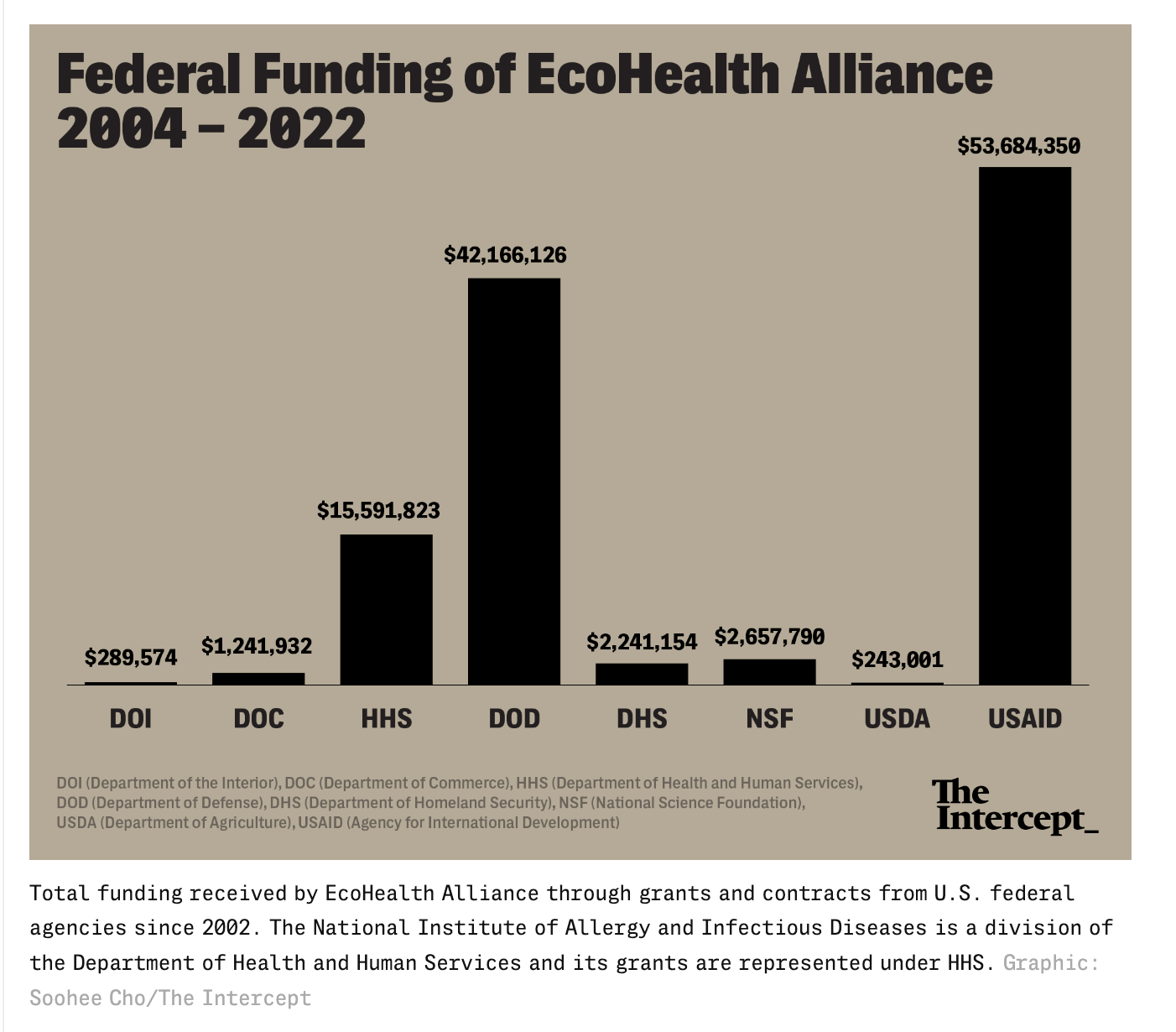
As RFK Jr. wrote, based on this information, in The Wuhan Cover-Up:
By far, Daszak’s largest funding pool was the CIA surrogate, the United States Agency for International Development (USAID). Through USAID, the CIA funneled nearly $65 million in PREDICT funding to EcoHealth between 2009 and 2020.
(p. 228, Kindle Edition)
Yet another article examining Daszak’s military/biodefense ties appeared in Independent Scientist News in December 2020, reporting that most of EcoHealth Alliance’s Pentagon funding “was from the Defense Threat Reduction Agency (DTRA), which is a branch of the DOD which states it is tasked to “counter and deter weapons of mass destruction and improvised threat networks.”
Furthermore,
The military links of the EcoHealth Alliance are not limited to money and mindset. One noteworthy ‘policy advisor’ to the EcoHealth Alliance is David Franz. Franz is former commander of Fort Detrick, which is the principal U.S. government biowarfare/biodefense facility.
The ISN article also provides a handy spreadsheet detailing EcoHealth funding.
So what is the Oversight Committee overlooking – and why?
There is no mention of DoD, DTRA or USAID funding in the Committee’s announcement or in the utterly performative, 100% toothless notice of suspension and debarment they sent to Peter Daszak. Does the U.S. House Committee on Oversight and Accountability not know who the major government funders of EcoHealth Alliance are?
If any agency can bypass the suspension and debarment by “determining that there is compelling reason” to fund EcoHealth, what is the point of those non-punitive consequences?
Why this charade of accountability when, in fact, the supposed overseers are willfully ignoring what’s actually going on?
Clearly, the Committee is not interested in investigating Daszak’s role in the biodefense industry that was responsible not just for the gain-of-function research that may have created SARS-CoV-2, but for the entire Covid pandemic response – which was most definitely not about public health and was, in fact, all about creating and administering the medical countermeasures which were the monomaniacal focus of the biodefense responders.
What to ask Peter Daszak if we had actual oversight
If the Committee were serious about investigating Peter Daszak and EcoHealth Alliance, here are some questions they would ask:
Non-public health funding sources and projects
- Most of the government funding for EcoHealth Alliance comes not from public health agencies but from USAID (State Department/CIA) and the Pentagon. What projects are these non-public health agencies funding? Are these projects related to biodefense/biowarfare research?
- Is the USAID and Pentagon-funded virus research conducted by EcoHealth and/or its partners intended primarily to prepare for naturally occurring pandemics or for potential biowarfare/bioterrorism attacks?
- Do the USAID and Pentagon-funded projects conducted by EcoHealth and/or its partners involve creating pandemic potential pathogens as part of biodefense/biowarfare research?
- Do you know or suspect that SARS-CoV-2 was an engineered virus created as part of a USAID and Pentagon-funded biowarfare/biodefense project?
- Do the USAID and Pentagon-funded projects conducted by EcoHealth and/or its partners involve work on medical countermeasures against potential biowarfare/bioterrorism agents?
Disease X op-ed
- On February 27, 2020, before the Covid pandemic had been declared and before anyone in the U.S. had died of Covid-19, you wrote an op-ed for The New York Times stating that the novel coronavirus was “Disease X.” You explained that the term Disease X was coined by you and a bunch of experts at the World Health Organization in 2018. In your report from 2018, it says:
“Disease X represents the awareness that a serious international epidemic could be caused by a pathogen currently not recognized to cause human disease. Disease X may also be a known pathogen that has changed its epidemiological characteristics, for example by increasing its transmissibility or severity.”
Why were you so sure, so early on, even before we knew there was a pandemic, that this was Disease X? What was it about SARS-CoV-2 (which, after all, was named as a direct successor of the original SARS, to which it was said to be very similar) that made it seem so uniquely dangerous to you? Why did you feel you had to warn the whole world about it on the pages of the NYT?
- Did you think SARS-CoV-2 was a known pathogen that had “changed its epidemiological characteristics” by “increasing its transmissibility or severity”? If yes, what made you think that?
- Did you think SARS-CoV-2 was a potential bioweapon that had been developed using funds from USAID and DOD by EcoHealth Alliance and/or its research partners in China or elsewhere?
- The New York Times has subsequently erased your Disease X op-ed from their online 2/27/2020 issue. You can only find it through the direct link. Why do you think they have made it all but impossible for anyone who doesn’t already know about the article to find it? Do you regret having written it?
Linking Disease X to genetic vaccine platforms
- In the NYT op-ed, you provided a link from the term “Disease X” to a 2018 CNN article in which Dr. Anthony Fauci says that, in order to combat such dangerous as-yet-nonexistent pathogens, “the WHO recognizes that it must “nimbly move” and that this involves creating “platform technologies.”
Fauci goes on to say that “scientists develop customizable recipes for creating vaccines. Then, when an outbreak happens, they can sequence the unique genetics of the virus causing the disease, and plug the correct sequence into the already-developed platform to create a new vaccine.”
That sounds an awful lot like the mRNA platform used for the Covid countermeasures that came to be known as the “mRNA vaccines.”
Why did you link to that particular article from your op-ed about disease X? Were you suggesting that the solution to the pandemic that you appeared to be predicting would be a genetic platform in which the “correct sequence” could be plugged to create vaccines?
- Were you already aware of the Covid mRNA vaccines being developed at the time of your op-ed (February 27, 2020) by Moderna and BioNTech/Pfizer, long before the official launch of Operation Warp Speed (May 2020)?
- Is it true that the Pentagon considered the mRNA platforms to be the preferred countermeasures against Covid-19, and that these were always intended to reach full funding and development, starting all the way back in January 2020?
- Was the USAID and Pentagon-funded research conducted EcoHealth and/or its partners related to the development of such mRNA vaccines? If so, how?
The need for a crisis to justify funding and development of genetic vaccine platforms
- In 2016, you participated in an Institute of Medicine working group on Rapid Medical Countermeasure Response to Infectious Diseases. The report quotes you as saying:
“Until an infectious disease crisis is very real, present, and at an emergency threshold, it is often largely ignored. To sustain the funding base beyond the crisis, we need to increase public understanding of the need for MCMs such as a pan-influenza or pan-coronavirus vaccine. A key driver is the media, and the economics follow the hype. We need to use that hype to our advantage to get to the real issues. Investors will respond if they see profit at the end of the process.”
It sounds like you’re saying we need the media to hype up a crisis so that investors will want to fund the type of pan-coronavirus vaccine that is exactly the genetic platform you highlighted in your op-ed, and also exactly the platform that emerged into public awareness shortly after your op-ed, and became known as the Covid mRNA vaccines.
Can you explain this uncanny overlap between your description of what was needed to get such platforms developed in 2016 and what actually happened in 2020?
- Did the USAID and Pentagon-funded research on coronaviruses conducted by EcoHealth Alliance and/or its partners support the development of such platforms? If so, how?
- Were you aware of a plan to use the emergence of SARS-CoV-2 as a trigger for the media hype, public-private funding, and massive mRNA vaccine development and deployment in early 2020 – exactly as you described them in 2016?
- If you were aware of such a plan, who was involved in it, and what was your role?
CONCLUSION
The U.S. House Committee on Oversight and Accountability has made a big show of publicly chastising Peter Daszak and EcoHealth Alliance for terrible behavior in the way they managed their funding from the NIH. The Committee has also highlighted very bad weaknesses in the grant making process of the NIH that need to be corrected.
As a result of the Committee’s recommendations, the HHS (parent agency of NIH) has issued a non-punitive notice to Peter Daszak, stating that EcoHealth cannot receive another penny of government funding… unless a government agency decides there is a compelling reason to provide such funding.
Clearly, all of the Committee’s investigations, reports, recommendations and notices in this matter are purely performative, considering 1) they actually impose no consequences, and 2) they ignore the fact that most of Daszak and EcoHealth’s funding come from military and state department sources for work on biodefense/biowarfare-related projects.
Is the Committee’s work just another example of bureaucratic incompetence and “waste, fraud and abuse” of our precious taxpayer dollars?
Or is it an intentional diversion, to distract us from the work the U.S. government was/is actually funding at bioweapons labs like the one in Wuhan, engineering pandemic potential pathogens and then deploying global public-private partnerships to develop medical countermeasures against those pathogens – all of which came together to create the catastrophe known as the Covid pandemic?
Fauci aide allegedly boasted about ability to ‘make emails disappear’ including ‘smoking guns’
By Emily Kopp | U.S. Right To Know | May 16, 2024
A longtime aide to former National Institute of Allergy and Infectious Diseases Director Anthony Fauci allegedly boasted in emails about his ability to evade public records requests and his intention to delete any potential “smoking guns,” a congressional hearing revealed Thursday.
Former National Institutes of Health Acting Director Lawrence Tabak testified before the House Select Subcommittee on the Coronavirus Pandemic, which has been investigating an American research organization at the center of suspicions that the COVID-19 pandemic may have resulted from a lab accident in Wuhan.
The hearing follows an announcement Wednesday that this organization — EcoHealth Alliance, helmed by President Peter Daszak — has had its federal funding suspended and could be on track to be debarred from federal funding for years. The enforcement action stems from EcoHealth’s failure to adequately oversee the research it subcontracted to the Wuhan Institute of Virology. This research included experiments that made SARS-related coronaviruses more dangerous. Daszak testified before the committee earlier this month.
EcoHealth’s research was underwritten by NIAID — placing Fauci and his aides in the spotlight too. The scrutiny of EcoHealth and NIAID has revealed that Daszak had a close connection to Fauci’s inner circle in the senior advisor to the NIAID director, David Morens.
Morens told the committee in a transcribed interview that Daszak is one of his oldest friends.
Now evidence has surfaced suggesting that Morens evaded the Freedom of Information Act — which requires that records from federal agencies be made public with limited exceptions — and that an unidentified public records official with the NIH helped him to do so.
NIH and NIAID did not immediately reply to request for comment.
Morens boasted about the ability to “make emails disappear” even after a FOIA request had been submitted, according to the committee.
The emails were revealed in questions by House Oversight Committee Chair James Comer, R-Ky.
“Dr. David Morens, a senior advisor to Fauci for decades, wrote in an email to Dr. Daszak, ‘I learned from our FOIA lady here how to make emails disappear after I am FOIA’d but before the search starts. So I think we are all safe. Plus I deleted most of those earlier emails after sending them to Gmail,’” Comer said Thursday. “Is that consistent with NIH document retention policies?”
“It is not,” Tabak answered.
Asked if the NIH FOIA office instructs employees on how to evade FOIA, Tabak answered, “I certainly hope not.”
U.S. Right to Know is among the organizations that have submitted FOIAs to the NIH for emails from Morens about information with potential relevance to the origins of COVID-19 and is litigating against the NIH over its failure to comply with a January 2022 FOIA request for Morens’s records.
In a separate email, Morens said that he intended to delete any records or emails that might constitute a “smoking gun.”
“He also later wrote Dr. Daszak, ‘We are all smart enough to know to never have smoking guns. And if we did we wouldn’t put them in emails. And if we found them we would delete them,’” Comer said. “Is that consistent with NIH document retention policies?”
“It is not,” Tabak again replied.
According to Comer, Daszak and Morens also collaborated in crafting public messages in response to emails set to be released by NIH under FOIA.
The emails described by Comer undermine Tabak’s prepared testimony at the hearing in which he claimed the NIH is committed to transparency and following the science on the question of the origin of the COVID-19 pandemic.
Tabak’s testimony sets the stage for Morens to testify next week. Morens supplied the committee with 30,000 emails the day before Daszak testified before the committee on May 1.
Morens wrote in an email to Daszak in 2021 that he communicates on Gmail “because my NIH email is FOIA’d constantly,” The Intercept previously reported.
“Just send to any of my addresses and I will delete anything I don’t want to see in the New York Times,” Morens wrote.
Looped into this email chain were several virologists who have cast the lab origin hypothesis as a conspiracy theory in the press. These virologists included University of Sydney virologist Edward Holmes, Scripps Institute virologist Kristian Andersen, and Tulane University virologist Robert Garry, who have also been investigated by the committee for their role in an influential paper that dismissed the idea SARS-CoV-2 could have been engineered without disclosing the involvement of Fauci and former NIH Director Francis Collins.
The committee released emails earlier this month showing that Daszak informed Morens of his intention to voluntarily release only enough records to stave off a subpoena for more. The committee is now demanding more documents from Daszak, according to Subcommittee Chair Brad Wenstrup, R-Ohio.
The committee’s investigation is building up to the testimony of Fauci on June 3.
Tabak confirmed Thursday that the NIAID did indeed fund gain-of-function research on coronaviruses in Wuhan through EcoHealth Alliance according to the colloquial understanding.
According to the policy in place from 2014 to 2018 — the “U.S. Government Gain-of-Function Deliberative Process and Research Funding Pause on Selected Gain-of-Function Research Involving Influenza, MERS, and SARS viruses” — the definition of gain-of-function research at the time of the experiments involving the Wuhan Institute of Virology included “research that improves the ability of a pathogen to cause disease.”
Grant reports demonstrate that “chimeric” or combined coronaviruses studied by EcoHealth and the Wuhan Institute of Virology caused more severe disease in mice engineered to express human receptors than the backbone virus.
However, Tabak downplayed the risk posed by these chimeric viruses because they were bat coronaviruses, though the public literature described one of these viruses as “poised for human emergence.”
Fauci repeatedly denied that NIAID funded gain-of-function research in Wuhan in high-profile exchanges with Sen. Rand Paul, R-Ky., in 2021.
“Sen. Paul, you do not know what you are talking about, quite frankly, and I want to say that officially,” Fauci said in a July 2021 hearing.
Tabak confirmed in the hearing Wednesday that in October 2021 the NIH communications office changed the definition of “gain-of-function research” on the NIH website.
Asked to identify which scientist at NIH made or vetted the decision, Tabak could not identify any particular official.
SARS2 Fingerprint Found In 2018 Proposal
Synthetic assembly method posited in 2022 paper found in DEFUSE draft
BY JOHN LEAKE | COURAGEOUS DISCOURSE | JANUARY 29, 2024
There’s a great scene in the 1986 film Manhunter in which the protagonist—an FBI behavioral sciences profiler named Will Graham—correctly postulates that the fingerprints of a remarkably twisted serial killer will be found on the corneas of his female victim. The Bureau and the guys in the latent print lab are skeptical and think that Will is himself being a weirdo, and are then astonished to discover that he is right.
To put Will Graham’s character in Jungian terms: he is an excellent detective because he possesses a keen understanding of the Shadow—that is, the archaic, aggressive, lustful, power-hungry side of human nature that lurks in all of us. All humans are capable of evil, above all those who walk around with the smug, unexamined belief that they never would be.
I was reminded of this scene today as I read an extraordinary report by “Right to Know” investigative reporter, Emily Kopp, who obtained early drafts of the DEFUSE grant proposal, authored by EcoHealth Alliance President Peter Daszak et al., and submitted to the Defense Advanced Research Projects Agency (DARPA) in 2018.
I highly recommend reading Kopp’s report, titled US scientists proposed to make viruses with unique features of SARS-CoV-2 in Wuhan. The following passage goes to the heart of the matter:
The documents reveal for the first time that a virologist working with the Wuhan lab planned to engineer new spike proteins – in contrast with the collaboration’s public work to insert whole spike proteins into viral backbones. Language in the proposal indicates this work may have involved unpublished viruses, generating unpublished engineered spike proteins.
This American virologist, University of North Carolina Prof. Ralph Baric, was set to engineer twenty or more “chimeric” SARS-related viral spike proteins per year of the proposal, and two to five full-length engineered SARS-related viruses. Documents previously reported by U.S. Right to Know show that some of the experimentation could secretly occur in Wuhan at a lower biosafety level than specified in the grant, apparently to save costs.
The proposal for Professor Baric to perform Dr. Frankenstein work on SARS-related viruses will come as no surprise to those who are familiar with his seminal papers on creating chimeric SARS-related viruses using gain-of-function procedures. The real fireworks revelation in an early draft of the DEFUSE proposal is the following passage:
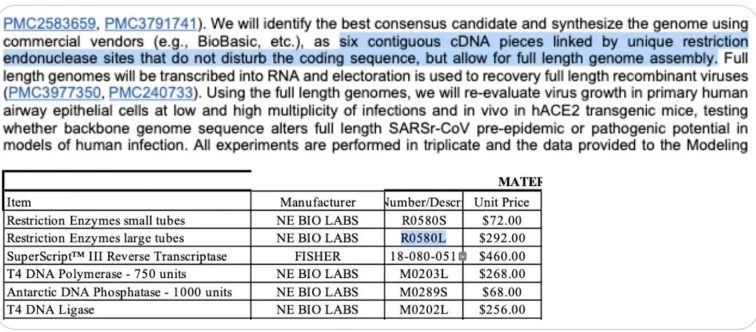
The passage highlighted in blue is PRECISELY the assembly procedure posited by Valentin Bruttel, Alex Washburne, and Antonius VanDongen in their 2022 paper titled Endonuclease fingerprint indicates a synthetic origin of SARS-CoV-2. Daszak et al. even propose purchasing the same restriction enzyme that Valentin et al. hypothesized was used in the lab synthesis of SARS-CoV-2. (Valentin’s Twitter commentary on the draft proposal fascinating and entertaining).
At the time Bruttel et al. published their paper, it was met with ridicule by prominent virologists Edward Holmes and Kristian Anderson, who called it “confected nonsense” and “kindergarten molecular biology.” Holmes and Anderson would say this, wouldn’t they? With stunning criminal energy, they have been key players in concealing the lab origin of SARS-CoV-2 since February 2020.
At the risk of tooting my own horn, I was not all surprised to read about this development. As a true crime author, I’ve spent the last twenty-five years studying criminal behavior, conspiracies, and criminal investigations. For years, Peter Daszak and his virologist compadres have obviously been in the business of modifying and enhancing bat coronaviruses in order to make them infectious and pathogenic to humans. I suspect the creation of SARS-CoV-2 and its accidental or deliberate release from a lab will eventually be regarded as the greatest true crime story in history.
It’s going to take a while for our dummy politicians and knucklehead mainstream media journalists to recognize it, “but at the length, truth will out.”
Plan to Build NIH-Funded Bat Research Lab in Colorado Sparks Fears of Lab Leak
By Michael Nevradakis, Ph.D. | The Defender | May 18, 2023
Colorado State University (CSU) is proceeding with controversial plans to construct a new research facility to study bat diseases with funding from the National Institutes of Health (NIH). Construction is slated to be completed sometime in 2024 or 2025.
University officials and proponents of the new facility argue the laboratory is necessary to enhance research capabilities looking into emerging diseases and viruses resulting from zoonotic — animal-to-human — transfer.
While CSU denies that gain-of-function research will occur at the laboratory, some researchers connected with the new facility previously were associated with actors involved with such research, including experiments conducted in Wuhan, China.
Francis Boyle, J.D., Ph.D., a bioweapons expert and professor of international law at the University of Illinois, is concerned about the facility.
Boyle told The Defender :
“It is well known that Colorado State University has a long and ongoing history of specialization in weaponizing insects with biowarfare agents for delivery to human beings.
“This new lab will magnitudinally increase CSU’s offensive biowarfare capabilities, in gross violation of the Biological Weapons Convention of 1972 and my Biological Weapons Anti-Terrorism Act of 1989 that provides for life in prison.”
Area residents, including a local grassroots group, and bioweapons experts, also have raised concerns over the potentially risky research, involving deadly viruses, that will be conducted at the facility and the risk of a lab leak akin to that which may have occurred at the Wuhan Institute of Virology in China, and may have led to escape of the SARS-CoV-2 virus.
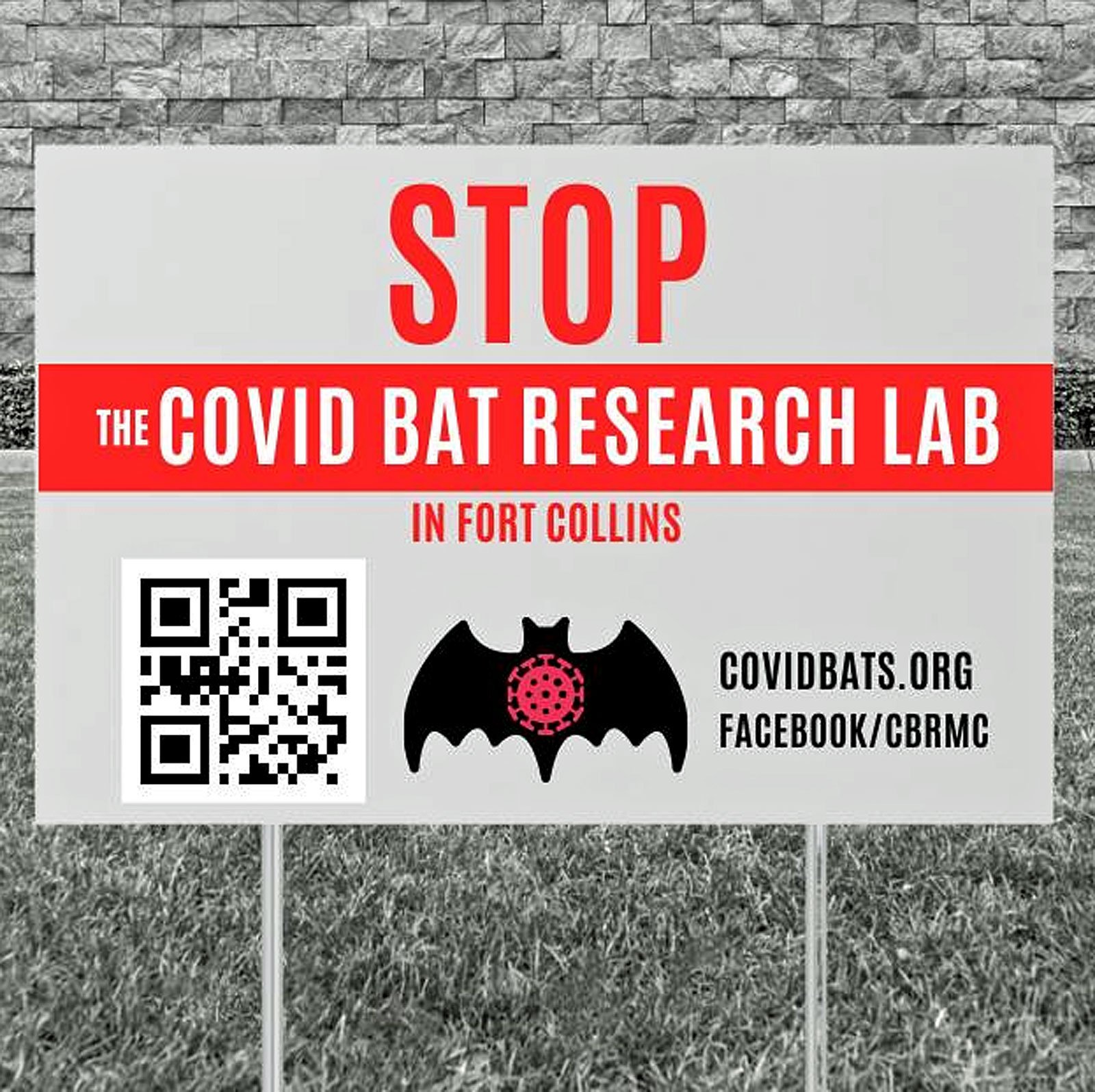
Christine Bowman leads a group of local citizens who formed the Covid Bat Research Moratorium of Colorado (CBRMC), a grassroots initiative opposing the new facility. The group has launched efforts such as a yard sign campaign to raise local awareness.
In an interview with The Defender, Bowman described being “stonewalled” by state and local officials and by CSU.
“We need answers as to how COVID-19 was modified to transfer from human to human before I will be satisfied that it’s okay to raise diseased bats to study in my neighborhood,” Bowman said.
“Now that we know that the COVID pandemic likely started from a lab leak in Wuhan, China, we are questioning the safety of continuing such research,” she added.
CSU receives ‘tens of millions of dollars’ in NIH research grants annually
According to The Colorodoan, the Chiropteran Research Facility, as it will be known, “would serve as a breeding facility to raise and care for bats of various species that can be used as research models in studies on a wide range of human viruses that are believed to have originated with bats.”
The laboratory will be constructed on the south end of CSU’s Foothills Campus near Fort Collins, at 3105 Rampart Road, within the Justin Harper Research Complex and adjacent to the university’s existing Center for Vector-Borne Infectious Diseases (CVID). It will consist of a 14,000-square-foot stand-alone bat vivarium.
According to CSU, the university “is a world leader in research on zoonotic infections. The University’s scientists have been studying bats and other vectors that transmit dengue fever, Zika and West Nile viruses for more than 30 years.”
Construction is scheduled to begin by this summer. The Colorodoan reported the facility is expected to open in fall 2024, while CSU said it will be completed by 2025.
CVID, formerly known as the Arthropod-born and Infectious Diseases Laboratory, was founded in 1984. According to The Colorodoan, it “currently houses the only captive breeding colonies of two species of bats used in its research.”
CVID’s website describes the facility as “a longstanding multi-disciplinary research and training center” whose researchers “have been successful in defining mechanisms of pathogen persistence and transmission, and developing new surveillance, control, and prevention strategies for vector-borne and emerging zoonotic diseases.”
“World-class facilities, including BSL-3 [biosafety level 3] laboratories and large insectary complexes, provide an outstanding scientific environment for researchers inside and outside CSU wanting to manipulate pathogens in vertebrate hosts and arthropod vectors,” the CVID website states.
The BSL3 laboratory in question is CSU’s Regional Biocontainment Laboratory, which operates with the support of the National Institute for Allergy and Infectious Diseases (NIAID) and is part of the university’s 120,000-square-foot Infectious Disease Research Center. It houses bats and samples of numerous deadly bacteria and viruses.
In October 2021, the NIH awarded a $6.7 million grant to CSU’s microbiology, immunology and pathology department at the College of Veterinary Medicine and Biomedical Sciences to construct the new bat vivarium.
Alan Rudolph, CSU’s vice president for research, told The Coloradoan the university will provide the remaining funds for the facility’s construction, the cost of which is expected to range between $8-9 million.
Rudolph said CSU receives “tens of millions of dollars” in NIH research grants annually.
‘Highly pathogenic’ agents will be housed at new facility
The CVID already conducts research involving viruses related to “chikungunya, dengue, malaria, Rift Valley fever, Zika virus, COVID-19, MERS, influenza [and] hantavirus disease.” The new facility will expand those capabilities.
According to the minutes of the Feb. 3, 2022, meeting of CSU’s Board of Governors, the new facility is justified due to the capacity it will have to study “emerging zoonotic viruses that originate in bats and cause high mortality in humans: SARS-CoV, MERS-CoV and SARS-CoV-2, Ebola virus, Marburg virus, Nipah virus and Hendra virus.”
It is unclear under what biosafety level the new facility will operate, but Bowman told The Defender :
“From what I understand, this facility is slated to be a BSL2. But what’s to keep that from increasing in the future without approval or informing the general public? What guarantee do the residents of Fort Collins have that the lab won’t increase from a BSL2 to BSL4, where even more dangerous viruses will be studied?”
CSU claims it “has no plans to conduct gain-of-function research of concern” there.
“Who decides what criteria we use for ‘concern’?” Bowman asked.
Rebecca Moritz, CSU’s biosafety director, said, “This will be the only facility like it in the United States,” and it will give students “the opportunity to learn directly from the researchers conducting this research in their classes.”
She added:
“CSU researchers have safely studied and worked with bats and other vectors for over 30 years. … Due to global warming and population growth, humans and animals are coming into contact more frequently and in ways not previously seen. This could result in an increased number of outbreaks and possibly pandemics.
“The main purpose of this facility will be to house bat breeding colonies for CSU researchers and researchers around the United States and the world. This facility will allow an expansion of CSU’s current work, including projects focusing on the role that bats play in disease transmission and the development of vaccines and therapeutics.”
“Personnel who will work in this facility will be highly trained and be required [to] adhere to strict biosafety and biosecurity practices,” Moritz claimed.
Moritz has spoken publicly about her involvement with gain-of-function research, including at the 2014 Gain of Function Symposium. At the time, Moritz was part of the Biosecurity Task Force at the University of Wisconsin-Madison.
Bowman said gain-of-function experiments are already being conducted at CSU and that the university is open about it.
“We are only aware that CSU is conducting gain-of-function on plants and mosquitoes because it is mentioned in the link they send to anyone who emails them or questions their research.”
Rudolph told The Colorodoan, “Bat research is not new to our campus; bat-research facilities are not new to our campus. It’s an expansion of existing work in existing facilities that have already made great impacts.”
Such research “helped us to develop vaccines, helped us to develop diagnostics to better determine who’s getting sick, why are they getting sick, when are they getting sick, and vaccines that help treat those people when they do get sick,” he added.
Some of the viruses for which research will be conducted at the new facility, including Hendra and Nipah, are considered “highly pathogenic BSL-4 agents,” classified “in the same biosecurity category as Ebola.”
The Nipah virus, for instance, has a high human mortality rate ranging between 40 and 75%. It “causes a rapidly progressive disease, which includes acute respiratory infection and encephalitis that can lead to coma or death.”
Earlier this month, the NIH reinstated a controversial federal grant, originally issued in 2014 under Dr. Anthony Fauci, then-director of NIAID, which operates under the NIH, to EcoHealth Alliance to study the risk of bat coronavirus spillover.
This involved gain-of-function research for the genetic manipulation of coronaviruses to make them more infectious to humans. Some of the NIH funds went to the Wuhan Institute of Virology, which collaborated with EcoHealth Alliance on this research.
EcoHealth is a New York-based nonprofit that says its mission is to develop “science-based solutions to prevent pandemics and promote conservation.”
Documents revealed by U.S. Right to Know (USRTK) indicate that some CSU researchers have previously collaborated with the EcoHealth Alliance.
Local activists ‘stonewalled’ by university, state, local officials
According to The Colorodoan, CSU’s campus planner, Gargi Duttgupta, told local authorities that the new facility would be approximately 316 feet north of the fence that marks the campus’ boundary with adjacent residential communities.
This may be too close for comfort for some area residents, who have attempted to engage with CSU and with local planning authorities to express opposition to the new facility and to obtain further information about its construction.
Their opposition led to the establishment of CBRMC, “a nonpartisan grassroots organization run on a budget of $0 by a group of concerned citizens from across the political spectrum.”
CBRMC says its mission is to put a moratorium on the construction of the new facility “until we first know what happened with the possible COVID bat lab leak and gain-of-function research in Wuhan, China.”
Some CBRMC members spoke at a Dec. 21, 2022, meeting of the Larimer County Planning Commission, expressing fears of a potential leak from the new facility, drawing comparisons with the suspected Wuhan lab leak.
But the planning commission unanimously approved the project. Lesli Ellis, Larimer County’s community development director, told The Colorodoan that no further approvals are needed before construction can commence.
According to The Colorodoan, “CSU officials insist that the new facility is merely an extension of work that has been done on its Foothills Campus for more than 30 years by the university and others, including the U.S. Centers for Disease Control and U.S. Department of Agriculture.”
The CSU Foothills Campus houses labs operated by the U.S. Department of Agriculture National Wildlife Research Center and the Rocky Mountain Prevention Research Center — described as the “second-largest CDC lab outside of Atlanta.”
“Strict safety protocols will be in place to prevent the escape of a virus or infected bat,” The Colorodoan also reported.
Rudolph told The Colorodoan the facility will need only dozens to hundreds — not thousands — of bats, which will be acquired by the U.S. government, “quarantined well outside the United States and deemed safe and not sick before they come to us.”
CSU does ‘not have a good track record’ on safety
A Jan. 11 CSU “Q&A on why CSU labs are safe” denies that illegal bioweapons research will take place at the institution and quotes Moritz, who said, “We do everything possible to decrease the risks of our research.” However, she acknowledged “there is no such thing as zero risk in research.”
Bowman said CSU alone will oversee safety at the new facility, and she questioned the lab’s safety record.
Bowman told The Defender :
“After letting chronic wasting disease [CWD] leak from their labs at CSU, hundreds of thousands of the deer population were killed from the disease. They do not have a good track record of ensuring the safety or containment of diseases.
“I personally do not have the data for this claim, but I have heard many people cite this as fact and no one at CSU is refuting the claim.”
CWD, “a contagious neurological disease that affects members of the deer family, causing erratic behavior and weight loss that eventually results in death,” was identified in 1967. It is described as “a mysterious malady intricately tied to Fort Collins.” The federal government declared a CWD state of emergency in 2001.
The Colorodoan reported that CWD “was related to scrapie in sheep and goats, mad cow disease in cattle and the fatal variant Creutzfeldt-Jakob disease in humans.”
As reported by Northern Colorado NPR affiliate KUNC, “Chronic wasting disease is not your garden variety infectious disease. It’s not bacterial, viral or even fungal. It’s caused by something we all have inside our bodies — something called prions.”
CSU is home to the Prion Research Center, which “studies the biochemistry, genetics, and pathogenesis of prions, the causative agent of incurable and often fatal diseases in humans and animals,” including bovine spongiform encephalopathy, classic Creutzfeldt-Jakob disease, variant Creutzfeldt-Jakob disease, CWD and scrapie.
According to the Prion Research Center, “Growing evidence also links the prion mechanism to proteins involved in the pathogenesis of other common neurodegenerative diseases, including Alzheimer’s and Parkinson’s, and forms an emerging area of the center’s studies.”
And in 2019, CSU reported that Prion Research Center scientists “have developed a new gene-targeted approach” to study CWS in mice. Described as a “real breakthrough,” the scientists “replaced the gene that encodes the prion protein in the mouse and replaced it with an exact replica of the code from either deer or elk.”
Researchers who spoke to The Colorodoan said that while it’s unclear if CWD originated in Fort Collins, it is hypothesized that it crossed species and spread there.
A U.S. Geological Survey map shows a significant cluster of CWD near Fort Collins and that cases identified elsewhere have been connected to the region.
A 2021 paper, “Text mining to identify the origin of chronic wasting disease,” published in the Issues in Information Systems journal, states:
“For the 16 [CWD] clusters in the first 40 years, the text mining process generated evidence supporting the trace back to Fort Collins for the first six clusters, five more clusters could be traced back to infected area linked to Fort Collins, and in 5 clusters the evidence supported an explanation for tracing the disease back to an area linked to Fort Collins.
“The evidence does not definitively exclude other theories for the disease origin. At minimum, Fort Collins was a primary catalyst in the widespread distribution of the disease.”
The paper noted, “As with COVID-19, government agencies can be reluctant to acknowledge potential culpability for releasing a devastating disease,” adding that “Ignoring the likely origin of this disease discounts the lax management of captive animals that has been the driving force for this biological disaster.”
Locals getting mixed messages from CSU officials
Local activists are concerned about a lack of communication between CSU officials, local authorities and the community, and contradictory statements they have received from CSU.
According to the CBRMC, CSU “gave citizens short notice on Nov. 30, 2022” about the public hearing, which was “held on the inconvenient date of Dec. 21, 2022 — snuck into holiday break.”
Since then, CSU has “not conducted any informational meetings with the public regarding their proposed research lab,” the CBRMC says on its website.
Bowman said a fact sheet about the facility was distributed at the meeting, stating that “SARS-CoV, SARS-CoV-2, MERS-CoV, Ebola virus, Marburg, Nipah virus and Hedra virus” would be studied at the lab, confirming information included in the February 2022 CSU Board of Governors report.
However, according to Bowman, Moritz said at the public hearing, “At this facility, we will not be able to study MERS, SARS-CoV-2 [or] Ebola viruses.”
“So, which is it, are they proposing to study these diseases in our backyard or not?” Bowman asked.
Bowman noted that the same fact sheet contains “a photo displayed prominently on the front with a person’s gloveless hand holding a bat.” She remarked:
“When you are touting the strength of your ability to do dangerous bat research with safety first and foremost, maybe you shouldn’t incorporate a photo of an irresponsible way to handle a bat.
“Couldn’t this be one way bat diseases transmit to humans and is proving our point that bats and humans shouldn’t mix, especially in a lab setting?”
An April 5 email from Greg Harrison, CSU associate vice president of Strategic Communications, to Bowman, said, “We do not have any public meeting about the facility scheduled at this time.”
This was despite a Jan. 24 email from Moritz to Bowman saying CSU was “working on a process to engage the public this spring to discuss the project and lab safety and security, as well as our commitment to the wellbeing of people in Colorado and around the world.”
Both emails are posted in CBRMC’s Facebook group. In the same group, Bowman referenced a March 15 Town Hall meeting with Sen. John Hickenlooper (D-Colo.) where the issue was to be raised. According to Bowman, “Sen. Hickenlooper chose not to answer any [questions] re: concern over CSU’s COVID bat lab.”
Bowman said this was not the only instance where elected officials ignored the concerns of local residents. She told The Defender :
“The community has been sending this information to our elected officials, who have also stonewalled us. I got no response from Sen. Hickenlooper.
“The response I got from Sen. Michael Bennet [D-Colo.] spoke about diversity, equity and inclusion and did not address the subject of bat research at all. The mayor of Fort Collins [Jeni Arndt] says that it is not in her jurisdiction and was uninterested.”
Bowman said that local residents deserve answers. She told The Defender :
“I believe that the residents of this county, state, and this country deserve answers to our questions regarding any potential danger to the public from this type of research considering the mayhem and destruction that the COVID virus unleashed on mankind.
“We do not want a repeat, and I think we should be allowed to have some say in what happens in our backyard. The fact that CSU is stonewalling their neighbors speaks volumes.”
Collaboration between CSU scientists, NIH, EcoHealth Alliance on bat viruses
Documents obtained by USRTK following several Freedom of Information Act requests indicate that plans for the new facility date back prior to receipt of the NIH grant in 2021, while key figures involved with the laboratory are connected to the EcoHealth Alliance and prior research involving SARS-CoV-2.
According to USRTK, the documents reveal that in February 2017, personnel of the U.S. Department of Defense’s Cooperative Biological Engagement Program “announced a new global bat alliance,” which would “build and leverage country and regional capabilities to generate an enhanced understanding of bats and their ecology within the context of pathogens of security concern.”
This new alliance was a collaboration between CSU, EcoHealth Alliance and the NIH’s Rocky Mountain Laboratories with the goal of building a bat research facility at CSU.
USRTK’s documents reveal that this original alliance grew into a group which became known as Bat One Health Research Network, whose scientists, including CSU and Rocky Mountain Laboratories researchers, were developing “scalable vectored” and “self-disseminating” vaccines to spread contagiously between bats.
These vaccines are purportedly aimed at preventing “emergence and spillover” of potential pandemic viruses from bats to humans. However, at least as far back as 2020, concerns were raised about the unintended consequences of releasing genetically engineered self-spreading “vaccines” into the wild.
Bat One Health also harkens to the “One Health” concept, which purports to serve as “an integrated, unifying approach that aims to sustainably balance and optimize the health of people, animals and ecosystems,” but which some experts have argued lowers human health to the level of animals and aims to surveil and control all life on Earth.
Notably, the term “One Health” is said to have first been coined by the EcoHealth Alliance, which today is a strong proponent of this concept.
A March 30, 2020, email obtained by USRTK, from Tony Schountz, Ph.D., associate professor in CSU’s Department of Microbiology, Immunology and Pathology, to Jonathan Epstein, vice president for Science and Outreach at EcoHealth Alliance, discusses the importation of bats and rats infected with dangerous pathogens such as the Lassa virus.
In another set of emails from 2018, Schountz communicated with scientists from the Wuhan Institute of Virology. In an Oct. 30, 2018, email, Schountz proposed a “loose association” between CSU and the Wuhan lab, involving “collaboration on relevant projects” involving bat-borne viruses and arboviruses.
Indicating the connection between the research planned to take place at the new facility, and COVID-19, Rebekah Kading, Ph.D., assistant professor in CSU’s Department of Microbiology, Immunology and Pathology, said, “This facility is especially timely considering the current COVID-19 pandemic, since some groups of bats have an evolutionary association with coronaviruses.”
According to CSU, the university has a partnership with Zoetis, which it describes as “the world’s leading animal health company,” “for the construction in 2020 of an incubator research lab in the Research Innovation Center on the Foothills campus.”
Zoetis was previously Pfizer Animal Health, before separating from Pfizer in June 2013.
Big Pharma, NIH interested in developing vaccines related to viruses to be researched at new CSU facility
Big Pharma has shown interest in developing mRNA vaccines targeting many of the same deadly pathogens that will be researched at CSU’s new facility.
For instance, in July 2022, Moderna announced the launch of its Phase 1 clinical trial of the mRNA-1215 vaccine candidate, “designed to fight the Nipah virus.” The vaccine was developed in collaboration with NIAID’s Vaccine Research Center.
In an NIH statement, Fauci said “Nipah virus poses a considerable pandemic threat because it mutates relatively easily, causes disease in a wide range of mammals, can transmit from person-to-person, and kills a large percentage of the people it infects,” adding that “The need for a preventive Nipah virus vaccine is significant.”
Efforts to develop a Nipah virus vaccine date back to at least January 2017, when CEPI (Coalition for Epidemic Preparedness Innovations) issued a call for proposals for the development of vaccines for the Nipah and Lassa viruses and MERS, soon after its official launch at that year’s meeting of the World Economic Forum.
EcoHealth Alliance researchers have long shown interest in viruses such as Nipah. A 2006 article in the Current Infectious Disease Reports journal titled “Nipah virus: impact, origins, and causes of emergence” was co-authored by Epstein, for instance.
At the time, Epstein was affiliated with the Consortium for Conservation Medicine, which later merged with the Wildlife Trust to become the EcoHealth Alliance.
Michael Nevradakis, Ph.D., based in Athens, Greece, is a senior reporter for The Defender and part of the rotation of hosts for CHD.TV’s “Good Morning CHD.”
This article was originally published by The Defender — Children’s Health Defense’s News & Views Website under Creative Commons license CC BY-NC-ND 4.0. Please consider subscribing to The Defender or donating to Children’s Health Defense.
Former Director Of National Intelligence Admits That Fauci Lied About Gain Of Function Research
By Tyler Durden | Zero Hedge | April 19, 2023
Only two years ago numerous alternative media sources including Zero Hedge were accused of spreading “conspiracy theories” and false information relating to the origins of the Covid-19 virus. Specifically, anyone who dared to suggest that the Level 4 virology lab in Wuhan, China (right across town from covid ground zero) might be the source of the outbreak, faced outright censorship on social media. The question many people should have been asking is: “Why?” – Why was the censorship so aggressive over clearly reasonable investigations into Wuhan lab operations?
Not only that, but why were the denials and spin from officials like Anthony Fauci so swift? Why not simply examine the evidence instead of dismissing it out of hand?
The real reason for the campaign to silence discussion on the Wuhan lab becomes evident as the connections between Fauci, the NIH and the lab are revealed. Elements of the US government including Fauci were in fact bankrolling gain of function research on coronaviruses at Wuhan, and shielding it from government oversight. It is undeniable. If one accepts that the most likely source for the covid pandemic was the Wuhan laboratory then one must also accept that Fauci and his associates helped to create the pandemic.
Fauci lied about these connections incessantly under oath. Here is Anthony Fauci defending his initial lie to Congress using further lies during questioning by Sen. Rand Paul:
Evidence of the research includes documents from the Department of Defense (obtained by Project Veritas ) which confirm that EcoHealth Alliance approached DARPA in 2018 about gain of function research on bat borne coronaviruses under a proposal called Project Defuse. DARPA rejected the proposal on the grounds that it did not outline the risks of such experimentation and violated a moratorium on gain on function research. EcoHealth then went to Fauci and the NIH for funding, and Fauci was quick to support it using the labs in Wuhan.
Documents from the NIH itself also show that the group engaged in gain of function research at Wuhan focusing on developing coronaviruses that could be transferred from animals to humans. Fauci was aware of this research by at least 2021 (and was likely involved from the very beginning) and yet continued to lie about NIH involvement.
Meanwhile, the National Pulse – which has done multiple deep-dive investigations on the topic, uncovered in May of 2001 that the WIV scrubbed all mention of its partnership with the NIH from their website.
Scrutiny over Fauci’s disinformation campaign may be too little too late, and we have to wonder if the man will ever face consequences for his actions. However, the exposure of Fauci and the NIH is so overwhelming that the former Director of National Intelligence now admits that Fauci misled Congress and the American public.
Hopefully, this revelation will help to discourage people from blindly following the claims of government bureaucrats during the next manufactured global crisis.
Bill Passed by House and Senate to Declassify COVID Origins Documents May Be Attempt to ‘Frame’ China
By Michael Nevradakis, Ph.D. | The Defender | March 13, 2023
Lawmakers and media misrepresented a bill requiring the declassification of documents related to the origins of COVID-19, according to several experts who warned that contrary to what the public was told, the legislation limits the types of documents the government must declassify — raising questions about the bill’s real intent.
According to the sponsors of the COVID-19 Origin Act of 2023 — which sailed through the U.S. Senate and the House of Representatives and is awaiting President Biden’s signature — the bill requires the government to declassify all documents pertaining to COVID-19.
But experts interviewed by The Defender said the bill requires the declassification only of documents related to the Wuhan Institute of Virology in Wuhan, China — the epicenter of the “lab leak theory.”
They suggested the limitations may be intended to reduce the culpability of U.S. and private actors in the potential leak of — or development of — COVID-19, by placing full blame on China and the Wuhan Institute of Virology.
Bill’s backers made ‘false claims’
Independent journalist Sam Husseini said Sen. Josh Hawley (R-Mo.), the Senate’s co-sponsor of the COVID-19 Origin Act, made “claims about the bill which are false.”
Hawley, on March 1, tweeted:
Speaking to Fox News March 2, Hawley made similar claims, saying, “My bill … will declassify all of the information the federal government has on COVID origins.”
Hawley later followed up his statements with a letter addressed to Chinese President Xi Jinping, informing him of the bill’s passage. This prompted a response from the Chinese government, according to The Gateway Pundit.
Another of the bill’s Senate co-sponsors, Sen. Mike Braun (R-Ind.), said in a statement:
“The American people deserve transparency, free from censorship or spin. It’s time to declassify everything we know about COVID’s origins and the Wuhan Institute of Virology, now.”
Braun also tweeted:
Rep. Mike Turner (R-Ohio), who chairs the House Intelligence Committee, told the House:
“The American public deserves answers to every aspect of COVID-19 pandemic including how this virus was created, and specifically whether it was a natural occurrence or was the result of a lab related event.”
Statements like these led media outlets, including The Defender, to report that if passed, the will would trigger the release of all documents — not just those related to the Wuhan Institute of Virology.
Bill ‘dubiously named’
On his blog, Husseini said the COVID-19 Origin Act is “dubiously named” and instructs Director of National Intelligence Avril Haines only to:
“Declassify any and all information relating to potential links between the Wuhan Institute of Virology and the origin of the Coronavirus Disease 2019 (COVID-19), including (A) activities performed by the Wuhan Institute of Virology with or on behalf of the People’s Liberation Army [of China].”
“This means that information not related to the Wuhan Institute of Virology is not being requested and would almost certainly therefore remain classified,” Husseini wrote.
The bill also states:
“There is reason to believe the COVID-19 pandemic may have originated at the Wuhan Institute of Virology …
“… the Director of National Intelligence should declassify and make available to the public as much information as possible about the origin of COVID-19 so the United States and like-minded countries can —
“(A) identify the origin of COVID-19 as expeditiously as possible, and
“(B) use that information to take all appropriate measures to prevent a similar pandemic from occurring again.”
The bill requires Haines to turn over the declassified evidence “no later than 90 days after the date of the enactment of this Act” and to submit to Congress an unclassified report containing all the documents requested in the bill, with “only such redactions as the Director determines necessary to protect sources and methods.”
Husseini noted that parts of the bill are unusually specific, focusing “on one strain of alleged evidence” by calling for Haines to turn over classified documents pertaining to “researchers at the Wuhan Institute of Virology who fell ill in autumn 2019.”
“Now, that could be very important,” Husseini wrote. “But why is this legislation limiting disclosures?”
A ‘classic Nixonian limited hangout’?
Husseini suggested some members of Congress may not have been fully aware that the bill they were voting for does not appear to, in fact, fully declassify all documents related to the origins of COVID-19.
“I have no idea if members of Congress have actually read the legislation and realize how limited it is,” wrote Husseini, who, in another post, called Hawley’s public rhetoric regarding the bill “false and misleading.”
Husseini told The Defender the bill may be acting as a “limited hangout” with the purpose of acknowledging the “lab leak theory” on the one hand, but via legislation that “makes us accept half of the truth.”
Francis Boyle, J.D., Ph.D., professor of international law at the University of Illinois, told The Defender, “I’m afraid this [bill] is going to be a classic Nixonian limited hangout” that “does not call for the declassification of all those sources [that] should be declassified and/or released.”
Boyle said any information that is declassified “is going to be helpful,” but that the bill’s provision allowing redactions raises concern.
“Who knows what Avril Haines is going to knock out of this report,” he said.
Husseini noted that the bill also makes no provisions for providing information that several groups, including U.S. Right to Know and some media organizations, have requested — but not yet received — via Freedom of Information Act (FOIA) submissions. Husseini said this information “is not classified but is being withheld.”
Husseini cited Gary Ruskin, executive director and co-founder of U.S. Right to Know, who said:
“Much of the federal government’s information related to the origins of Covid-19 is not classified, or likely not classified. We just haven’t been able to access much of it yet via FOIA/FOIA litigation.
“The NIH’s [National Institutes of Health] conduct in stonewalling FOIAs is especially outrageous. It’s time for the Biden administration to tell NIH to comply with the FOIA.”
At a March 9 U.S. Department of State press conference, Ned Price, the agency’s spokesperson, appeared to stonewall Husseini when he asked why the government hasn’t responded to U.S. Right to Know’s FOIA requests related to government funding of bioweapons agents’ discovery research, including the funding of such research in China.
“We can respond in writing on a question that specific,” Price replied. When further pressed by Husseini, Price said, “I would ask that you be respectful of your colleagues.”
An attempt to blame the virus exclusively on China?
There has been a flurry of news reports in recent weeks originating from various branches of the U.S. government indicating broader acceptance of the “lab leak theory.”
The U.S. Department of Energy said it now believes COVID-19 most likely emerged from the Wuhan lab — a position subsequently adopted publicly by FBI Director Christopher Wray.
On March 8, the House Select Subcommittee on the Coronavirus Pandemic heard the testimony of experts who also accepted the “lab leak theory.”
“All this — the recent hearings, the Hawley legislation, the WSJ piece — seem part of a coordinated effort on the part of the ‘intelligence community’ to own the pandemic story and use it for their purposes,” Husseini wrote.
Boyle shared similar concerns with The Defender :
“I am concerned that this [bill] is only going to get a part of the truth. Certainly not the full truth of what really happened here with COVID-19, which we need to get at.
“My concern is that all that’s going to get out of this report … will implicate the Wuhan BSL4 [biosafety level 4 lab] in COVID-19. Well, that’s fine with me. But what about the American involvement here?
“And this was funded by Tony Fauci and Francis Collins at NIAID [National Institute of Allergy and Infectious Diseases] and NIH. Those should be in this legislation too, if we really wanted to get to the bottom of what happened here.”
Boyle and Husseini told The Defender there are numerous government and private entities whose classified documents should be declassified.
Boyle said these include the University of North Carolina, the National Center for Toxicological Research, the U.S. Food and Drug Administration, the Dana-Farber Cancer Institute at Harvard Medical School, the U.S. Agency for International Development, EcoHealth Alliance and the Integrated Research Facility at Fort Detrick.
Husseini noted that state governments and private institutions also are likely to possess important information that the COVID-19 Origin Act does not cover. These include Scripps Research, Tulane University and the Wellcome Trust.”
The Wellcome Trust is headed by Jeremy Farrar, now chief scientist for the World Health Organization. “Farrar played a central role in disseminating the propaganda line that COVID could not have lab origins in early 2020,” Husseini said.
U.S. Right to Know sued the University of North Carolina, which is publicly owned, after it failed to respond to the watchdog group’s FOIA requests.
Husseini said the COVID-19 Origin Act “doesn’t even instruct the DNI [Director of National Intelligence] to declassify what it knows about other Chinese government institutions like the Chinese CDC [Centers for Disease Control and Prevention].”
Husseini told The Defender :
“Since [Fauci] retired, the system has seemingly skillfully tried to put the deranged stance of the last three years into the rearview mirror hoping people will forget the massive propaganda.”
Boyle told The Defender that “from this legislation, it does appear they’re trying to pin it all on China.”
Husseini, noting that “China may well have major culpability,” said this is not the same as full or exclusive culpability, which is what the U.S. government may now be attempting to establish.
Husseini wrote that “a general anti-China agenda, has taken primacy and is part of a dynamic which ‘ultimately lets’ U.S. institutions and ‘U.S. biowarfare off the hook.’”
He told The Defender :
“There are two pillars of the U.S. establishment here — one wants to polarize at some level with China and the other wants to ensure the U.S. government continues its discovery of bioweapons agents.
“For the establishment to be maintained, both those strains need to be maintained.”
According to Husseini, this may explain why the bill passed both houses with seemingly little debate. It passed the Senate with “unanimous consent,” and subsequently passed the House in a unanimous vote.
Husseini noted that Rep. Thomas Massie (R-Ky.), a member of the House Rules Committee, even put forth a rule “to ensure passage of Hawley’s bill.”
Husseini said Biden, who hasn’t yet said if he will sign the bill, has a few options he may be considering, telling The Defender :
“I see no sign of actual opposition from the Biden administration and I suspect this is all being done in coordination with the director of National Intelligence, as were the reports in the Wall Street Journal that drove this narrative.
“It’s possible Biden wants to appear reluctant on this and I suppose Biden could veto it and get an override so he could pose as being conciliatory to the Chinese or the like.”
Husseini said that “with the collapse of the completely fictional Daszak narrative in the late Spring and Summer of 2021 … a backup narrative has been put forward, especially through the Wall Street Journal,” whose report on the Department of Energy pivoting toward the “lab leak theory” was co-written by Michael Gordon, “who with Judy Miller perpetrated the Iraq weapons of mass destruction fraud on the U.S. public.”
He also blamed wide swaths of the independent media, particularly left-leaning outlets, for going along with establishment efforts to discredit the theory that COVID-19 emerged from the Wuhan Institute of Virology.
“Much of ‘the Left’ has basically done everything to kill lab origin — and effectively made it a right-wing issue,” Husseini said.
According to Husseini, those who long promoted the Chinese response to COVID-19 and who now are supporting the push to frame China, are pushing for a world “that combines the worst aspects of the U.S. — corrupt corporate capitalism — with the worst aspects of Chinese society: explicit authoritarianism.”
“The pandemic, it can hardly be ignored, helped isolate people from one another, helped restrict borders, was an excuse for massive civil liberties restrictions — all things useful to the World Economic Forum’s ‘Great Reset’ agenda,” said Husseini. “This is another reason that intentional release should be seriously examined.”
Lab leak or lab origin?
Husseini said he prefers the term “lab origin theory” over “lab leak theory.”
“I see no good reason to make assumptions,” Husseini said. “‘Leak’ assumes a mistake. It could have been a mistake, but why presume it?”
Boyle adopted a similar view, although he noted that the language of the COVID-19 Origin Act does not mention either term.
“It does not refer to a lab leak,” he said. “It doesn’t say ‘leak’ at all. It says ‘originated at the Wuhan Institute of Virology.’ Obviously, there could be different interpretations of why it originated there. I still believe it was a leak, but this does leave open why it might have originated there.”
Boyle reiterated his longstanding belief that “COVID-19 is an offensive biological warfare weapon with gain-of-function properties” and called for the halting of gain-of-function research.
According to Boyle, who drafted the Biological Weapons Anti-Terrorism Act of 1989, Congress’ reluctance to declassify documents that may implicate U.S. government entities in the origins of COVID-19 is reflective of the massive amounts of federal money spent on biological weapons research.
“They’re not doing that because the U.S. government agencies and scientists involved in the development of COVID-19 [have received] massive sums of money,” Boyle said. “We’ve been devoted to developing offensive biological warfare programs since after Sept. 11, 2001 … I’ve been speaking out about this publicly for years.”
Husseini told The Defender :
“Biowarfare is a deniable weapon, which makes disclosure of documents key. Another reason why the Hawley bill limiting disclosure may well signal a massive coverup in plain sight.”
In a pair of tweets Sunday, British Member of Parliament Andrew Bridgen said he received information from U.S. government sources indicating that the U.S. Department of Defense and the Fort Detrick research facility “were responsible for both the virus and the vaccines” and that “criminal proceedings” may follow.
Bridgen did not clarify which sources provided him with this information or who might face such criminal proceedings. At the March 8 Select Subcommittee on the Coronavirus Pandemic hearing, former director of the Centers for Disease Control and Prevention Dr. Robert Redfield said COVID-19 was “engineered” and blamed gain-of-function research for “the greatest pandemic our world has seen.”
However, Redfield stopped short of explicitly calling for a full ban on such activities, calling instead for a moratorium.
Boyle told The Defender “all this gain-of-function so-called ‘research’ has to be terminated immediately with legislation by Congress … The only way to protect ourselves is to terminate it immediately. No moratorium.”
“There was a moratorium” during the Barack Obama presidency, said Boyle, “and Fauci undermined the moratorium by outsourcing the work through the EcoHealth Alliance to the Wuhan BSL4 [laboratory]. So, a moratorium is worthless. We have to terminate all gain-of-function research everywhere. It has to be prohibited, to be made criminal.”
The Defender reached out to the offices of Hawley and Braun, Turner and Bridgen for comment, but did not receive a response as of press time.
Michael Nevradakis, Ph.D., based in Athens, Greece, is a senior reporter for The Defender and part of the rotation of hosts for CHD.TV’s “Good Morning CHD.”
This article was originally published by The Defender — Children’s Health Defense’s News & Views Website under Creative Commons license CC BY-NC-ND 4.0. Please consider subscribing to The Defender or donating to Children’s Health Defense.
Featured Video

Elijah Magnier: Yemen’s strikes are shattering Saudi Arabia’s long-term strategy
or go to
Aletho News Archives – Video-Images
From the Archives
British weapons and personnel doing much of the killing in Yemen
Press TV – June 18, 2019
A detailed report published by the Guardian newspaper has shown how Britain is massively contributing to Saudi Arabia’s devastating war on Yemen as it suggests that London is not only supplying the bombs that fall on Yemenis, but it provides the personnel and expertise that keep the war going.
The comprehensive report by Arron Merat published on Tuesday showed that Britain was doing much of the killing in Yemen as the country continues to provide Saudi Arabia with everything it needs to turn its southern impoverished neighbor into a graveyard.
“Every day Yemen is hit by British bombs – dropped by British planes that are flown by British-trained pilots and maintained and prepared inside Saudi Arabia by thousands of British contractors,” said Merat in the report. … continue
Blog Roll
 Aletho News
- Netizens condemn Japanese drama for projecting Japan’s wartime atrocities onto Chinese characters
- Racist Seinfeld Dances for Joy as Bibi Unveils His New Map
- A West Bank War for Netanyahu’s Election Campaign, Could It Backfire?
- Yemen denounces European Parliament’s ‘hypocritical’ push to blacklist Ansarullah
- Qalibaf: UAE’s UN bid aims to ‘clear the runway’ for ‘Greater Israel’, whitewash genocide
- Pakistan reopens Iran border after boosting security: Report
- Why are so many Brazilians voting for Flávio Bolsonaro?
- Democrats Put Anti-Russia Agenda Ahead of American Workers
- Elijah Magnier: Yemen’s Strikes Are Shattering Saudi Arabia’s Long-Term Strategy
- Pentagon designates Chinese cultural centers national security threat
- If Americans Knew
- An error has occurred; the feed is probably down. Try again later.
- No Tricks Zone
- Sudden Stratospheric Warming, Powerful El Niño Combination May Lead To Extreme Europe Cold, Energy Crisis!
- Two New Studies Find Thwaites Glacier Melt Cannot Be Driven By Human Activity Or A Warming Ocean
- E-Cars Reduce CO2 Emissions By Only 41% Compared To Internal Combustion Engine Vehicles
- Predictions Made By Renowned Climate Professor Over Past Decades Have Been Proven To Be Poor
- New Study Suggests Large Regions Of The Pacific Ocean Have Been Cooling For The Last 80 Years
- Germany’s Green Energy Debacle: High Energy Costs Force Kahla Porzellan to Close After 182 Years!
- New Study: 50 Years Of The Most Aggressive ‘Net Zero’ Policies Can Only Affect The Global Climate By 0.03°C
- US September “Heat” Was No Record…Many Records Set Decades Ago
- Latest European Green Energy Debacle; Portugal’s Largest Flagship Solar Park Insolvent!
- Green Energy Debacle: German Expert Professor Fritz Vahrenholt Warns Of Severe Economic And Social Consequences